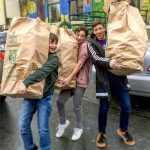
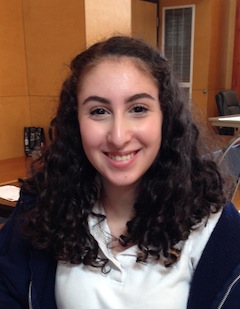
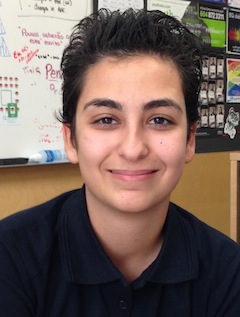
King David High School Grade 8 students Noam, Judd and Joey, collecting bread from COBS. (photo from facebook.com/foodstashfoundation)
Nov. 21 saw the start of King David High School’s now-established RAC Week. Started as part of the Random Acts of Kindness program – adapted as Random Acts of Chesed – this is a five-day celebration of paying it forward. Whether it’s picking up garbage, helping the homeless or moving furniture, every activity gives the students a chance to experience the rewards of helping others.
This year, The Giving Tree formed the basis for RAC Week’s good deeds. Illustrations from Shel Silverstein’s book about unconditional love decorated the main hall and foyer. Heartwarming messages read “Kindness is Contagious,” “Spread the Love” and “Smile! It’s RAC Week!”
RAC Week takes the students outside their comfort zones. According to the director of Jewish life at KDHS, Ellia Belson, this year’s destinations were chosen based on feedback gleaned from last year’s offerings. “The Grade 12s wanted to go where there was the greatest need,” she said.
Among the destinations were the Kerrisdale police detachment, Quest Outreach and Admiral Seymour Elementary School. At the school, which is on Keefer Street, they witnessed an unfamiliar degree of tension – and fighting – among the kids. KDHS student Ethan (Grade 10) described how he “tried to get people to play together who might not do so normally.”
During RAC Week, heartwarming messages read “Kindness is Contagious,” “Spread the Love” and “Smile! It’s RAC Week!” (photo by Shula Klinger)
Under the guidance of teacher Matt Dichter, Grade 8 student Noam accompanied Food Stash Foundation on their daily rounds. Started by David Schein, a former teacher at KDHS, the foundation was created to help reduce food waste in the Vancouver area. FSF collects leftover items from grocery stores, such as Whole Foods, at the end of each work day. Food Stash then delivers the food to where it’s needed most: more than 15,000 kilograms of food since September, said Schein. On the morning of Nov. 22, deliveries were made to the Kettle Society, Mount Pleasant Neighborhood House, Tenth Church and Oasis Café.
The RAC group from KDHS rescued food from COBS Bread, Greens, Fresh is Best and a number of other sites. The numbers speak volumes. Every year, each Canadian throws away approximately 127 kilograms of food. KDHS kids rescued 135 kilograms in a single day.
“I really liked working with the kids because it is a great way to raise awareness of food waste in the younger generation,” Schein told the Independent. “Half of food waste happens at home, so they can now go home and speak to their parents, start influencing food choices.” He added, “Saving me some lifting was also nice!”
With its emphasis on community service, RAC Week is a concentrated course in educating the emotions, as well as the intellect. Noam described how “it felt good to give back.” Asked whether his work with Food Stash had had an impact on his daily life, he answered with a definite yes. His intentions were clear, as he explained, “even finishing what’s on your plate” can have an impact on food wastage.
RAC Week offers a curriculum of social responsibility best taught outside the classroom, where students develop an awareness of other kids’ lives and struggles. The conversations that take place after the outings present an opportunity to reflect on these struggles and express gratitude for their own station in life. It also allows the students to teach one another, under Belson’s guidance, about what each group learned.
While the kids spoke animatedly about their excursions, their most energetic, personal and heartfelt responses were to Belson’s simple question, “What does chesed mean to you?”
At this, it seemed that half the students raised their hands, speaking with passion and clarity about “giving and not taking” (Ella). Connell quoted from the film Fantastic Beasts and Where to Find Them, with the admonition, “Be a giver, not a taker.” Ethan spoke at length about how it’s easy to “take for granted a loving home, a loving family…. It’s a week to recognize that by giving back.” Jordana agreed, talking about the importance of seeing “how others live – even so close to us. It made a difference.”
Sometimes, the greatest lessons in life can be taught in the simplest of ways. Adi talked about “being a mensch, helping people who have less, making people feel happier, making them smile.”
Shula Klinger is an author, illustrator and journalist living in North Vancouver. Find out more at niftyscissors.com.
Mauro Perelmann is coming from Brazil to lead a Dec. 17 musical tribute to Naomi Shemer and Leonard Cohen. (photo by Natan Guterman Fotografia)
On Dec. 17, Congregation Beth Israel will host a tribute concert to Israeli singer songwriter Naomi Shemer. The brainchild of Brazilian musical director, composer and arranger Mauro Perelmann, who appeared at Or Shalom last winter, the tribute show was originally created for a performance in Rio de Janeiro, Brazil. Following its success there, Perelmann is bringing the show to Vancouver, featuring local singers Stephen Aberle, Debby Fenson and Wendy Rubin.
The Vancouver concert – which will also include a tribute to Canadian icon Leonard Cohen, who passed away since the initial plans were made – is the result of extensive collaboration both internationally and within the Jewish community here. With the help of Perelmann’s friend Yom Shamash and sponsored by Congregation Beth Israel, Limmud Vancouver and Or Shalom, the concert features Shemer’s “best and most beautiful songs,” said Perelmann.
The archetypal Sabra, Shemer was born in 1930 at Kvutzat Kinneret, the Galilee kibbutz her parents helped found. Like other celebrated artists, she served in the Israel Defence Forces as part of the Nahal entertainment group, and went on to study at the Rubin Academy of Music in Jerusalem, now the Jerusalem Academy of Music and Dance.
After studying both classical and folk guitar in his home city of Rio de Janeiro, Perelmann followed in Shemer’s footsteps at the Rubin Academy. He studied there for a period of four years, 1976-1980, and it changed his life.
Raised in a secular Jewish home, both he and Shamash were members of Hashomer Hatzair, the Zionist youth group. Perelmann described his time in Israel as “a very touching experience, very important to my life.” On returning to Rio, he said, “I began to work as a musician, composer, arranger in Brazil. I returned to klezmer, to Hebrew and Israeli music. I began to work here in the Jewish community.”
Nowadays, Perelmann’s work follows “three branches,” he said: Jewish music; vocal music for choirs and other groups; and soundtracks for television and movies.
With only two weeks between his arrival in Vancouver and the concert, Perelmann has rehearsed with the three local singers via Skype. It was the first time he had used this technology to rehearse music.
“I sent them the scores with the voices written down and we used the technology to shorten the distance between us. It worked well! They went to the same place, I heard them singing, gave them feedback. When I arrive in Vancouver, we’ll rehearse with the whole band.”
Perelmann speaks passionately of Shemer’s compositions. He referred to her as “the voice of Israeli culture until the 1970s: the love of nature, of the people,” and added, “any Jew raised with music must know Naomi Shemer.” He described a wide-ranging repertoire, from touching love songs like “Umbrella for Two,” to lyrics describing scenes of everyday Israeli life, childhood and nature. Shamash described Shemer as the representation of “our idealized vision of a just, socialist and Zionist Israel.”
Concert-goers can, of course, look forward to hearing Shemer’s most celebrated work, “Yerushalayim Shel Zahav.” Made famous by Shuli Natan’s passionate renditions, it is a hauntingly nostalgic work, commemorating the end of the Six Day War of 1967. Combining a magical mix of open-hearted optimism and steely conviction, Shamash commented, “it was a kind of national anthem,” which united both a country and a generation of Jews around the world.
While it is widely regarded as a second national anthem of Israel, the song is not without controversy. In response to questions about the origins of the melody in Basque folk music, Perelmann said, “it happens in music; it wasn’t a conscious decision.”
And Shemer is known to have raised questions from Amos Oz, and others, over the perceived politics in “Yerushalayim Shel Zahav.” Describing the Jerusalem marketplace as “empty” without Jews, one might imagine that Shemer’s song disregards the presence of Arab Israelis. However, as Perelmann explained, Shemer clarified, “If there are no Jews there, then it is empty to me.”
Among the other Shemer songs to be featured at the Vancouver concert are “Al Kol Eleh,” “Hurshat Ha’Eucalyptus” (her song about the trees of Kvutzat Kinneret), “Lu Yehi,” “Orhim Lakayitz” and “Mahar.”
Vancouver singer Fenson treasures memories of “sitting around a campfire singing songs,” and described a lifelong relationship with Shemer’s music. “I received a book of Naomi Shemer songs for my bat mitzvah,” she shared. “Part of learning to speak Hebrew came from reading and singing those songs. Later, I used Naomi Shemer’s songs (and others) to help a friend who was also learning the language.”
As for the Cohen component of the concert, Shamash said, “The idea to add a small tribute to Leonard Cohen came from the Canadian singers…. The news of Leonard Cohen’s passing hit everyone hard, especially because it came two days after Donald Trump’s election. All of a sudden, the world looked darker and the need to grieve and mourn became more urgent. We all needed to see the light through the cracks of the broken world. I was asked to call Mauro to add a few Leonard Cohen’s songs. He understood. Hallelujah.”
The Shemer and Cohen tribute at Beth Israel on Dec. 17 starts at 8 p.m. Tickets are available at brownpapertickets.ca or at the door.
Shula Klingeris an author, illustrator and journalist living in North Vancouver. Find out more at niftyscissors.com.
When my father died in 2014, I was already familiar with the notion that mourning progresses in stages. These include denial, anger, grief, bargaining and, finally, acceptance, and they are widely recognized by the therapeutic professions.
Two years after my father died, however, I could make an argument for one more item in this neat list. This item is: paperwork. Paperwork that can take months or years to complete while other tasks are shelved, children get older and family relationships unravel.
And so it was that I didn’t really start grieving for my father until two years after his passing. This was the point at which I was finally able to look through my father’s archive. He had a wealth of his professional writing, as well as mementoes from his life in Israel – things I had never seen, never heard about, photos of people I didn’t recognize. Here, now, was another kind of loss: his memories, the languages he spoke, the cultural narrative of the Egyptian Jew who became the halutz (pioneer), the farmer and a soldier.
My grief was further complicated by my father himself: complex, secretive, angry, hard to fathom and even harder to love. But, as hard as it was to love him, it has been just as hard to let go of this contradictory, loving, gifted and extraordinary man, who spoke nonchalantly about his life being “nothing special,” while simultaneously and relentlessly craving recognition for his life’s work.
How was I to experience my grief, work through it in the tidy way suggested by the literature, without feeling like a hypocrite? Every time the sadness bubbled to the surface, another voice cried out, yes, but…. And yet, and yet, and yet.
My father loved trees. He loved the smell of them in Egypt. He loved planting them in Israel, shortly after its independence. After immigrating to England, he started a conservation charity to encourage children to do the same. He spoke fondly of his favorite plants, naming them with relish, acer palmatum, acacia, copper beech, pyracantha, weeping willow, honeysuckle. He talked about them the way other people talk about their friends, and his belongings reflected this after his death. One of his books was called Meetings with Remarkable Trees. It suited him. His meetings with remarkable trees had started when he was still a youngster.
It was also appropriate because, as straightforward as his relationship was with trees, his relationships with other people were confusing and painful. He was seldom content, often angry, and his brain was constantly besieged by business ideas, political observations and diatribes about the state of world affairs. I never saw him make a new friend. He called nobody from his old life and nobody called him. A staunch Zionist, he regarded orthodoxy with disdain. He refused to join the Jewish community and kept us apart from it, too.
But, when he was nurturing his plants, he was in touch with something sacred; this was his worship, his peace and his prayer. He could stand perfectly still, just watching the arc of the water landing on the dry earth, listening to the birds and the wind in the willow tree, utterly alone and completely at peace.
At other times, I tried to look after him. I tried to be his caregiver, his protector. So, with him gone, I felt myself to be – even with a multitude of other responsibilities – rather redundant.
By the spring of this year, I found an uncomplicated way that I could commune with my father: I nurtured my own garden. I thought of him as I watered, listening to the wind in the trees and watching the droplets creating rainbows. The water trickled down the spines of the squash leaves, pooling at the roots. I listened to the birds, felt the sun on my back, remembering the ice-cold glasses of water we’d enjoy together in the summer, the way he taught me to transplant trees, how I was always surprised by how much water he’d use. “Do you really need that much?” I’d ask.
He would collect seeds with a strange sort of compulsion, from public gardens, with no particular method – he would never store them properly or label them but there they were, stuffed in the bottoms of his pockets. Like me, now, collecting foxglove, chive, kale and garlic seeds for next year. Always thinking of the next harvest, another step toward self-sufficiency. “We made the desert bloom. We grew watermelons there.”
When I went to visit my mother this summer, I noticed that her own honeysuckle plant was growing wildly out of control. It had become so heavy that the lattice was falling off the wall of the house and it was beginning to encroach on other plants. The flowers were beautiful and the aroma intoxicating but, according to my mother, the vine was basically a weed. I offered to prune it back for her and was startled when she showed me how much could come off. Like a cautious hairdresser, I asked her, “Are you quite sure?” And she was. Besides, she told me, it would grow back in no time.
As I started to cut the branches, I realized that a good part of this monster was already dead. The branches overhead broke apart in my hands, dropping dry leaves in my hair. It was more than 30 degrees outside and, with older tools and a ladder pitching on the gravel, it was slow-going. I tried to avoid cutting live stems but soon grew too tired for mercy. I hacked at the convoluted, weedy vine and snapped the brittle trunk as perspiration ran into my eyes. As I did so, it occurred to me that something about the honeysuckle felt very familiar. In short, this tangled, complicated plant was very much like my father – extravagantly beautiful, complicated and with no respect for boundaries. One might almost say, parasitic.
And then I noticed what looked like a bundle of dry leaves tucked in the back. On closer inspection, I realized that it was an abandoned bird’s nest, carefully woven from the tiniest twigs with only the smallest space left to hold a few eggs. Right in the middle of that tangled mass of dead foliage, there was a sanctuary. Like our relationship – painful and nearly impossible to navigate but, at its heart, like that nest, there was something to treasure.
In the end, grief is not so much affixed to the image of the parent we have lost, or even the relationship we had. We are not grieving the relationship we could have had, either: we are acknowledging the gifts they did pass on.
My father, teaching me to cut and paste magazines; to write business letters with punchy opening lines; to edit my work, to edit it mercilessly until it was taut like a tightrope, without a single unnecessary word. Sure, he was a merciless critic, but this quality has served me well. Even as I revisit each sentence of this essay, it is an act of memory, a gesture of thanks to my father that I am so particular, so careful with my words and so determined that they should fall in, militarily, if possible, with my meaning.
In the end, this is how we find grace in grief when our relationship with the dead was challenging – toxic, even. We can choose how we remember, how we grieve and, ultimately, how we live, once our beloved relative is gone.
It is not simply an act of respect, this mourning. It is an act of gratitude, as we thank our lost ones for what they did give us, as we visit all of the unconditional love we can muster for that ancient connection, between parent and child.
Shula Klingeris an author, illustrator and journalist living in North Vancouver. Find out more at niftyscissors.com.
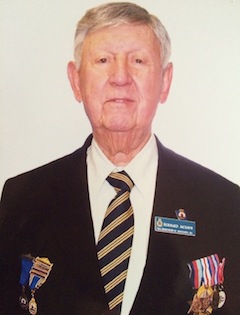
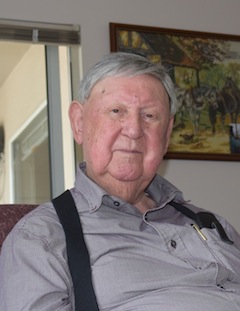
Bernard Jackson joined the British Royal Air Force Volunteer Reserve in 1941, and landed on a Normandy beach on “D-Day plus one”: June 7, 1944. (photo by Shula Klinger)
Bernard Jackson joined the British Royal Air Force Volunteer Reserve in 1941. The Second World War was in its second year and the Luftwaffe was bombing the centre of London. With Erwin Rommel’s army on the march toward Alexandria, Jackson was equipped and trained for desert warfare in North Africa. The RAF’s plans changed, however, and Jackson was sent to Portsmouth to board a ship bound for France, as part of Operation Overlord. He landed on a Normandy beach on “D-Day plus one,” he said: June 7, 1944. Seventy years after the end of the war, in 2015, Jackson was awarded France’s Légion d’Honneur.
Jackson took an active role in the war, right from the first bombings during the Blitz. “Young as I was,” he said, he was a firewatcher on the rooftops near his workplace in Charing Cross, in central London. Gazing at the sky, a teenage Jackson observed “the RAF and the Germans fighting overhead. It was very interesting.”
With battle raging in the skies, below ground was a different story. “Most people went down into the subway. Everyone was friendly, they found things to do,” he said.
Jackson’s youthful fascination with the tools of the trade is still apparent. “We used stirrup pumps to put fires out, with water from a bucket. They were so ingenious. I often wondered what happened to those stirrup pumps.” He offered a useful tip: sand is actually more effective than water at putting out fires.
Jackson described civilian office workers picking their way through the flames, broken glass and shattered buildings after another nighttime bombing raid. Londoners must have been shocked, going to bed with an intact city and getting up amidst smoking ruins. “People get used to anything,” he said, speaking with the wisdom of experience.
Jackson’s vignettes of wartime military life are varied. Prior to D-Day, he was attached to the Navy for combined operations training, on a destroyer. He spoke enthusiastically about this 10-day period off the coast of England. He also served in the RAF Regiment, guarding airfields and anti-aircraft guns, in the event of enemy fire.
Recalling his June 7 arrival at Arromanches, Jackson described a “choppy” crossing. He saw “German soldiers, British wounded…. As far as the eye could see, there were tanks, landing craft, ships and battleships, and they’re firing over our heads. An incredible scene.”
Obstacles had been cleared from the beach by that point – the enemy had littered the beach with mines and “hedgehogs” (large constructions of iron and concrete) to slow down Allied progress, but the psychological impact of the battle was all too obvious in the men. They were “all grey and bent over, all weary – they were knocked out,” said Jackson. He describes reaching a pillbox (bunker) above the beach, “surrounded by dead German soldiers.” By the end of the landings, 156,000 men had been brought across the Channel. After one day of fighting, there were 10,000 casualties and 2,500 dead.
Raised in an observant Jewish home, Jackson became a bar mitzvah at a synagogue on Menetti Street, near Charing Cross. He was glad to find two other Jewish boys in his unit of more than 100 men. His stories, which are peppered with local details, often refer to their “mischief.”
Bernard Jackson (photo from Bernard Jackson)
Jackson recalled with a laugh, “never mind [Bernard] Montgomery [who forbade fraternization with locals], we’re living eight to a tent! I said to two or three of the boys, ‘France is known for its cheese, let’s see if we can get a decent meal.’” Off they went to the village of Arromanches, where they found a café managed by “Madame, on a high chair like a throne.” Having explained in “doggerel French” that they were hungry, the boys were served an omelette with crunchy bread, a delicious treat that was paid for with scrip, the money printed for servicemen to use overseas.
Having managed to wangle the use of a truck once a week, the lads went on excursions together, said Jackson. “Being the boys that we were, we wanted to go and look at a château, and we found one! So, we were walking up the path to the château and saw a big horse in a field. It was the summer, and it was an apple orchard. There’d been fighting through the orchard, so the apples were on the ground; it was awful, there was a plague of flies. We saw the horse go into the forest. It trod on a land mine. Blew itself up. We turned around and went back.”
Jackson also described the accommodations made by troops, who slept in muddy ditches, with no bathing facilities. They used dissected gasoline cans as washbasins; the water was contaminated with arsenic, which gave the men impetigo. Even with proper medical care, this condition is extremely painful – and these boys had no antibiotics.
In spite of the immense hunger and hardship, Jackson spoke of the warm hospitality of locals in the months after the war. While his unit was stationed in Louvain, just outside Brussels, they were “parked in a field for a good while.” He recalled an impromptu but hectic social scene, which led to numerous interesting conversations.
“Us three Jewish boys managed to pal up with a husband and wife who owned an apartment block. They rented out rooms. This Belgian couple had hidden in their rooftop attic a Jewish couple, husband and wife, for two years. Quite a few air force fellas used to go there.”
The end of the story is bittersweet. “There was also a Jewish doctor and his wife, they had a beautiful girl, 18 or 20, who’d been in a concentration camp,” he said. “One of the boys proposed to this girl and they were going to marry, but she died very suddenly. She had picked up something in the camp.”
Jackson spoke animatedly of the war machinery that made the landing possible. In particular, he recounted how temporary “Mulberry Harbors” allowed Allied troops and vehicles to land in occupied France when all of the ports were held by enemy forces. When he drove back to the scene in his brand new Austin 10, one year later, he was dismayed to find the pride of British engineering “in bits, laying all over the beach. It’s buried in the sand, all rusty. It’s a disgrace.”
The trip was worth it nonetheless, he qualified. He and his pals attended a French celebration to mark the end of the war, which he described as “marvelous, marvelous.”
It’s clear from Jackson’s stories that – in his words – he “left home a boy and came back a man.” In any conversation with a storyteller of his calibre, there are many golden moments. It’s as if the air almost crackles with the immediacy of his memories, the descriptions of the grey-faced survivors of the D-Day landing, or his helpful instructions on how to boil water in a discarded German helmet. Quite apart from his resilient spirit and natural leadership, his candor is impressive. Speaking about such events – even 70 years later – can be difficult for many war veterans, not to mention that he actually went back only a year later.
“It’s a traumatic experience in many cases,” he said of why many people do not like to talk about their experiences in the war, or go back to where it took place. “I never talked about it to my children because, you see, my generation came out of the war saying there’ll never be another war after this one.” In other words, the information may have seemed redundant. But, Jackson added, “Look where we are today. It’s something in the human psyche. It’s greed. It’s power politics.”
Speaking to Jackson is a tremendous privilege; his vignettes of wartime – and postwar – Europe reveal a society in turmoil, where looting was common. He offered accounts of Russian dancing and vodka, gunfire and generosity, stolen yachts and black market cigarettes, hardship and hospitality.
Jackson is an astute observer of humankind and its many failings. But, as well as the stark and troubling stories, he has tales of compassion, generosity and the universal nature of the human experience. “People forget,” he said, “how the French suffered, on top of being occupied. They were short of food, coffee was unheard of, they hadn’t seen it in a long time – they used grass with acorns to give it body. They had no clothes; they stripped the dead for their clothes, even German soldiers, they just stripped off the epaulettes.”
Speaking of the Russian prisoners of war who insisted on sharing their meagre, greasy meals with Jackson and his comrades, he said, “They put dances on for us, someone played the accordion and they did these Russian dances.”
From peasants who could neither read nor write to highly educated ballet dancers or leading aircraft men like himself, Jackson said he realized, “they’re just like you, just like everyone else.”
Shula Klingeris an author, illustrator and journalist living in North Vancouver. Find out more at niftyscissors.com.
Singer/songwriter Jennifer Gasoi, seen here in a promotional shot for her new book, was back in her hometown last month. (photo by Philove)
Jennifer Gasoi’s new book, Blue and Red Make Purple, is both a hardcover children’s book and a CD collection. It was released to immediate acclaim, winning the 2016 Parents’ Choice Gold Award and a National Parenting Product Award.
Jennifer Gasoi’s new book, Blue and Red Make Purple, has already won awards.
Illustrated by Steve Adams, Gasoi’s songbook has a vintage feel with a touch of Chagall. It is vibrant and surreal, full of movement, as a group of animals get up to all sorts of musical capers. “I love the illustrations for this book,” Gasoi told the Independent. “I feel that Steve accurately depicted the joy, love and depth of my songs. He offers a brilliant visual representation of the music.”
Gasoi has local roots and, 15 years ago, she was performing at Rossini’s jazz bar in Kitsilano. She studied music at Capilano University’s jazz program and took part in community choir events around town before she decided it was time for a change and moved to Montreal. There, she taught music to young children and parents. Her debut album, Songs for You (2004), garnered awards and nominations, as did her second CD, Throw a Penny in the Wishing Well (2012).
Among the honors for her second recording was a 2014 Grammy Award for best children’s recording. An unusual compilation, the CD introduces children to a wide range of genres, including bluegrass, calypso and klezmer.
“Winning a Grammy was a life highlight,” said Gasoi. “It was something I had been dreaming of since I started my music career – and having Cyndi Lauper present the award was pure gold.”
Gasoi’s lyrics are deceptively simple. The song “Happy” from Wishing Well, for example, starts gently in a voice that sounds as natural as exhaling, were it not for the jaunty, syncopated piano accompaniment. This brief “ditty,” as she calls it, is written for children but models a spirit of resilience and self-acceptance that could be a mantra for any age. A chorus of “I feel happy” follows lines such as, “When I jump, when I fly, when I feel, when I cry.” Likewise, this song teaches generosity and compassion: “When I laugh, when I live the life I want to live, when I take a little less than I give. I feel happy….” And, “When I dance the way I want to dance. When I step out of the box and take a chance, I feel happy….”
Gasoi’s voice brims with a mix of confidence, mischief and kindness. Asked if she’s aware of this last quality, she laughed, “I do hear that. I hear that I’m soothing. Even when I was in jazz clubs and I’d be thinking, ‘I’m rocking this, I’m digging it!’ people would come up and say, ‘I’m so relaxed right now!’”
As an artist, Gasoi is working to a plan. Her goal is to reach children deeply, authentically, as both an educator and a musician. This drive has long been apparent, said singer Christie Grace, Gasoi’s contemporary at Capilano. “She was always extremely self-disciplined.”
“I have a soul connection with children,” said Gasoi. “I see their light and their beauty. I pray that, through my music, I can inspire them to tune into what they feel, what they love, what they are good at.”
With an eye to the greater good, the singer wants her music to motivate children to be active and empowered citizens working for “a world that is based on peace, compassion and love.”
Gasoi also recognizes that dialogue is part of any educational experience. The adults may be the ones who have laid out the agenda, but the lesson goes both ways. She speaks of the rich education she gained during the 15 years she honed her voice and performance style “teaching music in daycares and community centres, a lot of mom and baby groups.”
Asked about what keeps her motivated, Gasoi describes a visit to an inner city school in Montreal. “I performed my songs to the most enthusiastic audience I’d ever seen,” she said. “The kids were beaming with excitement. They knew all the songs.”
In a population that doesn’t usually have a chance to attend concerts, the experience was all the more poignant. The singer described the group as “jubilant and receptive.”
“One of the teachers told me that one of her students, a boy with autism, had never sat still for more than five minutes during any other concert,” said Gasoi. “During this show, he was engaged for the full hour. It’s moments like these that keep me going.”
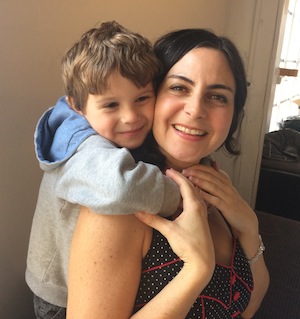
Singer/songwriter Jennifer Gasoi with one of her fans, Joel Harrington, the writer’s youngest son. (photo by Shula Klinger)
On stage at the Vancouver Writers Fest last month, Gasoi was utterly in her element. She addressed the audience of hundreds as if it were an intimate group of a few children, gathered around her knees. Her experience as an educator was apparent, as she asked questions and engaged the crowd in conversations, responding to the children as they called out answers and praising them for their unexpected gems. In the middle of “Little Blue Car Trip,” she asked the audience for another form of transportation. The first answer fired back, “Camel!” got a laugh from audience and band alike.
Gasoi’s band members – Jody Proznick (double bass), Joel Fountain (percussion/vocals), Chris Gestrin (piano/melodica) and Ralph Shaw (banjo) – are no less engaging. Shaw doubles as the Purple Man from the song of the same name, leaping across the stage to the strains of this energetic, multi-genred song, which culminates in a fiery rendition of “Hava Nagila.”
There’s nothing like a hometown reception for a returning artist and this show was no exception. “This week was absolute magic. Vancouver welcomed me with open arms!” said Gasoi, who continues to deliver songs packed with rhymes, wordplay and colorful imagery.
“I am constantly amazed by kids,” she said. “They are so pure, honest, innocent and in touch with their instincts. I see their potential and I am doing everything in my power to support them.”
Shula Klingeris an author, illustrator and journalist living in North Vancouver. Find out more at niftyscissors.com.
During the afternoon of Character Day, King David High School hosted a fair at which students could learn about – and sign up for – volunteer positions in the Jewish community and around the city. (photo from KDHS)
On Sept. 22, King David High School students celebrated Character Day. It was a day for both quiet introspection and animated group discussions about what makes human beings tick, and how we can reach our full potential, individually and as members of society.
KDHS is “committed to integrating tikkun olam into all students’ experiences, both during the school day and beyond,” said visual arts teacher Wendy Oberlander. And Character Day dovetails neatly with the school vision for students’ social-emotional learning.
Character Day began 10 years ago as the brainchild of San Francisco filmmaker Tiffany Shlain, whose work in film and technology has been recognized with numerous nominations and awards. Her new mission is Let It Ripple, which uses film as the medium to educate and inspire children to become activists pushing for positive social change. The program is massive, reaching 24 countries as far-flung as Mexico, India and Australia. Approximately 75,000 events were hosted, worldwide.
“Character Day presented us with a frame within which to launch this year’s service program,” said Oberlander.
At KDHS, the day started with three of Let It Ripple’s videos, which were seen by every student.
Lu Winters is the school’s social-emotional counselor. She is leading the school in a year-long project based on middot (character traits).
According to Winters, the Let It Ripple videos – The Science of Character, The Adaptable Mind and The Making of a Mensch – nurture self-knowledge, encouraging students to take what she calls “an inventory of themselves.” The films ask, “What are your strengths and which do you want to develop?” exploring qualities like creativity, humility, self-control and gratitude.
According to KDHS’s e-newsletter, “The central idea of character traits that is described in the film The Making of a Mensch will form the basis for TAG [teacher advisory groups] this year.”
Character Day is now an established fixture for the students of KDHS. It has grown and evolved over the six years that Winters has taught at the school. Since joining the staff, she has seen a move toward a richer and more inclusive and varied program of offerings. She described an array of sporting, spiritual and drama activities, as well as support groups for LGBTQ students.
Inbar ben Moshe (photo from KDHS)
This Character Day, Winters sat in with two classes to see how the activities were being received by the students. “They were really engaged,” she said.
“They said it is always easy to dismiss buzz words, but instead of brushing off words like honesty and generosity, they talked about being self-aware, about being a better person; they responded sincerely and thoughtfully,” said Winters.
During the afternoon, the school hosted a volunteer fair organized by Ellia Belson, director of Jewish life and events. At the fair, students could learn about – and sign up for – positions in the Jewish community and around the city. Booths were hosted by the B.C. Society for the Prevention of Cruelty to Animals, Ronald McDonald House, Louis Brier Home and Hospital, Vancouver General Hospital, Canadian Jewish Political Affairs Committee and the Walking School Bus.
The impact of the program came across loud and clear, in conversation with the kids themselves. They expressed their enthusiasm and drive for positive change. Inbar ben Moshe, in Grade 11, said the day was “inspiring!”
“It opened our minds to how we can improve our lives and the lives of others,” she said, and spoke of a determination to “really work on myself, to embrace the different aspects of myself.” She wants to volunteer by mentoring children, helping them to resist peer pressure and make good decisions.
Sappir Gini (photo from KDHS)
A Grade 10 student, who chose to remain anonymous, spoke about his own struggle with stress and the importance of learning to regulate one’s emotions. “It was interesting and it really influenced me,” he said. “It encourages people to think beyond what they already know; to get rid of stress by focusing on what you are good at.”
Sappir Gini (Grade 10) already reads to her nine-year-old brother and spoke of her ambitions in forensic science. She found the videos “inspiring, they made me want to learn more…. We saw how a bunch of people can come together and change things, people who are so eager, so curious – they can really make a difference.”
Sappir’s goals have crystalized as a result of participating in Character Day. She talked about her love of reading history books, and how she aims to be a reading mentor in inner city schools. Summing up the spirit of Character Day, she said, “Your imagination can take you anywhere – once you can read, you can do anything.”
Shula Klingeris an author, illustrator and journalist living in North Vancouver. Find out more at niftyscissors.com.
An old audio reel that writer Shula Klinger found in a suitcase of her late father’s mementoes features a revealing interview with Viennese author Edith de Born. (photo by Shula Klinger)
When my father died in 2014, I was given an old suitcase containing his mementoes. There were photos, much of his early writing and an audio reel in a box. All it said on the box was, “Interview with Edith de Born.” I had never seen this tape before and had no idea who de Born was. I also didn’t know why my father would have had the reel because, to the best of my knowledge, he had never worked in radio.
A quick Google search told me that de Born was a novelist, born in Vienna when it was still part of the Austro-Hungarian Empire. During the Second World War, she and her banker husband both worked for the Resistance. An obituary of another writer on theguardian.com mentions her as a “now-forgotten Austro-Hungarian novelist,” a gauntlet of a phrase if ever I read one. The next website I visited was a bookseller with secondhand copies of de Born’s books. The Price of Three Cézannes and The House in Vienna arrived a few weeks later.
Like de Born, my father’s family lived in Vienna in the early 20th century, in the final days of the Habsburg Empire. But what was behind my father’s desire to interview her? I took the reel to a digital studio and had the material transferred to a CD, hoping to find some answers.
The first time I listened to it, I thought I was listening to my father’s voice but couldn’t be sure. The recording was clean, without any extraneous noises, but still, technology distorts the human voice and it didn’t really sound like my dad. This man’s English was excellent and he spoke quickly, but his vowel sounds weren’t quite right, weren’t quite what I remember. His phrases lacked the colloquial idioms you’d hear in a native speaker.
A few minutes in, I was sure this was indeed my father. The recording was made not long after he had moved to England. His first language was (I think) Yiddish, followed by Arabic and Hebrew, English and French. Was my memory playing tricks or was this simply evidence of what my friends had observed in the 1970s – that my dad “had an accent”?
I listened carefully to the rest of the interview. Mostly my father asks de Born about her writing habits, literary preferences and the authors she has met. He wants to know if she keeps notes in a little book, whether her characters are based on people she knows. She answers no, no, no again and again. He seems to be looking for tips on how to be a novelist. He gets nothing.
The conversation is stilted but my father doesn’t seem dissatisfied with the author’s brief answers. Are these the questions of a novice reporter, just learning the tricks of his trade? Or is he working to a personal agenda, trying to glean something useful for himself?
I get a partial answer when de Born speaks of the authors she has met. Evelyn Waugh, she says. And Vladimir Nabokov, whose writing she describes as “divine.” Knowing that Nabokov emigrated to the United States, my father asks, “Did he have an accent?” An odd thing to focus on, one might think, when you’re discussing a world-renowned novelist.
But there’s my answer. I may have grown up oblivious to my father’s accent, but he certainly wasn’t. Like all immigrants, he was aware that it marked him out as different. In a country where one’s identity is defined by the class system, this put him outside regular society. It told others that he was different, and he was just as conscious that, to fit in and be accepted into middle class, professional life in England, one had to be more than educated, more than capable – one had to sound English, to sound as though you belonged. With tanned skin, curly hair and – as he well knew – an abrasive manner, he did his best to tone down the chutzpah and mimic the mannerisms and diction of those around him. But not before he met de Born.
I managed to date the recording to 1960 or 1961 by looking at the publication date of the book de Born is writing when she meets my father. At that time, my father had not seen most of his family for years. Was the conversation a way for him to maintain a connection to his own heritage? Or was he simply looking for professional guidance? De Born could have been the perfect mentor – if only she had agreed. It is clear, however, from her guarded answers that she is not looking to nurture an emerging new talent.
There is, however, a short conversation about her memories of Austria. For the most part, she refuses to discuss her past, but she does talk briefly about her father, a Viennese nobleman. When the emperor Franz Josef died in 1916, her father walked in the funeral procession through the streets of Vienna. She describes her fondness for her father, and speaks warmly of his influence on her life.
Fascinated to learn that there were only two degrees of separation between me and a person who had attended an emperor’s funeral, I decided to look up some of the events she described. I soon found the Pathé News archive. Turns out they have thousands of files online. Here, I found a silent movie of the 1916 procession.
Twenty-six seconds in, I was startled to see something that didn’t fit. In the midst of all the smartly dressed adult aristocrats, prancing black horses and royal footmen, there is a tall, dignified looking man. This man is holding the hand of a little girl. She must be 4 or 5 and she’s holding a teddy bear in her other hand. They turn in front of the camera for a second before they are obscured by the heads of royal guards. She reappears fleetingly, later on, and then she’s gone. Could this be de Born, the woman whose voice I hear in conversation with my father when he was still a young Israeli immigrant?
De Born’s work is not in vogue now but this is – I believe – a tremendous shame. An astute observer of human nature, her dialogue is incisive and the inner lives of her characters richly explored. The world of Viennese aristocrats is opulent but restricted, the women stifled by their positions in society. Even as the characters cling to old traditions, singing of a Habsburg emperor whose fate will be tied to Austria’s for all eternity, de Born’s narrator feels that her world is an anachronism: “No waxwork exhibition could possibly reproduce the atmosphere of a vanished epoch so uncannily as did those creatures who continued to move with old-fashioned grace in their own meaningless world,” she writes.
Soon after, she describes a very different scene, being “in the midst of people who spoke my language, but with whom I could not feel in harmony. ‘Ein Volk, ein Reich, ein Führer …’ chanted, yelled, screamed hysterically.” Little by little, de Born introduces ever more troubling elements, gradually building on a sense of a looming catastrophe – for Austrian nobility, for Europe at large and for Jews in particular. It may be set in polite society, but The House in Vienna is an exquisitely tense and emotional read. It is no wonder my father chose de Born as his interviewee. I have not found her described as a Jewish author, but – to me at least – her photograph on the dust jacket tells me everything I need to know.
As a daughter listening to her father’s voice after his death, the reel of tape is a gift and, like the work of his interviewee, it is a little eerie. It feels like eavesdropping. I don’t know if my father meant me to have it – or even find it – but I loved hearing his chuckle as he talked about something that he cared about, so deeply, as the young man I didn’t know. It’s a great way to remember him and his accent – full of life and Israeli/European inflections – hints at how he must have felt as a newcomer in England, all those years ago.
And, of course, it’s not a particularly smooth interview. At one point, the author laughs, somewhat revealingly, “Now we’re getting somewhere!” in her own gently accented English. Up to that point, my father’s questions have mostly been dead-ends. This question, however, was different, and the pace of the conversation quickens, the tone is light, almost cheeky. Hearing him make a genuine connection with another human being – something I rarely saw myself – was pure gold. It’s an infinitesimally small hunk of gold, but when you lose a complex and extremely guarded parent that you tried throughout your life – and failed – to connect with in this way, it can feel like winning the lottery.
Shula Klingeris an author, illustrator and journalist living in North Vancouver. Find out more at niftyscissors.com.
Shalom Branch 178 began as Fairview Branch 178 in 1945. (photo by Shula Klinger)
As the Second World War was drawing to a close, servicemen and -women began returning to Vancouver. Among them were Jewish veterans. As they looked for ways to reintegrate with civilian life, they found many clubs and associations closed to them on religious grounds. So, a group of them founded the B.C. Jewish Veterans’ Association. The association applied to the Canadian Legion and, on June 20, 1945, Fairview Branch 178 came into being. In 1972, thanks to the efforts of Charles Eppel, it became Shalom Branch 178. It has been a social hub for the veteran community now for more than 70 years.
Bernard Jackson, president of Shalom Branch 178. (photo by Shula Klinger)
At the time of the legion’s original charter, membership stood at 81. By 1950, this had risen to 219 and, in 1960, a ladies’ auxiliary was founded. These days, the legion’s membership stands at 75, but it’s falling, with the passing of many veterans.
Bernard Jackson has been the president of Shalom Branch 178 since 2002. Last year, the French government awarded him the Légion d’Honneur (France’s greatest honor for military and civil merits) for his service in Normandy in 1944.
Jackson speaks proudly of the original group of veterans. “They sold lottery tickets to raise money, with the object of building homes and a legion branch,” he said. “They bought land and built a property with assistance from BC Housing. The building of 102 apartments [Maple Crest] is in full use – it’s a mix of one- and two-bedroom suites.”
Every member of the legion takes part in the annual Poppy Campaign, which raises funds for veterans and needy families. Maple Crest residents are also supported by the Jewish Family Service Agency.
In the past, the legion has given bursaries to students at the University of British Columbia, the B.C. Institute of Technology and Vancouver Talmud Torah, as well as provided grants for medical equipment to local hospitals. Shalom Branch supports the Navy League of Canada and Brock Fahrni Pavilion, which is home to many veterans of the armed forces. The legion has installed a memorial to the fallen at the Jewish Community Centre of Greater Vancouver, and Schara Tzedeck Cemetery’s war memorial was dedicated in 1990. Other achievements include the purchase of a bus for Magen David Adom in 1982.
A page from the program commemorating Shalom Branch 178’s 70th anniversary. (photo by Shula Klinger)
Jackson is extremely concerned about the falling membership, and is disappointed at the lack of support. “Jewish support has disappeared but the need is still there,” he said. “It’s sad to see that we have such a crisis in the provision of low-cost apartments at a time when antisemitism is on the rise.”
Mark Perl is a more recent member of the legion. Born in Cluj, Romania, he moved to Israel in 1959 and fought in the Six Day War of 1967. “We need community support for our legion – not just funding,” he said. “This is our tradition, our unique history. Who’s going to carry this on?”
Jackson is determined to see a growth in education programs for today’s youngsters. “My generation made a big mistake,” he said. “We didn’t want to talk about the war. Now, young people watch all that shooting for fun. My generation knew what it was really about, and we thought this would be the last war.”
Jackson has spoken about this issue at Jewish Seniors Alliance, of which he also a member.
Shalom Branch 178 is entirely staffed by volunteers. Located at 2020 West 6th Ave., in Vancouver, new members are welcome and the hall is also available for rentals (604-737-1033).
Shula Klinger is an author, illustrator and journalist living in North Vancouver. Find out more at niftyscissors.com.
Students Tomer Berko Gabay (student council president), Liam Greenberg (secretary) and Nathan Tourvieille (treasurer) with Heartly, aka Karen Pasqua, senior events coordinator, Howard Blank, Reesa Pawer and Julie Kendell. Student Tal Pretli (vice-president) was absent when the photo was taken. (photo from Richmond Jewish Day School)
Until last year, Richmond Jewish Day School did not have a student council. That was when Reesa Pawer, education assistant at the school, decided it was time to make some changes and do something “for school spirit.”
Not only were students given an opportunity to vote in their council, but they cast their votes at the same time as their parents were participating in the federal election. Said an enthusiastic Pawer, “There were lineups to the ballot boxes! The votes were counted and the student council was elected, as they would be in a real election.”
Class representatives were then chosen by teachers and students. Since then, the council has gone from handing out hot chocolate at recess to coordinating an impressive fundraising program.
The students have targeted three charities to support, said Pawer. “They wanted a global charity, so they picked Variety Club. They wanted a local charity, so they chose the Richmond Animal Shelter, who received a cheque last term. And they wanted to support a Jewish charity, so they’re raising funds for the Jewish Food Bank.”
The project involved students from grades 1 through 7 and, said Pawer, the student council “did the legwork.”
To raise funds, students sold flowers, including gerbera daisies and roses, for local families’ Shabbat tables. They also sold cakes and contributed $2 on non-uniform days, which take place monthly on Rosh Chodesh, to raise funds for Variety.
On April 11, RJDS welcomed Howard Blank, president of Variety in British Columbia, to the school. After a short video presentation about the work of Variety, the students presented Blank with a donation. School council president Tomer Berko Gabay spoke at the assembly, saying that the student group felt “honored to give this $1,000 cheque to Variety – The Children’s Charity.”
The students had a chance to meet Heartly, Variety’s mascot, and were shown a video by Richard O’Shaughnessy, Variety’s events coordinator, about a young man who has benefited greatly from the generosity of Variety supporters. Born with only one hand, Drew now has a robotic hand, which allows him to complete even the most intricate tasks. His passion is making jewelry and, thanks to the robotic hand, he is now able to operate the tools required to do so. The RJDS kids watched the video in rapt attention, exclaiming “Cool!” when they heard about the “bionic” hand from Blank.
Blank praised the students for their community spirit and hard work. He described the “wonderful mitzvah” they had performed. “You’ve given a young boy or girl a new wheelchair or a special bicycle,” he said. “You guys really helped make sure that every kid gets a fair chance, and we think that’s right.”
RJDS principal Abba Brodt also applauded the students. “I am really proud of you,” he said. “You did something special – and so did your families.”
Asked how this fundraising program contributes to the students’ academic programs, Brodt described the integration of the school’s Jewish studies with the government-mandated B.C. curriculum.
“It was the perfect way to teach tikkun olam, to bring beauty to Shabbat tables and bring beauty to the wider world. It’s the perfect way to tie what’s out there in the world with what’s in here,” he said, putting his hand on his heart.
He added, “Reesa went above and beyond. This is a remarkable achievement for the student council. She gave the kids her full support.”
Blank took the time to answer questions from the group assembled, bringing the kids’ attention back to familiar experiences. He also reminded them to help kids in wheelchairs feel included when they meet them at playgrounds. “They don’t just want help, they’re just like you, they want friends,” he said.
RJDS students will present a cheque to the food bank in June, said Pawer. “This is the first year we’ve done such a big project,” she said. “We’re hoping to keep it going.”
Shula Klingeris an author, illustrator and journalist living in North Vancouver.
Ben Harrington churns the wheat while Joel Harrington and Sara Basya Mochkin look on. (photo from Chabad of East Vancouver)
On April 10, Chabad of East Vancouver hosted a packed Model Matzah Bakery at its Centre for Jewish Life on Fraser Street. Following a week of similar events at Chabad Lubavitch, children had an opportunity to make their own matzah from scratch. They began by winnowing the wheat kernels, then grinding and sifting them into fine flour. Water was then added to make dough. The kids rolled out the matzah, scoring it with dockers before handing it over to the grownups for baking.
The children managed to get the dough kneaded, shaped and into the oven in under 18 minutes to prevent the dough from rising. This would have made it chametz, a fermented grain, which is forbidden over Passover.
This process only began after a careful eye was cast over all of the ingredients and tools, from start to finish: whether keeping the grains and flour completely dry, to the meticulous cleaning of the tools used in the matzah production.
When 18 minutes were up, an egg timer went off, to cheers from the kids and applause from Rabbi Mendy Mochkin of Chabad North Shore.
The finished matzot were pulled from the oven by Rabbi Schneur Wineberg of Chabad East Van. After savoring the matzah with cries of “Mmm, delicious!” oranges were served, followed by knishes from Shuk restaurant.
Extra hands-on supervision was provided by Maggie Karpilovsky and the staff of North Shore Hebrew School.
Shula Klingeris an author, illustrator and journalist living in North Vancouver.