
Skip to content
  • Home
  • Subscribe / donate
  • Events calendar
  • News
    • Local
    • National
    • Israel
    • World
    • עניין בחדשות
      A roundup of news in Canada and further afield, in Hebrew.
  • Opinion
    • From the JI
    • Op-Ed
  • Arts & Culture
    • Performing Arts
    • Music
    • Books
    • Visual Arts
    • TV & Film
  • Life
    • Celebrating the Holidays
    • Travel
    • The Daily Snooze
      Cartoons by Jacob Samuel
    • Mystery Photo
      Help the JI and JMABC fill in the gaps in our archives.
  • Community Links
    • Organizations, Etc.
    • Other News Sources & Blogs
    • Business Directory
  • FAQ
  • JI Chai Celebration
  • JI@88! video

Recent Posts

  • האלימות בישראל מורגשת בהרבה מגזרים
  • טראמפ עוזר דווקא לנושא הפלסטיני
  • New rabbi settles into post
  • A light for the nations
  • Killed for being Jewish 
  • The complexities of identity
  • Jews in time of trauma
  • What should governments do?
  • Annie will warm your heart
  • Best of the film fest online
  • Guitar Night at Massey
  • Partners in the telling of stories
  • Four Peretz pillars honoured
  • History as a foundation
  • Music can comfort us
  • New chapter for JFS
  • The value(s) of Jewish camp
  • Chance led to great decision
  • From the JI archives … camp
  • עשרים ואחת שנים להגעתי לונקובר
  • Eby touts government record
  • Keep lighting candles
  • Facing a complex situation
  • Unique interview show a hit
  • See Annie at Gateway
  • Explorations of light
  • Help with the legal aspects
  • Stories create impact
  • Different faiths gather
  • Advocating for girls’ rights
  • An oral song tradition
  • Genealogy tools and tips
  • Jew-hatred is centuries old
  • Aiding medical research
  • Connecting Jews to Judaism
  • Beacon of light in heart of city

Archives

Follow @JewishIndie
image - The CJN - Visit Us Banner - 300x600 - 101625

Tag: mitzvah

Complexities of celebration

My family’s in the middle of a month of celebrations. June is always this way at our house, but it’s even more intense this time around.

In a “usual” June, we celebrate two family birthdays and a wedding anniversary; it’s also the end of school for our kids. This year, we started off with a bang. Our twins had their birthday on Erev Shavuot. In the morning, we joined the huge Pride Parade festivities. In the evening, our community, in Winnipeg, had a Tikkun Leil Shavuot (a traditional night of study at the beginning of the holiday) with hundreds participating from four congregations. While we ate dairy foods and celebrated, to our surprise, the whole room sang our kids a rousing version of Yom Huledet Sameach (Happy Birthday). It was something to remember – they were surrounded by smiles and learning.

Shavuot is celebrated in a lot of ways. It’s a first fruits and first wheat harvest holiday. It’s also the day that we celebrate the giving of the Torah and read the Book of Ruth. Some observe this holiday as a day of radical inclusion, when everyone, no matter your age or gender, should hear the Ten Commandments read.

Radical inclusion is something I think about a lot. This year, my nephew in Virginia, LJ, who has cerebral palsy and uses a power wheelchair and assisted communication device, celebrated Shavuot with his confirmation class at Temple Rodef Shalom, a Reform congregation near Washington, DC. He gave a speech at the service, carefully planned, about the intersection of his identities as a Jewish and disabled person and as an advocate for accessibility. He spoke eloquently about how Judaism teaches us to pursue justice, and how he works to help make that possible. LJ has given many speeches: on how others can learn about assisted communication, on how to teach math to those with visual disabilities, and on myriad other topics. At 16, LJ is already an accomplished advocate who rolls into rooms filled with adults and shows them new ways to help learners with disabilities.

During his recent speech, LJ mentioned how his religious school helpers have gone on to helping professions: speech pathology, special education, and more. It’s true that some see people with disabilities as having high needs, but all people have things to teach others and to give the world. LJ’s need for physical support results in a huge net positive. He positively affects the lives of many others around him.

At the Tikkun Leil Shavuot I attended, Rabbi Yosef Benarroch (who served in the 1990s as spiritual leader of Beth Hamidrash in Vancouver) gave the keynote. Benarroch is retiring from Congregation Adas Yeshurun-Herzlia here in Winnipeg and moving back to Israel to join his family. His address reminded us about all the ways in which we can help one another and perform acts of chesed (kindness) towards others. His summary of a day in the life of a congregational rabbi made me feel tired! However, it was filled with ways he was of service to others, while getting to do mitzvot (commandments) and sharing important moments in people’s lives.

I’d be the first to say that, sometimes, as a mom, helping meet others’ needs can be exhausting. There are years where I look ahead to June and think, “Wow, I’ll be making a lot of birthday cake – and how many holiday and celebratory meals?” Yet, hearing these two different perspectives, on Jewish advocacy and acts of kindness, really raised me up. It reminded me of how much there is to do in the world, and how lucky we are if we’re healthy, capable and able to do it.

Right now, in Manitoba, we’re coping with huge wildfires and many evacuees. As the bossy mom, I forced everyone to go through their closets so we could participate in the donation drives, because something like 17,000 people have been forced to flee their homes. One of my family members said, “We just donated stuff! We probably don’t have anything to offer!” Three bags of clothing (women’s, men’s and teens’) and blankets later, we were dropping off what we could find before Shavuot started. I reminded my 14-year-olds that this was their birthday mitzvah – the traditional extra commandment that they took on – and we celebrated it through the smoky morning. 

If you’re like me, it can be a struggle to relax into a wholehearted celebration while holding so much in our hearts at once. Whether it’s the hostages in Gaza, the war, the wildfires, antisemitism worldwide or issues closer to home, it’s understandable if it’s difficult to be completely joyful. Yes, we are commanded to celebrate at certain times, but I am reminded of the traditions of Jewish weddings. At every Jewish wedding, we break a glass to remind ourselves of the loss of the Temple in Jerusalem. We hold a bittersweet feeling of grief and pain even at our most meaningful moments. This acknowledgement doesn’t keep us from continuing to hope, to celebrate, while including everyone.

Today, I’ve had the honour of visiting a longtime family friend in the hospital. I brought her snacks and flowers from our garden. She’s just undergone surgery after a fall. I was relieved to find her in good humour. I’ve gotten to cook a bit for her family, as well as mine, and found time to work, walk the dog and even pull up copious weeds. Every handful of invasive greenery removed showed me the flowering plants underneath. I celebrated the riotous colour of both the weeds and the irises. 

There’s no guarantee that every moment will be happy or every summer a celebration. Still, we have so many opportunities to do kindnesses, perform mitzvahs and be there to advocate for one another. If Shavuot sticks with me long after it ends, it’s not because of cheesecake or even first fruits. During a month of family celebration this year, Shavout also offered the opportunity to celebrate our tradition, which offers us great gifts if we make the most of them: learning, Torah and radical inclusion, too. 

Joanne Seiff has written regularly for the Winnipeg Free Press and various Jewish publications. She is the author of three books, including From the Outside In: Jewish Post Columns 2015-2016, a collection of essays available for digital download or as a paperback from Amazon. Check her out on Instagram @yrnspinner or at joanneseiff.blogspot.com.
Posted on June 13, 2025June 12, 2025Author Joanne SeiffCategories Op-EdTags bar mitzvah, Judaism, lifestyle, mitzvah, radical inclusion, Shavuot

Birthday musings on mitzvot

It’s almost Israel’s 77th birthday! And a birthday is a good opportunity to reflect on things.

When my kids attended Chabad preschool, they celebrated their birthdays at school. The teachers encouraged them to think about a mitzvah (commandment) to take on to mark the occasion. Listening to preschoolers discuss what they’ve chosen and why is such a celebration of Jewish life! I’d invite you to try this out at the next available opportunity. You can ask any Jewish person what mitzvah they’d take on, it’s amazing to hear. Israel isn’t a person and can’t take on a mitzvah, but maybe we can help with that to celebrate its birthday.

One thread in our tradition follows certain steps: we improve the world and our behaviour, and that brings about the Messiah, or the Messianic Age, the next world and a better place. Ideas differ on how we do that and why, and even on what the Messianic Age will be like. We don’t agree on the specifics – and that’s fine. However, a recent page of Talmud that I studied in the tractate Sanhedrin, on page 98, really highlighted this concept. It’s a story, of course.

Rabbi Yehoshua ben Levi asks Elijah the Prophet when the Messiah will come. Elijah says, “Go and ask him.” Rabbi Yehoshua ben Levi says, “Well, where is he?”

Elijah describes him as sitting at the entrance of Rome, far away from where they are in the Galilee, at Mount Meron. The rabbi asks how he’ll recognize the Messiah. Elijah explains that the Messiah is sitting with all the other poor, sick people, but that the Messiah doesn’t untie all his bandages at once to replace them. Instead, he unties and reties them one at a time, so he’ll always be ready to bring about the redemption.

Rabbi Yehoshua ben Levi goes all the way to Rome, identifies the Messiah, and asks him “When will the Master come?”  The Messiah says, “Today.”

Rabbi Yehoshua ben Levi travels all the way back to the Galilee to see Elijah. Elijah asks him what the Messiah said and the rabbi tells him, “Well, he lied. He said the Messiah was coming today, and it didn’t happen.” Elijah says no, this is what he really said: he said he will come “today, if you listen to his voice.” (Psalms 95:7) 

Sue Parker Gerson, who wrote the introductory essay for this page of Talmud on My Jewish Learning, points out several things. First, that the traditional commentators inferred that we must do more mitzvot to bring about the Messiah. Additionally, she steps in with something that is a bit deeper: Rabbi Yehoshua ben Levi visits all these sick people with bandages, talks to one person, and then leaves. He didn’t stay to help any of the people. Perhaps, Gerson suggests, we need to put the “do the mitzvah” message into practice, to help people in need and fix wrongs we see in the world. Elijah saw that Rabbi Yehoshua ben Levi failed the test, so to speak, not helping when he should have.

Then, I read a Jewish advice column online. A parent is organizing a bat mitzvah and asks, “Should I invite relatives with whom I disagree politically? They also won’t like the liberal way we practise Judaism, but, if I invite them, they’ll likely come.”

The columnist suggests that, since COVID, it has been OK to make smaller guest lists and exclude people. Also, if the kid doesn’t want to invite these relatives, you don’t have to invite them. The columnist says briefly at the end, well, families usually invite everyone, and that’s what families do, but if you don’t want your happy occasion to include these people, that’s OK, too.

My gut reaction was that this answer failed the test. The columnist fails to behave Jewishly and recommend including everyone in a lifecycle celebration. The choice to exclude could cause bad feelings for years.

But, instead of a “failure” lesson, I have been considering what I might embrace about taking on mitzvot instead. I think a lot about turning negatives into positives lately. I’m the mom-chauffeur of junior high-age twins. I hear lots of negativity from the backseat! 

To begin: be the energy you want to see. If Rabbi Yehoshua ben Levi wanted the Messiah to come today, he had to do more to fix the world, including caring for the sick. Visiting the sick is a positive commandment. We should take care of one another, and it’s often not enough to just visit.

Also, don’t leave people out. If we want our lives, including our Jewish lives, to be inclusive, we can’t just ditch people. Even if a Jewish person, aka a family member, has different viewpoints, votes or behaves differently, within reason, we should invite them in, rather than leave them out. Offering unity and a “big tent” approach is the kind thing to do.

I just read Amir Tibon’s The Gates of Gaza, and its anecdotes echoed this. When Tibon’s family was trapped in their safe room in Kibbutz Nahal Oz on Oct. 7, 2023, his parents raced south with only a pistol to save them. His father, a retired, secular Israeli general, spent a harrowing day attempting to save Israelis, both soldiers and civilians, on the way to Nahal Oz. After exchanging deadly fire with the enemy, he ends up with a soldier’s weapon and his helmet, but he still wore civilian clothing, which confused soldiers under pressure. A religious soldier nearby helped. The soldier took off his army issue tallit katan (an undershirt with tzitzit, ritual fringes, on it) and handed it to him. Tibon, clothed in borrowed tzitzit and a helmet, weapon in hand, was ready for battle. The soldier’s inclusivity and flexibility saved lives. Saving a life, a huge mitzvah in Jewish tradition, outweighs everything else.

Helping each other and skipping negativity contribute to our people’s unity. We may disagree with one another and vote differently. Just this week, I’ve signed two petitions and written several letters to voice disagreement; in Israel, protests are part of life. Also, this week, a cousin of ours was inducted into the Israel Defence Forces. When it counts, we’re there for one another. Regarding issues of life and death, we protect one another.

Finally, sometimes restraint is the better part of valour. Occasionally, the first word out of our mouths is no, or a defensive or harsh response. Holding back, listening and considering the situation may help us make thoughtful choices that better reflect the people we wish to be. Israel’s birthday is a chance for all of us to celebrate, listen and include. Like everyone and every nation, Israel has flaws, but embracing positive steps may change lives, or even save them, in the years to come. 

Joanne Seiff has written regularly for the Winnipeg Free Press and various Jewish publications. She is the author of three books, including From the Outside In: Jewish Post Columns 2015-2016, a collection of essays available for digital download or as a paperback from Amazon. Check her out on Instagram @yrnspinner or at joanneseiff.blogspot.com.

Posted on April 11, 2025April 10, 2025Author Joanne SeiffCategories Op-EdTags commandments, good deeds, Israel, lifestyle, mitzvah, Talmud, Yom Ha'atzmaut

Finding awe & wonder again

As a kid, I remember sitting through High Holidays with my family at our Reform congregation. We’d hit a section in the services where the English responsive reading, inspired by the Hebrew, used words like “awe,” “awesome” and “supreme.” There were smirks and stifled giggles as we passed this yearly reading. Why? Our family had discussed it at a holiday meal, and we agreed this sounded like a really big pizza special. It was hard to concentrate after that, thinking about pizza.

This moment hit me again when I heard Rabbi Jeffrey Saxe, one of the rabbis at Temple Rodef Shalom in Virginia, give a Kol Nidre sermon about awe, gratitude and wonder. It was powerful. Before I get into the details, we chose to stream services again this year from home in Winnipeg. In part, it’s so we can be a part of two worlds – my parents’ congregation in Virginia, where I grew up, and our Winnipeg synagogue, too. After the holiday, I can discuss sermons with my mom as if I had been sitting beside her during services and this is meaningful. For many people who are apart from their families during holidays, using shared moments to bond is important.

Even though I knew our choice to stay home made sense, I felt pressured to “get back to normal” and “be together again,” especially when a synagogue publication suggested that those who chose to stream did so for “mobility reasons.” (Not all those who choose to stay home have the same challenges. There are multiple reasons to stay home.)

Back to Rabbi Saxe’s sermon, which touched on the ways that the rabbis created liturgy that helps us remain grateful, and even encourages experiences of awe and wonder. If you see a rainbow, there’s a prayer for that. There are specific prayer formulas for eating fruits, snacks, and there’s even, Rabbi Saxe mentioned, a prayer for after you’ve gone to the bathroom. At this, some in the congregation laughed.

I felt shame. Not only is the bathroom prayer something I’ve written about and, yes, recited, but it’s also something I might have laughed at as a kid. Without going into details, thanking G-d for the intricacies of how our bodies work, opening and closing appropriately at the right times, can be absolutely meaningful. If you doubt this, maybe you have been very lucky and never had food poisoning or a stomach virus. Yes, we smirk and laugh when we feel uncomfortable, sure. Also, it’s when we take things like being healthy for granted.

I also felt weird guilt about not being in a congregational community over the holidays, even though we had a holiday meal with another family, dressed up, streamed services and took time off together. I felt strange checking messages over Yom Kippur. Then something happened.

Within a short period of time, two of our close family friends ended up in the hospital. One is in his 80s, in ICU, with COVID. The other friend is 5 years old, and she has a sister who is a newborn.

During Yom Kippur, the 5-year-old was admitted to Children’s Hospital after being up all night in the emergency room.

In the middle of Yom Kippur services, I got up, went to the kitchen and gathered together food for the parents for this unexpected stay. This is why we make the second round challah, I thought, as I threw it in the bag. I left my family, hopped in the car while fasting, and navigated the hospital until I found the room with one dear-to-us child with her oxygen mask, her exhausted-looking parents and their infant. I handed them the food, it wasn’t time for a visit, and rushed out again.

Somewhere on the drive home, I processed what had happened. I felt a profound sense of awe. I had been in exactly the right place. If I’d gone to services in person, I wouldn’t have been online or known that our friends’ child had been admitted to the hospital. I wouldn’t have been able to rush out and offer food, a quick bikkur holim (visiting the sick), and support her family. Leaving the twilight of their windowless hospital room, I was blinded by sunlight as I left the garage. I parked in front of our house and took a moment to cry.

Our liturgy traditionally links daily gratitude with prayer. This is an automatic check-in with nature, our bodies and the world to see and wonder at what’s around us. However, we’re all too likely to get sarcastic, cynical and, frankly, depressed. Mental health experts recommend expressing gratitude and getting into nature to improve our health, but the rabbis, like other faith traditions, prescribed it a long time ago.

It’s easy to ignore the natural world or our bodily functions. I’ve become increasingly aware of the sensory overload in our society. Some people easily manage very stimulating environments, like a dance club or even a household with the TV and radio on, a dog barking and a phone ringing, all at once. Others cannot manage this much. Sometimes, it’s diagnosed as a sensory processing disorder, but this can mean different things. There’s a person who cannot manage too much input, and the person who needs fidget toys and constant stimulation to maintain equilibrium. Nature or the trendier “forest bathing” can sometimes help us find balance.

As I head into autumn, I’m seeking fewer big events or gatherings. Here’s to quiet moments of awe. One of my kids is a new band student. His enthusiasm about his instrument is contagious. I cannot wait to play sax duets and “honk” together. The other kid has been spotting woodpeckers on our dog walks and pointing out migrating birds as the weather turns.

Rabbi Saxe closed his sermon with Genesis 28:16, when Jacob wakes up and says, “Surely, G-d is in this place and I did not know it!” Perhaps, like Jacob, we can all wake up and discover the joys of small wonders, too. We just have to slow down, open up and look for them.

Joanne Seiff has written regularly for CBC Manitoba and various Jewish publications. She is the author of three books, including From the Outside In: Jewish Post Columns 2015-2016, a collection of essays available for digital download or as a paperback from Amazon. Check her out on Instagram @yrnspinner or at joanneseiff.blogspot.com.

Posted on October 12, 2023October 12, 2023Author Joanne SeiffCategories Op-EdTags bikkur holim, High Holidays, Judaism, lifestyle, mitzvah, Talmud
Instilling responsibility

Instilling responsibility

Vancouver Talmud Torah head of school Cathy Lowenstein Lowenstein addresses those gathered for the closing of this year’s Mitzvah of Valuing Philanthropy program. (photo by Jennifer Shecter-Balin)

On June 15, Grade 7 students at Vancouver Talmud Torah celebrated the close of the year’s Mitzvah of Valuing Philanthropy (MVP) program. Started by the late Sari Zack Weintraub Greenberg nine years ago, MVP integrates a curriculum of tikkun olam (repairing the world), rooted in traditional Jewish teachings, into the students’ educational experience.

Head of school Cathy Lowenstein said Greenberg’s work “revolutionized the school’s tikkun olam curriculum.” Greenberg encouraged the students to “lovingly expand their universe of obligation,” said Lowenstein. The program is something that the kids look forward to in their Grade 7 year, she continued, noting that “tikkun olam is a cornerstone of the school.”

Since its inception, the MVP program has raised a total of $220,000. This year’s 39 Grade 7 students raised an impressive $27,000. On top of this fundraising record, this year’s Tzedakah Project has also contributed $10,000 as a grant to “motivate and inspire” the kids to develop their passion for tzedakah (charity/justice) and chesed (loving kindness).

photo - VTT MVP Ariel Lewinski and Judy Boxer of Chimp
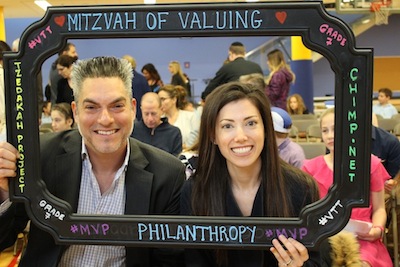
VTT MVP Ariel Lewinski and Judy Boxer of Chimp. (photo by Jennifer Shecter-Balin)

The MVP group expressed thanks to Cambridge Uniforms for their ongoing support of the program. This year also saw the involvement of Chimp representatives Judy Boxer and Ariel Lewinski, who offered support via the company to this generation of philanthropists. Boxer and Lewinski gave gift cards totaling $10,000 out to the members of the audience on June 15. Each card could be used to donate $100 to a charity of the recipient’s choice.

The MVP program is support by the Irma Zack MVP Endowment Fund, established by Dr. David Zack – Greenberg’s father – in memory of his late wife, and the original seed funding was donated by Sylvia and the late Lorne Cristall. It is through these funds that the school has been able to run MVP and other such initiatives.

The MVP students followed a careful process of selection of charities to support. They picked ethical commandments to work with, such as healing the sick, helping others in difficulty, or feeding the hungry. They researched the agencies that satisfied these criteria and found contacts with whom to work. Having interviewed these contacts, the kids then had 20 minutes to convince their class to contribute to their agencies, turning classrooms into boardrooms for allocation meetings.

Funds were donated to 24 different organizations this year, including household names like UNICEF and Magen David Adom, and local beneficiaries like the Vancouver Aquarium and Big Sisters. Students also selected Down Syndrome Research and CEASE, an agency that supports women victims of sexual exploitation and domestic violence.

Several students offered their perspectives on the MVP initiative to the Jewish Independent.

Asher Teperson described how “we assumed the roles of principal researchers, primary investigators, bankers and lawyers to assess the needs in our community and respond to them in concrete ways.” For the MVP students, this was a rite of passage. “We had a taste of what it means to become an adult in the eyes of the Jewish community,” said Asher.

Estie Kallner echoed these sentiments: “How often are 12- and 13-year-olds asked to make phone calls to strangers, conduct interviews in corporate offices, request clarification on financial matters and pester agency executives on their overhead costs?”

Julia Huber closed the program remarks with a reflection on how much they had grown through the experience. She described a group of “restless, nervous and confused” kids at the start of the program. However, she said, “with support and encouragement, not only did we embrace the challenge, but we exceeded even our own ambitious goals.”

As another student, Isabella Leipsic, observed, the program left them with a profound sense of their own “strength” in “moral decision-making.” She added, with thanks to the program, “our lives will never be the same.”

Shula Klinger is an author, illustrator and journalist living in North Vancouver. Find out more at niftyscissors.com.

Format ImagePosted on July 14, 2017July 11, 2017Author Shula KlingerCategories LocalTags education, Judaism, mitzvah, tikkun olam, Vancouver Talmud Torah, VTT

Finite and infinite light

How can we explain the mitzvah of the Chanukah light? What about two of its features? One, the lights are to be placed by the door of one’s house that is next to the street or public domain, and they must be placed on the left-hand side of the door. These features have deep symbolism: our tradition tells us that the “left hand side” and the “public domain” both stand for the realm of the profane; by placing the lights there, we are bringing the Divine light into the area of existence that is most resistant to it.

The mitzvah of the Chanukah lights is similar in two respects to that of the mezuzah: both have to be placed by the side of the door of a house or courtyard, and both must be set on the “outside.” However, there are also two differences between them. A mezuzah must be fixed on the right-hand side of the door, while Chanukah lights are to be set on the left. Though both are placed outside, in the case of the mezuzah, this is only to mark the entrance. Chanukah lights, however, are intended to illuminate the outside, the public domain. The mezuzah points inward, while the menorah shines outward.

These points of difference may, in fact, be connected. We learn that the public domain, rishut ha’rabim, literally the domain of the many, suggests the idea of multiplicity or a lack of unity; the left-hand side is the name for the source of life in which there is a separation and disunity. Public domain and left-hand side, therefore, are related, both symbols for the dimension of division and alienation from G-d.

Interestingly, the precept of mezuzah is said to be equal in importance to all the other mitzvot together; it is said to include all other mitzvot within itself. Indeed, almost all mitzvot share the two features that characterize the mezuzah: the idea of the right hand, and of being directed inward.

Most mitzvot are to be performed with the right hand. For example, burnt offerings were vitiated if they were not offered with the right hand. Certain commandments must be performed indoors, and it remains evident that those that may be done outside have no integral connection with the idea of the public domain, since they may also be performed indoors. In short, they have no connection with place at all.

The Chanukah light – occupying the left-hand side and intended for the outside – has a different character to almost all other precepts in Judaism. The difference between the mezuzah (and all other mitzvot) and the Chanukah light is analogous to that of positive and negative commandments. The positive are those that can only be performed with objects that belong to the domain of the permitted; the negative covers the (non-performance of the) forbidden.

Every performance of a mitzvah brings spiritual light to the world, in the form of Divine light. The light that is drawn down by the fulfilment of a positive mitzvah is of the kind that can be internalized in the act itself, clothed or contained within it. The act “clothes” the light in the same way as the body “clothes” the soul. A Divine light that can be contained in such a way is finite; it takes on the character of that which contains it, and cannot descend to the realm of the impure or forbidden.

The light that is released by the fulfilment of a negative command, however, is infinite. It cannot be contained by the forbidden (or indeed by any) act, nor does it share its character, so it can be released only by refraining. Only an infinite light can reach that far, into impurity, in order to be undimmed where it shines. The Chanukah light is of this infinite kind; it brings light to the left-hand side and the public domain, both symbols of impurity and alienation from G-d. However, Chanukah light goes even beyond the negative commandment. Recall that it is, in fact, a positive command. Chanukah lights illuminate and purify, rather than negate, the world of outside, just as a positive command purifies the world of inside.

This is the connection between the Chanukah lights and the Torah, which is also called “a light.” The Torah also specifies acts that are forbidden and things that are impure. Through studying the Torah, the sparks of holiness embedded in the realm of the forbidden are released and elevated.

The miracle of Chanukah is apparent not only in the fact that “for your people, Israel, You worked a great deliverance and redemption as at this day” – a deliverance from a people who were “impure,” “wicked” and “arrogant,” and despite their being “strong” and “many”; but also in the result that “afterwards, Your children came into Your most holy house, cleansed Your Temple, purified Your sanctuary, and kindled lights in Your holy courtyards.”

May each and every one of us recognize the beauty in the mitzvah of lighting Chanukah candles, and may we be blessed with a fun, delicious and wonderful eight-day festival.

Esther Tauby is a local educator, counselor and writer. This article is based on the talks of the Lubavitch Rebbe, OBM.


Posted on December 12, 2014December 10, 2014Author Esther TaubyCategories Celebrating the HolidaysTags Chanukah, commandments, mitzvah, rishut ha’rabim
Proudly powered by WordPress