
Skip to content
  • Home
  • Subscribe / donate
  • Events calendar
  • Business Directory
  • FAQ
  • News
    • Local
    • National
    • Israel
    • World
    • עניין בחדשות
      A roundup of news in Canada and further afield, in Hebrew.
  • Opinion
    • From the JI
    • Op-Ed
  • Arts & Culture
    • Performing Arts
    • Music
    • Books
    • Visual Arts
    • TV & Film
  • Life
    • Celebrating the Holidays
    • Travel
    • The Daily Snooze
      Cartoons by Jacob Samuel
    • Mystery Photo
      Help the JI and JMABC fill in the gaps in our archives.
  • Community Links
    • Organizations, Etc.
    • Other News Sources & Blogs
  • JI Chai Celebration
  • JI@88! video

Recent Posts

  • SFU honours Gloria Gutman
  • Lifting people’s spirits
  • Wedding a ray of light
  • Indigeneity and Zionism
  • Rule of law broken: councilor
  • Football and its roles
  • The burden of defence
  • Fish Café returns after fire
  • All right in what goes wrong
  • Nuns & mermaids at TUTS
  • Camp offers holiday retreat
  • Students and mentors inspire
  • Once-in-a-lifetime trip
  • 100 dancers, one heart
  • Money for the sciences
  • What “Jewish food” means
  • Have a cookie, schnitzel too
  • Federation now across BC
  • Israel fighting for its existence
  • Deal strengthens Iran
  • Patriotic belonging diminishes
  • A campaign to engage
  • Upstanders’ first live event
  • Responding to Carney
  • Having your own home
  • Music a family tradition
  • Musical to warm heart
  • Community milestones … June 2026
  • Sharing her passion for Israel
  • Or Shalom reopens its doors
  • JFS from past to future
  • Need holistic approach
  • Sharing stories, advice
  • Journalist shares fears
  • Skills to live together
  • Road to independence

Archives

Follow @JewishIndie
image - CJN box ad Rockowers 2026

Byline: Matthew Gindin

Newcomers settling in

Newcomers settling in

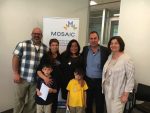
From left to right: Rabbi Dan Moskovitz, Meha Qewas, the Hon. Jody Wilson-Raybould, Hesen Mostefa, Brenda Karp and two of the Mostefas’ children. (photo from Temple Sholom)

“I am not scared,” says Meha Qewas, sitting at her small dining table with her 1-year-old daughter on her lap. In front of us is a plate of knefa, a very rich, sweet cheese dish covered in syrup, together with huge tumblers of juice many times bigger than what I’m used to being offered. Meha clearly values hospitality. The only thing sweeter than the mid-morning “snack” is the ebullience and warmth that flows out of Meha and her husband Hesen Mostefa.

When she says she is fearless, Meha is talking about finding work in Vancouver. Despite the challenges, she is confident both in her new friends in the Vancouver Jewish community and in her own ability to master English and overcome whatever other obstacles she may meet. Her confidence is not groundless: Meha was the main force behind and organizer of getting her husband and three children first out of Syria, then out of Iraq, the country where they took refuge for five years. “I wanted my children out of there,” she says, recalling the sight of Syrian children and youth in Iraq taking up smoking and selling candy on the street to make income for their families in the packed, rat-infested refugee housing.

Hesen also has a remarkable story to tell. Trained as a surgeon in Syria, he volunteered in Iraq with Médecins Sans Frontières (Doctors Without Borders), which eventually hired him as a doctor. During the years they spent in Iraq, Hesen put in long days with MSF while Meha struggled to take care of the children, run a household and plan their flight from Iraq. Eventually, Meha succeeded in securing passage to Canada with the help of sponsors from Vancouver’s Temple Sholom.

Temple Sholom’s efforts to sponsor Syrian refugees started with a High Holidays sermon from Rabbi Dan Moskovitz about the refugees’ plight. Members of the shul immediately formed a committee of volunteers to bring in at least one family, and others, if possible.

Meetings with the Jewish Federation of Greater Vancouver and the Anglican Diocese followed (the diocese is a federally approved sponsor for refugees with which other groups can team). The committee learned about private sponsorship and began working through Mosaic, a local agency that serves newcomers and refugees, and were connected to the Mostefas. The process to bring them to Canada was started.

In December 2015, however, Canada pulled some immigration services out of Iraq and began working through Jordan. A letter that Moskovitz gave to Senator Mobina Jaffer about the Mostefa family and their situation apparently found its way to the prime minister, and services in Iraq were reinstated as a result.

“In the end, over 200 people from shul got involved,” Moskovitz said. “I met personally with anyone who expressed concern about whether bringing in the refugees was a good idea. Most got on board with the initiative and I’m happy to say that, now that they [the Mostefas] are here, everyone in the community is thrilled.”

The synagogue’s efforts did not end there. They have since brought in another family, Bawer Issa, Shinhat Ahmed and their newborn son. The Issa family was welcomed at a Shabbat service in the synagogue on Aug. 25 (it can be seen on YouTube). Bawer spoke movingly at that event, recounting how some people had asked him if he was surprised, as a Muslim, that he had been rescued by Jews.

“We were not surprised,” he told the congregation. “Growing up in Iraq, we were brainwashed at school every day to hate Israelis and Jews as our number one enemy. My Kurdish father always told us not to care what they said, not to believe it. He told us that Israel had been the first to send aid when Saddam Hussein bombed us with chemical weapons.” Citing Israel’s continued support for Kurdish self-rule, Bawer said that he had already known that Jews were their friends.

At the upcoming biennial meeting in Boston of the Central Conference of American Rabbis, the umbrella organization of the Reform movement, a resolution – that Moskovitz helped write – will call for the sponsorship of 36 more refugee families by Canadian congregations.

The wider Vancouver community is invited to welcome the Issa and Mostefa families on Sept. 10, at 11:30 a.m., at a reception at Temple Sholom that also marks the first day back of the synagogue’s Hebrew school. An RSVP is requested to 604-266-7190 or via templesholom.ca/get-know-new-canadians.

Matthew Gindin is a freelance journalist, writer and lecturer. He writes regularly for the Forward and All That Is Interesting, and has been published in Religion Dispatches, Situate Magazine, Tikkun and elsewhere. He can be found on Medium and Twitter.
Format ImagePosted on September 8, 2017September 5, 2017Author Matthew GindinCategories LocalTags Canada, Dan Moskovitz, Iraq, Meha Qewas, refugees, Syria, Temple Sholom, tikkun olam
Thrilled by community

Thrilled by community

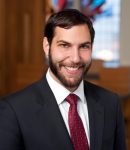
Rabbi Philip Gibbs is the new spiritual leader of Congregation Har El. (photo from Rabbi Philip Gibbs)

Rabbi Philip Gibbs, who took up the pulpit at Congregation Har El / North Shore Jewish Community Centre in July, had an unusually straight path to Judaism in many ways, at least for someone living outside the Orthodox world.

“Judaism was always part of my life,” Gibbs told the Independent.

Growing up in Marietta, Ga., he attended a Reform synagogue, went to Hebrew school and lived in a home life structured by Judaism. He found Judaism both comforting and intellectually engaging. He loved the thorny moral questions of Jewish tradition and studying Torah stories for guidance about how to live in the world. By the time he finished high school, he was on the regional board of the Reform Jewish Youth Movement (NFTY).

Being a leader in NFTY helped Gibbs see what it meant to bring others to and through the experience of Judaism – and the seed of a rabbinic calling was planted.

Gibbs went to college at Washington University in St. Louis, Mo., and graduated in 2012 with a double major in Hebrew and the humanities. He also attended summer programs for intensive Talmud study and, as he settled into “that place of serious learning about Judaism,” he felt at home. He was enamoured by how the Jewish community supported each other in times of crisis and celebration, giving a wider sense of meaning to even happy moments.

Gibbs attended the Jewish Theological Seminary (JTS), attracted “by its academic emphasis and its acknowledgment of the evolution of Judaism.” It also fit his personal level of observance.

He focused on Talmud and halachah (Jewish law) at the seminary and became the secretary of the committee on Jewish law and standards. He became passionate in his interest in halachah, both theoretically and as a “road to values.” He enjoyed taking ritual practice and explaining “the goal and meaning of it from a place of depth.”

Gibbs graduated with a master of arts in Talmud and received his rabbinic ordination earlier this year.

As a rabbinical student, he was engaged with global social justice and human rights issues, and became a member of Rabbis Without Borders. In his second year, after touring Hebron with T’ruah, a rabbinic human rights organization, he was featured in an article in the Forward about younger rabbis willing to grapple fully with the moral complexity of life in Israel.

Gibbs connected to Congregation Har El, which has been without a permanent spiritual leader for just over a year, through the JTS matching process for new rabbis. He had been to Vancouver before and looked forward to flying out for the interview.

“B.C.’s wilderness and outdoors activities are a big draw for me,” said Gibbs, who led the Jewish Outdoor Leadership Institute camp Ramah in the Rockies and is looking forward to the hiking and skiing opportunities available in the Vancouver area. “I grew up doing a lot of hiking in the southeast and led backpacking trips with Conservative movement summer camps. When I got here, I was also thrilled to find a community of very nice and caring people, a place that wanted depth in what they were doing.”

Gibbs said his main priority right now is getting to know the community before he begins putting together any new ideas. He is also getting to know Vancouver.

“It’s great,” he said. “One of the first things I did was get a bike – it’s a city very easy to get around in. My first view was before the forest fire smoke came in, and it was absolutely beautiful.”

Matthew Gindin is a freelance journalist, writer and lecturer. He writes regularly for the Forward and All That Is Interesting, and has been published in Religion Dispatches, Situate Magazine, Tikkun and elsewhere. He can be found on Medium and Twitter.
Format ImagePosted on September 1, 2017August 30, 2017Author Matthew GindinCategories LocalTags Har El, Judaism, Philip Gibbs, synagogue
Beth Tikvah’s rabbi

Beth Tikvah’s rabbi

Rabbi Adam Rubin, wife Judith and their children. (photo from Rabbi Adam Rubin)

When Rabbi Adam Rubin and his family visited Congregation Beth Tikvah in February of this year, they fell in love. “They seemed to like us, too, I guess, because I got the job,” the rabbi told the Jewish Independent.

Rubin was born in Santa Monica, Calif., and grew up in Tustin, a small community outside of Los Angeles. He went to a public high school, which had only a few Jews, and first found a connection to Jewish community when he went to Jewish summer camp in northern California.

Rubin worked as a counselor in his college years, then furthered his journey into Jewish culture with a trip to Israel. He had a remarkable experience there, staying with a working-class Israeli family and wandering around Jerusalem for hours every day, fascinated. After a friend handed him a brochure for Pardes Institute of Jewish Studies, he was intrigued and made plans to study there.

After graduating from University of California, Berkeley, with a degree in American and European history, Rubin spent two years at Pardes. Despite the traditional yeshivah curriculum, there is no expectation of Orthodox observance. Free to experiment and find his own relationship with Judaism, Rubin became observant.

He studied Israeli politics and history and went on to do his doctorate at University of California, Los Angeles, in Jewish history, focusing on the Hebrew culture of the Yishuv in the 1920s and 1930s, in the era of Hayim Nahman Bialik. He was interested in people who came to Palestine to refashion Jewish life, as Ahad Ha-am (Asher Ginsberg) and the followers of cultural Zionism did. Cultural Zionism was more focused on the renewal of Jewish culture than the political renewal of a Zionist state.

Rubin settled into an academic life in Los Angeles, teaching rabbinical students at Hebrew Union College (HUC) as well as students at University of Southern California (across the street). After several years in academia, though, he was less than happy.

“The core thing in an academic life is research and writing,” he said. “I can do that, but I’m a people person, very social. I love to be with people, and my favourite part of the job was the faculty connection to the broader community, which HUC required of its teachers.” Also, over time, “the love of history faded and was replaced with the love of Torah.”

By that time, Rubin had become “egalitarian observant,” was involved in an independent minyan and had enjoyed a study chavruta (group, literally friendship) for years. He was “living a meaningful, wonderful Jewish life,” he said, “and didn’t feel like I needed to be a rabbi to do that.”

As he increasingly wanted to serve the Jewish community more directly and to be with people, he turned to the rabbinical path. After his ordination at Ziegler School of Rabbinic Studies, he became assistant rabbi at Beth Shalom, a Conservative synagogue in Seattle.

“I wouldn’t have been able to make this major transition without the support of my wife Judith,” said Rubin, noting that he needed to take a significant loss of income and become a student again to become a rabbi. His wife, an experienced elementary school teacher, will be teaching secular studies at Richmond Jewish Day School.

Although Rubin had a “great experience” at Beth Shalom, he wanted his own pulpit. “I used to joke that I was the oldest assistant rabbi in the U.S.,” he said.

The Rubins have two children: Elior, 7, who will be going to RJDS, and Na’amah, 3, who will be going to a francophone preschool.

The rabbi is looking forward to taking up the spiritual helm at Beth Tikvah.

“I love that Beth Tikvah congregation has a do-it-yourself spirit – a great deal of the religious life of the shul is done by the congregants themselves. I love how deeply committed our members are to the flourishing of the community, and how much they love and support one another.”

When asked what he hoped to bring to Beth Tikvah, Rubin replied, “My passion for exploring the spiritual riches of the Jewish tradition and sharing the sacred experience of living a life of mitzvot, combined with a commitment to the intellectual rigour and seriousness of deep Torah study.”

Matthew Gindin is a freelance journalist, writer and lecturer. He writes regularly for the Forward and All That Is Interesting, and has been published in Religion Dispatches, Situate Magazine, Tikkun and elsewhere. He can be found on Medium and Twitter.
Format ImagePosted on August 25, 2017August 25, 2017Author Matthew GindinCategories LocalTags Adam Rubin, Beth Tikvah, Judaism, Richmond
Anger over flag-raising

Anger over flag-raising

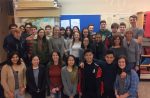
Kids4Peace at Camp Solomon Schechter. (photo from k4p.org)

Camp Solomon Schechter (CSS), located outside of Olympia, Wash., was mired in controversy earlier this summer, after it temporarily flew a small Palestinian flag alongside the large American, Canadian and Israeli flags that usually wave above the camp. The flag was hoisted to welcome a delegation from Kids4Peace, which included Palestinian Muslim and Christian children. The children had come to the Jewish summer camp to foster friendship and understanding.

According to a source at the camp, the decision to raise the Palestinian flag was not a political one, but was intended as an expression of the mitzvah of welcoming guests (hachnassat orchim).

The 13 children from Kids4Peace, whose visit inspired the incident, spent five days at the camp, where they attended Jewish prayers every day and learned about Zionism and Israel. Founded in Jerusalem in 2002, Kids4Peace is “a global movement of youth and families dedicated to ending conflict and inspiring hope in divided societies around the world,” according to its website. The organization works with more than 500 Palestinian, Israeli and North American youth.

“It provided an opportunity for many American Jewish campers to meet a Palestinian for the first time, and to recognize that there are Palestinian partners who want to work – together – for peace,” Kids4Peace Northwest regional director Jordan Goldwarg wrote on the Kids4Peace blog about the camp visit. “It provided an opportunity for Palestinian Kids4Peace participants to experience American Jewish life and to gain a deeper understanding of why a strong, stable Israel is so important for Jews the world over.”

The flag incident was first publicized on the Mike Report, an amateur news blog hosted out of Seattle by right-wing, pro-Israel activist Mike Behar, who was highly critical of the actions of CSS. The news of the raising of a Palestinian flag sparked intense criticism online and among some parents and alumni, including many British Columbians connected to the camp. The apology subsequently issued on the CSS Facebook page was met with so many hostile comments that the page itself was taken offline for a time.

The incident attracted attention in American Jewish papers, as well. Tablet’s Leil Leibowitz, who acknowledged that, on one level, the flag raising was a “sweet gesture,” nevertheless wrote a fiery op-ed accusing CSS of addressing “the Israeli-Palestinian conflict in a mindless, morally preening way, treating it not as something concrete but as a collection of grand symbolic gestures,” and suggesting that training children on such empty theatrics would set them up to join “fringe anti-Israel groups” as adults.

In a letter sent to parents and supporters following the visit, the camp wrote: “For the sake of a teachable moment, we did raise the Palestinian flag as a sign of friendship and acceptance. It was met with uncertainty by some campers and staff, especially the Israeli’s [sic], but all understood that the message of hope for peace by flying the Israeli flag alongside helped develop empathy. Still we plan to take down all the flags for Shabbat since there is no peace and also to relieve the sadness and anger that some feel by the site [sic] of the flag.”

The letter also said the camp remains “unabashedly pro-Israel and we are celebrating Israel alongside our new friends.”

“Camp Solomon Schechter is a proud Zionist and pro-Israel camp,” a subsequent statement said. “We honour the Israeli army and Israeli people on a daily basis at CSS. Our goal was to create a safe space for all, and begin dialogue among the next generation.”

The camp’s executive director, Sam Perlin, and co-board president, Andy Kaplowitz, also issued a statement responding to the depth of the negative responses from some members of the community: “Camp Solomon Schechter regrets raising the Palestinian flag alongside U.S., Canadian and Israeli flags … we neglected to foresee in such actions the serious political implications and, for that lapse in judgment, we are deeply sorry.”

Kids4Peace released an official statement, saying that, “To some, the Palestinian flag evokes the failure of past negotiations, continued hostility toward Israel and a feeling that there is no partner for peace.

“At the same time, the Palestinian youth who came to camp are precisely those peace leaders who are reaching out to work with Israelis to counter incitement and build a new future on a foundation of mutual respect and understanding. These Muslim and Christian youth are also part of the Palestinian people, and they deserve only admiration and support.”

The statement also noted, “Unfortunately, most Americans and Israelis never encounter any pro-peace Palestinian voices. Instead, their perspectives are shaped by painful past experiences and media portrayals that reinforce negative views. But it is wrong to view all Palestinians as enemies of Israel or the Jewish people. That’s why Kids4Peace came to camp in the first place.”

Both the Israeli and American governments have flown Palestinian flags in gestures of welcome or goodwill. The White House flew the Palestinian flag when Palestinian President Mahmoud Abbas met with U.S. President Donald Trump earlier this year. Israel lifted its ban on flying the Palestinian flag in 1993 and there were Palestinian flags flown at the Knesset in 2013, when a Palestinian delegation visited. Likewise, at a ceremony thanking all those who helped douse the wildfires in Israel’s north in 2016, the Palestinian flag was flown at an Israeli air base, next to the flags of Turkey, Russia and Greece.

Matthew Gindin is a freelance journalist, writer and lecturer. He writes regularly for the Forward and All That Is Interesting, and has been published in Religion Dispatches, Situate Magazine, Tikkun and elsewhere. He can be found on Medium and Twitter. This article was originally published by CJN.
Format ImagePosted on August 18, 2017August 16, 2017Author Matthew GindinCategories LocalTags camp, Camp Solomon Schechter, Israeli-Palestinian conflict, Kids4Peace, peace
IDF colonel visits Vancouver

IDF colonel visits Vancouver

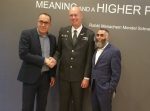
Left to right: Ilan Pilo, Jewish National Fund, Pacific Region; Col. Adam Susman, Israel Defence Forces defence attaché to Canada; and Rabbi Shmulik Yeshayahu of the Ohel Yaakov Community Kollel. (photo from Community Kollel)

While acknowledging that the situation in the Middle East is constantly changing, Col. Adam Susman told those gathered at the Ohel Yaakov Community Kollel on July 18 that the biggest threat to Israel is Iran, “as it has been for years.”

Susman, who is the Ottawa-based Israel Defence Forces (IDF) defence attaché to Canada, was in Vancouver at the invitation of the Jewish National Fund of Canada, Pacific Region.

Born in the United Kingdom, Susman moved to Moshav Sde Nitzan in southern Israel at the age of 3, according to JNF’s website. He joined the IDF’s Givati Brigade in 1987 and became a battalion commander after serving as head of the anti-ballistic and training branches. In 2005, he was appointed commander of Hanegev infantry brigade and chief of staff of the Sinai division, protecting Israel’s southern border. In 2009, he became commander of the Dan district in Home Front Command, working to ensure the safety of civilians in the metro Tel Aviv area. Prior to his appointment as the defence attaché to Canada in 2014, Susman was head of the International Military Cooperation Department of the IDF General Staff.

Rabbi Shmulik Yeshayahu of the Community Kollel was the emcee of the Vancouver event. “It is fitting to have this meeting during the weekly Torah portion of Matot-Masei,” he said in his opening comments. “In this parashah, a portion of the Jewish people stays behind on the way to the Holy Land, preferring to farm on the other side of the Jordan River rather than go in and fight for the land. They stayed there while the rest of the tribes fought and, later, they joined them. In Judaism, we have great respect for those who risk their lives to protect other people, and especially our homeland.”

Before introducing Susman to those gathered, Ilan Pilo, executive director and Jerusalem emissary of JNF Canada, Pacific Region, presented a brief video about JNF’s activities throughout Israeli history. He then invited the president of Royal Canadian Legion’s Shalom Branch, Ralph Jackson, to speak. Jackson, who introduced himself as “the only Jew in the Scots Guards during World War Two,” presented a donation of $5,000 to Susman for Beit Halochem, a nonprofit that cares for disabled Israeli veterans.

Leonard Shapiro, Shalom Branch vice-president, noted how the branch was formed during a time of great prejudice, when Jews needed their own veterans organization. “It has been a long time now since we’ve gone to war, however, thank God. We don’t get many new members. If anyone here would like to join and support our organization and activities, you don’t have to have been in the army, you just need to be over 18 and not have committed any horrible crimes. Little ones, OK,” he joked.

Susman shared a bit about himself and his experience in the Givati Brigade, which was the most highly decorated brigade in the 2014 conflict, a fact no doubt known to the many IDF veterans in the audience.

Susman is one of 16 Israeli attachés around the world – a small number that, he said, was due to Israel never having been part of a military coalition with another country. He outlined the ties between the Israeli and Canadian militaries, the chief threats to Israel today and the IDF’s response.

“There is cooperation between the IDF and the Canadian military strategically and practically,” he said. “The relations between the IDF and the Canadian military are good.”

Asked if the change of Canada’s federal government to the Liberals from the Conservatives had had any effect on that relationship, Susman said it had not.

Turning to the situation in Israel’s own region, he emphasized the lack of stability.

“The Middle East is an interesting neighbourhood, always changing – what I tell you today may not be true tomorrow,” he said.

“The biggest threat is Iran, as it has been for years,” he continued. “[Mahmoud] Ahmadinejad took every opportunity to say that Israel should disappear from the map of the world. The main threat they’ve posed has been building Hezbollah – without Iran, it would be a small organization. In recent years, Hezbollah has been fighting in Syria and they’ve lost a lot of people, but they’ve also gained a lot of operational experience. They have also steadily increased in rocket capabilities and can now reach Eilat.”

Susman said that Syria had previously been a big threat to Israel, but that’s no longer the case, due to its civil war and ISIS, as well as the reduction of the country’s chemical weapons by Western countries.

Hamas in Gaza is the next biggest threat, he said, noting that it is also supported by Iran. “They only exist to fight,” he said. “They are not building up Gazans as they claim. A good example is the tunnel found during 2014 Protective Edge, kilometres of resources that could [have been used] for clinics and schools. Gaza is a piece of cheese, there is 80 metres between the top and the water table, dotted with tunnels. That’s a major challenge.

“The Sinai is also a security problem,” he added. “Nobody controls it, and so everybody is in there. There was no Egyptian military following the peace agreement, so that’s the result. The MFO (Multinational Force and Observers) was created to survey the Sinai and, by the way, there are many Canadians in it.

“Some people say the IDF is a military that has a country,” quipped Susman. “We are strong, and we are good at finding solutions.”

Susman cited Iron Dome as an example. The IDF initially divided Israel into 157 zones with two missile interceptors for each missile. That was successful, he said, but each missile cost $70,000 so that intercepting one fired missile cost $140,000. Therefore, the IDF sought improvements. Israel was divided into 254 zones, he said, and each one had only one missile interceptor per fired missile. This system has a 90% success rate stopping missiles, which is still not good enough in Susman’s view. “We will improve yet further,” he said.

During the question-and-answer period, an audience member commented, “You said Iran is the biggest threat against Israel but you didn’t say what Israel is doing against Iran.”

“That’s right,” replied Susman without further explanation, eliciting laughter from the crowd.

The evening ended with the singing of “Am Yisrael Chai,” led by Yeshayahu.

Matthew Gindin is a freelance journalist, writer and lecturer. He writes regularly for the Forward and All That Is Interesting, and has been published in Religion Dispatches, Situate Magazine, Tikkun and elsewhere. He can be found on Medium and Twitter.
Format ImagePosted on August 18, 2017August 16, 2017Author Matthew GindinCategories LocalTags Community Kollel, Hamas, IDF, Iran, Israel, Jewish National Fund, JNF, security, Shalom Branch, veterans
Judaism’s importance

Judaism’s importance

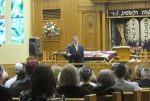
Rabbi Lord Jonathan Sacks speaks at Congregation Schara Tzedeck on April 28. (photo by Cynthia Ramsay)

“There is one thing about Judaism for which we were mocked for centuries, whose wisdom is just becoming clear in the 21st century,” Rabbi Lord Jonathan Sacks told a packed Schara Tzedeck synagogue on April 28, after describing the world as “a terribly dangerous place” in which religion has “returned in some of its most violent and aggressive forms.”

“We did not try to conquer or convert the world,” he explained. “Why? Because we believe that God made a covenant with Noah before he made a covenant with Abraham and, therefore, you don’t have to be a child of Abraham to be in a relationship with the Holy One, blessed be He.

“We believe that the righteous of every nation have a share in the World to Come and, therefore, we never sought to conquer or convert the world. Christianity and Islam sought to become, and did become, world powers, and they achieved great things, but right now their clash, which is threatening in some ways to take us back into the age of crusades, is so dangerous because our powers of destruction are so great.”

Sacks was introduced to the crowd of approximately 700 people by Schara Tzedeck Rabbi Andrew Rosenblatt, who talked about Sacks’ importance as an embodiment of the ethos of Modern Orthodoxy, which Rosenblatt said combines fidelity to Orthodox tradition with openness to the world. He commented on Sacks’ ability to bring Jews of all kinds together, quipping, “Tonight, we have here rabbis from all stretches of Oak Street.”

That was far from the only joke of the evening. When Sacks, who lives in London, England, took the stage, he asked the audience to forgive him if he rambled a bit, saying, “In my body clock it is now almost two in the morning and I am feeling very much like the man who once dreamt he was giving a speech in the House of Lords and woke up to discover that he was.”

After saluting the relative unity of the Vancouver Jewish community, Sacks took up his theme, which was the value of Judaism to both Jews and non-Jews, and the need for Jews to move confidently in the world as ambassadors of Jewish wisdom.

He noted how often it seems that non-Jews appreciate our strengths more than we do, and then he focused on seven things he felt Judaism has to offer the world: a sense of purposeful identity; a strength of community; the centrality of family; the prioritization of the intellect; a belief in the dignity of difference and an acceptance of religious and cultural pluralism; the sacred value of protest; and the importance of hope.

Sacks spoke of the essential human need for identity, pointing out that Moses’ first question to God was, “Who am I?”

Of community, the rabbi cited research showing that “regular attendance at a house of worship extends your lifespan by seven years.” He followed this up with a joke, saying that he told his wife, Elaine, “Maybe it just feels as though your lifespan has been extended by seven years.”

With regards to family, Sacks shared the story of taking Penelope Leech, a childcare expert in the United Kingdom, to a Jewish school in London on a Friday morning. There they watched a mock Shabbat, complete with “5-year-old abba and ima, 5-year-old baba and zaida shepping naches [feeling proud].”

Sacks said Leech asked one of the boys, “What do you not like and like about Shabbes the most?” The boy responded, “What I don’t like is not getting to watch TV! What I do like is it’s the only time Daddy doesn’t have to rush off.”

Leech apparently told Sacks, “that Sabbath of yours is saving their parents’ marriages.”

To illustrate Judaism’s appreciation of the intellect, Sacks told the well-known story of Nobel laureate physicist Isidor Isaac Rabi, who said his mother had made him a scientist by asking him every day when he came home from school not ‘what did you learn today?’ but ‘Izzy, hot du fregn a gut kashya [did you ask a good question]?’ What do we teach our children?” asked Sacks. “The Four Questions. Do you know how rare that is, to teach your children to question?”

Addressing one of his favourite themes, the dignity of difference, Sacks said, “You will meet with more diversity on a city street in one hour today than an 18th-century anthropologist would in a lifetime. We have to live with difference; we have to learn to respect difference. We have learned that the miracle of monotheism is not ‘one God, one people, one book’ – the miracle of monotheism is that it is the unity up there creates diversity down here.”

On his sixth point, Sacks said, “Many faiths teach the virtue of acceptance – yes, there’s injustice and suffering in the world, but in Olam Haba, in the World to Come, it will be OK; or, in Nirvana, where you escape from the sufferings of the world. Judaism is a religion not of acceptance but of protest.” Rather than accepting the pain and injustice in the world, God tells us to be partners in making the world a better place, he said.

And, lastly, Sacks described Judaism as “the voice of hope in the human conversation.”

“Optimism is the belief that things are going to get better,” he said. “Hope is the belief that, if we work hard enough, we can make things better. It takes no courage, just a kind of naiveté, to be an optimist. It takes great courage to have hope. Let us go out and do what we are called to do, to be Hashem’s ambassadors to the world. Let us, and not only non-Jews, recognize the value of what it is we’ve got.”

Sacks’ talk, which was sponsored in part by Cathy and David Golden to mark their 30th anniversary, was followed by services and dinner.

Matthew Gindin is a freelance journalist, writer and lecturer. He writes regularly for the Forward and All That Is Interesting, and has been published in Religion Dispatches, Situate Magazine, Tikkun and elsewhere. He can be found on Medium and Twitter.
Format ImagePosted on May 19, 2017May 19, 2017Author Matthew GindinCategories LocalTags Jonathan Sacks, Judaism, Schara Tzedeck
Yom Hashoah at KDHS

Yom Hashoah at KDHS

The Sir Charles Tupper Secondary School Grade 11 history class for which King David High School teacher Anna-Mae Wiesenthal (middle row, second from the right), did a presentation on the Holocaust. Their teacher, Bonnie Burnell, is to Wiesenthal’s left. (photo from Anna-Mae Wiesenthal)

“They were in awe of the Holocaust survivor,” said Bonnie Burnell, a teacher at Sir Charles Tupper Secondary, describing the reaction of her students to survivor Robbie Waisman’s talk at a Yom Hashoah assembly at King David High School (KDHS) on April 24. “Looking at him as he spoke at the podium, they could scarcely imagine him on the inside of a Nazi concentration camp.”

Students from Prince of Wales Secondary School and, of course, from KDHS also joined the assembly, which was organized by KDHS teachers Anna-Mae Wiesenthal and Aron Rosenberg, and included Cantor Yaakov Orzech chanting El Malei Rachamim.

The multi-school initiative was led by Wiesenthal, who is currently pursuing a master’s degree in Holocaust and genocide studies. Last year, she went to Austria and Poland with the Sarah and Chaim Neuberger Holocaust Education Centre of Toronto. In addition to teaching about the Holocaust at KDHS, she has been giving presentations at various public schools. She told the Jewish Independent that students have been very engaged and have asked many questions. This outreach led to the recent assembly at KDHS, where other schools’ students were invited to attend.

photo - Holocaust survivor Robbie Waisman addresses the assembly for Yom Hashoah at King David High School on April 24
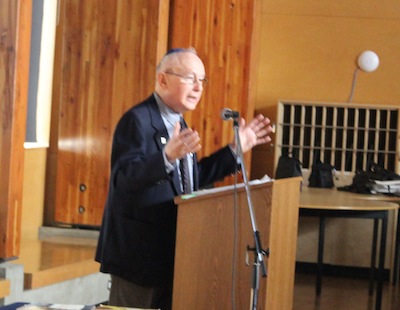
Holocaust survivor Robbie Waisman addresses the assembly for Yom Hashoah at King David High School on April 24. (photo from Anna-Mae Wiesenthal)

“My students, in general, were impressed with the ceremony and glad that they had made the decision to come,” Burnell said. “We have had a real focus on racism in our curriculum this year, and this visit definitely adds something of central importance to that subject.”

Wiesenthal, who has taught at KDHS since 2006, became interested in focusing more on Holocaust education after attending an educators seminar at Yad Vashem in 2012.

“I feel Holocaust education is about giving voice to the millions of victims who were murdered simply because of who they were, and honouring their legacy and our history,” explained Wiesenthal. “It is about remembering the vibrancy of Jewish life both before and after the war. It is about preserving memory for future generations and across cultures. It is about taking the knowledge of unprecedented horrors, and keeping them in front of us so that we remain vigilant about our humanity in the face of genocides today.”

Wiesenthal also admitted to being inspired by a possible kinship with renowned Nazi hunter Simon Wiesenthal. Her great-grandfather, Mattityahu Wiesenthal, was a Russian boy saved from forced conscription in the Russian army by being “thrown across the river” from Russia into the town of Skala in Austria-Hungary, as many boys were at that time. As an orphan in Skala, he was taken in by Moshe Efroyim Wiesenthal, who supported many such refugee orphans, and the young boy took the family name Wiesenthal to honour his patron. Wiesenthal does not know if Moshe Efroyim was directly related to Simon Wiesenthal, but the latter remains one of her heroes, and she has been in touch with his granddaughter, Racheli Kreisberg.

Wiesenthal also recently initiated a pilot project at the Vancouver Holocaust Education Centre (VHEC), in which KDHS students trained as docents (museum guides) lead other students through the exhibit.

Another project was an art exhibit at KDHS, where her Jewish History 11 class viewed a video of a Holocaust survivor’s testimony, chose an aspect of the testimony that stood out for them and then created a work of art based on that aspect. Each work was accompanied by an artist’s statement, a picture of the survivor and why the student chose the testimony they did. Contributions included painting, sculpture, writing and music. “The quality of expression was very moving,” said Wiesenthal.

Rabbi Stephen Berger, head of Judaic studies at KDHS, said he is thrilled with the work Wiesenthal has been doing.

“She shares her passion with her students and fulfils the talmudic dictum, ‘Words that leave from the heart, penetrate the heart,’” he said. “Our school and students benefit immeasurably by having her as a teacher of history and Holocaust studies.”

Matthew Gindin is a freelance journalist, writer and lecturer. He writes regularly for the Forward and All That Is Interesting, and has been published in Religion Dispatches, Situate Magazine, Tikkun and elsewhere. He can be found on Medium and Twitter.
Format ImagePosted on May 19, 2017May 17, 2017Author Matthew GindinCategories Celebrating the Holidays, LocalTags Anna-Mae Wiesenthal, Bonnie Burnell, education, Holocaust, KDHS, Robbie Waisman, Yom Hashoah

End-time visions

Are we living in the “end times”? Many would agree that, some days, it feels like it. Vancouver School of Theology’s Inter-Religious Studies program will host an apocalyptically themed conference this month called Visions of the End Times. Presenters will invite attendees to explore their fears and hopes for the future.

As part of the conference, which runs May 23-25, the keynote speaker, psychologist Dr. Lionel Corbett, will give a free public lecture. In the May 23 talk, Corbett will discuss the psychology of apocalyptic thinking and religious violence.

On the mornings of May 24 and 25, more than a dozen regional scholars will speak about concepts of the “end times” found in sacred texts, film, popular music and contemporary culture. Afternoon activities will include a multifaith panel of local religious leaders and a creative writing workshop.

The conference had its genesis about three months before the U.S. election in a conversation between Rabbi Laura Duhan Kaplan, the director of Inter-Religious Studies at VST, and Harry Maier, professor of New Testament and early Christianity studies. The two professors contemplated why zombies are such a popular motif in contemporary culture. Are they a metaphor for soul-less humanity, for consumer culture consuming itself or a political world that has no awareness or conscience? This led to a discussion of the possibility of an academic conference on zombies in popular culture.

“Then,” Duhan Kaplan explained to the Jewish Independent, “we remembered we’re faculty at a theology school, and that zombies sort of appear in the Bible, in Ezekiel’s prophecy about the resurrection of the dead. So, we broadened the topic to Visions of the End Times and made the conference a VST project.”

Duhan Kaplan said she expects the conference will yield lively discussion. “My prediction for the thread that runs through the conference [is that] we will debate whether the world is getting worse or better, or heading in any direction at all.”

She said speakers will address topics such as extremism and religious violence, visions of the end times articulated by religious traditions, the meaning of end-times themes in music and film, the nature of utopian thinking, and a deeper look at end-times teachings in Jewish, Christian and Muslim scriptures. There will also be an open mic Tuesday evening featuring music and poetry of the end times, which Kaplan hopes will be “whimsical and fun.”

“I do believe that eschatological concepts [ideas resulting from the study of the end times] are helpful metaphors,” she said. “They place even terrible events into a hopeful vision. When something bad happens, they say, ‘Don’t worry, it’s just a blip on the way to a good end.’ For example, when something bad happens, many Jews say, ‘These are the footsteps of Mashiach.’ Personally, I take great comfort in Isaiah’s vision that ‘the lion will lie down with the lamb.’

“I don’t think human beings will ever make a [peace] treaty that holds indefinitely,” she continued. “But, while peace holds, people do experience a bit of ‘the World to Come,’ as we sometimes call the end times in Jewish thought.”

Corbett’s public talk is at 7 p.m. on May 23 at Chapel of the Epiphany on the University of British Columbia campus. For more information, visit vst.edu/event/vision-of-the-end-times-an-inter-religious-conference.

Matthew Gindin is a freelance journalist, writer and lecturer. He writes regularly for the Forward and All That Is Interesting, and has been published in Religion Dispatches, Situate Magazine, Tikkun and elsewhere. He can be found on Medium and Twitter.

Posted on May 12, 2017May 9, 2017Author Matthew GindinCategories LocalTags apocalypse, end times, religion, VST
Gathering in solidarity

Gathering in solidarity

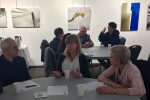
Attendees spoke to one another at their tables, following a list of questions to guide discussion. (photo from Rabbi Laura Duhan Kaplan)

A small group of Jews and Christians gathered at the Jewish Community Centre of Greater Vancouver on April 4.

After the first bomb threat at the JCC, Richard Topping, principal of Vancouver School of Theology, reached out to the Jewish community. He approached Laura Duhan Kaplan, director of Inter-Religious Studies at VST and rabbi emerita of Congregation Or Shalom. Yael Levin of the Centre for Israel and Jewish Affairs and JCCGV executive director Eldad Goldfarb then organized the dialogue, at which members of the United, Anglican and Presbyterian churches were present.

The evening opened with the singing of an egalitarian version of “Hinei Mah Tov” – “How good it is when brothers dwell together as one,” with achim, brothers, changed to kulanu, everyone. Topping then took the podium.

“When the first bomb threat was made at the JCC,” he said, “people at VST began asking is there anything we can do to show our solidarity with the Jewish community? We understand that a hoax like this is scary and it makes our friends feel vulnerable. In a post-Holocaust world, we don’t want to wait and see how a threat turns out. We want to assure you that we stand in solidarity with you against antisemitism. We are here to assure you that we stand with you against violence and against threats of violence.”

Sharon Dweck, development director of the JCCGV, gave an overview of the JCCGV’s activities within the Jewish community and beyond. She then shared her recollections of the first threat. “I broke my rule about keeping my nose out of daycare and rushed to hug my child,” she said. “Days after, as ‘manager on call’ after the bomb threat, I felt afraid and vulnerable, as well as a great sense of responsibility. ‘Would another threat come on my watch?’”

In total, the JCC received two threats, both of which were hoaxes.

Attendees spoke to one another at their tables, following a list of questions to guide discussion. People talked about everything from the importance of tikkun olam to Jewish humour, people they knew in common, their Jewish or Christian upbringings, and concerns over the then-upcoming vote to support the boycott, divest from and sanction Israel movement at the University of British Columbia, which was defeated.

Matthew Gindin is a freelance journalist, writer and lecturer. He writes regularly for the Forward and All That Is Interesting, and has been published in Religion Dispatches, Situate Magazine, Tikkun and elsewhere. He can be found on Medium and Twitter.

Format ImagePosted on April 28, 2017April 26, 2017Author Matthew GindinCategories LocalTags bomb threats, interfaith, JCC, Vancouver School of Theology, VST
Joni Mitchell for millennials

Joni Mitchell for millennials

Left to right, Andrew Cohen, Sara Vickruck, David Z. Cohen and Anna Kuman are among the cast of Circle Game: Reimagining the Music of Joni Mitchell. (photo by Tyler Branston)

Andrew Cohen and Anna Kuman, a Vancouver-based husband-and-wife team who are both composers and choreographers, will debut Circle Game: Reimagining the Music of Joni Mitchell this month at the Firehall Arts Centre.

The genesis was Mitchell’s 70th birthday in 2013, Cohen told the Jewish Independent.

“There was a lot of press that caught our attention,” said Cohen. “After that, it seemed like her music started following us around, popping up everywhere. We started researching her – her music, her lyrics, her impact on Canadian art and culture. We opened that can of worms and very much found a spark of something. We decided to see if we could take her poignant and meaningful and topical lyrics and reimagine them.”

The pieces Cohen and Kuman came up with are diverse re-arrangements of Mitchell’s material.

“We sat down on the piano to dissect and distil her songs,” said Cohen. “We threw in some harmony or a different drum beat. We came up with 20 different arrangements. Some are mash-ups, some are whole but more acoustic and unplugged, some are indie rock sounding or Latin.”

“We made a conscious effort to make the songs sound as if they were released today,” explained Kuman. “It’s the music of our parents’ generation, but we realized how poignant it still is for us. The social and political issues are repeating themselves. We wanted to change the sound so people could leave their preconceptions about the music of baby boomers behind.”

Kuman points to “Fiddle and the Drum” as a song that really resonates with today’s news cycle. “In that song, the line, ‘once again, America my friend,’ resonates powerfully,” she said.

The song lyrics include the following lines: “And so once again / America my friend / And so once again / You are fighting us all / And when we ask you why / You raise your sticks and cry and we fall / Oh, my friend / How did you come / To trade the fiddle for the drum? / But we can remember / All the good things you are / And so we ask you please / Can we help you find the peace and the star?”

While working on the project, both had songs they found personally meaningful. A song that sticks out for Cohen is “A Case of You.”

“The way we do it is very unique and will be unlike anything you’ve seen or heard before,” he said.

For Kuman, it was “Down to You,” which she described as “a story song.” In the lyrics, Mitchell “really painted a picture, a specific narrative. The way that we staged it in the workshop is that movement really evokes the emotion of the song. The arrangement that Andrew came up with is totally a cappella, yet really full.”

Cohen and Kuman are both in their 20s and are “proud East Vancouverites.” Cohen grew up going to Congregation Beth Tikvah in Richmond, and his parents were longtime members of the Beth Tikvah choir. Both he and his brother were in Perry Ehrlich’s ShowStoppers.

“We grew up at the JCC,” Cohen said, referring to the Jewish Community Centre of Greater Vancouver. “Anna taught tap at the Dena Wosk School [of Performing Arts], and we both taught there for years at Gotta Song! Gotta Dance!”

Both Cohen and Kuman are members of Temple Sholom, where they were married by Rabbi Dan Moskovitz.

When Cohen and Kuman started the process of composition, they were dating and not yet married. They did a workshop together, pitched it to Capilano University and were given a three-week residency and the time and space to experiment. This is their first foray as co-directors and co-collaborators.

“We got great feedback from the musicians and did a workshop presentation and invited people in the industry that we respect and we wanted to hear what they thought,” said Cohen. “The feedback was overwhelming and amazing. We knew we definitely had something – the spirit of our generation with the words of Joni Mitchell. There was some constructive criticism that we took and incorporated, too. It was great to have the roses and the thorns of a feedback session.”

“We will be the first to tell you how lucky we feel to be able to work with this calibre of talent,” said Kuman, referring to the musicians they are working with. “They are all multi-instruments who wail like nobody’s business and will sing to break your heart. We had a fairly extensive audition across the country, a ton of incredible talent came out for the show, but we settled for this six because they have the right skills and the right mix.”

The ensemble features Rowen Kahn (Superman: Man of Steel), Scott Perrie (Godspell), Adriana Ravalli (Rock of Ages), Kimmy Choi (Avenue Q), Sara Vickruck (Love Bomb) and David Z. Cohen (Heathers: The Musical). Together, they will play 18 instruments.

“We’d both like to encourage everyone to come out and see the show, whether you’re a Joni fan or not, or whether your mom is a Joni fan or not!” said Kuman. “We think it will be a great way to bridge the generation gap. What we hope we’ve accomplished is making the hits of 30 or 40 years ago sound like the hits that you’d hear on the radio.”

Circle Game runs April 29 to May 20. For tickets and showtimes, visit firehallartscentre.ca.

Matthew Gindin is a freelance journalist, writer and lecturer. He writes regularly for the Forward and All That Is Interesting, and has been published in Religion Dispatches, Situate Magazine, Tikkun and elsewhere. He can be found on Medium and Twitter.

Format ImagePosted on April 21, 2017April 20, 2017Author Matthew GindinCategories Performing ArtsTags Andrew Co, Anna Kuman, Firehall Arts Centre, Joni Mitchell, musical theatre

Posts pagination

Previous page Page 1 … Page 5 Page 6 Page 7 … Page 11 Next page
Proudly powered by WordPress