Skip to content
  • Home
  • Subscribe / donate
  • Events calendar
  • Business Directory
  • FAQ
  • News
    • Local
    • National
    • Israel
    • World
    • עניין בחדשות
      A roundup of news in Canada and further afield, in Hebrew.
  • Opinion
    • From the JI
    • Op-Ed
  • Arts & Culture
    • Performing Arts
    • Music
    • Books
    • Visual Arts
    • TV & Film
  • Life
    • Celebrating the Holidays
    • Travel
    • The Daily Snooze
      Cartoons by Jacob Samuel
    • Mystery Photo
      Help the JI and JMABC fill in the gaps in our archives.
  • Community Links
    • Organizations, Etc.
    • Other News Sources & Blogs
  • JI Chai Celebration
  • JI@88! video

Recent Posts

  • SFU honours Gloria Gutman
  • Lifting people’s spirits
  • Wedding a ray of light
  • Indigeneity and Zionism
  • Rule of law broken: councilor
  • Football and its roles
  • The burden of defence
  • Fish Café returns after fire
  • All right in what goes wrong
  • Nuns & mermaids at TUTS
  • Camp offers holiday retreat
  • Students and mentors inspire
  • Once-in-a-lifetime trip
  • 100 dancers, one heart
  • Money for the sciences
  • What “Jewish food” means
  • Have a cookie, schnitzel too
  • Federation now across BC
  • Israel fighting for its existence
  • Deal strengthens Iran
  • Patriotic belonging diminishes
  • A campaign to engage
  • Upstanders’ first live event
  • Responding to Carney
  • Having your own home
  • Music a family tradition
  • Musical to warm heart
  • Community milestones … June 2026
  • Sharing her passion for Israel
  • Or Shalom reopens its doors
  • JFS from past to future
  • Need holistic approach
  • Sharing stories, advice
  • Journalist shares fears
  • Skills to live together
  • Road to independence

Archives

Follow @JewishIndie
image - CJN box ad Rockowers 2026

Byline: Matthew Gindin

Storeys is now officially open

Storeys is now officially open

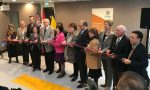
Cutting the ribbon at the official opening of Storeys on Dec. 1. (photo from Shelley Karrel)

“Those involved in Storeys feel like a family,” said Brenda Plant, executive director of Turning Point Housing Society, speaking at the opening gala of the rental housing development in Richmond on Dec. 1. “We’ve been working on this together for eight years now.”

Storeys, on Granville Avenue, provides 129 units of affordable rentals, which have on-site supportive services. The project is managed by five nonprofits. The Jewish community’s Tikva Housing Society has three floors of housing for low-income families: 18 units in total with rents at 30% of a household’s income – known as the Diamond Residences at Storeys. The other organizations involved are Coast Mental Health, providing units for low-income clients who need mental health supports; SUCCESS, which provides units for low-income seniors; Pathways Clubhouse Society of Richmond, which provides supportive environments for individuals working towards mental wellness; and Turning Point Housing Society, which provides units for individuals in recovery from addiction.

Richmond Mayor Malcolm Brodie spoke of the importance of the new building, pointing out that the City of Richmond contributed $19.4 million to the project, or one-third of the construction funding. “Some of you here may remember this site as a former KFC and a small office building,” he noted. “Eight years later, here we stand.”
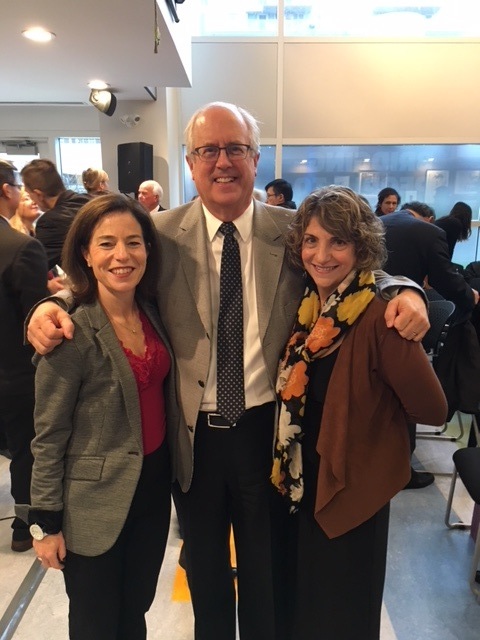
photo - Left to right, MLA Selina Robinson, Richmond Mayor Malcolm Brodie and Shelley Karrel
Left to right, MLA Selina Robinson, Richmond Mayor Malcolm Brodie and Shelley Karrel. (photo by Matthew Gindin)

“The housing units provided in this unique project will make such a difference in the lives of those who benefit from them,” said Selina Robinson, B.C. minister of municipal affairs and housing, during her address. To the nonprofits who made it happen, she said, “You guys rock.”

The event also featured remarks by MP Joe Peschisolido (Steveston-Richmond East); Kathleen Kennedy-Strath, chair of the board of Coast Mental Health; Jessica Berglund, president of the board of Pathways Clubhouse; Queenie Choo, chief executive officer of SUCCESS; Gord Argue, board chair of Turning Point Housing; and Shelley Karrel, co-chair of Tikva Housing.

The provincial and federal governments contributed just over $5 million and donors almost $2 million. BC Housing was key in assisting with providing the construction loan and will help organizations in securing their long-term mortgages at favourable rates.

Tikva’s involvement in Storeys was initiated under the leadership of Susana Cogan, who passed away before it was completed, and Linda Thomas, executive director of Tikva Housing, attended the opening with the society’s administrator, Anat Gogo, who led the Independent and others on a tour of the building. The suites are modern and well-designed, many with great views.

Tikva is supported by the Jewish Federation of Greater Vancouver and worked with Jewish Family Services to place the tenants. The Diamond Foundation gave Tikva the equity to be able to be at the table with the other Storeys project partners. Tikva’s 18 units are now home to families and individuals, from children through seniors.

“What has happened is that we have created a real community within a community,” explained Tikva Housing’s Karrel of the Diamond Residences at Storeys. “At one point, when the elevator wasn’t working because of a power outage, one of the tenants offered to go check on everyone to make sure they were OK. We hope to have communal Shabbat dinners and holiday events for the tenants,” she told the Independent.

Storeys is located near Garden City Bakery, Brighouse Park, Richmond Public Library, and many other resources. The Bayit’s Rabbi Levi Varnai recently visited to put mezuzot on the doors of the Jewish homes.

“In order to honour everyone’s commitment, I have a little present,” said Turning Point’s Plant midway through her presentation. She then handed out Staples’ “that was easy” buttons – “because I want you all to know that we’re going to do this again.”

Matthew Gindin is a freelance journalist, writer and lecturer. He writes regularly for the Forward and All That Is Interesting, and has been published in Religion Dispatches, Situate Magazine, Tikkun and elsewhere. He can be found on Medium and Twitter.
Format ImagePosted on December 8, 2017December 7, 2017Author Matthew GindinCategories LocalTags affordable housing, Diamond Residences, Richmond, Storeys, Tikva Housing
Communities dialogue

Communities dialogue

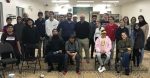
Teens from Temple Sholom and Al-Jamia Masjid at a dialogue session. (photo from Temple Sholom)

“We enjoy great conversation and great food and sharing some bad jokes,” Tariq Tayyib said in a recent phone interview. He was talking about the Jewish-Muslim dialogues that have been quietly underway between Temple Sholom and Al-Jamia Masjid. (Masjid is the proper Arabic name for what is often called a mosque, according to Tayyib.)

The dialogues began when Tayyib, a community volunteer involved in outreach efforts for Al-Jamia Masjid, and Haroon Khan, formerly its president and now trustee, came as observers to a Friday night service at Temple Sholom after arranging it with Rabbi Dan Moskovitz.

Tayyib and Khan have been hard at work over the past several months on an initiative called

Islam Unraveled, which seeks to explain Islam to the average Canadian and dispel stereotypes and misunderstandings.

“I wake up in the morning and turn on CNN and, more often than not, I find some crackpot doing something crazy in the name of Islam,” said Tayyib. “Muslims and non-Muslims both feel this way. Muslims are like, ‘Oh no, not another one,’ and non-Muslims are like, ‘What is it with this faith?’”

Tayyib and Khan spoke to Moskovitz about holding a dialogue, and Moskovitz suggested one for high school-age teens involved in the synagogue’s program and teens in the Al-Jamia community. In the following weeks, the teens met, and a series of other meetings occurred as well. The imam of Al-Jamia spoke at Temple Sholom to a group of seniors, and the Muslim group was invited to a Shabbat service and lunch afterward at Temple Sholom, catered by local Israeli vegan restaurant Chickpea. Following that, a delegation from Temple Sholom visited Al Jamia Masjid, bringing to a close a month of discourse events between the two communities.

Al-Jamia Masjid was founded in 1963. Khan’s father was instrumental in its founding. He said the masjid has been at the forefront of interfaith and multicultural work for generations.

“The masjid had a longstanding relationship with Rabbi [Philip] Bregman, and now with Rabbi Moskovitz,” said Khan.

In another dialogue event, Imam Aasim Rashid from the Al-Ihsan Islamic Centre in Surrey came to talk to the seniors. The meeting went well, even though the seniors asked some hard questions, according to Moskovitz – questions dealing with antisemitism in the Arab world and questions about the Israeli-Palestinian conflict, for example.

After expressing interest, Moskovitz was invited along with a group of other Temple Sholom members to the Al-Jamia, where they had a “wonderful visit.”

“Some of the members said that they had previously wanted to visit a mosque, but were unsure whether they would be welcome. It was meaningful to them to see how warmly they were met and embraced by the Al-Jamia community,” said the rabbi.

The visitors from Al-Jamia also enjoyed their Shabbat visit to Temple Sholom. “We saw many passages in the prayers which were reminiscent of the Quran,” they said. “We were very heartened by the welcome we received.”

The interaction between the teens, around 20 in total, has been particularly meaningful for both communities. The teens asked each other about their perceptions of the other community, and about similarities and differences in practice, comparing, for instance, kosher and halal.

“The questions tended to be more social and cultural than political or theological,” said Moskovitz. After the initial discussion, the teens went downstairs to hang out informally, and the adults report hearing sounds of lively and friendly conversation.

“We really saw the commonality that we share as being inspired by the Abrahamic principles and the teachings of the prophets,” said Khan. “All of the prophets of God carry a similar message. We have more in common than not. We should all make common cause to build bridges of understanding.”

Matthew Gindin is a freelance journalist, writer and lecturer. He writes regularly for the Forward and All That Is Interesting, and has been published in Religion Dispatches, Situate Magazine, Tikkun and elsewhere. He can be found on Medium and Twitter.

Format ImagePosted on December 8, 2017December 7, 2017Author Matthew GindinCategories LocalTags Al-Jamia Masjid, dialogue, interfaith, Temple Sholom, youth
More racist activities

More racist activities

(photo from Anti-Racist Action UVic/Facebook)

On Nov. 9, the anniversary of Kristallnacht, a swastika and “Heil Hitler” were found written on a hallway blackboard in the University of British Columbia Forest Sciences Centre. The antisemitic graffiti was first reported to Hillel BC, who then contacted security.

This was one of several racist incidents that have occurred on B.C. campuses and across Canada in recent months, including pro-Nazi posters found at UBC on Remembrance Day. On Halloween night and in the days following, posters reading, “It’s okay to be white,” appeared on several Canadian university campuses, apparently based on instructions from a post which Vice Canada traced to the anonymous online forum 4Chan, a hub for the alt-right.

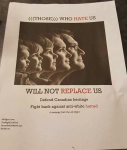
During the same week, antisemitic posters found at the University of Victoria read, “Those who hate us will not replace us. Defend Canadian heritage. Fight back against anti-white hatred. A message from the alt-right.” The word “those” was placed in triple parenthesis, a way of identifying Jews. When the posters were taken down, moderators of Anti-racist Action UVic Facebook page and others reportedly received a backlash of hateful messages online.

The election of Donald Trump one year ago this month is widely perceived as a triumph for the tangle of white supremacists, antisemites, misogynists, racists and ethno-nationalists who have come to be called the “alt-right.” In Kill All Normies, a book about the genesis of the group, journalist Angela Nagle describes an online world where cynicism, irony and absurd in-joke humour have combined with racism and misogyny to produce a “taboo-breaking anti-PC style” that has come to characterize the alt-right. Since then, the movement has tapped into latent racism and xenophobia, bolstered by the rise of people like Richard Spencer and Milo Yiannopoulos.

Not everyone is happy with the use of the term “alt-right.” Given their white supremacist beliefs, “alt-right” is somewhat innocuous. The Associated Press avoids the term because its editors think it downplays the movement’s racist goals.

Long before the 2016 election, the alt-right was gathering strength and allies. Trump granted the racists among his supporters visibility, lowering the social costs of bigotry and inspiring these supporters with a hope that their vision of “white identitarianism” could come to rule America once again. This has emboldened them and brought them out of the shadows.

In the days following the election of Trump, Canada saw a spate of vandalism, hate speech and pamphleteering directed against Jews and other minorities. As in the United States, this did not come to Canada overnight. In 2015, the CBC temporarily closed all online comments on stories featuring First Nations people because of the “staggering number of hateful and vitriolic comments” posted. In August 2016, the premier of Saskatchewan was forced to issue a plea for an end to hate speech following the second-degree murder of an aboriginal man on a farm. As a result, his own Facebook page was flooded with racist messages.

The posters at UVic were discovered by an anti-racist group on campus organized by Tyson Strandlund, who said the increasing activities of the alt-right in the public sphere are what led to his group’s creation in September. Strandlund said there has been heightened concern on campus since last summer, when an art installation meant to inspire conversations about resistance to racism was instead extensively defaced with racist slurs and had to be dismantled. He mentioned a meeting that was to take place in the Student Union Building on Nov. 15, for students and others to discuss anti-racist strategies.

David Blades, president of the Jewish Federation of Victoria and Vancouver Island, said they are “keeping close tabs” on the alt-right movement. “We have a good sense of who these people are,” he told the Independent. “What’s increasing is their public activity, not their numbers, which have remained pretty stable for years.

“Nevertheless,” he warned, “we have to be vigilant because they are also recruiting. There is no question that there is latent racism in Canadian society and it can be tapped into. My concern is that this was not isolated to the University of Victoria, this also happened at the University of Alberta and elsewhere. It was a coordinated national event. That’s my concern as Federation president. This is a shift in the overall organization of this group.”

Blades said he is “really happy with the response of UVic” and that there are plans in the works for “five days of activism against racism.”

“In some ways,” he said, “these incidents have been more effective at inspiring the opposite of what they intended: an increase in anti-racist activism.”

Matthew Gindin is a freelance journalist, writer and lecturer. He writes regularly for the Forward and All That Is Interesting, and has been published in Religion Dispatches, Situate Magazine, Tikkun and elsewhere. He can be found on Medium and Twitter.

Format ImagePosted on November 17, 2017November 15, 2017Author Matthew GindinCategories LocalTags anti-racism, British Columbia, David Blades, Federation, racism, Trump, Tyson Strandlund, UBC, UVic
Improving our inclusivity

Improving our inclusivity

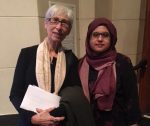
Rabbi Becky Silverstein, left, and Joanna Ware facilitated the Keshet program held in Vancouver last month. (photos from northeastern.edu and Jordyn Rozensky Photography, respectively)

Last month, a group of Greater Vancouver Jewish organizations sponsored a Keshet program for members of the community. Keshet provides training and support for Jewish clergy, educators, youth workers, counselors, allies and lay leaders to ensure that LGBTQ+ Jews are affirmed, celebrated and included in all Jewish educational and community settings.

The Oct. 22-23 weekend of training had its genesis in the efforts of Shelley Rivkin of the Jewish Federation of Greater Vancouver and Kevin Keystone, a former board member of Temple Sholom Synagogue, who has since moved to Toronto.

After the Union for Reform Judaism passed a resolution affirming the rights of LGBTQ+ people at their biennial meeting in 2015, Keystone brought a motion to the synagogue board to pass a supporting resolution, and recommended bringing Keshet to Vancouver.

“One of the most important reasons to bring in Keshet,” said Temple Sholom Rabbi Carey Brown, “was to present this important inclusion work within the framework of Jewish values and to address specific challenges within Jewish language and culture.”

When Keystone approached Federation, he found a sympathetic ear in Rivkin, who had previously attended a Keshet program. After being approached by the Vancouver Police Department about declaring the Jewish Community Centre of Greater Vancouver an LGBTQ+ safe space, Rivkin had become interested in supporting just such an initiative as Keshet, which she felt was long overdue.

Temple Sholom and Federation met with representatives of the JCCGV, Beth Israel, Or Shalom, Beth Tikvah, Har El, the Jewish Family Service Agency, Yad b’Yad, Hillel BC, and the Centre for Israel and Jewish Affairs. An agreement was reached to sponsor a training weekend, with Federation committing to contributing a significant amount of the funding.

“One of the most heartwarming things was to see how many synagogues and institutions said, ‘We want to be there, we want to help sponsor it,’” said Brown.

The two-day program was facilitated by Keshet’s Rabbi Becky Silverstein and Joanna Ware. It featured five sessions, including Beyond the (Cis)Gender Binary, which focused on youth workers and others interested in supporting youth in a variety of settings; and (Not So) Straight Talk about LGBT Inclusion, which was for Jewish communal professionals looking to explore LGBTQ+ inclusion from a Jewish perspective, and how it applies to their work. On the last day, there was a lunch and learn with Keshet at Hillel House on the University of British Columbia campus, which was open to students, faculty and community members, and two evening sessions. The Tachlis of Inclusion was billed as a more advanced look at LGBTQ+ inclusion, focusing on how board members can make their institutions more inclusive and embracing of LGBTQ+ families and individuals – participants took home an institutional self-assessment resource for further conversation within their organization. The other session, held at Suite Genius Mt. Pleasant and open to LGBTQ+ members of all ages and allies, was titled Intersections: Sharing Stories at the Intersections of Queer Jewish identities.

The community’s response to the training was favourable, with a post-event survey garnering positive responses and many people expressing gratitude for the training, said Rivkin. “Moving forward,” she said, “one thing we want to do is figure out where organizations are on a continuum towards inclusivity, and we need to look at that inventory and see where we want to be and what are some steps we can take.”

Alicia Fridkin, who self-identifies as a Jewish, queer, white settler activist and works as LGBTQ+ counsel for CIJA, had positive things to say about the event. “It was important to make some space for queer and trans Jews in Vancouver to come together around their identities, and to see that communities are committing to having a space for them,” said Fridkin. “It was a good reminder that we all have work to do, and also that we all have come a distance. It is important to give the LGBQT+ community more visibility. Also, the different Jewish communities in Vancouver tend to operate in silos. This was a good example of people coming together.”

Participants in the program are hoping to carry what they have learned into their institutional and personal lives. A group for queer and trans youth is in the planning stages at the JCCGV. Brown said Temple Sholom has begun a review of its infrastructure and communal language, and noted how the synagogue has already made some changes, such as calling people up to the Torah for aliyot according to their preferred pronouns.

Fridkin celebrates those kinds of initiatives. “People are very interested in being in a religious place that is inclusive,” she said. She hopes that these communal discussions about LGBQT+ people can be a model for becoming more inclusive and progressive on other issues, such as interfaith marriage and Israel/Palestine.

“We need to be open,” said Fridkin, “to the experience of the hurt that people in the community have who have been excluded for any reason, and work to address that.”

Matthew Gindin is a freelance journalist, writer and lecturer. He writes regularly for the Forward and All That Is Interesting, and has been published in Religion Dispatches, Situate Magazine, Tikkun and elsewhere. He can be found on Medium and Twitter.
Format ImagePosted on November 17, 2017November 15, 2017Author Matthew GindinCategories LocalTags Alicia Fridkin, inclusion, Jewish Federation, Keshet, LGBTQ, Shelley Rivkin, tikkun olam
Umbrella Shop to close

Umbrella Shop to close

Corry Flader, president of the Umbrella Shop. (photo from Corry Flader)

“He went around in Toronto on a bicycle repairing people’s umbrellas,” Corry Flader told the Jewish Independent. “He would knock on people’s doors.”

Flader is sharing how her grandfather Isadore (Izzy) survived and supported his young family in the 1930s. Izzy had come to Canada in 1910 from Poland and, a couple of decades later, married Ida.

“He would sit on people’s stoop and repair their umbrellas, and then move to the next house. It just metamorphosed. He met a guy who was a train porter and he said, ‘You know, if you want to make umbrellas, there’s a city named Vancouver where it rains 365 days a year.’ So, he goes home and says, ‘Ida, pack it up, we’re going to Vancouver.’… They pack up the four kids and enough kosher salami to last the train ride, and there they went.”

Since its beginnings 82 years ago, the various iterations of the Umbrella Shop have accumulated plenty of customers. At times, Flader’s family has sold 20 different styles of umbrellas, each in a variety of colours, designs and prints. For decades, it was one of the most popular places in the city to get your hands on a quality umbrella. But now, the Umbrella Shop, a third-generation business, will close its doors at the end of December.

Flader vividly recalls her family setting up in Vancouver’s Jewish community and opening their first store. “My dad told me he remembers looking for a house, and he finally bought one slated for demolition,” she said. “So him and the two older boys, who I think were between 10 and 13, began saving the place. My dad Charlie would have been around 3.”

That first shop was Vancouver Umbrella on the corner of Pender and Howe, which lasted until 1972. “I was the delivery girl,” said Flader. “I used to go pick up patio umbrellas in my dad’s 1969 station wagon. Many of your readers may remember me coming by to pick up their patio umbrellas for a re-cover, and they would give me a cool lemonade on a hot summer day or something.”

In the 1960s, Izzy’s son-in-law, Peter Hochfelder, was brought into the business. In 1972, Izzy and his son Norman sold their shares; a few years later, Sam retired. From that time, the owners were Charlie and Hochfelder. That shop ran until 1982, on Hastings Street, and then Charlie sold his shares to Hochfelder.

Corry’s brother Glen and Glen’s wife, Nancy, started GF Umbrella Shop Ltd. Corry helped them at the beginning, after which she became a school teacher. GF Umbrella Shop was on Pender between Richards and Seymour for almost 20 years. In 2001, Glen became ill and Corry became a partner and joined him in the business. They opened the Umbrella Shop on Granville Island in 2003.

“I love umbrellas, they are in my soul,” said Corry Flader. “It was my first job and my last.”

Some people have mistaken Vancouver Umbrella, in Richmond, for the Umbrella Shop, because the two independent businesses share the same roots. Hochfelder, his wife Cheryl and daughter Shawna started up Vancouver Umbrella, and Shawna is the company’s current president. In an interview with the Georgia Straight, she assured customers that their shop is not closing down and that they will continue to make and sell umbrellas.

From humble beginnings, the Umbrella Shop became a Vancouver institution spanning three generations. Flader told the CBC that her decision to close was based on health reasons. Since she made the announcement, she has received countless appreciative letters and visits from journalists. It is an establishment that will be missed.

Matthew Gindin is a freelance journalist, writer and lecturer. He writes regularly for the Forward and All That Is Interesting, and has been published in Religion Dispatches, Situate Magazine, Tikkun and elsewhere. He can be found on Medium and Twitter.
 

Format ImagePosted on November 10, 2017November 9, 2017Author Matthew GindinCategories LocalTags business, Corry Flader, Umbrella Shop
Waters’ Vancouver talk

Waters’ Vancouver talk

Martha Roth, left, and Itrath Syed. (photo by Matthew Gindin)

“I don’t get why people cannot look straight at what’s happening in the occupied territories and see it for what it is,” Roger Waters said to a full house at St. Andrew’s-Wesley Church on Oct. 26. “There’s a word for what is happening there: ethnic cleansing.”

The event took place a few days before the end of Waters’ cross-Canada Us and Them Tour, the final leg of a North American tour that kicked off almost a year ago. The primary songwriter behind Pink Floyd albums like The Wall and Dark Side of the Moon was invited to speak by Independent Jewish Voices (IJV). Among talk sponsors were IJV, CanPalNet, Seriously Free Speech, Not in Our Name, and Solidarity for Palestinian Human Rights. Waters was interviewed by Martha Roth, co-chair of IJV Canada, and Itrath Syed, a professor at Langara College.

Many in the Jewish community were opposed to his speaking, accusing Waters of antisemitism and anti-Israel bias. B’nai Brith Canada made a documentary called Wish You Weren’t Here and followed him around Canada showing it in conjunction with his concerts. A week before the talk, the Centre for Israel and Jewish Affairs sent out a mailing identifying Waters as “the rock musician obsessed with boycotting Israelis” who has become “the face of the hateful BDS movement.” An online petition called for the talk to be canceled.

At the church, Waters said his genesis as a BDS (boycott, divest from and sanction Israel) activist happened after a 2006 trip to Israel. “I was going to do a gig in Tel Aviv,” he said, “and I started to get emails from Palestinians and others who said that might not be such a good idea due to this very new movement started by Palestinian civil society called BDS, and they tried to prevail on me to cancel the gig. As an act of compromise, I moved the show to Neve Shalom, where they grow chickpeas and there are Jewish people living there, Arabs living there and Christians living there. All of their children go to school together, so it’s a lovely experiment in what can happen when people don’t fixate on all the things that we disapprove of in each other.”

photo - A small group of protesters met across the street from the church, draped in Israeli flags and carrying signs
A small group of protesters met across the street from the church, draped in Israeli flags and carrying signs. (photo by Matthew Gindin)

Waters returned the next year for a tour of the territories with UNRWA and became a convert to BDS. “Since then, I’ve tried to open my big mouth as often as I can,” he said. “It’s been a long, quite trying, difficult road, not nearly as hard and trying, obviously, as living under occupation. The blackening of my name is just one more way of obscuring the truth. They want to stop the public discourse where people tell the truth about what happened in ’47-’48, what happened in ’67, in ’73, what’s happening now.”

Waters praised young Jews opposing the occupation. He said, “If you look at polls now, you find that younger Jewish people are no longer looking at the situation and not seeing anything. They’re saying, ‘This is not what Judaism is about, this does not represent the way I feel, it goes against everything I believe in with my heart. I am a human being, I am humane, and I do not want my people or anyone who pretends to represent me to behave like this. It’s happening, and it lightens my heart every time I hear someone speak out. It’s great.”

Waters also discussed his communist mother’s tutelage of him as a social justice activist, his opposition to the Trump administration, capitalism and militarism, and the inspiration behind songs on his recent album Is This the Life We Really Want?

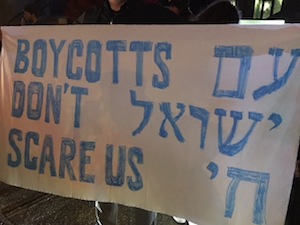
A small group of protesters met across the street from the church, draped in Israeli flags. One entered the talk and unfurled a banner reading, “Boycotts Don’t Scare Us – Am Yisrael Chai,” before being peacefully removed. A college-age Israeli protester held a sign saying, “Israeli Lives Matter” and told the Independent that what was going on inside was “just like Nazi Germany.”

IJV sent someone out to invite the protesters in afterward for dialogue. While they declined, one Jewish protester exchanged phone numbers with a Palestinian from Gaza who had approached the group, agreeing to meet later and talk.

Matthew Gindin is a freelance journalist, writer and lecturer. He writes regularly for the Forward and All That Is Interesting, and has been published in Religion Dispatches, Situate Magazine, Tikkun and elsewhere. He can be found on Medium and Twitter.

Format ImagePosted on November 3, 2017November 1, 2017Author Matthew GindinCategories LocalTags anti-Israel, IJV, Martha Roth, Roger Waters
A widening community

A widening community

Alex Cristall, general chair of the Jewish Federation of Greater Vancouver’s annual campaign, has pledged $250 for every new donation this year or donation from someone who didn’t donate last year. (photo from JFGV)

The hashtag for this year’s Jewish Federation of Greater Vancouver annual campaign is #WeCan’tAffordToLoseThem. “We want to make everybody feel needed and part of the community. For the health of our community, we need everybody,” explained Alex Cristall, general chair of the campaign.

“Last year, due to the times, we focused on security. This year, it’s about affordability and connectedness,” he said. “If you live in the core, where we have a lot of infrastructure, it is extremely expensive, even people of means struggle. When you add being Jewish on top of that – sending your kids to Jewish day school, going to summer camp – it’s costly. It’s also very expensive for seniors. People are making decisions that it’s too expensive to be Jewish. That’s a big issue. We want to make it easy to live a meaningful Jewish life.”

For this year’s campaign, Cristall has pledged $250 for every new donation or donation from someone who didn’t donate last year, a fact he’s eager to get out to the community. “The last couple of years, we’ve had some real success with the growth of our campaigns, but we’ve also had a number of donors that we’ve lost,” he said. “We want people to know that every donor counts, no matter what the dollar value is, because when people get involved and give, that’s how you grow community.”

Federation has been working to expand its reach to the Jewish communities developing in regions outside of the city. “This is the first time that half of our growing population lives outside of Vancouver,” said Cristall. “We have to figure out a way to get services out to Surrey, Burnaby, Langley, the Tri-Cities, North Vancouver. We’re going to see continued Jewish growth in the suburbs. The big push is to help our partners reach these people and connect them to the community.

“To that end,” he said, “the Federation has had events in Port Moody, [and supported] a camp out in the Tri-Cities, with kids coming in from Langley. We’re increasing our subsidies to schools, camps, the JFSA [Jewish Family Service Agency], so that everyone who wants to participate can find a way to participate. If you live in the city, we want to make it affordable and accessible and, if you live out in the suburbs, to make them feel part of the community and to embrace them.”

This is the second year of Cristall’s time as campaign chair. “I have a great cabinet with me,” he said. “We’re all equals but, for these two years, I’m the voice of the campaign. The core message we’re trying to convey is ‘building community,’ helping people to live meaningful Jewish lives.”

Despite the centrality of fundraising to the Jewish Federation’s activities, giving money is not the only way to help Federation serve the Jewish community.

“Volunteering, reaching out to more donors, canvassing, boards, different agencies, coming to events – our job is to fundraise for these agencies, give up some time. There is a spot for everybody to help,” said Cristall.

Asked how he got involved serving the community, Cristall pointed to his parents, Lorne and Sylvia Cristall, decades-long philanthropists and volunteers in the Jewish and general communities.

“As a kid,” he added, “I also went to Jewish day school, to summer camp. I was always very involved in the community. I’ve benefited from being part of the community and it feels good to give back.”

For more information about the campaign and to donate, visit jewishvancouver.com.

Matthew Gindin is a freelance journalist, writer and lecturer. He writes regularly for the Forward and All That Is Interesting, and has been published in Religion Dispatches, Situate Magazine, Tikkun and elsewhere. He can be found on Medium and Twitter.

Format ImagePosted on October 6, 2017October 5, 2017Author Matthew GindinCategories LocalTags Alex Cristall, annual campaign, Jewish Federation
Three Vets closes this month

Three Vets closes this month

Jerry, left, and Keith Wolfman. (photo by Matthew Gindin)

I’m vacillating between anxiety and bliss,” said Jerry Wolfman. After 50 years of working alongside his younger brother Keith in what was once their father’s store, Vancouver’s Three Vets is coming to an end.

“The anxiety comes from thinking about what happens the day after the doors close,” Jerry explained to me from behind one of the two cash registers at the front of the store. “The bliss comes from the freedom that will follow.”

photo - Three Vets has always been bustling
Three Vets has always been bustling. (photo from the Wolfmans)

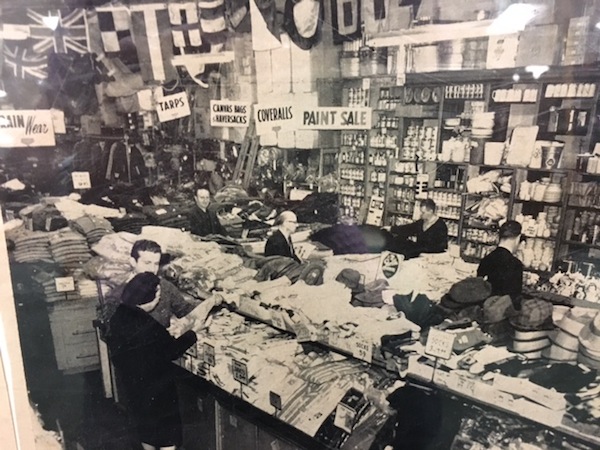
The camping equipment and military surplus store first opened its doors 70 year ago, at Prior and Main streets. The building of the Georgia Viaduct forced the store’s move to its current location, on Yukon Street at 6th Avenue, which will close Oct. 29. A giant banner over the front door announces, “Closing Out Sale: Up To 70% Off!”

Inside, the shelves are still littered with camping goods, gadgetry, clothing and hunting equipment. Through a small door on a side wall, First Nations masks and decorated wooden paddles can be glimpsed, belonging to Jerry’s other business, selling indigenous arts and crafts, which, he said, he plans to continue.

Keith is a little more sanguine about the future, at least on the surface. “What am I going to do? I’m going to take a chair yoga class and go swimming at the JCC.” He said he might also help members of his family with their business or kibitz around with other side projects.

Both Keith and Jerry grew up helping in the store, which was founded by their father, Bill Wolfman, and two other army veterans. Wolfman senior began the business with the idea of ending a shortage of bedding in logging and mining camps by using military surplus.

Keith and Jerry’s early trajectories seemed to point away from involvement in the business. Jerry went to college to study anthropology but didn’t see a future in it. Keith went traveling, at one point backpacking overland from Istanbul to Kathmandu through Iraq, Iran and Pakistan. Both brothers made their way back to their father’s store in their 20s, however, and haven’t left.

photo - Keith, left, Jerry and their mother Esther in years past
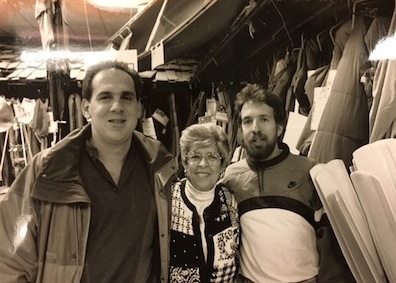
Keith, left, Jerry and their mother Esther in years past. (photo from the Wolfmans)

Jerry said it was their love of camping and the outdoors that resulted in the expansion of the store from a military surplus provider to “the great outdoor store” their sign declares them to be. Eventually, their range of merchandise expanded even further, to include housewares, emergency preparedness supplies, rain gear, travel accessories and other odds and ends that struck the brothers’ fancies. They also offered repairs for lanterns and stoves. The business often served police officers, firemen, ambulance personnel and film crews.

Some years ago, Keith and Jerry were approached by a land developer to sell the store, but they refused. The next offer they received was too good to turn down.

Other factors influencing their decision to close up shop, said Jerry, was the increase in big-box competitors, the growth of the online marketplace and increasing property taxes.

Earlier this year, on April 24, Three Vets announced the closure on its Facebook page. “It has been an absolute pleasure helping all of you with your outdoor needs,” said the statement. “We have enjoyed helping you get ready for camping trips, hiking treks, summer camp and other outdoor activities and we loved hearing about your adventures when you returned home. We can’t thank you enough for all the support you have offered us over the years.”

The Wolfman brothers have not just received support but given it in abundance, supporting a number of causes and organizations in the Jewish and general communities.

Matthew Gindin is a freelance journalist, writer and lecturer. He writes regularly for the Forward and All That Is Interesting, and has been published in Religion Dispatches, Situate Magazine, Tikkun and elsewhere. He can be found on Medium and Twitter.
 

Format ImagePosted on October 6, 2017October 5, 2017Author Matthew GindinCategories LocalTags business, Jerry Wolfman, Keith Wolfman, Three Vets
Controversy over Icke’s talk

Controversy over Icke’s talk

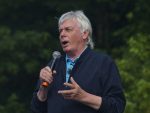
David Icke spoke in Vancouver earlier this month at the Orpheum. (photo by Tyler Merbler via cjnews.com)

David Icke – a controversial conspiracy theorist, antisemite and Holocaust denier – spoke in Vancouver at the Orpheum on Sept. 2, despite the city’s civic theatres board’s recommendation to Mayor Gregor Robertson and city council that Icke’s booking be canceled.

In a statement quoted in the Vancouver Sun, the city said that under the Charter of Rights and Freedoms, “the city is not in a position to take action intended to censor speech that is otherwise permissible under Canadian law.”

Icke is a British author and speaker known for his bizarre views. A former football player and sports broadcaster for the BBC, Icke was once also a spokesperson for the U.K. Green Party. All that changed in 1990, when, by his own account, a psychic told him that he had a special mission on earth and would soon begin receiving messages from the spirit world. The following year, he announced on primetime British television that he was “the son of godhead” (also a title of Jesus Christ’s) and predicted global natural disasters to come.

Over the next several years, Icke developed his worldview, which has been called “new age conspiracism.” He described himself as “a full-time investigator into who and what are really controlling the world.” In his 1994 book The Robots Rebellion, he answered the question by singling out Jews. But, he also argued that the really major players in world dominion were an ancient order of shapeshifting, blood-drinking reptilian humanoids called the Babylonian Brotherhood. Their goal, according to Icke, is the creation of a neo-fascist global state, known as the New World Order.

When Icke added Holocaust denial to his worldview in his 1995 book And the Truth Shall Set You Free, his publisher felt he had crossed a line. As a result, that book, and Icke’s subsequent works, were published at his own expense.

Icke combines familiar New Age philosophies with conspiracy theories about public figures being reptilian humanoids and pedophiles. He believes in reincarnation, a collective consciousness that has intentionality and the “law of attraction” (that good and bad thoughts can attract like experiences).

According to a report by Political Research Associates – an American nonprofit research group that studies white supremacist groups and militias – Icke’s ideas are “a mishmash of most of the dominant themes of contemporary neofascism, mixed in with a smattering of topics culled from the U.S. militia movement.” The same report details the support that Icke has gotten from far-right and neo-Nazi groups, including the violent U.K. group Combat 18, which was linked to bombings of minority neighbourhoods in London.

Aiden Fishman of B’nai Brith Canada described Icke’s views as “classic antisemitic ideas” and said the booking should never have been allowed. “It’s totally, totally incompatible with the city of Vancouver’s role as an open and tolerant multicultural municipality to allow Mr. Icke to speak at a city-owned facility after we’ve brought all these concerns to their attention,” Fishman told CBC News.

“You are free to be a racist in Canada, you are free to say so and tell others that they should be, too,” Micheal Vonn, policy director of the B.C. Civil Liberties Association, told the CJN. “But this is not just about Mr. Icke’s rights. Everyone who comes to see him has their Charter rights involved, as well. The government should not be in a position to prevent you from hearing what you would like to hear.”

To those who say that the talk should not have been held at a city-owned venue, Vonn said: “The city does not support this, the city is neutral with regards to the content. Can you imagine if the city could pick and choose who among the public they allowed to make use of the venue? They can’t be cherry-picking what members of the public get that benefit. The city can’t be saying this is available only to people that we like. It is, as it should be, available to all members of the public involved in lawful activity.”

To be unlawful, Icke’s speech would have to constitute criminal hate speech, which has a high burden of proof in Canada. “He would need to be intentionally and explicitly inciting harm,” said Vonn.

An admittedly unscientific Vancouver Sun poll asking whether the event should be canceled, showed that most readers supported Icke’s right to free speech, with more than 81% of respondents saying the show should go on.

Despite significant coverage of the event leading up to the talk, Icke’s lecture, which he claimed would last 10 hours, apparently failed to attract a media presence. Nor have there been any allegations of criminal hate speech.

Matthew Gindin is a freelance journalist, writer and lecturer. He writes regularly for the Forward and All That Is Interesting, and has been published in Religion Dispatches, Situate Magazine, Tikkun and elsewhere. He can be found on Medium and Twitter. A longer version of this article was originally published by CJN.
Format ImagePosted on September 29, 2017September 28, 2017Author Matthew GindinCategories LocalTags antisemitism, David Icke, free speech
Bar mitzvah is musical’s hook

Bar mitzvah is musical’s hook

Clockwise from the top: Jason Sakaki (Brett), Julia Mclean (Patrice), Graham Verchere (Evan), Julian Lokash (Archie), Emma Leblanc (ensemble) and Rachel Valentina (ensemble). (photo by Anita Alberto)

Jason Robert Brown’s 13: The Musical, a show that centres around the bar mitzvah of its young hero, Evan Goldman, will première in Vancouver on Sept. 28, presented by Bring On Tomorrow Co.

Concerned both with authenticity and sensitivity with regards to the show’s Jewish content, director Chris Adams invited Congregation Beth Israel Rabbi Adam Stein to meet with the cast and crew after a rehearsal Aug. 29. The Jewish Independent was invited to attend.

13 was the first-ever Broadway show to feature an all-teenage cast when it debuted in 2008. The cast of the local production is an accomplished team of professional young actors who have appeared on such networks as ABC, NBC, CBC, Disney and FX. They were dynamic, cheerful and attentive throughout Stein’s visit, laughing at his jokes and making a few of their own as well. The rabbi, who himself has a background in theatre, seemed right at home.

The musical follows 12-year-old Evan Goldman, a Jewish kid from New York who moves to a small town in Indiana after his parents’ divorce. A fish out of water, the story details his struggle to adapt to his new community and make friends, with a key plot point centring around him trying to get the cool kids to come to his bar mitzvah, and the rite of passage that results as Evan’s perspective matures.

Stein explained the meaning of the bar mitzvah ritual to the cast, saying that the passage into adult moral responsibility is at its core. He also described some of the details of the synagogue ceremony. In 13, Goldman is heard singing one line of his Haftarah and Stein explained its meaning and checked the trope in the script, which was correct.

The rabbi also explained the meaning of the tallit and tefillin the bar mitzvah boy would begin wearing, and advised the cast about how the tallitot in the show should be handled – for starters, don’t hold them by the tzitzit (fringes). They also discussed how to stage and choreograph the synagogue scene, and debated how to costume the actors who appear in a dancing rabbis scene. Stein helped the cast imagine the layout of a synagogue, and suggested that having all the rabbis look like Chassidim would be stereotyping.

13: The Musical was penned by young adult novelist Dan Elish with TV producer and writer Robert Horn. Starring as Evan is Graham Verchere, 15, whose recent credits include Theatre in the Raw’s The Raymur Mothers and Arts Club Theatre’s A Christmas Story. Graham is a regular on the FX series Fargo and will appear in ABC’s The Good Doctor, which premières Sept. 25.

The Bring On Tomorrow cast also includes Jewish community member Julian Lokash, who just had his own bar mitzvah 15 months ago. “I first heard about the play at my own bar mitzvah,” Julian told the Jewish Independent. “Friends of mine who were there are now in the cast for this production.”

Asked if he played an ambassadorial role as the only Jewish actor in the play, Julian said he wouldn’t quite say that, but he did feel called to a certain degree of leadership. “Everyone turned to me when they had a question,” he admitted.

Julian’s acting credits include Theatre Under the Stars’ Shrek, Oliver! and Beauty and the Beast; the lead role of James in Carousel Theatre for Young People’s James and the Giant Peach; and roles in Gateway Theatre’s Music Man and Famous Artists Ltd.’s Mrs. Claus’ Kitchen.

13 director Adams is joined by vocalist Monique Creber as musical director. The production company, Bring On Tomorrow Co., is a collective of artists founded in 2016. The group “aims to assemble the city’s brightest professional theatre talent with award-winning musical artists to mount productions monumental in scale, energy and sound.”

Asked why Bring On Tomorrow was inspired to produce this show, Adams told the JI that it was all based “around the kids.”

“We knew we had the talent out there to present this show,” he said. “We wanted to give these professionals an opportunity to be leads…. Often kids in this city play the ‘kids’ roles. Well, in 13, every role is made for kids. They have to step it up because there isn’t a cast of professional adults driving their own show. It really is a wonderful challenge and something that a lot of them don’t get to experience every day.”

13 runs Sept. 28-Oct. 1 and Oct. 4-8 at the Waterfront Theatre. For tickets and more information, visit bringontomorrowco.com.

Matthew Gindin is a freelance journalist, writer and lecturer. He writes regularly for the Forward and All That Is Interesting, and has been published in Religion Dispatches, Situate Magazine, Tikkun and elsewhere. He can be found on Medium and Twitter.
Format ImagePosted on September 22, 2017September 28, 2017Author Matthew GindinCategories Performing ArtsTags bar mitzah, Judaism, Julian Lokash, musical theatre

Posts pagination

Previous page Page 1 … Page 4 Page 5 Page 6 … Page 11 Next page
Proudly powered by WordPress