Skip to content
  • Home
  • Subscribe / donate
  • Events calendar
  • News
    • Local
    • National
    • Israel
    • World
    • עניין בחדשות
      A roundup of news in Canada and further afield, in Hebrew.
  • Opinion
    • From the JI
    • Op-Ed
  • Arts & Culture
    • Performing Arts
    • Music
    • Books
    • Visual Arts
    • TV & Film
  • Life
    • Celebrating the Holidays
    • Travel
    • The Daily Snooze
      Cartoons by Jacob Samuel
    • Mystery Photo
      Help the JI and JMABC fill in the gaps in our archives.
  • Community Links
    • Organizations, Etc.
    • Other News Sources & Blogs
    • Business Directory
  • FAQ
  • JI Chai Celebration
  • JI@88! video

Recent Posts

  • Story of Israel’s north
  • Sheltering in train stations
  • Teach critical thinking
  • Learning to bridge divides
  • Supporting Iranian community
  • Art dismantles systems
  • Beth Tikvah celebrates 50th
  • What is Jewish music?
  • Celebrate joy of music
  • Women share experiences 
  • Raising funds for Survivors
  • Call for digital literacy
  • The hidden hand of hate
  • Tarot as spiritual ritual
  • Students create fancy meal
  • Encouraging young voices
  • Rose’s Angels delivers
  • Living life to its fullest
  • Drawing on his roots
  • Panama City welcoming
  • Pesach cleaning
  • On the wings of griffon vultures
  • Vast recipe & story collection
  • A word, please …
  • מארק קרני לא ממתין לטראמפ
  • On war and antisemitism
  • Jews shine in Canucks colours
  • Moment of opportunity
  • Shooting response
  • BC budget fails seniors
  • Ritual is what makes life holy
  • Dogs help war veterans live again
  • Remain vital and outspoken
  • An urgent play to see
  • Pop-up exhibit popular
  • An invite to join JWest

Archives

Follow @JewishIndie
image - The CJN - Visit Us Banner - 300x600 - 101625

Byline: Matthew Gindin

Faculty boycott Hillel

Faculty boycott Hillel

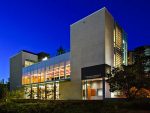
Hillel House building at the University of British Columbia. (photo from Hillel BC)

The University of British Columbia Geography Students Association (GSA) recently canceled a gala that was to take place in rental space owned by UBC’s Hillel chapter, due to pressure from some of the faculty in the department of geography.

The faculty members said they insisted on boycotting the event because of what they called the “controversial” and “political” nature of Hillel, according to numerous reports. The faculty members had not been publicly identified as of press time and could, therefore, not be located to clarify their position.

The Centre for Israel and Jewish Affairs (CIJA) has accused them of boycotting the GSA gala based on the perception that Hillel supports the state of Israel, which CIJA is calling discriminatory.

“Boycotting Jews or a Jewish organization simply because you object to the state of Israel’s policies is classic antisemitism,” said Nico Slobinsky, CIJA’s director for the Pacific region.

“It is hard to believe that there is such blatant antisemitism on a Canadian university campus in 2018. There should be zero tolerance for any expressions of discrimination, racism and antisemitism on campus and anywhere else in Canada.”

Samuel Heller, the assistant executive director of Hillel BC, told the CJN that, “The actions of these faculty members have resulted in a de facto boycott of the Jewish student centre on campus. To boycott Jews based on one’s political views about Israel is discriminatory and antisemitic. Their actions have led to the resignation of the lone Jewish student on the executive of the GSA, as he felt marginalized and discriminated against because of his Jewishness.”

Addressing the claim that Hillel is a controversial and political space, Heller said, “Hillel doesn’t have any politics. What these faculty members really object to is Hillel’s support of Israel’s existence. We are a Jewish organization and Israel is a part of Jewish identity.… To demand that Jews disavow parts of our identity to placate faculty members is wrong and discriminatory.”

But not everyone accepts Heller’s characterization of Hillel as “having no politics.” The Progressive Jewish Alliance at UBC (PJA) released a statement on Facebook on March 16, saying: “While we recognize the right of the GSA to move the gala based on political considerations, we urge the GSA to recognize that Hillel is the physical Jewish space on campus, alongside having a political position. While we wait for a statement from the GSA, we would like to point out that the ramifications of their decision are alienating Jewish students on campus. Likewise, we encourage Hillel to consider how their political positions, such as an opposition to all boycotts of Israel, can alienate other Jewish and non-Jewish organizations and students.”

The PJA is referring to Hillel International’s Standards of Partnership, which state that Hillel will not partner with, house or host organizations, groups or speakers that deny the right of Israel to exist as a Jewish and democratic state with secure and recognized borders; delegitimize, demonize or apply a double standard to Israel; or support the boycott of, divestment from or sanctions against the state of Israel.

In 2012, concerns about Hillel’s refusal to partner with Jewish organizations that support the BDS movement led to the formation of Open Hillel, an organization that agitates for Hillel to end the Standards of Partnership.

Numerous controversies have broken out over Hillel boycotting groups or individuals in recent years. In one example, in March 2017, B’nai Keshet, a queer Jewish group at Ohio State University, co-sponsored a Purim fundraiser for LGBTQ refugees in the Columbus area. Because Jewish Voices for Peace, an organization that supports BDS, was one of the sponsoring groups, OSU Hillel cut ties with B’nai Keshet, due to pressure from Hillel International, prompting students on numerous American campuses to hold “solidarity Shabbats” with the LGBTQ group. In June, a letter calling for the end of the standards was signed by more than 100 rabbis and submitted to Hillel.

The UBC Progressive Jewish Alliance hopes that the controversy will not only provoke change in the GSA, but in Hillel, as well.

“We hope that both organizations take this opportunity to engage in genuine dialogue around the complexity of politics and place,” it concluded in a statement.

Philip Steenkamp, the vice-president of external relations at UBC, told the CJN that the university is “aware of concerns that have been expressed by CIJA” and “are looking into this matter and will follow due process to ensure it is appropriately addressed.”

Matthew Gindin is a freelance journalist, writer and lecturer. He writes regularly for the Forward and All That Is Interesting, and has been published in Religion Dispatches, Situate Magazine, Tikkun and elsewhere. He can be found on Medium and Twitter. This article was originally published by the CJN.
Format ImagePosted on March 30, 2018March 29, 2018Author Matthew GindinCategories LocalTags antisemitism, BDS, British Columbia, Hillel, Israel, UBC
Is it genocide in Myanmar?

Is it genocide in Myanmar?

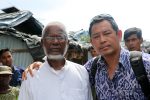
Maung Zarni, right, with a 67-year-old Rohingya man from Maungdaw, who had been a leader at a township level in former prime minister Ne Win’s early days, when Rohingyas were recognized as an ethnic community with full citizenship rights. (photo from Maung Zarni)

Calls are mounting to recognize Myanmar’s violent campaign against the Rohingya as genocide. At the United Nations’ Human Rights Council in Geneva on March 12, Yanghee Lee, special rapporteur on the human rights situation in Myanmar, said she is “becoming more and more convinced that the crimes committed … bear the hallmarks of genocide and call[s] in the strongest terms for accountability.”

Nearly 800,000 Rohingya have fled state-sanctioned and -organized violence in Myanmar (Burma) since August 2017, after the government – blaming an alleged attack on Myanmar’s security forces by Rohingya militants – initiated a brutal campaign of arson, murder and systematic rape and torture against the civilian Rohingya population in Rakhine state. The violence follows decades of oppressive measures against the Rohingya, which, in recent years, have included restrictions on education and medical care, deliberate starvation, state-imposed birth control, property seizure, and removal of citizenship and civil rights.

“These human rights violations constitute nothing less than a slow-burning genocide,” human rights activist Maung Zarni, founder of the Free Burma Coalition, told the Jewish Independent.

With respect to the situation in Myanmar, for months terms like “atrocities,” “military crackdown” or “state-sanctioned violence” have been used to describe it, instead of using the word “genocide.” The UN has previously called what is happening in Myanmar, a majority Buddhist country, whose dominant ethnic group is Bamar, “ethnic cleansing.”

There have been some exceptions to the hesitancy to call the government’s actions genocide. For example, French President Emmanuel Macron called it that last September. And independent tribunals and experts like the International State Crime Initiative and the Permanent Peoples’ Tribunal have also called it genocide. But the media and other international organizations have generally not been using the word.

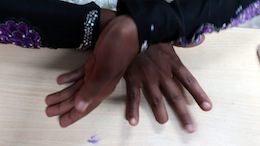
photo - A young girl in a displaced person’s camp shows how her hands were tied behind her while she was raped; one of her finger tips was cut off for resisting
A young girl in a displaced person’s camp shows how her hands were tied behind her while she was raped; one of her finger tips was cut off for resisting. (photo from Maung Zarni)

“There is a high barrier for the use of the term genocide, and I think this is correct,” said Rainer Schulze, professor of modern European history at the University of Essex and founder of The Holocaust in History and Memory journal, speaking at the Berlin Conference on Myanmar Genocide Feb. 26, which the Jewish Independent attended. “We should not use the term genocide lightly. Not every human rights violation, ethnic cleansing or forced resettlement is a genocide. The Genocide Convention gives us a very clear definition, but, with regards to the Rohingya, it is appropriate and must be used.”

Gianni Tognoni, general secretary of the Permanent Peoples’ Tribunal in Rome, agreed. “The UN has been playing with names,” he said at the conference. “To declare something as genocide is to declare it as something intolerable for the international community. Instead, this is delayed.”

“Governments, in general, are very reluctant to use the term genocide for fear that it could damage diplomatic initiatives to secure peace or damage bilateral relationships,” Kyle Matthews, executive director of the Montreal Institute for Genocide and Human Rights Studies at Concordia University, said in conversation with the Independent. “In some cases, governments have refused to label atrocity crimes as a genocide for fear it would force them to take a stronger response, such as intervening militarily.”

The Convention on the Prevention and Punishment of the Crime of Genocide adopted by the UN in 1948 obliges signatories to take concrete steps to respond to genocide. As of December 2017, 149 states had ratified or acceded to the treaty, including Canada. In 2005, all member states of the UN endorsed the Responsibility to Protect (R2P) doctrine, a doctrine Canada was instrumental in promoting. The Canadian government continues to avoid the term genocide, however – although it has taken some steps towards addressing the situation.

“I would say the Canadian government has been one of the most responsible and thoughtful governments in trying to find a solution to protect the Rohingya minority in Myanmar and in neighbouring countries,” said Matthews. “Ottawa has appointed Bob Rae as special envoy to the prime minister to help identify different policy options and strategies for engaging the government of Myanmar. Ottawa also recently imposed economic sanctions on leading figures in Myanmar’s military.”

On Feb. 16, the federal government imposed sanctions, under Canada’s new foreign human rights legislation, against Maung Maung Soe, a high-ranking member of the Myanmar military. “What has been done to the Rohingya is ethnic cleansing,” Foreign Affairs Minister Chrystia Freeland told CBC in a statement that did not use the word genocide. “This is a crime against humanity.”

The sanctions impose a “dealings prohibition,” which freezes an individual’s assets in Canada and renders them inadmissible to enter Canada under the Immigration and Refugee Protection Act.

Matthews said there is much more that we could be doing. Speaking at the Berlin conference, he said, “Broader economic sanctions have to be done immediately. We should look at travel restrictions. We need to demand humanitarian access to Rakhine state [where the remaining Rohingya live, access that is currently denied by Myanmar]. We need to do more economic naming and shaming of who is associating with the regime. Myanmar embassies around the world should be protested.” The government should issue a travel advisory, he said, warning “you are going to a state that is now committing genocide.”

Matthew Gindin is a freelance journalist, writer and lecturer. He writes regularly for the Forward and All That Is Interesting, and has been published in Religion Dispatches, Situate Magazine, Tikkun and elsewhere. He can be found on Medium and Twitter.

Format ImagePosted on March 23, 2018March 22, 2018Author Matthew GindinCategories WorldTags genocide, human rights, Myanmar, refugees, Rohingya, United Nations
Transforming Judaism

Transforming Judaism

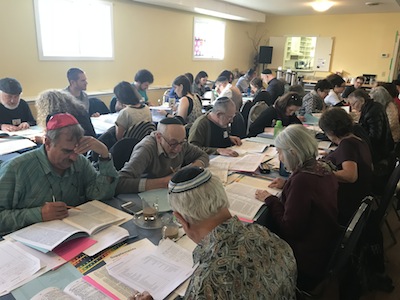
Rabbi Benay Lappe, founder and rosh yeshivah of Svara, in Chicago, taught Talmud at Congregation Or Shalom earlier this month. (photo from Or Shalom)

“For all you straight folks, let me tell you – you’re all queer. Your job is to find that queer part of you, wear it on you, walk it through the world. That’s how the world changes.”

Rabbi Benay Lappe, founder and rosh yeshivah of Chicago’s Svara: A Traditionally Radical Yeshivah, made this observation during a lecture at Congregation Or Shalom on March 10. Lappe is a passionate and unique teacher of Talmud, who is “dedicated to bringing the Talmud to the 99%,” meaning the majority of Jews who do not study it.

As Lappe explained at Or Shalom, there are three kinds of queer. The first refers to, as she put it, “me, a lesbian woman, and other people with non-heteronormative sexualities or folks who are trans or non-gender-conforming. The second refers to those who ally themselves with queers, embracing queer culture and rights. The third category is someone profoundly ‘othered’ or marginalized, who owns that experience and walks it through the world as a critique to the mainstream.”

It is in the third sense of the word that Lappe addressed the audience. “The rabbis who wrote the Talmud were a small group of queer, fringey people,” she said, explaining that the talmudic sages were a small group of Jews who responded to a time of crisis in Jewish history with radical creativity. When the Temple was destroyed after centuries of colonization at the hands of the Romans, only one group was poised to respond effectively – the sages who wrote the Mishnah, and their spiritual descendants, who later wrote the Talmud. “When the master story doesn’t work anymore,” said Lappe, “it matters how you respond.”

According to Lappe, for the Jews of that time, some retreated into the old story and built walls around it, many abandoned the Jewish story and assimilated, and a small group remained faithful to the Torah while radically transforming and updating it. The Talmud, she explained, records for posterity how the rabbis evolved Judaism. “The rabbis knew that master stories change,” she said, “and they encoded a set of mechanisms into their new master story that enabled constant change.”

photo - Talmud workshop at Or Shalom
(photo from Or Shalom)

The “new master story” is embedded in the Talmud, which was updated to reflect changing moral and social sensibilities. It shifted Judaism from a Temple-based religion practised in Israel to a home- and synagogue-based one founded on a communal and personal discipline of halachah (Jewish law) that could be practised anywhere. Lappe believes that, through studying the Talmud in a non-fundamentalist way, in a way that gives primacy to the power of our reason and moral intuition in confrontation with the text, we can learn lessons for how to transform and vitalize Judaism today. (Reason is “svara” in Aramaic, the name of her yeshivah.)

According to Lappe, Judaism is once again going through what she calls a “crash,” a shattering of its master story, and the study of Talmud provides us with case studies in how to respond.

Lappe has an enthusiastic supporter in Or Shalom’s Rabbi Hannah Dresner.

“I have known Rabbi Benay for many years; we shared a spiritual community in Chicago,” said Dresner. “She is fun and funny and tough and with the quickest mind. Her crash theory is a different languaging of Reb Zalman Schachter-Shalomi’s theory of paradigm- shifted halachah. This is based on the truth that halachah, as a path, is meant to evolve and move forward, alive in the pilpul, in the wrestling of how we can enact Torah now, in our authenticity.” (Schachter-Shalomi is the founder of the Jewish Renewal movement to which Or Shalom belongs.)

“I always thought I was at the margins of Judaism, being a queer Jewish woman,” said Alicia Jane Fridkin, who attended the weekend teachings. “Rabbi Benay helped me to realize that queer people are not at the margins: we are at the forefront of an ever-changing religion. She illustrated how each era of Judaism began with radical Jews who sought to practise in new and meaningful ways, including the era of rabbinical Judaism that we have been practising for the past 2,000 years.”

Fridkin added, “I immediately blocked off the dates in my calendar for Queer Talmud Camp at her yeshivah, Svara, which I hope to attend this summer.”

Matthew Gindin is a freelance journalist, writer and lecturer. He writes regularly for the Forward and All That Is Interesting, and has been published in Religion Dispatches, Situate Magazine, Tikkun and elsewhere. He can be found on Medium and Twitter.

Format ImagePosted on March 23, 2018March 22, 2018Author Matthew GindinCategories LocalTags Benay Lappe, education, Judaism, LGBTQ, Or Shalom, Talmud
Inclusion is our future

Inclusion is our future

At Share the Journey on Feb. 6, before the official program started, left to right: Carmel Tanaka, Leamore Cohen, Penny Gurstein, Shane Simpson, Alisa Polsky, Tammy Kalla and Clark Levykh. (photo from JCC inclusion services)

“Inclusion is the framework for our community’s future,” said Shannon Gorski, executive member-at-large of the Jewish Community Centre of Greater Vancouver board of directors, at Share the Journey: An Evening of Inspiration. “The JCC was my second home volunteering since childhood,” she said in her opening remarks. “We want to make sure the JCC grows to support all who depend on its presence.”

The Feb. 6 event at the Rothstein Theatre was one of several initiatives being led by the JCC during Jewish Disability Awareness and Inclusion Month (JDAIM). It featured a few speakers, including Shane Simpson, provincial minister of social development and poverty reduction, as well as the screening of a video of the Bagel Club’s trip to Israel last year and of the film My Hero Brother.

The Bagel Club is a JCC inclusion services program. According to the website, the group is “a social club for adults with diverse needs that focuses on social and recreational activities while promoting Jewish heritage, education and community engagement.” Activities include yoga, Israeli dancing, arts and crafts, outings and music appreciation. The Bagel Club also runs a community kitchen focusing on creating “delicious and nutritional kosher-style meals” together. Eleven Bagel Club participants were present on the night of Feb. 6, with Lyle Lexier offering a few remarks on the use of language regarding differing abilities and David Benbaruj introducing the film screening.

photo - Left to right: Kathleen Muir, Harriet Kositsky and Shannon Gorski
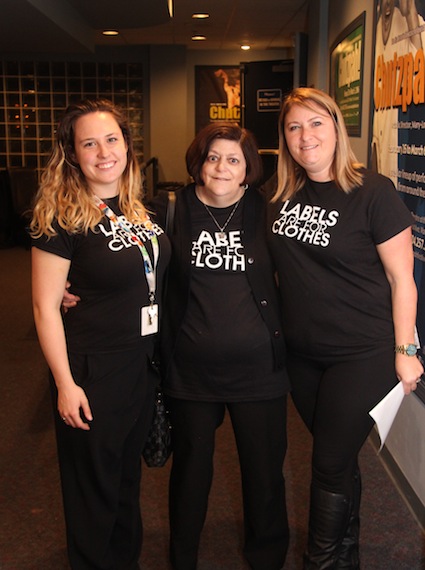
Left to right: Kathleen Muir, Harriet Kositsky and Shannon Gorski. (photo from JCC inclusion services)

Many at the event, including Simpson, when he took to the stage, were wearing the black T-shirt the JCC made for JDAIM, which says, “Labels are for clothes,” on the front. In his remarks, the minister spoke about the importance of inclusion and diversity work throughout all of the communities of British Columbia and highlighted the work of his own department, which focuses on community-building and poverty reduction within its greater mission.

Simpson shared some of the results of the fact-finding mission his ministry had recently undertaken in 28 communities in British Columbia. He highlighted the urgent situation in the province with regard to poverty and inequality: “678,000 people live in poverty in British Columbia,” he said, “which is 15% of the population. Forty percent of those are the working poor; one in five children live in poverty. If you are indigenous or have special needs, you are twice as likely to be poor.”

The minister said “social isolation is a key piece” that needs to be addressed throughout the province. “After people with disabilities in this province tell me they don’t have enough money, they tell me they want a job, they want to contribute,” he said. “When employers reach out and hire a differently abled employee, they tell me after they made the fit, they got a remarkable employee.”

Leamore Cohen, inclusion services coordinator at the JCC, introduced the video on the Bagel Club’s Israel trip. As Omer Adam’s “Tel Aviv Habibi” pulsed in the background of the video, the audience clapped to the beat.

Tammy Kalla and Penny Gurstein then read a list of Jewish Federation of Greater Vancouver Inspiring Inclusion grant recipients. Congregation Beth Israel was given funds to hire a tutor so that children with learning challenges could learn to read Torah; Beth Tikvah to hire the appropriate professionals to enable children and youth with invisible disabilities to participate fully alongside their peers in a range of programs; the JCC for a new program called Family Yoga Fundamentals; Richmond Jewish Day School to offer a fully inclusive music program; and Vancouver Hebrew Academy to instal a wheelchair ramp to the playground equipment that has been specially designed for children of all abilities.

The evening concluded with the 2016 Israeli film My Hero Brother, directed by Yonatan Nir. It follows a number of Israelis whose siblings have Down syndrome, as they take their brothers and sisters hiking in the Indian Himalayas. In introducing the screening, Benbaruj spoke beautifully about love, community and his wish that the inclusive communities we had learned about throughout the night could be a model for the world.

Matthew Gindin is a freelance journalist, writer and lecturer. He writes regularly for the Forward and All That Is Interesting, and has been published in Religion Dispatches, Situate Magazine, Tikkun and elsewhere. He can be found on Medium and Twitter.

Format ImagePosted on February 23, 2018February 21, 2018Author Matthew GindinCategories LocalTags Bagel Club, British Columbia, inclusion, Israel, JCC, Shane Simpson
Jewish take on health issues

Jewish take on health issues

Attendees engaged with panelists, left to right, Drs. Eric Cadesky, Brian Bressler and Jennifer Melamed at a Kollel event Jan. 29. (photo from Kollel)

A small but passionate group gathered at the Ohel Ya’akov Community Kollel Jan. 29 to engage with Drs. Brian Bressler, Eric Cadesky and Jennifer Melamed on the topic of Canadian Health Care Challenges Through the Jewish Lens, which focused on the legalization of marijuana, the treatment of addiction, the practice of harm reduction, the opioid crisis and medical assistance in dying (MAiD).

Cadesky, who chaired and moderated the event, is a family doctor in Vancouver and president-elect of Doctors of B.C.; until last summer, he was also medical coordinator at the Louis Brier Home and Hospital, a position he held for some eight years. Bressler is a gastroenterologist at St. Paul’s Hospital and a clinical assistant professor in the University of British Columbia’s department of medicine, while Melamed is co-owner of the Alliance Clinic, an addiction services facility in Surrey.

Bressler framed the conversation in terms of what he called the four principles of medical ethics for a healthcare provider: autonomy, respecting a patient’s choice and their right to understand and consent to treatment; beneficence, doing or recommending everything that could benefit a patient; nonmaleficence, taking into account all known risks to a patient and doing no harm, or the least amount possible, if harm is unavoiadable; and justice, making treatments available to all patients.

“I wouldn’t distinguish between those principles and Jewish ethical principles,” said Bressler. “I think they’re entirely consistent.”

Within this framework, the doctors’ dialogue with the audience took place.

One exchange was sparked by Melamed’s criticism of harm reduction clinics. “This is the dilemma we face,” she said, “is addiction insanity? Should we respect the patient’s autonomy even if the addiction has impaired that autonomy and they are not truly free to make decisions for themselves anymore because of the effects of the addiction?”

She said, “I refuse to accept harm reduction as the end result, as the highest result for my patients.”

Arguing that there “is really no such thing as a safe injection,” she said she believes such clinics are doing more harm than good.”

An audience member countered that recovery might be a realistic goal for working and middle-class patients, who have seemingly more to recover for; but, for addicts living in extreme poverty, who have a history of trauma and/or mental illness, they may not have a realistic chance of recovery. “With harm reduction, we keep them away from crime and treat them like human beings.”

The Kollel’s Rabbi Avraham Feigelstock said that, from a Jewish point of view, the community has a responsibility to do everything in its power to help a person recover. However, the question of how harm reduction clinics could go beyond their current purpose and move towards recovery was not pursued.

Discussing opioid use, Bressler expressed both a cautionary approach, based on his own practice (Crohn’s patients are at particular risk for addiction), and the opinion that it is important to focus on addressing the sources of pain, not just pain itself.

Both Bressler and Melamed were negative about the legalization of marijuana and its use in a medical setting. They said there was some evidence that marijuana was effective for a very limited number of conditions – neuropathic pain and nausea were mentioned – but that the risks of marijuana, such as cognitive impairment and a link to developing psychosis, were well-evidenced.

Melamed expressed concern about what she thinks will be the massive costs of policing marijuana intoxication, among drivers or industrial workers, for example.

When one person raised the potential of increased teen use of the drug, Melamed said teens were already using and she didn’t fear an increase, though she was concerned about the potential for increased use among adults.

Another audience member suggested the Jewish community should protest marijuana’s legalization.

The doctors took a less defined stance towards medical assistance in dying. Both Bressler and Melamed said they had personal and professional experience with it but did not take a stand in favour or against it, instead highlighting issues to consider. Bressler acknowledged the right of Canadians to MAiD but also pointed out that the practice conflicts with Jewish law.

Feigelstock said the general principle in Judaism is to prolong life but not necessarily to prevent death. “According to Jewish law, generally speaking, you may choose not to do things to prolong the life of someone who is dying,” he explained, “and you may give medicines to relieve suffering, which have the side effect of possibly shortening life, but you do not do something that will directly kill the patient. Every case must be dealt with separately, however, case by case; one cannot make general statements about what to do.”

Matthew Gindin is a freelance journalist, writer and lecturer. He writes regularly for the Forward and All That Is Interesting, and has been published in Religion Dispatches, Situate Magazine, Tikkun and elsewhere. He can be found on Medium and Twitter.

Format ImagePosted on February 9, 2018February 7, 2018Author Matthew GindinCategories LocalTags addiction, healthcare, Kollel, marijuana, medically assisted dying
The greatest Jewish novel?

The greatest Jewish novel?

What strange quirk brought it about that what may be one of the greatest and most Jewish of Jewish novels should be written not by a Diaspora Jew, nor an Israeli Jew, nor a Diaspora Jew who had made aliyah, but rather an Israeli who relocated to New York?

Further stymying expectations, Ruby Namdar did not write this novel in English, but in Hebrew (it was recently translated by Hillel Halkin). “For who?” asked an audience member at the Cherie Smith JCC Jewish Book Festival event on Nov. 26, when I had the pleasure of interviewing Namdar in front of a small gathering. If Namdar wanted his novel, which he acknowledged to be soundly in the lineage of Bernard Malamud, Saul Bellow and Philip Roth, to be read by New Yorkers, why write it in Hebrew? If he wanted the novel to make sense to Israelis, why write it about a rootless Diaspora Jew with no connection to Israel?

“I don’t know what I was thinking,” said Namdar, “I don’t know who I was writing for, I just wrote.”

The Ruined House is not just a great Jewish novel or a great novel in modern Hebrew. It possesses a structure that is at once talmudic and kabbalistic, a structure that is deep and intricate yet carried off with such a sense of understatement and naturalness, effortlessly unfolding within Namdar’s lucid, lyrical and vivid prose, that most English-language reviewers thus far have not fully noticed it. This structure is what gives the novel its profoundly Jewish resonance, which is at once modern and ancient, rootless and anchored in the archetypal depths of Jewish experience and textuality.

Talmudic structure

The Ruined House is divided into seven books, with its seventh book being the culmination of an obviously Jewish numerical pattern. Each book follows the anti-hero, Andrew P. Cohen, over the course of one year of his life, as he enters what seems to be a midlife crisis from hell (or perhaps from heaven).

Cohen is a successful and wealthy professor of comparative culture, who lives in an idyllic Manhattan high-rise with a view of the river, a pristine Apollonian realm in the skies. He has a beautiful young lover, Ann Lee, and an adoring group of followers and acolytes. He cherishes his controlled, harmonious and detached existence, which he has gained through leaving his wife and two daughters years before.

At the end of the first six sections of the novel are a few pages of text designed to look like a blat Gemara, a page of Talmud. The central text in these inserts tells the story of a high priest preparing and executing the Yom Kippur sacrifices. While he does so, he is watched by Obadiah, a humble Levite who wonders whether the priest is truly pious or just a functionary in league with the elite. Encircling the narrative are passages from the Talmud, Mishnah and Tanakh, which describe the laws, folklore and spiritual significance of the high priest’s duty. They also feature key excerpts from Shaarei Gilgulim (The Gate of Reincarnation), a kabbalist text written by Chaim Vital (1542-1620) to expound the cosmology of his master, the Ari HaKodesh, Isaac Luria (1534-1572).

The insertion of these texts is deliberate and precise. Just as the narrative in the inserts is flanked by canonical Jewish sources, the narrative of the novel is surrounded by ancient Jewish forces. As the hidden, broken nature of Cohen’s life begins to surface, he begins to have intense, waking visions of the ancient Temple in Jerusalem. His dreams turn nightmarish, alternating between repressed guilt at his betrayal of his family and dreadful tableaus of the rape of Jerusalem by the Romans and the murder of Jews by the Nazis.

The structure of the story and the inserts are not the only mirrors in the book: Cohen’s life is cast as priest-like. His elite status; the pure harmonious realm in which he lives; his having separated from his wife like Moses to live in the skies; even the elaborate meat dinners he cooks up for his dinner guests alone in his perfect kitchen all point to it. His name, of course, highlights both the substance and the irony of his life as priestly metaphor. At one point, his daughter, Rachel, disgustedly mocks people who think that Jews named Cohen are descended from the priestly lineage: “Everyone knows they just gave out those names randomly at Ellis Island.”

As Cohen descends into apparent madness, a grotesque version of the priestly sensibility gets stronger in him. He becomes morbidly obsessed with the impure and averse to the physical, the decaying and the dead. He finds himself horrified by menstrual blood and semen. The explanation of this growing claustrophobic sensibility lies in the paragraphs of Shaarei Gilgulim, which are included in Namdar’s inserts.

Kabbalist elements

Shaarei Gilgulim describes the way that some souls, during the process of reincarnation, unite with other souls in order to complete their own tikkun (repair). In the first pages of The Ruined House, “one shining soul, the figure of a high priest” is suddenly visible above New York among the celestial machinations momentarily revealed as the veil is briefly sundered. The key to the priest’s identity lies in the kabbalist doctrine of ibbur, or impregnation, where a soul from beyond enters into an earthly person in order to help them, to complete their own mission, or some combination of the two. In Cohen’s case, as suggested in a last talmudic insert, he has been “impregnated” by the soul of the high priest in need of tikkun for feeling himself superior to Obadiah, the humble Levite. The high priest and Cohen share a sin in common: arrogance. Their collective confrontation and reckoning with it will be psychically violent and cathartic and come close to doing Cohen in.

Critique of Diaspora?

Some reviewers have read The Ruined House as a critique of the Diaspora Jew, viewing the narrative as a kind of punishment of Cohen, enacted on him by the rising tide of archaic Jewish intrusions into his life. Namdar said this is a moralistic distortion of his ambivalent, questioning text. Instead, Namdar pointed to the shatterings of the illusion of wholeness and perfection that happen in the book. “Where things are broken, there, seeds can take root and grow,” he said.

For example, Cohen’s harmonious life is an illusion that is shattered in the course of the book, leaving a “ruined house.” Yet the figure of the ruined house (bayit asher necharev in the original Hebrew, a phrase that comes from a poem by Yehuda Amichai) is also an allusion to another ruined house, that of the Beit Hamikdash, the Jerusalem Temple, whose pristine world of order and control, Namdar suggests, also was illusory.

The third ruined house is suggested by the timing of the events in the novel. The story begins in the Hebrew month of Elul (signifying its theme of repentance), on Sept. 6, 2000. After the narrative comes to a head on Tisha b’Av, the date of the destruction of the Temple, it jumps from Aug. 1, 2001, to Sept. 18, 2001, leaving a lacuna where Sept. 11, 2001, and the destruction of the Twin Towers, resides.

“I did not want Sept. 11 to appear in the narrative, thus making the novel reducible to being about that event,” said Namdar when I asked him about this. “Rather, I wanted the trajectory to point to its occurrence outside the frame.”

There is much more to talk about in this remarkable novel, which manages at once to be so Jewish, so Israeli, so American and so human. I did not touch here on the attention Namdar lavishes on the details of Cohen’s daily life or Namdar’s subversion of the lineage of Malamud, Bellow and Roth in his intense empathy with the female characters of the novel, and his unsparing deconstruction of Cohen’s narcissistic masculinity. I did not examine his vivid and hilarious slow-motion evocation of a grossly excessive bar mitzvah, or his brilliant parody of the Zionist clichés of a Birthright-like propaganda tour of Israel, and many other delights. I hope this introduction is enough to invite you to step into Namdar’s mesmerizing fusion of a talmudic-esoteric structure with an incandescent evocation of life in Manhattan, and discover what else he has hidden there, of which, I promise you on good authority, there is much.

Matthew Gindin is a freelance journalist, writer and lecturer. He writes regularly for the Forward and All That Is Interesting, and has been published in Religion Dispatches, Situate Magazine, Tikkun and elsewhere. He can be found on Medium and Twitter.

Format ImagePosted on February 2, 2018February 1, 2018Author Matthew GindinCategories BooksTags Cherie Smith JCC Jewish Book Festival, Jewish life, Judaism, kabbalah, literature, Ruby Namdar, Talmud, Torah, translation

At controversy’s centre – Louis Brier

Louis Brier Home and Hospital has accused Dr. Ellen Wiebe, who specializes in medically assisted dying, of wrongdoing, for providing a medically assisted death to 83-year-old resident Barry Hyman, without the consent or knowledge of the care facility.

The home accused Wiebe of “borderline unethical” behaviour and has filed a complaint with the College of Physicians and Surgeons, but Wiebe is adamant that her actions were not unprofessional.

“By far the most important thing is the patient,” Wiebe told the CJN. “The second is the family. Mr. Hyman’s wish was to die in his home. People have all kinds of wishes and desires, but dying wishes are held to a higher standard than other wishes.”

Asked about the family’s agreement to abide by Louis Brier’s policies, and the dispensation given by the B.C. Ministry of Health for institutions to refuse the provision of services that go against their religious beliefs, Wiebe said, “I’m not part of those agreements. My agreement is purely with my patient, not the facility, and since I don’t have visiting privileges at Louis Brier like I do at Vancouver General Hospital, I am not required to abide by the agreement between Louis Brier and the ministry.”

Wiebe was invited into the facility by Hyman’s daughter, Lola Hyman, and his other immediate family members, who wanted to honour Barry Hyman’s long-held wish to die on his own terms. Disabled by a stroke and diagnosed with lung cancer, Hyman had asked to die at the care facility, which had become his primary residence. Lola Hyman had broached the topic with David Keselman, the chief executive officer of Louis Brier, who told her it was against their policy, which is formulated according to Orthodox Jewish law.

Lola Hyman told the Globe and Mail that she wanted to honour her father’s wishes in a place that was comfortable for him, not somewhere that would be unfamiliar to him.

On the night of his death, she said, “the room was very quiet. We just held his hand and stared at him. My sister was sobbing, just sobbing. I was a stone. A complete stone. My heart was racing that someone would open the door.”

The Supreme Court of Canada struck down the Criminal Code prohibition on physician-assisted dying in 2015 and the federal government passed legislation legalizing it in 2016. The court recognized that doctors should not be coerced into performing the procedure against their will, but did not specify whether health-care organizations could refuse to comply.

In British Columbia, the Ministry of Health made an agreement that allows members of the Denominational Health Association (DHA), which includes the Louis Brier, to refuse to provide services that are inconsistent with their religious values.

“Anyone who comes here knows what our policy is and, if they don’t like the policy, they should go somewhere else,” Mark Rozenberg, the chair of the ethics committee of Louis Brier’s board, told the Globe and Mail.

Keselman declined the CJN’s request for comment, saying that the board was in meetings to decide how to respond to the media exposure. The home’s rabbi, Hillel Brody, said he was not permitted to discuss Louis Brier’s policies with the press.

Shanaaz Gokool, chief executive officer of Dying With Dignity Canada, told the CJN that organizations like Louis Brier are not being asked to take part in medically assisted dying, but simply not to obstruct residents from a medical service to which they have a right.

“The doctors bring in their own equipment. The health-care facility has no involvement in the procedure. By not allowing this, they are undermining the rights of the residents of Louis Brier who call it their home,” Gokool said.

It is not clear if institutions that refuse to allow medically assisted deaths on their premises enjoy the same Charter-protected religious freedoms as individuals who refuse to provide the service, because the issue has not yet been tested in court.

A joint statement issued by Dying With Dignity Canada and the Canadian Association of MAID Assessors and Providers said, “We support health-care professionals who, as a matter of conscience and compassion, help their patients overcome unfair barriers to access.… And we will defend clinicians who are attacked or punished for their participation in the lawful provision of MAID (medical assistance in dying). These courageous individuals should be applauded, not penalized, for putting their patients first.”

Louis Brier is one of a number of faith-based organizations that are in a quandary: although the centre is run in accordance with Orthodox Jewish law, not all residents are religious Jews, and it also has non-Jewish residents.

A 2014 Ipsos-Reid poll conducted on behalf of Dying With Dignity Canada showed that 84% of Canadians were in favour of allowing physicians to help someone die, if that person is suffering and wishes to die.

There is also the issue of public funding, as “67% of the Louis Brier’s funding is public,” said Gokool. “They are funded by taxpayers and should abide by Canadian law.”

Lola Hyman told the Globe that she was left feeling distressed, both at the possibility of Wiebe suffering on account of helping her father, and at having upset the front-line staff at Louis Brier, who were shocked by Barry Hyman’s sudden death. She said that all of this could have been avoided if British Columbia went the way of Quebec and stopped allowing publicly funded organizations to obstruct the rights of their residents.

“Everyone is entitled to their religious beliefs and traditions and customs,” Hyman told the Globe. “But, when it comes to somebody who is very sick and dying, we need to have a different approach.”

Matthew Gindin is a freelance journalist, writer and lecturer. He writes regularly for the Forward and All That Is Interesting, and has been published in Religion Dispatches, Situate Magazine, Tikkun and elsewhere. He can be found on Medium and Twitter. This article was originally published by the CJN, cjnews.com.

Posted on January 26, 2018January 24, 2018Author Matthew GindinCategories LocalTags Ellen Wiebe, health, Hyman, Louis Brier Home, medically assisted dying
Pondering a hospitable Zion

Pondering a hospitable Zion

Jerusalem (photo by Andrew Shiva via Wikipedia)

Hospitality is culture itself and not simply one ethic amongst others. (Jacques Derrida, On Cosmopolitanism)

One of the late French-Jewish philosopher Jacques Derrida’s most famous short works is his On Cosmopolitanism, in which he discusses the problem of refugees. Cosmopolitanism is a word first coined in ancient Greece by wandering, homeless philosophers and popularized by the Stoics. It refers to the idea that the whole world (cosmos) is my city, or community (polis). It is the idea of an international or, better, transnational humanity and citizenship. Cosmopolitanism became popular again during the European enlightenment and slowly had a growing influence on international law and modern ethical sensibilities, including the sense that countries have a duty of hospitality, of offering refuge even to peoples of other nationalities.

This same ethical idea occurs in Derrida’s own Jewish tradition, where “love the stranger” is a commandment uttered many more times than “love your neighbour” and where Isaiah the prophet urged Israeli kings to give shelter to refugees of war.

In On Cosmopolitanism, which was based on a speech Derrida gave to the International Parliament of Writers on the subject of refugees, Derrida discusses the nature of hospitality and the contradiction at its heart. Hospitality involves welcoming guests into your home, in sharing resources and shelter, yet, to do so, it must remain “a home.” Should all boundaries of the home dissolve in unconditional welcome then the possibility of hospitality itself will also be obliterated. Derrida’s insight mitigates against a naive or utopian call for the obliteration of borders or the indiscriminate welcome of refugees.

In this thought of Derrida we see a tragic conflict at the heart of modern Zionism. Do we want a hospitable Zionism? Is the house the Jews built in Israel for Jews alone? Yet if the doors are flung wide, what will happen to “our Jewish home”?

There is much anxiety to protect our “home,” of that we can be sure. An extensive security wall, checkpoints, and airport border guards who are masters of interrogation. When we press Israel to become more hospitable – to African asylum seekers, to displaced Palestinians – we hear a chorus of voices arise: if we let them in, if we include them, the demographics will dissolve our home!

And we so badly want a home. Wandering for 2,000 years, we were homeless, exiled, a tolerated or cursed minority. Finally, we returned to our ancient home and, amid controversy with others who had come to live there and also claim it as home, built walls to protect it.  We now again had a home, and we have chanted this word to ourselves over and over again, “home, home,” for the last 70 years.

Yet what good is a home that does not extend hospitality? Sure, we airlifted Ethiopians, we opened our arms to Russians, and so on and so forth. Yet they were us, our family. True hospitality, though, as it says in our own foundational text, is given to the stranger. The other.

Unconditional welcome is not the only way to destroy a home. What good is a home that offers no hospitality? Is a home that offers no hospitality even a home at all?

Israel is in the process of deporting the 60,000 African refugees who arrived before the building of a barrier wall with the Sinai to prevent more entering. As Russel Neiss wrote in the Forward, “For years, in actions held to be illegal multiple times by Israel’s Supreme Court, the Israeli government has arrested and placed these refugees in a detention centre in the Negev and forcefully deported them to other African nations in exchange for money or favourable terms for weapons contracts and military training.”

Twenty thousand refugees, most from Sudan and Eritrea, have already been deported or left of their own accord, and the government has ordered the rest to leave, with a small financial gift and plane tickets paid, or be jailed.

According to Derrida, hospitality is both a duty and a defining feature of a real home. The feeling that an inhospitable Israel is not really a home, I fear, is growing and will continue to grow among Israelis and Jews. Maintaining the feeling that Israel is a Jewish home only will require an unremitting focus on perceived and real threats to Jews in Israel and abroad. It will reinforce the unhealthy sense of home as a shelter from others, rather than fostering the healthy sense of home, one that is open to sheltering others.

The result may be that we have a very well guarded home. But, for those of us who perceive the lack of hospitality on offer, it begins to feel like no home at all. The opposite of Derrida’s formula – “in order for there to be hospitality, there must be a home” (a formula that is surely true and needs due respect) – is “in order for their to be a home, there must be hospitality.”

Jews, being a transnational people for so many years, became, in two senses, a “cosmopolitan people.” One was that fact of transnationality; the other stemmed from the involvement of Jews in socialist political movements, which problematized nationalism, as well as our involvement in activism aimed at the liberalization of immigration laws. It was all of this, seemingly, which coalesced to give birth to the use of “cosmopolitan” as an antisemitic code word for “Jew.”

I don’t think “cosmopolitan” is an insult, but rather a very high compliment. When an antisemite calls Jews “cosmopolitan,” I hear it as a calling, not a calling out. Israel will not truly be our Jewish home until it embodies the highest cosmopolitanism of the Jewish spirit, which can be read in the Torah’s call – millennia ago – to love the stranger and refugee.

Matthew Gindin is a freelance journalist, writer and lecturer. He writes regularly for the Forward and All That Is Interesting, and has been published in Religion Dispatches, Situate Magazine, Tikkun and elsewhere. He can be found on Medium and Twitter.

Format ImagePosted on January 19, 2018January 17, 2018Author Matthew GindinCategories Op-EdTags Israel, Judaism, Torah, Zionism
Completing the Tanya

Completing the Tanya

Rabbi Binyomin Bitton (photo by Noam Dehan)

On Dec. 4, Chabad of Downtown Vancouver, led by Rabbi Binyomin Bitton, held a siyyum, a celebration to mark the conclusion of studying the entire book of Tanya, sometimes called “the Bible of Chassidic thought.”

The siyyum also celebrated Yud-Tes Kislev, the 19th day of the Jewish month of Kislev, which began this year on the evening of Dec. 6, and is known as “the New Year of Chassidism,” due to the release of the founder of Chabad and author of the Tanya, Rabbi Schneur Zalman of Liadi, known as the Alter Rebbe, from prison in czarist Russia on that date in 1798.

The Tanya is a guide to the pursuit of righteousness and the meaning of Jewish religious life from a Chabad Chassidic perspective. It is known for its counsel on how the intellect can transform the emotional life, and its teachings on how contemplating the nature of God and the soul can inspire and focus spiritual life. The Tanya also asserts that the height of the spiritual life lies paradoxically in the simple actions of human beings, and that the highest expression of God’s intention in creation is in the human doing of a mitzvah (religious commandment, good deed).

Bitton opened the siyyum by noting his pleasure that it happened to fall so close to Yud-Tes Kislev, when Jews all around the world start a new cycle of Tanya learning. He then welcomed Adina Ragetli, a descendant of the Alter Rebbe, to play the niggun (sacred wordless melody) of the Alter Rebbe, “Arba Bavos,” on the harp.

“We are all very happy tonight,” said Bitton afterwards, “except one person, whose name I won’t say, but I’ll tell you the letters of his name, Samech-Mem-Alef-Lamed [Samael, an evil angel, whose name is not spoken by Chassidim]. You know what the letters of his name stand for? Siyyum masechet lo aseh [the completion of a book you will not do].”

Rivka Arieli read the final section of Tanya with which they completed the book, and then the rabbi invited a series of students to speak of the meaning of the text to them. First to talk were Eduardo and Gabrielle Sonnino, who spoke of their discovery of the meaning of Judaism through the Tanya after coming to Canada from Brazil three years ago. They spoke humorously of their adoption of Jewish observance as a result, teasing Bitton that, in getting them to “leave their cheeseburgers,” he had ruined their lives.

Shirley Hirsch and her husband, Gabriel, had learned previously with Rabbi Lipa Dubrawsky, z”l, the educational director of Chabad-Lubavitch BC for 15 years until his passing in 2013. His wife, Dena Dubrawsky, urged the Hirsches to contact Bitton, and soon they were taking on Tanya every Monday. Hirsch spoke of the uniqueness of the Tanya in conveying the highest mystical truths of Judaism in a form that anyone can understand.

Robert Elias shared how the study of Tanya and its differentiation between the egoic and divine elements in the person had helped him improve his marriage, mend broken friendships, improve his relations with his co-workers, and remove the sense of ennui he was experiencing in his otherwise successful professional life.

Ragetli closed the celebration with another piece of music. Rabbi Yechiel Baitelman of Richmond Chabad also attended the siyyum.

Matthew Gindin is a freelance journalist, writer and lecturer. He writes regularly for the Forward and All That Is Interesting, and has been published in Religion Dispatches, Situate Magazine, Tikkun and elsewhere. He can be found on Medium and Twitter.

Format ImagePosted on December 15, 2017December 14, 2017Author Matthew GindinCategories LocalTags Binyomin Bitton, Chabad, Judaism, Tanya

Being kosher in today’s world

On Dec. 7, Temple Sholom Sisterhood hosted a discussion on the relationship, history and relevance of today’s kosher practices. The panel aimed to “explore, broaden and in some cases challenge the term kashrut” and “explore integrating values such as ethics, community and spirituality as it relates to food.”

The panelists were Rabbi Lindsey bat Joseph, executive director of the Centre for Jewish Excellence; Michael Schwartz, director of community engagement at the Jewish Museum and Archives of British Columbia; and Noam Dolgin, a Jewish environmental educator and “sustainable realtor.”

As participants ate baked organic apples – sourced locally and made with gluten-free oats – Dolgin began at the beginning, discussing the Garden of Eden and asking the audience to name the first mitzvah (commandment) given to human beings alone. Although many people think it was “be fruitful and multiply,” that commandment was given to animals as well. The first human commandment, Dolgin said, was to “work and protect” the garden. After leaving the hunter-gatherer society of the garden, we became farmers able to produce surplus food and wealth, he explained, and so came the laws around our relationship to the land and to other people, which aimed to promote justice towards the earth and to each other.

Dolgin gave an overview of the development of Jewish law in relation to land, animals and people, touching on such core rabbinic laws as ba’al tashchit (do not waste) and ba’al tzarei chayyim (do not be cruel to animals). Dolgin said, although there are biblical laws protecting the land, there has been a shift in recent years from an emphasis on immediate human concerns – “don’t pollute upwind,” for example – to deeper ecological concerns, such as “don’t pollute at all.”

Schwartz spoke about how Jewish culinary traditions go beyond the legalities of kashrut. He focused on the home as the locus of cultural preservation, and noted the museum’s recent initiative to collect and share Jewish cultural stories around food. As part of this project, he said, one Jewish woman talked of her memories of food from Second World War-era Bangalore, India; another spoke of her Mizrahi Jewish family who had lived in China for years and were more comfortable in Vancouver’s Chinatown than in other parts of the city, including Jewish institutions.

Schwartz also discussed efforts to bring Jewish ethics to bear on food, describing the community’s creation of a food bank, and of other food-justice-related organizations.

“The alert among you will notice that I have made it this far into my talk without mentioning the word kosher,” he said. “That is not an accident. The reason for this is that I wanted to demonstrate that there are many ways that food can preserve our identity and inform our morals.”

Rounding out the discussion, bat Joseph explored the architecture of kosher law and the way it was built out of biblical law. She explained how kosher laws are traditionally considered to be transrational, or beyond human understanding. She said, despite our not understanding the details, the Torah suggests two primary purposes of kashrut: to make us distinct from the nations around us and to promote a holy lifestyle, to encourage mindfulness and “a sense of priestliness in the most mundane things.” She debunked the commonly held idea that kosher laws may have had a connection to health.

A wide-ranging question-and-answer period included humourous stories of trying to live kosher, different family traditions, and the struggle to balance inclusivity both among Jews and between Jews and non-Jews while observing kashrut.

Matthew Gindin is a freelance journalist, writer and lecturer. He writes regularly for the Forward and All That Is Interesting, and has been published in Religion Dispatches, Situate Magazine, Tikkun and elsewhere. He can be found on Medium and Twitter.

Posted on December 15, 2017December 14, 2017Author Matthew GindinCategories LifeTags culture, Judaism, kashrut, Temple Sholom

Posts pagination

Previous page Page 1 … Page 3 Page 4 Page 5 … Page 11 Next page
Proudly powered by WordPress