
Skip to content
  • Home
  • Subscribe / donate
  • Events calendar
  • Business Directory
  • FAQ
  • News
    • Local
    • National
    • Israel
    • World
    • עניין בחדשות
      A roundup of news in Canada and further afield, in Hebrew.
  • Opinion
    • From the JI
    • Op-Ed
  • Arts & Culture
    • Performing Arts
    • Music
    • Books
    • Visual Arts
    • TV & Film
  • Life
    • Celebrating the Holidays
    • Travel
    • The Daily Snooze
      Cartoons by Jacob Samuel
    • Mystery Photo
      Help the JI and JMABC fill in the gaps in our archives.
  • Community Links
    • Organizations, Etc.
    • Other News Sources & Blogs
  • JI Chai Celebration
  • JI@88! video

Recent Posts

  • SFU honours Gloria Gutman
  • Lifting people’s spirits
  • Wedding a ray of light
  • Indigeneity and Zionism
  • Rule of law broken: councilor
  • Football and its roles
  • The burden of defence
  • Fish Café returns after fire
  • All right in what goes wrong
  • Nuns & mermaids at TUTS
  • Camp offers holiday retreat
  • Students and mentors inspire
  • Once-in-a-lifetime trip
  • 100 dancers, one heart
  • Money for the sciences
  • What “Jewish food” means
  • Have a cookie, schnitzel too
  • Federation now across BC
  • Israel fighting for its existence
  • Deal strengthens Iran
  • Patriotic belonging diminishes
  • A campaign to engage
  • Upstanders’ first live event
  • Responding to Carney
  • Having your own home
  • Music a family tradition
  • Musical to warm heart
  • Community milestones … June 2026
  • Sharing her passion for Israel
  • Or Shalom reopens its doors
  • JFS from past to future
  • Need holistic approach
  • Sharing stories, advice
  • Journalist shares fears
  • Skills to live together
  • Road to independence

Archives

Follow @JewishIndie
image - CJN box ad Rockowers 2026

Byline: Matthew Gindin

Yeshivah will stay here

Yeshivah will stay here

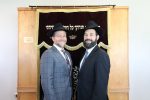
The Pacific Torah Institute’s Rabbi Noam Abramchik, left, and Rabbi Aaron Kamin. (photo from PTI)

As Vancouver’s only Orthodox yeshivah, Pacific Torah Institute (PTI) holds a unique place in the community. Since the talmudic era, when the rabbis of what is now Iraq gathered to debate Jewish law and texts and created the intense intellectual culture at the heart of traditional Judaism, the house of study (beit midrash) has been at the heart of Orthodox Jewish religious culture. In recognition of this, even non-religious Jews have long prided themselves on the presence of a yeshivah in their community and been willing to materially support it.

Located at 41st Avenue and Oak Street near a cluster of Jewish community organizations and services, PTI teaches traditional Jewish textual learning, including Talmud b’iyyun (with in-depth analytical study) and musar (the practices of ethical self-discipline and character transformation), thus carrying on the centuries-old twin focus of the Lithuanian-style yeshivah. So, when news spread that PTI, which has operated in the community since 2003, was considering relocating to Seattle, ripples of urgent concern spread throughout some quarters of the Jewish community.

A town hall meeting was organized, which took place at Schara Tzedek Synagogue. The discussion elicited strong support, both emotional and financial. Heads of school Rabbi Noam Abramchik and Rabbi Aaron Kamin left the meeting determined to save the yeshivah by attracting more students from beyond the Pacific Northwest, as well as from closer to home.

“There was never a desire to pick up and move,” Abramchik told the Independent. “There were enrolment questions, which coincided with the opening of a similar school in Seattle. Students from Seattle have been a consistent part of our student body, and we were worried – with them staying there and competition from another nearby school, we might not have enough students to be viable.”

Although PTI is affiliated with the Rabbinical Seminary of America, part of the community commonly known as the Chofetz Chaim network, it is an independent yeshivah that relies entirely on direct support from donations and fees. In recent years, enrolment has decreased because of families moving out of Vancouver, creating what Abramchik called “an existential issue” in the yeshivah’s high school program.

Kamin said affordability in Vancouver is a major factor. As well, the community is small, so, when members leave, it has a destabilizing effect. “When some families move,” he said, “you lose critical mass and it gets harder for an Orthodox Jewish community to function and have what everyone needs.”

Both rabbis talked about the opportunities and challenges that come with operating a yeshivah here.

“Vancouver’s strength is its openness,” said Abramchik. “Students here get the benefit of living a Torah lifestyle while interacting with all kinds of people and ideas, being a part of the wider world.”

Yet, the nature of the community also means “we don’t have the strength in numbers, we don’t have as many institutions and services,” said Abramchik.

One common challenge for smaller Orthodox communities is the need for young people to go elsewhere for advanced Torah study or to make a shidduch (marriage match). PTI offers higher level Torah learning until the age of 21 or 22, but those who want to continue their studies will have to move to another city, as will many of those seeking a life mate. Both Abramchik and Kamin have children who have gone to New York to find a shidduch, though some of them would like to eventually return to Vancouver with their families and make a home here.

Both rabbis are deeply embedded in the local Jewish community.

“Fifteen years of being here is fantastic,” said Abramchik. “My children couldn’t have been raised in a healthier, more wholesome environment, with such breadth of experience. As a rabbi who values religion above all else, I couldn’t be prouder of who they are as Jews and people, and directly attribute that to the incredible education they received in Vancouver through Vancouver Hebrew Academy (the Orthodox day school), PTI and Shalhevet (the Orthodox girls high school), as well as the wide range of people they’ve come into contact with, as we have hosted many diverse people at our Shabbat table over the years.”

Asked why they want to stay here, the rabbis were in agreement. “If we were looking to best serve our institution per se, the move to Seattle makes sense,” said Abramchik. “There are 300 Shomer Shabbos [Orthodox observant] families versus probably 60 here. We had a number of supporters saying we should go, but, after giving 10 years to this community, we feel it’s our home … we weren’t ready to leave it if there was any possible way to stay here.”

After the community town hall, the rabbis’ commitment to stay was strengthened, Abramchik said. “Is Vancouver a better city for having this institution or not? We heard a resounding yes, we heard this from people who do not send their children here, never will. We heard this needs to get done, we need to find a way to make this happen.”

“Our first priority is to do what we feel is God’s will,” said Kamin. “We believe this is the best thing for ourselves and our spiritual advancement, we want to do the right thing. The right thing transcends the institution, it transcends our own personalities. It was very much a feeling of this is the right thing to be doing, to make this decision to stay – the right thing for the community and the right thing for the boys now and the future boys.”

For Toviah Salfinger, a student at PTI, the news they are staying is welcome. The yeshivah plays “a huge part in my life,” he said. “It enables me to be able to really grow in terms of religious life. It would be pretty hard to have a solid foundation as a religious Jew without a yeshivah.”

Salfinger sees the challenges of Vancouver as holding a hidden blessing. “The fact that you’re in a community where there isn’t a strong Jewish religious presence, it helps you in a way,” he said, “because it puts the responsibility on you to live up to that, to be an example as religious person.”

Salfinger said he’d like to go on to study at the Rabbinical Seminary of America yeshivah in New York, and maybe become a rabbi who teaches kids. Maybe, he said, if there is an opportunity, he will one day be able to return to Vancouver.

Matthew Gindin is a freelance journalist, writer and lecturer. He is Pacific correspondent for the CJN, writes regularly for the Forward, Tricycle and the Wisdom Daily, and has been published in Sojourners, Religion Dispatches and elsewhere. He can be found on Medium and Twitter.

Format ImagePosted on June 22, 2018June 19, 2018Author Matthew GindinCategories LocalTags Aaron Kamin, education, Judaism, Noam Abramchik, Pacific Torah Institute, PTI, yeshivah, youth
Kick scooting for a school

Kick scooting for a school

Gil Drori and Bex Band are kick scooting down the West Coast to raise money to build a school in Tanzania. (photo from Gil Drori)

Gil Drori and Bex Band are en route to the Mexican border. They left from Vancouver last month. What’s newsworthy is how and why. They will be making the journey entirely by way of kick scooter – that’s right, not electric scooter, but kick scooter, the glorified skateboard with safety rails, and they will be doing so to raise money for a school in Africa. They are calling their adventure Kicking the States.

“We decided to do a charity challenge like no other that would help raise money to build a school in a poor village in Tanzania. We visited the village and the half-built school last year and saw the reality and hardship that the children are living in,” Drori told the Jewish Independent in an email interview. “It wasn’t easy to see but we wanted to do something positive, which is how the idea for Kicking the States came about.”

The journey is about 2,500 kilometres long and will take the couple three months. It is, as they say, “entirely muscle-powered.” Drori and Bend have had to pack very lightly to fit all their gear into their modified front pannier, so they are carrying just a tent, sleeping bags and a spare change of clothes.

“When we first thought of the idea, it seemed an impossible challenge, which is exactly why we went for it,” Drori told the JI.

Drori was born in Jerusalem and grew up in Zichron Yaakov. He met Bend while traveling in Guatemala. He’d recently finished his army service and Bend, university. Despite having completely different backgrounds, they “instantly clicked.” They now both live in the United Kingdom, where Bend comes from, and call London home, although they still visit Israel regularly. They recently celebrated their third wedding anniversary.

A kick scoot journey of this kind has never been attempted before, so there are no precedents, and Drori and Bend are learning as they go. “It’s a real adventure!” said Drori.

They hope to raise a total of $10,000 along the way, through sponsorships and by delivering free talks at events for which admission is by donation.

Two years ago, Drori and Bend were working regular jobs, Drori in IT and Bend in teaching. They decided to leave the city life to hike the Israel National Trail, having never done anything like it before. It took two months to complete and, from that point, they have been attracted to adventure as a way of exploring and seeing of what they are capable. They now both work as digital nomads, which gives them the flexibility to keep taking on new challenges, like Kicking the States.

“I think the simplicity of traveling with just a bag with everything you need and working your body each day is really appealing,” said Drori.

Before taking on their latest adventure, they did a four-day mini-trip on scooters, which showed them that it was possible.

“We’ve had a tough but great first two weeks on the expedition,” said Drori. “Physically, it has been very demanding and we have been scooting distances of 30 to 50 miles a day [50 to 80 kilometres], so are left achy and tired. Hills also pose a challenge and we have to get off and push the scooters uphill, which is not easy with all our gear attached.”

Most days, Drori and Bend have no idea of where they’ll be sleeping that night. They have been reliant on people offering to host them, as well as staying at campsites and even sleeping in the yards of strangers. “It has been quite tiring sometimes, living with that uncertainty each day,” said Drori, “but we are trying to embrace the excitement that that also brings.”

The two have faced setbacks every day so far, from road blockages, wrong turns, running low on food and fatigue. Drori said focusing on the money they have raised is what gets them through.

“The children we met in Tanzania are living in real hardship and their only hope of escaping is by getting an education,” said Drori. “They are fed two meals a day at the school, learn to read and write, leave with qualifications and, more important than that, confidence in themselves. We believe that every child should have a right to an education no matter what their circumstances, which is why we are so passionate.”

Drori said they have been surprised by the amazing people they have met along the way. “It’s been the absolute highlight,” he said. “Such kind and wonderful people who, despite us being strangers, have hosted us for a night, fed us or made generous donations to the charity. We’ve met people from all walks of life and have heard so many interesting stories. It sounds cliché, but it restores your faith in humanity. People really are good!”

Drori stressed that 100% of the money raised goes directly to the school. “We really hope that people will support us and get behind this cause,” he said.

People can donate at justgiving.com/kickingthestates.

Matthew Gindin is a freelance journalist, writer and lecturer. He is Pacific correspondent for the CJN, writes regularly for the Forward, Tricycle and the Wisdom Daily, and has been published in Sojourners, Religion Dispatches and elsewhere. He can be found on Medium and Twitter.

Format ImagePosted on June 15, 2018June 14, 2018Author Matthew GindinCategories WorldTags Africa, fundraising, Gil Drori, kick scooting, tikkun olam
Genocide still happening

Genocide still happening

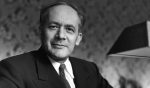
Polish-Jewish lawyer Raphael Lemkin was the first to use the term “genocide.” (photo by Moidov)

The word “genocide” was conceived by Polish-Jewish lawyer Raphael Lemkin to describe the attempt of the Ottoman Empire to efface Armenians from Turkish society. He articulated the empire’s actions as a specific category of crime – one that could be named, analyzed, resisted and penalized by the global community.

Lemkin was born in 1900 on a small farm near the Polish town of Wolkowysk. As a young man, he heard that as many as 1.2 million Christian Armenians were killed by the Ottoman Empire, the population of which was mainly Muslim. He also knew of the pogroms and violence against his own people, of course, but it was the situation of the Armenians that led him to the idea of a change in international law that could address such violence.

When the German army invaded Poland, Lemkin fled Europe for safety in the United States. He began teaching at Duke University and, in 1942, he joined the war department, where he documented Nazi atrocities. This led to the 1944 book Axis Rule in Occupied Europe: Laws of Occupation, Analysis of Government, Proposals for Redress, wherein Lemkin first introduced the word “genocide.”

“By ‘genocide,’ we mean the destruction of a nation or of an ethnic group,” Lemkin wrote. “Generally speaking, genocide does not necessarily mean the immediate destruction of a nation, except when accomplished by mass killings of all members of a nation. It is intended rather to signify a coordinated plan of different actions aiming at the destruction of essential foundations of the life of national groups, with the aim of annihilating the groups themselves. Genocide is directed against the national group as an entity, and the actions involved are directed against individuals, not in their individual capacity, but as members of the national group.”

Lemkin later worked on the Nuremberg trials, where he succeeded in getting the word genocide included in the indictment. Genocide was not yet a legal term, however, and the verdict at Nuremberg set a precedent only for war crimes. While in Nuremberg, Lemkin learned of the death of his parents, who, along with 49 other family members, were killed by the Nazis.

Lemkin was determined to see genocide added to international law and, after his return to Europe, he began agitating for this at the meetings of the then newly established United Nations. His efforts to enlist the support of national delegations and influential leaders eventually bore fruit. On Dec. 9, 1948, the United Nations approved the Convention on the Prevention and Punishment of the Crime of Genocide. As of December 2017, 149 states, including Canada, had ratified or acceded to the treaty.

Lemkin committed the rest of his life to convincing nations to pass legislation supporting the convention. He died in 1959, “impoverished and exhausted by his efforts,” according to Lemkin House, an American sanctuary for asylum seekers named in his honour.

At the 2005 World Summit, all member states of the United Nations endorsed the Responsibility to Protect (R2P) doctrine, which Canada was instrumental in promoting – on paper, at least, it carries Lemkin’s vision forward.

“The international community,” states the doctrine, “through the United Nations, also has the responsibility to use appropriate diplomatic, humanitarian and other peaceful means … to help protect populations from genocide, war crimes, ethnic cleansing and crimes against humanity … we are prepared to take collective action, in a timely and decisive manner … on a case-by-case basis and in cooperation with relevant regional organizations as appropriate, should peaceful means be inadequate and national authorities manifestly fail to protect their populations from genocide, war crimes, ethnic cleansing and crimes against humanity.”

This article was being written as almost one million Rohingya refugees were preparing to celebrate Ramadan in the camps of Cox’s Bazar, in Bangladesh – 700,000 of them have fled Myanmar since August 2017, running from what several international observers have called genocide. Yet Canada, and many others, including the UN, have shied away from using Lemkin’s term to describe the situation.

Modern Turkey still denies the Armenian genocide that was instrumental in inspiring Lemkin’s efforts. And, although some countries, notably Germany and Rwanda, have made attempts to deal with their past, with the crimes committed by their governments and civilians, the fight to prevent, identify, resist and respond effectively to genocide remains relevant.

Matthew Gindin is a freelance journalist, writer and lecturer. He is Pacific correspondent for the CJN, writes regularly for the Forward, Tricycle and the Wisdom Daily, and has been published in Sojourners, Religion Dispatches and elsewhere. He can be found on Medium and Twitter.
Format ImagePosted on June 1, 2018May 30, 2018Author Matthew GindinCategories WorldTags genocide, history, Raphael Lemkin, United Nations
Prayer, protest at JCC

Prayer, protest at JCC

Gabor Maté reads the names of Palestinians killed by the Israel Defence Forces during the Great March of Return protests in Gaza. (photo by Matthew Gindin)

“Each one of them was a full human being, with a full life,” said Rabbi David Mivasair, addressing a dozen or so people, most of whom were Jews, outside of the Jewish Community Centre of Greater Vancouver on May 21, the second day of Shavuot, for Yizkor, the traditional memorial service for the dead.

Organized by Independent Jewish Voices, the group gathered to commemorate the Palestinian protesters who had been killed by the Israel Defence Forces during the Great March of Return protests in Gaza, which began on March 31 and ended May 15 (which Palestinians observe as Nakba Day). They gathered, according to the event’s Facebook page, for another reason, as well: “We will also publicly denounce the Centre for Israel and Jewish Affairs for its continual dishonest manipulation of Canadian political leaders and media sources to silence and minimize Israel’s brutality toward Palestinians and, in this case, shift the blame for the killings to the very people who were killed.”

Those present included Gabor Maté, a physician, author and member of the Jewish community. He and others took turns reading the names of Palestinians who had been killed. Afterwards, he told a story from an article that Uri Avnery, an Israeli peace activist, had written days before. In the article, Avnery described how he, as a teenage member of the Irgun, had done similar things to those of the Palestinian protesters when demonstrating against the then-occupying British forces for Israel’s independence, but the British shot over their heads, not at them. Maté also criticized the JCC for not being inclusive enough of all Jewish voices, saying that, in practice, it was more like “the Zionist community centre.”

“The confusion between Zionism and Judaism is a tragedy,” said Maté. “I’m just glad to be here to bear witness along with the rest of you.”

Shawkat Hasan, a member of the Palestinian community and the B.C. Muslim Association, whose family lost their home in the war of 1948, also spoke, emphasizing that the conflict was not between Jews and Muslims but between Zionism and its “victims,” and calling for widespread resistance to violence against Palestinians.

The group carried out their service peacefully. The idea for it came about only days before, and the organizing of it was rushed to coincide with Shavuot. One sign read, “Murdering innocents is not a Jewish value.” Some passersby stopped to join or listen, as members of the group chanted the names and recited Kaddish, and some to express their opposition.

Mivasair told those assembled that the location had been chosen to protest CIJA, who have their offices inside the JCC. CIJA had launched a campaign calling for Prime Minister Justin Trudeau to apologize for remarks Trudeau had made that the “reported use of excessive force and live ammunition is inexcusable” and his call for “an immediate independent investigation” after a Canadian doctor was shot by the IDF while treating protesters.

“Hamas has left Israel no choice but to use force to protect the tens of thousands of Israelis who live close to Gaza,” said Shimon Koffler Fogel, CIJA’s chief executive officer, in a statement May 16. “We are outraged and saddened that Hamas is again using civilian human shields. For Israelis and the Jewish community, Palestinian casualties are painful tragedies. For Hamas, Palestinian casualties are sickening public relations achievements.”

“Everything that CIJA says is contestable,” Mivasair told the Jewish Independent following the service. “The situation in Gaza is desperate enough, due to the policies of the Israeli government, to explain the actions of the Palestinian protesters without imagining that they were primarily orchestrated by Hamas, which they were not. Why are organizations that purport to speak for the Jewish community suppressing discussion in Canada about what is really going on?”

The Yizkor service at the JCC followed weeks of protests by Palestinian solidarity groups outside of federal Justice Minister Jody Wilson-Raybould’s Vancouver constituency office.

In the conflict at Israel’s border with Gaza, the IDF faced some 50,000 protesters. More than 100 Palestinians were killed and between 8,700 and 13,000 wounded, depending on the source of the data. The IDF’s actions, in particular the use of live ammunition, has been condemned by organizations including B’Tselem, Human Rights Watch and Amnesty International. According to Israel, most of those killed were members of the terrorist group Hamas, which, the Israeli government says, organized the protests.

Matthew Gindin is a freelance journalist, writer and lecturer. He is Pacific correspondent for the CJN, writes regularly for the Forward, Tricycle and the Wisdom Daily, and has been published in Sojourners, Religion Dispatches and elsewhere. He can be found on Medium and Twitter.
Format ImagePosted on May 25, 2018May 23, 2018Author Matthew GindinCategories LocalTags CIJA, conflict, David Mivasair, Great March, IJV, Israel, JCC, Palestinians
Looking to the future

Looking to the future

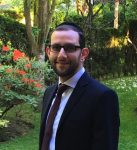
Rabbi Shlomo Gabay is the new spiritual leader of Congregation Beth Hamidrash. (photo from Shlomo Gabay)

“The Sephardic world has its own customs, its own personality – communicating that to the next generation is a priority for Beth Hamidrash,” Rabbi Shlomo Gabay told the Independent. “They needed someone who could guide the next generation in the Sephardic way.”

Gabay was explaining why he, a rabbi who most recently worked as a high school teacher in the Sephardi community of Gibraltar, was invited to take over the role of spiritual leader at Congregation Beth Hamidrash following the departure of Rabbi Ilan Acoca in August of last year.

Gabay was born in London, England, and attended yeshivah in Gateshead, a hub of Orthodox Jewish life in Britain. He married “the rabbi’s daughter,” Rachel, who works in graphic and web design, and the couple now has three daughters. Coincidentally, Rachel Gabay is the niece of another former Beth Hamidrash rabbi, David Bassous.

After the Gabays married, they spent some time in Israel, where Shlomo Gabay pursued training in kiruv, or Jewish outreach. He then landed his first job, in Gibraltar, where he worked as a teacher of Gemara and halachah at the Jewish boys high school. He also taught other classes and founded and directed the Shovavim Project, an annual six-week learning program, in Gilbraltar.

Gibraltar is a British territory on a peninsula jutting out of southern Spain, across the water from Morocco. The community is almost totally Sephardi and led by Chief Rabbi Ron Hassid.

“Gibraltar is very relaxed, it’s very beautiful,” said Gabay, who earlier this year posted on Beth Hamidrash’s Facebook page a video of himself and some monkey friends on the Rock of Gibraltar. “It’s a holiday place where everybody goes. The population is almost 30,000, but 11 million [tourists] … come a year. The streets are full all the time, you get to meet people from all over the world.”

Gabay sees some similarities between Gibraltar and Vancouver – the natural beauty, the many tourists and a more laid-back culture than London for example – although, obviously, there’s a considerable difference of scale.

Gabay and his family are settling in well and enjoying the West Coast, even the previous winter weather. “London and Vancouver,” he said, “have something in common as well – rain.”

During the interviewing process, the Gabays were invited to come for a trial Shabbaton and Beth Hamidrash decided they had a winner.

“One of the strong reasons we were chosen,” said Gabay, “was because Beth Hamidrash felt they needed to focus on the next generation. Sephardic culture is quite different from Ashkenazic culture – the food, the personality – they didn’t want it to be pulled away in a different angle from what the founders intended.”

Beth Hamidrash has been without a rabbi for a year and a half. Gabay said he is looking forward to reinvigorating what the community is known for – having a warm, family atmosphere, being a community social hub, as well as a place of culture and Torah learning. “We want everyone to be happy here,” he said.

Gabay offers Talmud classes on Tuesdays and has started a Sunday class after breakfast, which covers a different topic of discussion every week. Rachel Gabay is a trained teacher of Judaics, as well as having training in marriage counseling and preparation for marriage.

Matthew Gindin is a freelance journalist, writer and lecturer. He is Pacific correspondent for the CJN, writes regularly for the Forward, Tricycle and the Wisdom Daily, and has been published in Sojourners, Religion Dispatches and elsewhere. He can be found on Medium and Twitter.
Format ImagePosted on May 25, 2018May 23, 2018Author Matthew GindinCategories LocalTags Beth Hamidrash, Judaism, Sephardi, Shlomo Gabay
Collaborative housing options

Collaborative housing options

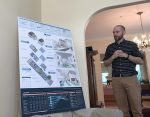
Travis Hanks of Haeccity Studio Architecture. He and his colleague Shirley Shen made a presentation at the launch of CoHo on May 12. (photo by Noam Dolgin)

A diverse group of people a couple of dozen strong, all looking for solutions to Vancouver’s housing crisis, met on May 12 to brainstorm and learn. The meeting was organized by CoHo BC, an organization founded by Jewish community member Noam Dolgin, which describes itself as “an initiative to support, encourage and simplify collaborative ownership of property in B.C.”

The gathering took place at the home of Celia Brauer, another Jewish Vancouverite who herself is looking at co-housing options. “I have been loving this house and surrounding green space for 18 years now,” she said in the press release about the meeting. “I would very much enjoy sharing this corner of paradise with someone, especially since it would allow me to remain here.”

After getting to know one another a bit, smaller groups were formed to share ideas of their ideal dwellings and produce a collaborative vision for a home that included them all.

It was clear that everyone present had already given the idea some thought. One team envisioned a shared home with a combination of private areas and shared spaces – such as a library, places where people could work and places kids could play, plus a carport for a shared vehicle – as well as a backyard. (All three mini-groups dropped the idea of a front yard as an unneeded encumbrance.) The other two teams came up with different visions: one imagined private houses sharing courtyards and outdoor spaces on the same lot; another saw a shared structure with self-contained living spaces within it.

Following this exercise, architects Travis Hanks and Shirley Shen of Haeccity Studio Architecture made a presentation on the firm’s Micro-op concept, which won the Urbanarium Missing Middle Competition. (Urbanarium is a registered nonprofit founded by a group of architects, planners and others committed to re-imagining the city.)

Haeccity’s “missing middle” project is about providing alternatives to houses on the one end, and high-rises and condos on the other. Hanks and Shen are exploring ways to increase density on lots that are in the “buffer zones” of major arterials, between single-family neighbourhoods and commercial areas.

Hanks and Shen described the concept: a three-storey building of six or seven housing units that would fit onto a single-family lot of about 33 feet by 122 feet without impinging on the space or esthetic values of adjacent single-family homes. It could be in two buildings, separated by a common courtyard, with the flexibility of a combination of one-, two- and three-bedroom units ranging in size from 525 square feet to 1,350 square feet.

Haeccity’s proposal imagines new urban policies that would provide both more affordable housing and more community-rich neighbourhoods. The housing would be purchased like in a co-op model, where tenants would buy shares in the community. Although this would make buying in more affordable, as well as potentially foster community, intergenerational connection and other benefits that come from long-term residents, many of those at the May 12 meeting were concerned about the lower return on investment such a community would entail, should residents decide to leave. Hanks and Shen were clear that there was a trade-off involved.

“If we’re going to get serious about affordability,” said Hanks, “we have to get serious about separating from the market.”

In his presentation on the CoHo project, Dolgin explained, “CoHo aims to be a portal for information. It is also a ‘matchmaking service’ for homeowners, buyers and sellers to find others with complementary housing needs.”

Dolgin said he plans to collect information that will make it easier to understand people’s needs and to connect like-minded people together. Citing a 2016 Ipsos Reid poll – which found that 11% of respondents would consider buying real estate with a friend or business partner and three percent would consider buying with a stranger – he said openness to co-housing is steadily growing in Vancouver, especially among millennials. What is missing, he said, is an infrastructure to help make it happen.

Brauer then briefly outlined the housing offer she would like to make and led interested guests on a tour. She is offering to sell 60% of her property to someone willing to share it so that she can stay within her community, in the neighbourhood she’s known for almost two decades. She would like to build her own small house in the back of the lot. The only access to her envisioned laneway house would be from the front street. In a kind of microcosm of the needs of the larger co-housing community in Vancouver, Brauer’s plan will be dependent both on finding the right shidduch (match) and on the city being willing to accommodate the project.

“The next step for CoHo BC involves building the community through a series of events, social media and networking,” said Dolgin. “We need to work together to spread the word about this organization and this housing type. People in B.C. are constantly searching for community and affordability, so I truly believe collaboration and some form of communal living or co-ownership is a viable option that would appeal to more than 10% of the population. Our job is to create the community and infrastructure to facilitate and encourage this type of housing.”

For more information, visit cohobc.com.

Matthew Gindin is a freelance journalist, writer and lecturer. He is Pacific correspondent for the CJN, writes regularly for the Forward, Tricycle and the Wisdom Daily, and has been published in Sojourners, Religion Dispatches and elsewhere. He can be found on Medium and Twitter.
Format ImagePosted on May 25, 2018May 23, 2018Author Matthew GindinCategories LocalTags affordability, Celia Brauer, Haeccity, housing, Noam Dolgin
Experiencing a renewal

Experiencing a renewal

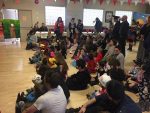
More than 100 people came out to Burquest Community Association’s Purim carnival this year. (photo from Burquest)

At the end of a short, upward-sloping driveway in Port Coquitlam, what was originally a Jehovah’s Witness centre was converted into a Jewish community centre a couple of decades ago. The community the centre houses, Burquest, has been active since 1973. As the Jewish presence in the Tri-Cities grows, it is playing an increasingly essential role in providing services and connecting Jews to one another and to our culture and traditions.

The Burquest Jewish Community Association is dedicated to the “religious, social, cultural and educational needs of the Jewish population of the Fraser Valley,” with a membership of around 70 families, according to their website. The membership is diverse, with roots in five continents and a wide variety of Jewish backgrounds and interests, ranging in age from infants to grandparents. Yet, two years ago, the community’s future was uncertain – the board was considering continuing under the auspices of the Jewish Federation of Greater Vancouver, until Shoshana Szlachter stepped up to offer new leadership. She became board president just over a year ago.

“We were suffering from an onerous debt, it didn’t look like there was enough membership to keep it going,” Rudy Rozanski, Burquest vice-president, told the Jewish Independent. “A few of us got together, and Shoshana was at the head of that, and we decided that we do believe in the future of Burquest and we decided we did want to re-invigorate it. We had many ideas and they were instituted by Shoshana in a clear and positive way. We transformed it into a centre for Jewish learning, as well as being a community centre.”

Part of Burquest’s new success seems to lie in going back to their origins. “When I first joined Burquest, we were non-denominational, and then went Reform. But that didn’t work out as an experiment,” said Rozanski. “In a sense, we’ve returned to our roots.”

A year into Burquest’s renewal, things are looking up.

“Financially, we’ve come along really well,” said Szlachter. “When I came in, I thought, there’s still some life in this old donkey, let’s give it a kick and see what happens.”

The community reduced the cost of seats for the High Holidays and gave free memberships to those who bought tickets – this tripled membership. The centre has also gotten key grants, including from Federation, the Waldman Foundation and the City of Coquitlam. They have partnered with PJ Library to offer activities for children, as well as expanding their programming overall. For example, Burquest now has a Seniors on the Go program, covering yoga for seniors, mah jongg, art and piano gatherings, and a lunch-and-learn program on Jewish genealogy. There is a women’s class led by Devorah Brody, a teen club, Maccabee Kids (with optional Hebrew lessons) and a parent-and-tot drop-in program called Coffee and Knishes. Cantor Steve Levin leads religious services, and holiday events have been well-attended, with some 100 people joining the Chanukah and Purim celebrations.

“For a small community, our calendar is pretty full,” said Szlachter.

“I really enjoy the wide range of programming that Burquest is now offering,” said Sandra Hochstein, who has been involved with Burquest for 20 years. “When my daughters were young, I participated in all the child-oriented activities and am glad to see they are still there and going strong. Now that I am an empty-nester and newly retired, I love being able to participate in the adult activities, such as lunch-and-learn sessions and Monday morning yoga. I still appreciate the sense of community that I feel when attending Shabbat or High Holiday services.”

Asked about Szlachter’s role in Burquest’s “renewal,” Rozanski said, “Shoshana is an outstanding leader who is genuinely effective and concerned about our community, and her decisions regarding Burquest’s future have been unanimously applauded. Renewal is the right word for what our community is going through.”

More information about Burquest can be found at burquest.org.

Matthew Gindin is a freelance journalist, writer and lecturer. He is Pacific correspondent for the CJN, writes regularly for the Forward, Tricycle and the Wisdom Daily, and has been published in Sojourners, Religion Dispatches and elsewhere. He can be found on Medium and Twitter.
Format ImagePosted on April 27, 2018April 25, 2018Author Matthew GindinCategories LocalTags Burquest, family, Judaism, Rudy Rozanski, Sandra Hochstein, Shoshana Szlachter, Tri-Cities
A girl’s rite of passage

A girl’s rite of passage

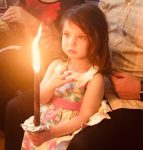
Mia holds a Havdalah candle. (photo by Miriam Leo Gindin)

Many Orthodox Jews wait until a boy’s third birthday before giving him his first haircut in a ritual called upsherin, a Yiddish word meaning to “cut off.” In recent years, this custom has spread outside of the Orthodox world to be embraced by other Jews and, as a recent upsherin in Vancouver showed, some are beginning to include girls in the custom as well.

On March 17, Noam and Val Dolgin invited family and friends to their house for the upsherin of their daughter, Mia.

“For me, this was an opportunity to connect with tradition. I love the lifecycle traditions of Judaism,” Val Dolgin told the Jewish Independent.

Noting that they had done the same thing for their son Erez, who is two years older than Mia, she said, “I think it’s really important for kids to see themselves as being a part of a multi-generational community that cares about them, that makes them feel safe; that they can know they’re part of something bigger than themselves, that there are lots of people around rooting for them to succeed. For me, it was a chance for Mia to be affirmed in her community, to mark a transition, and to connect with tradition in a way that’s meaningful.”

Val Dolgin’s parents, who did not grow up with the upsherin tradition, were present at the ceremony. “My parents are very proud that they have Jewishly involved children,” she said. “They had never been to an upsherin before Erez and Mia’s. For them, they enjoy any opportunity to celebrate their family.”

Traditionally, the upsherin marks when, at the age of 3, a boy officially begins his Torah education and starts to wear a kippah and tzitzit. It was first mentioned in Sha’ar HaKavonot by Rabbi Chaim Vital, a student of 16th-century kabbalist Isaac Luria. The ceremony’s origins are mystical, and it was seldom observed outside of the Orthodox world until recently. The traditional ritual includes the haircut (leaving peyot), eating cookies shaped like Hebrew letters and dipped in honey (to show learning is sweet) and the wearing of tzitzit and a kippah for the first time.

The idea of three years as the transition time derives from the mitzvah of orlah. The Torah says that if you plant a tree, all fruits that grow during the first three years are orlah, or off limits (Leviticus 19:23). Given the kabbalistic comparisons of people to trees, many Orthodox Jews leave a child’s hair uncut during the first three years.

“The ritual of upsherin was special for us on a few levels,” said Noam Dolgin. “First, the ecological connection, which reminds us that we are part of nature. Two, it marks an important transition from baby/toddler to child. And, lastly, it is an important moment when our child is old enough to start learning and internalizing Jewish and communal values and mitzvot.”

He added, “I believe the practice has even more significance today as we better understand child development and re-explore our ecological connections. And, of course, we would do it for our daughter – it’s just as relevant to her development and place in our community as it was our son.”

“The upsherin marks a Havdalah between freest babyhood and, at age 3, the first increment of teaching and training a child,” said Or Shalom spiritual leader Rabbi Hannah Dresner, who led the ceremony. “What a great ritual to promote and renew! For us, of course, it is an egalitarian marking of readiness. Traditionally, the first snip is taken from the centre of the forelock, the place of the third eye or of insight, the spot that will, someday, at the next big milestone of readiness, receive the tefillin shel rosh, the tefillin box that sits on the forehead. For those in progressive Jewish circles, kippah, tzitzit and tefillin are all ritual wear promoted for girls and boys alike. The upsherin can be a sweet, celebratory beginning of Jewish education and the beginning of mitzvah-doing in the lives of all our children.”

Matthew Gindin is a freelance journalist, writer and lecturer. He is Pacific correspondent for the CJN, writes regularly for the Forward, Tricycle and the Wisdom Daily, and has been published in Sojourners, Religion Dispatches and elsewhere. He can be found on Medium and Twitter.
Format ImagePosted on April 27, 2018April 25, 2018Author Matthew GindinCategories LifeTags Dolgin, Hannah Dresner, Judaism, upsherin
Festival fêtes Russian music

Festival fêtes Russian music

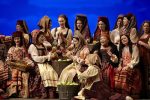
A scene from Vancouver Opera’s production of Eugene Onegin. (photo by Trudie Lee)

“I’ve sung a lot of Russian, and I love it,” Jewish community member and opera singer Leah Giselle Field told the Jewish Independent. Field will have a lot to love at this year’s Vancouver Opera Festival, which starts next weekend.

Russian White Nights, the second annual Vancouver Opera Festival, celebrates Russia’s luminous midsummer nights. Among the festival offerings is Eugene Onegin, based on the classic of Russian literature by Alexander Pushkin, which was turned into a lyric opera with a libretto co-written by Pyotr Ilyich Tchaikovsky with K.S. Shilovsky. The festival will also feature the première of The Overcoat, an opera based on Nikolai Gogol’s famous short story, as well as Requiem for a Lost Girl, an original chamber musical collaboration that explores themes around homelessness and violence towards women.

According to the press material, Eugene Onegin – which plays April 29 in the afternoon, and the evenings of May 3 and May 5 – promises “breathtaking music [and] choreography, lavish orchestrations and compelling arias.” Field will be playing the role of Larina, the mother of the two main female protagonists of the story, Olga and Tatyana.

“The libretto includes portions of the original verses of Pushkin,” Field said, noting that the score is one of her favourites. “Tchaikovsky originally thought it would be blasphemy to make Pushkin’s poem into an opera, but eventually he agreed. I love the Pushkin poem the opera is based on as well – it’s so environmentally evocative, it is so Russian, and it takes you into right into that environment.”

A number of Russians feature in the cast, including baritone Konstantin Shushakov (Onegin), soprano Svetlana Aksenova (Tatiana) and tenor Alexey Dolgov (Lensky). This new production has been created in collaboration with Calgary Opera and is directed by Tom Diamond and conducted by Jonathan Darlington. Eugene Onegin will be sung in Russian with English surtitles projected on a screen.

In addition to Eugene Onegin, Field will participate in a chamber music performance of Dmitri Shostakovich’s From Jewish Folk-Poetry Op. 70 on May 4, 5 p.m., at CBC Studio 700. This song cycle was written in 1948 by the Soviet composer, who initially wrote eight songs that were meant to reflect the hardships of being Jewish in the Soviet Union. In order to disguise this sensitive material, Shostakovich added three more songs depicting the “great life” Jews had under the Soviet regime. Despite these efforts, the censors were not fooled and refused to approve the work – it could not be performed until after Stalin’s death in March 1953.

On the lighter side, Field will also appear in a family-oriented original adaptation of Maurice Sendak’s Where the Wild Things Are, a student performance co-produced by Vancouver Opera and Delta School of Music on May 5, 1 p.m., also at CBC Studio 700. The production is one of four offerings aimed at children and/or teens on the festival’s Family Day.

Vancouver Opera general director Kim Gaynor, also a member of the Jewish community, is in her second season at the organization, which she came to after years working the festival circuit in Europe. Gaynor told the Independent that she has modified the Vancouver festival quite a bit from its first year, trying to take a more “out of the box” approach. This includes a more diverse and daring program with a mixture of classical and contemporary works, and the inclusion of chamber music. The festival will also include three films: the silent film Man With A Movie Camera on April 28, the 2001 CBC production of The Overcoat on April 29 and 1965’s Dr. Zhivago on May 1.

The festival starts on April 28 with an outdoor celebration at Queen Elizabeth Theatre Plaza that features Russian cultural performers, food trucks, market vendors, a circus presentation, a movie screening and a patio bar. Festivities that day will get underway at 2 p.m., and a highlight will be the re-creation of the pinnacle of white nights celebrations in Russia that evening. A 40-foot schooner with scarlet sails will serve as the stage for acrobatics, music and custom-designed projections on the 22-foot-high sails in a performance suitable for all ages. Scarlet Sails will also be offered April 29 and May 3 and 5.

The Vancouver Opera Festival runs to May 6. The full program and more information can be found at vancouveropera.ca.

Matthew Gindin is a freelance journalist, writer and lecturer. He is Pacific correspondent for the CJN, writes regularly for the Forward, Tricycle and the Wisdom Daily, and has been published in Sojourners, Religion Dispatches and elsewhere. He can be found on Medium and Twitter.

Format ImagePosted on April 20, 2018April 18, 2018Author Matthew GindinCategories Performing ArtsTags chamber music, film, Kim Gaynor, Leah Giselle Field, Onegin, opera
Remembering Sam Belzberg

Remembering Sam Belzberg

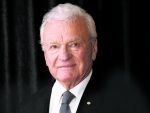
Samuel Belzberg

Businessman and philanthropist Samuel Belzberg died on March 30 in Vancouver, after suffering a stroke several days earlier.

Belzberg, 89, was the chair and chief executive officer of Gibralt Capital Corp., which is based in Vancouver.

After moving here in 1968, Belzberg formed Western Realty with his brothers, which they sold in 1973, according to the Vancouver Sun. In 1970, he formed First City Financial, which adapted through the years, operating until 1991.

In his 60s, Belzberg reinvented himself as a private equity investor, quickly amassing significant successes. He bought out and revived the Keg restaurant chain. He also financed a Quebec-based vaccine manufacturer called ID Biomedical and took on real estate projects in Nova Scotia, California, Oregon and elsewhere.

In his later years, he became more known for his generous philanthropy. Belzberg’s parents had immigrated to Alberta from Poland just before many of their friends and family were sent to Nazi concentration camps, and it was the immigrant experience that inspired him to help others.

“Mom and Dad lost so many of their brothers and sisters, yet Canada took them in,” he told the Sun in 2003. “This country takes people in, so why shouldn’t we help people? It’s our responsibility to help. I think about it every day.”

Belzberg headed the initial $13.5 million campaign to build Simon Fraser University’s (SFU’s) Downtown Vancouver campus, a space that has since become an integral part of the city’s urban life.

SFU president Andrew Petter told the Vancouver Sun that Belzberg will have a lasting legacy at SFU. “Sam was a larger-than-life figure,” said Petter. “He was one of the builders of SFU.”

Both Belzberg and his wife, Frances, have been honoured by SFU for their leadership and contributions.

Belzberg also donated the initial $500,000 to start the Simon Wiesenthal Centre in Los Angeles in 1977 and served as its founding chairman. “Sam was both a visionary and proud Jew,” Rabbi Marvin Hier, who founded the centre, said in a statement.

On top of that, Belzberg helped found Yeshiva University High School of Los Angeles and was an active supporter of the Jewish community in Vancouver.

“Countless organizations in our community benefited from his vision and his philanthropy, including ours,” said Ezra Shanken, chief executive officer of the Jewish Federation of Greater Vancouver. “He had such a youthful energy about him and, every time we met, he was always open to new ideas and new ways to help Jewish life flourish. He truly cared about this community and he appreciated others who valued tikkun olam and tzedakah as he did. He and [his wife] Fran were a team and they have instilled those values in their family from one generation to the next.”

In 2001, Belzberg created Action Canada, which, in partnership with the federal government, endows 20 fellowships each year to Canadians “who want to make a difference in the world.” He also founded the Dystonia Medical Research Foundation– a cause that was very personal to him. In the 1970s, his daughter, Cheri Belzberg, was diagnosed with the rare neurological condition, which impacted her mobility and speech. “Nobody knew the first thing about it in those days,” Belzberg told the Jewish Independent in 2014.

Belzberg received the Governor General of Canada Award in 1992 and, in 2002, was promoted to Officer of the Order of Canada. In 2009, he was awarded the Order of British Columbia for his extraordinary philanthropy and community leadership.

Belzberg is survived by Frances, his wife of 68 years, his four children, 16 grandchildren and 12 great-grandchildren.

Matthew Gindin is a freelance journalist, writer and lecturer. He is Pacific correspondent for the CJN, writes regularly for the Forward, Tricycle and the Wisdom Daily, and has been published in Sojourners, Religion Dispatches and elsewhere. He can be found on Medium and Twitter. A version of this article was originally published by CJN.

Format ImagePosted on April 13, 2018April 11, 2018Author Matthew GindinCategories LocalTags business, philanthropy, Sam Belzberg, tikkun olam

Posts pagination

Previous page Page 1 Page 2 Page 3 Page 4 … Page 11 Next page
Proudly powered by WordPress