Skip to content
  • Home
  • Subscribe / donate
  • Events calendar
  • News
    • Local
    • National
    • Israel
    • World
    • עניין בחדשות
      A roundup of news in Canada and further afield, in Hebrew.
  • Opinion
    • From the JI
    • Op-Ed
  • Arts & Culture
    • Performing Arts
    • Music
    • Books
    • Visual Arts
    • TV & Film
  • Life
    • Celebrating the Holidays
    • Travel
    • The Daily Snooze
      Cartoons by Jacob Samuel
    • Mystery Photo
      Help the JI and JMABC fill in the gaps in our archives.
  • Community Links
    • Organizations, Etc.
    • Other News Sources & Blogs
    • Business Directory
  • FAQ
  • JI Chai Celebration
  • JI@88! video

Recent Posts

  • Last hostage home
  • New bill targets hate crimes
  • Concerning actions
  • Recipes not always required
  • Survivor urges vigilance
  • Seniors profoundly affected
  • Farm transforms lives
  • Musical legacy re-found
  • A range of Jewish literature
  • A concert of premieres
  • Variety telethon on Feb. 22
  • Victoria club’s many benefits
  • Avodah dedicated to helping
  • Artists explore, soar, create
  • Life’s full range of emotions
  • Community needs survey closes March 29
  • Jerusalem marathon soon
  • Historic contribution
  • Chronicle of a community
  • Late-in-life cartoonist
  • Cashflow vs growth portfolio
  • My new best friend is Red
  • ישראלים רבים ממשיכים לתמוך בטראמפ ועדיין אינם מבינים במי מדובר
  • עשרים ואחת שנים בוונקובר
  • Supporting the Iranian people
  • The power of photography
  • A good place to start
  • When boundaries have shifted
  • Guitar virtuosos play
  • Different concepts of home
  • Broadway’s Jewish storylines
  • Sesame’s breadth and depth
  • Dylan Akira Adler part of JFL festival
  • Mortality learning series
  • A new strategy to brighten up BC
  • Sharing latkes and light

Archives

Follow @JewishIndie
image - The CJN - Visit Us Banner - 300x600 - 101625

Byline: Matthew Gindin

Breaking new ground

Breaking new ground

Or Shalom’s Rabbi Hannah Dresner is both the first woman and the first Jewish Renewal rabbi to be elected head of the Rabbinical Association of Vancouver. (photo from Or Shalom)

“I grew up in a household of many amazingly powerful spirits,” Rabbi Hannah Dresner of Or Shalom Synagogue told the Independent. “My parents’ circle of friends loomed larger than life.”

Dresner has memories of playing ping-pong with Jesse Jackson, making paper dolls with Abraham Joshua Heschel and being read bedtime stories by Elie Wiesel. Her father, Samuel Dresner, was a rabbi and a renowned scholar of Chassidic thought. He was a close personal disciple of Heschel, who is widely regarded as one of the most important theologians and Jewish ethicists of the 20th century.

Dresner, herself an artist, dancer and academic for years before heeding the call to become a rabbi, walks softly and carries a big soul. Since coming to Vancouver to head Or Shalom after Rabbi Laura Duhan Kaplan stepped down from the pulpit to take on a role at the Vancouver School of Theology, Dresner has made waves by bringing a new range of creative programming to the shul. Events have included a dance troupe performing an interpretation of a Chassidic tale to live jazz music, a Shabbaton on Jewish wisdom about the afterlife, and guest Rabbi Benay Lappe teaching how to queer the Talmud.

Most recently, Dresner has again broken new ground in Vancouver, by being chosen head of the Rabbinical Association of Vancouver. She is both the first woman to hold the position and the first Jewish Renewal rabbi.

The Jewish Independent spoke to Dresner just days after she had convened her first meeting as chair. She said she was heartened to see that her election was a comfortable choice for the mainly male membership of the RAV – Rabbi Carey Brown is also a member – and an exciting opportunity for her to serve both her own shul community and the wider Vancouver Jewish community.

“I see this as a way for Or Shalom to be more visible as a legitimate part of the Jewish community of Vancouver, to bring our own sensibility to fostering kinship between rabbinic colleagues, and an opportunity for myself to serve the Jewish people,” she said.

So far, Dresner – who said she is very much still learning the ropes of the RAV – has innovated by introducing a session of group Torah study into the association’s meetings.
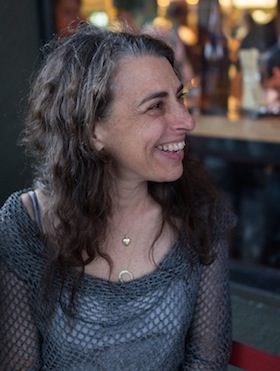
photo - Rabbi Hannah Dresner
Rabbi Hannah Dresner (photo from Or Shalom)

Dresner is known for combining traditionalism and progressive Judaism, including a commitment to “deep ecumenicism,” an openness to the wisdom not just of the different denominations of the Jewish community but the different religious traditions of humankind. This is what drew her to the Jewish Renewal movement founded by Reb Zalman Shachter-Shalomi. Renewal is known for its embrace of both traditional liturgy and observance and Torah study with feminist, ecological and ecumenical perspectives.

She said, “My job here [at Or Shalom] is to really nurture the historic members and create a space that is bold and fresh and open and willing to embrace our contemporary thoughts and needs, and to be truly inclusive; to nurture the old and to welcome and open as many portals as possible.”

Before becoming a rabbi, Dresner went to Barnard College to study dance and art then taught at the Ramaz School in New York. She went to graduate school at the University of Chicago and got her master’s in fine arts, becoming an exhibiting painter at a blue-chip gallery, with a career as a working artist while teaching in MFA programs. Her longest tenure was at Northwestern University for 10 years, where she was tasked with inventing new undergraduate courses across the arts.

When Dresner got married and had children, she felt the need for a prayer space tolerant of young mothers, a community in which to raise kids. She founded the Lomdim Chavura, which some quipped stood for “lean, mean davening machine.” The group met on Shabbat mornings and co-parented – they “birthed each other’s babies into life, and doula’d community members into death as well,” said Dresner.

“It was spiritual improvisation,” she said, noting that the chavura regularly gathered to experiment with new forms of expression. It was within that space that Dresner became interested in leadership and discovered davening and ritual as new spaces for her creative expression. She began seeing Jewish communal life as another way of being an artist in the world.

“Everything was woven together in our communal life,” said Dresner. “We made sukkot out of gourds or sunflowers. Ritual life was part of gardening, was part of cooking, was part of life and dance and art.”

Dresner said her discovery of the seamlessness of those things made her transition into the rabbinate very natural. “It is about translating those family expressions into a larger family,” she said.

Dresner had begun studying Chassidic texts while still an MFA advisor, to feed her soul and connect again with the spiritual milieu of her childhood. “We used to study the Sefer Ba’al Shem Tov every Shabbat afternoon,” Dresner said of her early childhood immersion, “and we sang niggunim until dark and then made Havdalah.”

Dresner’s study of Chassidus gradually blossomed into studying for the rabbanut. “I’m not really in rabbinical school,” she told herself. “I’m just taking these classes.”

Dresner was eventually ordained as both a rabbi and mashpia ruchanit (spiritual counselor). She has been two different kinds of CLAL fellow, in the Rabbis without Borders and Clergy Leadership Incubator programs.

During her rabbinic studies, Dresner was close with Daniel Siegel, the founding rabbi of Or Shalom, and she was excited when a job opening arose at the synagogue. “Coming here to the congregation that he founded had a lot of meaning to me and I had a lot of respect for Laura, the previous rabbi, as an intellectual as well,” said Dresner.

In 2001, Dresner had gone to Berkeley with husband Dr. Ross Andelman to focus on integrating their families. They made a deal: she had left her dream job and moved for him, and he would repay the favour after the kids had graduated high school. Once Dresner was ordained as a rabbi with ALEPH, Andelman, who is known in the Or Shalom community as “the rebbetz” (a play on the traditional name for the rabbi’s wife, rebbetzin) was true to his commitment and left his job as medical director of a county mental health system in Northern California to come here. “He’s a man who acted on his feminism,” said Dresner.

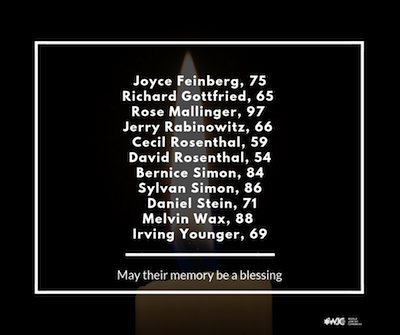
One of Dresner’s first calls to public duty as head of the RAV came on Oct. 28, when she led the vigil remembering the victims of the Pittsburgh massacre, which claimed the lives of 11 Jews.

Matthew Gindin is a freelance journalist, writer and lecturer. He is Pacific correspondent for the CJN, writes regularly for the Forward, Tricycle and the Wisdom Daily, and has been published in Sojourners, Religion Dispatches and elsewhere. He can be found on Medium and Twitter.
Format ImagePosted on November 9, 2018November 9, 2018Author Matthew GindinCategories LocalTags Hannah Dresner, Jewish Renewal, Judaism, Or Shalom, Rabbinical Association of Vancouver, RAV
New principal at RJDS

New principal at RJDS

Richmond Jewish Day School principal Ronit Amihude with the award-winning children’s book What Do You Do With An Idea? by writer Kobi Yamada and illustrator Mae Besom. (photo by Coleen Lou)

Ronit Amihude is a leader with a vision. The new principal at Richmond Jewish Day School (RJDS) has been working in Jewish education since high school and in day school settings for more than two decades. She brings with her a passion for relevant, pluralistic Jewish education, and training in forward-looking pedagogical theory and practice.

Amihude was born in Winnipeg and moved to Toronto in the early 1990s to work at the Heschel School, at the time a small progressive Jewish school with a dream of crafting creative education that involved children in a way that was individualized and relational. Amihude did a little bit of everything in her 18 years there and was able, she told the Jewish Independent, “to see how you can take a small beautiful seed and turn it into a gorgeous garden.”

Amihude got a master’s in education while at Heschel and went through the Jewish Theological Seminary’s Day School Leadership Training Institute, a 15-month program which, according to their website, “prepares new and aspiring heads of school for their work in Jewish day schools by providing engaging experiential learning opportunities, cutting-edge leadership development, ongoing mentoring, and the chance to collaboratively problem-solve with cohort peers.”

While at Heschel, Amihude took on multiple leadership roles. After her tenure there, she was recruited to Atlanta, where she became the principal of learning, teaching and innovation at the Epstein School.

Richmond Jewish Day School began looking for a new principal after Abba Brodt, a beloved educator and administrator who had been with the school since 2010, left in 2017. Amihude had heard about RJDS over the years and felt it had “the same heimish [homey] feeling as Heschel” and was “a beautiful little school community” that believes all Jewish kids deserve a Jewish education and could be helped to get one.

“The feeling I got was that RJDS is a wonderful place where kids are supported and appreciated, where it is not just STEM that is taught, but kindness, perseverance and acceptance,” she said.

Amihude applied for the job last December and, after multiple Skype calls and phone chats, she flew out in February of this year and contracts were signed around Pesach.

When Amihude spoke with the Independent, it was her fifth day on the job and she generously made time in her hectic schedule to talk. Her first impressions of life at RJDS were resoundingly positive.

“It is a really diverse population where that is celebrated,” she said. “It’s a place where children of all levels of observance and non-observance from all over the world – Israel, Russia, Colombia and elsewhere – learn together. Kids who think everybody eats matzah balls on Yom Tov learn there are lots of ways to be Jewish.”

Amihude said a balance between tradition and pluralism is important for her, and the school community is open to different styles of being Jewish. This approach is showcased, in part, by their pluralistic approach to tefillah (prayer), which embraces Orthodox and progressive rituals. “If kids are given a hard line, telling them that only one way is authentic,” said Amihude, “then what message does that give them if that’s not the way of themselves or their family – that they’re not Jewish?”

This fall at RJDS, students took part in the international Kindness Rocks movement, where kids decorate rocks with messages of encouragement and kindness and place them out in the community. The school put a unique spin on this practice by integrating it into the days of teshuvah (repentance/return) between Rosh Hashanah and Yom Kippur.

Amihude said an essential part of her mission at RJDS is giving kids the tools to find their own Jewish selves outside of school and to help their families figure out who they are and what they want to be doing. She wants to see a collaborative space where kids can work together to create, to learn perseverance and problem solve.

“Can the kids build a model sukkah? Can they create a double-decker chanukiyah for parents and kids to light together? There is so much we can be doing with 21st-century skills, while celebrating the Jews that we are and the people that we want to be.”

Matthew Gindin is a freelance journalist, writer and lecturer. He is Pacific correspondent for the CJN, writes regularly for the Forward, Tricycle and the Wisdom Daily, and has been published in Sojourners, Religion Dispatches and elsewhere. He can be found on Medium and Twitter.
Format ImagePosted on November 9, 2018November 7, 2018Author Matthew GindinCategories LocalTags diversity, education, inclusion, Judaism, Richmond Jewish Day School, RJDS, Ronit Amihude
In solidarity against hatred

In solidarity against hatred

Selina Robinson, minister of municipal affairs and housing, speaks at the local memorial for the victims of the shooting at Tree of Life synagogue in Pittsburgh. (photo by Alan Katowitz)

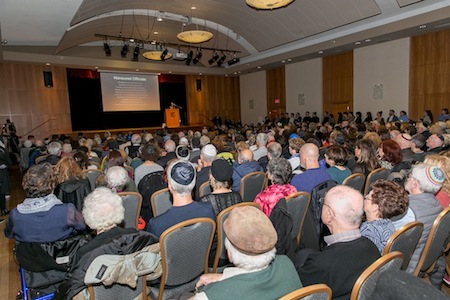
On Sunday afternoon, Oct. 28, the day after a gunman opened fire on Shabbat worshippers in Pittsburgh in the Tree of Life synagogue, hundreds gathered at the Jewish Community Centre of Greater Vancouver for a vigil for the victims.

Eleven congregants were murdered and four police officers wounded before the shooting suspect, Robert Bowers, was apprehended, in what the Anti-Defamation League is calling the greatest antisemitic massacre in American history. Above the crowd in the Wosk Auditorium at the JCCGV, a projector showed a version of the logo of the Pittsburgh Steelers that had been created in the wake of the shooting – it had one of the iconic stars replaced by a Star of David.

The local response was so large that a separate service had to be held in the community centre’s atrium. The Jewish Independent attended the vigil in the auditorium, which was opened by Rabbi Hannah Dresner, spiritual leader of Or Shalom Synagogue and head of the Rabbinical Association of Vancouver.

“We must stand with other minorities to combat hatred with nobility, goodness, and with radical love,” said Dresner. “We must strengthen our empathy with marginalized peoples and do the job, each of us, that is uniquely ours, to create a heaven right here on earth. But first, we must grieve a Jewish loss.”

The rabbi closed with reading a poetic translation of Psalm 23, which is traditionally read at funerals.

Rabbi Jonathan Infeld of Congregation Beth Israel said, “I’ve lived for the last 13 years in Vancouver but was born in and grew up in Pittsburgh. I went to Tree of Life many times as a teenager. HIAS [Hebrew Immigrant Aid Society], the organization the deranged individual was most upset about, was the organization that brought my parents to the sanctuary of Pittsburgh.”

The shooter, who had yelled, “All Jews must die!” before opening fire, had written on Facebook before the attack that he was incensed by Jewish support for immigrants and refugees, who he believed were entering the United States to slaughter white people.

“The massacre took place in Squirrel Hill, in Mr. Rogers’ neighbourhood, where Fred Rogers taught us the Torah verse, ‘you shall love your neighbour as yourself,’ so well,” Infeld noted. “The response to something like this is repairing the world.”

He appealed to everyone present, and all Jews, to fill every synagogue to capacity in the coming weekend. “I ask that all synagogues in Vancouver be filled, with not one seat empty,” he said.

photo - Karen James, chair of the board of the Jewish Federation of Greater Vancouver, addresses the community in the Wosk Auditorium
Karen James, chair of the board of the Jewish Federation of Greater Vancouver, addresses the community in the Wosk Auditorium. (photo by Alan Katowitz)

Karen James, chair of the board of the Jewish Federation of Greater Vancouver, then spoke, followed by Selina Robinson, minister of municipal affairs and housing, who read a statement from B.C. Premier John Horgan.

“British Columbians’ hearts are broken, hearing the devastating news of the shooting at the Tree of Life synagogue in Pittsburgh. Everyone should feel safe in a place of worship,” said Horgan in his statement. “My caucus and I and everyone in the House reject antisemitism, racism, discrimination, intolerance and bigotry. When these rise up, we must stand up united and denounce them together in the strongest of terms. An attack like this is a deep violation of safety and security. Our thoughts are with the families of those targeted and Jewish people around the world.”

Robinson was among many officials present, including Bruce Ralston, minister of jobs, trade and technology; Ravi Kahlon, parliamentary secretary for sport and multiculturalism; Howard Chow, Vancouver Police Department deputy chief constable; Irene Lanzinger, president of the B.C. Federation of Labour; and several members of the Legislative Assembly. Richmond North Centre MLA Teresa Wat changed a flight to be there.

“I am quite connected to the Jewish community,” Wat told the Jewish Independent, “especially the Bayit congregation in Richmond. When I saw what’s happening, I felt really sad. We need to combat this kind of attack on humankind as a global village. Everyone is related and, if it happens to one ethnic group, it can happen to any other. I am happy to see this vigil and hope that all ethnic groups will gather in solidarity to condemn this kind of atrocity.”

image - the names of those who were murdered in Pittsburgh shootingRabbi Dan Moskovitz of Temple Sholom led a candlelighting in remembrance of the victims, with help from Rabbi Adam Rubin of Beth Tikvah. Moskovitz read the names of each victim and shared something from their biography. “In the Jewish tradition,” said Moskovitz, “we need the names. To say Kaddish, to pray, to remember.”

Rabbi Aaron Bisno of Congregation Rodef Shalom in Pittsburgh then joined the service in the auditorium on video, thanking the Vancouver Jewish community for their solidarity. He told the story of being at his synagogue on the day of the shooting – where he was doing a baby naming for two Jewish fathers who had adopted a child – and hearing the news and having to tell the congregation that they were on lockdown until the shooter was apprehended. Bisno urged the crowd to “repair the world when we find it fractured instead of blaming each other for that which we find uncomfortable. I give you my most sincere blessing of gratitude.”

Rabbi Shlomo Gabay of Congregation Beth Hamidrash chanted El Male Rachamim (God Full of Compassion), a traditional prayer of mourning. Rabbi Philip Gibbs read an English translation.

Many non-Jewish community clergy were present at the vigil, including Dr. Kala Singh and Pritam Singh of the Sikh community, Prof. Harry O. Maier of the Vancouver School of Theology and Haroon Khan of the Al Jamia Masjid mosque.

Matthew Gindin is a freelance journalist, writer and lecturer. He is Pacific correspondent for the CJN, writes regularly for the Forward, Tricycle and the Wisdom Daily, and has been published in Sojourners, Religion Dispatches and elsewhere. He can be found on Medium and Twitter.
Format ImagePosted on November 2, 2018November 1, 2018Author Matthew GindinCategories LocalTags antisemitism, memorial, Pittsburgh shooting
Advocating for children

Advocating for children

Left to right are Ann Montague, Dr. Blye Frank, Marta Santos Pais, Jerry Nussbaum, Lillian Boraks-Nemetz and Marny Point. (photo by Tiffany Cooper)

On Sept. 13, at the Dean’s Distinguished Lecture held by the University of British Columbia faculty of education in partnership with the Janusz Korczak Association of Canada (JKAC), the audience listened to the words of a saint.

It is an apt description of Marta Santos Pais, whose middle name does indeed mean saint, in Portuguese. Santos Pais is the United Nations special representative of the secretary-general on violence against children. She has worked for decades with remarkable optimism, resilience, focus and patience to try and create a world where no child will suffer violence. At the least, it’s a saintly endeavour.

Santos Pais, who has a law degree from the University of Lisbon, was appointed to her current position in 2009, after a distinguished career working in several capacities in Europe for the rights of children, including being involved in the drafting of many high-level resolutions and policies. As a global independent advocate, Santos Pais would like to see the elimination of all forms of violence against children: in the justice setting, in the home, in institutional care, in schools, in the workplace and in the community.

The co-sponsor of the lecture, JKAC, was established in 2002 and is dedicated to the remembrance of Janusz Korczak and the dissemination of his ideas about the protection and education of children. Korczak was a Polish Jew who was killed by the Nazis along with the orphaned children under his care in the Warsaw Ghetto. Despite being given the opportunity to escape, Korzcak instead chose to stay with the children and accompany them to Treblinka, where they were all murdered.

Marny Point, a coordinator and instructor in NITEP, the Indigenous Teacher Education Program at UBC, and a representative of the Hul’q’umi’num Salish peoples, spoke in her language as well as in English to open the event. Holocaust survivor, author and JKAC board member Lillian Boraks-Nemetz then spoke briefly, reading from Korczak’s ghetto diary and highlighting the need for those who care for children to first attain self-knowledge.

“How can we aspire to become the kind of teacher and human being Korczak was?” asked Boraks-Nemetz, underlining his claim that it was through knowing ourselves that we may begin. Evoking Korczak’s warning that children are too often overlooked amid the storms that blow through the adult world, Boraks-Nemetz quoted him to that effect: “It is the children who always have to carry the burden of history’s atrocities.”

Dr. Anton Grunfeld presented a graduate scholarship to Ann Montague, a researcher in child education. She was awarded the scholarship on the basis of an ethnographic study of children’s education she conducted in Bali with an eye towards “mobilizing children as agents of care for the environment.”

While Dr. Blye Frank, dean of the faculty of education, introduced Santos Pais, Dr. Mary Ellen Turpel-Lafond, an Allard School of Law professor who works at the Indian Residential School History and Dialogue Centre – and who served as British Columbia’s first representative for children and youth from 2006 to 2016 – spoke a bit about Santos Pais first. She highlighted Santos Pais’s influence on the Truth and Reconciliation Commission of Canada’s 94 calls to action for the federal government, especially the sixth, which advises the abolition of Section 43 of Canada’s Criminal Code allowing the corporal punishment of children. Several of the evening’s speakers noted the importance of convincing the Canadian government to repeal Section 43 and join other countries that have outlawed all physical violence against children. Turpel-Lafond noted with particular gratitude the work of JKAC president Jerry Nussbaum in this regard.

Santos Pais began by acknowledging Korczak’s legacy, citing its role in inspiring the provisions of the UN Convention on the Rights of the Child (CRC). She drew a connection between the achievement of sustainable development and putting children first – starting with investing in the early years and creating a safe, loving environment for all children.

Progress has been made in the areas of “data, legislation, policy and program developments,” but the daily reality of millions of children, particularly the most vulnerable and marginalized, cries out to be addressed with more effectiveness, she said.

Santos Pais spoke of the goal to “leave no children behind anywhere and at no time – but, of course, the world is not yet there.” She noted that 2019 marks the 30th anniversary of the CRC, giving us an occasion to recommit to addressing the one billion children still affected by violence each year.

Santos Pais spoke of the UN’s efforts both to listen to children around the world about their experience of violence, and to comprehensively study the wider social and economic costs of violence towards them. According to Santos Pais, presenting such evidence can be an important piece in motivating governments to see preventing violence towards children not as an expense but as a benefit to their country as a whole. Still, she said, many governments have told her that the goal of completely eliminating violence towards children in the near future is too idealistic, that it is “a joke.” To the contrary, she stressed, “We tend to believe that this goal can be accomplished and that there are many practical steps that we can take towards it.”

After Santos Pais’s speech, Nussbaum and Frank presented her with a Janusz Korczak statuette in honour of her service to children. “Thank you so much,” she said. “I’m going to cry now in my seat.”

Matthew Gindin is a freelance journalist, writer and lecturer. He is Pacific correspondent for the CJN, writes regularly for the Forward, Tricycle and the Wisdom Daily, and has been published in Sojourners, Religion Dispatches and elsewhere. He can be found on Medium and Twitter.
Format ImagePosted on October 12, 2018October 9, 2018Author Matthew GindinCategories LocalTags Janusz Korczak, Marta Santos Pais, tikkun olam
Vintage paddles for auction

Vintage paddles for auction

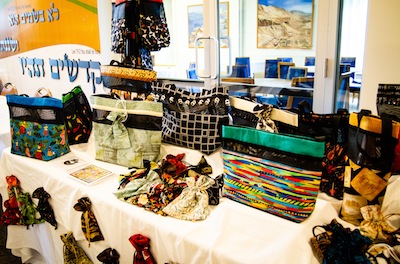
Members of the Tikun Olam Gogos show off some of the paddles being auctioned, until Oct. 10. (photo by Paula Simson)

Last fall, Sue Hyde, dragon boat master and member of Tikun Olam Gogos (which loosely translates as Grandmothers Repairing the World), walked into a board meeting with a hand-painted paddle she had decorated herself. Her idea was to sell paddles like it to raise money for the Stephen Lewis Foundation’s Grandmothers to Grandmothers Campaign, which supports grandmothers in Africa who are raising children orphaned by AIDS.

Tikun Olam Gogos is a Jewish charitable organization, sponsored by the Sisterhood of Temple Sholom, and it is dedicated to fundraising for Grandmothers to Grandmothers. The board was in favour of Hyde’s idea – and one of the board members bought the paddle on the spot. Paddles for African Grandmothers was born.

Hyde had access to more than 30 vintage paddles and the Tikun Olam Gogos asked various artists to paint them. The resulting paddles are being auctioned off until Oct. 10 at tikunolamgogos.org/on-line-auction.

“The paddles were done by a selection of different artists, including one stand-up paddle done by a Syrian refugee,” Tikun Olam Gogos member Sunny Rothschild told the Independent. “The rest are meant to hang on the wall. The paddles are amazing, intricately carved as well as painted. Some are two-sided and some aren’t.”

photo - Tikun Olam Gogos makes bags and other items to raise funds, which will be for sale at the group’s Many Rivers to Cross event Oct. 13
Tikun Olam Gogos makes bags and other items to raise funds, which will be for sale at the group’s Many Rivers to Cross event Oct. 13. (photo by Paula Simson)

The fundraiser will culminate with an evening concert on Saturday, Oct. 13, featuring the City Soul Choir and a meet-and-greet with the artists. Winning bidders can pick up their paddles then.

Marie Henry, the founder of Tikun Olam Gogos, also spoke with the Independent. The Tikun Olam Gogos are part of the Greater Vancouver Gogos, which includes more than 25 groups.

“I was visiting in-laws in Kelowna, and I went to a public market and saw a stall where women were selling beautiful tote bags. I found out they were supporting the Stephen Lewis Foundation,” she explained. “I came back and joined the group in Vancouver, but the only problem was I was the only Jew in the group and events kept conflicting with the Jewish calendar. ‘This is crazy,’ I thought, ‘I’m going to form my own group.’”

Henry did just that, in 2011. Today, the group, which is named after the Jewish concept of repairing the world (tikkun olam) and the Zulu word for grandmother (gogo) has Jewish and non-Jewish members. Henry said that only some of the members are actual grandmothers, with the rest being “grand others.”

There are a few hundred Grandmothers to Grandmothers groups across Canada, as well as organizations in the United Kingdom, Australia and the United States. Tikun Olam Gogos has sold more than 2,000 tote bags, with all profits going to the Stephen Lewis Foundation. That’s some $200,000 in donations from tote bags, said Rothschild.

“The admin costs are 11% of all the monies raised, one of the lowest rates of all charities in Canada,” Henry added.

While Henry takes care of notes and minutes and other administrative details for the group, she said, “We have a lot of really talented women in the group, like Sunny, who takes responsibility for part of the group and helps run it.”

Rothschild joined Tikun Olam Gogos almost four years ago, when she was slowing down her career as a lawyer and had more time for volunteer work. She is active in sewing the group’s signature tote bags, as well as taking turns selling them at local craft fairs, where the Gogos get a chance to tell people about their work and the Stephen Lewis Foundation. “That’s the best part,” she said.

“I have a Post-it up in my house – ‘May my life be for a blessing,’” said Rothschild. “This is one of the things that I do because I want my life to be meaningful and to have mattered.”

“The reason that I started this group when I found out what they are doing,” said Henry, “is to help these grandmothers raise up to 15 grandchildren. My grandchildren live a life of privilege and I feel so horribly guilty that these women in their senior years have to suffer so horribly badly. Doing this, I feel useful. In the final analysis, we are performing tikkun olam.”

“I don’t think that the governments in Sub-Saharan Africa understand the revolution that is going to take place because of these women becoming empowered,” said Rothschild. “There are amazing stories of what women are doing, standing up for their rights. It’s really quite amazing what’s happening.”

“The support that we give them helps them to do that,” added Henry. “I see this as the same to the way that suffragettes in North America stood up for their rights, and here it’s happening in a similar way nearly a hundred years later.”

For now, Henry and Rothschild are hoping the community will come out to support Paddles for African Grandmothers at the Many Rivers to Cross concert.

“We’ll be selling tote bags,” said Rothschild. “People can buy a glass of wine, there will be food too – it will be a lovely event.”

Tickets for the Oct. 13, 7 p.m., show at Temple Sholom can be purchased via tikunolamgogos.org/events.

Matthew Gindin is a freelance journalist, writer and lecturer. He is Pacific correspondent for the CJN, writes regularly for the Forward, Tricycle and the Wisdom Daily, and has been published in Sojourners, Religion Dispatches and elsewhere. He can be found on Medium and Twitter.
Format ImagePosted on October 5, 2018October 3, 2018Author Matthew GindinCategories LocalTags Africa, City Soul Choir, Marie Henry, Stephen Lewis, Sunny Rothschild, Temple Sholom, tikkun olam, Tikun Olam Gogos
Challenges improve life

Challenges improve life

Israeli judo master Arik Zeevi will speak at FEDtalks Sept. 16. (photo from JFGV)

When we’re faced with a challenge, most of us are naturally cautious. But, says Israeli judo master Arik Zeevi, if you have a passion for something, go for it, explore it and, even if you fail, “you will always be proud that you took the challenge.”

Zeevi, who will be one of four keynote speakers at this year’s FEDtalks Sept. 16, advises in a 2014 TED Talk, “Go for the challenge because, I personally think that, by taking a challenge, that is the best way to grow, to improve your life.”

In that TED Talk, Zeevi shares the story of his experience at the 2001 World Judo Championship. Having trained intensely for two years and becoming a national hero in Israel – and with his journey to the championship being filmed by a team of videographers – Zeevi was “knocked out” (in judo terms, his opponent “threw [him] by ippon”) two minutes after setting foot in the ring.

Undaunted by losing the world championship match, Zeevi, a lightweight, registered to fight in the open match in which fighters of any weight could spar. Friends and colleagues warned him to back out, and the Israeli media fretted over what injuries he might sustain. But, Zeevi beat one opponent, a second, then a third; the fourth knocked him down. Though he failed to win the gold medal, he took the silver – and set a precedent. In the years that followed, having witnessed Zeevi’s success, more and more lightweights competed in the open category, and also won medals. The match morphed into its own championship event.

Zeevi won many judo medals in his time, and he is the 2000, 2003, 2004 and 2012 European champion. He is currently ranked eighth in the world, though he retired from fighting in 2012. Today, Zeevi is an inspirational speaker whose main income comes from talking to companies about what he calls “the similar worlds of sports and business.”

“It is all related,” he told the Jewish Independent, “excellence in sport and excellence in life.”

Zeevi also heads the nonprofit Israeli Foundation for Olympic Excellence (IFOE), which hires and funds Olympic coaches who identify, support and train Israeli children and youth they hope have Olympic potential.

“We scout kids who have talent, we try to nurture them and connect them to the sport that is right for them,” said Zeevi. “You could be Michael Phelps, but unless you’re living next to a swimming pool, you’ll never know.

“The biggest problem in Israeli sport,” he said, “is that all sports are coached by amateurs in private clubs. The coaches are getting income according to the numbers of kids, putting quantity over quality. Professional coaching is rare.”

Zeevi grew up in a tough neighbourhood in Bnei Brak and knows what it is like to have few opportunities.

“My coach was very young, and he was like an older brother to me,” said Zeevi. The coach played a role for Zeevi that he is now trying to play for others. “He pushed me to discover myself,” explained Zeevi. “Around 12, I became very serious. Before that, I was just trying to be part of something. At 12, I got my first invitation to train on the national team. My coach was a Soviet Georgian guy – they are fighters, warriors. By 13 or 14, I was already very big, and he pushed me to fight bigger guys. When 15, I won the championship against seniors over 21. He did a great thing for me, pushing me like that. When you find an athlete, you have to challenge them.”

It is the appreciation for what sports did for him that motivates Zeevi to make high-level training available to more young people. “I really believe in sports as education,” he said. “It is the best way to stimulate mental skills, and it teaches you how to deal with stress, failure, difficulty.”

Zeevi himself has three children. His daughter won the Israeli championship in gymnastics, and his middle son is into basketball and judo. Zeevi said his son has also taught him the lesson that sometimes pushing is not what brings success. “The more I push him forward, the more he goes backward,” he said, “so I have to take a gentler approach. The most important thing is just to be there for them. Then they will succeed.”

While in Canada, Zeevi will also be visiting a judo club in Toronto, which is run by an Israeli friend from his training days. There, he will be giving a master class for advanced fighters before he returns to Israel for Yom Kippur.

FEDtalks, which launches the Jewish Federation of Greater Vancouver’s annual campaign, is being held this year on Sept. 16, 7 p.m., at the Vancouver Playhouse. For tickets and more information, visit jewishvancouver.com.

Matthew Gindin is a freelance journalist, writer and lecturer. He is Pacific correspondent for the CJN, writes regularly for the Forward, Tricycle and the Wisdom Daily, and has been published in Sojourners, Religion Dispatches and elsewhere. He can be found on Medium and Twitter.
Format ImagePosted on August 31, 2018August 29, 2018Author Matthew GindinCategories LocalTags Arik Zeevi, FEDtalks, Israel, Jewish Federation, judo, philanthropy, sports
A life of music and activism

A life of music and activism

Gary Cristall (photo by Brian Nation)

‘My Jewish identity has always been associated with the struggle for basic human values and rights and freedoms,” said Gary Cristall, co-founder of the Vancouver Folk Music Festival, in conversation with the Jewish Independent. “I thought that was the centre, was the core of being Jewish. That was the way I was raised and the stories that were told. I had two identifications with being Jewish – one was social justice, and the other was culinary. I worshipped at Schwartz’s Deli in Montreal.”

A longtime advocate for both the arts and progressive politics, whose passion was forged in the Canadian left of the 1950s and ’60s, Cristall is a cultural pioneer. He co-founded the Vancouver Folk Music Festival in 1978, later serving as its coordinator and artistic director until 1994.

As well as being an educator, activist and promoter, Cristall has fought for artists, struggling to win them professional respect while also defending their rights to fair fees and copyright ownership. For his range of work, he was awarded an honourary doctorate by the University of British Columbia in 2015 and was recognized as an outstanding alumnus of Simon Fraser University in 2017.

Cristall sees his involvement in activism and folk music as natural outgrowths of the culture in which he was raised. “Jews played a major role in folk music in this country, and in the States,” he said. “There were around 50 Jews who invented folk music. It was a conspiracy that was so successful no one understood what had happened.”

Cristall estimates that about 10,000 people attended the first Vancouver Folk Music Festival in 1978. This year’s festival, which takes place July 13-15, is expected to draw more than 35,000 people to Jericho Beach, where the event has been located since 1979. Seven stages are set up in the park and every available inch of parking space in the neighbourhood disappears. This year’s festival will present more than 50 concerts or workshops by artists from around the world, as well as an artisan market and a range of food vendors.

Beyond the festival, Cristall has served in the Canada Council for the Arts and was the founding president of the Public Service Alliance of Canada.

“When the CCA hired me, I was getting tired, getting ready to leave the festival, wondering what I would do next,” Cristall said. “When I saw the job ad, I thought, they’ll never hire me, but they’ll interview me and I’ll get a free trip to see my mother in Toronto. But they were looking to make a change, and they were interested in me because I was a shit-disturber and a rabble-rouser. They called my bluff, and said, ‘OK, you want to change things, come work for us.’”

Today, Cristall is at both Douglas College and Capilano University, where he teaches Canadian cultural policy and arts administration. He has spent 18 years working on a history of folk music in English-speaking Canada, which, he joked, is “1,200 pages written so far, a few hundred pages left to go.”

Asked about what he’s looking forward to at the festival year, Cristall reeled off a list of a dozen performers and what’s special about them. Among them, he mentioned Rodney Crowell, “a brilliant songwriter”; Guy Davis, a “great blues player, son of Ossie Davis and Ruby Dee, left-wing Harlem artists going way back”; Les Poules à Colin, “young people who are the children of that first revival generation of Quebecois folk music”; the Dead South, “Saskatchewan bluegrass”; Dálava, “a Moravian group doing avant-garde classical and folk and jazz music”; Dori Freeman, whose hometown, Galax, Va., “was a centre of old-timey music”; Vancouver’s Gord Grdina, who “plays the oud and is a brilliant guitar player, got a Juno, plays with a 10-piece band”; A Familia Machado, a “great guitar player playing with two members of his family from Brazil”; and Archie Roach “from Australia, a senior aboriginal songwriter.”

As he spoke, the enthusiasm poured off of him. Cristall is clearly still a man who loves music. “They’re the real thing,” he said. “That’s what I like about the folk festival, it’s the real thing.”

In his list of highlights, Cristall notably passed over most of the more well-known acts playing at the festival, names like Art Bergmann, Ry Cooder, the Mariel Buckley Band, Neko Case and indigenous artist and 2018 Juno nominee Iskwé. “What I love about the folk festival is not just seeing the big names, but seeing someone I never heard of before and come home loving,” said Cristall.

How does the world look to a longtime activist like Cristall? What’s his advice to the next generation?

“My hope is very much alive,” he said. “My Zaida was imprisoned for political activism, and he escaped and came to Canada. I’ve been active since 1965. We have to keep on fighting, nothing says we’re going to win quickly. I’m not pessimistic. Every movement has its ups and downs and nobody said that we were going to win fast and easy. My advice to younger people is get involved, educate yourself, learn and fight. That also connects to the kind of music [at the festival], both implicitly and explicitly – the music is a struggle to survive against the behemoth of capitalism and the fact that those artists have survived is a cultural victory. Hey, it’s too late to be pessimistic.”

For the full festival lineup and tickets, visit thefestival.bc.ca.

Matthew Gindin is a freelance journalist, writer and lecturer. He is Pacific correspondent for the CJN, writes regularly for the Forward, Tricycle and the Wisdom Daily, and has been published in Sojourners, Religion Dispatches and elsewhere. He can be found on Medium and Twitter.
Format ImagePosted on July 6, 2018July 5, 2018Author Matthew GindinCategories MusicTags activism, folk music, Gary Cristall, history
Rabbi chosen as a fellow

Rabbi chosen as a fellow

Rabbi Susan Shamash began a fellowship with Rabbis Without Borders this month. (photo from Susan Shamash)

“Rabbis Without Borders addresses borders within Judaism,” said Rabbi Susan Shamash, one of two Canadian rabbis who began a fellowship with Rabbis Without Borders (RWB) this month. “The fellowship aims to span denominations and to break down barriers between rabbis of different denominations, so that they can cross the borders and collaborate.”

While at a Shabbaton led by RWB when she was a rabbinical student, Shamash became interested in the Clal fellowship. Established in 1974 by Rabbi Irving Greenberg and Elie Wiesel, Clal’s “mission has been to help prepare the Jewish people for the unprecedented freedom and openness of North America,” notes the announcement of Shamash’s acceptance into the competitive program, which began in 2008.

Shamash told the Independent that RWB tries to develop rabbis who are able to think and work outside the box while working inside specific communities. Although based in the United States, Clal welcomes Canadian rabbis to its fellowship and, this year, Rabbi Denise Handlarski of Toronto’s Oraynu, a secular humanist congregation, was also accepted.

Shamash completed her rabbinical training in January 2017, obtaining semichah (ordination) from Aleph: Alliance for Jewish Renewal, after a decades-long career as an administrative law judge. Shamash received semichah with four others at that year’s Ohalah conference in Boulder, Colo., from a large number of rabbis, 10 of whom signed her certificate. Her training was overseen, as are all Aleph rabbinic trainings, by a committee of three. In her case, it was Rabbi Victor Gross, Rabbi Hanna Tiferet Siegel (one of the founders of Vancouver’s Or Shalom) and Rabbi Laura Duhan Kaplan (formerly spiritual leader of Or Shalom, now on the faculty of Vancouver School of Theology).

Shamash has been involved with Or Shalom since it started and counts the founding teachers, Siegel and her husband Daniel, among her mentors, as well as Duhan Kaplan, who is delighted to have her aboard. “As a longtime member of the RWB network, I’m delighted that Rabbi Susan Shamash will join us,” Duhan Kaplan told the Independent. “We need more Canadian voices like Rabbi Susan, willing to creatively address emerging issues in our religious and cultural life.”

“I am excited to join Rabbi Laura Duhan Kaplan and [Or Shalom] Rabbi Hannah Dresner in bringing the deep wisdom of this fellowship to Metropolitan Vancouver,” said Shamash.

“I went into law school because I needed a professional skill, and it was a wonderful and rewarding career,” she explained. “I met Rabbi Daniel Siegel while at school – he was a Hillel director at the time and just founding Or Shalom. I learned a lot under his and Hanna Tiferet’s mentoring.”

Although Shamash enjoyed her judicial career, she said she is deeply satisfied with her transition to a second career. “In some ways, I came home, even though I really loved the law,” she said. “I might have become a rabbi for my first career but, at that time, it was not at all encouraged [for a woman]. I was very interested in the study and the prayer life as a kid.”

Primary areas of interest for Shamash include interfaith ceremonies and outreach to underserved Jewish communities, both of which she thinks the fellowship will help equip her for. “The fellowship will inform the work that I do with interfaith families or marriages between observant Jews and unaffiliated Jews or non-Jews, as well as working with people who want some Yiddishkeit for ‘hatching, matching and dispatching,’ as they say, the cycles of life, but want that outside of synagogues and institutions,” she said. “I would also like to take Judaism [beyond] the Lower Mainland and bring Jewish experience to smaller communities in B.C.”

She said there is a lack of diverse offerings for Jews outside of major urban centres, and she would like to help fill that gap.

Shamash currently teaches Talmud at Or Shalom, where she delights in making the study available to people who might otherwise not have access to it. She is hoping, over the years to come, to collaborate with others in the Jewish community to increase the options for serious adult yeshivah-style learning for the non-Orthodox.

Matthew Gindin is a freelance journalist, writer and lecturer. He is Pacific correspondent for the CJN, writes regularly for the Forward, Tricycle and the Wisdom Daily, and has been published in Sojourners, Religion Dispatches and elsewhere. He can be found on Medium and Twitter.
Format ImagePosted on June 29, 2018June 28, 2018Author Matthew GindinCategories LocalTags ALEPH, Judaism, Or Shalom, Rabbis Without Borders, RWB, Susan Shamash
Negev Dinner helps Israeli children

Negev Dinner helps Israeli children

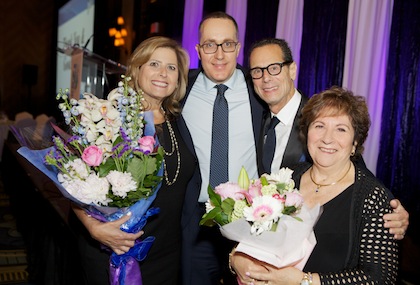
Left to right: Ilan Pilo, Michelle Pollock, Dr. Neil Pollock, Wendy Eidinger Spatzner and David Goldman. (photo by Robert Albanese)

Vancouver supporters of the Jewish National Fund (JNF) gathered in their finery at the Four Seasons Hotel Vancouver on June 3 to celebrate Israel’s 70th birthday and pay tribute to philanthropists Neil and Michelle Pollock.

Michelle Pollock is a former lawyer, the immediate past president of the board of the Jewish Community Centre of Greater Vancouver, and has co-chaired the Jewish Federation of Greater Vancouver annual campaign’s women’s division for six years, as well as supporting Jewish education, among many other causes. Dr. Neil Pollock is chief surgeon and medical director of Pollock Clinics. He has undertaken teaching missions to Rwanda, Congo and Haiti, as well as being involved in philanthropy at home and abroad.

photo - Bernice Carmeli, dinner co-chair, with Ilan Pilo, David Goldman and Ilene-Jo Bellas
Bernice Carmeli, dinner co-chair, with Ilan Pilo, David Goldman and Ilene-Jo Bellas. (photo by Robert Albanese)

JNF Pacific Region president David Goldman welcomed the crowd – who had to pass a few dozen protesters on their way into the hotel – and introduced the evening’s emcee, Michael Nemirow, a friend of the Pollocks, who is also involved in various community organizations and activities. “I’ve done the math, and we have around 11 hours of speeches and entertainment for you this evening, but we’ll try to compress it into three,” Nemirow said, eliciting laughter from the crowd.

After Maurice Moses led the audience in O Canada and Hatikvah, B.C. Lt.-Gov. Janet Austin took the stage. She praised JNF for its work in the “restoration and preservation of the Jewish homeland,” which covers everything from ecological to social to security initiatives. Austin also commented about the Pollocks, highlighting Neil Pollock’s work in Rwanda to prevent the spread of HIV.

Galit Baram, consul general of Israel for Toronto and Western Canada, focused her remarks on the 70th anniversary of Israel, “the only democracy in our region, a bastion of democracy.” She described its strengths in the areas of human rights, medicine, multiculturalism and technological innovation. She said Israel is led by people “both on the right and on the left who love their country with all their hearts” in the face of multiple existential threats. “We rely on our friends who share common values, and Canada, our ally, is among them,” she said.

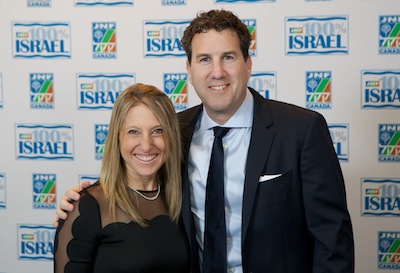
photo - Honourary chairs Jodi and Alex Cristall
Honourary chairs Jodi and Alex Cristall. (photo by Robert Albanese)

“The success of Israel did not happen in a vacuum,” said Baram, citing JNF as a key organization in supporting the state, one in whose name every Israeli has a tree planted. She also spoke of JNF’s contributions in a multitude of activities, including supporting soldiers with post-traumatic stress disorder and her “personal favourite,” the building of a protected playground in Sderot in an area that has suffered shelling from Hamas and other militant groups. Baram thanked Canadians for the warm welcome and open arms with which Israeli diplomats are welcomed in the country.

After Hamotzi, chanted by the Kollel’s Rabbi Avraham Feigelstock, Ilene-Jo Bellas, former president of the JNF Pacific Region (2012-2015), was presented with the JNF Bloomfield Award by local shaliach Ilan Pilo. He described Bellas as an indefatigable servant for Israel who “bled blue and white,” a portrayal she affirmed as fact after taking the podium.

The video on the work of the JNF was introduced by JNF Canada president Wendy Eidinger Spatzner, who explained that the First Zionist Congress established a fund to purchase land in Israel and that this fund became JNF. She talked about JNF’s extensive work to “build the infrastructure of Israel,” noting that it affects the daily lives of “pretty much every Israeli citizen.”

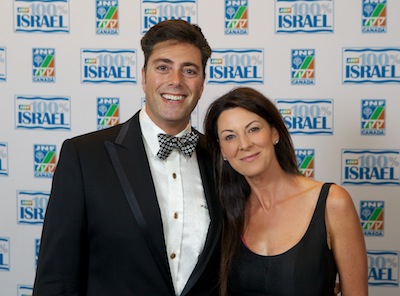
photo - Honourary chairs Jodi and Alex Cristall
Honourary chairs Jodi and Alex Cristall. (photo by Robert Albanese)

Rabbi Dan Moskovitz then led everyone in Birkat Hamazon, before Vancouver TheatreSports performed a series of improv skits centred on the Pollocks’ life as a married couple.

The keynote speaker of the dinner was Doron Almog, a former major general in the Israel Defence Forces, who received the Israel Prize for lifetime of achievement. He discussed his role as founder of ALEH, the charity for children with developmental disabilities that the Pollocks chose to support with monies raised from the evening.

Almog spoke on the theme of commitment, as experienced throughout his life and in the work he has done for children. He shared the story of the death of his brother, a tank operator who died after being injured, left behind by his fellow IDF soldiers. Almog subsequently swore to never leave behind an injured soldier.

Almog’s son Eran, who was named after his fallen uncle, was born with a combination of autism and developmental problems, and a psychiatrist told the family that he would probably never speak, remaining at the cognitive age of an infant. “This son became the greatest teacher of my life, he taught me more than anyone about life, about commitment,” said Almog.

After his son died, Almog went to see how children like Eran are treated “in the only Jewish state in the world.” What he saw horrified him: “The first thing you saw is the stink; distorted, terrified faces; shameful things. What the hell are these places, why are they being punished more?”

photo - Keynote speaker Maj. Gen. (Res.) Doron Almog, founder of ALEH, right, with local businessman and philanthropist Gary Segal
Keynote speaker Maj. Gen. (Res.) Doron Almog, founder of ALEH, right, with local businessman and philanthropist Gary Segal. (photo by Robert Albanese)

Almog discovered that such children were objects of shame in Israeli society. Golda Meir, prime minister of Israel from 1969 to 1974, had a granddaughter with Down syndrome who, as an adult, gave interviews to the press, said Almog. In these interviews, he continued, “she said, ‘Golda never visited me, Golda never loved me, Golda told my mom, “Never mention the prime minister of Israel having a retarded granddaughter.”’ Yigal Alon [deputy prime minister of Israel, 1968-1979] had a beautiful child who, at age 5, was taken away from the kibbutz she was born in and sent away to Scotland and he never spoke about her. And inside me I heard my son screaming, ‘My dear father, I will never complain to the media, you can send me away to Scotland and never speak of me, but, if you do that, you do not deserve even the title of “father” or even the title of human. I am the ultimate test of commitment,’ he said to me, the echo box of your bleeding brother.”

After Almog left the military, he established the village of ALEH, “a paradise where the children can have a full life. We broke the walls of stigma and shame and stereotypes.”

ALEH Jerusalem, a multi-service home for children with disabilities, now receives help from more than 450 volunteers from all over the world. Some of them, said Almog, are children of Nazis, who say they are coming as atonement for Hitler’s decision to kill people with disabilities. “The social chain is always measured by its weakest link,” said Almog, receiving a standing ovation.

After a video explaining more about ALEH, there was a video tribute to the Pollocks introduced by their children, Josh, Elliot and Shoshana. The Pollocks said a few words, after which Goldman and Pilo wound up the celebration.

Matthew Gindin is a freelance journalist, writer and lecturer. He is Pacific correspondent for the CJN, writes regularly for the Forward, Tricycle and the Wisdom Daily, and has been published in Sojourners, Religion Dispatches and elsewhere. He can be found on Medium and Twitter.
Format ImagePosted on June 29, 2018June 28, 2018Author Matthew GindinCategories LocalTags ALEH, children, health, inclusion, Israel, Jewish National Fund, JNF, Negev Dinner, Pollock
On death and dying

On death and dying

Rabbi Laura Duhan Kaplan, director of inter-religious studies at Vancouver School of Theology. (photo from Laura Duhan Kaplan)

“Most of the world’s religions speak of dying to self,” said Dr. Eloecea, a Christian psychotherapist speaking at the Inter-Religious Conference on Spiritual Perspectives on Death and Dying at the Vancouver School of Theology May 22-24. “If we can do this before the time death approaches, suffering is greatly diminished for ourselves and for those around us.”

“Dying to self” refers to giving up egotism and self-centred attachments. Eloecea’s words echoed a theme that appeared in many of the sessions I attended, which was that of a holistic spiritual path of surrender and humility that unites life and death.

Rabbi Dr. Laura Duhan Kaplan, formerly of Or Shalom Synagogue and now director of inter-religious studies at VST, discussed how she had been spurred by reading Plato to take a closer examination of Jewish views of death and the afterlife. “Plato said living well is preparing for death. But what is death?” she asked.

Duhan Kaplan explained how the texts of kabbalah offer accounts of a soul’s journey after death. The soul travels through stages of physical, emotional, intellectual and spiritual purification, she said. According to Duhan Kaplan, this account of the afterlife is based both in kabbalistic theories of the soul’s development and glimpses of higher consciousness by current spiritual seekers. As Duhan Kaplan presented them, these texts are a guide to a lifetime of self-reflection, humility and non-attachment.

The stages of the soul’s ascent after death are tied to the rituals and rhythms of the traditional Jewish year of mourning that follows the death of a loved one, she said. “When I decided I would research Jewish views of the afterlife I had no idea I would discover what I did.”

Duhan Kaplan spoke of the dreams and spiritual experiences she had after the deaths of her father, mother and mother-in-law. She said the stages of her parents’ journeys offered particular gifts that related to their stages of spiritual ascent in the next worlds. The movement from the shivah period through the year of saying Kaddish to the yahrzeit and Yizkor corresponds to the soul’s difficulty in letting go, the emotional purification, the visit to the lower Gan Eden, the “paradise of understanding and good deeds,” and then the return to the storehouse of souls to merge with the divine. This description captures just one thread in the rich tapestry of connections Duhan Kaplan wove.

Other teachers at the conference presented different lenses through which spirituality relates to death. Acharya S.P. Dwivedi, poet and interfaith activist, presented the traditional Hindu view of karma, reincarnation and freedom from rebirth through non-attachment and identification with the transcendent self (atman). Dwivedi described how in the Hindu view the jiva (individual soul) moves from birth to death, experiencing happiness or suffering in accordance with the good and bad actions it commits, until finally it finds its true identity with the atman – the innermost self that is one with all of existence – and lets go, returning to its source and not again being reborn.

Syed Nasir Zaidi, Muslim chaplain at the University of British Columbia, discussed the importance in Islam of confronting and making peace with death. “Death should be our strength, not our weakness,” Zaidi said, emphasizing how thoroughly internalizing the reality of our own death and ceasing to fear it can enrich our spiritual path. Zaidi pointed out that, according Rumi, it is death that gives value to life, making it precious. Zaidi also explained that, in Islam, peace with death is accomplished through confident submission to God’s will in a life of virtue and acceptance of life’s unfolding as an expression of God. “Abraham told his children they should not die before becoming Muslims,” Zaidi said. “Obviously, this doesn’t refer to being members of the religion of Islam, but rather to having submitted to God, which is what being a muslim [submitted one] means.”

Some presenters offered specific practices. Eloecea shared a series of meditations aimed at producing positive thoughts to change the state of the brain, to shift from the egotistical self and its entrapping habits. Lynn Mills, a PhD student at Trinity College in Dublin, Ireland, Skyped in to present a liturgy for people in the early stages of Alzheimer’s, which consisted of psalms and prayers to be recited in their presence. This had two parts: the first was a morning liturgy for every day, the second a way to celebrate the person’s life before memory loss prevents them from knowing friends and family and remembering the stories they share.

A variety of other topics were covered. Mark Stein, a Jewish chaplain, tackled the issue of what to do when non-Christians (or anabaptists, who only baptize believing adults) are called upon to give baptisms for sick or stillborn children. Can a Jew baptize a child? Should they? Stein spoke of the need for chaplains to support people in these extreme situations. He spoke of the transformation this could cause in a chaplain, leading them not only to embrace a pragmatic flexibility but to an openness – seeing God’s work as something also happening beyond one’s own religion.

One recurrent issue was medical assistance in dying, about which there was a panel discussion moderated by Duhan Kaplan on the opening night of the conference. Rabbi Adam Rubin of Congregation Beth Tikvah spoke as a member of the panel. He noted the lack of a consensus about medically assisted dying across Jewish traditions, but affirmed a few core teachings. “First, because of the infinite preciousness of every life, we’re commanded to do everything we can to preserve life,” Rubin told the Independent. “Second, we must do everything we can to attenuate suffering. Some traditional rabbinic authorities hold that this imperative means that one can give a level of pain-killing medicine (morphine, for example) that might even endanger the life of a patient, in order to reduce the patient’s suffering. In addition, some authorities allow the removal of life-sustaining machines or apparatuses if they extend suffering, in order to allow the normal course of physical decline to take place. This is a tricky and controversial subject within Jewish tradition,” he said, “but the general idea is that there’s a place for ‘allowing nature to take its course’ if it is likely to reduce suffering. All of that said, there is a (rare for Judaism!) consensus in traditional Jewish law that it is absolutely forbidden to take one’s own life or to assist in taking someone else’s life.”

Rubin warned of the dangers of simplistic notions of consent or decision-making that don’t take into account the full range of pressures and emotional factors that might influence a person’s decision. “People are not robots, making ‘clean,’ rational decisions in a vacuum,” he said. “So, my approach, and my take on Jewish tradition, is that we must fight the things that might lead to someone wishing to end their life.”

In addition to the talks and panels, there was an afternoon session for musical and meditative reflections on the first day of the conference. Jewish music ensemble Sulam (which contains both Duhan Kaplan and her husband Charles Kaplan) performed, as did the Threshold Singers; the music was followed by Zen priest Myoshin Kate McCandless giving a presentation on meditation and chant in support of end-of-life care.

The keynote event of the conference, which was open to the public, was called We Die Alone and Yet We Don’t. It was a conversation with Dr. David Kuhl, facilitated by Duhan Kaplan. Kuhl is a professor in the department of family practice in the faculty of medicine at UBC. He helped design and develop the palliative care program at St. Paul’s Hospital, and is known for his 2011 book What Dying People Want: Lessons for Living from People Who Are Dying.

Matthew Gindin is a freelance journalist, writer and lecturer. He is Pacific correspondent for the CJN, writes regularly for the Forward, Tricycle and the Wisdom Daily, and has been published in Sojourners, Religion Dispatches and elsewhere. He can be found on Medium and Twitter.
Format ImagePosted on June 29, 2018June 28, 2018Author Matthew GindinCategories LocalTags death, dying, Eloecea, interfaith, Laura Duhan Kaplan, Mark Stein, spirituality, Vancouver School of Theology, VST

Posts pagination

Previous page Page 1 Page 2 Page 3 … Page 11 Next page
Proudly powered by WordPress