Skip to content
  • Home
  • Subscribe / donate
  • Events calendar
  • News
    • Local
    • National
    • Israel
    • World
    • עניין בחדשות
      A roundup of news in Canada and further afield, in Hebrew.
  • Opinion
    • From the JI
    • Op-Ed
  • Arts & Culture
    • Performing Arts
    • Music
    • Books
    • Visual Arts
    • TV & Film
  • Life
    • Celebrating the Holidays
    • Travel
    • The Daily Snooze
      Cartoons by Jacob Samuel
    • Mystery Photo
      Help the JI and JMABC fill in the gaps in our archives.
  • Community Links
    • Organizations, Etc.
    • Other News Sources & Blogs
    • Business Directory
  • FAQ
  • JI Chai Celebration
  • JI@88! video

Recent Posts

  • Eby touts government record
  • Keep lighting candles
  • Facing a complex situation
  • Unique interview show a hit
  • See Annie at Gateway
  • Explorations of light
  • Help with the legal aspects
  • Stories create impact
  • Different faiths gather
  • Advocating for girls’ rights
  • An oral song tradition
  • Genealogy tools and tips
  • Jew-hatred is centuries old
  • Aiding medical research
  • Connecting Jews to Judaism
  • Beacon of light in heart of city
  • Drag & Dreidel: A Queer Jewish Hanukkah Celebration
  • An emotional reunion
  • Post-tumble, lights still shine
  • Visit to cradle of Ashkenaz
  • Unique, memorable travels
  • Family memoir a work of art
  • A little holiday romance
  • The Maccabees, old and new
  • My Hanukkah miracle
  • After the rededication … a Hanukkah cartoon
  • Improving the holiday table
  • Vive la différence!
  • Fresh, healthy comfort foods
  • From the archives … Hanukkah
  • תגובתי לכתבה על ישראלים שרצו להגר לקנדה ולא קיבלו אותם עם שטיח אדום
  • Lessons in Mamdani’s win
  • West Van Story at the York
  • Words hold much power
  • Plenty of hopefulness
  • Lessons from past for today

Archives

Follow @JewishIndie
image - The CJN - Visit Us Banner - 300x600 - 101625

Byline: Deborah Rubin Fields

Olive trees have long history

Olive trees have long history

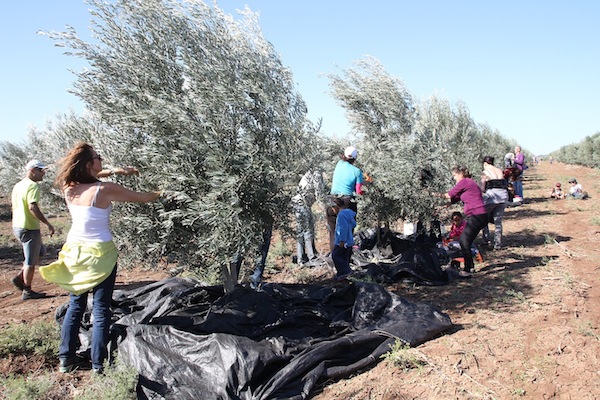
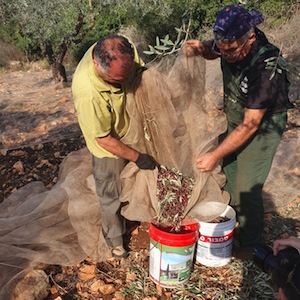
Volunteers help pick olives on a windy day in the fair trade grove of Emek Yizrael. (photo from Yoram Ron)

For thousands of years, olive trees have grown in Israel. Neolithic pottery containing olive pits and remnants of olives have been discovered in Israel’s Mount Carmel region, proving that early people produced olive oil by pulverizing the ripe olives in small pots. Some ancient trees reportedly still exist – in the Palestinian village of al-Walaja, residents claim they have the world’s oldest olive tree, supposedly 5,000 years old. More realistic is Beit Jala’s claim to an 800-year-old olive tree.

Olives for making oil are picked around December or January, so it is probably no coincidence that Chanukah comes so close to the picking season. As you know, Chanukah’s miracle revolves around the story that a very limited amount of olive oil burned in the Temple menorah for eight nights.

While the olive branch is a symbol of peace, the olive harvest in both Israel and the Palestinian territories is a challenging time. For Palestinian olive growers, extremist settlers and Israeli government policy have turned their harvest into an uncomfortable, if not a physically and economically dangerous event. Documented cases show some settlers assaulting Palestinian farmers – threatening them, driving them off their own land, physically attacking them or throwing stones at them. Sometimes, settlers vandalize Palestinian vehicles and damage farming equipment. In other cases, settlers jump-start the harvest, stealing the fruit from hundreds of trees. In the saddest of cases, settlers vandalized hundreds upon hundreds of Palestinian olive trees, in what appears to be a gross violation of Deuteronomy’s 20:19 bal tashchit precept. In this law, we may not uproot or cut down a fruit tree if we do not have an acceptable reason to do so. In the early part of last year’s harvest, the Office for Coordination of Humanitarian Affairs reported that 25 Palestinians were injured, more than 1,000 olive trees were burnt or otherwise damaged and large amounts of produce were stolen.

Since the construction of the separation barrier, some Palestinian olive growers have ended up with their groves located on the other side of the barrier and farmers must obtain special permits and go through special gates to get to their trees. The B’Tselem Organization has documented situations in which Israeli soldiers have blocked the access gates or held farmers up, and there have been reports that soldiers have used anti-riot material on the growers.

In a few cases, the separation between olive groves and homes means that growers have to travel some 25 kilometres round trip. Moreover, the growers are given fixed times to get to their trees and, sometimes, the periods available are not long enough to finish all the picking. Related, Palestinians are sometimes put into a situation in which they have to pick their fruit while the olives are still strongly attached to the branches. Olive picking is largely a manual procedure, so, to dislodge the unripened olives, growers either hit the trees with a rod or shake the trees very hard. This can result in damage to both the trees and the olives.

photo - Two men loading freshly picked olives in the organic grove of the Galilee’s Kfar Deir Hanna, November 2020
Two men loading freshly picked olives in the organic grove of the Galilee’s Kfar Deir Hanna, November 2020. (photo by Itiel Zion)

The current pandemic has caused financial havoc all over the world, including in Israel. This harvest season, Jewish Israeli olive growers have had tons of olives stolen. In the Emek Yizrael area, the Border Police found about 10 tons of olives in a nearby sheep pen. The olives had already been bagged and the gathering containers were standing to the side. The alleged thieves live in Zarzir, a village some 10 kilometres from Nazareth. Shomer Hachadash (the New Guard) tries to prevent these incidents using dogs and heat-sensing drones for nighttime surveillance. Some very bold olive thieves have even been spotted in daylight hours.

Despite this gloomy picture, however, there are promising things happening in Israel’s olive industry. Kfar Kanna’s Sindyanna is an olive oil producer. The Galilee operation is a certified fair trade establishment. In addition, it is a nonprofit organization with strong social and political commitments. Their olive oil bottles proudly say that the oil is produced by Jewish and Arab women in Israel.

Sindyanna aims to improve the working conditions and livelihoods of local Arab women, a clearly marginalized group. For example, Sindyanna provides employment training for Arab women. On the political level, Sindyanna is committed to inter-religious understanding by contracting Muslim, Jewish and Christian women. Moreover, the growers who sell their olives to Sindyanna, like the population of the Galilee itself, are a mix of ethnic groups.

Hadas Lahav, Sindyanna’s chief executive officer, said the company strongly affirms sustainable farming. Over the years, it has built strong connections with local farmers, buying olive oil directly from about 100 individual farmers and large family groups. Some of the farmers are organized into large family companies, like Al-Juzur’s seven families of the Younis clan. In Deir Hanna, the 2,500 organic olive trees belong to the Hussein family. In the Birya Forest, there are 10,000 organic olive trees maintained by Hussein Hib.

In the Jezreel Valley, there is a non-organic grove that belongs to Sindyanna in cooperation with the landowners, the Abu Hatum family from Yafi’a. In Iksal, the non-organic groves belong to the Dawawsha family. In Arabeh, the non-organic olive groves belong to the Khatib family and, at Moshav HaYogev, they belong to the Ashush family.

photo - Close-up of freshly picked olives in Sindyanna’s fair trade grove in Emek Yizrael
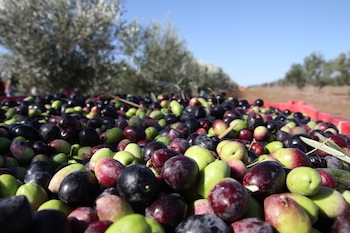
Close-up of freshly picked olives in Sindyanna’s fair trade grove in Emek Yizrael. (photo from Yoram Ron)

As Lahav pointed out, with olives, there are good years and less good years. The 2020 harvest was significantly smaller than the 2019 harvest. In a way, it was fortuitous that 2020 produced less fruit, as, with COVID-19, few permits were given to seasonal pickers entering Israel from the West Bank.

The olives picked for Sindyanna’s products are Coratina (this olive tree is highly adaptable and produces abundantly in hot dry climates, including rocky soils), Barnea (this olive was bred in Israel for oil production, but is also used for green or black table olives) and Souri (olives that are native to Israel and have been the major variety cultivated traditionally under rain-fed conditions in northern Israel). On average, in irrigated groves, a tree produces five kilograms of olive oil and, in a non-irrigated grove, a tree produces three kilograms of olive oil. The olive oil is kosher.

Here are some factoids about Sindyanna. Many of us are familiar with Dr. Bronner’s soaps, but did you know that Sindyanna of the Galilee’s organic olive oil is an essential ingredient in Dr. Bronner’s Magic Pure-Castile Soaps? KKL-JNF is also involved with Sindyanna of the Galilee – in KKL-JNF’s Birya Forest, the organic olive grove was once part of the now-defunct Qabba’a village. Not too long ago, another organic grove in Wadi Ara (planted on a former Israeli army firing range) was threatened by the construction of high-tension wires; following the protests of local farmers and the village council, the course of the power line was diverted.

Sindyanna of the Galilee sells its olive oil on Amazon and, this year, it will start selling its olive oil on select Canadian websites and in certain food stores.

Deborah Rubin Fields is an Israel-based features writer. She is also the author of Take a Peek Inside: A Child’s Guide to Radiology Exams, published in English, Hebrew and Arabic.
Format ImagePosted on January 15, 2021January 13, 2021Author Deborah Rubin FieldsCategories IsraelTags business, fair trade, farming, history, Israeli-Palestinian conflict, olive oil, olives, Palestinians, politics, Sindyanna

Views on various occupations

COVID-19 changed a lot of people’s perceptions as to what types of jobs are essential. Not only doctors, nurses and other healthcare workers are on the front lines, but so are retail clerks, maintenance workers, truck drivers and many others. In this context, it is interesting to think about what occupations, if any, have been promoted or praised in Judaism.

As it turns out, Jewish scholars gave work considerable attention. Talmudic sages advocated for working rather than living off charity. Indeed, this principle provides some food for thought for modern-day Israel, where many ultra-Orthodox do live off charity. According to a January 2020 report by Dr. Lee Cahaner and Dr. Gilad Malach for the Israel Democratic Institute, between the years 2003 and 2018, about 50% of ultra-Orthodox men aged 25-64 and 76% of women in the same age bracket worked.

Scholars had a great deal of respect for labour. The Talmud abhorred idleness and argues that it leads to mental illness and sexual immorality. (See Babylonian Talmud, Tractate Ketubot 59b, at jlaw.com/articles/idealoccupa.html.)

“Rabban Gamliel the son of Rabbi Judah HaNasi would say: Beautiful is the study of Torah with the way of the world, for the toil of them both causes sin to be forgotten. Ultimately, all Torah study that is not accompanied with work is destined to cease and to cause sin.” (Pirkei Avot, Ethics of the Fathers, 2:2). Midrash Rabbah Bereshit (Vayetze chapter) goes even further, saying that practising a craft saved lives.

Yet, the sages believed that being absorbed with making money is not the ideal for an individual. Again referring to the Pirkei Avot (4:10), Rabbi Meir asserted: “Rather limit your business activities and occupy yourself with the Torah instead.”

Historically, teachers were valued – but only to a point. The high priest Joshua ben Gamla (circa the first century CE) issued an opinion that “teachers had to be appointed in each district and every city and that boys of the age of six or seven should be sent.” Where the boy had a father, it was the father’s responsibility to make sure his son had a basic education. Significantly, between the third and the fifth century CE, providing the salary of the Torah and Mishnah teacher became a communal task. Even those without children contributed to the teacher’s wages.

But teachers were not fully trusted. The Mishnah of Tractate Kiddushin 82a teaches that a single man or single woman should not become a teacher. The Gemara explains that the rabbis worried that such a teacher might have an affair with a parent of one of the students.

On torahinmotion.org, Rabbi Jay Kelman contends that the Gemara initially suggests that the Mishnah is afraid that an unmarried teacher might molest his students, but then rejects this explanation, noting that molestation is not something we need to suspect happening. Kelman, however, says, “this is something which no longer can be said with any degree of certainty. What we can say with certainty is such a fear is warranted even with those who are married and that, while rare, when it occurs, the results are devastating and tragic.”

While on the subject of sexual misconduct in certain occupations, here is an idea that might resonate with the #MeToo movement: the Talmud lists certain precarious trades that require men to often be alone with women. For example, a male goldsmith who makes jewelry for women. Talmud scholars were uneasy that such a businessman would be tempted to sin.

Curiously, harsh words were said about doctors. Tractate Kiddushin 82a ends with this statement by Rabbi Yehudah: “The best of physicians deserves Gehenna.” Why do they deserve a damned place? An article on talmudology.com contends that the opinion was based either on the belief that doctors were haughty before G-d or the fact that their treatment sometimes killed the patient.

Even though Israeli citizens highly value their army, Shalom Sabar points out in a Forward video that, in Medieval Haggadot, the “bad son” was portrayed as a soldier. This was because, at the time, non-Jewish soldiers would come to kill Jews.

Sailors, on the other hand, “are mostly pious … with many a ship sinking, sailors were in constant fear causing most to be super honest in the hope that G-d would protect them.” As Kelman summarizes, there really are no atheists in the foxhole.

On myjewishlearning.com, Rabbi Jill Jacobs states that, since Mishnah Zeraim (Seeds) deals solely with agricultural issues, we have proof that Judaism emerged from an agriculturally based community. Yet, in the Torah, farmers get off to a really bad start. Early in Genesis, we learn that Cain was the first farmer. Notwithstanding, G-d refused to accept his offering, accepting only his brother Abel’s. Cain couldn’t accept this rejection. In a jealous rage, Cain killed his brother and hid what he had done. G-d, consequently, reduced Cain to a life of wandering.

At a time when, around the globe, people are learning more about the extreme misconduct of some police officers, it is worth looking further into the Torah to see what Deuteronomy 16:18 and later commentators wrote about the police. Deuteronomy points out that both judges and police should be appointed to govern the people with due justice. Drawing on various Jewish sources, Rabbi Jacobs divides the function of the Deuteronomy-based police into several specific, but integrated parts: the patroling police person who “reminds the public to obey the law”; the roving inspector who ensures fair pricing and compliance with local ordinances; the arresting police officer who, while assuming the person is innocent until judged guilty, nevertheless begins the judgment process by arresting the suspect; the bill collector police officer who extracts payment from the obligated party to give to the aggrieved party; and the police officer who is a leader in his/her community. From Jacob’s assessment on truah.org, it would appear that today’s police have what to improve, especially when it comes to trust-building measures.

Over the centuries, Jewish scholars have taken into account the fallibility of people engaged in certain occupations. With tremendous insight into human behaviour, our sages apparently realized progress is not always in a forward direction. We have a long way to go in (re)establishing the integrity that Jewish scholars outlined for certain professions.

Deborah Rubin Fields is an Israel-based features writer. She is also the author of Take a Peek Inside: A Child’s Guide to Radiology Exams, published in English, Hebrew and Arabic.
***

The abstract of the article “Jewish Occupational Selection: Education, Restrictions or Minorities?” (The Journal of Economic History 65, no. 4 [2005]), Maristella Botticini and Zvi Eckstein reads: “Before the eighth-ninth centuries CE, most Jews, like the rest of the population, were farmers. With the establishment of the Muslim Empire, almost all Jews entered urban occupations

despite no restrictions prohibiting them from remaining in agriculture. This occupational selection remained their distinctive mark thereafter. Our thesis is that this transition away from agriculture into crafts and trade was the outcome of their widespread literacy, prompted by a religious and educational reform in Judaism in the first and second centuries CE, which gave them a comparative advantage in urban, skilled occupations.”

The full article is available at jstor.org.

– DRF

Posted on December 18, 2020December 16, 2020Author Deborah Rubin FieldsCategories Op-EdTags COVID-19, education, history, jobs, Judaism, minorities, Mishnah, occupations, Talmud, work
Beauty of quilting tradition

Beauty of quilting tradition

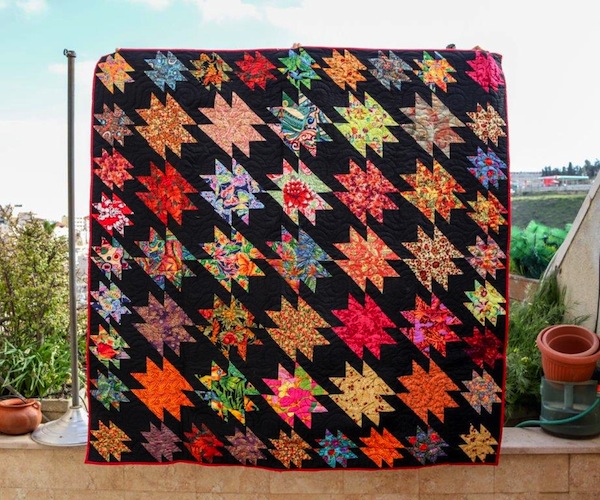
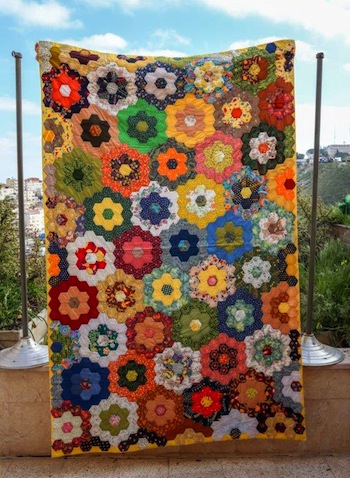
One of Shlomit Etzion’s handcrafted quilts. (photo by Nir Falay)

Despite being generally considered the cradle of ancient civilizations and the source of the world’s monotheistic religions, the Middle East region is not known for its quilting. Yet, even in Jerusalem, you will find dedicated quilters.

Quilting is the process of sewing two or more pieces of fabric together to make a thicker padded material. Quilting is done all over the world, from Europe to America, to Southern Asia. While we don’t know its origins, we do know that, for many years, people quilted their clothes. Moreover – despite the Middle East not being recognized for its quilting – the earliest piece of quilted garment comes from the figure of a Pharaoh, dating to around 3400 BC, the period of ancient Egypt’s First Dynasty.

Shlomit Etzion, a Jerusalem resident since birth, said she has always worked with her hands. Her mother encouraged her to do handcrafts and she recalls that she started with embroidery. For a time, Shlomit considered going to a high school where she could pursue that, but decided not to go that route. In the end, she began quilting after she finished her university degree.

What would compel someone to begin quilting? For Shlomit, it was the beauty of traditional quilts. She likes Amish quilts and has even visited Amish quilters. She also likes the quilts of Native Americans. That is not to say, however, that she does art quilt, which employs both modern and traditional quilting techniques to create art objects. An art quilt is an original exploration of a concept or idea rather than the handing down of a pattern. It experiments with textile manipulation, colour, texture and/or a diversity of mixed media. Since this is not the type of work she creates, Shlomit describes herself as a traditionalist who uses traditional patterns as a jumping off point.

(As an aside, there are a number of quilt patterns based on the Hebrew Bible. They include Jacob’s Ladder, the Children of Israel, Joseph’s Coat of Many Colours and the Star of Goshen.)

In the beginning, Shlomit worked using scraps from old clothes and sewing by hand, just as was originally done in the United States. But now she buys her material, because it offers her more choices. She only uses cotton, as she likes the feel of it. When she visits the United States, she always goes to fabric stores to shop for material. However, there are now a few stores in Jerusalem that have a good cloth selection.

Shlomit uses a Bernina quilting machine, but there is a lot of picking of materials, measuring, pinning and cutting to do by hand. To secure her pieced top, the insulating fabric and the backing fabric, she brings her materials to a woman with a long-arm machine. Amazing as this may sound, Shlomit pointed out that nowadays, instead of sewing, some people even glue their pieces together.

photo - A handcrafted quilt by Shlomit Etzion
A handcrafted quilt by Shlomit Etzion. (photo by Nir Falay)

In her work, Shlomit often uses the nine-patch on point (consisting of nine evenly sized blocks stitched together). However, she has also made stunning quilts using the jelly roll pattern – for which the fabric is pre-cut and you can use a simple sewing method to put it together – and the log cabin pattern. In log cabin quilts, there is a repeated single block pattern of light and dark fabric strips that represent the walls of a log cabin; a centre patch, often of red cloth, represents the hearth or fire. Other geometric shapes such as trapezoids or right-angle triangles might appear in her quilts.

Shlomit likes fall colours the best – oranges, tans, brown shades. Because she is a red head, for a period of time she steered away from greens and blues. As a child, she had been pushed to wear those colours.

Life in general inspires her art, and living in Jerusalem plays a role, she said.

She derives tremendous joy from quilting, she added. She can sit for a whole day doing it. She enjoys not just the sewing, but also the technical work. She probably has 50 to 60 completed quilts at home, she said.

In Israel, unfortunately, people are not very interested in paying the price that quilt handwork commands, so her sales have covered the cost of her supplies, but not the hours she has spent making the quilts.

She prefers to work alone, but, when quilting meetings are held in Jerusalem, she joins the group. The Jerusalem quilting group is not formally active, though. Members seem to get together most regularly when they have an exhibit for which to prepare. While some readers may have seen movies or read books – such as Margaret Atwood’s Alias Grace or Whitney Otto’s How to Make an American Quilt – in which people attend quilting bees, working on the same quilt, this does not happen in Jerusalem. Like many groups, the Jerusalem quilters have met less often because of COVID-19 concerns.

Even though they aren’t an active group per se, the Jerusalem quilters have had some lovely exhibits at the International Convention Centre, the Jerusalem Theatre, the YMCA and the Mormon College. (See israelquilt.com/en/quilting-groups for more information.) Shlomit herself has exhibited in the United States and in the United Kingdom.

I suspect this quote about quilts originally targeted the receiver, rather than the giver: “Blankets wrap you in warmth, quilts wrap you in love.” In Shlomit’s case, however, the physical making of the quilt is a form of love.

Deborah Rubin Fields is an Israel-based features writer. She is also the author of Take a Peek Inside: A Child’s Guide to Radiology Exams, published in English, Hebrew and Arabic.
Format ImagePosted on December 4, 2020December 2, 2020Author Deborah Rubin FieldsCategories IsraelTags arts, Jerusalem, quilting, Shlomit Etzion, textiles, tradition

Song’s enduring popularity

How does a 1940 Yiddish theatre song – probably based on a passage from the Talmud’s Tractate Bava Metzia – end up becoming a popular piece sung around the world?

Over a 75-year period, Aaron Zeitlin’s “Dona Dona” (in Yiddish, “Dos Kelbl,” “The Calf”) has been sung by some of the 20th century’s biggest English-speaking performers, including Joan Baez, Donovan, the Chad Mitchell Trio, Chad & Jeremy, and countless others. It has been sung in Japanese, German, French (in this version, the calf is replaced by a boy trying to figure out his future) Swedish, Hebrew, Russian, Italian, Catalan and Vietnamese. Zeiltin’s original “Dos Kelbl” was put to music by Sholom Secunda; in 1956, Arthur Kevess and Teddi Schwartz translated it into English.

“Dona Dona” was part of Zeiltin’s Yiddish play Esterke, based on the legendary relationship of a Jewish woman named Esther and King Casimir of Poland. Zeitlin first published it in 1932 in Globus, the Yiddish literary journal he edited. The play about Esterke and Kazimierz the Great was a Polish-Jewish mystery in four acts. Male and female actors sang “Dona Dona” as a solo, as a duet and as a chorus with orchestration.

Zeitlin was invited to New York for the performance of Esterke, which is an indication of how influential Yiddish theatre was in the pre-Second World War Jewish cultural world. With the outbreak of the war, however, he was unable to sail back to his family. His wife, two children, father and brother were killed in the Holocaust.

This terrible loss haunted Zeitlin for the rest of his life. Indeed, some maintain that “Dona Dona” represents the tremendous suffering and loss of life Jews experienced in the Holocaust. While Zeitlin – who was living in Poland in the 1930s – was certainly aware of the growing threat of Nazism, he composed the song before the Holocaust began.

Over time, the song has been interpreted in many different ways. In a 2010 article in The Jewish Magazine, Mendel Weinberger understands “Dona Dona” as a reference to the struggle between the physical and the spiritual. The calf represents the body, the seat of desire. The body seeks pleasure, wealth and honour, and is a slave to these desires. The calf on the way to the slaughterer is a metaphor for the body’s journey towards death. The calf (i.e. the body) is mournful because it has become attached to life and fears the unknown of the next world. The swallow, on the other hand, represents the soul, in Weinberger’s interpretation. The Divine Soul is a part of G-d’s Being and is not bound by the material limitations of the physical world; it is free to soar in the spiritual realms high above the earthly one.

Baez, who, probably more than anyone else in North America, was responsible for popularizing the English version of the song, has said she was attracted to the “beauty of the melody.” At the beginning of her long career, she started singing “Dona Dona” as a civil rights protest song. It appeared on her first album and became a “staple” in her performances.

In 1975, Seoul, South Korea, banned the playing of “Dona Dona.” The government considered the song to be leftist and violence-inducing. Two hundred and sixty other songs appeared on this blacklist.

Pointing to how times change or perhaps stay the same, in 2018, Liao Yiwu, a Chinese writer in exile, used “Dona Dona” to boost the morale of someone under long-term house arrest. He had been trying to get permission for poet Liu Xia (widow of Nobel Prize winner, dissident Liu Xiaobo) to immigrate to Germany. In a phone call that year, the severely depressed widow cried continuously, saying, “It is easier to die than to live.” Liao Yiwu played “Dona Dona” for his desperate friend, who has since been released and allowed to leave for Germany.

Given that Zeitlin had religious training, the Gemara of Talmud Bava Metzia 85a is a likely inspiration of “Dona Dona” and, therefore, probably best explains the song’s true meaning. The Gemara tells the story of how Rabbi Yehuda HaNasi, the redactor of the Mishnah, came to endure terrible pains. A young calf, destined for the slaughterhouse, met up with the rabbi. The calf placed its head under the rabbi’s coattails and cried. Yehuda HaNasi said to it, “Go! It was for this that you were created.” Because he should have shown greater mercy to the calf, the rabbi was punished for 13 years with great suffering. Only when he expressed pity for some baby weasels did his pains leave him.

Deborah Rubin Fields is an Israel-based features writer. She is also the author of Take a Peek Inside: A Child’s Guide to Radiology Exams, published in English, Hebrew and Arabic.
***

“Dona Dona” 

On a wagon bound for market
There’s a calf with a mournful eye
High above him there’s a swallow
Winging swiftly through the sky
How the winds are laughing
They laugh with all the their might
Laugh and laugh the whole day through
And half the summer’s night
Dona Dona Dona Dona Dona Dona Dona Don Dona Dona Dona Dona Dona Dona Dona Don

Stop complaining, said the farmer
Who told you a calf to be
Why don’t you have wings to fly with
Like the swallow so proud and free
How the winds are laughing
They laugh with all the their might
Laugh and laugh the whole day through
And half the summer’s night
Dona Dona Dona Dona … Don

Calves are easily bound and slaughtered
Never knowing the reason why
But whoever treasures freedom
Like the swallow has learned to fly
How the winds are laughing
They laugh with all the their might
Laugh and laugh the whole day through
And half the summer’s night
Dona Dona Dona Dona … Don

Posted on December 4, 2020December 2, 2020Author Deborah Rubin FieldsCategories MusicTags Aaron Zeitlin, China, Dona Dona, Esterke, Joan Baez, Mendel Weinberger, singing, South Korea, theatre, Yiddish
Evolution of the Jewish calendar

Evolution of the Jewish calendar

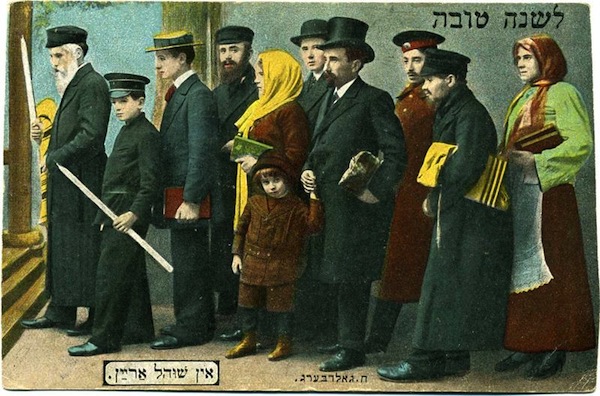
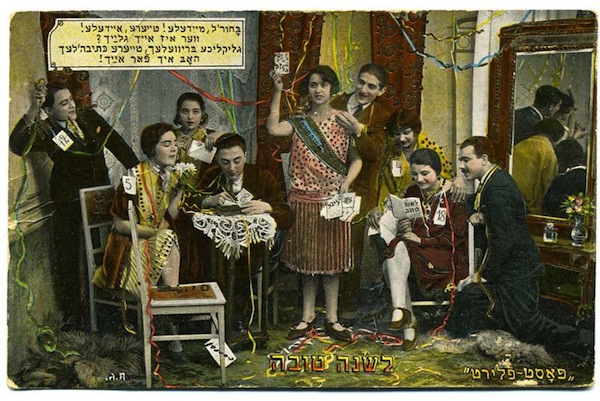
Rosh Hashanah greeting cards (above and below) from the author’s family’s collection. The cards are almost 100 years old. The translation of the one in which people are walking is “Into the synagogue.” It is signed by Chaim Goldberg, a well-known artist who also illustrated many children’s books. The party postcard, also done by Goldberg, is a printed rhyme, which translates as, “Boy, girl! Dear, refined! Who is like you? Happy letters, dear writings, I have for you!”

The Jewish calendar is an amazing conceptualization of time that has evolved (what else?) over time.

In his blog on the Museum of the Jewish People at Beit Hatfutsot website, Ushi Derman relates that, originally, the Jewish calendar was a solar calendar. But it was not just a solar calendar, it was a holy solar calendar, delivered by angels to Enoch. (See the Book of Enoch, the section dealing with astronomy, called “The Book of Heavenly Luminaries.”) Temple priests had to follow a rigorous schedule – time itself was judged to be sacred. Thus, the Temple in Jerusalem was regarded as both the house of G-d and the dwelling of time.

With the destruction of Jerusalem’s Second Temple, the priests lost their power. They were no longer the mediators between G-d and the people. Authority switched to the scholars (our sages) of the Mishnah (edited record of the Oral Torah), Talmud and Tosefta (similar to the Mishnah, but providing more details about the reasons for or application of the laws).

In a bold move, the scholars declared that G-d had handed religious authority to humans. “Each month, envoys were sent to watch the new moon and to determine the beginning of the month. Thus, the ownership of time was expropriated from G-d and delivered to man – and that is why the Hebrew calendar has survived for so many centuries,” writes Derman in the 2018 blog “Rosh Hashanah: The Politics and Theology Behind Jewish Time.”

Here is a lovely story from The Book of Legends, edited by Hayim Nahman Bialik and Yehoshua Hana Ravnitzky, illustrating the above change. A king had a clock. “When his son reached puberty, he said to him: My son, until now, the clock has been in my keeping. From now on, I turn it over to you. So, too, the Holy One used to hallow new moons and intercalate years. But, when Israel rose, He said to them, until now, the reckoning of new moons and of New Year’s Day has been in My keeping. From now on, they are turned over to you.”

Perhaps oddly, the Mishnah mentions more than one new year. In fact, it points out four such dates on the Jewish calendar:

  • The first of Nissan is the new year for kings and for festivals;
  • The first of Elul is the new year for tithing of animals (some say the first of Tishrei);
  • The first of Tishrei is the new year for years, sabbaticals and Jubilee, for planting and vegetables;
  • The first of Shevat is the new year for trees, according to the House of Shammai, while the House of Hillel (which we adhere to today) says the 15th of Shevat, or Tu b’Shevat.

With its thrice daily prayers, the synagogue came to replace the Temple. Excluding Yom Kippur, synagogue attendance is higher on Rosh Hashanah than any other time of year. Rosh Hashanah prayers are compiled in a special prayer book, or Machzor.

image - Rosh Hashanah greeting cards from the author’s family’s collection. The cards are almost 100 years old. The party postcard, also done by Chaim Goldberg, is a printed rhyme, which translates as, “Boy, girl! Dear, refined! Who is like you? Happy letters, dear writings, I have for you!”Amid COVID-19, the following words about Rosh Hashanah have heightened meaning: “The celebration of the New Year involves a mixture of emotions. On the one hand, there is a sense of gratitude at having lived to this time. On the other hand, the beginning of a new year raises anxiety. What will my fate be this year? Will I live out the year? Will I be healthy? Will I spend my time wisely, or will it be filled in a way that does not truly bring happiness?” (See the Rabbinical Assembly’s Machzor Lev Shalem for Rosh Hashanah and Yom Kippur, published almost a decade ago.)

Sounding the shofar is one of the special additions to Rosh Hashanah services. According to Norman Bloom – in a 1978 article on Rosh Hashanah prayers in Tradition: A Journal of Orthodox Jewish Thought – the timing of the shofar blowing weighed in the physical safety and comfort of the congregation. Hard as it may be to comprehend today, scholars considered potential attacks from both local enemies of the Jews and from Satan himself. They also considered the comfort of the infirm, who might not be able to stay through a long service.

Rosh Hashanah has other curious customs. For example, there is a tradition of having either a fish head or, among some Sephardim, a lamb’s head as part of the Rosh Hashanah meal. This is meant to symbolize that, in the year to come, we should be at the rosh or head (on top), rather than at the tail (at the bottom). Vegetarians and vegans substitute a head of lettuce.

Both Sephardi and Ashkenazi Jews have Rosh Hashanah seder traditions. The symbolic foods include beets, leeks, pomegranates, pumpkins and beans. As Rahel Musleah has pointed out, each food suggests a good wish for the coming year. Thus, before eating each one, people recite a special blessing. Humour is at play, too, as some of the blessings are puns on the food’s Hebrew or Aramaic name. (Read Musleah’s article “A Sephardic Rosh Hashanah Seder” at myjewishlearning.com/article/a-sephardic-rosh-hashanah-seder.) Of course, we cannot neglect to mention that the festive table also includes apples dipped in honey, for a sweet new year, and a round challah, symbolizing both the cycle of life and G-d’s kingship.

Another Rosh Hashanah custom is Tashlich. This ceremony involves going to a body of water to symbolically cast off one’s sins. Breadcrumbs are often used, as are leaves, but, seeing that COVID-19 will be a part of this year’s holiday, here is another suggestion. Originally, this activity was used with youth groups of the Reform movement – participants wrote out their sins and then the papers on which they were written were put through a paper shredder. A dramatic gesture, suited to our current need for social distancing.

My city, Jerusalem, is a land-bound city without a sea or lake in its immediate vicinity. So, what do residents of the capital do? Those who wish to practise Tashlich go to one of the following four sites. Two of the four places are near the Supreme Court: the Jerusalem Rose Garden and the Jerusalem Bird Observatory. Also in the same general area is the Botanic Garden in the Nayot neighbourhood and, in the Old City, one can go to the Shiloah Springs in City of David.

Wishing all readers a year of blessings and not of curses.

Deborah Rubin Fields is an Israel-based features writer. She is also the author of Take a Peek Inside: A Child’s Guide to Radiology Exams, published in English, Hebrew and Arabic.
  * * *

Additional observations

• Hebrew has a number of expressions using the word rosh. Here are just a handful of examples: rosh hamemshala (prime minister); rosh kroov, literally cabbage head, or a negative reference to someone who is not very bright; rosh katan, someone who is small-minded; l’kabel barosh, to be defeated; and rosh tov, or good vibes.

• Anyone interested in learning more about the solar calendar should read Prof. Rachel Elior’s article, “Enoch Son of Jared and the Solar Calendar of the Priesthood in Qumran,” which can be found in a Google search.

Format ImagePosted on September 11, 2020September 10, 2020Author Deborah Rubin FieldsCategories Celebrating the HolidaysTags history, Jewish calendar, Judaism, Mizrahi, New Years, Rosh Hashanah, seder, Sephardi, time, tradition
Feeding the body and mind

Feeding the body and mind

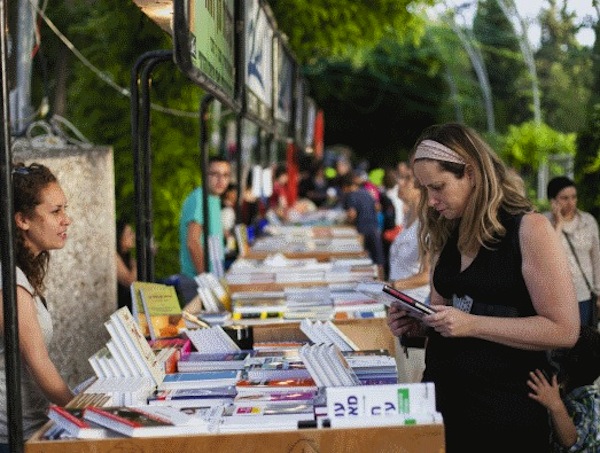
National Hebrew Book Week has taken place every year in June. Its fate for this year, in light of the COVID-19 pandemic, is unclear. (photo from gojerusalem.com)

In Israel, you know Shavuot is approaching when you see the grocery stores setting up displays of pasta and spaghetti sauce. The pandemic shouldn’t change that.

Israelis are obsessed with the thought of eating non-meat meals on Shavuot. I suspect that at the heart of this obsession is the feeling that, even today, many people still consider eating a non-meat meal equivalent to eating less than a full meal. Hence, the worry that there really will be a satisfying meal to appropriately celebrate the holiday.

While there are many lovely explanations about why we eat dairy on Shavuot, they seem to be secondary to some practical considerations. As Rabbi Prof. David Golinkin points out, in the late spring, young calves, lambs and kids are weaned. Thus, historically at this time in Europe, there was an abundance of milk. Bear in mind that refrigeration is a fairly new process and that, prior to refrigeration, farmers needed to move fast with perishable milk. They made cheese and butter, which, likewise, needed to be consumed relatively fast. This dairy excess may have motivated some Jews to eat dairy on Shavuot. (See the article “Why do Jews Eat Milk and Dairy Products on Shavuot?” on the Schechter Institutes’ website, schechter.edu.)

But, eating a non-meat meal on Shavuot is not restricted to the customs of European Jewry. As Jewish food expert Claudia Roden notes in The Book of Jewish Food: An Odyssey from Samarkand to New York, Sephardi Jews in Syria made cheese pies called sambousak bi jibn, Tunisian Jews had a special dairy couscous recipe and, in places like Turkey and the Balkans, Jews prepared a milk pudding called sutlage for Shavuot. (If you don’t want to eat animal-based foods, you don’t need to feel left out. The United Kingdom’s Jewish Vegetarian Society helps you enjoy a variety of traditional, but vegan, cheesecake recipes.)

So from where did all this dairy focus originate? One appealing explanation reminds us of what was supposed to have happened on Shavuot, namely that the Jewish people received the Torah. In Gematria, the Hebrew word for milk (chalav) adds up to 40, the number of days on which Moses stayed on Mount Sinai in order to receive the Torah.

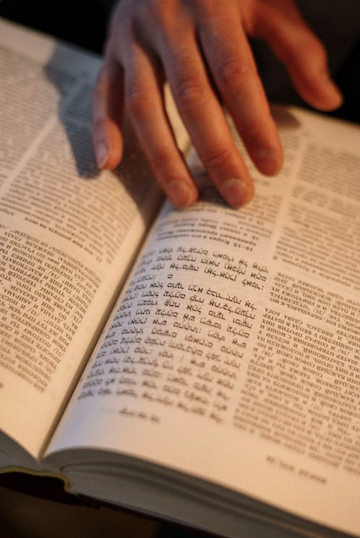
Significantly, studying the Torah and other Jewish texts on Shavuot eve has become a major trend in Israel, as well as in the Diaspora. The big Israeli cities offer any number of options for participating in a tikkun leil Shavuot. These free learning sessions welcome the participation of all of Israeli society, from the religious to the secular, and everyone in between. Those living in smaller towns and on kibbutzim and moshavim likewise hold study sessions on the night of the holiday.

The idea of all-night studying originates with the kabbalists. The earliest members of this group apparently studied with Rabbi Shimon bar Yochai, the author of the Zohar, who lived in the second-century CE. It was this scholar (also known by his initials, as Rashbi) who stated: “G-d forbid that the Torah shall ever be forgotten!” (See the Babylonian Talmud Tractate Shabbat 138b.) By the Middle Ages, the kabbalistic all-night Shavuot study had really picked up steam in places such as Safed.

photo - Studying the Torah and other Jewish texts on Shavuot eve has become a major trend in Israel, as well as in the Diaspora
Studying the Torah and other Jewish texts on Shavuot eve has become a major trend in Israel, as well as in the Diaspora. (photo from pexels.com)

Some claim the reason for studying during the night is found in the midrash stating that it was a way to correct for the Children of Israel’s mistake of oversleeping on the morning they were meant to receive the Torah. Others claim, however, that the Hebrew word tikkun should not be translated as correction, but rather as adorning or decorating the bride. The bride in this instance is the people of Israel and the groom is either G-d and/or the Torah.

According to a late 17th-century Libyan tradition, Shavuot symbolizes the wedding day between the people of Israel and the Torah. According to this tradition, the Torah is the bride, which explains the title of the Libyan Shavuot text entitled Tikkun Kallah. Accordingly, those who read this tikkun are likened to bridal attendants.

The importance of studying on Shavuot is bolstered by the fact that Israel’s Hebrew Book Week (or, in some places, Book Month) begins right after Shavuot. I do not believe this occurrence is coincidental, but rather links us to the idea that we are still the People of the Book and a people of books.

The Israeli book fair has been running for many years. This year, 2020, would mark the 59th annual celebration of Hebrew Book Week and the fair’s age is all the more impressive when you recall how shaky was the Israeli state’s start as an independent entity. Recent years’ events have included Israeli authors appearing in coffee houses, story hours and plays for children, guided walks in Israel’s National Library, the more traditional book signings and, of course, the possibility of thumbing through thousands of Hebrew books.

In brief, our spring holiday offers opportunities for both spiritual and physical nourishment.

Deborah Rubin Fields is an Israel-based features writer. She is also the author of Take a Peek Inside: A Child’s Guide to Radiology Exams, published in English, Hebrew and Arabic.
Format ImagePosted on May 15, 2020May 14, 2020Author Deborah Rubin FieldsCategories Celebrating the HolidaysTags books, education, history, Israel, Judaism, kabbalah, Shavuot, Torah
Israel’s soldiers not forgotten

Israel’s soldiers not forgotten

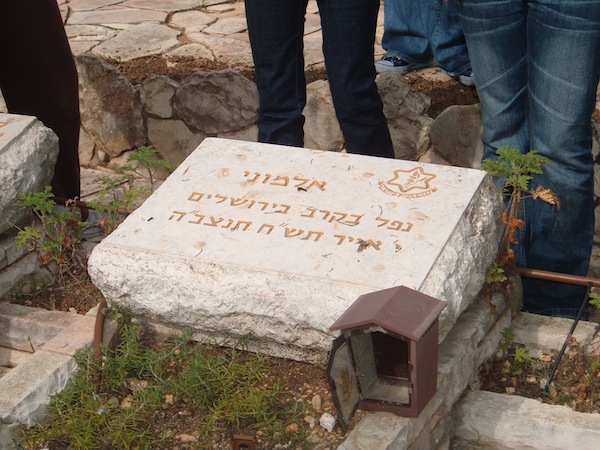
The grave of an unknown soldier on Mt. Herzl in Jerusalem. (photo by Deborah Rubin Fields)

As of Israel Independence Day last year, 23,741 Israeli soldiers had died during their service. The country has come to memorialize its fallen soldiers in one of three ways: 1) most commonly, it provides a grave and a headstone in a military cemetery, with information provided on the soldier, 2) when there is no official grave (that is, when no one really knows where the body of the deceased is), it inscribes the name either on a memorial wall or marker, and 3) it furnishes a grave and a headstone, but little or no information about the deceased is engraved on the stone.

Today, when a soldier dies, the following identification is to be established: the name of the soldier, their army identification number, national civilian identification number, army rank and army unit, as well as their job in the army. When they are buried, the headstone notes the full name of the deceased, their parents’ first names, country of birth (if outside of Israel), date of birth (according to both the Hebrew and Gregorian calendars), aliyah date, date and place of death and age at the time of death. The stone also contains the emblem of the Israel Defence Forces. In a military cemetery, the tombstone’s content reflects a high degree of uniformity. One monument pretty much contains the same details as the next one.

In pre-state Israel and in the War of Independence in 1948, these practices were not yet in place. Young men and women – many of whom had just survived the Holocaust – fought to establish the state. They (and all other soldiers) had little military training. They might not have known Hebrew very well. Not uncommonly, they were the only survivor of their families.

Times were tense, at times verging on the chaotic. The fighting left limited time for socializing, for establishing relationships. So, if a soldier died, it was not surprising to have known them only by their first name. Under the circumstances, most fellow fighters would not have been acquainted with the soldier’s parents, would not have even known their names.

At the end of the War of Independence, about 1,000 of the 4,500 fallen were considered missing. It was the chief rabbi of the IDF, Rabbi Shlomo Goren, who initiated an intensive project of identifying the dead. The establishment of military cemeteries helped the identification process move forward, but, even after that, there remained anonymous soldiers, and headstones with missing information.

Recognizing this situation, Dorit Perry and Uri Sagi started Giving a Face to the Fallen. The organization has been in existence fewer than 10 years. Its team of some 52 volunteer investigators and activists comes from a variety of backgrounds. It includes bereaved family members, friends of fallen soldiers, judges, former career army officers and others. As the organization’s website states, all volunteers believe there is “a duty to remember and, in so doing, to … repay the debt we owe to those who gave their lives for the establishment of the state of Israel.”

All of the volunteers are in a race against time, trying to piece together information on 500 soldiers who fell fighting either in pre-state Israel or in the War of Independence. They ask the following questions: Did you (or maybe your grandfather or an older neighbour) know the fighter we are researching? Maybe you fought with such person either before the creation of the state or in the War of Independence? Maybe you still have pictures of your fighting unit?

The volunteers also try to fill in blanks by asking to see old photos of youth movement activities, aliyah preparation groups (aliyah registration cards have provided investigators with correct birth dates and with the names of relatives, see blog.nli.org.il/en/baumgarten) and family albums. Some soldiers do not even have a photo on file.

Besides trying to find people still alive who were acquainted with these fallen soldiers, volunteers search archives. It is real detective work. When successful, there is the rededication of a tombstone with the added information. To date, out of the more than 800 “untraceable” soldiers, they have pieced together the missing information for 120 of them.

The stories of the fallen soldiers of this period are poignant. Take the example of Tobias Marmolstein, who came from Bitshekov, Czechoslovakia. His father had died in Tobias’s arms at Mauthausen concentration camp. Twenty-year-old Tobias was killed as his Haganah unit fought to open the road to Jerusalem. He had been in Israel for just nine days. He is buried on Mt. Herzl.

Each life story has its twists and turns. For instance, over two decades passed before Shaul Yekutiel Urbach came to be buried in Israel. He arrived in Palestine in 1939 to visit Tel Aviv relatives. When the Second World War broke out, he was unable to return to his large family in Kielce, Poland, so he volunteered to fight for the British. The British sent him to fight in Greece. There, the Germans took him prisoner. The Nazis sent him to do hard labour in Schlesien, Germany. In a revolt against a Nazi camp officer, Shaul was wounded, and he died in a German hospital. After the war, his only surviving brother, Raphael Fishel – the rest of the family had been murdered at Treblinka – tried to have Shaul’s remains brought to Israel. For 22 years, the British stalled in releasing his body from their military cemetery. Finally, in 1967, Shaul was reinterred, on Mt. Herzl.

Uri Sagi has maintained that a blank headstone or one that is missing information makes the soldier invisible. A fallen soldier, Sagi said, should not be invisible.

As time passes, it becomes harder and harder to find acquaintances and family who can fill in the blanks with firsthand testimony. For more information on Giving a Face to the Fallen, visit latetpanim.org.il.

Deborah Rubin Fields is an Israel-based features writer. She is also the author of Take a Peek Inside: A Child’s Guide to Radiology Exams, published in English, Hebrew and Arabic.
Format ImagePosted on April 24, 2020April 24, 2020Author Deborah Rubin FieldsCategories Celebrating the HolidaysTags Giving a Face to the Fallen, IDF, Israel, memorial, soldiers, terrorism, Yom Hazikaron
Hadrian’s Arch – built to last

Hadrian’s Arch – built to last

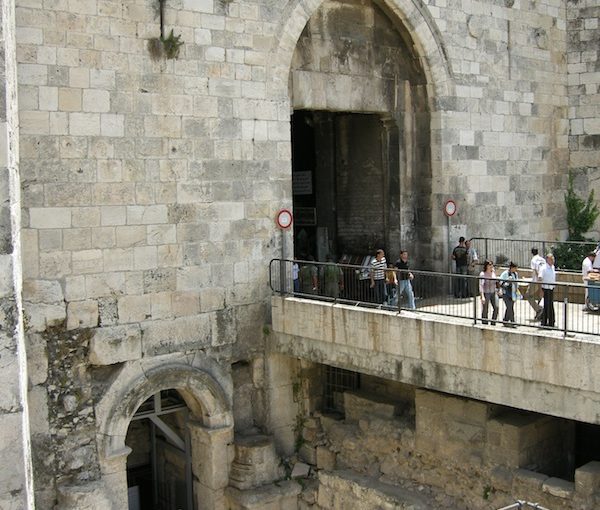
Damascus Gate today and, below it, the Aelia Capitolina arch leading to the Roman Plaza. (photo by Deborah Rubin Fields)

Revenge is sweet. Apparently, while the Roman Emperor Hadrian did not spike enemy heads on palisades, after three years of battle, he did construct an arch celebrating the suppression of the Bar Kochba revolt. This archway was quite detailed, as it marked the northern border of his Jew-less Roman colony (Jews were only allowed in on Tisha b’Av to mourn the temples they had lost) and the Aelia Capitolina, a colony built on the Jerusalem the Romans had destroyed.

Below and to the left of Damascus Gate (built by Suleiman the Magnificent in 16th century CE) are the remains of Hadrian’s Arch of Triumph and his Roman Plaza. Although the site has been explored since 1864 by numerous archeologists, only recently have the Israel Antiquities Authority, the Jerusalem Municipality and the East Jerusalem Development Company (PAMI) cooperated to open to the public the arch that Hadrian ordered built in 135 CE.

The arch seen today was actually part of a three-arched entrance way. Two shorter arches bordered a taller and wider centre one. Only the eastern entrance remains fully intact, along with the bases of what were once elaborate stone pillars. Inside this archway, one still sees the vaulted ceiling and the floor made of large stone slabs.

The thick blocks making up this flooring measure some two metres (6.6 feet) long and 1.2 metres (3.9 feet) wide. To prevent people from slipping on the stones, the Romans striated some of the pavement, which is still in place, albeit worn smooth from use.

None of Hadrian’s building machinery was motorized, of course. Even the Roman tread wheel crane was run on human or animal power. Not one to waste and not one to overlook architectural beauty, Hadrian scavenged the enormous stones of the razed Second Temple and public structures – Herodian stones from the Temple area are distinct in having narrow margins and low, flat, smooth centre bosses. Hadrian used these stones to build two massive guard towers flanking the archway on the right and left.

As the Herodian stones were not attached by mortar, it was probably relatively easy – the average weight of each is said to have been two to five tons – for Hadrian’s gate builders to dismantle the Temple-area stones. These huge limestone pieces still stand, as the remains of the guard towers, neatly stacked at an incredible height of some 11 or 12 metres.

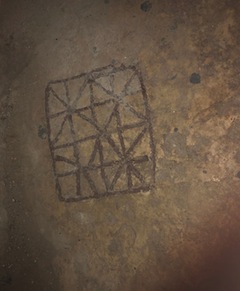
photo - In the Roman Plaza, a Roman soldiers’ game can be found on the ground
In the Roman Plaza, a Roman soldiers’ game can be found on the ground. (photo by Deborah Rubin Fields)

Soldiers throughout history have faced boredom. To counter this, the Roman soldiers in these guard towers played games. One such “board game,” is still scratched into the flooring near the towers.

The gate with its three arches was typical of its period. Just above the remaining arch, one can still decipher the “C” in the Latin inscription bearing the city’s Roman name, Aelia Capitolina. In Jerusalem, a similar example of this kind of gate is the Ecce Homo Arch. It served as an entrance to the eastern forum of Aelia Capitolina. Part of it may be seen today, along the Via Dolorosa.

As further evidence of how well-planned Hadrian’s city was, the gate opened into a plaza, a circular space that was the junction or crossing point of the eastern and western cardines (plural of cardo; literally, heart) or main roads. According to Simon Sebag Montefiore’s book Jerusalem: The Biography, this plaza led to two forums, one close to the destroyed Antonia Fortress and one close to today’s Church of the Holy Sepulchre. There, Hadrian reportedly built a temple to Jupiter.

This gate appears on Jordan’s mosaic Madaba Map. On the sixth-century map – a model of which appears inside the discovered Roman Plaza – one sees an open square with a column just beyond the gate. To prevent anyone from forgetting who was victorious over the Jewish rebels, the column was topped with Hadrian’s figure. On site, there is a model of the column to give current-day visitors an idea of how the column looked. From this column, distances to different parts of the country were measured. Moreover, the column is the source of Damascus Gate’s Arabic name, Bab al-Amud.

To the left of the arch entrance are the large millstone remains from the later Byzantine period. Most likely, an olive oil factory existed there in ancient times.

To the east of the Roman Plaza, there are three other sites worth visiting when such things become possible again, once the COVID-19 pandemic is contained:

Zedekiah’s Cave (also known as Solomon’s Quarry) has visiting hours like those of the Roman Plaza. As the cave has very good acoustics, over the past few years, it has been used to host concerts. The entrance fee is currently 18 shekels. The local telephone is the same as that of the Roman Plaza, 02-6277550. There is partial wheelchair accessibility.

Rockefeller Archeology Museum, on the northern side of the street, recently had a small, but fascinating, exhibit dealing with the 100-year history of Jerusalem Armenian Ceramics. (imj.org.il/en/exhibitions/glimpse-paradise). The museum is free of charge, with hours Sunday, Monday, Wednesday and Thursday, and even on Saturdays. There is a short flight of stairs at the entrance, so contact the curator, Fawzi Ibrahim, about visiting in a wheelchair. The local number is 02-628-2251.

The Northern Promenade route of the Old City’s ramparts allows you to visit these areas from “above,” but is not designed for wheelchairs or strollers. Buy tickets at the tourist office just inside Jaffa Gate.

From the Romans onward, rulers have built special arches marking the defeat of their enemies. Hadrian’s Arch might also have served as a reminder to potential rebels not to try again. What does seem clear is Hadrian has left us with a 1,885-year-old reminder of the many changes of hands Jerusalem has undergone.

Deborah Rubin Fields is an Israel-based features writer. She is also the author of Take a Peek Inside: A Child’s Guide to Radiology Exams, published in English, Hebrew and Arabic.
Format ImagePosted on April 3, 2020April 2, 2020Author Deborah Rubin FieldsCategories TravelTags archeology, Damascus Gate, Hadrian, history, Israel
Ketubot have a long history

Ketubot have a long history

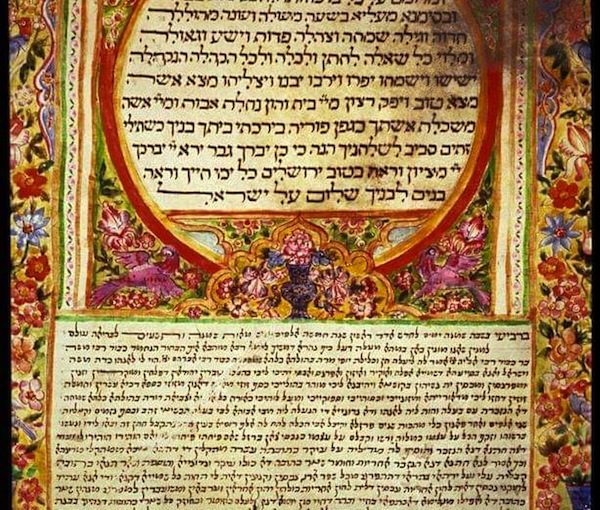
An illustrated ketubah from Mala, India, 1938. (image from Deborah Rubin Fields)

Mazal tov! So, you or someone you know is getting married. Today, Jewish weddings may be big or small, formal or informal, traditional or not. No matter the style, the ketubah, or Jewish marriage contract, is the common denominator.

The ketubah is a short, but ancient document. In his book The Ketuba: Jewish Marriage Contracts through the Ages, David Davidovitch writes: “It may be assumed that … the ketubah was first introduced at the time of the Babylonian exile.” The ketubah “testifies to the obligations undertaken by the husband towards his wife in their joint life together. The principal function of the ketuba is … to serve as a document that safeguards the position of the woman after she has entered the marital state.”

In a traditional ketubah, the groom obligates himself to pay a base amount, and perhaps additional sums that are then written into the contract. He vows to work, honour, feed and support the bride. In added phrasing, he specifically agrees to provide clothing, food (thus providing food is mentioned twice in a traditional Orthodox ketubah) and conjugal rights. The groom’s spelled-out duties are the key to the contract. The wife’s responsibilities are not spelled out, yet details of her dowry are given.

The ketubah was written in Aramaic, for many years considered the legal language of Jewish texts, records and reports, plus the lingua franca of the Middle East. Even today, many Orthodox couples continue to use the Aramaic version. As a legal document, the ketubah requires witnessing by two individuals.

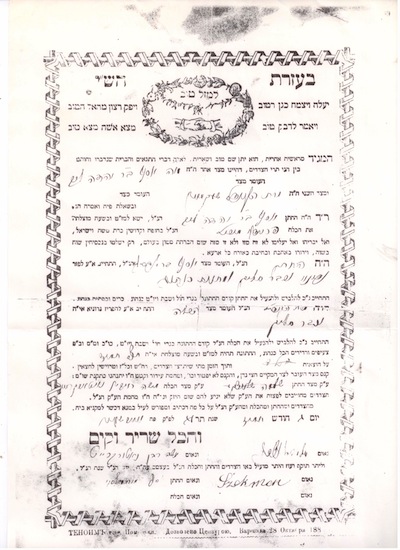
image - The ketubah of the writer’s maternal grandparents, from Warsaw, Poland, 1913
The ketubah of the writer’s maternal grandparents, from Warsaw, Poland, 1913. (image from Deborah Rubin Fields)

That Jewish couples have used ketubot since ancient times does not mean, however, that all ketubot are the same. They have differed from place to place and from period to period. Probably the most blatant difference in ketubot is that some have been illustrated while some have not. According to Davidovitch, the Italian Jewish community produced the most beautiful documents. In illustrated ketubot, common motifs have included scenes from the Torah, cherubim, flowers, birds (sometimes exotic), fish (as signs of anticipated fertility), candelabra or menorot, gates, arches, columns and even emblems of particular countries. It is hard to say with certainty if, historically, unillustrated ketubot reflected the conservative nature of various Jewish communities or if only the rich could afford artists to decorate the contract.

Sometimes, these dissimilarities appeared within one country. For instance, between the 18th and 20th centuries, the ketubot of the Indian Jewish communities consisted of two distinct sections – the opening formula, or superscription, in the upper register and the contract itself beneath. The superscription was written in square Hebrew characters, whereas the contract itself was penned in a semi-cursive Hebrew script. The superscription began with an invocation to G-d, followed by blessings and good wishes to the newlyweds and ended with biblical verses relating to marriage and fertility. Yet, within various Indian communities, there were differences: for example, while a ketubah from Kolkata (Calcutta) was illustrated, a ketubah from Pune was not.

According to Prof. Shalom Sabar, “printed Jerusalem ketubot made their way to many countries in the east, and indirectly led to the decline of the tradition of written ketubot and hand-made illustrations. The printed ketubah (with or without decorations) slowly took the place of the hand-made ketubah throughout almost the entire Jewish world, and the ancient artistic tradition died…. During the 1970s, the decorated ketubah and motifs connected to Jerusalem [were] revived. In an era where many people were ‘searching for their roots’ and acquired a renewed interest in Jewish art in its various forms, many couples began ordering hand-decorated ketubot for their weddings.” (See the National Library of Israel, web.nli.org.il/sites/NLI/English/collections/jewish-collection/ketubbot/ketexhibit/Pages/Yemen-1925.aspx.)

Today, some couples opt to write their ketubah using egalitarian language. Their vows might reflect their responsibilities to each other, as well as responsibilities to the Jewish people and to the entire world. One example of this is the ketubah devised by Rabbi Prof. Rachel Adler. Her ketubah is called a Lovers’ Covenant. It contains biblical verses about covenant, calling marriage a covenant of distinction. Other couples focus on specific vows to be carried out in their shared life.

Other examples of changing times are ketubot for interfaith couples and for same-sex couples. Regarding same-sex couples, Lynda Fishman of Jessy Judaica Shop reports that “most couples choose a ketubah first and read through the text that is offered by the artist. Most couples prefer the same-sex text, although not all artist[s] offer a same-sex text … most do offer an egalitarian text, which can be gender-neutral.” Fishman always requests the couple “speak to their rabbi/officiant first before ordering. It’s very important for the officiant to approve the text first or to let us know if they would like any changes made.”

Masorti (Conservative) Rabbi Diana Villa and the late Rabbi Monique Susskind Goldberg worked extensively to try and prevent the problem of mesoravot get, Jewish women whose husbands have refused to grant a get, or Jewish writ of divorce; this situation occurs more in Israel than in other Jewish communities. In a detailed paper on the issue, they urged couples to sign a prenuptial agreement.

For those living in Israel, they further recommend using their Agreement for Mutual Respect. “The principle guiding financial agreement is that the husband guarantees at the time of the wedding to pay his wife a large sum of money in the future should she want a divorce and should he refuse to give her a get, even though their life together has ended. The purpose of the agreement is to have the husband give the get quickly in order to be rid of the heavy debt.”(See To Learn and to Teach [2007], the fourth booklet of a series published by the Schechter Institute of Jewish Studies).

While prenuptial agreements are less common in the Orthodox world, the Orthodox organization Chupa Pratit requires couples to sign a halachic (according to Jewish law) prenup stipulating financial sanctions if one partner refuses to consent to a divorce, to prevent incidents of “chained” women, or men. (See chuppot.org.il/en.)

The National Library of Israel has an online collection of more than 4,200 ketubot from collections all over the world. Whatever direction you decide to go in when choosing yours, good luck with your preparations. And may your shared life be as hearty and as long-lived as the ketubah itself.

Deborah Rubin Fields is an Israel-based features writer. She is also the author of Take a Peek Inside: A Child’s Guide to Radiology Exams, published in English, Hebrew and Arabic.
Format ImagePosted on February 28, 2020February 26, 2020Author Deborah Rubin FieldsCategories LifeTags halachah, history, Judaism, ketubah, marriage, weddings
Women and education

Women and education

One of the family cards, produced 100 years ago, that is currently on long-term loan in the folklore department of the Hebrew University of Jerusalem, on Mt. Scopus. It is from the Chaya and Chana Gitelman Collection.

Not too long ago, I was flipping through a collection of old family cards, all of which were produced 100 years ago in Eastern Europe. On the cover of one card, a young girl sits at a table writing in a notebook. Her mother stands over her, looking on. From a modern perspective, there is nothing unusual about a woman knowing how to read and write. But less than 200 years ago, this would have been considered somewhat revolutionary.

Just how revolutionary? In the article, “The History of Jewish Women in Early Modern Poland: An Assessment,” Prof. Moshe Rosman reported that, at the end of the 19th century, more than half of all Jewish girls could not read, not even in Yiddish. Rosman noted that not only was limited attention given to educating Jewish women, but that those who first wrote the history of this period, deemed it hardly worth dealing with the subject.

In early modern Poland, education for Jewish girls and women was largely designed to make them into faithful Jews who would keep female rituals. For the most part, their education was informal and conducted in Yiddish. Brenda Socachevsky Bacon states that a learned woman was an aberration and considered outside the norm. In analyzing Shmuel Yosef Agnon’s story “Hakhmot Nashim” (“The Wisdom of Women”), which was published in 1943, Socachevsky Bacon says a woman’s very presence in the beit midrash causes the men to be uncomfortable. “They view the realm of Torah study as their own, even as their own hypocritical behaviour belies their dedication to it,” she writes. “The men will not allow this discomfort to continue, even if it involves transgressing the Torah’s commandment not to embarrass another person publicly.”

Fortunately, this was not the whole story of this period. Rosman explains there were secularized school settings in which Jewish girls learned both Yiddish and European languages. The objective of these schools was modernization and general knowledge. Girls read classic European literature. In this instance, the scorn was sometimes transferred, with traditional Jewish literature viewed contemptuously.

According to Prof. Eliyana Adler (“Rediscovering Schools for Jewish Girls in Tsarist Russia”), private schools for Jewish girls were a crucial ingredient in transitioning Russian Jewry into modernity. She reports that, from 1844 to the early 1880s, well over 100 private schools for Jewish girls opened in cities, towns and shtetlach throughout the Pale of Jewish Settlement.

The educators who opened and ran private schools for Jewish girls pragmatically balanced their ideological motivations with very real concerns about funding and retaining communal goodwill. Thus, those who ran private schools offered a variety of student tracks. Rich Jews (like their wealthy Christian neighbours did elsewhere) could pay to board their children. Many schools offered weekly instruction in both music and French as paid electives.

Adler goes on to say, “at the same time, families of modest means were offered tuition payments on a sliding scale. Noteworthy, poor students were actively recruited for scholarship positions. Other schools offered less sophisticated fee scales, but clearly worked within the same framework. The rewards for having a robust student body became clear as both the government and certain private and communal bodies began to award subsidies to successful private schools.”

These private schools for Jewish girls designed Jewish studies curricula to meet the expectations of the Russian Jewish communities from which they drew their students. The curricula had to be modern and useful without being radical. Thus, efforts were made to introduce training in practical crafts; that is, crafts that could be put to use in the marketplace. In 1881, the first trade school for poor Jewish girls opened in Odessa. Thereafter, both trade schools and sections within other schools that offered more in-depth training in such skills as sewing opened with increasing frequency.

image - One of the family cards, produced 100 years ago, that is currently on long-term loan in the folklore department of the Hebrew University of Jerusalem, on Mt. Scopus. It is from the Chaya and Chana Gitelman Collection
One of the family cards, produced 100 years ago, that is currently on long-term loan in the folklore department of the Hebrew University of Jerusalem, on Mt. Scopus. It is from the Chaya and Chana Gitelman Collection.

By the end of the 1890s, in Odessa alone, more than 500 girls studied in four communally funded vocational schools for Jewish girls. Jewish educators responded to the growing interest in interaction with the surrounding society by opening their private girls schools to Christian girls and by offering to teach courses in the Jewish religion in Russian schools. Prayer served as the common denominator of religious courses – the major focus of religious education was on prayer.

The teaching of Jewish history rather than simply the Torah allowed for an unprecedented degree of interpretation and even mild biblical criticism. Hebrew reading was also offered in many of the schools. Almost all Jewish girls schools offered penmanship and arithmetic.

Every private school for Jewish girls in the Russian Empire required extensive instruction in the Russian language. It was not uncommon for all general studies subjects to be taught in Russian.

Examples of the above educational transformation may be found in the bigger cities of Eastern Europe. In Plonsk (located some 60 kilometres from Warsaw), for example, toward the end of the 19th century, organizations such as Kahal Katan (literally, Small Community), educated the poorer strata of society. Also during this period, the city (which had a Jewish majority) opened a primary school for Jewish children, where some 80 pupils, mostly girls, studied in Russian. (See yadvashem.org/yv/en/exhibitions/communities/plonsk/jewish_education.asp.)

Vilna is another example. In 1915, the Association to Disseminate Education established three schools – one for boys, one for girls and one mixed – whose language of instruction was Yiddish. Also in 1915, Dr. Yosef Epstein established the Vilna Hebrew Gymnasium (high school), which was later renamed after him. The informal educational system included literature, drama, music, industrial arts and other courses. (See yadvashem.org/yv/en/exhibitions/vilna/background/20century.asp.)

According to Dr. Ruth Dudgeon (“The Forgotten Minority: Women Students in Imperial Russia, 1872-1917”), Russian women, aided by sympathetic professors, created educational institutions that evolved into universities and medical, pedagogical, agricultural and polytechnical institutes for women. Moreover, in 1916, the Ministry of Education overcame its bias against preparing women for public activity, rather than the home, and mandated the equalization of the curricula in the boys’ and girls’ gymnasia.

In the 1870s and 1880s, Jewish-Russian enrolment in the courses for women was between 16% and 21%. The imposition of quotas in the 1880s, however, reduced the number of Jewish students. But, in places where the quota was lifted, the number of Jewish women in the courses soared.

In the restricted Pale of Settlement, young Jewish women wanting to study did everything to establish residency elsewhere. The “everything” included registering as a prostitute. According to Dudgeon, one brother found out about his sister’s actions and then drowned himself in the Neva; the grieving sister, in turn, ended her life by taking poison.

As circumstances for Jews in the Russian Empire deteriorated in the 1880s, those Jews who stayed in that part of the world came to embrace new ideological solutions to the situation. In an atmosphere of violence, deprivation and brutally strict quotas in education and professions, Russian-Jewish parents wanted their children enrolled in schools where the course of study offered some hope for the future.

By the turn-of-the-century period, educators were no longer opening private schools for Jewish girls based on the old model. The schools they opened – whether they were trade schools where Zionism was taught, religiously mixed schools devoted to full acculturation, or Yiddishist schools committed to inculcating socialism – promised more than basic literacy.

In Poland, Gershon Bacon writes, “the education of Polish Jews in the interwar period was characterized … [as] the ‘victory of schooling.’ The compulsory education law of the reborn Polish republic had brought about in one generation what had eluded generations of prodding by tsarist officialdom and preaching by Jewish maskilim (people versed in Hebrew or Yiddish literature). Whether in the public schools or in the various Jewish school networks, Jewish children in Poland were educated according to curricula that deviated in almost every respect from that of traditional Jewish education. [Notably,] religious families had no objections to sending daughters to secondary schools, even though they objected to exposing sons to secular education.

“What is most striking,” continues Bacon, “are the differences in enrolment figures in institutions of higher learning. There was a much larger proportion of Jewish women students among female students as a whole (36% in 1923/1924), as distinct from the percentage of Jewish men among male students (22% in 1923/1924). It would seem that we have here but another example of a phenomenon observed in other countries, where Jewish women entered institutions of higher learning earlier and in greater proportion than their non-Jewish counterparts.” (See jwa.org/encyclopedia/article/ poland-interwar.)

So many factors about these educational statistics still need to be explored. Nevertheless, one can observe that an outcome seems to have been the creation of a modern Jewish Eastern European woman who “opened her mouth with wisdom.” (Proverbs 31:26)

Deborah Rubin Fields is an Israel-based features writer. She is also the author of Take a Peek Inside: A Child’s Guide to Radiology Exams, published in English, Hebrew and Arabic.
Format ImagePosted on December 13, 2019December 12, 2019Author Deborah Rubin FieldsCategories WorldTags education, history, Judaism, women, Yiddish

Posts pagination

Previous page Page 1 Page 2 Page 3 Page 4 … Page 8 Next page
Proudly powered by WordPress