Skip to content
  • Home
  • Subscribe / donate
  • Events calendar
  • News
    • Local
    • National
    • Israel
    • World
    • עניין בחדשות
      A roundup of news in Canada and further afield, in Hebrew.
  • Opinion
    • From the JI
    • Op-Ed
  • Arts & Culture
    • Performing Arts
    • Music
    • Books
    • Visual Arts
    • TV & Film
  • Life
    • Celebrating the Holidays
    • Travel
    • The Daily Snooze
      Cartoons by Jacob Samuel
    • Mystery Photo
      Help the JI and JMABC fill in the gaps in our archives.
  • Community Links
    • Organizations, Etc.
    • Other News Sources & Blogs
    • Business Directory
  • FAQ
  • JI Chai Celebration
  • JI@88! video

Recent Posts

  • Last hostage home
  • New bill targets hate crimes
  • Concerning actions
  • Recipes not always required
  • Survivor urges vigilance
  • Seniors profoundly affected
  • Farm transforms lives
  • Musical legacy re-found
  • A range of Jewish literature
  • A concert of premieres
  • Variety telethon on Feb. 22
  • Victoria club’s many benefits
  • Avodah dedicated to helping
  • Artists explore, soar, create
  • Life’s full range of emotions
  • Community needs survey closes March 29
  • Jerusalem marathon soon
  • Historic contribution
  • Chronicle of a community
  • Late-in-life cartoonist
  • Cashflow vs growth portfolio
  • My new best friend is Red
  • ישראלים רבים ממשיכים לתמוך בטראמפ ועדיין אינם מבינים במי מדובר
  • עשרים ואחת שנים בוונקובר
  • Supporting the Iranian people
  • The power of photography
  • A good place to start
  • When boundaries have shifted
  • Guitar virtuosos play
  • Different concepts of home
  • Broadway’s Jewish storylines
  • Sesame’s breadth and depth
  • Dylan Akira Adler part of JFL festival
  • Mortality learning series
  • A new strategy to brighten up BC
  • Sharing latkes and light

Archives

Follow @JewishIndie
image - The CJN - Visit Us Banner - 300x600 - 101625

Byline: Deborah Rubin Fields

Glimpse into lives of orphaned Pinsk relatives

Glimpse into lives of orphaned Pinsk relatives

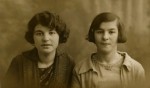
Anne, left, and Eva Gitelman. (photo from Deborah Rubin Fields)

The things we take for granted. Today, we spend countless internet hours looking for someone (or something). We assume increasingly rapid communication systems will effectively power these searches. Yet, for Eva Poll and Anne Rosenthal Schiffman, my paternal grandmother’s nieces (my first cousins once removed), staying in touch was a tremendous undertaking.

Beginning in the mid-1920s and continuing for almost 70 years, these two sisters struggled to keep in contact with their three Pinsk siblings, once their orphanage had shipped them and 32 other Jewish orphans to adoptive Jewish families in the United Kingdom.
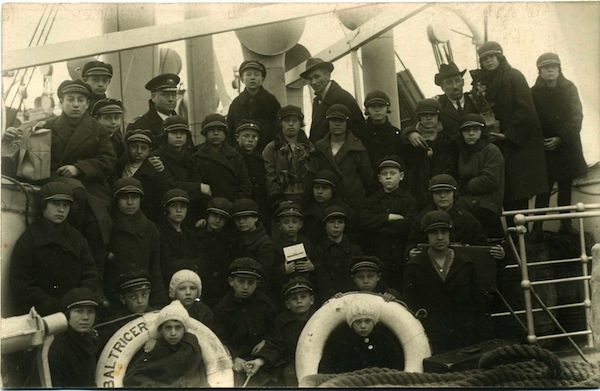
photo - Pinsk's orphaned children on the SS Baltricer, April 1926
Pinsk’s orphaned children on the SS Baltricer, April 1926. (photo from Deborah Rubin Fields)

How did I piece together this faraway story of my Pinsk relatives? The truth is that until their death, my cousins Eva and Anne held on to letters, cards, diaries and photos from Pinsk (today a city in Belarus). Through these saved items, my family’s story emerges.

Eva was born in 1913 as Chaya. She was the fourth of five children born to Avrom and Shaina Basya Gitelman of Pinsk. Anne was born in 1916. She was named Chana. Their older siblings were Hershel, born 1906, Sarah Leah, born 1907, and Devorah, born 1909.

Prior to 1918, I know little about Eva and Anne’s life. But late that summer, both their parents died within weeks of each other. With their deaths so close together, the parents might have succumbed to either the influenza pandemic or to starvation (giving their five young children whatever food they had been able to scrounge). According to Azriel Shohet, author of The Jews of Pinsk, 1881-1941 (translated from the Hebrew by Faigie Tropper and Moshe Rosman, edited by Mark Jay Mirsky and Moshe Rosman), at the time, conditions in Pinsk were terrible.

Eva and Anne went to live in the Jewish orphanage at 2 Dominikanska St. It is not known how my older (but still quite young) cousins managed, either on their own or with assistance.

My paternal grandparents had just emigrated to Chicago but, somehow, they learned the children had been orphaned. My grandfather contacted the Joint Distribution Committee, asking for photos of the orphans. With eight of their own children, it is unlikely my grandparents were in a position to provide much assistance.

All I know is that by age 16 or 17, Sara Leah married Yisrael Kuper and that they quickly began their own family. Devorah began working in the Pinsk veneer factory and lived with the Kupers. At some point, Hershel married a woman named Faigel and became a father.

What I have learned through research is that the orphanage’s economic situation worsened in the early 1920s. Shohet writes that even though the staff took good care of the orphans, it sometimes had to feed the children hot bean cereal instead of bread. In August 1923, the orphanage sent the following “advertisement” [translated from Yiddish] to the Pinsker Relief Fund in London:

Chaya learns in the school and Chana Gitelman learnt dressmaking. In peacetime, they lived in a village near Pinsk. In the war, they became ruined. The parents died and the children were taken to an orphanage…. They … are good children and very diligent. (Courtesy of David Solly Sandler, author of The Life and Times of the Children from the Three Pinsk Jewish Orphanages in the 1920s)

By 1924, the two sisters and their orphaned friends knew they were candidates for adoption by Jewish families in Britain. In 1924, close to the time of Rosh Hashanah, a friend named Faigel Bambel wrote the following in Anne’s autograph book:

To remember
To Chana Gitelman
When you go away to a faraway land, don’t forget me…. Don’t forget how it was for you here where we were together. Today I send you my wishes, and I believe that we’ll remain good friends. (Yiddish translation by Amy Simon)

By 1926, the orphanage had found homes for Eva, Anne and 32 other orphans. A few months before departing Pinsk for the United Kingdom, the siblings had their last family photo taken. (For unknown reasons, Hershel and family are not in the picture.) At sailing, Eva was 13 years old and Anne was 10 years old. The sisters never saw Pinsk again.

While I never asked Eva or Anne about the psychological toll of leaving family, the onboard ship photo seems to indicate the difficulty of parting. Eva is the only child holding a suitcase. According to her nephew, Colin Schiffman, Eva saved all her Pinsk correspondences in this suitcase. Moreover, Eva kept the suitcase under her bed, taking it out to use as a writing table.

They were adopted by two different Jewish London families: Eva by the Polsky family (Eva later shortened her family name first to Pole, then to Poll) and Anne by the Rosenthal family. To their credit, these two families permitted the girls to maintain contact with one another, as seen in the lovely 1929 photo from their adolescence.

From saved correspondences, I discovered that until at least 1939, the sisters were in contact with the Pinsk part of the family. To insure responses to their letters, Eva and Anne purchased two-part (send-and-receive) international postal cards. One saved card already shows the Second World War censor stamp the British employed after declaring war on Germany.
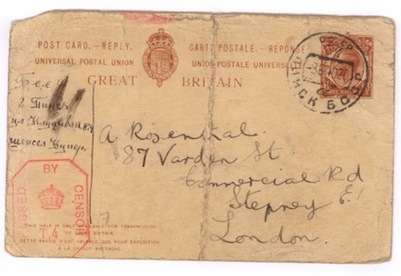
image - Eva and Anne purchased send-and-receive international postal cards. This saved card, sent from Pinsk, shows the censor stamp the British employed after declaring war on Germany
Eva and Anne purchased send-and-receive international postal cards. This saved card, sent from Pinsk, shows the censor stamp the British employed after declaring war on Germany. (photo from Deborah Rubin Fields)

Anne must have told the Pinsk family about her plans to marry Bobby Schiffman on July 14, 1940, as brother Hershel sent a message: “Chana, how are you, what’s new with your wedding and with work? Regards to your parents and to your husband/groom.” Cousin Chaya wrote: “Regards to Chana and her husband.” Bobby and Anne had three sons: Alan, Stephen and Colin and eventually several grandchildren.

Eva chose to remain single. She had been engaged at least once, but did not go ahead with marriage because she had promised her Pinsk family she would always look after her little sister. Eva’s nephew Colin confirms that, by 1941, Eva was already living with the Schiffmans in London. Colin recalls that, as a young woman, Eva led a busy social life. For most of Eva’s working life she was the final quality-control person at the clothing factories at which she worked (and she sent back many items!).

After the Second World War and for the next 50 years, Eva searched for family, but kept her feelings to herself. As such, she never revealed how much emotional or physical energy it demanded to send numerous handwritten letters to Jewish newspapers, to the Hebrew Immigrant Aid Society, to the JDC, to Yad Vashem. Just as important, she never divulged how hard it was waiting for replies. While she found relatives in such far-flung places as the United States and Argentina, she unfortunately discovered no Pinsk family member had survived the Nazi onslaught.

With Yiddish-speaking relatives, the sisters communicated in (both written and spoken) Yiddish, but together they conversed in English. As the years went by, the two sisters seemed to enjoy a quiet life of working in the family’s Newbury Park house and garden, taking care of Colin, Bobby and the family cat, and, importantly, keeping each other company.

Anne died in August 1995. Eva died in April 2001. Despite trying childhoods, a difficult passage from one country to another and an upbringing in two different homes, until the end, the two sisters remained tremendously devoted to each other.

In the macro, their cherished papers provide an eye-opening glimpse of one corner of early 20th-century Eastern European Jewry. In the micro, they open a fascinating window to the lives lived by some of my relatives, lives marked by separation, on the one hand, and continuity, on the other.

Deborah Rubin Fields is an Israel-based features writer. She is also the author of Take a Peek Inside: A Child’s Guide to Radiology Exams, published in English, Hebrew and Arabic.

Format ImagePosted on November 7, 2014November 5, 2014Author Deborah Rubin FieldsCategories LifeTags Anne Rosenthal Schiffman, Eva Poll
Jerusalem’s spooky historical spots

Jerusalem’s spooky historical spots

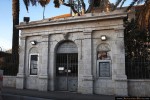
The Ministry of Health building in Jerusalem was the scene of a macabre wedding in 1881. (photo by Deborah Rubin Fields)

A government building, a zoological park, a bird observatory and a residential city street: What do these four Jerusalem locations have in common? In fact, each place is shrouded in mystery. Each conceals secrets. Each is part of Jerusalem’s landscape of spooky sites.

Back in 1881, the Ministry of Health building at 86 Jaffa Rd. (located across the street from the Mahane Yehuda market) was destined to be the villa of a well-to-do Christian Arab groom and his new bride. Unfortunately, the old adage “money does not buy happiness” came true. Personal wealth did not prevent personal tragedy; the young man died right before his wedding.

Making a macabre decision, the bereaved parents decided to go ahead with the gathering. At the party, the deceased groom was propped up next to his bride-to-be. Before everyone went off to the funeral, the bereaved mother supposedly honored “the couple” by performing the traditional wedding dance and dabbing the bride with henna.

Not surprisingly, this story had a chilling effect on local residents. The building remained empty for 10 years. After that, the Ottomans turned it into a general municipal hospital, a mustashfa. But because of its morbid history, even the most destitute patients were afraid to go there. It took a long time for people to forget its spooky beginnings, but eventually Jerusalemites, particularly from Lifta, Malha and Silwan, began to use the 30-bed facility.

Although financially strapped, the hospital stayed open until the British took over in 1917. They turned it into the Mandatory’s offices of the Ministry of Health. After 1948, the Israeli government made the building the Jerusalem regional offices of the Health Ministry. Today, Jerusalemites know it as the place to get their anti-rabies shots or their inoculations for the big post-army trip to South America or Asia.

Unfortunately, today the inside looks like many other old Jerusalem buildings: modern fixtures rudely stuck to old structures in utilitarian rather than esthetic fashion. Yet, some of the intriguing architectural additions remain outside: the winding, exposed staircases at the front of the building, for example, still shine. At one point, the stairs led to a roof from which guards had a good command of the comings-and-goings on Jaffa Road, at that time the main artery to the coast.

photo - Both the Jerusalem Biblical Zoo and the Jerusalem Bird Observatory offer visitors a chance to see and learn more about bats
Both the Jerusalem Biblical Zoo and the Jerusalem Bird Observatory offer visitors a chance to see and learn more about bats. (photo by Deborah Rubin Fields)

Some animals also bear the brunt of unearned labels and gossip. Take bats, for example. At one time or another, many of us will have heard fears about bats biting people, as well as the mythical association of bats with vampires.

While some might take points off due to the fact that bats are not considered kosher (see Deuteronomy 14:18), bats deserve credit for keeping our environment in check by consuming copious amounts of insects. Besides that, close up, bats are rather cute.

Strange as it may seem, if you stroll past 83-87 Bar Kochba St. in residential French Hill at dusk (or near HaChayil 41, close to midnight), you might notice some of the small, winged creatures (not larger than an adult hand) darting through the air. At this time of day, bats leave the east side of the street and head for the park on the west side. Look quickly before they disappear from view.

If this subject drives you batty, the Jerusalem Biblical Zoo offers explanation and viewing of both insect-eating bats and fruit-eating bats. The zoo takes part in the research and conservation of the dwindling insect-eating bat population. Moreover, some time ago, the zoo acquired a new male Australian fruit bat. He was apparently quite the hit with the ladies, who evidently enjoyed “hanging out” with him.

In past years, the zoo has hosted summer’s eve tours focusing on bats and other night-active animals. Pre-registration has been mandatory and there is a charge. For more information, call 972-02-675-0111. Children 8 years old and over are welcome to participate.

The Jerusalem Bird Observatory near the Knesset also offers bat- (and other night-active animal-) watching activities for children ages 5 and above. For more information, call 972-02-653-7374 or 972-052-386-9488, or email [email protected]. There is a small fee for the walking tour.

Remember when you visit Jerusalem, keep an eye out for surprising sights and historical facts; things are not always what they appear to be and surprises are in store.

Deborah Rubin Fields is an Israel-based features writer. She is also the author of Take a Peek Inside: A Child’s Guide to Radiology Exams, published in English, Hebrew and Arabic.
Format ImagePosted on October 31, 2014October 29, 2014Author Deborah Rubin FieldsCategories IsraelTags bats, Jerusalem Biblical Zoo, Jerusalem Bird Observatory
Spanish Jewry’s Golden Age

Spanish Jewry’s Golden Age

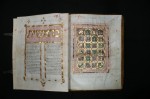
An illuminated Chumash from the El Escorial Library collection in Madrid. (photo from Courtesy of El Escorial Library)

Everyone has heard: “All good things must come to an end.” This saying certainly holds true when talking about Spanish Jewry’s Golden Age. Back in the Middle Ages, Spain’s church and state used forced conversion, expulsion and the Inquisition to obliterate Jewish life on their peninsula. While we might have some sense of how these methods devastated the lives of this once great Jewish community, we are probably less aware of the toll it took on the products of this culture, namely its books.

Let’s first be clear about what the Spanish Inquisition was. In her article “Medieval and Early Modern Sephardi Women,” published in the volume Jewish Women in Historical Perspective, Prof. Renée Levin Melamed writes that the Inquisition was “a temporary legal institution or court set up by the Roman Catholic Church in order to extirpate suspected heresy. Its jurisdiction was solely over baptized Catholics; thus, it could bring to trial converted Jews or Muslims, suspected witches, sectarians and the like.”

What set the Spanish Inquisition in motion? According to Prof. Felipe Fernandez-Armesto (author of Ferdinand and Isabella), in the late 1400s, the Spanish monarchs genuinely dreaded that the souls of their Catholic subjects would be forever lost to Islam and Judaism. Indeed, there was a pervasive fear that those who had already left Judaism (those former Jews known as conversos) had not really put aside their original religion. Hence, Spanish Christians strongly suspected conversos of Judaizing. To deal with this perceived threat to Christianity, the king and queen established the Inquisition.

Once the institution began functioning, religious considerations were perverted into accusations based upon economic rivalry, as well as the settling of assorted personal grudges. Moreover, as the offices of the Inquisition had the power to impound the possessions of the accused, it became advantageous to keep the institution going. Far worse than losing one’s possessions, however, was the sadistic physical torture the indicted commonly suffered, and the death by burning of those convicted. Fernandez-Armesto writes that contemporaries of Ferdinand and Isabella chose conveniently (and paradoxically) to forget – or ignore – the fact that “the Spanish royal house, too, was remotely affected by Jewish blood, through its founder, Henry of Trastámara, and his mother, Leonora de Guzmán, mistress of Alfonso XI.”

While Christian officials busied themselves in setting up the Inquisition, a few undaunted Spanish Jews moved ahead in printing sacred Hebrew texts. Significantly, these came to be highly regarded: “Their biblical texts were regarded as more accurate and authoritative … their codices are … very precise,” writes Teresa Ortega-Monasterio in Spanish Biblical Hebrew Manuscripts.

In Early Hebrew Printing in Sepharad ca. 1475–1497, Prof. Shimon Iakerson points out that “in 1482, Solomó ben Moisé Levi Alkabiz was established in Guadalajara and produced the first printed edition of the Talmud; in 1485, [Eliezer ben Abraham ibn] Alatansi was established in Híjar; and, in 1487, Samuel ben Mousa y Emanuel was working in Zamora (Torre Revello 17).”

While we know that Alkabiz printed a Rashi commentary on the Torah, information about Alatansi’s press is limited, and researchers only know of a fragment from the halachic compendium of Jacob ben Asher, including two copies of the latter prophets and two copies of the Torah. From what we know, ben Mousa, like Alkabiz, printed Rashi’s commentary on the Torah, as well.

It should be noted that during this same period, Hebrew printing was going on elsewhere, but it has been difficult to assign locations. Nevertheless, by comparing the fonts and printing paper to known texts, it is possible to suggest (but not confirm) those who may have worked on the books and the possible location of their workplace.

Intriguingly, for a limited time, there was cooperation between Jewish and non-Jewish printers. For example, it appears that Alfonso Fernandez de Cordoba “rented out” his frames to Jewish printers in Híjar in order that they might decorate the pages of their editions. Elsewhere, the Christian type caster Maestro Pedro of Guadalajar was mentioned in a Hebrew text.

Still, the Spanish monarchy felt threatened by the accessibility to Jewish learning afforded by the printing of Hebrew texts. Copies of the Talmud became a target of the Inquisition. From there, the hunt intensified, turning towards other Jewish texts. Two years before the 1492 expulsion of Jews from Spain, Ferdinand and Isabella ordered Grand Inquisitor Fray Tomás de Torquemada to burn Hebrew books. Later, during an auto-da-fé (act of faith, which really meant the public burning of a heretic) extravaganza in Salamanca, this same church father oversaw the burning of more than 6,000 volumes, which were said to be “infected with Jewish errors.”

Even after the expulsion, this ruthlessness continued, as Inquisition officials confiscated Jewish books and searched for any so-called “Jewish contamination” in the conversos community. Arias Montano (1527-1598), the first director of El Escorial Library, described the situation this way: “Of Hebrew books, of which there was great wealth in Spain, there is now great poverty.” In fact, the Inquisition finished off Hebrew printing in Spain.

Miraculously, some Hebrew books printed in Spain survived this onslaught, often as single copies or as mere fragments, writes Iakerson. Some of these remnants exists in Spain, stored in places like the library of the Royal Monastery of El Escorial, in the library of the Royal Palace of Madrid and in the library of the Complutense University of Madrid. While the originals remain out of the public eye, some facsimiles are on view today. For example, in Cabinet 43 of the Escorial Library’s viewing room, there is a facsimile of a 15th-century Torah, which also contains the Masora, or Masoretic texts (various scholarly notes on the biblical text written into the margins).

In his 1969 book Hebrew Illuminated Manuscripts, art scholar Bezalel Narkiss located illustrated medieval Spanish Jewish manuscripts in several European libraries and museums. These beautiful texts are now housed in places such as Sarajevo’s National Museum of Bosnia and Herzegovina, National Library of Portugal in Lisbon, the Oriental Department of the Berlin State Library, British Museum in London, Israel Museum in Jerusalem, National Library of Israel in Jerusalem, Oriental Library of the Hungarian Academy of Sciences in Budapest and John Rylands University Library at the University of Manchester. Many of these collections are available for online viewing. For example, in 2012, the National Library of Spain gathered and mounted a large temporary exhibit of Spain’s most important medieval Hebrew texts. The exhibit is now viewable online and includes Hebrew Bibles, liturgical texts, texts dealing with reason and revelation, biblical exegesis, polemics and Spanish reports on the Inquisition trials of various conversos, suspected of Judaizing.

With the ability to digitize ancient documents and with the increasing international connection between libraries, perhaps additional surviving medieval Spanish Hebrew texts will be discovered. At the very least, we hope to learn more about those already discovered fragments of this once-flourishing Jewish culture.

Deborah Rubin Fields is an Israel-based features writer. She is also the author of Take a Peek Inside: A Child’s Guide to Radiology Exams, published in English, Hebrew and Arabic (take-a-peek-inside.com).

Format ImagePosted on September 19, 2014September 18, 2014Author Deborah Rubin FieldsCategories WorldTags Arias Montano, Bezalel Narkiss, El Escorial Library, Felipe Fernandez-Armesto, Fray Tomás de Torquemada, Renée Levin Melamed, Shimon Iakerson
Inclusive and accessible playgrounds

Inclusive and accessible playgrounds

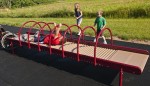
Equipment like the Roller Table can help children develop their upper body muscles. (photo by Deborah Rubin Fields)

Not all playground equipment is created equal. Some equipment is accessible while some is not. Certain equipment is accessible to young wheelchair users, yet cannot be labeled inclusive play apparatus. However, some playground items are both accessible and inclusive and, notably, provide wheelchair-bound children with opportunities for either muscle toning and/or creative play.

Landscape Structures has designed a number of accessible and inclusive pieces of playground equipment. Take, for example, the new ZipKrooz. This is a scaled-down version of the popular adult zip line. The young passenger sits in a hard, high-back seat, secured with a harness. For safety, the chair runs fairly close to the ground. Gravity propels the child across the line. Close to the end of the line, the chair rocks back toward the centre before coming to a stop. The launching action is repeated, as many times as desired. A child using a wheelchair might need help from a grown escort to assist with the transfer to and from the wheelchair to the zip seat, to position the child at the beginning of the line, and to gently push the back of the chair to launch the occupant.

The Play Booster Sway Fun Glider is a roomy, communal “landed” boat that artificially creates wave motion. The “sailors” can either rock the boat from their seated positions or assistants can stand outside the bow or stern, swaying the boat. Wheelchair access is provided via a pull-down ramp. Sitting around a bolted-down table, two wheelchair-using youngsters may join in imagery play with other passengers. Wheelchairs are apparently not locked down; instead, wheelchair users either stabilize themselves with their chair’s brakes and with the table’s hand holds or have their attendants sit behind them, holding the chair’s back hand grips.

The next three play lot items not only promote inclusion and accessibility, but also muscle strengthening. The Accessible Stationary Cycler, the Accessible Power Lifter chinning bar and the Roller Table, for example, help children develop the muscles in their upper body – in their arms, upper back, neck and/or chest. Each apparatus is built low enough so that children using wheelchair mobility (and who have use of their arms and hands) can either reach up to raise themselves out of their chairs or sit in their chairs to comfortably play.

The following two pieces of equipment provide for inclusion and accessibility while focusing on creative enterprise.

Landscape Structures manufactures what it calls an Elevated Sand Table. This raised sandbox allows juvenile wheelchair users (who have use of their arms and hands) to build sandcastles from their chairs. From a standing position, children without physical disabilities play alongside.

The Chimes Reach Panel lets wheelchair users and non-physically challenged children to literally play harmoniously. They may make music together by ringing a row of chimes.

On the other side of the accessibility spectrum (and geographically on the other side of the world), there is the Australian-made Liberty Swing. With its design to accommodate most wheelchairs, this swing is apparently a big hit in Australia, yet this equipment sometimes stands off to the side of the other playground equipment, fenced off and under lock and key.

Admittedly, vandalism and theft are problems playground officials face worldwide. But this reality means that while the swing is accessible to children who use wheelchair mobility, it is not necessarily mainstream integrated.

Play is necessary for a child’s physical and mental development. In the Western world, playing with one’s peers, regardless of one’s physical or mental ability, has been deemed a child’s right. Overall, the surveyed play items show significant progress has been made in fulfilling this objective. Physical and occupational therapists who work with children would do well to encourage their young clients and their families to make use of such equipment, and to try and make playgrounds everywhere as accessible and inclusive as possible.

Deborah Rubin Fields is an Israel-based features writer. She is also the author of Take a Peek Inside: A Child’s Guide to Radiology Exams, published in English, Hebrew and Arabic (take-a-peek-inside.com).

Format ImagePosted on May 16, 2014May 14, 2014Author Deborah Rubin FieldsCategories LifeTags accessibility, Accessible Power Lifter, Accessible Stationary Cycler, Chimes Reach Panel, Elevated Sand Table, Landscape Structures, Liberty Swing, Play Booster, Roller Table, Sway Fun Glider, wheelchair, ZipKrooz
Visit Israel’s ancient water holes

Visit Israel’s ancient water holes

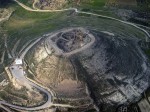
An aerial view of the acropolis of Herodium. (photo from commons.wikimedia.org)

In Israel, water scarcity has long been an issue. Even the Old Testament narrates that the Hebrews complained to Moses about the lack of fresh drinking water (Exodus 17:1-7, Numbers 20:2-13) in the arid Zin Wilderness.

Whether the answer to that particular water problem came from Divine intervention or from human ingenuity or both, the fact remains that the people who populated the ancient Land of Israel figured out sustainable solutions to their water shortages. This article focuses on three historical examples of sustainable water practice.

The first of the sustainable water system to be examined takes you forward in ancient history and north of the Zin Wilderness or Desert (Midbar Tzin, in Hebrew) to Herodium, a hilltop palace and fortress built by King Herod that stood securely at the highest peak in the Judean Desert.

Herodium was constructed more than 2,000 years ago in 23-20 BCE. Needless to say, it was crucial to have access to drinking water in this semi-arid and elevated location, and four vast underground cisterns for rainwater and spring water were carved deep into the mountain. Three of the cisterns were built in close proximity, about 80 feet below the summit. The fourth was hewn slightly above, about 16 feet from the summit. The largest cistern could hold up to 400,000 gallons of water. Access to the three lower cisterns was via the northeast side of the mountain, close to Herodium’s only flight of steps.

Water traveled a few miles from the Spring of Artas to drain into the large pool of Lower Herodium. It was carried uphill on donkeys and emptied into the lower cisterns. There were two ways to obtain water from these cisterns. One, exiting the palace-fortress with empty water skins or jars via the stairs until reaching the opening to the three lower cisterns. Water would then either be carried all the way back or, two, be transported to the opening of the higher cistern, at which point water was (ingeniously) funneled into the reservoir. A bucket attached to a man-made vertical shaft then brought this water up to the palace courtyard. This method was less labor intensive and insured the privacy of the “royals.”

As the nursery rhyme states, “some like it hot and some like it cold.” At Herodium, you had both hot and cold – and more. The Roman-style bathhouse featured a below-floor heating system in both the tepidarium (warm) and the caldarium (perhaps the precursor of the hot tub?), as well as a cold bath (frigidarium), or some kind of Roman bath/Hasmonean ritual bath hybrid, according to a Stanford professor of history.

According to David Mevorah, a curator of a Herod exhibit at the Israel Museum, by installing Roman baths, the king helped spread the importance of washing to the indigenous people of ancient Israel. Moreover, at what is called Lower Herodium (apparently the high-rent district of the day), the enormous pool (referred to by local residents today as El Hammam and measuring 70×45 metres or 230 feet) functioned as a swimming pool, a water reservoir and a small lake for boating, according to historians.

Today, Herodium is no longer a hilltop palace-fortress, but an amazing national park located just south and east of Jerusalem. For directions and hours, call the Herodian National Park at 057-776-1143 or visit parks.org.il.

***

Another (though more modern) solution to water scarcity is located just across the street from the Jerusalem Theatre at 17 Marcus St. Five large cisterns once serviced the Jesus Hilfe Asyl (what later became known as the Hansen Hospital). The Herrnhut Brothers, German Christians affiliated with the Moravian Church, donated the money to build the hospital in the late 1800s. It housed and treated people who were suffering from Hansen’s disease, a bacterial disease that was misdiagnosed as leprosy.

With the water collected, the 70 hospital patients (plus, in some cases, their healthy children) and the German Sisters of Mercy met all their water requirements, including medical needs, personal sanitation, in the kitchen and laundries, and for garden and farm maintenance.

Under the supervision of Jesus Hilfe builders, local workers constructed the cisterns, the largest of which was probably built in 1898. When full, it held 15×15 metres of water. In late December 1902, it even overflowed.

The other four cisterns were fed from rain gutters, which began on the hospital roof complex. Rain was collected from the staircase, the cistern roof and even from the road outside the compound’s high stone wall. Two cisterns were built near the laundry; one cistern was built near the southern garden while the others were situated within the main building, in the central courtyard or kitchen area.

With the advent of medicines to effectively treat Hansen’s disease, the in-patient hospital closed. Over the years, it has been an Israeli Ministry of Health outpatient facility and an early-childhood development centre. At present, it is being used as a Jerusalem municipal cultural centre. Inside the facility, you can visit an informative exhibit dealing with the history of the hospital and health care in Jerusalem. For visiting hours and tour arrangements, email [email protected] or call 054-744-6123.

***

Another ingenious water system is today located in a Ramla (or Ramle) city park. During the early Muslim period, in the early eighth century, Ramla was a strategically significant town, and served as the administrative centre of Palestine. Ramla was close to the road serving the holy city of Jerusalem and the port of Jaffa. Obviously, maintaining control of such an important location meant it had to be populated. This included providing inhabitants with a viable source of water.

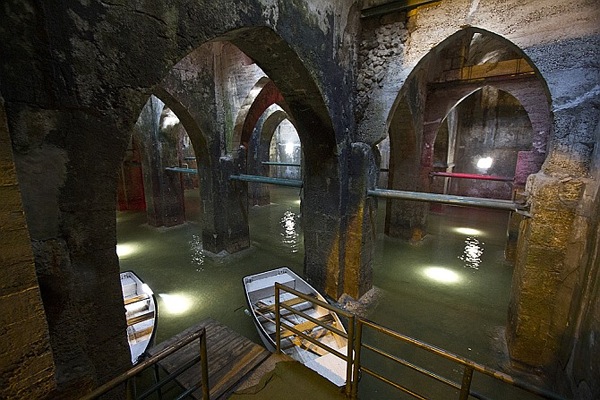
photo - Since summer of 2013, Ramla's Pool of Arches has been used for a new purpose: concerts!
Since summer of 2013, Ramla’s Pool of Arches has been used for a new purpose: concerts! (photo by Ron Peled from goramla.com)

Entering the city park, you’ll catch a glimpse of some long, rounded structures peeking up from the ground. When you descend the steep, narrow metal staircase (that now covers the original stone) leading to the pool, you take a step back in time, into the early Muslim period. This building, however, was not just any old storage unit. This elaborate reservoir, built in 789, is decorated with heavy brick, stone arches and a domed roof. Down below, you’ll find yourself facing an underground dock. It could pass for a medieval fort or a house, except that the floor is missing. In its place, the different chambers are filled with water deep enough for row boating! Altogether, the place gives you a mini-taste of Venice, Italy, except that at Ramla’s Pool of Arches, you never see the sky.

Today, we know arches make the sturdiest of structures, but this was still a novel idea back in the eighth century. Indeed, this construction proved so successful that the 400-plus-metre Pool of Arches withstood the devastation of the 1068 CE earthquake. You can see five of the original six vaults that covered the pool. Fifteen square pillars and 16 cross-shaped pillars support the vaults. Pointed arches exist between each pair of pillars. To compliment the arches, the architect designed small windows above them. These windows were likewise shaped as pointed arches. Locals drew water from 24 square openings in the ceiling.

There are various theories about the reservoir’s original source of water. Some claim it was filled only with rainwater. A more compelling assertion is that water flowed 10 kilometres from Tel Gezer via Caliph Sulayman ibn Adb al-Malik’s water conduit (in Hebrew referred to as an amah). Two points are clear: (1) it wasn’t water from any adjacent spring and (2) we are talking about a part of the world that is hot and dry for months at a time. The engineering and maintenance of this cistern was so successful that archeologists believe it was actively used for 150 years.

The site has a somewhat obscure history and goes by a variety of names, including the Pool of St. Helena and the Pool of Al-Anziya. In the early 20th cenutry, the British repaired the pool, but it was the (post-statehood) Ramla Municipality that converted it for boating.

After you visit the Pool of Arches, make note of the continuation of the city’s old subterranean water system. Ancient water cisterns are located in the White Tower’s large courtyard.

Visitors aged 2 and up can take a boat ride; life jackets are provided. For hours and directions, call 08-977-1595, 08-920-7586 or 052-851-0715. A helpful map can be found at ramla.muni.il/eng.

Deborah Rubin Fields is an Israel-based features writer. She is also the author of Take a Peek Inside: a Child’s Guide to Radiology Exams published in English, Hebrew and Arabic (take-a-peek-inside.com).

Format ImagePosted on May 2, 2014May 1, 2014Author Deborah Rubin FieldsCategories TravelTags Caliph Sulayman ibn Adb al-Malik, David Mevorah, Hansen Hospital, Herodium, Israel Museum, Jerusalem Theatre, Jesus Hilfe Asyl, Moravian Church, Pool of Arches, Roman baths, Tel Gezer, White Tower
Films offer glance at Bedouin life

Films offer glance at Bedouin life

A still from the movie Voices from El Sayed.

When one is a Bedouin living in southern Israel, ironies seem to multiply with regularity. Two relatively recent Israeli-made films bring this incongruous life into sharp focus.

In the first, Voices from El Sayed: A Snail in the Desert (2009, documentary), director Oded Leshem examines a minority within a minority – a special needs Bedouin group. In the second, Sharqiya (2012, drama), director Ami Livne focuses on an Israeli Bedouin who, although he has spent his young adult life protecting other Israelis – first as a soldier and then as a security guard – faces eviction from his land because the Israeli authorities do not acknowledge it as his.

Leshem focuses on both the social and technological challenges facing the deaf members of the El Sayed Bedouin. In an understated but convincing manner, Leshem makes this point: for people who are deaf, this Bedouin tribe is both heaven and hell.

Leshem presents a lot of information in his 75-minute film. For starters, he unearths this nugget: the El Sayed have the highest concentration of deaf people of any community in the world. Estimates are that this desert community located northeast of the Negev city of Be’ersheva has 3,000 tribal members and, of this number, 125-150 are deaf. Intra-marriage is high – 65 percent of El Sayed’s couples are somehow related – so deafness is, therefore, more often transmitted from generation to generation. Almost every family has a deaf family member.

In this village, deafness is acknowledged as a fact of life. Not only is it considered normal, but everyone in the film – hearing and deaf – knows and uses sign language. At first glance, deaf community members appear totally accepted and functioning comfortably within the group. There is always someone with whom to converse – but in which language does one communicate?

According to Leshem’s film, language is one of the major social challenges facing Israel’s minorities. The film notes that the older deaf members of El Sayed converse in their own form of signing: El Sayed Bedouin Sign Language (EBSL). A number of the younger members, however, have studied in schools outside the community. These schools fall under the jurisdiction of the Israeli Ministry of Education, so these Bedouin study Israeli Sign Language (ISL). In addition, these same young students learn to read and write in Hebrew, rather than in Arabic, their mother tongue.

There is no school for the deaf on tribal land: children are bused to a school in Be’ersheva. But not every deaf child attends or has attended this facility. As the audience learns, some young adults studied in the centre of the country. However, on the positive side, the film explains that Be’ersheva has a special early childhood class for the hearing challenged, which is taught by traditional Bedouin teachers.

The deaf young adult tribal members who speak in the film want to marry deaf partners. But in this strongly paternalistic society, their parents still have a lot of say in marital matches. Some of the hearing parents want their marriage-age children to break what they see as a chain of deafness, so they are interested in having their deaf offspring pair off with hearing mates.

Not only are there parents who want to alter the course of future generations, but there are those trying to improve the life of their offspring in the present. The movie depicts one set of hearing parents who decide that one of their children will be the first El Sayed member to undergo a cochlear implant.

The good news is that the Israeli health-care system will cover the cost of the surgery and the implant itself. But, as viewers soon grasp, this family faces many other obstacles. The first several months following surgery entail regular and frequent trips back to Be’ersheva’s Soroka Hospital. During these hospital visits, the parents learn how to encourage their toddler to listen in everyday situations. Both the mother and father accompany the child to the hospital. There, they work with a Hebrew-speaking professional staff. The father speaks and reads Hebrew fluently, but the mother does not. No Arabic translator is provided. This point is critical as, at home, the mother has the huge task of ensuring that all the other children participate in the training.

No less significant is the hospital staff’s lack of awareness of the overall situation in El Sayed. While Leshem’s camera reveals that high-tension wires stand in close proximity to the village, the film’s narrative discloses that El Sayed is not hooked up to the national grid. There is no electricity, except for the generators that power the village. Just as the hospital staff comes to terms with the family’s difficulty in keeping all the implant parts properly charged, so the audience grasps just how challenging this procedure is for this family.

El Sayed lacks what most Westerners would consider basic utilities or services. For the dispersed Bedouins living in areas of southern Israel, which successive governments have classified as “unrecognized,” not having electricity or running water is a common situation. Nowhere is that brought home more clearly than in Livne’s drama Sharqiya.

photo - a still from Sharqiya
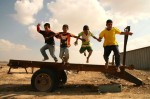
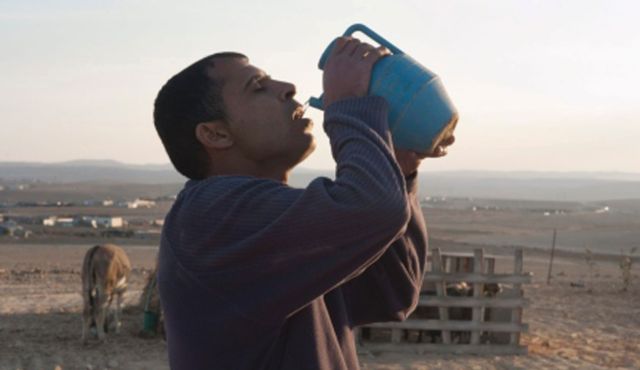
A still from Sharqiya.

The story of Sharqiya centres around two brothers and the wife of one trying to live on family land. The land appears fairly inhospitable. Family members live quite minimally in one-room tin huts, serviced by a temperamental generator. In the barren surroundings, one brother herds a small number of goats, while Kamel Najer, the other brother and main character, works as a security guard in Be’ersheva’s central bus station.

Westerner viewers might wonder why it is so important to keep this undeveloped plot of land, especially when Israeli authorities offer compensation for leaving it. Coming from a Western society, it is also hard to get one’s head around the notion of inheriting land without documentation. But this is exactly what the Najer brothers claim: their family has lived on the land for generations.

In the film, viewers watch the authorities stand by, waiting to destroy the Najers’ homestead, as Kamel packs up cherished memorabilia from his army service. We witness this young Israeli Bedouin – who has felt enough sense of belonging to hold on to his army pictures and banners – have his living space made not just unfit, but non-existent. Livne makes it clear that if Israeli society does not appreciate the irony of this situation, it will not understand that such treatment puts the fragile foundation of Israel’s democratic structure at risk of collapse.

When the human and humane element is missing – as depicted by the Israel Land Authority’s tractor leveling the family’s meagre housing and corral – the cracks in society’s foundation deepen. The frustration and the disappointment do not fade out: in the closing shot, they are inscribed on Kamel’s face.

Deborah Rubin Fields is an Israel-based features writer. She is also the author of Take a Peek Inside: A Child’s Guide to Radiology.

More on the Bedouin

The following links are to position papers or websites of some of those involved in Israeli Bedouin affairs.

From the Israeli government: mmi.gov.il/static/HanhalaPirsumim/Beduin_information.pdf

From Jewish National Fund: www.kkl.org.il/eng/about-kkl-jnf/kkl-jnf-in-public-discourse/kkl-jnf-conferences/kkl-jnf-european-leadership-conference/kkl-jnf-position-bedouin

From a few nongovernmental organizations:

• adva.org/uploaded/NegevEnglishSummary.pdf

• dukium.org/eng/wp-content/uploads/2011/06/NCF-CounterClaims-Dec10.pdf

• acri.org.il/en/category/arab-citizens-of-israel/negev-bedouins-and-unrecognized-villages

Format ImagePosted on February 7, 2014April 16, 2014Author Deborah Rubin FieldsCategories TV & FilmTags Ami Livne, Bedouin, Oded Leshem, Sharqiya, Sign Language, Voices from El Sayed

Posts pagination

Previous page Page 1 … Page 7 Page 8
Proudly powered by WordPress