Skip to content
  • Home
  • Subscribe / donate
  • Events calendar
  • Business Directory
  • FAQ
  • News
    • Local
    • National
    • Israel
    • World
    • עניין בחדשות
      A roundup of news in Canada and further afield, in Hebrew.
  • Opinion
    • From the JI
    • Op-Ed
  • Arts & Culture
    • Performing Arts
    • Music
    • Books
    • Visual Arts
    • TV & Film
  • Life
    • Celebrating the Holidays
    • Travel
    • The Daily Snooze
      Cartoons by Jacob Samuel
    • Mystery Photo
      Help the JI and JMABC fill in the gaps in our archives.
  • Community Links
    • Organizations, Etc.
    • Other News Sources & Blogs
  • JI Chai Celebration
  • JI@88! video

Recent Posts

  • SFU honours Gloria Gutman
  • Lifting people’s spirits
  • Wedding a ray of light
  • Indigeneity and Zionism
  • Rule of law broken: councilor
  • Football and its roles
  • The burden of defence
  • Fish Café returns after fire
  • All right in what goes wrong
  • Nuns & mermaids at TUTS
  • Camp offers holiday retreat
  • Students and mentors inspire
  • Once-in-a-lifetime trip
  • 100 dancers, one heart
  • Money for the sciences
  • What “Jewish food” means
  • Have a cookie, schnitzel too
  • Federation now across BC
  • Israel fighting for its existence
  • Deal strengthens Iran
  • Patriotic belonging diminishes
  • A campaign to engage
  • Upstanders’ first live event
  • Responding to Carney
  • Having your own home
  • Music a family tradition
  • Musical to warm heart
  • Community milestones … June 2026
  • Sharing her passion for Israel
  • Or Shalom reopens its doors
  • JFS from past to future
  • Need holistic approach
  • Sharing stories, advice
  • Journalist shares fears
  • Skills to live together
  • Road to independence

Archives

Follow @JewishIndie
image - CJN box ad Rockowers 2026

Byline: Deborah Rubin Fields

Trip to India reveals much

Trip to India reveals much

Inside of Kadavumbagam Synagogue of Mattancherry, Cochin, facing what’s left of the women’s gallery. (photo by Deborah Rubin Fields)

In enormous and populous India, anonymity does not exist. And social or group orientation counts – in a big way. Ironically, this is apparent in laidback Kerala, a lush coastal farming state in the southwest of the country.

In Kerala, Jews, Christians, Muslims and Hindus basically lived in harmony for years. Yet, within the region’s small Jewish community – often referred to as Cochin Jews, since almost all the Kerala synagogues were built in the kingdom of Cochin – differences have existed between the apparently ancient Malabar Jews, the Meshuhurarum, whose ancestors were reportedly freed slaves, and the Paradesi Jews, who arrived hundreds of years later. Frequently, the groups referred to each other, sometimes derogatorily, as Black Jews, Brown Jews or White Jews. Even today, when one talks with those involved in these communities, issues related to paternalism, land rights and misappropriation of property enter into the conversation.

How have these divisions expressed themselves? A sense of imbalance sneaks in when learning about the famous Tamil script copper plates. The area’s ruler, Bhaskara Ravi Varman, presented these special plates upon the Malabar Jews’ arrival in 1069 CE, although the Malabar Jews often claim they arrived in southern India with King Solomon’s merchants. The plates provide a detailed list of the elevated rights and privileges the sovereign bestowed upon his new residents.

Somehow or other, these important proofs of status are no longer in the possession of the Malabar Jews. Rather, they are reportedly held by the Paradesi Jews who arrived in the 16th century from Spanish, Portuguese, Iraqi, Yemenite and European lands. Just how the Paradesi came to control them is not spelled out in historical accounts of these communities. It is simply presented as fact.

In her autobiography Ruby of Cochin: An Indian Jewish Woman Remembers (1993), Ruby Daniels (1912-2002) and Prof. Barbara Johnson recall Daniels’ experience at the Paradesi Synagogue, “our family had to sit separately from the others … the men in the azarah (entrance room) and the women in the separate building just in front of the synagogue. We could see everything from there, but it was a shame for us.”

Daniels also relates that, around 1950, a mixed couple wanted to marry in the Paradesi Synagogue. “The White Jews … opposed the marriage … [so] they had the wedding in Bombay.” And, “these Paradesis didn’t marry among the Jews of the other seven synagogues. Sometimes, they called the others ‘Black Jews’ though in fact most of them were not very black in color. And, sometimes, they spoke of them as converts and slaves, even though these Jews had been in Kerala hundreds of years before them.”

Still, the Malabar Jews managed to live a peaceful existence, working largely as shop owners. Over time, they spread out to five different Kerala towns and villages: Cochin, Ernakulam, Parur (also written Paravur), Chendamangalam and Mala. For Zionist rather than antisemitic reasons, the Jewish population, especially the Malabar Jewish community, resettled in Israel in the 1950s. The cemeteries and the eight or nine synagogues they built in the 1500s through the 1600s were left behind.

Today, the Malabar Jewish community’s presence in southern India is still felt, albeit not strongly. The Kerala governing body took upon itself to restore the community’s Chendamangalam Synagogue and Parur Synagogue. These centres of former Jewish life are now museums. However, some empty Jewish institutions are now being used for other purposes, such as offices, storerooms, handicraft and antique shops.

While five aging Paradesi members (and outside sponsors) maintain their synagogue and cemetery, this is definitely not the case in the Malabar Jewish cemetery in Mala. A sizable portion of it has been parceled off to build a stadium, which, in turn, might be converted into the K. Karunakaran Sports Academy, and graves have been desecrated. Significantly, this land grab violates the cemetery and synagogue preservation agreement the Malabar Jews signed with the Mala panchayat (the elective village council in India) before making aliyah in 1955. Villas now stand on the northern edge of the cemetery, but these were built on land the Malabar Jews sold to locals, so that they would have enough money for the move to Israel.
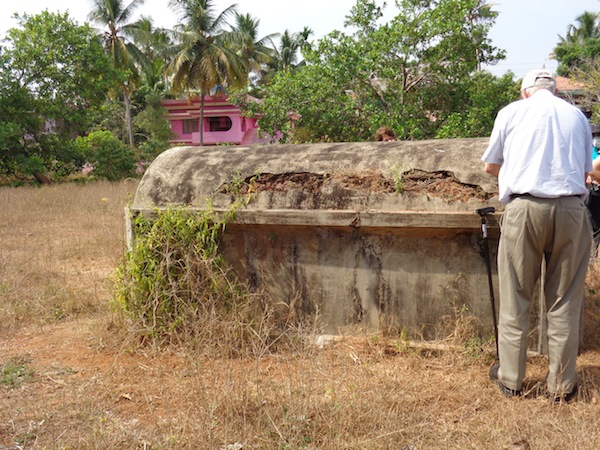
photo - Mala Jewish cemetery, one of three graves left intact. The villa can be seen in the background
Mala Jewish cemetery, one of three graves left intact. The villa can be seen in the background. (photo by Deborah Rubin Fields)

How did the cemetery disrepair come about? According to a professor emeritus, historian and social activist who goes by the name C. Karmachandran: “The Jews [who emigrated] from Mala could not visit and monitor the developments in Mala due to the social and political problems they faced in the infant nation of Israel. I understand … Indian Jewish immigrants were given only exit visas, with which it was not possible to return to India for a visit … only [in] the 1990s, it became easy for the Indian Jews to visit.”

He continued, “From the side of the local authority, their initial enthusiasm to conserve the Jewish monuments began to decline in course of time…. It may be noted that there was no purposeful destruction at that time, but there was serious neglect. There was nobody in the locality to point out its historical significance as we do now. Whoever came to power … found the vast area of the Jewish cemetery ‘ripe’ for their ambition to make money in the pretext of useful developmental projects.”

According to Karmachandran, “the Mala Jews in Israel seemed to be weak in protecting their interest in Mala cemetery. Even today that is the case … there is no effective Jew[ish] organization in Kerala to approach a court of law … the Paradesi … have no interest or influence beyond … Jew Town. They don’t maintain much contact with the remaining Malabari Jews who have a strength of around 25 members in its fold.”

While Kerala has a Hindu majority, the area around the Mala Jewish cemetery is currently 75% Muslims and 25% Christians, so sectarian politics has become an issue in the cemetery’s preservation, as well. An anonymous local source stated, “political parties who want to get the votes of Muslims will keep mum because [those who] speak for the Jewish monuments are being pictured as anti-Muslims and agents of Israel.”

Importantly, Karmachandran and other Kerala Christians, Muslims and Hindus have mobilized themselves to form the Heritage Protection Society, Mala. The group’s goal is to save what they consider not just their former neighbors’ Jewish heritage, but what they maintain is their common Indian heritage. To assist in the preservation project, contact Karmachandran at [email protected].

More on Jewish India

  • Oh, Lovely Parrot is a composite of musical pieces sung in the Malayalam language by Kerala Jewish women. As part of its digitized Jewish music conservation project, the Israel National Library (in collaboration with Hebrew University) offers free listening from its website. The online Jewish art collection of the library also has about 200 of Zev Radovan’s 1995 black-and-white photos of religious objects from the Malabar Jewish community.
  • A few years ago, Essie Sassoon, Bala Menon and Kenny Salem published Spice & Kosher: Exotic Cuisine of the Cochin Jews. Also, in Claudia Roden’s The Book of Jewish Food: An Odyssey from Samarkand to New York, there is a section devoted to “The Three Jewish Communities of India.” Finally, in his book Olive Trees and Honey: A Treasury of Vegetarian Recipes from Jewish Communities Around the World, Rabbi Gil Marks (z”l) devoted space to presenting a number of curried vegetarian Indian dishes.
  • Reconstructed Malabar synagogues are on view in different locations around Israel. Over a period of several years, Jerusalem’s Israel Museum restored the interior of Cochin’s Kadavumbagam Synagogue. It was opened to the public in 1996. The heichal (ark) and tebah (podium) originally came from the Parur Synagogue. Oddly enough, since the 1950s, the synagogue’s original heichal has been in use at Nehalim, an Israeli moshav composed of Orthodox German Jews. Moshav Netivim has an active synagogue and the Cochin Jewish Heritage Centre with artifacts of the Malabar Jewish community.

Deborah Rubin Fields is an Israel-based features writer. She is also the author of Take a Peek Inside: A Child’s Guide to Radiology Exams, published in English, Hebrew and Arabic.
Format ImagePosted on April 15, 2016April 13, 2016Author Deborah Rubin FieldsCategories TravelTags Cochin, India, Karmachandran, Malabar, Paradesi
Golda Meir lived her beliefs

Golda Meir lived her beliefs

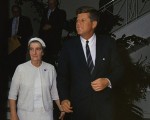
Foreign Minister of Israel Golda Meir meets with U.S. President John F. Kennedy on Dec. 27, 1962. (photo by Cecil Stoughton, National Archives and Records Administration, via commons.wikimedia.org)

Few people reach the pinnacle of power in their country of origin. Even fewer born outside their country of residence climb all the way up the political ladder of their adopted country. Finally, almost no women attain the highest positions of any national government. Yet one woman defied all these societal norms to become the fourth prime minister of the state of Israel – Golda Meir.

Meir (1898-1978) was born in Kiev, Ukraine, raised in the United States and lived in Israel for 56 years. Her long Israeli political career began in America in 1918 when she attended a Philadelphia conference. She wrote in her autobiography, My Life (G. P. Putnam’s Sons, 1975), that she “sat for hours listening, completely absorbed … [in] the excitement of the debates and of being able to cast my own vote.”

This American right to voice an opinion was a value she treasured all her political life. Hence, even in her later power-wielding positions as Israeli government minister, ambassador and prime minister, she sought the views of people from all walks of life. She saw it her duty to leave the door open to common citizens and diplomats alike. Life in the United States had given her “an understanding of the meaning of freedom, and awareness of the opportunities offered to the individual in a true democracy.”

At the time of the above conference, she was 20 years old. Though she was already planning to move to Palestine, it is unlikely she envisioned becoming an Israeli prime minister, as no Jewish state existed then. In fact, she believed young people did not need to pick a profession they would follow, so much as they needed to pick the way they would behave. When, in 1971, she met with students from her old Milwaukee, Wisc., elementary school – then called Fourth Street School, today named after her – she advised: “It isn’t really important to decide when you are very young just exactly what you want to become when you grow up. It is much more important to decide on the way you want to live.” She suggested it was enough for a young person “to be honest [and] to get involved with causes which are good for others, not only for yourselves.”

She put words into practice. By age 11, she was already involved in her first public service project. With a friend, she formed the American Young Sisters Society. The group’s goal was to raise money for youngsters who had difficulty paying for schoolbooks. With her school friends, she painted posters, held community meetings and raised the much-needed funds.

This obligation to assist others was a major part of Meir’s life. In Israel, her goal was to achieve social equality for all people, and she insisted that this would not happen unless she had the help of all citizens. She asserted that people of lesser means must not sit back and be “passive,” that they had to speak up for themselves and work to better their life situation. On the other hand, she held that people of greater means had to work to close the social and economic gaps. She believed that, for everyone’s lot to improve, there had to be a sharing of responsibility.

Still, Jewish-American feminist Letty Cottin Pogrebin criticizes Meir for not specifically advancing the case of women. On the Jewish Women’s Archive website, Pogrebin writes in the section on Meir: “She was, in current parlance, a ‘queen bee,’ a woman who climbs to the top, then pulls the ladder up behind her. She did not wield the prerogatives of power to address women’s special needs, to promote other women or to advance women’s status in the public sphere. The fact is that, at the end of her tenure, her Israeli sisters were no better off than they had been before she took office.

“Just as some Jews choose not to be Jewish-identified because they think they have the option to behave as if peoplehood doesn’t matter, Golda Meir chose not to be woman-identified and behaved as if gender doesn’t matter. But, of course, when one is Jewish and female, both facts matter.”

Meir’s career came to a relatively inauspicious end. After the Yom Kippur War, which was fought while Meir was prime minister, the government’s actions were questioned. Although the official investigation committee did not blame her for what had happened, she decided to resign. When she announced she was quitting in 1974, she said: “Five years are enough. I have come to the end of the road. It is beyond my strength to continue carrying the burden.” (reprinted in Front Page Israel: Major Events as Reflected in the Front Pages of the Jerusalem Post, edited by Ari Rath and Erwin Frenkel)

She later wrote that, while she did not feel guilty, she felt responsible for not having mobilized troops earlier in that conflict. She came to believe that she should have rejected the assessment of her military and intelligence staff. She writes in My Life: “That Friday morning, I should have listened to the warnings of my own heart and ordered a callup. For me, that fact cannot and never will be erased, and there can be no consolation…. I know that I should have done so, and I shall live with that terrible knowledge for the rest of my life. I will never again be the person I was before the Yom Kippur War.”

After 60-plus years of public service, Meir did what she had been doing since she lived in the United States. She listened to what people in the street were saying about the government’s actions, and she took responsibility for those actions.

Deborah Rubin Fields is an Israel-based features writer. She is also the author of Take a Peek Inside: A Child’s Guide to Radiology Exams, published in English, Hebrew and Arabic.
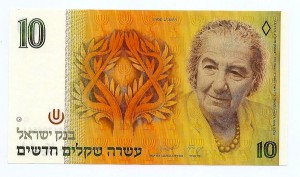
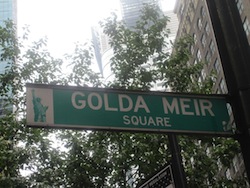
photo - In New York City, there is Golda Meir Square
In New York City, there is Golda Meir Square. (photo by Billy Hathorn (talk) via commons.wikimedia.org)

More on Meir

Looking at the current state of Golda Meir’s former places of residence, one could say they reflect the mixed feelings Israelis harbor toward her. On the one hand, not too long ago, northern Kibbutz Merchavia turned her first apartment into a small museum. Southern Kibbutz Revivim, moreover, established the Golda Meir Cultural Centre and the Golda Meir Memorial Wing, as Meir was a founding member of the kibbutz.

Her later Ramat Aviv apartment, however, stands derelict – a grimy plaque mentions she once lived there and the guard post, which once protected her, stands abandoned. Meir’s home while prime minister – the home that once served as the official residence for

photo - Golda Meir has been commemorated in Israel in various ways, including on the new sheqalim banknote in 1992, as well as in other countries
Golda Meir has been commemorated in Israel in various ways, including on the new sheqalim banknote in 1992, as well as in other countries. (photo by Berlin-George via commons.wikimedia.org)

Israel’s prime ministers – has fared a little better, perhaps because this prime piece of real estate is looking for a suitable buyer. While living at 46 Ben Maimon (Rambam) St., Meir customarily invited members of her inner cabinet – what became known as the “Kitchen Cabinet” – for advance briefing. She prepared the coffee and cake.

* * *

Interviewed in 1973 for Ms. Magazine, Meir said: “Fashion is an imposition, a rein on freedom.” She wore sturdy, black, tie shoes with a thick low heel. In the early days of statehood, women soldiers wore similar shoes. They became known as “Golda shoes.”

– DRF

Format ImagePosted on March 4, 2016March 3, 2016Author Deborah Rubin FieldsCategories IsraelTags feminism, Golda Meir, Israel, Letty Cottin Pogrebin
The state of Jewry in Russia

The state of Jewry in Russia

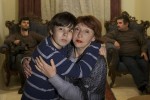
A scene from filmmaker Reuven Brodsky’s documentary Home Movie. (photo by Yevgeny Spivak)

In 1989, the USSR’s emigration gates opened. Responsible for prying them open was a small group of tremendously courageous and patient Soviet Jews (called refusenikim for their denied exit permits) who had fought long and hard for their religious and cultural freedom, with thousands of Western Jews and non-Jewish people of conscience. The Soviet Jewry movement, which began in the United States in the 1960s and spread from there to other countries, including Canada, eventually witnessed 1.6 million Jews and their non-Jewish relations leave for Israel and the West. A thrilling climax, but then what happened?

While it is hard to say how many Jews live in Russia today, estimates are between 400,000-700,000, approximately 0.27%-0.48% of the total Russian population. Since the early 1990s, efforts to revitalize Jewish life in Russia and other former Soviet Union (FSU) countries have been ongoing.

After the dissolution of the USSR, different denominations within world Jewry started operating openly in Russia. Of all the different Jewish religious groups on the scene today, Chabad has probably worked the hardest to bring Jewish awareness to the unaffiliated. It sends its emissaries (usually a couple consisting of a male rabbi and his teacher wife) to Russia and numerous other FSU centres.

After so many years of not being able to publicly run Jewish institutions, Russian Jewish communities now have 17 day schools, 11 preschools and 81 supplementary schools with about 7,000 students. There are also four Jewish universities. The major towns have a Jewish presence, with synagogues and rabbis. In the past few years, a state-of-the-art Jewish museum even opened in Moscow and a deluxe Jewish community centre containing a small movie theatre, synagogue, mikvah, kosher gourmet restaurant and guest rooms for Sabbath observers was inaugurated in December 2015 in Zhukovka, near Moscow.

photo - The Zhukovka Jewish Community Centre was inaugurated in December 2015
The Zhukovka Jewish Community Centre was inaugurated in December 2015. (photo from Federation of Jewish Communities of Russia via jta.org)

Yet the picture is far from rosy. In an introductory essay to An Anthology of Jewish-Russian Literature: Two Centuries of Dual Identity in Prose and Poetry (2007), book editor Maxim Shrayer critically views Jewish cultural life in post-Soviet Russia: “… my preliminary conclusion is that Jewish-Russian writers whose careers were formed during the Soviet years continue to address Jewish topics in their work, some due to a renewed personal interest as well as the freedom to write about it, others out of cultural inertia. At the same time, younger authors of Jewish origin in today’s Russia have tended to be assimilated and Russianized, resulting in a dearth of Jewish consciousness in their writing.

“Jewish-Russian literature in the former USSR might have found a temporary domain in the pages of such periodicals as the Moscow-based magazine Lekhaim … [one of the] attempts to consolidate, perhaps artificially, a critical mass of writers and readers even as Jewish-Russian culture itself spirals toward disappearance.”

In Jewish Life After the USSR (Indiana University Press, 2003), Prof. Zvi Gitelman claims that, following the breakup, Russian Jews have become increasingly less concerned about intermarriage. Ethnic identity as such seems to be based on antisemitism – even if it is unofficial, popular antisemitism rather than state-sanctioned antisemitism.

Looking to the future, the offspring of these intermarriages are likely to feel less tied to Judaism. Speculatively, they are likely to remain so unless Russian-based Jewish institutions are willing to “reach out” to people who, according to the strict reading of Jewish law, are not considered members of the “tribe,” he argues.

Since 2000, immigration to Israel and/or to the West has slowed down. But, based on past experience, immigration – provided the doors to Israel and/or the West remain open – will likely pick up if antisemitism flares up, if the Russian economy takes a real and prolonged nose-dive or if political-military strife developed in Russia as it has in the Ukraine. As Lee Yaron recently reported in Haaretz, the situation is already changing: in 2015, “15,000 immigrants … came from the former Soviet Union … an increase of over 20% from last year’s figure.”

In the post-USSR age, Jewish culture in Israel and Russia mix in unexpected ways. Gone is my grandparents’ generation who, once out of Russia, never again saw “left behind” family members. Today, many former Russian Jews living in Israel (and vice versa) frequently fly four hours to visit relatives who did not leave. According to the Israeli Ministry of Tourism, there were 60 weekly flights from Russia to Israel, as of the end of December 2015.

But the exchange is beyond familial ties. Here are four examples – two from the arts and two from the sciences.

Israeli filmmakers who left the USSR as children have begun making at least part of their films in Russia. Seven Days in St. Petersburg, written, directed and produced by Reuven Brodsky, is one case in point. Significantly, the protagonists speak both Hebrew and Russian. A few years earlier, Brodsky made the documentary Home Movie, described as, “The final chapter in the breakdown of the director’s family – one of many who did not survive the trials of immigration.”

Also in the film world, just a few months ago, Vladi Antonevicz released Credit for Murder, a documentary dealing with the topic of Russia’s neo-Nazis. As if the subject in and of itself is not dangerous enough to undertake, Antonevicz’s film apparently exposes a connection between the Russian administration and these hate groups. Antonevicz claims that certain Russian politicians are manipulating neo-Nazi activity to further their own political needs. To make this film, Antonevicz infiltrated Russian neo-Nazi groups, secretly investigating an unsolved double murder. He succeeded, but some say his small film crew has had to lay low after completing the film.

Former Russian Jews in Israel (and in the West) have likewise forged profitable positions in the start-up world. Moscow-born Prof. Eugene Kandel, outgoing head of Israel’s National Economic Council, analyzes this phenomenon. In a July 29, 2015, Forbes blog by Scott Tobin, the professor is quoted as saying, “Many Russian-born techies now working in Israel are especially innovative because the Soviet state traditionally under-invested in computer hardware and other technology, even as the state was scrambling to develop weapons and related technology to win the Cold War. That left engineers to fend for themselves and develop creative workarounds in many businesses.”

Finally, medical tourism from Russia has blossomed. Many well-to-do Russians come to Israel to be treated by Russian- and Hebrew-speaking doctors, nurses, technicians and medical secretaries (see imta.co.il).

A cause for hope and promise? Stay tuned.

Deborah Rubin Fields is an Israel-based features writer. She is also the author of Take a Peek Inside: A Child’s Guide to Radiology Exams, published in English, Hebrew and Arabic.
Format ImagePosted on February 12, 2016February 11, 2016Author Deborah Rubin FieldsCategories WorldTags Diaspora, former Soviet Union, FSU, Israel, Russia, USSR, world Jewry
Sacred for three faiths

Sacred for three faiths

The Hellenistic/Hasmonean excavation at Nebi Samwil. (photo by Anthony Bale)

Just over 10 kilometres north of the Temple Mount, the Old City and east Jerusalem, where terrorist attacks continue, Muslims and Jews both go up to Nebi Samwil, to what they consider to be the holy burial place of Samuel the Prophet.

On the Thursday between Yom Kippur and Sukkot and the first day of Eid al-Adha, the Muslim Feast of Sacrifice, I visited this archeology site located in the West Bank. It was quite a scene.

A young Muslim family in Western holiday dress entered the Muslim part of the joint prayer site. They were followed by a young ultra-Orthodox couple who climbed to the roof for photo-taking. Close on their heels, a group of young adult Chassidic males piled out of a mini-van.

Walking by the Muslim cemetery, along the northern perimeter of the archeology site in the direction of the spring, I nearly bumped into a glitzy-dressed bridegroom, clad from head (kippah) to toe (pointy shoes) in silvery white. Continuing on my way, I glimpsed Bratslav Chassidim scurrying into the trees on their way to hitbodedut or seclusion. At the edge of the spring named after the Prophet Samuel’s mother, Chana, North American yeshivah students were drying off following immersion in this natural mikvah, ritual bath. (If you visit, consider equipping yourself with a bullhorn or whistle to announce your upcoming presence to anyone who might be in this open mikvah.)

Special religious experiences are not new to the site. For example, some 500 years earlier, Christians were having mystical experiences at Nebi Samwil. In 1413, Margery Kempe, an English mystic, traveled from the coastal plain toward Jerusalem. When she passed Nebi Samwil, she was so overjoyed by the view and by her reported heavenly contact, she nearly fell from her donkey. Two German pilgrims broke her fall. “One of them was a priest, and he put spices in her mouth to comfort her, believing her to have been ill. And so they helped her onwards to Jerusalem.” (The Book of Margery Kempe)

And, speaking of “joy,” earlier on when the Crusaders first looked south to Jerusalem from this point, they were so enthralled that they named the area Mount of Joy or, in French, Mont de Joie. In between combating those they considered pagan, heretical or politically inexpedient, the Crusaders happily settled in at Mont de Joie. They established a cistern, church, monastery (apparently commemorating Samuel the Prophet), pilgrims hostel, stable, quarry (drinking troughs and hewn stones are clearly visible today) and a fort. Before they began construction, they razed the area upon which they built. Crusader joy was relatively short-lived, however, as a generation later, in 1187, Salah ad-Din pushed them out and ushered in the Mamelukes. Curiously, the remains of one Mameluke building have an arch displaying a Star of David. While it looks like a Magen David, back then it was not a Jewish symbol.

Like the earlier Umayyads and Abbasids (638-1099), the Mamelukes went into pottery production. Archeologists have uncovered the large kilns they used, as well as pottery with place-identifying Arabic seals. Oddly enough, during this same period, the site became a holy place for Jews from Egypt, Syria, Mesopotamia and elsewhere. In 1730, however, Jerusalem’s Mufti Sheikh Muhammad al-Khalili called a halt to Jewish pilgrimage, by what Yitzhak Magen terms “appropriating the tomb from the Jews” and forbidding Jews to pray there. The mufti erected a mosque at the site.

Some Jewish sources have identified Nebi Samwil as the biblical Rama, the burial place of Samuel. Others have identified it with Mitzpah, a site connected to Samuel, and later to the Hasmoneans.

Speaking of the Hasmoneans, the well-built structures from the Hellenistic period were not destroyed by natural disaster or by fighting. It appears that the community was simply abandoned. One theory maintains that the Hasmoneans did not want competing places of worship, as there apparently was a tradition of worship at both Mitzpah and neighboring Givon (see Maccabees I: 3,46 and Kings I: 3,4). That is, they wanted to centralize worship and power in Jerusalem.

In being at the site, you see how people have protected their holdings. One way has been to build a fortress, equipping it with soldiers and weaponry. Another way has been to declare a place a holy site. While we cannot actually prove that Samuel the Prophet was buried at this site, neither can we totally disprove it. So the tradition stands for Jews, Muslims and Christians. Today, the site houses both a Wakf-run mosque with its tomb of the Prophet Samuel and an Orthodox synagogue with its separate tomb for the Prophet Samuel.

***

If you visit Nebi Samwil, don’t be fooled into thinking that you are going to the original citadel and mosque. The British destroyed it while fighting to take Jerusalem from the Ottoman Turks. During the Mandate, however, they rebuilt the structures.

The visiting hours for the archeology site are 8 a.m.-4 p.m. (winter) and 8 a.m.-5 p.m. (summer). Visiting hours for the prayer sites are Sunday-Wednesday continuously, with the exception of two hours between 2-4 a.m.; and Thursday-Friday, from 4 a.m. until an hour before Shabbat begins. More on the site, including a map, can be found at parks.org.il/sigalit/DAFDAFOT/nabi-samuel_eng.pdf.

At the time of my visit, there was no checkpoint, and apparently only one guard on the premises. Originally located among the archeology ruins, Israeli authorities moved the village called Nebi Samwil to its current setting in 1971, with some controversy. (For example, see alt-arch.org/en/nabi-samuel-national-park.)

Nebi Samwil is partially accessible to wheelchair users. If readers wish to get further details on the subject, they can contact the park curator, Avivit Gara, at 972-2-586-3281.

Deborah Rubin Fields is an Israel-based features writer. She is also the author of Take a Peek Inside: A Child’s Guide to Radiology Exams, published in English, Hebrew and Arabic.
Format ImagePosted on November 20, 2015November 17, 2015Author Deborah Rubin FieldsCategories IsraelTags archeology, Israel, Nebi Samwil, Samuel the Prophet
Canadian machalnikim

Canadian machalnikim

The Machal memorial, in Jewish National Fund’s Yitzhak Rabin Park. (photo from machal.org.il)

You would think that, after serving in the Second World War, you would just want to pick up where you had left your civilian life. Indeed, the vast majority of Jewish and non-Jewish Canadian soldiers did so. But some 300 Canadian fighters joined more than 4,100 volunteers from almost 60 countries to fight for and maintain Israel’s independence. They were referred to as machalnikim, machal being an acronym in Hebrew for mitnadvei chutz l’Aretz, or “overseas volunteers.”

According to Smoky Simon, World Machal chair, four interrelated factors impelled the volunteers to keep fighting: the Holocaust, the British deportation of Holocaust survivors, the Arab threat to wipe out Palestine’s Jewish population and the feeling of Jewish unity, particularly in times of major crises.

These veteran fighters provided inexperienced Israeli forces with much-needed military knowledge and leadership. For example, Torontonian Ben Dunkelman claimed that “Canadian pilots accounted for one-third of all Arab planes shot down in that war.” In fact, John McElroy, a Canadian Second World War ace, succeeded in doing just that.

Following Israel’s independence, Machal volunteers built the radar system for the then-infant Israeli army. According to Rabbi Dr. Joe Heckelman, in his 1974 book American Volunteers and Israel’s War of Independence, this “early warning” system identified intruder planes “at relatively great distances.” Until mid-1949, a significant number of Machal personnel worked on the radar unit, then called Squadron 505.

Other Canadians volunteered for other kinds of service. Thus, Toronto-born Leonard Fine, who had served for five years as a physical training instructor in the Royal Canadian Air Force, joined the Israeli 72nd Infantry Battalion of the 7th Brigade. Dunkelman commanded this brigade. The only two platoons of the completely English-speaking B Company successfully removed problematic Arab Liberation Army observers and snipers situated on the Kabul mountains, overlooking the small Arab village of Tamra. Canadian volunteer Sidney Leisure died in the shooting. A month later, Fine became the sergeant major of the support company.

Another former member of the Canadian Air Force also switched military careers in Israel. Montreal-born Willie Rostoker volunteered to staff immigrant ships, undaunted by the fact that he had no sailing experience. Rostoker was quick to learn, and started studying navigation and other seaman’s skills. He proved to be a very good helmsman. Between 1946 and 1948, he worked on several Aliya Bet ships, including Ulua (aka Chaim Arlosorof), which docked in Palestine on Feb. 27, 1947; Pan York (aka Kibbutz Galuyot), which arrived in Palestine on Jan. 1, 1948; Fabio (aka the Battle of the Ayalon Valley), which made it to shore on May 29, 1948; and the Kefalos (aka the Southerner), which steered into Israel on Nov. 23, 1948. In addition, before the ma’apilim (Jews who tried to enter Palestine during the British blockade) set sail on the Battle of the Ayalon Valley, Rostoker trained them. When the fighting ended, he made Israel his home.

Speaking of ships, David Azrieli reports in Rekindling the Torch: The Story of Canadian Zionism (2008) that, during this period, two Canadian corvettes were purchased as “freighters” – the Beauharnois, renamed the Josiah Wedgwood, and the Norsyd, dubbed Aliya Bet Haganah. Canadian Moishe Sokolov volunteered to sail with the Haganah. It was supposed to transport 1,200 refugees and return for more people. But, once in Yugoslavia, the crew learned it would be the last Aliya Bet ship allowed into Palestine. Hence, orders were to take as many refugees as possible: 2,600 boarded, with about half below deck and half on deck. According to information obtained from the World Machal website: “It was so crowded that the ones above could not get below, and the ones below could not get topside. It was a very difficult and dangerous trip for all, passengers and crew alike, but all the refugees got to Palestine.”

After Israeli independence, the vessels were reactivated and renamed the Hashomer (Guard) and the Haganah (Defence). The vessels engaged Egyptian warships, bombarded enemy positions and patroled the shoreline. Their biggest coup came on Aug. 24, 1948, when the former Canadian corvettes seized a huge cargo of arms intended for the Arab armies. In what was called Operation Pirate’s Booty, the Hashomer and the Haganah intercepted the Argiro, a ship sailing under the Italian flag. The Israeli crew members found 8,000 rifles and 10 million rounds of ammunition.

photo - Canadian Machal volunteer Joe Warner, who is now 90 years old
Canadian Machal volunteer Joe Warner, who is now 90 years old. (photo from machal.org.il)

Although not from a Zionist background, Canadian Joe Warner, now 90 (and going strong), joined the fighting because he felt “it won’t be worth being a Jew elsewhere if Israel did not survive.” He fought in southern Israel, in the Faluja area. The battles in which he participated helped free the Negev from Egyptian control of main roads. The combat – especially around the strong concrete police fortress of Iraq-Suidan – was intense. Years later, when Warner visited the Givati Museum established at that very spot, he found the captured Egyptian cannon his anti-tank unit had used.

Warner had been training as a pharmacist after his Second World War discharge. So, in Israel, he was called upon to be a pharmacist/ medic. He responded by setting up a first-aid station at Hazor, making use of medical equipment and supplies seized from the Egyptians. This early hands-on experience apparently served him well, as for 15 years he helped establish and manage Pfizer drugs in Israel.

In contrast to Warner, now 91-year-old Batya Wolfson Lam had a strong Zionist background. As a member of Toronto’s Shomer HaTzair, she had made aliya in 1947 or 1948. After three months of boring work on Kibbutz Sasa, she jumped at the call for volunteers to help in the fighting. She joined Machal, as the pay was slightly higher than the pay received by regular Israeli soldiers. She was assigned to the English-speaking air force codes and ciphers department. There, she received messages that she forwarded in secret code. She first worked at a station on Yarkon Street in Tel Aviv but, after a year, she opened stations in Jerusalem, Dorot, Yavniel and Haifa. She trained the staff for these locations. She served in the army for two years, returning briefly to Sasa. Then, she moved to Kibbutz Eindor, where she met her husband. Although her four children chose not to remain on the kibbutz, she has lived there for more than 70 years. She regrets that Machal volunteers haven’t received more recognition for their contribution to Israel.

Mention must be made of the Canadian volunteers who lost their lives in Israel’s fight for independence. They include both Jews and non-Jews. According to Heckelman and World Machal, they were George (Buzz) Beurling, Wilfred (Zev) Cantor, William (Willy) Fisher, Leonard (Len) Fitchett, Sidney Leizerowitz, Edward Lugech, Ralph Moster, Sidney Rubinoff, Reuben (Red) Schiff and Fred Stevenson. Two cousins, Harvey Cohen and Ed Lucatch, are not recorded to have joined any army unit; they disappeared without a trace.

Deborah Rubin Fields is an Israel-based features writer. She is also the author of Take a Peek Inside: A Child’s Guide to Radiology Exams, published in English, Hebrew and Arabic.

Format ImagePosted on November 6, 2015November 4, 2015Author Deborah Rubin FieldsCategories IsraelTags Israel, Machal
Bulgaria: more than cheese

Bulgaria: more than cheese

The roof of Sofia’s synagogue. (photo by Deborah Rubin Fields)

Until recently, if someone had asked me what I knew about Bulgaria, I would have said, “Isn’t that the name of a cheese?” Now having visited Bulgaria, I realize how limited was my perspective.

Bulgaria’s colorful Jewish history dates back to antiquity. According to Elko Hazan’s comprehensive 2012 book The Concise Illustrated Encyclopedia of Jewish Communities and their Synagogues in Bulgaria, over the centuries Jews had a presence in some 40 Bulgarian cities and towns.

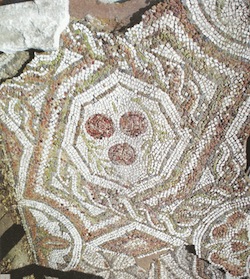
scan - Part of an ancient mosaic synagogue floor found in Plovdiv. This photo is from The Concise Illustrated Encyclopedia of Jewish Communities and Their Synagogues in Bulgaria (Kamea Design, 2012).
Part of an ancient mosaic synagogue floor found in Plovdiv. (photo from The Concise Illustrated Encyclopedia of Jewish Communities and Their Synagogues in Bulgaria (Kamea Design, 2012)).

For example, near Plovdiv’s Maria Luiza Boulevard, archeologists uncovered a third-century CE synagogue. Its proximity to ancient Philippopolis’ Roman forum suggests that wealthy Jews in good standing with the Romans built the structure. The accomplishment of these well-placed Jews is all the more remarkable when you consider that Philippopolis had an estimated population of 100,000. Archeologists discovered two mosaic synagogue floors, one over another. The stunning mosaic featured both the Four Species (lulav, etrog, myrtle, willow) and a menorah. The second floor may have had geometric patterns. That more than one floor was found probably indicates the synagogue was renovated in the fifth century and destroyed in the sixth century. (See The Jewish-Greek Tradition in Antiquity and the Byzantine Empire, edited by James K. Aitken.)

Greek inscriptions commended the synagogue’s donors or founders. The east and west mosaic panel read: “‘From the gifts of Providence … Cosmianus, also called Joseph, executed the decoration (of the building). Blessing to all!” The central panel read: “From the gifts of Providence … El … also called Isaac made decoration of 120 feet (mosaic).” The adoption of a Roman-sounding second name attests to adaptation by Jews to the Greek and Roman culture. (See Negotiating Diaspora: Jewish Strategies in the Roman Empire, edited by John M.G. Barclay.) Ironically, as the synagogue remains are in storage, the only way to get a sense of how grand the floor was is to visit the impressive new museum of the (fifth-century) Small Basilica.

The ceiling of Plovdiv’s Zion Synagogue
The ceiling of Plovdiv’s Zion Synagogue. (photo by Deborah Rubin Fields)

But Plovdiv’s charming Zion Synagogue (13 Tsar Kaloyan St.) is still up and functioning (one of two still active in Bulgaria). It was first built in 1886-1887. In 2003, the extensive five-year renovation of the starry-sky ceiling and the colorful geometric-paneled walls was completed. The building is only open for Kabbalat Shabbat prayers, so visitors should contact Eva Mezan (at +359-87-944-8675) to verify hours.

Although there is seating for 250 worshippers, some 20 local men and women attend this service. The second floor ezrat nashim (women’s section) is not used. Instead, an invisible mechitza (divider) has men sitting on one side of the aisle, women on the other. The congregation’s lay cantor leads services from the raised bima adjacent to the aron ha-kodesh (Torah ark). The congregation uses a Bulgarian-Hebrew siddur. Vocal congregants despair over the sad state of their community, with its high rate of intermarriage.

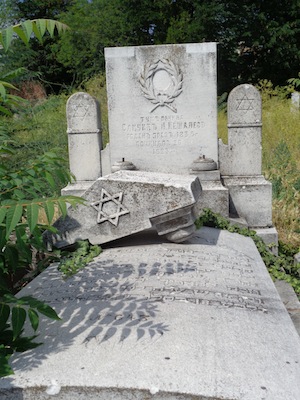
photo - The Jewish cemetery in Plovdiv
The Jewish cemetery in Plovdiv. (photo by Deborah Rubin Fields)

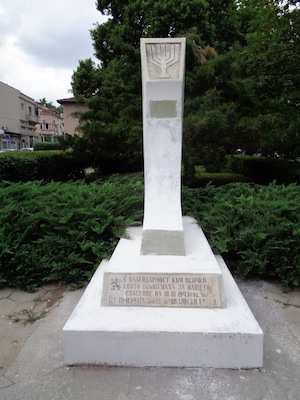
Plovdiv’s small Jewish community likewise has difficulty managing the graves in the Jewish section of the municipal cemetery (73 Knyaginya Maria Louisa Blvd.). While there is upkeep of “new” graves, headstones laid as recently as 1923 are somewhat neglected. Near the corner of the Sixth of September and Russki boulevards, Plovdiv’s Jews, however, do maintain a Bulgarian/Hebrew/English thanksgiving monument to the Bulgarian people for their help during the Second World War.

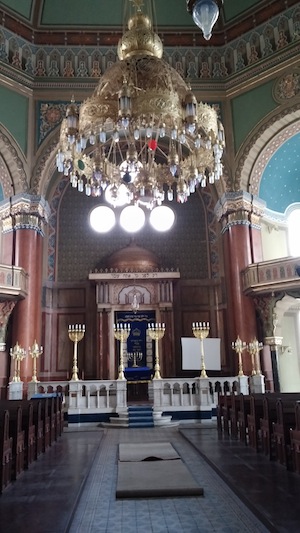
Sofia’s opulent 1,170-seat, 100-year-old Central Synagogue (16 Ekzarh Joseph St.) is also struggling, with barely enough people to hold daily morning prayers. The small on-site Jewish nursery school and the tiny, underdeveloped Jewish museum strikingly contrast with the enormous octagonal-shaped synagogue sanctuary. (Note: museum hours are limited, and not necessarily in accordance with posted times.)

photo - The Jewish community’s Bulgarian/Hebrew/English monument to the Bulgarian people for their help during the Second World War
The Jewish community’s Bulgarian/Hebrew/English monument to the Bulgarian people for their help during the Second World War. (photo by Deborah Rubin Fields)

Within walking distance of the synagogue, visitors may see (upon receiving special written permission from Dr. Lyudmil Vagalinski, [email protected]) another example of Bulgaria’s ancient Jewish history in the National Institute of Archeology with Museum’s (2 Saborna St.) lapidarium. A Latin marble pedestal from Oescus – a first- to fifth-century CE Roman town near the Danube – mentions the lay synagogue head Archisinagogus, according to Hazan.

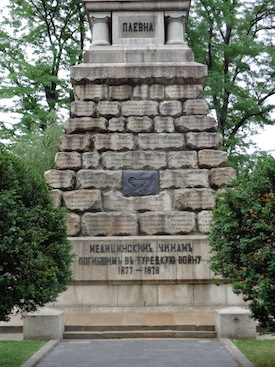
Sofia’s 131-year-old Doctors’ Garden (located close to the National Library and Sofia University) memorializes the 531 fallen medics of the Russo-Turkish War (1877-1878), most of whom died in battles at Pleven, Plovdiv, Mechka or Shipka. A good number of these Russian medical personnel were Jewish, a credit to the reforms established by Russian Emperor Alexander II.

A few blocks away is the street named after biochemist Asen Zlaratov. The street plaque mentions he helped to set up the Committee for the Protection of Jews. Even beforehand, Zlaratov published a newspaper article critical of Germany’s book burning.

photo - Sofia’s Doctors’ Garden memorializes the 531 fallen medics of the Russo-Turkish War
Sofia’s Doctors’ Garden memorializes the 531 fallen medics of the Russo-Turkish War. (photo by Deborah Rubin Fields)

More than 51,000 Jewish Bulgarians (most of the community) moved to Israel in the mid- to late-1940s. Between 1967 and 1990, Communist Bulgaria had no diplomatic relations with Israel. Today, estimates are that 5,000 Jews live in Bulgaria. Chabad Rabbi Yosef Salamon and Rabbi Yossi Halprin and their spouses supervise Jewish educational, social and religious functions for the small remaining Bulgarian Jewish population. According to the Hebrew language Chabad Bulgaria website, Bulgaria has more than 15 organized Jewish community centres or Shalom organization representation. In Sofia, Chabad runs King David, a kosher restaurant offering take-outs and hotel deliveries.

photo - The interior of Sofia’s synagogue
The interior of Sofia’s synagogue. (photo by Deborah Rubin Fields)

Over the centuries, Bulgarian Jews have influenced both their own community and the larger non-Jewish community. Here are some of the “big names”:

  • For his second wife, Tsar Ivan Alexander married the formerly Jewish Sarah (born in Tarnovgrad in the early 1300s). As the Empress Theodora, she was an ardent supporter of Eastern Orthodox Christianity. She provided for many churches. Unfortunately, her religious zeal may have motivated her to set up a church council against her former coreligionists.
  • Rabbi Joseph Caro (1488-1575), author of the Shulchan Aruch, considered the standard legal code in Judaism, lived in Nikopol for 13 years before eventually settling in Safed. Nikopol has a monument dedicated to Caro, as well as a permanent exhibit in its city museum, notes Hazan in his encyclopedia.
  • Nikopol-born Eva Frank and her father Jacob Frank tried to pass themselves off as messiahs in the late 1700s.
  • Modernist painter Jules Pascin (1885-1930) was the son of a Bulgarian Sephardi father. Ernest Hemingway recounts his relation with the sociable, but depression-driven, painter in A Moveable Feast.
  • Nobel Prize-winning writer Elias Canetti (1905-1994) was a Bulgarian-born Sephardi Jew. In his book The Tongue Set Free, Canetti describes his early Jewish home life in pre-First World War Bulgaria. In his Ruse birthplace, there is a square named after him, and the Technical Institute has a commemorative plaque.
  • Andrei Luka-nov was one of the few communist Jews to hold a central position of power. He served as Bulgaria’s prime minister from February 1990 to December 1990, resigning when the country’s economy went into a tailspin. He was the son of another Bulgarian communist, Carlo Lukanov, a Russian Jew who was Bulgaria’s foreign minister from the late 1950s to the beginning of the 1960s. In 1992, he was held in custody for allegedly taking money from public coffers. No charges were filed against him. He went on to head up the Russian-Bulgarian gas company Topenergy. Mysteriously, he left the company shortly before his Oct. 2, 1996, assassination by unknown assailants. At the time of his murder, the media reported that “Red Baron” was supposedly the eighth richest man in Europe.Apropos, thousands of other Bulgarians who fell out of Communist favor ended up in 100 internal forced labor camps. For a taste of this period, visit Sofia’s Museum of Soviet Art (7 Lachezar Stanchev St.).
  • Solomon Passy, PhD, was Bulgaria’s foreign minister in the early 2000s. Today, he is president of Bulgaria’s Atlantic Club. Passy campaigns for public access to wifi for the whole European Union, an option he regards as a universal human right and the EU “fifth freedom.”

Many more signs of the once vibrant Jewish community still exist, but it takes experts like Elko Hazan to guide us to them.

Deborah Rubin Fields is an Israel-based features writer. She is also the author of Take a Peek Inside: A Child’s Guide to Radiology Exams, published in English, Hebrew and Arabic.
Some additional facts

  • The Bulgarian equivalent to Israeli-made Bulgarian cheese is “sirene,” a dairy product usually derived from cow’s milk, but may also be made from sheep or goat’s milk. Unlike Israeli-made Bulgarian cheese, it does not have a salty taste.
  • While for many years Bulgaria was an agricultural country, today it is the world’s ninth “most preferred” outsourcing destination in consultancy. Experts, however, contend that Bulgaria must make it easier to hire foreigners, stop a brain drain, attract natives who graduated abroad and improve quality of life. (Financial Times of London)
  • Several years ago, the Bulgarian Ministry of Culture attempted to find funding to refurbish the once beautiful, abandoned Vidin synagogue, but apparently nothing came of these efforts.
  • King Boris III (whose heart is interred at the famous Rila Monastery), the Bulgarian Orthodox Church (including Archbishop Stefan of Sofia and bishops Neofit of Vidin and Kyril of Plovdiv) and several brave Bulgarian parliamentarians (such as Dimitar Peshev) saved the country’s Jewish population from deportation to Nazi death camps. Yet, 11,343 Jews from Serbian Pirot, Greek Thrace and Yugoslavian Macedonia – countries Nazi Germany ceded to the Bulgarian government – were brutally hauled off to Treblinka. (See ushmm.org and yadvashem.org.)
  • For more on Bulgaria during the Holocaust, read “The little country that defied Hitler” by Anna Levy.
  • For more information about Bulgarian Jewish cemeteries, see the 2011 online report of the United States Commission for the Preservation of America’s Heritage Abroad.
Format ImagePosted on September 11, 2015September 9, 2015Author Deborah Rubin FieldsCategories TravelTags Bulgaria, Elko Hazan
Conserving, restoring, sharing Dead Sea Scrolls

Conserving, restoring, sharing Dead Sea Scrolls

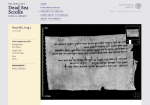
On the website deadseascrolls.org.il, visitors can explore the texts of the Dead Sea Scrolls. (screenshot)

Have you ever taped up a torn page? In our household, taping has saved many a book and article from falling apart. Seems like a practical solution, right?

Wrong! While it might do the job on faulty binding or read-it-again storybooks, it hasn’t worked well on extremely old, organic (mostly animal skin) materials, such as the Dead Sea Scrolls. Curator Pnina Shor, who heads up the Israel Antiquities Authority’s Department for the Treatment and Conservation of Artifacts, recently discussed this sticky mess.

photo - Qumran in the West Bank
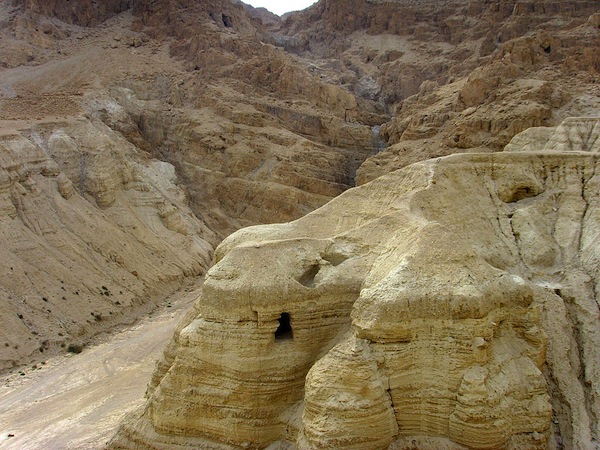
Qumran in the West Bank. (photo by Effi Schweizer via commons.wikimedia.org)

According to Shor, for some 2,000 years, the Dead Sea Scrolls had been stored in 11 dark caves below sea level in a steady climate of hot/dry days and cold/dry nights. Beginning with their first discovery in the late 1940s, archeologists transferred the scrolls from the Qumran area to open rooms at Jerusalem’s Rockefeller Museum, some 800 metres above sea level. As anyone who has ever visited Jerusalem and the Dead Sea knows, these places are geographically close, but climatically quite far apart.

At the time, archeologists eagerly wanted to piece together the enormous puzzle of 15,000 (biblical and non-biblical) fragments now at their disposal. Most manuscripts date from the first century BCE to the first century CE, the periods of the Hasmonean and Herodian rule. The archeologists did not know the risks involved in handling such fragile, ancient pieces. So, for example, they touched the parchment with their bare hands, leaving skin oil on the surfaces. They drank their tea and ate their lunch over the texts. (Like the rest of us, researchers are guilty of leaving crumbs and spills.)

In the early second half of the 20th century, archeologists were unaware of the negative consequences of taping torn texts and fragments. They did not realize that the glass panes sandwiching the pieces would put additional weight on the delicate remains.

So, what happened? Sadly, the tape’s adhesive congealed. Some of the texts (especially evident along the edges of the texts) darkened to the point where they became indecipherable to the naked eye.

Measures to contain or reverse the damage began in the 1960s. Unfortunately, this treatment inadvertently resulted in further damage. Until the 1990s, when there was consultation with U.S. preservation experts, it was not understood that the safest environment for the scrolls was a replication of their original storage conditions. Since that time, however, the scrolls have been stored in a climate-controlled laboratory, and exhibited in like conditions for extremely limited periods of time.

Between 1990-2009, the Dead Sea Scrolls Publication Project put out 32 volumes, entitled Discoveries in the Judean Desert. These reports are based on the original infrared photography conducted from the 1950s-60s. The infrared negatives are referred to as PAM (Palestine Archeological Museum).

Four full-time conservationists work on the scrolls. The specialists repair each piece separately, depending on the condition of the leather or papyrus. If you have ever tried removing Scotch tape, you have a sense of what it can do to the material underneath.

The aging adhesive is painstaking removed using a water-based adhesive. Staff members lift stains using a kind of dry poultice. The writings are then placed on acid-free cardboard, lightly covered by Japanese tissue paper. They are housed in solander boxes.

Over the past several years, the IAA has come to feel responsible for sharing these ancient finds, not just with the professional world of archeologists, biblical researchers and historians, but with the public at large. So, on the one hand, some of the scrolls are lent to foreign museums for temporary exhibition. (Currently, the Los Angeles-based California Science Centre has a show.) The more compelling outcome of the new IAA policy, however, has been the mounting of the scrolls to the internet. This undertaking goes by the name of the Leon Levy Dead Sea Scrolls Digital Library project, which has brought experts from far afield.

NASA’s Dr. Gregory Bearman was among those who served as a consultant for imaging technologies. With the assistance of various outside experts, a spectral imaging protocol was established, and it applies to the copying of all the writing:

  1. Displaying the “raw” image alongside the full, enhanced version so others can see both the beginning and end point of the work that has been done.
  2. Documenting the imaging procedure so another scholar, employing basically the same image and tools, can replicate the procedure. In that way, the investigator can better judge the degree of subjectivity involved in a given set of image manipulators.
  3. Labeling aggressively enhanced images as electronic reconstructions, that is, the scholar’s best judgment of what s/he thinks should be there, as opposed to what really is there.

The operating philosophy is to cause no [irreversible] harm. Bearman explained some of the benefits of applying spectral photography, namely that it can “determine the amount of water present in the parchment from which the scrolls are made. Data such as this has added value for conservation and preservation issues. If, for example, we discover that the parchments are too dry, it will be necessary to modify the conditions in which they are maintained.”

In his grey-walled photo lab, Shai Halevi spoke about how he photographs and stores the fragments using multi-spectral photography. Working with Google Research, he photographs the fragments using colors both visible (there are seven bands in this range) and invisible (there are five bands in this range) to the naked eye. Thus, letters that had been illegible are now digitally readable using infrared wavelengths in combination with spectroscopy. You have to see it to believe it:

Halevi described how he copies the fragment from a variety of angles, altering the resolution so that we (the viewing public) will be able to navigate around any part of a scanned image and magnify or reduce any section. Using different filters, Halevi allows us, for example, to see parchment folds appear and disappear at will.

He saves the images in a databank maintained by Google. For each fragment, there are 28 frontal images (referred to as “recto”), 28 back images (“verso”) and two extra color images, which the spectral imaging creates. The internet goal is twofold: first, to have all the fragments uploaded for open viewing and, second, to eventually add transcriptions and translations for all the text.

Recently, perhaps with a gesture toward Shavuot, which celebrates our receiving of the Ten Commandments, Shor brought out an ancient manuscript containing the Decalogue. This inscription is part of a very small scroll (its width is only 2.56 inches, or 6.5 centimetres) containing excerpts from the Book of Deuteronomy. It lists two reasons for keeping the Sabbath: what we know as the Masoretic text of Deuteronomy 5:15, the commemoration of the Exodus, that is, with a strong hand and outstretched arm, G-d took our ancestors from Egypt; and what we know as the Masoretic text of Exodus 20:11, the commemoration of Creation, that is, G-d created the world in six days and rested on the seventh.

This and other texts are within easy reach on the website of the Leon Levy Dead Sea Scrolls Digital Library (deadseascrolls.org.il).

Deborah Rubin Fields is an Israel-based features writer. She is also the author of Take a Peek Inside: A Child’s Guide to Radiology Exams, published in English, Hebrew and Arabic.
Posted on May 29, 2015May 27, 2015Author Deborah Rubin FieldsCategories IsraelTags archeology, Dead Sea Scrolls, Gregory Bearman, IAA, Israel Antiquities Authority, Leon Levy, Pnina Shor, Shai Halevi, Ten Commandments
Writing is really on the walls

Writing is really on the walls

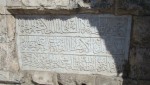
An inscription on a water fountain built by Suleiman the Magnificent. (photo by Ariel Fields)

When it comes to Jerusalem, the writing really is on the wall. The problem is, some people (easily recognized, as they go around saying “it’s like talking to a brick wall”) will try to convince you walls can’t tell you anything. Don’t listen. If you ignore Jerusalem’s walls, you’ll miss out. The following matryoshka/babushka story (or story within stories) shows that “walls are the skin of the residents,” as the muralist cooperative CitéCréation is fond of saying.

Admittedly, you might initially doubt whether writing on the wall matters. To quell your uncertainty, here is what Tel Aviv University’s Prof. Jonathan Price has to say: “Inscriptions are an important and unique historical source. They provide information in many areas no other source can provide.”

Thus, while there’s no CD of the trumpet/shofar playing, we know that trumpet blasts from the southwest end of the Temple Mount indicated the beginning and end of the Sabbath. How? In his extensive history, The Wars of the Jews, Flavius Josephus writes about this practice.

The truly astounding physical evidence, however, is a stone carved sign now located in the Roman/ Byzantine section of Jerusalem’s Israel Museum. The inscription on this first century CE stone reads, “‘To the place of the trumpeting.” The stone directed the Temple kohain “trumpeter to the high point on the Temple Mount, where he would announce the beginning and end of the Sabbath.”

An archeologist described its discovery. It was found in the “debris from the dismantled walls, engraved on an eight-foot-long piece of limestone. The stone has a rounded top indicating it was a kind of parapet situated on top of the wall or the tower at the southwest corner of Herod’s giant Temple Mount. Unfortunately, the clearly readable inscription is broken off, so we only have the beginning of it.”

The trumpeter’s corner had a distinct vantage point. From his post, the trumpeter looked out over ancient Jerusalem, from the City of David to the Upper City in the West. When he gave a blast, even the merchants and shoppers in the markets heard.

Moving slightly away from the Old City, we come to an ornate Ottoman inscription just above the southern end of Sultan’s Pool. It reads: “[There] has ordered the construction of this blessed sabil, our master the Sultan the greatest prince and the honorable Khaqan, who rules the necks of the nations, the sultan of the [land of] Rum, the Arabs and the non-Arab [’ajam], the Sultan Suleiman, son of Sultan Selim Khan, may God perpetuate his reign and his sultanate. On the date of the tenth of the month of Muharram the sacred, in the year of 943 [29 June 1536].” (Ottoman Jerusalem, Auld and Hillenbrand, eds., 2000)

This sabil (drinking fountain) served the many passing pilgrims. The Ottoman ruler Suleiman the Magnificent built five more sabils inside the walls of the older city. Moreover, several other sabils (the earliest dating back to the Byzantine period of the sixth/seventh century) have been excavated at this same location.

The drinking fountain’s water came from an aqueduct originating at Solomon’s Pools, near Bethlehem. Importantly, this aqueduct primarily serviced the Temple Mount area. To insure an adequate water supply, Sultan’s Pool (today an outdoor concert venue) was a floodwater reservoir. Just a few years ago, archeologists uncovered a Second Temple period bridge that stood over the adjacent ravine of Ben Hinom Valley. The original bridge maintained the elevation of the path along which the water coursed. In 1320 CE, the Mamluks rebuilt the bridge. Two of the original nine arches supporting the bridge were excavated to their full three-metre height.

A relatively short walk from the fountain, but with a significant leap in time, we arrive at the Hebrew year 5694 (corresponding to 1933-1934). At that time, builders completed work on a structure at 6 King David St. As the country was still controlled by the British (the Mandatory period lasted from Sept. 29, 1923-May 14, 1948), the Hebrew stone dedication might be termed both prophetic and Zionist. The inscription from Psalms 102:15 reads: “Your servants take delight in its stones and cherish its dust.” Heads up, however, to view this stone, as it is high on the right side of the entranceway.

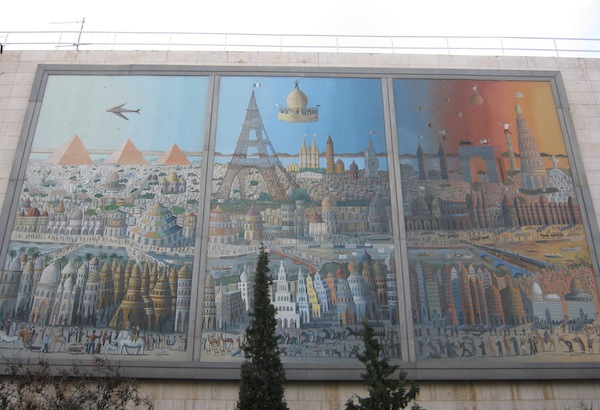
photo - In 2001, the French art group CitéCréation painted a mural depicting the Jerusalem Light Rail system, which didn’t start running until 2011
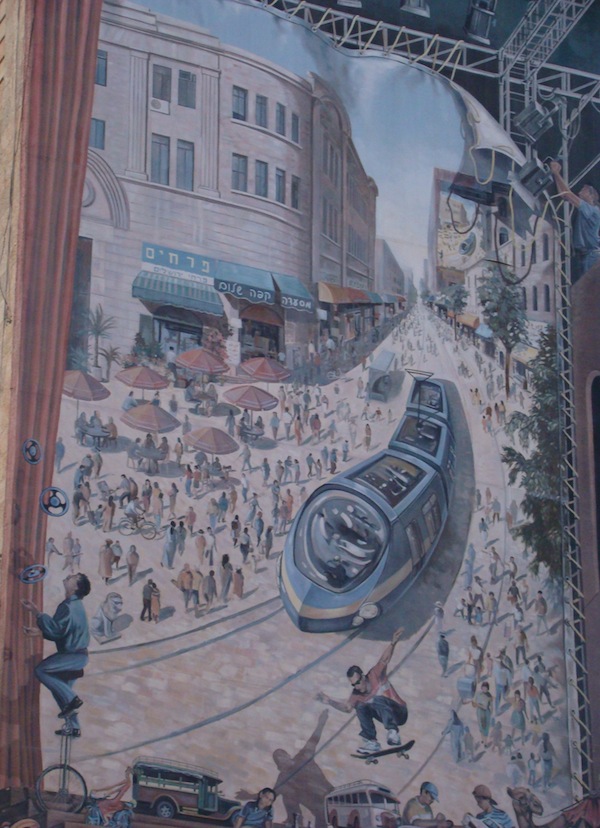
In 2001, the French art group CitéCréation painted a mural depicting the Jerusalem Light Rail system, which didn’t start running until 2011. (photo by Ariel Fields)

No matter what you think of the Mandatory period, most people will agree that the British constructed attractive and made-to-last Jerusalem streets and boulevards. Although King George Street has changed tremendously since Israel gained independence, the stateliness of the road’s 1924 commemoration is visible in the dedication stone on the side of what is now a woman’s clothing store. The esthetically pleasing inscription is carved in the languages of the time: English, the official language of the British Crown has a central spot on the stone. It is flanked by slightly smaller Hebrew and Arabic translations.

They say a picture is worth a 1,000 words, so here goes: Across from the above inscription, where King George, Strauss and Jaffa Road intersect, look up to see what was for 10 years regarded as a “time-warp” fresco. In 2001, the French art group CitéCréation painted a long exterior building wall depicting the Jerusalem Light Rail system. Since the light rail only began running at the end of 2011, for years Jerusalemites considered this painting a bad joke. Like many other Jerusalem projects, this one finally came into being years after its original promised inauguration.

Despite a violent summer and fall, the Jerusalem Light Rail demonstrates that the city’s ethnic and religious groups can – and do, literally – come into close contact. Jerusalem’s train is an example, albeit a fragile coexistence.

photo - Gavriel Cohen’s 1976 mural on the Gerard Behar building
Gavriel Cohen’s 1976 mural on the Gerard Behar building. (photo by Orli Fields)

In sharp contrast to the slow development of the light rail, the wall project on the Gerard Behar Theatre (its address is 11 Bezalel St.) shows how quickly things can get done, if one really works at it. In 1976, Gavriel Cohen painted a huge building mural in just 92 days. Humorously, this 18-metre-wide painting is entitled “Around the World in 92 Days.” When you see the painting, you will understand its “play” on the title of Jules Verne’s famous adventure story.

Like Verne, Cohen was born in France. Moreover, the Jerusalem Foundation donor who underwrote the building’s renovation was himself a millionaire French Jew. He named the building after his son, Gerard Behar. Today, the wall has added significance, as many French Jews are making Israel their home. The Jewish Agency reported nearly 7,000 French Jews made aliya in 2014, doubling the number of the preceding year.

We now move back in time to the Hebrew year 5632 (1872). In the tiny Jerusalem neighborhood of the House of David – the fourth neighborhood built outside the walls of the Old City – there is another inscription above the doorway of what (with controversy between different religious blocs) has recently become a yeshiva. David Reiz, a Jew from Jonava, Poland (today the Republic of Lithuania) donated the money to build this area. The Hebrew stone dedication contains a description of the 1872 purchase of the lot and the subsequent building of the apartments and a study house (bet midrash). The home of Rav Kook (first chief Ashkenazi rabbi of Mandate Palestine) and the popular dairy restaurant Ticho House (currently undergoing repair) are a few steps away. The square courtyard in which the inscription is found still has the wells residents used for their household needs. Reportedly, today’s residents are a mix of doctors, artists and yeshiva students.

Even if they never took up residence in Israel, over the years people of different denominations have considered Jerusalem to be their centre of the world. Thus, in front of Jerusalem’s City Hall, there is a large reproduction of Heinrich Bünting’s 1581 map of the world. Bünting (1545-1606), a German Protestant pastor and theologian with a strong interest in cartography, created a map (included in his printed map book) featuring a three-leaf clover (which to this day is still part of his native Hanover’s coat of arms). Europe is the western leaf, Asia is the eastern leaf and Africa is the southern leaf. Jerusalem lies at the centre of the clover.

As Hebrew University’s Prof. Rehav Rubin (1987) wrote: “These maps do not teach us anything about the appearance of the city in ancient times, but from them we learn how Christian Europeans and the map-makers themselves saw sacred texts and the place of Jerusalem in the sacred texts.”

So much of Jerusalem’s history is laid out on its walls; come visit to discover it.

Deborah Rubin Fields is an Israel-based features writer. She is also the author of Take a Peek Inside: A Child’s Guide to Radiology Exams, published in English, Hebrew and Arabic.
Format ImagePosted on April 17, 2015April 16, 2015Author Deborah Rubin FieldsCategories IsraelTags Gavriel Cohen, graffiti, Jerusalem, Jonathan Price, Rehav Rubin, street art

Mixing mercy and medicine

At the close of what Western countries call Valentine’s Day, a tenuous ceasefire went into effect in war-torn eastern Ukraine. Unfortunately, the days prior to the truce were not what you would call all “hearts and flowers.” Up to the last minute, both sides pushed to make territorial gains. We can be sure that no love has been lost.

Needless to say, tanks, rockets and guns do not tell the whole story of the armed conflict. Beyond the military operations are the civilians whose lives have been affected.

One critical result of the fighting is that the overall health situation in Ukraine has rapidly deteriorated. (Even in peacetime, however, the health situation was not on par with Western medicine.) Recently, the United Nations reported that drug supplies are running out and that the country has seen a rise in the number of tuberculosis diagnoses. As there are not enough shelters for displaced people whatever their health status, some of these individuals are being sent to hospitals. This in turn has created a lack of treatment space for acute medical cases. To date, these are the statistics on the war in Ukraine:

  • 5,486 people killed and 12,972 wounded in eastern Ukraine
  • 5.2 million estimated to be living in the areas of conflict
  • 978,482 internally displaced people, including 119,832 children
  • 600,000 have fled to neighboring countries, two-thirds of whom have gone to Russia

image - The English Surgeon cover

How can we in the West appreciate what is happening to the people living in the conflict zone? One unlikely way is to reconsider Geoffrey Smith’s powerful 2007 documentary The English Surgeon. The film deals with how medicine is practised in Ukraine and puts a personal face on what life (in more promising times, perhaps) is like for Ukrainians.

This film reveals how two dedicated neurosurgeons make do with scarce medical supplies with a goal to improve their patients’ quality of life. In the course of this sophisticated British-produced documentary, viewers become intimately acquainted with the hospital exploits of this medical odd couple: Dr. Henry Marsh, a British neurosurgeon, and his Ukrainian counterpart, Dr. Igor Petrovich Kurilets. Smith’s movie is enlightening and viewers can glean much about Marsh’s point of view. In his experience, performing the surgery itself is not the hard part, it’s knowing when to treat that’s complicated.

Early in the film, Marsh talks about the importance for him of helping other people; he questions what we are if we don’t try to help others. When the movie was filmed, Marsh had already been volunteering in Ukraine for 16 years. He tells us that when he first started his project, he found surgical conditions comparable to those that existed in the West 60 years prior. He was appalled at the misdiagnoses he encountered, and by the stories of patients that could have been helped had they received appropriate medical interventions earlier.

The film exudes irony and humor as viewers get to know Marsh. He explains that he always liked working with machines and using his hands. He also enjoys the sensory aspects of working with wood. At one point, he says that surgeons like blood, and he likens surgery to a kind of sport.

Kurilets displays no less of a quirky wit. For instance, he points out a painting hanging on his wall. In the picture are happy Cossacks sitting around a table. Kurilets thinks there are many similarities between Cossacks and surgeons. He comments that in the painting, the Cossacks could be gathered around an operating room table. He appreciates the Cossacks’ aggressiveness. Actually, his own pro-activeness has gotten him into trouble with the authorities; he later reveals that he was unemployed for two years following repeated run-ins with the Soviet system. Ironically, he currently rents rooms from a hospital run by the KGB, his former nemesis.

Kurilets is still a doer today, albeit perhaps slightly more pragmatic than he once was. He has plans to build a new hospital. He underscores his philosophy of life by explaining that the point is not to just make plans – something that happened a lot in the former Soviet Union – but to actually do, to get things done.

In fact, these two individuals are pragmatism personified. Marsh and Kurilets buy brain surgery tools in the local open-air market. Kurilets’ Bosch drill comes from this market. Marsh also regularly donates equipment to Kurilet’s practice. In an understated way, we learn some of the real costs of surgery in this area of the former Soviet Union versus the West: the 80 Sterling drill bits that Marsh’s hospital uses once will be used by Kurilets for 10 years.

Marsh also confronts deeper issues. He struggles with being able to leave patients with hope, even when there is nothing that surgically can be done.

One patient who can be treated is Marian, a young, rural man of limited financial resources. Marian has a brain tumor that could either leave him severely disabled or kill him. The doctors tell him that the only way they can help is by conducting brain surgery, but without anesthesia. Marian agrees.

The operating room in which this incredible procedure takes place is so small that, at one point, a member of the surgical team has to bend down, almost crawling to get to the other side of the room. Even in this incredibly tense scene, Marsh reveals his wry humor by saying that the healthy section of the brain should look “like a good cream cheese,” not rubber. He does not underestimate the tremendous vitality of the organ on which he operates, however. In surgery, he says, “We are the brain.”

Sharing some of the soul-searching he does in his practice, Marsh humbly admits that he has made some big mistakes. He narrates the painful story of one young Ukrainian patient that he brought to England for surgery. Marsh reveals that both of Tanya’s surgeries went terribly wrong. Even today, he can’t put Tanya’s story aside. He tells Kurilets that he thinks about Tanya a lot. Kurilets agrees that there were lessons to be learned from her case. But Marsh doesn’t just contemplate Tanya; he seeks physical contact with this lost patient. In a haunting moment of tremendous honesty and humanity, he pays a visit to her family members. He reveals to Tanya’s family how nervous he was before the visit.

The English Surgeon is a powerful movie, stunning, but frequently heart-wrenching. It displays not just the truth of the situation in Ukraine, but the truth about people.

The film is available online without charge at documentarystorm.com/the-english-surgeon or on Netflix Canada. You can view an interview with the filmmaker at pbs.org.

Deborah Rubin Fields is an Israel-based features writer. She is also the author of Take a Peek Inside: A Child’s Guide to Radiology Exams, published in English, Hebrew and Arabic.
 ***

A number of organizations are trying to help civilians in Ukraine. Working at opposite ends of the life spectrum are two Jewish charities: the Survivor Mitzvah Project (survivormitzvah.org), which helps elderly Holocaust survivors residing in Ukraine, and Tikva Children’s Home (tikvaodessa.org), whose mission is to care for “the homeless, abandoned and abused Jewish children of Ukraine and neighboring regions of the former Soviet Union.”

***

While many are probably familiar with Jonathan Safran Foer’s book Everything Is Illuminated (which was also made into a film in 2005), the Good Reads website has assembled a list of other books dealing with Ukraine (goodreads.com/places/76-ukraine). The list contains fiction and non-fiction books for children and adults.

Posted on February 20, 2015February 24, 2016Author Deborah Rubin FieldsCategories TV & FilmTags Geoffrey Smith, health care, Henry Marsh, Igor Petrovich Kurilets, The English Surgeon, Ukraine
Safe options for pet lovers

Safe options for pet lovers

When it comes to cases of domestic violence, wanting to keep our pets has particularly dangerous implications; it can potentially put both children and adults at risk. (photo from commons.wikimedia.org)

Times are tough. Difficult financial circumstances and/or acts of violence force all kinds of people to seek shelter outside their homes. As if leaving one’s home in the wake of such challenges isn’t bad enough, sometimes this leave-taking involves the very painful question of what to do with the individual or family’s pet.

Many of us can well appreciate the desire to hold on to our animals. When it comes to cases of domestic violence, however, wanting to keep our pets has particularly dangerous implications; it can potentially put both children and adults at risk.

Dr. Frank Ascione provides this eye-opening statistic: “In 12 independent surveys, between 18 percent and 48 percent of battered women have delayed their decision to leave their batterer, or have returned to their batterer, out of fear for the welfare of their pets or livestock.” (Violence Against Women, 13(4), 2007)

Why are these pet owners willing to go to extremes to hold on to their animals? Genevieve Frederick of the U.S. organization Pets of the Homeless elaborates on her nonprofit’s website, “Their pets are nonjudgmental; provide comfort and an emotional bond of loyalty. In some cases, they provide the homeless with protection and keep them warm.”

In addition, Dr. Andrew Gardiner, who helps run free veterinary clinics at two homeless hostels in Edinburgh, Scotland, offers this interesting observation: “… many homeless people say that having a pet is what gives them hope….”

Critically, keeping the family dog or cat is vital to children’s continued emotional stability. In her groundbreaking paper for the National District Attorneys Association (NDAA), Allie Phillips states, “When a child has been abused or traumatized, it can be the nonjudgmental comfort from an animal that helps the child heal…. Children often love their pets like family members and, if a pet is threatened, harmed or killed, this can cause psychological trauma to the children.”

Moreover, Jewish law requires us to be pro-active in cases of domestic abuse as well in situations of cruelty to animals. In a 2007 article entitled “Few are guilty, but all are responsible: The obligations to help survivors of abuse,” Rabbi Mark Dratch (executive vice-president of the Rabbinical Council of America and founder of Jsafe) writes: “… the physical, emotional and spiritual dangers that result from perpetrators of abuse and violence … obligate each of us to protect potential victims from them.” Among the texts he uses to base his conclusions about Jewish responsibilities toward people in domestic violence situations are Leviticus 19:16 and Deuteronomy 22:2 and, in the case of cruelty to animals, Exodus 23:5 and Deuteronomy 22:4.

According to the Jewish Coalition Against Domestic Abuse: “Domestic abuse occurs in Jewish families at about the same rate as in the general community – about 15 percent – and the abuse takes place among all branches of Judaism and at all socioeconomic levels. Studies show that abuse occurs in every denomination of Judaism in equal percentages, and we see abuse in all communities including the unaffiliated.”

But the Jewish community in particular, and the community at large, have thus far established few shelters for pet-owning domestic violence victims. In 2014 (during two days of census taking), Vancouver had 1,820 individuals living in emergency or transitional facilities, 957 people living on the streets (homelesshub.ca/community-profiles/british-columbia/vancouver) and 88 children (under the age of 19) in the company of a parent. Of those people living in transition homes, 116 were women and children fleeing violence (vancouver.ca/files/cov/results-of-the-2014-metro-vancouver-homeless-count-july-31-2014.pdf).

Another complication once someone is able to transition back to a more stable living situation is access to affordable, pet-friendly rental accommodations. Vancouver has one of the lowest vacancy rates in Canada. Moreover, in British Columbia, there is no law permitting tenants to have a pet. In fact, the existing Residential Tenancy Act explicitly gives landlords the right to refuse pets, or to charge an extra deposit for accepting pets. Many renters have a hard time finding rental apartments and pet-owning residents have an even harder time locating suitable housing. People are often forced to choose between their pet and a roof over their head.

What then is available to these needy residents and their animals? The Salvation Army’s Centre for Hope in Abbottsford is currently working on becoming pet friendly. Shilo St. Cyr, program supervisor of Sheena’s Place, an Elizabeth Fry Society facility in Vancouver, reports: “We don’t accommodate women and children who have pets. We usually try to arrange for a dog sitter/shelter.”

Jodi Dunlop, Vancouver branch manager of British Columbia’s Society for the Prevention of Cruelty to Animals, reports: “Currently, our branches offer a two-week compassionate board for the animals. This gives the person leaving the violent situation a chance to find accommodation and not have to worry about the care and safety of their pet. In some cases, we have extended the care for the animal. It is dependent on each situation and also the animal’s welfare while in our care. There is no charge for this service. Our goal is to always reunite the animal with their owner.”

No doubt the animals are kept safe in foster care. But individuals and family members must temporarily deal with separation, both from their physical home and from the most cherished parts of that former home life.

Indeed, the flipside of this human attachment is such that dogs and cats of homeless people are also very attached to their owners. Gardiner points out: “The pet and the person spend so much time interacting with each other that the human/animal bond is incredibly strong. If these pets are taken from their owners, it is not uncommon for them to suffer separation anxiety or demonstrate other behavioral problems. In the worst case, a dog that is unable to adjust could end up being put down. That would be a terrible outcome.”

Nationwide, the number of Canadian domestic violence shelters offering pet facilities is still very small. While individual Vancouver cat and dog owners might find shelter for themselves and their pets at either 412 Women’s Emergency Shelter or St. Elizabeth’s-St. James Community Service Society, it appears the family member seeking temporary shelter in Vancouver would do best to contact either the BCSPCA branches in the Vancouver area or, as St. Cyr advises, contacting 211. Additionally, for more non-pet-related inquiries, the Women’s Safety and Outreach Program recently opened a weekday hotline between 5 p.m. and 1 a.m. – it can arrange transportation for women fleeing violence to housing (transition, shelter). As of this writing, the telephone number is 604-652-1010.

Deborah Rubin Fields is an Israel-based features writer. She is also the author of Take a Peek Inside: A Child’s Guide to Radiology Exams, published in English, Hebrew and Arabic.
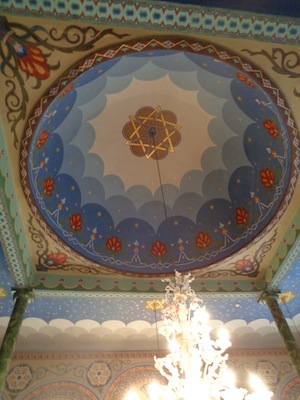
Format ImagePosted on January 30, 2015January 29, 2015Author Deborah Rubin FieldsCategories LifeTags Andrew Gardiner, domestic violence, Frank Ascione, homeless, Jodi Dunlop, Mark Dratch, pets, Shilo St. Cyr, women

Posts pagination

Previous page Page 1 … Page 6 Page 7 Page 8 Next page
Proudly powered by WordPress