Skip to content
  • Home
  • Subscribe / donate
  • Events calendar
  • Business Directory
  • FAQ
  • News
    • Local
    • National
    • Israel
    • World
    • עניין בחדשות
      A roundup of news in Canada and further afield, in Hebrew.
  • Opinion
    • From the JI
    • Op-Ed
  • Arts & Culture
    • Performing Arts
    • Music
    • Books
    • Visual Arts
    • TV & Film
  • Life
    • Celebrating the Holidays
    • Travel
    • The Daily Snooze
      Cartoons by Jacob Samuel
    • Mystery Photo
      Help the JI and JMABC fill in the gaps in our archives.
  • Community Links
    • Organizations, Etc.
    • Other News Sources & Blogs
  • JI Chai Celebration
  • JI@88! video

Recent Posts

  • SFU honours Gloria Gutman
  • Lifting people’s spirits
  • Wedding a ray of light
  • Indigeneity and Zionism
  • Rule of law broken: councilor
  • Football and its roles
  • The burden of defence
  • Fish Café returns after fire
  • All right in what goes wrong
  • Nuns & mermaids at TUTS
  • Camp offers holiday retreat
  • Students and mentors inspire
  • Once-in-a-lifetime trip
  • 100 dancers, one heart
  • Money for the sciences
  • What “Jewish food” means
  • Have a cookie, schnitzel too
  • Federation now across BC
  • Israel fighting for its existence
  • Deal strengthens Iran
  • Patriotic belonging diminishes
  • A campaign to engage
  • Upstanders’ first live event
  • Responding to Carney
  • Having your own home
  • Music a family tradition
  • Musical to warm heart
  • Community milestones … June 2026
  • Sharing her passion for Israel
  • Or Shalom reopens its doors
  • JFS from past to future
  • Need holistic approach
  • Sharing stories, advice
  • Journalist shares fears
  • Skills to live together
  • Road to independence

Archives

Follow @JewishIndie
image - CJN box ad Rockowers 2026

Byline: Deborah Rubin Fields

Going with the flow in Petra

Going with the flow in Petra

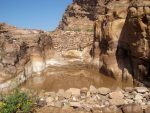
An ancient water reservoir at Petra. (photo by Orli Fields)

Desert living is tough. The toughest part of it is having water fit for consumption. Nobody knew this better than the Nabatean people. The desert was their home.

Some 2,600 years ago, the Nabateans daringly accepted the challenge of finding and supplying water to their people. They did this by building desert towns with life-sustaining water systems.

Archeologists and hydrologists have studied the waterworks at the Nabatean town of Petra. They report that Petra stood in a huge desert canyon, in what is today the country of Jordan. This area receives little rain. Petra gets only about six inches of rain a year. Temperatures go from a low of 34°F to a high of 94°F (1.1°C-34.4°C). For about half the year, the daytime temperatures are quite high. Yet 30,000 people once lived in Petra.

Petra is far from any ocean, sea, river or lake, but the Nabateans did not lack for water. Three things made this possible: the Nabateans had very smart water engineers, they had skilled builders and they had talented water managers.
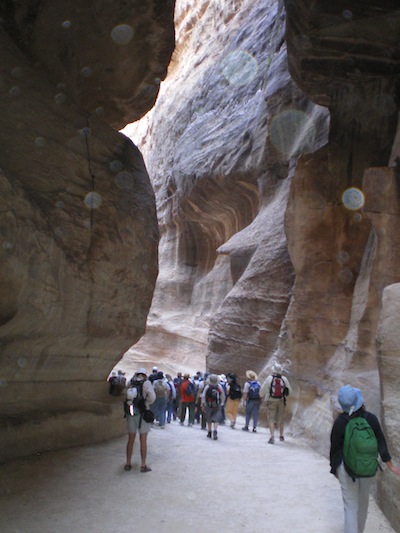
photo - Petra’s water engineers had to consider the ups and downs of yearly rainfall, the ups and downs of temperature, and the ups and downs of Petra’s mountainous surroundings
Petra’s water engineers had to consider the ups and downs of yearly rainfall, the ups and downs of temperature, and the ups and downs of Petra’s mountainous surroundings. (photos by Deborah Rubin Fields)

The engineers’ biggest worry was getting Petra to save as much water as possible. So, first, they designed a water system covering the whole city. The system collected a maximum amount of water from two sources: from rain and from local springs.

The engineers had several considerations. For instance, they had to worry about the ups and downs of yearly rainfall. They had to take into account the ups and downs of temperature. And they had to overcome the ups and downs of Petra’s mountainous surroundings.
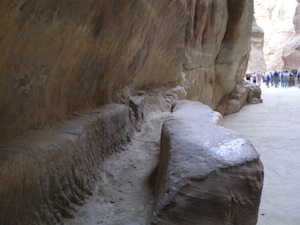
photo - closeup of mountain pipelineThe engineers also had to lower the risk of the system getting blocked. They realized that water pipes that ran along the side of a mountain would be hard to clean. Thus, they designed special water filters. These filters made it easy to trap and remove rocks or silt. If there were particles, they would settle in the reservoirs, not in the pipes. The engineers’ design was practical. It functioned throughout the year and, importantly, provided for a lot of water storage. It included crisscrossing water pipelines, channels, dams, tunnels, reservoirs and cisterns (totaling some 200 surface and underground units).

When looking at Petra’s water system, it is important to note how it was built. There were no motorized digging machines or hauling trucks, of course. All work was done by hand. The chisel was probably the most commonly used tool and, with this simple tool, builders carved an amazing water system.

Water managers had to maintain good water pressure and water flow. Too much pressure, for example, would cause a pipe to break, and that would result in wasted water. The managers’ goal was to maximize flow while minimizing leakage. They did this in part by operating a partial flow of water.

Also to reduce water leakage, the water managers used a particular kind of pipe. This pipe was often made from clay baked at high temperatures; it was short, with thin walls. Even with this innovation, Petra’s mountains and its irregular rainfall and temperatures must have meant that water managers were always on the alert.

And, sometimes, they were really “put to the test” – for example, when a large camel caravan entered Petra. When a large group of dusty and thirsty traders and animals arrived, it meant one thing: a sudden increase in the demand for water. Water would be needed for drinking and bathing. For such situations, water managers needed to ensure that back-up water sources were working.

In times of real emergency, the Nabateans had numerous storage centres. Scientists figure that some sites held three weeks’ emergency supply while other sites held several months’ supply. Thus, inhabitants had some insurance against a siege or drought.

Scientists have estimated that about 12 million gallons (or more than 45 million litres) of fresh spring water ran through Petra’s water channels daily. Water was relatively plentiful and also accessible – residents could easily reach the water that ran into nearby fountains.

The Nabateans also traveled through present-day Israel. Along what is today recognized as the UNESCO World Heritage Incense Route, the Nabateans established forts and settlements. In agricultural communities such as Shivta, they “captured” rainwater to grow grapes for wine production.

Both in travel and at home, the Nabateans’ water systems were as complex as they were practical. Even in ancient times, they overcame the harshness of desert living. They harnessed its unpredictability and thrived.

Deborah Rubin Fields is an Israel-based features writer. She is also the author of Take a Peek Inside: A Child’s Guide to Radiology Exams, published in English, Hebrew and Arabic.

Format ImagePosted on December 16, 2016December 15, 2016Author Deborah Rubin FieldsCategories TravelTags history, Nabateans, Petra, water
Navigating Northern Ireland

Navigating Northern Ireland

The HMS Caroline, a First World War light cruiser, is worth visiting. (photo by Deborah Rubin Fields)

Identified for so long – from the late 1960s to the late 1990s – by “the Troubles,” peace appears to be bringing both social and political stability to Northern Ireland. This, in turn, has led to an economic upswing.

Greater Belfast, and some of the other coastal towns, such as Derry, once had successful shipbuilding and textile industries. At the height of Belfast’s shipbuilding, for instance, Harland and Wolff, the biggest company, employed 35,000 workers. Edward James Harland and Gustav Wilheim Wolff, who came from a German-Jewish family, started this company in 1861. They designed and built the White Line ships, the most famous of which was the doomed Titantic.

Heavy industries suffered during the Depression and were later largely knocked out of the game by the terrible decline during the Troubles – the 30-year conflict between the unionist and mostly Protestant majority, who wanted to remain part of the United Kingdom, and the nationalist/republican and mainly Catholic minority, who wanted an independent Northern Ireland – by Chinese industry and/or both. Today, Belfast’s scaled-down dock industry focuses on ship repair and iron works.

Over the past 10 years or so, Northern Ireland has moved creatively to remember its more glorious industrial past. It maintains the history of shipbuilding in two ways: by awarding historic preservation distinction to two large, biblically named shipyard cranes, the Samson and the Goliath, and by recently expanding the whole area, which is referred to as the Queen’s Island, to encompass the Titanic Quarter. If visiting, worth seeing are the HMS Caroline, a First World War light battle cruiser, local businesses (studios, etc.), educational facilities and apartment buildings, and worth doing are such leisure activities as boating and cycling.

Northern Ireland’s maritime culture dates back hundreds of years. Paralleling the region’s general history, Northern Ireland’s naval life features a lot of rough water. Some locals might tell you it was the fairies, banshees and vampires that caused nautical disasters, but non-believers will tell you human error or unpredictable stormy weather caused numerous shipwrecks.

Thus, for example, while the Spanish had the money and manpower to fight the British fleet in the late 16th century, the rough coast of Northern Ireland, on-board disease and a scarcity of supplies wiped out a not-insignificant part of the Spanish Armada, mockingly referred to by non-Spaniards as the “Invincible Armada.”

Since the late 1960s, Northern Ireland divers and archeologists have sought to locate some of the many ships that foundered along their coast. Fascinatingly, underwater discoveries are now exhibited in Derry’s Tower Museum and at Belfast’s Ulster Museum. Shipwreck sites are likewise marked along the stunning Giant’s Causeway cliff path.

While on the subject of walks, Northern Ireland offers a lot of unspoiled, green countryside. If you’re outfitted correctly, hiking is a great way to see this stunning part of the world.

Northern Ireland’s extended social, religious, political and economic battles ended in 1998. Probably nothing currently recalls the Troubles more than the murals painted in Belfast and Derry. What visitors might not realize is that a significant number of the murals are actually part of the high walls separating the unionist (largely Protestant) neighborhoods from the nationalists (mostly Catholic) neighborhoods. Since the peace agreements, the barbed wire at the top of the walls has been removed, and the gates that nightly lock the sectarian neighborhoods are bolted by a private security firm rather than by British military or police.

The murals cover a wide range of topics. Understandably, some of these locally painted murals focus on remembering the significant events of the Troubles, such as the civil rights marches and Bloody Sunday. Some of the art portrays political allegiance; some pays tribute to dead paramilitary fighters; and some are memorials to murdered children.

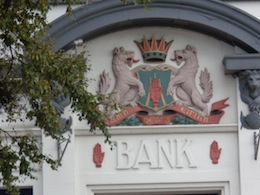
photo - Bangor Bank, adorned above its doorway with three Red Hands of Ulster
Bangor Bank, adorned above its doorway with three Red Hands of Ulster. (photo by Deborah Rubin Fields)

Today, however, the murals have expanded their scope to include conflicts from around the globe, such as the Israeli-Palestinian conflict. The pro-Israeli mural on Northumberland Street is dedicated to Lt.-Col. John Henry Patterson, a Christian Zionist who commanded the Jewish Legion in the First World War. The pro-Israel mural seems to receive less respect than the Palestinian and, this past summer, it was vandalized in a reported hate crime. Similarly, two years ago, an Ulster History Circle plaque erected at Israeli President Chaim Herzog’s Belfast birthplace was removed following defacement and building vandalism.

While on the subject of symbols of Northern Ireland, you may notice an open hand, often painted red, over building lintels. While it is hard to pinpoint the exact origin of what is known as the Red Hand of Ulster, it bears a similarity to Judaism’s “hand of God.” In Judaism, the “hand of God” has been a fairly common symbol, generally referring to God’s stepping into human affairs, but can be a subject in and of itself. Moreover, in both Judaism and Islam, the five-fingered hamsa is used as an amulet against the evil eye.

Belfast has a small assortment of sites with a link to Judaism, its texts or symbols. For example, in front of Customs House, there is a large stone water trough dedicated to Francis Calder, who founded the SPCA in Belfast. The trough contains a quote from Proverbs 12:10: “A righteous man regarded the life of his beast.” Close by is Albert Memorial Clock, dedicated to Queen Victoria’s husband. Undoubtedly better known for the way the tower leans, due to a sandy base, it has six-pointed stars carved into the stone.

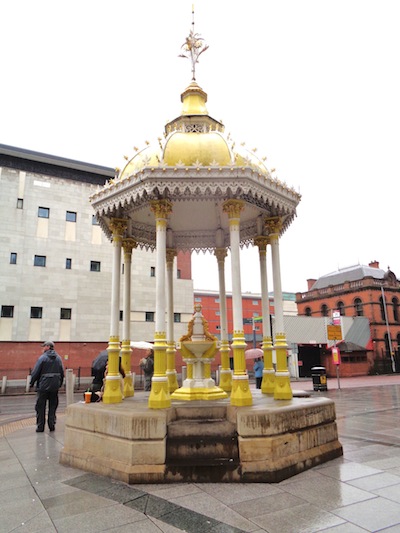
photo - Jaffe Fountain in Belfast
Jaffe Fountain in Belfast. (photo by Deborah Rubin Fields)

Not far from downtown’s Victoria Square shopping mall, there is a striking yellow fountain donated by Daniel Joseph Jaffe (1809–1871), the founder of the Jewish community. Jaffe’s son, Sir Otto, was the mayor of Belfast twice (1899 and 1904). Sadly, his German birth led to his leaving Northern Ireland. During the First World War, when the Germans torpedoed the Lusitania near Cork in May 1915, anti-German sentiment rose to the point where, even as a leading industrialist, philanthropist and naturalized U.K. citizen, Jaffe was accused of being a German spy. He left Northern Ireland in 1916 for London, England.

The most known Jewish and Canadian connection to Northern Ireland is a tragic one. On April 2, 1912, the Titanic left its Belfast shipyard. At its Southampton launching, it carried an unidentified number of Jewish passengers, some wealthy, established Jews, but many poor Jews seeking a better life in the United States. When the Titanic sank around Newfoundland on April 15, 1912, a small number of unidentified Jewish deceased were buried at Baron de Hirsch Cemetery in Halifax, N.S.

If you plan to travel to Northern Ireland, read This Man’s Wee Boy: A Childhood Memoir of Peace and Trouble in Derry by Tony Doherty and Reading in the Dark: A Novel by Seamus Deane, and listen to Tommy Sands’ “There Were Roses.” Seek in-person and/or virtual assistance from the attentive staff at Discover Northern Ireland, Northern Ireland’s tourist facilities (discovernorthernireland.com) and visit the small Belfast Jewish community’s website (belfastjewishcommunity.org.uk) and its lively Facebook page. While you’re in the country, you can attend Shabbat morning study sessions and services.

Deborah Rubin Fields is an Israel-based features writer. She is also the author of Take a Peek Inside: A Child’s Guide to Radiology Exams, published in English, Hebrew and Arabic.
Format ImagePosted on December 16, 2016December 15, 2016Author Deborah Rubin FieldsCategories TravelTags Northern Ireland
A visit to Mount Herzl

A visit to Mount Herzl

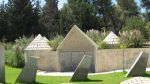
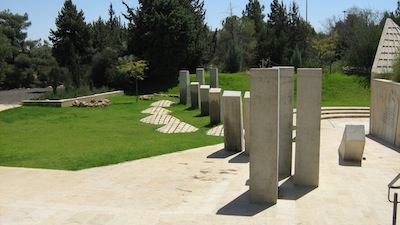
On Mount Herzl is a memorial to the more than 4,000 Ethiopian Jews who died attempting to reach Israel. (photo by Deborah Rubin Fields)

The 29th of the Hebrew month of Cheshvan – this year, it fell on Nov. 30 – is a day of celebration for the Israeli Ethiopian community and a national Israeli holiday. Late in the afternoon, thousands of people gather in Talpiot (southern Jerusalem) on the Haas Promenade for Sigd, the day marking the acceptance of the Torah, and celebrating their history and culture.

photo - The memorial to Ethiopian Jews is multifaceted
The memorial to Ethiopian Jews is multifaceted. (photo by Deborah Rubin Fields)

Despite the enormous loss of life and the discrimination faced by Israelis of Ethiopian descent, Sigd still is, in part, a prayer to make it possible to reach Israel. The Knesset legislated the Sigd Law in 2008, which made 29 Cheshvan a national holiday. The Knesset also legislated 28 Iyar (the Hebrew month that falls roughly in May) as the memorial day for community members who died making the journey to Israel. And, the year prior, in 2007, the Israeli Ministry of Immigration and Absorption in cooperation with the World Zionist Organization and the Israeli Defence Ministry unveiled a memorial to the more than 4,000 Ethiopian Jews who died attempting to reach Israel. Located on Mount Herzl, this stirring monument gives official recognition to the community’s largely unknown suffering. Until it was commemorated, the only existing monument stood in southern Jerusalem, at Kibbutz Ramat Rachel.

Starting at the end of 1979 and continuing for some four years, the Ethiopian Jewish community uprooted itself en masse to fulfil its dream of coming to Israel. It was both a physically exhausting and mentally terrifying journey. In Ethiopia’s forests and Sudan’s deserts, thousands were robbed, beaten, raped and even murdered. If there are graves for the fallen, they are far away from Eretz Yisrael.

The Mount Herzl memorial reminds visitors not just of the Ethiopian villages, but of an entire life left behind. Explanations are mounted in Amharic, Hebrew and English. In Hebrew, eight panels dramatically narrate 1) the exodus from Ethiopia from a boy’s perspective, 2) the events along the way, as explained by the group’s head, 3) life in Sudanese refugee camps, from a mother’s recollections, and 4) the actual departure for Israel, as related by the kes, or religious head of the community.

To learn more about Ethiopian Jews’ journey to reach Israel, Baruch’s Odyssey: An Ethiopian Jew’s Struggle to Save His People by Baruch Tegegne, as told to Phyllis Schwartzman Pinchuk, and the children’s book The Storyteller’s Beads by Jane Kurtz are recommended reads. As for movies, there are Mekonen: The Journey of an African Jew, directed by Rivka Shore; Live and Become, directed by Radu Mihaileanu; Zrubavel, directed by Shmuel Beru; and Yiftach’s Daughter, directed by Einat Kapach.

Deborah Rubin Fields is an Israel-based features writer. She is also the author of Take a Peek Inside: A Child’s Guide to Radiology Exams, published in English, Hebrew and Arabic.
Format ImagePosted on December 2, 2016December 1, 2016Author Deborah Rubin FieldsCategories IsraelTags aliyah, Ethiopia, memorial, Sigd
Tower of David a must-see

Tower of David a must-see

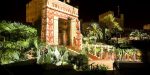
A scene from Migdal David’s The Night Spectacular: the Queen of Sheba with her entourage. (photo by Amit Geron)

While growing up in the United States, my friends and I never seemed to tire of asking each other, “Who is the Lincoln Memorial named after?” and “Who is buried in Grant’s Tomb?” The point of asking these silly questions seemed to be their obvious answers. When you grow up, however, you learn that the truth is not always so clear. Take, for example, Jerusalem’s Tower of David, also called David’s Citadel. King David, for whom it is apparently named, had nothing to do with the tower or any other part of this historic structure.

The tower is actually part of a medieval fortress that contains architectural additions from later periods. It is located near Jerusalem’s Jaffa Gate, which is the most trafficked entrance to the Old City. The tower is so well-recognized, it appears emblematically in countless Jerusalem paintings and photographs.

Early Byzantine Church fathers misinterpreted Josephus Flavius’ writings, ascribing the Tower of Phasael, from King Herod’s time, to King David. To further complicate the issue, Muslims also associated the Herodian tower with King David. They named their mihrab (prayer niche) Nabi Daud, David the Prophet. Later still, 19th-century Western Christians labeled the Turkish minaret added to the Mamluk mosque the Tower of David. This wrong name is what the tower is still called.

Tower of David Museum’s mission, in contrast, has evolved over time and various administrations. When the museum first opened in 1989, the aim was to present Jerusalem in all the years of its existence. Today, that is still a large part of the museum’s objective, but staff now creatively focus on familiarizing the public with the building complex’s amazing and lengthy physical presence. No easy job in an historic structure bound by preservation guidelines, in a city that has supreme importance to several of the world’s major religions and dates back to the second millennium BCE.

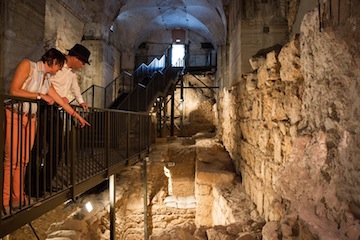
One of the new must-see additions is the Kishle. The discovery of the Kishle – when the Turkish Ottomans built a prison there in the mid-1800s, the Kishle referred to soldiers’ barracks – was accidental, but the follow-up to this archeological find has been careful and meticulous. What has recently been opened to the public is a continuous cut-away, or time line, of Jerusalem. The excavations reveal Jerusalem from as early as the sixth century BCE. It likewise shows walls from the time of King Herod – some of Herod’s huge building stones from the last quarter of the first century BCE are also still in place to the right of the museum’s main entrance by Omar Ibn El-Khattab Square – as well as evidence from the Middle Ages. Of particular importance is the discovery of a wall from the First Temple period, which adds to our knowledge about the city wall’s ancient route. Walking outdoors to the Kishle exhibit is an adventure in and of itself, as visitors traverse a dry moat that surrounds the Citadel. Also outdoors are finds going all the way back to the Second Temple period.

photo - Excavations of the Kishle
Excavations of the Kishle. (photo by Oded Antman)

The museum makes an effort to present Jerusalem from a variety of angles. Take, for example, the current temporary exhibit, Camera Man. In this wonderful photo display, we are able to see Jerusalem over 50 critical years of existence, a time in which its rulers switched hands three times, from Turkish rule to British rule to state of Israel rule. But the beauty of this show is that it zeroes in not on the wheeler-dealers of these various administrations, but rather on the daily life of the average Jerusalemite.

Relatedly, the museum seeks ongoing public involvement. Hence, it has taken two rather bold steps: it has taken part of the Camera Man exhibit out of the museum complex, mounting some of the photos in the centre of town, in close proximity to busy Machane Yehuda Market. A second significant step – that dynamically changes the exhibit, even as it is being shown – relates to the museum’s invitation to Jerusalem residents to send photos from their own family albums. Thus, with this participation, the exhibit is frequently being updated.

But the museum has not limited itself to just presenting Jerusalem’s history through photography. In the past year, it has gone digital in a big way. Families with elementary school-age children may now pay a small additional fee to tour the museum with enhanced iPad technology. In the Hebrew version of the award-winning Swipe the Citadel – an English version is in the pipeline – the family joins in the search for an archeologist’s young missing daughter. The virtual family and the real visiting family travel through the museum’s many old stone corridors looking for the girl. At the end of the adventure, virtual father and child are reunited, and visitors have been exposed to Jerusalem’s long and amazing history. There are currently six other apps for improving the on-the-grounds museum experience, including a digital detective game to discover who built the tower. A preview of what is available can be seen at tod.org.il/en/todigital.

The museum is always thinking of new ways to reach families. With this in mind, it has started hosting a new outreach program that allows families with children with special needs to participate as a family unit. The whole family attends and each member of the family engages to the extent to which he or she can. The museum already has a quiet room and a time-out room, and has been consulting with specialists to further develop meaningful family experiences.

While the Night Spectacular is an established program for Jerusalem tourists, readers might not know that there have been incredible outdoor evening concerts in the museum complex. These concerts have varied, from large events of hundreds of people listening to classical music, to smaller events of international liturgical music.

In the past, Tower of David Museum has hosted some incredible events for Jerusalem’s ethnically diverse population. For example, in 2000, Washington state artist and craftsman Dale Chihuly put this question to the people of Israel: “What’s incredibly hard to make, but all too easy to break?” Through his installation at the museum, Chihuly showed there is more than one way to solve this riddle, but his simple, yet thoughtful, answer was: “glass and peace.” The artist has donated some of his work to the museum.

While there may be a question about the museum’s name, there is no question you have to check it out the next time you are in Jerusalem.

Deborah Rubin Fields is an Israel-based features writer. She is also the author of Take a Peek Inside: A Child’s Guide to Radiology Exams, published in English, Hebrew and Arabic.
Format ImagePosted on September 23, 2016September 21, 2016Author Deborah Rubin FieldsCategories Israel, TravelTags Israel, museums, technology
Jerusalem’s French aspects

Jerusalem’s French aspects

Salt print of Adolphe Crémieux, December 1856, by Nadar (1820-1910), from the J. Paul Getty Museum. (photo from Wikimedia Commons)

While Jerusalem’s French connection thankfully lacks the violence and crime of the 1971 movie by the same name, both the film and real-life “French” Jerusalem have one thing in common: both expose us to off-the-beaten-track sites. Take a look at what you’ll find in Jerusalem.

The Israel Museum (11 Ruppin Blvd.) has amazingly reassembled an original 18th-century French salon called the Rothschild Room. (All that’s missing is the fancily dressed smart-set listening to a book or music recital.) It also has an impressive collection of French impressionist and post- impressionist painters, such as Pierre-Auguste Renoir, Camille Pissarro, Edgar Degas,

Alfred Sisley, Claude Monet, Paul Cézanne, Paul Gauguin and Henri de Toulouse-Lautrec, as well as works by earlier French artists such as François Boucher.

Speaking of paintings, 120 years ago, Count Marie Paul Amédée de Piellat painted Crusader-related images on the wall of what is today known as Jerusalem’s French Hospice, a non-denominational facility for the terminally ill. Painted in fresco-style, they were recently uncovered during a routine repair.

First built some 130 years ago as St. Louis Hospital – after the same King Louis IX who was responsible for broadening the Inquisition and burning Talmuds – it stands at 2 Shivtei Yisrael St. Around the corner from the hospice is the Romain Gary French Institute of Jerusalem, which promotes French culture by means of French-language courses, a French-language library and a media and entertainment space.

Romain Gary was a Second World War pilot, French diplomat and filmmaker, but was best known for his prolific writing. He won literary prizes using various pen names. Born to Jewish parents, his mother had him baptized a Catholic. Oddly, he had a large menorah at the foot of his bed when he shot himself dead.

Jerusalem’s Ratisbonne Monastery – built in the late 1880s, in Rehavia, 26 Shmuel HaNagid St. – is named after two French Jewish brothers who converted to Catholicism and made it their mission to have Jewish children follow in their “way.” Just before Israel declared statehood, 60 children from Kfar Etzion were safely evacuated to the monastery before the kibbutz fell. Most of the kibbutz defenders, however, were killed in the fighting. During the period in which the Jordanians blocked Hebrew University’s Mt. Scopus campus, the Ratisbonne Monastery served as the school’s law faculty.

Today, the monastery is an international theological school for those studying for the Catholic priesthood.

Several Jerusalem streets are named after French personalities who were either themselves Jewish or had connections to Jews. Centrally located Emile Botta Street is named after the French consul in Jerusalem during the Ottoman rule. The 90-year-old Pontifical Biblical Institute stands on this street. This facility has been in the news lately, as an Egyptian mummy belonging to the institute is currently on exhibit at the Israel Museum.

Emile Zola Street in the German Colony honors the outspoken journalist who defended Captain Alfred Dreyfus’ innocence. In a Jan. 13, 1898, letter (J’accuse!) to the French president, Zola publicly charged the French government and army with suppressing the true story behind Dreyfus’ arrest. Zola himself paid a high price for his bravery; he fled to Britain to avoid prison, only to die there suddenly and suspiciously from carbon monoxide poisoning.

Located near Emile Zola Street is Adolphe Crémieux Street. Crémieux was a Jewish lawyer, statesman, staunch defender of human rights (both of Jews and slaves) and the founder, in 1860, of the Alliance Israélite Universelle; four years later, he served as its president. Unfortunately, the Alliance vocational school no longer stands, but you can still see approximately where the gate was on Jaffa Road, in front of the site’s successor, the Clal Building.

Crémieux did much to better the conditions of the Jews in France. In 1827, he advocated the repeal of the Oath More Judaico, a piece of stigmatizing legislation left over from pre-revolutionary France. Crémieux apparently brought about the abolition of the oath when he defended Rabbi Lazard Isidor. The rabbi – who went on to become France’s chief rabbi – had refused to take the antisemitic oath and was charged with contempt of court. Crémieux got him acquitted. On March 3, 1846, the French Supreme Court finally declared the oath illegal.

Crémieux was likewise involved in defending Saratov (Russia) Jews facing charges of blood libel. For his instrumental assistance in bringing about the end to slavery in the French colonies, Crémieux was nicknamed the “French Abraham Lincoln.”

In recent years, Crémieux Street drew significant attention when police investigated former prime minister Ehud Olmert for the suggested favorable terms he received on the purchase of a home on this street, in exchange for help rendered to the contractor who sold it to him. The National Fraud Unit ultimately advised that there was not enough evidence to proceed with criminal charges against Olmert in the “Crémieux Street affair.”

Frederic Chopin Street is named for the well-known, Polish-born, French composer and pianist. Probably not coincidentally, this Talbiya street is the site of the Jerusalem Centre for the Performing Arts. Six halls serve as regular venues for music and dance concerts, dramatic performances and films.

Located in an ultra-Orthodox neighborhood, Estori Haparhi Street is named after the first topographer of the land of Israel. Haparhi’s family lived in Provence, but was expelled from France, along with the rest of the medieval Jewish population. Following this expulsion, he made aliyah and frequently preached the necessity of settling in the Holy Land. While making his living as a doctor, he wrote a book citing the biblical and halachic borders of Israel. He claimed that the Arabic names of numerous towns and villages reflected their Jewish textual names.

Speaking of medieval France, the Jerusalem municipality named three Mekor Baruch neighborhood streets after medieval Jewish scholars, Rashi and his two grandsons, the Rashbam and Rabenu Tam.

Neve Yaakov’s Gamzon Street recognizes the French resistance work of Robert Gamzon. In wartorn France, he set up an underground for issuing false identities to children and young adults. With these papers, they were able to escape France. Gamzon went on to fight in Israel’s War of Independence and to do research at the Weizmann Institute.

Talpiot’s Marie-Pierre Koenig Street commemorates the bravery and leadership of the French general who headed the Free France forces in the Second World War and took part in the D-Day landing. During the war, Koenig let members of the Jewish Brigade fly the blue and white flag, in defiance of British orders banning such action. Even after becoming the French minister of defence, Koenig remained an advocate of the new state of Israel.

For a general understanding of how the Holocaust affected French Jewry – including the critical assistance provided by French Jewish underground workers – plan a physical, or at least a virtual, visit to Yad Vashem (yadvashem.org). France’s recognition of Jewish defence was short-lived, however. Following the Six Day War, France embargoed its Mirage fighter jet. This forced Israel to develop the Kfir jet, and a street named HaKfir reflects Israel’s decision to go blue and white.

Deborah Rubin Fields is an Israel-based features writer. She is also the author of Take a Peek Inside: A Child’s Guide to Radiology Exams, published in English, Hebrew and Arabic.
Format ImagePosted on September 23, 2016September 21, 2016Author Deborah Rubin FieldsCategories Israel, TravelTags France, Israel, Jerusalem, tourism
Museums adapt using tech

Museums adapt using tech

Museloop’s app that it created for Israel Museum. (photo from Museloop via Times of Israel)

How do museums and other purveyors of history attract visitors and make the past relevant, especially as people come to expect more and more digital experiences?

Perhaps surprisingly, Werner W. Pommerehne and Bruno S. Frey recognized the problem more than 36 years ago. In their article “The museum from an economic perspective,” which was published in the International Social Science Journal in 1980, they stated:

“Museum exhibitions are generally poorly presented didactically. The history and nature of the artists’ work is rarely well explained, and little is offered to help the average, uninitiated viewer (i.e., the majority of actual and potential viewers) to understand and differentiate what is being presented, and why it has been singled out. Accompanying information sheets are often written in a language incomprehensible to those who are not already familiar with the subject. There is no clear guidance offered to the collections, and little or no effort is made to relate the exhibits to what the average viewer already knows about the history, political conditions, culture, famous people, etc., of the period in which the work of art was produced.”

Keren Berler, chief executive officer of Israeli start-up Museloop recently put the problem into current perspective. Younger visitors, she noted in an Israeli radio interview this past June, find museum visits passive and boring. She said, especially when seeing museum art exhibits, young people need something more to draw them into what they are seeing. So, her company has designed a museum-based application for iPhone and Android use. The application includes games, such as find-the-difference puzzles, plus information about the artist, all of which will hopefully make the visitor better remember the art and some facts about it.

Interestingly, in describing the games, two of the attributes she mentioned were competitiveness and the ability to take “selfies.” Children as young as 8 or 9 years old can use the app on their own, but younger children would need an adult to assist them.

Right now, the Museloop app focuses on Israel Museum’s under-appreciated (read: under-visited) permanent art collection. This exhibit includes the works of a number of “heavies,” such as Marc Chagall, Claude Monet, Pierre-Auguste Renoir, Paul Cézanne and Paul Gauguin. The goal is to make the experience so appealing that young visitors will then want to visit other museums. Since Israel Museum is paying the start-up for the development and use of the app, visitors benefit by having free use of it.

In contrast, Tower of David Museum has its own in-house digital department. This department has developed its own applications for heightened exhibit viewing.

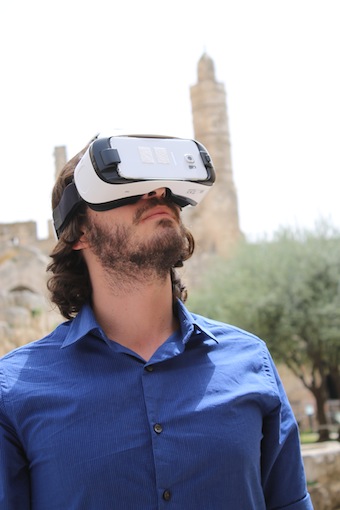
photo - Virtual reality in the actual reality of Tower of David Museum
Virtual reality in the actual reality of Tower of David Museum. (photo from Tower of David Museum)

According to Eynat Sharon, the head of digital media, her department takes into consideration the visitor’s total museum experience. This experience consists of three overlapping circles: the pre-visit, in which a person visits either the museum’s website or mobile site; the actual physical visit; and the post-visit, in which the person digitally shares with friends and family on Facebook, Instagram and other social media what they encountered at the museum. The museum’s technical equipment and apps may be rented by museum visitors for a small fee.

Are these new applications then to be applauded? Some people still need convincing. Last year, art critic Ben Davis reflected on news.artnet.com, “For many, many viewers, interfacing with an artwork through their phone trumped reflecting on its themes. In effect, now every art show is by default a multimedia experience for a great portion of the audience, because interaction via phone is a default part of the way people look at the world.”

Dan Reich, who is the curator and director of education for the St. Louis Holocaust Museum and Learning Centre, said, “Personally, I am not big on technology. You end up with lots of button-pushing but not necessarily a lot of education. As a museum, we are pretty low-tech. We have an audio tour of the permanent exhibit, several stops in the museum where you can press buttons and hear testimony, an interactive map and – more recently – added an interactive screen entitled ‘Change Begins With Me,’ which deals with more recent or contemporary examples of hate crimes and genocide. We have been digitizing our collection of survivors’ testimonies. We have testimonies edited to different lengths. Generally, survivors like to be recorded, knowing their words are being preserved.”

And recent comments on TripAdvisor show that museums don’t necessarily have to be high-tech to succeed in their mission.

Visitors, for example, gave the St. Louis Holocaust Centre high marks.

Other Holocaust learning centres, however, have started taking current technology through uncharted waters. The USC Shoah Foundation now uses holographic oral history. According to Dr. Stephen Smith, the foundation’s executive director: “In the Dimensions in Testimony project, the content must be natural language video conversations rendered in true holographic display, without the 3-D glasses. What makes this so different is the nonlinear nature of the content. We have grown used to hearing life histories as a flow of consciousness in which the interviewee is in control of the narrative and the interviewer guides the interviewee through the stages of his or her story. [Now] with the … methodology, the interviewee is subject to a series of questions gleaned from students, teachers and public who have universal questions that could apply to any witness, or specific questions about the witness’ personal history. They are asked in sets around subject matter, each a slightly different spin on a related topic.” One educator confided that, while the technology is “creepy,” the public apparently likes it.

So, how do museums cope with the possibility that the medium in and of itself becomes the message? In other words, how do museums keep their audiences from being distracted by the technology? At the same time, how can museums survive financially if they follow goals that differ substantially from those of visitors, funders and other supporters?

A few months ago, Canadian entrepreneur Evan Carmichael offered guidelines at an Online Computer Library Centre conference. His suggestions seem applicable to museum administrators as well: express yourself, answer their questions, offer guidance, involve the crowd, “use your audience to create something amazing … create an emotional connection, get personal, and hold trending conversations, go to where things are happening, be there.

Time will tell whether the advent of museum-related high-tech will realize Don McLean’s 1971 tribute to Vincent Van Gogh’s art: “They would not listen, they did not know how. Perhaps they’ll listen now.”

Deborah Rubin Fields is an Israel-based features writer. She is also the author of Take a Peek Inside: A Child’s Guide to Radiology Exams, published in English, Hebrew and Arabic.
Format ImagePosted on September 23, 2016September 21, 2016Author Deborah Rubin FieldsCategories WorldTags art, history, Holocaust, museums, technology
The Jewish holiday of love

The Jewish holiday of love

Since it takes place in summer, Tu b’Av has become popular for open-air events. A local example is the JNF Future’s annual Summer Sail, for which guests are encouraged to follow the tradition of wearing white.

Picture this potentially risqué scene: “… the daughters of Jerusalem used to go out … and dance in the vineyards [and] whoever did not have a wife would go there.”

Surprisingly, perhaps, this description is in the Babylonian Talmud, Tractate Taanit, 31a. In the days before internet dating sites and apps, speed-dating or singles bars, this was how Jewish singles met up at least once a year, on Tu b’Av. Welcome to the Jewish day of romance, Temple-times style.

Maybe it didn’t go as far as the cliché “clothes make the [wo]man,” but even back then, it apparently mattered what you wore to the vineyard. The bachelorettes decked out in white. If a single woman didn’t have white clothes, she’d borrow from someone else. In fact, the tractate describes this nice touch – everyone borrowed, so that no one felt embarrassed if they didn’t have something.

Presumably, wearing white at night had its advantages, too, as it made the women stand out in the moonlit vineyard. Moreover, when we think “white,” most of us think purity and, associatively, virginity, which brings us to this: wearing white underscores the next step, the Jewish wedding. At this ceremony, both the bride and the groom traditionally wear white – the groom (chatan, in Hebrew) puts on a white robe (kittel) or a prayer shawl (tallit) and the bride wears a white dress.

The writings of medieval Jewish scholars like Rabbi Aaron ben Jacob ha-Kohen and Rabbi ben Solomon ibn Abi Zimra (the Radbaz) suggest that wearing white at Jewish wedding ceremonies is a very old custom. They write that one’s wedding day is like a personal Yom Kippur, when the bride and groom’s sins are forgiven. Thus, the wearing of white becomes a proof-text for the line from Isaiah 1:18: “If your sins prove to be like crimson, they will become white as snow.”

Jewish scholars actually connect Yom Kippur and Tu b’Av. Unexpectedly, the Talmud claims that Tu b’av is as important as Yom Kippur in at least one way: “Rabbi Shimon b. Gavriel said: There were no days as joyous in Israel like the 15th of Av and Yom Kippur.” (Taanit 26b)

Chag Haahava, the Holiday of Love, or Tu b’Av (the 15th day of the Jewish month of Av), falls just six days after we mournfully recall that, on Tisha b’Av (Ninth of Av), both the First and Second Temples were destroyed, and numerous other Jewish catastrophes occurred. Here again, we link Tu b’Av to another Jewish wedding custom – the breaking of the glass, recalling the Temples’ destruction.

According to Tractate Taanit (30b-31a), the 15th of Av also joyously commemorates a number of other events in early Jewish history:

(1) This day marked the end of the “wilderness” generation; that is, the end of G-d’s punishing with death the Hebrews who had been the contemporaries of the spies who lacked the requisite faith for conquering the land (Numbers 14: 29-35). The 40 years of desert wandering ceased at this point and the children of the exiles entered Canaan.

(2) On 15 Av, G-d lifted the restriction on intermarriage between members of the 12 tribes.

(3) G-d reinstated the tribe of Benjamin, which He had banned for the tribesmen’s gang rape in Gibeah of a visiting concubine, who subsequently died.

(4) During the Temple period, the task of providing firewood for sacrifices ended on 15 Av, when the woodcutters would ceremoniously break their axes.

(5) Hosea, son of Elah, the last king of the Northern Kingdom, permitted travel to Jerusalem’s Holy Temple for the pilgrimage holidays.

(6) This day also marks when permission was given to bury those killed by the Romans at the Betar fortress.

While the Shulchan Aruch (Code of Jewish Law) doesn’t specify any particular customs for Tu b’Av, it does indicate that, as with other joyous days in the Jewish year, Jews should skip reciting tachanun (confession of sins) on this day.

Given the injunction to “be fruitful and multiply,” it is not hard to understand why this ancient holiday was judged to be so important. Indeed, one could make the claim that the holiday’s timing is hardly coincidental. It comes when the moon is full, reminding us that its cycle parallels women’s 28-day reproductive cycle.

Moreover, on a spiritual level, the sun’s illumination of the full moon suggests a cosmic union of the masculine and feminine – a kesher (Hebrew for connection) between G-d and His Divine Presence (Shekhinah). Rabbi Dr. Jill Hammer writes: “In the Zohar, the full moon signals the time when the

Divine womb creates pure and blessed souls. It is the time when the moon and sun, which, in kabbalist thought, represent the feminine and masculine faces of G-d, are most in contact. The Zohar [notes] that, at the full moon, the Shekhinah is called a field of apples, while at the dark moon, she is called field of anatot [poverty].”

It is somewhat ironic that this great holiday was not celebrated in Israel until recently. But Israelis seem to be making up for lost time. As Tu b’Av approaches, articles on the true meaning of love appear on a variety of websites, in ultra-Orthodox through to humanistic Judaism posts. Moreover, the day has evolved into a favorite Jewish Israeli wedding date – to get married on this day, couples must make their wedding arrangements far in advance.

As Tu b’Av falls in the summertime – this year, it starts the evening of Aug. 18 – it is ideal for outdoor events. Hence, the holiday has become popular for open-air evening concerts and all-day festivals.

As we become more of a global community, it is not surprising that modern Tu b’Av rituals have been influenced by Valentine’s Day accoutrements. Indeed, Tu b’Av art often mimics Valentine’s Day graphics, Israeli magazines guide people to romantic getaways, Israeli newspapers recommend places to feast on heart-shaped ravioli or splurge on rich chocolate mousse desserts or get tipsy on Pink Monica cocktails.

Anyone interested in learning more about Jewish rituals for celebrating Tu b’Av, however, can start their research at ritualwell.org.

Deborah Rubin Fields is an Israel-based features writer. She is also the author of Take a Peek Inside: A Child’s Guide to Radiology Exams, published in English, Hebrew and Arabic.

Format ImagePosted on July 22, 2016July 19, 2016Author Deborah Rubin FieldsCategories Celebrating the HolidaysTags love, Tu b’Av, Valentine's Day
From the Mamluks to today

From the Mamluks to today

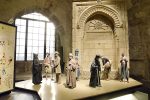
suleiThe above display at the Tower of David Museum shows a variety of characters typical of Jerusalem in the 19th century in front of a fountain. Jerusalem’s water system was restored during the rule of Sultan Suleiman the Magnificent; fountains (sabils) were built throughout the city, providing water to its residents and to visitors for generations. (photo by Hamutal Wachtel courtesy of Tower of David Museum Jerusalem)

Running water is still a luxury. For most of history – and still in many parts of the world – there has been a constant struggle to locate and maintain water resources. Certainly, this has been the history of inland Jerusalem, which, for thousands of years, has been important to merchants, travelers, pilgrims, politicos and residents alike.

When the Egyptian Mamluks came to Jerusalem in the middle of the 13th century, they found the public water system in need of rehabilitation. To relieve the weary and the thirsty, Mamluk rulers constructed a series of sabils, or free public drinking fountains.

Perhaps the Mamluks repaired or built these esthetically pleasing drinking and washing (i.e. Muslim ablution) facilities out of a heightened sensitivity to the under-privileged. The Mamluks themselves apparently began as young captured or bought slaves, forced to fight, especially in Egypt. While they did not establish social welfare ministries, the Mamluks nevertheless gave alms to ensure water, food, medical care and even (madrasa) education for the poverty-stricken.

The Sabil al-Shurbaji demonstrates this charitable approach. Abed al-Karim al-Shurbaji, the sabil’s endower, was an apparently wealthy Jerusalem resident who lived at the end of the 17th century. In 1686, he had the following welcoming, non-denominational inscription installed on his fountain: “Abed al-Karim al-Shurbaji built the sabil so that thirsty people might drink, hoping through this deed for reward, blessing and charity from Allah the Glorious. Beloved respectful one, set out to date it, and say [it is] a drink from Paradise or a spring.”

In addition to providing regular water flow for his sabil, al-Shurbaji built a cistern nearby in order to have water during droughts. The commissioned sabil was actually a single room with a double window on the northern side, covered by a shallow pointed dome. Compared to the ornate designs ordered by earlier Mamluk rulers, Sabil al-Shurbaji’s architecture is simple.

According to Dr. Avi Sasson, Jerusalem had some 30 sabils, from the nucleus of the Temple Mount to the surrounding city and beyond. Suleiman the Magnificent – sultan from 1520 to 1566 – built all his sabils at street intersections and at central sites around Haram esh-Sharif, the Temple Mount. Medieval sabils were built on the Temple Mount. Starting in the early Ottoman period, sabils began to spread into the city, following housing development outside the Old City walls.

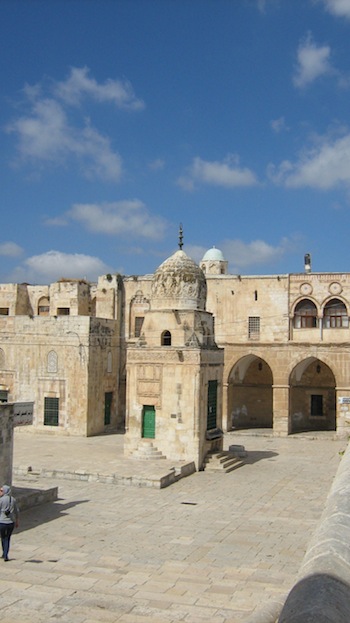
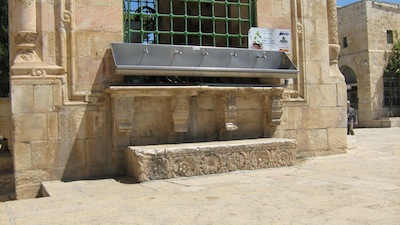
photo - Sabil Qaitbay (Fountain of Qayt Bay)Sabils appeared in three forms: built into a wall; free-standing, sometimes looking like a kiosk; and stylized tanks that required refilling, as they had no constant source of water. In the first two types of sabils, the drinking water came from reservoirs, cisterns or aqueducts. Exquisitely chiseled, these stone fountains sometimes incorporated carved items from other sites, such as the Roman – Prof. Dan Bahat says Crusader – sarcophagus or stone coffin used as a trough at Sabil Bab al-Silsila (Fountain of the Chain Gate), or the Crusader door frame on the Harem’s (1482 CE restored) Sabil Qaitbay (Fountain of Qayt Bay).

photo - The Mamluks’ Sabil Qaitbay (Fountain of Qayt Bay), located on the Temple Mount, was built in the 15th century. Note the contrast between the modern metal trough and the ornate Crusader stone door fixture used as a step
The Mamluks’ Sabil Qaitbay (Fountain of Qayt Bay), located on the Temple Mount, was built in the 15th century. Note the contrast between the modern metal trough and the ornate Crusader stone door fixture used as a step. (photos by Deborah Rubin Fields)

While researchers know of the existence of 10 sabils on the Temple Mount, Sabil Qaitbay is one of two sabils on the Temple Mount noted for its unique shape. The 1482 CE fountain – which is actually the rebuilding of an earlier sabil of Mamluk Sultan Saif al-Din Inal – has an ornately carved stone dome. Highly stylized Quranic inscriptions run along the top of the structure. Lacking its own water source, the fountain required refilling. The entrance to the fountain structure was from a set of rounded stone stairs on the east side.

The eight-sided Sabil Qasim Pasha originally got its water from an aqueduct. Water streamed from openings in the marble slabs. Today, the sabil gets its water piped in from the al-Aqsa Mosque water system.

Suleiman the Magnificent’s sabils are probably the best known. In the past year, the Jerusalem Municipality has restored Suleiman’s Sabil Birkat al-Sultan. The sabil’s stones are now clean and there are spouts for drinking fresh water. Runners in Jerusalem’s Marathon this year could stop at this 480-year-old fountain to quench their thirst.

According to a 2009 article in Sustainability by Jamal Barghouth and Rashed Al-Sa’ed, documents show that early in the Mamluk period, Baibars (in 1267 CE) and Mohammad Ibn Qalawun (in 1327 CE) conducted water restoration projects. Rulers, however, soon discovered that keeping Jerusalem water flowing was a demanding job.

Upset over their lost income, private water carriers not infrequently sabotaged the aqueduct along its Judean Desert edge. In addition, south of Jerusalem, farmers diverted the water flow to irrigate their fields. To protect the water, rulers stationed guards and soldiers along the line, but that did not totally stop daring water thieves. Even the severe punishments for those caught tampering with the water system did not completely deter people. Eventually, the Ottomans proposed a different tack: in exchange for leaving the line alone, farmers and towns were given tax breaks.

Accumulated waste material in the open-air aqueduct eventually caused complete blockage. Suleiman the Magnificent reportedly cleaned the aqueduct and undertook many other restoration activities. Later Ottoman rulers were left to instal a closed line.

Eventually, however, the Ottomans abandoned the whole system, forcing Jerusalemites to draw water from wells and local pools until the eventual British Mandate installation of a modern water system. While the Gihon Water Company, established in 1996, lacks the artistic and charitable sense of early sabil builders, it nevertheless reliably supplies fresh water, as well as sewage and drainage services, to about a million people, including Jerusalem residents and those living in Abu Ghosh and Mevaseret Yerushalayim.

Deborah Rubin Fields is an Israel-based features writer. She is also the author of Take a Peek Inside: A Child’s Guide to Radiology Exams, published in English, Hebrew and Arabic.

Sources (further reading)

  • Poverty and Charity in Medieval Islam: Mamluk Egypt, 1250–1517 by Adam Sabra (2006), part of Cambridge Studies in Islamic Civilization
  • “Sabils (Water Fountains) of Jerusalem from the Medieval Period to the Twentieth Century” by Avraham Sasson in Water Fountains in the Worldscape (2012), edited by Ari J. Hynynen, Petri S. Juuti and Tapio S. Katko, published by International Water History Association and KehräMedia Inc.
  • “Sustainability of Ancient Water Supply Facilities in Jerusalem,” by Jamal M. Barghouth and Rashed M.Y. Al-Sa’ed in Sustainability 1(4) (2009)
  • Jerusalem of Water: The Supplying of Water to Jerusalem from Ancient Times until Today by Yad Ben Zvi for HaGihon Water Company Ltd. (in Hebrew)
Format ImagePosted on June 24, 2016June 22, 2016Author Deborah Rubin FieldsCategories IsraelTags Egypt, fountains, Israel, Jerusalem, Mamluk, sabil, Suleiman
Israel’s decade of austerity

Israel’s decade of austerity

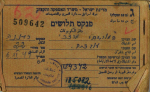
Israeli ration cards, which were distributed to all citizens, had to be presented at the neighborhood grocery to which a person was registered. (photo from National Library of Israel)

If Rip Van Winkle – or his Jewish equivalent, Honi the Circle Drawer, a first-century BCE scholar who, according to rabbinic tradition, slept for 70 years – had fallen asleep in Israel of the early 1950s only to awaken today, he would be stunned by the consumerism that has taken over the country. Israel has quite literally gone from a country of tremendous shortages to one of plenty. While one should not overlook that a significant part of the population lives in poverty, as they do in other countries, the availability of products and the ability to purchase has radically changed since early statehood.

Shortly after Israel gained independence in 1948, thousands of destitute Jews from Europe and Africa began arriving. These people needed to be settled quickly, as hostilities continuously loomed on Israel’s borders. The new state had low foreign currency reserves, making it hard to acquire the materials necessary for “firing up industry.” To cope with the dual costs of absorption and defence, the financially strapped Israeli government initiated an austerity plan, referred to in Hebrew as mishtar ha-tzena. As hated as the British Mandate had been, according to Prof. Guy Seidman, the newly independent Israeli government chose an austerity plan remarkably similar to the one the British had run in pre-state Israel and in its other colonies.

The tzena officially lasted from mid-1949 until 1959. Israel’s then-socialist-oriented administration wanted all citizens (new and veteran) to have the same basic necessities, so the government instituted both price control and rationing. It gave ration coupons for food staples, furniture and clothing. The emphasis was on using local produce while building up foreign reserves.

Water, which in many places had been distributed by water trucks during the War of Independence, continued to be rationed. One poster from this period shows how, with a 10-litre water bucket, a person could quench their thirst, bathe, rinse fruits and vegetables, cook, wash dishes, mop floors, launder clothes and flush toilets. In maabarot (transitional housing facilities for new immigrants), water ran from central faucets, but it had to be boiled before drinking. Public showers and washrooms were generally inadequate and often broken.

All citizens had to register with a makolet (local grocer). Israelis shopped at their neighborhood store using their government-issued purchasing cards. Prices for all products were translated into a fixed points system.

The government set an average daily calorie allotment of 2,700-2,800 calories. Children and older people received a higher daily calorie allowance. Here is a sampling of an average person’s daily quantities of rationed dry staples: 360 grams bread, 60 grams corn flour, 60 grams white flour, 17 grams white rice and 58 grams white sugar. Monthly, individuals had this imposed ceiling on proteins: 750 grams meat, 12 grams eggs and 200 grams low-fat cheese. “Fillers” such as potatoes had a monthly limit of 3,500 grams.

To counter the shortages, many started their own small gardens or built chicken coops. During the first year of the program, Lilian Cornfeld’s cookbook Ani Mevashelet (I Am Cooking) appeared to guide people in preparing meals based on the allowed rations. (Born in Montreal, Cornfeld was one of the first Canadian women to move to Palestine, doing so in 1922.) Ironically, the eggplant recipe for making ersatz chopped liver has become a staple Israeli dish at catered affairs, eateries and take-out facilities. Back then, most Israelis did not have refrigerators and ovens – people cooked and even baked complete meals on gas burners using an aluminum pot, a sir peleh, or “wonder pot.”

photo - A poster from the austerity period: “End the black market, before it finishes you off”
A poster from the austerity period: “End the black market, before it finishes you off.” (photo from National Library of Israel)

In the first year of the program, Israelis as a whole agreed with the government’s approach to the emergency. But, by the second year, some citizens were finding it hard to cope with the food lines and the food points. A thriving black market appeared. In response, the government set up a special unit in 1950 to root out the black market. Hundreds of inspectors were enlisted and special courts judged arrested profiteers.

How did people dodge the restrictions? Zeev Galili, who served as Yedioth Ahronoth’s city editor and deputy chief editor, recalled how his father disobeyed the imposed food ban. His father took him to a relative’s Petah Tikva farmstead and they stashed into a suitcase carefully wrapped eggs, tomatoes, olives and carrots, covering everything with clothes. His father warned him not to reveal what was in the case. When they reached Tel Aviv and food inspectors stopped the bus, passengers fearfully descended, everyone tense about being caught red-handed breaking the law. As “luck” would have it, Galili’s father’s suitcase was at the bottom of the pile of bags strapped to the roof and the inspectors did not open his case.

Other children, however, objected to their parents’ illegal dealings. Media personality Yaron London recalled that his mother bought 10 eggs from a black marketeer who mysteriously appeared at their door. Young London threw the eggs into the garbage. For this, he said, his mother “smacked me across the face. Then she covered her face with her hands and wept. After that, she came to her senses and threw her arms around me. I hugged her back. It was a moment of great joy.”

The austerity plan led to public criticism and outright accusations. Avshalom Cohen, for example, composed a satirical song about the black market; the minister of rationing and supply and minister of agriculture, former Canadian Dov Yosef, was frequently vilified.

According to historian Dr. Mordechai Naor, while the Mapai coalition (National Religious, Sephardim and Progressives) supported the plan, both sides of the opposition objected to it. Leftist Mapam felt the plan did not consider laborers’ voices, especially as the government refused to increase workers’ salaries, while rightist General Zionists and Herut claimed the program interfered with both private initiative and the middle class.

Although Yosef felt the time was premature, beginning in 1952, then-prime minister David Ben-Gurion gradually repealed the austerity plan. By 1959, the program had ended.

According to Seidman, the results of Israel’s mishtar ha-tzena paralleled the outcome of the English austerity program: “an initial success in curbing price and demand during wartime, followed by gradual erosion in the policy’s effectiveness and public compliance, futile criminal measures carried out by the police and the court and, finally, the formal dissolution of the legal edifice of the austerity regime.” While not a huge success, the program did manage to provide its growing population with a modicum of food and other basic necessities.

Today’s Israel is vastly different from the Israel of the 1950s. In the 57 years that have passed since the tzena ended, Israel has changed radically, beginning with a seven percent increase in calorie consumption every 10 years. Rabbi Yaakov Litzman, Israel’s current minister of health, recently launched a program encouraging healthy eating and discouraging the intake of high-fat, high-sugar and salt-filled junk food.

On the one hand, Israel now exports goods and services, and has earned an international reputation as a start-up nation. On the other hand, with its open market policy, it has seen the rise of numerous shopping malls that offer imported products. Like other Westerners, Israelis have become big online shoppers.

Nonetheless, many Israelis have been “left behind,” unable to make ends meet. Hopefully, the still-young state will close the gap between the haves and the have-nots and continue to manage its economy well into the 21st century.

Deborah Rubin Fields is an Israel-based features writer. She is also the author of Take a Peek Inside: A Child’s Guide to Radiology Exams, published in English, Hebrew and Arabic.
Format ImagePosted on May 6, 2016May 5, 2016Author Deborah Rubin FieldsCategories IsraelTags austerity, black market, Israel, mishtar ha-tzena
The old town that Jan built

The old town that Jan built

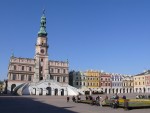
 Zamosc town hall. (photo by Tomasz Zugaj)

If you were rolling in money, what would you do with it? Would you build a town for yourself? That’s what Jan Zamoyski did.

As you approach the town’s main square, you might be inclined to think that someone has fooled with your itinerary. On first glance, it might well appear that somehow you have been detoured from Poland to Italy. Before you stands Zamosc, which can only be described as a stunning example of a planned, late-16th century Renaissance town. Designed by Italian architect Bernardo Morando, it follows the model of the citta ideale, or ideal town.

More than 400 brutal years have passed since the town’s inception. Yet, Zamosc has remarkably withstood the enormous devastation of the Second World War and the utilitarian, unesthetic architecture of the communist era. It largely retains its original layout, a large number of original buildings and fortifications.

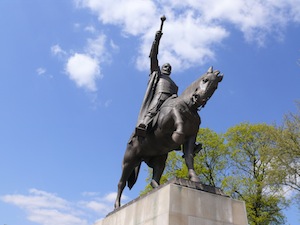
Zamosc stands in southeast Poland, 142 miles (228 kilometres) from Warsaw. Zamoyski founded Zamosc on his own property in 1589. He was an intriguing character, an extremely wealthy and educated man who juggled a variety of careers, including in the military and politics. He was a hetman (head of the army) and a chancellor. His taste in things Italian probably began during his student days at the University of Padua.

photo - A statute of Jan Zamoyski, founder of Zamosc
A statute of Jan Zamoyski, founder of Zamosc. (photo by Tomasz Zugaj)

While he was an army man, Zamoyski’s focus in establishing Zamosc was seemingly more economic than military. It should be noted, however, that he did not forget to commission an imposing fortress and city ramparts.

Located on the trade route linking western and northern Europe with the Black Sea, Zamoyski envisioned Zamosc as a thriving trade centre. He invited Italian, Turkish and Dutch Jewish merchants to work and live in his new town. His liberal policy toward outsiders was likewise extended to Armenian, Greek and Scottish merchants, and to Ruthenes (Slavs of the Orthodox Church). His outreach to foreigners did not spring as much from liberality, as from a strong desire to see Zamosc succeed. At the time, all of the mentioned ethnic groups had reputations for jump-starting floundering economies.

Zamoyski’s concerns went beyond the economic, though. As an intellectual ruler who was likewise a devout Roman Catholic, he had an academy – located today at Academy and Perec Streets – a high court and a large church, which was originally dedicated to Saint Thomas the Apostle and the resurrection, but was elevated in 1992 to cathedral status, and an imposing palace centrally constructed. Altogether, Zamosc’s buildings reflect the idea that institutions should be in physical harmony with the residents of a town. Just as the organs of the body support the human being, so Zamosc’s institutions were designed to organically mesh with the populace.

As mentioned, when Zamoyski decided to build his town, he imported a skilled Italian architect. It seems clear, however, that the chancellor also considered Morando because of his sensitivity to Polish culture. Morando had already worked in Poland and had gained an appreciation of Polish life.

The 16th-century Great Market Square features colorful arcaded houses characteristic of Morando’s native Padua. These houses, located at the northern end of the square, were designated for the Armenian merchants, hence the street’s name, Ormianski.

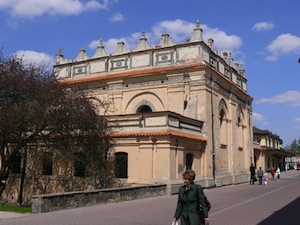
photo - The town’s 17th-century synagogue
The town’s 17th-century synagogue. (photo by Tomasz Zugaj)

In length and width, the square measures exactly 100 metres. It is here that the two main axes of the old town cross. The 600-metre longitudinal axis runs east to west: from Bastion No. 7 to the Zamoyski Palace. The 400-metre crosswise axis runs north to south, joining the Great Market Square to the two smaller market squares: Solny (this area, translated as the Salt Market, was assigned to Jewish merchants) and Wodny (translated as the Water Market). The original buildings in these smaller markets complemented those of the Great Market.

The town hall in particular was an enormous enterprise, taking nine years to complete (1591-1600). It was meant to draw attention. And, with its fan-shaped double staircase and imposing tower, it certainly achieved this purpose. During the early part of the construction work (1591-1593), Morando also served as the town mayor. His appointment ended before he was able to hang his name on the door of town hall’s mayoral offices.

In 1992, the town of Zamosc became a UNESCO World Heritage site. Hopefully, this award will help to preserve the beauty of this Renaissance town for years to come.

More on Zamosc

  • From July 11 to July 18, Zamosc is hosting the international folklore festival Eurofolk. About seven international carriers fly regularly between Vancouver and Warsaw.
  • Famous people who lived in Zamosc include L.L. Zamenhof, founder of Esperanto. He had the revolutionary idea that hatred would disappear if people spoke the same language. A revolutionary who was born in Zamosc was Rosa Luxemburg.
  • The old town of Zamosc stands largely intact. Humans fared far worse. For instance, the Jewish population, which had comprised almost half the city’s pre-Holocaust population (12,531), has vanished. Those who could, fled from the Nazis. Others were forced into a ghetto. In a series of four deportations, many Jews were sent to Belzec. Others were shot in marches and in roundups. As a reminder of the once-thriving Jewish community, visit the synagogue (9-11 Zamenhofa St.), which has been undergoing an extensive renovation project.

Deborah Rubin Fields is an Israel-based features writer. She is also the author of Take a Peek Inside: A Child’s Guide to Radiology Exams, published in English, Hebrew and Arabic.

Format ImagePosted on April 15, 2016April 13, 2016Author Deborah Rubin FieldsCategories TravelTags Bernardo Morando, Holocaust, Poland, Renaissance, Zamosc, Zamoyski

Posts pagination

Previous page Page 1 … Page 5 Page 6 Page 7 Page 8 Next page
Proudly powered by WordPress