Skip to content
  • Home
  • Subscribe / donate
  • Events calendar
  • News
    • Local
    • National
    • Israel
    • World
    • עניין בחדשות
      A roundup of news in Canada and further afield, in Hebrew.
  • Opinion
    • From the JI
    • Op-Ed
  • Arts & Culture
    • Performing Arts
    • Music
    • Books
    • Visual Arts
    • TV & Film
  • Life
    • Celebrating the Holidays
    • Travel
    • The Daily Snooze
      Cartoons by Jacob Samuel
    • Mystery Photo
      Help the JI and JMABC fill in the gaps in our archives.
  • Community Links
    • Organizations, Etc.
    • Other News Sources & Blogs
    • Business Directory
  • FAQ
  • JI Chai Celebration
  • JI@88! video

Recent Posts

  • עשרים ואחת שנים בוונקובר
  • Supporting the Iranian people
  • The power of photography
  • A good place to start
  • When boundaries have shifted
  • Guitar virtuosos play
  • Different concepts of home
  • Broadway’s Jewish storylines
  • Sesame’s breadth and depth
  • Dylan Akira Adler part of JFL festival
  • Mortality learning series
  • A new strategy to brighten up BC
  • Sharing latkes and light
  • Johnson awarded for human rights work
  • Cherished tradition ensured … Silber Family Agam Menorah
  • Nothing as lovely as a tree
  • Camp welcomes new director
  • Popular family camp expands
  • A life-changing experience
  • Benefits of being a counselor
  • Camper to counselor
  • האלימות בישראל מורגשת בהרבה מגזרים
  • טראמפ עוזר דווקא לנושא הפלסטיני
  • New rabbi settles into post
  • A light for the nations
  • Killed for being Jewish 
  • The complexities of identity
  • Jews in time of trauma
  • What should governments do?
  • Annie will warm your heart
  • Best of the film fest online
  • Guitar Night at Massey
  • Partners in the telling of stories
  • Four Peretz pillars honoured
  • History as a foundation
  • Music can comfort us

Archives

Follow @JewishIndie
image - The CJN - Visit Us Banner - 300x600 - 101625

Byline: Deborah Rubin Fields

A food fit for a queen

In my North American Ashkenazi house growing up, my mother always cooked arbis at Purim time. The dish is associated with Queen Esther, for whom this was supposedly a mainstay. Why? Because, some Jewish sources say, Queen Esther kept kosher in the court of her non-Jewish husband, King Ahasuerus. Eating this dish nowadays is one way in which Jews remember Queen Esther’s fortitude.

As I recall, this basic and healthy dish of cooked chickpeas took forever to cook, but it was worth it. It had a chewy, nutty kind of taste.

Arbis, like other Jewish foods, has been quite the globetrotter. For example, some Yiddish speakers refer to the dish as nahit, which, according to L.J.G. Van Der Maesen in a 1987 article, is close to the name used in Turkey, Romania, Bulgaria, Iran, Afghanistan and other adjacent former Soviet bloc countries, with arbis actually referring to another legume, peas. However, H. Gams’s 1924 legume study claims that the ancient Greek words for chickpea were orobos and erebinthos, and that these two words are related to the old German word arawiz and sound similar to erbse, the new German word for chickpea.

Besides eating arbis on Purim, traditional Ashkenazi Jews serve this dish at the Shalom Zachar, an after-dinner gathering on the first Friday night following the birth of a baby boy. There is a mourning aspect to this event, as the newborn’s soul, which had once dwelt in the heavenly realm, must now reside inside the earthly, physical body. Hence, arbis is served at this gathering as a food symbolic of the circle of life.

But a different explanation involving a play on Hebrew-Yiddish words goes like this: arbis, the Yiddish word for chickpeas, helps us remember the promise G-d made to Avraham. “I shall multiply [in Hebrew, arbeh] your seed like the stars of the Heavens.” (Genesis 22:17)

There is a Sephardi version of chickpeas, also served on Purim. Iraqi Jews call it sambusak el tawa, or chickpea turnovers. While most recipes call for adding salt and pepper to arbis, nahit or chickpeas, author Claudia Roden, in her book The Book of Jewish Food, suggests serving them as a sweet side dish with sugar or honey. Editors Anne London and Bertha Kahn Bishov also offer a sweet nahit casserole – in their Complete American-Jewish Cookbook recipe, brown sugar is added. Meanwhile, in the Jewish Vegetarian Year Cookbook, authors Roberta Kalechofsy and Rosa Rasiel recommend eating arbis as a Yom Kippur break-the-fast entree containing salt, cumin, green pepper and tomato sauce.

As we read every year, Megillat Esther opens with an assessment of the vastness of King Ahasuerus’s kingdom – it covered areas from India to Ethiopia.

Indian chickpea history goes way back: the earliest occurrence of chickpeas in India dates from 2000 BCE, at Atranjikhera in Uttar Pradesh, according to Van Der Maesen. Moreover, archeologists have discovered Bronze Age (2500–2000 BCE) chickpeas, peas, green gram and black gram inside storage jars at the Harappan site of Farmana, located in the Indian state of Haryana.

The Archeology of Africa: Food, Metal and Towns, edited by Thurstan Shaw, notes that, in the Natchabiet and Laliblea cave excavations near Ethiopia’s Lake Tana, there was evidence of chickpeas, barley and legumes. Significantly, shiro, which is made from powdered chickpeas, is a staple in Ethiopia.

In his book Ancient Canaan and Israel: New Perspectives, Jonathan Michael Golden reports that, during the Early Bronze Age, at Halif Terrace (located in Israel’s northeastern Negev), people were eating chickpeas, possibly with olive oil. Israeli archeobotanists say there was an agricultural revolution during the Neolithic period. Although not the easiest legume to cultivate – the crop can be wiped out by ascochyta blight and needs good drainage in sunny, dry, warm conditions – chickpeas became one of the early domesticated plants. Zohar Kerem, Simcha Lev-Yadun, Avi Gopher, Pnina Weinberg and Shahal Abbo offer an explanation. In a 2007 article, they claim that the cultivators of that period sensed the nutritional benefits of chickpeas. Today, scientists know that chickpeas are rich in tryptophan, an essential amino acid. They can bring about higher ovulation rates, improved infant development, a feeling of satiety, better performance in stressful situations and a lessening of depressive moods.

Indicative of how important chickpeas are to the Mediterranean diet, an international Hummus Day was inaugurated almost six years ago, on May 13. But let’s give arbis the last word: what goes around, comes around. Here’s a recipe.

ARBIS

1 pound uncooked, dry chickpeas
Cold water to cover chickpeas
Salt to taste (added during the cooking process)

Soak the chickpeas 12 to 24 hours in a pot. Drain the water and rinse the chickpeas to get rid of possible lectin, phytic acid and enzyme inhibitors. Return the chickpeas to the pot, adding enough water to cover them, plus another two inches. Total cooking time will be about two hours, but could be up to four hours, depending on what you consider tender or soft. Cook with the pot covered. Skim off the white froth, which early in the cooking might form at the top. Keep the flame low and add water as needed. After 45 minutes, add salt to taste and go back to cooking the chickpeas. When soft enough to eat, drain and spread out on a paper towel to dry. Sprinkle with salt. May be served hot or cold.

Deborah Rubin Fields is an Israel-based features writer. She is also the author of Take a Peek Inside: A Child’s Guide to Radiology Exams, published in English, Hebrew and Arabic.
Posted on February 23, 2018February 21, 2018Author Deborah Rubin FieldsCategories Celebrating the HolidaysTags arbis, chickpeas, food, history, Purim
House no longer home

House no longer home

South Side Hebrew Congregation.  (photo by Deborah Rubin Fields)

“It has seemed to me sometimes as though the L-d breathes on this poor grey ember of Creation and it turns to radiance – for a moment or a year or the span of a life. And then it sinks back into itself again, and to look at it no one would know it had anything to do with fire, or light.” (Gilead by Marilynne Robinson, 2004)

Once I had turned onto Chicago’s Congress Parkway, I shut off Waze. I told myself that, from here on, I could navigate from long-stored memory. My destination: my old South Shore neighbourhood. My objective: by means of an on-site visit, to share recollections of my Chicago-based formative years with our four Israeli-bred children, so they could have a real sense of where I came from and why I am the way I am.

I expected the community I’d lived in from birth until halfway through my adolescence to be much changed. It’s a fact of life, people change, places change. Certain relatives and friends, however, discouraged my visiting where I’d grown up; some even informed me the local press had renamed the area Terror Town.

Consequently, with a bit of trepidation, we drove into South Shore to begin my guiding and reminiscing. South Shore (named for its proximity to the southern shore of Lake Michigan) had been a middle-class neighbourhood. Some upper-middle-class (probably closer to the lake), some lower-middle-class, lots of solid middle-class.

As I explained to my children, when I was growing up, my area was a religiously mixed Caucasian neighborhood, but we got along with our non-Jewish neighbours. I played with the Christian kids on our block.

Moreover, when it came to schooling, my parents likewise wanted my brothers and me to be broadly exposed, meaning we attended both Chicago Board of Education public schools (not Jewish day schools) and a five-day-a-week afternoon Hebrew school and Hebrew high school. But, even though we attended a public school, there were different rules for different people. For instance, a special bell rang in our elementary school one day a week at 2 p.m., signifying that practising Catholic kids were free to leave for catechism lessons. When we missed school for a Jewish holiday, we had to return to school with a note from our parents explaining why we had been absent. Needless to say, we had to make up whatever work or tests we missed.

Significantly, in those days, Chicago had other forms of “acceptable” discrimination. Jews and other minorities were not allowed to live in certain areas and were not given membership in certain clubs. The nearby South Shore Country Club was one such restricted place. In the late 1960s, when the rules changed (because of hard-fought anti-discrimination legislation), one of my parents’ closest friends, a history professor, was belatedly invited to join. He relished responding, “I don’t want to belong to any club which hadn’t wanted me.”

Now that I had the chance, I wanted to see the inside of the club. It had been converted into a municipal public park, golf course and cultural centre, close to where former President Barack Obama’s library will be constructed. Either the grounds had not been maintained at their previous level or the previous standard had been over-imagined, but I was underwhelmed by what I saw. Spontaneously, my children – who have all visited the remains of Nazi concentration and death camps – commented the club’s gatehouse reminded them of the entrance to Auschwitz.

Though we had lived in a mixed neighbourhood, there was a Jewish community centre, plus seven synagogues (representing various streams of Judaism) within walking distance of our apartment – more than in my current Jerusalem neighbourhood! Because my parents had “shopped around” until I was about 6 years old for the synagogue that best met our family’s needs, I was acquainted with just about all of them.

photo - Deborah Rubin Fields went to Hebrew school five days a week in this building owned by South Side Hebrew Congregation. The Men’s Club also met there. For awhile her grandfather was the president
Deborah Rubin Fields went to Hebrew school five days a week in this building owned by South Side Hebrew Congregation. The Men’s Club also met there. For awhile her grandfather was the president. (photo by Deborah Rubin Fields)

Now, as I drove my children through South Shore, I saw that South Side Hebrew Congregation, Congregation Habonim, Congregation Bnai Bezalel, Congregation Agudat Achim and South Shore Temple had become churches. Beth Am Congregation was now a school. The buildings by and large looked the same, except for the signs identifying the churches that now occupied the premises, and the occasional cross on the windows. The brick menorot were still on the façade of Torah Synagogue and the mikvah, but at least part of the complex had become a beauty supply shop.

I recalled one story from my club at the Jewish Youth Centre. My group went for a picnic supper at Rainbow Beach. My neighbour and friend, D., disregarded our warnings, returning home with what she called a gift for her mother, a long-dead alewife. When D. entered her apartment complex, the rest of us raced to the back of the building to snicker at D.’s mother screaming about the smelly fish.

And, speaking of social functions, my old synagogue, South Side Hebrew Congregation, played a social role, as much as it did a religious role. It wasn’t just a place for praying, as are many Israeli synagogues, it was a place to meet up with people with whom we shared a common core. For synagogue members like us who felt like part of a minority group, SSHC offered a sense of belonging, of comfort and of security.

Hence, every Shabbat morning, I went to the junior congregation. One our Hebrew teachers, Mr. Wolfson, with his heavy eastern European accent, directed our tefillot. My parents often went to the adult service. I have lots of good memories about SSHC, especially listening to Sparky Rosenstein, the president of the shul trying, but never really succeeding in blowing the shofar; stringing fresh cranberries and popcorn to hang in the giant communal sukkah (though we traditionally ate dinner in the sukkah of family friends, wrapped up in our coats, as Chicago was so cold already); walking around with a flag, apple and chocolate Kisses on Simchat Torah; and going up on the bimah to get the cantor wet when we started reciting the prayer for rain.

Years ago, I had gone on tours of old Jewish neighbourhoods with Prof. Irving Cutler. Back then, I had marveled at how Jews had established themselves in so many of Chicago’s districts. Yet now, seeing what had become of the Jewish institutions of my childhood, I was saddened no one had stayed around to keep them going. I whimsically thought it was too bad the Jews of South Shore hadn’t called on the Golem to protect these synagogues. Of consolation was the fact that people have continued to use most of the buildings as houses of worship.

During the entire trip, way-back-when scenes flooded my mind. Many I shared with my family. If the content wasn’t always complete, the emotion was. And this feeling my children will always have and it will be enough.

“… the end of all our exploring / Will be to arrive where we started / And know the place for the first time.” (T.S. Eliot, Four Quartets).

Deborah Rubin Fields is an Israel-based features writer. She is also the author of Take a Peek Inside: A Child’s Guide to Radiology Exams, published in English, Hebrew and Arabic.

Format ImagePosted on December 1, 2017November 30, 2017Author Deborah Rubin FieldsCategories TravelTags Chicago, family, Jewish life, memoir
Can you hear me now?

Can you hear me now?

The black dial phone in the Jerusalem residence of former prime minister Levi Eshkol. (photo by Sharon Altshul)

Around Rosh Hashanah, some of us do this back-and-forth dance, reflecting on things past while looking ahead. As I live in Israel, I am going “to dance” to what I believe is the most pervasive part of our daily existence – our (some would say obsessive) phone use.

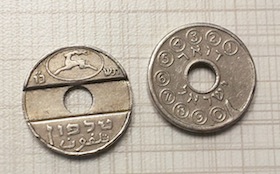
In the days prior to Israel’s becoming a “start-up nation,” telephone service was in pretty sad shape. For many years, most Israelis did not have phones in their homes. So, in the evening, you would wash up, dress up and go outside to use a public telephone. To make your call, you would load your pockets with asimonim, round, grooved, metal tokens. If you were calling someone outside your area code, you would hope that the weight of all the necessary asimonim would not tear your pockets.

photo - In the old days, Israelis would need to gather up their asimonim and head to the public payphone to make a call
In the old days, Israelis would need to gather up their asimonim and head to the public payphone to make a call. (photo by Hidro for Creative Commons)

Talking on payphones was fraught with problems. For starters, how would the person at the other end know you wanted to chat? Answer: the call had to be carefully arranged in advance, with both sides knowing the time, location and telephone numbers of the public telephones that were to be used.

It was an event requiring lots of patience. You had to stand in line with your neighbours, who also wanted to use the phone. You had to ignore the pressure from those behind you, telling you to hurry up and let someone else have a turn. Loud “discussions” occasionally broke out. People claimed they had a dahuf (urgent) call to make or receive. (In Israel, the term dahuf is thrown around a lot.) Thus, the beginning of the Israeli telecommunication era is essentially a study in how people function in groups.

Moreover, Israeli payphones seemed to have a mind of their own. You would be talking when, suddenly, in one big gulp, the telephone cruelly swallowed all your tokens. No amount of whacking the sides of the phone box or banging the receiver in its cradle would return the tokens. You were simply finished for the night. Talking on a payphone was such a tricky business, people would resort to sending postcards, as it was an easier way to relay a message.

By and large, Israeli households did not have telephones until the 1960s – as late as 1964, 55,800 Israeli homes were waiting for phones. If someone had acquired a telephone before the sixties, the person was either suspected of, or envied for, his or her protectzia, the fact that s/he “knew” somebody.

After a long wait – possibly for years – the phone company gave a household a black stationary phone with a short cord. Meaning that, to talk, you had to stay in one place. If you were lucky, nobody’s line would cross yours. If it did, you were stuck listening to their private affairs. People didn’t hang up right away because they didn’t know how long it would take to reconnect with friends. And, while on the subject of talking on the phone, to counter the high cost of doing so, employers with chatty employees or families with talkative children (or adult family members) went to the extreme of putting a lock on their dial phone.

After the implementation of the black telephones, changes came faster. Although the colour choice remained limited, Israelis could choose something other than a phone. They could also order a long phone cord or a press-button phone. Likewise, people could have phones in more than one room. Some advances have gone smoother than others. For example, fax installation and transmission continues to gravely challenge Bezek (the Israeli telephone company, established in 1984) and Bezek users.

In the international sphere, things also changed, albeit unevenly. In the late 1950s, Israel got hooked up to five continents. To place or receive an overseas call, you had to go to the central post office. You sat in a special glassed-in wooden booth while a special operator made the connection.

After a period of time, there were telecartim, or insertable phone cards for public phones. These cards became quite popular and many Israelis became phone card collectors and traders. I remember attending a telecart exhibit in Tel Aviv.

photo - There are a few remaining payphones in Israel
There are a few remaining payphones in Israel. (photo by Deborah Rubin Fields)

What feels like light years later, Israelis started equipping themselves with cellphones and, not long after that, with ear sets. Suddenly, it seemed that many people were experiencing severe mental health problems. In public, flaying arms and shouting at invisible people became rampant. I remember the first time I spotted a person exhibiting this behaviour. Only when he drew near did I see a thin black wire around his jaw and ear. I sighed, “another cellphone casualty.”

Israelis are apparently now making up for lost time by being glued to their mobile phones. They converse everywhere (on dates, in toilets, on trains and buses) about everything.

Some of the usage issues are (pretty close to being) unique to Israel. If you were under the impression that kashrut (kosher) is a food-related concept, think again. In Israel, as well as in a few Western countries, there are kosher cellphones. While they are not edible, they have been a boon to Israel’s ultra-Orthodox community. According to Cellular Israel, “a kosher phone is any phone that is approved and certified by vaad harabonim” (the rabbinic committee for matters of communications).

A kosher phone can only make and receive voice calls. Text messaging and emails will not work on a kosher phone. Moreover, for health, security, public services, water and electricity personnel, there is even a kosher phone designed to avoid breaking the laws of Shabbat. Technically, this mobile device may be dialed without connecting. There is even a kosher de-smarted (meaning that it has no web-browsing capability) smartphone.

Not all the changes appear to be positive. While more studies need to be done, Israeli researchers are beginning to think there is a real downside to cellphone use – it might even interfere with the biblical injunction to “be fruitful and multiply.”

As reported in Reproductive BioMedicine Online, there appears to be an association between higher rates of abnormal semen concentration and talking on cellphones for an hour or more a day, and talking on the devices as they are being charged. Among men who reported holding their phones within 50 centimetres of their groin, a higher rate of abnormal sperm concentration was found. Semen concentration was abnormal among 47% of those who stored their phone in their pants pockets, while it was abnormal in only 11% of the general male population. In brief, Israeli men might need to curb their cellphone use.

There might be another advantage to having an alternative to cellphones. Several years ago, when there was a wave of terrorism, having old-fashioned payphones around turned out to be beneficial. When an attack occurred, Jerusalemites whipped out their cellphones “to report in” with their families. With so many people simultaneously calling, the system crashed. It was the city’s remaining public phones that allowed people to reassure worried loved ones.

Admittedly, many of the above changes likewise happened elsewhere in the Western world; the telecommunication revolution has been a global revolution, after all. But, for many in Israel, each change or step of the way was met with a kind of curiosity or wonder that may have been singular to Israel. Today, that innocence has disappeared. For better or for worse, I’m not sure.

Deborah Rubin Fields is an Israel-based features writer. She is also the author of Take a Peek Inside: A Child’s Guide to Radiology Exams, published in English, Hebrew and Arabic.
Format ImagePosted on September 15, 2017September 14, 2017Author Deborah Rubin FieldsCategories IsraelTags communications, culture, Israel, technology
City overflowing with history

City overflowing with history

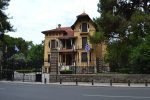
The early 20th-century Casa Bianca is today one of the locations of the Municipal Art Gallery of Thessaloniki (Salonika). (photo by Pappasadrian)

When you think Salonika, don’t think old, think ancient. Because of its geographic location on the Via Egnatia trade route, this northern Greek city traces its beginnings to 316 BCE. Even back then, who you knew was key. Thus, the town was named Thessalonike, after Alexander the Great’s sister, the wife of Cassandrus. Over the years, it has been called Thessaloniki, Saloniki or Salonika. (Note: sometimes the “k” is switched to a “c.”)

Jewish Salonika is a small community of about 1,000. But it was not always this way. Trade drew lots of different people to Thessaloniki, including Jews.

The original Jewish residents were Romaniot Jews – they spoke Greek and maintained a Hellenistic culture. In the beginning, Romaniot Jews and non-Jews held the same occupations and language. As a strategic town in the Byzantine Empire, both groups faced invasions. But, by the 1000s, the empire reached a level of stability that permitted flourishing Jewish scholarship. During this early phase of the Middle Ages, Jews from other areas, such as Anatolia, Germany and Hungary, settled in Salonika. In the late 1300s, more Jews arrived, this time from Provence, Northern Italy, Sicily and Catalonia.

What followed will sound familiar. Religious affiliation defined the Jewish Salonikan way of life: the Romaniotes had their synagogue, the Ashkenazim had theirs and the Jews from Italy and France had theirs. The situation intensified when Salonika received the many Jews that Spain and Portugal expelled. Back then, there was no worry about space and growth, as the Ottoman takeover had depleted the city’s population, but the influx of Sephardim was so great that, by the end of the 16th century, Romanite ritual was no longer practised. Ladino or Judeo-Español became the Jewish community’s language of choice.

For more than four centuries, half of Salonika’s population was Jewish, pinning it with the title, “Mother of Israel,” or “Madre d’Israel.” With so many Jews, it was not uncommon for the non-Jews of Salonika to be conversant in Ladino.

Not only that, but, as the Renaissance had influenced many of the Sephardi arrivals, Jewish Salonika received a significant secular and religious boost. The city became famous for its Jewish silk producers, weavers and wool dyers. Libraries, an influential talmudic academy, a printing press and a conservatory for Jewish religious singing all started during this golden period.

By the 1600s, the corrupt and inept Ottomans had started milking the merchant class. When, in 1636, Judah Kovo, the chief of the Salonika delegates, came to Murad IV to pay the annual “clothes tax,” the sultan capriciously ordered his execution. No Jew was well enough “connected” to stay the order. Unfortunately, at the same time, key foreign markets dried up. Having the means to escape, many wealthy Jewish merchants left. Other Salonikan Jews tried to escape troubles by following in the footsteps of a false messiah, Shabbetai Zvi.

photo - The 15th-century White Tower is one of the most-recognized monuments in Salonika
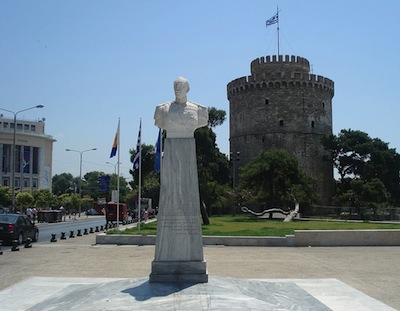
The 15th-century White Tower is one of the most-recognized monuments in Salonika. (photo by MaurusNR)

The Ottoman Empire was in decline by the 17th century. Nonetheless, in the late 1800s and early 1900s, Salonika’s well-to-do Jewish residents managed to open flour mills, brick factories, breweries, soap-works and silkworm nurseries, carpet and shoe-making factories and several large tobacco workshops. Most of the Jewish population, however, remained poor. Considerable philanthropy within the community eased some of the daily hardships and provided education for many of the male children.

During this period, Jewish economic, social and political pursuits varied: on the one hand, some influential Jews continued in commerce and banking; on the other hand, some Jews became heavily involved in socialism. (The Workers’ Union, for example, was started in 1909 by a group of Salonika Jews. It became the most important socialist organization in the Ottoman Empire.) The railroad and port were important factors. Amazingly enough, until 1923, the city’s port closed on Shabbat and Jewish holidays.

The social balance started to shift in the intervening years of the First and Second World Wars. The national government passed laws aimed at hellenizing the city. Slowly, the Jews – numbering 61,439 in a 1912 Greek census – became segregated (the horrendous 1917 fire probably abetted this process) and reduced many to second-class citizens by virtue of their not speaking the Greek language. Some antisemitic activities occurred, leading to a pogrom that drove many Jews to leave. (See the 2015 essay “Mother of Israel” by Dr. Lena Molho at greece-is.com/mother-of-israel.)

When the Nazis arrived, they herded Jews into a ghetto, then to Auschwitz. While the courageous actions of Archbishop Damaskinos Papandreou (and the Athens police chief) saved thousands of Greek Jews, the Nazis killed 96% of Salonika’s Jews.

The killing was not enough for the Nazis, however. They also destroyed Salonika’s 2,000-year-old Jewish cemetery. Headstones ended up as pavement, urinals, driveways and even a dance floor. More damage – both physical and emotional – was sanctioned by the Greeks themselves. The university was built right on top of the cemetery. Even today, there is still no campus memorial to the massacred Jews.

Interestingly, individual Jewish Salonikans might well tell you their families came from Spain – as if this migration happened only recently. (See Bea Lefkowicz’s PhD thesis, published in 1999 by the London School of Economics.) At least among the older generation, this seems to be part of their personal narrative.

Today’s Jewish community is tightly run. A council provides numerous services to its members. Rabbi Eliyahu Shitrit, an Israeli with Moroccan roots, has been the community’s spiritual leader for several years now.

Central Salonika has the feel of a port town like Haifa, but with its own unique history. Some of its Jewish-related buildings from the 19th and 20th centuries still stand. Even if you don’t believe in ghosts, there is something eerie about today’s Jewish Salonika. But visitors will also see how grand and vital this place once was. Walk around and you will see sites specifically related to the Nazi occupation of the city, but also the Baron de Hirsch Hospital, the Villa Allatini and Allatini Flour Mill, Villa Bianca, Villa Modiano, Villa Mordoh, the White Tower, the market synagogue, Yad l’Zikaron and the Museum of Jewish Presence in Thessaloniki.

Deborah Rubin Fields is an Israel-based features writer. She is also the author of Take a Peek Inside: A Child’s Guide to Radiology Exams, published in English, Hebrew and Arabic.

Format ImagePosted on September 15, 2017September 14, 2017Author Deborah Rubin FieldsCategories TravelTags Greece, history, Judaism, Salonika
Observations on China

Observations on China

A Magen David is still attached to the roof of a former synagogue in Harbin, China. (photo by Deborah Rubin Fields)

If a few years ago you had flown on an international flight from Beijing, China, you would have noticed a departure terminal display of Chinese marionettes. Like many other sites in China, there was more to this small puppet exhibit than met the eye. While the display explained the history of this colourful theatre, it ironically underscored the question about which we Westerners are most curious: who is pulling the strings in today’s China?

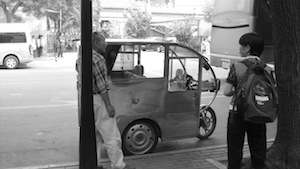
photo - A taxi in Beijing
A taxi in Beijing. (photo by Deborah Rubin Fields)

Our arrival point was Beijing. Right away, our local guide made critical comments about the regime. In her opening remarks, she stated the temperature in Beijing never went above 39°C. Why? Because then, she claimed, the government would have to give people the day off. So, officially, it never got hotter than 39°C. When she said this, I half-expected some secret police (perhaps our tour bus driver?) to arrest her for her sarcasm. As no one hauled her away, I started to rethink where I was and what I knew about China.

Our guide gave the group free time to wander Tiananmen Square. Like all those who visit the square, we passed through a metal detector and an X-ray security check. Yet, once past this point, uniformed police officers were few and far between. As my husband and I walked around the vast and infamous plaza, however, mounted cameras were everywhere. Nevertheless, everyone seemed oblivious to the fact that someone, somewhere was watching their every move. Chinese citizens and foreign visitors alike seemed preoccupied with one thing: taking photographs of each other.

This preoccupation with self expressed itself in different ways. For instance, several young Chinese awed me with their self-assurance. In Xian, a female guide-in-training confided in me that she wanted to do what she called exciting graduate work in the United States. She seemed undaunted by applying for permission to study abroad, having to take foreign entrance tests, getting accepted at an American university, finding funding and a challenging subject to study. She showed both marvelous confidence and a sense of mobility.

In a Jewish cemetery in Harbin, a young girl materialized by our side. Earlier, I had noticed her pushing her bike up the steep hill to the cemetery. It seemed she wanted nothing more than to practise her very limited English vocabulary. We huddled around her and the puppy she was carrying in her basket. She did not seem at all fazed that we weren’t able to understand her. We never learned where she came from (there were no homes close by) or where she was going. From our guide’s translation, all we learned was that she was 12 years old and that she had to leave to take care of her dog.

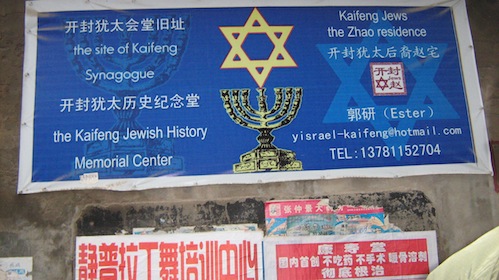
photo - A sign advertising a synagogue in the former Jewish quarter of Kaifeng
A sign advertising a synagogue in the former Jewish quarter of Kaifeng. (photo by Deborah Rubin Fields)

In Kaifeng, a 30-year-old female resident demonstrated a similar sense of unabashed certainty. Claiming Jewish descent, she expressed conviction in being able to build an entire synagogue. Although she seemed to have little knowledge of Judaism, much less about Jewish politics and/or philanthropy, she believed she would be able to achieve her goal.

In Beijing, one of our Chinese lecturers bombastically concluded that the Kaifeng Torah scrolls – which, according to the British Library, are from the 17th century – were fake. He offered no new study material; he simply and quickly discarded what others had written. Conversely, he offered a lengthy explanation of how, throughout his career, he had managed to be in the right place at the right time. And so it seemed, from his down-pat Silicon Valley gestalt and his outstanding command of American English.

I hoped that, on the road, I’d catch people “off guard.” In fact, there were lots of antics on the road. In big cities like Beijing and Shanghai, pedestrians had designated crosswalks and lights, but drivers didn’t honour them. People on foot would begin crossing with the “green walking man,” but would end up dodging approaching vehicles. Yet, no one yelled or raised a fist at the intruding scooters, cars, buses, trucks and taxis.

In traffic, drivers impulsively decided to make U-turns on multi-lane highways. Intriguingly, other drivers simply yielded. There was no Western-style road rage; Chinese drivers just let the others merge into traffic. There was likewise fascinating seen-but-not-seen vehicle activity: scooter owners pocketed illegal fares from passengers they had picked up, while parking attendants of an upscale spa discreetly covered the car licence plates of relaxing “Party” members.

Yet, even with all the upward mobility of the big cities, we saw signs of hardships, past and present. For example, a senior university lecturer and former member of the Chinese diplomatic corps, still carefully extinguished his cigarette butt, saving the remainder for a later smoke. On the way to our Harbin hotel, I saw people searching for clothes in a giant heap of cast-offs. Down the same road, people were picking up chunks of coal in a coal yard. We saw small dwellings where even my head (I am only 5’1”) would touch the ceiling.

Aha, I said to myself. I have found the “true” China in all this dust and pollution. The real China, I told myself, resembles the USSR of the late 1970s. But, as we kept driving, we reached the downtown skyscrapers and tall new apartment buildings. No beloved Chinese cranes (the ornithological family name is Gruidae) soared the horizon. They had been replaced by swiveling construction cranes.

Plastered on some of these buildings were the names of Western brand items. Not only were there ads for Western consumer products, but the Chinese models themselves all had surprisingly Western facial features. In fact, I later heard that Chinese plastic surgeons are doing a booming business “styling” Caucasian-type eyes.

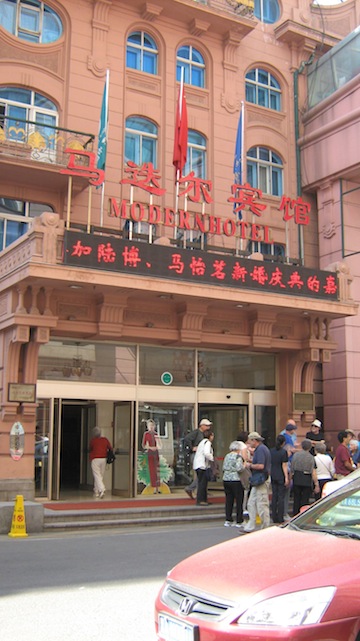
photo - The entrance to Modern Hotel, formerly owned by Harbin Jews
The entrance to Modern Hotel, formerly owned by Harbin Jews. (photo by Deborah Rubin Fields)

And what of China’s Jews? The merchant economy of ancient China brought Jewish traders to Kaifeng as early as the eighth century. The community thrived, reaching its height in the 17th century at 5,000 members. But, following generations of war, poverty and religious isolation, the community significantly declined. Some claim that Kaifeng Jews were victims of their own success, as they assimilated so well.

Wanting to establish a foothold, Russia encouraged its Jews to settle in Harbin in the 19th century. By 1908, Harbin had a diverse Jewish community of 8,000.

Shanghai first saw Russian Jews fleeing czarist persecution and massacres in the early 1900s, continuing through the 1917 revolution. Then came Jews from Baghdad, Bombay and Cairo, including several financially successful families. In the 1930s and early 1940s, more families from Germany and Nazi-occupied areas fled to Shanghai.

Most of China’s Jews did not want to live under communism. So, after the Second World War ended, they left for either the West or Israel. Now, Beijing has a transient Jewish community of international businesspeople.

***

Even today, one party in China is calling the shots. Democratic freedoms such as multiple political parties or a free press are missing, so some elite group is still pulling the symbolic strings of millions of people. But the strings appear to have a lot of slack and the go-phrase ironically comes from other cultures: seize the day! In this, the Chinese seem to be having a lot of success.

Deborah Rubin Fields is an Israel-based features writer. She is also the author of Take a Peek Inside: A Child’s Guide to Radiology Exams, published in English, Hebrew and Arabic.
***

Sidebar …

In 2014, the Chinese film industry produced a movie entitled Dr. Rosenfeld, by director Xu Zongzheng. The movie, which stylistically calls to mind old Soviet movies, was recently screened in Jerusalem.

Dr. Jakob Rosenfeld came to China as a Viennese-Jewish refugee from Nazi Austria. A urologist and gynecologist by training, he joined Mao’s army to fight the Japanese. He was elevated to the rank of general and to a postwar job as health minister in the Manchurian government. At the end of the film, viewers read that, in 1952, Rosenfeld died in Tel Aviv of a heart attack.

– DRF

Format ImagePosted on July 21, 2017July 21, 2017Author Deborah Rubin FieldsCategories TravelTags China
Jews under the rule of Timur

Jews under the rule of Timur

A statue of Amir Timur. (photo by Deborah Rubin Fields)

The 14th century was not a great time for European Jewry, to say the least – there were various kinds of persecution, including forced conversions, expulsions and massacres, especially in Western Europe. Yet, the Jews of what is now Uzbekistan got through this period relatively unmolested.

Turko-Mongol military leader Timur (Iron), who ruled from 1370 to his death in 1405, is also known historically as Tamerlane, from the Persian Timur-i lang (Timur the Lame), and Amir Timur (or Temur).

Timur conquered central Asia and parts of India – today’s Iraq, Iran, Afghanistan, Pakistan, Azerbaijan, Georgia, Uzbekistan, Turkmenistan, Tajikistan, Kyrgyzstan, large chunks of Turkey and Syria, and the northwestern portion of India. While it is estimated that his armies killed 17 million people, about five percent of the global population at the time, it seems he left Jews alone.

“Over the years, the moral justification for [Timur’s] campaigns … had evolved into a formality,” writes Justin Marozzi in Tamerlane: Sword of Islam, Conqueror of the World. “If the objects of his attentions happened to be Muslim, as they almost invariably were, then they had become bad Muslims. If they were infidels, so much the better.” Yet Michael Shterenshis, in Tamerlane and the Jews, contends that Timur did not consider Jews as infidels, at least not infidels needing to be violently eliminated, perhaps because they had no political ambitions and all they sought was Timur’s protection.

It would seem that Timur’s Jews were of more service alive than dead – which is a good thing, as Timur once reportedly constructed 28 towers from 70,000 of his enemies’ skulls, each tower consisting of 2,500 heads. According to Shterenshis, the ruler primarily used his Jewish subjects as taxpayers and skilled artisans. Jewish weavers and dyers contributed greatly to his efforts to rebuild the region and to reinstitute the abandoned Silk Road, which connected Europe to Asia.

Yu Datkhaev’s The Bukharan Jews is mentioned in Alanna E. Cooper’s Bukharan Jews and the Dynamics of Global Judaism. According to Cooper, Datkhaev argues that the term “Bukharan Jews” came to be after Timur moved several hundred Jewish families from Bukhara to Samarkand to assist in overhauling Samarkand, his designated capitol. These Jews reportedly lived near Timur’s recently rehabilitated and stunning Registan.

Timur’s Jewish subjects appear to have been loyal followers. Indeed, while Jews are not mentioned in his court history, there is a preserved letter from Herat physicians who ask the permission of Shah Rukh (one of Timur’s sons) to treat Timur’s injured soldiers. Significantly, they are offering their services to the state army, notes Shterenshis.

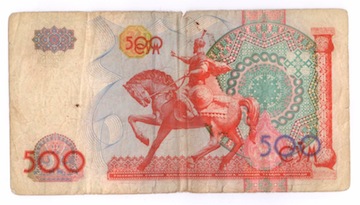
photo - Timur depicted on Uzbekistan’s 500 som note
Timur depicted on Uzbekistan’s 500 som note. (photo by Deborah Rubin Fields)

Timur seemingly responded in kind. He never issued anti-Jewish proclamations, laws, orders or restrictions. He never oppressed the Jews for being Jews, says Shterenshis. Under Timur, he adds, Jews were able to own houses and land, and they could be farmers – the regime did not impose upon Jews the role of moneylenders.

Jews under Timur’s reign were better off than the Jews of Europe and those in the Mamluk Sultanate, but were worse off than those who lived under the Mongols of China. Under Timur, Jews enjoyed a legal, but inferior status, writes Shterenshis. In contrast to their appointed role in other countries, Timur’s Jews were not particularly used as translators or envoys and their main occupations seem to have been as artisans, local merchants and doctors, says Shterenshis, noting that Jewish doctors under Timur did not enjoy the enhanced status they had previously, from the 10th to 12th centuries. Nonetheless, in local Jewish legends, Tamerlane is painted in a favourable light, says the historian, and is even supposed to have moved the Prophet Daniel’s remains to a tomb in Samarkand.

Some sources indicate that the Jewish presence in Samarkand pre-dates Timur’s rule. Tenth-century Samarkand (as well as Khorezm, Osh and Kokand) apparently hosted famous Jewish scholars, known in the singular as khabr, a word derived from the Hebrew chaver (friend or colleague), “which they used to distinguish themselves from ‘commoners,’” writes Irena Vladimirsky in “The Jews of Kyrgyzstan” (bh.org.il/jews-kyrgyzstan).

Indeed, the notion that Jews had been living in Central Asia prior to Timur’s rise to power is reinforced by the late-12th-century traveling Jewish chronicler Binyamin M’tudela (Benjamin of Tudela), who described this community as having as many as 50,000 members, among them “wise and very rich men.” Furthermore, the Samarkand community apparently appointed someone as nasi (head) of their community, who collected the requisite taxes of a recognized ahl al-demma (protected group).

In that period, Jews reportedly made Samarkand a major Jewish centre, and community members contributed to the construction of Samarkand’s aqueduct.

In the centuries after Timur, Jews came to dominate the region’s textile and dye industry, according to historian Giora Pozailov.

Uzbekistan’s aging Jewish population is now mainly concentrated in the cities of Tashkent, Samarkand and Bukhara. Even before the demise of the Soviet Union, Uzbek Jews began leaving, mainly for the United States and Israel. As the JTA article “Dwindling at home, Central Asia’s Bukharian Jews thrive in

Diaspora,” which can be found at ucsj.org, notes, Bukhara’s two synagogues almost never open at the same time, so that at least one of them has a minyan.

Deborah Rubin Fields is an Israel-based features writer. She is also the author of Take a Peek Inside: A Child’s Guide to Radiology Exams, published in English, Hebrew and Arabic.
Format ImagePosted on June 23, 2017June 21, 2017Author Deborah Rubin FieldsCategories WorldTags Diaspora, history, Tamerlane, Temur, Timur, Uzbekistan
Israeli food evolution

Israeli food evolution

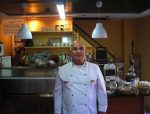
Chef David Polivoda (photo from David Polivoda)

When people reflect on Israel’s transformation since the establishment of the state in 1948, they often focus on geographic, political, economic and social changes. Slightly less tumultuous, but no less dramatic, has been Israel’s culinary development. In a country where people like to eat, and to eat a lot, the past 69 years has witnessed an amazing transition in Israeli food habits.

In the first years of statehood, for example, salad fixings were hard to come by, largely due to Israel’s tzena, or austerity program (1949-1959). Yet, even well after the lifting of the tzena, a salad meant finely chopped tomatoes and cucumbers, maybe with some onion and parsley, with a little lemon juice and olive oil. And this remains a classic Israeli salad. However, the days of such limited ingredients have come and gone.

While certain fruits and vegetables are, of course, seasonal – when you see ample supplies of strawberries and artichokes, you know Pesach is on the way – there is no end to the variety now available. Israeli farmers seem to have mastered the ability to grow just about everything. And this is just the tip of the iceberg, as former chef David “Poli” Polivoda explained about the evolution of Israeli food and palates.

First, a bit about Polivoda’s professional background. He began cooking shortly after his army service. Back then, he lived on a kibbutz by the Dead Sea, where he was part of a soldiers’ group that settled in the area. After his discharge, he studied carpentry and animation, but discovered – to the chagrin of the animation studio director – that his true vocation was cooking. He began his career in the Kibbutz Ein Gedi kitchen and, afterward, in its guesthouse.

Since then, Polivoda has worked in Jerusalem corridor guesthouses, on Magic One cruise ships, at the Osem food conglomerate, at various elite Jerusalem hotels, including the King David, and has done chef stints in Europe and in the United States. He also has been a restaurant inspector and now gives culinary tours of Jerusalem’s Mahane Yehuda.

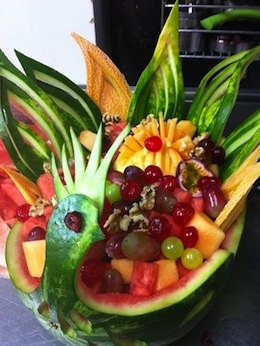
photo - Chef David Polivoda’s sculpted fruit bowl
Chef David Polivoda’s sculpted fruit bowl. (photo from David Polivoda)

When he first started out, cooking as a profession was not highly regarded. Nowadays, there are countless cookbooks, culinary websites and workshops, televised cooking shows and chef competitions – his chosen profession has earned a “wow” rating. In Israel, Polivoda said there are several places to learn to be a professional chef and there are certificates and national (government) achievement-based licences, as well as more than one association of Israeli chefs.

When he was starting out, a typical meal in a nice hotel meant a steak dinner. Meat was, and still is, relatively expensive, and much of it is imported. Back then, there were few restaurants and the average Israeli’s financial situation did not permit dining out. At home, Israelis typically ate an evening meal of bread, salad, eggs, cheese and plain yogurt (pretty close to what people ate for breakfast).

Polivoda said kashrut limitations have resulted in a lot of creativity as far as food preparation is concerned. For example, Italian cooking has become very popular with Israelis, despite the prohibition against mixing milk and meat – in downtown Jerusalem alone there are at least six kosher Italian dairy restaurants. Israeli chefs have learned to successfully produce tasty meatless Italian dishes.

With respect to hotel meals, Polivoda said the meals are generally much larger than those most Israelis would eat at home. He said in a hotel restaurant, people eat at least a third more. In hotels, buffets are set up for breakfast, lunch and dinner and the focus is on a display of abundance, he explained. Salads were, and remain, an important part of the buffet, but, according to Polivoda, an economic reason lies behind the plentiful spread – a buffet means less wait staff is needed.

He explained that, while hotel management seeks a high level of prepared food, it wants to have it made as cheaply as possible. Thus, restaurants might lower their costs by using cheaper raw ingredients. Two examples of this are Israeli mock chopped liver made from eggplant, rather than from liver, and “Ben-Gurion rice” or ptitim, which are really tiny pieces of hard wheat, that is, pasta.

Still, Polivoda said it is the chef who makes the lasting impression on guests, not the eatery’s manager. And, he said, when people eat out today, they expect more than they did in the past.

Eating habits in Israel have changed for a variety of reasons.

First, Israel is economically better off overall. Many Israelis can afford to travel abroad and those who do come back want to re-experience the tastes they enjoyed during their travels.

As well, Israel now imports a wide range of food products, so people are exposed to more variety. Additionally, the Israeli food industry not only services the increasingly cosmopolitan local population, but has made major inroads in exporting agricultural products.

Finally, Polivoda noted that, on the one hand, Israelis are proud of their cultural background while, on the other hand, they try to turn everything into a business. One result is a broader diversity of choices, with more ethnic restaurants trying to cater to an increasingly diverse population.

However, it’s a tough industry, and Polivoda predicted that many restaurants would come and go, as there are people who go into the business without understanding how hard it is to stay afloat. Meals will become somewhat less plentiful, he said, also noting that there is much waste in the industry.

He presented two optimistic points: prices for dining out will decrease and, as the in-gathering of exiles continues, with newcomers wanting to enjoy something from their roots, ethnic food will continue to have a place in Israeli cuisine.

Deborah Rubin Fields is an Israel-based features writer. She is also the author of Take a Peek Inside: A Child’s Guide to Radiology Exams, published in English, Hebrew and Arabic.
Format ImagePosted on June 16, 2017June 15, 2017Author Deborah Rubin FieldsCategories IsraelTags food, history, Israel
A Jewish gladiator?

A Jewish gladiator?

A painting from Pompeii showing gladiators fighting. It is housed in the National Archeology Museum in Naples. (photo by Deborah Rubin Fields)

Among the fabulous finds of Pompeii is the helmet of an apparently Jewish gladiator. Who would have thought?

As many readers might know, Pompeii was the unfortunate recipient of Mount Vesuvius’s 79 CE wrath. Many gladiator helmets have been dug up in Pompeii’s excavations. (Unfortunately, this collection is kept in storage at Naples’ National Archeology Museum.)

In the paper “A Jewish Gladiator in Pompeii,” historian Dr. Samuele Rocca notes that one of these stored helmets stands out for its unique decoration. While there are images on other recovered helmets and weapons, they usually come from pagan iconography. On this one helmet’s forehead relief, however, there is a seven-branched palmetto tree with a cluster of dates on each side.

During the time of the gladiators, the palmetto symbol was apparently employed in only one other place – as an engraving on Judaean coins. These coins, Rocca says, were associated with Jews. Indeed, the symbol was jointly chosen by the local Jewish leadership and the Roman procurator. Thus, the palm tree symbolized both the religious and secular ideals of the late Second Temple Jewish leadership.

photo - The amphitheatre in Pompeii
The amphitheatre in Pompeii. (photo by Deborah Rubin Fields)

Moreover, Rocca reports that a small number of other Jews came to Pompeii both before the exile of 70 CE and afterward. In Pompeii, they did not form a Jewish community as such, but apparently Jewish women lived at Pompeii.

Remarkably, archeologists have excavated lists of Pompeian names. Apparently, during this time, Maria was a Jewish name. One Pompeii woman bearing that name worked with textiles.

Another woman with the same name lived in the Casa dei Quattro Stili, although her rank and societal position remain a mystery. It is theorized that the most well-known Maria was a prostitute, who worked in the Thermopolium of Asellina, in Via dell’Abbondanza.

While Prof. Andrew Wallace-Hadrill, in Herculaneum, Past and Present, writes that food could not have stayed hot in the thermopolia’s terracotta containers, others maintain that the thermopolia were the precursors of today’s restaurants. In brief, this explanation makes a case for Maria to have been a barmaid or waitress.

Estimates are that, in 70 CE, Titus took 20,000 Jewish slaves to Rome, so it is not surprising that Jews arrived in Pompeii as slaves. In fact, from the many documents salvaged from Herculaneum – another town severely affected by that same Vesuvius eruption – we know that Roman society was organized along the lines of freeborn, enslaved, freed and those holding a special status. According to Wallace-Hadrill, “It is a society in which your legal status has an overwhelming importance…. But a society characterized by movement between status groups … the third group comprised those who were neither freeborn nor regularly set free … but who had nevertheless … been promoted to full citizenship.” On still-legible marble panels listing residents’ names, he writes, “only a sixth of the Roman male citizens in Herculaneum could name their freeborn fathers … it leaves them massively outnumbered.”

After Mount Vesuvius’s horrific 79 CE eruption, you may well wonder how so much Herculaneum documentation is still available. Wallace-Hadrill explains, “Pompeii was blanketed in ash and pumice pebbles, while Herculaneum was covered in the fine, hot dust of pyroclastic surges and flows, result[ing] in the extensive preservation at Herculaneum of organic material – principally wood, but also foodstuffs, papyrus and cloth.”

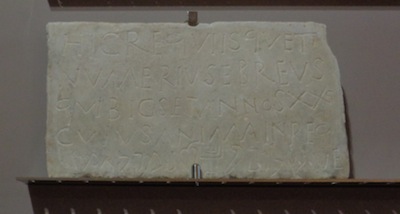
photo - The tombstone for the young Jewish Numerius, written in both Latin and Hebrew, which can be seen at the National Archeology Museum in Naples. Note the menorah in the middle of the bottom line
The tombstone for the young Jewish Numerius, written in both Latin and Hebrew, which can be seen at the National Archeology Museum in Naples. Note the menorah in the middle of the bottom line. (photo by Deborah Rubin Fields)

As somewhat of an aside, Salvatore Ciro Nappo, in Pompeii, notes that the Pompeians apparently did not consider Mount Vesuvius dangerous. One indication of this is that the House of the Centenary has a lararium (shrine niche for household gods) fresco in the servants’ rooms showing Bacchus, a thyrsus (a type of staff or wand) and a panther in front of the mountain. Vineyards entirely cover the mountain, presumably indicating Vesuvius brought festivity and prosperity.

Today, archeology is, for the most part, an appreciated study, but that was not always the case. According to Wallace-Hadrill, when medieval rulers wanted to tunnel down into the ruins of Pompeii, they ran into opposition from the Inquisition. Sanctioned excavation – haphazard as it first was, with some kings taking “the good stuff” or even going so far as to destroy finds so as not to share the wealth – did not begin until the 1700s.

Archeology has shown that nearby Naples, located 14 miles southeast of Pompeii, had a bona fide Jewish community pre-dating the Jewish arrival in Pompeii. For trade reasons, Jews started settling in this port city in the first century BCE. Life was tolerable for them, even as the Roman Empire started falling apart. When, in the late fifth and sixth centuries CE, Justinian tried to regain the Roman Empire from the Germanic Ostrogoths, the Jews of Naples fought against Justinian.

These Jews apparently “blended in” to the extent that they inscribed their tombstones almost entirely in Greek or Latin. Significantly, while the travertine (the land-formed version of limestone) grave markers at Naples’ National Archeology Museum are usually not in chiseled Hebrew, they do contain obvious Jewish symbols such as menorot, lulavim, etrogim and shofarot. On one tombstone, the inscription reads: “Here lies Numerius, a Jew, who lived for 26 years and whose soul is in peace. Shalom, Numeri[u]s, amen.”

The French Angevins oppressed the Jews in the 13th century, but their Aragon successors (in the 1400s) basically left them in peace. Naples thus became a major centre of Jewish book production during the 15th century. Then, as happened in other European countries, the Jews were expelled in 1541, only allowed back in generations later. In the 1800s, the Rothschilds, who were the banking concern in Naples, helped restart the Jewish community. In the 1920s, the community grew to 1,000. While 80% of Italian Jewry survived the Holocaust, Naples’ current Jewish population is about half its former size, with even fewer people belonging to Naples’ synagogue.

Deborah Rubin Fields is an Israel-based features writer. She is also the author of Take a Peek Inside: A Child’s Guide to Radiology Exams, published in English, Hebrew and Arabic.
Format ImagePosted on March 31, 2017March 31, 2017Author Deborah Rubin FieldsCategories TravelTags archeology, gladiators, history, Pompeii
Making Israeli cities bloom

Making Israeli cities bloom

Planting trees as a community project in Jerusalem. (photo by Ariella Tzuvical)

Are Israeli city-dwellers still attached to the land? The answer is yes, but the connection to the land plays itself out in a surprising way.

By and large, today’s Israelis are an apartment-bound lot, but many dream of having a house with a garden. Those who are lucky enough to have a small garden – or an apartment with a patio – plant flowers and even grow fruit. Depending on the season, many Israelis grow grapes, oranges, tangerines, pears, grapefruits, lemons, kumquats, olives and pomegranates. Interestingly, some of these items have been grown in Israel since ancient times: “a land of wheat and barley, and grapevines and fig trees and pomegranates; a land of olive trees and honey … you shall eat and be satisfied.” (Deuteronomy 8:7-10)

Community gardening is a budding and not insignificant phenomenon taking root in Israeli cities. In Jerusalem alone, there are 70 community gardens. Municipalities, community centres, local branches of national nature preservation organizations (like Hachevra L’haganat Hateva), pro-environment charitable bodies (like Keren Sheli) and the Ministry of Environmental Protection are teaming up to help urban residents create these gardens. They are assisting interested apartment dwellers by providing seed money, land or know-how to get projects off the ground and onto porches, patios and even rooftops.

Why do urban Israelis grow fruits and vegetables? One young mother from Tel Aviv commented in a Yediot Ahronot article that she wants her children to understand that produce does not come from the supermarket.

Of course, most people want to use their homegrown fruits and vegetables in their regular cooking and preserving. But some grow fruit, such as the pomegranate, for special holiday consumption. For these gardeners, the following Rosh Hashanah blessing takes on added significance: “May the desire of our G-d and the G-d of our Fathers be to increase our merit like the [seeds of the] pomegranate.”

The Jerusalem-based Melamed family says it gardens for exercise, art and culture. They maintain that gardens produce cultured people. Another Jerusalemite looks at her blossoming pear tree and says that keeping a garden enriches a person’s life.

Although Israel, like most other Western countries, has largely switched from being an agrarian society to a technological society, places like the Jerusalem Botanical Gardens believe that gardening has a place. With that in mind, the facility has hired staff to make urban gardening more relevant to those living in Jerusalem.

As well, many Israelis seem to maintain the notion that G-d provides the ingredients for surviving off the land. Thus, when Jews celebrate the rebirth (or reproduction) of the Jewish year, they read: “See, I give you every herb, seed and green thing to you for food.” (Genesis 1:28-30) The annual Torah reading about producing in order to have food has helped fix the idea in the Jewish psyche.

Dr. Rabbi Dalia Marx wrote in A Torah-Prescribed Liturgy: The Declaration of the First Fruits: “The declaration of the first fruits is a bold text.” In Deuteronomy 26, Moses addresses the Israelites on the plains of Moab, “calling upon the Israelites wandering in the wilderness with no permanent ties to the earth to imagine themselves as farmers securely living in their own land. But simultaneously, the text demands of farmers living in their own land that they remember their days as wanderers in the wilderness – and necessarily … ponder the fragility of their own lives.”

When bringing the first fruits of the land to the Temple, the farmer thanks G-d for the bounty in a manner providing for “the entire recapitulation of national history.” In essence, “the farmer teaches himself that the final chapter in the national story is unfolding in real time.”

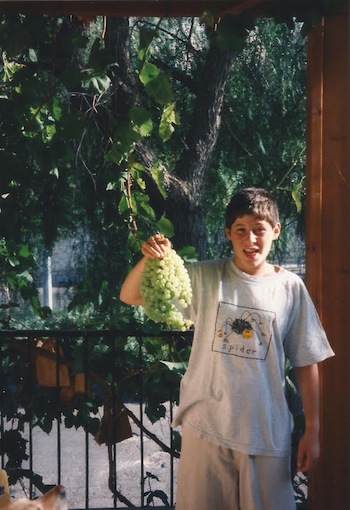
photo - Ilan Rubin Fields holds a cluster of grapes from the family’s grapevine
Ilan Rubin Fields holds a cluster of grapes from the family’s grapevine. (photo by Deborah Rubin Fields)

It should not come as a surprise that Israelis still seriously celebrate the agricultural component of their Jewish pilgrimage holidays. At Sukkot, Israelis everywhere erect sukkot, or booths, just as growers did in their fields thousands of years ago. And, of course, during Sukkot, observant Jews around the world purchase and bless the following combination of plants and fruit: the etrog (citron), lulav (palm), hadas (myrtle) and aravah (willow). These are known as the arbah minim, the four species.

The Passover seder plate contains greens that remind Jews that spring has arrived in Israel, while Shavuot commemorates the harvest that began around Pesach time and ended seven weeks later. For many years, this agricultural holiday had special meaning for those living in Israel, as the early settlers lived off farming. Today, Israel holds a variety of festivals showing off the bikurim, or first produce of the season. These holiday celebrations focus on the production of dairy products and honey.

In early winter, Jews throughout the world celebrate Chanukah by eating foods prepared in oil. Some food researchers maintain this may be related to the fact that Chanukah coincides with the end of the olive harvest. In late winter – except during the Shmitah year, when Jewish law dictates that the land be given a chance to rest – Israeli schoolchildren are out in force planting new trees on Tu b’Shevat, the birthday of the trees, which is increasingly celebrated with a special seder.

Avi Eshkoli, a veteran Jerusalem-area gardener, reported that he had seen more people trying to observe the Shmitah than he had ever witnessed before. He noted that the practice covers the gamut of Israeli religiosity and spirituality.

Part of what continues to tie Israelis to gardening is deeply implanted in Jewish tradition. There is no escaping the fact that Jewish holidays are connected to natural events. Every Jewish holiday begins with a blessing over the wine, the fruit of the vine, and special holiday texts such as Shir HaShirim (the Song of Songs), which is read on Pesach, and Megillat Ruth (the Book of Ruth), which is read on Shavuot, are ripe with references to gardens and fields.

The blessing over the wine is even part of the Jewish wedding ceremony. And, moreover, before the Sabbath eve meal, Jews recite the Kiddush that recalls G-d’s creation. Thus, at least once a week, many Jews are reminded of the process of birth, growth and production in the natural world.

Dr. Rabbi Marx points out that the “new” liturgy for Yom Ha’atzmaut, Israeli Independence Day, incorporates the concept of first fruits, reflecting “that we are home now, but acknowledg[ing] both the process leading to this moment and the fact that the dwelling in the land of Israel is not obvious or guaranteed.”

For Israelis then – and perhaps for many Jews in the Diaspora – urban gardening is not just about growing plants, but about growing spiritually as a people.

Deborah Rubin Fields is an Israel-based features writer. She is also the author of Take a Peek Inside: A Child’s Guide to Radiology Exams, published in English, Hebrew and Arabic.
Format ImagePosted on March 10, 2017March 8, 2017Author Deborah Rubin FieldsCategories LifeTags gardening, Israel, Judaism, urban gardens
Israel’s first whisky distillery

Israel’s first whisky distillery

Tours and tastings of Milk and Honey distillery can be booked on certain days. (photo by Ariel Fields)

Is a Bronfman family saga about to begin again? While it has a ways to go before reaching the heights of the once-mighty Seagram empire, Milk and Honey, Israel’s first whisky distillery, may one day have the last laugh. In the meantime, its young investors and workers seem to be having a good time.

I was raised to believe Jews don’t drink anything stronger than wine or the occasional beer. There were, of course, notable unexplained exceptions, as on Shabbat and holidays, when men drank schnapps or Slivovitz at the synagogue’s kiddush. My tasting and tour of Milk and Honey has forced me to change my thinking.

About four years ago, a small group of friends, all Israeli high-techies and entrepreneurs, got together to create Israel’s first whisky distillery. While it is a bit hard for me to comprehend people actually “dreaming” about starting a whisky business, don’t we attribute Herzl to saying, in 1902, “If you will it, it is no dream; and if you do not will it, a dream it is and a dream it will stay”? And this group did pick a pretty Zionist name for its company.

Located in south Tel Aviv, about a 15-minute walk from Old Jaffa, the physical plant is less than a half-block long. The building is basically divided into two sections, the liquor-making facility and the visitors centre. One section looks out on the other from a full-length no-secrets-here glass divider. Six people currently work at Milk and Honey.

As a newbie to whisky-making, I did not know that basically just three ingredients go into single malt whisky: malting barley, water and yeast. Milk and Honey uses Israeli-sourced water. The barley is imported from England’s Muntons company and then mashed at Milk and Honey. The rest of the process – the fermentation, distillation and maturing – also take place on-site.

Milk and Honey has an Israeli-made fermentation tank. One of its two stills is new, but the other was constructed in 1983. It has a capacity of 9,000 litres. To my way of thinking, copper would give the whisky a funny taste, but our guide said they purposely built the still from copper, in order to give the whisky a more delicate taste.

The whisky maturation room has an elaborate alarm system, especially against fires, as the whisky is stored in combustible, wooden barrels.

In big whisky-producing countries such as the United States, Ireland, Scotland and Japan, single malt whisky needs to sit in its cask (barrel) for three years. While lots of people complain about Tel Aviv’s high humidity and temperatures, these factors might ultimately be advantageous to this type of business. Estimates are that the heat and humidity will speed up Milk and Honey’s whisky maturation process, making it two to 2.5 times faster than the above countries’ products.

Still, it will be awhile before Milk and Honey single malt whisky is sold en masse in bottles. The company does plan, however, to market some kind of limited series, which will be periodically released over the next three years.

In the meantime, Milk and Honey has started selling a few types of other liquor, including one called New Make and another called Levantine Gin.

As its name implies, the New Make does not go through barrel aging; its chief use is apparently for cocktail-making. The Levantine Gin is noteworthy for its Middle East quality – it is made with za’atar, a Middle East plant with a thyme-like taste, and other botanicals purchased locally at Tel Aviv’s Levinsky Shuk (Market). While not mentioned by our in-house guide, the use of za’atar ties this liquor to ancient Jewish roots (no pun intended). Za’atar (or “eizov,” in Hebrew) is mentioned in the Torah: in Exodus, Leviticus and Numbers, and references are also made in Kings I and Psalms. Moreover, although he did not prescribe za’atar specifically for hangovers, 12th-century philosopher, astronomer and physician Maimonides (aka Rambam) prescribed za’atar for headaches.

Impressively, these two products have already won awards. Just the day before I visited Milk and Honey, the Levantine Gin had won a gold medal and the New Make a silver at the 2016 Terravino Mediterranean International Wine and Spirit Challenge. Not a bad start for a new company.

All of Milk and Honey’s liquor is certified kosher. Tours and tastings are available on Tuesdays, Thursdays and Fridays by prior arrangement. See mh-distillery.com/visit-our-distillery.

Deborah Rubin Fields is an Israel-based features writer. She is also the author of Take a Peek Inside: A Child’s Guide to Radiology Exams, published in English, Hebrew and Arabic.
Format ImagePosted on February 10, 2017February 8, 2017Author Deborah Rubin FieldsCategories IsraelTags distilleries, Israel, whisky

Posts pagination

Previous page Page 1 … Page 4 Page 5 Page 6 … Page 8 Next page
Proudly powered by WordPress