Skip to content
  • Home
  • Subscribe / donate
  • Events calendar
  • News
    • Local
    • National
    • Israel
    • World
    • עניין בחדשות
      A roundup of news in Canada and further afield, in Hebrew.
  • Opinion
    • From the JI
    • Op-Ed
  • Arts & Culture
    • Performing Arts
    • Music
    • Books
    • Visual Arts
    • TV & Film
  • Life
    • Celebrating the Holidays
    • Travel
    • The Daily Snooze
      Cartoons by Jacob Samuel
    • Mystery Photo
      Help the JI and JMABC fill in the gaps in our archives.
  • Community Links
    • Organizations, Etc.
    • Other News Sources & Blogs
    • Business Directory
  • FAQ
  • JI Chai Celebration
  • JI@88! video

Recent Posts

  • Story of Israel’s north
  • Sheltering in train stations
  • Teach critical thinking
  • Learning to bridge divides
  • Supporting Iranian community
  • Art dismantles systems
  • Beth Tikvah celebrates 50th
  • What is Jewish music?
  • Celebrate joy of music
  • Women share experiences 
  • Raising funds for Survivors
  • Call for digital literacy
  • The hidden hand of hate
  • Tarot as spiritual ritual
  • Students create fancy meal
  • Encouraging young voices
  • Rose’s Angels delivers
  • Living life to its fullest
  • Drawing on his roots
  • Panama City welcoming
  • Pesach cleaning
  • On the wings of griffon vultures
  • Vast recipe & story collection
  • A word, please …
  • מארק קרני לא ממתין לטראמפ
  • On war and antisemitism
  • Jews shine in Canucks colours
  • Moment of opportunity
  • Shooting response
  • BC budget fails seniors
  • Ritual is what makes life holy
  • Dogs help war veterans live again
  • Remain vital and outspoken
  • An urgent play to see
  • Pop-up exhibit popular
  • An invite to join JWest

Archives

Follow @JewishIndie
image - The CJN - Visit Us Banner - 300x600 - 101625

Byline: Cynthia Ramsay

CANCELED – See The Runner at PuSh

CANCELED – See The Runner at PuSh

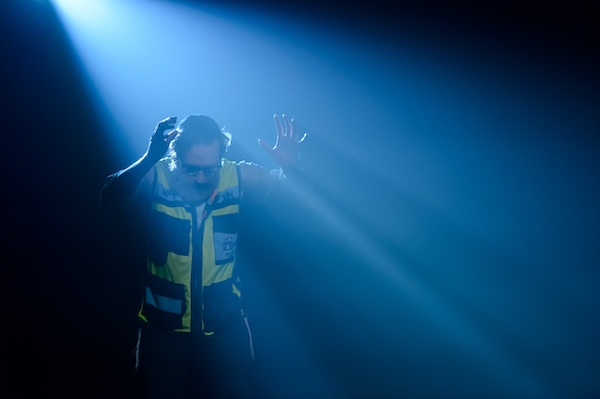
Christopher Morris as Jacob in The Runner, which is at Fei and Milton Wong Experimental Theatre Jan. 24-26. (photo by Dylan Hewlett)

Since this article was published, PuSh has canceled the production. For the statement, click here.

Among the offerings of this year’s PuSh International Performing Arts Festival is Christopher Morris’s The Runner, which runs Jan. 24-26 at Fei and Milton Wong Experimental Theatre.

The one-man play is dedicated to Jakoff Mueller, a ZAKA member in Israel who died in 2018. The main character is Jacob, an Orthodox Jew with the Israeli volunteer emergency response organization. In one of the emergencies depicted, Jacob helps an injured Arab woman before he tends to a soldier, and his choice has significant repercussions. The actor in the role – in Vancouver, it will be Morris – performs the whole 60 minutes of the play while walking/running on a treadmill.

The Jewish Independent interviewed Morris by email before the playwright stepped back from doing media after a scheduled Victoria run of the play was canceled due to pressure from protesters, who objected to the story being told “from an exclusively Israeli perspective.”

JI: Can you share more about your relationship with Jakoff Mueller, how you came to meet him, to be invited into his home, and how he contributed to writing of The Runner?

CM: I first met Jakoff in 2009 at a small get-together in the house I was staying at in Jerusalem. This was during my first research trip to Israel to write this play. The owner of the house was a friend of Jakoff and she thought it would be interesting for me to speak with him, seeing as I was doing research about ZAKA. Jakoff was an incredibly thoughtful man with a great sense of humour, and we hit it off. He invited me to come and visit him where he lived in northern Israel and I did, over many occasions during the research trips I made to Israel. Though no event or fact from Jakoff’s life is represented in the play, his compassion for valuing all human life and his spirit of questioning is in the play. The world was a better place with him in it.

JI: When did you start writing The Runner and when and where did it première?

CM: My curiosity with ZAKA began when I was a teenager in Markham, Ont., in the 1990s. I heard a media interview about the work ZAKA did and it really struck me. I kept thinking that ZAKA’s work would be an interesting premise for a play but didn’t know how to do it. So, in 2009, I made my first trip to Israel to begin researching the play. I spent nine years (on and off) writing it and it premièred at Theatre Passe Muraille in Toronto in 2018.   

JI: You’ll be playing the role of Jacob, but I see in much of the material Gord Rand as the actor. Are you stepping in for him, does the role rotate, is he no longer part of the production?

CM: Yes, I’ll be playing the role of Jacob in Vancouver. The show had critical success when it premièred in Toronto, winning three Dora Mavor Moore Awards (best script, best production and best direction for the late Daniel Brooks). We were receiving a lot of interest to tour the show, so we rehearsed in multiples of every role in the production (actor, stage managers, director, designers) in the event that one person from the original team may not be available. Daniel Brooks rehearsed me into the role so I could play it when Gord wasn’t available. Over the years, I’ve played it on and off a few times and am really looking forward to performing the role in Vancouver.

JI: You’ve written a one-pager offering guidance for venues presenting The Runner. Is there anything you’d add to that, given the Israel-Hamas war? Not only because tensions are higher, but, for example, there are direct parallels in the description of victims in the mass grave in Ukraine [where ZAKA members, including Jacob, travel in the play] and what happened to Israelis on Oct. 7, which could be triggering.

CM: It’s always been important when presenting The Runner in collaboration with theatres to give some social context when the show is being presented. I am always available to the staff at the theatre to offer any specific insight about the play in the context it’s being presented in. PuSh and I have been in constant contact about how to support the play and the audiences who will see it in January.  

JI: When were the PuSh shows booked and, if there have there been other productions mounted since Oct. 7, what has reaction been overall?

CM: We’ve been discussing doing this show with PuSh for over a year and it was officially booked last May. We completed a run of the show from Nov. 2nd to the 19th, 2023, at the Thousand Islands Playhouse in Gananoque, Ont., and the reaction to the show was extremely positive. A few hours ago, it was publicly announced that the Belfry Theatre will not be presenting The Runner in March.

I support the conversations taking place in response to The Runner right now, I always think it’s important to discuss things. It’s hard to know how audiences will experience any play right now, let alone one set in Israel, like The Runner. But the power of this production, and why so many people have connected with it since it premièred in 2018, is that it’s a nuanced and thoughtful conversation about the preciousness of human life.

JI: Are you a member of the Jewish community? Either way, why did you choose to write a play about terrorism from the perspective of an Orthodox Jewish man?

CM: I’m not a member of the Jewish community. I was brought up Catholic but regard myself as an ex-Catholic (since the age of 13). I wrote a play about medical triage in the perspective of an Orthodox Jewish man because I wanted to write a play about ZAKA.

JI: I’m struck by what I interpret, perhaps mistakenly, as calls for humanity/morality only from Jews/Israelis, not from terrorists or people who see terrorism as a valid form of resistance. In the thinly veiled Gilad Shalit reference, for example, Jacob bemoans the un-Jewishness of Israel keeping the remains of dead terrorists in case of an exchange but he doesn’t seem to question the morality or humanity of the terrorists. Similarly, the only ones who seem to be called to account for killing in this play are Jews – presumably an Israeli shot the Arab woman in the back, an Israeli shooting an Arab protester leads to an Israeli boy being killed, a Jewish Israeli accidentally shoots another Jew when trying to shoot a terrorist, and another gunshot by a Jew, after a vehicular terrorist attack, has fatal consequences for a Jew.

CM: Because it’s a one-person show, Jacob’s view is a singular perspective, and I wrote about the unique situations he would be facing as a ZAKA member. Jacob is dismayed by all the violence that surrounds him and, throughout the play, he advocates for seeing all human life as equal. As a disempowered, isolated person, with limited interactions to people outside of his community, I believe Jacob feels his best bet to effect change is by addressing those around him.

JI:  While ZAKA prioritizes victims over terrorists, other Israeli medical professionals are supposed to triage patients. In the play, an ambulance takes the Arab girl away and obviously keeps her alive. Why does no Jew in the play support Jacob or show him kindness?

CM: It is true that Israeli medical professionals give care to patients, like the ambulance described in the show that takes the Palestinian teenager away and a hospital which no doubt helped her with her wounds. When writing the complex character of Jacob, it was important to include examples in the play of how hard it was for him to connect to other people before he offers medical care to the teenager. This was important to create a complex human being and an interesting dramatic context. Jacob’s mother supports him and shows him kindness. As does the Palestinian teenager when he arrives unexpectedly at her door, and the Palestinian man who saves him by helping Jacob get to his car.

JI: There is a line in the play that has been highlighted by reviewers as powerful, and that’s [Jacob’s brother] Ari’s dictate about why he’s a settler on the land – “because it’s mine!” Again, this doesn’t come up in your play, but is relevant: the chant for Palestine to be free from the river to the sea. What hope do you see, or does Jacob see, if you’d rather – can one get off “the treadmill” alive?

CM: Though my play is set in Israel, I feel I lack the experience or expertise to offer a fully informed answer to the complexities of the overall conflict. But the biggest hope for me in the play and the only statement about life I feel I wrote (as opposed to the numerous questions I ask in the play) is Jacob’s description of how the Palestinian teenager treated him with kindness:

Her hand on my shoulder.
Are you alright.
That’s all that matters.
Kindness.
An act of kindness.

This is my offering for the complex world we live in. 

To read my op-ed on the Belfry Theatre’s cancelation of The Runner, click here. To read other statements on the cancelation, including from Morris, click here.

For tickets to the PuSh Festival, which includes BLOT, co-created by Vanessa Goodman, and Pli, co-presented by Chutzpah! Festival, go to pushfestival.ca.
Format ImagePosted on January 12, 2024January 12, 2024Author Cynthia RamsayCategories Performing ArtsTags Belfry Theatre, Christopher Morris, Israel, PuSh Festival, terrorism, The Runner
CANCELED Play should not be canceled

CANCELED Play should not be canceled

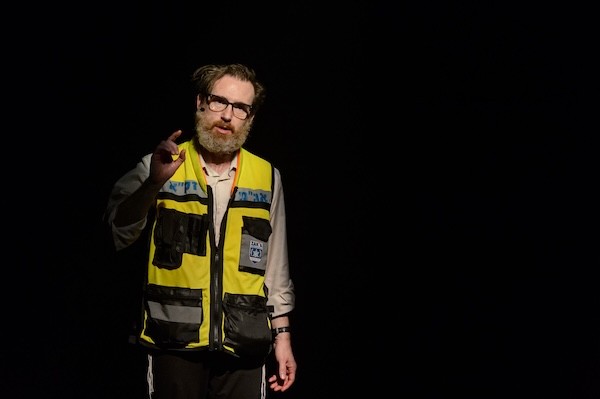
Christopher Morris as Jacob in The Runner. (photo by Dylan Hewlett)

Since this article was published, PuSh has canceled the production. For the statement, click here.

The Belfry Theatre in Victoria has removed Christopher Morris’s play The Runner from its 2024 lineup. I can see why it did so – the threats of violence are real, and scary. But it was the wrong decision.

“The Belfry Theatre presents contemporary work, with ideas that often generate dialogue. That is why, a year ago, we decided to bring the much-acclaimed play, The Runner, to Victoria. However, we believe that presenting The Runner at this particular time does not ensure the well-being of all segments of our community,” reads the Jan. 2 statement.

Last month, a petition was started to remove the one-man play about an Israeli rescue worker whose life is forever changed after he helps an Arab woman, who may have stabbed an Israeli soldier to death, before attending to the soldier. A counter-petition was started by members of the Jewish community to keep The Runner at the theatre. At press time, the protest petition had more than 1,400 signatures, while the counter-petition had more than 2,400.

The Belfry Theatre invited people to come and discuss any issues surrounding the play. That Dec. 22 meeting dissolved into chaos, overtaken by protesters with bullhorns and anti-Israel signs. The Belfry building was subsequently vandalized with multiple stickers that said “trash” and anti-Israel sentiments, topped off with a red-spray-painted “Free Palestine.”

The threat of more violence – implied by the aggressiveness of the protesters at the December meeting and the defacement of the theatre’s building – was probably a main reason for the Belfry canceling the show. It seems that the protesters have successfully bullied the theatre into changing its programming. Instead of contributing to a safe space in which ideas could be presented, considered, discussed, perhaps agreed upon, perhaps not, the protesters have created an atmosphere of fear. They have put other creatives on notice – unless you reflect only what we believe, we will shut you down.

By succumbing to the pressure, the Belfry has perhaps protected its staff and its building – the importance of which cannot be understated – but a dangerous precedent has been set. On the larger world stage, we have seen how screaming down other viewpoints, vandalism and worse violence, misrepresentation and misinformation, can win the day. The success of such tactics in Victoria is another reminder, if we needed one, of how easily freedoms can be removed. How easily voices can be silenced.

Accuracy and context matter, and the petition includes neither.

The petition describes The Runner as “a story of Israeli settlers in a dehumanizing exercise of whether Palestinian and Arab life is of value.” Its writers “demand[ed]” the Belfry “remove The Runner from [its] 2024 lineup,” claiming that it “features the violent and racist rhetoric of Zionism from an exclusively Israeli perspective.” They cite two unattributed, non-contextualized sentences from the script that ostensibly support their position.

The play is not about Israeli settlers, it does not celebrate Israeli settlers or militant Zionism. Jacob – a volunteer from Jerusalem with ZAKA (Israel’s nongovernmental rescue and recovery organization) – is the main character, the hero, the one the audience is rooting for, along perhaps with the Arab woman he helps save.

The quote chosen by the petitioners is spoken by Ari, Jacob’s brother, who is portrayed as a rabid settler nationalist. He is a jerk, and an awful brother. People like Ari do exist, but one of the points of the play seems to be that he is not the model human, that his views are not what people should think.

The petitioners have one aspect of the play almost correct: it does focus on Israeli perspectives (plural), as the main character is Israeli, and so are his mother and brother, and his colleagues. And I will admit that I had trouble with this aspect of the play, too. I felt that The Runner only asked questions about Israelis’ morality, that it disparaged Jews’ claims to the land, that it depicted every Israeli character other than Jacob harshly. While terrorism is shown, the terrorist characters aren’t held to any account, in my view, and there are no moral demands made of them.

I am proud that the petition to keep The Runner in the Belfry’s lineup was initiated by members of the Jewish community. I believe in Israel’s right to exist and to defend itself, at the same time as I believe in the right of people to criticize, question and protest. In a democratic country, I don’t see the need to attack people or destroy property to voice an opinion, especially not about the arts. It is no wonder there are multiple conflicts taking place around the world – even in Canada, where we enjoy multiple freedoms and are relatively rich in resources, we find it challenging to be open, civil and respectful of diversity.

If The Runner had encouraged violence or discrimination, I might have signed a petition against it, too, and even joined a rally, but I hope that I would have chosen to critique it instead, to share my point of view instead of trying to silence Morris’s. I certainly would not have chosen to threaten or commit violence against people or property.

Several aspects of The Runner bother me, but I think it is an excellent piece of work because it has taken up more of my brain space than almost any other play, movie or performance that I’ve seen or book or article I’ve read. It has made me angry, thoughtful, sad, and I continue to contemplate my various reactions. It has literally kept me up at night. In this respect, Morris has done his job extremely well. People should see this play. I sincerely hope the bullies will not succeed in silencing the PuSh Festival’s presentation of it as well. 

For my interview with Christopher Morris, click here. To read statements about the Belfry Theatre’s decision to remove The Runner from its lineup, click here. For more on the Victoria situation, see thecjn.ca/news/runner-play-victoria. 

Format ImagePosted on January 12, 2024January 12, 2024Author Cynthia RamsayCategories Op-EdTags antisemitism, Belfry Theatre, freedom of expression, Israel, The Runner
What is life’s purpose?

What is life’s purpose?

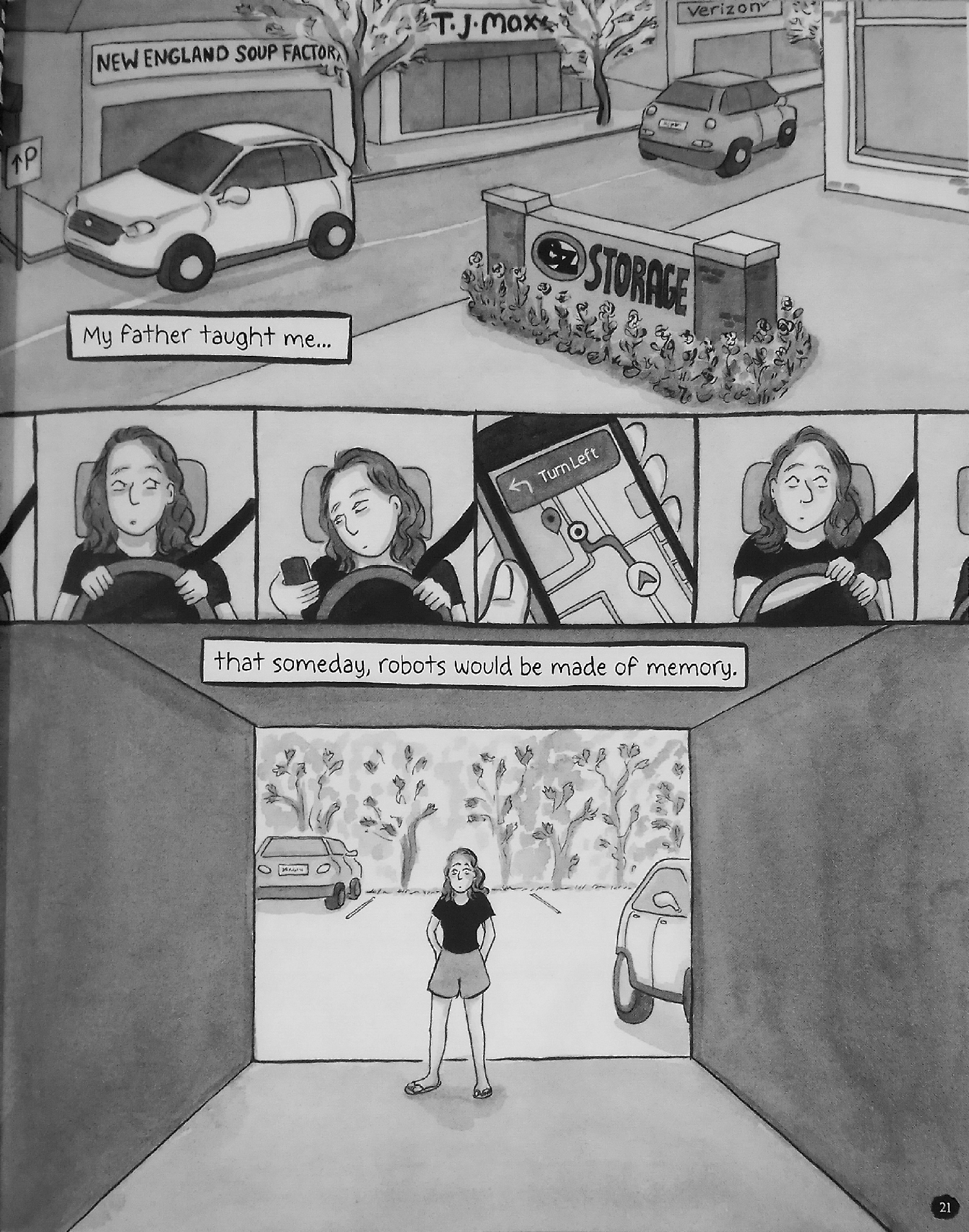
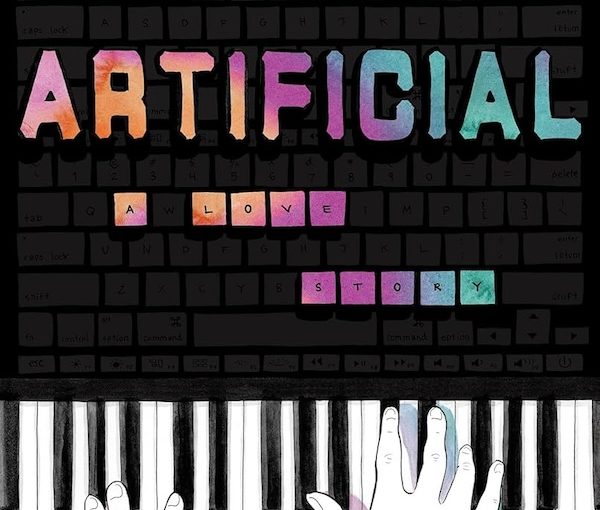
In her graphic memoir, Artificial: A Love Story, Amy Kurzweil tackles many existential questions, framed around her father’s quest to resurrect his father using artificial intelligence. Kurzweil participates in the Cherie Smith JCC Jewish Book Festival Feb. 12.

The purpose of life, of art, what it means to be human, to love and be loved, the value of relationships, our mortality. In a very personal story, cartoonist and writer Amy Kurzweil explores not just universal questions but the biggest of questions in her new book, Artificial: A Love Story.

Kurzweil participates in the Cherie Smith JCC Jewish Book Festival Feb. 12 in two separate sessions: one about the choice of the comic form to tell a story, the other titled Art & Artificial Intelligence.

In Artificial, readers are invited into another part of Kurzweil’s world. Her debut graphic memoir, Flying Couch, was also family-focused, centring around her maternal grandmother’s story. As she writes on her website, “At 13 years old, Bubbe (as I call her) escaped the Warsaw Ghetto alone, by disguising herself as a gentile. My mother taught me: our memories and our families shape who we become. What does it mean to be part of a family, and how does each generation bear the imprint of the past, its traumas and its gifts? Flying Couch is my answer to these questions, the documentation of my quest for identity and understanding.”

image - Artificial: A Love Story, by Amy Kurzweil, page 21
Artificial: A Love Story, by Amy Kurzweil, page 21.

Kurzweil continues to grapple with these questions in Artificial, this time from the paternal side. Her father, Ray, an inventor and futurist, is building an AI tool that will allow him, basically, to resurrect his father, who died of a heart attack in 1970, at the age of 57. Ray has saved letters, articles, music and other material relating to his father, Frederic, a pianist and conductor, who fled Austria in 1938, a month before Kristallnacht, to the United States, saved by a chance encounter. Amy is helping her father sort through boxes upon boxes of material and computerize the information. She even chats with “her grandfather,” as the AI program is being developed.

“My father taught me … that, someday, robots would be made of memory,” writes Kurzweil. Of course, the creation of a Fredbot has functional, ethical, emotional and other challenges, and Kurzweil – in words and images – presents them with sensitivity, intelligence and creativity. Each page of Artificial is attention-grabbing and the level of detail on some pages is remarkable. Kurzweil meticulously re-creates correspondence, typed and handwritten, newspaper articles and other documents, emails and texts, but she also captures, for example, the doubt on her father’s face during a conversation and the concern she has for her partner when he’s undergoing some medical tests. Readers learn about the people asking the questions, not just the questions themselves.

As for the answers? There are multiple ones. Of her father’s project, his quest to conquer mortality using technology, Kurzweil writes that her father’s definition of infinity is, “Computers become so small and dense that they become intelligence itself. Humans who do not grow up or grow old and seal our stories. Our stories wake up and keep writing themselves. This future sounds like liberation from the sadness of a story’s end. But it also sounds terrifying.”

That Kurzweil isn’t completely convinced of the merits of her father’s project, even though she loves him dearly and is helping him try and accomplish it, makes Artificial a satisfyingly complex and relatable story. It is a love story on many levels, and one well worth reading. 

The Cherie Smith JCC Jewish Book Festival runs Feb. 10-15. For the program guide and to purchase event tickets, visit jccgv.com/jewish-book-festival.

Format ImagePosted on January 12, 2024January 11, 2024Author Cynthia RamsayCategories BooksTags AI, Amy Kurzweil, artificial intelligence, creativity, Frederic Kurzweil, graphic memoir, identity, Jewish Book Festival, Ray Kurzweil
Supported by paper, by fragility

Supported by paper, by fragility

Inbal Ben Haim in Pli, which will be at the Vancouver Playhouse Feb. 2-3. (photo by Loic Nys)

Imagine flying through the air on … paper?! That’s just what the circus artists do in Pli, which is being co-presented by the PuSh and Chutzpah! festivals Feb. 2-3 at the Vancouver Playhouse.

The show’s concept came from Israeli French circus artist Inbal Ben Haim, who performs the work with Domitille Martin and Alvaro Valdes. Ben Haim has always been attracted to working with various materials. In her first show, Racine(s), which means “root(s)” in French, soil was used as “poetic matter to talk about the connection of human beings with the earth and [their] homeland,” Ben Haim told the Independent. Racine(s) premièred in 2018.

“But my story of paper started from a workshop I had while I was in CNAC [Centre national des arts du cirque], with the artist Johann Le Guillem. In the point of view of Johann, circus is a ‘minor practice’ – a practice that has never been made, that no one’s practising anymore, or that it is very rare. He asked us to prepare a small presentation … and I wanted to work with paper, to create a huge bird of paper and to fly on it. Well, I didn’t manage to do it, but I started sculpting the paper and made a paper puppet, which I suspended in the air and climbed on it.”

“A little bit later,” she continued, “I met Alexis Mérat, who is a paper artist [and who used to perform in Pli], and we figured out we do the same gesture with our hand – he is crumpling, and I am hanging from my rope. So, we wanted to try to do the two actions at the same time – to crumple and suspend. We were sure that the paper would break, but when we discovered that hanging from paper was possible, it inspired us a lot in the poetical point of view of this image – putting your body, your weight, your life, on something so fragile as paper. In a way, it’s a human action that we all do sometimes. It seemed to us that we absolutely needed to continue this research.”

As they did, Ben Haim said it became clear that they had to involve Martin, who she knew from Racine(s). Martin is not only a performer but a scenographer and one of Martin’s specialties is creating a set that is also circus apparatus, said Ben Haim. “This is how we started to work together.”

Ben Haim studied both visual arts and physical practice, and the visual circuses she creates are a melding of those two passions.

“I was always a hyperactive child,” she said. “I did sports, athletics and martial arts since [I was] very young. But, when I discovered circus practice, and especially aerial acrobatics, I found a space of quiet, of high intensity in a calm place. I found a different relation to gravity and to the body, and also a practice that was very physical but at the same time poetic and interior. It touched me deeply.”

Ben Haim said she wasn’t scared the first time she climbed a rope or was suspended from a trapeze. “I was used to climbing on very high places – trees, mountains, and so on,” she explained. “My parents tell that when I was 1 year old, they found me one day up on a ladder – which means I learned how to climb before I knew how to walk.”

It’s only as she has worked longer in the profession that she has felt more fear. “I get to be more aware of all the risks we take, not only in the acrobatic act but in the hanging and rigging – this is where most of the accidents happened,” she said. “I get to be more and more careful with age and with experience.”

Ben Haim moved to France in 2011 to pursue her art and training, first at Piste d’Azur: Centre régional des arts du cirque PACA, then the CNAC de Châlons-en-Champagne, from which she graduated in 2017. Her bio also notes that “she developed a teaching method for therapeutic circus and worked in various contexts in Israel and France. By blending circus, dance, theatre, improvisation and visual arts, Ben Haim has created her own form of poetic expression. Largely inspired by the human bond made possible by the stage, the ring and the street, she aims to create strong connections between the audience and the artist, the intimate and the spectacular, the earth and air, and the here and there.”

This interplay of connections is evident in Pli and how Ben Haim, Martin and Mérat worked together.

“In the moment we discovered that hanging and climbing on paper was possible, we dove into this research, and we wanted to discover and understand all the possible ways to do that,” said Ben Haim. “We did a lot of experiments which are visual and physical, but also mechanical. Alexis is an engineer, so he held all this point of view that finally makes all that we do quite safe.

“We were creating nine apparatus of hanging on paper in different ways, and we observed how the body changed the paper,” she continued. “We created also many scenographies from paper in which I entered to transform them, getting in a different relationship with the matter…. I metamorphose it, and then it holds me differently – it becomes a duet with lots of listening and care.

“In parallel, we were creating costumes from paper, we made lots of sound work, [registering] the different sonorities of paper to compose the music and doing … research on the possibilities of lighting paper on stage. We can say that the paper guided us in this journey.”

Jessica Mann Gutteridge, artistic managing director of the Chutzpah! Festival, was drawn to Pli right away when she was introduced to it by the PuSh Festival, whose director of programming is Gabrielle Martin.

“Chutzpah! and the PuSh Festival share many common interests in terms of the kind of work we present and have been looking for opportunities to work together,” said Gutteridge. “PuSh knows that Chutzpah! has a particular interest in presenting Israeli artists, as well as audiences who are interested in dance and innovative performance, so this project was an excellent opportunity for us to join forces and co-present.”

The 2023 Chutzpah! Festival, which took place just last month, “included a project that centred on long sheets of paper used to create visual artworks on scrolls, with professional and community artists exploring the centuries-old art form of crankies,” said Gutteridge. “This resonance with Inbal’s work creates a lovely bridge to our winter Chutzpah! PLUS collaboration with the PuSh Festival.” (Crankies are a centuries-old artform in which an illustrated scroll is wound on two spools set in a viewing window.)

Chutzpah! took place as the Israel-Hamas war continued, and the probability is that the war will still be going on when PuSh begins Jan. 18.

“We can say that art is not saving anyone’s life in times of war, so what is its power in front of violence?” responded Ben Haim when asked the role of the arts, even in times of conflict.

“I believe that art has the power to bypass the mind and touch beyond it – the heart, the emotions, the curiosity, our sense of humanity,” she said. “Art has the chance to connect us – above the definitions and identities, as nationality, history and politics. And can connect us into something bigger than what we think we are, something which is common.”

She said, “As someone who searches more for solutions than accusations in any conflict (personal or geopolitical), I search the space of connection moreover than the reasons of separation. I believe that that’s the only way we can find peaceful and respectful solutions for all sides. I feel the need of being able to deeply see each other, human beings, beyond the grief, the fear, the sadness. I think art offers us this kind of space, where we can feel all humans, and experience ourselves as a connected grid. It is not the ‘solution,’ but I think it’s a good starting point, especially in our days.”

Having lived for many years in Israel, in a region of recurring conflict, Ben Haim said, “I know how persistent experiences of fear, pain, loss and distress make us become less and less sensitive, and more into defensive and violence. It happens in order to protect ourselves from those difficult experiences, and it is common for all sides. But, in the long run, it is devastating, for ourselves and for our partners. 

“Even in the middle of a storm of violence, I think art helps us keep a space of sensibility in this crazy world,” she said. “An untouched place where we can simply be, observe, experience, feel. To marvel in front of some piece of beauty, beside the destruction. Having, for short moments, a sense of hope. To feel the strength in the subtlety, in vulnerability, the power in the creative act, in being alive. And this sensibility can be a window of connection. A thread to follow slowly and gently.”

Pli is 60 minutes with no intermission and the teaser can be viewed on YouTube or Vimeo. It is recommended for ages 11+. For tickets to the Feb. 2-3 shows at the Playhouse (in-person and livestream), visit pushfestival.ca. 

Format ImagePosted on December 15, 2023December 14, 2023Author Cynthia RamsayCategories Performing ArtsTags Chutzpah! Festival, circus, dance, Inbal Ben Haim, Jessica Mann Gutteridge, paper, Pli, PuSh Festival
Encouraged to be oneself

Encouraged to be oneself

Lifelong friends can be made at summer camp. (photo from Camp Kalsman)

Fun is in all that we do,” Rabbi Ilana Mills, director of URJ Camp Kalsman, told the Independent. “Our staff creates dynamic programming that lets campers laugh and play in a way that doesn’t happen anywhere else. Where else can you spend a day with your friends and your evening doing messy night with a slip-n-slide, water balloons, shaving cream, and more?”

Summer camp is a unique experience for children and young people, for campers and counselors. While fun is at the forefront of programming, so is learning. In the case of Jewish camps, there is the added element of Shabbat observance and other elements of Judaic practise and values.

Looking at the example of Camp Kalsman, which is located north of Seattle, one can see the breadth of activities summer camp can offer. A typical day at Kalsman includes singing, pool time, prayers, and activities that range from canoeing and kayaking on the lake, to climbing the camp’s tower and/or high ropes, to farming or gardening, to painting or having a cook-out.

The camp has chugim (electives), which usually run three to four days, and campers do a project during them, said Mills. “Campers will get to rank their choice from a list of options and we do our best to give campers their choices,” she said. Chugim includes such things as pottery, embroidery, hiking, water aerobics, yoga or soccer.

And older campers have “Sababa Time,” said Mill. “Sababa Time is an hour each day where older campers get to choose their own activities from a number of creative options that changes each day. Those might include volleyball, board games, outdoor cooking, or spa days.”

The camp schedule also carves out free time for campers.

“Life is so busy and camp is as well. Free time enables campers to choose what they need on any given day,” said Mills. “Whenever we have free time, we have options for campers to choose which option best fits their needs.  Some campers need to get energy out, so they play basketball or go to the pool. Others may need down time, so they may read a book in the trees. Campers use free time to relax, recharge and have fun in a manner that best suits them. Recreation can be a time to re-create, to rejuvenate.”

photo - Kids at Camp Kalsman get ready to take a canoe out onto the lake
Kids at Camp Kalsman get ready to take a canoe out onto the lake. (photo from Camp Kalsman)

In addition to obvious practices, such as the celebration of Shabbat and group tefillah (prayer), Kalsman tries to impart Jewish values and culture throughout activities.

“We design our programs to foster a holy community through connection between campers, between campers and staff and between campers and the larger community,” said Mills. “We believe connection is important on every level, so our cabins do cabin time every night to form connections and, every week, we have all-camp programs, where campers of different ages can get to know one another. When we eat, pray and sing together, we connect to the larger community.”

Camp Kalsman ends each night in siyum, “a special closing prayer where we pray Hashkiveinu and Shema using a special tune written just for Camp Kalsman,” said Mills.

When asked what summer camps in general – and Jewish camps specifically – can give kids that schools can’t, Mills shared a quote from a 10-year-old camper, who said, “Kalsman lets me take off all the masks I have to wear at school and really be me.”

“At Kalsman, our campers know that they are valued, honoured and supported for who they are,” said Mills. “Camp enables kids to be kids, to be free, and to have fun in a way that they don’t get anywhere else. It frees them of the burdens of school and competition and allows them an outlet to be part of a great community. Kalsman campers disconnect from their devices and connect to a larger, holy community. Campers learn independence and problem solving, they learn they can make mistakes and how to manage mistakes in a safe environment. Camp is the place where kids can explore who they want to be in the world.” 

Format ImagePosted on December 15, 2023December 14, 2023Author Cynthia RamsayCategories LocalTags Camp Kalsman, education, identity, Israel, summer camp, youth
A 1930s immigration story

A 1930s immigration story

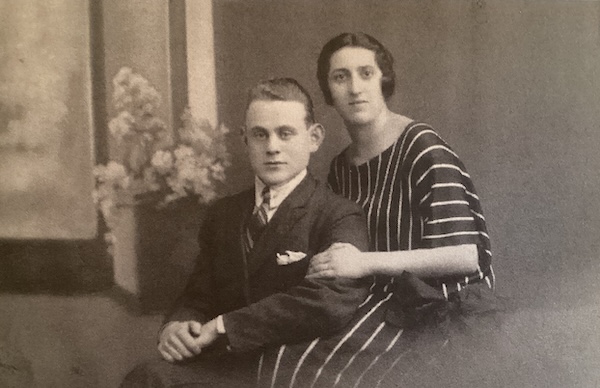
Author Norman Ravvin’s grandparents, Yehuda Yoseph and Chaya Dina Eisenstein, around the time of their engagement, in 1928. (photo from Who Gets In: An Immigration Story)

Relentless perseverance, continual pressure on select politicians and some key allies are what helped Norman Ravvin’s maternal grandfather, Yehuda Yoseph Eisenstein, finally bring his wife and two children to Canada from Poland in 1935, five years after he immigrated here. In a decade generalized as a time of “none is too many” with regards to Canada’s immigration policy towards Jews, Ravvin’s grandfather managed to get his family into the country.

In his new book, Who Gets In: An Immigration Story (University of Regina Press), Ravvin combines his novel-writing skills with his academic expertise to create an engaging memoir about his grandfather’s first years in Canada, one that is firmly situated in the larger context of what was happening at the national level at the time. An extensively researched book – with 10-and-a-half pages of sources – Ravvin’s style will make readers feel like they’ve come to know him a bit, as he allows his personality to be seen in the telling, though what is documented fact and what is conjecture or opinion is clear.

“My approach is to make nothing up. The story rides its own hard-to-believe rails,” says Ravvin on his webpage. “I present its narrative creatively, so readers relate to it on a personal level. Events and personalities from nearly a century ago remain fresh, telling and relevant to contemporary North American life.”

Ravvin does allow his imagination some space. He doesn’t know, for example, the exact reasons his grandfather left Poland, but he can surmise that rising antisemitism was one of them. Whether it was because his grandfather objected physically and publicly to a slur and became a marked man, or whether a rock was thrown into the family’s sukkah, Yehuda Yoseph Eisenstein’s response, writes Ravvin, “was to say ‘I can’t live with these people anymore.’ Or, as he would have said in Yiddish, ‘Ich ken mit zei mer nisht lebn.’ It’s good to hear some of these things in the language in which they took place. In this incident, the spoken words evoke the moment of decision with clarity and purpose.”

Eisenstein had three siblings who had already left Poland, with his younger brother Israel (Izzy) having settled in Vancouver. It was this brother who offered Eisenstein sponsorship and, while Canada was a much less welcoming place by 1930, “a single man could obtain a visa with a brother’s sponsorship.” The problem was Eisenstein had been married in 1928, without a civil licence, as he was already planning on leaving and knew that he would need to appear single to get into Canada. The illegality of the marriage and the misrepresentation of his marital status on his immigration application would cause Eisenstein much tsuris (distress) in getting his wife, Chaya Dina, and their children, Berel and Henna, to Canada as well.

image - Who Gets In book coverWho Gets In is divided into two parts. The first is about Eisenstein finding his place in the country; the second is about his efforts to bring his family over. Ravvin wants to “paint a detailed picture of the time and place, with careful attention to Western Canada,” where his grandfather went, and he does this by talking about such things as the content of school history books in the 1920s, Canada’s immigration numbers and the country’s changing demographics, the implications of government forms that asked immigrants to declare their “Nationality” and “Race or People,” how census data were being interpreted and used, the popularity of eugenics in Canada and beyond, the impacts of the Depression, and so much more.

Ravvin uses history not only to provide context for his grandfather’s experiences but also brings it into the present. Assimilability was a key consideration in assessing immigrants’ suitability in Eisenstein’s day and continues to be – current NDP leader Jagmeet Singh “was approached while campaigning and told that he should remove his turban to look more Canadian,” notes Ravvin.

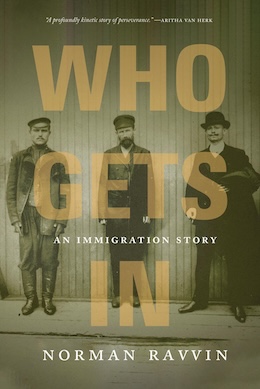
Ravvin spends quite a lot of ink discussing various perceptions of what a Canadian should like and contemplating how his grandfather would have been considered. The cover of Who Gets In features a photo that was part of a newspaper article in 1910. The three men “appear as cutouts in a group of twelve ‘Types’ of ‘New-Comers’ from ‘Photographs Taken at Quebec and Halifax.’” From left to right, they are described as “Pure Russian, Jew, German.” As the landing form stripped Ravvin’s grandfather of his nationality – someone crossed out the typed letters “PO” and wrote in by hand “Hebrew” – so too is the Jew in this photograph stripped of his, observes Ravvin.

In setting the scene for Part 2 of the book – the bureaucratic fight his grandfather must undertake – Ravvin discusses the Indigenous peoples that inhabited the Prairies where his grandfather ended up. Eisenstein first went to Vancouver, where he hoped to stay and work as a shoichet (kosher butcher), but he was apparently seen as competition by Rev. N.M. Pastinsky, “who happened to be on the board of the Pacific Division of the Jewish Immigrant Aid Society (JIAS) and thus someone with whom one might not want to tangle.”

Eisenstein backtracked to Saskatchewan, living first in the farming town of Dysart and then in Hirsch. Ravvin talks about what Jewish life in rural Canada was like and some of the impacts that European settlement had on the Cree, Saulteaux and Assiniboine.

Ravvin starts the book with the story of the Komagata Maru – the chartered ship from India, full of immigrant hopefuls, mostly Sikhs, that was not allowed to land on the coast of British Columbia in 1914 and was instead forced to return to India, with disastrous results. He returns to the incident at the end of Part 1 to point out that one of the central (negative) figures in his grandfather’s life was A.L. Jolliffe, “who began his civil career in 1913 as an immigration agent in Vancouver,” playing a role in the handling of the Komagata Maru.

“By the 1930s,” writes Ravvin, “Jolliffe had ascended to the position of commissioner for the Department of Immigration in Ottawa. He is the closest thing to a bête noire in my grandfather’s story. If the much better-known doorkeeper, F.C. Blair, played any role in my grandfather’s struggle, he left no trace in any of the documents beyond a shared penchant for the use of pompous and hectoring language that appears in letters in my grandfather’s file.”

Jolliffe denies more than once Eisenstein’s applications for permission to bring his wife and children to Canada – in one instance, while expressly not recommending deportation, Jolliffe suggests that, if Eisenstein wants to be reunited with his family, he should return to Poland. Ultimately, Eisenstein is successful only because he has allies such as A.J. Paull, executive director of the JIAS, and Lillian Freiman who, married to influential merchant A.J. Freiman, had “remarkable access to the leaders of early-twentieth-century Canada.” She also did many amazing good works, including managing “Ottawa’s response to the flu epidemic in 1918 almost single-handedly.” Ravvin also positively differentiates the federal government, as led by R.B. Bennett, prime minister from 1930 to 1935, from that which succeeded it, the “none is too many” government led by William Lyon Mackenzie King as prime minister.

Eisenstein finally achieves his goal through an order-in-council – a decision made by the Privy Council, the prime minister’s cabinet – that “asserted its right to ‘waive’ determinations of an earlier order in which strict immigration regulations were brought into effect. This reflected an ability – understood to exist by those in the know – of the minister to ‘issue a permit in writing to authorize a person to enter Canada without being subject to the provisions’ of the Immigration Act, without interfering with the status of those provisions.”

The Eisenstein family was one of the lucky ones. 

Format ImagePosted on December 1, 2023December 4, 2023Author Cynthia RamsayCategories BooksTags Canada, Eisenstein, history, Norman Ravvin, Who Gets In
Laugh, cheer, boo at panto

Laugh, cheer, boo at panto

Steffanie Davis, who plays Belle, with a couple of the young actors in East Van Panto: Beauty and the Beast, at the York Theatre until Jan. 7. (photo by Emily Cooper, illustrations by Cindy Mochizuki)

Every year, the Cultch and Theatre Replacement’s annual panto, celebrating East Vancouver and poking fun at pop culture and local politics, seems to outdo itself. East Van Panto: Beauty and the Beast, which opened at York Theatre last week, is a rollicking good time that doesn’t sacrifice quality for fun. The text, music, sets, performance – everything is top-notch about this production that will have you cheering, booing, laughing, clapping … generally having a great time.

In the story by new-to-the-panto playwrights Jivesh Parasram and Christine Quintana, Belle, who dreams of studying business at the University of British Columbia so she can get the skills to bring wealth to her East Van neighbourhood, is captured by Beast, an arrogant young man from West Van who is turned into a mattress by Enchantress for his unbending attitude. The curse will not be lifted until this young man, who “won’t flip for nobody,” is able to change his mind – a prized ability in this production. Unfortunately, the curse extends to the staff and patrons of the Japanese food store into which the man had entered to buy some sushi. Transformed into such items as miso soup, soy sauce and various types of sushi, these innocents rely on Belle to save them – and herself – “before the last cherry blossom falls.”

Using physical humour and wittily riffing on pop songs like “Flower” by Miley Cyrus, “Kokomo” by the Beach Boys and “Sweet Dreams” by the Eurythmics, the panto cast is led by Steffanie Davis as Belle and Jason Sakaki as Beast, both strong actors with fantastic singing voices, funky moves and excellent comedic timing. The supporting cast is equally as skilled, and they are, in turn, supported by first-rate creative, design and production teams. Anita Rochon directs the show, and Veda Hille is composer and musical director. Jewish community member Mishelle Cuttler, as assistant musical director, alternates nights with Hille at the keyboard.

East Van Panto: Beauty and the Beast is an ode to community. In this iteration, it highlights two decades-old local businesses, Fujiya Japanese Foods and Mr. Mattress, which are located across the street from each other, at Venables Street and Clark Drive. A highlight of opening night was meeting several folks from Mr. Mattress, a long-time advertiser in the Jewish Independent.

The panto runs until Jan. 7 in-person and on-demand online Dec. 18-Jan. 7. For tickets, visit thecultch.com/event/east-van-panto. 

Format ImagePosted on December 1, 2023November 30, 2023Author Cynthia RamsayCategories Performing ArtsTags Beauty and the Beast, East Van Panto, musical, social commentary, the Cultch, Theatre Replacement
From poems to songs

From poems to songs

Loolwa Khazzoom (photo by Moriel O’Connor)

“Dear Hostages, as the world rallies to celebrate your desecration I will not forsake you,” begins the poem written by Seattle-based multimedia artist and educator Loolwa Khazzoom. Posted on her Facebook page, with a #BringThemHomeNow poster featuring photos of Israelis kidnapped on Oct. 7, it continues, “My instinct is to deprive myself of oxygen / Because you are underground / And I will not forget you // But I know that you would dance / In the sun / If given the chance / So I now rise up / And dance for you.”

Many of Khazzoom’s songs begin as poems. In this case, she told the Independent, “I felt as if I could not breathe and as if I did not even want to breathe, out of solidarity with the hostages and with all of Israel, in particular, all the victims of the Oct. 7 massacre. It’s like I wanted to physically feel their pain and suffering, as a way of physically demonstrating that I would not forsake them or forget them.”

In a traumatized mental state, Khazzoom returned to the “healing tools of poetry and music,” which was another way she could show her solidarity and do her part in keeping the issue of the hostages in front of people.

Similarly, Khazzoom and her band, Iraqis in Pajamas, recently released another poem-turned-song, “#MahsaAmini.” They did so this past Sept. 16, the first anniversary of the death of 22-year-old Mahsa Amini at the hands of Iranian “morality police.”

Finding out about Amini’s murder soon after it took place, from TikTok videos posted by Iranian women, Khazzoom “jumped into action.” She wrote to her political representatives, raised funds for United 4 Iran and reposted Iranian women’s videos on her feed constantly, to help boost the content’s views. “In addition,” she said, “a day after I found out about what happened, a poem with my feelings poured out of me, and I posted it on social media. Months later, I put that poem to a melody, and the band developed it into a full band song, which we released on the [anniversary of the] day of Amini’s murder.”

The death affected Khazzoom deeply for many reasons.

“First, the women in my family wore the abaya, the Iraqi equivalent of the hijab – Jewish women throughout the region were subject to Muslim dress codes, so it’s a Jewish issue, too,” she said. “Second, so many people assume that Islam is indigenous throughout the Middle East and North Africa, but it’s not. Arab Muslims rose up from the Arabian Peninsula and conquered the entire region, forcibly converting masses under the threat of death. So many indigenous ethnicities and religions predated the Muslim conquest, including Jews, Persians, Berbers and Kurds. The Iranian women protesting and burning their hijabs felt to me like challenging that Muslim conquest and awakening the ancient Persian warriors. Third, Persia is central to Jewish history and the origins of the Mizrahi community, dating back nearly three millennia ago…. And, lastly, the fire of these women, and the men who joined them, and their willingness to risk their lives for their dignity and freedom was just breathtaking and profoundly inspirational.”

Another of Iraqis in Pajamas’ releases this year was also intensely personal for Khazzoom.

“I wrote ‘The Convert’s Quest’ in response to some friends on social media sharing how hurt they were, coming under attack during the process of their conversion to Judaism. I had ample experience witnessing variations on this theme throughout my life – both first-person, seeing it happen to friends, and through my research as a Jewish multicultural educator. For decades, I felt very disturbed by this seemingly growing trend.

“I am the daughter of a Jew by choice, as my mother called herself, so the matter of conversion to Judaism is very personal for me,” she said. “I remember understanding very clearly as an Orthodox Jewish child that, according to halachah (Jewish law), once you convert, you are no longer to be called ‘a convert,’ but rather, a Jew, period. So, even from a religious Jewish perspective itself, I was very distraught by the ways that Jewish leaders and communities were rejecting or harassing converts, or even all-out forbidding people from converting. It all flies in the face of Jewish history, theology and practice.”

The band released “The Convert’s Quest” on May 24, on the harvest holiday of Shavuot, which celebrates the giving of the Torah to the Jewish people and on which the Book of Ruth is read. It tells the story of Ruth, a Moabite woman who converted to Judaism, whom Jewish tradition teaches will be the ancestor of the Messiah.

“To me, Jewish converts are the lifeblood of the Jewish people,” said Khazzoom. “I have a provocative line in my song, saying that converts are ‘the most Jewish Jews of all,’ because they are intentionally and consciously practising the foundational precepts of Judaism, which so many either take for granted or do rote, as is often the case in the Orthodox Jewish world where I was raised. In addition, amidst life-threatening levels of racism and violence against Jews, converts choose Judaism…. Why would we reject, in any way, from subtle to blatant, someone with such a heroic Jewish soul?”

Even when delivered in a playful manner, Khazzoom’s song are serious to the core. The campy “Kitchen Pirate,” for example, “emerged from my choice to reject the conventional option of surgery, in the wake of a cancer diagnosis in 2010,” she said. “Instead, I chose to radically alter my diet and lifestyle. Simply by overhauling my diet, I cold-stopped the growth of the nodules, which remained stable for the next five years – neither growing nor shrinking – until I returned to my lost-love of music, following which they began shrinking.”

Khazzoom said her songs “are always questioning, always challenging, always defiant. Sometimes, it’s more explicit, other times it’s embedded in silliness, which, parenthetically, I also see as defiant. I am and forever will be a curious, playful and awe-inspired child. I think that, if and when we ‘outgrow’ that, we die inside. And I refuse to capitulate to that norm of expected behaviour once we enter adulthood. By way of example, to this day, at age 54, when I am flying in a plane, if there is nobody sitting next to me, I will stretch out my arms and pretend I’m a bird, during takeoff.”

Not everyone has appreciated this aspect of her personality. “I have constantly gotten into trouble for it and have been at odds with my family, my community and society at large,” said Khazzoom. “I have endured terrible loneliness and often even self-doubt as a result. But I always come back to my core. And all of my songs emerge from that place – that raw, gut-wrenching place of being fiercely alive and allowing the clash with everything around me, and then writing about it.”

It is this enthusiasm that Victoria-based band member Mike Deeth enjoys about being in Iraqis in Pajamas, whose third member is Chris Belin.

“Loolwa and Chris are both easy-going, creative people. The energy is very positive, which makes collaborating with them fun and organic,” Deeth told the Independent. “Further, I appreciate the passion Loolwa has for the subject matter she writes about. One thing I always struggled with as a musician is ‘What do I have to say?’ At the end of the day, I’m a privileged guy who has never had to face oppression, hate, war or genocide. I have a lot of respect for artists who have experienced darker parts of humanity and have the courage to bring that perspective into their art.”

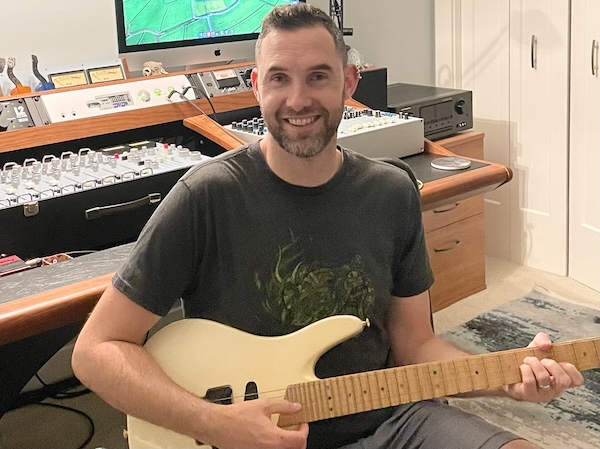
Born in Toronto, Deeth, who is not Jewish, spent most of his adolescence in Calgary, and moved to Vancouver Island when he was 18. He first picked up a guitar a few years earlier and has been playing ever since. “I was in my first band at 18 and played in bands throughout my 20s. For the past several years, I have been mainly focused on recording,” he said.

photo - Mike Deeth
Mike Deeth (photo from Mike Deeth)

Deeth got hooked on music production in his teens, getting his first digital recorder at age 16. “I still remember pulling all-nighters with friends trying to write songs and get ideas down on tape. Production was always fascinating to me, as I could layer parts together into something bigger than I could ever play on my own.”

Deeth and Khazzoom met a couple of years ago through a Craigslist posting. “She was looking for a guitarist to contribute to an early version of her track ‘The Convert’s Quest,’” he explained, complimenting Khazzoom on the fact that she “puts her full heart into her songs.”

“I recorded some initial guitar demos and, about a year later, we reconnected and worked up the current releases,” he said.

Deeth adds guitar to the songs and completes the mix and master of the songs when they are ready for those steps. Khazzoom sings, writes and plays bass, while Belin – who lives in Pennsylvania – composes the drum parts and performs them.

Among his other music ventures, Deeth has “played the guitar with Bryce Allan, a country musician here on the island, and recorded a few tracks with him. I also work closely with Jennie Tuttle, another musician from Victoria. We have been recording together for seven or eight years now.”

For Deeth, “recording is such an interesting combination of art and science. I get to be musically creative, but I also get to play with cool machines, solve problems and think about gain staging, compression ratios and other technical aspects. I thoroughly enjoy both the artistic and scientific parts of the process – they work my mind in different ways.

“I also love how each project starts as a blank canvas and ends with a new piece of music out in the world. There are an almost infinite number of possibilities when recording a track (all the possible settings on the equipment, the subtleties of different instruments) and it always fascinates me how each song takes shape during the process.”

“Mike has an exquisite sensitivity in his musical composition, performance and recording,” said Khazzoom. “He’s not only super-talented and -skilled, but he’s warm, upbeat, enthusiastic and professional. It’s a joy to create music with him. As is the case with our drummer Chris Belin, Mike has an uncanny ability to capture the essence of the songs I write, to the point that I feel he is playing back to me the sound of my soul. I have literally sat and cried after hearing the mixes.”

For more on Khazzoom, visit khazzoom.com. For more on Deeth’s production and sound services, visit glowingwires.com. 

Format ImagePosted on December 1, 2023November 30, 2023Author Cynthia RamsayCategories MusicTags conversion, hostages, Iran, Iraqis in Pajamas, Israel, Judaism, Loolwa Khazzoom, Mahsa Amini, Mike Deeth, Oct. 7, politics, punk music, recording, social commentary, terrorism

Mysteries to be solved

The past can consume you if you let it. And reality isn’t as easy to discern as you might think. Two recently published thrillers from Simon & Schuster share these themes in common, but their authors address them in completely different ways.

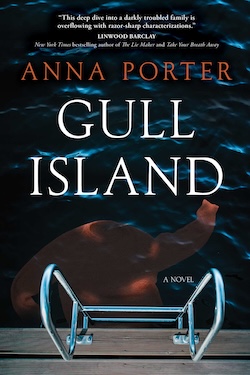
Anna Porter’s Gull Island takes readers on an unsettling, at-times gory, modern-day journey through the protagonist’s thoughts and memories as she visits alone her family’s isolated island cottage and a ferocious storm hits, unmooring her boat and rendering her cellphone ineffective. Roberta Rich’s The Jazz Club Spy begins with a brutal pogrom in 1920 Ukraine and then jumps to 1939 Manhattan, where the protagonist, now a young woman, sees in passing one of the Cossacks who rampaged her village – as she starts looking for him to exact her revenge, she is enlisted by the US government to help find him for them, as he is a possible conspirator in an assassination plot.

Neither genre – psychological thriller or espionage novel – is the type of fiction I’d generally pick up, but I enjoyed both. They provided an escape, I learned a few things, I wanted to know how they would end. 

While The Jazz Club Spy started off gritty and harsh, by the second chapter it read more like a young adult novel. Given the state of the world at the moment, I didn’t find that necessarily a negative thing. I rooted for Giddy Brodsky, who survived that traumatic pogrom and was now helping her family pay the rent and feed themselves, her dad having left for reasons we eventually find out.

image - The Jazz Club Spy book coverAs a cigarette girl in a club, Giddy uses her natural sleuthing skills – looking through customers’ pockets, listening to conversations for clues, etc. – to help her friend Hattie’s clairvoyant act. After Giddy sees the Cossack on a tram, but loses him in the crowd, she puts those skills to personal use, and then uses them to help the government. This happens after she asks a club regular who works in the immigration department for assistance, and he shares with her that the Cossack is an “undesirable” and could she help the government track him down.

Giddy is not only a competent detective but an aspiring entrepreneur, who creates her own makeups and lotions. The money she earns from spying goes to help her set up her own beauty store. But, to achieve success, she must first complete her mission, one that is complicated by love and the dangerous situations she must place herself in to root out the Cossack and try to prevent the assassination and a potential global political crisis.

The Jazz Club Spy is all about external threats and heroic acts. There is no doubt about Giddy’s strength, purpose and whether she’s a good person. Gull Island, on the other hand, is all about internal threats and acts that cause harm (even if that isn’t the intent). Jude’s a great unknown, even to herself, and she gets progressively more disoriented as the storm hits the island and she struggles to get the water pump working, hurts herself in various accidents, and drinks we’re not quite sure how much alcohol while she’s there.

image - Gull Island book coverJude has come to the island at her mother’s request. Jude’s father has gone missing and a copy of his will is apparently at the cottage. She is also there for personal reasons, to rummage about, to figure something out, to look through old photographs; there are many of her sister, not so many of her. Jude has grown up in a dysfunctional family and the cottage was not generally a happy place. As the storms intensify – the rain and wind outside, the memories barraging Jude and the physical cuts and bruises she receives along the way, dealing with broken glass, wild animals and things not so clear – the tension ratchets up. When the sun returns and Jude surveys the damage left behind, a key piece of the mystery is understood.

Porter isn’t afraid to explore dark places, and she masterfully leads readers through Jude’s turmoil. I found it noteworthy that the book Jude finds at the cottage to read is Sapiens: A Brief History of Humankind by Yuval Noah Harari. “I had abandoned it years ago because I didn’t want to feel as insignificant as the author had made me feel,” thinks Jude. “But tonight, being alone in the cottage, with something digging under the bedroom window, feeling insignificant would be useful.” Spoiler alert: by the end of the novel, she is set to finish the book. 

Posted on December 1, 2023November 30, 2023Author Cynthia RamsayCategories BooksTags Anna Porter, espionage, fiction, Gull Island, psychological thriller, Roberta Rich, Simon & Schuster, The Jazz Club Spy, young adult fiction
Perfect gifts for holiday

Perfect gifts for holiday

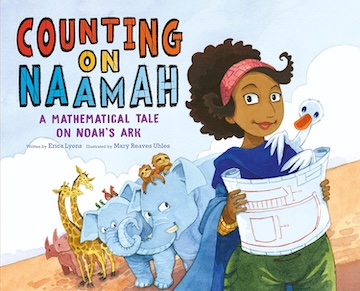
In 2019, NASA astronaut and scientist Jessica Meir was part of the first all-woman spacewalk. According to image - Counting on Naamah book cover: Jewish Women who Rocked the World, she “celebrated Hanukkah in space by wearing festive holiday socks and sending a Happy Hanukkah message to earth on social media.”

This is just one of the many “Fun Fact[s] to Mench’n” in this enlightening book written by the mother-daughter team of Rachelle Burk and Alana Barouch, and illustrated by Arielle Trenk. She’s a Mensch! is one of two books the JI received from Seattle’s Intergalactic Afikoman to review. The other is the perfect antidote to the “girl math” phenomenon popularized on social media, though hopefully kids under 9 aren’t engaging with that. Counting on Naamah: A Mathematical Tale on Noah’s Ark by writer Erica Lyons and illustrator Mary Reaves Uhles imagines Noah’s wife as being a genius in math and engineering.

Using the basics of the Noah story, Counting on Naamah offers a midrash of sorts. “A midrash is a tale that begins with a story from the Torah. Then it fills in the missing pieces to imagine the rest,” explain Lyons and Reaves Uhles at the back of the book. “The story of Noah leaves a lot to the imagination. What was it actually like to live on that ark? How did they take care of all those animals? And who was the generally unnamed ‘Mrs. Noah’? Counting on Naamah tries to answer these questions.”

The story begins when Naamah is a child, and uses her talents to help each of her three brothers – with market transactions, estimated herd transport times and archery angles. She has her own projects, as well, drafting plans for a desert sand scooter, for example.

When she meets and falls in love with Noah, the two become “impossible to divide,” but Naamah retains her agency and is a crucial help in building the ark, housing and feeding the animals, and more. And Noah knows just what to do to thank her.

Counting on Naamah is a charming story, creatively and colourfully illustrated. As is She’s a Mensch!, which is a nonfiction work that highlights 20 women who “rock!”

“Jewish women ‘round the world have talent, strength and smarts,” the book starts. “They shine like stars in every field from science to the arts.

“Jewish women through the ages have helped shape history. These mensches are authors and activists, athletes and adventurers, and everything in between.”

Indeed, the women featured range from writer Emma Lazarus in 1883 to Meir, in 2019. They include familiar – Golda Meir, Barbra Streisand, Ruth Bader Ginsburg – and less familiar names, like Marthe Cohn, who was a spy for France during the Second World War; Vera Rubin, who provided proof of dark matter in the 1970s; Nalini Nadkarni, who performed the first survey of rainforest treetops in 1981; and Judit Polgár, who became a chess grandmaster at age 15, in 1991. There’s a list of 18 honourable mentions.

Each entry in She’s a Mensch! has something different: unique drawings that connect the mensch to their chosen pursuit, a four-line poem and a short blurb about the mensch, often a fun fact, and always a mensch-related question to ponder, such as, How can you help others? (Henrietta Szold) What kinds of stories can you tell? (Judy Blume) and What great adventures do you dream of going on? (Cheryl and Nikki Bart)

image - Where Do Diggers Celebrate Hanukkah? book coverBoth of these books would make great Hanukkah gifts for kids of any gender. As would this year’s Hanukkah addition to Intergalactic Afikoman publisher Brianna Caplan Sayres’ and illustrator Christian Slade’s Diggers series, which has more than 10 books, and counting.

Where Do Diggers Celebrate Hanukkah? (published by Penguin Random House) would be a happy addition to a kid’s Diggers collection, or a fun introduction to the series. For the diggers, cranes, mixers, armoured trucks, tankers, dump trucks and food trucks, we’re asked to wonder what each does for an aspect of the holiday. For example, “Does Mom dig up the ancient jar that held the precious oil?” And the cranes, “Do they decorate their construction site with ‘Happy Hanukkah’ all around?” After a day of serving meals outside, do food trucks “serve sufganiyot and other food that’s fried?” Inquiring minds will want to know. 

Format ImagePosted on December 1, 2023November 30, 2023Author Cynthia RamsayCategories BooksTags children's books, Diggers, Empowerment, Hanukkah, Intergalactic Afikoman, Penguin Random House, women

Posts pagination

Previous page Page 1 … Page 17 Page 18 Page 19 … Page 84 Next page
Proudly powered by WordPress