Skip to content
  • Home
  • Subscribe / donate
  • Events calendar
  • News
    • Local
    • National
    • Israel
    • World
    • עניין בחדשות
      A roundup of news in Canada and further afield, in Hebrew.
  • Opinion
    • From the JI
    • Op-Ed
  • Arts & Culture
    • Performing Arts
    • Music
    • Books
    • Visual Arts
    • TV & Film
  • Life
    • Celebrating the Holidays
    • Travel
    • The Daily Snooze
      Cartoons by Jacob Samuel
    • Mystery Photo
      Help the JI and JMABC fill in the gaps in our archives.
  • Community Links
    • Organizations, Etc.
    • Other News Sources & Blogs
    • Business Directory
  • FAQ
  • JI Chai Celebration
  • JI@88! video

Recent Posts

  • Story of Israel’s north
  • Sheltering in train stations
  • Teach critical thinking
  • Learning to bridge divides
  • Supporting Iranian community
  • Art dismantles systems
  • Beth Tikvah celebrates 50th
  • What is Jewish music?
  • Celebrate joy of music
  • Women share experiences 
  • Raising funds for Survivors
  • Call for digital literacy
  • The hidden hand of hate
  • Tarot as spiritual ritual
  • Students create fancy meal
  • Encouraging young voices
  • Rose’s Angels delivers
  • Living life to its fullest
  • Drawing on his roots
  • Panama City welcoming
  • Pesach cleaning
  • On the wings of griffon vultures
  • Vast recipe & story collection
  • A word, please …
  • מארק קרני לא ממתין לטראמפ
  • On war and antisemitism
  • Jews shine in Canucks colours
  • Moment of opportunity
  • Shooting response
  • BC budget fails seniors
  • Ritual is what makes life holy
  • Dogs help war veterans live again
  • Remain vital and outspoken
  • An urgent play to see
  • Pop-up exhibit popular
  • An invite to join JWest

Archives

Follow @JewishIndie
image - The CJN - Visit Us Banner - 300x600 - 101625

Byline: Cynthia Ramsay

Inspiration to improve world

Inspiration to improve world

Jeff L. Lieberman – director, writer and producer of Bella! – with his mother, Carole Lieberman, at the documentary’s July screening in San Francisco. (photo by Pat Mazzera)

“I could feel defeated now / I could be broken-hearted / I could be finished long before I’d even started / But that would be too easy and I never take the easy way.”

In his production notes, Jeff L. Lieberman – director, writer and producer of the award-winning documentary Bella! – rightfully highlights these lyrics from the original song Mark W. Hornburg and Doug Jervey composed specifically for this film about Bella Abzug (1920-1998). Abzug never shied away from a fight and would always come back after a loss.
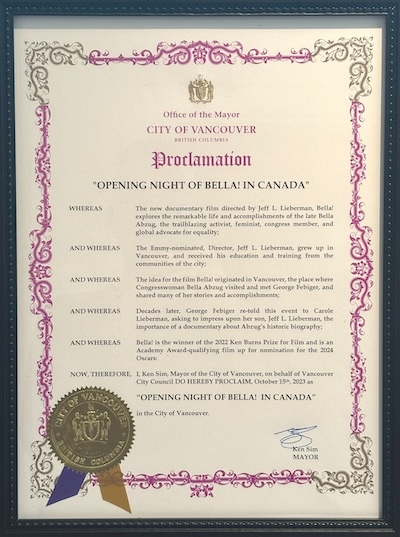
photo - Vancouver Mayor Ken Sim issued an official proclamation of Oct. 15, 2023, as the opening night of the film Bella! in Canada
Vancouver Mayor Ken Sim issued an official proclamation of Oct. 15, 2023, as the opening night of the film Bella! in Canada. (photo from Re-emerging Films)

Lieberman, who has lived in New York City since 2007, returned to his hometown of Vancouver for the Canadian première of Bella! Oct. 15 at the Park Theatre. The film was presented by the Vancouver Jewish Film Centre and sponsored by Dexter Realty. Ahead of the event, Vancouver Mayor Ken Sim issued an official proclamation of the opening night of the film in Canada. The proclamation recognizes that the documentary “explores the remarkable life and accomplishments of the late Bella Abzug, the trailblazing activist, feminist, congress member, and global advocate for equality.” The proclamation acknowledges that Lieberman grew up in Vancouver and that the idea for the film originated here. It was a suggestion from Carole Lieberman, who had gotten the idea from a neighbour, but more on that later.

For those unfamiliar with Abzug, she was one of only 12 women (of 435 members) to enter Congress in 1971. There, she was instrumental in getting women the right to have credit cards in their own name; she introduced curb cuts that allowed people with disabilities or other mobility issues more freedom of movement; and she brought in the Equality Act, the first federal LGBTQ+ rights legislation in the United States. Other issues about which she was vocal included ending the Vietnam War and supporting the impeachment of Richard Nixon.

Abzug was the first woman to run for the Senate from New York and the first woman to run for mayor of New York City. After she lost both races – in heartbreaking fashion – she took on other challenges, including being one of the leaders of the feminist movement and a co-founder of the Women’s Environment and Development Organization.

“Raised in a community filled with strong Jewish women, Bella Abzug was not a totally unfamiliar name,” writes Lieberman in his director’s notes. “Her orbit filled my 1980s home: the books of Letty Cottin Pogrebin (featured in Bella!) and Anita Diamant lined our bookshelves; we sang the songs of Debbie Friedman; and were proud to see Gloria Steinem (also featured in Bella!) appear on the evening news. However, Bella’s name did not quite push through like it had in other homes throughout the 1970s, when she appeared on magazine covers and became one of the most recognizable faces in Congress – due in part to her trademark branding – her iconic hats.”

Lieberman includes many audio clips of Abzug talking about various things, including her first jobs as a lawyer – she enrolled in law school at Columbia University in 1944, where she was one of six women in a class of 120, and graduated in 1947. She said she would go out to clients on behalf of a firm and be told to sit and wait until “the lawyer” arrived.

“So, I had an identity crisis and, in those days, professional women wore hats,” she says. “So, I put on a pair of gloves and a hat and whenever I appeared anywhere, they then knew I was there for business. I’ve since taken off the gloves, but I grew to like wearing hats and that was merely my way of being me.”
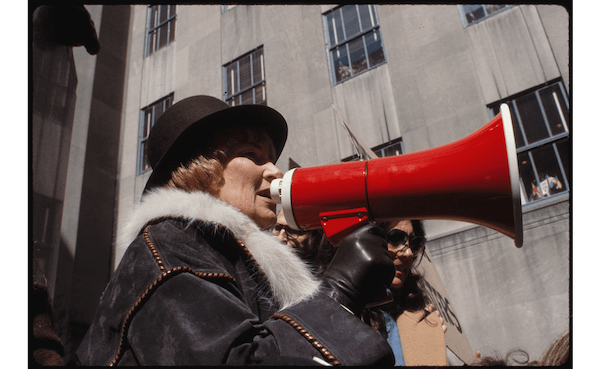
photo - Congresswoman Bella Abzug, in 1979
Congresswoman Bella Abzug, in 1979. (photo from Bernard Gotfryd, Library of Congress)

Bella! captures Abzug’s big personality and her passion for politics and social change. She made an impact on abortion rights, gay rights, equality for women and minorities, climate issues and more. Not understanding how a person who accomplished so much had basically disappeared from public knowledge was one of the reasons Lieberman made the film.

“In 2016, after completing my previous film, The Amazing Nina Simone, I began brainstorming ideas for my next project,” he writes. “My mom came up with a list of documentary ideas that like any well-meaning parent included suggestions that ignored many boundaries of reality. After politely rejecting most of the ideas, I paused when she mentioned Bella Abzug. I liked the idea but was pretty confident that her story had been told many times before. My mom said the idea had come from a neighbour who had met Bella when she visited Vancouver for a climate conference. I didn’t know George Febiger, but spoke to him on the phone and he told me about his very memorable day spent touring the city with Bella, and the many stories and insights that she had shared. He thought Bella’s story was long overdue. After doing some research, I quickly realized a comprehensive documentary film about Bella Abzug had never been done before, and George was not alone in his belief – it was Bella’s time.”

And Lieberman gives Abzug her due. He had access to never-before-shared audio and video footage, of which he and the production team of Re-emerging Films – Jamila C. Fairley, Tamar Kaissar and Amy Wilensky – made brilliant use. The film includes interviews with Abzug’s children and we meet her supportive husband, Martin, who died in 1986, through archival recordings, as well as other Abzug supporters and rivals. The film features interviews with a host of political activist celebrities who worked with and were inspired by Abzug, including Hillary Clinton, David Dinkins, Phil Donahue, Marlo Thomas, Barbra Streisand, Maxine Waters and many others.

Returning to the original song that ends the film, Lieberman writes, “It is easy for any one of us to retreat and be discouraged by the onslaught of overwhelming, bad news. It takes more work to stand up and fight – but less work if we all do it collectively. With the perils of climate change, dismantling of civil rights, and our democracy being challenged by both inside and outside threats, we hope that Bella! inspires a future generation of leaders who will pick up the bullhorn and lead us toward sustainable solutions. And we hope this film inspires everyone to find those small things they can do improve the world and never take the easy way.”

Bella! had its world première this summer in the United States. While there currently are no other screenings planned for Vancouver, the film will be aired on PBS, and will also stream more widely in the coming months. It can be rented to stream at vimeo.com/ondemand/445444. For more information, visit bella1970.com.
Format ImagePosted on November 24, 2023November 23, 2023Author Cynthia RamsayCategories TV & FilmTags Bella Abzug, documentary, Jeff Lieberman
A fresh take on Hanukkah

A fresh take on Hanukkah

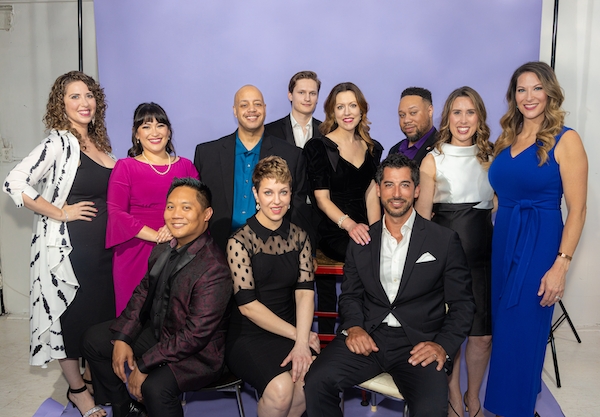
Chicago a cappella in June 2022. The ensemble released Miracle of Miracles: Music for Hanukkah last month. (photo by Kate Scott)

The CD Miracle of Miracles: Music for Hanukkah arrived at the Jewish Independent unsolicited. The album, released last month by Cedille Records, features a range of songs from the American Jewish musical tradition, performed by Chicago a cappella vocal ensemble. As someone who spent a good portion of her teenagehood in a choir at a Conservative synagogue and about a decade singing in another Conservative synagogue choir later in life, I have been happily singing along to this recording, enjoying the fresh take on songs with which I am mostly quite familiar.

Miracle of Miracles will appeal most, I think, to someone like me, who grew up in a Conservative Judaism milieu where a cantor and choir formed a large part of the service, or someone who appreciates classical music, as Chicago a cappella are classically trained A-listers, who perform a repertoire of music from the ninth to the 21st centuries. The current artistic director is John William Trotter, and Miracle of Miracles was recorded over a few days last January at Northeastern Illinois University in Chicago.

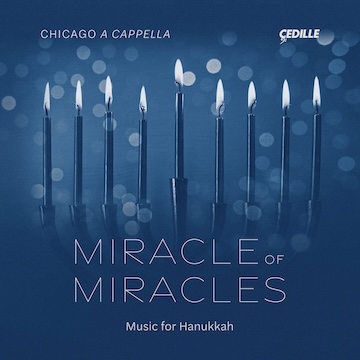
image - Chicago a cappella CD coverThe CD opens with an arrangement of “Oh Chanukah / Y’mei Hachanukah” by Robert Applebaum that the liner notes describe as “modern versions of the song form from the confluence of at least two streams, the first springing from Hebrew lyrics, the second flowing together from Yiddish and English sources. Turning again to [composer] Harry Coopersmith’s mid-20th-century collection … to create something of a mash-up of ‘Oh Chanukah’s’ popularity.”

There are several Applebaum arrangements. His “Haneirot Halalu” (“These Lights We Light”) mixes English translation and commentary into the traditional Hebrew lyrics, and his “Maoz Tzur” is a cantor-choir interplay that comprises elements most of us will recognize and be able to join initially, but then becomes more complex. His finger-snapping arrangement of Samuel E. Goldfarb’s well-known “I Have a Little Dreidl” – called “Funky Dreidl” – is in English with the Hebrew “nes gadol haya sham,” “a miracle happened there,” as a kind of chorus. It’s followed on the CD by a lively rendition of Mikhl Gelbart’s Yiddish “I Am a Little Dreidl (Ikh bin a kleyner dreidl).”

Other Yiddish offerings are Mark Zuckerman’s arrangement of “O, Ir Kleyne Likhtelekh” (“O, You Little Candle”), the lyrics of which were written by poet and lyricist Morris Rosenfeld, and an arrangement by Zuckerman of “Fayer, fayer” (“Fire, Fire”) by Vladimir Heyfetz, about burning the latkes while frying them.

Applebaum’s jazzy “Al Hanism” (“For the Miracles”) is one of three versions of the song on this recording. There is also an arrangement by Elliott Z. Levine that is the traditional, fast-paced version I’ve sung countless times and love, and the expansive, movie soundtrack-sounding arrangement by Joshua Fishbein.

Levine also contributes “Lo v’Chayil” (“Not by Might”), based on text from the Book of Zechariah, which is not a Hanukkah song per se, but, as the liner notes say, “rather the more transcendent spirit that underlies the commemoration of Hanukkah.” Translated from the Hebrew, the verse is: “Not by might nor by power, but by My spirit, saith the Lord of Hosts.”

Other composers/arrangers whose work is featured on this CD are Steve Barnett (“S’vivon” / “Little Dreydl”), Gerald Cohen (“Chanukah Lights”), Daniel Tunkel (four movements of his “Hallel Cantata”), Jonathan Miller (“Biy’mey Mattityahu” / “In the Days of Mattityahu”).

Two bonus tracks are included: an arrangement by Joshua Jacobson of Chaim Parchi’s Hanukkah tune “Aleih Neiri” and Stacy Garrop’s take on the prayer for peace “Lo Yisa Goy”: “Nation shall not lift up sword against nation, neither shall they learn war any more.”

In the program notes, Miller, who is Chicago a cappella’s artistic director emeritus, talks about the limited number of Hanukkah songs that are appropriate for an ensemble to perform, commenting that “Jewish choral music is a recent phenomenon, begun in earnest only about 200 years ago in Berlin, so there’s a simple quantity issue: we have much less repertoire to peruse than in other choral traditions. Given all of this, we are especially grateful for the composers and arrangers whose persistence and skill have given us the works found here.”

photo - Chicago a cappella artistic director John Trotter
Chicago a cappella artistic director John Trotter. (photo from Cedille Records)

Despite the dearth of Hanukkah choral music, Trotter, the ensemble’s current artistic director, observes that the CD comprises “a sprawling variety of styles.”

“There are at least two reasons for this breadth,” he writes. “On the one hand, we are in debt to the fertile imaginations of our composers, who envisioned so many different sound worlds and so many different ways to clothe these texts. But there is also the nature of Hanukkah itself, which offers so many different modes of personal, social and spiritual practice. Consider just three of these. Hanukkah offers the chance to reflect on the historical significance of the Maccabean revolt, with its consequences echoing through to the present day. It invites quiet contemplation of the candle flames, set aside from any utilitarian purpose. And it provides an opportunity to gather with family and have a really great party with really great food.”

Miracle of Miracles would provide a perfect acoustic background for a Hanukkah gathering. To purchase a CD or buy or stream the music digitally, visit cedillerecords.org/albums/miracle-of-miracles.

Format ImagePosted on November 24, 2023November 23, 2023Author Cynthia RamsayCategories Celebrating the Holidays, MusicTags Cedille Records, Chanukah, Chicago a cappella, choral music, Hanukkah
A spoof on true crime

A spoof on true crime

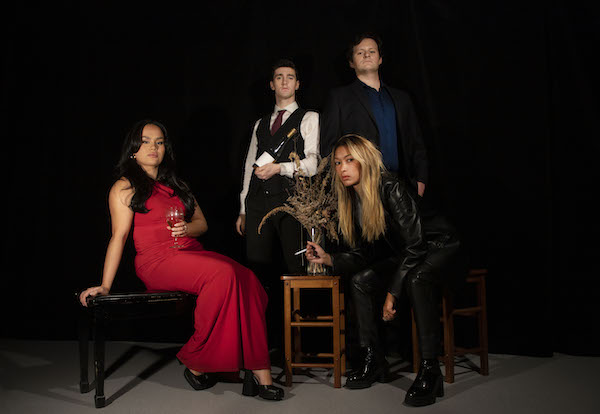
Left to right: Sophia Paskalidis, David Underhill, Drew Ogle and Mai Stone (seated) co-star in Tragedy, Slander & Wine. (photo by Sarah Cherin)

When a community theatre production ends with an actor dying on stage, the media descends on the small B.C. town. Conspiracy theories flourish and no one is above suspicion.

This is the plot of Tragedy, Slander & Wine by Jewish community member David Volpov, which premières at the NEST on Granville Island Nov. 13-19. The mystery/comedy explores, among other things, media literacy.

“My goal in writing Tragedy, Slander & Wine is to bring awareness about the issue and to invite audience members to think more critically about the media they consume. So, that’s where the idea of true crime entered the play,” said Volpov, executive director of Promethean Theatre, which is presenting the work. “I see true crime lovers popularize a lot of sensationalistic interpretations of well-known deaths. I think people tend to want to believe wild hypotheses instead of the cut-and-dried truth simply because it’s more entertaining. This conspiratorial thinking can become dangerous if it impedes on innocent people’s lives, which is what happened in real life to the town of Moscow, Idaho, after several infamous deaths.”

On Nov. 13, 2022, Ethan Chapin, Xana Kernodle, Kaylee Goncalves and Madison Mogen were stabbed to death in the young women’s off-campus (University of Idaho) house. False accusations and other misinformation proliferated, causing much harm to the community. Eventually, suspect Bryan Kohberger was charged with their murders, and his trial continues.

In Volpov’s fictional story, the play’s description notes, “The finger-pointing grows so rampant that the victim’s sister, Shannon (Mai Stone), can’t even have a healthy relationship with her own mother. Shannon’s longtime friend Alec (Drew Ogle) promises to help Shannon replenish her image in the public eye and shed her status as a pariah. But they find out that manipulating the media is harder than they anticipated. They have to get past power-hungry reporter Penelope (Sophia Paskalidis) and gatekeeping publicist Colin (David Underhill). Soon, Shannon uncovers a secret plot that upends everything she thought she knew about the tragedy.”

The play features four actors on stage and seven performers who act only on screen.

“I knew that I needed a multimedia film component in the production to spoof true crime,” Volpov told the Independent. “We filmed interviews with the townsfolk, who give the audience information about the circumstances of the mystery of the play. The film is played on TVs, which are onstage during the entire performance.”

This approach was new to many working on the production and Volpov said he appreciated the help of a few film artists who offered their guidance. In particular, he noted, “Our videographer, Bruna Xavier, and our film editor, Ian Tan, are both godsends. I’m really excited for audiences to see what this collaboration created because it’s not something that Vancouver audiences have seen before.”

Tragedy, Slander & Wine is Promethean Theatre’s sixth production. Formed in 2018, the company’s mandate is “to create work opportunities for emerging artists,” said Volpov. “There are some apprenticeships open to emerging artists in Vancouver theatre companies, but I keep hearing from my peers that these positions only take them so far. They feel stuck in what they consider a trainee limbo before they can get a shot at a role they want. That’s why Promethean puts emerging artists directly in positions of creative leadership. In that sense, we act as a launchpad for artists who want to continue expanding their practices.” (For more information, visit prometheantheatre.ca.)

photo - With Tragedy, Slander & Wine, playwright David Volpov invites audience members to think more critically about the media they consume
With Tragedy, Slander & Wine, playwright David Volpov invites audience members to think more critically about the media they consume. (photo from Promethean Theatre)

Volpov joined the producing team after having acted in Promethean’s first production, Saint Joan. He graduated from the bachelor of fine arts acting program at the University of British Columbia in 2020.

“Like many people who graduated then, my final play at UBC was cut short after just three performances due to COVID,” he said. “This experience really opened my eyes…. I always knew acting is a difficult profession, but to see virtually every theatre and movie set shut down spiked my existential worries a lot. There’s a silver lining, though. I returned to playwriting during the lull period in 2020 because I realized that writing was a way I could create art while social distancing. I learned that I didn’t have to wait for theatre work to come to me; I could generate work myself. In hindsight, I didn’t actually know what art I wanted to make when I graduated UBC. It wasn’t until I began writing plays that I found my voice and had something to say about the world.”

Tragedy, Slander & Wine is one of the works Volpov began writing during the pandemic. “I felt troubled by how quickly conspiracy theories spread,” he says in the press release for the play. “I saw this cycle repeat after each major world event. Our abilities to engage in meaningful discourse eroded while our reliance on bias-confirming news increased. With so much misinformation online nowadays, how is anyone supposed to parse through what’s fact and what’s fiction?”

“Research shows that feelings of anxiety, disenfranchisement and isolation cause people to think more conspiratorially,” Volpov told the Independent. “People feel comforted by believing that their enemies cause their bad fortune (as opposed to random chance). One of the reasons conspiracy theories endure is because they have a backfire effect: when someone confronts a conspiracy theorist about their beliefs, it is interpreted as confirmation. Theorists think ‘of course, the higher powers want to convince me I’m wrong, that’s part of their plan.’ I don’t think conspiracy theories will ever go away, unfortunately.”

Nonetheless, Volpov is doing what he can to improve the situation, in addition to writing about it.

“Promethean Theatre partnered with a media literacy platform to provide education about the topic,” he said. “They are called Ground News and are a Canadian company based out of Kingston, Ont.

“I believe that there are many ways that people can combat their confirmation biases and to have a well-rounded knowledge about current events,” he continued. “The number one thing people can do is to read multiple sources about one story. I know it probably feels like a chore, but reading different perspectives can mitigate our political blindspots.

“After that, I recommend cutting your social media use when engaging with current events. Traditional media isn’t perfect, and it’s rightfully facing scrutiny from the public, but social media can be especially pernicious because the algorithm can steer people to engage with content that already supports their beliefs. Also, the algorithm boosts sensationalistic content while ignoring nuance, which I think is necessary for every discussion.

“My next piece of advice is, be diligent about claims you read. If information can’t be traced back to a source,” he said, “it can’t be verified as true.”

Tragedy, Slander & Wine is recommended for audience members age 16+ because of its “mature content, including references to substance abuse, murder and suicide.” Among the performances is a matinée for high school students Nov. 15, and artist talkbacks after the Nov. 18 and 19 matinées. For tickets, visit plainstage.com/events/tragedy-slander-and-wine.

Format ImagePosted on November 10, 2023November 9, 2023Author Cynthia RamsayCategories Performing ArtsTags comedy, David Volpov, media literacy, Promethean Theatre, satire, Slander & Wine, theatre, tragedy, true crime
Culture Crawl starts Nov. 16

Culture Crawl starts Nov. 16

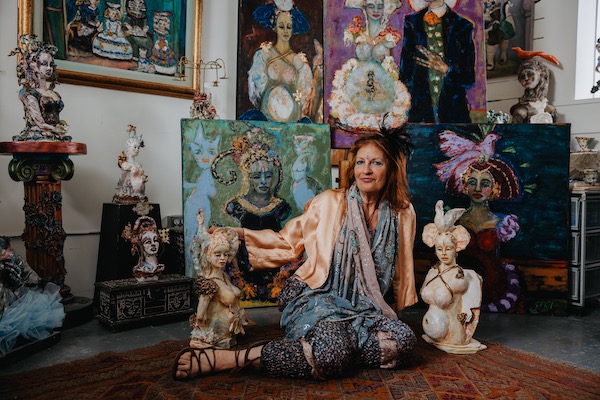
Suzy Birstein is one of the many Jewish community artists taking part in this year’s Eastside Culture Crawl Visual Arts, Design & Craft Festival, which runs Nov. 16-19. (photo by Britt Kwasney)

The 27th annual Eastside Culture Crawl Visual Arts, Design & Craft Festival takes place Nov. 16-19 and features almost 450 artists, including many from the Jewish community. Among the community members opening their studios to visitors are Suzy Birstein, Olga Campbell, Hope Forstenzer, penny eisenberg, Robert Friedman, Lori Goldberg, Lynna Goldhar Smith, Ideet Sharon, Stacey Lederman, Shevy Levy, Lauren Morris and Esther Rausenberg.

“We welcome the public to dive back into the Culture Crawl this fall to experience and be inspired by our artists’ growth and discovery. [The pandemic] has been a time of change for many of us and I believe art is a conduit for moving forward together,” says Rausenberg in the event’s press release. Rausenberg is a photo artist, as well as artistic and executive director of the Eastside Arts Society, which puts on the Crawl.

The Independent spoke with a few of the participating Jewish artists about what visitors to their studios can expect to see, and whether creativity is a place of refuge or if it is harder for them to create in times of conflict, including but not limited to the Israel-Hamas war and the war between Ukraine and Russia.

Visitors to Birstein’s studio will see her “figures from fired clay infused with aged and lustred surfaces, which inspire paintings in oil, cold wax and collage.”

The artist is currently working on two series, which will merge into the solo retrospective at Il Museo Gallery, curated by Dr. Angela Clarke for 2025.

“Both series evoke my art/travel adventures to Europe, Mexico and Cambodia,” said Birstein.

“‘Ladies-Not-Waiting’ reference the gazed-upon women by old master painters – Velasquez, Fouquet and Manet – alongside self-portraits painted by masterful female artists, Frida Kahlo, Leonora Carrington and Leonor Fini,” she said, while Tsipora (her Hebrew name, meaning Bird) is a series of loose self-portraits, which “embrace an exotic earthiness living within my poetic imagination.”

Both bodies of work, she said, “speak to nesting and transcendence, the mirror and reflection and celebrate the individual and universal.”

For Birstein, in times of conflict, “be it COVID, warfare, personal challenges – the only thing that centres me, coming directly from within me, is the creative refuge of my studio and making art. As I say this, I must stress that the love and compassion I feel for and receive from my family, friends, students and peers is the other half of that equation. I can’t imagine one without the other and I am extremely grateful.”

Friedman describes himself as “a muralist-styled stained glass artist.” He has worked in stained glass for more than 40 years and has recently added a blown glass dimension to his work, according to his website, which is also a recent addition.

“My studio is a great place and haven for creative thought and output,” he told the Independent. “[T]hese troubled times just [add] more impetus for me to have it reflected even more so in my artwork.”

Goldberg also finds herself more driven.

“My work is about vitality, life, vibration forging connections and bringing two opposing energies together as a way to find potential for resolution,” she said. “I have a responsibility as an artist to respond. I am more motivated. Expressing ‘Heaven on Earth’ is one way I respond to pain and suffering.”

Goldberg had a three-month residency on the North Shore, which she spent painting the forest – work that studio visitors will see.

“I was recently reading the book Speak for the Trees by Diana Beresford-Kroger about how the roots of the trees, the mycelium and plants and trees talk to each other,” said Goldberg. “By painting in the forest, I learnt how to listen, experience the tranquility, vitality and interconnectedness of the forest and to myself.”

Since the spring, Goldhar Smith has been “creating minimal colour-field style landscapes based on the idea of the shape of light and the colour of shadows,” she said. “The paintings are rendered in soft blues and pastels or deeper mysterious tones and suggest memories of places real and imagined.”

She acknowledged, “The conflict in Israel has, of course, been enormously upsetting and I find myself in despair for both sides of the conflict. My paintings do not yet reflect these emotions, but they will in coming months. I don’t yet know what I will be painting but I will be exploring more difficult terrain.”

For Forstenzer – a glass artist and director of the Sidney and Gertrude Zack Gallery – creativity can be a place of refuge, but also more challenging in times of conflict.

“Making work when I’m feeling the stress of all that’s going on personally and globally is truly healing,” she explained, “but when I’m feeling overrun with those things, it can be a lot harder to fully concentrate at times.”

Lately, Forstenzer has been making glass clocks, something she describes as “incredibly fun.”

“I can experiment with colour and pattern in the glass, and I’ve learned a lot about clockwork mechanisms, which is also an exciting thing to dive into – I’ve been down many rabbit holes online about clockmakers,” she said. “I’ll have a bunch of clocks on display and for sale at the Crawl.

“I also have spent a lot of the last year generally playing with colour and pattern,” she added. “I’ve made vessels – vases, bowls, cups – that experiment with a particular colour or look or pattern or stripe in glass. Once I have a colour process in place, I often go on to use those colours, patterns and processes in sculptural pieces. Since I’ve done so much experimenting this year, there will be a lot of pieces on display and for sale at the Crawl as well.”

In addition to opening their studios, Forstenzer and Birstein are part of the Crawl’s juried exhibition, which has the theme “Out of Control.”

“At a time when we start to celebrate our freedom from pandemic restrictions, it’s an opportunity to reclaim experiences that were denied for so long, a chance to think outside of the box and just let go,” says Rausenberg in the press release.

The exhibition features the work of 80-plus Eastside artists and takes place at multiple venues: Alternative Creations Gallery and Strange Fellows Gallery (both until Nov. 19), the Pendulum Gallery (until Nov. 24) and the Cultch (until Nov. 25).

For more information, visit culturecrawl.ca.

Posted on November 10, 2023November 9, 2023Author Cynthia RamsayCategories Visual ArtsTags creativity, David Friedman, Eastside Culture Crawl, glass, Hope Forstenzer, Lori Goldberg, Lynna Goldhar Smith, painting, sculpture, stained glass, Suzy Birstein
The opposite of death is love

The opposite of death is love

Hadar Galron in Whistle, which is at the Firehall Arts Centre Nov. 14-15, as part of the Chutzpah! Festival. (photo by Nathan Yakobovitch)

“As a child I was never hugged or kissed; I think my parents did not even see me. I wrote this story to stop being an invisible child,” Israeli author Ya’akov Buchan has said about Whistle: My Mother was Mengele’s Secretary.

The play Whistle is part of this year’s Chutzpah! Festival, with performances Nov. 14 and 15 at the Firehall Arts Centre. Writer, director and actor Hadar Galron, who adapted Buchan’s story for the stage, stars in the monodrama.

“Buchan was born to two Auschwitz survivors, and began writing after he was injured in the Yom Kippur War. He’s written 18 books – four concerning the Holocaust – but he felt that people don’t read so much anymore, and that he wanted to write a play about second generation Holocaust survivors,” explained Galron in an interview with the Independent. “Dramatic writing and prose are very different techniques, and Ya’akov sent me about 30 pages of interesting and well-written content, but not dramatic enough for stage.

“The first meeting with him was out of respect – I thought I’d give him a few tips and let him take it from there,” she continued. “I remember the turning point: I said, ‘You mention twice in these pages the name Mengele. You can’t just throw in a name like that, it needs to have some dramatic payoff, or not to be mentioned at all.’ Ya’akov said nothing, just nodded. And, suddenly, I thought that maybe Mengele had tortured one of his parents. ‘Were any of your parents somehow … (how to say this?!) … connected to Mengele?’ Ya’akov looked me squarely in the eye and said, quietly, ‘My mother was Mengele’s secretary.’ That was when I knew I would take the task, and help him tell his story and the story of the second generation.”

In recent years, Galron has been working on several plays that deal with the lasting impacts of trauma. “We tend not to consider [the] second generation as traumatic,” she said, “but something as horrendous as the Holocaust leaves some people so scarred that they cannot really love anymore, even their children. Or, they love but in a different, obsessive way. The children who grow up without feeling love are traumatized, too, but their wounds are invisible.

“It’s important to understand that, whilst the trauma lasts a minute or a year or five years, post-trauma lasts a lifetime and, when considering [the] second generation, then even more than a lifetime. Long-term traumas such as [the] Holocaust are not a swing of the sword, they are more like the bite of a snake – the venom penetrates the body and mixes with the blood of the victim.”

Though she generally directs her own works, Galron said, “When I’m the actress, I need someone on the outside. At first, I thought maybe I’d direct and not act. It was Ya’akov who begged me, after seeing my stand-up cabaret Passion Killer, to act the part.”

Jaffa, Israel-born director and playwright Hana Vazana Grunwald was the first person who came to Galron’s mind to direct.

“We studied theatre together at Tel Aviv University, but that was decades ago! I had no idea where to find her,” said Galron. “We’d met a couple of times in festivals, etc., along the years. I was thinking of her on my morning walk-jog in the park by my home. In the distance, I saw a woman that reminded me of Hana and then we got closer and I saw it actually was Hana! She lives five minutes away from me, but that was the first day she decided to go out and take a power-walk before work. I don’t believe in coincidence – it’s only God’s way of remaining anonymous.”

Grunwald started out in community theatre more than 25 years ago. She is the director of the Frechot Ensemble, a collective of women creators, which she founded some 10 years ago.

“I see myself as a feminist Mizrahi (Middle Eastern Jew) writer, who brings to the forefront my personal story,” she told the Independent. “But my personal story is never just my own, it’s an inherent part of my political story, my family’s story and the collective which I belong to. I feel that my world isn’t really represented in Israeli theatre. I don’t see the household I grew up in, I don’t encounter complexities and dilemmas that interest me. I realized I have the responsibility to represent myself – I have to write these texts, I have to tell these stories. My job is to search through history and prose and to bring back the voice of all those whose voice was taken away from them.”

When Galron sent her the script for Whistle, Grunwald said, “I was immediately hooked. But, after we met again, I felt that the opportunity to work together and find connections would also be reflected in the play’s dramaturgy.

“The challenge that the play Shirika [Whistle, in Hebrew] brings to our door is how to retell the story of the Holocaust and the story of the members of the second generation, who feel transparent. Two images guided me in my search for the keys to directing the play,” said Grunwald.

“The first: whistle. Tammy, the protagonist, lost her ability to whistle, she lost her ability to love and feel loved and, as she says in the play, ‘The opposite of death is not life, the opposite of death is love.’ The way this whistle is expressed on stage is through the prop of a kettle full of boiling water. The boiling and bubbling kettle and the whistler on stage metaphorically tell the story of the Holocaust, a story that never ends.

“The second image we chose is the painting. Tammy is a painter and, when we wondered what was painted on the stage, we realized that the body is the canvas, the body treasures and carries the wounds of the past, the memories – the actress jumps from limb to limb and with the help of simple means such as brushes and paints Tammy marks national history…. This is the way in which the trauma is present again on the stage.

“It seems that precisely now the spectacle of a whistle is given a relevant meaning,” Grunwald added. “We find ourselves facing a terrorist attack in which again Israeli Jews are brutally murdered and mass murdered because of their Jewishness. We again witness horror stories in this war against Hamas. We find ourselves again, 75 years after the establishment of the state of Israel, in a shocking event that reminds us of the fear of being destroyed. The harsh scenes from both sides shake the soul, sow terror and fear, and remind us that the feeling of security is a temporary illusion and we must not forget it. I work at the Hebrew-Arab theatre in Jaffa, a theatre that gives a stage to the binational discourse, it gives a stage to both narratives, and I feel that, these days, it is the first to be hurt.”

Galron also works with artists of different backgrounds and shared one of her experiences.

“Between 2016 and 2018, I was artistic director of the Shalom Festival, a small festival that was an official part of the Edinburgh Fringe fest,” she said. “We created this festival after an Israeli production, in 2014, was shouted down by the BDS [boycott, divest and sanction movement] and, in 2015, there were no Israeli productions.”

She was inspired by Sir Rudolf Bing, founding director of the Edinburgh International Festival, from which the Edinburgh Fringe Festival has its roots. Galron explained that Bing, a Jewish-Austrian opera singer, who fled Nazi Germany, “created the festival as a cultural bridge, inviting, firstly, German artists to take part! With that in mind, I told the sponsors of the Shalom Festival that we cannot make a one-sided Shalom (Peace) Festival and that, as the artistic director, I would like to bring artists from all of Israel, including Israeli Arabs – both Muslim and Christian – and also some Palestinian artists. At first, there was big objection but, eventually, I convinced them that these are Palestinians who believe in peace, in dialogue. Until today, even in these times, I am in contact with my Palestinian friends.

“I believe art is a bridge,” she said. “I believe art and culture and theatre have the power to heal – to give us insight and create empathy. From my very first performance as a stand-up artist – my show was on the status of women in the Jewish law – I made a decision to make my art meaningful, to merge life and stage.”

Since the Oct. 7 Hamas terror attacks on Israel, Galron has been posting related videos and other items on Facebook, including “Creativity in place of survival” writing challenges. She got the idea from a course she took during COVID with Dr. Joe Dispenza. “In one of the online digital courses, he speaks of how our brain can be either in ‘survival’ or in ‘creativity’ mode,” said Galron. “The moment I heard this, I understood many things about myself and how creativity has always been for me a way of surviving. Now I know that, when we begin to be creative, we actually begin to pull ourselves out of ‘survival’ [mode] even if we are being creative whilst we try to survive. A bit like Baron Munchausen explains that he pulls himself by his hair out of the pit.”

About how she is doing since the attacks, Galron said, “I didn’t have a real answer to that question until yesterday, because everything is so chaotic. But I was speaking to a university student of mine who answered, ‘I’m committed to the good.’ I was so moved by this. She told me she adopted it from her yoga teacher. I adopted it from her. I’m committed to the good.”

For tickets to Whistle and other Chutzpah! shows, visit chutzpahfestival.com.

Format ImagePosted on October 27, 2023October 26, 2023Author Cynthia RamsayCategories Performing ArtsTags Chutzpah! Festival, Hadar Galron, Hana Vazana Grunwald, Holocaust, second generation, theatre, Ya’akov Buchan
Two world premières

Two world premières

Artists of Ballet BC and Arts Umbrella practise Shahar Binyamini’s BOLERO X. Part of HERE, which runs Nov. 2-4, the work brings 50 dancers on stage for the first time in Ballet BC history. (photo by Marcus Eriksson)

Ballet BC begins its season Nov. 2-4 with HERE, a diverse program that includes two new works from choreographers who have never worked with the company before, and the return, by popular demand, of Enemy in the Figure by William Forsythe.

“Each work stands on its own, and there are no common themes, so to speak,” Ballet BC artistic director Medhi Walerski told the Independent. “It invites audiences to create their own narrative and interpretation, allows for personal engagement, and invites them to explore the scope of human connection and expression.”

One of the new works featured is the world première of Israeli choreographer Shahar Binyamini’s BOLERO X.

“I have been following Shahar’s work for awhile, and I was eager for both the company and the audience to immerse themselves in his distinctive style and choreographic language,” said Walerski.

It will be the first time Binyamini is presenting his work in North America, Walerski added, “and it is a privilege that he has chosen Ballet BC for this special occasion.”

BOLERO X brings 50 dancers to the stage – the most in Ballet BC history.

Of the logistics, Walerski said a multitude of factors come into play. “Scheduling is at the forefront, both in the studios and at the theatre. Fortunately, we’re collaborating with Arts Umbrella Dance, sharing a common vision of turning the impossible into reality.

“On the production side, the costume department is putting in tremendous effort,” he said. “Led by our dedicated head of wardrobe, Kate Burrows, our incredible team is going the extra mile to bring that vision to life. Our rehearsal directors are navigating a new experience of rehearsing many dancers at once, and they are doing this brilliantly. It shows the professionalism and dedication of our remarkable team.”

Binyamini returned to Vancouver to work with the company this week. It is important that such performances continue, even when there is a war going on “because the arts and creation are amazing bridges in order to build trust,” he said. “What we see happening could easily happen anywhere else and be used as inspiration for other conflicts to accelerate in the same direction. The crime against humanity is the destruction of trust and, in order to build trust, you need to create channels into humanity. Dance could be a very important vessel or tool to connect people. And this is what gives me the motivation to be here and working. Because what I do is important, especially now.”

“Art has this unique power to breathe life into the world, and it brings vitality into our everyday lives,” said Walerski. “It is an incredible force that transcends boundaries. It has this magical ability to bridge gaps between people, regardless of geographical or cultural differences. It’s like a vibrant thread weaving through the fabric of humanity, connecting hearts and minds. It brings a sense of unity and shared understanding, nurturing a profound connection among individuals who might otherwise seem worlds apart.”

The press material for BOLERO X says “the creation explores themes of unison and repetition, while still allowing for individuality and stand-out solo and duet performances.”

“I’m focusing more and more on the dancers’ uniqueness in relation to the large group,” said Binyamini. “There is unison, but individuality within that unison. Here at Ballet BC, I find I can explore more the individual aspects and solos. These dancers are so generous and they give you everything – all they have. It’s very rewarding.”

Maurice Ravel’s 1928 composition, Bolero, “is very repetitive, obviously, the melody itself, but the orchestration brings more layers,” Binyamini explained. “A long crescendo of something getting more intense has been very present in my work previously. It’s what turns me on. So, when I started working with Ravel, I tried various works, but got fixated on this and it felt like it really fit. It allowed me to focus on something I was already into, but gave me the anchor and licence to clear out all the unnecessary thoughts or feelings. I decided to just focus on the musicality and the playfulness, which allows the dancers to stay playful.”

Binyamini was not at all daunted by the challenge of having 50 dancers on stage.

“I felt and still feel how much of a force it is to react to, and to say yes to. To have a dialogue with 50 dancers is such a powerful thing in the studio and it enables me to be in the moment, especially with all the other things going on in my life,” he said. “I feel very comfortable working with a lot of people.”

photo - Ballet BC artist Sidney Chuckas at work in the studio ahead of the season opener HERE
Ballet BC artist Sidney Chuckas at work in the studio ahead of the season opener HERE. (photo by Marcus Eriksson)

The other new creation – and world première – being presented in HERE is Stephen Shropshire’s Little Star. Originally commissioned by former Ballet BC artistic director Emily Molnar, its trip to the stage was delayed by the pandemic.

The inspiration for Little Star was composer Angelo Gilardino’s “cycle of guitar variations based upon ‘Ah vous dirais-je Maman,’ a popular children’s song originating in 18th-century France and adopted for the English-language lullaby ‘Twinkle, Twinkle, Little Star,’” explains the press release. “Shropshire’s movement language for the creation is dynamic, beginning with themes suggesting something child-like and playful, before evolving into something more intricate and complex.”

Rounding out the HERE program is Forsythe’s Enemy in the Figure, which was mounted by Ballet BC in 2018. Set to music by Thom Willems, the work involves improvisation, which means that each performance is different.

“Dance can tell a universal story, like music,” Binyamini said. “I think it’s very challenging to tell a story based on movement, but, when doing it correctly, it’s very effective and has the potential to go much deeper than words, because it’s something we all have in common. We can all relate to physical effort, and have empathy for someone that is moving. You can connect to that energy. To be able to tell a universal story through movement is a big challenge, but very satisfying.”

HERE takes place Nov. 2-4, 8 p.m., at the Queen Elizabeth Theatre. Tickets, starting at $19, are available at balletbc.com.

Format ImagePosted on October 27, 2023October 26, 2023Author Cynthia RamsayCategories Performing ArtsTags Arts Umbrella, Ballet BC, Bolero X, Israel, Medhi Walerski, Shahar Binyamini
Share delight of letters

Share delight of letters

“Shabbat Saskatchewan,” by Esther Tennenhouse. Part of Otiyot (Letters), a joint exhibit with her son Joel Klassen, which is now at the Zack Gallery.

Colourful and playful, dark and ominous, Esther Tennenhouse’s artwork is engaging and thought-provoking, as she offers her take on Torah and midrash, immigration and language, orthodoxy and modernity. Otiyot (Letters), an exhibit she shares with her son Joel Klassen, opened at the Zack Gallery last week.

Tennenhouse’s sense of humour, curiosity, imagination and sincerity come through in the work on display, and in her responses to questions about the exhibit.

“Ot means ‘letter’ (of the alphabet) – it also means ‘sign’ and ‘signal,’” she told the Independent. “It was my first choice of name for the show: Ot – Starring the Letter Shin. Sounds like ‘ought,’ as in ‘thought.’ Ot was visually terse (and sounds adorable). That was why it was Ot in [the] JCC program book – I had to provide that bit before these pieces were made! Yikes! But it got changed to the longer plural in Hebrew and lost its zap. More truthful, though, as I have so many (too many) words of explanation on the wall beside each piece.”

All the works were made specifically for the exhibit, said Tennenhouse, “only for this place, for anyone who happens to walk into the JCC,” where the Zack Gallery is located.

“I was driven by my own relationship to the alef-bet: me, a quite secular, second-generation, Winnipeg-born Jew living in Vancouver, of prairie-born parents, who learned my aleph-bet as a child, quite long ago. I think many like me, with my sort of education, walk by these gallery doors, so I thought they might wander in and relate.”

Born and raised in Winnipeg, Tennenhouse went to Talmud Torah there from age 4 to 11, then to public school. She earned a bachelor’s in English and, while working at the Winnipeg Free Press, majored in sculpture at the University of Manitoba School of Art.

She moved to Aklavik, in the Inuvik region of the Northwest Territories, and then to Yellowknife, where she learned about ceramics at the Yellowknife Guild of Arts and Crafts. She later worked with translucent clays.

Moving with her family – husband Ron, son Joel and daughter Timmi – to Vancouver in 1995, Tennenhouse found a home at Or Shalom, participating in the Talmud and Torah study offered there, reengaging in Jewish education after a break of some 45 years.

Klassen also attends Or Shalom. His art background includes having drawn at home and working with painter Sylvia Oates – who he describes as a mentor – in her Parker Street studio. Klassen has had a one-man show in artist Noel Hodnett’s Parker Street studio, and he was in the Kickstart Disability Arts and Culture’s 2019 group show Nothing Without Us at the Cultch. For the past four years, he has attended the JCC’s Art Hive, which is facilitated by Kim Almond.

Klassen’s Hebrew letters and drawings are in five of the pieces at the Zack Gallery, said Tennenhouse.

“Making letters as individuals, each with their own character, was the most fun to do,” she said. “Jan Wilson, a friend and quilter, offered to help if I drew out the correctly sized letters backwards for transfer and picked the fabrics.”

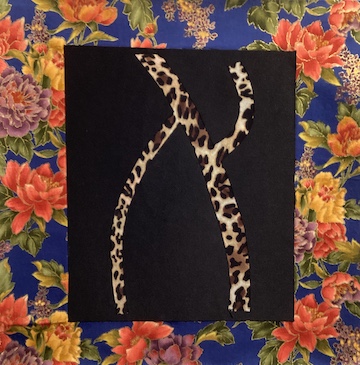
The letters comprise eight of the works on display, and offer much to think – and smile – about. Klassen’s aleph is filled in with leopard print fabric, surrounded in black with a flowered border. The word “wild” comes to mind as one looks at it, not just the wildness of animals and nature, but of human beings. The piece is called “Aleph in the Garden.”

photo - “Aleph in the Garden” by Esther Tennenhouse, Joel Klassen and Jan Wilson
“Aleph in the Garden” by Esther Tennenhouse, Joel Klassen and Jan Wilson.

“I did not shy away from diversity,” said Tennenhouse. “It’s sort of an underlying element. I felt the show had to offer something to any individual, whatever their history with the alef-bet, and it deals with very well-trodden themes. I felt a need for an element of surprise, which is one reason why Joel’s aleph became a leopard in the garden (of Eden?).”

A last-minute addition to the depictions is one of the 12 new letters for gender-neutral word endings that were created by Israelis graphic designer Michal Shomer a few years ago.

“They appeared in welcome signs outside schools and on IDF buildings, etc., but the kabbalist idea of the power of the alphabet lives on – the new letters were vigorously rejected by religious factions,” said Tennenhouse. “‘Changing the letters removes any kedusha (sanctity) the words have or any ability the words have of channeling God’s energy into the world,’ said sofer Rabbi Abraham Itzkowitz. ‘This project essentially makes Hebrew like any other language.’ Some of the signs were taken down. Religious schools were forbidden to use them.”

That said, Tennenhouse told the Independent, “What first tickled me into this aleph-bet project was the poetry and passion of the ideas of the early mystics. They conceived of letters of the alef-bet existing even before the creation of the world – all 22 were vessels of the divine, all things were created by their combinations. Meditative/ecstatic kabbalah taught that individual letters were something to meditate upon, which led to ecstasy, one of the steps to sense of union with G-d. American calligrapher Ben Shahn, who titled one of his books Love and Joy About Letters, quotes the 13th-century Rabbi Abulafia, who said the delight in combining letters is like being carried away by notes of music.”

Tennenhouse and Klassen’s “Shir” (song, poetry, chant, in Hebrew) is truly delightful, like a page out of a children’s book. A multimedia piece, it depicts several animals and the sounds they make, both in Hebrew and in transliteration, though the giraffe just “hum[s] at night.”

Two other works are striking, both on their own and in contrast to each other: Sinai 1 and Sinai 2.

photo - Detail of "Sinai 2" by Esther Tennenhouse and Joel Klassen
Detail of “Sinai 2” by Esther Tennenhouse and Joel Klassen.

The latter features three bright yellow flowers, surrounded by green. “It is a triangle canvas which is about the mountain bursting into bloom when Moses came down with the Ten Commandments – this was a midrash from the 1500s. The triangle has flowers by Joel. I asked him to put flowers on it, envisioning little flowers here and there – he just went swoosh woosh on it.”

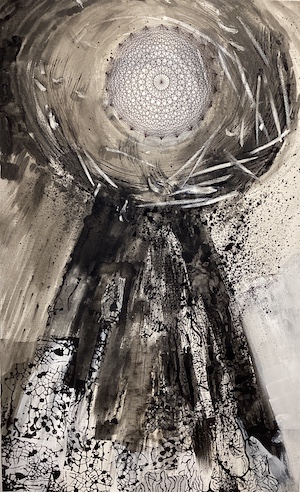
Sinai 2 is a vertical rectangle with whites, greys and blacks depicting a furious ball of activity on top of the mountain that includes the Hebrew letters.

photo - "Sinai 1" by Esther Tennenhouse
“Sinai 1” by Esther Tennenhouse.

“The Torah tells of fear, awe, the shaking mountain, seeing sounds, lightning, Moses’ anger, the breaking tablets,” said Tennenhouse. “Looking back, I overburdened the canvas [with] anger, though laying on the 231 Gates – a diagram from the Sefer Yetzirah which shows each letter combining with each other letter of the alef-bet – because I see the story of the giving of the Torah as a sort of creation story for our intense embrace of literacy. The diagram relates to Rabbi Abulafia’s talk of combination of letters but distracts visually from the anger/violence, [the] mountain, fear.”

There is so much more in this exhibit.

“Cursive Handwriting: Kovno Testament” is a stark, unfinished work, featuring the words, written in his own hand, of Lithuanian writer Eliezer Heiman, who died in the Kovno ghetto during the Holocaust. It was to have three more samples of cursive, said Tennenhouse. “I left room for them before I put on the image of Heiman’s tablets. Those spaces stayed empty. Everything else edited themselves out because of what happened in Israel on Oct. 7.”

There is the multimedia triptych “Shabbat Saskatchewan,” which Tennenhouse said “is me trying to use real photos and documents to create some presence of my mother’s grandparents and parents.”

“It ended up being centred on great-grandmother Esther Dudelzak Singer, Baba Faige (Fanny) Singer and my mother with her sisters,” she said. “Yiddish was their mamaloshen (mother tongue) and the Sonnenfeld community was religiously observant.”

“The Owl and the Pussy Cat” adds colour and vibrancy to Edward Lear’s black and white drawing of his nonsense poem, the Yiddish translation of which – by the late Marie B. Jaffe – fills the two side panels of this triptych. Tennenhouse couldn’t find much information out about Jaffe, she said, “But, thanks to Eddie Pauls at the Jewish Public Library in Montreal, [I] learned she immigrated to New York in 1909 from Lithuania.”

Tennenhouse began to see the owl and the cat in their boat as sailors braving the rough seas, traveling around the world to find “Di Goldene Medine,” “the Golden Land,” America.

“You might say ‘Saskatchewan,’ too, is about leaving home, traveling across seas and finding a new place but keeping your language and culture,” said Tennenhouse.

Otiyot (Letters) is on display at Zack Gallery until Nov. 12.

Format ImagePosted on October 27, 2023October 26, 2023Author Cynthia RamsayCategories Visual ArtsTags art, Esther Tennenhouse, Joel Klassen, multimedia, Otiyot, painting, Zack Gallery
Trauma, loss and hope

Trauma, loss and hope

Composer Rita Ueda has written an opera inspired by Barbara Bluman’s book I Have My Mother’s Eyes. (photo by Danilo Bobyk)

“In light of what is happening in the news today, we need to tell the story of Chiune Sugihara and the Bluman family more than ever,” composer Rita Ueda told the Independent. “I suspect more and more world leaders, communities and individuals will be faced with the decision to either do the easy thing, or the right thing. We need to tell ourselves more stories of compassion, courage, healing and family love.”

Ueda’s chamber opera I Have My Mother’s Eyes: A Holocaust Memoir Across Generations premières at the Rothstein Theatre Nov. 18-19, as part of the Chutzpah! Festival. Directed by Heather Pawsey, the opera tells the story of Sugihara, the Japanese diplomat who risked his own life during the Holocaust to issue visas to Jews, including members of Vancouver’s Bluman family. Its title comes from the late Barbara Bluman’s book of the same name, which was published in 2009, five years after her death from cancer.

“I don’t think I fully knew why I wanted my mother’s book published … when I immersed myself in this legacy project,” said Danielle Schroeder. “Looking back, bringing her story and my grandmother’s stories to life brought me a lot of comfort and meaning as I grappled with the profound sense of loss her death brought…. Also, at the time it was published, stories about the impact of intergenerational trauma and resilience were not being written about that much in the mainstream, so I felt my mom’s book was unique in the way it interweaves and interconnects her and her mother’s stories of trauma, loss and hope. And, of course, being able to share with the world the story of courage, generosity and compassion of the Sugihara family was also important to me.”

Ueda found out about the Bluman family in 2017, through an installation at the Maritime Museum, and reached out to George Bluman, Barbara’s brother. She was moved by the intergenerational nature of I Have My Mother’s Eyes.

“Zosia [Susan] Bluman’s escape from the Holocaust is only a part of the story,” she said. “The story of how the next two generations carried on the family legacy affected me to the core. When George suggested I expand the opera to include the story of the three generations of the Sugihara family that saved them, I became compelled to create the opera!”

“I was very touched and honoured that such a well-respected Canadian composer would want to write an opera about my mom’s book,” said Schroeder. “Especially after meeting Rita in person and learning … how my mom’s book impacted her, it was easy to say ‘yes.’”

Ueda’s opera is inspired by Barbara Bluman’s book, rather than based on it.

“Opera is best suited to convey the characters’ emotional journey,” Ueda explained. “The opera covers all three characters from the book – Zosia, Barbara and Danielle – the three generations of the Bluman women, and their love for each other in light of all the events in their lives. Materials on the three generations of the Sugihara family were based on my two visits to the Sugihara family in Tokyo. Madoka Sugihara spent over five hours with me on each visit, and she showed me many photos and books. She let me play [her grandfather] Chiune Sugihara’s collection of sheet music on his piano, and she told me many family stories. I was truly moved by the two families’ journey of survival, healing, and love for each other.”

George Bluman shared a bit about the real-life people depicted: Zosia, Barbara and Danielle on the Bluman side and Chiune, Yukiko, Hiroki and Madoka on the Sugihara side.

Bluman’s mother was born in 1920 and died in 2004. “Her story, before coming to Vancouver in July 1941, comes to life in I Have My Mother’s Eyes,” he said. “In Vancouver, she worked as a salesperson/buyer in women’s clothing at Cordell’s and Jermaine’s. She was one of the founders of the annual Warsaw Ghetto memorial program, the forerunner of the current annual Yom Hashoah commemoration. Mum is featured in the 2000 PBS documentary Sugihara Conspiracy of Kindness, as well as in the Holocaust museums in Washington, New York and Los Angeles. She loved her family, hosting raucous weekly Sunday dinners for all, often including her children’s friends.

“My sister, Barbara Bluman (1950-2001), graduated from UBC Law School in 1975, among the first large class of women. She was an independent thinker and feminist who lovingly balanced raising her children and her career in law. Her commitment to human rights was demonstrated in all of her pursuits…. Her deep dedication to Holocaust understanding led to her contribution to the Gesher Project, a second-generation cultural exploration of the Holocaust, and organizing an important symposium on the Nuremberg trials.”

Bluman said that, from 1996 to 2000, his sister made notes from 19 interviews with their mother. “Excerpts from these notes formed the basis for her book,” he said, praising his niece’s efforts in getting the book published.

“Yukiko Sugihara (1913-2008) married Chiune Sugihara (1900-1986) in 1936,” said Bluman. “In 1993, my family first met her, together with her oldest son, Hiroki (1936-2002), and Michi (Hiroki’s wife) for a few hours at the Vancouver airport during a stopover on their way to a dinner in Toronto organized by Ontario Premier Bob Rae involving the Jewish and Japanese communities. There was a spontaneous outpouring of strong emotions. To me, in her demeanour, she was an empress! She knew no English and I no Japanese, but I felt what she was saying. My mum and Barbara attended the dinner in Toronto, where the principal guest speaker was David Suzuki.”

There were a few other encounters, and Bluman said he and his brother Bob have corresponded regularly with Madoka. “I have met her twice in visits to Japan,” said Bluman, noting that Bob joined him on the second visit.

“Madoka is a very gracious person and works passionately on making the world aware of the heroic legacy of her grandparents. According to Madoka, her grandmother Yukiko played a most essential role in the Sugihara story.”

Ueda’s opera is “especially meaningful,” said Schroeder, “because it brings my mother back to life and honours her in such a profound way.”

She added, “I wouldn’t be here if it wasn’t for the Sugihara family, so to see a piece of art be created that brings our family together is moving beyond words.”

photo - Teiya Kasahara as Yukiko Sugihara and Barbara Ebbeson as Zosia Bluman in I Have My Mother’s Eyes, which is part of the Chutzpah! Festival
Teiya Kasahara as Yukiko Sugihara and Barbara Ebbeson as Zosia Bluman in I Have My Mother’s Eyes, which is part of the Chutzpah! Festival. (photo by Flick Harrison)

It has taken seven years to get to this point – the opera’s première.

“George and Danielle have been wonderful to work with,” said Ueda. “They have shown me photos (which you will see in the production) and shared family stories with me. They also introduced me to the wonderful Sugihara family.”

Ueda shared “two fun facts”: George Bluman, an emeritus math professor at UBC, trained her brother, a former math professor himself; and she has received permission to turn Yukiko Sugihara’s Midnight Sun Songs, poems that chronicle her story as the wife of Chiune Sugihara, into a sequel to I Have My Mother’s Eyes. The world première will be in Tokyo in October 2024.

Ueda has been composing since she was a toddler. “My late mother was an opera singer, so I grew up in a household with music,” she said. “My early musical ‘scores’ were crayon drawings of picture-representations of the sounds I improvised at the piano. My very first composition teacher when I was 3 (who was about 95 at the time) encouraged me to improvise at the piano and to keep on ‘drawing’ scores in crayon colours, even though his own teachers in the 1880s were Helmholtz and Tchaikovsky. He also arranged for me to see many concerts and events with composers such as Steve Reich, Earle Brown and John Cage.”

The environment, human rights and other societal issues have inspired Ueda’s work. “People in the audience do not need to agree with what I say in my music, but I want them to use the experience as a catalyst for important community dialogue,” she said.

For Ueda, opera is the perfect medium for telling a story with a strong emotional content.

“Opera cannot deliver a blow-by-blow story like a TV drama, film or documentary,” she acknowledged, “but music combined with voice can speak to you at the deepest, most profound level. Through opera, I hope to tell engaging and relevant stories that are important to us – who we are, what we stand for, and what we believe in. European opera has had a history of elitism throughout the past 400 years, but recent Canadian opera productions have been changing this. I hope I Have My Mother’s Eyes will contribute to this change.”

For tickets to see I Have My Mother’s Eyes, visit chutzpahfestival.com.

Format ImagePosted on October 27, 2023October 26, 2023Author Cynthia RamsayCategories Performing ArtsTags Barbara Bluman, Chutzpah! Festival, Danielle Schroeder, George Bluman, Holocaust, intergenerational trauma, opera, Rita Ueda, Sugihara
Melding multiple forms of art

Melding multiple forms of art

Karina Bromberg during Eden Shabtai‘s Elevate Intensive in Los Angeles in August 2022. (photo from Karina Bromberg)

“I think the difference between my dream as a kid and my wanting to do this professionally was getting to experience the behind-the-scenes of what it means to be a professional dancer and choreographer,” Karina Bromberg, 21, told the Independent. “I fell in love with the journey towards the ‘goal’ of being in a movie or on stage and that’s what made me want to keep pursuing this career path.”

Bromberg is the producer and director of the rishon series, which integrates choreography with live music, videography, photography and fashion. The first iteration, rishon.1, was held this past June and rishon.2 will take place at SKL Design+Vision in Burnaby on Oct. 14, at 1:30 p.m.

“Drawing from the knowledge acquired during the creation of rishon.1 and a careful analysis of the final product, my focus for the second instalment has primarily been on elevating the visuals displayed on screen, refining the choreography and creatively designing the performance space,” Bromberg shared with the Independent.

“Given that rishon serves as a platform for emerging and diverse creatives to converge, the cast for rishon.2 is intentionally different, maintaining a commitment to inclusivity and diversity. While the overarching goal and concept remain consistent,” she said, “the skills honed from the first iteration have empowered me to progress and further enrich what rishon offers to both the audience and the dedicated crew involved.”

The idea for rishon came in 2021, when Bromberg and a friend, during a freestyle session, gave each other different objectives to dance.

“I noticed I would analyze and apply the objective to my dance through the senses: How does it look? How would it feel? What smell would it have? Does it make a sharp, or soft sound?” said Bromberg, who is originally from Karmiel, Israel. “It was then that the idea to create something that will somehow involve the five senses formed. Months of pondering the idea led me to realize it needed to evolve into an in-person showcase, which later took the name rishon, meaning ‘first’ in Hebrew.”

Wanting to stage something different, Bromberg searched for venues that would allow audience members to stand amid the artists. “The ultimate goal,” she said, “was to create an immersive and intimate environment where both the audience and the artists were on the same level. Concurrently, I began working closely with TRS, a music artist, and was involved in campaigns for a fashion brand; getting to know artists from different industries, I saw the potential to bring us all together in one space. I expanded on rishon’s creative framework by bringing in the elements of live music, fashion design, modeling and video content of art created for screen.”

Bromberg has been dancing seriously since the age of 5, doing competitive aerobics in Israel, and, at 12, starting “hip-hop, house, popping and dancehall classes at the local dance studio,” she said. “I was dancing competitively at dance competitions like Hip Hop International in Israel and, upon immigrating to Canada, I stopped for about a year. It took me and my parents some time to understand how things work here and to find a studio we could afford and I could easily commute to alone. So, in the meantime, I learned routines off YouTube and danced in my living room.”

Bromberg was 14 when her family moved to Vancouver, and she admits to having been “resistant and closed-minded about the move … but my parents strived and worked hard to open up more doors and provide a better future for me and my younger brother.

“The story of why Vancouver is pretty funny,” she added. “My mom liked to go on Google Earth and see different neighbourhoods and, when she saw the Science World ball, she decided we were going to Vancouver. It was pretty, and less cold than the rest of Canada – which, coming from Israel, was important to us!”

Bromberg’s resumé now includes dancing in Netflix, Paramount+ and CW productions.

“In 2019,” she said, “there was a big audition for Christmas Chronicles 2, choreographed by Chris Scott. Unrepresented by a dance agency, I attended the audition and made it to the last round. I remember having a lot of fun, but I didn’t set my expectations too high. Two months later, while visiting my family in Israel, I received an email confirming that I had booked the job. It was such a proud and surreal moment. Being my first job, I absorbed a wealth of knowledge and remain thankful for the opportunity extended to me.

“The onset of COVID-19 resulted in a work hiatus until 2021, when I was directly booked for a short dance scene in Honey Girls. Being unrepresented at the time, I diligently pursued and submitted self-tapes to anything I could find. In the same year, I booked Monster High, my biggest commercial job to date. It was three months in length, and one of the best times of my life. I was invited back to dance in Monster High 2 in the beginning of 2023 and, following this gig, I was able to get represented by a local dance agency. I recently wrapped up filming for Riverdale Season 7, Episode 14, marking another milestone in my journey.”

Bromberg said she has always loved performing and would help choreograph end-of-the-year shows in her elementary school back in Israel. “I’ve just always had a pull to perform and dance and move my body,” she said. “I’ve always dreamed of being on the big stages or in music videos ever since I was allowed to watch MTV, but I think the dream became something more solid and realistic in my mind in 2021 when I was visiting LA to perform at a showcase. I have been training with a company based in LA since May 2020, four to five times a week over Zoom in my room or garage. The opportunity to work with the choreographer in person and to be in the room with people I look up to, I remember feeling so in my purpose and starting to believe even more that this is what I am supposed to be doing.”

Falling in love with the journey towards her goal includes a commitment to creating. She has videos on her website of solo dances that she has choreographed.

“I wanted to practise dancing for the camera, as well as start investing in my own ideas,” she said. “I often have a vision for visual art that can be made when I listen to songs, and I enjoy directing these videos and filming them, so I made a promise to myself to go through with every idea that doesn’t leave my mind and I have the itch to create.”

Several of the videos feature the music of Baby Keem.

“The production on the songs and Baby Keem’s delivery have stuck out to me since the first time I heard him, and the pull to choreograph and create to his music has been unstoppable since,” she explained. “I recently watched an interview with him, where he talks about constantly living in his art and taking inspiration from anything he does … and I feel very much the same. I go to concerts and watch for the creative direction, the choreography, the show flow, or I will put on a movie or a TV show and look at angles it was shot from and the editing. I am constantly playing music no matter what it is I’m doing and I often hit the ‘go to radio’ feature on Spotify to discover new artists and genres to continue the creative flow and keep an open mind. The inspiration comes from everything I do, consume and engage with.”

In this context, it is easier to see how Bromberg conceived and mounted the multifaceted rishon.

“From a technical standpoint, bringing rishon.1 to fruition in June required extensive research, numerous emails, location scouting, securing funds and making quick adjustments,” she said. “It was a significant learning experience for me, considering I had never organized an event before…. Building a team was crucial to me, and each member brought unique and specialized knowledge, contributing to the success of the show.

“Reflecting on the process, I almost forget the hard and consistent efforts, along with the many no’s I encountered while seeking funding and assembling my team,” she said. “Looking back, the overwhelming feeling is how right everything felt…. Creatively, outlining the show came naturally.  I knew I wanted the soundtrack to be one album, and the ideas just flew to me. I went with my first thought, leaving no room for second-guessing. Whenever anxiety or ‘imposter syndrome’ crept in, I looked back at the progress I’d made, refocused on the work, and found it dissipating.”

For more about Bromberg, visit karinabromberg.com. For tickets to rishon.2, go to eventbrite.com.

Format ImagePosted on October 12, 2023October 12, 2023Author Cynthia RamsayCategories Performing ArtsTags choreography, dance, Karina Bromberg, multimedia, rishon.2
The Debaters special edition

The Debaters special edition

The special Chutzpah! Festival edition of The Debators will be moderated by Kate Davis. (photo from Chutzpah!)

This year’s Chutzpah! Festival opens with a bold question: “The Ten Commandments. Holy Moses, is it time for some new ones?” And the audience at the Rothstein Theatre Nov. 2 will be the ones to decide which comedian answers the question best at the special festival edition of The Debaters.

“As holder of stage rights for The Debaters comedy format, I have been presenting non-CBC stage productions for awhile, all with radio host Steve Patterson as moderator. These have been very successful, but I’ve also been keen to produce stage versions for specific audiences in different communities,” show creator Richard Side told the Independent. “This Chutzpah! Festival is the perfect opportunity to do that with a cast of comedians and a debate topic that will really connect with the audience and with [artistic managing director] Jessica Gutteridge’s vision for the fest.”

Debating the topic at the Rothstein Theatre will be comedians Jacob Samuel and Charlie Demers, and comedian Kate Davis will act as moderator. But the event won’t just be about making jokes.

photo - Charlie Demers
Charlie Demers (photo from Chutzpah!)

Demers, a Debaters regular, shared “his bona fides for this event” with Side: “I was team captain of the Canadian delegation to the World Schools Debating Championships in Jerusalem in 1998; you can also say that I am a novice Anglican Third Order Franciscan.”

“The 3rd order Franciscan movement,” explained Side, “is a group that includes religious and lay people who try to emulate the life of St. Francis of Assisi…. As for how it relates to the topic of the Ten Commandments – [Demers] is arguing that the 10 commandments do not need revising so, along with the jokes, I am sure he will have some heartfelt points as well. And that is why I thought him ideal for a comedy debate that was not going to just ‘roast’ the commandments but also might have some insight in it, too. Facts and funny is what The Debaters is all about, laughs – and logic.”

Samuel, who is Jewish, is on the other side of the argument. First appearing on the CBC radio show about six years ago, he told the Independent: “Preparing for The Debaters is always a combination of excitement, stress and wracking my brains on how to squeeze jokes out of a given topic. I do a lot of brainstorming, writing and rewriting, and pacing around going over my arguments out loud. For the Chutzpah! show I’ll be preparing as I always do. However, I am doing maybe a bit more research than I would normally do to try to be as accurate as possible when it comes to the Torah and Jewish beliefs. I think it’s fair to say that this audience may be a bit more knowledgeable about Judaism than the average crowd.”

photo - Jacob Samuel
Jacob Samuel (photo from Chutzpah!)

Jewish Independent readers will be quite familiar with Samuel, whose one-panel cartoons the paper has published and whose comedy career the paper has followed.

“I think the last time I was in the Jewish Independent,” he said, “it was to promote the recording of my debut comedy album in late 2019 (what a time that was!). Well, it turns out, I won a Juno Award for that very album in 2021. I also got married and now have a mini Bernedoodle named Mendl who, to me, is also Jewish (he’s loud, anxious and has a very sensitive stomach).”

Samuel has learned a lot since his first time on The Debaters, which was at the 2017 Winnipeg Comedy Festival. “The debate was about emojis,” he said. “I thought it would be really subversive and clever if I held up giant emoji printouts for my closing argument – not the greatest idea for an audio-only show but, hey, it was my first time on radio. Luckily, they had me back and enough times that I often lose count.”

Davis, a member of the Toronto Jewish community, is also a Debaters veteran.

“My first Debaters,” she said, “was in 2007 in London, Ont. – ‘Should dads be in the delivery room?’ Of course, I was for this, as dads are the ones who got us into this mess in the first place.”

For Davis, being a mom is not just part of her private life, she incorporates it into her writing and gives parenting workshops, too, as well as talks on various related, and unrelated, topics.

“I love performing comedy and my speaking is my comedy and everything I believe in,” she said. “Over the years, I have created four different keynotes on work/life balance, connectivity, mindfulness and mental resilience, all of which I hope contribute to a healthier, happier life. Whether I am writing my comedy, books, scripts or a keynote, I find being multifaceted is like going to the gym – you don’t just work out your arms. Each one contributes to each other. I might write an article and think that’s a great joke and try that in my standup.”

Davis said she is “super-excited to be moderator for The Debaters – Chutzpah! Edition” that stars Demers and Samuel.

“I know what great comics they are and, honestly, I think moderating is being a great listener and keeping things going. But, let’s be honest,” she said. “I am pretty excited for the puns!!! Also, to prepare, I will be eating as many matzo balls as I can.”

For tickets to the The Debaters – Chutzpah! Edition (which is not a CBC-affiliated production and won’t be recorded for broadcast), visit chutzpahfestival.com. A portion of ticket sales will benefit the Jewish Community Centre of Greater Vancouver’s inclusion programs.

Format ImagePosted on October 12, 2023October 12, 2023Author Cynthia RamsayCategories Performing ArtsTags Charlie Demers, Chutzpah!, comedy, Jacob Samuel, Kate Davis, Richard Side, Rothstein Theatre, Ten Commandments, The Debaters

Posts pagination

Previous page Page 1 … Page 18 Page 19 Page 20 … Page 84 Next page
Proudly powered by WordPress