Skip to content
  • Home
  • Subscribe / donate
  • Events calendar
  • News
    • Local
    • National
    • Israel
    • World
    • עניין בחדשות
      A roundup of news in Canada and further afield, in Hebrew.
  • Opinion
    • From the JI
    • Op-Ed
  • Arts & Culture
    • Performing Arts
    • Music
    • Books
    • Visual Arts
    • TV & Film
  • Life
    • Celebrating the Holidays
    • Travel
    • The Daily Snooze
      Cartoons by Jacob Samuel
    • Mystery Photo
      Help the JI and JMABC fill in the gaps in our archives.
  • Community Links
    • Organizations, Etc.
    • Other News Sources & Blogs
    • Business Directory
  • FAQ
  • JI Chai Celebration
  • JI@88! video

Recent Posts

  • Story of Israel’s north
  • Sheltering in train stations
  • Teach critical thinking
  • Learning to bridge divides
  • Supporting Iranian community
  • Art dismantles systems
  • Beth Tikvah celebrates 50th
  • What is Jewish music?
  • Celebrate joy of music
  • Women share experiences 
  • Raising funds for Survivors
  • Call for digital literacy
  • The hidden hand of hate
  • Tarot as spiritual ritual
  • Students create fancy meal
  • Encouraging young voices
  • Rose’s Angels delivers
  • Living life to its fullest
  • Drawing on his roots
  • Panama City welcoming
  • Pesach cleaning
  • On the wings of griffon vultures
  • Vast recipe & story collection
  • A word, please …
  • מארק קרני לא ממתין לטראמפ
  • On war and antisemitism
  • Jews shine in Canucks colours
  • Moment of opportunity
  • Shooting response
  • BC budget fails seniors
  • Ritual is what makes life holy
  • Dogs help war veterans live again
  • Remain vital and outspoken
  • An urgent play to see
  • Pop-up exhibit popular
  • An invite to join JWest

Archives

Follow @JewishIndie
image - The CJN - Visit Us Banner - 300x600 - 101625

Byline: Cynthia Ramsay

Tzimmes helps close festival

Tzimmes helps close festival

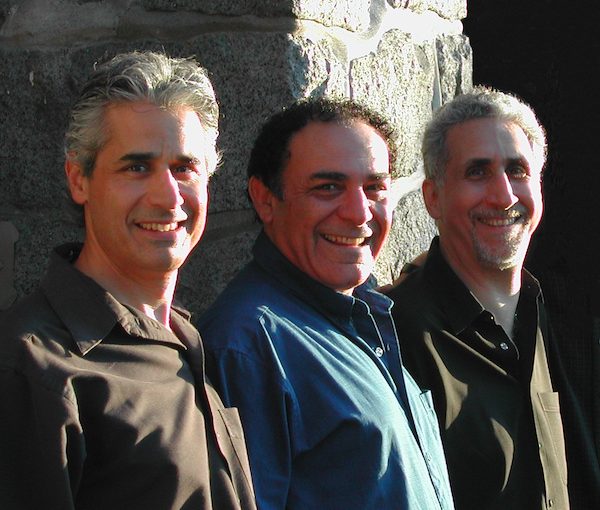
Left to right, Tzimmes’s Saul Berson, Yona Bar Sever and Moshe Denburg perform in the Ukrainian Hall Community Concert and Social on Nov. 5. (photo from Heart of the City)

A festival favourite, Tzimmes, will perform at the 20th Annual Downtown Eastside Heart of the City Festival, taking part in the Nov. 5 Ukrainian Hall Community Concert and Social, which closes out the 100-plus live and online events that take place at more than 40 venues over 12 days.

Presented by Vancouver Moving Theatre with the Carnegie Community Centre, the Association of United Ukrainian Canadians and other community partners, this milestone year of the festival – with the theme “Grounded in Community, Carrying it Forward” – starts Oct. 25.

“We have performed at DTES Heart of the City Festival on several occasions over the years,” Tzimmes founder and band leader Moshe Denburg told the Independent.

“November 2008 was the first time and, two years later, in October 2010, we performed again. We were invited a few years ago, in the fall of 2020, but couldn’t make it due to a scheduling conflict.”

In addition, said Denburg, a small group from the Vancouver Inter-Cultural Orchestra (VICO), which Denburg founded, played the festival in 2011. “The repertoire was, of course, intercultural, but included klezmer and Hebraic pieces as well,” he said. “Every time we played the festival, there was a truly welcoming atmosphere, and I would like to say it is an honour to be part of the mitzvah (good deed) that Heart of the City is performing for the neediest amongst us.”

“For 20 years, the Heart of the City Festival has been grounded in the Downtown Eastside and focused on listening and learning from the cultural practices of the community,” notes the press release. “The festival works with, for and about the Downtown Eastside community to carry forward our community’s stories, ancestral memory, cultural traditions, lived experiences and artistic processes to illuminate pathways of resistance and resilience.” The festival’s mandate “is to promote, present and facilitate the development of artists, art forms, cultural traditions, history, activism, people and great stories about Vancouver’s Downtown Eastside.”

The closing event at which a trio of musicians from Tzimmes will play – Denburg (lead vocal/guitar), Yona Bar Sever (lead guitar/backup vocal) and Saul Berson (clarinet/flute/saxophone) – will also feature the Barvinok Choir, Dovbush Dancers and the Vancouver Ukrainian Folk Orchestra. The concert will be opened by cultural speaker Bob Baker of the Squamish Nation and DTES resident, artist, poet and community activist Diane Wood will read “100 Years of Struggle” by the late Sandy Cameron, an historian and poet, among other things, who was very involved in the Downtown Eastside.

About what the Tzimmes trio will play at the concert, Denburg said, “The Tzimmes repertoire is always made up of Jewish music in the larger world context. So, there will be aspects of klezmer and Yiddish song (European), Ladino (Judeo-Spanish/Mediterranean), and pieces in a more Middle Eastern style as well. If anyone wants a primer on our repertoire, they can visit our YouTube page: @BigTzimmesProductions. Have a look/listen to ‘Dror Yikra,’ ‘Cuando’ and ‘Moishe’s Freylakh,’ and you’ll get an idea of what’s to come.”

The Independent last spoke with Denburg in 2021 about Tzimmes’s then-new two-CD album The Road Never Travelled. Since that interview, the group released, in 2022, a remixed and remastered version of their first album, calling it Sweeter and Hotter.

“In 2020, as we were creating our fourth album, The Road Never Travelled, I realized that there was almost enough material for a second disc, but it needed a few more pieces,” said Denburg. “Around that time, my dear friend and band mate, Yona, suggested that I try to remix our debut recording. We always felt that we were constrained by a simpler technology back in 1993, and that certain aspects of the mix could be improved – vocals could be clearer, instruments brought into better relation and so on. Looking around, I found a fine facility in Red Bank, N.J., that specialized in transferring old reel-to-reels to a digital format. The tapes of Sweet and Hot were 27 years old, but they transferred wonderfully to digital tracks.

“On the second disc of The Road Never Travelled, we included several remixed liturgical pieces from Sweet and Hot,” Denburg said, noting that the group continued the process and worked on every track of their 1993 debut album. He said, “The result, we believe, is an enhanced version of Sweet and Hot that does not compromise the original at all; in fact, we humbly submit, the result of all this work is that the sweet parts are even sweeter, and the hot stuff even hotter!”

The closing concert/social of the Heart of the City Festival – called Building Community: 20 Years of Friendship – takes place at the Ukrainian Cultural Centre, with doors opening at 2 p.m. and the concert at 3 p.m. Tickets ($30/$20) are available at eventbrite.ca.

***
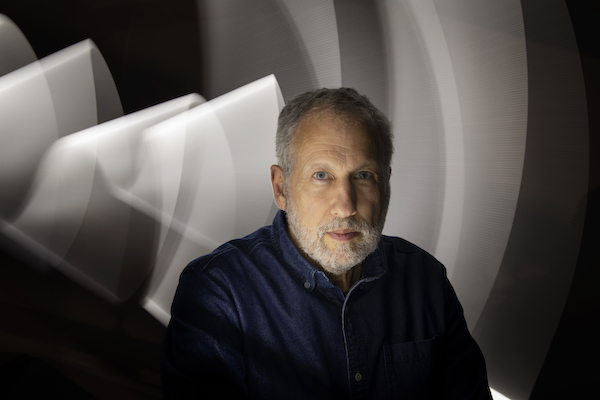
photo - Among the many Heart of the City events is a month-long exhibit at Carnegie Community Centre of photographer David Cooper’s work for the festival over its 20 years
Among the many Heart of the City events is a month-long exhibit at Carnegie Community Centre of photographer David Cooper’s work for the festival over its 20 years. (photo from Heart of the City)

Among the many other events taking place during Heart of the City is an exhibit of photographer David Cooper’s work for the festival over its 20-year history, curated by Vancouver Moving Theatre co-founder Terry Hunter. (For more on Cooper, see jewishindependent.ca/capturing-community-spirit.)

Cooper will attend the Nov. 1, 4 p.m., opening reception in the third-floor gallery at Carnegie Community Centre. The exhibit, which runs to Nov. 30, will feature two to four photos from each of the festival’s 20 years, displayed chronologically with the festival poster for each year.

Organizers said Cooper provided guidelines for selecting the images: “simple, elegant, expressive images with energy, movement and/or emotion that represent the cultural and social diversity of the festival’s programming and people.” The exhibit also will include photos of festival participants who have passed away.

For more information, visit heartofthecityfestival.com.
Format ImagePosted on October 12, 2023October 14, 2023Author Cynthia RamsayCategories Music, Performing Arts, Visual ArtsTags Carnegie Community Centre, David Cooper, Downtown Eastside, Heart of the City Festival, klezmer, Moshe Denburg, photography, Tzimmes, world music
Tell your own “crankie” stories

Tell your own “crankie” stories

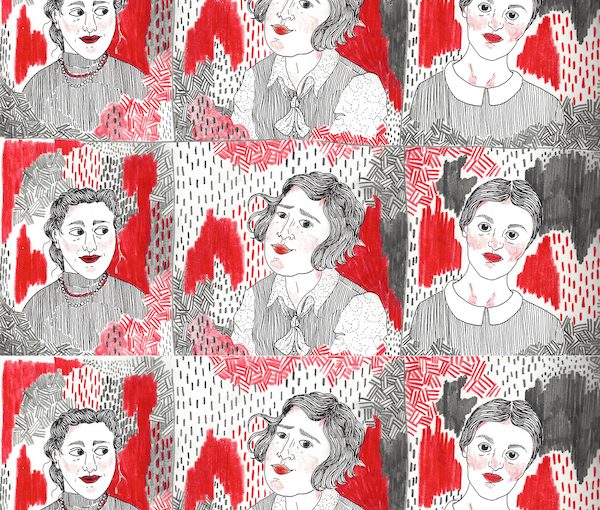
Where Do Stories Come From? (fun vanen nemen zikh di mayses) on Nov. 9 highlights a poem from each of three Yiddish women writers: Ida Maze, Esther Shumiatcher-Hirschbein and Yudika. (Illustration by Cesario Lavery)

This year’s Chutzpah! Festival includes several opportunities for people to participate in the arts being performed. A prime example is Where Do Stories Come From? (fun vanen nemen zikh di mayses), wherein attendees of the Nov. 9 event at the Rothstein Theatre will be able to learn new music inspired by Yiddish poetry and, in the Zack Gallery, on Nov. 7 and/or Nov. 12, participate in a “crankie” workshop.

Where Do Stories Come From?, which is presented by the Chutzpah! Festival and KlezKanada – co-curated by the organizations’ respective artistic directors, Jessica Mann Gutteridge and Avia Moore – includes “new musical and visual settings for three Yiddish poems by celebrated Canadian women writers, selected and translated by Faith Jones, with accompanying visual artwork in the form of ‘crankies’ – a centuries-old art form in which an illustrated scroll, evocative of the Torah, is wound across spools set in a viewing window.”

The artistic directors decided early on to work with the poetry of Canadian women writers who wrote in Yiddish, said Gutteridge, “and there was no more perfect collaborator to work with on selecting the poetry than Vancouver’s own Faith Jones. For the musical work, we drew on the incredibly rich community of KlezKanada’s artists and were lucky that Sarah Larsson was interested in the project – she’s not only a gifted composer with a thorough knowledge of Yiddish music, but is herself a stunning vocalist and music director.

“We also spent a lot of time looking at incredible artworks by Jewish visual artists and ultimately selected Benny Ferdman, Ava Berkson and Cesario Lavery, all of whom bring an interest in Yiddish, diverse styles, and interest in visual storytelling to the project. As part of the project involves community participation, we also ensured that all the artists are skilled at and enjoy working with community of all abilities and ages.”

The idea for the event came after Gutteridge met Moore at a KlezKanada Summer Retreat in 2022.

“When the JCC Association announced they would be funding new community-based projects incorporating live music and storytelling with an emphasis on partnerships,” said Gutteridge, “we realized we had a wonderful opportunity to work together to share our assets – KlezKanada’s immersive creative residency environment and access to brilliant artists with knowledge of Yiddish culture, and the Chutzpah! Festival’s presentation opportunities.

“KlezKanada’s 2023 Summer Retreat theme was Yiddish film and, because it’s a very unplugged environment, had plans to explore the ‘pre-film’ illustrated story technique of crankies,” she continued. “We thought this art form would pair beautifully with the musical work being created, and would offer a very engaging opportunity to the community to participate in creating a multidimensional presentation together.”

Where Do Stories Come From? is supported by the JCC Association’s Making Music Happen program and Chutzpah! Festival’s music programming is supported by AmplifyBC’s Live Music Presentation Fund.

The event’s title comes from one of the three poems highlighted, one by Ida Maze. “It’s a poem that grabbed the entire group immediately and we knew we wanted to work with it,” said Gutteridge. “In the poem, Maze creates a strong visual image of a little house that appears to be abandoned, but as you approach you see that a fire is lit and, in the house, sit a grandfather and a grandmother sharing culture and stories with the children, and the stories are then carried away on the wind. For us, this poem really captured the idea of the project – that intergenerational cultural transmission is the key to how we survive and thrive and, in many ways, is a model for how we hope to see this project unfold. But I think the very notion that we pose this as a question invites everyone who experiences the work to ask themselves where they think stories come from.”

The other poems are by Esther Shumiatcher-Hirschbein and Yudika.

“Faith made a longer list of poems selected for their striking visual imagery and potential musicality and presented them to our full group of artists,” explained Gutteridge. “Right away, we all responded to the Ida Maze work and had to then narrow our choices to two more. We asked the artists to highlight which poems they found particularly inspiring and, as artistic directors, Avia and I also kept an eye on whether the selections were creating an interesting and balanced program in terms of style and theme. It was an enjoyable and smooth process and I think we all enjoyed kicking off the project together in this way.”

As for the workshops, Gutteridge said, “Ava and Cesario will be with us through the week to guide workshop participants through the process of making their own crankies, inspired by prompts from the poetry we will provide. While the crankies being made for the music event will be large scale, a wonderful characteristic of this art form is that it can be made any size using very humble materials like a shoebox or even a matchbox. With our partner the Zack Gallery, the work created in the workshops will be on display in a community exhibition, and our video director Flick Harrison will be on hand to help participants capture their crankies in action. Participants can opt to share their crankies and stories in an online video gallery. We hope we will see intergenerational groups making crankies together!”

During the week, Chutzpah! will also be hosting the return of the Flame, with their evening of storytelling on Nov. 6.

“The Flame’s artistic director, Deb Williams, will teach her remarkable day-long storytelling workshop on Sunday, Nov. 12, ending just before our final crankie workshop and the concert presentation,” said Gutteridge. “We hope that these projects together will inspire community participants to explore their own stories and find new and inspiring ways to tell and share them.”

For tickets to Where Do Stories Come From? and other Chutzpah! events, visit chutzpahfestival.com.

Format ImagePosted on October 12, 2023October 12, 2023Author Cynthia RamsayCategories Performing ArtsTags Chutzpah!, film, Jessica Mann Gutteridge, KlezCanada, Rothstein Theatre, storytelling, workshops, Yiddish, Zack Gallery
Following historic footsteps

Following historic footsteps

Elam Rotem, founder and director of Profeti della Quinta, which plays in Vancouver Nov. 9. (photo by Theresa Pewal Photographie)

Swiss ensemble Profeti della Quinta, directed by Elam Rotem, brings Stars of  the Italian Renaissance: Monteverdi & Rossi to Vancouver Nov. 9. Part of Early Music Vancouver’s 2023/24 season, the concert takes place at Christ Church Cathedral.

“Salomone Rossi and Claudio Monteverdi are two composers we like very much,” Rotem told the Independent. “We find the fact that they were colleagues – they played together as instrumentalists and collaborated as composers – very interesting. Even more interesting is the fact that the Jewish singers and musicians in Mantua had this double musical life, where sometimes they sang madrigals and participated in the opera productions at the court (collaborating with Monteverdi and other non-Jewish musicians) and, at other times they sang Hebrew polyphony in the synagogue.

“In this program,” said Rotem, “we follow in the footsteps of those Jewish musicians from Mantua who, unlike Jews in other places (in Italy or elsewhere), participated in the arts. This particular constellation allowed Salomone Rossi to develop his polyphonic music for the synagogue, and it is also the reason why, despite the hopes of Rossi and his followers, this tradition never took off elsewhere.”

Rotem – who was born in Sdot Yam, Israel – has a bachelor’s in harpsichord from the Jerusalem Academy of Music and Dance, and he came to Basel, Switzerland, at the end of 2008 to specialize in early music at Schola Cantorum Basiliensis, from where he received his doctorate in a joint program with the University of Würzburg, in Germany. His PhD thesis was on early basso continuo practice.

“Throughout the 16th century, music was primarily polyphonic – typically composed of four to five parts. Towards the end of the century,” he explained, “new ideas led to the development of a new technique in which only two parts were composed: a vocal part and a basso continuo part – an instrumental bass line on which the player had to fill in the harmonies above it. The possibility of having only one singing voice allowed a much more direct and expressive communication with the audience and played an important role in the creation of early operas. The difference between the older polyphony and the new monodic style is so great that it changed the course of music history, and some examples of this will be heard in our concert.”

The origins of Profeti della Quinta go back to Rotem’s studies at Kibbutz Kabri High School, where he organized a vocal quintet with fellow students. Rotem is also a singer.

“I started Profeti in the corridors of my high school, wherever we could find some church-like acoustics” he said, “but the group only became professional after we won the York Early Music Competition in 2011.”

The ensemble now performs throughout Europe, North America, Israel and elsewhere. Focusing on the vocal repertoire of the 16th and early 17th centuries, the group “aims to create vivid and expressive performances for audiences today while, at the same time, considering period performance practices.”

About how he approaches this dual goal, Rotem said, “First and foremost, I’m interested in music from the period that I find interesting and beautiful. Then, I’m also interested in how it was performed and in what context – and, for that, you have to research and try things out. For example, we sing from (copies of) original partbooks and not from modern scores, so each singer has only his or her own line. This makes listening and making music very different. Then we also try to understand the music better. Finding out the motivations behind the decisions of composers, we feel that we can deliver their music better.”

In response to a question about how Rossi’s music is perceived with regard to its Jewishness – including his liturgical compositions – Rotem said, “It depends on what people mean by ‘Jewish music.’ If, for some people, Jewish music means Eastern European klezmer music, then Rossi’s music doesn’t sound Jewish. Rossi’s music is written in the language of his time – what we can categorize (if we must) as late Renaissance Italian style. If we compare the music of his prayers, for example, with the contemporary love madrigals (also his own), we see that the prayers are more solemn and simpler. But this is hardly surprising – the way composers created their music was based on the text, and so a heart-wrenching madrigal text would be composed in a very different way than a psalm praising the Lord. Another way to look at Rossi’s prayers is not so much as pieces of music in the normal sense, but simply the text of the prayers served on a plate of harmony – with the goal of elevating and glorifying the prayer.”

Joining Rotem (bass vocals, harpsichord and musical direction) from Profeti della Quinta on the Western Canadian tour that will take the musicians to Vancouver, Edmonton and Calgary, are Doron Schleifer (countertenor), Andrea Gavagnin (countertenor), Lior Leibovici (tenor), Loïc Paulin (tenor) and Ori Harmelin (chitarrone, which is a kind of lute). After the concert in Vancouver, there will be a talk and Q&A with Rotem, hosted by Suzie LeBlanc, artistic and executive director of Early Music Vancouver.

For tickets to the performance on Nov. 9, 7:30 p.m., at Christ Church Cathedral, visit earlymusic.bc.ca.

Format ImagePosted on October 12, 2023October 14, 2023Author Cynthia RamsayCategories MusicTags Christ Church Cathedral, Early Music Vancouver, Elam Rotem, Monteverde, Profeti della Quinta, Salomone Rossi
Multidisciplinary approach – When the Walls Come Down

Multidisciplinary approach – When the Walls Come Down

Racheal Prince, left, and Caroline Hébert in When the Walls Come Down, which is at the Rothstein Theatre Nov. 8 and 10. (photo © iiiiportraits)

“I think the performance is a really fun way to learn a little bit about Deaf culture,” Caroline Hébert, the lead actor and inspiration for When the Walls Come Down, told the Independent. “I hope people can make the time to try something different and I look forward to meeting some new people at the Chutzpah! Festival.”

When the Walls Come Down (WTWCD) will see three performances at the Rothstein Theatre next month, as part of the festival. A collaboration from Vancouver’s Dance//Novella, led by Racheal Prince and Brandon Lee Alley, the work highlights moments in Hébert’s life, “shed[ding] light on stereotypes and difficulties faced by many Deaf Canadians and tell[ing] a story of resilience and love,” according to the press material. It is performed with movement, music, projections and lighting, and in ASL with English voiceovers.

“Racheal and Brandon and the WTWCD team have been learning ASL,” said Hébert. “It’s really inspiring to me to see a group of people who want to create an environment where we can share ideas and our culture. I want to participate in more collaborations as I continue my journey as a Deaf actor. This is my first time stepping into a leading role for a one-hour show. I think, at first, I wasn’t really sure if this is something I could do. Over time, I realized that I can do it, and I can connect to many different people through my art form.”

The creation of WTWCD began in 2020, said Prince and Alley, when “our curiosity led us to explore the fusion of ASL and dance, with a strong desire to collaborate with a Deaf actor and blend their creative ideas with ours. Caroline was recommended to us by Chis Dodd, director of SOUND OFF. What intrigued us further was her last name, Hébert, which happened to be the maiden name of Racheal’s grandmother. This unexpected connection felt like a sign. After a video-translated conversation with Caroline, we realized that she possessed a compelling story that needed to be shared, so we quickly chose her as the central character for the work.”

As for her decision to be that central character, Hébert said, “I was interested in trying something new and I thought why not!? I did dance a little when I was a child so maybe that was also part of the reason?”

WTWCD debuted as a live-streamed performance during the 2021 Vancouver International Dance Festival (VIDF), which made it “challenging for us to establish a direct connection with the audience and gauge their reception of the work,” said Prince and Alley. “However, we knew this work had the potential of uplifting and illuminating a traditionally marginalized community, so we kept refining and building upon our initial ideas.”

In 2022, they received an invitation to perform WTWCD in Edmonton at the SOUND OFF festival, the first time the piece was presented in a live setting. “To our astonishment, the audience responded with thunderous stomps and a standing ovation. It was truly incredible to witness the profound connection the work had with the Deaf community,” they said.

In addition to that positive reaction, the pair won the 2023 VIDF Emerging Choreographic Award. “To us,” they said, “this award emphasized the collaborative and harmonious aspect of the work’s creation, transcending our roles as individual choreographers.”

Both creatives multitasked to make WTWCD. Prince and Alley choreographed the work; they played a part in the storyline creation and development with Hébert and her daughter, Anna-Belle Hébert, all four of whom perform the piece; Alley composed the music and Prince did the costume and set design. Other key contributors are lighting designer James Proudfoot, assistant lighting designer Chengyan Boon, and mentors and coaches Chris Dodd and Landon Krentz.

“Being a contemporary dance company, one of our goals was to find innovative ways to convey the music to a Deaf audience,” said Prince and Alley. And it was Alley who “came up with the idea of using a playful animation to advance the storyline and evoke the emotional essence of the music.

“To realize this vision, we collaborated with the Vancouver Film School,” they said. “We pitched our ideas to them, leading to the organization of a competition involving five different groups. Each group listened to our concepts and then presented us with small animations. After careful consideration, we selected the group that we believed best captured the essence of the work and the nuances of the music. They went on to create the animations that will be showcased during the performance.”

Listed on Dance//Novella’s website are producer Jill Tao, designer/animators Kanako Takashima and Cecilia Cortes, animation lead Arturo Acevedo and storyboard artist/designer Heena Yoon.

An integral part of this project has been Anna-Belle Hébert.

“She is a CODA (child of Deaf adult), fluent in ASL, QSL, English and French,” explained her mother. “Anna-Belle understands who I am and the story I want to share because it’s partly her story too. In the beginning, I recommended that Racheal and Brandon reach out to Anna-Belle to see if she would like to join the process, which they enthusiastically agreed to. In the performance, she is my voice over actor, but has also been a huge part of the creative process. She really helps bridge the gap between our ideas and how they can connect to hearing and Deaf people at the same time.”

Both Prince and Alley talk about how much they have learned while creating WTWCD. “One significant revelation for us,” they said, “was the realization that ASL and English are two distinct languages. Initially, we attempted to transcribe everything in an effort to ensure clarity, but this approach only seemed to confuse Caroline further. With the guidance of a specialized ASL coach, Caroline developed a unique method for documenting the script on paper. This breakthrough allowed her to memorize and retain everything effortlessly while making it her own.”

Prince and Alley had nothing but good things to say about Hébert.

“Caroline is an incredibly generous and patient collaborator,” they said. “During our rehearsals, we frequently paused our creative process to listen to stories from Caroline’s life. Each story offered us a glimpse into the experiences of a Deaf child, mother and student, which ultimately became the core of our creative journey. The exchange of knowledge and personal narratives became the driving force behind our work, giving it profound meaning for our team.”

When the Walls Come Down is at the Rothstein Theatre Nov. 8 and 10, at 8 p.m., and there is a special matinée for school groups grades 6 and up on Nov. 9, 11 a.m. (contact [email protected] for more information about that). The show runs 60 minutes with no intermission. For tickets, visit chutzpahfestival.com.

Format ImagePosted on October 12, 2023October 12, 2023Author Cynthia RamsayCategories Performing ArtsTags ASL, Brandon Lee Alley, Caroline Hébert, Chutzpah!, dance, Deaf culture, Racheal Prince, Rothstein Theatre
Vazana at Chutzpah! Fest

Vazana at Chutzpah! Fest

Nani Noam Vazana performs at the Rothstein Theatre Nov. 11 as part of this year’s Chutzpah! Festival. (photo from NaniMusic.com/ProLadino)

Gracing the cover of this year’s Chutzpah! Festival guide and posters is Nani Noam Vazana. The Amsterdam-based musician is one of the only artists in the world writing and performing new songs in Ladino, or Judeo-Spanish. The JI spoke with her when she last came to Vancouver, in 2017, and did so again, ahead of her Nov. 11 Chutzpah! show at the Rothstein Theatre.

“The concert in Vancouver is a part of my international Ke Haber tour that will take me through 15 countries,” said Vazana. One of the highlights of the tour will be a concert at the Library of Congress in Washington, DC, she said, “where I’ll have the honour of documenting my new Ladino songs for libraries and universities all over the world and make them available for Ladino research.”

The tour features mostly songs from Ke Haber but will also include “some traditional Sephardic songs and surprise covers – different to each show!” she said.

Ke Haber incorporates a millennial’s perspective – hers – into the writing of songs “in an old, almost extinct language,” she said, explaining that “Ladino is a language of the Sephardic Jews who were expelled from the Iberian Peninsula in the Middle Ages (Spain and Portugal of our days). My grandmother has roots in Portugal and she and her family sailed to Morocco from Porto in the 1400s. That’s where she grew up and where my parents were also born.

“In the ’50s, both my parents’ families immigrated to Israel and my father wanted to leave the past behind so he actually forbade us to speak Ladino at home,” she continued. “The only times I had contact with the language was when I was left alone with my grandmother. It was the language of witchcraft and mystery because she would only use it to speak to me in secret and tell me magical fairy tales that I actually thought she made up herself, because nobody else knew them. We sang songs in the kitchen while cooking, and it was all seeping in through the senses, very inviting and very curious.”

Vazana’s grandmother passed away when she was 12 years old.

“One of my first memories is of me and my Nona (Grandma) sitting at the kitchen table, peeling beans and singing ‘Los Guisados De La Berendjena,’ a song about seven recipes for eggplants. She hardly spoke Hebrew and my father forbade us to speak Ladino…. But, it seems, you carry this love subconsciously in you wherever you go, because, 15 years after my Nona passed away, I visited Morocco for the first time and heard people on the street singing the same lullaby she used to sing to me when I was a little girl. All of a sudden, those forgotten kitchen songs came alive and I started a long journey searching for songs and melodies that led me to release my traditional Ladino album Andalusian Brew. Sometimes, all it takes is just a sound or a scent and you’re transported to a life you’ve forgotten.”

After performing traditional repertoire for a few years, Vazana felt a yearning to write her own songs, and she dove into an exploration of the language. “I visited a scholar in Leiden, who showed me a lot of texts at an ancient Jewish library, but I wanted more,” she said. “So, I dug deep into medieval poetry and started learning the rhythm of the stanzas. Based on existing rhythmical formations, I started writing my own lyrics in Ladino, concerning questions we ask ourselves today, and, I must admit, I found a lot of correlation between where we are now and the medieval Iberian population.”

Vazani described Ke Haber as “an album of new songs that sound old, or maybe the other way around.”

“There are songs in the album that speak about female empowerment, like my song ‘No Kero Madre,’ a mother-daughter dialogue about the will to break free from the arranged marriage tradition and marry out of love,” she explained. “What a lot of people don’t know about Ladino is that it is a matriarchal language, so the relationship between mother and daughter is put on a pedestal, as the highest form of love in existence.

“In my song ‘Sin Dingun Hijo Varon,’ I describe the transformation of a transgender teenage girl who wants to be recognized as a boy. The father tries to kick her out of the house but the mother steps up and accepts her child as a boy.

“My song ‘Una Segunda Piel’ is about a Sephardic retirement ritual where your family and friends sow around you the shroud of the dead! You lie down in a cocoon, meditate and think about the troubles you want to leave behind. When the cloth is done [with], it goes into the cupboard, symbolizing all your troubles, and you emerge from it as if shedding your skin. That’s why the title is ‘Una Segunda Piel,’ which means ‘A Second Skin.’

“For my song ‘El Gacela,’” she said, “I composed music to an ancient text by Shmuel Hanagid, which is a love poem between two men. When the song was published, some people claimed that I was ‘outing’ the Jewish saint, but I think if he already published this work, he was out in the first place.”

The recording of Ke Haber, which started in London, England, in 2020, was complicated by COVID.

“I had to figure out a creative way to finalize the project, so we started recording remotely,” she said. “That’s really hard, because programs like Zoom have latency, so you can’t really record with other musicians simultaneously. We had to overdub – can you imagine playing music when the band is not in the same room? We all came to the studio whenever we were able to travel from Columbia, Chile, the Canary Islands, Bosnia, Israel, India, the Netherlands and Poland! That’s why the album is also a colourful tapestry of musical traditions and cultural aspiration from all over the world.”

While COVID was a quiet time touring-wise, “it was also a turmoil of creativity,” said Vazani, “because I just couldn’t sit still at home and wait for the world to pass by. So, I broadcasted house concerts every week, learned to edit video and record sound, which led to facilitating multicam broadcasts for other artists, such as the West East Orchestra.

“I also started doing voiceover gigs, overdubbing cartoon characters for animation and narration for documentaries and commercials. I also dabbled in emceeing when hosting online events and I hosted my own weekly podcast, interviewing [professionals] from the music industry about tips for emerging musicians.”

She received offers from music colleges and music industry conventions worldwide and hosted masterclasses and panel discussions for more than 30 institutions. “Eventually,” she said, “I was commissioned by the Dutch national TV broadcast NPO to create and host my own television series that will start airing in 2024.”

In addition to all that, Vazani teaches at the London Performing Academy of Music and the Jerusalem Music Academy, and is chair of the Amsterdam Artist Collective. She is also a guest lecturer at Codarts University, Rotterdam.

She enjoys being active – “for the mind and the soul to stay agile, we gotta train them,” she said. “This is my mental gym.”

And she’s not that interested in achievements, she said, though she has garnered several awards. “I am interested in being on the road as much as possible with my music,” she said. “This translates in my mind into happiness, and that’s not a fleeting experience, it’s a state of existence.”

To support Vazani’s music and receive content in return – all the music she has released, for example, and exclusive meet-and-greet sessions – readers can join her music family at nanimusic.com/family. For tickets to her performance at Chutzpah! and the whole festival lineup, visit chutzpahfestival.com. The festival runs Nov. 2-23.

Format ImagePosted on September 22, 2023September 21, 2023Author Cynthia RamsayCategories MusicTags Chutzpah!, Judeo-Spanish, Ke Haber, Ladino, Nani, Nani Noam Vazana
VIFF films explore humanity

VIFF films explore humanity

Filmmaker Sam Green will narrate live his documentary 32 Sounds, which is part of the Vancouver International Film Festival. (photo by Catalina Kulczar)

“There’s a thing in documentary filmmaking where, after you’ve done an interview with someone, you need to get what’s called room tone,” shares director, writer and editor Sam Green in his film 32 Sounds. “Room tone,” he explains, “is basically just sitting still for about 30 seconds or so and recording the sound of the room; this can help out a lot with editing later. I’ve been making films, which is kind of just marveling at people in the world, for 25 years now, and there’s always something odd and wonderful about this moment. An interview takes a person to other times and places and, now, they’re just here in the present, sitting with the sound of the room.”

Watching some of his interviewees, as they struggle or embrace sitting in silence for a few seconds, is one of the many highlights of Green’s latest documentary, 32 Sounds, which screens Oct. 5, 7 p.m., at the Vancouver Playhouse, as part of the Vancouver International Film Festival’s specialty program VIFF Live. New York-based Green will be in town to narrate the screening in-person, and audience members will be given headphones to wear, to help make the experience as immersive as possible.

The film premièred in January 2022 at the Sundance Film Festival. It exists in three forms: one as described above, but sometimes also with live music by composer JD Samson, who wrote original music for the film; another designed for an immersive at-home experience; and a theatre version without the in-person performance aspect. Watching the film at home without headphones was not ideal, but it was still enjoyable and mind-opening. There are parts where it would have added understanding and had greater impact to have heard something in only the left ear or only the right one.

32 Sounds is not just auditorily stunning but a visual pleasure, and intellectually stimulating, as well. Though there are explanations of how humans hear and how sound affects our bodies, the documentary is more philosophical than scientific. It presents concepts like the idea that all the sounds that have been made in the world should still be out there somewhere, “tiny ripples vibrating,” as contemplated by mathematician Charles Babbage, who is credited with having invented the computer, in the 1800s. If we had the right device, mused Babbage, we should be able to listen again to every joke, declaration of love or angry word ever uttered, narrates Green. “The air itself is one vast library, on whose pages are forever written all that man has ever said or woman whispered,” wrote Babbage in 1837.

In 2022, Green wrote: “I’ve made many documentary films over the years, and each one has changed me in some way, but none as much as the film I just recently finished called 32 Sounds. The film weaves together 32 different recordings as well as images, music by JD Samson, and voice-over to create a meditation on sound. Or, put a different way, the film uses sound to consider some of the basic features of our experience of being alive: time and time passing, loss, memory, connection with others, and the ephemeral beauty of the present moment.”

From the sound of a womb, to a cat purring, to fog horns, to a man who captures the sound of bombs landing nearby as he’s recording his music, Green masterfully takes viewers (listeners) on an emotional journey. We get to see how movie sound magic is made by foley artists like Joanna Fang. We meet sound and visual artist Christine Sun Kim, who talks about the deaf community, as well as hearing people’s perceptions of her work. Edgar Choueriri, professor of physics at Princeton, plays part of a tape he made for his future self when he was 11 years old. And we get to know a bit about composer and academic Annea Lockwood, 81 at the time of filming, who had been recording things like the sound of rivers for more than 50 years. Lockwood fundamentally changed how Green thinks about sound, especially a point she makes in the film: “There’s something I started writing about a year ago: listening with, as opposed to listening to,” she shares. “And it’s my sense that, if I’m standing here, I’m just one of many organisms that are listening with one another within this environment … we’re within it and we’re all listening together, as it were.”

32 Sounds has much to recommend it, including the chance to get up and dance, if you choose, when Green pumps up the volume on Sampson’s music, so you can “feel the sounds in your whole body.”

Accepting oneself

image - William Bartolo as Daniel, left, and Daniel Gabriel as his secret lover, Isaac, in a still from Cut, which is part of VIFF’s International Shorts: Nothing Comes Easy program
William Bartolo as Daniel, left, and Daniel Gabriel as his secret lover, Isaac, in a still from Cut, which is part of VIFF’s International Shorts: Nothing Comes Easy program. (image from VIFF)

Sound that you can feel in your whole body plays an important part in the short film Cut by Samuel Lucas Allen. In what may – or may not – be semi-autobiographical, Cut tells the story of Daniel, a high school student who tries to hide his Jewishness and his queerness. At key moments, the original score created by Sam Weiss thrums with tension, underscoring Daniel’s inner conflict.

Despite being somewhat heavy-handed – there is nothing subtle in this film, perhaps because it is only 19 minutes long – Cut is interesting, well-acted and put together. It opens with a Chassidic man holding a rooster, then shows Daniel cutting his hair, which falls onto a copy of Merchant of Venice, from which the teen will eventually have to perform, by memory, Shylock’s “If you prick us, do we not bleed?” speech. Daniel’s room has drawn images of men on his walls, in various poses, apparently his own work.

The film defines its three main elements: kapparot, as a “Jewish ritual where a chicken is blessed and slaughtered in the place of a person, to atone for their sins”; tefillin as a “pair of leather boxes containing portions of the Torah, worn by Jewish men in their morning prayers”; and cut, “a slang term for circumcision, the surgical removal of the foreskin, usually performed for religious reasons.”

It is mainly the Jewish aspect that Allen deals with in this work. Daniel is able to walk away from a gay slur, but not an antisemitic one, and, in the end, he is reconciled to himself and his Orthodox father by the mystical Chassidic man’s performing kapparot over him. We witness Daniel’s acceptance of being Jewish, but are left to wonder if he comes to accept his queerness, an aspect of his being that conflicts with Orthodox Judaism, though his soul would still be considered divine in religious circles, even if he engages in homosexual acts, which are prohibited by the Torah.

Cut is featured in VIFF’s International Shorts: Nothing Comes Easy, a program for viewers aged 18+, in which the films’ “protagonists discover that sorting out their lives can be much more difficult to achieve than they realized.” It screens Oct. 5, 6:45 p.m., and Oct. 7, 12:15 p.m., at International Village 8.

The Vancouver International Film Festival runs Sept. 28-Oct. 8. For the full schedule and tickets, visit viff.org.

Format ImagePosted on September 22, 2023September 21, 2023Author Cynthia RamsayCategories TV & FilmTags identity, Judaism, LGBTQ2S+, Sam Green, Samuel Lucas Allen, sound, Vancouver International Film Festival, VIFF
Trio launches campaign

Trio launches campaign

Citizen West performs at the Jewish Federation of Greater Vancouver annual campaign launch Sept. 10, 7 p.m., at Congregation Schara Tzedeck. (photo from Citizen West)

The word “fun” came up more than once in the Jewish Independent’s interview with the three tenors who comprise Citizen West. The group will help launch this year’s Jewish Federation of Greater Vancouver annual campaign on Sept. 10, and the audience should expect a wide range of music, an abundance of positivity and a high-energy – and fun – performance.

Marc Devigne, Cody Karey and Omer Shaish are all accomplished musicians in their own right. Internationally renowned individually, together they have entertained audiences in more than 150 countries. With their multilingual repertoire, their message is that “we are all global citizens and, through music, we can connect with individuals of all cultures and backgrounds.”

“Music unites and connects us through harmony and a common rhythm and is spiritual in its nature,” Karey told the Independent. “I feel my most spiritually connected when experiencing a profound shared moment, and singing or performing from a stage, especially with such amazing company, really does that for me.”

Karey, who is based in Vancouver, explained how he, Toronto-based Devigne and Miami-based Shaish, came together.

“Citizen West is the product of all of us colliding at slightly different times over the last several years,” he said. “We all set out as solo artists and ended up having parallel careers. Initially, we were competitive rivals, but, as we all became connected and got to know each other, it was clear to us that we could really do something special if we combined our efforts and worked together. The three of us have been officially performing as Citizen West since 2020, but our individual connections and the idea of Citizen West go back years earlier. Our pianist, Trevor [Hoffmann], was instrumental (pun intended) in the earliest days of Citizen West as we developed our repertoire and arrangements, so this reunion performance alongside him will be a little extra special.” (Hoffmann is from Maple Ridge.)

While living in different places and following their own professional paths, Shaish said the trio see each other relatively often.

“We perform a lot as headliners on cruise ships,” he said, “so we get to sing together and travel the world together. It’s a lot of fun! The ships have brought us to some really interesting places, such as Alaska, Easter Island and even Antarctica. Those were great experiences to share with these two. We also perform on land, of course, and we come up with new repertoire all the time. We have four produced sets and, on top of that, we try to cater to our clients’ vision and needs.”

Regarding that, campaign director Gayle Morris shared with the Independent Federation’s vision of the Sept. 10 event. “This year, we wanted to try something fresh, drawing upon the incredible success and positivity of last year’s ‘Amazing Happens’ campaign,” she said. “We want our community to leave the evening inspired and excited by a creative approach to campaign opening. Citizen West are an incredible trio of tenors and a

pianist, whose extensive repertoire of music means there’s something for everyone to enjoy!”

When asked for a hint about the repertoire they will perform at the launch, Shaish said, “I don’t want to give away too many spoilers, but I can say that there’s going to be a wide variety of genres, from classical music and Broadway to pop music, rock and even a splash of Hebrew!”

For Shaish, who is from Tel Aviv originally and grew up in Israel, this show will be special.

“Living in the U.S., I often find myself shifting between my roots (Jewish/Israeli music) and my other passion toward pop music and musical theatre,” he said. “I’m truly excited about this performance, because this is the first time that these two worlds collide.”

“There’s always so much more to learn, live and experience, and I feel that it’s with this outlook that Citizen West can explore and take stylistic chances with many genres,” added Devigne, who grew up in a small French community in Manitoba. Karey grew up in Fort St. James, B.C.

“There is a fraternal sense of camaraderie and connection when we work together,” said Karey. “Our slightly different quirks and styles complement each other well and create a compelling blend. The experience of being on the road is very different when you have good people to share that with. It’s also quite fun!”

Devigne echoed this sentiment. “There’s a sense of brotherhood that comes with being in a group,” he said. “It opens up more creative opportunities as an artist and brings more colour, layers and texture to songs. It’s a nice feeling to be on stage and know you have people you can rely on to support and elevate a performance. We feed on each other’s energy on stage and it makes for a great time. We draw inspiration from each other and I truly believe it lifts us all to be better artists and performers when we perform together.”

“I think it goes with the theme of this event,” said Shaish, referring to the Federation campaign launch. “We all discovered the ‘power of community’ or the ‘power of together.’ There’s something very special and powerful in sharing the stage. When the three of us blend with harmonies and our unique chemistry, it feels like true magic.”

The campaign’s opening event – “Celebrate the Power of Community” – takes place Sept. 10, 7 p.m., at Schara Tzedeck Synagogue. It also features Eric Fingerhut, president and chief executive officer of the Jewish Federations of North America, as keynote speaker; Barak Loozon, strategic advisor to the office of Israeli President Isaac Herzog, speaking about Herzog’s dialogue initiatives; and campaign chair Shay Keil, a senior wealth advisor at ScotiaMcLeod and supporter of many Jewish community organizations and initiatives, sharing his story about how Federation campaign donors helped inspire his Jewish journey. For tickets ($18), visit jewishvancouver.com.

Format ImagePosted on September 1, 2023August 29, 2023Author Cynthia RamsayCategories LocalTags annual campaign, Citizen West, Cody Karey, fundraising, Gayle Morris, Jewish Federation, Marc Devigne, music, Omer Shaish, philanthropy

Kalla’s toxic new thriller

“I see how it looks…. Just another teen suicide. Or maybe an accidental OD. Another addict who fooled his parents. No…! I know my Owen…. Never, never, never….”

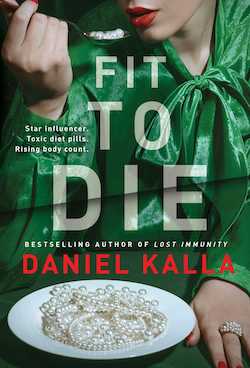
image - Fit to Die book coverThis is the reaction of Owen’s mother – who happens to be a U.S. senator – to her son’s death in Daniel Kalla’s latest thriller Fit to Die (Simon & Schuster Canada). L.A. detective Cari Garcia initially writes off the reaction as a mother ignorant of her child’s drug use, and bristles against the political pressure to determine the young track star’s cause of death. When she learns he died from ingesting a capsule that contained 2,4-Dinitrophenol, or DNP – used as a fertilizer, pesticide or explosive, but also abused by people to lose weight – she becomes more motivated to solve the mystery, in part because of a tragedy in her own past.

Meanwhile, here in Vancouver, toxicologist Dr. Julie Rees is dealing with a mysterious increase in deaths among bodybuilders, finding out that DNP is the cause. Then, a famous pop star and social media influencer dies in her penthouse, showing the same symptoms. And the co-owner of a wellness centre with locations in Los Angeles and Vancouver dies of a similar overdose. All the cases are connected and the L.A. and Vancouver police and medical personnel have to work together to find out who’s behind the influx of DNP on the market.

Like all of Kalla’s books, Fit To Die is an intriguing read, suspensefully written. While I didn’t enjoy it quite as much as I have his other thrillers – it was somewhat repetitive and the main characters’ backstories didn’t ring as true to me – I still wanted to know whodunnit. I also value having learned about the real-life issue of toxic diet pills and gaining some insight into body dysmorphia and eating disorders. I trust Kalla’s facts, as he is not only a writer, but an emergency room physician and a University of British Columbia clinical associate professor. He was kind enough to answer some questions via email.

JI: There are some Jewish-sounding surnames in the novel. In what ways does your being Jewish enter into your novel writing?

DK: Well, in this case the Hertzberg-Davis Centre is the real forensic lab for the LAPD. So that made it easy. I couldn’t remove the Jewish influence in my writing even if wanted to, which, obviously, I don’t. I’ve written a historical trilogy, The Far Side of the Sky, that is explicitly a Jewish story. In thrillers like Fit to Die, I don’t consciously think about my background or religion, but there is no doubt it influences the writing.

JI: Do you name characters after friends, or sometimes offer naming opportunities for charity auctions or the like?

DK: Haha. I learned early in my writing career to never name a character after a friend. It only ends badly. I’ve never auctioned off a character name for charity, but I would love to. It can be agony finding the right character name. Why not outsource it?

JI:  This is your 10th thriller. How has your writing style and/or process evolved since your first one?

DK: I hope I’ve learned from some of my past mistakes. Paradoxically, it gets easier and harder. Easier in the sense that I’m more confident in my voice and the nuts and bolts of my storytelling. Harder in that I’m more critical of my writing and fear becoming derivative in my stories. But the one thing that keeps me going is my enthusiasm for telling a new story. I think I’m more passionate than ever.

JI: From the several thrillers of yours that I’ve read, your topic choices are timely and coincide with current events. The medical side, you’ve got covered. But what are some of your sources for other aspects? In this book, for example, how the dark web works and even the pop culture aspects, including language, like “partizzle”?

DK: I obviously have a huge advantage with respect to the medical background, but that’s only a part of it. As you point out, this story – about a (real) and deadly diet pill that is marketed online to the most vulnerable and amplified by toxic social media – took some intense research. I had to learn all about body dysmorphia and immerse myself in the TikTok culture, which explains some of the Zoomer slang one of the character uses, like “partizzle.” I was lucky to have a local VPD superintendent help guide me through the logistics of what an investigation into this kind of complex online conspiracy would look like.

JI: Where do you find time to write?

DK: For me, it’s never about the time. I’m lucky to work in the ER, which is shift work, but I think I could find time no matter what my day job was. For me, it’s all about momentum and inspiration. When I have those, I find the time. When I don’t, free time doesn’t help.

JI: What part of your soul does writing feed?

DK: Not to sound overly melodramatic, but it kind of feeds my core. Medicine does, as well, but in a very different sense. I find purpose as a doctor, but I find my passion as a writer. I can imagine retiring one day from medicine, but I can’t imagine not writing.

JI: Can you speak about the process of getting a book from idea to publication?

DK: The challenge of transforming the kernel of an idea into a publishable novel always seems insurmountable from the outset – this book particularly. I wanted to build a compelling mystery and resurrect some characters from a past novel (The Last High) and introduce new ones, all while tackling a highly sensitive yet vitally relevant topic: how the toxic diet culture and social media prey on the most vulnerable. I like to think I met the challenge, but, of course, that’s for each reader to decide.

Posted on September 1, 2023August 29, 2023Author Cynthia RamsayCategories BooksTags Daniel Kalla, dieting, eating disorders, fiction
About the Rosh Hashanah cover art

About the Rosh Hashanah cover art

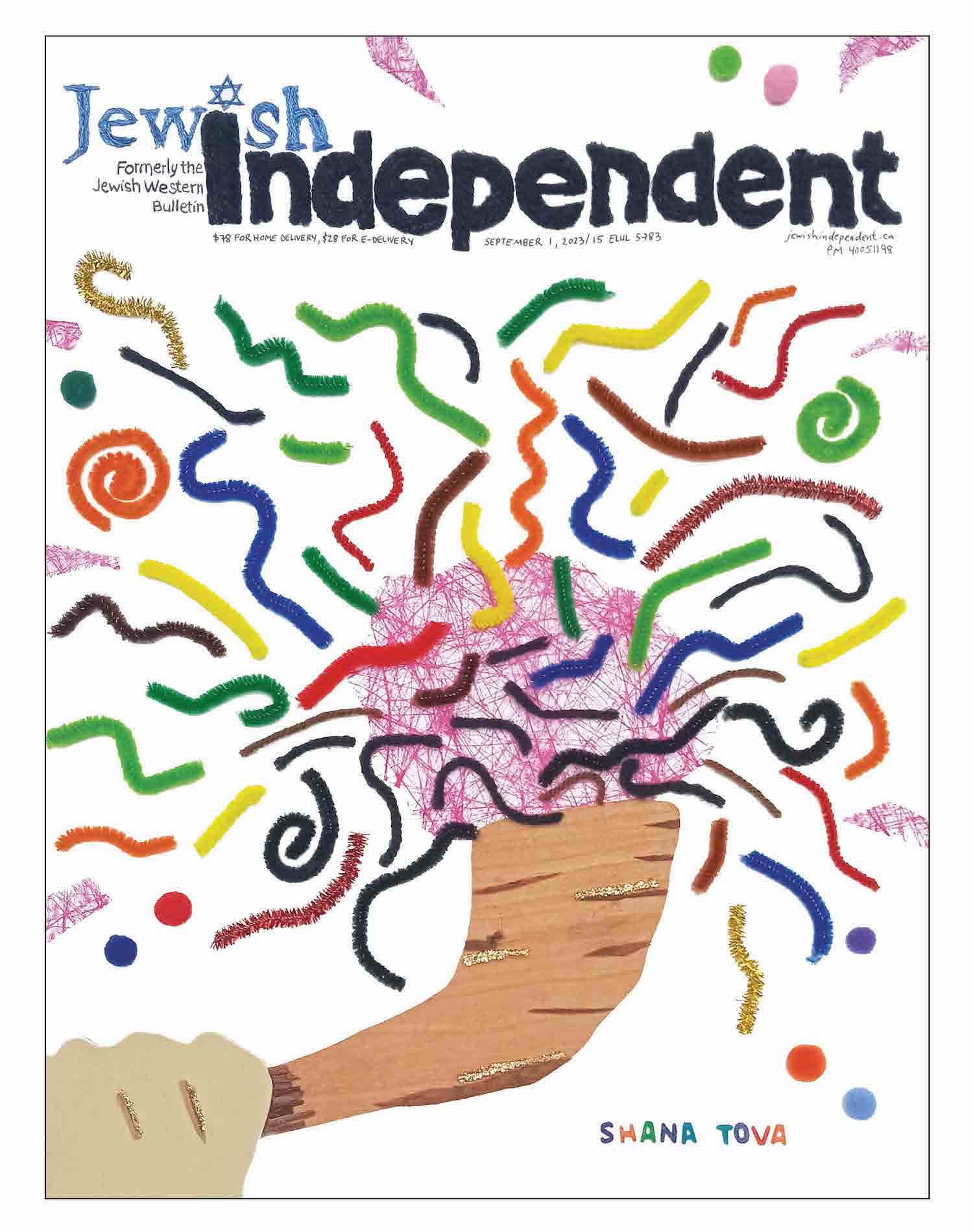
I spent hours online trying to find a suitable piece of art for this year’s Rosh Hashanah cover, then even more hours for what I might do myself. I really wanted to include a shofar in whatever I did, as a call to hope and action, for myself as much as anyone else.

I stumbled on artist Yitzchok Moully’s Elul Shofar Art Challenge (moullyart.com). Moully’s work is bright, colourful, full of life. As I mulled it over, I received an email from local artist Merle Linde, who generously created art for the JI ’s Passover cover this year and for last’s year Rosh Hashanah issue. She sent me an emotionally charged piece lamenting the countless trees that have been destroyed by wildfires. The base painting was an acrylic pour, and I spent several fun hours learning about and practising the technique, deciding it wasn’t quite what I wanted for my shofar blast.

I eventually came across creativejewishmom.com, the site that inspired my 2020 Passover cover depicting the Israelites (made of corks) crossing the Red Sea, who made a second appearance for Passover 2021, participating in Zoom seders. This time, it was a Tashlich picture made with yarn, coloured paper and felt marker that caught my eye on creativejewishmom.com. Inspired, I made the JI masthead out of yarn and ink, and created the shofar and the hand holding it – I wanted there to be a human presence, as we are critical to any change, for better or worse.

image - JI Rosh Hashanah 2023 coverThe middle section of the page eluded me for days, and I tried various things that just didn’t feel or look right. Thankfully, a middle-of-the-night couple of hours resulted in the finished cover, albeit with some tweaking in Photoshop. It ended up being more cheerful than I was intending. I am happily surprised at my latent optimism, and hope that readers also find it uplifting.

Posted on September 1, 2023August 30, 2023Author Cynthia RamsayCategories Celebrating the HolidaysTags art, High Holidays, Merle Linde, Rosh Hashanah, shofar, Yitzchok Moully

VHA’s new principal

“Children want to be heard and validated for what makes them unique at all ages, just like us adults. The old adage that children should be seen and not heard is exactly the opposite of what we need from kids today,” Ellia Belson told the Independent.

photo - Ellia Belson, principal of Vancouver Hebrew Academy
Ellia Belson, principal of Vancouver Hebrew Academy (photo from Ellia Belson)

Belson is the new principal of Vancouver Hebrew Academy. She comes to VHA from King David High School, where she was the director of Jewish life, and has also taught at Vancouver Talmud Torah. “The experience gives me insight into the learning process and what motivates children to learn at different stages of their lives,” she said. “While a child in Grade 2 will be motivated by classroom activities, by the time they are 11, they are already starting to differentiate themselves from their parents and looking for ways to express their individuality.”

Belson takes over from the team of Ian Mills, Shannon Brody and Rivki Yeshayahu, who supported VHA while the school “looked for a principal who can lead an Orthodox Jewish school in such a unique city as Vancouver,” said Leslie Kowarsky, VHA board president. Prior to this trio, Rabbi Barak Cohen was principal for a year, after having taken the helm from Rabbi Don Pacht, who served as the school’s head for 17 years.

“We are thrilled to have secured Ellia Belson as our new principal,” said Kowarsky, noting that Belson has a master’s in special education from the University of British Columbia. Belson attained her teacher certification and bachelor’s from Simon Fraser University, and her resumé also includes Judaic studies for teachers from Bais Rivkah Seminary and Touro College in New York and Hebrew University in Israel, as well as other education training. In addition, she has more than 10 years’ experience at Energex Energy Management Systems Inc., a company started by her husband Rami.

“She is a Vancouver native, and many of our families remember fondly that her father, Sol Pavony, was himself the founding principal of what was then Vancouver Torah Academy,” said Kowarsky. “Mrs. Belson is already hard at work and is available to any prospective parents seeking an Orthodox Jewish education for their child.”

Belson’s education philosophy is focused on student-centred and inclusive learning.

“Students need multiple modes of learning to stay engaged and motivated. By providing students with multiple avenues to the curriculum and by offering choices, students feel a sense of control over their learning,” she explained. “For instance, a student might choose to read a storybook, a news article or a Gemara text to express their analysis on how one’s actions will have consequences. Then, they might choose to express this through writing, art or a PowerPoint. By recognizing a child’s individual learning style and offering different ways to access the information, you can provide opportunities for enrichment and academic achievement.”

For the coming year, Belson said the focus will be “on increasing our school spirit and joy for learning. We will be offering a new Judaic curriculum for Hebrew and Torah learning. We will be implementing a social-emotional program for all the classrooms, with opportunities for teacher growth through additional professional development. In addition, classes will enjoy extra teacher supports for those who need it.

“We want to emphasize the positives of our Judaism through experiential learning while keeping parents in the loop with consistent streams of communication coming home,” she said. “Our view is that a child’s academic and social learning happens as a team, which includes parents, students and teachers. We need to work together to reach our goals.”

VHA is also working towards expanding its existing daycare to open spots for infants and toddlers, “as there is a huge demand,” she added.

Belson’s ties to VHA are many. As Kowarsky noted, Belson’s father was the first principal of VHA’s predecessor, Torah Academy, which was started under the auspices of Rabbi Yitzchok Wineberg, head of Chabad Lubavitch BC.

About that family connection, Belson said, “It is an incredible feeling of responsibility to our VHA community. He was my mentor in every way and my inspiration for what a person should be. Humble, wise, attentive, full of love for every person – he was a true educator and authentic to his beliefs.”

While Belson herself was too old to attend VHA by the time it started – she attended VTT as a child – all four of her kids attended VHA.

“Each of our Jewish schools has a lot to offer our children and each has its own emphasis and values,” she said. “At VHA, the feeling is for living a Jewish life that is accepting of who you are no matter where you come from, your socioeconomic status or your level of religiousness. At VHA, the emphasis is on being your best self, with kindness to others and a cultivating a strong Jewish identity. Having a place to be accepted, whether Orthodox or not, was very important to me then and now.

“VHA has historically been a school known for its academic excellence and many of its alumni are, today, successful doctors, lawyers, teachers and rabbis. I took on this position,” she said, because “having no Orthodox school for our children would have far-reaching consequences to our wider Vancouver Jewish community.”

Belson concluded, “I’m excited and positive about contributing to VHA’s sense of excitement for learning. I think we have a bright future and an opportunity to implement modern teaching strategies within our ancient traditions.”

Posted on August 18, 2023August 17, 2023Author Cynthia RamsayCategories LocalTags education, Ellia Belson, Judaism, Leslie Kowarsky, Vancouver Hebrew Academy, VHA

Posts pagination

Previous page Page 1 … Page 19 Page 20 Page 21 … Page 84 Next page
Proudly powered by WordPress