Skip to content
  • Home
  • Subscribe / donate
  • Events calendar
  • News
    • Local
    • National
    • Israel
    • World
    • עניין בחדשות
      A roundup of news in Canada and further afield, in Hebrew.
  • Opinion
    • From the JI
    • Op-Ed
  • Arts & Culture
    • Performing Arts
    • Music
    • Books
    • Visual Arts
    • TV & Film
  • Life
    • Celebrating the Holidays
    • Travel
    • The Daily Snooze
      Cartoons by Jacob Samuel
    • Mystery Photo
      Help the JI and JMABC fill in the gaps in our archives.
  • Community Links
    • Organizations, Etc.
    • Other News Sources & Blogs
    • Business Directory
  • FAQ
  • JI Chai Celebration
  • JI@88! video

Recent Posts

  • Sharing her testimony
  • Fall fight takes leap forward
  • The balancing of rights
  • Multiple Tony n’ Tina roles
  • Stories of trauma, resilience
  • Celebrate our culture
  • A responsibility to help
  • What wellness means at JCC
  • Together in mourning
  • Downhill after Trump?
  • Birth control even easier now
  • Eco-Sisters mentorship
  • Unexpected discoveries
  • Study’s results hopeful
  • Bad behaviour affects us all
  • Thankful for the police
  • UBC needs a wake-up call
  • Recalling a shining star
  • Sleep well …
  • BGU fosters startup culture
  • Photography and glass
  • Is it the end of an era?
  • Taking life a step at a time
  • Nakba exhibit biased
  • Film festival starts next week
  • Musical with heart and soul
  • Rabbi marks 13 years
  • Keeper of VTT’s history
  • Gala fêtes Infeld’s 20th
  • Building JWest together
  • Challah Mom comes to Vancouver
  • What to do about media bias
  • Education offers hope
  • Remembrance – a moral act
  • What makes us human
  • המלחמות של נתניהו וטראמפ

Archives

Follow @JewishIndie
image - The CJN - Visit Us Banner - 300x600 - 101625

Author: Pat Johnson

Students pen survivors’ memoirs

Students pen survivors’ memoirs

Dr. Peter Suedfeld, professor emeritus of psychology at the University of British Columbia, spoke on behalf of the survivors who participated. (photo by Jennifer Oehler)

Emotions were high at a graduation event where survivors of the Holocaust and Langara College students who wrote their memoirs shared their reflections on the experience.

Writing Lives was a two-semester course and a partnership between Langara College, the Vancouver Holocaust Education Centre (VHEC) and the Azrieli Foundation. In the first semester, students learned about the history of European Jewish culture and the Holocaust. In the second term, groups of three students were teamed with a Holocaust survivor. Students interviewed the survivor, transcribed their recollections and wrote their memoirs, which were presented at the closing event April 20.

“These memoirs will be given to the survivors as gifts for themselves and their families, but they will also be archived and they may possibly be published, and they will also serve as legacies for the survivors, their families and perhaps the research community in general,” said Dr. Rachel Mines, an English instructor at Langara and coordinator of the Writing Lives project. “I’m also the daughter of survivors, so I know how important it is that the stories get told and kept as a legacy for the families and the children and the grandchildren and great-grandchildren and also for the community at large, which I think is something that this particular program has succeeded in very well.”

Dr. Peter Suedfeld, professor emeritus of psychology at the University of British Columbia, spoke on behalf of the survivors who participated.

“I have been interviewed a number of times by different people, of different levels of experience. So, when I was asked if I was willing to be interviewed by some students from Langara, I thought, ‘Oh well,’” Suedfeld said to laughter. “It’s not going to be very interesting. They are probably amateurs who don’t really know what they’re doing.”

He was pleasantly surprised, he said.

“My expectations were not fulfilled at all,” he said. “They had fresh points of view, they had interesting ideas about the Holocaust, they had interesting questions – not the kind of routine things that I’ve gone through before with more professional interviewers who tend to ask the same questions the same ways. Some of the questions made me think about my own experiences in ways that I never had before…. The interviews were always interesting and lively, occasionally funny, sometimes a bit frustrating and rarely, but once in awhile, irritating. But, all in all, a very positive experience and I expect that most of my cohort probably had similar experiences, and I certainly hope that the students did as well.”

Frieda Krickan, speaking on behalf of the students in the program, saw Writing Lives as an opportunity to honour the survivors, deepen her knowledge of Holocaust history and serve her Jewish community.

“This class has been so much more than that in so many ways,” she said. “It’s been a life-changing experience and I feel incredibly lucky to be a part of it. This class has taught me the importance of personal perspectives and historical documentation. Memoirs put a more human face on history and they memorialize what our survivors have been through and create empathy that historical facts and figures just cannot…. These survivors represent living history. These memoirs are a way of honouring survivors and making sure that history will never forget them…. You cannot get that sort of visceral emotion and intense human connection from a book or documentary. This is a living, breathing human being in front of you opening up about their most intimate and painful memories. It is an experience I will never forget.”
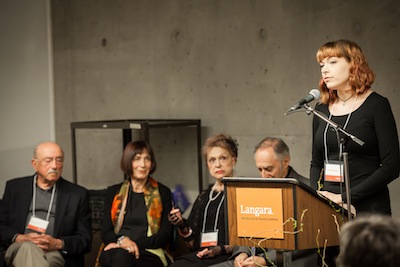
photo - Frieda Krickan, speaking on behalf of the students in the program, saw Writing Lives as an opportunity to honour the survivors, deepen her knowledge of Holocaust history and serve her Jewish community
Frieda Krickan, speaking on behalf of the students in the program, saw Writing Lives as an opportunity to honour the survivors, deepen her knowledge of Holocaust history and serve her Jewish community. (photo by Jennifer Oehler)

She added: “I came out of this class with something I did not expect: hope. Amidst all their personal accounts of suffering and loss, our survivors still managed to impart upon us the importance of hope. I don’t know if I’ve ever had such a life-affirming experience as talking to these survivors.”

Gene Homel, an instructor in liberal studies at the B.C. Institute of Technology who taught part of the Writing Lives course, said evidence-based and factual history are important at a time when the veracity of events past and present are being called into question.

The collection and preservation of eyewitness accounts is what makes the Writing Lives project so valuable, said Ilona Shulman Spaar, education director at the VHEC.

“Some students told me that they would never forget the personal encounters that they had with their interviewees and that they will always carry them close to their hearts. Some even mentioned that this program was life-changing for them,” she said. “Some of the survivors shared with me that they greatly appreciated being part of this program. For them, too, it was a unique experience, as most of them never gave interviews to this extent or in such depth.”

Robbie Waisman, one of the survivor participants, said the greatest fear that Holocaust survivors have is what’s going to happen after they are gone.

“What you are doing gives us hope that it’s going to be remembered, to make this a better world,” he said. “So thank you.”

Serge Vanry, another survivor participant, said it was an experience that he hadn’t expected.

“I started out wanting to do this, but feeling uneasy about somehow getting involved in the past, a past that has been put away quite a bit,” he told the audience. “I was talking about events that I had forgotten, things that were difficult, things that were hard to live with and things that can haunt you. As I was looking back at the past, I started to discover a lot of things that I had forgotten – events, situations that really had disappeared for me.”

Turning to the students, he said: “You did extremely well and I am really thankful and I’ve really appreciated what you’ve done for me, for the things that I don’t want to forget, the things that need to be told again for me and for my family.”

Other survivors who participated in Writing Lives were Alex Buckman, Amalia Boe-Fishman, Jannushka Jakobouvitch and Mark Elster. Excerpts from student-participants’ journals have run in previous issues of the Independent (search “Writing Lives” at jewishindependent.ca).

Mines thanked the Azrieli Foundation, for expertise and materials that made Writing Lives possible, and the VHEC, “which has been crucial, essential, absolutely indispensable in supporting Writing Lives … through liaising with survivors, making their library available for research and as an interview room and, generally, just being generous in terms of their time, their advice, expertise and not to mention moral support.”

Mines added that she hoped this pilot project of Writing Lives would become an ongoing program and, in the days following the closing ceremony, she received the news that Writing Lives will indeed run again, starting in the fall semester.

Pat Johnson is a communications and development consultant to the Vancouver Holocaust Education Centre.


Format ImagePosted on May 5, 2017May 3, 2017Author Pat JohnsonCategories LocalTags Azrieli Foundation, Holocaust, Langara College, memoir, survivors, VHEC
A little music … a few trysts

A little music … a few trysts

Katey Wright and Warren Kimmel co-star in A Little Night Music, which opens at Anvil Centre Theatre on May 13. (photo by David Cooper)

“The end of Act One may just be the most brilliant piece of musical theatre writing ever,” actor Warren Kimmel told the Independent when asked about Stephen Sondheim’s A Little Night Music, which will have a limited run at the Anvil Centre Theatre, starting next week.

And Jewish community member Kimmel knows of what he speaks when it comes to musical theatre. To name only some of the super-well-known musicals he’s been in – Billy Elliot, Fiddler on the Roof, Les Misérables, My Fair Lady, Mary Poppins, Sound of Music, Beauty and the Beast.

In A Little Night Music, which takes place around the turn of the last century, Kimmel plays Fredrik Egerman, who has just married 18-year-old Anne, many years his junior. One problem is that Fredrik’s son also loves Anne. Two other problems are that Anne is reluctant to give herself to Fredrik and Fredrik hasn’t quite doused the fire that exists between him and Desiree, a former girlfriend. Then there’s Desiree’s jealous (and married) lover. “All of these trysts and twists come to a head,” reads the promotional material, “when Desiree convinces her mother to host Fredrik and his family for a weekend on her lavish estate – where the count [Desiree’s lover], with his wife … crash the party.”

“Apart from its sheer entertainment value – the incredible music and genius lyrics of Stephen Sondheim – A Little Night Music is based on a film by Ingmar Bergman – Smiles of a Summer Night – so the themes are eternal,” said Kimmel. “How do you find love? How do you find the right person to love? How do you love the person you are with? How do you get the person you are with to love you? How do you remain faithful? Should you remain faithful? Like all great works of art, it doesn’t so much speak to a modern audience as whisper and shout!”

“I don’t know if I can adequately state the importance of Stephen Sondheim and his work,” director Peter Jorgensen told the Independent. “No other single artist has thought more deeply about composition as a tool for telling stories. No other lyricist gives characters such distinctive, rich language. As a musical dramatist, he has set the gold standard for artistry and craftsmanship.”

“Sondheim has a special place in the heart of all singer/actors,” agreed Kimmel. “His material is, without doubt, the most challenging and also the most satisfying to perform of anyone in the musical theatre canon. It’s really hard to get right but thrilling every time you do. Fredrik has some particularly complicated and expressive songs, and that’s the best and worst thing about this role.”

The Broadway musical – with music and lyrics by Sondheim and book by Hugh Wheeler – won six Tony Awards, a Golden Globe and a Grammy. In the local Patrick Street Productions mounting of the show, Kimmel co-stars with Katey Wright, who plays Desiree.

Real-life husband-wife team Wright and Jorgensen founded Patrick Street Productions in 2007. Their mandate: “to offer great productions of great plays and musicals for Metro Vancouver, with an emphasis on contemporary musicals that have not yet been professionally produced in the region.”

“For Patrick Street Productions,” said Jorgensen, “it is important for us to program musicals that challenge conceptions of what a musical is and what a musical can do. That aspiration is never better matched than with a Sondheim musical.

“As to why A Little Night Music,” he continued, “in many ways it is similar to why Hal Prince (the show’s original director) and Sondheim chose to create the show: we wanted to program something romantic and light that had a broad appeal, but that was still sharp and biting. Hal Prince described the show as ‘whipped cream and knives.’ There is no better statement that sums up the show’s appeal than that.”

Kimmel added, “Apart from ‘Send in the Clowns,’ which is perhaps Sondheim’s best known song, A Little Night Music is not as well-known as some of his other stuff, and certainly not as well known as Phantom of the Opera or something like that, but this piece is a real gem. The end of Act One may just be the most brilliant piece of musical theatre writing ever. The brilliance of the material forces you to really step up – and everyone has. From the costumes to the lighting, from the orchestrations to the casting, the level of work and attention to detail in this production are quite wonderful. It’s just worth seeing on every level.”

A Little Night Music opens at Anvil Centre Theatre in New Westminster on May 13, 8 p.m., with previews on the nights of May 11 and 12. Show times are Wednesday through Saturday, 8 p.m., with 2 p.m. matinées May 14, 20-21. Tickets are $25.50 for the previews and range from $25.50 to $39.50 for the run; they can be purchased at ticketsnw.ca or 604-521-5050.

Format ImagePosted on May 5, 2017May 3, 2017Author Cynthia RamsayCategories Performing ArtsTags musical theatre, Peter Jorgensen, Sondheim, Warren Kimmel
Diamonds at Shalva opening

Diamonds at Shalva opening

The new Shalva National Centre in Jerusalem officially opened on April 27. (photo from Shalva)

History was made on April 27, when hundreds of friends and donors traveled from around the world to gather in Jerusalem to celebrate the grand opening of the new Shalva National Centre. The day began with a rendition of “To Dream the Impossible Dream.”

photo - Leslie Diamond
Leslie Diamond (photo from Shalva)

“I fell in love with the concept that Shalva represents,” said Jerusalem Mayor Nir Barkat. “It is an icon and a role model for the world. Shalva has shown innovation in dealing with children with disabilities and I believe it will create ripple effects around the world.”

Leslie and Gordon Diamond, who dedicated the centre, flew in from Vancouver with family and friends. In addition, they dedicated the Steven Diamond Sports and Wellness Centre in memory of their son, Steven. With its semi-Olympic pool, large therapy pool, fitness centre and gymnasium, it is a significant gift of wellness to the Shalva children, their families and the broader community. Also dedicated was the Shalva Inclusive Parks in memory of Ambassador Ronald E. Arnall.

“Shalva epitomizes tikkun olam, making the world a better place and respect for family dignity. I am sure that Shalva will serve as the gold standard in its field for many years to come,” said Gordon Diamond. “For me and my family, it is an amazing honour to help this institution. Imperfection is inevitable in this world. We cannot make this a perfect world, but this is where society can shine. There is no more shining model than Shalva.”

“We have built a centre of excellence, full of colour, a magical place for the children of Shalva,” said Shalva chairman Avi Samuels. “We are humbled to open this state-of-the-art facility.”

photo - Gordon Diamond, reading into the microphone 
Gordon Diamond, left, with Shalva co-founder Kalman Samuels, who is holding the mezuzah. (photo from Shalva)

MK Chaim Katz said, “This is a huge day of giving. There’s so much heart and so much soul. I am bursting with pride to know that these world-class facilities are available right here in the state of Israel.”

The ribbon-breaking ceremony began with the sounding of 10 shofars. Barkat said, “When people come to the city of Jerusalem, they ask me what they should see. I tell them to go see the City of David so they see their roots. And then I tell them to go and see Shalva. People who enter this centre do not go out the same people. This place changes them.”

Kalman Samuels, who founded Shalva 27 years ago with his wife Malki when their infant son became blind and deaf following a faulty vaccination, thanked the audience of philanthropists, dignitaries and well-wishers. He said, “Your boundless love and your selfless care for your brothers and sisters with disabilities makes this earthly site heavenly.

I have gratitude to the Almighty and gratitude to each of you who continue to impact precious lives.”

Format ImagePosted on May 5, 2017May 4, 2017Author ShalvaCategories IsraelTags disability, Gordon Diamond, health care, Israel, Leslie Diamond, SHALVA
Ring to fund students

Ring to fund students

Olga Ornstein, the mother of Frank Ornstein. Frank gave his friend, George Szasz, his mother’s ring, which George is hoping to sell to fund a scholarship in the Ornstein family’s name. (photo from Jewish Federation of Greater Vancouver)

Last summer, community member George Szasz approached the Jewish Community Foundation, hoping to establish a scholarship endowment fund to honour a dear friend’s memory. The friend, Frank Ornstein, z”l, survived the Holocaust and eventually immigrated to Vancouver. With no children or living family members to speak of, Frank bequeathed a family ring saved from the Holocaust to George, which George is hoping to sell to fund a scholarship in the Ornstein family’s name.

Lipot and Olga Ornstein, both of blessed memory, were an affluent couple in the Hungarian city of Szeged and doted on their only son, Frank. Born in 1924, Frank grew from a skilled boy scout to a star athlete with a wide range of friends. They lived peacefully with their non-Jewish neighbours, and Frank began dating a non-Jewish girl.

Even as anti-Jewish sentiment grew around them, the city’s residents lived amiably together. It was a shock when laws mandated division by 1943. Jews, including the Ornsteins, were evicted from their homes, stripped of their property and segregated in ghettos. As a fit 19-year-old, Frank was sent away to a labour camp. Lipot and Olga were forced onto an overcrowded cattle car without food or water for a three-day journey to a concentration camp in Austria.

Life in the camp was grim. Lipot and Olga wrote Frank postcards, holding onto hope that, after the war, the family would be reunited and return to their life in Szeged. In March 1945, the camp buzzed with news that Russian soldiers were near and the captives desperately hoped for liberation. The day before the soldiers arrived, however, German guards marched the camp’s prisoners, including Lipot and Olga, to a local gym and blew them up.

Frank was liberated from the labour camp and, in late 1945, returned to Szeged, sick but alive. There, he found out that his parents, and most of the city’s Jewish residents, would never return. Frank’s girlfriend’s family had secretly stored some of his parents’ valuables, including his mother’s diamond ring, and returned them to him: memories of a life that had vanished.

Realizing life in Szeged would never be the same, Frank took his few possessions and family mementoes and immigrated to Israel. In Israel, he trained as an airplane mechanic and found both a love and an affinity for the trade. He worked for Israel’s El Al Airlines and immigrated to Vancouver in the late 1950s, as a chief mechanic for Canadian Pacific Airlines and, later, Air Canada.

After Frank’s death in 2006, George was bequeathed the Ornstein family’s mementoes. Frank’s life was marked by trials and resilience, and George is determined to honour the Ornstein family’s history and heritage. Of the Ornstein family keepsakes, Frank’s mother’s ring is of particular value, appraised at between $30,000 and $50,000, and George is determined to sell the ring to establish a yearly scholarship for deserving Israeli students studying Frank’s life passion: airplane mechanics.

If you are interested in assisting George to create the Ornstein family legacy, contact Marcie Flom, director of the Jewish Community Foundation, at [email protected].

This article was originally published by Jewish Federation of Greater Vancouver in e-Yachad and is reprinted with permission.

Format ImagePosted on May 5, 2017May 3, 2017Author Jewish Federation of Greater VancouverCategories LocalTags fundraising, Holocaust, Israel, Jewish Community Foundation, Ornstein, Szasz
Who owns the past?

Who owns the past?

Left to right: Mitchell Gropper, QC; Prof. Guy Pessach, Hebrew University; Prof. Catherine Dauvergne, dean of the Peter A. Allard School of Law, University of British Columbia; and Randy Milner, Vancouver chapter president, Canadian Friends of the Hebrew University. (photo from Canadian Friends of the Hebrew University, Vancouver)

What happens to the archival materials of a Jewish community when that community no longer has the capacity to maintain itself can be complicated and messy. A 2013 Supreme Court decision in Israel provided a solution but also raised important questions about identity, collective memory and the relationship between Israel and the Diaspora.

On March 17, Prof. Guy Pessach of Hebrew University of Jerusalem presented a lecture as part of the Mitchell H. Gropper, QC, Law Faculty Exchange Program. An initiative of Hebrew U and University of British Columbia, the program’s UBC webpage notes that, since the program began in 2010, each law faculty “has hosted three visiting professors from the other university.”

Pessach’s topic was Who Owns the Past? – Law, the Politics of Memory and the Israeli Supreme Court. He discussed two cases but focused primarily on a lawsuit involving the Vienna Jewish community and the Central Archives for the History of the Jewish People, which is in Jerusalem. He said decisions made by the Israeli Supreme Court reflected a propensity for Israel to regard itself as the international arbiter of Jewish cultural property and collective memory.

According to Pessach, Vienna was the second-largest Jewish community in Europe in the early 20th century. The nearly 200,000 Jews in the 1930s were reduced to fewer than 9,000 after the Holocaust. In the early days of Israel’s statehood, the Central Archives actively collected materials from Jewish communities in Europe to safeguard the rich Jewish history of these disappeared communities.

Although the Viennese community continues to decline in population, he said, in the 21st century, it sufficiently reorganized to request the return of its archival materials from the Central Archives. When the archives refused, claiming that the material was given on “indefinite loan,” Vienna’s Jews launched a lawsuit.

According to a January 2013 article in Haaretz, “The collection includes thousands of papers stored in 200 containers, documenting 300 years of the Vienna community from the 17th century up to 1945. After the Holocaust, community leaders decided to transfer the archive to Jerusalem, fearing it would not be stored properly in Vienna, and they continued to add documents to the collection. Yet the Viennese community insists it sent the documents – in four shipments in 1952, 1966, 1971 and 1978 – with the explicit agreement, time after time, that the documents were only on loan and remained the property of the community.”

Vienna lost its case. At the time, Israeli state archivist Yaacov Lozowick, stated, according to Haaretz, that “the depositors felt they were strengthening the cultural importance of the young state of Israel as the centre of the Jewish people; they were proud about their contribution; and they had no intention of the collection ever returning.”

In the case, said Pessach, Israel asserted its place in the Jewish world as protector of Jewish identity and history. He explained the ins and outs of the court’s decision and discussed the issues of cultural property law and restitution. He said restitution is not just the physical return of culturally and historically significant items but also symbolic justice for a community. He noted that similar situations continue to play out in Jewish communities, in the form of art stolen by the Nazis, and that Canadian First Nations and many other groups are also currently seeking restitution for cultural property stolen during colonial times.

For more information on the Mitchell H. Gropper, QC, Law Faculty Exchange Program, call the Canadian Friends of the Hebrew University office at 604-257-5133 or email [email protected].

Format ImagePosted on May 5, 2017May 3, 2017Author CFHU VancouverCategories LocalTags Gropper, Guy Pessach, Hebrew University, Israel, law, UBC
Providing mutual support

Providing mutual support

Sara Omer and her kids lost their husband/father Reuven in 2008. (photo from IMP Group)

May 1 was Yom Hazikaron (Israel Memorial Day), May 2 celebrated Yom Ha’atzmaut (Israel Independence Day) and this month marks the 50th anniversary of the Six Day War and the reunification of Jerusalem. For the widows of Israel’s fallen soldiers, who paid the ultimate price so that Jews all over the world could revel in the modern-day rebirth of the Jewish state, these anniversaries stir varying emotions.

At 94 years old, Devorah Arkin Roth is one of the country’s oldest war widows. Her husband, Mordechai Arkin, was killed while defending Hadassah Hospital in Jerusalem just weeks before the official outbreak of the War of Independence in May 1948. She shares fond memories of her husband, as she stares at the photo album of their wedding and the newborn pictures of their first child.

“He was a very talented man who wanted to go to Columbia University in New York to study physics,” she recalled. “But the deteriorating security situation in the country wouldn’t permit him to leave. He worked at Hadassah Hospital and doubled as a guard when he was killed. At the time of his death, I was already pregnant with our second child.”

photo - At 94 years old, Devorah Arkin Roth is one of Israel’s oldest war widows
At 94 years old, Devorah Arkin Roth is one of Israel’s oldest war widows. (photo from IMP Group)

Though Roth remarried and feels privileged to be a mother, grandmother and great-grandmother, she still gets the jitters each time one of her grandchildren goes into the army. “It’s difficult to see your grandchildren being drafted into the IDF [Israel Defence Forces] after what I had to endure, and even more so because one of my grandchildren was injured as well in battle,” she said.

The Six Dar War was an astounding military accomplishment, as the IDF beat back the armed forces of Egypt, Syria and Jordan – but 776 IDF soldiers lost their lives.

Pte. Yossi Mori was killed on the first day of the Six Day War (June 5, 1967) after his unit was shelled in a minefield. His widow, Dania, recalled, “We had a great group of friends and, to this day, we meet every Memorial Day at his grave. During these years, you keep going, building your home, raising children and grandchildren. You don’t just sit all day thinking about your loss, because then your life would stop.”

First Lieut. Yehuda Ram died while liberating the Golan Heights on the last day of the war (June 10). “Yehuda died when he was 23 years old and we had only been married for a year. It was young love, an innocent one,” Shoshana, his widow, remembered. “I actually came back from the war filled with guilt. Why did I survive and he didn’t? Those feelings disappeared with the years because you can’t keep living like that.”

Even in between wars, when IDF soldiers constantly train in order to be ready for the next conflagration, there are inherent dangers, which can exact a toll.

For example, Sara Omer’s world was nearly destroyed in 2008, when her husband Reuven was killed in the midst of a training exercise as part of his IDF reserve duty. She had to face life alone with her three young boys, twins Nadav and Yotam, who were 6 years old, and Guy, then 2 years old.

“The unexpected loss of my husband was indeed shocking and, when Yom Hazikaron comes around every year,” she said, “it is a difficult day for all of the widows, but my children, who are now teenagers, attend a special ceremony at the Knesset, which is both uplifting and inspiring.”

Run by widows and orphans, the IDF Widows and Orphans organization (IDFWO) creates a support network to help them through difficult times. The organization provides services that touch every aspect of their lives, from a communal bar/bat mitzvah service at the Kotel, to professional training courses.

One of the most important activities of the IDFWO is to bring together people with common experiences for mutual support. Regular retreats give widows a break and a chance to benefit from mutual understanding. The IDFWO Otzma Camps give orphans the same opportunity.

“Once a war widow, always a war widow, even if you remarry and love your second husband. The IDFWO gatherings and activities are very important for a very specific reason,” one of the widows explained. “We might not always agree with each other’s opinions about different things, but we all speak the same language and understand each other, as widows. Since we have all experienced the same loss and trauma, we can speak to each other in our language and help each other when we need to, especially on Yom Hazikaron, when we all could use a hug and a smile.”

To learn more about the IDFWO, see idfwo.org/eng.

Format ImagePosted on May 5, 2017May 3, 2017Author IMP Group Ltd.Categories IsraelTags IDF, IDFWO, Israel Defence Forces, orphans, widows, Yom Ha'atzmaut, Yom Hazikaron
Israel’s BDS website

Israel’s BDS website

Featured on israelbds.org are popular articles that describe the history of Israeli-international scientific cooperation, research that has resulted from that cooperation and the people involved, as well as links to scientific papers. (image from israelbds.org)

Building Dialogue through Science, or BDS, is the purpose of a new website, israelbds.org, which features the many and varied scientific studies that rely on close collaboration between Israeli researchers and those in different countries.

These studies range from the SESAME synchrotron, a Middle Eastern facility based in Jordan that serves life-sciences researchers from Egypt to Iran; efforts to discover the processes that lead to the stellar explosions known as supernovae, in which Israeli researchers are alerted to possible events in the California night sky; brain research; quantum physics studies; scientific archeology; and much more.

Featured on the website are popular articles that describe the history of Israeli-international scientific cooperation, research that has resulted from that cooperation and the people involved, as well as links to scientific papers.

“Building dialogue through science, rather than building walls, has always been our way of doing things,” said Weizmann Institute of Science president Prof. Daniel Zajfman. “If we are going to work against the other BDS [boycott, divest from and sanction Israel], we must do so with real information. That is the intent of the site we have created. When scientists cooperate in their research, they bring back to their countries an understanding of the ways people can work together on many levels – over and above the scientific – including respect for other cultures and a desire for peaceful coexistence. That is why we believe that cooperation between Israeli scientists and those in universities and research institutes around the globe must be preserved at all costs.”

The hope, indeed, is that anyone visiting the website will understand what the world stands to lose from cutting off ties to Israel’s researchers and preventing students and labs around the globe from benefiting from Israeli advances.

Valeria Ulisse, an Italian research student studying the development of the nervous system at the Weizmann Institute of Science sums it up: “In Italy, I was in a really good lab but I was missing something internally. I wanted to improve my knowledge, to start a new project, to change my life and I found the place to do it.”

Israeli science is open to collaboration with anyone, independent of their political opinions.

“Research thrives on the meeting of different worldviews, and it is important to preserve that freedom to meet and discuss, even with those with whom we don’t always agree,” said Zajfman.


Format ImagePosted on May 5, 2017May 3, 2017Author Weizmann InstituteCategories IsraelTags BDS, boycott, Daniel Zajfman, science, Weizmann Institute
Commemorative $10 note

Commemorative $10 note

(photo from Bank of Canada)

Beginning June 1, 40 million commemorative bank notes will be distributed through Canada’s financial institutions. The $10 note, celebrating the 150th anniversary of Confederation, features Sir John A. Macdonald, Sir George-Étienne Cartier, Agnes Macphail and James Gladstone. Macdonald was Canada’s first prime minister and one of the Fathers of Confederation. Cartier, also one of the Fathers of Confederation, was a principal architect of Canadian federalism and a proponent of Confederation as a means of safeguarding French Canada and other minorities. Macphail was a champion of equality and human rights who, in 1921, became the first woman elected to the House of Commons in Canada. Gladstone, or Akay-na-muka (his Blackfoot name), committed himself to the betterment of indigenous peoples in Canada and, in 1958, became Canada’s first senator of First Nations origin. The back of the note emphasizes Canada’s natural landscapes. For more information, visit bankofcanada.ca/banknote150.

Format ImagePosted on May 5, 2017May 3, 2017Author Bank of CanadaCategories NationalTags Agnes Macphail, Confederation, James Gladstone, John A. Macdonald, Sir George-Étienne Cartier
This week’s cartoon … May 5/17

This week’s cartoon … May 5/17

Format ImagePosted on May 5, 2017May 3, 2017Author Jacob SamuelCategories The Daily SnoozeTags Tetris, thedailysnooze.com
מאה ימים

מאה ימים

דונלד טראמפ משנה דעתו כל הזמן: מתנגד להסכם הסחר עם קנדה ומקסיקו, תומך בו, מתנגד לו ותומך בו. (צילום: Gage Skidmore)

נשיא ארה”ב, דונלאד טראמפ, ממשיך לשנות את דעתו בכל נושא ונושא גם במלאת מאה ימים לכהונתו. אף אחד ממקורביו, בממשלו, ממשלתו ובקרב חברי הקונגרס מטעם מפלגתו, לא יודעים מה ילד יום וממה לצפות מטראפ שמעורר מבוכה רבה. לכן גם לא מפתיע במיוחד שטראמפ שהודיע כי הסכם הסחר הצפון אמריקני של ארה”ב עם קנדה ומקסיקו – נפט”א “הוא גרוע ביותר בהיסטוריה”, לאחר מכן אמר כי יוכנסו בו רק תיקונים קטנים בכל הנוגע לקנדה. אחרי כן הודיע טראמפ בשבוע שעבר כי הוא יבטל את הסכם נפט”א (ואף כבר הכין טיוטה של צו נשיאותי לסגת מההסכם), ולאחר יום חזר בו והודיע כי הוא כי ימשיך לתמוך בו, תוך הכנסת תיקונים מסויימים. זאת לאחר ששוחח בטלפון עם נשיא מקסיקו, אנריקה פנייה וראש ממשלת קנדה, ג’סטין טרודו, שביקשו ממנו להשאיר את הסכם הסחר על כנו, כי אחרת יגרם נזק גדול יותר לשלושת הצדדים, ולפעול במשותף במטרה לשפרו. טראמפ ציין כי אם הוא מסוגל לעשות עיסקה הוגנת עבור ארה”ב במקום לבטל את ההסכם המדובר, זה מה שהוא יעשה. נשיא ארה”ב הוסיף: “אנחנו מתכוונים לתת הזדמנות טובה למשא ומתן מחודש לשיפור תנאי ההסכם, שהתחיל ממש כבר בימים אלה”.

טרודו מצידו אמר לעיתונאים לאחר ששוחח עם טראמפ בטלפון, כי השיחה בין השניים הייתה מוצלחת. בשיחה הוא הבהיר לנשיא ארה”ב כי יציאת ארה”ב מההסכם תגרום כאב גדול לשתי המדינות. שני האישים סיכמו ביניהם לשפר את תנאי ההסכם לטובת שלוש המדינות השותפות בו. טראמפ אישר לאחר מכן כרגיל באמצעות טוויטר כי הסכים לבקשתם של טרודו לשנות את תנאי הסכם הסחר במקום לבטלו.

הסכם ליצירת אזור סחר חופשי של צפון אמריקהי בין ארה”ב, קנדה ומקסיקו – נפט”א – נולד בשנת 1994. אז חתמו עליו ראשי המדינות: נשיא ארה”ב ביל קלינטון, ראש ממשלת קנדה, בריאן מלרוני ונשיא מקסיקו קרלוס סאלינס. אגב מלרוני השמרני נחשב למקורב לטראמפ במשך שנים, ולכן הוא משמש כיום כיועץ לממשלת טרודו הליברלית שמנסה ללמוד כיצד לנהוג במגעים מול הנשיא האמריקני הבלתי צפוי לחלוטין.

נפט”א נועד לביטול רוב המכסים בין שלוש המדינות וכן להסדיר את מעבר כוח האדם והסחורות בין ארה”ב למקסיקו. ההסכם יועד בעיקר לשפר את מצבם של ענף החקלאות, ענף ייצור המכוניות וכן ענף הטקסטיל. ההסכם שנחשב למבורך בעיני רבים בהם גם מומחים בתחום הכלכלה, שילש את כמות המסחר וההשקעות בין ארה”ב, קנדה ומקסיקו. במונחי שווי כוח הקנייה של התוצר הלאומי הגולמי של החברות בהסכם, הוא יצר את גוש הסחר החופשי הגדול בעולם. ובמונחי תמ”ג נומינלי נחשב נפט”א להסכם הסחר השני לאחר הסכם איגוד הסחר החופשי של הגוש האירופאי המאוחד.

הסכם נפט”א הביא לכך שהתגבר סחר החוץ בין שלוש המדינות וכלכלן צמחו במהלך התקופה מאז נחתם. כלכלת קנדה צמחה בקצב הגבוה ביותר, אחריה כלכלת ארה”ב ואחרונה כלכלת מקסיקו. לפי משרד המסחר של ארה”ב: מאז חתימת ההסכם רמת האבטלה במשק האמריקני ירדה, בו בזמן שנרשם גידול מתמיד בשכר העובדים הריאלי לשעה. כן נרשם גידול בשכר העובדים של מקסיקו ואף גידול ביצוא החקלאי של ארה”ב לקנדה ומקסיקו. המומחים מציינים כי נפט”א הזיק לתעסוקה בארה”ב הרבה פחות מהתחרות עם סין ומדינות אחרות, ודווקא ביטולו עלול לפגוע בתעשיות האמריקניות.

Format ImagePosted on May 3, 2017May 3, 2017Author Roni RachmaniCategories עניין בחדשותTags Canada, Mexico, NAFTA, trade, Trump, United States, ארה"ב, הסחר, טראמפ, מקסיקו, נפט"א, קנדה

Posts pagination

Previous page Page 1 … Page 445 Page 446 Page 447 … Page 667 Next page
Proudly powered by WordPress