Building community bridges – memorial for genocide of Lithuanian Jews

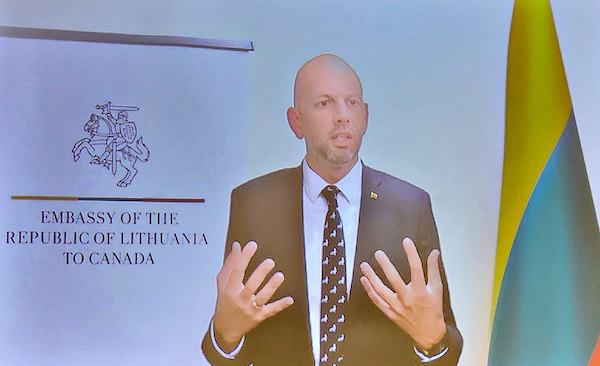
Lithuania’s ambassador to Canada, Darius Skusevičius, greets participants in pre-recorded video. (photo from Lithuanian Community of BC)

As a young teen growing up in Vancouver in the 1960s, I used to be puzzled by Remembrance Day. We were given red poppies at school to honour the soldiers who served Canada during the First and Second World Wars. But I knew my parents had also experienced war, and their families – my grandmothers, aunts, uncles, cousins, even my half-brother and stepsister – had been horribly murdered. Why were there no red poppies for them and the six million others who had died in the Holocaust? Where were their memorial parades, their wreaths?

In Vancouver’s Peretz School, which I attended a couple of afternoons a week to learn about Jewish culture, we commemorated Yom Hashoah, which was established by the Israeli government in 1959. Our commemoration was a small event, important to staff, students and families, but ignored by Canadian society in general. It was not until 2005, when the United Nations General Assembly established Jan. 27 as International Holocaust Remembrance Day, that non-Jews as well as Jews began to join in collective memorialization – or so I thought until quite recently.

In 1994, the Lithuanian Parliament established Sept. 23 as National Memorial Day for the Genocide of Lithuanian Jews. Every Sept. 23, the anniversary of the liquidation of the Vilna (Vilnius) Ghetto, commemorative activities are held at Lithuanian memorial sites, in schools and in other educational institutions. Government institutions, with the support and involvement of local Jewish communities and survivors’ groups, shape the content of these activities, and Jewish and non-Jewish Lithuanians regularly participate in them.

A few years ago, I joined the Lithuanian Community of British Columbia (LCBC), where I currently serve on the board of directors. This year, on Sept. 22, with the support of the Vancouver Holocaust Education Centre (VHEC) and generous volunteers from Lithuanian and Jewish communities, LCBC and its partners, National Memorial Day for the Genocide of Lithuanian Jews was commemorated. The event, which took place at the Peretz Centre for Secular Jewish Culture in Vancouver, was held for the first time in Canada.

Participants were welcomed by Algis Jaugelis, president of the LCBC, followed by opening remarks by Nina Krieger, the executive director of the VHEC. The ambassador of Lithuania to Canada, Darius Skusevičius, kindly provided a recorded welcome to the event, followed by a written statement from Christopher Juras, the honorary consul of Lithuania in Vancouver.

LCBC member and historian Dr. Gene Homel presented an overview of Jewish life in Lithuania from the 1300s to the present day. I gave an illustrated presentation on the Jewish community in my father’s ancestral town in Lithuania, using photos and information found in my research.
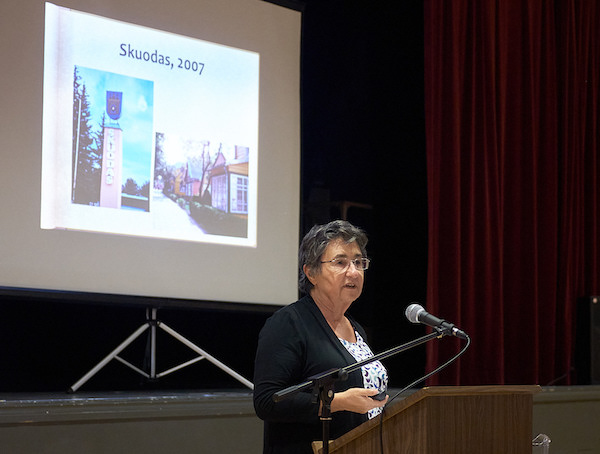
photo - Rachel Mines characterizes the lives of the Jewish residents of Skuodas, Lithuania
Rachel Mines characterizes the lives of the Jewish residents of Skuodas, Lithuania. (photo from Lithuanian Community of BC)

Helen Mintz, a Yiddish translator, read a selection from one of her translations of Abraham Karpinowitz’s short stories. Karpinowitz, the son of a theatrical family in Vilna, survived the Holocaust and later wrote several volumes of stories memorializing prewar Jewish life in Vilna.

The ceremony ended with the singing of the “Partisans’ Song” / “Zog Nit Keynmol,” written by Hirsh Glick in the Vilna Ghetto, which was followed by a recording of Glick’s words translated into Lithuanian and read by high school student Giedrius Galvanauskas under the auspices of Eli Rabinowitz’s We Are Here! international educational project.
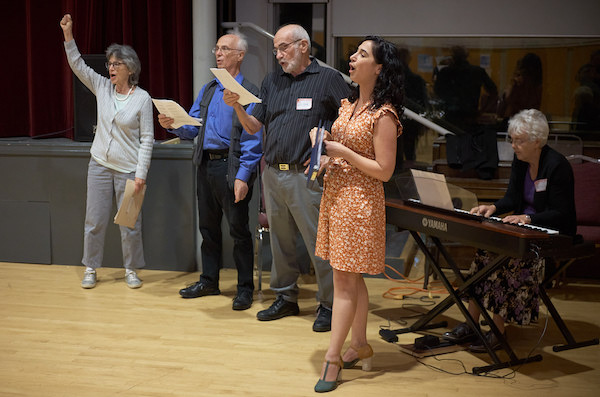
photo - The ceremony ended with the singing of “Zog Nit Keynmol.” Left to right are Celia Brauer, Alan LeFevre, Victor Neuman and Kathryn Palmer. At the piano is Cathrine Conings
The ceremony ended with the singing of “Zog Nit Keynmol.” Left to right are Celia Brauer, Alan LeFevre, Victor Neuman and Kathryn Palmer. At the piano is Cathrine Conings. (photo from Lithuanian Community of BC)

Lithuanian and non-Lithuanian participants found the remembrance ceremony both educational and emotional, and emphasized the importance of dialogue and reconciliation. According to Jaugelis, it was “an important and moving event, an opening of doors and minds, with great potential for future intercultural and bridge-building events.” Andrea Berneckas, another LCBC director, wrote, “It was such a privilege to be part of this solemn, yet beautiful and hopeful event. I look forward to being part of the Lithuanian community’s strengthening of ties by the sharing of stories and experiences.”

“I look forward to more opportunities to bring the communities together,” said Krieger. And Celia Brauer, a local Yiddishist whose parents survived the Holocaust in Latvia and Poland, summed up the general feeling: “We are far away from the original homeland, yet this event brought people closer together – which is incredibly important.”

National Memorial Day for the Genocide of Lithuanian Jews is now on LCBC’s yearly calendar of events and the next memorial will take place in September 2023.

More information about the Lithuanian Community of British Columbia can be found at lithuaniansofbc.com.

Rachel Mines, the daughter of Holocaust survivors, was born and raised in Vancouver. As a child, she attended classes at the Peretz School (now the Peretz Centre for Secular Jewish Culture) and served on Peretz’s board of directors 2015-2016. Mines, whose Lithuanian citizenship was reinstated in 2022, now serves on the board of directors of the Lithuanian Community of British Columbia.
Still waiting for knee surgery

I am not known for my patience. And I’ve been preparing for my long-awaited knee replacement surgery for nearly three years.

I’ve acquired all the necessary post-surgical equipment: expensive ice and compression machine, bath transfer bench, walker, crutches, cane, toilet riser, reacher, long-handled shoehorn, high density cushion, a chair with arms. I attended all the prehab and pre-surgery webinars, got my SPARC parking pass, watched all the recommended surgical and how-to videos (several times each), made a list of what to bring to the hospital and rescheduled a host of medical appointments and personal commitments. I even arranged to “foster” some of my furniture out to friends to clear the way for my anticipated post-surgical walker/crutches. I had meetings with the surgeon, pre-admission nurses, anesthesiologist, physiotherapists and an occupational therapist. I was more prepared for my surgery than Eisenhower was for D-Day. I repeat, I am not a patient woman.

Staff at Oasis (Osteoarthritis Service Integration System) and ASAP (Arthritis Surgical Assessment Program) are my new BFFs. They told me about assistlist.ca, a website that lists used medical equipment for sale. I learned that the Red Cross Health Equipment Loan program has become stricter about who it lends to. It used to be that everyone got their equipment there. Since COVID, anyone who wants to borrow from there has to sign a waiver explicitly disclosing their need for assistance. Luckily, I don’t need their services.

I’m armed with more resources than I know what to do with, so it just makes sense to share them. There are lots of medical supply stores, but the ones who have the greatest variety are Lancaster Medical on West Broadway and Macdonald’s Prescriptions (in the Fairmont building). Best place to buy high-density cushions (and any kind of foam) is Discount Foam on Fraser Street near 33rd. Need an ice/compression machine? Go to the source: ProCare Medical Inc. Just FYI, the Polar Care Wave machine combines the ice therapy and the compression that targets not only swelling but also pain. Apparently, it’s a must-have for knee replacement surgery.

If you have an extended medical plan, check to see what they cover, because this equipment can be expensive. Also check if they cover a private or semi-private hospital room. And don’t forget to get a doctor’s note indicating that you need this equipment for a knee or hip replacement, and include this with your extended health claim. My health carrier insisted that I buy from an actual medical supply store (not, say, Facebook Marketplace) and that the receipt indicate the source, and that my name be on the receipt. You might want to buy your equipment secondhand to save some money, but just remember that your extended health won’t cover it.

I learned that a high-density cushion, which I’ll need post-surgery, is not a benefit covered by my health plan. I also learned that, after knee replacement, all seating must be two inches higher than the top of my knee. That includes the toilet, the bed, all chairs and couches, and the car seat. Seriously, the logistics of preparing one’s home (and car) before surgery seem never-ending. Like making sure that everything you need on a daily basis is within counter-height reach. No squatting to get toilet paper out from under the sink – unless you have a reacher. No going to restaurants without your high-density cushion. No bending over to put on your socks. The list goes on. And on.

To say that I was ready for surgery would be this century’s understatement. Then I got COVID.

Don’t ask me how. It’s one of the world’s great mysteries. I am vaccinated five times. After intense speculation, the only culprits I can point to are either the physiotherapist appointment I had (both of us wearing KN-95 masks) or an elevator (me masked, of course).

It was a Friday morning and I just thought my allergies were acting up. Or maybe I’d been mouth-breathing at night – slight sore throat, stuffy nose, tired, a bit of a dry cough and a headache. Minor stuff. Until I did a COVID rapid home test. I tested positive. I immediately called the urgent care clinic and got a PCR test, phoned my gastroenterologist and proactively got a prescription for the antiviral medication Paxlovid, and waited. Less than 24 hours later, when positivity was confirmed, I started on the medication and was better in five days. My surgery was scheduled for four weeks later – and this was a problem, as I will explain.

I want to make one thing clear. I do not blame my orthopedic surgeon or the anesthesiologist for my knee replacement surgery being postponed three times. I do blame COVID. I do blame miscommunication. And I definitely blame an over-burdened healthcare system. Primarily, the latter.

My husband and I have been crazy cautious and isolating like nobody’s business during the pandemic. The wild card is that I’m immunocompromised, so I’m at higher risk for any kind of infection. But nobody has been more careful than us. In fact, I’m pretty sure I spent more money on KN-95 facemasks, latex gloves and hand sanitizer in the past two-and-a-half years than I have on clothing. By a long shot. Until this point, we went nowhere, saw no one and did nothing. But, as COVID eased up a bit during the summer, so did we. But incrementally. Literally by centimetres. I met a few friends for dinner outside. We traveled to Victoria for four days. Wild and crazy stuff by all accounts.

Having just been told for the third time that my surgery would be postponed, I was devastated. It had to do with a seven-week waiting period post-COVID before getting an anesthetic or surgery, because of the risk of blood clots and pneumonia. Immunocompromised … blah, blah, blah.

All this is to say that I should have listened to a wise woman long ago, who advised that I “get comfortable with uncertainty.” Umm, OK. How exactly do I do that? Apparently, you breathe. And wait. And breathe. And practise mindful meditation. Maybe get a little anxious. Breathe some more. Meditate. Eat. Maybe get a bit more anxious. Breathe. Wait some more. I’m now an expert breather.

The only thing that helps me is holding firm to my belief that nothing happens by accident. Everything happens for a reason. Usually one to which I am not privy. But still. Enter faith and trust – stage right, stage left, stage centre. That’s really my only life raft. Luckily, it’s sturdy and solid and mine for the taking. Anytime, anywhere. Now that’s what I need to practise. Oh yeah, and breathing. Meanwhile, I’ll continue cooking and eating. Stay tuned.

Shelley Civkin, aka the Accidental Balabusta, is a happily retired librarian and communications officer. For 17 years, she wrote a weekly book review column for the Richmond Review. She’s currently a freelance writer and volunteer.

RJDS’s new early ed program

Richmond Jewish Day School preschool children gather for Shabbat celebration, with Sara Solomon assisting. (photo from RJDS)

Sara Solomon, Richmond Jewish Day School’s new program director for early education, knows firsthand the importance of a community-centred Jewish day school. She can remember making the daily half-hour bus ride each way from Richmond to Vancouver to attend the nearest Jewish elementary school. It wasn’t until 1992, when RJDS opened its doors, that she could attend school closer to home. But it isn’t sentimentality that has drawn her back to RJDS. It is the school’s novel and forward approach to teaching elementary education.

“[RJDS’s] family-centred culture of the school and the progressive approach to education … aligned with my own values,” said Solomon, who graduated from Langara College in 2010 with a diploma in early childhood education and a certificate in special needs. She said the school’s focus on innovative teaching methods for individualized education aligns with her own practice of “emergent curriculum” – a teaching method that supports the belief that children excel when they are permitted to learn at their own speed and according to their own strengths, interests and abilities – was a deciding factor when it came to applying for the position.

RJDS offers two preschool programs: Gan Alef, for infants and toddlers (0-3 years old) and Gan Bet, for children ages 3-5. For both, the school employs what RJDS principal Sabrina Bhojani refers to as a “constructivist play-based approach” to education. Instead of using teacher-led lessons and activities, educators use curiosity and inspiration to nurture the child’s development. “This provides opportunities, experiences and materials that are responsive to children’s interests and passions,” said Bhojani.

photo - Richmond Jewish Day School principal Sabrina Bhojani
Richmond Jewish Day School principal Sabrina Bhojani. (photo from RJDS)

Although the children are usually in group settings, individuality of expression is encouraged. “We also weave Judaic concepts and history through storytelling; language and traditions are experienced through holiday celebrations and Hebrew songs,” Bhojani explained.

“We try to incorporate [the curriculum] in as natural a way as possible without it seeming like we’re inputting information,” Solomon added. The curriculum often uses Jewish holidays to inspire exploration of colours, themes and Hebrew words. “For Sukkot, [we had] a picture of a sukkah and there was a discussion about what the sukkah is, how it’s used,” she said by way of example.

The school also had a small sukkah outside that the students could visit. “The younger children were given some natural materials the teachers collected from outside,” along with some paints. “The older group were given the leaves or needles from an evergreen tree for the roof, some popsicle sticks and a few other things. There was no expectation for it to look like a sukkah,” Solomon explained, noting that the kids weren’t given specific exercises or told to decorate the structure. But the materials were provided for creative expression and exploration that eventually led to decorating the sukkah.

Bhojani said the new RJDS-run early education centre was created to overcome several challenges facing the Richmond Jewish community. The first was to expand access to early childhood education, an urgent need that is being felt throughout the Metro Vancouver area and beyond.

According to Bhojani, infant-toddler spaces are in high demand across British Columbia. “In the last few years, the number of childcare spaces has simply not been enough to meet the needs of families. This has been a province-wide issue, but it has been far worse for families in Richmond, particularly those families seeking a place they could be assured that their Jewish children could express themselves in an authentic manner.” At the moment, she said, “RJDS Early Learning Centre is the only Jewish child care in the Lower Mainland that accepts child under 18 months old.”

The new centre will support continuity of education for children throughout the elementary school experience.

photo - Sara Solomon when she was in sixth grade at RJDS. Solomon was one of the school’s first graduates
Sara Solomon when she was in sixth grade at RJDS. Solomon was one of the school’s first graduates. (photo from Sara Solomon)

Bhojani said the previous preschool was run by an independent contractor that rented space from RJDS, but its curriculum wasn’t synchronized with what was being taught in the upper grades. “[Being] that it was a third-party organization, we had no authority or oversight in the daycare’s programming,” she said. With the demand for childcare spaces, the former preschool also wasn’t able to guarantee availability for families that wanted to enrol all of their children at RJDS for preschool through Grade 7 attendance.

“We realized quickly we needed our own licensed facility,” and one that fit with the new lesson plans, Bhojani said. “Soon after, we made a commitment to building our own learning centre in order to be able to better serve our community.” That included renovating parts of the school.

The improvements were paid for by two local grants, one of which was specifically tailored to increasing the number of childcare spaces in British Columbia. The B.C. New Spaces fund, offered through the provincial government, helped cover the cost of structural renovations in the preschool area.

The second grant came from the Jewish Community Foundation, which provides unrestricted grants for a wide variety of community needs. While the school did not disclose the amounts they received from each grant, Solomon said the two grants allowed them to make targeted upgrades in time for the 2022/23 school year.

“So far, we have been able to repaint the building, put in all new flooring, upgrade the lighting, and the next steps are going to be some plumbing upgrades,” Solomon said.

The school will still have some further additions to make, such as a new washer and dryer, a sink in one of the classrooms and some improvements in the outdoor play space. Solomon said she is hoping the school will be able to develop an engaging play area, where classes can be held outdoors, too. “We have the most beautiful property here,” she said. “We are on farmland and we are really hoping that we can incorporate that into our outdoor play space.”

Bhojani said the school’s new early education program director comes with the life experience and drive that will help make the new preschool a real success. “As an original RJDS graduate, current school parent and former board member, Sara Solomon has an unparalleled dedication and commitment to our school,” said Bhojani. “She, along with a highly qualified and experienced staff, in the short time that we have been open, have created beautiful spaces in which children feel nurtured and loved.”

Jan Lee is an award-winning editorial writer whose articles and op-eds have been published in B’nai B’rith Magazine, Voices of Conservative and Masorti Judaism and Baltimore Jewish Times, as well as a number of business, environmental and travel publications. Her blog can be found at multiculturaljew.polestarpassages.com.

Petitioning for change

Richmond educator Alisa Magnan is petitioning Richmond city council to create, adopt and publish a truth and reconciliation policy. (photo from Alisa Magnan)

On Sept. 30, the National Day for Truth and Reconciliation, Richmond educator and Jewish community member Alisa Magnan hoped to attend a commemoration event in her home city – but couldn’t find one. Instead, she went into Vancouver for a special naming ceremony, where Trutch Street was renamed Musqueam View Street.

“[Former] Vancouver Mayor Kennedy Stewart spoke about being a settler himself, and about wanting to do more for reconciliation,” she recalled. “On the City of Vancouver’s website, they have a whole policy and framework for reconciliation, but the City of Richmond’s website has nothing, and even their history starts with settlers in 1860. There’s almost no mention of Musqueam except that they came to Richmond to work in the cannery!”

Magnan, a teacher at Spul’u’kwuks Elementary in Richmond for the past 10 years, initiated a petition with her co-worker, Katherine Myers, that she plans to present at a Richmond city council meeting on Nov. 21. The petition requests that Richmond city council adopt a truth and reconciliation policy that includes signage around historically significant places like the midden at Spul’u’kwuks Elementary, a commemorative event in the city for the annual National Day for Truth and Reconciliation, and a policy on the city’s website that shows what Richmond is doing.

Last month, Magnan attended the all-candidates meeting in Steveston, where she asked Richmond Mayor Malcolm Brodie what he did on the National Day for Truth and Reconciliation. She said Brodie’s response was that he had worked on his campaign.

Magnan also reached out to Richmond city councilor Carol Day to ask why there was no land acknowledgment made prior to council meetings. Day responded that the city is in litigation with both the Cowichan and Musqueam First Nations and that, until it has been resolved, making the land declaration would compromise the city’s legal position. Particularly with the litigation with the Cowichan tribe, Day wrote, “it’s very, very serious, affecting private land that regular people own, land owned by the Port of Vancouver and city-owned land. The court case is groundbreaking and, if the Cowichan win, it will set a precedent for the entire country.”

The Richmond School Board has been very proactive on truth and reconciliation, said Magnan, doing land acknowledgment and scheduling professional development days where educators learn about truth and reconciliation and pass that onto their students. “Our kids are learning about this but not their parents,” she noted. “One parent commented that there was so much negative being taught about the residential schools. ‘Aren’t there any positives?’ the parent wondered.

“In order for Indigenous voices to be heard, you have to know what they’re going through. People need to be educated without having to go searching for it,” Magnan said. “Our goal for the petition is to encourage the City of Richmond to create a truth and reconciliation policy that’s public, so we can see what’s being done, or at least to show they’re working towards it. We want to be proud of what Richmond’s doing, not embarrassed that there’s no ceremony on the National Day for Truth and Reconciliation.”

To sign the petition, go to change.org/t-r-policy.

Lauren Kramer, an award-winning writer and editor, lives in Richmond. To read her work online, visit laurenkramer.net.

New cantor welcomed

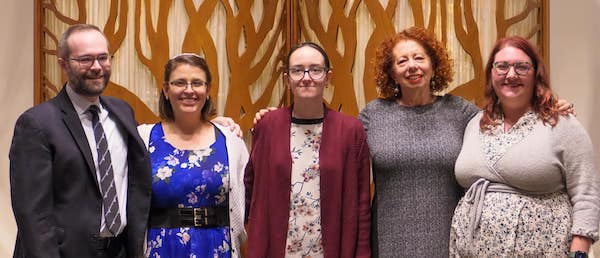
Left to right: Cantor Josh Breitzer, Cantor Shani Cohen, Rabbi Kylynn Cohen, Prof. Joyce Rosenzweig and Cantor Lianna Mendelson at Shani Cohen’s installation as cantor at Temple Sholom the weekend of Oct. 28-29. (photo from facebook.com/templesholom.ca)

Temple Sholom officially installed Cantor Shani Cohen, the first ordained cantor to serve the congregation, on the Oct. 28-29 Shabbat weekend, with services and music throughout to mark the occasion.

Always passionate about music and Judaism, Cohen found a path that combined her interests – and talents – while studying for a master’s of music in vocal performance and pedagogy at the University of Houston in the mid-2010s. There, she started working for Congregation Shma Koleinu.

“Rabbi Scott Hausman-Weiss saw something in me, and invited me to lead High Holy Day services with him. He knew that I would become a cantor before I did. Once I started leading services, I looked into becoming a cantor and what that would mean,” Cohen told the Independent. “What I discovered was that being a Reform cantor encompasses so many different skills: you get to lead the congregation in prayer, teach b’nai mitzvah, introduce new music, and lead lifecycles for the community.”

photo - Cantor Shani Cohen
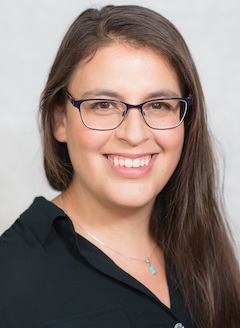
Cantor Shani Cohen (photo from Shani Cohen)

Following her studies in Houston, Cohen enrolled at Hebrew Union College and embarked on a five-year cantorial program, which comprised a first year of study in Jerusalem, followed by four years in New York. “I got to work with the most incredible, groundbreaking cantors and rabbis of our generation, and enter into a diverse community of Jewish clergy around the world,” she said. “The training for cantors centres on Jewish music and liturgy, but many of our courses are in conjunction with the rabbinic students, including pastoral care, Bible, Jewish history and philosophy, and lifecycles.”

As a student, she presented recitals every year on different topics, such as Shabbat, High Holy Days, and Jewish composers. In her final year, she wrote a thesis and presented a recital on the same topic – her research delved into the collaboration between rabbis and cantors, looking into the history of these roles and the way clergy teams function in Reform congregations today.

Cohen was influenced by the cantors of the early to mid-20th century, which is often referred to as the cantorial “golden age.” These cantors included such names as Yossele Rosenblatt, Moshe Koussevitzky, Leibele Waldman and Moishe Oysher.

“I love how they brought their full voices to every piece, whether they were leading services or performing on the concert stage. I am also greatly inspired by the incredible teachers that I had at the Hebrew Union College Debbie Friedman School of Sacred Music (DFSSM), including Chazzan Israel Goldstein, z”l, who I got to work with as my coach my second year.”

Two of Cohen’s mentors, Prof. Joyce Rosenzweig and Cantor Josh Breitzer, were in attendance at her October installation, offering both words and music. Cohen worked with Breitzer as an intern at Congregation Beth Elohim in Brooklyn, where she got “to see firsthand his ability to weave together traditional and contemporary musical styles in an authentic, cantorial way.”

She said, “I too strive to bring the breadth and depth of Jewish music into my cantorial work, showing our community that both new and old music has a place in our synagogues. I think this is what cantors are called to do in order for us to keep this art form alive.”

Cohen delights in both the variety of her job and its interpersonal nature, noting that no two days are alike. “I could go from teaching students and leading prayer with our religious school one day, to officiating a wedding or going to visit one of our home-bound congregants the next,” she said. “Each facet of my work feels meaningful, especially being there for people when they are feeling vulnerable: when someone loses a loved one, gets bad news, or even the excitement and anxiety of preparing for their child’s b’nai mitzvah.”

A native of the Bay Area, Cohen attended the University of Puget Sound in Tacoma, Wash., where she studied music and psychology. “I love being close to the water and, when the sun comes out, you appreciate it so much more because so much of the year is dark and rainy,” she said. “It was definitely a big contrast from where I grew up, but I felt a strong connection to this part of the continent when I was an undergraduate student, and am so grateful to be able to live here now.”

Cohen and her wife Rabbi Kylynn Cohen moved here with their black Lab mix, Trouble.

“The addition of Cantor Cohen to Temple Sholom’s clergy team is a milestone for our growing congregation, having grown from 600 households in 2013 to nearly 950 households just nine years later,” said Rabbi Dan Moskovitz, senior rabbi at Temple Sholom. “Cantor Cohen adds a depth of pastoral skills and Jewish knowledge to her outstanding musical and cantorial abilities.

“She stands upon the shoulders of lay cantorial soloists Arthur Guttman and Naomi Taussig, who together set the tone and tenor for generations of Vancouver Jewish families,” he said.

“It is an honour and a privilege to be part of the Temple Sholom clergy team,” said Cohen, who brings the team to three, joining Moskovitz and Rabbi Carey Brown. “And I am grateful to get to do this work every day.”

Sam Margolis has written for the Globe and Mail, the National Post, UPI and MSNBC.

Racism talk versus action

When George Floyd was murdered by a Minneapolis police officer in 2020, it reawakened awareness about police violence and institutional racism in the United States and beyond. Nearly three years later, many of the anti-racist pledges made during that time remain unfulfilled.

“Do you know that most of those commitments have not been met and there is no accountability for not doing this?” said June Francis, special advisor to the president of Simon Fraser University on anti-racism, director of the Institute for Diaspora Research and Engagement, co-founder of the Black Caucus at SFU and an associate professor in the Beedie School of Business. “Companies said they were going to do X,Y and Z, research shows they’re not doing it. Accountability is everything. If we don’t see change and there are no repercussions … then we get tired, society goes back.”

Francis was speaking Nov. 3 at an event titled From Talk to Action: Challenging Racism in Canada Today. The panel discussion, at Robson Square, was presented by the Simces & Rabkin Family Dialogue on Human Rights in partnership with the Canadian Museum for Human Rights and Equitas, an international human rights education organization.

Francis aimed a particularly sharp critique at academic institutions.

“When students arrive at a university, they are being groomed to become racist people,” she said. “I say this honestly because what they are taught is any ideas worth knowing emanate out of white supremacists. White ideas are the enlightened [ones], the primitive becomes us, our art is considered primitive, our work is always denigrated. It’s only recently that Indigenous knowledge has become a thing, only because we’ve totally destroyed the planet and now we’ve suddenly awakened and, even then, we have a certain category of it as being nonscientific. Universities are founded on these ideas that are meant to create this idea that some people are superior to others and we perpetuate this every day. Then we go on to only fund research that does that. We go on to promote people who do that research. We go on to insist that our students who dare to challenge the system don’t graduate unless they do what we tell them to do.”

Annecia Thomas, who joined Francis on the panel, was mobilized to action in the aftermath of Floyd’s murder, as well as when students at her Kamloops high school made light of the murder in an online post. She was afraid to speak up, she said.

“But, I think, through this fear I gained another fear – that was not speaking up,” she said. “Without speaking up, it would just continue.”

Also on the panel was Daniel Panneton, director of allyship and community engagement at the Friends of Simon Wiesenthal Centre for Holocaust Studies. He addressed online hate and how it can transmute into real-world violence, citing the case of Dylan Roof, the South Carolina man who was radicalized online and, in 2015, murdered nine people in an African-American church.

Concerns about free speech rights, which are sometimes invoked to defend racist, misogynistic or otherwise bullying behaviours online are specious, he argued. These actions effectively deter members of historically marginalized communities from running for public office and participating in the public sphere, he said.

“The tolerance of hate and threatening speech in our society threatens the free-speech rights of vulnerable communities,” said Panneton.

The panel was moderated by Niigaan Sinclair, an Anishinaabe man who is head of the department of Indigenous studies at the University of Manitoba and is a frequent commentator in national media.

“I grew up as a refugee, but I didn’t know it,” he said, referring to Canadian governments who forced his ancestors off their lands. “In every other country of the world, that would be called ethnic cleansing, but in Canada they call it progress.”

He said the ultimate goal of racism is to erase its own history.

“The outcome of violence is always silence, not to talk about it, to make sure that it happens in perpetuity and that it’s somehow legal and justified,” said Sinclair.

Zena Simces and Dr. Simon Rabkin, who launched the annual series four years ago, spoke of their motivations.

“We established the dialogue on human rights because we saw a void in Vancouver with respect to a dedicated program on human rights for everyone in the community, for all groups,” said Simces, a consultant in health, social policy and education and a former leader in the now-defunct Canadian Jewish Congress.

“To combat racism, we first need to understand it, think about the background and understand the history,” said Rabkin, a professor at the University of British Columbia medical school who has provided health care to underserviced areas in northern Canada and in Kenya. “Talk and reflection is not enough, it won’t move us forward. We need a vision of the future in order to provide a guidepost and a goal to aim towards.”

Fresh new start to year

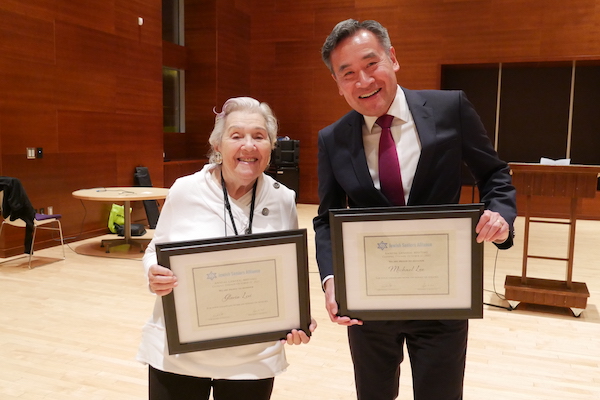
Gloria Levi and Michael Lee were honoured by Jewish Seniors Alliance for their contributions to the well-being of seniors in the community, as was Dolores Luber. (photo from JSA)

When you looked around the room at Congregation Beth Israel on Nov. 27, the pandemic of the last two-plus years would not have crossed your mind. The room was filled with more than 100 happy guests enjoying dinner together.

The occasion was the 15th annual general meeting and gala for Jewish Seniors Alliance of Greater Vancouver. Three people were honoured for their contributions to the well-being of seniors in the community: Dolores Luber, Gloria Levi and Member of the Legislative Assembly Michael Lee.

After welcoming the guests, emcee Rabbi Philip Bregman called upon Beth Israel Rabbi Jonathan Infeld to recite the Hamotzi. JSA board member Tony DuMoulin read an inspiring message from Serge Haber, the founder and visionary of JSA.

photo - Dolores Luber was awarded the first JSA Star. She received a collage made up of covers from Senior Line, a magazine she has edited for 10 years
Dolores Luber was awarded the first JSA Star. She received a collage made up of covers from Senior Line, a magazine she has edited for 10 years. (photo from JSA)

Then, Ken Levitt introduced Luber, the editor of Senior Line magazine. She is the first winner of the JSA Star for her commitment to enriching the lives of seniors through articles, book reviews, film reviews and news. Luber, who has served as the editor of the magazine for 10 years, emphasized the free hand she enjoyed in choosing the topics of the articles, artists’ profiles and other material for the magazine. Her goal was to enlarge the scope of the publication, so that it included people from many cultures and ethnic backgrounds. She was awarded a collage of select covers of Senior Line, with her and her dog, Kesem, in the centre of all the covers, which reflect JSA’s culture of diversity and support.

Levi was introduced by her friend Jane Heyman, who spoke about Levi’s fascination with seniors at the young age of 30, when she worked with the Golden Age Club. Levi went on to develop provincial programs for seniors. She is also the author of six books, most recently the creative memoir The Hotel Keeper’s Daughter, which was published this year.

Levi thanked JSA for the honour, as she received a standing ovation. She spoke lovingly about Haber, who would never take “no” for an answer.

Lee was introduced by Grace Hann, a trainer for the JSA peer support program. He was honoured for his ongoing work with seniors. Elected MLA for Vancouver-Langara in 2017 and 2020, he, along with Andrea Krombein, has launched the South Vancouver Seniors Network. This network has sponsored more than 100 webinars connecting seniors with various topics of interest and with one another.

Lee met Haber and Levitt in 2016. He was impressed with Haber’s passion and commitment and recognized the JSA as a leader in the development of seniors organizations in Vancouver.

Tamara Frankel, co-chair of the event, presented Gyda Chud and, in absentia, Larry Shapiro, with a gift in appreciation of their leadership as co-presidents of JSA over the last three years. A short video by incoming president Tammi Belfer, who spoke from Israel, was screened.

Following the dinner by Nava Catering, the winner of the 50/50 raffle was announced by Frankel – who was shocked to see that she was the winner. Frankel donated her winnings to JSA; the raffle raised more than $1,000.

Tamara Frankel is a member of the board of Jewish Seniors Alliance and Shanie Levin is a JSA Life Governor. Both Frankel and Levin are on the editorial committee of Senior Line magazine.

Which path to choose?

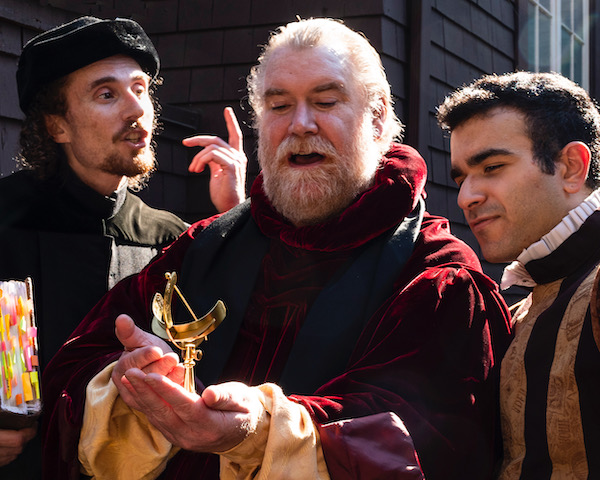
Left to right: Misha Kobiliansky (Luther), Matthew Bissett (Faustus) and Dylan Nouri (Hamlet) in United Players’ production of Wittenberg, which is at Jericho Arts Centre Nov. 11-Dec. 4. (photo by Nancy Caldwell)

The play Wittenberg tackles heady subjects – skepticism or faith? Divine plan or free will? – with fast-paced high- and low-brow humour, mixing the serious and the silly, an actual historical figure with characters from literature.

United Players brings David Davalos’s comedy to Jericho Arts Centre Nov. 11-Dec. 4. Directed by Jewish community member Adam Henderson, it also stars community member Misha Kobiliansky – as Martin Luther.

The play, described as a prequel to both Hamlet and Doctor Faustus, is set in the year 1517. Luther (whose writings would spark the Protestant Reformation but who also would become viciously antisemitic) teaches theology at the University of Wittenberg. His colleague is philosophy professor John Faustus (who has yet to make his deal with the devil for knowledge and pleasure, as he does in Christopher Marlowe’s Doctor Faustus). They debate each other and attempt to sway the views of one of their students, Hamlet (the indecisive Prince of Denmark penned by Shakespeare).

Hamlet has returned to school, in crisis after having studied Copernicus’s radical new theory of the universe, that the earth revolves around the sun. Meanwhile, as the play description explains, Faustus “has decided to make an honest woman of Helen, once ‘of Troy,’ aka ‘the Eternal Feminine,’ but she prefers her freedom” and Luther “is outraged at the abusive practices of the church to which he has sworn obedience.” In a college tennis tournament, Laertes (another character taken from Shakespeare’s Hamlet) competes against Hamlet for the championship title.

Wittenberg is Kobiliansky’s debut with United Players, but he is a veteran actor. When asked how he got into acting, he said, “That’s a nice story I like to tell. Back in the day, my mother worked as a piano player for the Moscow Art Theatre and she used to take me backstage with her when I was little. I remember watching a few plays from behind the scenes and watching actors go on and off stage – the atmosphere there was incredible! I was ‘scarred’ for life.

“A few years after, our family moved to Israel and somehow acting studies never came up, until I was in my early 20s. There were a few of us, theatre enthusiasts with no acting experience, and this very seasoned director who recently came to Israel from Ukraine. He wanted to find a young group of people and do some theatre together. He worked us through a pretty rigorous acting course for about a year and then we actually staged a few plays. Those were great times.”

Prior to winning the role of Luther, Kobiliansky was only minimally familiar with the historical figure on which his character is based.

“All I knew was that he led the Reformation and that the Lutheran Church is named after him,” said Kobiliansky.

While Luther’s antisemitism is a matter of historical record, with catastrophic consequences, of his concepts that a non-Christian might be sympathetic to, the actor said, “Well, Martin Luther’s relationship with God and his struggles with faith can apply pretty much to any religion, I think…. His anti-indulgence protest could be compared to any anti-corruption movement anywhere in the world, where those in power take advantage of their position for personal benefit, by pushing an ideological concept to an extreme.”

Limiting his comments to the character of Luther, as depicted in 1517, Kobiliansky said, “The thing I probably love the most about Martin Luther’s stance in this play – he stands for filling life with purpose as opposed to freedom and progress (represented by Faustus). Progress is a nice concept, but progress for a progress’s sake gets you nowhere.”

Wittenberg also stars Matthew Bissett (Faustus), Dylan Nouri (Hamlet), Deborah Vieyra (the Eternal Feminine) and Jake Anthony (Laertes). Running Nov. 11-Dec. 4, performances take place Thursday through Saturday, 8 p.m., and Sundays, 2 p.m., with talk backs Nov. 17 and 20. Tickets ($30, $26 seniors, $15 students) are available at unitedplayers.com or 604-224-8007, ext. 2.

New play honours Sugihara

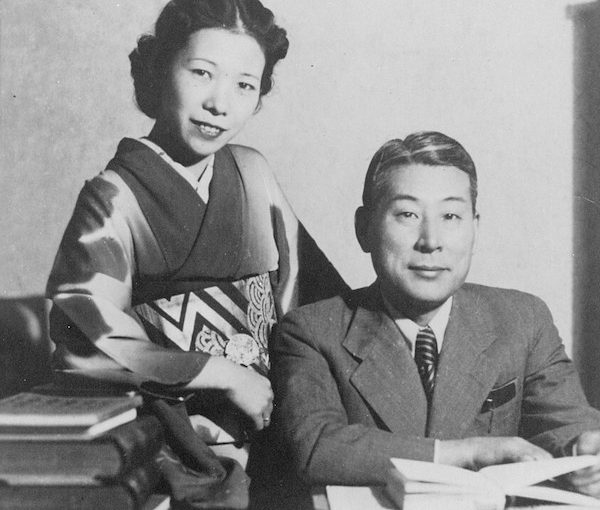
Yukiko and Chiune Sugihara (photo from Firehall Arts Centre)

It is written in the Mishnah that, “If you save the life of one person, it is as if you save the entire world.” Chiune Sugihara saved 6,000 Jewish lives – 6,000 worlds – in the summer of 1940, despite the dangers of doing so to himself and his family.

A new play about Sugihara sees its world première at the Firehall Arts Centre this month. Written by Japanese-Canadian actor and playwright Manami Hara, Courage Now opens Nov. 19.

Contrary to his government’s strict instructions to not issue visas to Jewish refugees, Sugihara, the Japanese consul in Kaunas (Kovno), Lithuania, handwrote in a 30-day period more than 2,300 visas for Jews trying to escape from Europe via the Soviet Union to Japan. Sugihara was a husband, a father, a career diplomat, a linguist, but, above all, with his strict Samurai upbringing, he believed in respect for, and sanctity of, human life. As he said, “They were human beings and they needed help.”

Sugihara’s actions are responsible for more than 40,000 Jews being alive today. Yet, after the war, the Japanese government dismissed him from diplomatic service and treated him as a persona non grata. However, Israel has honoured his courage and his memory on three occasions – in 1985, by recognizing him as one of the Righteous Among the Nations at Yad Vashem; in 2016, by naming a street in Netanya after him; and, in October 2021, by dedicating Sugihara Square in Jerusalem.

In an interview with the Independent, playwright and actor Hara talked about the journey that led her to write Courage Now.

“About 12 years ago, my mentor from Studio 58, Jane Heyman, approached me and asked if I knew about Sugihara and I said that I did not. She told me his story, that her parents and uncle had been saved by him and that she would not be here if not for his actions. We talked about collaborating on a play. Her story and my being Japanese made it very personal for me, as I was very embarrassed by how the Japanese government treated him after 1945.”

Getting a play from conception to the stage is a long process.

“I heard that a Japanese playwright, Hiraishi Koichi, had written about Sugihara. I got a hold of his play, translated it into English and worked with Jane on it but it just did not seem dramatic enough,” said Hara. “I talked to Koichi and asked if I could adapt the play and he gave me permission. So, I researched the Jewish families who were Sugihara survivors and created more scenes. But it still did not seem to have the theatrical weight it needed to be a success so I put it away for a couple years, as I felt I had lost my vision.

“About five years ago, I traveled to Japan and had a chance to speak to Sugihara’s daughter-in-law and two of his grandchildren, which gave me a firsthand intimate look into his life and that of Yukiko, his wife. Then it dawned on me that the way to tell the story was from two female points of view, that of Yukiko and of a child survivor, Margaret. So, I went back to the story and after many years of writing drafts and workshopping, here we are.”

There are five characters in the play: Sugihara, Yukiko, a young Margaret, an adult Margaret (Jewish community member Advah Soudak) and young Margaret’s father (community member Amitai Marmorstein). Margaret is a fictional character, created from the stories of many survivors. Scenes are set up to move between the Lithuanian summer of 1940 and mid-1980s Vancouver, where an adult Margaret now lives.

Hara does double duty in this production, as the playwright and performing as Yukiko. “It is difficult to switch, wearing both hats, you feel like you have a split personality,” she acknowledged. “However, I take off my playwright hat and then I concentrate on my character in terms of what are her needs, where should I be focused and what is happening with the other characters. So, when I am on stage, I am the actor and I let the director take over from there. If he or the other actors see anything that needs tweaking or fixing, they will let me know. It is a very collaborative process. We are three weeks from opening and still finalizing many of the details.”

Hara sees her character as a spirited, stubborn, strong woman, not as stereotypically subservient, but rather as someone who also was idealistic and who was supportive of her husband in all that he did. “She knew the risk to her family and the sacrifice that would have to be made in carrying out her husband’s plan to save the Jewish refugees,” said Hara. “It is an amazing role and I am so honoured to be able to bring this story to Vancouver audiences. I hope the audience takes away that there is always hope, that there is always a way to find courage to walk towards that hope and one should never give up.”

Director Amiel Gladstone got involved in the project, having worked with Hara before.

“She was looking for the right kind of collaborative director for the show and she reached out to me because I work so much with new plays,” said Gladstone in a telephone interview with the Independent. “She told me that she had been hoping for a Jewish director…. I told her that my father was Jewish.”

As to the play, he said, “It is a memory play dealing with two women trying to piece together what happened to them years ago during those dark times. We had to create a space that includes both 1940 and present-day locations: a Japanese home and garden, a Jewish refugee apartment, the Kaunas consul office, a park, the train station, with all the locations in view at the same time. It becomes a dream world, where the actors move from set to set as they go back and forth in time. Itai Erdal’s lighting design will inform the audience as to the change in time and place.” (Erdal is also a member of the Jewish community.)

Soudack’s character, in her 50s, is going through a difficult separation and divorce. In an interview with the Independent, Soudack explained, “She realizes that she has a big hole in life, as she does not know what happened to her parents. She travels to Japan to seek out Sugihara and to ask about her father but learns that Sugihara is dead (he died in 1986) so she looks to Yukiko for answers. At the same time, Yukiko is also going back and remembering that time through her interaction with Margaret.”

Soudack had to grapple with capturing the essence of Margaret’s psychological issues, including post-traumatic stress disorder.

“She has broken pieces of memory that she wants to fit together. She has had a difficult life,” said Soudack. “It must have been terrifying to be leaving your family, everything you know and being put on a train and sent off on your own. She has a lot of anger, sadness and abandonment and betrayal issues. She does not form close loving relationships very easily, as she learned that people closest to her disappear. She has to work through all this as she seeks the truth.”

Working with Hara has been a treat, said Soudack. “It is fabulous with the playwright right there so, when a question comes up, she can give us the explanation. It is a beautiful sense of collaboration, respect, joy and appreciation of what she wrote and it is a gift to be right there with her working through this project.”

As to being a Jewish actor in this role, she said, “As a Jewish person, you grow up with the Holocaust and the plight of the Jews – it is so part of our DNA that, when you come across a story and people that you never heard of, it makes you have such gratitude and respect for these non-Jewish heroes who, in the face of so much antisemitism, still found the courage to do the right thing. If I could meet Mr. Sugihara, I would hug him, look him in his eyes and thank him for his bravery and courage.”

Courage Now runs to Dec. 4. For tickets, visit firehallartscentre.ca or call the box office, 604-689-0926.

Tova Kornfeld is a Vancouver freelance writer and lawyer.

A crush leads to new career

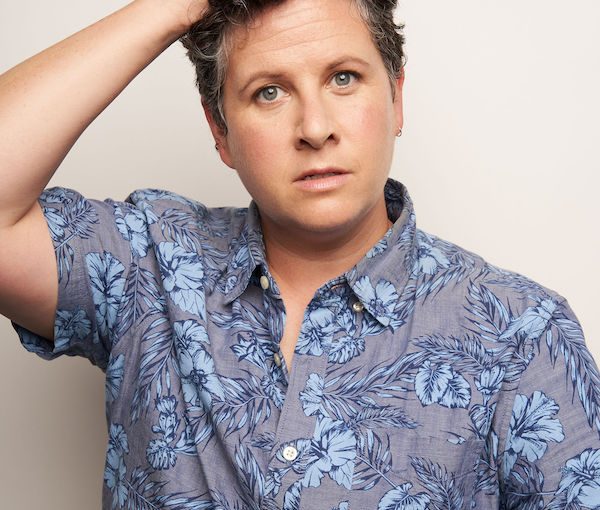
Liz Glazer headlines the Nov. 24 Chutzpah! event Celebrating Queer Jewish Comedy. (photo from Chutzpah!)

Lawyer-turned-comedian Liz Glazer shares the Rothstein Theatre stage Nov. 24 with the Holy Sisters, Israeli drag queens Ziona Patriot and Talula Bonet, in the Chutzpah! Festival event Celebrating Queer Jewish Comedy. The evening is hosted by multidisciplinary artist and performer Yenta, whose alter ego is Stuart B. Meyers.

Based in New Jersey, Glazer is an award-winning comedian. Before taking to the stage as a career – and engaging in other creative endeavours, including acting and writing – she was a tenured law professor.

Of comedy, Glazer said, “I never intended to get into it. I had a crush on a woman who asked if I ever thought of doing comedy (no) and said she would put me on her show (to which I initially also said no, then realized she would probably be at her own show, so I said yes). I loved it so much from that first performance, and I think what I loved about it wasn’t even the laughs or attention or even that this woman I had a crush on was in the audience, though all of those things were nice, but that all I had to be to do it was me.

“I enjoyed teaching law, but there was always something about it where I had to fit what I wanted to say or write about into a framework of legal analysis. I had to have the topic of whatever I was saying or writing be the law, not just my own life, because there would eventually be something like a bar exam. When I did comedy, all I needed to talk about was myself. Though I should note: after all of my shows there are exams, so audience members should be prepared for that.”

Glazer’s first comedy performance was on March 5, 2013. She admitted to having been “a wreck.”

“I wrote stuff to say,” said Glazer, “but had the thankfully correct instinct that it wouldn’t connect with the audience or be funny or good, so I called a friend with experience performing comedy and she told me to just say something vulnerable to the audience at the beginning of my set.”

Thinking she got the message, she hung up before realizing she didn’t know how to be vulnerable.

“They don’t teach you how to do that in law school,” she said. “So, I paced around a bunch trying to think of something vulnerable to say, couldn’t really think of anything, then headed to my front door to leave for the show…. I see a package at my front door, and I hadn’t ordered anything.”

With time to spare before the show, Glazer brought the package inside. As she was about to open it, she said, “I realize[d] a trick to being vulnerable is not knowing the answer to something, and I didn’t know what was in the package, so perhaps the vulnerable thing I could do to start my set would be to open the package on stage. So I did.

“Turns out the package was from my mom, who had visited my apartment a couple weeks before and noticed that my white fluffy cat Mona – who would climb to the top of my closet – was shedding her white fluffy fur on my dark suits I would wear to teach class, making me look like a white fluffy law professor. My mom said I should buy vinyl suit covers … [but] knowing I wouldn’t, she ordered me three packs of six of them and sent them to me without my knowledge. So, my first set ever began with my opening this package on stage and explaining to the audience my relationship with my mother and my cat Mona, and how I’m a law professor who teaches class with white fluff all over my suits. And it worked! I think because, even though I had no idea how to do comedy, I couldn’t not be myself because I was genuinely reacting to what was in that package in the moment I opened it for the first time along with the audience. And/or because, as a rule, vinyl suit covers are very funny.”

Glazer no longer relies mainly on improvisation, but it still is an important part of her act.

“I do write a lot of jokes,” she said, “and much of my shows consist of prepared material but also improvising is everything, to quote the great Joan Rivers (in a very short interview I saw somewhere and am not sure where). Live comedy, whether it’s written down ahead of time or not is, by nature, dependent on interaction and connection with the audience which is, by nature, improvisational. So, to prepare for a show, I make sure I know what I want to say – sometimes a set of things and, more often, one big idea I want to get across – and I annoy my wife for a few hours repeating it aloud while she tries on clothes and asks me if I like them. And I try to meditate before [a show] because the key ingredient for me is clearing my focus so I can be present with the audience in the moment. That’s really the stuff. Connection and clarity.”

Glazer is married to Rabbi Karen Glazer Perolman, a spiritual leader at Congregation B’nai Jeshurun in Short Hills, N.J.

“I was raised going to Orthodox Jewish day school, a Conservative synagogue, and I’m now married to a Reform rabbi, so I think that makes me Chassidic,” Glazer joked. “I do talk about being Jewish in my comedy, and I do comedy for Jewish organizations and synagogues frequently. I talk about being married to a rabbi and, when I do comedy for Jewish audiences, I talk more extensively about my upbringing and how I learned in school all of these rules about what not to do, then lived in a house where we ate pepperoni pizza on trayf silverware on Shabbos.

“At an even deeper level,” she said, “my lineage consists of four out of four grandparents who survived the Holocaust. Not to brag, but it’s true. And I think of them constantly when I do comedy, especially when it’s explicitly about being Jewish and especially now as antisemitism is on the rise, unfortunately. There’s always a fearful part of me that wonders how much to talk about being Jewish in situations where there might be antisemitic people in the audience or if I post a video that may spark antisemitic comments, but I think of my grandparents in those moments, too. I think, if they survived for me to not be loudly Jewish, what was the point?”

Glazer doesn’t shy away from who she is or what challenging circumstances she has faced.

“I’m recording an album soon called Still Born Sorry, about grief and trauma and stillbirth (and it’s funny!) that will be an audio album available wherever you get your music and such, and also part of a documentary film about how I was supposed to record an album and have a baby last year, and neither of those came to fruition when I thought they would. That prior album was supposed to be called Born Sorry, and was postponed due to a stillbirth, so this one (the album and the documentary) will be called Still Born Sorry, which may be the best pun I definitely did not intend.”

In addition to the Nov. 24 performance at Chutzpah!, Glazer will be leading a two-hour workshop on the afternoon of Nov. 25. Participants will explore their “personal experiences, opinions and overbearing family members to find funny material to bring to the stage,” as well as setting up a “punchline joke structure and what it means to find a comedic voice.”

For anyone a little nervous about trying to seek out that voice, Glazer said, “I adore nervous people, so I really encourage especially those who are, to come to the workshop.”

Glazer encouraged readers to check out her website, dearlizglazer.com, and send her “a nice email! I would love to hear from you!”

For tickets to Glazer’s workshop and any Chutzpah! performance, visit chutzpahfestival.com.