Skip to content
  • Home
  • Subscribe / donate
  • Events calendar
  • Business Directory
  • FAQ
  • News
    • Local
    • National
    • Israel
    • World
    • עניין בחדשות
      A roundup of news in Canada and further afield, in Hebrew.
  • Opinion
    • From the JI
    • Op-Ed
  • Arts & Culture
    • Performing Arts
    • Music
    • Books
    • Visual Arts
    • TV & Film
  • Life
    • Celebrating the Holidays
    • Travel
    • The Daily Snooze
      Cartoons by Jacob Samuel
    • Mystery Photo
      Help the JI and JMABC fill in the gaps in our archives.
  • Community Links
    • Organizations, Etc.
    • Other News Sources & Blogs
  • JI Chai Celebration
  • JI@88! video

Recent Posts

  • Or Shalom reopens its doors
  • JFS from past to future
  • Need holistic approach
  • Sharing stories, advice
  • Journalist shares fears
  • Skills to live together
  • Road to independence
  • Cutting grass with scissors
  • Zionism as a solution
  • Deceit, desire & the divine
  • Reclaiming sacredness
  • Creative project ideas
  • Summer squares and cobbler
  • Thou shalt … summer commandments
  • Legal help for students
  • Revisiting myth of Lilith
  • Wrong person rebuked
  • Canada’s mixed messages
  • Questions for museum
  • Symposium on antizionism
  • Making soccer political
  • CJPAC lauds Pulver’s impact
  • City recognizes Vrba’s legacy  
  • Organ donation saves lives
  • Theodore’s March premiere
  • A healing Shabbaton
  • Supplying healthy food
  • A chime of metal tags
  • Yellowknife seder a first
  • Ishai energizes, unifies
  • A Lag b’Omer to remember
  • Expanding the healing
  • Hannah Senesh – a unique hero
  • Community milestones … May 2026
  • Деньги до зарплаты на карту Займ до зп онлайн за 5 минут 2026
  • Микрокредит онлайн в Казахстане Микрозайм в Акшамат

Archives

Follow @JewishIndie
image - The CJN - Visit Us Banner - 300x600 - 101625

Month: February 2020

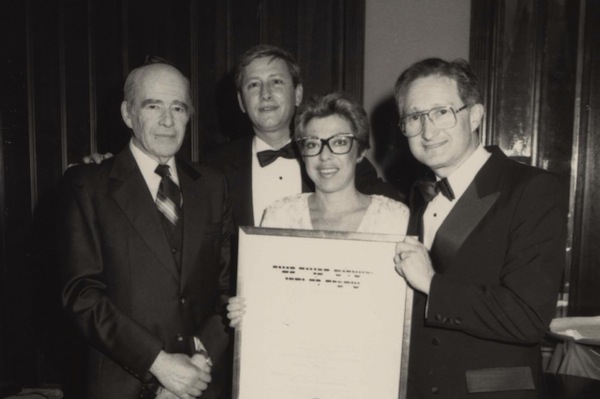
Mystery photo … Feb. 28/20

Mystery photo … Feb. 28/20

Two unidentified people on the left with Gail and Michael James on the right holding a certificate at a Jewish National Fund event. (photo from JWB fonds, JMABC L.12042)

If you know someone in these photos, please help the JI fill the gaps of its predecessor’s (the Jewish Western Bulletin’s) collection at the Jewish Museum and Archives of B.C. by contacting [email protected] or 604-257-5199. To find out who has been identified in the photos, visit jewishmuseum.ca/blog.

Format ImagePosted on February 28, 2020February 26, 2020Author JI and JMABCCategories Mystery PhotoTags history, Jewish museum, Jewish National Fund, JNF
Using apps and robots – coronavirus

Using apps and robots – coronavirus

One high-tech solution for patients possibly infected with the coronavirus is a robot that can enter the patient’s room and be controlled by medical staff from the outside. (photo from IMP)

Before the coronavirus arrived in Israel – there were two reported cases at press time – Sheba Medical Centre was preparing for it with different high-tech means: a telemedicine app that enables patients to receive care in the isolation, but comfort, of their own home; and robots that can treat in-hospital patients in order to minimize contact with staff.

Sheba’s Datos Health-In is a telemedicine app that enables patients to remain at home. In the event of an epidemic, with more patients than isolation rooms available, the app can be a viable tool for patients who are not severely ill. With the app, patients can enter vital signs and other information, which is directly accessed by their doctor. Patients can also establish contact with their physicians at any time of day or night.

The program was launched on Feb. 9 and tested on Israelis who had been in China and who, according to Health Ministry instructions, had to be in quarantine for 14 days, the incubation period of the virus. Doctors initialized contact with the patients twice a day.

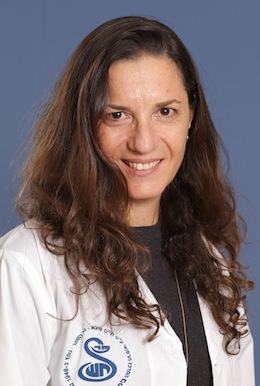
photo - Sheba Medical Centre’s Dr. Galia Barkai
Sheba Medical Centre’s Dr. Galia Barkai (photo from IMP)

“This is one instance where telemedicine protects staff as well as other patients, by minimizing direct contact with those infected with the coronavirus,” explained Dr. Galia Barkai, head of telemedicine services at Sheba.

Another high-tech solution for patients possibly infected with the coronavirus is a robot that can enter the patient’s room and be controlled by medical staff from the outside. Designed by California-based virtual healthcare company Intouch Health, the robots are already in use in other departments, such as in the intensive care unit of pediatric cardiology, and the trauma unit.

“This technology is the perfect solution to provide care for in-patients infected with coronavirus, while protecting staff from contagion,” said Barkai.

Screening for the virus produces results in just a few hours but, with symptoms that are not very dramatic and that are reminiscent of the flu, including fever, cough and shortness of breath, Israel’s Health Ministry is only allowing those who have returned from China and a few other countries in the Far East to be tested.

– Courtesy International Marketing and Promotion (IMP)

Format ImagePosted on February 28, 2020February 26, 2020Author Ben Horodenker IMPCategories WorldTags coronavirus, Galia Barkai, health care, Israel, Sheba Medical Centre, technology
Treating children’s asthma

Treating children’s asthma

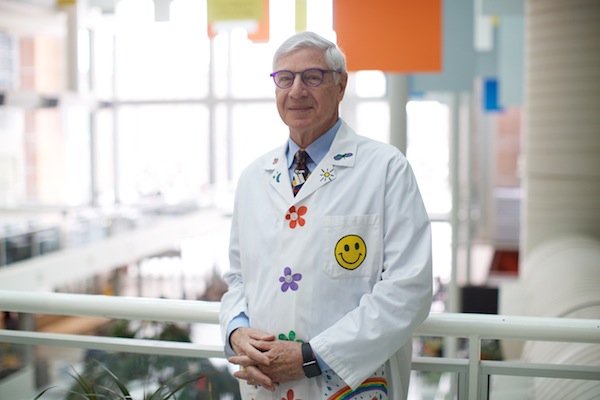
Dr. Allan Becker has devoted much of his life’s work to the study of asthma and how it affects children who have it. (photo from Allan Becker)

As Jewish community member Dr. Allan Becker was starting his career as a general practitioner, his daughter was diagnosed with asthma. As a result, he has devoted much of his life’s work to the study of the condition.

“My interest really started when my oldest daughter began having a wheezing episode at about two years of age,” Becker told the Independent. “It was pretty obvious that this was an infection – something we call bronchiolitis, which is fairly common in young children.”

Becker was working in Dauphin, Man., at the time of his daughter’s diagnosis, in the 1970s, and was beginning to see more and more kids with asthma coming into the emergency room.

“Since 1980, when I returned to academics, I’ve been trying to understand why the epidemic started – what the developmental origins of asthma and allergies are,” said Becker, who is now based in Winnipeg. “And, really, they’re the canary in the coal mine when you think about the increase in chronic diseases.

“Asthma is by far the most common chronic disease in children and it’s the earliest to start,” he said, “but we’re seeing parallel increases of other chronic diseases, like diabetes, inflammatory bowel diseases, various forms of arthritis, and others.”

Over the course of a five-decade career, so far, Becker has seen chronic diseases become more prominent. And, while the reasons for this change remain elusive, it seems clear that it involves genes and the environment.

In the early 1990s, Becker and Vancouver-based Dr. Moira Chan-Yeung embarked on a study of ways to potentially prevent the development of asthma.

“Think about the environment in terms of things we breathe and eat … and things like pets in the home, like tobacco smoke exposure, like pollution, like bad nutrition, Western-style diets, etc.,” said Becker. “We started a multifaceted prevention of asthma program in 1994.”

While that study did not reap substantial results, it did eventually lead to a current study examining the environmental impact on expectant mothers in all areas, including the benefits of decreasing stress, which Becker feels may be the most important factor.

Information about the study, called Canadian Healthy Infant Longitudinal Development (CHILD), can be found at childstudy.ca.

“CHILD started in 2008 and is an observation study, because we don’t believe we know enough to prevent the disease as yet,” said Becker. “We’re now seeing the children at 8 and 9 years of age, and we’re looking way more broadly at the environment. We’re looking at stress very specifically, both for parents and children.

“We’re looking much more in terms of diet, but also at the microbiota, the bacteria and other organisms that live in us, with us and on us, and which are likely extremely important – maybe critical – in helping to shape children’s immune responses in early life.”

According to Becker, there are more bacteria in our gut than there are cells in our body, and microbiota are now being considered as the cause of and potential cure for all sorts of illnesses.

One of the biggest hurdles is trying to determine if a young child who is wheezing has asthma and should be treated as such, or if the child has a respiratory infection that causes wheezing. Becker said part of the problem is how to more accurately define wheezing, which is described as a whistling noise coming from the chest.

“The key thing is that it’s not just the whistling noise in the chest,” said Becker. “It’s also that tugging in, particularly tugging in under the ribs, with the tummy pulling in when breathing. That’s a very good indication that those airways are narrowed and that the child has to work hard at moving air, particularly moving air both in and out. That’s what we teach our trainees to work on with the families they see.

“And, obviously, any time a child is distressed – if they’re looking distressed, particularly if there’s a change in colour of the lips – those are urgent issues. And, some children have such severe narrowing of the airways that you don’t hear wheezing, because they’re not moving enough air, but they will be struggling to breathe. You’ll see them pulling in their tummy and you’ll see their shoulders heaving,” he said. “And you’ll often see toddlers and older kids with their hands braced on their knees, hunched forward, trying to get air in. That type of tripoding is really a worrisome sign, as is a change in lip colour – that’s an emergency. Those children need to be brought to emergency quickly.”

If it gets to the point that the child is given inhalers, Becker pointed out that blue puffers are for particularly bad episodes, while orange or red puffers are for management.

For a bad episode, he said, two inhales from the blue puffer should be taken. “An inhalation and a bit of a pause, and then a second puff and inhalation … in many cases, that will be enough to help control things,” said Becker. “If it doesn’t help make things better, then, in five to10 minutes, it should be repeated. If the child is still distressed, that’s an indication they need to be brought to a hospital.”

The blue puffer should not be used for asthma management, he warned, as the body will develop resistance to it. So, if the controller medications are not providing enough control, he said parents should talk to the doctor who prescribed the puffer to determine a solution.

“If people are needing to use the blue puffer on an ongoing basis, even once or twice a week, week after week, that’s really telling you that you don’t have control of what’s going on and is very worrisome,” said Becker. “There should never be a death from asthma. But, sadly, every year there are some. And, these deaths are – rather surprisingly – not necessarily in kids with the most severe, persistent asthma; they’re in kids who are thought to have mild asthma. But, in fact, when you look at it, if you are using the blue puffer and need to get a new one every month or two, that’s a big red flag … needing to use the blue puffer in the middle of the night, that’s a big red flag. Nighttime symptoms are really a worry – those are kids who need to be seen and properly assessed and, in most cases, they need to be using controller medication.”

Becker is proud of having led the development of a national certification for asthma educators in Canada – Canada was the first country to provide this type of certification.

“We have a children’s allergy and asthma education centre in Winnipeg attached to our children’s hospital,” he said. “It’s one of the only real free-standing ones in North America. The website is asthma-education.com.”

Rebeca Kuropatwa is a Winnipeg freelance writer.

Format ImagePosted on February 28, 2020February 26, 2020Author Rebeca KuropatwaCategories NationalTags Allan Becker, asthma, children, education, health care, Winnipeg
Camp helps lift spirits

Camp helps lift spirits

A moment of levity during the taking of Justine and Stewart Silver’s wedding photos. (photo from Justin Silver)

The late Stewart Silver was born and raised in Montreal. He had worked as a standup comedian, and moved to Toronto in hopes of furthering his career. Justine Silver grew up in a Houston suburb. In late 1990, she followed her sister, who had moved to Toronto, and, there, she joined Jewish online dating site Jdate. So had Stewart.

“There was a thing where you had to describe your perfect date,” recalled Justine. “Profile after profile included long romantic dinners and were all gushy and gross … but his said, ‘Yeah, after we grab a drink, we step out of the restaurant and trip over a big bag of money.’ I was like, ‘Oh my gosh … that’s the perfect date!”

The couple took their time getting to know each other and, after a year and a half, got married.

To all appearances, Stewart was a healthy 44-year-old. He had biked up hills in Christie Pits Park the day before he had a fatal heart attack while the couple was having a conversation on Nov. 16, 2011.

Left shocked and widowed, Justine embarked on a healing path, including taking a hiatus from her event-planning business.

“It’s been quite some time since then and there’s been grief bursts,” said Silver. “In the early days, there was a lot of therapy and some peer support groups. Then, I found Camp Widow and have been to a few of those. I was pleased it wasn’t at all associated with any religion and was welcoming…. There was one in Tampa, and so a couple of widow friends that I had met up with, here, in Toronto, in a peer support group for young people who’d lost their spouses under the age of 55 … decided to make a whole trip of it. We went to the beach, museum, and then to Camp Widow. It’s a very transformational experience when you feel that you’re surrounded by people who understand the topsy-turvy world that you’re starting to barely understand yourself.”

The first camp Silver went to, in Tampa, was in the spring of 2018. Then, in November 2018 and November 2019, she attended the camps in Toronto. She and her friends have already signed up for the next November 2020 camp in Toronto.

While it’s called a “camp,” the weekend is more like a conference, with people coming together for sessions on various topics.

“One of the neat things I like at Camp Widow is that the name tags, everyone has one, but there are a couple features to it,” said Silver. “One of them, there’s a ribbon at the bottom. For example, in my work as an event planner, if you’re a presenter, your ribbon will say ‘presenter,’ or, if you’re on the organizing committee, it will say ‘organizing committee’ or ‘volunteer.’

“But, these [also] have the number of years ago that your loss occurred. So, for me, that was six years. So, let’s say it’s a teal ribbon. All of a sudden, you notice the six-year people … and there’s a bond, because you’re in a different place than, say, the six-month people. Everyone is compassionate to everyone else, but it’s just a really interesting way to bond with people.”

As far as the camp schedule, there are some group meals, as well as meals on your own. There are various types of sessions offered.

“There are tracks, like for people who are five years out, one year, or one to five,” said Silver. “I can’t remember the exact breakdown, but you can decide to go to everything along a certain track, or you can decide in the moment what you’ll do, which sessions you’ll go to. Then, there are some networking evening events, different ways of getting to know people.”

One is designed like speed-dating, but not for that purpose. You get the chance to talk to someone for a certain amount of time, and then you move on to the next person and chat with them. “It’s really interesting to see where the commonalities fall,” said Silver.

On Saturday night, there is a banquet with a theme and people dress up – some participants may not have gone out since their loss. After dinner, each person says the name of their loved one out loud, while some 200 others quietly listen. Then, there is a dance, which gives the opportunity to destress and socialize. The DJ doesn’t play any music that could potentially trigger anyone’s grief, like slow songs.

At the camp, there are people from their mid-20s to people in their 70s and 80s; people from all religions, cultures and political leanings.

For Silver, Camp Widow “creates community and support amongst widows and widowers…. Sometimes, when you’ve lost someone, it can be very isolating, which can be in different and unexpected ways. I wouldn’t say never, but it doesn’t go away. The intensity definitely lessens and you find new ways to live with grief. And there are plenty of people who, we say, are ‘re-partnered.’ When you’ve been widowed and then you meet someone else and you have a boyfriend/girlfriend, wife/husband or partner, we say you’re ‘re-partnered,’ because we don’t think that means you’re not still widowed.”

The camp provides tools and connections that widows and widowers may not otherwise find on their own.

“I feel camaraderie in sharing my story and being heard, or hearing someone else’s story and being helpful to them,” said Silver. “At this past Camp Widow, I did an art thing. I can do crafty things OK, but I’m not really an artist. But, one of the workshops I went to was all about healing through art and it was just a whole different facet. We all had paint and they set it up so well…. We had a white piece of paper and I got white paint and I painted a white heart. Then, I put a line through it – a squiggly line, like it was broken – and you could barely see it … like you couldn’t see that my husband had a heart problem…. Then, everyone shared in the room what theirs was about. When you do that, it’s like opening up a wound, and then the scar heals better next time.”

Six months ago – eight years into her healing journey – Silver and her older sister, Eileen Jadd, who is a social worker, started the charity Good Grief Bereavement Healing Services.

“We have a roster of counselors in different parts of Toronto for bereaved people,” said Silver. “We’re also offering workshops on eye movement desensitization, which is a thing for trauma victims. It really helps you compartmentalize the trauma, so you can talk about it without being retraumatized. So, we’re doing a workshop on that.

“We’re starting a group on sibling loss and, eventually, will have a physical building. We want to have a centre, so people who’ve lost someone, it’s like a snap of the fingers and they’ll know where to go. When you know there’s an accident, you know to dial 911. We want it to be, ‘Wow, you’re in need, you’ve lost someone, and you know exactly where to go.

“I think widows and widowers need their person’s name to be said. People are so afraid of saying it, because they don’t want to bring it up in fear. But, they want their names to be said, so that’s a big part of it. I happen to talk about Stewart all the time, but a lot of people don’t have those opportunities in their own lives.”

In addition to talking about him when memories arise, Silver said, “Every year, I go to shul and I say his name and a prayer for him, and commemorate it that way. I remind people that we got married in that synagogue, and I remind people that he was a person that existed and stood in that space with me, and that his influence is still there. Just because he’s not standing next to me in that moment … he’s still there. In those ways, we talk about him.”

Camp Widow is put on by Soaring Spirits International. For more information, visit soaringspirits.org, campwidow.org, widowedresilience.org and goodgriefhealing.ca.

Rebeca Kuropatwa is a Winnipeg freelance writer.

Format ImagePosted on February 28, 2020February 26, 2020Author Rebeca KuropatwaCategories NationalTags Camp Widow, death, grieving, health care, Justin Silver, lifestyle, mental health, widows
Teaching kids reading skills

Teaching kids reading skills

With Hoot Reading, kids and teachers can see and hear each other via video chat. (screenshot)

Hoot Reading allows kids to get in their desired screen time, while also improving their reading skills. Jewish community member Carly Shuler, co-founder and chief executive director of the online tutoring company, came up with the educational concept while working on Sesame Street.

“While I was there, I was working on a research project aimed at understanding how to help kids learn through video chat,” Shuler explained. “Fast forward a couple of years and my co-founder, Maya Kotecha, and I decided the idea was too good to stay in the lab. So, we got the rights, formed Hoot Reading, and here we are.

“Something a lot of parents don’t know is that there is a deadline for reading,” she said. “We talk a lot about the fourth-grade reading slump, which is this phenomenon that happens in Grade 4, when children need to make the leap from learning how to read to reading to learn.”

The school system is based on the assumption that, by Grade 4, kids will be reading fluently. While some kids are indeed fluent readers by then, some 60% of students are reading below grade level as they start Grade 5. And, from then on, the ability to read is needed for every single topic, from math to science to social studies to music and to health, not to mention for activities outside of school.

“What happens is that those kids, come Grade 4, that we thought were average students, fall behind,” said Shuler. “They lose confidence and they disengage from school. And so, while we don’t believe at Hoot Reading that earlier is better, we do believe that there is a deadline for becoming a fluent reader – and that deadline is Grade 4.

“Hoot Reading, in particular, is good for all kids from kindergarten through to Grade 4 and, then, also any kids who are struggling after that point,” she said. “So, we have kids up to Grade 10 reading with us. They are in that 60 percentile of kids who are reading below grade level.”

The tutoring is done online with classroom teachers, one-on-one, in 20-minute lessons, two to three times a week. The app is basically Facetime meets Kindle, said Shuler. Kids and teachers can see and hear each other via video chat, and both the teachers and the students can point to things and see where the other is pointing.

“It allows for that dialogic reading, but it’s the interactive back and forth that is so important as a child progresses as a reader,” said Shuler. “Kids can do it from the comfort of their own home, from their family car, from their sibling’s piano lesson, or wherever they are. It can really happen anywhere at any time, so parents find it very convenient.”

Weighing in on screens, Shuler said, “At Hoot Reading, we don’t believe all screens are created equal. As parents, we should be paying more attention to what our kids are doing on screens, rather than just focusing on how much time they are spending on them. There are some really great things they can do.

“We believe screens can sometimes have a real benefit to our children’s learning, such as by allowing us to offer an affordable way to do one-on-one reading tutoring. So many kids can get access to it, whereas they couldn’t before. So, we encourage parents to think about it that way.”

Further to this, Shuler encourages parents to be reading mentors and role models, showing their kids that they, too, are using their screens to read.

“It’s really important that our children know that we are reading, so that they can see that it can be a really fun part of their media world,” she said. “Whether we are reading on a Kindle or reading a hard copy book, we want to show them and do it in front of them … and talk about the books and stories at the dinner table, because it’s really important that kids see reading can be fun.”

Shuler feels strongly that parents should help their kids choose apps and games that encourage reading. The ability to comprehend what you are reading and to be able to follow instructions is an important skill. While enjoying some games that do not involve reading is OK, she recommended finding games that do provide a different medium for kids to further their love of reading.

Just like any other skill, the more you practise, the better you get at it and Shuler maintains that kids should read aloud with a grown-up for at least 10 minutes a day, five days a week.

“In the same way that, when learning to play basketball, some kids might be a little better at it than others, but the best way to improve anything is through practise,” she said. “We have to practise and we have to practise out loud, with a grown-up there. Whether that grown-up is a parent, a Hoot Reading teacher, or someone else, kids need to be practising – and that’s not what’s happening in so many households. We’re so busy nowadays, between after-school activities and all the amazing things our kids get to do. But, reading cannot fall onto the backburner, because, if kids don’t practise, they’ll probably end up in that 60% by Grade 4.”

Shuler said kids need to have what they learn in school reinforced at home and, therefore, increasing public awareness is critical.

“A lot of parents don’t know – they just think about reading in terms of literacy or illiteracy so, once their child can read, they think, ‘Great! My child can read. We’ve got this!’ But, the truth is, again, reading is a skill, and you get better at it the more you read. That’s where most parents don’t know how important it is to continue the reading out loud, even if their child is reading.”

She added that “the key is in knowing how important it is and in making sure we prioritize reading practice in the same way we prioritize brushing our teeth.”

Finding books and other material that interest kids and make them excited about reading is paramount. “Just try to keep it a positive experience as much as possible,” said Shuler, “and do what you need to do as a parent to make that happen.”

Shuler and Kotecha recently launched a new initiative, called Hoot for All, sponsored by Spin Master, that will allow them to provide reading tutoring for kids at Boys and Girls Clubs across Canada at no cost to the kids’ families.

For more information, visit hootreading.com.

Rebeca Kuropatwa is a Winnipeg freelance writer.
Format ImagePosted on February 28, 2020February 26, 2020Author Rebeca KuropatwaCategories WorldTags Carly Shuler, children, education, Hoot Reading, technology
Ketubot have a long history

Ketubot have a long history

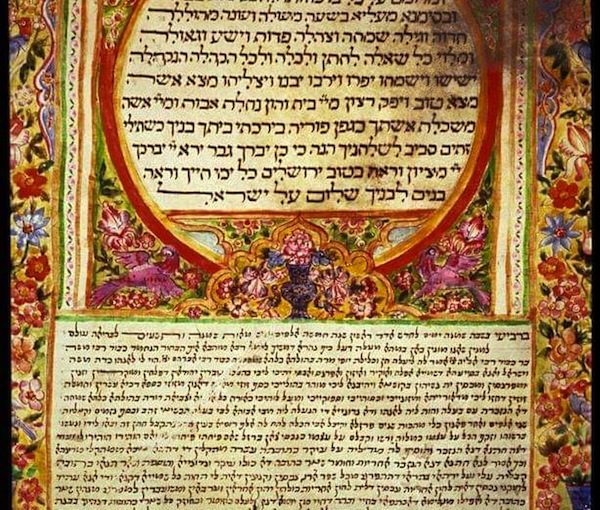
An illustrated ketubah from Mala, India, 1938. (image from Deborah Rubin Fields)

Mazal tov! So, you or someone you know is getting married. Today, Jewish weddings may be big or small, formal or informal, traditional or not. No matter the style, the ketubah, or Jewish marriage contract, is the common denominator.

The ketubah is a short, but ancient document. In his book The Ketuba: Jewish Marriage Contracts through the Ages, David Davidovitch writes: “It may be assumed that … the ketubah was first introduced at the time of the Babylonian exile.” The ketubah “testifies to the obligations undertaken by the husband towards his wife in their joint life together. The principal function of the ketuba is … to serve as a document that safeguards the position of the woman after she has entered the marital state.”

In a traditional ketubah, the groom obligates himself to pay a base amount, and perhaps additional sums that are then written into the contract. He vows to work, honour, feed and support the bride. In added phrasing, he specifically agrees to provide clothing, food (thus providing food is mentioned twice in a traditional Orthodox ketubah) and conjugal rights. The groom’s spelled-out duties are the key to the contract. The wife’s responsibilities are not spelled out, yet details of her dowry are given.

The ketubah was written in Aramaic, for many years considered the legal language of Jewish texts, records and reports, plus the lingua franca of the Middle East. Even today, many Orthodox couples continue to use the Aramaic version. As a legal document, the ketubah requires witnessing by two individuals.

image - The ketubah of the writer’s maternal grandparents, from Warsaw, Poland, 1913
The ketubah of the writer’s maternal grandparents, from Warsaw, Poland, 1913. (image from Deborah Rubin Fields)

That Jewish couples have used ketubot since ancient times does not mean, however, that all ketubot are the same. They have differed from place to place and from period to period. Probably the most blatant difference in ketubot is that some have been illustrated while some have not. According to Davidovitch, the Italian Jewish community produced the most beautiful documents. In illustrated ketubot, common motifs have included scenes from the Torah, cherubim, flowers, birds (sometimes exotic), fish (as signs of anticipated fertility), candelabra or menorot, gates, arches, columns and even emblems of particular countries. It is hard to say with certainty if, historically, unillustrated ketubot reflected the conservative nature of various Jewish communities or if only the rich could afford artists to decorate the contract.

Sometimes, these dissimilarities appeared within one country. For instance, between the 18th and 20th centuries, the ketubot of the Indian Jewish communities consisted of two distinct sections – the opening formula, or superscription, in the upper register and the contract itself beneath. The superscription was written in square Hebrew characters, whereas the contract itself was penned in a semi-cursive Hebrew script. The superscription began with an invocation to G-d, followed by blessings and good wishes to the newlyweds and ended with biblical verses relating to marriage and fertility. Yet, within various Indian communities, there were differences: for example, while a ketubah from Kolkata (Calcutta) was illustrated, a ketubah from Pune was not.

According to Prof. Shalom Sabar, “printed Jerusalem ketubot made their way to many countries in the east, and indirectly led to the decline of the tradition of written ketubot and hand-made illustrations. The printed ketubah (with or without decorations) slowly took the place of the hand-made ketubah throughout almost the entire Jewish world, and the ancient artistic tradition died…. During the 1970s, the decorated ketubah and motifs connected to Jerusalem [were] revived. In an era where many people were ‘searching for their roots’ and acquired a renewed interest in Jewish art in its various forms, many couples began ordering hand-decorated ketubot for their weddings.” (See the National Library of Israel, web.nli.org.il/sites/NLI/English/collections/jewish-collection/ketubbot/ketexhibit/Pages/Yemen-1925.aspx.)

Today, some couples opt to write their ketubah using egalitarian language. Their vows might reflect their responsibilities to each other, as well as responsibilities to the Jewish people and to the entire world. One example of this is the ketubah devised by Rabbi Prof. Rachel Adler. Her ketubah is called a Lovers’ Covenant. It contains biblical verses about covenant, calling marriage a covenant of distinction. Other couples focus on specific vows to be carried out in their shared life.

Other examples of changing times are ketubot for interfaith couples and for same-sex couples. Regarding same-sex couples, Lynda Fishman of Jessy Judaica Shop reports that “most couples choose a ketubah first and read through the text that is offered by the artist. Most couples prefer the same-sex text, although not all artist[s] offer a same-sex text … most do offer an egalitarian text, which can be gender-neutral.” Fishman always requests the couple “speak to their rabbi/officiant first before ordering. It’s very important for the officiant to approve the text first or to let us know if they would like any changes made.”

Masorti (Conservative) Rabbi Diana Villa and the late Rabbi Monique Susskind Goldberg worked extensively to try and prevent the problem of mesoravot get, Jewish women whose husbands have refused to grant a get, or Jewish writ of divorce; this situation occurs more in Israel than in other Jewish communities. In a detailed paper on the issue, they urged couples to sign a prenuptial agreement.

For those living in Israel, they further recommend using their Agreement for Mutual Respect. “The principle guiding financial agreement is that the husband guarantees at the time of the wedding to pay his wife a large sum of money in the future should she want a divorce and should he refuse to give her a get, even though their life together has ended. The purpose of the agreement is to have the husband give the get quickly in order to be rid of the heavy debt.”(See To Learn and to Teach [2007], the fourth booklet of a series published by the Schechter Institute of Jewish Studies).

While prenuptial agreements are less common in the Orthodox world, the Orthodox organization Chupa Pratit requires couples to sign a halachic (according to Jewish law) prenup stipulating financial sanctions if one partner refuses to consent to a divorce, to prevent incidents of “chained” women, or men. (See chuppot.org.il/en.)

The National Library of Israel has an online collection of more than 4,200 ketubot from collections all over the world. Whatever direction you decide to go in when choosing yours, good luck with your preparations. And may your shared life be as hearty and as long-lived as the ketubah itself.

Deborah Rubin Fields is an Israel-based features writer. She is also the author of Take a Peek Inside: A Child’s Guide to Radiology Exams, published in English, Hebrew and Arabic.

Format ImagePosted on February 28, 2020February 26, 2020Author Deborah Rubin FieldsCategories LifeTags halachah, history, Judaism, ketubah, marriage, weddings
Couple cartoons about love

Couple cartoons about love

Yehuda and Maya Devir and their self-drawn webcomic characters in One of Those Days. (image from Devirs)

Fans always do a double take when they see Yehuda and Maya Devir at a comics convention or in a New York City subway, or wherever. The young Israeli couple looks like they jumped right out of their virally popular webcomic One of Those Days.

“I suppose it’s like meeting a real Bart Simpson in the street,” mused Yehuda. “We act exactly the same as our characters.”

Indeed, about seven million social media followers know that Maya loves super-hot showers and hates folding laundry. They know Yehuda’s a big baby when he’s sick and is willing to say “I’m sorry” after an argument. They sympathized with the couple’s struggle to get pregnant.

Most of all, fans smile at the humorous spin the webcomic puts on everyday scenes in a marriage, from dishes in the sink to kisses on the couch.

“We get lots of emails and messages from around the world about how we changed the way couples look at their relationship and how they talk to each other,” Yehuda told Israel21c. “It’s amazing that we can make such a difference for people, that our work can connect Muslim, Jewish, black, white, rich, poor … it doesn’t matter.”

One of Those Days won the Most Creative Content Maker Award at the Inflow Global Summit 2019 Awards for social media influencers.

“We dedicated our award to our followers and supporters around the world. We have fans in Brazil, Japan, Trinidad, Iran, Iraq – basically, every country,” Yehuda said. “People thank us for making them happy once a week and making them feel they are not alone. It’s an amazing journey we’ve been on.”

The Devirs’ journey began in September 2016, when they packed up their diplomas in visual communication from Jerusalem’s Bezalel Academy of Art and Design and moved to Tel Aviv.

The newlyweds hoped to find an affordable apartment in a nice neighbourhood. And they hoped to make a living in illustration and design. Neither aspiration was terribly realistic.

“A friend suggested we post a selfie on Facebook asking friends to help us find an apartment,” said Maya. “We didn’t know how to take a good selfie, but we can draw really well, so we did a cartoon of ourselves and posted that.”

Not only did that illustration help them find an affordable flat in a very expensive city, but it also formed the kernel of One of Those Days.

While working as a freelance illustrator in the fashion, music and startup industries, Yehuda posted funny snippets on social media about being a new husband.

“Very quickly I joined him because I wanted him to make me look good,” Maya said with a laugh, “and because the story belonged to both of us. The concept was to illustrate moments we both experienced.”

In May 2017, Bored Panda posted a piece about the Devirs that went viral. “After a week, we gained half a million followers on Instagram,” Maya said. “Since then, we never stopped gaining followers. We got tons of emails and Yehuda couldn’t manage by himself. So, I left my job as art director in an ad firm and joined him full-time in October 2017. This was our dream – to create something of our own.”

They take complementary roles in each cartoon. “We start the idea together and the actual illustration is Yehuda’s talented hand,” said Maya. “Then I add my suggestions about colour composition and typography. I also manage the business.”

She said, “I opened an ecommerce shop. At first, we sold only autographed A5-sized prints of One of Those Days comics and Yehuda’s other comic illustrations. People who were into art and comics appreciated that.”

The online shop now sells three One of Those Days books plus merchandise, including apparel, shower curtains, calendars, phone skins and other items imprinted with favourite cartoons.

The Devirs’ YouTube channel has 46,000 subscribers. They have a Patreon subscription content service. They’ve appeared at comic-cons in Europe, India and will soon visit the United States. They are in great demand to give talks and lectures.

“Everything we do is because our fans suggested it,” said Yehuda. “Now, they want a TV show and we are going to try to do it. We are working with a scriptwriter at a studio in the U.S.”

photo - The online shop sells three One of Those Days books, plus other merchandise
The online shop sells three One of Those Days books, plus other merchandise. (image from Devirs)

Relationships proved to be a universal kind of language for the Devirs. “When we decided to move into the stage of being parents and saw it wouldn’t be that easy for us, this was a turning point,” Yehuda confided. “Would we really talk about the unpleasant experience of trying to get pregnant? It’s a super-personal subject.”

Maya felt that Yehuda’s humorous and colourful style would put the right spin on the topic and could be supportive for other couples in a similar situation. And so they introduced comics about ovulation, periods and lovemaking on demand. Messages offering support and advice came pouring in. It was like a worldwide group therapy session, Yehuda said.

The cartoon announcing Maya’s pregnancy got 16 million likes and shares. The first illustration of baby Ariel got 13 million. As of Dec. 1, she had 219,000 Instagram followers at just six months old.

“It was unbelievable to see the amount of love we got from people we didn’t know,” said Yehuda. “As Israeli and Jewish people, it was especially unbelievable to get supportive reactions from our huge fan base in the Arab world. The Israeli part is not important. We’re just the cartoon couple about love.”

Now living on Maya’s childhood kibbutz, the couple puts Ariel in the care of her two grandmothers when they travel to shows and lectures. The difficulty of parting with their baby became another comic that went viral because it was so relatable.

“It’s hard for Maya and me to leave her,” said Yehuda, “but, when she’s older, she’ll join us.”

Israel21c is a nonprofit educational foundation with a mission to focus media and public attention on the 21st-century Israel that exists beyond the conflict. For more, or to donate, visit israel21c.org.

Format ImagePosted on February 28, 2020February 26, 2020Author Abigail Klein Leichman ISRAEL21CCategories Visual ArtsTags art, Devir, illustration, Israel, marriage, webcomics
Predicting diabetes risk

Predicting diabetes risk

A new computer algorithm can predict in the early stages of pregnancy, or even before pregnancy has occurred, which women are at a high risk of gestational diabetes. (photo from Weizmann Institute)

A new computer algorithm can predict in the early stages of pregnancy, or even before pregnancy has occurred, which women are at a high risk of gestational diabetes, according to a study by researchers at the Weizmann Institute of Science.

The study, reported recently in Nature Medicine, analyzed data on nearly 600,000 pregnancies available from Israel’s largest health organization, Clalit Health Services.

“Our ultimate goal has been to help the health system take measures so as to prevent diabetes from occurring in pregnancy,” said senior author Prof. Eran Segal of the institute’s computer science and applied mathematics, and molecular cell biology departments.

Gestational diabetes is characterized by high blood sugar levels that develop during pregnancy in women who did not previously have diabetes. It occurs in three to nine percent of all pregnancies and is fraught with risks for both mother and baby. Typically, gestational diabetes is diagnosed between the 24th and 28th weeks of pregnancy, with the help of a glucose tolerance test in which the woman drinks a glucose solution and then undergoes a blood test to see how quickly the glucose is cleared from her blood.

In the new study, Segal and colleagues started out by applying a machine learning method to Clalit’s health records on some 450,000 pregnancies in women who gave birth between 2010 and 2017. Gestational diabetes had been diagnosed by glucose tolerance testing in about four percent of these pregnancies. After processing the dataset – made up of more than 2,000 parameters for each pregnancy, including the woman’s blood test results and her and her family’s medical histories – the scientists’ algorithm revealed that nine of the parameters were sufficient to accurately identify the women who were at a high risk of developing gestational diabetes. The nine parameters included the woman’s age, body mass index, family history of diabetes and results of her glucose tests during previous pregnancies (if any).

Next, to make sure that the nine parameters could indeed accurately predict the risk of gestational diabetes, the researchers applied them to Clalit’s health records on about 140,000 additional pregnancies that had not been part of the initial analysis. The results validated the study’s findings: the nine parameters helped accurately identify the women who ultimately developed gestational diabetes.

These findings suggest that, by having a woman answer just nine questions, it should be possible to tell in advance whether she is at a high risk of developing gestational diabetes. If this information is available early on – in the early stages of pregnancy or even before the woman has gotten pregnant – it might be possible to reduce her risk of diabetes through lifestyle measures such as exercise and diet. On the other hand, women identified by the questionnaire as being at a low risk of gestational diabetes may be spared the cost and inconvenience of the glucose testing. (Visit weizmann.ac.il/sites/gd-predictor to access the self-assessment questionnaire.)

In more general terms, this study has demonstrated the usefulness of large human-based datasets, specifically electronic health records, for deriving personalized disease predictions that can lead to preventive and therapeutic measures.

The work was led by graduate students Nitzan Shalom Artzi, Dr. Smadar Shilo and Hagai Rossman from Segal’s lab at the Weizmann Institute of Science, who collaborated with Prof. Eran Hadar, Dr. Shiri Barbash-Hazan, Prof. Avi Ben-Haroush and Prof. Arnon Wiznitzer of the Rabin Medical Centre in Petach Tikvah; and Prof. Ran D. Balicer and Dr. Becca Feldman of Clalit Health Services.


Format ImagePosted on February 28, 2020February 26, 2020Author Weizmann InstituteCategories IsraelTags childbirth, diabetes, health care, pregnancy, science, women
‘הקהילה היהודית בוונקובר, חלק א

‘הקהילה היהודית בוונקובר, חלק א

רוב המהגרים דוברי היידיש התיישב באזור הפועלים סטראטקונה, והמשיכו באורח חייהם המסורתי.

(מוזיאוןהעםהיהודי L.22046)

ונקובר, עיר בקולומביה הבריטית, העיר השלישית בגודל אוכלוסייתה בקנדה, ומקום משכנה של הקהילה היהודית השלישית בגודלה. כשבעה אחוזים מיהודי קנדה חיים בוונקובר ובסביבתה.

משנות החמישים של המאה התשע עשרה החלו מהגרים רבים להגיע אל האזור הדרומי-מערבי של מחוז קולומביה הבריטית דהיום. רבים נמשכו לאזור בשל הבהלה לזהב, אחרים בשל הזדמנויות עסקיות מגוונות, וביניהם גם יהודים ממחוזות קנדה האמריקניים במערב, במזרח ובמרכז, ומאירופה. ייסודה של הקהילה היהודית בוונקובר היה פרי מאמציהם של מספר אישים, אשר זיקתם ומסירותם ליהדות ולמתיישבים בני דתם אפשרה את גיבושם של החיים היהודים בחוף המערבי של קנדה. אחד המתיישבים היהודים הראשונים באזור היה לואיס גולד, יליד פולין, שנודע בכינוי לואיס המדלג. הוא הגיע לאזור ונקובר עם משפחתו בתחילת שנות השבעים של המאה התשע עשרה, והקים חנות כלבו וסופרמרקט ברחוב ווטר. בהמשך הרחיבה משפחת גולד את עסקיה, ורכשה אדמות. בנו של לואיס, אדוארד עשה חיל. כבר באלף שמונה מאות תשעים ושתיים היה בעליו של בנק הלוואות וביטחונות, ובשנת אלף תשע מאות וארבעה עשרה נבחר לחבר מועצת דרום ונקובר.

לרוב מזוהה ראשית תולדות היהודים בוונקובר עם פעילותם של האחים מאיר, גודפרי, יצחק, צ’לרס ודייויד אופנהיימר, שנולדו בבוואריה, גרמניה. הם באו למחוז במערב קנדה בשנת אלף שמונה מאות חמישים ושמונה, בעקבות הבהלה לזהב. האחים אופנהיימר התיישבו במחוז ונקובר באלף שמונה מאות שמונים וחמש, שנה לפני ייסודה של העיר. שנתיים לאחר מכן היו דייויד ויצחק חברי מועצת העיר ושנה אחרי כן נבחר דייויד לראשות העיר, וכיהן כראש העיר השני, במשך ארבע שנים. האחים אופנהיימר בע”מ שהוא העסק הוותיק ביותר בוונקובר, הקימו את חנות הכלבו הראשונה, במבנה הלבנים הראשון בעיר, שעדיין עומד ברובע גסטאון. בסוף המאה התשע עשרה. הם גם רכשו שטחי אדמה גדולים, והיו בעלי הקרקעות השלישיים בגודלם בוונקובר.

בשנת אלף שמונה מאות תשעים ואחת חיו בוונקובר שמונים וחמישה יהודים. בסוף המאה התשע עשרה החלו לזרום לאזור מהגרים יהודים ממזרח אירופה. רוב המהגרים דוברי היידיש התיישב באזור הפועלים סטראטקונה, והמשיכו באורח חייהם המסורתי. רובם היו בעלי חנויות או בעלי מלאכה, ועסקו במקצועות שהביאו עמם ממזרח אירופה, חייטים, סנדלרים ורוכלים.

מנהיגם הדתי הראשון של יהודי ונקובר היה זבולון פרנקס, יליד אוקראינה אשר התיישב בוונקובר בשנת אלף שמונה מאות שמונים ושבע. בחנותו התקיימו התפילות הראשונות של הקהילה האורתודוכסית בראשיתה. חברת הציוד”י. פרנקס בע”מ היא יורשתו של העסק המקורי שייסד פרנקס. אברהם דייויד גולדשטיין, יליד פולין, עסק בפיתוח ובבנייה. הפרוייקט הנודע ביותר שלו הוא”סילביה קורט, בית הדירות הגבוה הראשון בעיר. הבניין, שנקרא על שם בתו בת השתים עשרה, הוא עדיין אחד מתווי ההיכר של מערב העיר. בימי השפל הכלכלי הגדול, בשנות השלושים של המאה העשרים, הוסב לבית-מלון, ומאז אלף תשע מאות שבעים ושש הוכרז בניין לשימור.

באלף שמונה מאות שמונים ושבע הוקצתה בבית העלמין מאונטיין וויו, שנוסד זמן קצר קודם לכן, חלקה נפרדת לקבורה יהודית. אגודת אחים הייתה הקהילה הראשונה שנוסדה בוונקובר. התפילות הציבוריות הראשונות שקיימה היו בחגים הגדולים, באוקטובר אלף שמונה מאות תשעים ואחת, באולם אבירי פיתיאס שברחוב קורדובה (כיום חלק מחנות הצבא והצי). שלוש שנים לאחר מכן הגיע מוויקטוריה בקולומביה הבריטית הרב שלמה פילו, יליד גרמניה, ועם בואו נוסדה הקהילה הליברלית. בית הכנסת של הקהילה, עמנואל, נוסד שנה אחר כך.

Format ImagePosted on February 26, 2020June 30, 2020Author Roni RachmaniCategories UncategorizedTags British Columbia, history, Jewish community, Jewish museum, JMABC, Vancouver, Victoria, וויקטוריה, וונקובר, מוזיאון העם היהודי, קהילה יהודית, קולומביה בריטית, תולדות
Climate hot topic at Limmud

Climate hot topic at Limmud

Dr. Larry Barzelai and Maayan Kreitzman will talk about environmental activism at Limmud on March 1. (photos from the interviewees)

Environmental activism is among Canada’s top news stories in recent days and the issue will be confronted from both a Jewish and a broader perspective by two leading voices at Limmud Vancouver next month.

Dr. Larry Barzelai, a Vancouver family doctor, assistant professor at the University of British Columbia’s faculty of medicine and B.C. chair of Canadian Association of Physicians for the Environment (CAPE), will present alongside Maayan Kreitzman, a PhD candidate at the Institute for Resources, Environment and Sustainability at UBC. The pair acknowledges that they come at the topic using different tactics, but aim for the same objective.

Kreitzman has been among those blockading the port and traffic.

“The actions happening in the streets right now are in response to this Coastal GasLink natural gas pipeline construction on Wet’suwet’an land,” she said. But this is only one element of the much larger picture, which is that oil and gas development is “occurring unabated and greenhouse gas emissions and ecological destruction is continuing unabated throughout the world, when we know that these activities are threatening our life-support system and are putting billions of people at risk over the next decade. People are already being impacted today.”

The issue brings together a host of concerns, she said, including “indigenous rights and sovereignty, the Canadian government’s complicity in a climate-unsafe future … as well as the business side of that from the private sector.”

Kreitzman has heard the complaints that disruptive protests may turn off potential allies and anger the general public.

“I think people’s emotions are valid and there is a valid concern about disrupting ordinary people that need to make a living and need to take care of their families,” she told the Independent. “On the other hand, I think many of the people that sometimes make these kind of complaints aren’t really the people that are struggling to feed their families. People that come from a place of privilege need to recognize that these protests inconveniencing them is a small price to pay for the types of progressive changes that will benefit all of us, including their children.”

Kreitzman said she and Barzelai will “bring a concise summary of the latest science to people so that they really understand the magnitude of the situation that we’re in.”

She said, “We’ll be speaking to a spectrum of different actions, from the personal to the more conventional campaigning type of approaches, like report-writing, research, lobbying, letter-writing, to direct-action approaches, which is what I’m most interested in, where people that have privilege start putting their bodies on the line and breaking the law on purpose, using the message of nonviolent civil resistance, which has been successful in many movements throughout history.”

Barzelai takes a more conventional approach to advocacy, but shares Kreitzman’s sense of urgency.

“Climate change, which we’re calling a climate emergency, is upon us,” he told the Independent. “It’s dramatic and we have to take big steps to do something about it. Maayan is taking a bit more radical approach to this. Myself and my group are a bit more middle-of-the-road, shall we say, but I think we both have the same endpoint in mind – that things have to change dramatically.”

CAPE, which has been around for about 25 years, focuses on the health impacts of environmental decisions and climate change.

“We see diseases that are spreading, we see cancers that are becoming more rampant, we are seeing the floods and the wildfires and the temperature changes that are dramatically affecting people’s health and we figure it’s our responsibility as doctors to look at climate change from a health perspective and to inform people of what’s going to happen unless we make dramatic changes,” he said.

Fracking is one area where he thinks British Columbia is “really going down the wrong path.”

“They’ve bought this myth that natural gas is clean energy, which it is absolutely not, and they are doing their best to increase rather than decrease global warming, and we think that’s the crucial issue that needs to be discussed in Canada and especially in B.C.,” he said.

Kreitzman and Barzelai will speak at Limmud Vancouver on March 1.

Tickets and more information can be found at limmudvancouver.com.

Format ImagePosted on February 21, 2020February 19, 2020Author Pat JohnsonCategories LocalTags climate crisis, education, environment, Larry Barzelai, Limmud Vancouver, Maayan Kreitzman, tikkun olam

Posts pagination

Previous page Page 1 Page 2 Page 3 … Page 6 Next page
Proudly powered by WordPress