Teaching in new ways

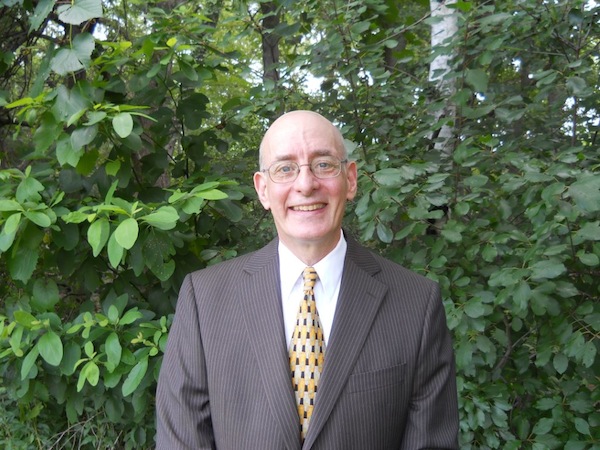
Prof. Ira Robinson of Concordia University’s Institute for Canadian Jewish Studies teaches a wide range of students about the Holocaust and antisemitism. (photo from Ira Robinson)

Ira Robinson is the director of Concordia University’s Institute for Canadian Jewish Studies and a professor of Judaic studies in the department of religions and cultures. A strong believer that an educator shouldn’t teach the same course in the same way year after year, he is always looking for new ways to reach students of all ages.

Born in Boston, Mass., Robinson moved to Montreal with his wife, Sandra, 40 years ago.

“I came to Canada because Concordia offered me a job, and I landed in the right place at the right time,” he told the Independent. “Academics don’t always have a complete choice of where they are going to settle. I came to Montreal and Montreal has a large and interesting Jewish community and a tremendously interesting bilingual culture.”

Though Robinson had never envisioned writing a book about antisemitism or the Holocaust, he did so, publishing A History of Antisemitism in Canada in 2015.

Robinson was trained by students of the late Salo Baron, a Polish-American historian, who once said, “If you want to understand the totality of Jewish history, you have to take into consideration that the pogroms and the massacres take only an infinitesimal amount of time, even though they wreak great havoc.”

According to Robinson, “Ninety-nine percent of the time, we’re dealing with normal life…. Baron and his students decided to look at the Jews as they had lived and not as they had died. That was the lesson that I took.”

For Robinson, this meant he would have to determine his own take on the history of antisemitism in Canada and, hence, “I came out with the book.”

Robinson starts many of his courses by telling students that there is nothing he is going to teach them that is not completely denied by somebody, somewhere. With this message, he is stressing that what he is about to teach is his perspective on what took place.

In looking at the history of antisemitism in Canada, for example, Robinson tried to contextualize the reasons Jews were looked at as guests in the 1920 and 1930s in Canada.

“What I did in this book is create a continuous narrative on antisemitism in Canada from the 18th century through to the present,” he explained. “There have been many very good studies on various aspects of antisemitism in Canada, the most famous of which is [Irving] Abella’s and [Harold] Troper’s None is Too Many. This academic book uniquely made a difference in the political discourse of Canada. Now, whenever anyone debates a refugee issue in Canada, the phrase, ‘None is too many,’ is sure to come into the discourse or debate at some point. That was a great success, but the book only concentrates on the 1920s to the 1940s, and mainly focuses on the Canadian federal government.”

Since the research for Robinson’s book was completed in 2014, antisemitism has increased, he said. For that reason, he decided to find ways to teach about the problem to younger children, kids in grades 4 to 6.

“It presents a challenge, because I have to begin with who they [antisemites] are and where they are,” said Robinson. “And so, I started by talking with them [the kids] about bullying, because bullying, as you understand, is something that kids know about and people talk to them about it.

“If you see somebody bullying somebody else, what are you supposed to do? If you can intervene, you should intervene. If you need to call somebody in a position of authority, you call somebody…. So, I said, ‘imagine that there are kids and you can bully them and nobody is going to stop you. And imagine that, if somebody goes to a person of authority, they will just say, ‘Good for you!’”

Robinson took it a step further, creating a PowerPoint presentation focusing on the wearing of the yellow Jewish star that was imposed upon Jews.

“I showed first a picture of a girl’s dress with the yellow star shown on it – just the dress, nobody in it,” he said. “Then, the next thing I showed was a little girl in a dress with the yellow star. When I changed the slide from just the girl’s dress with the yellow star to the little girl in the dress with a yellow star, I could hear a slight gasp among the students. So, there are ways – you have to talk to the people you have in front of you.”

Robinson gave this presentation in a public school and, as far he knows, there were no Jewish students in the classroom. “I am used to talking to a wide range of people,” he said. “And, in my university classes, for instance, I do expect Jews to enrol, and they do. But, I also expect Muslims and Christians to enrol, and they do, and everybody else, too.”

In Robinson’s view, the challenge of finding ways to disseminate the information effectively is always a worthwhile exercise.

“There are lots of people involved in Holocaust education and I think a lot of them are spending a lot of effort introducing and assisting in educating about the Holocaust in public school systems. The problem, as always, is not lack of good will,” he said, “but that the schools are under great pressure from a whole bunch of different directions. What should our children study? And the mega trend, not merely in public schools, but also in universities, is moving away from the social sciences and humanities, and focusing on other subjects.”

As far as teaching methods regarding the Holocaust and antisemitism, Robinson said, “I think I am able to speak with more depth, because you can’t teach the same course in the same way for decades. You have to develop a scholarly understanding as the field develops and, so, my teaching is informed by my reading and my reading continues to inform me.

“And my power is that I am able to direct students to certain books, certain articles and certain films that I think will help them develop their sense of things. But, before I can even do that, before I can guide anybody, I have to find the things myself, first and foremost.”

Rebeca Kuropatwa is a Winnipeg freelance writer.
A loving tribute to her father

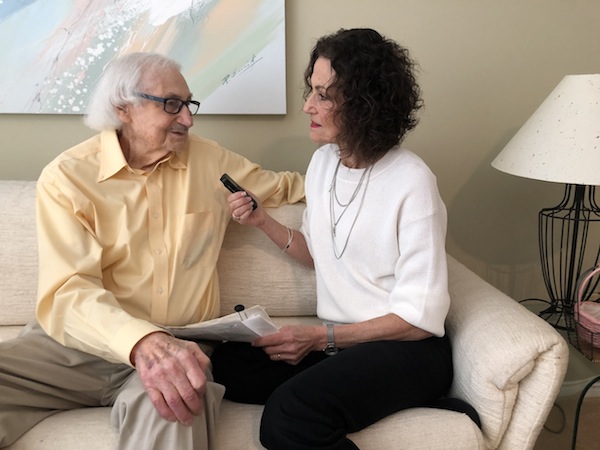
Lou Segal being interviewed by his daughter, Ramona Josephson, 2019. (photo from Ramona Josephson)

A few years ago, the Jewish Museum and Archives of British Columbia contacted my dad, Lou Segal, to interview him, as part of their mission to record the history of South African Jews living in Vancouver. It planted a seed in my mind. Why don’t I interview my dad, and record his voice for my family? So, with tape recorder in hand, we began. My dad (Lou) loves to tell a story and soon I had literally hours of tape.

It wasn’t my intention to write a book. But how would future generations know Lou’s story, and the lessons he has to share? And so the book Who’s Lou? A Loving Tribute to Lou Segal was born.

This is a story of a deeply spiritual man who governs his life with love and integrity; a self-made man who wanted to help others and, in so doing, became a pharmacist and entrepreneur; a man who is a role model and mentor to his four kids, 11 grandkids and five great-grandkids; a man who remains in constant gratitude for all his blessings; a 94-year-old man still in love with my 92-year-old mom!

Born in 1925 Yanishki, Lithuania, home to some 900 Jews, he set sail as a young boy on the Adolf Woermann with his mother and younger brother to join his father in South Africa. His father had left earlier to create a better life for them, after being attacked selling wares from his horse and cart. After a turbulent journey, they arrived in Cape Town, but there was no one to meet them. His father had mistaken the date.

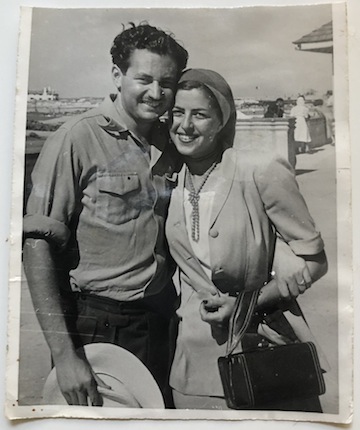
photo - Lou and Friedah Segal on their honeymoon, 1951
Lou and Friedah Segal on their honeymoon, 1951. (photo from Ramona Josephson)

“I remember my mother holding our hands, wailing in Yiddish: ‘Where’s my husband?’” said Lou. “We were told we’d have to sail back to Berlin if no one came. Just as the ship’s horn blasted, an angel came on board. She said she was my mother’s sister and we were able to leave the ship. She belonged to a Jewish agency that provided assistance for Lithuanian immigrants.” If not for her, how different this story would have been.

Lou’s childhood was difficult. “My first days of school were traumatic. I arrived late in the school year, wearing my tzitzit. I could only speak Yiddish and, even though I was 7, I was put into the equivalent of preschool. I was so embarrassed. Antisemitism was rife and I was ridiculed and beaten up often. I had no one to turn to.”

The family originally lived in a poor neighbourhood and many of Lou’s friends were black kids and they played soccer together. He learned to speak Zulu and, later, this would save his life.

As the years went by, his father’s business prospered, and the family moved to nicer homes. Their last home in Pretoria is today the residence of the consulate of Madagascar.

When Lou was 16, he first laid eyes on my mom, Friedah, at Muizenberg, a popular beach resort and meeting place for young Jewish people. Lou’s eyes always tear up when he talks about my mom.” To this day,” he said, “I am still so in love with your mother. The minute I saw her, she mesmerized me. But it wasn’t mutual. Mom would joke that, as the years went by, I was always looking at her, but she was looking the other way.”

One of Lou’s brothers, Charles Segal, recently received the Guinness World Record for most recorded pianist. Lou can’t claim the same, but he finally won my mom’s heart after she saw him playing the piano as a guest entertainer at a party one night. The next day, she called him … and the rest is history. They were married some years later in Cape Town, after Lou graduated as a pharmacist. They had four children, Basil, Ramona (me), Darryl and Janine.

But tragedy nearly struck when Lou had a fire in his pharmacy. His delivery boy lit a cigarette in the dispensary and a bottle of benzene erupted into flames. Lou tried to stomp out the fire with his foot. His pants went up in flames and his skin was burnt to the bone. A customer rushed him to the hospital. He needed skin grafts on both legs. A teaching professor came into his hospital room one day and told his students in Afrikaans, thinking my dad couldn’t understand, that he would likely never walk again.

“My heart dropped,” Lou recalled. “I asked Mom to bring my tefillin to the hospital, and I put it on every morning and prayed to G-d. Miraculously, over time, the grafts started taking. After six months, I was discharged, and was gradually able to go back to my usual activities. To this day, I lay tefillin every single day. I believe it is one of the most important of the 613 mitzvot in the Torah.”

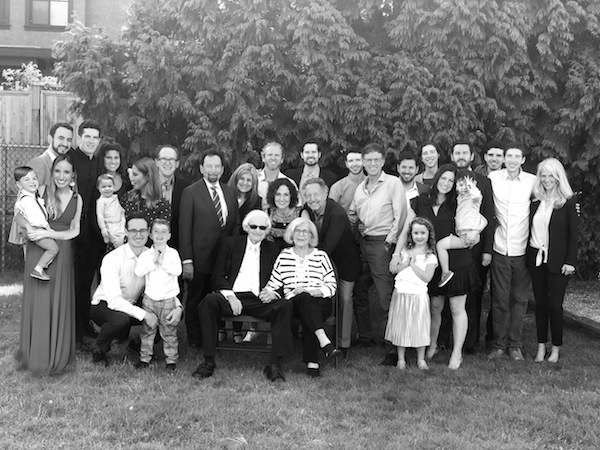
photo - Lou’s family at the launch of Who’s Lou?
Lou’s family at the launch of Who’s Lou? (photo from Ramona Josephson)

Lou was a pharmacist but became a successful and respected entrepreneur. He was a branding whiz, was coined the ‘Man with Ideas’ and was so well known that the newspaper created a caricature of him.

“I always wanted to make a difference in people’s lives. I had a deep knowledge of pharmacognosy and could formulate products from scratch using plants and natural ingredients. As time went by, I realized I could manufacture most products and so I started to create my own brand lines.” His products became household names.

In 1948, apartheid was introduced in South Africa and black people were forced to carry passbooks to restrict their freedom of movement. In 1960, they took to the streets in protest; stores were burglarized and cars overturned. The police opened fire and the bloodshed that followed is called the Sharpeville massacre.

“Demonstrations in Cape Town passed my drugstore,” said Lou. “Several blacks entered and were about to jump over my counter to attack me when a black man shouted in Zulu that I was his ‘doctor’ and they must stop. Over the years, I had tended to many black people who had come to my drugstore bleeding from fights. They’d promise to pay me later but I knew they never would. I had grown up with them and just wanted to help. I believe this man saved my life.”

Our family considered leaving the country but, after Nelson Mandela’s arrest, there was a false sense of security and life went on.

By that time, we, like so many white South Africans, were enjoying a wonderful lifestyle in Cape Town. We went to shul as a family every Friday night, played tennis or lounged on the beach on weekends. Lou kept fit, swimming lengths in our pool, going to the gym, playing tennis. He was a Toastmaster and he and my mom had a large network of friends. They loved to party and took ballroom dancing lessons in our home.

But there was always an underlying level of tension and the turning point came in 1976, after the Soweto Uprising. Black schoolchildren took to the streets in the thousands, protesting the government’s insistence that Afrikaans be the official language in schools. It became bloody.

My older brother, Basil, and I felt there was no future for us in South Africa and we both independently immigrated to Vancouver. I recall, when Basil phoned to say he had arrived in Vancouver, Mom asked: “Vancouver? Where’s that?” Basil replied: “Look at the map. It’s as far north and as far west as you can go!”

photo - Plaque representing Lou Segal’s top 10 “commandments”
Plaque representing Lou Segal’s top 10 “commandments.” (photo from Ramona Josephson)

My parents learned that they could bring our younger siblings on their passport if they immigrated before either of them turned 21.

“I was just 54 years old and at the prime of my career,” said Lou. “I had a business partner, and we were under negotiations to merge with two other companies to be listed on the Johannesburg stock exchange. I owned several large property holdings, both residential and commercial. There were strict regulations as to how much money you could take out the country. If you violated the law you could lose everything. But we had this deadline to move to Vancouver and be together again with our four kids, and that is what we decided to do. Family first!”

Our home in Cape Town later became the residence of the consulate of Lithuania.

Lou came as a retired man but he never retired. He still goes into the office, where he works with my younger brother, Darryl, manufacturing the HerbalGlo line of hair and skin products. Darryl wants to retire, but he can’t, because Lou still goes to the office.

Lou is a man who never raised his voice, but his life lessons and strong moral values are heard loud and clear by all who know him.

Who’s Lou? is filled with loving tributes from family and four rabbis who have officiated over the years at Congregation Beth Tikvah. We are so grateful to Barbi Braude for the hours she put into the concept and design of the book, which was launched in honour of Lou on Sept. 7 at a Kiddush luncheon at the synagogue. It is available at the synagogue library, the Jewish Museum and Archives of British Columbia and the Isaac Waldman Jewish Public Library.

Ramona Josephson is one of Lou Segal’s four children and is married to Ken Karasick. Her two children, Jaclyn and Marc, have brought Lou and Friedah four great-grandchildren. She is a happily retired dietitian and nutritionist and author of HeartSmart Nutrition: Shopping on the Run.

NCJW hosts Govender

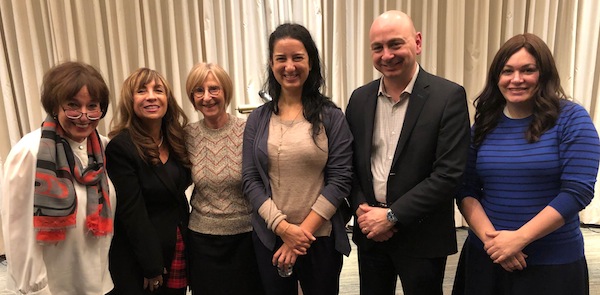
Left to right: Debby Altow, NCJW Vancouver past president; Cate Stoller, NCJW Vancouver president; Shelley Rivkin, vice-president, Jewish Federation of Greater Vancouver; Kasari Govender, B.C. human rights commissioner; Ezra Shanken, Jewish Federation executive director; and Etti Goldman, Centre for Israel and Jewish Affairs. (photo by Rochelle Garfinkel)

Newly installed B.C. Commissioner of Human Rights Kasari Govender spoke to members and guests of the National Council of Jewish Women of Canada on Nov. 21 at the Jewish Community Centre of Greater Vancouver. Govender discussed a wide range of topics, including the connections her office will be making with similar bodies across Canada, her focus on the systemic issues affecting human rights in our province, and her welcoming of ideas for implementing forward-thinking and creative approaches to human rights issues. Govender’s presentation echoed the values and focus of NCJWC Vancouver section, which has a long tradition of innovation and creativity in the sphere of social action. For more information about upcoming events and programs, visit ncjwvancouver.org.

Northern lights

(photo from facebook.com/liatg)

Benji Goldstein, who lives in Sioux Lookout with his family, is a full-time doctor working in indigenous communities in northern of Ontario. He has created for Chanukah an almost six-foot chanukiyah out of ice, improving his 1.0 version from two years ago to this 2.0 model, which stands on a big block of ice. The bricks were frozen in milk cartons, which he collected over time, and the structure weighs 400 kilograms. It will be lit every night of the holiday from his mobile phone.

The Jewish Independent found out about Goldstein’s creation from local community member Tamara Heitner, who shared with us the Facebook post of Goldstein’s sister-in-law, Liat Goldstein.

May there one day be peace

Operation Protective Edge, on Aug. 3, 2014. (photo from flickr.com/photos/idfonline)

Part 3 of a three-part series, in which the author shares his diaries from the homefront, providing a glimpse of daily life under missile threat during Operation Protective Edge in 2014. For Part 1, click here; for Part 2, click here. 

July 23

Day 16. Iron Dome success rate at 90%. Missiles still get through. Today, an errant rocket hit a house. No casualties. This prompted yet again another lecture from Dad to his kids. Don’t be over-confident and continue taking the Code Red alerts seriously.

Six hundred and sixteen dead in Gaza. Mostly civilians. Locked in a war zone. A human catastrophe. Simply put, as American Civil War general William Sherman put it, “War is hell.”

Hamas fighters seen emerging from their hideout in an ambulance. Balancing war aims with the desire to avoid collateral damage, the Israel Defence Forces decided against bombing the ambulance.

More missile action in Rehovot. Spoke with our son while huddled in our protective room. He was out with friends at a nearby café. They talked with us from under a table.

July 28

Huge uncertainty. Again that word. Shuffling from ceasefire to ceasefire. Meantime, my Code Red app doesn’t stop beeping.

What is sure? The death and devastation in Gaza is tragic. The continued threat to Israel from Hamas’s missiles and terror tunnels is unacceptable. Two ends of a very sharp sword that Hamas must sheathe to bring quiet.

Israel cannot rest until the Hamas threat is eradicated. Or at least severely beaten. In the past 12 months, more than 200 missiles have been fired at our southern communities. Another 200 rockets were fired at the same communities in the 10 days leading to our military offensive. Since the start of Operation Protective Edge, a staggering 2,500 rockets fired at Israel. Yikes!

Exceptionally telling was a picture in our morning paper. Israeli soldiers carrying a wounded bomb-sniffing dog in a stretcher to a waiting helicopter. Contrast to Hamas terrorists firing from behind women and children.

Returning from Tel Aviv with my wife and daughter, a Code Red sounded. A known routine. Pull over. Exit car. Crouch down on roadside. Cover heads with hands (!). My wife huddled over our daughter and I huddled over my wife. Double protection for my daughter. Unbeknownst to my daughter, while the Iron Dome chased and intercepted its target overhead, I managed a quick and loving grope of my wife. Nothing like some comic relief. Another Love Is moment.

July 31

Driving home from work as a missile barrage hit the south. Three people lightly injured by falling missile fragments. Text messages from my loving family:

Wife: “Where’s Dad?”

Son: “Think he’s at work. Tough luck for him – ha ha!”

My son inherited my dark and cynical sense of humour.

A country at war: 65,000 reservists now called up; 18,000 pending call-ups. Flags strung up along our main roads. War jingles on the radio. Billboards supporting our troops. Famous Israeli singers touring the front (which is one city over!). Patriotic teenagers waving flags and dancing at major intersections.

Nonstop beeping of the Code Red app. Heard everywhere. Movie theatres. Restaurants. Grocery stores.

Soldiers’ funerals attended by hundreds.

Solidarity with impacted businesses in the south, holding market days in major cities. Large public service campaign to buy “blue and white.”

Aug. 2

Sixty-three of our bravest boys killed. Three civilians killed. One soldier, Hadar Goldin, captured. Dead or alive?

U.S. President Barack Obama asked Hamas – one of the most barbaric terrorist movements in the world, who flagrantly have violated six humanitarian ceasefires, who hide behind innocent women and children, who plant arsenals and war rooms in hospitals, schools and mosques – to please set the soldier free. Pretty please. With sugar on top. Don’t think the president gets it.

Aug. 5

Three times I told my son to get up for work. Each time, he mumbled OK. Each time, he fell back asleep. Then, running to our safe room at 7:15 a.m. with Code Red apps blaring, he finally got out of bed.

Leaving home this morning, I told my daughter that today should be relatively quiet. Entering another ceasefire. “Ya, like Hamas will respect that,” my 12-year-old quipped.

A tough day yesterday. More than 85 rockets rained on Israel. Terror attacks in Jerusalem. Terror alerts in Tel Aviv. Entering a 72-hour truce, which will hopefully usher in … something.

Preparing for the inevitable “day after.” Fists clenched. Hearts palpitating. Brow sweating.

Aug. 6

Halfway into the truce. So far, quiet met with quiet. Yesterday, I woke to the sounds of missiles and my Code Rep buzzing. Today, I woke to the sounds of silence – well, actually, to the sounds of my kids arguing and my dog barking. Beautiful noise.

There’s an atmosphere of victory. Our soldiers – our children – are heroes. Hamas was dealt a severe and long-term blow. Is more isolated in the Arab world. Some strategic shifts in alliances per the dictum “My enemy’s enemy is my friend.”

Will not forget those who fell in our defence, as well as the few civilian casualties. Saddened by the death and destruction in Gaza. Pray that one day soon Gazans will rise above Hamas, save themselves.

Hope our enemies are deterred from other misadventures. Pray that peace will be upon us. Am Yisrael chai.

Aug. 11

A bit premature with my last entry. Suffering from wishful thinking. Looks like victory has not yet arrived. While Hamas took a severe beating and is largely isolated, they continue their disregard for a real truce.

Both sides met in Egypt to negotiate a settlement while the ceasefire took effect, but huge gaps. Not surprisingly, talks broke down. Hamas resumed their missile barrage. Israel reactivated our air defences and continues to pound Gaza.

International condemnation of Israel totally disproportionate. Fierce anti-Israel and antisemitic rallies throughout the world, especially in Europe. Jews surrounded in synagogues (France). Jew-free areas (United Kingdom). A rabbi killed on his way to synagogue (United States). Jewish kids bullied in schools (Australia).

Still feel safer in Israel than in Europe. Even now. Think the mass immigration of Arabs to European lands and poor absorption processes taking effect.

Going to Italy next week for a family vacation. Need to minimize our “Israeliness.” English will be our language of choice. A bit scary.

Amid a second three-day truce, am doubtful the truce will last.

Aug. 13

The truce ends at midnight. Lots of anxiety. What comes next?

Didn’t Netanyahu once say he would never negotiate with terrorists? The world looks different at the top, when the decision is yours.

Am working late tonight. If the truce ends early, I hope it lasts at least till I get home.

Aug. 17

Waiting on the outcome of an extended ceasefire. Expires midnight Monday.

The solid backing and relative discipline Netanyahu enjoyed from the government is starting to crack. Lots of conflicting postwar opinions, positions and plans. Two Jews, three opinions.

Heading to Italy for our long-awaited family respite.

Aug. 26

Back from Italy. Fiftieth day of Operation Protective Edge.

While away, we tried, as best we could, to unwind from the tensions of our little shtetl. You can never really escape the reality of your country being hit by missiles. Especially with the Code Red app going off when eating pizza in a town square, when visiting the Coliseum, when at the Vatican, when touring the medieval hamlets of Tuscany. Could have just turned off the app but, for a sense of identity, some twisted need to remain connected, didn’t.

After 50 days, Gaza is burning. Death and devastation are immense. But Hamas – like that Duracell rabbit – just keeps going.

In a Sisyphus-like manner, another ceasefire is in the making.

Israel is awash in the ALS Ice Bucket Challenge. Escapism of any kind, however temporary.

Aug. 29

Waited a few days before writing this entry. Wanted to be sure this ceasefire held. It has. But gaps remain wide. Hamas remains a wild card.

Discussions in Israel are intense. Significant introspection. If Netanyahu thought the Gaza battlefield was tough, here comes the national post-mortem. This soul-searching (self-flagellation?) is indicative of the Israeli psyche, our democracy. This constant search inwards may be the secret to our success as a people, as a country.

A contrast to the other side. Celebrating their “victory.” Dancing in the streets. Shooting in the air. Proclamations of battles won that never happened. A lack of critical introspection that will, unfortunately, keep our enemies from making any real progress in developing a strong, forward-looking society.

Former National Security Council head Ya’acov Amidror: “One of the main differences between Israeli and Palestinian societies is that, if Israel has a glass of water three-quarters full, it will complain about and search for the missing quarter. If the Palestinian glass is only one-quarter full, it will celebrate the one quarter and even imagine a second quarter.”

What was? What will be? I defer to our pundits and leaders. To hopefully bring, if not peace, at least quiet to this wonderful, ever-challenged, always robust, constantly developing and very happy country.

May peace be upon us. As-salumu alayna. Shalom.

Bruce Brown, a Canadian-Israeli, made aliyah 25 years ago. He works in high-tech and is happily married, with two kids. He is the winner of a 2019 American Jewish Press Association Simon Rockower Award for excellence in Jewish writing.

The real and imaginary mix

Norman Ravvin (photo by Allen McInnis/The Gazette)

For anyone interested in the history and landmarks of Vancouver, especially, but also cities in Poland, reading Norman Ravvin’s new novel, The Girl Who Stole Everything (Linda Leith Editions, 2019), will take longer than its 310 pages would suggest. You’ll want to allot time for side trips to the internet to see what the Army & Navy building on West Cordova Street looked like in the middle of the last century, for example, or Stan Douglas’s mural at the Woodward’s complex of the 1971 Gastown riot. Stalin’s Palace of Culture and Science in Warsaw? The main square in the town of Radzanów, Poland?

While The Girl Who Stole Everything is set in real places described in detailed accuracy by Ravvin, there is still much left to the imagination. The discovery of family secrets – in one case, which were literally buried; in the other, figuratively – leads to events that bring Vancouver dulcimer musician Nadia and bookseller-café owner Simon together and, eventually, take both to Poland. Nadia’s father never told her that her uncle, who owned a pawnshop on West Cordova, was murdered in 1962, beaten to death in a robbery gone wrong, and Simon’s father told him nothing of their prewar Polish heritage. Both a little lost in life before friends drop these revelations on them, Nadia and Simon find meaning and direction as they search out the truth of their histories.

The Jewish Independent interviewed Ravvin, who lives in Montreal, about his novel, which is available for purchase most anywhere. Ravvin said he will be in Vancouver for the Cherie Smith JCC Jewish Book Festival in February, for readers who would like the chance to speak with him themselves.

Jewish Independent: I was struck by your attention to detail in the history and geography of Vancouver, and I imagine the same with Warsaw and Radzanów, though I wouldn’t know that from personal experience. Have you lived in all these places? If not, from where did you gather your local knowledge?

Norman Ravvin: I came to know Vancouver as a child, traveling from Calgary with my family to visit my mother’s mother, who lived on Willow Street. Those trips and her presence in the city contributed to my coming back to study at UBC, where my dad went for a few years in the wartime before enlisting in the Navy. I did my undergrad degree and a one-year MA in the English department.

So, I lived in the city, altogether, only about six years. I lived at UBC, then on the West Side, then in the West End, which I came to think of as “my neighbourhood.” Having left in the mid-80s, with family still there, I continued to come back and never really let go of it as “home,” or maybe a “second home.” We tend to spend two or three weeks in the city in the summer each year. My background knowledge of the city then is also connected with my mom’s youth in the city, my dad’s time there in the wartime, and my grandmother’s life in the city.

Radzanów requires a longer answer. It is my ancestral place on my mother’s side. I first visited it in 1999. I have traveled to Poland seven or eight times since then, making three follow-up trips to Radzanów. I went with different guides in each case, so some of the visits were more revealing than others. In a few cases, standing in the village square, we ended up talking to locals and, in one case, sitting for a beer in a local kufelek, or little beer hall. Going with Poles is key: you cannot access the locals or understand the scene or get a feeling for things otherwise. I met people who remembered my family. I was shown the interior of the intact synagogue building.

More recently, I was back as part of an event organized through a high school class and teacher from a larger nearby place called Mława. The students and their teacher took part in a program that Polish schools follow, called To Bring Memory Back. In their case, they held an event to “open” the synagogue – which took place in the village community centre, since the synagogue is a hollow shell – hoping to raise interest and funds to have the building renewed in some way.

As you’d expect, I added great amounts of reading and research to these visits, in order to try to understand Radzanów from a contemporary as well as historical perspective. I did not want to make up things on this front. The scenes with a film crew are imagined, but a film on the wartime was in fact filmed in the Radzanów square, a kind of lucky coincidence for me. I looked at how that film looked. And research into the Germans’ activities in the area is quite developed, since there was an SS headquarters in the nearby town of Ciechanów. I have not had the guts or the opportunity to live in Radzanów. That aspect of the book is built from all the other related work and research and visits.

JI: In a similar vein, your references to music seem from an insider’s view. What instruments, if any, do you or have you played?

NR: I play the guitar. My son is a first-rate musician, which I am not. So, music is a very established fact in our home life. I am interested in things that overlap between Jewish and Polish identity and, certainly, along with food, music was an area of shared culture and knowledge before the war. Aspects of this inhabit the realm of cliché in contemporary “world music” culture. Klezmer, as it was played before the war, and its nearness to other Polish folk music, is really a kind of untapped source of possible nearness between the two groups. So my character, Nadia, almost inadvertently stumbles into this territory. She finds her way to Eastern European music and is drawn, without her meaning it to happen, to Poland.

JI: The Night Jew, Gentle Jew, Dulcimer Girl, Typewriter Girl … could you talk a bit about these “labels” that appear in the novel? Are they to evoke an archetype, a uniqueness or something else?

NR: This is a challenging query, which goes to the matter of how this book changed over time, through different drafts, and also points to other key aspects of the book.

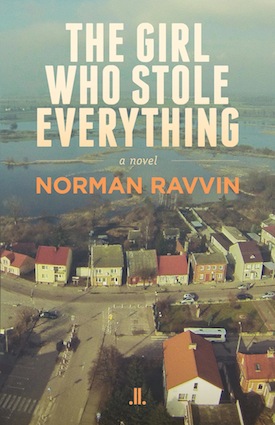
image - The Girl Who Stole Everything coverFor a long time it had the title The Dulcimer Girl, which is one of Nadia’s alter egos once she arrives in Poland. And the instrument itself, key to early klezmer, in its Polish guise, as a hammered instrument, was something I thought of as a talismanic object, which evoked the locale, the culture of Jews and Poles in another time.

The Typewriter Girl was also an early title that fell by the wayside, and relates to the other main female character, Ania. She is “the Typewriter Girl” by way of her work for a Polish government bureaucratic special office, which is tasked with investigating the files kept on people during the communist era. Understanding the typewriters used on each file is a way of verifying the files or revealing fraudulence.

The typewriter, like other technologies in the book – cars, books, recorded music – is evocative of a time when things worked in a way that they no longer do. So, the dulcimer and the typewriter, even hardcover books, are surely objects of nostalgic and loveable possibilities.

The Night Jew is central to the novel’s sense of Poland being haunted by the Jews murdered in the wartime. One can spend time in Poland and either look for these Night Jews or, as I sometimes feel, be one. There are plenty of real Jews in Poland today. But the Night Jew must be someone from another world altogether.

The Gentle Jew is in fact a particular nickname for a key figure in the narrative. He is an early ’60s denizen of West Cordova Street.

JI: There are many parallels in the lives of Simon and Nadia – a father’s secrets, their love of walking, etc. – and their lives do overlap, of course, but what inspired you to connect these disparate stories?

NR: Some of these parallels develop intentionally, but then others work themselves out as a book goes through drafts. Certainly, you’re right, walking is a returning motif. Nadia does seem to walk cities after the example of her father, as if she walks to be like him when she cannot know him.

The secrets of fathers: I guess, in this book, one of the premises is that ancestral stories, which go untold, can irrupt without warning. So, in the case of the younger characters in Canada, Simon and Nadia, they share this predicament, and their own lives are changed by the irruptions when they finally happen. It is satisfying when these kinds of patterns develop almost without meaning them to. This is where writing can be a bit like making music, where refrains, verse and chorus structure allow for such catchy and satisfying effects – a rhyming of sound and idea.

JI: If there is anything else you’d like to add, please do.

NR: I guess it’s important to say that I’ve returned to Vancouver in fiction for another try at it. My second novel, Lola by Night, was a Vancouver book. And, in The Girl Who Stole Everything, I felt strongly about doing things with the city that others hadn’t. I’m a walker in Vancouver, whenever I can be, so that element, which you ask about, is motivated by my own appreciation of what different parts of the city have to offer. When I walk, I do think of what’s changed since my last visit, so it may be that writing about a place can be well done from afar, as long as you keep it close enough and periodically in view. It’s interesting to have a Vancouver book come out in Montreal, where the West Coast is a kind of terra incognita.

A bleak take on our times

Bari Weiss, the New York Times columnist, grew up in Pittsburgh and so the shooting at the Tree of Life synagogue, in October 2017, hit even closer to home for her than for most Jewish North Americans. For many American Jews, she writes, it was the awakening after “a holiday from history.” It seems to have raised the question: Is the postwar reprieve from antisemitism coming to an end?

The majority of her tight, short book, How to Fight Anti-Semitism (Crown, 2019) is a litany of bleak, depressing anecdotes and statistics about the rise of antisemitic ideas and violence in North America and Europe. One imagines the title, which suggests action and optimism, being brainstormed by the publisher’s more upbeat marketing department over the alternative The Sky is Falling. But this is not to discount the value of the bleakness. It is a brief synopsis of rightful concerns around the political climate in the West in 2019.

The awakening, Weiss seems to acknowledge, was overdue. She recounts the 2006 kidnapping, weeks of torture and eventual murder of Ilan Halimi in Paris by a gang who assumed that, because Halimi was Jewish, he was also rich. As shocking as the ferocious crime, writes Weiss, was the response by the French authorities and the public, who largely chose to ignore the innately antisemitic nature of what had happened in order to retain a national self-perception that was challenged by the murder.

The consequences of what is happening, she warns, raise the stakes from the safety of Jews to the protection of the very idea of America.

“The object of our protection is not just the Jewish people. It is the health and future of a country that promised to be a New Jerusalem for all who sought it out,” she writes.

I am always disconcerted by the argument that, if we do not stand up for Jewish people when they are threatened, the enemies might eventually come for someone we actually give a damn about. But the evidence accumulates that this may be the best argument at hand.

Weiss summarizes the many antisemitisms – of left and right, of the Soviets and the fascists, of some Muslims and some African-Americans – even “Purim antisemitism” and “Chanukah antisemitism” (an interesting theory first advanced by the writer Dara Horn and it’s worth a Google). In brief, Weiss argues that the right of the spectrum considers Jews insufficiently white and not Christian, while the left contends that Jews are too white and overly privileged. Far-right antisemitism is more familiar, perhaps more clearly identifiable and is fought in partnership with what she calls Jewish people’s natural allies, liberals. Antisemitism on the left puts Jews in an especially challenging position.

She notes that the antisemitism and racism of Steve King, the far-right Republican congressman, is open to widespread criticism. “But criticize Women’s March leader Linda Sarsour for her repeated antisemitic outbursts? Criticize her and you are not just rendered racist and misogynist and an Islamophobe in league with Trump, you stand accused of putting her life at risk for trying to hold her accountable for promoting antisemitism.” (For her part, Sarsour two weeks ago declared that Weiss is “on the wrong side of history,” a statement so brazenly jaw-dropping that the publisher really should issue a revised edition of Weiss’s book just to include Sarsour’s latest.)

Weiss also walks into the lion’s den by making the equation between Muslim migration to Europe and increased antisemitic violence. And the stats she includes make challenging reading. A 2008 Pew poll indicated that 97% of respondents in Lebanon have negative view of Jews, followed by 96% in Jordan, 95% in Egypt and 76% in Turkey and Pakistan. She contrasts this with a 2015 Anti-Defamation League survey indicating that, in Germany, 56% of Muslims hold antisemitic views, compared with 16% of the general population. In France, it’s 49% to 17% and, in the United Kingdom, 54% to 12%.

When, at the end of the book, she actually gets to the nub of fighting antisemitism, Weiss outlines a number of strategies, few of which are novel but all of which are worthy.

“Resist hierarchical identity politics,” is one of her steps. “Corrupt identity politics on the right – the Olympics of Purity – tell the Jews that they can never be white or Christian enough. Corrupt identity politics on the left – the Olympics of Victimization – tell the Jews that they can never be oppressed enough.”

She calls on Jews to maintain liberalism for the sake of a healthy democracy, to support Israel, which includes demanding that Israel live up to its ideals, to “lean into Judaism” and “tell your story.”

She calls on Jews to “apply the kippah (or Magen David) test”: “If you would be uncomfortable wearing a kippah or a Magen David necklace in your neighbourhood, you should make a plan to improve your neighbourhood or make a plan to leave it.”

Most of her recommended ways to fight antisemitism presume that the reader is Jewish. This may be a fair assessment on the author’s part, but a non-Jewish person seeking to be an ally, who would find plenty of motivation in the first part of the book, will not find much actionable advice in the last short section. It should not, of course, be left only to Jews to fight antisemitism but, like the pragmatic decision to argue that the safety of Jews is a prerequisite to the safety of the entire society, it is probably a reasonable assumption at this point to accept that Jews are the most likely to do so. Which may simply underscore the problem her book is intended to confront.

Choosing life, despite lament

Craig Darch’s L’Chaim and Lamentations (NewSouth Books, 2019) is a bittersweet collection of seven short stories. Most of the characters in his first foray into fiction are older Ashkenazi Jews whose pasts are almost characters themselves. Yet, as strong as are their memories, these Jews are doing their most to live in the present, and to even assure the future.

Darch is the Humana-Sherman-Germany Distinguished Professor of Special Education at Auburn University, in Alabama, where he has taught for 37 years. He has lived several places in the United States, but New York City and Poland are the locations of import in these stories. At least one – “Who’s the Old Crone?” – was inspired by his birthplace, Chicago.

Having moved to South Bend, Indiana, with his family when he was 6 years old, Darch shares in an article on the Auburn website, “We attended synagogue in South Bend and continued to travel to Chicago to see my grandparents, where we frequented the famous Jewish deli called Ashkenazi. I remember always seeing the same three old men in there. I wondered about them, about their lives. Now, through fiction, I can give them names and their own story.”

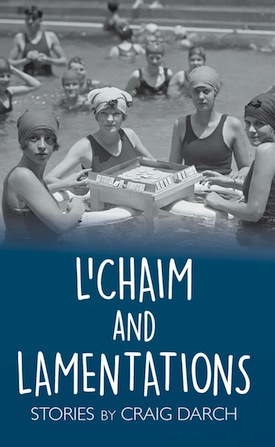
image - L’Chaim and Lamentations coverIn the humorous tale Darch has imagined, Rabbi Fiddleman, “held court each day in Schwartzman’s with his two followers – Pincus Eisenberg and Mendel Nachman.” As described by another customer at the deli, the “group of three old men, the only other customers in the place, huddled together with covered heads at a booth in the far corner, all remnants from the Romanian synagogue, bankrupt and boarded up years ago. Now, with no place for them to go, the octogenarians arrived early each morning and stayed for several hours – sipping tea, noshing on the cheapest fare, and kibbitzing about spiritualism and life after death, debates that frequently drifted into polemical arguments concerning the metaphysics of Spinoza and Kant. Though generous with their opinions, when it came to money each one was more frugal than the next, and each had a knack for consuming great quantities of Schwartzman’s tea while nibbling a single bagel over the course of several hours.”

Darch’s characters are recognizable people with whom readers will feel loneliness and friendship (“Sadie’s Prayer”), fear (“Wasserman’s Ride Home”), heartache and bewilderment (“Kaddish for Two”), justice tinged with bitterness (“Leonard Saperstein & Company”), mystery and hope (“The Last Jew in Krotoszyn”), joy and possibility (“Who’s the Old Crone?”), acceptance and perseverance (“Miss Bargman”).

The young people in these stories represent both forces of change and the need for new traditions, as in the emotional story “Kaddish for Two,” in which a son finally gets the courage to tell his Orthodox parents that he is gay, and as preservers of the past, as in the somehow cheering “The Last Jew in Krotoszyn,” in which Magda, a 13-year-old non-Jewish girl, befriends Ruta, the story title’s last Jew.

“Ruta watched Magda run out the cemetery gate, heading toward home,” writes Darch. “Then Ruta shuffled slowly away, each step more difficult than the last. She stopped for just a moment to catch her breath. Bone tired, she rested her hands on her hips. She understood such fatigue was just one more signal, a tweak from the Almighty himself; her time in this world was coming to an end. But strangely, she had no fear of dying. She had faith that Magda would tend the cemetery and pass on the stories, the truth of Krotoszyn.”

Human connections – positive, negative and in between – are at the foundation of every story in L’Chaim and Lamentations. Enjoy.

Scrumptious soup ’n’ cookies

Kermit Soup, ready to serve. (photo by Shelley Civkin)

Treat your friends to one little taste of my Kermit Soup (aka kale-and-potato soup) and I guarantee they’ll be green with envy. Granted, it’s an unholy colour, which could be off-putting to some, but don’t dismiss it out of spoon. Even those who vigorously eschew kale (and aren’t partial to green) will be begging for seconds.

During these seemingly endless, dark days of fall and winter, there’s nothing more comforting than a thick, hearty soup. (Unless of course it’s a healthy serving of 15-year-old Balvenie, but that’s just wasted calories.) To me, soups are the bait-and-switch of mealtimes. If you haven’t been shopping in awhile, and all you’re planning for dinner is tuna sandwiches, then a good, substantial soup can easily step up to the plate and take on the starring role. After all, soup has got so much going for it: it’s filling, scrumptious and everything else pales by comparison. Especially if it’s Kermit Soup (you’ll see what I’m talking about soon enough). Don’t feel you need to apologize for its aberrant tint. I mean, just take a look around at the freakish hair colours you see on the streets. Kermit Soup has absolutely nothing to be embarrassed about. Nor do you.

It does help if you have a really good blender to make this soup. In fact, it’s rather essential. I’ve got a Breville at home and that sucker could crush rocks. (I’m pretty sure my blender has a bigger engine than my car.) Yams? No problem. Acorn squash? A joke. Carrots? In its sleep. Not that my recipe calls for any of those. Just saying. So, without further ado – meet the star of the dinner show.

KERMIT SOUP

2 cloves garlic
3 small/medium Yukon gold potatoes, diced
half a large yellow onion
6 cups baby kale, chopped and lightly packed (the store wouldn’t let me take     it without parental permission, so I used adult kale instead)
4 tbsp unsalted butter
1 quart (4 cups) chicken (or mushroom) broth
Salt and pepper to taste

  1. Mince the garlic.
  2. Peel and chop the onion.
  3. Peel and cube the potatoes.
  4. Rinse kale and drain it well. Remove the thick stems then chop it up.
  5. Melt butter over medium heat in a heavy soup pan.
  6. Add garlic, onion, potatoes, and salt and pepper to taste.
  7. Stir and cook for several minutes over medium heat.
  8. Add the broth and bring it to a boil. Skim off fat from the top.
  9. Gently simmer with the lid on for about 15 minutes or until potatoes are tender.
  10. Add the kale and cook without the lid for about three to five minutes or until tender.
  11. Transfer the soup to a blender a few cups at a time and puree. You might want to remove the little circle part of the blender lid to let some of the steam escape (but not while the blender is running). As each pureed batch is ready, pour it into another saucepan.
  12. Ready to serve! It’s even better reheated the next day, and it’s good cold, too. If you’re not too hungry, have some bread with it and you’ve got yourself a light, yet filling fall meal. You’re welcome.

So, by now you’ve devoured your Kermit Soup and tuna sandwiches. To great acclaim. The soup, that is. An hour-and-a-half goes by and you’re jonesing for something sweet. Now what? You could get in your car and drive to some overpriced, hipster dessert restaurant that charges $12.95 for a two-inch purple yam, all-vegan crème brulée. Or, you could rock it old school. In the comfort of your own home. With Weetabix Chocolate Chip Cookies.

Yes, Virginia, Weetabix is more than just a breakfast cereal. Plus, it adds a nice crunchy texture to your cookies that you won’t soon forget (unless you overdo it with that 15-year-old Balvenie I referenced earlier. But that’s on you, not me). I always keep a box of Weetabix around, just in case of a cookie emergency. Which seems to happen with increasing frequency. And there are always chocolate chips hidden in my freezer (as if I don’t know where they are). So, go ahead, don your apron, pretend you’re Suzie Homemaker or Donna Reed and bake your family some irresistible cookies.

WEETABIX CHOCOLATE CHIP COOKIES

4 Weetabix, crushed
1 cup all-purpose flour
1/2 tsp baking soda
1/2 tsp salt
3/4 cup soft butter or margarine
1/2 cup firmly packed brown sugar
1/4 cup granulated white sugar
1 1/2 tsp vanilla extract
1 egg
1 cup semi-sweet chocolate chips

  1. Mix together crushed Weetabix, flour, baking soda and salt in medium bowl. Set aside.
  2. In a large bowl, using a hand mixer, cream together butter/margarine and sugars. Beat in vanilla and egg.
  3. Add dry ingredients and mix well. Stir in chocolate chips.
  4. Drop dough by tablespoonsful onto an ungreased baking sheet (or line with parchment paper).
  5. Bake at 350°F for 12 minutes (or slightly longer for a crispier cookie).
  6. Eat and repeat. Or eat ’em and weep. I’ll leave that to your discretion. These are so popular that you might want to make two batches at once. Just to be on the safe side. One batch never lasts more than half a day in my home, and there are only two of us. Again, you’re welcome.

These aren’t exactly balabatish recipes. More like nouveau accidental balabusta. But I do stand behind them. You see, I’m channeling my inner balabusta while I make them, and that’s good enough for me. I’ll leave the rugelach, kichele and komish broit to some other ambitious balabusta. On some other day. It just goes to show that food doesn’t need some fancy Yiddish name to taste geshmak. One bite of these Weetabix cookies and one spoonful of this Kermit Soup and you’ll be kvelling all over the place. Just clean up after all that kvelling, OK? Bottom line: it’s all about the heart and soul of the cook.

So, stop kvetching and get thee into the kitchen. Those cookies and soup aren’t going to make themselves. Just promise me one thing – you won’t ask for a refund if you don’t love the Kermit Soup.

Shelley Civkin, aka the Accidental Balabusta, is a happily retired librarian and communications officer. For 17 years, she wrote a weekly book review column for the Richmond Review. She’s currently a freelance writer and volunteer.

In Jerusalem for Sigd

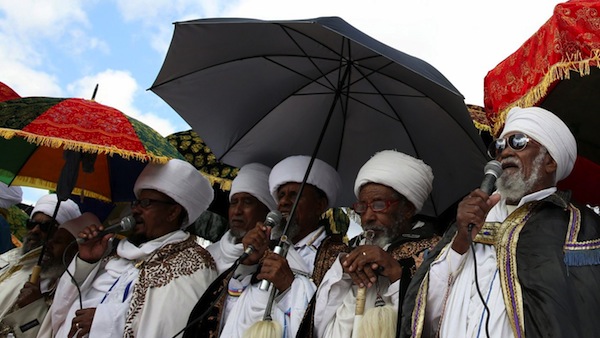
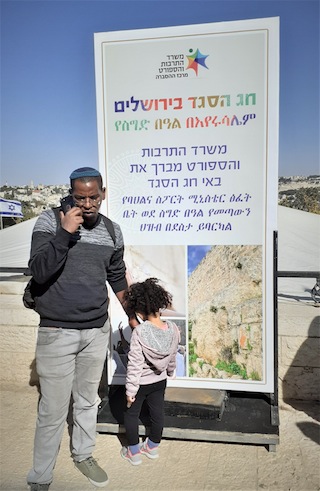
Standing on the Haas Promenade in southern Jerusalem overlooking the Old City of Jerusalem, the Ethiopian priests wore traditional clothing and carried parasols. (photo by Gil Zohar)

Approximately one-third of Israel’s 125,000-strong Ethiopian Jewish community came from across the country on Nov. 27, the 29th of Cheshvan in Judaism’s lunar calendar, for the festival Sigd. The mass clan gathering takes place 50 days after Yom Kippur, just as the holiday of Shavuot is celebrated 50 days after Passover.

Sigd, derived from the Hebrew word for prostration sgida, celebrates the renewal of the covenant between God and the Jewish people that followed the return of the Jews to the Land of Israel from the Babylonian exile 2,600 years ago, as described in the biblical book Nehemiah.

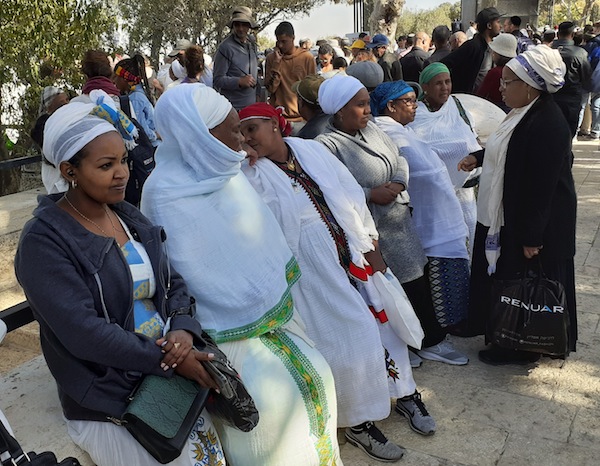
Symbolizing the Ethiopians’ rapid acculturation from rural Ethiopia to Israel’s high-tech start-up nation, many elders wore traditional clothing while teenagers preferred skin-tight jeans and Israel Defence Forces (IDF) khaki. Many celebrants were chatting on their cellphones.

The central event of the Sigd celebration was the priestly blessing by the kessim (spiritual leaders) in Geez, the sacred language used by Ethiopian Jews in their liturgy. Amharic, their traditional language today, has been widely displaced by Hebrew. Standing on the Haas Promenade in southern Jerusalem overlooking the Old City of Jerusalem, the priests wore traditional clothing and carried parasols.

Prior to being rescued from persecution and poverty in Africa in a series of military and espionage operations, including Operation Solomon in 1991 and continuing until today, Ethiopian Jews would ascend mountain tops above their villages in Gondar province for a mass Sigd prayer expressing their yearning for Zion. In Israel, the holiday has morphed into a day of thanksgiving for their rescue, as well their gratitude for the Torah and their cultural heritage, and most Ethiopian Jews under the age of 40 living in Israel only know those stories from their parents’ recounting. Children were not included in the Sigd observances in Ethiopia, both because of the difficulties of making a three-day trek up a mountain and to preserve the solemnity of the day.

photo - Among Ethiopian-Israelis, Sigd has morphed into a day of thanksgiving for their rescue, as well their gratitude for the Torah and their cultural heritage
Among Ethiopian-Israelis, Sigd has morphed into a day of thanksgiving for their rescue, as well their gratitude for the Torah and their cultural heritage. (photo by Gil Zohar)

Mingling with the colourful costumes and umbrellas of the older generation are the uniforms of the hundreds of Ethiopian men and women serving in the IDF. With the autumn temperature still summer-like, many youth are wearing skin-tight clothing that would have scandalized their elders in Ethiopia.

Among the elders is Rabbi David Yosef, a silver-bearded kes wearing a crocheted kippah, who explained how Sigd fits into the life of Ethiopian Jews.

The ancient community, which may date back to King Solomon and his dalliance with the Queen of Sheba 3,000 years ago, became cut off from mainstream Jewry, he says. More historically, Jews lived in Ethiopia from before the destruction of the First Temple in 586 BCE when the Babylonian conquerors of the Holy Land arrived. Driven into exile, these Jews considered themselves to stem from the tribe of Dan, one of the 10 lost tribes. Many were compelled to convert to Christianity in the 19th and 20th centuries but the community continued to dream and pray for a return to Jerusalem.

Starting in 1973, Ethiopian Jews suffered terribly under the dictator Col. Mengistu Haile Mariam. When Israel became aware of their plight, significant investigation and research was done, leading to a rabbinic ruling that accepts the Ethiopian Jews as part of the Jewish nation, entitling them to immigrate to Israel under the Jewish state’s Law of Return. That paved the way for 8,000 Ethiopian Jews to move to Israel. But then Mengistu forbade Jews to leave the country, and that led to the decision to covertly bring them to Israel. The 2019 Netflix movie The Red Sea Diving Resort recounts one of the Mossad’s rescue operations.

Nevertheless, some Israelis disputed the Ethiopians’ status as Jews. Rav Yosef carefully explained the Ethiopian Jewish engagement and wedding ceremonies and asserts that their practice conforms to the mishnaic description in Tractate Kiddushin (part of the Oral Law) of what constitutes proper Jewish betrothal. The community has always preserved its ritual status as Jews, he insisted.

“We missed Jerusalem for thousands of years,” he said. “Today, in Jerusalem, we celebrate … but, just as we say ‘Next year in Jerusalem’ at the Passover seder, so, too, at Sigd, we pray for a rebuilt Jerusalem.”

For Ziva, a 20-year-old from Ashkelon with braided hair, the Sigd celebration is a significant milestone. “I feel like it’s a day of unity for us,” she said.

For the young woman, who arrived in Israel with her parents 12 years ago, the observance of the ancient holiday reminds her that “there’s so much to remember.”

Giving the celebration the government’s seal of approval, Knesset Speaker Yuli Edelstein and Culture and Sport Minister Miri Regev both spoke, while President Reuven Rivlin delivered a video message.

The Ethiopian chief rabbi in Israel, Reuven Wabshat, said that, after the mass immigration of Ethiopian Jews to Israel, the decision had been taken by the community to continue celebrating the holiday, even though its essence is about the yearning to return to Jerusalem. He said the decision was made so that the community would not forget the “powerful heritage of Ethiopian Jewry,” and to help Israeli society understand the travails experienced by the Ethiopian Jewish community throughout their history.

photo - A large part of the Sigd celebration in Jerusalem is teaching about the Ethiopian community’s “ancient heritage, which every child should be proud of and pass on to the next generation”
A large part of the Sigd celebration in Jerusalem is teaching about the Ethiopian community’s “ancient heritage, which every child should be proud of and pass on to the next generation.” (photo by Gil Zohar)

The rabbi asserted that it was crucial for broader Israeli society to understand the Ethiopian Jewish community’s heritage and that it is an integral part of the Jewish people because of the “difficulties” the community has experienced in Israel.

The Ethiopian community has frequently complained of discrimination and racism against it and, in particular, has suffered from over-policing and a disproportionate number of arrests and indictments relative to its size. The recent death of Solomon Tekah, killed by a ricochet following an altercation between a group of youths and a police officer, led to renewed claims of police brutality, as well as protests and riots by members of the Ethiopian community. A previous bout of protests was sparked when video footage emerged of police officers beating an IDF soldier from the Ethiopian Jewish community.

“As you know, in recent years, the Ethiopian Jewish community has had difficult experiences, because people do not know and do not appreciate what Ethiopian Jews went through, and looked at things which are not relevant, such as differences in place of origin, but not the internal aspects of Ethiopian Jewry,” said Wabshat. “The Sigd holiday can bring people to the understanding and recognition that Ethiopian Jews are of the same flesh as all Jews around the world and, when the state recognizes Sigd, as it has, it means that we can all be one people.”

Among the kessim who participated in the prayers was Kes Mentasnut Govze from Beersheba. He explained how, in Ethiopia on Sigd, the Jewish community would travel to and ascend a mountain to “pray to God as one people with one heart that we would reach Jerusalem the next year and that the Temple would be rebuilt.”

Govze noted that, although the community has now reached Israel and Jerusalem, the Jewish people’s mission is not yet finished. “We still have not built the Temple and we must be clean,” he said. “If we go on the correct path, the path of the Torah, God will help us, we will build the Temple and bring the sacrifices.”

Member of Knesset Pnina Tamano-Shata described the holiday as “a big gift for Israeli society” since, she said, it could help unite the Jewish people. “It is so wonderful to see so many people here who are not from the Ethiopian community, and this holiday has become a holiday for all the Jewish people,” she said. “It is celebrated in kindergartens, schools, in the army, in local authorities, and the message is that this story is your story, it’s my story, and the story of all Jews, whether from Europe or from Arab countries.”

The MK said the identity of the Ethiopian Jewish community was strong, but noted the problems it has faced, including “difficulties which are connected to Israeli society, such as police violence, discrimination and racism,” but said the community has remained positive.

“We are positive and fully open to Israeli society, we are not in a place of antagonism, even though we have had a very hard, challenging and intensive year, and we are far from getting justice; nevertheless, everything has its time and period,” she said.

Michal Avera Samuel, director of the nongovernmental organization Fidel (Association for Education and Social Integration of Ethiopian Jews in Israel), said the thousands of people who came to the celebrations in Jerusalem came “to learn and understand the heritage of Ethiopian Jews, which is an ancient heritage, which every child should be proud of and pass on to the next generation.”

She added, “The goal is that, through studying in school and youth groups, we can teach the heritage of Ethiopian Jews, and build a courageous identity together with a sense of belonging within Israeli society.”

Gil Zohar is a writer and tour guide in Jerusalem, Israel.