Camp should be “wow!”

Hanging out around a campfire with friends is one of the things many kids love about summer camp. (image from pxhere.com)

Every year when I was a child, the first day back at school after the summer break, we’d be expected to write an essay on “What I did during my summer holidays.” Back then, my family were so poor I rarely did anything much, but I was blessed with a fertile imagination so I concocted an amazing list of activities. After all, the first rule for a writer, which was my ambition even then, is never to let the truth interfere with a good story. Oh, how I would have loved to go to a summer sleepaway camp.

Fortunately, times have changed and my kids and various grandchildren have had that opportunity. So, I’ve rounded up relatives, kids, their friends and my friends, to ask what they loved and hated about summer camp.

These are some of the reactions I got in the “hate” department. “The toilets and showers – ugh!” “The mosquitoes, which feasted on my blood every day.” “My girlfriend, who was prettier than I was, got all the boys interested in her, especially the one I liked.” “The others were better at sports than I was, and I couldn’t swim. They laughed at me.”

None of those I quizzed however, failed to have lots of reasons to list under “things I loved.” “We put on a musical at the end of camp, and we did everything, including painting the scenery. It was great!” “Parents Day, when they would visit the camp and bring us wonderful things to eat, that they rarely bought for us at home. The chocolates were divine.” “I learnt all kinds of crafts, that I still do sometimes. We were taught basketry, jewelry-making, ceramics and how to press flowers.” “One day, we had a Backwards Day – it was terrific fun. We even wore our clothes inside out.” “I loved the campfires, under the stars. We’d sing together, roast potatoes and onions, it was heaven. I can still remember the feeling of being among friends under a sky filled with stars, and the wind in the treetops. I think that was true happiness.”

Whether or not a camp will be a positive experience for a child largely depends on the parents’ preparation. Don’t send them to a camp you once attended and enjoyed without considering how the camp may have changed or the difference between your needs and desires and those of your child.

Think about what your child needs – to learn new skills, develop more self-confidence and independence, maybe to improve proficiency in certain areas. For the latter, there are lots of specialty camps such as tennis, horse-riding, hiking, adventure, backpacking or gymnastics.

The camp you choose will depend on the age and level of independence of the child. The first sleepaway camp can be very frightening for a young child and sometimes the best way to prepare them is to take them beforehand to the campsite and explain all the activities that will take place there.

Teenagers usually welcome escaping home and discipline for awhile and spreading their wings. No matter what the age, you need to consider and investigate the accessibility of the camp, its medical facilities and security arrangements. You also need to consider any fears your child might have, such as if a below-average athlete will feel comfortable trying new skills and be allowed to work on them at their own pace. Often it helps if they have a friend or two among the campers and, of course, try to meet the counselors to assess that they are competent and sympathetic.

A camp has the potential to offer a child many positive and rewarding experiences. They can be fun, healthy and relaxing. Many of the programs provide an opportunity to develop new skills, and become more responsible and independent. The main reaction I got from kids who’d been to a good camp was: “Wow! It was great. I want to go again this year!”

Dvora Waysman is a Jerusalem-based author. She has written 14 books, including The Pomegranate Pendant, which was made into a movie, and her latest novella, Searching for Sarah. She can be contacted at dwaysman@gmail.com or through her blog dvorawaysman.com.

Tips for choosing right camp

No matter your observance level, prioritizing a Jewish camp will boost your kids’ enrichment and ownership in the Jewish community. (photo by Joe Goldberg / flickr)

Day camp or sleepaway camp? Single sex or co-ed? Traditionally Jewish or liberal? Shabbat observant? Kosher? STEM or sports camp? The choices are endless. No matter your observance level, prioritizing a Jewish camp will boost your kids’ enrichment and ownership in the Jewish community.

As a parent, I often feel overwhelmed by the options available. Many say, “You’re the expert!” when it comes to your own kids. Yet, it can be hard to get inside kids’ brains to know what is right for them – and summer camp is one of those big decisions. It’s a time for childcare, enrichment and fun. But it must be decided in advance, it’s sometimes expensive and it can feel like a risky guess. Here are some tips to get started.

What do you need?

If you must get kids to camp before work, let’s be honest. Camp serves as childcare. It needs to be something you can pull off each morning. Make a list of what you need to make it through the summer. Early morning or afternoon care, a way to purchase healthy snacks and lunches, or a bus that picks the kids up? These may be essentials for some parents.

Some need much more. Kosher food? Stricter Sabbath observance? These may limit your choices. If your kid has special needs, your work schedule is unpredictable or you live far from Jewish camping options, things become complicated. Some parents start with geography. For many, it’s unrealistic to try to drive an hour to camp each morning with small kids before getting to work.

Plan ahead

If your list of possible Jewish camping options is short, find out when sign-up opens and get your kids’ names on the list. Sign-up often happens in January or February – long before we’re ready!

What do your kids want?

I started my research by asking my twins what they liked to do most in the summer. To my surprise, playing outdoors with Mommy and the dogs ranked top on their list. When I prioritized the other “wants,” it became clear that taking swim lessons at a lake (with a half-hour drive on each end) and just getting a chance for free play in the sunshine were key elements of their summer. For that summer, we had only a month of camp and a long but inexpensive “staycation,” with trips to a lake with a parent. We fit in making challah, doing Jewish art projects and reading PJ Library books, too.

Other requests might include attending camp with a close friend or trying out a new skill (music, acting, soccer, coding) – and these could all happen at a Jewish camp.

Be realistic

Maybe your kids know what they want, but, sometimes, they don’t. That’s OK. A general day camp, with lots of activities and choices every day, may be just the ticket.

One summer, I was sent to a co-ed sleepaway camp far from home for a month. I didn’t know anyone. The daily activities included a large dose of sports, which I hated. Worse yet, there was an outbreak of head lice. It was awful. By contrast, I also spent two years attending an overnight girls’ camp for two weeks each summer with a friend. I loved the library and the arts and crafts stations and have vague but good memories.

A kid’s maturity level matters, too. I was an independent oldest sibling, ready for overnight camps at 8, but, at that age, it was clear my twins were not ready to go anywhere overnight. I did ask them though. Did they want to go to sleepaway camp with some of their friends? I got a resounding no. Your kids often know what they’re ready for and what they wouldn’t enjoy. Give them a choice.

Feel confident in safety

Camp is a lot more flexible than life during the school year. There’s swimming, group sports and many other ways to have fun – and get hurt. Many camps are staffed by well-meaning teenagers and university students, with only a few adults supervising. Be sure things are safe and the activities are a right fit for your kids. Even one bad interaction with a bully or an unsafe situation could make camp hard for your kid.

There’s also a feeling of confidence when you know that the people in charge are knowledgeable and making good decisions that you can trust.

Ensure communication

Make sure the camp gives parents and campers lots of information from the beginning about what they will be doing each day, what they need to bring and how to have a successful experience. A camp that doesn’t remind you to bring towels or bag lunches may also be disorganized in other ways, too. See if the counselors offer you information when you drop off or pick up your kid so you can know more about what goes on. Tell those in charge that you expect to know about any injuries or tussles during the day.

Compromise is key

Sometimes, when you’ve gotten through your list of Jewish camps and kids’ desires, you find that the best camp for one kid might not work for the other. Or, the only horseback riding camp is single sex, and the kid’s best friend is not the same gender.

Sometimes, we need to choose out of our comfort zones to make things work. My kids attended a Chabad travel camp for years. It didn’t jive with my egalitarian sensibilities. Some of the theology concerned me. However, they definitely learned about Judaism and had fun. I trusted one of the directors, my kids’ former preschool teacher, completely.

It’s important to optimize things as best you can, and then compromise, too. There are a limited number of Jewish camps out there. Your kids have only a few summers to have fun outdoors with friends. Put aside some of the details you can’t change so you can make the most of their fun – and Jewish – times in the sun. They may remember their camp experience forever.

Joanne Seiff has written regularly for CBC Manitoba and various Jewish publications. She is the author of three books, including From the Outside In: Jewish Post Columns 2015-2016, a collection of essays available for digital download or as a paperback from Amazon. Check her out on Instagram @yrnspinner or at joanneseiff.blogspot.com.

אמזון תתרחב בוונקובר

אמזון בוונקובר (amazon.jobs)

הנהלת אמזון החליטה לאחרונה לבטל את החלטתה קודמת שהייתה להקים את אחד משני מהמטות המרכזיים שלה בצפון אמריקה – בעיר ניו יורק. במקומו העבודה תפוצל למספר מטות קטנים יותר שפרושים בשבע עשרה ערים שונות ביבשת. ובעיקרם: בוונקובר, בסן פרנסיסקו ובבוסטון. כידוע בשנה שעברה החליטה אמזון להקים מטה שני בנוסף לניו יורק והעיר ארלינגטון (שבמדינת וירגי’ניה) זכתה בו. אך כאמור הוחלט לרדת מניו יורק וונקובר תהיה אחת המרוויחות הגדולות ממהלך זה. בארלינגטון יועסקו כעשרים וחמישה אלף עובדים ובערים הנוספות (כולל ונקובר) יועסקו גם כן כעשרים וחמישה אלף עובדים של אמזון.

עתה מתברר שכנראה ונקובר תזכה לנתח משמעותי עוד יותר ואמזון תפתח בעיר מטה גדול במיוחד, שיעסיק לא פחות מעשרת אלפים ואולי אף שניים עשר אלף עובדים. המטה יוקם בבנין של רשות הדואר הקנדית לשעבר שמוגדר כבניין לשימור. לכן מעטפת הבניין נשמרת אך מעבר לכך כל החלק הפנימי נהרס. על הגג הרחב של הבניין יבנו שני מגדלי משרדים. העבודות לפיתוח והקמת הפרוייקט החדש בבניין של קנדה פוסט לשעבר, שכבר התחילו לפני מספר שנים, ימשכו עוד כשלוש שנים. זאת בניהולם של שתי חברות בנייה גדולות: קבוצת קוודראד ריל פרופרטי ובנטל קנדי.

אמזון התכוונה תחילה לשכור “רק” כארבע מאות ושישה עשר אלף סקוור פיט בבניין של הדואר לשעבר, אך עתה מתברר שהחברה האמריקנית בעצם תשתלט על כל שטחי המשרדים בבניין. מדובר על היקף של למעלה ממיליון סקוור פיט בבניין המתחדש. זהו ללא צל של ספק שטח ענקי בקנדה מידה של דאון טאון ונקובר. בכך אמזון תהפוך למעסיק התאגידי הגדול ביותר של העיר ונקובר.

בניין הדואר שלעבר ברחוב ג’ורג’יה יהפוך להיות בית משרדים גדול ומרכז קניות, שיכלול גם שטחים מסחריים ובהם: מסעדות, רשת קמעונית גדולה (כנראה רובלואו), מכון כושר ובית מרקחת. פרוייקט זה יביא לשינוי משמעותי בחיי הדאון טאון של ונקובר, שלא נחשב לסוער במיוחד עד היום. התפתחות הדאון דאון של הצד המזרחי של ונקובר כוללת גם הקמת בניין משרדים נוסף ברחוב ג’ורג’יה – מול בניין הדואר לשעבר, שיתנשא לגובה של עשרים וארבע קומות. הבניין בשטח של כארבע מאות אלף סווקר פיט אמור להיפתח בסוף שנה הבאה. במשרד ישוכנו בין היתר משרדים של אפל, ווסט בנק ודללויט ונקובר. בצמוד לבניין זה קיימות תוכניות פיתוח להקמת מגדל משרדים נוסף בגבוה כעשרים קומות, שישתרע על פני כשלוש מאות אלף סווקר פיט. עוד ידוע כבר שבניין משרדים נוסף מוקם בימים אלה בסמוך, ברחוב ג’ורג’יה פינת סימור. הבניין בגובה שלושים ושלוש קומות שיתפרש על כארבע מאות אלף סווקר פיט יפתח בסוף אלפיים עשרים ואחד.

אמזון מעסיקה כיום כאלפיים עובדים בוונקובר שמשוכנים במספר משרדים זמניים. עם פתיחת משרדיה החדשים והגדולים בניין הדואר לשעבר, יגדל מספרים כאמור ללפחות כעשרת אלפים. בנוסף החברה האמריקנית תשלט על בניין משרדים חדש בן תשע קומות ברחוב דונסמיר, בו ישוכנו העובדים של אמזון שנמצאים כיום במשרדים זמניים ברחבי העיר. כידוע לאמזון יש גם משרדים בבניין של טלאס גארדן שסמוך לבניין הדואר לשעבר.

כשחברה ענקית כמו אמזון מרחיבה את פעילותה משמעותית באזור מסויים, מביא הדבר לכך חברות גדולות נוספות מגיעות גם כן לאותו אזור ופותחות בו גם כן משרדים. וכך יתפתח משמעותית החלק המזרחי של דאון טאון ובעצם כל דאון טאון ונקובר.

Letting imagination fly

Janet Strayer at the opening of her solo exhibit, Wings of Imagination, on Nov. 28 at the Zack Gallery. (photo by Olga Livshin)

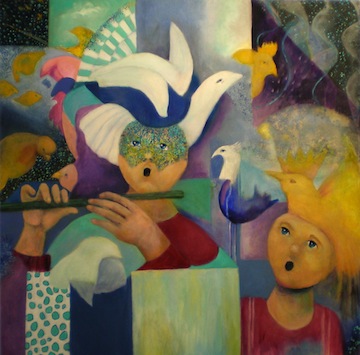
Janet Strayer first conceived the idea for her new show at the Zack Gallery, Wings of Imagination, about a year ago. “I was talking with Linda, and the bird theme came about,” she said in an interview with the Independent, referring to Linda Lando, director of the gallery.

“Birds appeared in my paintings before,” said Strayer. “They take us into the air, into a different place. Birds symbolize freedom – freedom of movement, freedom of imagination. The flight of imagination allows us to envision different possibilities, different solutions, even different ways to see familiar things. When I considered the name for this show, I thought about [Albert] Einstein and his words that knowledge is always limited, but imagination is limitless. Imagination is the most important thing for any artist.”

Wings of Imagination is all about flight and wings. Birds populate the paintings. Bright and whimsical, they flitter around birdhouses, soar towards a distant sky or interact with other creatures, real or imaginary. Some images are bright, almost cartoonish, inviting a smile, while others seem more serious, characterized by quiet intensity and misty, pastel colours. And then there are funky collages, with real 3-D birdhouses attached to the two-dimensional pictures.

“There are three distinct styles of paintings in this show,” said Strayer. “The three styles are consistent with the theme of the show. I started it conceptually, as I always do, but I couldn’t explore it in any one direction. Wings of imagination is a huge theme, and there is no one way to approach it – all the possible ways should be expressed. Freedom of expression is what it is all about; it is like several different directions of flight.”

image - “Papageno” by Janet Strayer, whose exhibit at the Zack Gallery runs until Jan. 5
“Papageno” by Janet Strayer, whose exhibit at the Zack Gallery runs until Jan. 5.

One of the styles is almost impressionism. The paintings’ blurry lines are reminiscent of Claude Monet’s foggy nights. The dream-like imagery catapults the viewers into some eldritch realms of sublime illusions with their wings and birds, sky and air.

“Another style is magic realism,” the artist explained. “I wanted to go magical. Imagination is magic. The Canada goose is flying, but his wings are magical – you can’t see such pattern on a real goose, except in your imagination. Beside the goose hangs my homage to Leonard Cohen, as he walks across the sky.”

The two paintings of “Birdwoman” seem similar in composition but entirely different in their palettes and in their emotional subtext. “The colours in ‘Birdwoman on the Roof’ are muted compared to the other one,” said Strayer. “On the roof, she is open to the sky, not as loud as the other, more of a mystery. It has space for you to come in and indulge in your own perception, while the other one is more enclosed inside its room and its brilliant colours.”

Strayer’s magic realism paintings are eccentric and capricious, with clear lines between the colours and frolicking creatures from fantasy novels, while her third style, the collages, appear at first glance as a jumble of small images punctuated by birdhouses.

“Birds need places to live in,” said the artist. “I took a risk with the collages, didn’t know what would happen, but it was such fun working with them. It took me three months to finish those two collages. They started with fragments, and then they led to other fragments. And feathers. And birdhouses. Things tell you what to do, until the entire image comes alive. It was like an adventure in my studio every day. Where would it go?”

Strayer’s playful adventure resulted in two unique art installations. “I wanted people to be surprised by these collages,” she said. “I wanted them to stop and look at all the tiny details. We don’t always stop and look. Even with art, so often, we come to a gallery, but we just glance. We don’t stop and really look.”

Strayer’s is a familiar name to Zack Gallery patrons. She had a solo show at the gallery in 2010, but the difference between the two shows is not only temporal but esthetic. While the previous show was black-and-white digital art and a poetic look at childhood, this one is bursting with colour and exuberance, and features mostly acrylic paintings.

“I enjoy creating digital art,” she said, “but I wouldn’t want it as a steady diet. I’m an explorer. I always want to try something different. I love to work on real paintings. And I’ve always loved colour.”

For Strayer, a predominantly abstract artist, the esthetics of her creations are more important than the telling of a story or the conveying of a message.

“A message should come through the esthetics,” she said. “And, if someone has a different interpretation than me, it’s fine, too. As soon as the paintings are on the gallery wall, they are not mine anymore, even though I created them. Everyone could see something different, compatible with their own memories and experience.”

Wings of Imagination opened on Nov. 28 and runs until Jan. 5. To learn more about Strayer, visit janetstrayerart.com.

Olga Livshin is a Vancouver freelance writer. She can be reached at olgagodim@gmail.com.

Sketching historic shuls

Ben and Carla Levinson (photo by Sam Margolis)

With the speed of a street-corner caricaturist yet the precision of someone who seemingly misses nothing, Ben Levinson has for decades been capturing the cityscapes of the many places to which he has traveled with his wife, Carla. No pencil, no erasing. Just a black ink pen and a small sketchbook.

“My architectural career taught me to sketch quickly and furiously, and I am able to see details that most would not see,” Levinson told the Independent in an interview earlier this fall.

During these adventures, Levinson has sketched everything of architectural interest to him: churches, cathedrals, mosques, pyramids and, of course, synagogues, while Carla would station herself at a café.

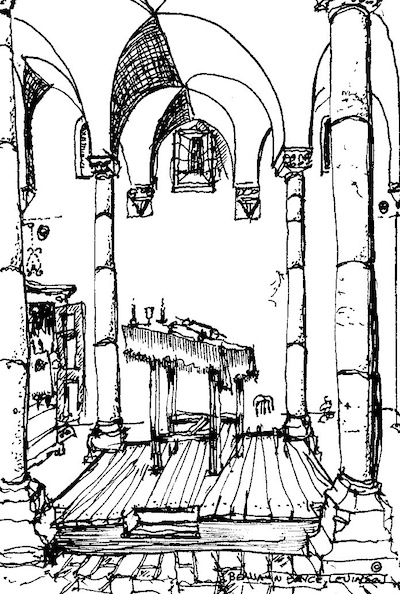
image - Synagogue at Tomar, Portugal. Sketch by Ben Levinson
Synagogue at Tomar, Portugal. Sketch by Ben Levinson.

By the time she was done with her coffee and croissant, Ben would have a complete rendering to show her. During the infrequent occasions she would finish first, incomplete drawings would be filled out when they reached their hotel.

The alacrity, accuracy and artistry of the sketches were at times the envy of those whom they encountered on their travels.

“We met artists whose wives and partners waited all too patiently and were ready to move on, whereas Ben was long done,” Carla said.

After looking through Ben’s sketchbooks one day, Carla suggested he do a show devoted to synagogues. Carla, who ran Victoria’s Gallery 1248, helped curate the selection of sketches that appeared at the Wings of Peace Gallery at Victoria’s Congregation Emanu-El from Sept. 4 through Yom Kippur. Now those sketches have been compiled into a book which is tentatively titled In Search of Identity: The Story of the Wandering Jew.

The book’s 49 sketches transport the viewer throughout the old and the new worlds. Many of the sketches are connected by the common experience of Jews moving on because of antisemitic treatment, despite centuries of coexistence in a community.

The figurative journey, which includes interiors and exteriors and is really the result of several holidays the Levinsons took over the span of two decades, sets off in Toledo, Spain, home to one of the few remaining synagogues left after the Spanish Inquisition scattered Jews throughout Europe and the Americas. Levinson’s exhibit and book spend a lot of time in Sephardi lands: a 14th-century Moorish-style synagogue in Cordoba; a tiny shul in Tomar, Portugal, the only pre-Renaissance temple in the country; larger houses of worship in Morocco, home to the largest Jewish population in the Arab world; and, finally, to the Portuguese Synagogue in Amsterdam, completed in 1675.

Poignant reminders of the once-thriving Jewish communities of Eastern Europe follow. Levinson leads the viewer through Berlin, Prague and Budapest, along with artistic reconstructions of the Terezin sleeping barracks and an ancient dig in Vienna.

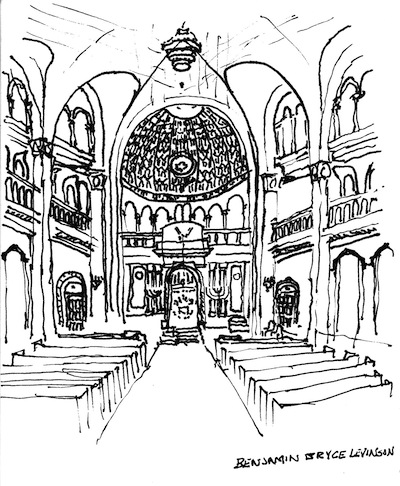
image - Templo Libertad in Buenos Aires, Argentina. Sketch by Ben Levinson
Templo Libertad in Buenos Aires, Argentina. Sketch by Ben Levinson.

The voyage shifts to France, Italy and Scandinavia, with the majestic Marais synagogue in Paris, the synagogue at the Museum of Jewish Life in Trieste and the Gothenburg Synagogue, the scene of a firebomb attack in 2017.

Levinson also presents active scenes of a crowd forming outside a Venice synagogue on a sunny Shabbat morning, passersby in front of an Antwerp temple and a sea of bicycles by the Great Synagogue of Copenhagen.

The visual trip wraps up with drawings from Mexico City and the Byzantine-style building of Libertad Synagogue in Buenos Aires.

Born in Medicine Hat, Alta., in 1942, Levinson graduated from the University of Manitoba’s architectural program. In 1966, he moved to Victoria and worked for various firms before starting his 30-year private practice as president of Benjamin Bryce Levinson Architects in 1980. In addition to leading his practice, he continued sketching and showing his work at various venues, including the Architectural Institute of British Columbia and the Jewish Community Centre of Greater Vancouver.

Levinson was instrumental in restoring Congregation Emanu-El in the early 1980s. When he arrived in town, he felt an initial disappointment upon seeing the synagogue with “its pink stucco, balcony balustrade pickets, missing fence and hidden dome ceiling.” He helped the synagogue’s leadership in obtaining grants and helped steer the building and fundraising committees to get the money necessary to revitalize the region’s most historic Jewish building.

Small Town Architect, the name of his first book, documents his 40-year career in architectural design and recounts his travels and artistic endeavours. His work can be found throughout Victoria and in numerous communities throughout the province; in elementary schools, municipal halls, grocery stores and restaurants, among other buildings.

Sam Margolis has written for the Globe and Mail, the National Post, UPI and MSNBC.

Choose to seek hope

Chanukah is about, among other things, sparking light amid the darkness. It is a message of hope that we should uplift all year round, not only in December. As discussed in this space last week, social media, and media generally, advances divisive and unsettling messages. So, while it takes perhaps more effort to light a candle than to curse the darkness, we should invest the little extra effort to find those stories that soothe our souls, calm our anxieties, and give us frameworks on which to build. Just as we have at our fingertips access to a million indignities and frustrations, so, too, can we choose to search for inspiring stories of kindness and coexistence.

As we share news in these pages throughout the year, we necessarily approach some unpleasant topics. But we also make a point to bring you uplifting news, including medical and other advances from Israel and our own community here in Canada. From Winnipeg, we recently reported on Operation Ezra, an ongoing program through which the Jewish community in that city assists newcomer Yazidis who are survivors of genocide, as well as the interfaith Meditation for Peace program at that city’s St. Boniface Cathedral. Closer to home, the Jewish and Muslim communities of Kelowna and area are celebrating their similarities with neighbourly get-togethers.

Just recently, community action led a Vancouver-area auction house to cancel the sale of Nazi paraphernalia. Taking a similar situation a step further, a Lebanese businessman, Abdallah Chatila, recently paid 50,000 euros for a hat owned by Hitler, and other Nazi memorabilia, in order to keep it out of the hands of neo-Nazis. He donated the items to Yad Vashem.

Israel’s President Reuven Rivlin met with Chatila and pinpointed the significance of the act. “What you did was seemingly so simple, but this act of grace shows the whole world how to fight the glorification of hatred and incitement against other people,” said Rivlin. “It was a truly human act. I know you have been thanked many times, but it was important for me to say it loud and clear here at the President’s Residence in Jerusalem – we appreciate it and thank you for it very much.”

About the same time, a group of civil society leaders and intellectuals from across the Arab world met in London for the inaugural meeting of what is being called the Arab Council for Regional Integration. These individuals, admittedly not-quite-mainstream in their respective bodies politic, reject the boycott and isolation of Israel, recognizing the harm it has caused to Palestinians and the greater Arab world to quarantine the most innovative economy in the region. This comes amid what appears to be a major reconfiguration of Middle East politics, which bodes well for Israel. The Gulf States are making overtures to Israel and other longtime belligerents are softening their tones. It is, of course, part of an internal Sunni-Shiite political struggle within the area, but that in no way takes away from the historic nature of the opening.

This year, we reported on the response to Tag Mechir (“price tag” attacks by radical West Bank settlers) with Tag Meir (“Light Tagging,” in which volunteers perform surprising acts of kindness across divides). We also ran a story on T’ruah: The Rabbinic Call for Human Rights, which works in Jewish social justice circles in Israel and North America. And we published an article on the efforts of the Jerusalem Foundation, a font of coexistence projects in the holy city, from Hebrew-Arabic bilingual education and colour-blind poverty alleviation efforts to a dance troupe for ultra-Orthodox women and kids music programs that transcend cultural differences.

Elsewhere in Israel, dance is the medium of another intercultural project, in a workshop created earlier this year called Steps from Sana’a to Hebron, in which Yemenite Jews pair their traditional dance with the Palestinian dabke danced by a group of Palestinians from outside Hebron.

Especially at this time of year, despite the inter- and intra-cultural divisions in Israel, there are countless small points of light. In Haifa, long considered a model of inter-religious coexistence, December is a time of celebrating Chanukah and Christmas in a diverse community including Muslims, Baha’is, Druze and others.

As simple as such small interactions might seem, they can have the most profound impact on participants. Once you begin searching for such stories, the results are bountiful.

Here in Canada, in Israel and around the world, similar stories of goodwill and overcoming differences abound. They are not likely to crawl across the bottom of your cable news screen. So, we must seek them out. We must.

An advocate for two states

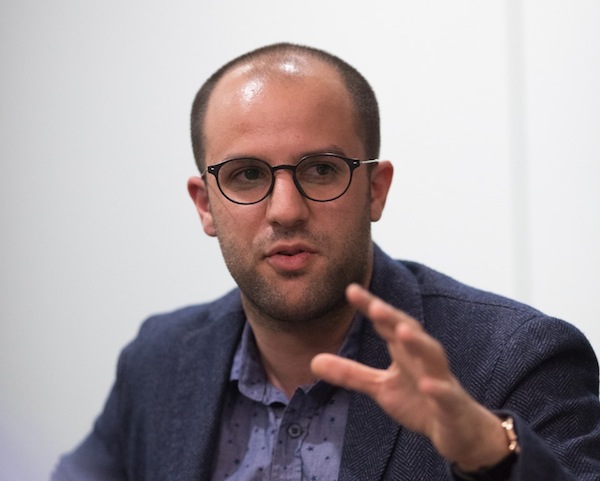
Eli Kowaz is communications director at the Israel Policy Forum. (photo from Eli Kowaz)

This article is one in an occasional series about people with British Columbian roots having positive impacts in Israel and elsewhere.

For Vancouver-born Israeli Eli Kowaz, there is only one path to ensuring Israel remains both a Jewish state and a democracy: a two-state solution. The road to that ideal may be long and the slogging hard, but this is the core mandate of the Israel Policy Forum, where he serves as communications director.

Though focused on Israel and its situation, IPF’s mission is to “shape the discourse and mobilize support among American Jewish leaders and U.S. policymakers for the realization of a viable two-state solution.”

Israel currently has military control over the entire land from the Mediterranean Sea to the Jordan River but, to continue being a Jewish state as well as a democracy, Kowaz said, Israel faces a decision.

“It can decide to annex the West Bank, keep the entire land and, if it wants to be a Jewish state, it will have to give up on the democracy aspect because, if it was to grant all the citizens living between the Jordan and the Mediterranean equal rights, then already today, Jews would be about 50-50, a small majority,” he said.

The answer is not cut and dry, he acknowledged. The Jordan Valley is a vital Israeli security interest and, come what may, Israel is likely to maintain military control there for the foreseeable medium-term. But both Israeli Prime Minister Binyamin Netanyahu and U.S. President Donald Trump have recently obfuscated their countries’ erstwhile support for a two-state solution. In Netanyahu’s case, it’s at least partly political, said Kowaz.

“He is dependent on his right-wing coalition partners, he’s willing to say things and even do things to secure his position as prime minister, even though he’s already surpassed [David] Ben-Gurion as Israel’s longest-serving one,” Kowaz said. “A lot of it is right-wing pandering to those people. Another part of it is a genuine security concern. The research done by the top security experts in Israel and others show that there is a way to keep that area secure while advancing a gradual separation of Palestinians and an eventual two states. Obviously, it’s not something that’s happening tomorrow.”

Kowaz, now 29, grew up in Vancouver’s Oakridge neighbourhood with an Israeli father, Joseph Kowaz, who moved to Vancouver in his 20s, and a mother, Andrea (Rogow) Kowaz, who moved here from New York at a young age. His late maternal grandparents were community leaders and academics Dr. Sally and Dr. Robert Rogow.

He attended Vancouver Talmud Torah and Hebrew Academy for elementary school and Magee and King David high schools, “so I kind of got a taste of Orthodox Jewish education, more of a secular traditional and also public school, so it was nice to have,” he said.

Kowaz did a gap year in Israel after high school, studying at Hebrew University and Ben-Gurion University. Returning to Canada, he graduated from McGill University in Montreal and then completed a graduate degree in digital media at Ryerson University in Toronto. His final project for his degree addressed ways to remember and educate about the Holocaust in the 21st century.

“From the beginning, I wanted to do something that was Israel-related,” said Kowaz. “So, it was either move straight to Israel or look for something Israel-connected that was outside of Israel.” He moved to New York City and soon got work at IPF. He moved to Tel Aviv last year and, in July 2018, married Tal Dor, a former graphic designer for the Israel Defence Forces newspaper BaMahane. She occasionally gives Kowaz advice and support from her experience.

Part of a generation that gained political awareness during the Second Intifada, Kowaz said he has been affected by the violent imagery of those days.

“I obviously want the best for everyone, but Israel is most important to me and I want Israel to be a Jewish state,” he said. “I want Israel to be a state that’s also accepted in the world to the best that it can be. Obviously, there will still be people that hate us but I don’t want Israel’s best allies to be Hungary, Poland, these right-wing [governments] with elements of fascism. We don’t want those to be our best friends, so, at the end of the day, I don’t think we have a perfect partner and the Palestinians, they’re never going to be a perfect partner, but we should do what’s best for Israel, which is at least preserve conditions for a two-state solution, a form of separation to secure Israel as a Jewish and democratic state as a goal for the next five, 10, 15 years. Keep that a possibility. And, right now … I think it’s definitely still an option. It’s still on the table. We haven’t killed it. But it’s treading in the wrong direction.”

The Israel Policy Forum began in 1993, said Kowaz, on the very day the day of the famous handshake on the White House lawn with Yitzhak Rabin, Bill Clinton and Yasser Arafat.

“At that time, Yitzhak Rabin was looking for American Jewish support for his vision of peace,” he said. “Even back then, AIPAC were already becoming close with Binyamin Netanyahu, who [had been] Israel’s ambassador to the UN and, at that time, he was already opposition leader.”

IPF does a lot of work in Washington, D.C., with policymakers, convening roundtable discussions and panels with congresspeople, congressional staffers and opinion leaders, as well as organizing events in synagogues around the United States, all focused on preserving conditions for two states.

Their positions are credibly backed up, said Kowaz, by security experts in Israel, called Commanders for Israel’s Security, which was begun by former major-general Amnon Reshef, a hero of the Yom Kippur War, and includes a cadre of 290 former IDF generals, Mossad and Shin Bet division heads and others.

“They work in Israel, so we work closely with them to relay their policy proposals and their messaging to an American audience,” he said. “It represents about 80% of the retired security establishment. It doesn’t get more legitimate than that. These are people that, I think, between all of them have 6,000 years of experience at the highest positions, making decisions constantly with people’s lives.”

While AIPAC has an upstart challenger on the left, J Street, Kowaz sees IPF as a more fact-based alternative to the politically oriented advocacy groups.

“People are looking for a voice that is different, that’s more policy-based, less trying to rally the troops and more looking at the facts,” he said. “I think we provide that kind of home and, in a way, everything’s very fact-based.”

Kowaz looks forward to continuing to work toward the perpetuation of Israel as a Jewish democratic state.

“It really doesn’t matter to me what the role is, I think that’s where I’d like to see myself,” he said, adding: “I’ve given up on the professional soccer career.”

A call to join Maspik!

No external threat worries Canadian Jewry more than the rising tide of antisemitism. For years, in grassroots consultations hosted by the Centre for Israel and Jewish Affairs (CIJA), community members have unanimously and consistently said antisemitism is their primary concern.

Pay attention to any conversation on the steps of your nearest synagogue or community centre and you’ll likely hear concerned community members say that Jewish organizations of all stripes should be doing more to combat the scourge of Jew-hatred. To paraphrase the words of an emphatic member of the community in Montreal: “Get together already! Enough is enough! Maspik!”

That passionate individual faithfully represented the perspectives of many in our community. To combat antisemitism, we must work together. We are stronger when we are united, and we must unite on this issue now.

No country in 2019 is free of antisemitism, no political orientation is insulated against Jew-hatred and no movement is entirely immune from discrimination against our people.

Contemporary antisemitism wears many faces and threatens our community on multiple fronts – from the extreme right to the extreme left and, increasingly, from segments within the Muslim community. Some antisemites operate in broad daylight in the public square and on social media. Others lurk in the obscurest corners of the dark web. What unites them is their hatred of Jews. And that should unite us.

Canada may be the best place in the world in which to be Jewish but, make no mistake, this country is not immune from antisemitism and the threat it poses to our safety and well-being.

For years, CIJA has worked to keep antisemitism at the margins. In recent months, these efforts have resulted in two important developments: Canada’s adoption of the International Holocaust Remembrance Alliance’s (IHRA) definition of antisemitism as part of the government’s anti-racism strategy and, secondly, the incorporation of many of CIJA’s policy positions in the study by the House of Commons Justice Committee, including our call for the creation of a national strategy to combat online hate and radicalization.

While these are important steps, in these challenging times, they are not enough. The enormity of the danger demands a unified approach. This is why we are calling on other organizations and individuals to join CIJA and a broad alliance of Jewish and non-Jewish groups in Canada from all sectors in establishing Maspik! A Coalition to Combat Antisemitism.

Thanks to support drawn from the proceeds of the recent Jewish National Fund Negev Dinner in Toronto, honouring Wendy Eisen and Carole Zucker, we now have the initial seed funds to launch this coalition, which we will expand and sustain over the longer term by establishing a fundraising program to ensure sufficient resources to create real impact.

In the coming weeks, CIJA and our federation partners across the country will establish an independent committee of lay leaders to oversee the grants and applications process. Once established, coalition members will be invited to apply for funding for action-oriented initiatives that advance our overarching objective of confronting and combating antisemitism in Canada.

It is time to act together. With your help, this coalition will provide support for individual organizational efforts, diminish the distracting noise of institutional egos, and give expression to a resounding sense of unity, as we join forces to combat a blight that is as old as the Jewish people.

Join CIJA, your local federation and other organizations representing tens of thousands of Jewish Canadians in saying enough is enough. Maspik!

Shimon Koffler Fogel is president and chief executive officer of the Centre for Israel and Jewish Affairs (CIJA). To learn more about Maspik! A Coalition to Combat Antisemitism, visit maspik.ca.

Young learners, big mission

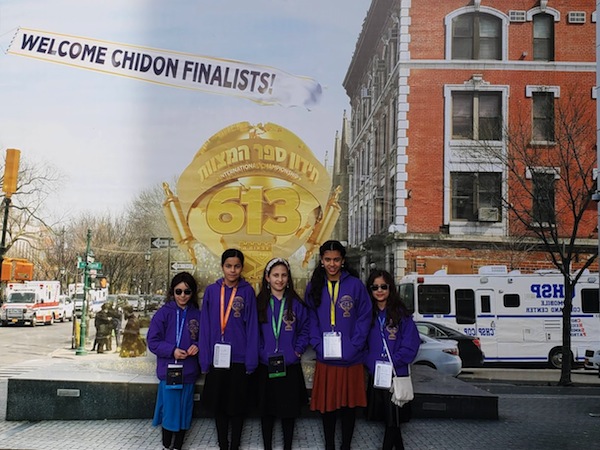
Left to right: Chana Rivka Bitton, Miriam Feigelstock, Baila Shapiro, Shira Oirechman and Ora Yeshayahu. The biggest event of the Tzivos Hashem year is a Shabbaton in New York, the highlight of which is an international competition called Chidon Sefer Hamitzvos, where kids from around the world compete in their knowledge and understanding of the 613 mitzvot of the Torah, as codified by Maimonides. (photo from Tzivos Hashem)

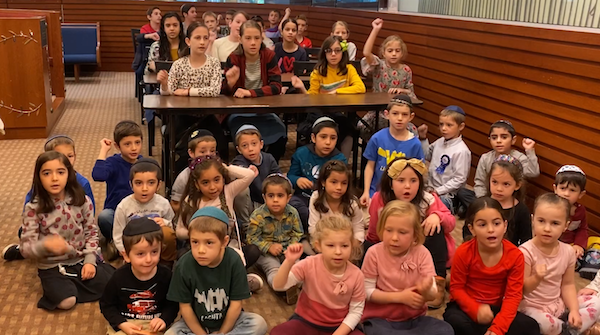
Walking into the Lubavitch Centre at 41st and Oak Street a couple of months ago, I witnessed a hub of activity so vibrant with excitement it was practically humming. Every available space was brimming with excited children, from little ones to newly minted teenagers. Engaged in drawing, listening intently, and engrossed in a whole variety of activities, I knew these kids had to be connected to Chayolei Tzivos Hashem.

Make no mistake – Chayolei Tzivos Hashem (CTH or Tzivos Hashem, for short) is serious business. According to Tzivos Hashem Vancouver coordinator Riki Oirechman, it’s an educational program for Jewish children ages 3-13, founded in 1980 in New York by the Lubavitcher Rebbe, Menachem Mendel Schneerson. Tzivos Hashem focuses on teaching about kindness, good deeds and refining our character to become better people and more effective influencers in our community. The program aims to increase Jewish identity and provide children with Chassidic Jewish learning through informal activities and songs.

Tzivos Hashem Vancouver was established several years ago by Rabbi Shmulik Yeshayahu, Rabbi Dovid Rosenfeld and Rabbi Schneur Wineberg and, since then, it has grown in size. Today, they count 50 children registered in the local program, and have plans to expand its hours. Currently, it is being held every Sunday at the Lubavitch Centre, from 10:30 a.m. to noon, in groups divided by age.

“It’s incredible to see how much the kids learn every week, and how much they enjoy coming,” said Oirechman. Parents even relate that their kids consider it the “highlight of their week.”

The Vancouver chapter of Tzivos Hashem was able to run the first two years thanks to a grant from the Phyliss and Irving Snider Foundation. This helped lay the foundation for the program. Since then, it is partially self-funded and relies on tuition fees for each student.

“The program is designed to give young children a sense of pride and belonging, a feeling of connectedness to other Jews,” said the Lubavitch Centre’s Rosenfeld. “It’s meant to instil in them an appreciation for what they do and inspire them to do even more.”

When asked what they learn, Rosenfeld said the curriculum includes things like a deeper insight into the Jewish holidays and following examples of role models from our ancient and recent history. The older kids learn Mishnah and Talmud. All of the learning is illustrated according to Chassidic theory, as taught by the Lubavitcher Rebbe.

“We encourage the children to advance their knowledge, not just maintain it,” said Rosenfeld. “Constant review and reinforcement of the different concepts allows the kids to build on the knowledge they gain each week. Moreover, we try to channel the kids’ studies into the practical realm, having them translate their knowledge into action. Whether through class activities, such as visiting the Louis Brier Home with cards and hamantashen before Purim, or with doughnuts before Chanukah, the kids can keep track of their mitzvot (good deeds) through an online logging system.”

“The Sunday program,” added Oirechman, “teaches kids in a fun, highly interactive and hands-on way. Our lessons incorporate creative team challenges, unique arts and crafts, educational games, Tanya (the foundational work of the Chabad movement) and mishnayot (the oldest authoritative post-biblical collection and codification of Jewish oral laws), memorization, weekly missions, songs and much more. In the short time we have each Sunday, we instil and teach the kids important values.”

photo - A group of Tzivos Hashem learners
A group of Tzivos Hashem learners. (photo from Tzivos Hashem)

Tzivos Hashem is based on the Rebbe’s style of teaching, and offers children badges for missions based on things they accomplish in their daily Jewish lives – for instance, saying Modei Ani every morning, washing their hands before meals, giving tzedakah, saying Tehillim (Psalms), etc. Using the army and its ranks as a metaphor for how Tzivos Hashem is structured, the program enables children to learn at their own pace and get rewarded for it. Each student starts out as a private, but, as they do more good deeds and complete missions, they earn mitzvah badges. After collecting enough badges, they are awarded medals. When they get enough medals, they are promoted in rank. Think of it like a Chassidic Airmiles loyalty program; when the children complete missions every week and behave during the Sunday programs, they’re rewarded with mileage points.

A few times throughout the year, there is a prize store, where the students can use the points they earned to buy prizes online. The global headquarters of Chayolei Tzivos Hashem hosts monthly raffles, where children who have completed missions can have a chance to earn more prizes. There are monthly international webcast rallies, where recognition and honour are given to students who have gone up in rank. The physical prizes act as incentives to learn and do more but, in reality, the incentives are inherent, or self-generated: love of Hashem and commitment to Torah values and Yiddishkeit.

The biggest event of the year is a Shabbaton in New York, the highlight of which is an international competition called Chidon Sefer Hamitzvos, where kids from around the world compete, on stage, in their knowledge and understanding of the 613 mitzvot of the Torah, as codified by Maimonides. The competition motivates the children to review the mitzvot and commit them to memory.

Oirechman said the Tzivos Hashem program is adding to both to the quality and quantity of learning opportunities and resources available in Vancouver for Jewish children. For more information about the Vancouver Tzivos Hashem program, email tzivoshashemvancouver@gmail.com or visit their website, thvancouver.ca.

With the goal of living Torah-observant lives, kids in the program are steered to become “lamplighters” – igniting and spreading light wherever they go, through good deeds, acts of kindness and Torah study. Light is something that can be shared infinitely and it only takes a bit of light to extinguish darkness. And while, from my outsider’s point of view, the army metaphor sounds rather harsh, it actually reflects a message that couldn’t be gentler and more caring: to love and help your fellow Jew.

Shelley Civkin is a happily retired librarian and communications officer. For 17 years, she wrote a weekly book review column for the Richmond Review. She’s currently a freelance writer and volunteer, including with Chabad Richmond.

A life of music, poetry

Ayelet Rose Gottlieb released two new collaborative CDs this year. (photo by Sergio Veranes)

Ayelet Rose Gottlieb released two new collaborative CDs this year: Who Has Seen the Wind? by the group Pneuma and I Carry Your Heart: A Tribute to Arnie Lawrence. Both creative endeavours will appeal to those who appreciate top-level musicianship, improvisation and meaning beyond the notes.

As she has done with other recordings, Who Has Seen the Wind?, which was released on Songlines, centres around a theme. In this case, the wind. Gottlieb and James Falzone, François Houle and Michael Winograd – clarinetists and fellow composers – have written music inspired by a range of poetry from various cultures, including Iranian and Japanese. The title of the CD comes from a poem by English poet Christina Rossetti of the same name, and Pneuma means breath, spirit or soul in ancient Greek.

I Carry Your Heart: A Tribute to Arnie Lawrence, which was released on Ride Symbol Records, also has poetry as one of its foundations, but it is, as its name says, a tribute to Arnie Lawrence and, specifically, his record Inside An Hourglass.

“Arnie’s Inside an Hourglass album has always been one of my favourite Arnie Lawrence records,” Gottlieb told the Independent. “In 1969, he went into the studio with his band and with his 8-year-old son Erik and with 5-year-old Dickie Davis Jr. (son of bassist Richard Davis). The band and children played a full record worth of improvised music together. This improvisation was released on the record label owned by the great flautist Herbie Mann.

“When I became a mother, this record started resonating with me in a new way. It reflected something of how I wanted to be a parent – in freedom, in music, in improvisation, with my kids and not in an ‘alternate reality’ that is separate from them.

“At one point,” she said, “I spoke to Arnie’s son, Erik, about the idea of revisiting the concept of that original album. Erik jumped on board and, along with my three little kids and our mutual friend and musical partner, Anat Fort, we went into pianist Chris Gestrin’s home studio in Coquitlam, B.C. My three little kids were 2 years old (twins) and 7 months old at the time of the recording. Baby Maia was with us for the full eight hours and the twins were there for about four hours. We also used some pre-recorded sounds that I edited in advance to create daily-sound tapestries for us to improvise over.

“We brought in some poetry by Arnie and E. E. Cummings and we let the day unfold as it did. The music on this album is all fully improvised – unrehearsed and unplanned. The biggest challenge was then to choose what to toss and what to keep. We loved so much of what came of this once-in-a-lifetime session.

“Our album is not a remake, but rather a revisiting of Arnie’s 1969 concept,” she stressed. “It’s a tribute to him and an extension of what he started back then, when his son was 8 years old. Fifty years later, Erik was creating this homage to his first album, now as the adult in the room, with his father’s mentee and her three children.”

Gottlieb met the elder Lawrence in Israel, where she grew up, when she was 16 years old; he had moved to Jerusalem from New York.

“He was the first to throw me into the deep waters of jazz,” she said. “My dear friend, fellow vocalist Julia Feldman, and I would go hear him play at the restaurant above the Khan Theatre. One day, someone told Arnie that the two teenagers sitting in the corner night after night are singers! At the start of the next set, somewhere around the middle of the first tune, Arnie walked up to me with a mic and commanded – ‘Sing.’ And that, I did.

“From that night on, Julia and I would frequent any restaurant, café or club he played at. In order to be able to hang with the ever-changing, always burning band, I memorized hundreds of tunes off of my father’s LPs and transcribed countless solos. After awhile, Arnie started calling me to perform with him, not as a sit-in guest, but as an equal on the bandstand. I always felt that playing alongside Arnie elevated my own playing to new levels. His trust in me allowed me to trust myself and my own musicality, at the fragile age of 17.”

Around this time, Gottlieb began composing. “I was finding my voice and my place in music,” she said. “When, at 19, I decided to go study at New England Conservatory in Boston, Arnie, who was my greatest advocate, wrote a wonderful recommendation letter, which felt like he was delivering me to my future teachers – Ran Blake, Dominique Eade, George Russell and others.

“Though my time with Arnie was spent primarily playing jazz standards, I feel that he gave me my foundations as a composer, improviser and as an educator. He taught me to work deeply with my ears, and to be present and connected. He gave me his trust, before I really did anything to deserve it. And this trust gave me the wings I still use to fly.”

Gottlieb is an avid poetry reader and collector, and has “shelves full of books and folders full of files with texts that I may or may not use some day, but they ‘feed’ me with inspiration and insight, daily. In recent years,” she said, “I’ve also been working as a poetry and prose translator from Hebrew to English.”

She sees everything, “through ‘glasses’ of music and poetry,” she said. “Music informs all of my experiences and poetry is built into my world of associations and my way of expressing myself in the world. When I compose, perform or improvise, I am the most ‘me,’ without filters. It feels like a calling, and a personal necessity. I’ve never had a time in my life in which I didn’t have music. It has been my companion and an extension of me, ever since I can remember myself. Some of my earliest memories involve music-making.

“It is also my portal into the world of spirit,” she said. “I experience inspiration in a great variety of ways. I often feel that the music I’m writing or improvising is received, rather than created. Of course, there is lots of knowledge, experience and work that goes into it, too. But this instinctual, primal connection is at the core of all of my works. This is why, when I make music, I do not think about anything other than what the music asks of me.

“I start thinking about the audience when it’s time to birth the music into a physical existence – when I’m working on packaging, releasing an album, bookings, getting the word out about it, etc.”

As an example of this transition from inner to outer focus, Gottlieb gave Pneuma, all of the members of which contributed to Who Has Seen the Wind?

“My contribution,” she said, “was a six-part song cycle based on Christina Rossetti’s poem ‘Who Has Seen the Wind?’…. This song cycle is a great example of my connection to music and poetry.

“The idea to work with clarinets was inspired by my paternal grandfather, who was an amateur clarinetist. Right from the start, this project was a way for me to communicate with him, and continue our connection and relationship beyond the limitations of the physical world. How wonderful to have such a thing as music, which bridges the gap between the earthly and the spheres beyond it!

“Christina Rossetti’s poem, which I know so well, kept surfacing in my associations as I was walking the streets of Vancouver with my babies in the stroller, in autumn 2016. From this poem, eventually emerged the form of this composition.”

When it came time to bring the music into physical form, the band members and their producer, Tony Reif, chose photographs for the CD sleeve by B.C.-based photographer Gem Salsberg, which, said Gottlieb, “pair a visual with the music, making it all the more accessible and clarifying our intensions with this set of music, inspired by the wind. We wrote liner notes, to bring our audience even further into the process of the creation and the stories behind the tunes. The album was released with a beautiful 16-page booklet, with all of the poetry printed.”

While the CD was released just this year, Pneuma’s première performance was at the Vancouver Jazz Festival in 2017.

“I love interacting with audiences,” said Gottlieb, “hearing people’s experiences with the music I make, answering questions, sharing muses, etc. The audience and their support fills my batteries as I continue on my path in music. There is always that back and forth between the internal work that is required in order to create the work and the external, open part of it – which is about sharing it generously, with as many people as possible.”

For more information on or to purchase either of these CDs, or other Gottlieb albums, visit ayeletrose.com.