O My God at Emanu-El

Bema Productions presents the Canadian première of the comedy O My God at Congregation Emanu-El Synagogue in Victoria, Jan. 16-26. In O My God by Israeli playwright Anat Gov, God walks into a therapist’s office suffering from depression. The therapist asks, “How long have you felt this way?” God says, “Two thousand, five hundred years. Give or take.” “You’ve been depressed for 2,000 years and only now you’ve come to therapy? What were you waiting for?” asks the therapist. And God says, “I thought time would heal.”

Gov, who died of cancer at 58, was born in 1953, and was a graduate of Thelma Yellin High School of the Arts. She was briefly a student in Tel Aviv University’s theatre department – she dropped out to become a successful playwright and television writer. She also married and was a mother of three and grandmother of two.

The Bema Productions staging of O My God is directed by Zelda Dean and performed by Christine Upright (the therapist), Rosemary Jeffery (God) and Jesse Wilson, who is on the autism spectrum himself, plays the autistic son of the therapist.

Tickets ($23) can be purchased online at ticketrocket.co or at the door.

Inspired through story, song

Musician Myrna Rabinowitz, left, and Jewish Senior Alliance’s Shanie Levin. (photo from JSA)

The theme of this year’s Jewish Seniors Alliance-Snider Foundation Empowerment Series is “Be inspired!” and the first of four sessions was called Be Inspired through Story and Song.

Held at the Peretz Centre for Secular Jewish Culture on Nov. 29, Gyda Chud, co-president of the JSA, introduced the two presenters, referring to each as “a gift to our community”: storyteller Shanie Levin, who is a member of JSA’s executive board and on the editorial board of JSA’s Senior Line magazine, and singer-songwriter and guitarist Myrna Rabinowitz.

Rabinowitz opened with the Yiddish song “Abi Gezunt” (“As Long as You’re Well”) and the audience echoed enthusiastically the refrain, “As long as you’re well, you can be happy.”

Levin followed with a story by Kadya Molodowsky, the first lady of Yiddish poetry. A House with Seven Windows is about a proud, strong heroine in the mid-19th century who embraced the dream of “normalizing” Jewish life through a return and settlement in the land of Israel.

Other songs by Rabinowitz included the Yiddish translation of Leonard Cohen’s “Hallelujah,” as well as “Sleep Little Boy,” a Yiddish song that she wrote eight years ago for her first grandson. She ended with the Yiddish rendition of “Sunrise Sunset” from Fiddler on the Roof (Tog Ayn Tog Oys).

Tall Tamara by Abraham Karpinowitz, both sympathetically comic and painfully tragic, was another inspiring story of Vilna’s poor and the unexpected dignity available to one woman through a chance contact with Yiddish literary culture.

Levin also shared Ted Allan’s Lies My Father Told Me, about the relationship between a 6-year-old child and his grandfather that transcends the differences in ages with deep connection. This story was made into a Golden Globe-winning film of the same name.

The last story Levin read – If Not Higher by I.L. Peretz – was about a rabbi who demonstrates that doing good deeds on earth may be a more exalted activity than doing God’s will in heaven.

Chud thanked the performers and urged the audience to attend upcoming JSA events, the next one being the screening of the movie Music of the Heart, starring Meryl Streep, at the Jewish Community Centre of Greater Vancouver on Jan. 15.

Marilyn Berger, who initiated the Light One Candle project and designed a card to help JSA celebrate Chanukah, encouraged the audience to spread the light and make a special donation to help JSA continue its peer support program, as well as its advocacy work.

For more information about JSA, visit jsalliance.org.

Tamara Frankel is a member of the board of Jewish Seniors Alliance.

Many milestones for Wosk in 2019

Dr. Yosef Wosk, right, with Max Wyman, 2017. (photo by Fred Cawsey)

The Yosef Wosk Poetry Initiative at the Jewish Community Centre of Greater Vancouver, which began in 2009, marked its 10th year with a celebratory gathering of artists and poets and with the publication of a commemorative book earlier this year. In addition, the Yosef Wosk Poets’ Corner, along with the adjacent Poet Laureates Garden, was inaugurated on the newly renovated top floor of the downtown central Vancouver Public Library – it was named in recognition of Dr. Yosef Wosk’s decades-long support of the VPL.

Wosk was an early major donor to the redevelopment of the eighth and ninth floors and the roof of the central branch of VPL and was asked to serve as honourary chair of the VPL campaign in 2018/19. The architect for the renovations, as for the library itself, was Moshe Safdie, while Cornelia Hahn Oberlander designed an extensive garden to complement her roof garden that crowns the award-winning structure.

In the library world, Wosk – who has established more than 400 libraries on all seven continents over the past 20 years – was able to fund more than 50 new initiatives in 2018/19, including 20 libraries in remote Himalayan villages and 37 in Jewish communities throughout the world.

As a writer and publisher, Wosk’s work has appeared in a number of publications. Most recently, these include having curated and written the preface for Memories of Jewish Poland: The 1932 Photographs of Nachum Tim Gidal, featuring photographs by Gidal from Wosk’s and the Israel Museum’s collections (Gefen Publishing, Jerusalem and New York, 2019). He also initiated and funded a biography, written by Christopher Best, of Faye Leung, the effervescent pioneer in the Chinese and real estate communities, affectionately known as the Hat Lady (Warfleet Press, 2020).

Wosk’s essay “On the Wings of Forever” was published in the online Ormsby Review this year in collaboration with the Canadian Academy of Independent Scholars. The editor’s preface notes that: “With prose as profound and learned as it is clear and accessible, here Wosk examines and appreciates the role of museums and museum workers in the digitizing modern world. It’s not gloom ’n’ doom. Instead, he outlines what he calls ‘a stirring vision, one of innovative technology on a human scale, heart-centred and soul-sized.’”

In collaboration with the Canadian Museums Association, Wosk helped transform the President’s Award into the President’s Medal; he also commissioned the medal and wrote the introduction in the booklet that accompanies the honorific, which was first awarded in 2019.

The province-wide Max Wyman Award for Critical Writing in the Arts, which was inaugurated by Wosk in 2017, formed an alliance this year with the VIVA Awards (the Shadbolt Foundation), which will begin in 2020.

In academia, Wosk was reappointed this year as an adjunct professor in humanities at Simon Fraser University and completed four years as a Shadbolt Fellow at SFU, where he was recently named a Simons Fellow.

During the year, Wosk served on 11 boards in the Jewish and general communities in areas such as education, medical research, museums, libraries, literature, business and the arts. These boards have included the Vancouver Holocaust Education Centre, Schara Tzedeck Cemetery Board, CHILD Foundation, Museums Foundation of Canada and Pacific Torah Institute. He was also an ambassador for the Vancouver Sculpture Biennale and is completing a second term with the B.C. Arts Council.

Green Thumb milestone

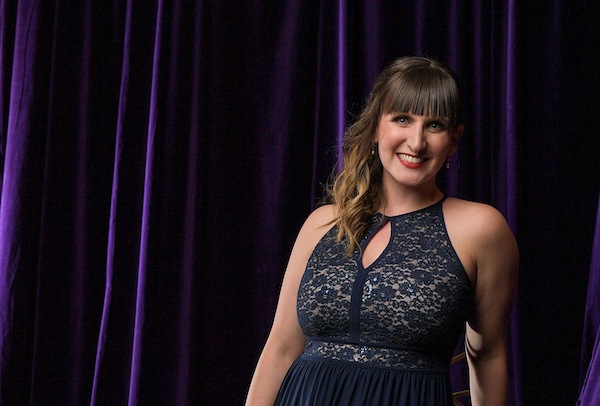
Breanne Harmon at the 41st Annual Business / Arts Awards. (photo from Business / Arts)

On Nov. 7, Vancouver-based Green Thumb Theatre, in partnership with TELUS, was awarded the Community Impact Award sponsored by KPMG at the 41st Annual Business / Arts Awards Gala, held at Meridian Hall in Toronto. The Business / Arts Awards recognizes and celebrates partnerships between business and the arts, and profiles exceptional volunteers and leaders in the business and arts community who have made a significant impact on the arts in Canada.

Breanne Harmon (née Jackson) is general manager of Green Thumb. She was born and raised in Richmond, and was an avid and active member of both Beth Israel USY and Vancouver Hillel at the University of British Columbia, where she graduated with her bachelor of fine arts in theatre production and design.

Since 1975, Green Thumb Theatre has been a staple in many schools across Canada. Each year, they tour to hundreds of schools and communities, and bring professional productions to students who may otherwise have no exposure to theatre in their communities. For the past 13 years, TELUS has been a committed partner, supporting Green Thumb in creating and executing relatable, educational, artistically excellent and relevant theatre for young audiences. Throughout this partnership, TELUS has supported the development of plays that address important social issues, including bullying, homophobia, drug addiction, respectful relationships and consent.

“By bringing live professional theatre that addresses social issues youth face on a daily basis directly into their schools, we can continue to reach thousands of youth with our programming each year, making a lasting impact on those who see our plays,” said Harmon.

Green Thumb Theatre is the third theatre company – and first theatre for young audiences and touring company – to be awarded the Community Impact Award. This is the first time Green Thumb Theatre has been recognized by Business / Arts.

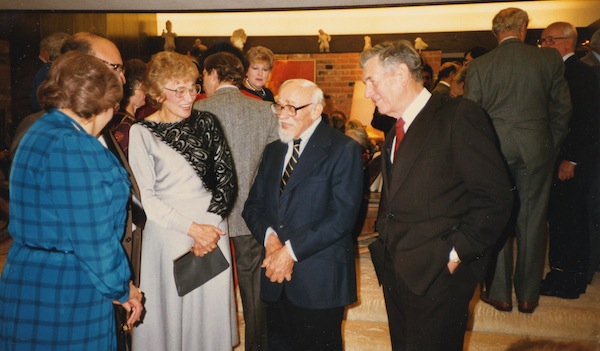
Mystery photos … Dec. 20/19

Photographs from an unidentified event in 1985, possibly a University of British Columbia event, likely in honour of Harry Adaskin, who is pictured centre-right in the above photo. (JWB fonds, JMABC L.13769)

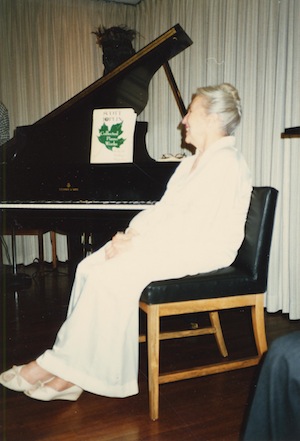
photo - Photograph from an unidentified event in 1985, possibly a University of British Columbia event, likely in honour of Harry Adaskin
(JWB fonds, JMABC L.13755)

If you know someone in these photos, please help the JI fill the gaps of its predecessor’s (the Jewish Western Bulletin’s) collection at the Jewish Museum and Archives of B.C. by contacting archives@jewishmuseum.ca or 604-257-5199. To find out who has been identified in the photos, visit jewishmuseum.ca/blog.

The supporting cast in our lives

Shabbat, Dec. 21
Vayeishev, Genesis 37:1-40:23

I am a rabbi because of a game of catch I played at camp with a rabbi more than three times my age. I found love and happiness and my partner in life because my best friend and my family helped me through a very difficult time. I survived the social pressure cooker of high school because my woodshop teacher took a personal interest in my well-being. I am alive today, I truly believe, because an anonymous man pulled me back from the curb as I was about to step into oncoming traffic in Manchester, England. (I was looking in the wrong direction for British traffic patterns.)

We have all sorts of names for these people in our lives. Some call them guardian angels, some call them heroes, and our tradition calls them shlichim, “messengers” or “emissaries” from God. I call them supporting actors. A rabbi, a friend, family, a teacher and an anonymous man in the movie that is my life: these are the people who have enabled me to play a starring role!

These are the people who, intentionally or not, gave the trajectory of my life a nudge at just the right moment and kept it on track, or steered it in a new and better direction. If awards were given to supporting actors in life as they are to movie actors, then they would each deserve an Oscar for the roles they played and for how their playing of their roles enabled me to play mine.

Who are the supporting actors in your life? Who are the people, past or present, who, at critical crossroads in your life’s journey, gave you directions, held your hand and walked a bit of the way with you? Who are the people who, upon reflection, were it not for them, everything would be different and so much would not have been possible?

Consider for a moment the story of Joseph and his coat of many colours in this week’s Torah portion, Vayeishev.

Here, we meet Joseph, son of Jacob, grandson of Isaac, great-grandson of Abraham, who, by all accounts, is a leading man in the story of the Jewish people. Joseph, in my estimation, is the second most pivotal person in Jewish history. The most pivotal one is a man whose name we don’t know and the Torah doesn’t record, but whose role as a supporting actor in one scene of Joseph’s life changes the arc of Jewish history.

In this week’s portion, Joseph goes out searching for his brothers, who are supposed to be in the field tending the flock. He searches in all the usual places but can’t find them. Along the way, he meets a man whose name we never know: the Torah refers to him simply as ha-ish, “the man” who saw Joseph wandering in the field (Genesis 37:15).

There is an allusion here to the nameless man or angel that Jacob, Joseph’s father, wrestled with in the previous parashah, Vayishlach. We note that, sometimes, when the Torah does not name a character, that character comes to play a pivotal role in the unfolding story. Such is the case in this instance. The man sees that Joseph appears to be lost and approaches him. He asks: “What are you looking for?” Joseph responds, “I’m looking for my brothers. Can you tell me please where they are tending the flock?” (See Genesis 37:15-16.)

The nameless man remembers seeing Joseph’s brothers, he overheard them talking about heading toward a place called Dothan. On the anonymous man’s advice, Joseph seeks his brothers there and finds them. Shockingly, they are not happy to see him. They conspire against him, abuse him, threaten to kill him and, eventually, sell him into slavery to a band of traveling nomads who are headed to Egypt. Through a series of events, Joseph, the boy who looked for his brothers in a field, becomes the chief advisor to Pharaoh and ascends to the second-most powerful position in all of Egypt.

Meanwhile, a famine occurs in the Land of Israel and these same brothers are sent by the leader of the Israelites, their father Jacob, to find food. They travel to Egypt and, this time, it is they who are surprised to find their brother – not only alive, but also in a position to help them. After a series of encounters, Joseph embraces them, asks after his father and makes all the arrangements for the entire nation of Israel to immigrate to Egypt. His position and power save the Jewish people and, for many years, they live well in Egypt and thrive.

Then, a new pharaoh comes to power and forces the Israelites into slavery. A prophet named Moses rises up from among them and, through plagues of frogs, lice, boils and so on; the splitting of the Red Sea; and, ultimately, the giving of the Torah, the people return to the Land of Israel. And that’s pretty much the story of our people.

But what about this nameless man? Who or what was he?

The commentators offer a variety of answers. The 11th-century scholar, Abraham ibn Ezra, reads the text of Genesis 37:15 with a p’shat, a “straightforward” interpretation and concludes this was a passerby. Rashi, on the other hand, delves further and concludes: “This [the man] was the angel Gabriel, as it says (Daniel 10:21), ‘and the man Gabriel.’” (Rashi on Genesis 37:15) Rashi draws inference from the definite article that is used to identify “the” man.

Ramban explains that he was an ordinary man (a passerby), yet he was unwittingly fulfiling God’s design. He was actually “sent” by God to guide Joseph, though he himself was not aware of the significance of his actions. In Hebrew, the word malach means both “angel” and “messenger,” because every malach, human or supernatural, is one of God’s messengers, activated to implement His will on earth. (See Ramban on Genesis 37:15.)

Menachem Mendel Morgensztern of Kotzk, known as the Kotzker Rebbe (1787-1859), goes in a completely different direction: “The angel taught Joseph that, whenever one is straying in the ways of life, when one is downtrodden or downcast, one should speak to oneself and clarify for oneself what one is really asking for, looking for, seeking, and what one really desires, so that one can return and first explain to oneself what one needs.”

The Kotzker Rebbe seems to disagree with Ramban, Rashi and Ibn Ezra, saying, it’s not a passerby, God or an angel that points the way. Rather, he says that the supporting actor in this unfolding mystery is Joseph’s inner voice and that, sometimes, our inner voice can be our own supporting actor.

Whatever or whoever he was, were it not for ha-ish, the man Joseph met along the way, the man who told Joseph where to find his brothers, how different it all could have been.

We never know in the present tense which people or events will be the most instrumental and transformative in our lives but, in hindsight, nothing is clearer. Upon reflection, the pieces of the puzzle and the paths of our lives are perfectly clear, even if they may be filled with uncomfortable observations.

This week’s parashah is a reminder to all of us to recognize the supporting actors who have guided us on our path and pointed us to our direction. It compels us to acknowledge, honour and thank them – even to give them awards – for the important roles that they’ve played, for doing so teaches us something greater still: in recognizing the transformative influence of supporting actors in our lives, we become keenly aware of how important we are in the lives of others. And we come to appreciate the capacity each of us has to help our friends, neighbours, even strangers achieve wholeness in life and find what they are seeking.

Rabbi Dan Moskovitz is senior rabbi at Temple Sholom and author of The Men’s Seder (MRJ Publishing). He is also chair of the Reform Rabbis of Canada. His writing and perspective on Judaism appear in major print and digital media internationally. This article originally appeared on reformjudaism.org.

A not so diasporic dialogue

Awhile back, friends invited me to a writers group. Although I told them that I wasn’t quite the right fit for the group, they convinced me to go.

The meeting was nearby. I enjoyed walking on a cold, dark and starry night. Yet, the meeting’s “gatekeeper” told me that I wasn’t eligible for their future gatherings, as I didn’t (yet) write or edit in their genre. Instead, she invited me to another writers event in October. (I’m not on the social media lists for these types of things, as I tend to focus on writing deadlines and my household – and I’m introverted.)

The event, titled Diaspora Dialogues, took place on a Friday and Saturday. Although it might been possible for me to attend some parts of it, I saw only one gathering that interested me. Called Vulnerability and the Public Space, it boasted a live podcast, but it was held on Saturday afternoon. As someone who writes on religious issues in the public sphere, it seemed relevant. However, I saw no way that I could pull off attending – Saturday is a family day for us. After we go to services, I’m often feeding everyone a big lunch and playing with kids afterwards. (In an ideal world, we’d even take a nap!) To go, I’d have to have given up my day off and commit to attending on Shabbat.

This “diaspora” event, which seemed designed for Canadians of colour, was scheduled at a time when Muslims might be busy (Friday afternoon) and on Shabbat, when Jewish families might be busy with family or synagogue or both. It wasn’t inclusive of religious diversity. It excluded any person who might be both religiously observant and a Canadian minority.

Even the event’s title puzzled me, as the first dictionary definition for diaspora usually references the historical dispersal of the Jewish people outside of Israel. The “scattering of a people outside their original country to other places” is a secondary definition. So, OK, this was a secondary use of the definition, fine.

I resolved my personal conflict. I emailed one of the organizers to point out the discrepancy. Although I write about vulnerable religious issues, often in the public space, I wouldn’t be able to attend this “diaspora” event, as its timing excluded Canadian religious minorities. No matter, though, perhaps I could access the podcast online later? Where, I asked her, could I locate the podcast link?

I received no reply. The podcast never appeared online.

We celebrate our religious freedom on Chanukah. It’s the chance to rededicate our spaces to Jewish practice. However, the holiday’s origins are a tale of struggle between minorities and the majority: Jewish assimilationists, religious fundamentalists and the Seleucid empire’s religious majority (aka the Greeks, or the Assyrians). We remind ourselves of this in each generation – we can’t take religious freedom or Jewish practice for granted.

There has been a huge rise in antisemitic activity. Identifiable Jews or Israelis are now often targeted, assaulted and harassed throughout the world.

A far more subtle and insidious change has also happened in terms of Jewish identity. Now, U.S. President Donald Trump has decided, via presidential order, to define Jewish students as an ethnic or racialized “national”group that, theoretically, can’t be discriminated against. Yet, the definition alone is a worrying precedent.

Take a look around you at any Chanukah event. We’re not one race by any (purely artificial and historic) definitions. We aren’t one homogenous ethnic group, even if we might have been thousands of years ago. Just ask those who argue about doughnuts versus latkes or other holiday foods. What or who defines us? We’re now facing new identity definitions – as delineated from the outside.

We are a diaspora religious minority group that evolves and changes. We haven’t disappeared despite changing definitions.

Chanukah’s a minor holiday on our calendar. It celebrates clinging to our freedoms in a dark world. It relies on a subtle understanding that not all discrimination is based on racism. It implies that religious, ethnic or racial background alone doesn’t solely define someone’s minority status.

A true acknowledgement and respect for religious freedom is one that practises intersectionality instead.

What is intersectionality? Our identities – racial, sexual, class, gender, religion, nationality, etc. – are complex and changing. We are each the result of several roads, always under construction, that meet in one huge intersection.

As Jewish North Americans, living in the Diaspora, we’re more than one ethnicity, gender or race. Together, we celebrate our tradition and identity as a triumph over adversity. We just may have to celebrate with an understanding that we’re no longer included in some folks’ definition of diaspora and, hence, excluded from the narrative. Heck, I cannot even access the podcast about the narrative!

Wishing you a very happy, inclusive Chanukah from my family to yours. Have a great winter break, one where you feel included! May it be full of light, joy and peace.

Joanne Seiff has written regularly for CBC Manitoba and various Jewish publications. She is the author of three books, including From the Outside In: Jewish Post Columns 2015-2016, a collection of essays available for digital download or as a paperback from Amazon. Check her out on Instagram @yrnspinner or at joanneseiff.blogspot.com.

Providing care and support

Jamie Kinaschuk helps caregivers in various ways. (photo from Jamie Kinaschuk)

“When somebody faces a situation of becoming a caregiver, they can embrace it and see it as a sense of purpose for the person they’re caring for, or they can resent having to do it,” Jamie Kinaschuk, a social worker with A & O (Age and Opportunity) Inc. in Winnipeg, told the Independent.

“When you embrace it, you can feel that the tables have turned – from the time my parents looked after me to, now, me looking after them – and you can see this as something you want to do, are proud to do. That makes it easier.

“On the other hand, you can have a child or a spouse who’s just not ready and doesn’t want that responsibility. They may have been designated by other family members.”

In some situations, said Kinaschuk, the ultimate caregiver is the closest in physical proximity to the family member needing care and, as such, other family members expect them to carry the load of caring, not taking into account that the caregiver has their own life, family, job and/or other commitments.

Being a caregiver takes a toll in many ways, including that their life has to be put on hold to a certain extent.

“Somebody might become a caregiver with some resentment … or, maybe, the relationship between the caregiver and the recipient hasn’t been the greatest and it just happens that they live together,” said Kinaschuk. Regardless of the circumstances, “there is an impact on you physically, mentally, emotionally and financially.”

The care given varies by recipient. For some people, minimal help is needed – things like cooking, house cleaning or doing laundry and shopping. For others, assistance could be needed in bathing or grooming, getting dressed or using the toilet. Often, needs change over time and a caregiver is left to find ways to fill the new requirements of the person for whom they are caring. As a caregiver, one must learn to adapt.

“Maybe they have to locate a different doctor for a different health issue that has arisen,” said Kinaschuk. “Maybe they have to apply for home care, to locate medical supplies or transportation. Maybe it’s come to a point where they can no longer transport them, so they need something like Handy Transit.

“Sometimes what adds to the difficulty of being a caregiver is, if you’re a male caregiver, having to do the personal care if you’re caring for your mom. That could be a struggle – dressing, bathing and toileting.”

Ideally, caregivers will have their own support system, people who can provide some relief. Staying healthy is the most important thing a caregiver can do, not just for themselves but also to not become a further burden on the family.

Kinaschuk, who started his career with Winnipeg’s Jewish Child and Family Service in 2000, runs a caregivers support group.

“In my group,” he said, “we see a lot of caregivers struggling to access resources or, because they don’t have any other supports, they’re really struggling with the situation. There are times where, I’ll give you an example, a caregiver is struggling because their sibling doesn’t understand what they’re going through; they don’t know how difficult it is. That other sibling may say, ‘You can deal with it’ and ‘That’s not a problem.’”

Kinaschuk recommends having a heart-to-heart conversation with the other siblings or relatives to inform them about what’s going on. If a conversation is not an option, a letter can work wonders in getting the message across. “This way, they can read it and hopefully not rip it up, and then read it again,” said Kinaschuk. “And maybe they’ll realize that, ‘Yeah, my brother or sister is going through a lot. I better start supporting them.’”

One of the concerns is that a caregiver may take their frustrations out on the care recipient. Good communication with other family members and their support diminishes this risk, as does attending a caregiver support group. When possible, a talk about boundaries could be beneficial for all involved.

“Both the caregiver and the recipient need to realize that there are boundaries,” said Kinaschuk. “They both have boundaries.” Caregivers, he said, have to be honest with themselves and the recipient – be up front about the fact that they can only do so much.

“The recipient needs to realize that the caregiver needs time. They can’t be demanding 24/7 care,” he said. “They have to be respectful, to respect each other. If the recipient is too over-demanding, it drains the caregiver.”

If all involved can embrace the situation and find the positives, such as having an increased sense of purpose, then, being a caregiver can be an uplifting, life-changing experience.

“From the support group perspective, it’s all about empowering,” said Kinaschuk. “When people attend the support group, first of all, that’s where you see that you’re not alone – you see that other people are experiencing similar emotional, physical and mental situations.”

In his sessions, Kinaschuk asks that people not give advice, but rather share their experiences, in the hope that others can take what information they need to find a solution that fits them. At some meetings, he invites professionals – from the regional health authority and groups specializing in Alzheimer’s and palliative care, among others – to teach the group about different aspects of providing care.

Rebeca Kuropatwa is a Winnipeg freelance writer.

Constructing age-tech maps

Keren Etkin (photo by Pazit Oz)

Keren Etkin, a 32-year-old Israeli master’s student, has been working on what she calls the Age Tech Market Map. This small but full link library is a place for older adults to find the latest news about technology.

“I am a gerontologist by training and tech enthusiast by nature,” said Etkin, who was born and raised in Israel and currently lives in Tel Aviv. “Gerontology is the study of various aspects of aging and gerontologists are either scientists researching the various aspects of aging or professionals working in the aging business.”

While working on her undergraduate degree in the sciences, Etkin began volunteering with Holocaust survivors, which she found a stark contrast to working in the lab. After graduating, she continued further along this path, finding work in the nonprofit sector. But she soon realized that, without a relevant degree, it would be challenging for her to advance her career, which is why she is currently studying for a master’s in gerontology.

“I work at the intersection of tech and aging, which is a very interesting place to be right now, professionally,” said Etkin. “I also run The Gerontechnologist [thegerontechnologist.com], which allows me to explore different aspects of the age-tech ecosystem and talk to many interesting people who do interesting and impactful work.”

Etkin’s first job in the industry was with Intuition Robotics, where she helped develop and build ElliQ, a friendly sidekick for older adults.

“ElliQ was the first big project I was involved with,” said Etkin. “I was recruited to Intuition Robotics in 2016 as the company’s first employee and only gerontologist. That was a very hands-on project that I feel fortunate to have had the opportunity to work on for several years.

“I know there are other gerontologists out there working in or with start-ups or investing in start-ups, and I think that’s a good thing – to have professionals from the aging industry come work inside the tech industry and help build tech solutions for the aging population.”

ElliQ makes it easier to connect to family, friends and the digital world, and helps users stay active and engaged. With it, people can read and respond to messages, share pictures, get reminders about medications, respond to questions and even receive surprise suggestions throughout the day.

“I think incorporating technology into any field of work is beneficial, specifically when it comes to the aging industry,” said Etkin. “There’s a lot to gain, since it’s very labour intensive. Some of the work currently being done by humans could be done by machines – like paperwork and some physical tasks – hence, freeing up humans to perform tasks that require uniquely human skills, such as empathy, critical thinking and creative problem-solving.”

The biggest hurdle Etkin sees in the industry is that most tech companies do not view older adults as potential users. In her opinion, they are missing out on a huge sector.

“Studies show that older adults are adopting technology more and more,” she said. “Internet use is rising steadily and many older adults own smartphones. From my experience, older adults are willing to use technology as long as they find that it’s useful and brings value to their lives.”

According to Etkin’s website, “The global spending power of people 60+ years old is expected to reach $20 trillion by 2020. Americans over 50 are expected to spend $84 billion annually on tech products by 2030.

“Contrary to common belief, most older adults hold a positive perception of technology. Many are eager to learn new tech skills as long as they find them useful. However, most of them admit they require some assistance in setting up and learning to use new devices.

“A report by the Pew Research Center found that 42% of older adults in the U.S. own smartphones and that 67% use the internet. Baby boomers spend an average of 27 hours a week online.”

Etkin began working on The Gerontechnologist in 2017. At the time, she was just looking for was a snapshot of the ecosystem and she was curious to learn what other people in the field were working on.

“After spending many, many hours doing online research, I came to the conclusion that there was no age-tech market map out there and so I decided to create it myself,” said Etkin. “After publishing it online, I got a lot of feedback and realized that other people were also interested in this. I also realized that I enjoyed creating content about age tech, and it sort of took off from there. The blog today serves anyone who’s interested in tech for older adults.”

This past summer, Etkin started posting podcasts and video series on thegerontechnologist.com, and she plans to keep working on projects that she is passionate about and that she thinks bring value to the world.

Etkin is working on the 2020 Age Tech Market Map. In the process, she will evaluate more than 2,000 service providers and choose the top 200 for the map.

“I would love to hear about Canadian start-ups developing tech for older adults,” said Etkin. “You can reach me through the contact page on my website or message me on LinkedIn and Twitter.”

Rebeca Kuropatwa is a Winnipeg freelance writer.

Living’s Jewish aspects

A still from the Netflix show Living With Yourself, co-starring Paul Rudd.

As the secular New Year approaches, many people make resolutions, in an effort to become a better person. What if there were a shortcut? What if, for a tidy sum, you could be transformed, virtually overnight, into the person you’ve dreamed of being?

This the conundrum posed by the Netflix show Living With Yourself, an eight-part series released in late October, starring Paul Rudd and Aisling Bea, who play spouses Miles and Kate Elliot. Rudd is also one of the executive producers.

The premise is this: Miles, a shlub discontent with and disconnected from his wife, and suffering career ennui, discovers a “spa” that offers a treatment to improve his charm and confidence. For a small fortune, they promise, a “new you.” And so, a shlemiel enters and a gentleman exits. Just one problem: [spoiler] it’s actually a cloning lab and, unbeknownst to Miles and Clone Miles, the two men exist and, later, each must contend with the other in his life.

Rudd’s 25 years of movie experience includes Ant Man, Anchorman, Knocked Up, 40-Year-Old Virgin and Clueless. On television, he played Mike Hannigan in Friends and appeared in Reno 911, among other things.

The New Jersey-born actor hasn’t been shy in publicly discussing his Jewish identity. He kibitzed a bit about his Jewishness in an interview segment of Between Two Ferns. In an episode of Finding Your Roots, he found out that his grandfather, Davis Rudnitsky, fought the Nazis, only to return home to England to face antisemitism. In 2017, Rudd played his first (overtly) Jewish character, Moe Berg, in the biopic The Catcher Was a Spy, about a baseball player who joins the Second World War effort as an undercover agent.

In Living With Yourself, there is one explicit Jewish moment, when a Holocaust survivor tells Miles an off-colour anecdote about the Shoah, involving pork. But there are also hidden Jewish themes. For example, envious of a colleague’s extraordinary success in the office, Miles is spurred by the prospect that his technological makeover could help him outperform this coworker. Though Judaism has no problem with someone being motivated to accomplish because of another’s success, the Torah warns against jealousy. The ninth commandment is one obvious caution against such sentiment: “Thou shalt not covet.” Another is Joseph’s brothers (Genesis 36), who, enraged with jealousy, sell Joseph into slavery. In a sense, Miles and Clone Miles are like brothers, and they develop petty and spiteful jealousies, wanting the best of both worlds, but not able to have it.

If only Miles initially had derived fulfilment and was grateful for what he had, he wouldn’t be in this much trouble. Ethics of Our Fathers (Pirkei Avot) (4:1) advises just that: “Who has wealth? The one who is pleased with his lot.” The meaning isn’t limited to “wealth” of materials, of course, but the wealth of blessings that are bestowed upon us, including, for most of us, our loved ones, our safety, our employment and access to the necessities of life.

Notably, though, Miles versus Clone Miles is illustrative of the yetzer hara (good inclination) and the yetzer hatov (bad inclination) at battle with each other. Interestingly, neither character is completely good nor bad, but a combination, reflecting the real, complicated, human condition, where we have both inclinations competing inside us.

Often, we are able to convince ourselves of the nobility of our decisions – that is, find a good reason for our perhaps less-than-good action; explain away the importance of a choice’s potential harm. Paradoxically, the yetzer hatov has a sneaky side. To explain this, author and radio host Dennis Prager often cites the late Rabbi Wolfe Kelman, former head of the Conservative rabbinate. He once told Prager that he had his yetzer hara under control, but his yetzer hatov “always got him into trouble.”

Rarely do ordinary people wake up each morning and strive to make another human miserable. Still, we must wrestle with our “other” selves, overcome our justifications and egos, to make principled choices. Every day is a lesson in living with ourselves.

Dave Gordon is a Toronto-based freelance writer whose work has appeared in more than 100 publications around the world.