Skip to content
  • Home
  • Subscribe / donate
  • Events calendar
  • Business Directory
  • FAQ
  • News
    • Local
    • National
    • Israel
    • World
    • עניין בחדשות
      A roundup of news in Canada and further afield, in Hebrew.
  • Opinion
    • From the JI
    • Op-Ed
  • Arts & Culture
    • Performing Arts
    • Music
    • Books
    • Visual Arts
    • TV & Film
  • Life
    • Celebrating the Holidays
    • Travel
    • The Daily Snooze
      Cartoons by Jacob Samuel
    • Mystery Photo
      Help the JI and JMABC fill in the gaps in our archives.
  • Community Links
    • Organizations, Etc.
    • Other News Sources & Blogs
  • JI Chai Celebration
  • JI@88! video

Recent Posts

  • Legal help for students
  • Revisiting myth of Lilith
  • Wrong person rebuked
  • Canada’s mixed messages
  • Questions for museum
  • Symposium on antizionism
  • Making soccer political
  • CJPAC lauds Pulver’s impact
  • City recognizes Vrba’s legacy  
  • Organ donation saves lives
  • Theodore’s March premiere
  • A healing Shabbaton
  • Supplying healthy food
  • A chime of metal tags
  • Yellowknife seder a first
  • Ishai energizes, unifies
  • A Lag b’Omer to remember
  • Expanding the healing
  • Hannah Senesh – a unique hero
  • Community milestones … May 2026
  • Sharing her testimony
  • Fall fight takes leap forward
  • The balancing of rights
  • Multiple Tony n’ Tina roles
  • Stories of trauma, resilience
  • Celebrate our culture
  • A responsibility to help
  • What wellness means at JCC
  • Together in mourning
  • Downhill after Trump?
  • Birth control even easier now
  • Eco-Sisters mentorship
  • Unexpected discoveries
  • Study’s results hopeful
  • Bad behaviour affects us all
  • Thankful for the police

Archives

Follow @JewishIndie
image - The CJN - Visit Us Banner - 300x600 - 101625

Images

A universalist tikkun olam

A universalist tikkun olam

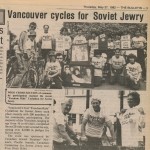
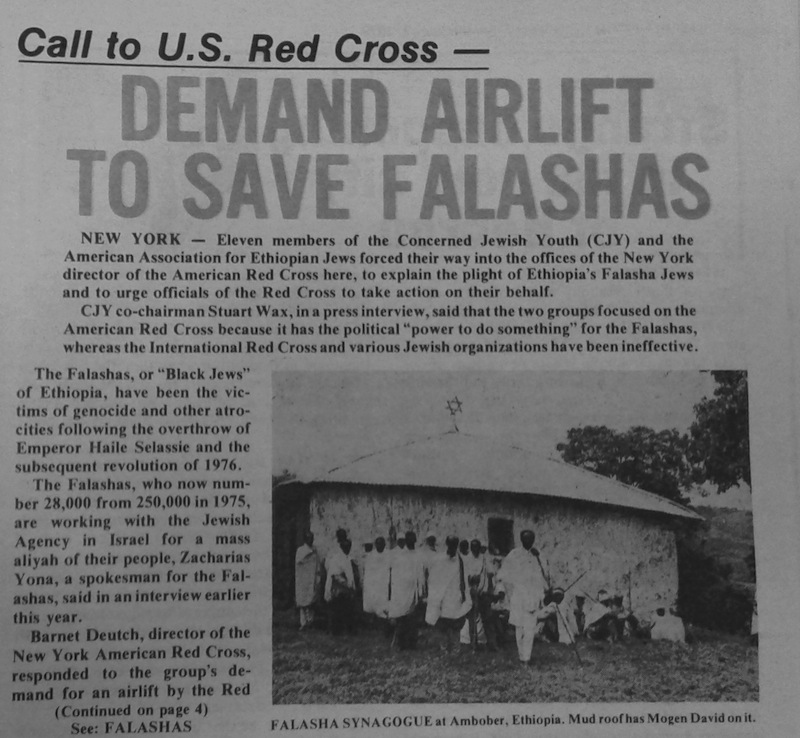
Growing up, the writer was involved in community campaigns to help free Soviet and other Jews suffering state-sponsored, organized persecution. These campaigns were international and Vancouver youth also participated in them. Here are but two of the many items in the JWB about these causes: top one is from 1982; below, from 1976.

I was recently reminded of a fashion-activist item many Jewish teens of my generation wore: the stainless-steel Soviet Jewry bracelet. Etched with the name and date of arrest of a single Jewish dissident in the Soviet Union, each bracelet transmitted to the wearer a deep and penetrating sense of social justice and tribal consciousness. I wore mine proudly, and recall being equally pleased to be selected from my seventh grade class to present handmade cards of encouragement to Avital Sharansky, the wife of jailed activist Anatoly Sharansky (later Israeli politician Natan Sharansky), when she visited Vancouver in the mid-1980s on her global campaign to secure his release.

Growing up, the writer was involved in community campaigns to help free Soviet and other Jews suffering state-sponsored, organized persecution. These campaigns were international and Vancouver youth also participated in them. Here are but two of the many items in the JWB about these causes: this is from 1976.

With the last of the Jewish communities having been freed from state-sponsored, organized persecution (other campaigns as my generation was growing up included the freeing of Ethiopian and Syrian Jews), there is little in the way of that Soviet Jewry bracelet campaign to bind today’s Jewish teens together in such a single, uncontroversial way. The modern state of Israel represents an ongoing cause, of course, but that issue is much more fraught: should a Jewish teen wear a bracelet etched with the name of a fallen Jewish soldier, or the name of one of the 182 Palestinian children currently (as of February 2015) being held in Israel detention – according to data provided by Defence for Children International? When it comes to social justice and activist solidarity, the issue of Israel is clearly complex.

I decided to poke around to see what Jewish teens these days are concerned with when it comes to issues and activism. What I found was a dizzying array of causes. From the website of the Orthodox NCSY (National Conference of Synagogue Youth), I found reports of teens volunteering with Habitat for Humanity and with Oklahoma tornado victims. Both USY (Conservative Judaism’s United Synagogue Youth) and NFTY (the Reform movement’s North American Federation of Temple Youth) select an annual theme to guide their social action and tikkun olam efforts: for 2014, USY chose “a focus on acceptance and tolerance including but not specific to gender, special needs, LGBTQ and racial equality,” according to its website. NFTY chose a similar theme for 2014-15: sexuality and gender equality. Habonim-Dror, which has various active local chapters, or kenim (nests), included a Maryland referendum initiative, for example, to campaign for undocumented high school graduates to become eligible to pay in-state university tuition fees.

Other Jewish educators I polled from the Jewish educators’ network JEDLAB reported that their teens are involved in various issues, including suicide prevention, food banks, poverty, water issues, peace/conflict resolution, mental health awareness and advocacy, women’s rights and empowerment, LGBTQ activism, medical marijuana, vaccines, human trafficking, transgender acceptance, orphans in western Kenya and child soldiers.

A report from the Jewish Teen Funders network attempts to aggregate data from 71 Jewish teen foundations in the United States and Canada during 2013-14, showing where the total of nearly $1 million in philanthropic dollars went. Across 362 grants awarded, the top five issue-areas in descending order were: youth, education, special needs, chronic illness and poverty.

And none of this even begins to capture the array of charitable and social awareness efforts represented in today’s mitzvah projects popular among 12- and 13-year-olds marking their bat and bar mitzvahs, a trend that was absent in my generation, as I recall, anyway. As a complement to that, here in Ottawa, my own shul has been running a monthly b’nai bitzvah class by Cantor Jeremy Burko, which has been including discussion of Jewish-history-informed social justice topics, such as labor conditions in the fashion industry.

What’s the takeaway from this big picture? On one hand, there is no longer a single cause (if there ever was one) that unifies Jewish teens. And that means that tribalism is likely being replaced by a sense of universalism: the sense that social justice must necessarily cross ethnic and religious boundaries. On the other hand, today’s Jewish teens are no doubt indeed being united in the very belief that through Jewish social action, they can repair the world in a global, nuanced and holistic sense. So, while I admit to feeling some nostalgia for the simplicity of the worldview embodied in the Soviet Jewry bracelet I wore with pride and even some excitement, I think we should feel buoyed by the youthful energy and optimism in our midst that the world is ours – and theirs – for the repairing.

Mira Sucharov is an associate professor of political science at Carleton University. She blogs at Haaretz and the Jewish Daily Forward. This article was originally published in the Ottawa Jewish Bulletin.

Format ImagePosted on May 15, 2015May 14, 2015Author Mira SucharovCategories Op-EdTags Soviet Jewry, tikkun olam, youth
Finding love in the JWB – on the occasion of the JI’s 85th

Finding love in the JWB – on the occasion of the JI’s 85th

A singles ad placed in the Bulletin by father-son team Ron and Steve Freedman in 1992 led to the engagement (in 1997) of their son/brother David to Betty-Mae Coblenz, who were married in 1998.

image - scan from paper The Bulletin by father-son team Ron and Steve Freedman in 1992 .Ron Freedman, who passed away in December 2014, worked for the Jewish Western Bulletin / Jewish Independent for 46 years. As we mourned his loss with his family at a ceremony celebrating his life, his son David shared the story of how his father and his brother Steve, who has worked at the paper for more than 30 years, used the power of community media to change his life.

As Alex Kliner explained in his May 15, 1998, Menschenings column:

“David Freedman was baffled. Three young women had responded to his personals column ad in the Jewish Western Bulletin. But wait! He had never placed an ad. But whatta ya’ gonna do? His curiosity was aroused. So he agreed to meet Betty-Mae Coblenz for coffee. They talked for hours. Not long ago, Betty-Mae Coblenz became Betty-Mae Freedman.

“And the mysterious ad? It seems David’s dad, Ron, and brother, Steve, (both JWB staffers) had placed it in the personals under David’s name. It was a joke! Not a bad joke, eh? And what’s more, it obviously pays to advertise in the JWB!”

Format ImagePosted on May 15, 2015May 15, 2015Author The Editorial BoardCategories From the JITags Aldex Kliner, Betty-Mae Coblenz, David Freedman, Jewish Western Bulletin, JWB, Menschenings, Ron Freedman, Steve Freedman
בלקברי עושה עלייה מובטחת

בלקברי עושה עלייה מובטחת

בפועל בלקברי רכשה את חברת הסטארט-אפ הישראלית וואצ’דוג. (צילום: Kārlis Dambrāns via wikimedia.org)

בלקברי עושה עלייה מובטחת: תיפתח לראשונה מרכז פיתוח בישראל

חברת הסמרטפונס הקנדית בלקברי (שהמטה שלה נמצא בווטרלו אונטריו) תיפתח לראשונה מרכז פיתוח בישראל. המרכז בפתח תקווה ויועסקו בו כמאה עובדים. זאת במסגרת הרחבת פעילותה ונסיונותיה לשפר את הטכנולוגיה ואבטחת המידע שלה, ולהגדיל את נתח השוק במגזר העסקי שבשוק הסמרטפונס.

בפועל בלקברי רכשה את חברת הסטארט-אפ הישראלית וואצ’דוג, לפיתוח טכנולוגיה לאבטחת מסמכים וקבצים. הגוף שמשתמש בטכנולוגיה שלה יכול לשלוט טוב יותר במידע ובקבצים שלו. הוא יכול לדעת היכן נמצאים הקבצים שלו בכל רגע נתון, ולהשמיד אותם מרחוק במקרה הצורך. בלקברי תצטרף את הטכנולוגיה של וואצ’דוג לשירותי הפורטפוליו שלה, למיגון מערכות ההפעלה.

עלות רכישת וואצ’דוג על ידי החברה הקנדית מוערכת בין מאה למאה וחמישים מיליון דולר. וואצ’דוג הוקמה ב-2008 ולצורך פעילותה גוייסו השקעות בסדר גודל של כ-30 מיליון דולר.

יו”ר ומנכ”ל בלקבריי, ג’ון צ’ן, הצליח לעצור את הידרדות החברה שכמעט והביאה לסגירתה. הוא פיטר עובדים, שיפר מערכות והתייעלות, והתמקד בתחום התוכנה הארגונית. תחת ניהולו יוצאים מכשירים שמעניינים את השוק לשם שינוי, בהם ‘פספורט’. 200 אלף מכשירי ‘פספורט’ נמכרו ביום אחד, עת הדגם יצא לשוק בספטמבר אשתקד. והמלאי הראשוני שלו אזל בתוך עשר שעות בלבד. בעיון בדוחו”ת הרבעוניים של בלקברי שפורסמו בסוף מרץ עולה כי החברה הצליחה לבלום את את הצניחה בהפסדיה, ורשמה לראשונה לאחר שנים רווח נקי (של 28 מיליון דולר).

בהודעה להוציא לעיתונות הסביר צ’ן מדוע בלקברי רכשה את וואצ’דוג: “בלקברי ממשיכה כל העת להגדיל את מעטפת אבטחת המידע, כך שהיא תוכל לאפשר שיתוף מידע יותר מאשר הגבלתו. רכישה זו היא צעד נוסף קדימה בהפיכתה של בלקברי לפלטפורמה המובילה לתקשורת סלולרית, תוכנה וישומים מאובטחים, התומכת בכל מכשיר ובכל מערכת. הודות לרכישת סקוסמרט אשתקד, השותפות שלנו עם סמסונג, מאמצעי הפיתוח שלנו והרכישה הזו של וואצ’דוג, אנו יכולים כעת לספק תקשורת מאובטחת מקצה לקצה הכוללת שיחות קוליות, הודעות טקסט, תקשורת נתונים וכעת גם שיתוף קבצים מסוכרן”.

ועוד חדשות בנוגע לבלקברי: הסכסוך עם טי-מובייל האמריקנית הסתיים לאחר כשנה, והאחרונה תחזור למכור מכשירים של בלקברי.

קסדה עם שני ראשים: חייל שאיבד אותה לפני 70 שנה ציווה להחזירה למי שמצא אותה

ג’ורדן צ’יאסון (21) מהעיר מונקטון שמזרח המדינה הוא אספן של ציוד צבאי ישן. לפני כשנה הוא רכש בחנות מקומית לציוד צבאי ישן קסדה ב-30 דולר. לאחר שבדק את הקסדה מקרוב מצא שחרוט עליה השם גו’רג’ ג’ונסטון ומספרו האישי. הוא חיפש מידע על ג’ונסטון ומצא שהוא עדיין חי ואפילו גר באותה עיר. צ’יאסון החליט להביא את הקסדה לג’ונסטון בן ה-93, והמפגש עימו ועם אשתו אנני היה מרגש ביותר. הזקן לא האמין שיתאחד מחדש עם הקסדה שלא ראה במשך עשרות שנים.

ג’ונסטון הצעיר לחם עם הכוחות הקנדיים במלחמת העולם השנייה בבלגיה, הולנד, צרפת ובריטניה. הוא השתמש בקסדה במשך שש שנים, לדבריו היא הצילה אותו לא פעם. עם סיום המלחמה ופתיחת החגיגות הגדולות הקסדה אבדה. ג’ונסטון חזר הביתה למונקטון ושכח ממנה.

ג’ונסטון נפטר לפני מספר שבועות בגיל 94 ולפני מותו ציווה להחזיר את הקסדה לצ’יאסון. אלמנתו מסבירה מדוע: “בשנת חייו האחרונה בעלי וצ’יאסון הפכו לחברים קרובים. בעלי חשב שרק צ’יאסון יוכל לשמור על הקסדה היקרה הזו”. צ’יאסון מוסיף: “עם סיום הלוויה משפחת ג’ונסטון ניגשה אליה ומסרה לי את הקסדה למשמרת. אני בכיתי וכולם בכו”.

Format ImagePosted on May 12, 2015Author Roni RachmaniCategories עניין בחדשותTags BlackBerry, George Johnston, helmet, Israel, John Chen, Jordan Chiasson, Second World War, WatchDox, בלקברי, ג'ון צ'ן, ג'ורדן צ'יאסון, גו'רג' ג'ונסטון, וואצ'דוג, ישראל, מלחמת העולם השנייה, קסדה
Dancing Arabs screens

Dancing Arabs screens

Eran Riklis, director of Dancing Arabs. (photo from Mongrel Media)

Dancing Arabs, which was part of the most recent Vancouver Jewish Film Festival, has its general release on May 15. A multilayered coming-of-age story, the screenplay is by Sayed Kashua, who wrote the novels on which it is based, and it is directed by Eran Riklis.

While called Dancing Arabs, the film is a combination of Dancing Arabs and Second Person Singular, two novels with very different tones.

“I read a first draft that Sayed wrote before I joined the project and it was much more Dancing Arabs and it was much more kind of a comedy,” Riklis told the Independent in a phone interview. But that changed. The first part of the movie, “which was almost pure Italian comedy,” became a way to draw in the audience, “maybe taking away any preconceptions or resistance that an audience might have when it comes to see a film, where it has all the opinions in the world about the Arabs, and this and that.”

Riklis wanted the audience “to fall in love with the character and then, when the film changes its tone and it gradually becomes more and more dramatic … you can’t walk away because you love this character and you want to root for him, you want to join him on his journey.”

With the novel Dancing Arabs being autobiographical, Riklis said he had to remind Kashua that the film was a different entity. It was about Eyad, “and even though there are reflections of reality, the grandmother and the father, whatever it is, it still is a new life, which is true of almost any film that deals with a real story at least partly.”

The challenge was “to do something which is at once meaningful and yet communicative, and striving to reach a wider audience. For me,” said Riklis, “all my films, or most of my films, deal with, let’s say, not easy issues, but I always try to … remember that this has to be a good story.”

Reaction to his films has varied. “If you look at The Syrian Bride, for instance, it had a very warm reception everywhere, both in Israel and worldwide. Lemon Tree was very tough in Israel because it was a little bit too close to home, and then really about sensitive issues, and yet it was probably my biggest success worldwide.” The response everywhere to Dancing Arabs has been “very emotional,” he said, which makes him happy because it means people “understand that this film comes from a place of respect and love and honoring the subject, as complicated as it is, but nobody’s trying to manipulate you here. There is a manipulation in the sense of filmmaking because that’s what filmmaking is about, but I think, emotionally speaking and intellectually speaking, this is a democratic film: it’s like, here are the facts, here’s the situation, here’s a story, here’s the person … and you judge for yourself.”

“… here we’re talking … about a minority that is 20 percent of the country. That’s 1.6 million people…. This is a major thing and, not only that, they’re not in Afghanistan, they’re living right in the middle of the country, next to us, amongst us, with us, and yet they’re invisible.”

When asked what sets Dancing Arabs apart from his other films about the region, Riklis said, they “have dealt with either the Israeli-Palestinian conflict or the regional conflicts or the Druze conflict, whatever, but here we’re talking … about a minority that is 20 percent of the country. That’s 1.6 million people. It’s not like you have some people living on the hillside with two camels. This is a major thing and, not only that, they’re not in Afghanistan, they’re living right in the middle of the country, next to us, amongst us, with us, and yet they’re invisible.”

The novels’ treatment of an internal conflict within Israel “was something that I felt was close to home,” said Riklis. “It’s important enough, and it’s getting more important by the minute. I can see what has happened between the time I shot the film and now. The internal tensions and the growing gap within Israeli society, both within the Jewish one and between the Jews and Arabs inside the country, I felt it’s time to shed a light.”

Riklis and Kashua worked on the script for about a year, on and off, not only because of the material but because they were both busy. Kashua was not involved in the filming process.

“In a strange way, even though it was not an easy film to make on many levels, when I look at it now, I feel it was one of my easiest films,” said Riklis. “That’s because, emotionally, I was so much into it. People ask me, how can you create an Arab family? Well, first of all, I had Sayed writing, so it comes from a very authentic place, but also, once you step in, you say, well, this grandmother is my grandmother, this father could be my father. It’s very easy for me … well, not easy, but, I go back to using respect and knowledge and making sure you get your facts right, at least emotionally, then it’s not so difficult for me because when I watch people, when I look at people, I don’t see color and race, not even age, I don’t really care.”

As with many books, much of the action in Kashua’s novels takes place in the protagonist’s mind. “I think the answer is simplicity,” said Riklis about transforming that style of writing to the screen. “It’s almost like just tell the story, just go with your characters, put them in interesting situations, make sure that every situation is a step forward.

“At the end of the day, I think a director, and almost everybody, is a slave to the story in terms of making sure the story keeps being interesting, keeps being reflective, keeps moving forward.”

“One thing I’ve discovered – but it’s me and another million directors, I think, or at least the good directors have realized – that every inch on the screen is significant. You can sometimes convey 10 pages of text by the color of a shirt. There are so many elements that you put together and I’m really careful with that in terms of what a person is wearing … what’s his environment and what other people are doing and what he’s looking at. And then you have the camera, the kind of lens that you choose and the lighting. There are so many elements that support you but also mean that you have to take responsibility and make sure that they really serve the story. At the end of the day, I think a director, and almost everybody, is a slave to the story in terms of making sure the story keeps being interesting, keeps being reflective, keeps moving forward.”

Music plays a big role in both books, and also in the film.

“It’s funny,” said Riklis, “because there were a lot of things in the script where it was like, ‘Naomi [Eyad’s Jewish girlfriend] and Eyad go to a concert in a club in Jerusalem,’ and we didn’t dig into it…. Then I found myself Googling myself to death to find what was popular in the late ’80s in Israel.” He came upon a song from a controversial rock opera, with explicit lyrics about rape and the Palestinians, and it became “a totally different scene. Suddenly, it’s emotional, and suddenly Naomi’s not feeling comfortable and Eyad is not feeling comfortable, and it has its own message and it’s brutal, and yet it’s not.

photo - Eyad (Tawfeek Barhom) and Naomi (Danielle Kitzis) in Dancing Arabs
Eyad (Tawfeek Barhom) and Naomi (Danielle Kitzis) in Dancing Arabs. (photo by Eitan Riklis via Mongrel Media)

“Same thing went with, for instance, Joy Division, ‘Love Will Tear Us Apart,’ which came from me.” Riklis had seen Control, a film about the British band. He said, “Ian Curtis, the lead singer, was epileptic and used to collapse on stage and at some point couldn’t take it anymore and committed suicide at a very young age – I felt, wow, this is the song for Yonatan, this is exactly a reflection of Yonatan’s life.” A peer who Eyad helps with his schoolwork and eventually befriends, Yonatan has muscular dystrophy.

There were other sound choices, as well. For example, where the script says Naomi and Eyad go to a movie, “I realized that following the scene where Eyad carries Yonatan to the bathroom, which is a very emotional scene, and he carries him almost like it’s a very Christian or Jewish image … my next cut I knew was Naomi and Eyad at the cinema and I didn’t want to see a clip from a movie, I wanted to listen to it. Then I said, OK, what’s appropriate here?… I thought about Wings of Desire, the Wim Wenders film, which in Hebrew is called Angels of Berlin. I said, what we need now, what Yonatan needs now, maybe Eyad as well, is an angel to protect him and to maybe keep him alive. And so I said, maybe it would be beautiful if they [are] listen[ing] to this monologue from the film, the beautiful voice of Bruno Ganz. Even though it’s in German, it’s just purely emotional.

“That’s the way I work,” said Riklis. Whether it’s the music, films “or even the news clips that you see in the movie, they always give you another layer. For example, Eyad comes to Edna’s and Yonatan’s house for the first time and he’s left alone in the living room. On television, there’s a report about a suicide terrorist who drove a bus into a ravine and dozens were killed.… The reality outside is on TV and yet he goes to the window and he watches and he hears the Arab prayers coming from the Old City. It’s almost like he’s looking at his own [life], like his older life is calling him back. And yet, he’s in this fancy apartment in west Jerusalem.”

Riklis admitted, “It’s interesting, I think, when people see the film for the second time – they discover so many things they haven’t seen the first time.”

Format ImagePosted on May 8, 2015May 6, 2015Author Cynthia RamsayCategories TV & FilmTags Dancing Arabs, Eran Riklis, Sayed Kashua
Nourishing the whole child

Nourishing the whole child

Dr. Adele Diamond, left, with Dr. Rania Okby at a Canadian Associates of Ben-Gurion University-hosted event at the University of British Columbia, in which Okby discussed some of the health challenges facing the Bedouin in Israel. (photo by Cynthia Ramsay)

Next week, Adele Diamond, professor of developmental cognitive neuroscience at the University of British Columbia, will be presented with an honorary doctorate from Ben-Gurion University. The professor spoke with the Jewish Independent at her lab on the UBC campus.

Born in New York City, Diamond’s academic career took root at Harvard, where she studied anthropology, sociology and psychology, but was not yet interested in the brain. After she decided to retire her first thesis idea, she was inspired to take a closer look at brain development in babies.

“My first year in graduate school, my advisor [Jerome] Kagan was jumping up and down about all the changes you see in babies’ behavior in the first year of life. No matter where they are in the world, whether they’re in kibbutzim, in nuclear families, they’re in Africa, they’re in Asia, it doesn’t matter. You see the same cognitive changes at basically the same time during the first year. He said, ‘It can’t all be learning and experience, their experiences are too different. There has to be a maturational component [in the brain].’ He was so excited about this, you couldn’t help but be excited,” she said.

Today, Diamond’s lab seeks to understand how children’s minds and brains develop. Specifically, she studies an area called the prefrontal cortex (PFC) and the cognitive abilities that depend on it, known as executive functions (EFs).

In a 2011 paper, Diamond describes the critical role of EFs. “To be successful takes creativity, flexibility, self-control and discipline. Central to all those are executive functions,” including cognitive flexibility (thinking outside the box, perspective taking), working memory (mentally relating different ideas and facts to one another) and inhibitory control. Other EFs that depend on these three building blocks include mental reasoning, creative problem solving, planning and execution.

EFs can be lacking in children who have behavioral, neurological and developmental disorders and are compromised in kids diagnosed with attention deficit disorders and autisms. The PFC is also influenced by environmental factors, compromising EF in kids experiencing poverty and other disadvantages and stressors. Fortunately, there are interventions that have been found to be successful, especially when implemented in early childhood.

“Traditional activities that have been part of all cultures throughout time (e.g., dance, music-making, play and sports) address all these aspects of a person – they challenge our EFs (requiring focus, concentration and working memory), make us happy and proud, provide a sense of belonging and help our bodies develop,” the lab’s website explains. Importantly, Diamond’s lab has “documented marked advances in executive functions due to an early childhood school curriculum (Tools of the Mind) that requires no specialists or expensive equipment, just regular teachers in regular classrooms. The children who spent more time in social pretend play outperformed their peers who received more direct academic instruction.”

She explained in a 2007 paper, “Brain-based doesn’t mean immutable or unchangeable. EFs depend on the brain, yet exercising and challenging EFs improves them, much as physical exercise hones our physical fitness. Yet, transfer is never wide; to get diverse benefits, diverse skills must be directly trained and practised.”

There is a deep connection between mental health and EF and it’s not just depression and anxiety that have a negative impact – sadness and loneliness also correlate with compromised EFs. “Prefrontal cortex and executive functions are kind of the canary in the coal mine. So, if anything isn’t right in your life, it’s going to hit prefrontal executive functions first and most,” she said. “So, if you’re sad, if you’re lonely, if you’re troubled, if you’re not physically fit, if you’re not getting enough sleep, if you don’t feel socially supported, if you feel ostracized, any of those things, it’s going to impair executive functions. A lot of people notice that when they’re feeling stressed or down for whatever reason they can’t think as clearly or exercise as good self-control – and that’s not just your perception, it’s really true … the phenomenological experience is credible.

“There are a lot of technical reasons why that’s true for prefrontal in the neurochemistry. That’s one of the reasons I argue that we have to care about the whole child. We can’t say school is just about the cognitive, because if the child is sad, if the child is stressed, if the child is lonely, the child’s not physically fit, the child isn’t going to be able to do as well academically as the child would otherwise be able to do. The child can’t show the academic potential he actually has.”

“If you step in right away when the kids disagree then they don’t have the chance to work it out among themselves…. I think a lot of kids don’t have that now. Parents are too afraid. There isn’t any place to play and I think those are important learning experiences.”

The trend towards structured play can be problematic for a child’s developing brain. “The helicopter mom, who needs to structure it all for the kids, doesn’t give them any chance to have some autonomy, have some say, use some creativity and work out disagreements,” Diamond said. “If you step in right away when the kids disagree then they don’t have the chance to work it out among themselves…. I think a lot of kids don’t have that now. Parents are too afraid. There isn’t any place to play and I think those are important learning experiences.”

Another useful tool in developing mental discipline can be memorization. In the West, we have largely decided that memorization is not a worthwhile, but there are cultures where rote memorization is still highly valued.

“In East Asia, they have too much extreme of memorization and too little creativity,” Diamond said. “The child’s goal is to learn from the masters, not question them, not try to come up with new things. First, get to know what the sages have to teach us. In some ways, I think the Orthodox Jewish education is like that. Each generation that is further from Mount Sinai knows less, and so we really want to try to absorb all that the older generations have to teach us before we think about surpassing them.

“But I think a mix is the right way…. I used to be on the bandwagon of memorization is just stupid; I hated it when I was in school. You can just look up these things, why do you have to memorize it? Then I was in Dharamsala, I gave a talk to the Dalai Lama, and we were talking afterwards. I asked him, I said, ‘I’ve told you about Tools of the Mind. What is a Buddhist way to train the minds of young children?’ The Dalai Lama said, ‘We don’t try, we wait until they get older.’ But his translator, [Thupten] Jinpa said, ‘We have them memorize. We’ll take something long and each day they have to memorize a little more. It’s a mental discipline that we’re teaching them.’ I think it’s a way of disciplining the mind, training the mind. I think there’s a real place for it, in that case.”

In fact, memorization can afford more cognitive and creative freedom. “What you want to do as you keep getting older is not have to pay attention to the fine details and be able to chunk things, so that you can deal with more and more the bigger picture and relating things,” said Diamond. “The more things are memorized, the more you can chunk it. You don’t have to go through the words of the poem, you just say the name of the poem and now you have all of it. Now you have a lot more information at your disposal to be able to play with and work with….”

Most of all, it’s important to grasp the (misunderstood) role of joy in nurturing developing minds and healthy children, she suggested.

“First, we often think that joy is the opposite of serious. If we’re walking down the school corridor and the kids are having a great time in the classroom, there’s lots of noise, we think they must be on recess, they couldn’t possibly be doing a lesson because there’s too much happy noise coming out of there. That’s, I think, a bad misconception. You can be learning and doing serious stuff and still have a great time. And you don’t have to be miserable to learn important stuff.”

Attachment is another key to healthy development. “I think Jewish families are pretty good about having secure attachment,” she said. “Sometimes they get a little enmeshed later, but I think that Jewish families really let the child know that the child is loved and cared for, they’re there for the child.”

She added, “Of course, a kid who is not securely attached is going to be more fearful, it’s going to be harder for other people to get close to him, for him to get close to other people. A kid who is securely attached thinks the world is a good place, he’s safe, he can trust other people, he can trust the world. There’s a lot more reason to feel relaxed and joyful.”

“The analogy I use is who learns a route better: the driver or the passenger? Everybody knows the driver does and we all know why, because the driver has to use the information and the passenger is just passively sitting there…. If you say, well, why should kids be actively involved in learning as opposed to just be passive recipients, everybody can understand that point and then we get to the more virtuous things.”

An influence in Diamond’s work is Abraham Joshua Heschel’s emphasis on doing. In Judaism, action, not belief, is key. “There are two things. One is, when we’re not talking about virtuous things, we learn better when we’re actively involved. The analogy I use is who learns a route better: the driver or the passenger? Everybody knows the driver does and we all know why, because the driver has to use the information and the passenger is just passively sitting there…. If you say, well, why should kids be actively involved in learning as opposed to just be passive recipients, everybody can understand that point and then we get to the more virtuous things.

“The Dalai Lama has said, if you want others to be happy, practise compassion. If you want to be happy, practise compassion. Now, the first part makes sense to everybody. The second part doesn’t always make sense.” It will never make sense intellectually, she continued, “the only way it makes sense is for you to do something nice for somebody else and see the wonderful smile you get in reaction, and then you understand. Or somebody says how meaningful that was to them or how important it was and then you see what you get back. But there’s no way to understand that without experiencing it.

“So, you tell the cynical kid, ‘I want you to just do it for awhile.’ What Heschel said is that the musician might be playing for the money but if he’s thinking about the money when he’s playing the concert he’s not gonna play a good concert. While he’s doing it, he’s got to be heart and soul in the music. So, if the child wants to see what it’s like to do nice things for people, during those few times when he’s doing nice things, he’s got to be heart and soul, not cynically doing it, but doing it genuinely. I think, in short order, the child can see that he gets something back from it. You don’t have to do it for years and years before you can see the wisdom of what mom and dad wanted. You can see it pretty quickly.”

The upcoming honor from BGU has grown out of a mutual appreciation. “I have lectured at most Israeli universities, but one of my favorites is Ben-Gurion, I think I’ve been there more than others…. I met the president [Rivka Carmi] last time I was there and she wanted me to come back and teach the course again.” They formed a personal relationship, as well, Diamond said, and then, recently, Carmi nominated her for the award.


Basya Laye is the former editor of the Jewish Independent.

 

Format ImagePosted on May 8, 2015May 8, 2015Author Basya LayeCategories LocalTags Adele Diamond, health, UBC, University of British Columbia
Torah writing unifies

Torah writing unifies

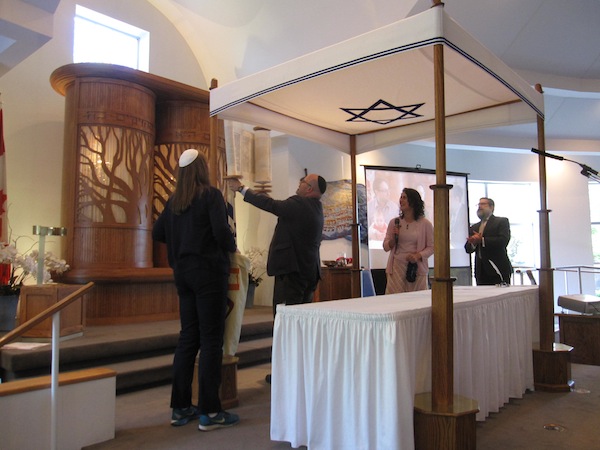
Torah scribe Rabbi Moshe Druin writes one of the scroll’s final letters with the help of a Temple Sholom family, who won the honor by lottery with five others. Rabbi Dan Moskovitz uses his cellphone to allow the rest of the congregation to witness the writing. (photos by Cynthia Ramsay)

On Sunday, May 3, Temple Sholom completed a new Torah in honor of its 50th anniversary. Florida-based sofer (scribe) Rabbi Moshe Druin was assisted by more than 1,000 hands in writing the scroll and there were so many people who contributed to the project that Temple Sholom Rabbi Dan Moskovitz noted at the siyum hasefer that the congregation had also written “a new Torah of volunteerism.”

photo - Rabbi Dan Moskovitz raises the newly completed Torah as, left to right, Cantor Naomi Taussig, Rabbi Carey Brown and Rabbi Moshe Druin look on.
Rabbi Dan Moskovitz raises the newly completed Torah as, left to right, Cantor Naomi Taussig, Rabbi Carey Brown and Rabbi Moshe Druin look on.

Gratitude and community were the words of the afternoon, as the combined blast of several shofarot brought the excited crowd to order. Project co-chairs Anne Andrew and Jerry Lampert offered their thank you’s to all those who helped with the project that began in October 2014, including more than 100 volunteers working more than 1,200 volunteer hours. Siyum co-chairs Kevin Keystone and Marnie Greenwald added their appreciations, while also explaining the logistics of the upcoming parade of the Torah, to be headed by the band Balkan Shmalkan.

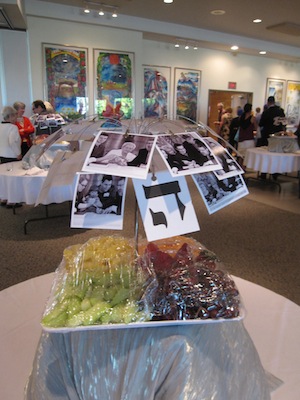
photo - At each table, there were photos of those who inscribed a letter in the Torah
At each table, there were photos of those who inscribed a letter in the Torah.

Alex Konyves led two groups of kids in song, Rabbi Carey Brown told a short story about letters as prayer, and synagogue president David Schwartz spoke of the many impacts of the project on the congregation. “I am very pleased to report,” he added, “that we have raised to today over $336,000. We’d love to make our double-chai goal of $360,000.” A scroll of dedication will be created and those who make a dedication before June 1 will be included on it.

Schwartz also announced that Moskovitz’s contract had been renewed to June 30, 2021, at the last board meeting. The congregation applauded, cheered and rose to their feet before Schwartz could conclude, “with great joy and without hesitation, he accepted our offer.”

The klei kodesh – Moskovitz, Brown, Cantor Naomi Taussig, Rabbi Philip Bregman, emeritus, and Cantor Arthur Guttman, emeritus – then joined the congregation in a responsive reading.

Prior to the ceremony, Moskovitz and Druin, who had just arrived in Vancouver, went to the Louis Brier Home and Hospital to scribe the Torah with the congregation’s most senior members. Moskovitz also shared that the Torah’s rollers, its mantle and wimple were created by congregation members Michael Kliman, Leni Freed and Julia Bennett, respectively. “This Torah belongs to all of us, on so many levels,” he said.

Druin expressed his hope that the Torah would provide reassurance “that you are all part of this community through this Torah … [and] that God is here with you, with this Torah, for you, for your children….”

photo - During the parade, led by the Balkan Shmalkan band, the Torah was carried by many different congregation members. In this photo, Henry Grayman is holding it.
During the parade, led by the Balkan Shmalkan band, the Torah was carried by many different congregation members. In this photo, Henry Grayman is holding it.

Just as there was a lottery for the first six letters of the Torah, there was a draw for the last six – each representing a decade of the synagogue and one for the next generations, explained Moskovitz. After the Torah was completed, it was dressed and paraded north along Oak to 54th, east for a bit, then a “legal U-turn,” as per Keystone’s instructions, back the synagogue to take its place in the aron kodesh.

For more about the project, visit templesholom.ca/were-writing-a-torah.


Format ImagePosted on May 8, 2015May 6, 2015Author Cynthia RamsayCategories LocalTags Dan Moskovitz, Moshe Druin, siyum hasefer, sofer, Temple Sholom
New life for cemetery

New life for cemetery

Fifth- and sixth-generation descendants prepare to enter the gates of the newly restored Jewish Cemetery at Mountain View. (photo by Robert Albanese Photography)

Several generations of Jewish life in Vancouver were represented Sunday afternoon at the rededication of the Jewish cemetery section at Mountain View Cemetery.

The historic burial site was first consecrated in 1892. In recent years, the site had deteriorated. There were more than 150 unmarked graves, many neglected headstones, pathways had eroded, hedges overgrown and the entryway had deteriorated.

Under cloudless skies, young children, all born more than a century after the first burial in the Jewish cemetery, assembled at the new entryway, joined by other generations of families with ancestors buried there, to officially open the gates of the rededicated cemetery.

The project, which took less than three years, was undertaken by a team of volunteers led by Shirley Barnett and assisted by the civic officials who run the cemetery, including cemetery manager Glen Hodges, with the support of the city, which owns Mountain View Cemetery.

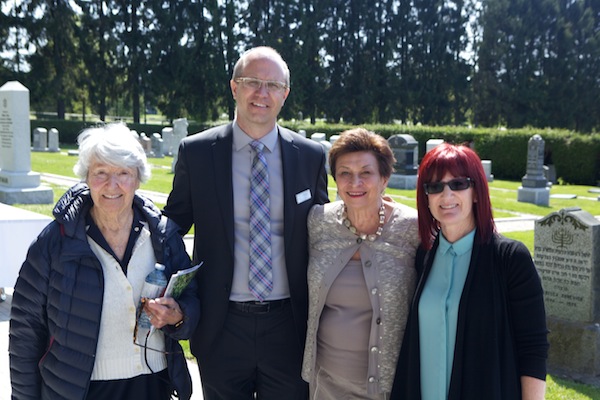
photo - Left to right are landscape architect Cornelia Hahn Oberlander, Mountain View Cemetery manager Glen Hodges, Jewish Cemetery at Mountain View Restoration Project committee chair Shirley Barnett and restoration project administrator Myra Adirim
Left to right are landscape architect Cornelia Hahn Oberlander, Mountain View Cemetery manager Glen Hodges, Jewish Cemetery at Mountain View Restoration Project committee chair Shirley Barnett and restoration project administrator Myra Adirim. (photo by Robert Albanese Photography)

Jack Kowarsky, chair of the Schara Tzedeck Cemetery board, noted that the City of Vancouver had given the Jewish community this parcel of land 123 years ago, before which Jewish bodies had been shipped to the nearest consecrated Jewish cemetery, which was across the water in Victoria.

The 450 Jews interred at Mountain View, Kowarsky said, represent the forefathers of the current community.

Raymond Louie, Vancouver city councilor and acting mayor, called the rededication an important day for the Jewish community but also for the City of Vancouver. He credited Barnett, Arnold Silber and Herb Silber for the progress made during two and a half years of work, and he reflected on Mayor David Oppenheimer, the city’s first Jewish mayor, who was pivotal to the creation of the Jewish part of Mountain View.

Louie said the day was an opportunity for Vancouverites to remember ancestors and celebrate our multicultural heritage.

Barnett, who was presented with a book documenting the work that took place, deflected attention to others in the audience, noting that a single individual – Cyril Leonoff – led the community’s fight in the late 1960s, when the city attempted to remove all upright headstones and replace them with flat ones to make maintenance easier.

Barnett expressed gratitude for the happy coincidence that both Bill Pechet, a world leader in cemetery design, and Cornelia Hahn Oberlander, a globally recognized landscape architect, are both Vancouverites.

J.B. Newall Memorials, a memorial and monument company that is also a preeminent headstone restoration company, Barnett said, generously donated a headstone for the previously unmarked 1892 gravesite of the first interment in the cemetery, as well as refurbishing many headstones.

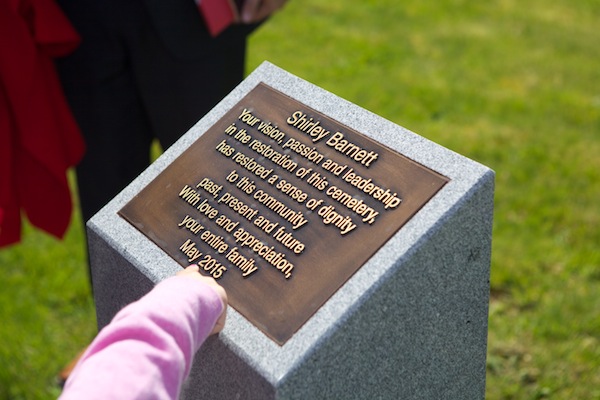
photo - plaque honoring Sheila Barnett
(photo by Robert Albanese Photography)

Arnold Silber brought laughs to the audience when he referenced Barnett’s reputation for getting things done. He reflected on the phone call from Barnett three years earlier asking him what should be done about the poor state of the cemetery where her grandfather is buried.

Silber told Barnett that “we would do everything she wanted – as long as she would be in charge.”

Turning to Barnett, Silber said: “Your dreams always become a reality.”

Silber stressed that the Jewish cemetery at Mountain View has an inclusive mandate that “any Jew, regardless of their affiliation, can be buried here at Mountain View.” He added that, now that the renovation and rededication have taken place, funds are being raised for perpetual maintenance and protection of the site.

“All generations to come will understand the value of this great Jewish cemetery,” he said.

With the renovation, several new plots have become available.

Rabbi Andrew Rosenblatt and Cantor Yaacov Orzech provided an indication of what the original dedication ceremony might have been like in 1892. At the time, the rabbi said, those assembled would have proceeded seven times around the cemetery as part of the consecration process but, he noted, the size of the assembled people Sunday did not permit such a procession.

The cantor offered some of the prayers that would have been included in that ceremony 123 years ago, including the prayer accompanying a casket to the gravesite.

Rosenblatt noted that the rededication was taking place on Pesach Sheini, a day specifically created, according to rabbinical interpretation, so that those who contract ritual impurity by caring for the deceased should be able to nevertheless celebrate the joy of Passover.

Rev. Joseph Marciano offered the prayer traditionally spoken when leaving a cemetery.

After the generations of descendants of those interred in the burial ground passed through the gates, followed by scores of rabbis, cantors, city councilors, an MP and community leaders, two headstone unveilings took place, one for “Baby Girl Zlotnick,” who died in 1920, and another for Otto Bond, the previously unmarked grave of the first individual interred there.

Pat Johnson is a Vancouver writer and principal in PRsuasiveMedia.com.

Format ImagePosted on May 8, 2015May 6, 2015Author Pat JohnsonCategories LocalTags Arnold Silber, Jack Kowarsky, Jewish Cemetery at Mountain View, Shirley Barnett
Hebrew U marking 90 years

Hebrew U marking 90 years

Duvdevan elite unit veterans who visited Vancouver on the weekend are, left to right, Gilad Waldman, Daniel Kolver, noted singer and actor Tzahi Halevi, who sang at the event, Ariel Rubin and Boaz Faschler. (photo by Robert Albanese Photography)

The historical, contemporary and future impacts of the Hebrew University of Jerusalem were celebrated Sunday night at Congregation Beth Israel.

Several hundred members of the community gathered to mark the 90th anniversary of what has become one of the world’s great academic institutions.

Founded in 1925 by some of the greatest thinkers of the 20th century, including Martin Buber, Chaim Weizmann, Chaim Nahman Bialik and Albert Einstein, the university has produced seven Nobel laureates and is routinely recognized as one of the 100 best universities in the world.

The culmination of the evening focused on four young Israeli soldier-students and a scholarship project intended to both reward dedication to the state of Israel and to ensure that individuals who have demonstrated that they are among the foremost citizens of that country will continue to contribute productively throughout their lives.

The young men who addressed the audience are recent veterans of Duvdevan, an elite anti-terror undercover unit of the Israel Defence Forces.

Daniel Kolver was motivated to strive to become a member of the elite unit after being a teenage eyewitness to the Passover massacre at the Park Hotel in Netanya, in 2002, at which 30 Israelis were murdered by a terrorist at a seder.

He explained that Duvdevan members often operate as “Trojan horses,” charged with locating and arresting – or killing – the most dangerous terrorists, those “ticking bombs” who are minutes or hours away from executing attacks.

Each year, about 15,000 17-year-old Israelis apply to serve in Duvdevan and 150 are accepted. After some of the most intensive military training in the world, these soldiers are entrusted with hostage rescues, capturing terrorists in extremely dangerous urban warfare situations and delicate counter-terrorism operations.

Last year alone, the unit participated in more than 400 missions – each one of which involved at least one suspect. Kolver screened dramatic video of an operation in which his unit had two minutes to get through a labyrinthine neighborhood, detonate an explosive to blow the door off the home of a terrorist, identify the man hiding behind his wife and extricate the target and the unit from the premises within 10 seconds.

Another speaker, Ariel Rubin, admitted that he initially sought acceptance to Duvdevan to show off that he got into the elite unit. But the excruciatingly tough training eliminated all ego and superfluous motives.

“You disconnect your head from the physicality and you say, I’m doing this for my country … to protect Israel, to protect the Jewish people, because if we’re not there, nobody’s going to do it for us,” he said.

Fellow unit veterans, Boaz Faschler and Gilad Waldman, spoke of the difficult transition from being in one of the most secretive military units to assimilating into everyday life.

Among the purposes of the presentation was to raise support for the scholarship fund at Hebrew U, which awards 50 scholarships annually to soldiers from Duvdevan after their years of service.

The evening event, organized by the Vancouver chapter of Canadian Friends of the Hebrew University, featured two other presentations.

Ambassador Ido Aharoni, consul general of Israel in New York, acknowledged that Israel is not winning the global war for public opinion. Significant to the problem Israel faces is that a huge proportion – 40% of North Americans and Europeans and 30% of much of the developing world – can be defined as “infosumers,” a tech-savvy group of individualists who seek out their own information and share specific traits. Among the characteristics of this growing demographic is that they see themselves as part of an expanding global identity whose national identities are eroding. They are also significantly unfavorable toward force, whether by the military or police. Aharoni’s thesis was reinforced by the fact that riots had been taking place for days in the United States over police brutality and murders of African-American civilians.

Screening a photograph of a presumably Palestinian youth throwing a rock at a tank, Aharoni noted that this is the global image most associated with the Israeli-Palestinian conflict. But he also noted that polls indicate that in both Europe and North America, small numbers of people identify with either side in that conflict, most falling in the middle. Israel’s contradictory message of being both victim and victor, he said, is difficult to comprehend. And images of tanks versus stone-throwers, however unrepresentative this might be of the genuine power dynamic or context in the Israeli-Arab conflict, is not being successfully countered.

A more successful approach, he said, would be to appeal not to those who identify as opposed to the Israeli narrative, but to the large majority who subscribe to neither narrative. He called for greater emphasis on Israel’s contributions in fields of medicine, science, culture and other areas that benefit humankind.

Following the ambassador’s presentation, Prof. Noam Shoval of Hebrew U’s department of geography, spoke about the geographic realities of the city of Jerusalem.

Using a range of GPS and technological tools, researchers have studied the movement of Jerusalem’s residents and visitors, day and night, over time, to discover that the perception of Jerusalem as a culturally divided city is not accurate. There is an enormous amount of interaction by Jewish, Muslim and other residents of Jerusalem throughout and across areas of the city that are otherwise generally acknowledged as Jewish or Arab.

Shoval acknowledged that he would like to see Jerusalem remain united under Israeli jurisdiction, but he acknowledged that others might see a unified Jerusalem jointly administered by Israel and a future Palestinian state, or unified under some sort of international governance as was proposed in 1947. He concluded that dividing the city is not an ideal resolution.

“A division of the city is an outcome of war – not of peace,” he said.

Pat Johnson is a Vancouver writer and principal in PRsuasiveMedia.com.

Format ImagePosted on May 8, 2015May 6, 2015Author Pat JohnsonCategories IsraelTags CFHU, Duvdevan, Hebrew University, HU, IDF, Ido Aharoni, Israel Defence Forces, Noam Shoval
Sharing business vision

Sharing business vision

Innovators Lunch speaker Brian Scudamore with Kate, left, and her mother, Wendy, who received supportive services from Jewish Family Service Agency in a time of need. (Adele Lewin Photography)

The 2015 Innovators Lunch raised almost $296,000, with more expected. The total was boosted by speaker Brian Scudamore, founder and chief executive officer of 1-800-Got-Junk?, donating back his fee to the Jewish Family Service Agency.

On April 29, 545 people came out to hear Scudamore speak at the Hyatt Regency Vancouver. They also watched a video featuring several people who had been helped by JFSA’s programming and service provision, one of whom, Michael Narvey, addressed the crowd. The audience also heard from JFSA board chair Joel Steinberg, Beth Israel Rabbi Jonathan Infeld, day-of-event co-chairs Megan Laskin and Hillary Cooper and senior management consultant Richard Fruchter. Shay Keil of Keil Investment Group, which was a co-presenting sponsor with Austeville Properties, introduced Scudamore.

Though Scudamore dropped out of high school and out of university, he said, “I love to learn. I love asking questions, meeting people and learning why they are successful, what motivates them and drives them in life. It just happened to be that school did not work for me.”

So, he became an entrepreneur, with a focus on vision, people and systems. He illustrated the importance of these three things in the story of how he became a businessman.

In summer of 1989, he was one course short of high school. Knowing he wasn’t going to complete that course, he talked his way into Langara College, one of the four colleges he would attend briefly. His vision at the time was to go to college and that’s what he did. However, he had to find his own way financially, as his parents weren’t going to fund his studies, given his history: “I don’t think it was a good ROI [return on investment],” he admitted.

While waiting in the line of a McDonald’s drive-through, Scudamore noticed that pickup truck in front of him had the hauler’s phone number on the side. He thought, “What a great idea. I had a thousand dollars in the bank, took 700 of it to go buy a pickup truck of my own.” He spray-painted his number on the side and parked it in different locations around the neighborhood. “Mobile billboards got me business and, within two weeks, I had a business that was humming and making money.”

The experience of building something, his interactions with customers and having fun inspired him to consider business as a future. “My grandparents, my Jewish grandparents … ran a small Army Surplus store in a fairly impoverished area of San Francisco downtown. I used to go down every spring break, summer, Christmas holiday, Chanukah, go work at the store, and I loved it. I loved watching how they treated people. They were the only store on the street that wasn’t robbed once a week. In fact, in their history, they were only robbed twice because I saw that they would give an ear to anyone who came in…. They would never give money, but they would give love, attention and time of day to somebody. They developed a group of friends in the community and the word out on the street was that you just don’t mess with the Lorbers, they’re nice people.

“I learned that business wasn’t just about ringing the cash register and making money. It’s never been that for me, and thank goodness for the influence of my grandparents. For me, business is having fun, bringing people on board and building something special together.”

By 1991, he was at the University of British Columbia. Bored, he made a deal to sell his business, which fell through. This failure taught him “that the low moments precede the highs.” And something good did happen. He grew the business and, in 1992, on the advice of his then girlfriend, he told his business story to the press. The result: a front-page article in the Province. He described it as a “full-sized ad, for free…. I’m going to systematize this and start doing more.” That day, he not only “felt like a rock star,” but he got “100 phone calls in 24 hours.”

In 1993, he finally sat down with his dad to tell him that he was dropping out of university. He incorporated his business, went from one to three trucks and was at about half-million dollars in revenue by 1994.

He had 11 employees but nine of them weren’t the right fit, he said, so he fired them all. He took full responsibility for not being a good leader, for hiring the wrong people. He apologized, and learned from the experience. Among the most important lessons: “it’s all about people.”

He spoke about The EMyth, “the most incredible business book” he’s ever read, which recommends running your business like a franchise even if you don’t plan to make it one. Franchises tend to be more successful, he explained, because they are based on systems of best practices that can be replicated. He followed that direction and, in 1997, hit a million dollars in revenue.

He joined the (Young) Entrepreneur Organization. For him, “it was a way to learn from others, other businesspeople, entrepreneurs that had been successful. I could understand what works and what didn’t, and that filled my thirst for knowledge.” He also actively sought out mentors and people on whom he could rely for advice.

In 1998, he was “bored” and wanted more. He wrote a short list of possibilities, or goals, including “being the FedEx of junk removal,” being “on the Oprah Winfrey Show” – “I envisioned a future that was so crazy, but I started to read it and I’m, like, my craziness actually seems real to me. I could see the vision, the picture in my mind, and I latched on to it and I said I will make this happen – not if, I hope to, want to, will try to, I will make this happen, and I crystal-balled the future.”

At the time he wrote down this vision, he had almost 10 paycheques written to himself that he couldn’t afford to cash, and there were employees who quit over his new direction. Nonetheless, he began to learn about how to franchise. He spoke to many people, he got over hurdle after hurdle, including having to find out who owned the phone number 1-800-Got-Junk and buying it once he did – from the Idaho department of transportation – as he’d already designed the logo with the number. The first franchise was created in 1999 and it made $1 million in the first year, “because we had the systems.”

In the next several years, the focus was on franchising and also on systematizing the media aspect, which had proven so useful before. “Fortune magazine did this three-page feature and we had 506 inquiries in the first week, and I’ll say the first week was Thursday to Sunday.”

He asked his employees what they could imagine with regard to growing the business, with the caveat that they would have to take responsibility for bringing the idea(s) to fruition. The company also works with employees to help them set and accomplish personal goals and, in 2004, 1-800-Got Junk? won British Columbia’s best company to work for contest. They immediately set upon figuring out how they could win it again, not for the sake of winning, but to keep improving the business and the work environment.

At $100 million in sales in 2006, the rollercoaster descended, he said. They dropped $40 million in revenue and he had to fire his best friend – “thankfully he knows it was the right decision.” They were both quick shooters and the business needed a more cautious partner. In the end, the entire leadership team was changed, dozens of people laid off, “partially because of mistakes we made, partially because of the recession. It was awful.” Three and a half years of rebuilding, however, turned things around.

Scudamore has learned to embrace mistakes, to learn from them, and he encourages his employees to do so, as well. “If you’re not making mistakes, if you’re not getting out of your comfort zone and taking risks in life, you’re not living,” he said.

Once he found the right-hand person who best complemented his strengths and weaknesses, Eric Church, the business expanded into other companies, such as Wow 1 Day! Painting and You Move Me. He also expanded personally into other areas, such as becoming involved in Free the Children with his family, thanks to Lorne Segal. He “didn’t have this sense of philanthropic community” when he was a kid, but his daughters, now 10 and 7, believe they “can actually change the world.”

He said, “I believe that we all have a purpose to do something great in our lives and we’ve all got to get to building something, a family, community, charitable organizations and business.… I think, again, it comes down to, ‘It’s all about people.’ Can you inspire people, can you find the right people and treat them right?”

One thing Scudamore loves about community, “is people helping other people.” He concluded, “I don’t know if everybody knows their purpose and what they’re doing. I often believe sometimes you need to be a little crazy to think you can change the world, but I think that we’re all a little crazy, and I know that we can.”

For more on Scudamore, visit 1800gotjunk.com/us_en/about/brian_scudamore.

Format ImagePosted on May 8, 2015April 12, 2021Author Cynthia RamsayCategories LocalTags 1-800-Got-Junk?, Brian Scudamore, Innovators Lunch, Jewish Family Service Agency, JFSA
Some superior senior solutions

Some superior senior solutions

Michael Geller, left, and Dr. Eric Cadesky. (photo by Binny Goldman)

Every year, we look to the Jewish Seniors Alliance Spring Forum for inspiration and the 170 people gathered in the Wosk Auditorium at the Jewish Community Centre of Greater Vancouver on April 26 found it.

Debbie Cossever, representing the Jewish Seniors Alliance, and Claire Weiss of the L’Chaim Adult Day Centre were co-chairs of the partnered event, entitled YOLO: You Only Live Once – How Full is Your Cup?

Marshall Berger opened the afternoon’s program with a humorous song to the tune of “Side by Side” about a newly married aged couple. Cossever welcomed the audience, described the aims of JSA and invited newcomers to join the organization. JSA has approximately 700 members, including 34 affiliates representing more than 5,000 seniors in the Greater Vancouver area.

Cossever introduced Weiss, who explained that the afternoon was also a celebration of L’Chaim’s 30th anniversary, the group having started in the Beth Israel Youth Lounge in 1985 and then moving to the J in 1988. Last year, their staff delivered 1,933 client hours. She reminded those present that they are always looking for more members to join their “family.” The candles on a huge chocolate cake celebrating the 30 years were lit and all sang “Happy Anniversary,” which ended with calls of mazel tov!

Moderator Gloria Levi, a social services consultant, was then introduced. Levi has a master’s degree in public policy and is the author of Dealing with Memory Changes As You Grow Older and a series of booklets, Challenges of Later Life.

She introduced Michael Geller, an architect, planner, real estate consultant and property developer, who serves on the adjunct faculty of Simon Fraser University’s Centre for Sustainable Community Development. The talk was conducted in an interview format.

Geller’s topic was Lessons My Father Taught Me. He acquainted listeners with the unique and collaborative relationship he shared with his father, Sam Geller, who was one of the first members of the Jewish Senior Advisory Council (the original name of the JSA). He passed away 11 years ago at the age of 92.

Sam Geller was born in England and was a soldier in the Second World War who had survived being a prisoner of war. That occurrence colored his life. The very fact that he had survived made him happy and grateful to be alive and he never sought material things for happiness, often saying that things could have been so much worse. He moved to Vancouver from Toronto and enjoyed life at Langara Gardens, his grandchildren visiting him, doing Sudoku, crosswords, swimming and exercising daily. Then, after an emergency life-saving surgery, Geller said his father attempted to live each day to the fullest, saying, after all, it could very be his last.

Geller said his dad was a stoic, truly enjoying what he had rather than accumulating more items just to impress others who he may not care about in the first place. The lesson he received from his father was “Do what you enjoy, what makes you happy and continue contributing to the happiness of others, as that increases one’s own inner joy.” Geller recommended the book The Ancient Art of Stoic Joy by William B. Irvine.

The love and respect that Geller said he felt for his father was reflected on his face throughout the talk. Thoughts of his father swimming are with him as he does his own laps in the pool.

Levi then introduced Dr. Eric Cadesky, a family physician, assistant professor at the University of British Columbia, medical coordinator at Louis Brier Home and Hospital and a board member of Doctors of British Columbia. His presentation was entitled Getting It Just Right: How to Maximize Your Quality of Senior Life.

Cadesky disclosed that his mother-in-law was amused when she learned of his topic and asked, “What do you know about aging?” He explained that all of us age, no matter our number of years, but it is how we do it that is really important.

Cadesky believes that some of the choices we make act to decrease our quality and length of life and suggested that people live by three guidelines: Do enough. Not too much. Start now.

Enough means to be active, to walk or swim, as movement will lessen and ease pain. Enough also means to eat fresh, colorful foods that don’t require a microwave or have an expiry date. Enough means to socialize, learn a new language, do puzzles, these activities help to keep dementia at bay. Enough also means to use patience to deal with people who give you advice and knowing what advice to toss aside.

Not too much reminds us that anything that sounds too good to be true usually is. Certain vitamins (except for Vitamin D and B12) can be unhealthy to take in pill form. For example, post-menopausal women should not be taking calcium, and A, C, E, copper, zinc and selenium should be acquired from fresh food only. It is very important to be honest with your doctor when seeking medical advice. Sometimes “de-prescribing” is necessary – and an assessment can be made on all of your medications.

Start now means that we should be discussing with our doctors challenges that may be stopping us from doing what we want to be doing. Also, we generally do more for others than we choose to do for ourselves and we should start thinking of ourselves.

Cadesky advised us to have a realistic approach to life and not to fall for advertisements, which may be totally misleading. Scrutinize, be critical and intelligent in your choices and have confidence in your doctors, he said. Remember, too, he said, making others happy enriches our own happiness.

Audience questions were many. How can we ease a senior’s loneliness? Get involved in activities, he said, perhaps at JSA or L’Chaim. What are the benefits of fish oil? There is benefit in eating fresh fish but not in taking fish oil in pill form, he answered. There was also a discussion around the value of probiotics and alternative medicine. Cadesky recommended directing individual questions to your physician and stressed how critical it is to be honest with your doctor. A question, which made everyone laugh, was “Are you taking any new patients?”

Marilyn Berger, JSA president, and Serge Haber, JSA president emeritus, thanked the many volunteers who made the event possible. Special thanks went to the co-chairs, table sponsors and staff, Annica Carlsson, Karon Shear, Rita Propp, and to Stan Shear for videotaping the session, which will be posted to the JSA website (jsalliance.org).

Door prizes were then handed out to the delight of the recipients. Over tea and coffee and chocolate cake, as well as fresh fruit and veggies by Susy Segal’s Nava Catering, helped by Bagel Club volunteers Ophira Schwartzfeld, Harriet Corda and David Benbaruj, attendees felt we had experienced an extraordinary afternoon and had adhered to the advice of our two speakers and that adage of Dr. Charles Glassman, “Live your everyday extraordinary!”

Binny Goldman is a member of the Jewish Seniors Alliance of Greater Vancouver board.

Format ImagePosted on May 8, 2015May 6, 2015Author Binny GoldmanCategories LocalTags Eric Cadesky, health, Michael Geller, seniors

Posts pagination

Previous page Page 1 … Page 434 Page 435 Page 436 … Page 494 Next page
Proudly powered by WordPress