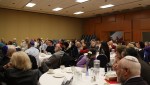
On April 26, Congregation Har El put the patriarch Abraham on trial for attempted murder, assault and unlawful confinement. (photo from Har El)
Har El Synagogue on the North Shore was turned into a court of law on Sunday, April 26, when the community staged a mock trial of Abraham. More than 80 members of the community formed the jury, determining three charges laid against the patriarch: attempted murder, assault and unlawful confinement, all as defined under the Canadian Criminal Code. The charges related to the binding of Abraham’s son, Isaac, as recounted in the Book of Genesis.
Justice delayed is justice denied, it is said, but, even so, an elapse of some 4,000 years between the commissioning of the alleged offences and a trial is unprecedented.
Madam Justice Mary Ellen Boyd (retired B.C. Supreme Court judge) presided. Prosecuting and defence attorneys were Alastair Wade and Warren Millman, respectively, taking on the case pro bono in an interlude from their busy professional lives as Vancouver lawyers. Rabbi Shmuel Birnham provided the biblical background materials, recounting the text of Genesis 22, which formed the Agreed Statement of Facts for the legal proceedings. Birnham also assisted the jury in their deliberations, referencing a number of midrashic commentaries on the events under dispute. Psychiatrist Dr. Fred Shane proved a star turn as expert witness, opining as to the state of mind of Abraham at the time of the incident. Despite the pressures of having to support two wives and an admission of having heard the voice of God, Shane was confident of Abraham’s soundness of mind and that he was fit to stand trial.
The judge gave instructions to the jury, who then asked questions and advocated for and against the defendant.
It was agreed that the entire audience would comprise the jury, whose decision would be by majority vote. After more than two hours of hearing the evidence, arguments and jury deliberations, the jury foreman, Morley Lertzman, returned the verdict as follows: not guilty of attempted murder and assault, but guilty of unlawful confinement. The judge reserved judgment as to the sentence to be imposed.
The morning proved to be an enlightening and entertaining mix of Torah study combined with a refresher on the Canadian criminal justice system.
This event was part of a monthly Sunday morning series called LoxTalks, now in its third year. Programs are varied and, in the past, included presentations like Growing Up Jewish, where congregants shared personal tales of life in Germany, Romania, Hungary, Ireland, Israel and Morocco. This program was followed by Jewish by Choice, at which congregants discussed their experiences with conversion and their lives as Jews. A discussion period with questions from the audience is an essential part of each program.
The final program before the summer break is on May 31 and will feature a talk by Daniel Friedmann, an astrophysicist and author who will discuss a reconciliation of Genesis and current scientific observations. All are welcome from the Jewish and non-Jewish communities, however, please do call the synagogue office ahead of time at 604-925-6488 so the caterers know how many bagels to prepare.
In a separate program, the synagogue will host Dianne Watts, former mayor of Surrey, to share her firsthand knowledge of Israel and its importance in today’s word of business and technology, on June 7, at noon. Tickets to this talk are $18 and an RSVP is required to [email protected] or 604-925-6488, ext. 4.
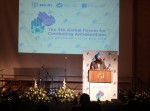
Tim Uppal, minister of state for multiculturalism, at the Global Forum for Combating Antisemitism. (photo from cic.gc.ca)
Canada’s position as a world leader in the global fight against antisemitism was reinforced last week at an international forum that saw experts and dignitaries tackling the issue of hatred towards the Jewish people.
The Hon. Tim Uppal, minister of state for multiculturalism, helped open the fifth Global Forum for Combating Antisemitism and reaffirmed Canada’s commitment to combating hatred and antisemitism in all its forms, including attempts to delegitimize Israel.
“Our government’s commitment to fighting the rise of antisemitism in all its forms is rooted in increased education and interaction between different communities to counter the ignorance and bigotry that spreads this pernicious hatred,” Uppal said in a statement. “We will continue to work to ensure that the horrid atrocities that occurred in the past never happen again.”
While in Jerusalem, Uppal met with businesses and experts to discuss the negative impact the boycott, divestment and sanctions movement would have on all sides in the region.
The forum is the premier biennial gathering for assessing the state of antisemitism globally and formulating effective forms of societal and governmental response. This year, it focused on two main subjects: confronting antisemitism and hate speech on social media, and the rise of antisemitism in Europe’s cities today.
Canada is a member of the International Holocaust Remembrance Alliance (IHRA) (holocaustremembrance.com), an intergovernmental body made up of experts from 31 countries that supports Holocaust education, remembrance and research around the world.
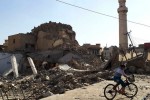
In July 2014, ISIS destroyed the Tomb of Jonah, the biblical prophet revered in Judaism and Islam, which was in the Iraqi city of Mosul. (photo from news-centre.uwinnipeg.ca)
The Islamic State of Iraq and Syria (ISIS) is disconnecting the present population from its past, and they will stop at nothing to achieve this goal, including murdering civilians and destroying cultural, religious and historical sites that interfere with their beliefs.
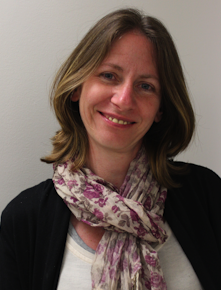
These were the sentiments shared by Winnipeg-based archeologist Dr. Tina Greenfield, who has worked in the Near East and conducted fieldwork in Turkey and northern Iraq under the threat of ISIS. Her University of Manitoba biography says that she is co-director of the Near Eastern and Biblical Archeology Laboratory (NEBAL) in Winnipeg, and is actively analyzing animal bone collections from Tel es-Safi and Tel Burna in Israel, Ziyaret Tepe and Gol Tepe in Turkey, and several sites in Iraq. Her lecture at the University of Winnipeg – ISIS and the Destruction of Archeological Sites in Iraq – was held on April 23.
Dr. Tina Greenfield is working to document archeological sites. (photo from umanitoba.ca)
She prefaced her talk by noting that keeping the population safe is, by far, more important than the artifacts on which she has worked. She then outlined the level of destruction that has occurred to some of the world’s oldest cities, and how she narrowly missed the expansion of ISIS in Iraq last year.
“I’m going to try to add some dimensions into this, so you understand how important this region is and why we should care,” said Greenfield. “So, while I will be discussing the Islamic State and a bit of their history and mantra, I twist into it my own experiences working in this region for the last two years, specifically.
“Yes, there are archeological sites being damaged, but it needs to be put into perspective. There are lives being lost in this region on a monumental scale. While I’m an archeologist, I’m trying to give another perspective. The priority is keeping the people safe in this region.”
The area in question is bordered by Turkey in the north, Iran in the east, and Saudi Arabia in the south. Also in the region, once known as Mesopotamia, are Lebanon, Syria, Jordan, Iraq, Israel and parts of Egypt. In the past, said Greenfield, “Mesopotamia refer[red] to the region between the Tigris and the Euphrates rivers. It’s also referred to as ‘the fertile crescent,’ because animals and plants were domesticated in this region. It’s also known as ‘the cradle of civilization.’”
The world’s earliest cities were built in this area, and major empires emerged from here, as well. Additionally, of historical and biblical interest, the first writings of the story of a great flood also originate there, as do the foundations of mathematics, astronomy, literature and poetry.
“Of all the empires, archeological sites from this region, each one has been damaged from Islamic State,” said Greenfield. “I’m giving you a brief introduction, so you can understand when I show you the sites, what is being damaged.”
The Assyrian Empire stretched from 2000 to 611 BCE, she explained, with its height about 3,000 years ago. “This is arguably the earliest empire of the ancient Near East, and Ashur is the capital of this region,” said Greenfield.
“There were some 19th-century gentleman explorers who came from Europe to try and find evidence of the Bible; they ended up in northern Mesopotamia and they dug these magnificent sites. It was a bit of a competition, because one was from Britain and one was from France.
“They each brought these riches back and displayed them in the British Museum and the Louvre. Suffice it to say, there was an awakening [about this historical time period] and the Mesopotamians and Assyrians were ‘rediscovered.’” It is these places that have sustained the most damage by ISIS out of all the Assyrian sites during the last four years, she said.
The motives and tactics of ISIS are many, she suggested. “We’re talking about terrorism, kidnapping, horrific murders, spreading terror throughout the region,” said Greenfield. “It developed from Al Qaida in Iraq. ISIS took precepts of the organization and beliefs, and developed them even further. It views itself as the restorer of early Islamic learnings. It also believes that it will cleanse the region of anything idolatrous or offensive…. There are eight million Iraqis and Syrians living under the control of ISIS right now. They seek to purify and stamp out anything offensive, idolatrous, any religious manifestations that don’t fit into their general ideas.”
In early 2015, museums and archeological sites became targets of the ISIS advance. “They weren’t picky,” said Greenfield. They targeted “everything from mosques, to churches, tombs, literary hero statues and manuscripts. They don’t want to have any part of that in this new caliphate state.
“They’ve publicized over 50 percent of their destructions in print and on social media. This is highly choreographed, highly targeted. There is no surprise that they have specialists in media. They want to break the link of what they consider heretical association with ancient Mesopotamia, destroying cultural heritage from all ethnic beliefs.”
This conquering tactic “isn’t new,” however. “We can look at Egyptian temples with statues, with faces smashed out, conquerors coming in and declaring things are idolatrous and smashing them. But, this is on a level we’ve never seen before. It’s calculated, choreographed and very well managed.
She continued, “There is looting … they are taking artifacts from these sites and selling them. There’s a massive network from South America to Asia to Europe. They’re selling to finance their organization.”
It’s important to bear witness to the destruction, she added. “Several of my Iraqi colleagues are trying to document, taking their lives in their own hands, essentially, to see what actual damage has been done to these sites. They’re also, in association with international organizations, trying to desperately document sites that haven’t been damaged yet, because we never thought these sites would be damaged and look what’s happened.”
Greenfield recounted that she had received an email on the day of her lecture from someone asking her what they can do, saying this must be stopped and asking by what means it is possible. So, what can be done about the damage being done to the region’s – and the globe’s – historical sites?
It’s an “excellent question,” replied Greenfield. “What do you do? How do we counteract the social media frenzy right now? Do we share them with people? How do we not play into their hands? But, how do you keep people aware of what’s going on?
“ISIS wants the link severed. They want the people gone and the history gone. How do we fight all of that at the same time? In my very humble position, the only thing I seem to be able to do is to continue to go out there – like this September and October again – and document this stuff.”
Since 2010, ISIS has been recruiting within the local population by paying more than government positions. “So, if you’re sitting there as a youth who is completely unhappy with the situation that’s occurred already and you’re offered a lot of money, it’s a no-brainer,” said Greenfield. “They are portraying themselves, in a sense, like Robin Hood, stealing and giving out food, giving out houses. They’re saying they’re protecting their own. Absolutely … there’s this ideology that they’re taking care of their people.”
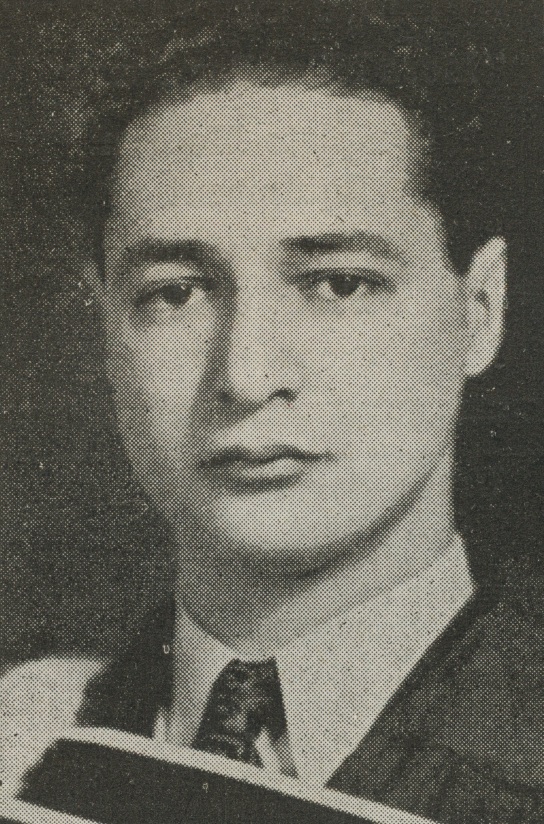
Portrait of Max Malit Grossman, circa 1926, copied from the book The Jew in Canada. Grossman’s mimeographs were the start of it all. (photo from Jewish Museum and Archives of British Columbia L.00011)
From 1930 until Abraham Arnold’s arrival in 1949, there was a new editor and/or publisher of the Jewish Western Bulletin every couple of years. Arnold lasted 11 years, Sam and Mona Kaplan about 36 all told. My first article ran in the JWB on March 28, 1997. I was listed as a contributor for the next year, becoming editorial assistant in May 1998, and assistant publisher that September. When Kyle Berger, Pat Johnson and I bought the paper, they graciously agreed that I become the publisher. Since that first issue, June 4, 1999, I have held that title. That makes 16 years. The second-longest term in the paper’s history.
For more than 10 years, I’ve been the sole owner of the Bulletin / Independent. While Kyle still contributes occasional articles and blogs, Pat is on the editorial board with former editor Basya Laye and me, and contributes weekly. I have worked with countless talented and kind people, many of whom have stuck with me, the paper and the community through some tough times, especially since the 2008 economic downturn. It is us, a handful of people, along with a few regular freelance writers, who get this paper to press every week. It is a labor of love for all of us. We do it for very little pay.
Financial struggle is as much a characteristic of this paper as is its Jewish character and its communal foundation, though that is one tradition I would happily leave to the dustbin of history.
Reviewing the 85-year history of the paper affirms my conviction that it is an absolute treasure, one of immeasurable value to Jewish life and this community. Yet, it is largely taken for granted. True, it has its admirers – thank you to all the organizations and businesses who advertise, and to all the readers who subscribe, donate or support our advertisers. But, on the whole, it is undervalued. And it has been almost since Day 1.
The newspaper got its start in 1928 as a mimeographed newsletter whose goal was to generate the funds and enthusiasm for a Jewish community centre. It succeeded in that regard, though the JCC would experience existential difficulties more than once in its life. Today, thankfully, the JCC is a strong and vibrant fixture in the community. When the mimeo became a tabloid in October 1930, its name was borrowed from a 1925 publication that was well-loved but, evidently, not well-funded, as it didn’t last for long.
More than one editor of the JWB has exhorted readers to pay their subscriptions and pleaded with organizations to buy advertisements. The relationship between editors and readers was much more contentious and frank during the 1930s and 1940s than it has been since. Reading these editorials every time I organize a special anniversary issue – this is my fourth – I am both saddened and heartened by the fact that, at their core, the issues remain the same.
This year, I have been particularly affected by the missives of editor and publisher Goodman Florence as he neared what turned out to be his last several months with the JWB. In the latter half of 1948, he starts to air some of the dirty laundry that has obviously been accumulating between himself and the Vancouver Jewish Administrative Council that took over control of the paper when the Jewish Community Centre, Jewish Community Chest and Hebrew Aid Society formed it in 1932, as well as other community organizations and even readers.
In August, he tackles head on the idea that readers have somehow gotten that “the Bulletin is a highly profitable proposition and is fought for. Such is not the case.” He points out that “subscriptions pay for only postage, paper and addressing, if it does that much. An attractive, newsy and acceptable publicity medium such as the Bulletin, is expensive to produce and its cost must be borne by advertisers.” This remains the case today.
That October, Florence’s one-year contract was coming to a close. Among his “many problems and many anxieties” is “the matter of the financial loss so far sustained in publishing for the community” under the terms of his contract, which he describes as “hastily arranged.”
He sums up his difficulties in being the publisher of an Anglo-Jewish weekly in November of that year, yet still holds hope that the situation is improving. In January 1949, he writes about all the ideas he has for the paper’s future, with only “a few final details” to be organized regarding a new contract. “I am hoping in the coming year to be able to devote more time and space to national and international affairs and will express a viewpoint in ‘editorials’ – and will endeavor to get prominent members of our community to also take their ‘pens in hand.’
“It will be my continued policy to assist every organization now in existence and which might come into existence, so long as the purpose is lawful and of good intention – to place itself before the public in as accurate a light as possible.”
After talking about an increase in the price of subscriptions and new help in finding advertisers, Florence concludes, “For 1949 I hope with your cooperation to make of our paper ‘one of the best’ – and to help build a progressive integrated community – and to spread the story of its good works throughout the land.
“For the opportunities of the past and the promise of the future, I wish to say, ‘Thank you.’ I will continue to do my best to serve you well.”
Less than a month later, his farewell editorial was published by the new team at the helm.
“Readers want world news, features, editorials . . . officers of all local organizations want their activities to be publicized. Up to date, I have not yet been able to completely sell the simple fact that to do all this requires considerable revenue,” Florence writes. “Some headway has been made in recent months, and there are now signs that more organizations are becoming aware of the need to place advertising that would be considered commensurate with the amount of news publicity their various activities require. There are signs also that more of the Jewish business men are coming to realize that there is after all some virtue in advertising in the Bulletin and doing business with the members of this growing Jewish Community.
“My decision [to leave] was arrived at after I realized that I had not been getting sufficient advertising support, and that without such assistance, progressive development could not be undertaken. I feel certain that now that the position has been drawn to your attention, the new publishers, Abe Arnold and Asher Snider, will get the support necessary to continue the venture, and I bespeak for them your utmost cooperation.”
When I look at the state of the publishing and newspaper industry today, I take heart that there have always been challenges and, despite the often-dire-sounding editorials of Florence and many of the paper’s other editors and publishers, here we are today. Many recessions have come and gone. Heck, the newspaper survived the Great Depression. Will it survive the internet? I certainly hope so, and not just because I would like to own a successful business.
I have looked through the physical pages of almost every JWB and searched through them online (multiculturalcanada.ca/jwb) ad nauseam for various people and events. I have read every single copy of the JI. Every time I look back at the articles and images in the papers, something surprises me, something sparks my imagination, something makes me think or makes me laugh.
I don’t know anyone who owns a community newspaper or any similar business. When I read that other editors, publishers and owners of the paper have had similar concerns, challenges and joys, there is a sense of solidarity, of not being alone. When I read about what various people in this community have had to endure, what they’ve accomplished, I am inspired. When I attended the rededication of the Jewish section of Mountain View Cemetery earlier this month, I felt like I had personally known many of those buried there. My connection to this community through its newspaper of record for 85-plus years is that strong and goes back that far.
But, ultimately, I didn’t know any of those people. I was born in Moncton and grew up in Winnipeg. My immediate family now lives in the Montreal-Ottawa-Toronto corridor and I came to Vancouver from Ottawa in 1992. My Winnipeg-based aunt had lived here in the 1960s. After I got my MA and a job – i.e. once it looked like I was staying awhile – she connected me with the Vancouver Jewish Folk Choir via her longtime friend and former musical colleague Claire Klein Osipov. It was one of my first connections to the Jewish community here and it has, obviously, led to other connections, including being the editor of the Jewish Museum and Archives of British Columbia’s annual journal The Scribe for the last seven editions.
I’ve always liked history, and I love having 85-plus years’ worth of it at my fingertips. It wasn’t until this special issue though that I decided to do a search for my aunt’s name – she passed away last fall.
My searches yielded more than a dozen results from 1962 through 1966, including the birth announcement of one of my cousins, her third son. And there was a photo of her, which was published twice, once with the wrong caption, a correction being noted in the following week’s paper. I knew that Aunt Chickie (married to Nathan Frankel at that time) was involved in the Peretz Centre and that she accompanied Claire on the piano, but seeing some of the committees she was on, the events she helped organize, the music she performed … seeing her face – I can’t describe the feeling, except to say, once again, this newspaper is such a vital resource in ways that I’m still discovering after almost 20 years working here.
S.A. Goldston, in the JWB.
The JWB had two fifth anniversary issues, one in 1934, another in 1935. In the first, editor S.A. Goldston writes, “It seems hard to realize that time has flown so quickly. We all remember well the small mimeographed copy first issued in the office of Max Grossman, and we wonder how many thought that the day was not far distant when it would grow to a regular weekly newspaper.”
He wonders whether the Bulletin had “filled the mission for which it was first intended? Is it any use today?” He leaves the answer to readers, “for naturally we are somewhat prejudiced in our personal views on the matter.
“The paper was first produced to act as the voice of the Community and to bring its readers in closer touch not only with the happenings in its own surroundings but with Jewry all the world over – to awaken Jewish consciousness, and if possible to create a deeper sense of unity among the Jewish residents of this City. In this way we can, without exaggeration, say [we] have been fairly successful.”
I love this last sentence, which, to me, shows clearly Goldston’s great humility. Yet his purpose is grand: publishing news of all the city organizations and devoting “considerable space to world happenings,” trying “hard to preach through the columns of this paper the absolute necessity of a United Jewry not only in Vancouver but throughout the world…. We have also, during the past year, continued to spur on our readers in civic, philanthropic and educational services and have received congratulations from non-Jewish communities on our work.”
But, he notes, as others would, “There are two things apart from the reading matter that is necessary to make a paper a success…. We need subscribers and advertisers.”
Of the advertisers the paper did have, he says, “We get a very fair share…. But we also owe a duty to every advertiser who uses our columns. We must give them our patronage whenever possible. They have confidence in us and [we] must show that this confidence is not misplaced. We would therefore respectfully suggest that in making your purchases those who advertise in the Bulletin be given preference.”
Goldston and his colleagues have “the great ambition of doubling the size of the paper,” which was then eight pages, within the next year. He asks for help in getting there, saying he has “much to be thankful for,” despite his “failing health,” and is proud to hold the position of editor.
The very next issue carried a front-page obituary. Goldston had passed away suddenly, at age 63. According to B.C. Archives records, he died April 11, 1934. His given names were Sim Alfred.
David Rome, in the JWB.
In the 1935 editorial marking “Five years of the Bulletin,” editor David Rome echoes some of Goldston’s remarks. He, too, speaks of gratitude and writes that the Bulletin’s “being taken as a matter of course by Western Canadian Jewry” is “the greatest compliment that can be offered to it,” showing that it “is not a freak venture but part of the life of its readers.
“But this sometimes blinds its readers to the phenomenon of a relatively small community successfully publishing a weekly newspaper for a number of years. Those who are daily in contact with the workings of the community publication realize fully the efforts that have to be made to maintain the standards set and to elevate them.”
Rome thanks all “those anonymous workers who have devoted unselfishly of their time and energy for this community enterprise. The Bulletin is a fairly big business and it needs a large amount of work and application to run this business. This devotion was given it by the members of the [Council’s Bulletin] committee and it is no more than fitting that thanks be given to them for their work.”
He notes that this anniversary of the paper also marks the first year since Goldston’s passing: “It is not at all an exaggeration to say that he worked beyond the limits of health, and the community should honor his memory and recognize his sacrifices for the community newspaper.”
Somehow I feel that, with every issue of this paper, we are honoring the people in this community who have made – and are making – sacrifices for whatever people and causes that are important to them. Every event, interview, photo, birth announcement, obituary … everything that gets recorded is proof of existence, of purpose, of being part of something larger than oneself.
This newspaper has always had a grand, even grandiose, view of the impact it could have on the community. But, looking back at 85 years – 90 if you count the original Bulletin, 87 if you start at Grossman’s mimeo – I’d say it has exceeded even the grandest of its expectations. And I’d like to see it continue to do so, whether or not I’m involved. But, as pretty much every publisher of the paper will tell you, “There are two things apart from the reading matter that is necessary to make a paper a success….” The future of this community treasure is, quite literally, in your hands.
The community has always enjoyed a good contest, JWB, December 1948.
Paging through 85 years of this newspaper reveals a stunning consistency of recurring phenomena, repetitious concerns, familiar family names, perpetually unresolved issues across decades and a solid tradition of community-building from generation to generation. The reporting across the decades reveals a comfortingly familiar refrain of the paper rallying the community to support the UJA Campaign, the Home for the Aged, Israel Bonds,
Hebrew University, Talmud Torah, Histadrut, summer camps, and the full range of communal organizations and causes, many of which continue to thrive today. Individuals are fêted for service to the community, for becoming bar or bat mitzvah, for graduating from university.
So perpetual are some of the issues facing the community and the Jewish world that headlines could be plucked form one decade and dropped unobtrusively onto the pages of the paper many years earlier or later. For fun, try to guess the years when these headlines appeared: “The past year will long be remembered as one of stress and strain;” “Jews must help Israel regain ‘positive image’”; or “Religious storm in Israel.” (Answers: the 1931 Rosh Hashanah issue editorial; 1985; 1950.)
Or these ones: “US won’t accept Likud position on territories”; “The trend of the time is toward the elimination of useless and duplicating organizations”; or “… it has been said that our loyalties are divided. That, in being Zionists, we fail as Canadians.” (Answers: 1977; 1925; 1929.)
Of course, some headlines are unique. On Nov. 3, 1988, the paper’s headline blared: “Israel achieves UN victory.” This was about a failed attempt led by Arab states to have Israel thrown out of the General Assembly.
Philanthropy is a continuous thread joining the decades. As early as 1930, the editorial was acknowledging that “The residents of the Vancouver Jewish Community doubtlessly at times become impatient with the term, ‘A worthy cause’” … before inveigling upon readers to support another commendable undertaking.
Warning of the dangers to communal well-being at the start of the Great Depression, an editorial in December 1930 takes a very Keynesian tone: “The foolish philosophy of tightening the purse-strings during a business depression, although the purse-holder is still well able to spend, becomes a selfish and heartless philosophy when applied to philanthropy. To deny assistance to those who are gripped in the vise of illness or need when the horizon looks darkest, is to display a false attitude to the charitable ideal.”
Pressure, sometimes not at all subtle, urged readers to give generously to the community chest campaign. “Larger Pledges Needed for Success of Chest,” the headline of October 9, 1936 read. “Open Your Door to Your UJA Canvasser,” pitched an issue in 1951.
Also unsubtle, but justifiably so, was the ominous plea for the 1940 campaign aimed at sending aid to the Jews of Nazi-occupied Europe: “Vancouver Jewish External Welfare Fund seeks support for Jews in Hungary, Poland, Germany and Romania … Tomorrow may be too late.”
Running in 1930, this headline nevertheless could have been from any decade in the paper’s history: “Bronfman Family Create Scholarship.” In this case, it was for the Talmud Torah and a Jewish orphanage in Winnipeg, but more than half a century later, the Bronfman family was instrumental in the creation of the Birthright-Israel program, which has sent thousands of young Jewish Canadians to Israel.
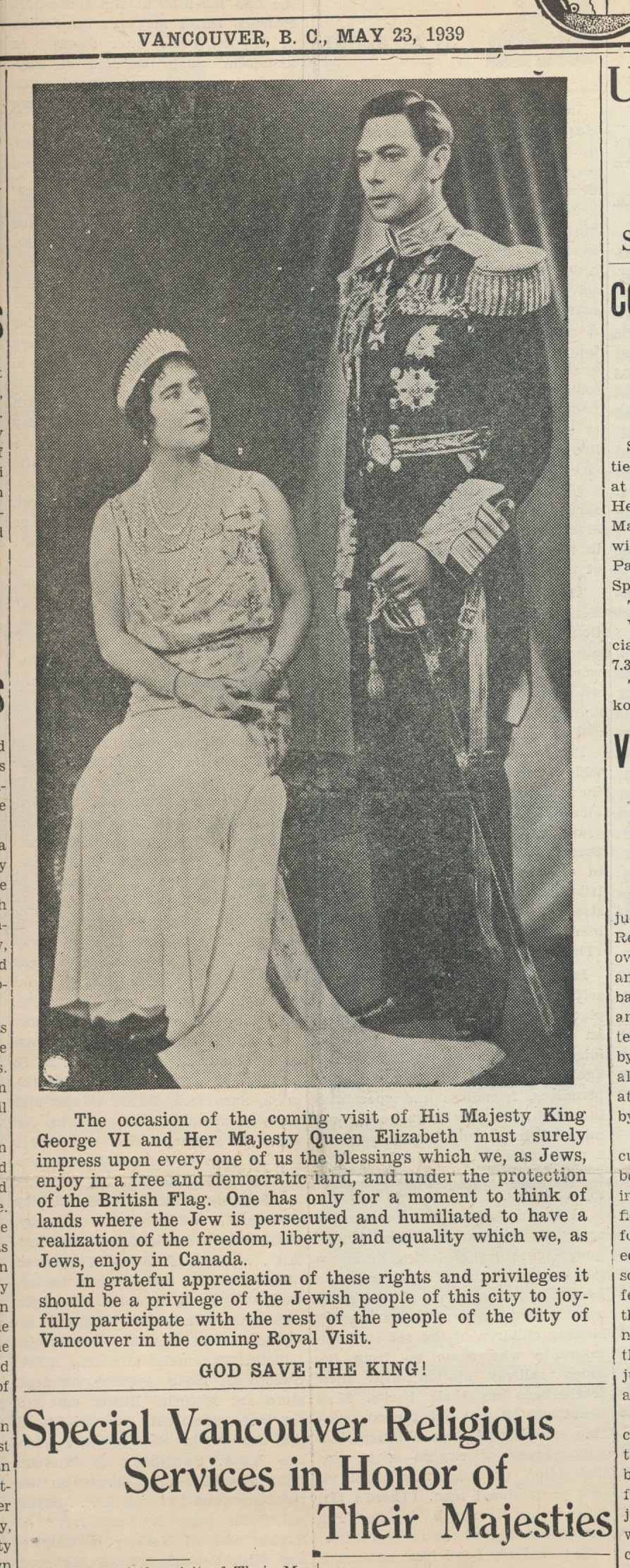
The paper routinely stressed the community’s loyalty to the Crown, JWB, May 1939. King George VI and Queen Elizabeth are pictured here.
In decades when Jewish allegiance to Canada was sometimes implied or openly expressed, the paper routinely adopted a highly patriotic tone. From heralding King George VI to lamenting his death with pages of editorial, there were also major assertions of Jewish allegiance to the new Queen Elizabeth II at the time of her coronation in 1953. Meetings of Jewish communal officials with elected leaders, including prime ministers, have been prominently reported, including just weeks ago when Prime Minister Stephen Harper met with Sephardi Canadians in Ottawa.
Emphasizing the responsibilities of citizenship has been a recurring theme. In 1930, the editorialist noted: “Indifferent people are often heard to say, ‘It doesn’t make any difference to me what party is in power, so why should I vote?’ Such a statement is the furthest thing from the truth and reflects an attitude which is to be strongly deplored.”
Although allegiance to Canada has been conspicuous, so too has been this community’s deep connections to the Jewish homeland.
In 1930, the paper reported on the appointment of a commission “to investigate the Moslem and Jewish Claims to the Wailing Wall.”
Throughout the 1920s and 1930s, anti-Jewish riots and pogroms in Palestine killed hundreds and shattered hopes of a peaceful existence in the Yishuv.
“As these words are written,” an editorial in 1936 lamented, “Palestine is again the scene of disorders, riots, bloodshed, sniping, isolated attacks and agonized mistrust, fomented hatred and international complications. The land of peace is again being ravaged by hate, and the eternal people of peace is again forced to consider problems of defence and even to raise physical means to ensure its own safety.”
These riots had the intended consequence of leading the British authorities to end Jewish migration to the Mandate. While met with outrage and agitation by Jews worldwide, the catastrophic historical impact of that decision would not be fully recognized until the endangered Jews of Europe suffered the Holocaust.
Even so, the paper recognized surprisingly early on the threat coming from Germany’s far right. In 1930, three years before Hitler took power, the Bulletin was already warning of the threat posed by the Nazis: “The Hitlerites, who, at the recent election in Germany made such tremendous gains, are marching to power on the wave of a dangerous and prejudiced nationalism. Their anti-Semitic policy is definite and has already manifested itself in many outbreaks and disorders of a most distressing kind.”
Concern for Jews all over the world has been constant in these pages. When the Sino-Japanese War broke out in 1937, the paper expressed fears for the Jews in China, noting that … “After Palestine, the United States and Latin America, China was the largest recipient of Jewish refugees in the 1930s.”
Jews and Christians packed Vancouver Lyric Theatre to overflowing after news of Kristallnacht signified what we now understand to have been the unquestioned beginning of the Holocaust.
By 1944, the realization of what had happened to European Jews was widely understood and an above-the-banner editorial held no punches: “To anyone working for one Jewish cause or another it becomes increasingly apparent that there are those among us who are SHIRKING THEIR DUTIES AND RESPONSIBILITIES.
“Yes, there are those among us who are too busy with their own affairs to think of their fellow man.
“Many of our fellow Jews never care to remember that somewhere in the darkness of Hitler’s Europe thousands and thousands of men and women and children are hiding in basements, in walled ghettos and in dismal forests in an attempt to escape certain death, while we abide in the glorious freedom and abundance of Canada.
“At this moment half the Jews in Europe are dead. WHAT IN GOD’S NAME WAS THEIR CRIME?
“You know, and I know, that their only crime is that THEY WERE BORN AS JEWS.
“Do you ever stop to ponder that it is only a curious turn of fate that led you or your parents to leave Europe and that you or your children might otherwise be among those who were exterminated by the Nazi slaughterhouses of Europe. WE MUST LEARN TO FEEL THE PAIN AND SUFFERING OF THOSE POOR BROKEN, BLEEDING PEOPLE AND DENY OURSELVES, IF NECESSARY TO SAVE THEM.”
When the war ended and the camps were liberated, the local community came together, helping in different ways, special prayer services among them.
Awareness of the extent of the Holocaust – and the role of Jewish statelessness in allowing it to happen – was made plain immediately after VE Day in an editorial penned by M. Freeman, president of Vancouver Zionist Organization: “For the Jews who have managed to survive this holocaust, Palestine and Palestine alone stands out as their only refuge. Only in a Jewish fatherland will they be safe. Only in Palestine can they start the broken lives anew with hope of ultimate restoration. We can help make this possible. We betray our own birth-right if we do less. No Jew, whatever his shade of opinion can withdraw from co-operating with the resurgence of his people. If we gave everything we ever owned, it still could not measure up to what they have already paid.”
From 1945, the issue of Soviet Jewry made top news month after month until 1989, when a new revolution allowed Jews across Eastern Europe to emigrate, changing the face of Israel and Vancouver, among other places.
The pages of the Bulletin also show that global events had unexpected ripples for Israel and the Jewish people. In 1973, the paper noted that, with the ceasefire in Vietnam, left-wing and other protest groups were turning their attentions to “Middle East peace.”
The connection between Jewish British Columbians and Israel leaps off the pages of the paper (including before Israel was “Israel”). The passing of the Partition Resolution was reported with jubilance and, months later, the dangers facing the new state were downplayed, declaring “A Nation Reborn.”
In 1954, in an event typical of discussions in the paper and in the community in the intervening years – and continuing today – a forum at the community centre mooted “What does Israel mean for us here?”
After the 1967 war, before the moral and military practicalities of occupying the West Bank took over the pages, the paper celebrated news of a reunited Jerusalem: “After 1900 Years City of David Returned to Israel.”
The paper has also highlighted the achievements of Jews around the world, from the first Jewish governor of Oregon to the appointment of a Jewish American ambassador to Albania. In 1930, the paper hyperbolically declared: “Of interest to every Jew in Canada is the recent election of David Arnold Croll, 30-year-old Jewish barrister as Mayor of Windsor, Ontario.” This item may not have had the universal interest the author believed, but Croll did go on to serve in the Ontario and Canadian parliaments and became the first Jewish senator in Canada.
Closer to home, the chronicling of events and achievements large and small has been the paper’s life’s blood. “Hadassah Chapter has Successful Year,” said a 1931 headline. “Permanent Camp Site Purchased by Jewish Council Women,” in 1937, was the first of many articles about the birth of what became Camp Hatikvah, originally in Crescent Beach, near White Rock, which was deemed by the reporter to be “the finest bathing resort in British Columbia.”
Since its beginning, the paper has been reporting on community-held contests of various sorts, including photo and public-speaking competitions – the latter still held annually despite worries as early as 1966 that, “These days when the custom of watching television has caused sociologists concern over the possibility of mankind forever losing the art of conversation …” began one editorial.
And, through it all, the community and the paper has managed to keep a sense of humor. From 1958:
Scrap collector: “Any beer bottles lady?”
Lady: “Do I look like I drink beer?”
Scrap collector: “Well, any vinegar bottles, lady?”
Luc Roderique as Usnavi and Sharon Crandall as Abuela Claudia in Arts Club’s In the Heights. (photo by David Cooper)
Even before the musical starts, the set draws you in. Then the music, the lighting, the actors, the choreography. It’s not that any one of these aspects is better than the other in Arts Club’s In the Heights, now playing at the Stanley Industrial Alliance Stage. This is merely their order of appearance.
Ted Roberts has created three storefronts and an apartment with a backdrop of the George Washington Bridge. The sun comes up – thanks to Marsha Sibthorpe – as a graffiti artist plies his trade. He’s listening to music, but it takes awhile to realize that there’s a live band “living” above the bodega – directed by Ken Cormier, the music is such a part of the scene that you don’t really notice it until you find yourself moving to it, or the actors start to move to it. Enter Lisa Stevens’ choreography. It, too, is subtle, occurring in bits and bursts with a few professionally trained dancers who raise the quality across the board.
While other critics have found the music and lyrics by Lin-Manuel Miranda and book by Quiara Alegría Hudes (who, according to the program, is of Puerto Rican and Jewish descent) wanting, I don’t need to be intellectually challenged when I go the theatre, and I don’t generally expect musicals to portray gritty realism, so I thoroughly enjoyed In the Heights. It was a refreshingly different cultural setting from other musicals and plays I’ve seen in Vancouver, and that made it easier for me to lose myself in it. While I’ll admit to drifting a bit near the end of the first half, the predictability of the story was a comfort, rather than an obstacle to my enjoyment.
There are two main plotlines. One centres around the bodega owner, Usnavi. He is a reluctant entrepreneur, having taken over the business when his parents died. He dreams of returning to the Dominican Republic, but feels duty-bound to keep the bodega going, and he’s also got to think about his sidekick cousin, the wise-cracking Sonny, who helps him out at the store. Not only that but (of course?) he’s torn about leaving, as he is madly in love – but too shy initially to approach – Vanessa, who works at next door’s soon-to-be-closing hair salon.
The other plotline focuses on Nina. Returning home to Washington Heights from Stanford University, she is the pride of the neighborhood, yet she has fallen short. Having to work two jobs has caused her grades to fall and she’s lost her scholarship. Her parents’ car-service business is barely keeping afloat, so there’s no money to be had there. In addition to the tensions that arise when Nina tells her parents the truth about her school situation, there is the not-so-small matter of her being in love with Benny, who, while trusted by her parents, for whom he has worked for years, is not Hispanic.
There is also a heat wave, a blackout and a death, and poverty, gentrification and other social issues are hinted at, however, none of these underlying elements rises to the foreground. In the Heights is light, fun fare and I, for one, won’t complain about that. The actors all do a great job at spitting out their lyrics clearly, staying on key and dancing in step; the musicians hit all the right notes. I left the Stanley in a better mood than I arrived, and that, to me, means it was a musical worth seeing.
In the Heights is on stage until June 7. For tickets and information, visit artsclub.com.
From the JI pages
JWB, 1987
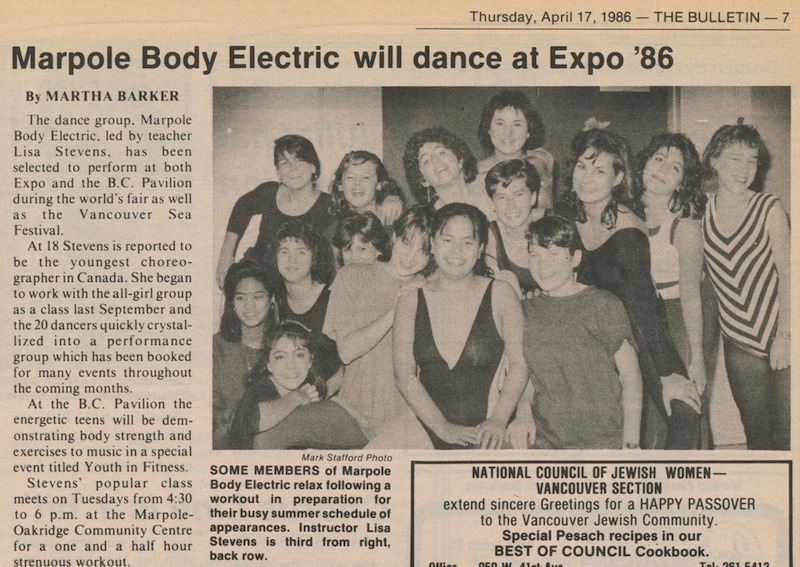
Lisa Stevens, the choreographer and assistant director of In the Heights, grew up in Vancouver, and readers of the Jewish Independent / Jewish Western Bulletin have followed some of the highlights of her career, even her pre-career.
She was part of the Grade 1 classes being fêted at the Shalom Yeladim celebration led by Rabbi Wilfred Solomon and Dr. Sheldon Cherry that welcomed the young students enrolled at Beth Israel School and Talmud Torah in 1973, and she shared her bat mitzvah on May 30, 1980, at Beth Israel with Lisa Goldman. She was winning dance competitions by 1977 and teaching by 1986, when she was reported to be “the youngest choreographer in Canada,” at age 18.
JWB, 2002
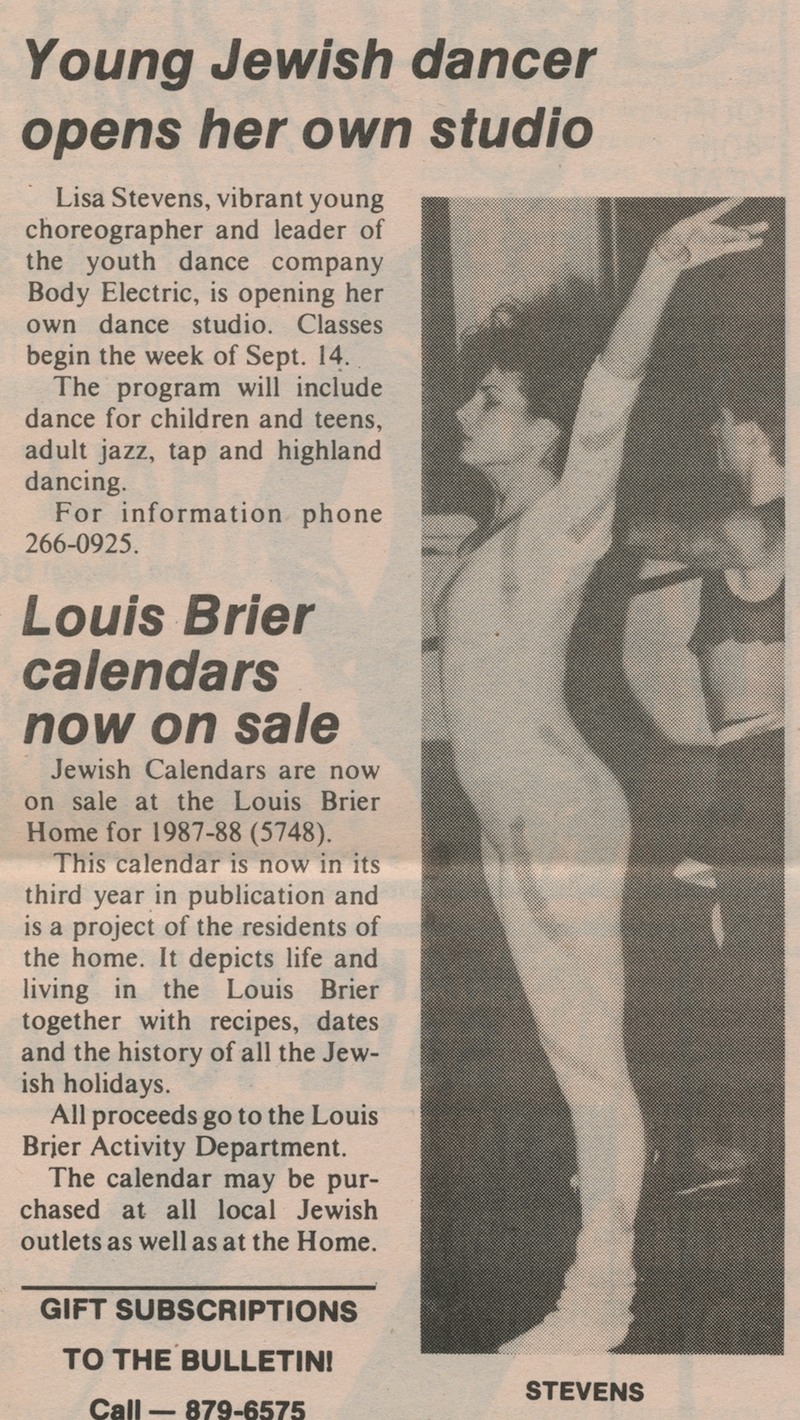
Stevens opened her own dance studio in 1987 and her students were winning awards by 1992. In 1993, two of them “beat out 3,000 dancers to win the national finals (duo category) of the Sega Video Dance Contest.”
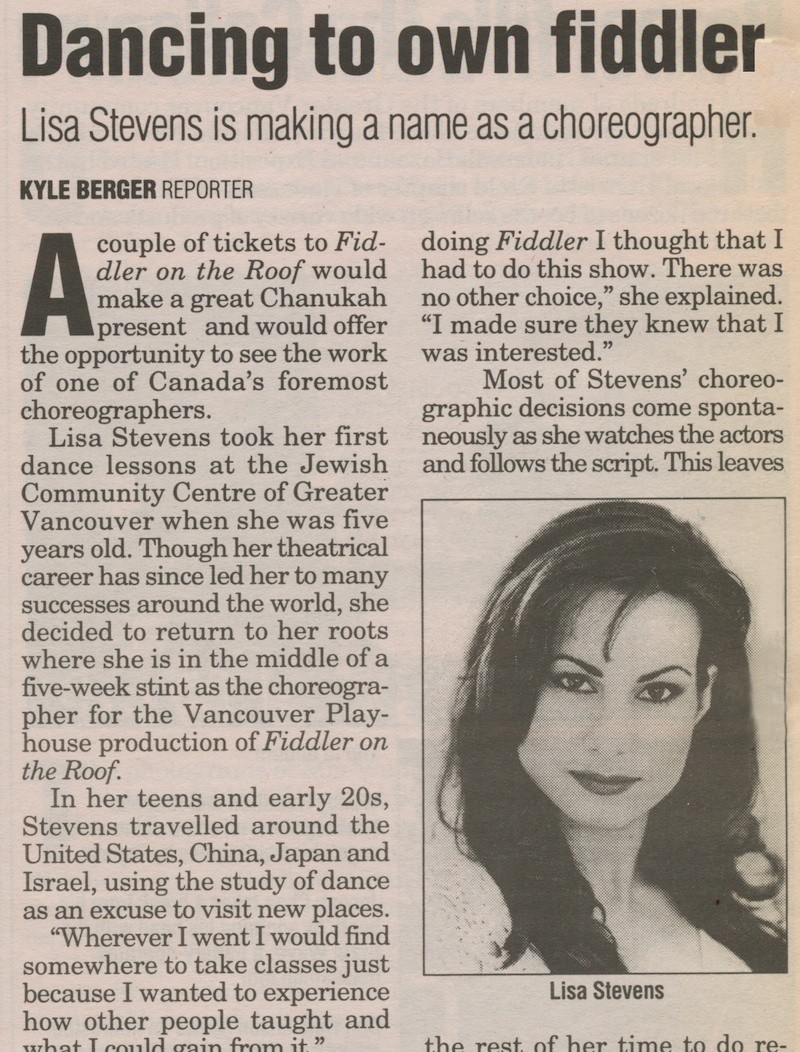
Off to London, England, in 1996, the JWB also caught up with her once she’d moved to New York. Stevens returns regularly to Vancouver to work on productions here and, no doubt, to visit family and friends. On more than one occasion, she’s taken time to chat with the paper and for that, we are appreciative.
Rabbi Zvi Hirschfield at Limmud Winnipeg. (photo by Rebeca Kuropatwa)
It was a packed room at the Gray Academy of Jewish Education during Rabbi Zvi Hirschfield’s session on gossip at Winnipeg’s Limmud festival in March. Some 80 attendees listened as Hirschfield steered the dialogue through biblical excerpts, and a discussion of gossip from ancient times to today.
Hirschfield grew up in Chicago. He studied for a number of years at Israel’s Yeshivat Har Etzion. After completing a BA in history at Columbia University, he did graduate work at Harvard University in medieval and modern Jewish thought. He received smicha from Israel’s Chief Rabbinate and has taught adult students of all ages at the Pardes Institute in Jerusalem for 15 years. Hirschfield lives in Gush Etzion with his wife, Dena, and their four children.
Gossip, he told those gathered, is destructive in many ways. Gossip can include inaccurate information, it can ruin reputations, it often lacks context and is especially subject to interpretation by the gossipper.
“The most obvious form of gossip that’s negative is when [the information is] false,” said Hirschfield. “I think we can all agree there is no possible justification that we’re comfortable with about sharing false information about somebody.”
What about sharing information that is true, however? To answer, Hirschfield led the audience on an exploration of a biblical passage from Numbers, 12:1-15. He explained, “We know that Aaron and Miriam are speaking about their brother, not an unusual family dynamic – two siblings speaking about the third sibling, seemingly saying something comparative. But, we know that God gets angry and views this as a sin.”
Even praise can be considered verboten, he said. “Even if I say something outright nice about somebody, the rabbis still seem to be saying that we should be very careful about that,” said Hirschfield.
“Why will [praise] bring about negatives?” asked Hirschfield. He gave an example. “I hear something good about Jim. I suddenly feel an urge [to think] something not so nice about Jim. So, when a name comes up, the rabbis are saying my instinct is well, yeah, Jim might be generous, but he’s also a lousy driver. We want to be helpful, but a little piece of us is taking a certain pleasure in sharing the information and creating a connection. We feel better about our own lives if we hear that somebody else is doing worse. I must be an OK person, because I would never do what Jim and his cousin did.”
He contined, “The rabbis seem to be saying that even when we are saying good things, there is an impulse to want to go to the negative. There is an agenda there whether we are aware of it or not. The rabbis are saying the other agenda is always there – always ready to emerge – when other people and their lives become the topic of our conversation.”
Hirschfield went on to talk about Moses (Moshe), who was referred to in the Torah as an anav [humble person]. He explained that this means Moses “was not in it for himself, not wanting his position for himself…. He felt his [brother Aaron] would be hurt and his only reaction was concern for his brother. It should be that way. An anav is somebody who doesn’t put themselves at the centre.
“I’m going to argue this is also the principle behind what happens with gossip,” he added. “So many of us fall into the trap that our sense of well-being is based on us looking to the left and the right. And, it’s such a deep trap that, even when we are trying to help, there’s a little piece of us that can’t help to cherish that nugget of information and go home and think, ‘I’m not as bad as Jim. I’m doing OK.’
“While sometimes we should share information to protect ourselves and other people, we have to be what we are thinking and make sure we are anavim. Moshe would share information, not to harm, but out of concern, out of love and out of care. If we want to be anavim and we’re not living our lives in comparison or competition, I don’t think there’s a danger.”
However, he clarified, “I’m not anti all competition. We can be motivated by other people’s success. If you learn a lot of Talmud, that motivates me to also learn a lot of Talmud, and I think that’s OK.”
The way Hirschfield sees it, “creating a holy community built on the us as opposed to being me … being about me and you is the way to go. Trying to find that success by bringing down other people takes away from communal holiness … and that’s the challenge.”
God, he continued, “is described as holy, because God doesn’t have to compete with anyone. [However, human beings] will try to win through fair means and sometimes through foul. Sometimes we’ll feel good because of our own accomplishments and sometimes we will feel good because of other people’s failure.” The alternative is to “aspire to create a shared context where we are all building something.”
Self-interest is not inherently bad, however. “We’re never going to be without self-interest,” he said. “We’re never going to lose our egos. We’re never going to lose that sense of … the way I figure out how I’m doing is by looking at other people. We’re human beings, and that’s clear.
“If I find myself constantly seeking out negative information about the people I’m around and I’m constantly supplying negative information, I’d want to use that as a type of mirror and say, ‘Wait a minute. Where am I? What’s going on with me that I am so excited and so interested to hear about other people’s failures? What is it about the fact that when I hear good news about somebody there’s a piece of me that wants to knock that down?’”
The focus, then, can be on the building a “holy community,” he said. “I think, for all of us here, that’s a way we can think about. How engaged am I in creating holy community? How committed am I to trying to build something with other people as opposed to building up my own ego by competing with others and tearing them down?
In closing, he said, “I think gossip, the rabbis are telling us, is one of the chief ways we can check in with ourselves to see where we are – comparing ourselves only to our better selves, finding ways to lift other people without looking to gain personally, using praise only when talking about God, and to act as an anav.”
Rebeca Kuropatwa is a Winnipeg freelance writer.
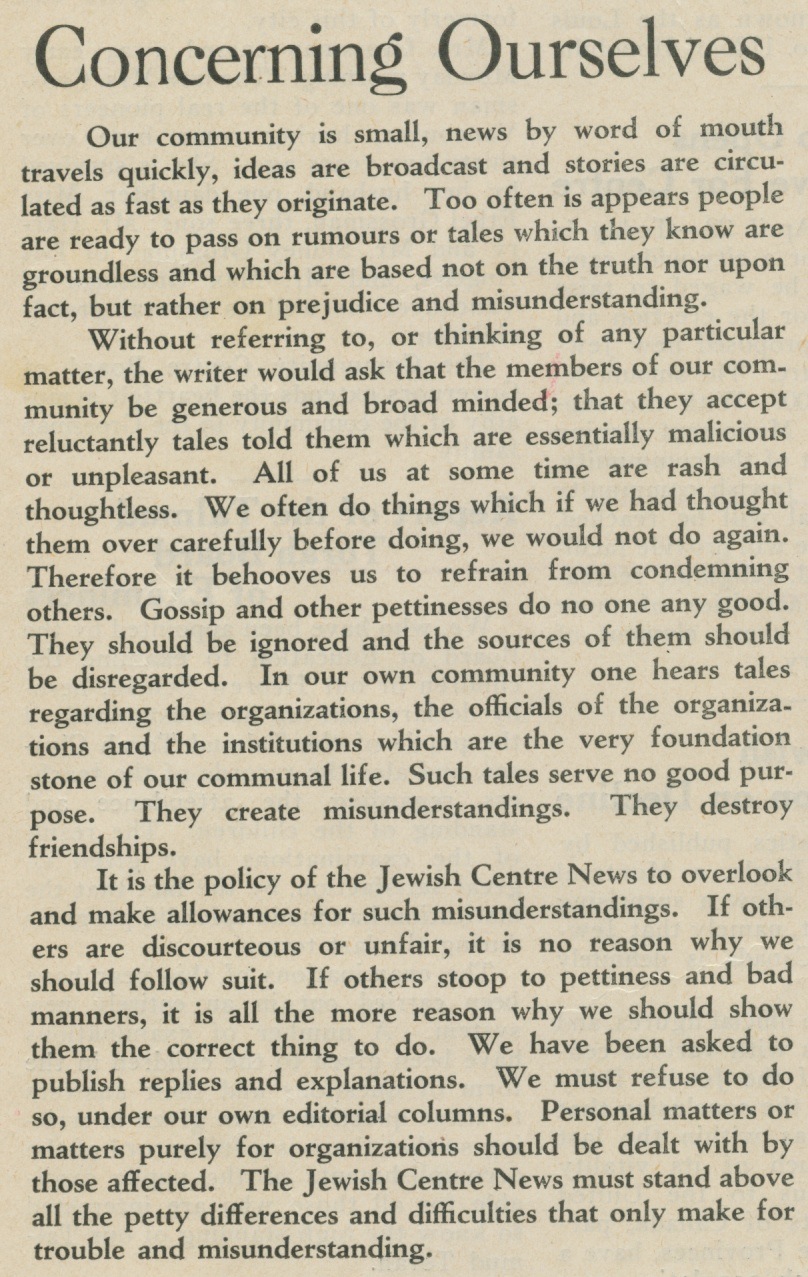
The effect of gossip has always been a concern in the Jewish community. Reading this story on Limmud Winnipeg’s session on how Judaism views gossip reminds us of an editorial from the very earliest days of the Jewish news here in Vancouver, from May 1, 1930.
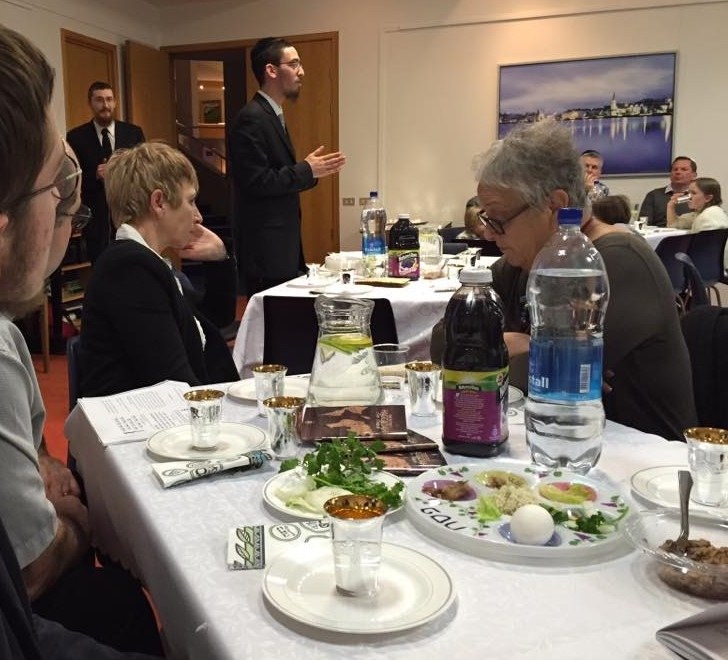
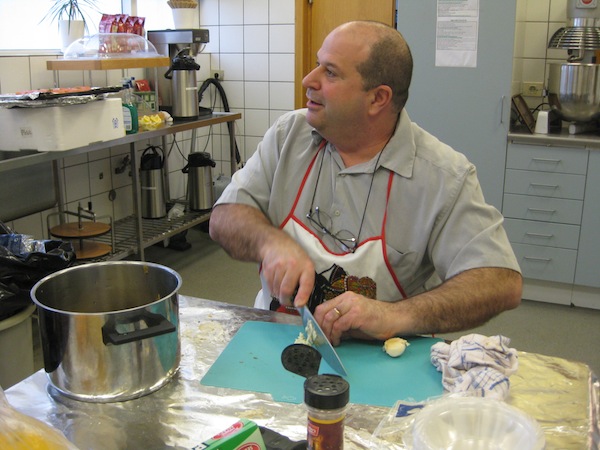
Jewish Icelanders preparing and celebrating Pesach with Chabad last month. (photos from Rabbi Berel Pewzner via Karen Ginsberg)
During a trip to Iceland in 2010, I had the pleasure of talking with a small number of Jews who called Iceland home. My connections were facilitated by a former colleague who had served from 2006 to 2009 as Canada’s ambassador to Iceland and happened to know that one of her locally employed staff members had Jewish family roots. From that initial serendipitous connection, came several more and, with each interview, I was able to gain some perspective on what kind of Jewish community exists in contemporary times in the country. I titled the article, “Like driftwood from Siberia,” because it seemed the most poignant metaphor – like driftwood, most of the Jews known to be in Iceland sort of washed up on the country’s shores as a result of a marriage or where they had been taken by their studies.
Shortly after the original article was published in 2010 by the Jewish Independent and by the national Icelandic newspaper, which serves the Icelandic diaspora in Canada, I received a phone call from an American Chabad rabbi, Berel Pewzner, seeking information about my experiences.
I have come to know that Rabbi Pewzner is drawn to Jewish life in remote and unique locations around the globe, so I am not sure whether Iceland was already on Chabad’s radar in terms of a small Jewish population in need of support or whether something in the JI article struck a chord. Whichever it might have been, a recent note from Rabbi Pewzner informed me that Chabad student rabbis have been visiting in Iceland for Yom Kippurs and Pesachs for the last five years, “bringing the warmth of Judaism to all.” He shared with me that during these annual visits, the student rabbis have been able to identify and visit with more than 100 Icelandic Jews, including 15 individuals who were new to the rabbis this particular year.
On Pesach, Chabad provides matza for all among those 100 Jews who wish some and then, to everyone’s delight, they hosted more than 60 participants for a full seder this year. Some of these newly located Icelandic Jews have been located as far from Reykjavik as the Faroe Islands.
In 2010, when I first traveled there, Iceland’s economy was in very rough shape. Many Icelanders felt that the recession they were then in would not reverse itself as quickly as other recessions had, and that they simply had to get used to the fact that their assets, both financial and real, were worth very much less than they would have liked. For some – particularly those who had family or business connections in other countries – it was easier to leave Iceland and begin again elsewhere. Rabbi Pewzner tells me that this sentiment is much less in evidence today. To the contrary, there is a now higher level of in-migration to Iceland than in the past. According a 2013 Statistics Iceland report, migration into Iceland is highest from Poland and Lithuania, but the next highest migration comes equally from Denmark, Germany, Latvia, the United Kingdom and the United States. While it is impossible to know for certain why people migrate, this report suggests living conditions, family reunifications, policies around gender equality and because of the natural splendor of the country. In Rabbi Pewzner’s recent experiences, he finds that American Jews of all levels of practice have included themselves in the recent upswing in migration to Iceland.
A May 1, 2015, article by Jenna Gottlieb, published in the Forward, supports Rabbi Pewzner’s observations. It reports that about 50% of the Jews now known to be in Iceland gathered for Rosh Hashanah services. The Ashkenazi food is undoubtedly a draw but so, too, is the rather unique opportunity during the Days of Awe to see the aurora borealis over the nighttime Icelandic sky.
It is very much the case that the Jewish population in Iceland continues to come into the country “like driftwood from Siberia,” to study, work, or because they are part of an interfaith marriage. Most are more secular than religious, but the common thread running through the community is the desire to retain and, with Chabad’s help, maintain a connection to their Jewish heritage. While Icelanders are considered accepting of Jews as individuals, Rabbi Pewzner noted that the Icelandic government in recent years has been deeply critical of Israel for its recent military incursions into Gaza.
It was truly a gift to receive the recent communications from Rabbi Pewzner about how things are moving forward in Iceland, with Chabad’s support, for the Jews within the country.
On the occasion of the 85th anniversary of the Jewish Independent, it is also a reminder that the information that is shared through a community newspaper helps to build community in many places, near and far.
Should anyone wish to contribute financially to the costs of these activities in Iceland or learn more about Chabad’s work there, visit jewishcayman.com/donatetoday for more information.
Karen Ginsberg is a travel writer living in Ottawa.
This photo and caption appeared in the Jewish Western Bulletin, Aug. 23, 1946.
May 5, 1945, is firmly etched in my “child’s” mind for that was the day of my family’s liberation or, more accurately, what remained of my family. The German occupation had been brutal and, with the collaboration of thousands of Dutch Nazis, 108,000 Dutch Jews had been deported and nearly all were murdered. Of those sent to Auschwitz and Sobibor, approximately 4,500 survived. Of Holland’s total prewar Jewish population of 140,000, fully 80% were murdered.
I had survived with my Christian hiders, Albert and Violette Munnik, and my “sister” Nora, their 12-year-old daughter. When I was reunited with my parents who had miraculously survived also, I had come to love the Munnik’s as my own family, and I was Robbie Munnik, not Robbie Krell. But I was given back, not without protest, a Jewish child who had no experience with Judaism but was nevertheless hunted for being a Jew.
In Nazi-occupied countries, 93% of Jewish children were murdered. Some escaped just before the war, a few thousand during the war through clandestine operations. But overall, no more than one in 10 survived. That is the nature of genocide. Murder the children.
Holland has somehow managed to maintain a reputation of comparative decency during the war years. Some of this good will emanates from the story of Anne Frank who left behind a diary written during her days in hiding in an attic in Amsterdam. The Frank family did in fact receive heroic assistance from Miep Gies, as did I from the Munniks and my father from the Oversloot family.
But of roughly 14,000 Dutch Jewish children in hiding, over half were betrayed. And, of course, so were the Franks. That adorable, intelligent adolescent Anne and her family were deported on the second to last train from Westerbork to Auschwitz on Sept. 3, 1944, three months after D-Day! She died an agonizing death of hunger and typhus in Bergen-Belsen. Only her father survived.
I write this piece on the 70th anniversary of liberation, a gift of 70 years of life. Who could imagine it? During the war, death had been a close companion, confirmed shortly after the war by the chilling reports that came our way from the few survivors that returned and from the photos that formed part of the news. I heard the descriptions of torture and murder from eyewitnesses. They were there. They had seen and suffered. And their lives and ours had been destroyed. No grandparents, no aunts or uncles. Two other children in our family survived, one also spared in hiding, the other, smuggled into Switzerland. That was it.
And what have I learned over these 70 years? The Holocaust imprint never leaves and no day passes without reminders. Had we tried to forget, it would have proved impossible. From the moment that the world discovered what had been done, the antisemites began their effort to deny what happened. Holocaust denial followed the campaign of murder with the effort to murder memory.
No wonder. Nearly everyone had blood on their hands. The British Mandate of Palestine was closed to Jewish immigration, preventing European Jewish refugees from fleeing. Canada and the United States had closed their doors. The Jews of Europe were trapped and murdered with technological efficiency, aided and abetted by Jew-hating collaborators in almost every country dominated by the Nazi invaders. The only way to be freed from guilt would be for the Shoah not to have happened. But the perpetrators were unable to erase the evidence. The Holocaust is the best-documented massive crime of murder and theft in human history.
Over the years, I have also learned of the systematic betrayal of visionary Jewish leadership who fought for the reestablishment of a Jewish nation-state in what is now Israel from the 1890s. No, Israel is not the result of the genocide inflicted upon European Jewry. If it were, Jews would not have had to fight the British colonialists in 1945-1947 to achieve freedom. And Holocaust survivors trying to reach Palestine would not have been incarcerated in camps in Cyprus.
The victory over the Ottoman Empire led to the establishment of a number of Arab states. Only the British promise of the 1917 Balfour Declaration’s intent to establish a home for the Jewish people went unfulfilled. The 1920 San Remo Conference affirmed that intent, only to witness the British carve off 80% of the territory known as British Mandatory Palestine to create the Emirate of Trans-Jordan. To add insult to injury, it was decreed that no Jew could settle there. This travesty resulted in the remaining 20% to be contested by Jews and Arabs to this day.
I was in Israel in 1961. The Western Wall of the Temple, the holiest site in Judaism, was controlled by Jordan and Jews were forbidden access. During Jordan’s illegal occupation from 1948-1967, all the synagogues in east Jerusalem were destroyed. Nor had Jordan advanced the cause of their Arab brethren or established a Palestinian state in the territories held.
I was at the Eichmann trial. I saw the architect of the annihilation of my people. Over time, it appears that a great deal of European posturing over Israel and its policies are an attempt to deflect attention from the horrendous misdeeds of the European past. There is a concerted effort to make Israel look like a nation with a brutal bent and whose activities, even those in self-defence are painted with the brush of Nazi and/or apartheid terminology. How offensive! How cruel! Its practitioners deny antisemitism for they have found a new outlet for Jew hatred, anti-Zionism. Israel has become the Jew of nations.
It is disconcerting, indeed, to witness the dawn of liberation 70 years ago descend into a night of renewed hate. I seek a measure of comfort in the words of Martin Luther King, Jr., and Eric Hoffer, the longshoreman philosopher. Dr. King wrote, “Israel is one of the great outposts of democracy in the world and a marvelous example of what can be done, how desert land can be transformed into an oasis of brotherhood and democracy. Peace for Israel means security, and that security must be a reality.” And Hoffer, “I have a premonition that will not leave me; as it goes with Israel so will it go with all of us. Should Israel perish, the Holocaust will be upon us all.”
I have to hope that antisemitism will be opposed and extinguished wherever it flourishes and that Israel’s right to exist will be protected. Then our liberation will have acquired meaning.
Robert Krell, MD, is professor emeritus of psychiatry at the University of British Columbia, and founding president of the Vancouver Holocaust Education Centre.
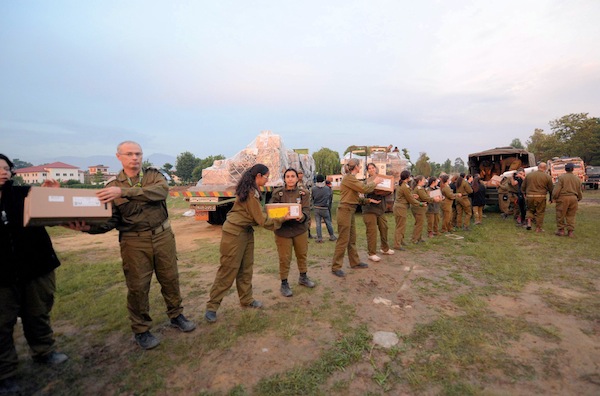
Israel is contributing to efforts to aid and assist the Nepalese government to reach, rescue and treat injured victims of the recent earthquake. The IDF has set up a comprehensive field hospital and also has flown out emergency rations and tents. (photos by IDF via Ashernet)
After Nepal was hit by the biggest earthquake in 80 years, the American Jewish Joint Distribution Committee (JDC) is aiding thousands of survivors through its relief efforts with partners on the ground, and is dispatching its disaster relief team from Kathmandu to remote villages to deliver aid and assess emerging needs in hard-hit areas. The team is assisting in the delivery of first-aid and shelter supplies, hygiene items, oral re-hydration solution, food packages and other supplies to 1,400 families over the coming days.
“Even while we’re helping survivors to heal throughout Nepal, we know more must be done and urge the public to continue its generous support of critically needed relief in this devastated country,” said Mandie Winston, director of JDC’s International Development Program. “Millions of Nepalese are facing harrowing conditions and the need for their immediate care, recovery and reconstruction efforts is required to secure Nepal’s future. Our efforts are focused on that path and to ensure the dignity of every human life along the way.”
To date, JDC has operated on three fronts in Nepal: the deployment of its expert disaster relief team on the ground; the support of locally based partners to ensure medical care and relief supplies within days of the quake; and the packing and shipping of medical and humanitarian supplies from the United States. These efforts have ensured life-saving medical treatment, food, clean water and shelter for Nepalese victims still reeling from the disaster. It has also enabled the assessment of needs and delivery of aid in real time, in tandem with changes on the ground, and the coordination of JDC’s network of local and international non-governmental partners working in Nepal.
These partners include the IDF Field Hospital, Tevel b’Tzedek, UNICEF, the Afya Foundation, the All India Disaster Mitigation Institute, Sarvodaya – Teach for Nepal, Heart to Heart International and Magen David Adom.
JDC has provided immediate relief and long-term assistance to victims of natural and man-made disasters around the globe, including the Philippines, Haiti, Japan and South Asia after the Indian Ocean tsunami, and continues to operate programs designed to rebuild infrastructure and community life in disaster-stricken regions.
JDC’s disaster relief programs are funded by special appeals of the Jewish Federations of North America and tens of thousands of individual donors to JDC. JDC coordinates its relief activities with the U.S. Department of State, USAID, Interaction, the Israeli Foreign Ministry, Israeli agencies and the UN coordination mechanism OCHA.
To contribute to the Nepal relief efforts, contact Jewish Federation of Greater Vancouver at 604-257-5100 or visit jewishvancouver.com/nepal-relief-fund.