Skip to content
  • Home
  • Subscribe / donate
  • Events calendar
  • Business Directory
  • FAQ
  • News
    • Local
    • National
    • Israel
    • World
    • עניין בחדשות
      A roundup of news in Canada and further afield, in Hebrew.
  • Opinion
    • From the JI
    • Op-Ed
  • Arts & Culture
    • Performing Arts
    • Music
    • Books
    • Visual Arts
    • TV & Film
  • Life
    • Celebrating the Holidays
    • Travel
    • The Daily Snooze
      Cartoons by Jacob Samuel
    • Mystery Photo
      Help the JI and JMABC fill in the gaps in our archives.
  • Community Links
    • Organizations, Etc.
    • Other News Sources & Blogs
  • JI Chai Celebration
  • JI@88! video

Recent Posts

  • Federation now across BC
  • Israel fighting for its existence
  • Deal strengthens Iran
  • Patriotic belonging diminishes
  • A campaign to engage
  • Upstanders’ first live event
  • Responding to Carney
  • Having your own home
  • Music a family tradition
  • Musical to warm heart
  • Community milestones … June 2026
  • Sharing her passion for Israel
  • Or Shalom reopens its doors
  • JFS from past to future
  • Need holistic approach
  • Sharing stories, advice
  • Journalist shares fears
  • Skills to live together
  • Road to independence
  • Cutting grass with scissors
  • Zionism as a solution
  • Deceit, desire & the divine
  • Reclaiming sacredness
  • Creative project ideas
  • Summer squares and cobbler
  • Thou shalt … summer commandments
  • Legal help for students
  • Revisiting myth of Lilith
  • Wrong person rebuked
  • Canada’s mixed messages
  • Questions for museum
  • Symposium on antizionism
  • Making soccer political
  • CJPAC lauds Pulver’s impact
  • City recognizes Vrba’s legacy  
  • Organ donation saves lives

Archives

Follow @JewishIndie
image - CJN box ad Rockowers 2026

Tag: tikkun olam

Giving back 150

Reflecting on Canada 150, Shimon Koffler Fogel, chief executive officer of the Centre for Israel and Jewish Affairs (CIJA), recently wrote in the Globe and Mail, “Surely marking 150 years as a united confederation means more than just an extravagant party and a day off work?… Canada 150 is an opportunity to appreciate the privileges and benefits we enjoy in our great country. But these reflections risk becoming mere platitudes if they are not animated with positive action. With privilege comes responsibility. Canada 150 is a moment for each of us to consider how we can pay the great gift of being Canadian forward through tangible contributions that enhance the experience for all who call Canada home.”

As someone whose family has been in Canada since the late 1700s, these words resonated with me. Indeed, my own ancestors were among Canada’s first refugees: Loyalists who had supported and fought for the British in the American Revolution.

In my case, the Lyon family (my father’s mother’s family) were Connecticut Loyalists who lost everything because of their active service to the Crown. Passionate supporters of the British way of life and system of government, they fled to New Brunswick bereft of their possessions. In their new home, unfamiliar but welcoming, they turned their efforts to building the extraordinary country that would become Canada.

The legacy the Loyalists left – combined with the work of generations of Canadians from innumerable backgrounds – was poignantly felt on the 150th anniversary of Confederation. Today, Canada is the envy of much of the world. While Canada is not perfect (what nation is?), we enjoy greater freedom, security, social harmony and prosperity than perhaps any other country on the planet.

More than anything, our forebears taught us that, as with most good things in life, a remarkable country doesn’t just happen; it is the product of vision, values and hard work. This no less true today than it was in 1867. The country my children inherit will be made better or worse by the actions (or inaction) of my own generation.

It was in that vein that Shimon continued, in his Globe and Mail column, to present a Pledge 150 challenge to all faith communities:

“The challenge is straightforward. We ask every church, temple, mosque and synagogue to commit to undertaking 150 positive deeds that make Canada better tomorrow than it is today: 150 volunteer hours visiting the elderly, 150 new donations to community food banks, 150 new Canadian Blood Services donations, 150 hands extended to indigenous communities. The list of concrete opportunities is as limitless as the need for them.”

What better way to teach our children what it means to be Canadian than to do something tangible to make our country a better place?

At the same time, the Pledge 150 approach requires us to be thoughtful, organized and sustained in our contribution. Based on the premise that we are changed through repetition, the great Jewish philosopher-rabbi Maimonides noted that it is better to undertake many individual acts than one large act of giving. The process of giving not only benefits the recipient but, when adopted as a conscious habit, it also creates a mindset of generosity in the donor.

If you, your family or your synagogue are interested in taking part, I invite you to visit pledge150.ca for more details – and to connect with us to share your pledge ideas with others. As for me and my family, we have pledged to collect 150 items of clothing over the year to donate to those in need. By encouraging our young children to be part of the effort, we share with them the importance of helping those less fortunate – a value at the heart of Jewish tradition and Canadian civic values.

Steve McDonald is deputy director, communications and public affairs, at the Centre for Israel and Jewish Affairs, the advocacy agent of Canada’s Jewish federations.

Posted on July 21, 2017July 19, 2017Author Steve McDonaldCategories Op-EdTags Canada 150, CIJA, Shimon Koffler Fogel, tikkun olam

Remembering gratitude

My family sat outside a museum, sharing snacks with some family friends. Their family’s preschooler offered us freeze-dried mangoes. My boys, great fans of fruit and veggies, had a mixed reaction to this novelty. As my twins ate their apples, I asked where they got these freeze-dried things.

“Oh,” our friend rolled her eyes. “I couldn’t live without Trader Joe’s.”

We had just returned from a trip to visit family in northern Virginia, near Washington, D.C. This is where I grew up, but it has changed enormously. It’s much more crowded, busy and wealthy than it was when I was a kid. It’s true that if you brave the traffic, you can buy nearly anything in its stores. Sometimes, I’m dazzled by the huge number of choices there. It’s a wide array of fresh, prepared (and sometimes even healthy) food. It’s sometimes expensive, but choice isn’t limited.

We have plenty of choice in Winnipeg, and I’m especially happy in the summer here. Whenever I can make them, I eat salads every day (a habit courtesy of spending a year on kibbutz in Israel) and we eat lots of fresh, local foods. Even so, the choices available in a very big, affluent metropolitan area can be overwhelming. When I expressed my amazement to one of my brothers, he said that, of course, I could get anything if I just ordered it from Amazon.

I didn’t get into the details of Amazon’s smaller selection in Canada, the huge distances and smaller population in our country, or the expense of doing this. I just nodded and indicated that, if we needed mango, I’d just get a fresh one.

Why is this issue in a Jewish newspaper? Our liturgy, the prayers and blessings we say at services, include multiple ways to be grateful. We’re grateful for food, for being able to get up in the morning, for not being sick, for being who we are, for peace … the list is a long one. To be honest, most people seem to say these things by rote. However, if you do go through the prayers and think about them, it’s a series of pretty meaningful things.

Teaching kids to be grateful has offered me a chance to remember to be grateful, too. When my husband and I model a “thank you, Mommy or Daddy, for this nice meal you made,” my kids learn to say thank you, too.

There are the more rare prayers – for rainbows and seeing the queen – but there’s also often a chance to say the Shehechiyanu, which is for joyous occasions and new foods. One of my boys nearly crowed the Shehechiyanu on this trip as he sat at the dinner table with all his grandparents with him at once. Then, without prompting, both boys thanked their New York City relatives for driving to see them, too.

It’s remarkable how easy it is to forget to be grateful. We often take things for granted. For instance, isn’t it amazing to have accessible fresh food that one can afford? We don’t have to go far to find Canadians who are hungry, or who live in remote places and don’t have this option.

What about clean water? Electricity? Internet? Affordable housing? The list could go on. It is a Jewish thing to acknowledge gratitude for what we have. It’s also a Jewish thing to do our best to give to those less fortunate and who need help.

It’s said that travel is broadening – and it sure is, I ate a lot on our trip! It also helps us see our daily experiences and lives better. My parents’ neighbourhood in Virginia is full of “tear downs” – perfectly decent, smaller houses that are purchased, demolished and a new “custom” home built in its place. Sure, the 1950s-era home might be dated, but the constant building, improving and affluence of the area means that old farmland becomes subdivided and all the farm stands disappear. The newly built urban homes, within a short walk of where I grew up, start selling at more than $1 million US.

So, some might say, “What’s wrong with having more? How about spending money if you have it? Doesn’t everybody need a bigger house?” (Or freeze-dried mangoes?) Practising the traditional art of reciting these prayers, the ones that encourage gratitude, help us be better at thanking G-d, our families and our communities for what we have. Reciting a prayer might remind us that being able to buy a fresh mango is a pretty good thing on its own. Even further, being grateful for what we have received might encourage us to help others with less.

It’s true that some people have more money and, therefore, can afford to spend it – but how many bedrooms and bathrooms does your family really need? Wouldn’t it be better to spend some of it on helping others have one meal a day? Housing? Clean water? Educational opportunities?

Sometimes thinking “small” – about square footage or fancy foods, for instance – really means thinking big, and helping taking care of many more in the world who have a lot less.

Joanne Seiff, a regular columnist for Winnipeg’s Jewish Post and News, is the author of a new book, From the Outside In: Jewish Post Columns 2015-2016. This collection of essays is available for digital download, or as a paperback from Amazon. See more about her on joanneseiff.blogspot.com.

Posted on July 21, 2017July 19, 2017Author Joanne SeiffCategories Op-EdTags environment, gratitude, Judaism, tikkun olam
Instilling responsibility

Instilling responsibility

Vancouver Talmud Torah head of school Cathy Lowenstein Lowenstein addresses those gathered for the closing of this year’s Mitzvah of Valuing Philanthropy program. (photo by Jennifer Shecter-Balin)

On June 15, Grade 7 students at Vancouver Talmud Torah celebrated the close of the year’s Mitzvah of Valuing Philanthropy (MVP) program. Started by the late Sari Zack Weintraub Greenberg nine years ago, MVP integrates a curriculum of tikkun olam (repairing the world), rooted in traditional Jewish teachings, into the students’ educational experience.

Head of school Cathy Lowenstein said Greenberg’s work “revolutionized the school’s tikkun olam curriculum.” Greenberg encouraged the students to “lovingly expand their universe of obligation,” said Lowenstein. The program is something that the kids look forward to in their Grade 7 year, she continued, noting that “tikkun olam is a cornerstone of the school.”

Since its inception, the MVP program has raised a total of $220,000. This year’s 39 Grade 7 students raised an impressive $27,000. On top of this fundraising record, this year’s Tzedakah Project has also contributed $10,000 as a grant to “motivate and inspire” the kids to develop their passion for tzedakah (charity/justice) and chesed (loving kindness).

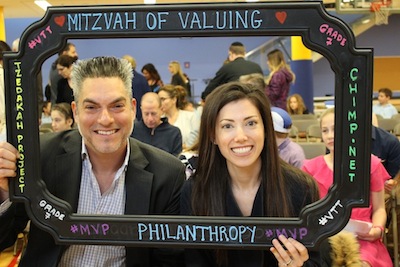
photo - VTT MVP Ariel Lewinski and Judy Boxer of Chimp
VTT MVP Ariel Lewinski and Judy Boxer of Chimp. (photo by Jennifer Shecter-Balin)

The MVP group expressed thanks to Cambridge Uniforms for their ongoing support of the program. This year also saw the involvement of Chimp representatives Judy Boxer and Ariel Lewinski, who offered support via the company to this generation of philanthropists. Boxer and Lewinski gave gift cards totaling $10,000 out to the members of the audience on June 15. Each card could be used to donate $100 to a charity of the recipient’s choice.

The MVP program is support by the Irma Zack MVP Endowment Fund, established by Dr. David Zack – Greenberg’s father – in memory of his late wife, and the original seed funding was donated by Sylvia and the late Lorne Cristall. It is through these funds that the school has been able to run MVP and other such initiatives.

The MVP students followed a careful process of selection of charities to support. They picked ethical commandments to work with, such as healing the sick, helping others in difficulty, or feeding the hungry. They researched the agencies that satisfied these criteria and found contacts with whom to work. Having interviewed these contacts, the kids then had 20 minutes to convince their class to contribute to their agencies, turning classrooms into boardrooms for allocation meetings.

Funds were donated to 24 different organizations this year, including household names like UNICEF and Magen David Adom, and local beneficiaries like the Vancouver Aquarium and Big Sisters. Students also selected Down Syndrome Research and CEASE, an agency that supports women victims of sexual exploitation and domestic violence.

Several students offered their perspectives on the MVP initiative to the Jewish Independent.

Asher Teperson described how “we assumed the roles of principal researchers, primary investigators, bankers and lawyers to assess the needs in our community and respond to them in concrete ways.” For the MVP students, this was a rite of passage. “We had a taste of what it means to become an adult in the eyes of the Jewish community,” said Asher.

Estie Kallner echoed these sentiments: “How often are 12- and 13-year-olds asked to make phone calls to strangers, conduct interviews in corporate offices, request clarification on financial matters and pester agency executives on their overhead costs?”

Julia Huber closed the program remarks with a reflection on how much they had grown through the experience. She described a group of “restless, nervous and confused” kids at the start of the program. However, she said, “with support and encouragement, not only did we embrace the challenge, but we exceeded even our own ambitious goals.”

As another student, Isabella Leipsic, observed, the program left them with a profound sense of their own “strength” in “moral decision-making.” She added, with thanks to the program, “our lives will never be the same.”

Shula Klinger is an author, illustrator and journalist living in North Vancouver. Find out more at niftyscissors.com.

Format ImagePosted on July 14, 2017July 11, 2017Author Shula KlingerCategories LocalTags education, Judaism, mitzvah, tikkun olam, Vancouver Talmud Torah, VTT
An out-of-hand hobby

An out-of-hand hobby

Si Kahn plays at the folk festival, which runs July 13-16. (photo from sikahn.com)

While Charlotte, N.C.-based folk musician Si Kahn – who’s coming to play at the Vancouver Folk Music Festival next week – may have called the United States home for most of his 73 years, he spent about 12 of his first 16 months of life in Canada. His father, Rabbi Benjamin Kahn, was sent to Montreal by B’nai B’rith in 1944 to help set up the Hillel Foundation at McGill University, which he did for just over a year before being called back to Pennsylvania State University.

“I like to say that I don’t have a single negative memory of my time in Montreal,” said Kahn, whose father eventually became the international director of B’nai B’rith Hillel Foundation (1959-1971).

And Kahn’s Canada cred goes back further.

“After my paternal grandfather, Gabriel Kahn, deserted the czar’s army and walked across Europe, he was a pick-and-shovel labourer for the Canadian Pacific Railway, helping build the ‘northern spur’ through the [Canadian] Shield towards Timmins,” Kahn told the Independent. “He was also a hod carrier in Winnipeg, helping build the Royal Alexandra Hotel, carrying 100 pounds of bricks or mortar up 10 or more storeys on his shoulders.”

Kahn tells his grandfather’s story – and that of many other members of his family – in the musical Hope. The song “Crossing the Border” highlights the border-crossings of his grandfather’s journey from Russia: “He got passage to Nova Scotia / Got married in Manitoba … Then he moved down south of the border / By the mills on the Merrimack River / He pumped gas and kept store for a living / Raised up his daughter and sons.”

Gabriel and his wife, Celia, settled in Lowell, Mass., said Kahn, who wrote about his Jewish roots and their influence on his music in an article called “The Chords that Bind.”

“When I was growing up … our family sang together,” he writes. “On the Sabbath and on holidays, we would stay at the dinner table long after the food and dishes had been cleared, and we would sing. Because musical instruments were not allowed on the Sabbath, we sang without instrumentation – but not without accompaniment.”

From his paternal grandfather, he learned “the fine points of creating a rhythm section, using only two basic variations (closed fist and open palm) of the basic hand-on-table technique.” From his parents, he and his sister, Jenette – whose career in the comic book industry included being president of DC Comics for more than 20 years – learned “the rudiments of high and low harmony, made up as you go along.”

The songs they sang were mostly prayers. “We sang a little bit in Yiddish, too, folk and story songs from the Old Country, which in this case meant almost any place in Europe,” he notes. And, despite his not understanding most of what he was singing, he did understand “what the songs really meant to us as Jews, as a family, as people in the world. They were our bond, our unity, our affirmation, our courage. They were our way of claiming our rhythmic and harmonic relation with each other and with our community. Our songs reinforced our solidarity, our sense that we could overcome the obstacles in our path.”

As for when his musical career began, Kahn told the Independent, “You might say I ‘turned professional’ in 1974. I had just turned 30 years old a few months before I recorded my first album, an LP titled New Wood, which was released in 1975 on June Appal Records.

“One of my first paid public performances was in 1979 … at the second-ever Vancouver Folk Music Festival. I’d led traditional labour and civil rights songs at rallies and demonstrations and on picket lines, but Vancouver was one of the first times I played my own original songs in public.

“While I do consider myself a professional musician, and while I’m a longtime member of the American Federation of Musicians (AFM), music has always been a very part-time vocation for me. My lifetime identity and work since I was 21 years old has been as a civil rights, labour and community organizer.

“I once told a reporter that my music is ‘a hobby that got out of hand.’ That’s really an accurate description. I typically do no more than three festivals and a dozen concerts each year at most. Most of my appearances are benefits for progressive nonprofits,” he said, adding that he’d be performing at the Vancouver Folk Music Festival house-party fundraiser on July 12.

Kahn heads to Orillia, Ont., for a July 7 performance at the Mariposa Folk Festival. From there, he’ll come to Vancouver for the folk festival, but also “to do some organizing work for Musicians United to Protect Bristol Bay.” It’s a cause he’s been helping on a volunteer basis since 2010 – the campaign’s goal is “to stop the Pebble Mine, and to protect permanently Alaska’s Bristol Bay, a cultural and environmental treasure, and one of the world’s last remaining great wild salmon fisheries.” He has donated all of the income from his 18th CD, called Bristol Bay, to the musicians’ group.

About combining music with activism, Kahn said, “The defining moment for me came when I was working with the Student Nonviolent Coordinating Committee (SNCC) on the Arkansas side of the Mississippi River Delta in the summer of 1965, when I was 21 years old, during the Southern Civil Rights Movement, which was very much a singing movement. That was when I first began to understand the usefulness of music in movements for social justice.”

Among Kahn’s many achievements in the social justice arena was being, in the early 1980s, an initial organizer and the founding national board chair for the Jewish Fund for Justice, the predecessor to Bend the Arc: A Jewish Partnership for Justice. He has written three books on community organizing.

“I see myself as an organizer, which I consider a specific type of activism, rather than as an activist,” he explained. “Organizers work to bring people together so that they can use the power of numbers to counter the power of money, authority and/or force.

“In any organizing campaign, in any campaign for justice, there will be competing sets of ‘facts.’ Whether our facts are more accurate/truthful than their facts isn’t nearly as important as whether, through organizing, we can build enough collective power to persuade those who have the ability to make the change, or changes, we’re asking for to meet our demands.”

On the topic of truth, Kahn said, “For me, there’s a difference between accuracy and truthfulness. Take, for example, the story of Moses receiving the Ten Commandments on Mount Sinai. Is that story accurate in the literal sense? But it should be told and retold truthfully, meaning that it’s our responsibility to transmit the story as it was told to us, whether verbally or in written form.

“My question is whether, in the real world, it’s even possible to differentiate,” he said. “If someone believes something passionately, it’s more than likely that no amount of either ‘facts’ or ‘alternative facts’ is going to persuade them to change their mind.

“Minds are more likely to be changed by experience. One of an organizer’s roles is to help the people she/he is working with have experiences through which they achieve a sense of possibility, that the world might be different for them and for others like them.

“This is also one of the places where storytelling can be useful. Years ago, I was in an audience listening to former U.S. senator Paul Simon. I don’t recall the specifics but, at one point, he was challenged on his support for legislation concerned with disability rights. He could have answered with facts/statistics (or, for that matter, with ‘alternative facts’). Instead, he said, ‘Let me tell you about a young man I know,’ and proceeded from there.”

In the musical Hope, there is a song called “Dreamers,” the chorus of which calls for us to “honour the dreamers.”

“I consider myself a ‘practical radical,’ someone who helps people work towards what at least appear – based on careful analysis and strategic thinking – to be achievable goals,” said Kahn. “If that’s being a dreamer, dayenu.

“There are many things I’d like to see in this world we share that I just don’t see as possible. I may be wrong in that judgment. But, if I’m going to help people organize themselves in order to achieve a goal they share, I need to believe there’s at least one and hopefully several practical paths to achieving that goal.

“The ‘dreamers’ I honour are those who not only have a dream, but who do everything they can to make it real.”

For the Vancouver Folk Music Festival’s 25th anniversary, Kahn wrote the song “For Canada,” which recalls the Underground Railway, the slaves making their dangerous way here: “When all hope was failing, think what strength it gave / To dream about a country that no longer held a slave….” A country to which, “… my own father’s father came with willing hands / To bend his back and lay the track across this wild land….”

And it was on his way home (by car) from his 1979 festival appearance that Kahn wrote “Plains of Canada,” the lyrics of which show his affection for the country – an affection that endures.

And so, too, does his love of singing and performing.

“Vancouver resident Josh Dunson, who was my agent for over 30 years until his retirement from the music business, once told me that what I bring to my musical performances is my many years’ experience as an organizer. That’s a very perceptive observation and a good description of what I try to do in the musical part of my life and work,” said Kahn. “When I’m planning a concert, when I’m on stage, I’m doing my best to help those who are listening feel that they’re not so much a passive audience but active participants. Sometimes this means singing along, sometimes it means thinking about what they’re hearing and applying it to their own lives and their own work. It’s that possibility that still excites me even after all these years.”

This year’s folk festival, once again at Jericho Beach, starts with a free concert the night of July 13, and then there are day and weekend passes that can be purchased for the performances July 14-16. For tickets and the full schedule, visit thefestival.bc.ca.

Format ImagePosted on July 7, 2017July 5, 2017Author Cynthia RamsayCategories MusicTags Bristol Bay, Si Kahn, social justice, tikkun olam, Vancouver Folk Music Festival
Helping one village at a time

Helping one village at a time

With solar panels, Innovation: Africa – founded by Sivan Ya’ari, centre – is helping bring light and water to African villages. (photo from Sivan Ya’ari)

“Growing up in Israel, we were a poor family,” recalled Sivan Ya’ari, founder of Innovation: Africa. “But the poverty I saw in Africa was true poverty. We can’t compare.”

Ya’ari spent part of her childhood in France, which later helped her land a job with Jordache, a jeans manufacturing company based in the United States that had some factories in French-speaking African countries.

“After spending time in villages and traveling to other countries, I realized that the main challenge in Africa, the main reason why Africa is still in poverty, is the lack of energy,” she told the Independent. “Because there is no energy, they can’t get access to medicine, vaccines – because there is no refrigeration. Because there is no energy, people don’t get access to good education. But, most importantly, people don’t have access to water.”

Ya’ari had imagined Africa to be a continent with little water, but she discovered there is actually plenty of water in Africa. However, the water is located in aquifers and, to get to it, you need to pump it – and to do that, you need energy.

“Growing up in Israel, I remember seeing solar panels on every building,” she said. “So, when I came and learned a bit more about energy, I thought, maybe we just need to transfer some of the knowledge and some of the technology to remote villages to give them a chance to access water and education.”

Ya’ari enrolled in Columbia University’s master’s in energy program and began fundraising to bring energy solutions to Africa.

As a student, Ya’ari started in one village, and then another, continuing to the point that, today, she has brought the technology – a large pump run by solar panels – to about 140 villages, and counting. The water is pumped into a large holding tank and then, with the help of gravity, flows to different taps that are installed throughout a village.

“Usually, we’re putting one tap two kilometres from the water pump system, another tap four kilometres from it and another … in all directions,” said Ya’ari. “So, with one water pump system, we’re able to reach many villages and people.”

Once the concept proved successful, Ya’ari founded Innovation: Africa, which operates in seven African countries. “In every country, we have an office with a local manager,” she said. “In Uganda, for example, we have seven full-time local people working who have all been trained. They are managing and doing the work on the ground.

“We first hire a company that does geological surveys. This provides information about how deep the aquifers are, how much water we can find and where would be best to drill. Then we hire a drilling machine company and have local contractors do the rest – installing the pump, the water tank, involving the community (meaning, the villagers) who decide where to instal the different taps.

“Once this is all installed, sometimes, in some villages, we instal an extra tank – only for irrigation technology (Netafim) that we bring from Israel – and then we provide irrigation pipes to the village.”

Each pump provides 30,000 litres on average per day per system.

Innovation: Africa recently received an award from the United Nations for their remote monitoring system – another technology that came from Israel.

“It’s off-grid, remote monitoring, so, at any point, we are able to remotely know how much water we’re pumping into every village,” explained Ya’ari. “If something breaks, meaning a pump hasn’t pumped water in 24 hours, we are notified about it by the system; not only us, but the local contractors and the local managers.”

Most of the funding has come from individuals and foundations, often with one individual or family sponsoring a village. On Innovation: Africa’s website (innoafrica.org), there is information about how to become a sponsor.

“We have a bar or bat mitzvah … choosing an orphanage to adopt and then they are traveling with their parents to be there when the kids get light for the first time,” said

Ya’ari. “We have families adopting villages. It’s very transparent, personal and concrete. The donors appreciate that they also have access to the remote monitoring. At any point on their phone, they are able to see how much energy was produced or consumed and how much water was pumped. They also know if something breaks. They are connected to the villagers. They go back and visit.”

According to Ya’ari, many children, especially girls, are kept out of schools in Africa so that they can walk the great distances necessary to get water.

“I believe that the best return on the investment is when we bring water to a village,” said Ya’ari. “What we found is that people are spending hours a day looking for water. Most of the time, the water they find is dirty and is not good for drinking. Once we bring clean water, the people are healthier. The changes we see … the children are going to school. We see a lot more girls going and getting an education. We see that they are growing food.

“What inspires me is the number of businesses villagers are able to grow with access to water. They are able to grow food and sell it in the market. They are making bricks and making their homes, no longer made with mud. We see livestock…. They are making more money.

“And, for the medical centres, it’s tremendous,” she said. “Once we provide a little energy and we buy a small fridge, then people come in from the capital to the village to help. The doctor, with energy, she can actually work.”

When it comes to the cost to make this happen, it is about $5,000 to light a classroom and $18,000 to light a whole school, including the homes of the teachers. To bring water to a entire village, it costs around $50,000.

No governments are involved in these projects. It is all about people on one end of the world helping out people on another end.

“Unfortunately, there is no shortage of villages waiting,” said Ya’ari. “In the seven countries that we operate, we have a long list of schools needing light and water centres. It has a lot to do with funding and people to adopt the villages. We have the people on the ground and the technology.”

Rebeca Kuropatwa is a Winnipeg freelance writer.

Format ImagePosted on June 16, 2017June 29, 2017Author Rebeca KuropatwaCategories WorldTags Africa, innovation, Israel, Sivan Ya’ari, solar energy, tikkun olam
Interfaith efforts recognized

Interfaith efforts recognized

The winners of the 2017 King Abdullah II World Interfaith Harmony Week Prize with King Abdullah, centre, at Al Husseiniya Palace in Amman, Jordan. (photo from worldinterfaithharmonyweek.com)

On April 30, the leaders of the Calgary Interfaith Council were in Amman, Jordan, to receive the 2017 King Abdullah Award for World Interfaith Harmony’s first prize from the king himself.

The council’s co-chairs – Rabbi Shaul Osadchey of Beth Tzedec Congregation, Debra Faulk of the Unitarian Church of Calgary and Imam Fayaz Tilley, a chaplain at the University of Calgary and board member of the Muslim Council of Calgary – were invited to attend the ceremony at the Royal Hashemite Palace. They were presented with the award by King Abdullah II. It included a cheque for $25,000 US to put toward their continuing work in Calgary.

Osadchey described the experience as “memorable, momentous, impactful.”

“The Calgary Interfaith Council (CIC) was reconstituted in February as part of the launch of the United Nations World Interfaith Harmony Week program,” Osadchey told the Independent. “The CIC is now the amalgamated body of five or six other smaller interfaith organizations in Calgary. It was launched as the central voice of the interfaith community here, so we decided to première that with the United Nations World Interfaith Harmony Week.

“We organized a week of programs that highlighted interfaith cooperation and strength of the community. We did a program that began with an opening ceremony at city hall. The mayor had issued a proclamation for the city that designated the week of Feb. 1st to the 7th as UN World Interfaith Harmony Week in Calgary, and he personally came and spoke.”

They had 15 different religious communities involved in the festivities, which included interfaith breakfasts, a weekend open house, and people were welcomed into various congregations for workshops and tours. There were also two “build days,” where participants volunteered to build a house with Habitat for Humanity.

“We raised $15,000 for the Habitat project,” said Osadchey. “It was a program with depth.”

The Calgary Interfaith Council submitted what they did to the website that oversees the worldwide program of activities, said Osadchey. “There were over 1,000 events worldwide and we were selected as the outstanding program for 2017 and won first prize, the gold medal. What that meant was that they asked us to send three representatives to receive the award in Jordan, along with the second- and third-place winners – the second-place winners were from Bosnia and the third-place winners were from London, England. We were flown to Jordan and spent three days there.”

According to the prize’s press release, the International Forum Bosnia’s Centre for Interfaith Dialogue was honoured “for their efforts toward dialogue and cooperation among ethnic and religious groups in Bosnia and Herzegovina” and the London-based nonprofit PL84U Al Suffa for “providing meals and services to the homeless, elderly and others in need in an atmosphere of interfaith respect and cooperation.”

At the Sunday morning awards ceremony, both King Abdullah II and Prince Ghazi ibn Muhammad were in attendance, with the latter giving a talk. Osadchey was asked to give a three-minute speech on behalf of the winning delegation.

Osadchey was the first Jew and rabbi to be part of one of the award ceremonies. “They were very respectful, very interested and engaged in the conversation about Judaism and about the Jewish experience in the interfaith arena,” he said. “Both the king and the prince were pleased to have me as a delegate and acknowledged that the interfaith dimension of the program had taken a significant expansion by having Jews included.

“I was looking forward to being able to convey some comments to the king. I began by reciting the brachah [blessing] that is said when you’re in the presence of the king or head of state. I recited it to the king in Hebrew and then translated it into English. And my comments were about how religious literacy is a necessary component for creating interfaith harmony.

“I suggested to the king that the World Interfaith Harmony Initiative develop a youth component that would focus on religious literacy among the youth of the world. And, when I received the medal from him and we had a few moments to exchange some words, he asked me to follow up on that proposal, as did the prince.”

Osadchey said he is in the process of writing a proposal to create this youth component, and added that he is looking forward to running a youth interfaith harmony week in Calgary. He hopes that others will use his model and do likewise in their communities.

“I think it’s important that not only adult leaders engage in creating relationships, but that we begin developing those among the next generation,” he said. “If we can do that, then the road to true harmony will be a lot easier to create.”

Since the world interfaith award was created in 2010, said Osadchey, there have been two other Canadian cities that have won awards – Toronto and Halifax, both achieving third place in their respective years.

The Calgary Interfaith Council is hoping to inspire a national designation of Feb. 1-7 as World Interfaith Harmony Week across the country and to bring other Canadian cities and communities into the picture. They are starting with their home province, encouraging their leaders to issue a proclamation designating it throughout Alberta. “We’re pretty close to getting that done,” said Osadchey. “Then, we’ve got an MP that’s working in Ottawa to do the same.”

Osadchey returned from Jordan full of hope and was impressed by the respect, interest and welcoming response of the Jordanian people he encountered. Nonetheless, he thought that, while interfaith activity might take place among the upper echelons of Jordanian society, he suspected that the general population is likely not as open or accepting. “That would have to do with probably lower levels of literacy, education, just in general,” he said.

He added, “The fact that their neighbour is Israel – and even though they have a fairly good relationship with Israel – it is still tinged with the Palestinian issue as well. I don’t think the ‘man on the street’ really cares about interfaith relationships in Jordan, but the leadership and the king certainly are trying to push the country more toward an acceptance of that.”

In Jordan, dialogue is mainly with the Christian world and does not seem to have any links with the Jewish world, but Osadchey is hopeful it may happen as a consequence of his visit.

“We’ll see how that takes place, but they’re reaching out,” he said. “The fact that the king of Jordan is the one responsible for this initiative…. They are trying to project a different image internationally.

“It’s really been very positive…. It’s had a positive effect on the Calgary community, both Jewish and non-Jewish, seeing this as a great recognition of our efforts in the interfaith community. It’s garnered a lot of recognition locally and spurred people to get more involved in our program, so that’s been a really positive benefit.”

For more information and to see more photos from the ceremony in Jordan, visit worldinterfaithharmonyweek.com/2017-prize-awarding-ceremony.

Rebeca Kuropatwa is a Winnipeg freelance writer.

Format ImagePosted on June 9, 2017June 7, 2017Author Rebeca KuropatwaCategories WorldTags Calgary, interfaith, Jordan, King Abdullah, religion, Shaul Osadchey, tikkun olam
Helping is partnership

Helping is partnership

Dr. Dan Ezekiel, left, and Ezra Shanken with JFSA Innovators Lunch co-chairs Shannon Ezekiel, left, and Dr. Sherri Wise. (photo by Rhonda Dent Photography)

“Something that we never could have imagined to be possible eventually became a reality because of our continued dreams,” said Beth Israel Rabbi Jonathan Infeld, referring to the establishment of the state of Israel, the 69th anniversary of which took place on the day he addressed the 13th Annual Jewish Family Service Agency Innovators Lunch.

“The JFSA as an organization,” he said, “continually looks forward to and works for ending hunger and poverty, healing those with mental illness and other challenges, solving issues of housing for our community – dreams that may at this moment seem impossible but, with the extremely dedicated and talented staff and donors and people who care about the JFSA, this is a dream that I believe is within our capacity.”

JFSA’s capacity was strengthened by the success of the May 2 lunch at Hyatt Regency Vancouver, which featured Kiva founder Jessica Jackley as the keynote speaker. After three years of declining donations, the 2017 event set a record – $340,224 has been raised from the lunch to date, writes JFSA chief executive officer Richard Fruchter in the agency’s May 24 enewsletter. The Edwina and Paul Heller Memorial Fund helped this year’s total by matching new gifts and any increases in renewed gifts to the event, up to a total of $25,000.

Co-chaired by Dr. Sherri Wise and Shannon Ezekiel, the lunch began with a welcome from Karen James, chair of JFSA’s board of directors. Fruchter then provided an update on the varied activities of the organization, including the services they offer the non-Jewish community. “We strive to make a difference for each and every person who walks through our doors,” he said.

This year’s short video shared the stories of a few people who JFSA has helped, including that of a young man struggling with anxiety and depression who received counseling at JFSA and a couple who received help finding needed subsidized housing for seniors. It also focused on the story of Tea and her father, Zadik.

“It’s remarkable to see a multi-generational story like Tea’s, whose family first arrived in Canada from wartorn Bosnia with almost nothing,” writes Fruchter in the May newsletter. “JFSA was there to welcome them, provide help and support as they adjusted to life in Canada and became productive citizens. Now, nearly 25 years later, we’re supporting her father, Zadik, a Holocaust survivor, through the [Claims Conference] Jewish Victims of Nazism program.”

At the lunch, JFSA board member and development chair Jody Dales told the audience of more than 600 that one of her and her husband’s main concerns is alleviating poverty, and that’s why they came to work with JFSA. She spoke about the importance of JFSA’s services for seniors with low incomes, and noted that this group includes Holocaust survivors. She spoke of the importance of the counseling that JFSA provides in a province where waitlists for psychiatrists can be eight months or longer.

JFSA spends more than $100,000 a year on operating the Jewish Food Bank and close to $400,000 making food vouchers available, said Dales. In the last few years, she added, the demand for vouchers has almost doubled and JFSA has had to reduce the amounts provided, from approximately $65 per month per individual, to $45. In addition, the agency has had to stop accepting new requests. Approximately five new people or families request to be put on the voucher list each month and all must be turned away, she said.

Shay Keil, director of wealth management at Keil Investment Group, introduced Jackley. Kiva, the microloan platform she launched in 2005, allows users to give loans of as little as $25 to entrepreneurs anywhere in the world. According to its website, Kiva has connected 1.6 million lenders with 2.4 million borrowers, facilitating almost $1 billion in microloans, which have a repayment rate of 97.1%.

photo - Kiva founder Jessica Jackley speaks at the 13th Annual JFSA Innovators Lunch on May 2
Kiva founder Jessica Jackley speaks at the 13th Annual JFSA Innovators Lunch on May 2. (photo by Rhonda Dent Photography)

In her Innovators talk, Jackley emphasized her journey from caring for the poor to helping them empower themselves, illustrating along the way how a small idea in social innovation, like Kiva, can grow and have such a large impact.

She told the Vancouver Sun in an interview, “I think people assume giving is a financial transaction, but what I am way more interested in and what changes the giver, is participating in someone else’s story and doing something outside your comfort zone, giving of your time, sharing a resource.”

“We all have something to offer, and it may not be money,” she also told the Sun. “As we expand the set of what we see as possible things to share, to give, I think we’ll see more abundance and possibility.”

The record revenue raised at this year’s Innovators comes at a time when the demands on JFSA are at record levels. The cost of living in Metro Vancouver, combined with rising food prices, particularly for produce, protein and dairy-based staples, is creating a crisis for many families, Fruchter told the Independent.

“In the past year, due to increasing hardship, the number of families having to use the Jewish Food Bank twice a month has almost doubled. Weekly phone calls seeking help with housing have also doubled over the past two years,” said Fruchter, and demand for help from new immigrants is also high.

“In the past year,” he said, “we have helped over 350 families make their new home in Canada.”

Matthew Gindin is a freelance journalist, writer and lecturer. He writes regularly for the Forward and All That Is Interesting, and has been published in Religion Dispatches, Situate Magazine, Tikkun and elsewhere. He can be found on Medium and Twitter.

Format ImagePosted on June 2, 2017May 31, 2017Author Matthew Gindin and Cynthia RamsayCategories LocalTags Innovators Lunch, Jessica Jackley, Jewish Food Bank, JFSA, Kiva, philanthropy, poverty, tikkun olam
Anything possible

Anything possible

Courage to Come Back chair Lorne Segal, left, with David Richardson, president of Octaform, a longtime supporter of Coast Mental Health and a personal friend of Segal’s, says a few words about the cause and his commitment to mental health before donating $50,000. (photo by Avi Dhillon Photography)

A record $1.57 million was raised at the 19th Annual Courage to Come Back Awards on May 16 at the Vancouver Convention Centre, where more than 1,500 people gathered to celebrate the extraordinary stories of triumph over adversity of the six awards recipients.

Each year, Coast Mental Health organizes this awards gala, an evening to recognize six remarkable British Columbians. Funds raised will go directly to Coast Mental Health to support those living with mental illness. The event was chaired by Lorne Segal, president of Kingswood Properties Ltd., and attended by many of British Columbia’s most notable business leaders and philanthropists.

After sharing their stories of how they have “come back to give back” in their communities, each of the six Courage to Come Back Award recipients received a glass sculpture designed by Musqueam artist Susan A. Point. This year’s recipients, with the category noted in parentheses, were Deborah Carter, Vancouver (addiction); Esther Matsubuchi, North Vancouver (social adversity); John Westhaver, Victoria (physical rehabilitation); Stephen Scott, Vancouver (medical); Rachel Fehr, Surrey (mental health); and Richard Quan, Vancouver (youth).

Westhaver perfectly captured the essence of the evening: “Looking back at my life, one thing I got is that anything is possible. Often we give up on our dreams because something gets in our way or we lose sight of our dreams. I invite you to never give up on your dreams. Anything is possible. The stories you have heard tonight are living proof.”

For the inspirational stories of this year’s Courage to Come Back Award recipients, visit couragetocomeback.ca/2017-recipients.

For 45 years, Coast Mental Health has helped provide housing, support services, and employment for people driven to recover from mental illness. Each program and service places clients at the centre of their own recovery. Coast Mental Health believes that recovery from mental illness is possible, but only when communities come together to break the silence around it, provide support and uplift the people it impacts. Coast Mental Health Foundation raises funds exclusively for Coast Mental Health. To find out more about the programs and services offered by Coast Mental Health, visit coastmentalhealth.com.

Format ImagePosted on June 2, 2017May 31, 2017Author Courage to Come BackCategories LocalTags Courage to Come Back, Lorne Segal, philanthropy, tikkun olam
Making Canada home

Making Canada home

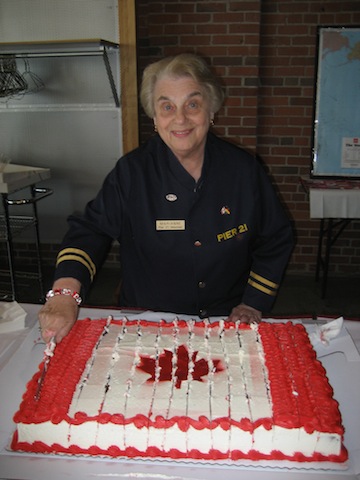
Marianne, left, with her father, Otto Echt, and sister Brigitte. (photo from Canadian Museum of Immigration [CMI] at Pier 21)

Marianne Ferguson’s family missed the train that was supposed to take them to Montreal from Halifax. Just 13 at the time, she and her sister were mostly excited at the prospect of something new, although they were sorry to leave friends and family behind in Europe. Their parents, however, were apprehensive, worried about starting a new life in a foreign country. And that was before they got stuck in Halifax – where, almost eight decades later, Ferguson, née Echt, still calls home.

In Europe, the Echts had lived in a little resort town called Brosen, just outside of the Free City of Danzig, which is today the Polish city of Gdansk. Ferguson’s father, Otto, was a pharmacist and a hobby farmer, and they lived well. Her mother, Meta, had multiple maids; the children – Marianne, Brigitte and Reni – had a nanny, and every spring and autumn a dressmaker would come into their home for a week to create new wardrobes for the upcoming season. When Adolf Hitler came to power, Ferguson’s family was relatively unaffected in the beginning. Even so, her parents saw what was coming and began making contingency plans.

Ferguson’s father kept homing pigeons on his farm. He would go to Poland to deposit money, and send the pigeons back home with coloured ribbons tied to them for Ferguson’s mother to decipher. A yellow ribbon meant he had arrived, for example, while a red ribbon meant he had deposited the money. He was able to get away with this scheme because the guards at the Polish border assumed he was entering his pigeons into competitions.

The Echts continued living in Brosen as the situation deteriorated for Jewish families. When the fair-haired Ferguson traveled to Hebrew school in Danzig with her sister, Hitler Youth would yell at her to ‘Stop walking with that Jew!’ When the Jewish children in the region were no longer allowed to attend school with their peers, the Jews of Brosen opened their own school on a local estate. The estate was at the end of a long street inhabited by Nazis, and it was understood the Jewish children all had to be in school and off the street by 8 a.m.

One day, when Ferguson was about 11 or 12, her streetcar to school was late. As she was walking alone down the long street to her school, a man sent his police dog after her. The dog attacked her, biting her on the elbow.

“And all of a sudden, somebody raised me up. Must have been an angel, really,” said Ferguson in a recent interview with the Independent from her nursing home in Halifax.

It was the milkman. He put Ferguson in his wagon, drove her to school and deposited her inside the gate. Ferguson said that man saved her life.

For her parents, it was the last straw. They decided they had to get out. A member of the Canadian consulate informed them that the country was not accepting pharmacists. Fortunately, though, the consulate worker saw their little farm and suggested sending them as farmers. And so it was that the Echts found themselves coming through Pier 21 in Halifax on March 7, 1939.

When they arrived at the pier, someone called their names and frightened Ferguson’s father. How did people here know who they were? But the woman calling them was Sadie Fineberg, from Jewish Immigrant Aid Services (JIAS). When the Echts missed their train, Fineberg put them up in a boarding house run by a Yiddish-speaking woman, and many Jewish families came to visit them.

photo - Marianne Ferguson
Marianne Ferguson (photo from CMI at Pier 21)

“My parents said, ‘The people were so nice to us, and how do we know what it’s going to be like in Montreal? Maybe we should stay in Nova Scotia.’ And then they helped us with finding the farm, they drove us out … and we moved over there,” said Ferguson.

The farm was in nearby Milford, about a 45-minute drive from downtown Halifax. The Echts had to stay and work the farm for seven years as a condition of their immigration and, after their term ended, they moved to Halifax. Fineberg became a close family friend, and her nephew Lawrence became Ferguson’s husband.

Ferguson’s extended family was not so lucky. Her parents had applied to bring 11 of them over to Canada, and they were supposed to arrive later in the year. Cutting through all the red tape took time, but the process seemed to be progressing. Ferguson’s 11 family members went to meet their boat in Hamburg – but it wasn’t there. That day was Sept. 1, 1939, and the Second World War had just broken out.

“My father had bought a second farm. We were so lucky, it was right next to our farm. We thought we would all be together in the two farms. But it wasn’t meant to be. They were all killed,” said Ferguson.

When the war ended, Ferguson began volunteering with JIAS, helping Jewish refugees find their way in Canada. Many of the displaced persons were children traveling alone. Ferguson remembers one 17-year-old boy in particular who came through Pier 21 in 1948 and needed money to get to Montreal. Ferguson and her mother gave him $20 and some food. They also told him that he would become a good citizen, and he should work hard and make something of himself. Meanwhile, Ferguson continued to volunteer at Pier 21 until it closed in 1971. She began volunteering there again when it reopened as a museum in 1999.

Unbeknownst to Ferguson, the boy listened to her. His name was Nathan Wasser, and he had survived multiple camps in the Holocaust, including Auschwitz. He was trained as an electrician in Munich after the war, so that’s the work he first did after arriving in Montreal. In 1952, he met his wife-to-be, Shirley, at a parade for Queen Elizabeth, who was still a princess at the time. Together, they started a family, having a daughter and a son, and he ventured into the business world. Wasser eventually came to own his own shopping centre.

photo - Marianne Ferguson volunteered at Pier 21 when it was an immigration facility and again when it reopened as a museum
Marianne Ferguson volunteered at Pier 21 when it was an immigration facility and again when it reopened as a museum. (photo from CMI at Pier 21)

Through it all, Wasser – who passed away in 2015 – kept in mind the two women who had helped him when he first came to Canada as a scared and overwhelmed teenager.

“So I said to him, ‘You know, you have this vision of two volunteers. Would you like to go back to Pier 21?’” said his wife Shirley Wasser in a phone interview with the Independent. “And he said, ‘Well, I’ll never find anything.’”

Despite his doubts, Wasser contacted the Atlantic Jewish Council in 2003. The council connected him to Ferguson (her mother had already passed away), and they arranged to meet when the Wassers visited Halifax later that year.

On the appointed day, Ferguson and her granddaughter waited in the lobby of Pier 21 for a man with a blue shirt. Unfortunately, it seemed as if every man was wearing a blue shirt that day. Finally, a couple entered. The man was wearing a blue shirt and carrying flowers.

“My granddaughter said, ‘I think that’s for you.’ And, you know, he recognized me,” Ferguson recounted as she started to tear up.

Ferguson and Wasser stayed in touch until Wasser’s death, and she is still in contact with his wife. Whenever the Wassers came to Halifax, the Fergusons would have them over for Shabbat dinner on the Friday, then the Wassers would take out the Fergusons for dinner on the Saturday. Every birthday and holiday, Nathan Wasser would send a bouquet of flowers to Ferguson.

“He had no words for her, how grateful and how appreciative he was to the pier and the volunteers,” said Shirley Wasser. “I think [Ferguson] was one of the finest ladies I’ve ever encountered.”

“He did save his money and he listened to what we were saying. He said he owed it to us to do well. He was so grateful,” said Ferguson, speaking of her late friend somewhere between laughter and tears.

Alex Rose is a master’s student in journalism at the University of King’s College in Halifax. He graduated from the same school in 2016 with a double major in creative writing and religious studies, and loves all things basketball. He wrote this article as part of an internship with the Jewish Independent.

Format ImagePosted on June 2, 2017May 31, 2017Author Alex RoseCategories NationalTags Canada, Halifax, Holocaust, immigration, Marianne Ferguson, Pier 21, tikkun olam
Continuing to bring hope

Continuing to bring hope

Fantaye, Gary Segal and Tesfaye in 2015, on a return visit by Segal to Gojam, Ethiopia. (photo from Gary Segal)

Thirty-seven spine surgeries, six nursing/midwifery scholarships, development of Sebi Sarko Rural Health Centre and the establishment of a pediatric program reaching more than 14,000 children living in rural areas. That’s part of what has been accomplished with the $1 million-plus that was raised in Vancouver five years ago at An Evening to Bring Back Hope.

The 2012 event honoured Dr. Rick Hodes, medical director of Ethiopia for the American Jewish Joint Distribution Committee (JDC) and senior consultant at Mother Teresa Mission. It also established a partnership between JDC in Ethiopia and the University of British Columbia Branch for International Surgical Care. With the monies raised in 2012, UBC Branch has developed curriculum with Hodes and engaged in spine-disease research in Ethiopia; as well, there have been physician and nurse exchanges between UBC-Vancouver General Hospital and Ethiopia’s Gondar Hospital.

This year, on June 8, An Evening to Bring Back Hope honours both Hodes and spine surgeon Dr. Oheneba Boachie-Adjei, and raises funds for the continuation and expansion of their work, as well as that of JDC and UBC Branch. Boachie, president and founder of FOCOS (Foundation of Orthopedics and Complex Spine) in Accra, Ghana, has performed most of the complex surgeries on Hodes’ spine patients since the two doctors starting working together in 2006.

The fundraising event includes a symposium and lunch at Congregation Beth Israel, at which attendees will be able to ask JDC staff questions about JDC’s humanitarian work and philanthropy, and a gala dinner at Vancouver Convention Centre-East. Event partners are JDC, UBC Branch and the Jewish Federation of Greater Vancouver. As in 2012, gala chairs are Gary and Nanci Segal.

“I am very pleased that Dr. Boachie will also be a focus of attention at the event,” Gary Segal told the Independent. Hodes, an observant Jew, and Boachie, a devout Baptist, “together work tirelessly to treat the sick and poor of all religions and ethnicities.”

“I truly believe that in today’s world filled with negativity, intolerance and discord, this cause and message of inclusion and multiculturalism resonates louder than ever,” said Segal.

Segal first met Hodes as part of a Federation/JDC trip to Ethiopia in 2007. He spent more time with Hodes on a family trip in 2008. “The more time I spent with Rick in clinic and at his home with his very large family of adopted and fostered children that all needed Rick’s help, the more heroic and inspiring Rick and his life story became to me,” said Segal. When hosting Hodes and his extended family of 18 children (at the time) for dinner, Segal learned that Tesfaye – whose spine had collapsed from tuberculosis – could not be operated on in Ghana, and thought, “I knew that I had to do whatever I could to save Tesfaye’s life.”

According to the fundraiser’s website, Segal “spent almost a year pursuing the possibility of bringing Tesfaye to Vancouver for spine surgery and, finally, on his 18th birthday, May 20, 2009, Tesfaye arrived in Vancouver and was welcomed into the Segal home. On June 12, ‘Team Tesfaye,’ led by surgeon Dr. Marcel Dvorak at VGH … successfully perform[ed] delicate 14-hour life-saving surgery.”

“For decades,” Segal told the Independent, “I have always given of my time and money to help a variety of community organizations and causes – I grew up with wonderful examples of this in both my mother and father. Helping Tesfaye was a unique experience, where the ‘giving back’ became such an intimate, personal and integral part of my life.

“On my 2010 trip back to Ethiopia after Tesfaye’s surgery, I retraced and revisited what his life was like before surgery. Understanding Tesfaye’s courage, dignity, perseverance and optimism – that he kept in the direst, most uncomfortable and debilitating of situations – motivates and inspires me daily, and always keeps my problems in perspective.

“Seeing the transformation in Tesfaye’s life and what it has meant to his family and entire village, further inspired me to found this Bring Back Hope initiative,” he continued. “One of the highlights of my life was that 2010 trip to Tesfaye’s remote village in Gojam – a typical village with mud huts, no electricity or running water – as the entire village celebrated his miraculous rebirth for three days, with feasting, chanting and Agew shoulder dancing. Seeing ‘up close and personal’ the impact of changing even one individual’s life, it became my vision to introduce Rick’s story to more people by holding a large dinner of caring people from different faiths and backgrounds, and to hopefully raise a lot of money to change more lives. Thus, the Bring Back Hope initiative was launched through the inaugural Evening to Bring Back Hope 2012.”

But his efforts extend beyond the events. “I never imagined before meeting Tesfaye that, one day, I would have a whole extended family in Ethiopia become part of my family,” he said.

It was hoped that Tesfaye’s sister, Fantaye, would be joining her brother at this year’s Bring Back Hope. Unfortunately, she won’t be able to make it – but for “good news” reasons, said Segal, “as she is about to graduate from Grade 12 at a high school in Ethiopia’s capital city Addis Ababa and the national exams she has to write to qualify for university only end on June 8.”

“I met Fantaye in February of 2010,” explained Segal, “when I flew over to Ethiopia to accompany Tesfaye on the journey out to his remote village in Gojam to be with him to experience his family and village seeing him standing upright for the first since he was crippled with TB of the spine at 8 years of age…. Tesfaye, living in the capital Addis Ababa since he was 12, heard that his mother wanted Fantaye to get married; he was concerned she was too young, being only 12 years old, and feared the husband’s family would force her, once she was married, to stop going to the village school. At his request, I asked his mother, Yeshi, to wait until Fantaye was older and completed school, but, sure enough, she was married a few months later, at the age of 12.”

When Segal returned to Ethiopia in December 2012 on a Bring Back Hope-related trip, he found, to his “surprise and delight,” that, “through Tesfaye’s persistence and insistence, Fantaye had left her husband and village to join her brother in Addis Ababa and live with him and go back to school. This took a lot of courage on the part of a then 14-year-old girl, going against the wishes of her family and entire village. At the same time, it took Tesfaye’s courage of conviction as to what was right for his sister for this to happen; I attribute this to Tesfaye understanding the greater world outside the village and Fantaye seeing the transformation of Tesfaye.”

Even after 27 years working with JDC in Ethiopia, Hodes still finds inspiration from his patients.

“The courage which Ethiopians live with who have spinal deformities is simply inspiring,” Hodes told the Independent. “Kids who are in pain but still go to school, kids who are teased at school but persist, kids who have no parents and are self-supporting as young teens but go to school and come for treatment.

“And the love which they show for each other is exemplary. I have a single mom who has a paralyzed son who has simply devoted her entire day – every day – to caring for this boy, who is now improving. In fact, I just brought him to Ghana five days ago for intensive physical therapy to see if we can jump-start his improvement.

“I bought a bag of cookies for a young boy with a bad back. He put them in his pocket. ‘Why don’t you eat it?’ I asked. ‘Later,’ he said, ‘I want to share it with my brother.’

“I have another mom who has a son who had a complex heart problem giving him very little oxygen. This boy could not walk more than three steps and the mom has made sure that he moves forward in life by carrying him, piggy-back, everywhere. She carried him to school, carries him home, brought him to Addis Ababa every month for phlebotomy, to remove the extra blood his body produces. And now he’s able to walk, after corrective heart surgery in India.

“I had an orphan boy with no relatives at all,” continued Hodes. “He came to Addis Ababa, supported himself by shining shoes, went to school and slept in a taxi at night until someone took him into their home. He, too, has had surgery and is now back in school.

“When I’m having a tough day – I frequently feel overwhelmed – it’s patients like this who keep me going, and remind me why I’m here.”

Hodes’ International Life-Saving Surgery Program 2016 annual report describes that year as “game-changing.”

“This was the first year that the Ethiopian government gave us support – they paid for the air tickets of 22 patients to Ghana for spine surgery,” explained the doctor. “They are continuing the air ticket support this year.”

Also in 2016, he said, “Our contract with the Ethiopian government ended its standard, three-year period and the program closed for evaluation. It was given an unprecedented five-year renewal.

“We have moved into new facilities at a government trauma hospital called AaBET [Addis Ababa Burn Emergency Medicine and Trauma] Hospital, where we see patients five days a week. We have started discussions to send two Ethiopian doctors to Canada for spine training. We now have several teams coming to Ethiopia to operate – in fact, we have three different spine teams coming this month, and will get at least 40 surgeries done inside Ethiopia!”

In addition to treatments, there have been discoveries. “We have described some new deformities, which we are now defining with Greek letters,” said Hodes. And, he added, “We believe we’ve made a major discovery about spine deformities caused by neurofibromatosis.”

In 2016, Hodes said there were 359 new spine patients, with 111 surgeries conducted on 105 patients. “We got two spines done in the U.S., and helped two patients go to India for heart care,” he said. “So far this year, we have 101 new spine patients.”

Hodes said the price for spinal surgeries ranges from $13,000 (or a little less) to $21,000, averaging about $18,000. For hearts, he said, “some patients need procedures (done in the catheterization laboratory) where a balloon is blown up to expand a narrowed valve or close a hole in the wall of the heart. Those cost around $2,000. Surgery costs depend on the complexity of the case, and generally run from $5,000-$10,000.

“If we get surgery done in North America, it’s at no cost to us, other than an air ticket. We just had two boys return from complicated surgery in Texas, and another from California.”

Hodes stressed, “I cannot sufficiently thank the people of Vancouver who are helping me. Their help is, quite literally, life-saving.”

For tickets to the gala ($500, with tax receipts issued for eligible portion) and sponsorship information, call Mercedes Dunphy at 604-710-4491 or Nanci Segal at 604-813-5550. For more information on the initiative, visit bringbackhope.com.

Format ImagePosted on May 26, 2017May 24, 2017Author Cynthia RamsayCategories LocalTags Boachie, Bring Back Hope, Ethiopian, Gary Segal, health care, JDC, philanthropy, Rick Hodes, tikkun olam

Posts pagination

Previous page Page 1 … Page 22 Page 23 Page 24 … Page 30 Next page
Proudly powered by WordPress