Skip to content
  • Home
  • Subscribe / donate
  • Events calendar
  • Business Directory
  • FAQ
  • News
    • Local
    • National
    • Israel
    • World
    • עניין בחדשות
      A roundup of news in Canada and further afield, in Hebrew.
  • Opinion
    • From the JI
    • Op-Ed
  • Arts & Culture
    • Performing Arts
    • Music
    • Books
    • Visual Arts
    • TV & Film
  • Life
    • Celebrating the Holidays
    • Travel
    • The Daily Snooze
      Cartoons by Jacob Samuel
    • Mystery Photo
      Help the JI and JMABC fill in the gaps in our archives.
  • Community Links
    • Organizations, Etc.
    • Other News Sources & Blogs
  • JI Chai Celebration
  • JI@88! video

Recent Posts

  • Federation now across BC
  • Israel fighting for its existence
  • Deal strengthens Iran
  • Patriotic belonging diminishes
  • A campaign to engage
  • Upstanders’ first live event
  • Responding to Carney
  • Having your own home
  • Music a family tradition
  • Musical to warm heart
  • Community milestones … June 2026
  • Sharing her passion for Israel
  • Or Shalom reopens its doors
  • JFS from past to future
  • Need holistic approach
  • Sharing stories, advice
  • Journalist shares fears
  • Skills to live together
  • Road to independence
  • Cutting grass with scissors
  • Zionism as a solution
  • Deceit, desire & the divine
  • Reclaiming sacredness
  • Creative project ideas
  • Summer squares and cobbler
  • Thou shalt … summer commandments
  • Legal help for students
  • Revisiting myth of Lilith
  • Wrong person rebuked
  • Canada’s mixed messages
  • Questions for museum
  • Symposium on antizionism
  • Making soccer political
  • CJPAC lauds Pulver’s impact
  • City recognizes Vrba’s legacy  
  • Organ donation saves lives

Archives

Follow @JewishIndie
image - The CJN - Visit Us Banner - 300x600 - 101625

Tag: theatre

The opposite of death is love

The opposite of death is love

Hadar Galron in Whistle, which is at the Firehall Arts Centre Nov. 14-15, as part of the Chutzpah! Festival. (photo by Nathan Yakobovitch)

“As a child I was never hugged or kissed; I think my parents did not even see me. I wrote this story to stop being an invisible child,” Israeli author Ya’akov Buchan has said about Whistle: My Mother was Mengele’s Secretary.

The play Whistle is part of this year’s Chutzpah! Festival, with performances Nov. 14 and 15 at the Firehall Arts Centre. Writer, director and actor Hadar Galron, who adapted Buchan’s story for the stage, stars in the monodrama.

“Buchan was born to two Auschwitz survivors, and began writing after he was injured in the Yom Kippur War. He’s written 18 books – four concerning the Holocaust – but he felt that people don’t read so much anymore, and that he wanted to write a play about second generation Holocaust survivors,” explained Galron in an interview with the Independent. “Dramatic writing and prose are very different techniques, and Ya’akov sent me about 30 pages of interesting and well-written content, but not dramatic enough for stage.

“The first meeting with him was out of respect – I thought I’d give him a few tips and let him take it from there,” she continued. “I remember the turning point: I said, ‘You mention twice in these pages the name Mengele. You can’t just throw in a name like that, it needs to have some dramatic payoff, or not to be mentioned at all.’ Ya’akov said nothing, just nodded. And, suddenly, I thought that maybe Mengele had tortured one of his parents. ‘Were any of your parents somehow … (how to say this?!) … connected to Mengele?’ Ya’akov looked me squarely in the eye and said, quietly, ‘My mother was Mengele’s secretary.’ That was when I knew I would take the task, and help him tell his story and the story of the second generation.”

In recent years, Galron has been working on several plays that deal with the lasting impacts of trauma. “We tend not to consider [the] second generation as traumatic,” she said, “but something as horrendous as the Holocaust leaves some people so scarred that they cannot really love anymore, even their children. Or, they love but in a different, obsessive way. The children who grow up without feeling love are traumatized, too, but their wounds are invisible.

“It’s important to understand that, whilst the trauma lasts a minute or a year or five years, post-trauma lasts a lifetime and, when considering [the] second generation, then even more than a lifetime. Long-term traumas such as [the] Holocaust are not a swing of the sword, they are more like the bite of a snake – the venom penetrates the body and mixes with the blood of the victim.”

Though she generally directs her own works, Galron said, “When I’m the actress, I need someone on the outside. At first, I thought maybe I’d direct and not act. It was Ya’akov who begged me, after seeing my stand-up cabaret Passion Killer, to act the part.”

Jaffa, Israel-born director and playwright Hana Vazana Grunwald was the first person who came to Galron’s mind to direct.

“We studied theatre together at Tel Aviv University, but that was decades ago! I had no idea where to find her,” said Galron. “We’d met a couple of times in festivals, etc., along the years. I was thinking of her on my morning walk-jog in the park by my home. In the distance, I saw a woman that reminded me of Hana and then we got closer and I saw it actually was Hana! She lives five minutes away from me, but that was the first day she decided to go out and take a power-walk before work. I don’t believe in coincidence – it’s only God’s way of remaining anonymous.”

Grunwald started out in community theatre more than 25 years ago. She is the director of the Frechot Ensemble, a collective of women creators, which she founded some 10 years ago.

“I see myself as a feminist Mizrahi (Middle Eastern Jew) writer, who brings to the forefront my personal story,” she told the Independent. “But my personal story is never just my own, it’s an inherent part of my political story, my family’s story and the collective which I belong to. I feel that my world isn’t really represented in Israeli theatre. I don’t see the household I grew up in, I don’t encounter complexities and dilemmas that interest me. I realized I have the responsibility to represent myself – I have to write these texts, I have to tell these stories. My job is to search through history and prose and to bring back the voice of all those whose voice was taken away from them.”

When Galron sent her the script for Whistle, Grunwald said, “I was immediately hooked. But, after we met again, I felt that the opportunity to work together and find connections would also be reflected in the play’s dramaturgy.

“The challenge that the play Shirika [Whistle, in Hebrew] brings to our door is how to retell the story of the Holocaust and the story of the members of the second generation, who feel transparent. Two images guided me in my search for the keys to directing the play,” said Grunwald.

“The first: whistle. Tammy, the protagonist, lost her ability to whistle, she lost her ability to love and feel loved and, as she says in the play, ‘The opposite of death is not life, the opposite of death is love.’ The way this whistle is expressed on stage is through the prop of a kettle full of boiling water. The boiling and bubbling kettle and the whistler on stage metaphorically tell the story of the Holocaust, a story that never ends.

“The second image we chose is the painting. Tammy is a painter and, when we wondered what was painted on the stage, we realized that the body is the canvas, the body treasures and carries the wounds of the past, the memories – the actress jumps from limb to limb and with the help of simple means such as brushes and paints Tammy marks national history…. This is the way in which the trauma is present again on the stage.

“It seems that precisely now the spectacle of a whistle is given a relevant meaning,” Grunwald added. “We find ourselves facing a terrorist attack in which again Israeli Jews are brutally murdered and mass murdered because of their Jewishness. We again witness horror stories in this war against Hamas. We find ourselves again, 75 years after the establishment of the state of Israel, in a shocking event that reminds us of the fear of being destroyed. The harsh scenes from both sides shake the soul, sow terror and fear, and remind us that the feeling of security is a temporary illusion and we must not forget it. I work at the Hebrew-Arab theatre in Jaffa, a theatre that gives a stage to the binational discourse, it gives a stage to both narratives, and I feel that, these days, it is the first to be hurt.”

Galron also works with artists of different backgrounds and shared one of her experiences.

“Between 2016 and 2018, I was artistic director of the Shalom Festival, a small festival that was an official part of the Edinburgh Fringe fest,” she said. “We created this festival after an Israeli production, in 2014, was shouted down by the BDS [boycott, divest and sanction movement] and, in 2015, there were no Israeli productions.”

She was inspired by Sir Rudolf Bing, founding director of the Edinburgh International Festival, from which the Edinburgh Fringe Festival has its roots. Galron explained that Bing, a Jewish-Austrian opera singer, who fled Nazi Germany, “created the festival as a cultural bridge, inviting, firstly, German artists to take part! With that in mind, I told the sponsors of the Shalom Festival that we cannot make a one-sided Shalom (Peace) Festival and that, as the artistic director, I would like to bring artists from all of Israel, including Israeli Arabs – both Muslim and Christian – and also some Palestinian artists. At first, there was big objection but, eventually, I convinced them that these are Palestinians who believe in peace, in dialogue. Until today, even in these times, I am in contact with my Palestinian friends.

“I believe art is a bridge,” she said. “I believe art and culture and theatre have the power to heal – to give us insight and create empathy. From my very first performance as a stand-up artist – my show was on the status of women in the Jewish law – I made a decision to make my art meaningful, to merge life and stage.”

Since the Oct. 7 Hamas terror attacks on Israel, Galron has been posting related videos and other items on Facebook, including “Creativity in place of survival” writing challenges. She got the idea from a course she took during COVID with Dr. Joe Dispenza. “In one of the online digital courses, he speaks of how our brain can be either in ‘survival’ or in ‘creativity’ mode,” said Galron. “The moment I heard this, I understood many things about myself and how creativity has always been for me a way of surviving. Now I know that, when we begin to be creative, we actually begin to pull ourselves out of ‘survival’ [mode] even if we are being creative whilst we try to survive. A bit like Baron Munchausen explains that he pulls himself by his hair out of the pit.”

About how she is doing since the attacks, Galron said, “I didn’t have a real answer to that question until yesterday, because everything is so chaotic. But I was speaking to a university student of mine who answered, ‘I’m committed to the good.’ I was so moved by this. She told me she adopted it from her yoga teacher. I adopted it from her. I’m committed to the good.”

For tickets to Whistle and other Chutzpah! shows, visit chutzpahfestival.com.

Format ImagePosted on October 27, 2023October 26, 2023Author Cynthia RamsayCategories Performing ArtsTags Chutzpah! Festival, Hadar Galron, Hana Vazana Grunwald, Holocaust, second generation, theatre, Ya’akov Buchan
Survivors a cautionary tale

Survivors a cautionary tale

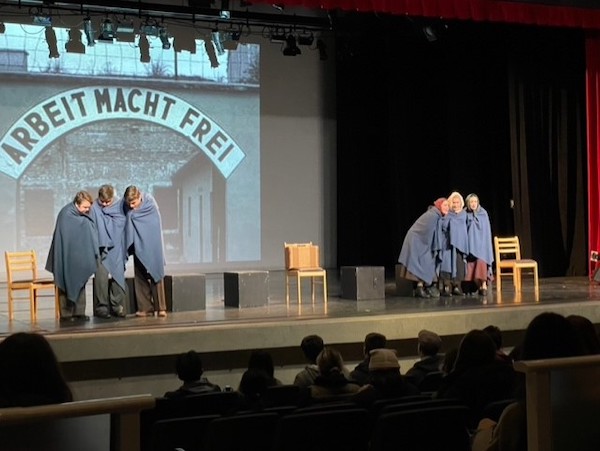
On Oct. 29 at the Phoenix Theatre in Victoria, there will be a one-night-only performance of Wendy Kout’s play Survivors, which is touring schools this month. (photo by Peter Nadler)

In light of the success of last year’s pilot tour, the educational play Survivors is touring middle and secondary schools throughout Vancouver Island this month. And, with the support of the University of Victoria, there will be one public performance of the play this month: at the Phoenix Theatre, Oct. 29, 2 p.m. Last year’s public shows sold out.

Following the mistaken honouring in Parliament recently of Ukrainian-Canadian Yaroslav Hunka, who fought in a Nazi unit during the Holocaust, there should no longer be any doubt about the ignorance of the history of the Holocaust. This conclusion is further supported by the existence of monuments in Canada that honour Nazi veterans who were members of the Galicia division of the SS in Ukraine. Furthermore, Canada’s Governor General Mary Simon has apologized for the Order of Canada given to Peter Savaryn in 1987. Savaryn was chancellor of the University of Alberta and president of the Progressive Conservative Party of Alberta in the 1980s – he also served with the Waffen-SS, a voluntary Nazi unit in Ukraine during the Second World War.

A 2019 study done by the Azrieli Foundation, Yad Vashem, the United States Holocaust Memorial Museum and the Claims Conference revealed Canadians’ lack of knowledge of this period in history. For example: 62% of millennials did not know that six million Jews were killed in the Holocaust and 22% of millennials hadn’t heard or were not sure if they had heard of the Holocaust. Nearly one-quarter of all Canadians believe that substantially fewer than six million Jews were killed (two million or fewer) during the Holocaust.

History shows that when it comes to racist attacks and xenophobia, Jews are often the “canary in the coal mine.” Holocaust awareness and education could not be more timely or important. “We’re not just telling history,” said Survivors playwright Wendy Kout. “We’re telling history as a cautionary tale for the present and the future.”

Survivors explores hatred, the capacity to survive and thrive, and serves as a call to consciousness of the present challenges. Combining history with life lessons, the audience is guided through a time when hatred was normalized. The audience is both uplifted by the survivors’ triumphs and inspired to take action against present and future racism.

The play tells a chronological history of the Holocaust through the personal prism of experience, interweaving the stories of 10 Holocaust survivors, four of whom were still alive when the play premièred in New York in 2018. Though each has a unique story, all the survivors “went through this horror and came through the other side to build meaningful, contributing, beautiful lives,” said playwright Wendy Kout.

The Victoria production of Survivors will be touring throughout the four Western provinces for the next few years. For more about those tours and the organizations collaborating on them, visit jewishindependent.ca/theatre-that-educates and holocausttheatre.com. For tickets to the Oct. 29 matinée at Phoenix Theatre, go to eventbrite.ca.

– Courtesy Victoria Theatre Productions

Format ImagePosted on October 12, 2023November 9, 2023Author Victoria Theatre ProductionsCategories Performing ArtsTags education, Holocaust, play, theatre, Victoria, Wendy Kout
Treatise on war, peace

Treatise on war, peace

Left to right: Tom Pickett, Advah Soudack, Kate Besworth and Karthik Kadam in Bard on the Beach’s production of Shakespeare’s Henry V, which runs to Aug. 13. (photo by Tim Matheson)

Bard on the Beach rarely presents Shakespeare’s history plays. The last time Vancouver audiences were treated to one of the House of Lancaster trilogies was in 2011. Like Julius Caesar, currently playing on the Mainstage, Henry V is a timely production, based on world events. Unlike Julius Caesar, which is set in modern times, director Lois Anderson has envisioned the setting for Henry V as an indeterminate time in a wartorn future.

In Henry V, there is a device Shakespeare often used – a play within a play. A traveling troupe of nine actors, seeking shelter from a raging storm, suitcases in hand, arrives in an apocalyptic time to present their version of Henry V. Their ultimate message: make love, not war.

When Henry IV died, his 16-year-old son, Prince Hal, ascended to the throne of England. His father had, on his deathbed, made it clear to his son that, to take on the crown responsibilities, he had to give up his profligate lifestyle and his association with the lower-class tavern set, including his mentor Falstaff. Once on the throne, and taking government matters seriously, Henry V is surrounded by ambitious advisors who encourage him to invade France as part of the ongoing Hundred Years War between the two countries. Reluctant at first, the arrival of an emissary at his court with a “gift” of tennis balls (analogous to a slap in the face) from the cocky French Prince, the Dauphin, convinces Henry to go to war.

On the battlefield, Henry comes of age, transitioning from an impressionable youth to a fierce leader of men. Although vastly outnumbered, the English are ultimately successful in the 1415 Battle of Agincourt, spurred on by Henry’s rousing now-iconic call to arms: “We few, we happy few, we band of brothers; for he today that sheds his blood with me shall be my brother.”

As part of the boy-to-man transition, Henry takes a hard line with his tavern pals, who have also joined the fight for king and country – condemning one to death for stealing a loaf of bread and eschewing the pleas for reconciliation from a dying Falstaff.

The audience is guided through the story by a narrator, the Chorus, who welcomes us to “the show” and provides numerous asides that give context and meaning to what is happening on stage, both in the action and in Henry’s mind (manifested by flashbacks to his carefree days of youth).

All the cast, save for the eponymous lead, play multiple roles and Anderson has chosen to always keep the actors on stage. When not involved in a scene, they sit off to the side. Costume changes take place right in front of the audience. The intimate Douglas Campbell Theatre allows for this up-close-and-personal action.

The women in this production are standouts. Jewish community member Advah Soudack not only acts, doing double-duty portraying Mistress Quickly (one of the tavern denizens) and the emissary Mountjoy, but also has a chance to show off her vocal skills with a haunting solo. Newcomer Marlee Griffiths is simply delightful as the French princess Katharine, especially as she practises English with her maid. Emilie Leclerc is both the narrator and French Queen Isabelle, and makes her Bard debut with a strong performance.

Kate Besworth plays Henry V in a gender reversal. Anderson’s vision encompasses the insecurity and angst of a teenager suddenly placed in charge of a country at war, who must make decisions with far-reaching consequences. Yet that same youth can be painfully shy when it comes to wooing, winning and wedding Princess Katherine (a strategic alliance that helps broker peace between the warring nations). Diminutive Besworth ably portrays these two sides of Henry’s character.

Among the male actors, Billy Marchenski is a tough Exeter; Craig Erickson, Henry IV; Tom Pickett, the King of France; and Karthik Kadam, the Dauphin. Munish Sharma gets to play with the role of portly Falstaff.

However, the real stars in this rendering are the designers. Kudos to all of them, starting with Jewish community member Amir Ofek in charge of the set design. In the program notes, he writes, “Director Lois Anderson and myself reimagined this production as an immersive audience experience that starts from the moment you enter the performance space.” He certainly accomplished this goal. When you step through the front tent flap, you are transported into a futuristic sepia-and-earth-tone world, chairs haphazardly stacked, looking like they are about to fall over (a metaphor for the chaos of the world), and an inner tent made of burlap sacks stitched together (scavenged from various local coffee shops), all atop a cracked, parched dirt floor. You really do feel like you are in a tent in the middle of a battlefield. The chairs are used to represent everything from beds to thrones to canons to barricades to weapons.

Mara Gottler’s costumes reflect the “anytime and no time” design mandate she was given and lend themselves to the quick on-stage changes. She wanted to “convey a visual narrative of war and love,” and accomplishes this with different colour palettes for the French and English courts and the tavern gang. Sophie Tang’s lighting, together with Joelysa Pankanea’s musical score, complete the effect. Original songs for the troupe add a novel layer to the production and choreographer/fight director Jonathan Hawley Purvis deserves a mention for the clever battle scenes.

Anderson’s vision is certainly a treatise on the evils – and inevitability – of war, yet still holds out a glimmer of hope for redemption through love.

Henry V runs until Aug. 13. For tickets, visit bardonthebeach.org or call the box office, 604-739-0559.

Tova Kornfeld is a Vancouver freelance writer and lawyer.

Format ImagePosted on July 21, 2023July 20, 2023Author Tova KornfeldCategories Performing ArtsTags Advah Soudack, Bard on the Beach, Shakespeare, social commentary, theatre
Bard masters comedy, tragedy

Bard masters comedy, tragedy

Oscar Derkx (Orlando) and Chelsea Rose (Rosalind) in As You Like It. (photo by Tim Matheson)

What do you get if you mix a Shakespearean comedy with 23 Beatles hits from the 1960s and set the whole thing in Vancouver and the Okanagan? An unforgettable night at Bard on the Beach, which opened its 34th season with a remounting of its 2018 hit As You Like It.

Various nips and tucks to the original script have been made. While purists may not appreciate the surgery, the Bard version still follows the convoluted saga of four pairs of young lovers who cross paths as they work through obstacles in their quests for true love. After all, all you need is love.

The action starts in Vancouver with a zany pre-show bout of Superstar Wrestling – make sure you get into the tent 15 minutes before curtain time. Ringmaster Touchstone introduces Charles 2 Guns Leibowitz, a narcissist on steroids, who takes on all comers for cash prizes. Orlando, who has been denied his inheritance by older brother Oliver, decides to go for it, although the underdog in size and confidence.

During the match, Orlando catches the eye of Rosalind, and it is love at first sight (“she loves you, ya ya ya!”). However, Rosalind is banished from Vancouver by her aunt, and runs off to the Okanagan with best friend Celia and faithful servant Touchstone. To do this safely, Rosalind uses one of Shakespeare’s favourite ploys and disguises herself as a boy (Ganymede), with Celia playing her sister.

Orlando, with his devoted servant, Adam, also heads to the Okanagan when his brother threatens to have him killed. As expected, he crosses paths with Ganymede/Rosalind and her entourage.

Add to the mix a lovelorn rube and the object of his affections, a shepherdess who becomes enamoured of Touchstone, a commune of back-to-earthers headed by Rosalind’s mother, who also was banished, and the plot twists and turns through secret notes, trysts, actors hiding behind trees (it is Shakespeare after all), strange picnics and more. Every scene morphs smoothly into a Fab Four moment through songs like “I Want to Hold Your Hand,” “Can’t Buy Me Love” and “All you Need is Love,” high-energy, fancy footwork (a shout out to choreographer Jonathan Hawley Purvis) and toe-tapping music from a five-piece band helmed by musical director Ben Elliott (who also acts in the play).

This is a real ensemble piece and every cast member seems to give it their all. I was particularly impressed with Chelsea Rose’s vocals, as Rosalind. Oscar Derkx (Orlando) is boyishly charming and can also belt out a song. Elliott (Silvius) showcases his comedic chops in a raunchy pas de deux with Alexandra Lainfiesta (Phoebe). Finally, Scott Bellis, as Jacques, movingly delivers the iconic soliloquy “All the world’s a stage,” where the Bard explores the circle of life in seven stages, from babe to senile senior. Clad in a black turtleneck sweater and corduroy bell bottoms, Bellis is the quintessential beatnik. He also gets one of the best lines of the night – “I can suck melancholy out of a song as a weasel sucks eggs.”

Director Daryl Clonan can be proud of this latest iteration, which has toured through parts of Canada and the United States. The production values are top rate, starting with the glitzy set including a psychedelic VW parked at the back of the stage. Kudos to costume designer Carmen Alatorre for capturing the essence of the era – paisleys, acid-wash jeans, fringed vests, bell-bottoms, granny glasses, headbands and beads for the Okanagan granola set with Jackie O pillbox hats, white gloves, two-piece suits, chinos and polyester shirts for the urban crowd. And Gerald King’s lighting works wonders with a rainbow palette projected against Plexiglas panels that illuminate the tent backdrop of ocean and mountains.

***

In something completely different, the cast members of As You Like It also star in Julius Caesar, which plays alternating nights on the BMO Stage.

Bard on the Beach last produced Julius Caesar in 2007. This summer’s adaptation by Stephen Drover, set in modern times, brings novel perspectives to the classic tragedy of political ambition, jealousy, tyranny, treachery, mob rule, murder and revenge, and will resonate with contemporary audiences.

Despite the title, the real protagonist is Brutus, who grapples with his loyalty to Caesar and what he believes is the greater good of Rome, when approached by a group of senators to help assassinate Caesar. Hesitant at first, he ultimately joins the other senators in plotting Caesar’s demise – to take place at a meeting on the Ides (15th) of March. Though Caesar has been warned by a local soothsayer to beware that day, he ignores that warning and the pleas of his wife to stay home.

Caesar (an impressive Andrew Wheeler) arrives at the senate resplendent in a white business suit, topped off with a jaunty fedora, to the cheers of his people. Once there, Brutus and his fellow conspirators surround Caesar and, one by one, stab him, the final thrust coming from Brutus. In this viscerally haunting scene, Caesar falls to the ground, his white suit covered in red blood, as he utters his last words, “et tu, Brute,” surrounded by the conspirators, their hands dripping with blood.

At the state funeral, Brutus tries to convince the crowd that Caesar had to die for the good of Rome, but Mark Antony – a loyal friend to Caesar and a skilful orator – gives the “Friends, Romans, countrymen, lend me your ears” speech, over a ghoulish glass coffin containing Caesar’s bloodied body. The crowd turns against the conspirators, who are forced to flee. Antony then summons Caesar’s nephew, Octavius, to raise an army to hunt down and kill the conspirators so that Caesar’s death can be avenged. This leads to a civil war, with the action coming right into the audience.

In the penultimate scene, Brutus, having been visited by Caesar’s bloodied ghost and surrounded by his fallen comrades, realizes that defeat is at hand and implores his trusty servant to kill him. Andrew McNee’s performance as Brutus in this scene is compelling.

The final scene is eerie, as Caesar’s ghost slowly walks off the stage into the sunset amid wisps of smoke.

Director Cherisse Richards has chosen to reverse many of the roles so that most of the conspirators are female, as is the role of Mark Antony, played by Jennifer Lines, who is simply sublime.

In another twist, Caesar’s wife, Calpurnia, and Portia, Brutus’s wife, appear more prominently in the adaptation, providing insights into the private lives and feelings of their husbands.

The stark set showcases a mix of old and new – jagged concrete columns evoke ancient Roman architecture, which morphs into tables, desks and even a wardrobe, against a backdrop of multimedia screens.

Jessica Oostergo’s warrior costumes are metaphors for good versus evil – Octavius’s allies clad in light khaki fatigues while Brutus’s side roams the stage in black and grey, looking like SWAT team members.

Video designer Candelario Andrade’s projections – spanning the spectrum from Joan of Arc, to Napoleon at Waterloo, to the Jan. 6, 2021, riots at the U.S. Capitol – accompanied by sound designer Kate Delorme’s ominous scores contextualize the action.

For Bard on the Beach tickets and the full schedule, which also includes Henry V and Goblin: Macbeth, visit bardonthebeach.org.

Tova Kornfeld is a Vancouver freelance writer and lawyer.

Format ImagePosted on July 7, 2023July 6, 2023Author Tova KornfeldCategories Performing ArtsTags As You Like It, Bard on the Beach, Julius Caesar, Shakespeare, the Beatles, theatre
Theatre that educates

Theatre that educates

Wendy Kout’s play Survivors is based on 10 real-life stories of young people’s Holocaust experiences. (photo by Peter Nadler)

Last year, Victoria-based Bema Productions and the Victoria Shoah Project collaborated on a pilot project: a nine-performance tour to middle and secondary schools of Survivors, a Holocaust-themed play by Wendy Kout. The success of the tour, which reached more than 1,100 students and 500 adults in the Victoria area, has led the organizations to broaden their reach throughout Vancouver Island, Metro Vancouver and other Western provinces beginning this autumn.

“Following our pilot tour in Victoria, we were asked to cover the Western provinces, and I happily accepted the challenge,” said Zelda Dean, the director of the play. “We will be touring to 30 schools on Vancouver Island in October 2023. In the fall of 2024, we will tour on the Mainland and in Alberta. Saskatchewan and Manitoba will be toured in 2025 – 150 performances in total will be presented.”

Citing a 2018 Canadian survey produced by the Azrieli Foundation, Yad Vashem, the United States Holocaust Memorial Museum and the Claims Conference, the Victoria organizers offer compelling reasons why Holocaust education is necessary today, particularly (but not only) for youth. According to the survey, 52% of millennials cannot name a concentration camp or ghetto; 62% of millennials did not know that six million Jews were killed in the Holocaust; 22% of millennials haven’t heard or are not sure if they have heard of the Holocaust; and 23% of all Canadians believe that substantially fewer than six million Jews were killed (two million or fewer) during the Holocaust, while another 24% were unsure of how many were killed.

“I have been alarmed at the ongoing rise in antisemitism for some years and have been looking for a suitable educational play. I had previously produced a play by Wendy and loved her work,” said Dean, regarding the selection of Survivors.

The intention of the one-hour play, suitable for those from Grade 6 to adulthood, is to provide a vehicle to teach lessons from the Shoah to younger audiences. Based on 10 real-life stories of young people’s Holocaust experiences, the play hopes to enable students to recognize the short- and long-term causes and effects of prejudice, discrimination and, ultimately, genocide. It also aims to foster critical thinking and bring the importance of human rights and social justice advocacy to the forefront.

Survivors goes through the chronological history of the Holocaust by enacting the experiences of Jewish children and teenagers from Europe. The young cast of six professional actors portrays the survivors, starting at innocence and continuing through the terrifying rise and rule of bigotry, xenophobia and violence, before they immigrate to America.

The play includes the true stories of a teen who watched her boyfriend being taken away to a concentration camp, a girl who was separated from her parents and relocated to England through the Kindertransport and a boy whose family struggled to escape to China.

Dean credited the young actors in the production for their diligence and dedication to their parts. “I put a casting call out and was delighted that a large number of very skilled young actors tried out for the roles. Those who were cast were tasked with doing considerable research into the Holocaust prior to rehearsals starting,” she said.

Survivors was originally commissioned and developed by CenterStage Theatre in Rochester, N.Y., in 2017, when Kout was asked to write a Holocaust play about survivors who had immigrated to the city. Shortly thereafter, while watching neo-Nazis march in Charlottesville, Va., Kout expressed the feeling that she was not simply writing an historical play but also a “warning play.”

The Victoria production in November and December 2022 – which played in school auditoriums, theatres and libraries, and had four public performances – was the first international tour of the play. There are other tours currently on both coasts of the United States, with Kout, along with the New York company that developed Survivors, creating a documentary on how the play came to be.

“Sharing the history of the Holocaust with students provides an important historical example of the dangers of allowing hatred and intolerance to take hold within a society,” said former B.C. minister of education Rob Fleming about the Victoria tour.

Additionally, several students who saw the play offered their input concerning how the performance affected them.

“I want to continue to learn more about the Holocaust and people’s stories. I’ve read [Elie Wiesel’s] Night and seen this play but other than that I haven’t heard many personal stories, so I’d like to learn more,” said one.

“I learned once again that I should not judge others selfishly based on race, religion, appearance or prejudice, and I will try to [remember that] whenever I meet new people from now on,” contributed another.

The organizers are looking for financial support to fund the upcoming Western Canadian tours.

“Over $450,000 is required to offer this powerful educational play to so many students, and we are actively fundraising to individuals, corporations, foundations, etc. We are running a campaign inviting folks to sponsor a school in their area for only $500,” Dean explained.

For more information about the play and to contribute, visit holocausttheatre.com or email [email protected].

Sam Margolis has written for the Globe and Mail, the National Post, UPI and MSNBC.

Format ImagePosted on July 7, 2023November 9, 2023Author Sam MargolisCategories Performing ArtsTags Bema Productions, education, Holocaust, survivors, theatre, Victoria Shoah Project, Wendy Kout, Zelda Dean
Learn klezmer dancing

Learn klezmer dancing

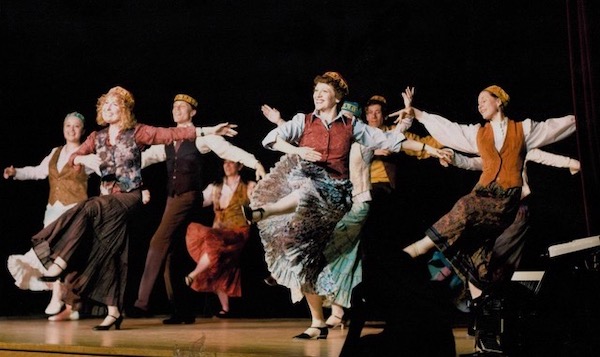
Kol Halev Performance Society in action. (photo from Kol Halev)

On May 7 at White Rock South Surrey Jewish Community Centre, Kol Halev Performance Society is holding a two-hour klezmer dance workshop, which is open to kids 8 and up, adults and seniors. And you don’t have to be Jewish to enjoy klezmer – this workshop is open to all!

In the workshop, participants will learn traditional and contemporary klezmer dances (traditional dances of Jewish celebrations originating in Eastern Europe) and read excerpts from The Kugel Valley Klezmer Band by children’s book author Joan Stuchner, in a joyous celebration of music, dance and storytelling. The instructors are Hadas Klinger (dance) and Tom Kavadias (theatre).

Klinger currently teaches recreational Israeli dance to adults at Richmond’s Congregation Beth Tikvah and at the Louis Brier Home, as well as jazz and Israeli dance instruction and choreography to K-6 kids and preteens. She has led Israeli dance workshops and drama workshops at a variety of youth summer camps, and has performed in Miami representing the Jewish Community Centre of Greater Vancouver as part of Maccabi Artsfest.

Kavadias has been involved in community theatre since 1985 as an actor and director, and he has worked with adults, teens and children. He has acted with Metro Theatre, Stage Eiren, Theatre North Van, and United Players.

There is no charge for the workshop, which takes place from 3 to 5 p.m., but registration is required by emailing [email protected] or via wrssjcc.org.

White Rock South Surrey Jewish Community Centre is located at 3033 King George Blvd. For questions about the dance program, call Sue Cohene at 604-889-4337. For other questions, call the WRSSJCC at 604-541-9995.

– Courtesy Kol Halev

Format ImagePosted on April 28, 2023April 26, 2023Author Kol Halev Performance SocietyCategories Performing ArtsTags dance, education, family, klezmer, theatre
Powerfully against othering

Powerfully against othering

Into the Little Hill runs May 19 and 20 at SFU Goldcorp Centre for the Arts, Fei and Milton Wong Experimental Theatre. (photo by Flick Harrison)

“Into the Little Hill is a powerfully emotional opera,” soprano Heather Pawsey told the Independent.

Pawsey is the artistic director of Astrolabe Musik Theatre, which, with Simon Fraser University Woodward’s Cultural Programs, is presenting the opera’s Canadian première May 19-20. A multidisciplinary, modern take on the medieval story of the Pied Piper of Hamelin, Into the Hill features two singers, three dancers and live music. Written by English composer George Benjamin with libretto by Martin Crimp, Jewish community member Idan Cohen of Ne.Sans Opera and Dance is the local production’s director and choreographer.

“From the moment I first heard Into the Little Hill, I knew I had to have dancers in the production,” said Pawsey. “My company, Astrolabe Musik Theatre, has been experimenting with dance and movement in classical music, in varying degrees, for over 10 years now. Dance and movement are such normal, natural, innately human ways of expression, yet we see it so rarely in opera and classical music.”

When she heard Into the Little Hill, she said, “I literally saw the dancers in my mind … and knew that this was the perfect opera to intentionally incorporate them as amplifications of the characters, as commentators on the story, and as true partners with the singers (who are also precisely choreographed).”

After that, she was just “waiting for the perfect person with whom to work.” And she found that person in Cohen – his company, Ne.Sans, exists to reimagine and reconnect opera and dance.

“When Idan and I met in Amsterdam in 2018 on an opera I was singing and he was directing, I knew at the first rehearsal that he was the person I’d been waiting for: someone who knows music, who knows dance, who can work with professional dance artists and with singers who may have little or no dance training, and whose knowledge and experience come together in a profound understanding of the possibilities of singing and dance.”

“We’ve connected on so many levels,” said Cohen of Pawsey, who introduced him to Into the Little Hill. “Since then,” he said, “we’ve enjoyed many long conversations about this wonderful opera that is so close to both our hearts. I am so excited to finally be able to share our version of this brilliant work.”

“As far as I know,” said Pawsey, “l’Opéra de Montréal is the only other company in Canada to have produced one of George Benjamin’s operas (Written on Skin, his second). In 2014, I watched Written on Skin on MediciTV and literally got goosebumps. Singing contemporary music is a huge part of my career, yet I had never heard of this composer nor heard music anything like his: crystalline, precise, profound, spare, yet filled with emotion, colour, shadow, passion and power. I looked him up immediately and discovered that Into the Little Hill was (at that time) the only other opera he’d written…. I knew then that I had to produce (and sing!) it; that it would have dancers; and, voilà! A decade later, here we are. This opera speaks so profoundly against ‘othering.’ I know that people will come away having experienced something powerful, intense and beautiful.”

Pawsey and mezzo-soprano Emma Parkinson sing all six of the opera’s characters.

“One of the things I love the most about Into the Little Hill is its exquisite precision,” said Pawsey. “Vocally, orchestrally, dramatically, dramaturgically there are no extraneous notes, no extraneous words, and the power of this concentration is intensified by having only two singers portray all the roles. We aren’t distracted by multiple singers coming on and off the stage, nor by the differing ranges and timbres of their voices – we have focus.

“We also have gender-neutrality, something that is difficult to achieve in traditional opera, where characters’ genders have historically been determined by voice-type (ie. tenor, soprano, etc.). Having only two singers sing all the roles makes gender, sexual orientation or how one presents to the world irrelevant, and leaves the make-up of the characters to each individual audience member’s imagination. As an artist, it frees me from having to imagine or recreate assumptions about how ‘men’ or ‘women’ move, behave and speak (sing), and allows me to enter fully into what that character is actually expressing. My hope is that this also helps audiences to identify more freely with the characters.”

The opera speaks to Cohen on many levels.

“As a queer artist, a descendant of Holocaust survivors, coming to Canada from Israel/Palestine, I have always valued the importance of raising voices of underserved communities and to acknowledge our troubled past, learn from it, and aspire to do better,” he said. “I chose to leave my country in search of a better future and, as I arrived in Canada in 2017, I was amazed to find how relevant the history of Canada is to my own, from multiple angles, both as the oppressed and the oppressor, often against my will.

“My work is embedded in this life experience and perspective, and I am passionate in telling classical stories through alternative lens,” he continued. “Into the Little Hill is such a powerful opera that speaks of the human condition in a very creative way. There are different ways to speak of the tragic history of Western culture, and one of the reasons I chose to be an artist is because I see the importance of speaking of the violence and hurt, and to fight against discrimination.

“This opera is such a great, complex example of the fact that there is no one source of harm, and not one source of knowledge and perspective,” he said.

Critics have generally lauded Into the Little Hill, though some have expressed concern over the way in which the story is told.

“The narrative style of this opera imposes a certain detachment or distancing,” Pawsey said. “Traditionally, opera is all about emotion – big, huge, dare I say OPERATIC emotion! Here, Martin Crimp’s libretto uses Brechtian techniques (such as the Narrator directly addressing the audience, breaking the fourth wall, etc.) to discourage the audience from becoming too emotionally involved. Brecht used these techniques to encourage a deeper focus on the socially significant aspects of the story. This is particularly relevant in this opera’s tale of ‘who are we labeling as the “rats” in our society, what are we willing to do to get rid of them and what happens when we refuse to “pay the piper,” ie. take responsibility for the consequences of our actions?’

“Detachment, distancing – this is what we, as humans, do when we label, when we ‘other,’ when we divide into ‘us’ and ‘them.’ It’s a part of the de-humanizing process, which allows us to plan or to undertake horrific acts. But this is not to say that audiences will feel emotionless at the end of Into the Little Hill,” she stressed. “Fascinatingly, the muting of emotion evoked for individual characters and their stories makes us feel even more deeply and keenly the emotion of the story overall and how its outcome affects all the characters – and, by extension, us.”

Into the Little Hill takes place at SFU Goldcorp Centre for the Arts, Fei and Milton Wong Experimental Theatre. Conductor Leslie Dala is music director for the production, whose orchestration includes bass flute, basset horns, mandolin and banjo. Lighting design is by Victoria Bell, with costume design by Elena Razlog. The dancers are Juolin Lee, Daria Mikhalyluk and Hana Rutka.

For tickets and more information, visit littlehill.eventbrite.ca.

Format ImagePosted on April 28, 2023April 26, 2023Author Cynthia RamsayCategories Music, Performing ArtsTags Astrolabe Musik Theatre, dance, Heather Pawsey, Idan Cohen, Into the Little Hill, Ne. Sans, opera, theatre
Who decides what culture is?

Who decides what culture is?

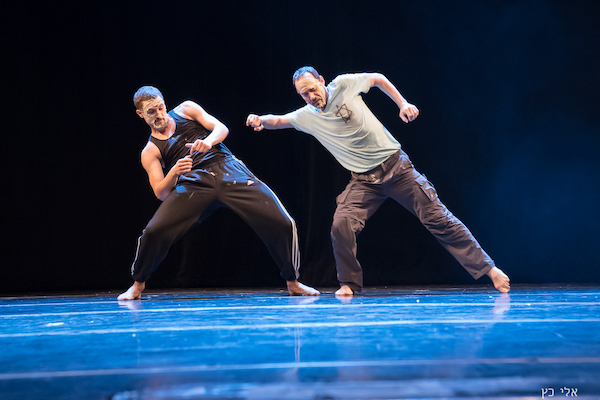
Mourad Bouayad, left, and Hillel Kogan in We Love Arabs, which is at the Dance Centre April 13-15. (photo by Eli Katz)

“I don’t have answers so I can only ask questions,” Israeli choreographer Hillel Kogan told the Jewish Independent. “If this is changing people’s political views, I doubt it, but at least what I’m trying to do is to put the questions on the table and make people, audiences, and myself see that art is not a separate sphere, that art is part of politics and social and cultural systems … and this is what I’m trying to expose in my pieces.”

The JI interviewed Kogan in advance of the Vancouver run of We Love Arabs, which is being presented at the Scotiabank Dance Centre by the Dance Centre and Théâtre la Seizième April 13-15. There will be both English- and French-language performances of this work, which also has Hebrew and Spanish versions. Kogan will dance the duet here with Mourad Bouayad.

We Love Arabs premièred at the 2013 Intimadance Festival in Tel Aviv. The brief outline for the piece, which Kogan has on his website, begins: “I address the audience, my name is Hillel Kogan. Some say that I do political art. I want to show you today how dance has the power to promote coexistence between Arabs and Jews in Israel. I invited an Arab dancer here….” The video teaser offers a glimpse of Kogan’s physicality, humour, tenderness, intelligence.

Born in Tel Aviv, Kogan has performed with and created for companies and choreographers around the world. At Batsheva Dance Company, he is director of educational programs. He is pursuing a master’s degree in cultural studies.

We Love Arabs garnered awards, and it has traveled to more than a dozen countries. The Vancouver show was postponed twice, said Mirna Zagar, executive director of the Dance Centre. First due to a scheduling conflict and then due to COVID. “However, I believe the work is just as relevant now as it was when we started,” she said. “It is an exceptional work that continues to engage audiences internationally.”

The Dance Centre often partners with other arts organizations, as a means of pooling resources and amplifying opportunities to show international artists. “This collaboration is along these lines,” she said. “I have known Esther Duquette, the now-outgoing artistic director at Théâtre la Seizième, for some years and the nature of this piece – multilingual and straddling theatre as well as dance – made it a perfect opportunity for our organizations to work together.”

The April 14 performance and talkback will be in French; the other two shows and the April 15 talkback in English. Kogan speaks six languages: Hebrew and Russian because his parents were born in the Soviet Union and he was born in Israel; he studied English in school; he learned French from working two years in Switzerland, and Portuguese and Spanish from working in Portugal for seven years. He doesn’t speak Arabic.

“This is interesting,” he said, “because this piece, We Love Arabs, is an autocritical peace that asks exactly this. Why am I facing the languages and cultures of the West and not the languages of my neighbours and of my co-citizens in Israel? Why don’t I read the books of Arabic writers? Why doesn’t Arab culture interest me, and why do I identify myself as ‘Western,’ which is a bit strange?”

It is both a geographic question, he said, living as he does in Israel, and a social, historical, cultural and political question. “And the piece deals with this question: who decides what the general culture is, and why I am – and why the Israeli art field, at least as I see it, is – so orientalist, which means looking at the Orient, at the Arab as inferior and wanting to impose on it the Western culture.”

The different versions of We Love Arabs resulted from Kogan’s wanting to perform the piece abroad, in the language the audience speaks. “I think it brings more this idea of relevance to the space,” he explained. “If I did the piece in Hebrew with subtitles, it would be more like a piece from Israel … and be framed as something local and in my perspective. The universality of the piece is one of the ideas – I want people to identify with it and, by choosing their own language, I feel there is more chance to make them sense that they are part of it as well.”

Kogan had no idea of how much impact We Love Arabs would have. “It was created for a small niche festival in Israel,” he said, and “for a specific audience who is already convinced in the political opinions that I hold. So, I didn’t imagine it ‘big.’… As I performed the piece out of Israel, I understood that the question of Jews and Arabs in Israel is just a microcosm of a more universal question: of the situation of power between minority and majority, and the way we see ‘the other’ – who is the master of the culture in any nation?”

In looking at the question, Kogan asks: “Who is invited to participate in creating a national identity, what is Israeli or what is Arab Israeli? It is not very different than the question of, I don’t know, for example, in Canada: who is invited, what is Canadian? Is it French? Is it American? Is it English? I don’t know the minority situation in Canada, but I know there is a history with Native Canadians. So, are they also invited to take part in culture? How much are they participating in mainstream dance, literature, music? How do we define what is high art and what is popular art? What is folk and folklore? And what is universal art?”

Initially dancing the duet with Kogan was Adi Boutrous, an Israeli Arab dancer who is also a choreographer and so not always available. Bouayad, who is French, danced in Israel in the Batsheva junior company. “This is how we met, so I invited him to perform with me,” said Kogan. “And, of course, it’s very different for an Israeli Arab to play the role of an Israeli Arab than for a French half-Arab person, because to be an Arab in France is different than to be an Arab in Israel.”

Not wanting to speak for Bouayad, Kogan noted that, while Bouayad may define “himself first as French, and his relationship with his Arab origins are just an extra part of his being,” for Israeli Arabs, he said, “I’m not sure that they are first Israeli and then Arab because of their own perception of themselves – but also the way the majority looks at them, the state looks at them, society looks at them, Jewish society looks at them.

“We often make the mistake even in the language, and we forget to say that Arabs are Israeli as well. We say Israelis and Arabs – even when we refer to Arabs who are citizens of Israel and who hold an Israeli passport, we call them Arabs, and we call ourselves, the Jews, Israelis…. We are both Israeli and the difference between us in definition is our religion. In a country like France, where it’s a republic and religion has at least formally not such an important role in the definition of citizenship and of nationality, then, of course, the change of cast is also changing the relationship.”

Kogan has no illusions that art can change the world. Elected politicians “are the ones who should change the world,” he said. For him, art is there to reflect, to inspire. “Art, for me, is a place for the imagination, for the possibility of not necessarily escaping reality, but giving an alternative to reality…. If art can feed the imagination and then, as an outcome of this feeding of imagination, can change the reality, OK, that’s great. But I think that … when artists try to change the world by their art – in history, at least as far as I see, it ends in political propaganda and just serves the hands of politicians.”

As many funny moments as there are in We Love Arabs, they have a profound purpose.

“I have anger towards some of the cultural systems, and the questions that I’m asking are involved with hard emotions. I feel that humour allows me to take some distance from the aggression and from being so emotionally involved,” said Kogan. “It allows me to laugh about myself as well. It allows me to invite people to laugh about a question without making it not serious. The laughing, I feel, is a tool to invite people to enter a conversation, to agree to criticize, to agree to ask questions … to see the bias, to be aware of the stereotypes, to be aware of the prejudgments that we have…. The laughter is just a means in order to speak about something very serious.”

For tickets to We Love Arabs, call 604-736-2616 or visit thedancecentre.ca.

Format ImagePosted on March 24, 2023March 22, 2023Author Cynthia RamsayCategories Performing ArtsTags Arab Israelis, culture, dance, Dance House, Hillel Kogan, Israel, Jewish Israelis, Mourad Bouayad, social commentary, theatre
Moscovitch play about life in Canada pre-legalized birth control

Moscovitch play about life in Canada pre-legalized birth control

(photo by Matt Reznek – Reznek Creative)

Excavation Theatre presents What a Young Wife Ought to Know by Jewish-Canadian playwright Hannah Moscovitch, at Performance Works on Granville Island March 24-April 1.

It’s Ottawa in the 1920s, pre-legalized birth control. Sophie (Bronwyn Henderson), a young working-class girl, falls madly in love with and marries a stable-hand named Jonny (Michael Briganti). After two difficult childbirths, doctors tell Sophie she shouldn’t have any more children, but don’t tell her how to prevent it. When Sophie inevitably becomes pregnant again, she faces a grim dilemma. Inspired by real stories of mothers during the Canadian birth-control movement of the early 20th century, playwright Moscovitch vividly recreates a couple’s struggles with reproduction.

The Excavation Theatre production will be playing in the final weeks of Women’s History Month, exactly 100 years after Canada’s first birth-control advocacy group was formed in Vancouver, and fresh off the landmark announcement that birth control prescriptions will be free in British Columbia starting April 1. For tickets, visit excavationtheatre.com.

– Courtesy Excavation Theatre

Format ImagePosted on March 10, 2023March 9, 2023Author Excavation TheatreCategories Performing ArtsTags birth control, freedom, governance, Hannah Moscovitch, history, politics, theatre
The Moaning Yoni returns

The Moaning Yoni returns

In this scene from their solo physical comedy The Moaning Yoni, Joylyn Secunda is playing the vulva character, Yoni, who is based on the archetype of the Jewish mother (inspired by their own grandmother) – Yoni is strangling the Disembodied Voice of the Patriarchy with a tampon string. (photo by Eric Zennstrom)

Joylyn Secunda is an actor, dancer and puppeteer. In The Moaning Yoni, Secunda brings to life more than a dozen characters to tell the story of a young college student named Zoë who is just trying to fit in, until one day she applies an elixir, and her vulva starts to talk. From Tinder to Tantra, The Moaning Yoni explores the intersection of gender, sexuality and spirituality.

Secunda has performed The Moaning Yoni some 50 times in cities across Canada. Other recent credits include Scrooge in A Wonderheads Christmas Carol (the Wonderheads), Zephyr in Crisis on Planet Z (Monster Theatre), Seek in Pop Pop (Presentation House) and puppeteer in The Breathing Hole (National Arts Centre).

The Moaning Yoni contains mature language and sexual themes. The Feb. 3, 7:30 p.m., show at the NEST on Granville Island will be hosted by drag artist Continental Breakfast. Tickets are $25 and can be purchased from eventbrite.com.

Format ImagePosted on January 27, 2023January 26, 2023Author Joylyn SecundaCategories Performing ArtsTags Joylyn Secunda, Moaning Yoni, performing arts, theatre, women

Posts pagination

Previous page Page 1 Page 2 Page 3 Page 4 … Page 13 Next page
Proudly powered by WordPress