Skip to content
  • Home
  • Subscribe / donate
  • Events calendar
  • News
    • Local
    • National
    • Israel
    • World
    • עניין בחדשות
      A roundup of news in Canada and further afield, in Hebrew.
  • Opinion
    • From the JI
    • Op-Ed
  • Arts & Culture
    • Performing Arts
    • Music
    • Books
    • Visual Arts
    • TV & Film
  • Life
    • Celebrating the Holidays
    • Travel
    • The Daily Snooze
      Cartoons by Jacob Samuel
    • Mystery Photo
      Help the JI and JMABC fill in the gaps in our archives.
  • Community Links
    • Organizations, Etc.
    • Other News Sources & Blogs
    • Business Directory
  • FAQ
  • JI Chai Celebration
  • JI@88! video

Recent Posts

  • BGU fosters startup culture
  • Photography and glass
  • Is it the end of an era?
  • Taking life a step at a time
  • Nakba exhibit biased
  • Film festival starts next week
  • Musical with heart and soul
  • Rabbi marks 13 years
  • Keeper of VTT’s history
  • Gala fêtes Infeld’s 20th
  • Building JWest together
  • Challah Mom comes to Vancouver
  • What to do about media bias
  • Education offers hope
  • Remembrance – a moral act
  • What makes us human
  • המלחמות של נתניהו וטראמפ
  • Zionism wins big in Vegas
  • Different but connected
  • Survival not passive
  • Musical celebration of Israel
  • Shoppe celebrates 25 years
  • Human “book” event
  • Reclaiming Jewish stories
  • Bema presents Perseverance
  • CSS honours Bellas z”l
  • Sheba Promise here May 7
  • Reflections from Be’eri
  • New law a desecration
  • Resilient joy in tough times
  • Rescue dog brings joy
  • Art chosen for new museum
  • Reminder of hope, resilience
  • The national food of Israel?
  • Story of Israel’s north
  • Sheltering in train stations

Archives

Follow @JewishIndie
image - The CJN - Visit Us Banner - 300x600 - 101625

Tag: theatre

A Shylock written for Rubinek 

A Shylock written for Rubinek 

Saul Rubinek in Mark Leiren-Young’s Playing Shylock, which is playing in Toronto. Leiren-Young wrote the work with Rubinek in mind. (photo by Dahlia Katz)

Victoria playwright Mark Leiren-Young spent October in Toronto, where his Playing Shylock is appearing at Berkeley Street Theatre through Nov. 24. The one-man show, which stars Saul Rubinek, is based on the Jewish character in Shakespeare’s The Merchant of Venice.

“I’ve been attending rehearsals, run-throughs and previews as a playwright,” Leiren-Young told the Independent from Toronto before the play’s world premiere. “That means I’m around to work on the script with the actor and director. Since it’s a new script, that means I’m adjusting it to reflect ideas that come up in rehearsals, working with the costumes, the designs and the space. Really, anything that needs doing to get the script as tight and right for the actor and the production as it can be – making sure ideas are clear, jokes land and that Saul is having as much fun as possible.”

photo - Mark Leiren-Young
Mark Leiren-Young (photo by Jeffrey Bosdet)

Leiren-Young’s play Shylock first appeared on stage at Bard on the Beach in 1996. Playing Shylock, he said, is an all-new play with the same core premise: a production of The Merchant of Venice has been canceled in mid-run due to a controversy over the production.

“This is a bespoke piece that started during the COVID lockdown and I built it around Saul’s life experiences after studying his voice, his personal history, his greatest roles, his mannerisms,” Leiren-Young said. “This was written to sound like Saul and feel like Saul and not like a character or story created by me.”

In fact, when actor John Huston, who starred in multiple productions of Shylock, touring five provinces, asked Leiren-Young what was recognizable from that first play, the playwright responded, “The lines that Shakespeare wrote.”

“Beyond keeping some of Shylock’s best lines from Merchant of Venice, this is an all-new play because we’re in an all-new world,” said Leiren-Young. “And it’s a new world in so many ways. Think about how controversies played out before social media. Think about how the issues in theatre and society have changed, and the issues the Jewish community is facing.”

According to Leiren-Young, the original draft of Playing Shylock was completed a couple of years ago. Yet, he tries to update his plays to reflect current circumstances.

“This script always included a cancelation letter inspired by an actual cancelation announcement,” said Leiren-Young. “The original draft for Playing Shylock was inspired by a letter announcing the cancelation of a screening of the controversial opera The Death of Klinghoffer about a decade ago.”

The letter now, he said, is largely inspired by the decision of the Belfry Theatre in Victoria to cancel its January production of The Runner after protesters demonstrated and vandalized its property because they objected to a play about an Israeli volunteer with the Orthodox group ZAKA.

“Not just because it’s more current, it’s Canadian and more relevant to the times,” he said, “but because that letter appeared to be used as the template for canceling another play at a theatre across the street from the Belfry.”

Rubinek, a distinguished stage veteran, is widely known to film and television audiences. To name but a few of his credits: Wall Street, Barney’s Version, Frasier. This past June, the Globe and Mail placed Rubinek in the 25th spot on its list of the greatest Canadian actors of all time.

“I believe that if the people who made that list see this show, they’ll want to bump up his ranking by a fair bit. Watching Saul deliver Shakespeare’s lines is amazing. Watching Saul deliver my lines is a dream,” Leiren-Young said. “He’s 76 and he’s better on lines than any other actor I have ever worked with.”

Of the play, Rubinek said Leiren-Young “leaps into the historic controversy about the character of Shylock with gleeful relish and biting humour and then has the chutzpah to create a poignant study of why theatre should matter.”

The actor added, “To collaborate with on a new play – and I’ve done a lot of them – Mark is an actor’s dream: tirelessly inventive, generous, creatively stubborn in all the right places and, best of all, funny.”

This weekend, on Nov. 10, 2 p.m., at Victoria’s Congregation Emanu-El, Leiren-Young will give a talk about Playing Shylock, his original play Shylock, the character of Shylock, the impact and history of The Merchant of Venice and “anything else the audience that day wants to talk about.”

The author of numerous books, Leiren-Young is the only writer to win the Leacock Medal for Humour (Never Shoot a Stampede Queen) and the Science Writers and Communicators Award for Canada’s best science book (The Killer Whale Who Changed the World).

Leiren-Young’s Sharks Forever is a non-fiction book for middle-school readers and features an introduction by environmental activist Paul Watson. His next book, Octopus Oceans, is being released in early 2025. He is currently working on a new book for young readers focusing on how to protect the oceans and the animals who live there.

To follow Leiren-Young online, visit his website, leiren-young.com, and his Substack page, substack.com/@skaanapod?. 

Sam Margolis has written for the Globe and Mail, the National Post, UPI and MSNBC.

Format ImagePosted on November 8, 2024November 7, 2024Author Sam MargolisCategories Performing ArtsTags antisemitism, Mark Leiren-Young, Playing Shylock, playwrighting, Saul Rubinek, Shakespeare, Shylock, theatre
A love affair that lasts

A love affair that lasts

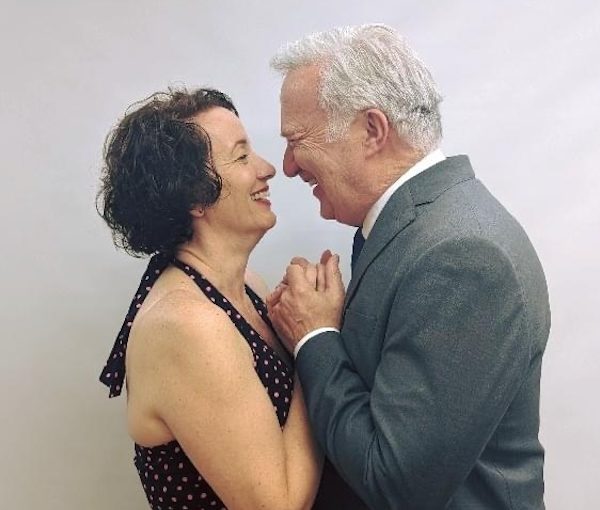
Sarah Heyman and Jerry Callaghan co-star in Bema Productions’ Same Time, Another Year, which opens July 17 at Congregation Emanu-El’s Black Box Theatre. (photo from Bema Productions)

From July 17 to 28, Bema Productions will be staging Same Time, Another Year, the sequel to Bernard Slade’s Broadway hit Same Time, Next Year, at Congregation Emanu-El’s Black Box Theatre.

The sequel catches up with Doris and George, who, in the first instalment, have carried on a long-standing love affair – meeting each other for a weekend once a year despite being married to others. Same Time, Another Year starts on their 25th anniversary, in 1976, and continues through their subsequent February rendezvous over the next 17 years.

The pair are now in their late sixties, faced with the responsibilities and consequences of life, all the while reexamining love beyond their annual assignation and the romance contained within it. Told in six scenes, and against the backdrop of the late 20th century, their affair and their perspectives on their relationship evolve and change. Along the way, there are illnesses, career successes and setbacks, second marriages, second families, and grandchildren.

“I knew that many of our patrons would remember Same Time, Next Year and, like me, wonder what happened to George and Doris 25 years later. I have had quite a few [people] tell me this since the advertising went out,” said Zelda Dean, founder and managing artistic director of Bema. “Maybe because I am ‘that age,’ the play spoke to me, as it addresses what we all have to face as we age – the fears that everyone has about their health and about losing the ones we love.”

Doris and George form a special bond beyond the bedroom, one with its own sincerity. Further, they provide a kind of gauge for what happens in the other’s life.

Dean told the Independent that what she likes most about the play is the unique relationship that develops over the many years, although the characters only meet once a year. She feels that audiences will enjoy the continuation of their journey.

Dean added that it has been a delight to work with the two leads, Sarah Heyman and Jerry Callaghan, whom she described as two very gifted actors. Both have been in the business for several years and are also close friends, which, Dean explained, made it easier for them to portray the relationship between the couple. 

“A ‘two-hander’ is always a challenge for the actors. Of course, many lines have to be learned and there is never time for a break on stage,” Dean said. “This particular play has six scenes, mostly four years apart. This means the actors have to change their costumes in two minutes or less. Much harder than one would think, especially standing in the wings.”

A Canadian playwright and actor, Slade created two popular television series in the late 1960s and early 1970s, The Flying Nun and The Partridge Family. He also wrote for Bewitched and The Courtship of Eddie’s Father, among others. He began his career as an actor, performing in more than 200 plays on stage, radio and television, in regional theatres around Toronto and on camera for the CBC.  By the mid-1970s, Slade turned his comedic focus to the stage and wrote more than a dozen plays.

One of the most produced and successful two-person plays, Same Time, Next Year opened on Broadway in March 1975, originally starring Ellen Burstyn and Charles Grodin, and ran for more than 1,400 shows during the course of nearly four years. It toured across the United States, played in London and was translated into several languages. It was adapted into a film in 1978 that featured Burstyn and Alan Alda. 

It has been said that Slade’s strength as a writer derives from his ability to fill the characters’ lives with events of great richness and depth, and still maintain the easy lightness so important to a romantic comedy – with strong dialogue and a consistent, realistic and emotional tone. The theme of Same Time, Another Year, as well as the original, is that few (if any) relationships fit into neat boxes, and each has its own rhythm and place in people’s lives.

For more information, showtimes and tickets, visit Bema’s website, bemaproductions.com. 

Sam Margolis has written for the Globe and Mail, the National Post, UPI and MSNBC.

Format ImagePosted on July 12, 2024July 10, 2024Author Sam MargolisCategories Performing ArtsTags Bema Productions, Bernard Slade, theatre, Victoria, Zelda Dean
Not-so-accessible city

Not-so-accessible city

Lenard Stanga as Hugh and Cadence Rush Quibell as Shiloh in Realwheels Theatre’s Disability Tour Bus podcast, which will be released July 17. (photo by Rashi Sethi)

On July 17, Realwheels Theatre releases its new production, Disability Tour Bus, as a radio play podcast available for streaming at realwheels.ca.

Written for podcast platforms by Amy Amantea and Jewish community member Rena Cohen, Disability Tour Bus follows Shiloh, a young wheelchair-user, as they navigate their first day as a guide for Funcouver Bus Tours. Working alongside longtime employee and relentless dad-joker Hugh, Shiloh struggles to stick to the Funcouver script when so much of “Canada’s most wheelchair-accessible city” is still so inaccessible. People and politics collide until a new passenger, Tess, comes aboard and offers common ground. The tour must go on! Because there’s someone special waiting for Tess at the end. At least she hopes there is.

The role of Hugh is played by Lenard Stanga, Jewish community member Cadence Rush Quibell plays Shiloh, and co-writer Amantea is Tess. The cast is rounded out by Mack Gordon, Caitlyn Bairstow, Ian Hanlin and Lauren Jackson playing multiple parts.

“As a wheelchair-user, I’ve heard that whole ‘most accessible city’ line a lot,” said Realwheels co-artistic director Adam Grant Warren. “It’s a big part of the reason I moved to Vancouver from the other side of the country. I’ve been here for 16 years now. After hundreds of busted elevators, torn-up sidewalks and too-full buses, I know Vancouver has a lot of work to do. Access-wise it means well, but it’s a mess sometimes. For me, that’s one of the most interesting tensions in this project: the attempt to create access when no one thought to ask what those of us who are looking for it actually need.” 

– Courtesy Realwheels Theatre

Format ImagePosted on July 12, 2024July 10, 2024Author Realwheels TheatreCategories Performing ArtsTags Amy Amantea, Cadence Rush Quibell, disability awareness, Disability Tour Bus, inclusion, podcasts, Rena Cohen, theatre
The birth of a classic movie

The birth of a classic movie

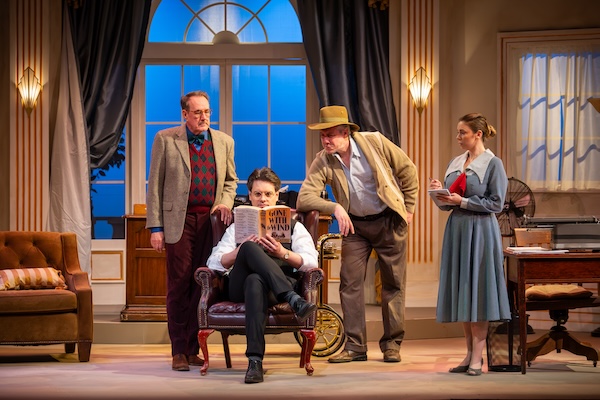
David Wallace, J.D. Dueckman, Matt Ramer and Rachel Craft in Metro Theatre’s Moonlight & Magnolias, which runs to May 18. (photo by Emma Chan)

Gone With the Wind (GWTW) is my all-time favourite movie and, if adjusted for inflation, the highest ranking movie of all time. To think that the screenplay for Margaret Mitchell’s 1037-page tome was hashed out in a five-day marathon by two Jews and a WASP holed up in producer David O. Selznick’s Hollywood office beggars belief. And yet, that is what happened – and Moonlight and Magnolias, currently playing at Metro Theatre, is Ron Hutchinson’s hilarious take on what went on in that office.

It is 1939, Selznick is producing both GWTW and The Wizard of Oz (TWO). He has just sacked director George Cukor three weeks into production (due to a run-in with Clark Gable) and pulled Victor Fleming off the set of TWO (he allegedly slapped Judy Garland) to direct. There are only five days until production resumes. Selznick’s reputation with his father-in-law, studio head Louis B. Mayer, is at stake. He needs a hit. Enter Ben Hecht, a successful Hollywood screenwriter, to the rescue. However, Hecht has not read the book and is not crazy about the job – as he says, “No Civil War movie has ever made a dime.” But he succumbs to Selznick’s relentless pressure, sacrificing his artistic standards for financial security.

Selznick gives strict instructions to his assistant, Miss Poppenghul, to hold all calls and let no one in or out of his office. He orders up a diet of peanuts and bananas (apparently brain food) for the triumvirate’s sustenance. 

As Hecht pecks away at his typewriter, Selznick and Fleming reenact various scenes from the book in zany physical comedy fashion, giving life to the iconic characters Scarlett O’Hara, Rhett Butler, Melanie and Ashley Wilkes and even Prissy, the maid. 

In Metro’s production, J.D. Dueckman is sublime as the neurotic Selznick. Kudos to him for mastering his dialogue-intense role and for his parodies of various GWTW cast. From his first approach to Fleming, played by Matt Ramer – “How do you feel about being locked up in a room with two crazy Jews?” – to his eureka moment for Clark Gable’s famous last line where yes, my dear, he frankly did give a damn, you can feel the passion behind the independent producer’s quest for his holy grail. 

In counterpoint, David Wallace as Ben Hecht plays his role in a much more subdued manner. The audience gets that he is torn between writing the screenplay as Selznick envisions it and his own activist leanings to not glorify the Antebellum South but, rather, “make America look its ugly mug in the face” – its racism and antisemitism (sound familiar?). He astutely points out to Selznick that, no matter what his successes are, he will never be allowed to join the country clubs of the WASP elite or buy a house in certain parts of Beverly Hills and that the handful of Jews who created Hollywood are always worried about being shipped back to a Polish shtetl.

Ramer captures Fleming’s broody persona and does a wonderful job portraying Melanie during her childbirth scene. All three men have great chemistry together.

Rachel Craft brings a feminine presence to the testosterone-fueled stage as the ever-suffering and sleep-deprived Selznick assistant. 

As the writing marathon continues, the order of the office disintegrates into paper- and peanut-shell-strewn chaos as the three amigos stumble around the office in a disheveled and bleary-eyed stupor. As they finish the project, the men realize that, indeed, “tomorrow is another day.” Cue the melodramatic theme song to close out the show.

Francesca Albertazzi’s set is what you would expect of a Hollywood mogul’s office – a polished mahogany desk, a crushed velvet couch, leather-bound armchairs and elegant light sconces. In a subtle nod to detail, the office window is framed in the iconic green velvet drop curtains fringed with gold tassels (that Scarlett used to fashion the gown she wore to visit Rhett in jail to ask for money to save her beloved Tara). The glorious reds, oranges and golds of the film are reproduced throughout the play by lighting director Les Erskine.

Director Catherine Morrison has ably helmed the production with her talented crew in this hidden gem of a funky theatre. You don’t have to be a GWTW fan to appreciate the show. Just go and see it. It will give you a nice escape from these troubled times. 

Tickets can be purchased at metrotheatre.com or from the box office, 604-266-7191. 

Tova Kornfeld is a Vancouver freelance writer and lawyer.

Format ImagePosted on May 10, 2024May 8, 2024Author Tova KornfeldCategories Performing ArtsTags Ben Hecht, David O. Selznick, Gone With the Wind, history, Hollywood, Metro Theatre, Ron Hutchinson, theatre, Victor Fleming

The rise and fall of a giant

Michael Shamata directs The Lehman Trilogy, which will be at Victoria’s Belfry Theatre from April 23 to May 19. (photo from Belfry Theatre)

From April 23 to May 19, Victoria’s Belfry Theatre will stage The Lehman Trilogy, a three-act play that follows the Lehman family’s story, from three immigrant brothers arriving in the United States in the mid-1800s to the founding of their investment firm, which became a financial giant, then fell.

Michael Shamata, the Belfry’s artistic director, said he knew at once after reading the play that The Lehman Trilogy had to be shown in Victoria. 

“I couldn’t put the script down,” he said. “In literary terms – it’s a ‘page-turner.’ In theatrical terms – it is a stunning high-wire act. Three exceptional actors play three brothers and three generations of the Lehman dynasty. It’s a wild ride: from a tiny store in Alabama to a Wall Street juggernaut – from small-town enterprise to full-on moral corruption.”

The Lehman Trilogy was written by Italian novelist and playwright Stefano Massini. It has since been translated into 24 languages and appeared on London’s West End and on Broadway. In 2022, the show picked up five Tony Awards.

Ben Power, associate director at London’s National Theatre, adapted the play from Mirella Cheeseman’s English translation. Massini’s original work started as a nine-hour radio play before being shortened to a five-hour, three-act theatrical work written in free verse. The length was whittled down again when it hit the London stage under the direction of Sam Mendes and the cast, which once numbered 20, was cut to three.

The tale is remarkable. Lehman Brothers started out as a dry goods store in Montgomery, Ala. The firm grew exponentially, moved to Wall Street and rose to become a corporate behemoth before its demise during the 2008 financial crisis. As the Belfry states on its website, “We view The Lehman Trilogy as an exploration of the American Dream, and ultimately a critique of American capitalism.”

The story of Lehman Brothers, once one of the world’s most esteemed financial institutions, offers a worthwhile glimpse into “this journey which is so emblematic of the evolution of consumerism, capitalism and the American way of life,” notes the Belfry. In its heyday, Lehman Brothers employed 25,000 people. At the time it declared bankruptcy, it was in debt more than $600 billion.

One reason the play is compelling theatre, Ben Power told NPR’s The Indicator from Planet Money in 2020, is that it explores the abstract, as the Lehman company grows into a financial powerhouse by being, essentially, a middleman. Whereas, at one time, a trader might have had to bring goods, such as cotton, to a market to be seen (and touched) by a purchaser, trade on a stock exchange involves no such visibility or tangibility, as goods are traded through companies like Lehman Brothers.

“There is a move into the imagination, a move into metaphor. Instead of having a thing, you just have a word,” Power said. “And I think one of the reasons the story works is that at the heart of all these financial systems is the idea that one thing stands for something else. You get the distance from the actual thing that you are selling and the people’s lives you are impacting when you do that. The more you move into the abstract, maybe, the harder it gets to have a moral framework around what you are doing.”

The Victoria production features actors Brian Markinson (Henry Lehman), Celine Stubel (Mayer Lehman) and Nigel Shawn Williams (Emmanuel Lehman). The three take on the roles of dozens of other characters throughout the play.

“Casting across race, religion and gender highlights the universal seductiveness of both the American Dream and capitalism,” says the Belfry on its website. “In addition, given that the production’s three actors are playing multiple characters – crossing genders, cultures and ethnicities – why should the casting not do the same?”

A Broadway staging of The Lehman Brothers encountered some snags due to the pandemic. The March 26, 2020, official opening at the Nederlander Theatre was postponed and did not reopen until September 2021.

Though widely acclaimed by reviewers, The Lehman Trilogy did not receive universal praise. Writing for The Observer, David Rich called the play “profoundly antisemitic.”

“Not in a crude way – a clumsy turn of phrase here, a jarring stereotype there – but in its innermost essence, connecting a modern audience to malevolent beliefs about Jews and money that are buried deep within Western thought. Most striking of all, none of the people responsible for writing, acting, directing or producing this play seem remotely aware, and most reviews have missed it entirely,” Rich wrote.

The play is the first Jewish-related work to be in the Belfry’s lineup since the cancellation of The Runner late last year. The planned scheduling of that play, about an Israeli ZAKA volunteer, made national headlines after anti-Israel protesters demanded that it not be shown. 

To order tickets for The Lehman Trilogy, go to belfry.bc.ca. 

Sam Margolis has written for the Globe and Mail, the National Post, UPI and MSNBC.
Format ImagePosted on April 12, 2024April 10, 2024Author Sam MargolisCategories Performing ArtsTags antisemitism, Belfry Theatre, capitalism, history, Lehman Brothers, Michael Shamata, The Lehman Trilogy, theatre
Art that makes people think

Art that makes people think

Domitille Martin in Pli, part of the PuSh International Performing Arts Festival, which runs Jan. 18 to Feb. 4. (photo by Lucie Brosset)

PuSh International Performing Arts Festival returns to Vancouver Jan. 18-Feb. 4. The mid-winter event that delivers innovative, contemporary works asks the questions, “Can a live art festival be a ritual for social change? A cultural strategy? A means to rethink history while imagining possible futures?” Participating artists include Jewish community members and a production presented with Chutzpah! Festival.

Vancouver’s Vanessa Goodman (Action at a Distance) is co-creator with Tangaj Collective (Simona Deaconescu, from Romania, and Gaby Saranouffi, from Madagascar) of BLOT, Body Line of Thought: “Our bodies are strong and fragile. BLOT redefines how we see our physical selves and their relationship to the world. In a stark set reminiscent of a science lab, two dancers observe the intricacies of the body and using salt, microbiome and physiology demonstrate how interconnected we truly are.”

BLOT will be presented Jan. 22-23, 7:30 p.m., at Left of Main, with a post-show talkback after the Jan. 22 production.

PuSh, with SFU Woodward’s Cultural Programs & Touchstone Theatre, presents Toronto-based theatre company Human Cargo’s The Runner, Jan. 24-26, 7:30 p.m., at SFU Goldcorp Centre for the Arts. The play description reads: “When Jacob, an Orthodox Jew, makes a split-second decision of who to help, his world comes crashing down. Urgent, visceral and complex, The Runner invites us into a nuanced exploration of our shared humanity and the value of kindness.”

In Pli, by France’s Les Nouvelles Subsistances (Inbal Ben Haim, Domitille Martin and Alexis Mérat), “paper becomes a playground. This visually stunning, philosophical work considers risk and transformation, as told through a circus artist moving through a set made entirely of paper – like a vast, changing sculpture. The relationship between body and paper offers a new conversation about the relationship between strength and vulnerability.”

Presented with Chutzpah! Festival, the circus/dance Pli runs Feb. 2-3, 7:30 p.m., at Vancouver Playhouse and Feb. 2-4 online.

In all, PuSh features 17 original works from 15 countries, including four world premières and seven Canadian debuts. The works presented offer personal accounts of resistance and acts of vulnerability, and push us to examine our relationship to themes such as migration, displacement, labour, injustice and artificial intelligence.

Events include Club PuSh, a casual atmosphere where people can connect with artists and party with fellow festival-goers; the PuSh Industry Series, which, in partnership with Talking Stick, stimulates dialogue with attendees during the second week of the festival; youth programming for participants aged 16 to 24; and, in partnership with Playwrights Theatre Centre, free artistic consultations with visiting dramaturgs representing diverse artistic points of view and cultural contexts.

Tickets for PuSh range from $16.75 to $39, with a top-tier seating option of $69 for Pli at the Playhouse, and PuSh passes for people who want to see multiple shows. To buy tickets, visit pushfestival.ca or call the festival audience services line at 604-449-6000.

– Courtesy PuSh International Performing Arts Festival

Format ImagePosted on November 24, 2023November 23, 2023Author PuSh FestivalCategories Performing ArtsTags Chutzpah! Festival, circus, dance, Human Cargo, Les Nouvelles Subsistances, PuSh International Performing Arts Festival, theatre, Vanessa Goodman
A spoof on true crime

A spoof on true crime

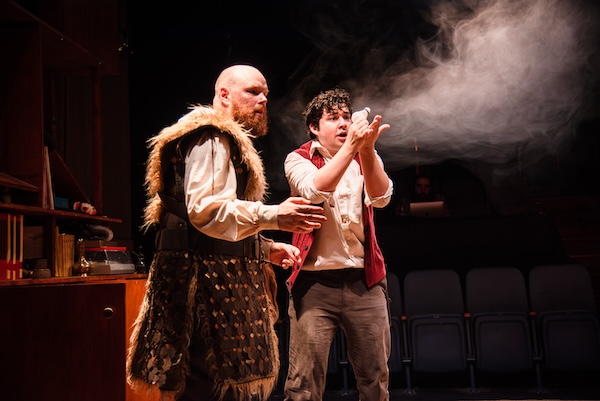
Left to right: Sophia Paskalidis, David Underhill, Drew Ogle and Mai Stone (seated) co-star in Tragedy, Slander & Wine. (photo by Sarah Cherin)

When a community theatre production ends with an actor dying on stage, the media descends on the small B.C. town. Conspiracy theories flourish and no one is above suspicion.

This is the plot of Tragedy, Slander & Wine by Jewish community member David Volpov, which premières at the NEST on Granville Island Nov. 13-19. The mystery/comedy explores, among other things, media literacy.

“My goal in writing Tragedy, Slander & Wine is to bring awareness about the issue and to invite audience members to think more critically about the media they consume. So, that’s where the idea of true crime entered the play,” said Volpov, executive director of Promethean Theatre, which is presenting the work. “I see true crime lovers popularize a lot of sensationalistic interpretations of well-known deaths. I think people tend to want to believe wild hypotheses instead of the cut-and-dried truth simply because it’s more entertaining. This conspiratorial thinking can become dangerous if it impedes on innocent people’s lives, which is what happened in real life to the town of Moscow, Idaho, after several infamous deaths.”

On Nov. 13, 2022, Ethan Chapin, Xana Kernodle, Kaylee Goncalves and Madison Mogen were stabbed to death in the young women’s off-campus (University of Idaho) house. False accusations and other misinformation proliferated, causing much harm to the community. Eventually, suspect Bryan Kohberger was charged with their murders, and his trial continues.

In Volpov’s fictional story, the play’s description notes, “The finger-pointing grows so rampant that the victim’s sister, Shannon (Mai Stone), can’t even have a healthy relationship with her own mother. Shannon’s longtime friend Alec (Drew Ogle) promises to help Shannon replenish her image in the public eye and shed her status as a pariah. But they find out that manipulating the media is harder than they anticipated. They have to get past power-hungry reporter Penelope (Sophia Paskalidis) and gatekeeping publicist Colin (David Underhill). Soon, Shannon uncovers a secret plot that upends everything she thought she knew about the tragedy.”

The play features four actors on stage and seven performers who act only on screen.

“I knew that I needed a multimedia film component in the production to spoof true crime,” Volpov told the Independent. “We filmed interviews with the townsfolk, who give the audience information about the circumstances of the mystery of the play. The film is played on TVs, which are onstage during the entire performance.”

This approach was new to many working on the production and Volpov said he appreciated the help of a few film artists who offered their guidance. In particular, he noted, “Our videographer, Bruna Xavier, and our film editor, Ian Tan, are both godsends. I’m really excited for audiences to see what this collaboration created because it’s not something that Vancouver audiences have seen before.”

Tragedy, Slander & Wine is Promethean Theatre’s sixth production. Formed in 2018, the company’s mandate is “to create work opportunities for emerging artists,” said Volpov. “There are some apprenticeships open to emerging artists in Vancouver theatre companies, but I keep hearing from my peers that these positions only take them so far. They feel stuck in what they consider a trainee limbo before they can get a shot at a role they want. That’s why Promethean puts emerging artists directly in positions of creative leadership. In that sense, we act as a launchpad for artists who want to continue expanding their practices.” (For more information, visit prometheantheatre.ca.)

photo - With Tragedy, Slander & Wine, playwright David Volpov invites audience members to think more critically about the media they consume
With Tragedy, Slander & Wine, playwright David Volpov invites audience members to think more critically about the media they consume. (photo from Promethean Theatre)

Volpov joined the producing team after having acted in Promethean’s first production, Saint Joan. He graduated from the bachelor of fine arts acting program at the University of British Columbia in 2020.

“Like many people who graduated then, my final play at UBC was cut short after just three performances due to COVID,” he said. “This experience really opened my eyes…. I always knew acting is a difficult profession, but to see virtually every theatre and movie set shut down spiked my existential worries a lot. There’s a silver lining, though. I returned to playwriting during the lull period in 2020 because I realized that writing was a way I could create art while social distancing. I learned that I didn’t have to wait for theatre work to come to me; I could generate work myself. In hindsight, I didn’t actually know what art I wanted to make when I graduated UBC. It wasn’t until I began writing plays that I found my voice and had something to say about the world.”

Tragedy, Slander & Wine is one of the works Volpov began writing during the pandemic. “I felt troubled by how quickly conspiracy theories spread,” he says in the press release for the play. “I saw this cycle repeat after each major world event. Our abilities to engage in meaningful discourse eroded while our reliance on bias-confirming news increased. With so much misinformation online nowadays, how is anyone supposed to parse through what’s fact and what’s fiction?”

“Research shows that feelings of anxiety, disenfranchisement and isolation cause people to think more conspiratorially,” Volpov told the Independent. “People feel comforted by believing that their enemies cause their bad fortune (as opposed to random chance). One of the reasons conspiracy theories endure is because they have a backfire effect: when someone confronts a conspiracy theorist about their beliefs, it is interpreted as confirmation. Theorists think ‘of course, the higher powers want to convince me I’m wrong, that’s part of their plan.’ I don’t think conspiracy theories will ever go away, unfortunately.”

Nonetheless, Volpov is doing what he can to improve the situation, in addition to writing about it.

“Promethean Theatre partnered with a media literacy platform to provide education about the topic,” he said. “They are called Ground News and are a Canadian company based out of Kingston, Ont.

“I believe that there are many ways that people can combat their confirmation biases and to have a well-rounded knowledge about current events,” he continued. “The number one thing people can do is to read multiple sources about one story. I know it probably feels like a chore, but reading different perspectives can mitigate our political blindspots.

“After that, I recommend cutting your social media use when engaging with current events. Traditional media isn’t perfect, and it’s rightfully facing scrutiny from the public, but social media can be especially pernicious because the algorithm can steer people to engage with content that already supports their beliefs. Also, the algorithm boosts sensationalistic content while ignoring nuance, which I think is necessary for every discussion.

“My next piece of advice is, be diligent about claims you read. If information can’t be traced back to a source,” he said, “it can’t be verified as true.”

Tragedy, Slander & Wine is recommended for audience members age 16+ because of its “mature content, including references to substance abuse, murder and suicide.” Among the performances is a matinée for high school students Nov. 15, and artist talkbacks after the Nov. 18 and 19 matinées. For tickets, visit plainstage.com/events/tragedy-slander-and-wine.

Format ImagePosted on November 10, 2023November 9, 2023Author Cynthia RamsayCategories Performing ArtsTags comedy, David Volpov, media literacy, Promethean Theatre, satire, Slander & Wine, theatre, tragedy, true crime
Survivors play brings tears

Survivors play brings tears

On Oct. 29, six young actors offered a powerful rendering of Survivors, a play by Wendy Kout, at the University of Victoria’s Phoenix Theatre. The production will tour BC and other Western provinces. (photo by Peter Nadler)

On Oct. 29, six young actors offered a powerful rendering of Survivors, a play by Wendy Kout about 10 Holocaust survivors. The performance at the University of Victoria’s Phoenix Theatre had the audience, many of whom were decades older than the actors, reaching for handkerchiefs as the last words of the play, “never again,” were spoken in unison on stage.

The Victoria organizers, who have been given the rights to perform Survivors across the Western provinces, are hoping the play and its message will eventually reach, inform and educate students about the Holocaust and the dangers of hate.

Suitable for audience members from Grade 6 and up, Survivors is intended to provide students the ability to recognize the short- and long-term effects of prejudice, discrimination and, ultimately, genocide. Other objectives are to foster critical thinking in young (and older) people and impress upon them the importance of human rights and social justice advocacy.

The six actors – Julie McGuire, Ryan Kniel, Sarah-Michelle Lang, Nolan McConnell-Fidyk, Sophie Radford and Brandon Sugden – took on the roles of the 10 Holocaust survivors and dozens of other characters pertaining to their respective stories during the 65-minute performance.

Survivors progresses chronologically, portraying events leading up to, during and after the Holocaust, bringing to the stage the experiences of Jewish children and teenagers from Europe. The professional cast portrays the survivors, starting at innocence and continuing through the terrifying rise and rule of bigotry, xenophobia and violence, before they immigrate to America.

Among others, the play includes the stories of a teen who watched her boyfriend being taken away to a concentration camp, a girl who was separated from her parents and relocated to England through the Kindertransport, and a boy whose family struggled to escape to China.

Four of the 10 survivors on whom the play is based were still alive when the play premièred in New York in 2018. Though each story is unique, all the survivors “went through this horror and came through the other side to build meaningful, contributing, beautiful lives,” notes Kout. “We’re not just telling history. We’re telling history as a cautionary tale for the present and the future.”

Several prominent members of the public, such as MLAs Murray Rankin and Rob Fleming, were in attendance at the UVic performance. In remarks made after the show, Rankin suggested he would press the Ministry of Education and Child Care to bring Survivors to schools in the province.

Rankin’s comments preceded the announcement by Premier David Eby the following day, Oct. 30, that Holocaust education would become mandatory in high schools throughout British Columbia beginning in the 2025-26 academic year. The move made British Columbia the second province, after Ontario, to mandate study of the Shoah.

There is a tangible sense of urgency by the organizers of Survivors to have the play viewed as widely as possible.

“We need to capture young minds of young people at an early stage before hate and racism becomes normalized,” their literature states. “We need to do this in the schools, because that is where most young people can be reached and it’s an opportunity to educate children and engage teachers.”

Survivors, with its aim to educate young people about hate, comes at a time when clear evidence of the ignorance of history has been in the news. In September, Anthony Rota, the speaker of the House of Commons, stepped down after honouring a Ukrainian veteran who fought with a Nazi unit during the Second World War.

More broadly, the organizers of Survivors cite a report by the Azrieli Foundation, Yad Vashem and others, which found that 62% of millennials did not know that six million Jews were killed in the Holocaust, 22% of millennials had not heard or were not sure if they had heard of the Holocaust, and 23% of all Canadians believe that two million or fewer Jews were killed during the Holocaust.

The Victoria production of Survivors that played last fall in school auditoriums, theatres and libraries, and had four public performances was the first international tour of the play. (See jewishindependent.ca/survivors-a-cautionary-tale and jewishindependent.ca/theatre-that-educates.) There are other tours currently on both coasts of the United States, and Kout, along with the New York company that developed Survivors, is creating a documentary on how the play came to be.

Survivors was originally commissioned and developed by CenterStage Theatre in Rochester, NY, in 2017, when Kout was asked to write a Holocaust play about survivors who had immigrated to the city. Shortly thereafter, while watching neo-Nazis march in Charlottesville, Va., Kout expressed the feeling that she was not simply writing an historical play but also a “warning play.”

For the Victoria troupe, Zelda Dean, the director, said, “Our goal is to expand the tour to more of Vancouver Island, to Vancouver on the mainland, and to select schools in the interior. The following year we will expand to include more schools throughout BC and other Western Canadian provinces.”

To learn more about Survivors and to donate, visit holocausttheatre.com.

Sam Margolis has written for the Globe and Mail, the National Post, UPI and MSNBC.
Format ImagePosted on November 10, 2023July 21, 2025Author Sam MargolisCategories Performing ArtsTags Holocaust education, survivors, theatre, Wendy Kout, Zelda Dean
The opposite of death is love

The opposite of death is love

Hadar Galron in Whistle, which is at the Firehall Arts Centre Nov. 14-15, as part of the Chutzpah! Festival. (photo by Nathan Yakobovitch)

“As a child I was never hugged or kissed; I think my parents did not even see me. I wrote this story to stop being an invisible child,” Israeli author Ya’akov Buchan has said about Whistle: My Mother was Mengele’s Secretary.

The play Whistle is part of this year’s Chutzpah! Festival, with performances Nov. 14 and 15 at the Firehall Arts Centre. Writer, director and actor Hadar Galron, who adapted Buchan’s story for the stage, stars in the monodrama.

“Buchan was born to two Auschwitz survivors, and began writing after he was injured in the Yom Kippur War. He’s written 18 books – four concerning the Holocaust – but he felt that people don’t read so much anymore, and that he wanted to write a play about second generation Holocaust survivors,” explained Galron in an interview with the Independent. “Dramatic writing and prose are very different techniques, and Ya’akov sent me about 30 pages of interesting and well-written content, but not dramatic enough for stage.

“The first meeting with him was out of respect – I thought I’d give him a few tips and let him take it from there,” she continued. “I remember the turning point: I said, ‘You mention twice in these pages the name Mengele. You can’t just throw in a name like that, it needs to have some dramatic payoff, or not to be mentioned at all.’ Ya’akov said nothing, just nodded. And, suddenly, I thought that maybe Mengele had tortured one of his parents. ‘Were any of your parents somehow … (how to say this?!) … connected to Mengele?’ Ya’akov looked me squarely in the eye and said, quietly, ‘My mother was Mengele’s secretary.’ That was when I knew I would take the task, and help him tell his story and the story of the second generation.”

In recent years, Galron has been working on several plays that deal with the lasting impacts of trauma. “We tend not to consider [the] second generation as traumatic,” she said, “but something as horrendous as the Holocaust leaves some people so scarred that they cannot really love anymore, even their children. Or, they love but in a different, obsessive way. The children who grow up without feeling love are traumatized, too, but their wounds are invisible.

“It’s important to understand that, whilst the trauma lasts a minute or a year or five years, post-trauma lasts a lifetime and, when considering [the] second generation, then even more than a lifetime. Long-term traumas such as [the] Holocaust are not a swing of the sword, they are more like the bite of a snake – the venom penetrates the body and mixes with the blood of the victim.”

Though she generally directs her own works, Galron said, “When I’m the actress, I need someone on the outside. At first, I thought maybe I’d direct and not act. It was Ya’akov who begged me, after seeing my stand-up cabaret Passion Killer, to act the part.”

Jaffa, Israel-born director and playwright Hana Vazana Grunwald was the first person who came to Galron’s mind to direct.

“We studied theatre together at Tel Aviv University, but that was decades ago! I had no idea where to find her,” said Galron. “We’d met a couple of times in festivals, etc., along the years. I was thinking of her on my morning walk-jog in the park by my home. In the distance, I saw a woman that reminded me of Hana and then we got closer and I saw it actually was Hana! She lives five minutes away from me, but that was the first day she decided to go out and take a power-walk before work. I don’t believe in coincidence – it’s only God’s way of remaining anonymous.”

Grunwald started out in community theatre more than 25 years ago. She is the director of the Frechot Ensemble, a collective of women creators, which she founded some 10 years ago.

“I see myself as a feminist Mizrahi (Middle Eastern Jew) writer, who brings to the forefront my personal story,” she told the Independent. “But my personal story is never just my own, it’s an inherent part of my political story, my family’s story and the collective which I belong to. I feel that my world isn’t really represented in Israeli theatre. I don’t see the household I grew up in, I don’t encounter complexities and dilemmas that interest me. I realized I have the responsibility to represent myself – I have to write these texts, I have to tell these stories. My job is to search through history and prose and to bring back the voice of all those whose voice was taken away from them.”

When Galron sent her the script for Whistle, Grunwald said, “I was immediately hooked. But, after we met again, I felt that the opportunity to work together and find connections would also be reflected in the play’s dramaturgy.

“The challenge that the play Shirika [Whistle, in Hebrew] brings to our door is how to retell the story of the Holocaust and the story of the members of the second generation, who feel transparent. Two images guided me in my search for the keys to directing the play,” said Grunwald.

“The first: whistle. Tammy, the protagonist, lost her ability to whistle, she lost her ability to love and feel loved and, as she says in the play, ‘The opposite of death is not life, the opposite of death is love.’ The way this whistle is expressed on stage is through the prop of a kettle full of boiling water. The boiling and bubbling kettle and the whistler on stage metaphorically tell the story of the Holocaust, a story that never ends.

“The second image we chose is the painting. Tammy is a painter and, when we wondered what was painted on the stage, we realized that the body is the canvas, the body treasures and carries the wounds of the past, the memories – the actress jumps from limb to limb and with the help of simple means such as brushes and paints Tammy marks national history…. This is the way in which the trauma is present again on the stage.

“It seems that precisely now the spectacle of a whistle is given a relevant meaning,” Grunwald added. “We find ourselves facing a terrorist attack in which again Israeli Jews are brutally murdered and mass murdered because of their Jewishness. We again witness horror stories in this war against Hamas. We find ourselves again, 75 years after the establishment of the state of Israel, in a shocking event that reminds us of the fear of being destroyed. The harsh scenes from both sides shake the soul, sow terror and fear, and remind us that the feeling of security is a temporary illusion and we must not forget it. I work at the Hebrew-Arab theatre in Jaffa, a theatre that gives a stage to the binational discourse, it gives a stage to both narratives, and I feel that, these days, it is the first to be hurt.”

Galron also works with artists of different backgrounds and shared one of her experiences.

“Between 2016 and 2018, I was artistic director of the Shalom Festival, a small festival that was an official part of the Edinburgh Fringe fest,” she said. “We created this festival after an Israeli production, in 2014, was shouted down by the BDS [boycott, divest and sanction movement] and, in 2015, there were no Israeli productions.”

She was inspired by Sir Rudolf Bing, founding director of the Edinburgh International Festival, from which the Edinburgh Fringe Festival has its roots. Galron explained that Bing, a Jewish-Austrian opera singer, who fled Nazi Germany, “created the festival as a cultural bridge, inviting, firstly, German artists to take part! With that in mind, I told the sponsors of the Shalom Festival that we cannot make a one-sided Shalom (Peace) Festival and that, as the artistic director, I would like to bring artists from all of Israel, including Israeli Arabs – both Muslim and Christian – and also some Palestinian artists. At first, there was big objection but, eventually, I convinced them that these are Palestinians who believe in peace, in dialogue. Until today, even in these times, I am in contact with my Palestinian friends.

“I believe art is a bridge,” she said. “I believe art and culture and theatre have the power to heal – to give us insight and create empathy. From my very first performance as a stand-up artist – my show was on the status of women in the Jewish law – I made a decision to make my art meaningful, to merge life and stage.”

Since the Oct. 7 Hamas terror attacks on Israel, Galron has been posting related videos and other items on Facebook, including “Creativity in place of survival” writing challenges. She got the idea from a course she took during COVID with Dr. Joe Dispenza. “In one of the online digital courses, he speaks of how our brain can be either in ‘survival’ or in ‘creativity’ mode,” said Galron. “The moment I heard this, I understood many things about myself and how creativity has always been for me a way of surviving. Now I know that, when we begin to be creative, we actually begin to pull ourselves out of ‘survival’ [mode] even if we are being creative whilst we try to survive. A bit like Baron Munchausen explains that he pulls himself by his hair out of the pit.”

About how she is doing since the attacks, Galron said, “I didn’t have a real answer to that question until yesterday, because everything is so chaotic. But I was speaking to a university student of mine who answered, ‘I’m committed to the good.’ I was so moved by this. She told me she adopted it from her yoga teacher. I adopted it from her. I’m committed to the good.”

For tickets to Whistle and other Chutzpah! shows, visit chutzpahfestival.com.

Format ImagePosted on October 27, 2023October 26, 2023Author Cynthia RamsayCategories Performing ArtsTags Chutzpah! Festival, Hadar Galron, Hana Vazana Grunwald, Holocaust, second generation, theatre, Ya’akov Buchan
Survivors a cautionary tale

Survivors a cautionary tale

On Oct. 29 at the Phoenix Theatre in Victoria, there will be a one-night-only performance of Wendy Kout’s play Survivors, which is touring schools this month. (photo by Peter Nadler)

In light of the success of last year’s pilot tour, the educational play Survivors is touring middle and secondary schools throughout Vancouver Island this month. And, with the support of the University of Victoria, there will be one public performance of the play this month: at the Phoenix Theatre, Oct. 29, 2 p.m. Last year’s public shows sold out.

Following the mistaken honouring in Parliament recently of Ukrainian-Canadian Yaroslav Hunka, who fought in a Nazi unit during the Holocaust, there should no longer be any doubt about the ignorance of the history of the Holocaust. This conclusion is further supported by the existence of monuments in Canada that honour Nazi veterans who were members of the Galicia division of the SS in Ukraine. Furthermore, Canada’s Governor General Mary Simon has apologized for the Order of Canada given to Peter Savaryn in 1987. Savaryn was chancellor of the University of Alberta and president of the Progressive Conservative Party of Alberta in the 1980s – he also served with the Waffen-SS, a voluntary Nazi unit in Ukraine during the Second World War.

A 2019 study done by the Azrieli Foundation, Yad Vashem, the United States Holocaust Memorial Museum and the Claims Conference revealed Canadians’ lack of knowledge of this period in history. For example: 62% of millennials did not know that six million Jews were killed in the Holocaust and 22% of millennials hadn’t heard or were not sure if they had heard of the Holocaust. Nearly one-quarter of all Canadians believe that substantially fewer than six million Jews were killed (two million or fewer) during the Holocaust.

History shows that when it comes to racist attacks and xenophobia, Jews are often the “canary in the coal mine.” Holocaust awareness and education could not be more timely or important. “We’re not just telling history,” said Survivors playwright Wendy Kout. “We’re telling history as a cautionary tale for the present and the future.”

Survivors explores hatred, the capacity to survive and thrive, and serves as a call to consciousness of the present challenges. Combining history with life lessons, the audience is guided through a time when hatred was normalized. The audience is both uplifted by the survivors’ triumphs and inspired to take action against present and future racism.

The play tells a chronological history of the Holocaust through the personal prism of experience, interweaving the stories of 10 Holocaust survivors, four of whom were still alive when the play premièred in New York in 2018. Though each has a unique story, all the survivors “went through this horror and came through the other side to build meaningful, contributing, beautiful lives,” said playwright Wendy Kout.

The Victoria production of Survivors will be touring throughout the four Western provinces for the next few years. For more about those tours and the organizations collaborating on them, visit jewishindependent.ca/theatre-that-educates and holocausttheatre.com. For tickets to the Oct. 29 matinée at Phoenix Theatre, go to eventbrite.ca.

– Courtesy Victoria Theatre Productions

Format ImagePosted on October 12, 2023November 9, 2023Author Victoria Theatre ProductionsCategories Performing ArtsTags education, Holocaust, play, theatre, Victoria, Wendy Kout

Posts pagination

Previous page Page 1 Page 2 Page 3 … Page 13 Next page
Proudly powered by WordPress