כאשר גרתי בישראל צפיתי שהמדינה תלך למקומות לא נכונים והיא תעמוד מול סכנות הולכות וגוברות מכל הכיוונים. אחד מחברי הטובים טען אז שאני רואה שחורות, מגזים בפסימיות שלי ונבואותי הרעות לא יתגשמו. לאורך השנים האחרונות החבר שינה את דעתו לגבי נבואותי מקצה לקצה. ועכשיו הוא טוען שהמציאות הקשה בה ישראל נמצאת, היא הרבה יותר קשה ממה שחזיתי ולכן נבואותי היו אופטימיות מידי
אני יכול להבין את אלה שרוצים להיות אופטימיים, לראות את האור, לשמוח ולעסוק בדברים חיוביים. אך אסור לשכוח שמי שמתעלם מהמציאות הקשה ביותר בה ישראל נמצאת כיום, מאפשר לראש הממשלה המושחת, בנימין נתניהו, להמשיך בדרכו הגרועה תוך חיסול הדמוקרטיה. ההיסטוריה מלמדת אותנו שמנהיגים רעים הולכים ותופסים תאוצה כאשר אין כח גדול שעומד מולם ועוצר אותם. אזרחים שמעדיפים לעסוק בחיי היום יום ולהתעלם ממה שקורה בישראל, יתעוררו יום אחד ויראו שהדמוקרטיה נמוגה לחלוטין, שזכויותיהם נעלמו ואין להם יותר זכות בחירה. ישראל בשליטת נתניהו צועדת לכיוון המסוכן הזה במלוא העוצמה. כי כידוע נתניהו חושב רק על נתניהו ולא אכפת לו מאחרים, בהם המשפחות השכולות, משפחות החטופים, תושבי ישובי הספר ואחרים
כל עוד לא יתאגדו כל כוחות האופוזיציה בניסיון רציני להפיל את ממשלת נתניהו המסוכנת, כל עוד לא יצאו לרחובות מיליוני אזרחים להפגין נגדה ונגד המדיניות שלה, הרכבת שצועדת אל התהום האסוני הזה לא תיעצר. על תושבי ישראל לנקוט בכל הצעדים האפשריים לעצור את נתניהו וממשלתו הרעה ולמנות תחתם ממשלה שפוייה שתדאג לישראל ולא לעצמה. המלחמה בעזה מיותרת, עולה במחיר רב של חיילים שנופלים, החטופים לא משוחררים וגם פלסטינים רבים נהרגים ללא סיבה מוצדקת. לאור זאת, ישראל הפכה כיום להיות אחת המדינות המנודות והשנואות בעולם. ולא פלא שהאנטישימיות מרימה ראש, וישראלים ויהודים נפגעים כל הזמן פיזית מאלה ששונאים אותם. האנטישמיות צפויה להחמיר כל עוד צה”ל ממשיך לפעול בעזה ולפגוע ולהרוג אזרחים מקומיים שם
את הישראלים המתנגדים לנתניהו אפשר לחלק לשלוש קבוצות: הקבוצה הראשונה כוללת את אלה שיעשו כל מאמץ להילחם בו, להביא לפיטוריו ובעצם פיטורי כל הממשלה הנוראית הזו. הקבוצה השנייה כוללת את אלה שמבינים שישראל תמשיך להידרדר לתהומות עמוקים עוד יותר. ועל כן מבחינתם הפתרון היחידי האפשרי הוא לעזוב את המדינה. הקבוצה השלישית כוללת את החלשים והתבוסתנים המציינים כי אין מה לעשות אלה לקבל את גזרות נתניהו כמו שהן, ולקוות לטוב
בתור אחד שנולד וגדל בישראל עצוב לי לראות את תהליך הנסיגה הגדולה של המדינה וההידרדרות הבלתי נתפסת הזו. יש שטוענים שכל הרע החל מהשבעה באוקטובר, אך אני חושב שזה התחיל הרבה שנים קודם לכן. בחודשים האחרונים, חברו הטוב של נתניהו במשך שנים, הסופר איל מגד, התנתק ממנו והחל לבקר אותו בחריפות. מגד הוא דוגמא טובה לחברים ומעריצים מושבעים של נתניהו ומשפחתו, שיום אחד התעוררו והבינו שהוא אסון למדינה. אני כבר אמרתי זאת בסוף שנות השמונים. נתניהו תמיד היה נתניהו: נוכל, שקרן פתולוגי, אינטרסנט ומגלומן. טועה מגד ה מציין כי הוא הבחין בתכונותיו השליליות של נתניהו רק אחרי השבעה באוקטובר. מגד היה עד אז פשוט עיוור שהעריץ את נתניהו
אם לא יקומו הישראלים ברובם ויהפכו לאקטיביים כדי להעיף את שלטונו של נתניהו, ישראל תלך לאבדון. אם לא תקום ממשלה חדשה ושפויה בקרוב זה יהיה אסון. הנזק שנתניהו גורם כל יום הוא כבד מנשוא.
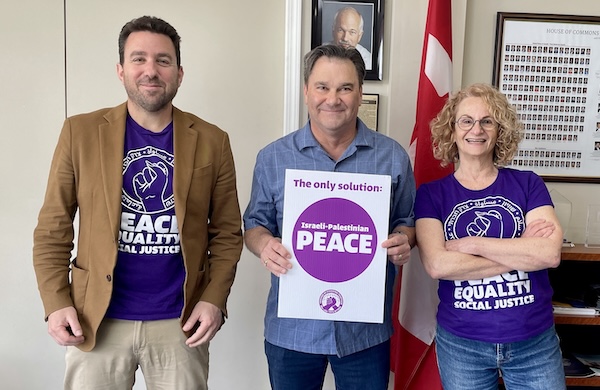
Interim leader of the New Democratic Party of Canada Don Davies, centre, with Itai Bavli and Avril Orloff of Vancouver Friends of Standing Together. (photo from Vancouver FOST)
This summer, Vancouver Friends of Standing Together has been holding weekly vigils in front of City Hall to continue the call for the return of the hostages, an end to the war in Gaza and an end to settler violence against Palestinians in the West Bank.
“We organize rallies, vigils and information sessions to raise awareness of the situation in Israel/Palestine and promote ‘another way’ that is not exclusively pro-Israel or pro-Palestine but pro-humanity,” Avril Orloff, who started the Vancouver Friends of Standing Together (FOST) chapter, told the Independent.
Adi Keidar, one of the chapter’s co-administrators, said, “If you are willing to accept that both Israelis and Palestinians deserve to live freely and safely on this land, I will be standing with and supporting you. Someone told me, ‘if you need to choose between pro-Israel or pro-Palestine, it is obvious for me, as a Jew/Israeli where I stand. However, if I knew and trusted that there is another way, I would choose both.’ Standing Together, for me, brings that other voice.”
“I joined the FOST group in June 2024 because it reflects my values and my belief that finding a just solution to the conflict is the only way forward,” Itai Bavli, also a Vancouver FOST co-administrator, said. “I care about all people living between the river and the sea and believe that both peoples can thrive if given the chance. I support Israelis and Palestinians alike and believe they both have the right to live freely and safely. Which means ending the occupation and supporting a Palestinian state. For me, it’s a responsibility I carry.”
Currently, there are nine local co-administrators, who play active roles as their other work and responsibilities permit, Orloff explained. “We try to divide up responsibilities, so no one is overburdened,” she said, noting that everyone involved is a volunteer. “We meet on an ad hoc basis as needed to brainstorm ways to increase awareness, bring out the voice of Standing Together and address issues that come up.”
Standing Together is an Israeli grassroots social movement made up of Jewish and Palestinian citizens that, according to its website, “envision[s] a society that serves all of us and treats every person with dignity. A society that chooses peace, justice and independence for Israelis and Palestinians, Jews and Arabs. A society in which we all enjoy real security, adequate housing, quality education, good healthcare, a liveable climate, a decent salary and the ability to age with dignity.”
Since the Hamas terror attacks on Oct. 7, 2023, and the ensuing war, Standing Together in Israel has been organizing demonstrations – attended by tens of thousands – calling for a hostage deal and a ceasefire agreement. They also have been engaging in public campaigns “aimed at re-humanizing the discourse, retaining humanity, mourning all lives lost and rejecting violence on social media in Hebrew, Arabic, and English.” Last May, they launched the Humanitarian Guard initiative at Tarqumiyah checkpoint to protect “aid trucks headed to Gaza from attacks by extremist settlers that come out to attack the trucks.” This month, they started a campaign to collect food and humanitarian aid for residents of Gaza.
In addition to the eight chapters of Standing Together that operate in Israel, there are Friends of Standing Together chapters worldwide that have formed since Oct. 7. The chapters in the diaspora raise awareness of and funds for Standing Together, as well as offer a local communal space for people who share the movement’s values and goals. Orloff is an ambassador for ST’s global crowdfunding campaign and recently surpassed her personal goal of raising $6,000 for the movement.
“I started the Vancouver FOST group in February 2024, when I first learned about Standing Together and discovered they had support groups around the world,” said Orloff. “I was drawn to ST because I felt that a lot of groups advocating for either Israel or Palestine focused on only one side or the other, which seemed short-sighted to me. Standing Together’s stance, by contrast, is that, with seven million Jews and seven million Palestinians living ‘between the river and the sea,’ none of whom are going anywhere, the only sustainable future is a shared one grounded in equality, security, peace and justice for all.”
Orloff, Keidar and Bavli said they appreciate that ST is about more than ending the war and that it’s “a broad-based social movement that goes beyond the specifics of Jewish/Palestinian issues to encompass social change at all levels of society, from the bottom up.”
“One of the biggest concerns and confusions I had on Oct. 7 and the events that followed was the rise of hate and polarization on both sides,” said Keidar. “It was rare that I could agree with much that was said, and I was constantly trying to hold two thoughts at the same time. I felt alone and was not seeing the benefit of supporting one side – it felt wrong and unjust and it didn’t fit my values.
Adi Keidar at one of Vancouver Friends of Standing Together’s vigils. (photo from Vancouver FOST)
“When I learned about Standing Together, it was the closest group that I felt spoke to my values and beliefs, as their focus is not one side or the other but humanity, which was the voice I felt was drowning in the hate that was brewing. I wasn’t willing to accept just one side. I believe that the only way to get out of this cycle is by compassionately seeing both sides, taking responsibility, finding the people that speak these values and bringing their voices out.”
Keidar participates in the weekly Bring Them Home rallies. Both she and Bavli spoke at a BTH rally this summer to raise the voice of Standing Together, to show “that it’s possible (indeed, necessary) to support both Israel and Palestine, and remind people that the immediate end of this war is only the beginning of the work to build a shared society in which all peoples live in peace and security.”
Vancouver FOST does local community-building through their WhatsApp group, social events (for example, film evenings, picnics, in-home gatherings), rallies and other activities. They raise awareness on social media via Instagram and work to build their membership, liaising with Standing Together and FOST groups globally. They meet monthly on Zoom with other Canadian FOSTs and build relationships with groups that share ST’s values and principles, like Women Wage Peace and various faith organizations. They have started doing outreach to Canadian politicians.
“We have endorsed Canada FOST’s Call to Action to the Canadian government and politicians to advance key priorities,” said Orloff, “including taking urgent diplomatic action to permanently end the war in Gaza; providing long-term support for peace and equality, not war; and supporting solidarity and partnership in our own society.”
The group organized and hosted an event in June last year, which brought Raja Khouri and Jeffrey Wilkinson to Vancouver to talk about their book, The Wall Between: What Jews and Palestinians Don’t Want to Know About Each Other. (See jewishindependent.ca/not-such-a-great-divide.) They have plans to host an information table at the University of British Columbia in the fall.
In an email, Orloff, Keidar and Bavli described Vancouver FOST as being “for more than we’re against. We don’t argue about terminology or labels or traffic in simplistic black-and-white ‘solutions,’ but are comfortable living with complexity and difference. We love to have juicy discussions, but, more than talk, we’re about supporting action that will bring about real, practical, sustainable change. We aren’t pro-Israel or pro-Palestine but pro-humanity,” they reiterated, “and we don’t see this as a left-right divide or an Israel-Palestine divide, but a divide between those who want peace and life for everyone and those who traffic in death and destruction. We’re here to offer a different way of thinking about the conflict and a different path forward, not to convince people that we’re right.”
Orloff said group members aren’t “settling for simplistic, one-sided solutions that make heroes of one side and villains of the other, but recognize that geopolitical issues have history and context that create layers of complexity, compounded by historical and intergenerational trauma on both sides. What I tell people is that, in this ongoing conflict, there is no win/lose: it’s either win/win or lose/lose. If we don’t find a way to justice, equality, peace and security for all, there won’t be justice, equality, peace or security for anyone.”
“We are involved with Standing Together,” the three co-administrators stressed, “because of deep feeling for Israel and the people living in the land. Many of our FOST members are Israelis who are heartsick at what Israel is doing in Gaza, the West Bank, and to its own Palestinian Israeli citizens. We believe in Israel’s promise and want to hold Israel to its highest ideals. There is no other way. It’s our responsibility to bring about the change.”
On Aug. 5, B’nai Brith Canada hosted an online discussion on the crises affecting Druze communities in Syria and the Iranian people, with a focus on the impact on these diasporas in Canada and potential actions by the Canadian government.
The speakers were Kiumars Rezvanifar, president of the Canadian Ethnic Media Association and founder of the Iranian Canadian Cultural Fellowship, and Jamal Sehnawi, an advisor to the Supreme Druze Council and a member of the Canadian Druze Society.
Rezvanifar said the recent violence in Syria’s Suwayda (Sweida) governorate could have resulted in “hundreds of thousands” of Druze deaths if the Israel Defence Forces had not intervened. He said the attacks included the killing of civilians and kidnappings, highlighting the case of a 5-year-old girl who was kidnapped, assaulted, and her family killed, allegedly by members of Hayat Tahrir al-Sham (HTS). He lamented that major Arab media outlets like Al Jazeera and Al Arabiya have downplayed the crisis, a silence he called “a moral issue.”
Independent casualty figures vary. The Washington Institute reported more than 800 dead and 900 injured. Reuters-verified footage and the Syrian Network for Human Rights cited more than 1,000 deaths, mostly Druze, including women and children. The Syrian Observatory for Human Rights documented 182 executions by government-affiliated forces as of July 19. Le Monde reported 1,311 deaths, while Anadolu Agency cited at least 321 killed, including six children and nine women.
These attacks have deeply shaken Canada’s Druze community, said Rezvanifar, who estimated the Druze population in Canada at about 50,000, mainly in Montreal, Toronto and Edmonton.
Sehnawi described the violence in Suwayda as “ethnic cleansing,” attributing it to the Syrian Ministry of Defence and Interior and to foreign fighters. He said the Druze community’s requests were for peace and recognition similar to that afforded to other communities worldwide.
Throughout the discussion, Sehnawi spoke about historical and cultural ties between Jewish and Druze communities, referring to Druze as “direct descendants to the sons of Jacob (Israel)” and noting traditions of service and community support.
The online conversation also addressed the situation in Iran. Rezvanifar spoke about decades of repression by the Iranian government, citing executions, censorship and the suppression of protests. He criticized European countries for “prioritizing economic interests over human rights,” noting that international attention often came “too late to effectively help the Iranian people facing brutal repression.”
In the face of internet blackouts and censorship, Rezvanifar praised citizen journalists, saying, “The Iranian population is tech-savvy and educated, constantly finding ways to circumvent restrictions.”
Rezvanifar alleged that Iranian regime operatives live openly in Canadian cities such as Vancouver and Richmond Hill (part of the Greater Toronto Area), claiming “thousands of visas may have been issued to regime members” and “fewer than 10 deportations have occurred in the past five to eight years.” These figures have not been independently confirmed.
He commented on the fact that it took repeated calls before Canada designated the Iranian Revolutionary Guard Corps a terrorist organization in 2024. The measure had been sought by various groups since the January 2020 downing of Ukraine International Airlines Flight PS752, which killed 176 people, most of them Canadian citizens or residents. Both speakers called for Canada and the international community to take action in support of affected communities.
“In real estate, it’s all about location, location, location,” Sehnawi concluded. “In this situation, it’s all about information, information, information.”
Uriel Presman Chikiaris a student at Queen’s University and serves as executive vice-president of external relations at Hillel Queen’s.
Director Francis G. Matheu, right, with actors Nolan Fidyk and Dan Landry rehearsing Alan Segal’s Shade Apparel. (photo by Sarah Nicole Faucher)
This year’s Victoria Fringe Festival, billed as “12 days of madcap fun this summer,” started on Aug. 20 and runs to Aug. 31. Included in the lineup are pieces by two local Jewish community members, Alan Segal and David Heyman.
Segal describes his play, Shade Apparel, as “comedy, drama and absurdity.” It features Danver, a playwright rooted in daily routine, who tries to find answers to questions he never knew he had. And, Segal told the Independent, “He is not prepared for the answers. Shade Apparel is a play about wanting to know more and not knowing where to find anything.”
In Segal’s words, our society is “heavily psychologized,” in that everything is given a psychological or emotional origin story, he said.“But, if we breathe, we absorb culture, ideas, ideals and assumptions.
“Most of the time, we have a slight awareness of the precise origin of these. Their origin tale, however, is found in the social cauldron of daily life. This, too, is our apparel. We are clothed in more than material fabric,” he said.
From an early age, Segal has had an interest in how people become, well, anything; for example, how are allegiance, assurance, belonging, anger, dissent, happiness, or its opposite, created?
Segal’s first Victoria Fringe experience was not as a playwright but as a supporter of the arts who was captivated by the aura and array of creativity he observed. Last year, he founded Imbroglio Theatre, which will put on Shade Apparel.
“Beyond headlines and supposed fame, people venture into many realms of expression. I loved it from the start, and I expect many will be enlivened by what is approaching in Victoria at the end of August,” he said.
The creative team for the Fringe show comprises Dan Landry, Nolan Fidyk and Kendra Bidwell (cast), Alan Segal (writer), Francis G. Matheu (director), Elaine Montgomery (stage manager), Luke Weston and Andrea Gregg (lighting design), Phil Letourneau (music and sound design), Sarah Nicole Faucher (costume design) and Doug Wills (poster and program).
“Shade Apparel is the second play I have written – a project I never intended to write and had no inkling of, until it leaped into my mind as a single scene,” said Segal.
His first play, Frey’s Anguish, premiered in March 2024 at Paul Phillips Hall in Victoria.
David Heyman’s Ducks co-stars, right to left, Gloria Snider, Lorene Cammiade, Ryan Kniel and Danielle Greschner. (photo from David Heyman)
Heyman’s play, Ducks, takes place in the aftermath of an incident in which 1,600 ducks flew into an oilsands tailings pond in northern Alberta and died – a true event that caused international criticism of the provincial government. Years later, the oil company that owned and operated the pond was fined and the government promised tighter restrictions; however, the damage toAlberta’s reputation was significant.
The fictionalized theatrical story centres on a government communications director who has 20 minutes to retrieve an embarrassing, career-ending invitation erroneously sent out in his name before the media or public find out about it.
“I was communications manager for the premier of Alberta at the time [of the real-life incident] and, although I was not involved in managing the issue …I was able to observe the crisis-management efforts from up close,” Heyman said.
“The characters and events in the play are entirely made up but are informed by my inside knowledge of how communications offices work, and how the media deal with such situations,” he said. “Before joining the Alberta Premier’s Office, I was a political reporter at the Calgary Herald for many years. Many people who work in governments in Alberta and BC have told me that the play feels authentic, which was my goal.”
When Ducks premiered at the Victoria One-Act Play Festival in 2023, it won the prize for outstanding original script. When it was performed at the 2024 Edmonton Fringe Festival, five of eight shows sold out and the play received stellar reviews. The play has also been performed at the Nanaimo Fringe Festival and in Tofino.
Heading into the Victoria Fringe, Heyman said, “We’ve got a top-notch cast, a great director and a great stage manager this year. The rehearsals are going very well and I’m confident it will be a hit.”
Heyman is the show’s producer and, joining him in mounting the Fringe show are Ryan Kniel, Lorene Cammiade, Gloria Snider and Danielle Greschner (cast), Francis G. Matheu (director), Andrea Gregg (stage manager) and Sarah Heyman (associate producer).
David Heyman has written an as-yet-unperformed sequel, Rhymes with Ducks, that he hopes to put on at next year’s festival. “The sequel is designed also to be a second (and final) act, and perhaps one day both will be performed as a single show,” he said.
For the Fringe, Shade Apparel is at Victoria Conservatory of Music’s Wood Hall, while Ducks is at James Bay United Church. Both plays are 45 minutes long. For tickets and more information, visit victoriafringe.com.
Sam Margolis has written for the Globe and Mail, the National Post, UPI and MSNBC.
Nina Krieger, centre, member of the BC Legislative Assembly for Victoria-Swan Lake, connects with community members. Krieger is the new public safety minister and solicitor general. (photo from Nina Krieger)
After a cabinet shuffle last week, Nina Krieger, member of the legislative assembly for Victoria-Swan Lake, is the new public safety minister and solicitor general, replacing Garry Begg, who became parliamentary secretary for Surrey infrastructure.
Saying she is “humbled and excited” to take on the position, Krieger told the Independent: “Our province faces complex challenges, and I am committed to working with my colleagues, local governments, Indigenous leadership, police services, business and community organizations to build safe, healthy and resilient communities for everyone.
“Public safety is one of the central issues of our time,” she said, “and British Columbians are looking to us to strengthen public safety through effective support of our law enforcement services and working across government to address the root causes of public disorder.
“I look forward to working with partners around the province to take meaningful action to keep BC a safe place to live, work and enjoy this beautiful province we call home,” she added.
Before being elected to the Legislative Assembly of British Columbia last fall, Krieger was the executive director of the Vancouver Holocaust Education Centre (VHEC). She takes over her new cabinet position after having served as parliamentary secretary for arts and film. Prior to this shift in roles, she spoke with the Independent about her time in office since being sworn in.
“The role of MLA is a unique opportunity and responsibility. I don’t think anything can quite prepare you for the busy, ever-changing schedule, and the range of issues and people that you encounter on any given day,” Krieger said.
“The learning curve is steep but exciting and I’m grateful to be learning alongside other new MLAs, from veteran members of caucus and from the incredible teams behind the scenes at the BC legislature.”
Krieger describes the move from the VHEC as “bittersweet,” saying it was difficult to leave an organization and a community for which she cares deeply. Nonetheless, she said the skills, experience and values she honed during her work at VHEC have proved meaningful and timely in her current role.
“I keep in close touch with former colleagues and the Holocaust survivor community and was honoured to return to the VHEC this spring to emcee a Yom Hashoah commemorative program featuring Premier David Eby, presented in partnership with the Province of BC and the Centre for Israel and Jewish Affairs,” she said.
Her introduction to the legislative side of the MLA job came during the recent spring session that concluded in May. She sat in the house and committee rooms, sometimes late into the night, delivering speeches about her community and constituents’ achievements and needs, as well as debating and voting on proposed legislation.
“I was proud to deliver several statements in the house, marking days of significance for BC’s Jewish community,” said Krieger.
“This spring, government passed legislation to protect consumers, respond to the threat of tariffs and implement countermeasures, deliver more renewable energy projects and major infrastructure projects, among other work,” she said.
During the summer months, MLAs return to their communities.
“I visit and meet with local organizations to hear about the work they do and how we can spotlight and support them,” she said. “I also have the chance to attend local events as an MLA over the summer, from graduation ceremonies to festivals, markets and sports games. With so many amazing people putting on great events around town here over the summer, it adds to the fun of this role.”
As the parliamentary secretary for arts and film, Krieger worked closely with the minister of tourism, arts, culture and sport to advance the
development and growth of British Columbia’s film, television and animation sectors, as well as supporting and growing the arts and culture sectors in the province. One of the perks of that job was attending film-related events and meetings, like local film festivals.
“It has been amazing to see the talent and work coming out of BC, and rewarding to stand strong in support of workers in the face of tariff threats,” she said.
Krieger acknowledges that it is a difficult time for Jews in the province and throughout Canada, with challenges in finding their political “homes.” She is grateful that there were Jewish voters whose values aligned with those of the BC NDP.
“I know that there is work to do to ensure that Jewish people in BC feel safe and supported, and that nobody is targeted because of who they are,” Krieger said. “Combatting antisemitism – which is illiberal, toxic to democracy and dangerous – requires the work of all levels of government and civil society.”
She continues to be in active contact with Jewish constituents and community leaders in Victoria, which, she says, is home to a diverse Jewish community. Constituents from a range of backgrounds have contacted her and expressed deep concern about the toll of the ongoing Israel-Hamas war on the civilian populations of the region.
“While foreign policy is beyond my scope as a provincial representative, it is vital to discuss ways to ensure that BC is a safe and inclusive place for all people,” Krieger said. “From my work as a Holocaust educator, I know that it is vital to counter misinformation, disinformation and conspiracy theories, which can fan the flames of xenophobia, antisemitism and hate, and keep communities divided. In my work as MLA, I hope to counter this by bringing people together, modeling respectful dialogue and upholding the values of truth and trust in democratic institutions.”
Krieger explained that her experience as an anti-racism educator showed her the importance of listening and continually learning with openness and compassion. It is relevant to her current work, she believes, because she is entrusted with the stories and experiences of many constituents, which are often shared to build a more just and inclusive society.
“The province helps fund anti-racism and anti-hate work done around BC,” said Krieger, “and I have the opportunity to talk to organizers that are the recipients of grant funding and hear about their work, share experiences and learn how we can continue to collaborate to do this vital work effectively.”
Sam Margolishas written for the Globe and Mail, the National Post, UPI and MSNBC.
Before Passover, a relative of ours in New Jersey asked if we would have problems getting Manischewitz wine. I told her all would be fine. Even though US alcohol had been taken off Manitoba’s shelves, we would just buy other brands of kosher wine instead, I said.
I felt confident about this possibility until I marched to the kosher section of the wine shop and saw the notification. The store encouraged us to buy whatever was available “right now” because all kosher wine, no matter where it is made, is imported through the United States. We were fine for Passover and, to be honest, my family is more flexible about wine the rest of the year, so the situation didn’t worry me too much.
A Manischewitz joke from my mom, visiting from the States, made me wonder about how much kosher wine is available now in Manitoba, and I did some googling. Between the provincially run Liquor Marts and the private wine shop that caters to those who keep kosher, I saw about six wine varieties available.
Then, my husband told a story he’d heard from someone attending minyan. Their family kept kosher. To get the kosher wine they wanted during Manitoba’s ban on US alcohol, they placed a special order with Happy Harry’s liquor store in Grand Forks, ND. The dad drove from Winnipeg, crossed the border, picked up two cases of wine, paid the duty at the border and drove home again. It was a 470-kilometre round trip, more or less, to resolve the issue.
You don’t think a lot about this when supply chains function between countries, but, in the absence of kosher wine imports, you have whatever odds and ends are left – and Kedem grape juice, which is still available.
Plenty of Jewish Canadians may be asking what they will drink on the holidays. This made me think about the Babylonian talmudic tractate I’ve just started studying, Avodah Zara. This tractate, compiled by about 500 CE, concerns how one lives alongside idol worship. It considers issues like whether Jews should do business with non-Jews before their festivals, because the money they earn might go towards ritual sacrifice to idols.
It gets more specific though. Jews lived in diverse places, with many different cultures around them. The rabbis wondered, what if there were a water fountain and the water spurted out of a Greek god or an idol? Jews may not drink “from Zeus’s lips.”
The rabbis then suggest a more concerning health issue about these fountains with pipes. There was danger, they posit, because these pipes brought water from ponds or rivers. You might swallow a leech. Medical suggestions about what to do if you swallow a leech (or, heaven forbid, a hornet) follow. Apparently, one is allowed to boil water on Shabbat to deal with this problem, or swallowing vinegar might help.
This discussion on Avodah Zarah, page 12, examines how to deal with many issues in communities where we Jews interact with others, working and living together, specifically mentioning Gaza and Bet She’an. Yes, those two locations have been in the news … funny how little changes.
This tractate page describes how to cope with another even more difficult dilemma. During this period – the Mishnah was compiled by about 200 CE, and the Gemara was added by 500 CE – some people believed that Shavrirei, a water demon, came out at night. If you got thirsty at night, you must wake up someone else to accompany you, as the demon would only be a problem if you were alone. However, if you were alone and thirsty, there was another solution. One knocked on the jug lid and recited an incantation: “shavrirei verirei rirei yirei rei.” Maybe reducing the name of the demon at each repeat results in causing the demon to disappear, too?
To most modern thinkers, this whole approach will seem bizarre. An entire tractate is devoted to avoiding idol worship, since Jews believe in only one G-d. Yet, at that time, Jews also seemed to believe that dangerous demons existed, swallowing leeches could be resolved by consuming hot water, and a person would die from swallowing a hornet but might delay their demise by drinking vinegar. Worldviews are complicated, and full of contradictions.
These days, Jews, both in Israel and the diaspora, live in community with non-Jews. We must cooperate and get along even when our traditions don’t jibe. Further, we must consider when our actions are meaningful and when they’re tokenism. Some examples of avoiding idol worship suggest that Jews should avoid even the appearance of worshipping idols. For instance, if you get a thorn in your foot near an idol statue, don’t bow down there to pull out the splinter! It looks bad.
From the outside, sure, Jews in Canada can stand behind our country’s counter-tariffs and the choices made by our country and provinces to deal with trade issues. It’s within the rights of provinces to pull US alcohol from our shelves. That said, how then do Jewish families who require kosher wine to say Kiddush, celebrate Shabbat or weddings or holidays? According to at least one household, it requires crossing the border, paying the duty and getting on with things.
It’s not clear whether the counter-tariffs, lack of US alcohol sales or decreased Canadian tourism to the United States will make any difference in the Canada-US trade relationship. Like the incantation to get rid of the demon Shavrirei, perhaps reducing the names of those who bother us makes them disappear. Maybe it’s just a ritual that makes us feel better. We can’t tell from here.
Over time, our priorities differ. Sometimes, we’re scared of a water demon. Other times, we’re feeling thrashed about by trade talks with an “orange” ruler of a different sort. In both cases, we might respond with token acts or incantations, which mostly don’t change things. Yet, the rabbis point out, water is essential to life. We must drink, so we come up with hopefully safe solutions to quench our thirst. Wine is a little less necessary, but we bless it multiple times a year, so does the kosher wine shortage matter more now? The issue creates discord between our Canadian and Jewish identities, as we live in the diaspora.
Perhaps all will be resolved when Canada’s internal trade between provinces improves. Maybe we’ll think less about this when the weather cools and we’re not quite so “thirsty.” Here we are, almost 2,000 years after these issues were first discussed, still wondering the best ways to live in diverse societies, meet our needs and get along with our neighbours.
Joanne Seiff has written regularly for the Winnipeg Free Press and various Jewish publications. She is the author of three books, including From the Outside In: Jewish Post Columns 2015-2016, a collection of essays available for digital download or as a paperback from Amazon. Check her out on Instagram @yrnspinner or at joanneseiff.blogspot.com.
שירו הגאוני של של שלום חנוך, מחכים למשיח, שנכתב בשנת 1985, מתאים למה שקורה בישראל היום לא פחות מאז. כותב חנוך בשירו: “תאונה למי שואל ארציאלי הבן. תאונה למדינה עונה השוטר המסכן. הבורסה נפלה, אנשים קופצים מהגג, גם משיח קפץ והודיעו שהוא נהרג. הכל אבוד, בוכה עזרא דהן הקבלן. משיח בשמיים ואנחנו בלי הכסף כאן. וירדנה היפה ממלמלת זה לא ייתכן. משיח לא בא משיח גם לא מטלפן. דצמבר המר זעקו כותרות בעיתון. ושר האוצר נתן במבט ראיון. הציבור מטומטם ולכן הציבור משלם, מה שבא בקלות באותה הקלות יעלם. האזרח הקטן נאלץ לשלם בגדול ואותי מעניינת ירדנה יותר מהכל. הולך למילואים וסופר את הכסף שאין. משיח לא בא. משיח גם לא מטלפן”
חנוך הסביר בשעתו את הרקע לכתיבת מחכים למשיח: “כעסתי על הציבור שנתן לאנשים ברמה בלתי מתקבלת על הדעת להנהיג אותו. כעסתי על כך שהעריצו דמגוגים טיפשים, שכל מה שמעניין אותם זה הפוזה בטלוויזיה. נדבקו למישהו והפכו אותו לגדול בשעה שצריכים היו לדרוש ממנו מקסימום של אמינות, אמת, אחריות, רמה מוסרית ושכלית. חיינו במדינה מטורפת, והראשון שצריך היה ללכת הביתה היה בגין עצמו. אבל הוא הבין רק כשהגיע בנפילה הגדולה שלו לקרקע. אין בעיני דבר נורא יותר מאנשים שעושים החלטות קלות לגבי החיים שלנו בשם הדמוקרטיה. כעסתי ואני אכעס עוד הרבה על ההפסד הגדול של המלחמה. על כך אין כפרה ואין סליחה”
היום בישראל המצב עוד הרבה יותר חמור מהמצב לפני ארבעים שנה. מנהיג דיקטטור נוכל, בנימין נתניהו, יושב על כיסא כמלך כבר יותר משבעה עשרה שנה. נתניהו לא מתכוון ללכת הביתה ומתכנן להמשיך ולשלוט בישראל עוד שנים רבות. רבים ממתנגדיו טוענים כל העת שהנה הוא כבר הולך הביתה וכל פעם הם מתבדים מחדש. מדהים לדעת עד כמה בישראל הציבור מטומטם כפי שאומר חנוך במחכים למשיח, וממשיך לתת לנתניהו וחבריו המושחתים להמשיך ולנהל את ענייני ישראל, שהולכת ושוקעת. בעולם ישראל נחשבת כיום לאחת המדינות המבודדות השנואות ביותר. לא פלא שהאנטישמיות כלפי ישראלים ויהודים בעולם מגיעה לשיאים חדשים כל הזמן. כלפי פנים: מדינת ישראל מפורקת לחלוטין בין מחנה מתנגדי נתניהו לבין חבורת המעריצים העיוורים שלו. אין סיכוי לגשר בין הפערים שנוצרו והשנאה הפנימית עברה כבר מזמן את הגבול. נתניהו האחראי הראשי לפציול החברתי בישראל, כמו גם לבידוד של ישראל בעולם, לא יקח שום אחריות על מעשיו והפאשלות הגדולות שלו לאורך כל ימי שלטונו. כמו ראש ארגון פשע בעולם התחתון, נתניהו מעולם לא לקח אחריות על מעשיו שגרמו לישראל נזק קשה ביותר, שקשה להאמין שאפשר לתקנו
בשיחות שלי עם בני משפחה וחברים בישראל, הם אומרים לי כל העת כי מרבית העם שונא את נתניהו וימיו כראש ממשלה ספורים. כך הם אמרו לי מיד לאחר השבעה באוקטובר, כך אמרו לי שוב לקראת סוף שנה שעברה, ולאחר מכן לפני מספר חודשים בעת אישור התקציב החדש בכנסת. עכשיו הם טוענים כי בעת הזו נתניהו הולך הביתה. אז חלומות לחוד ומציאות לחוד
האופוזיציה לנתניהו וממשלתו הנוראית היא חלשה עד גיחוח והיא איננה מסוגלת לארגן את השורות, לאחד את כל המפלגות המתנגדות לו, לארגן הפגנות ואספות עם, להשבית את המשק ולהפעיל את כל מה שניתן כנגדו. המצב בישראל וקשה ולנתניהו לא אכפת כלל כל עוד הוא יושב על כיסא המלך
Israel’s decades-long conflict with Iran is no longer a proxy war, but a real war. Israel has bombarded sites associated with Iran’s nuclear program – as has the United States – and assassinated top military officials and nuclear program scientists. Israel also has targeted installations of the Iranian Revolution Guard Corps, the branch of Iran’s military that reports directly to the supreme leader and protects the nation’s Islamic identity from internal and external threats. Iran has launched missiles at Israel, as well as at a US military base. As of press time, a US-brokered ceasefire appeared to be holding.
Ending Iran’s nuclear program, or, at a minimum, setting it back, is the objective of Israel’s military operation. Regime change – a situation in which the Islamist government of the ayatollahs is replaced by something presumably better – is on the lips of Israeli and American leaders. But, as tempting and positive as that might sound, the immediate mission is more specific and tangible. Some express hope that the debilitated Iranian regime may be subject to internal rebellion. We should remember, though, that the Iranian regime fought an eight-year war with Iran that cost a million lives and millions more injured. That conflict, which ended in an effective stalemate, suggests massive loss of life is not a barrier to the ayatollahs’ ideological objectives.
Western countries, Americans especially, have seen the dangers of becoming entrenched in catastrophic military affairs half a world away, with decades-long engagements in Iraq and Afghanistan in which the people of the region by some measures are now worse off than ever.
We all prefer diplomacy to war, of course, and the discourse in the lead-up to Israel’s strikes on Iranian sites was focused on whether a negotiated resolution was possible. For now, however, negotiation is off the table, although a weakened Iran with a disabled nuclear program would presumably be more amenable to talking.
The objective of preventing end-times religious fanatics like those of Iran’s government from obtaining nuclear weapons is something that most reasonable people can get behind. But “mission creep,” the potential for a limited military plan to expand into a long-term engagement, is one of many dangers stemming from the current situation.
Underestimating the seriousness of the enemy is another threat. Neville Chamberlain, the British prime minister in 1939, notoriously negotiated with Hitler and his name has gone down in history as someone who, put mildly, badly misjudged the preference for negotiation over force.
There have been dramatically conflicting reports about how close Iran is – or was – to nuclear weapons. Reports that Iran was on the cusp of nuclear capability were the justification for Israel’s attacks. Other reports suggest they were further away than Israel alleged. Perhaps no one knows but the Iranian regime.
We wish for peace. We also wish for a world where those who threaten peace can be contained. These basic truths can seem contradictory in the short term. But the long-term wish for peace, indeed the very survival of the Jewish people to judge by the explicit genocidal expressions from the top leaders of Iran in recent decades, requires that the nuclear program they have been constructing must never be allowed to near completion.
Interestingly, many voices who have condemned Israel’s approach to the war in Gaza are far more amenable to their approach with Iran. Although some people certainly view the Iranian threat and the Hamas threat as two prongs in the same war, the world seems more likely to acknowledge the urgent danger posed by Iran than they do the threat by Hamas, which is, at this point, limited primarily to Israelis. A nuclear Iran is viewed, by people in the West, as a direct threat to their own well-being – and that has seemed to focus their minds and create a common cause with Israel in ways the battle with Hamas has not.
Self-interest is a powerful force. A few leaders – notably Germany’s Chancellor Friedrich Merz, who said Israel is doing “the dirty work” for “all of us” – have acknowledged that the fight against Hamas and Iran are parallel battles. Others seem determined to view them as largely separate, as though existential threats to Israel are neither as concerning nor as world-changing as the Iranian dangers.
This may be true, in terms of scope, especially now that Hamas is widely seen to be massively weakened. However, the larger reality, as expressed by the German leader, remains: Israel is the frontline in a war that affects us all.
Bema Productions’ The Last Yiddish Speaker cast, director and crew: standing, left to right, Tess Nolan, Kevin McKendrick, Andrea Eggenberger, Nolan McConnell-Fidyk and Ian Case; seated, Siobhan Davies, left, and Zelda Dean. The play imagines a world in which the Jan. 6, 2021, attack on the Capitol in Washington, DC, was successful and Christian nationalists have taken over the United States. (photo by Peter Nadler)
Victoria’s Bema Productions is staging the international premiere of Deborah Laufer’s The Last Yiddish Speaker at Congregation Emanu-El’s Black Box Theatre June 18-29.
The drama imagines a dystopian world in which the Jan. 6, 2021, attack on the Capitol in Washington, DC, was successful and Christian nationalists have taken over the United States. In the play, a Jewish father and daughter must be careful and cunning, as any deviation from the norm could be deadly. When an aged Yiddish-speaking woman lands on their doorstep, they must decide whether to take the risk of helping the woman or focus on saving themselves.
Laufer has numerous full-length plays to her credit, as well as dozens of short plays and even musicals (written with composer Daniel Green). Her plays have been produced around the world and she has been recognized with numerous awards.
While The Last Yiddish Speaker focuses on Judaism and the right for Jews to exist, the play could be about any marginalized group, in any country.
“Although the play is set in the USA, the theme is universal: the struggle of good over evil,” Zelda Dean, founder and managing artistic director of Bema, told the Independent. “In this play, Canada is still a safe place for Jews.”
That said, it has a message for Canadian audiences, as well, Dean said. “It is very important that we address social and political issues, particularly with the huge increase in antisemitism in Canada. The play is entertaining, engaging and enlightening. It takes place in 2029, when the fascists have taken over the USA. It is timely and powerful.”
Directed by Kevin McKendrick, The Last Yiddish Speaker features Ian Case, Siobhan Davies, Nolan McConnell-Fidyk and Dean.
McKendrick is an award-winning director, notably being recognized by the Alberta Theatre Projects for significant contributions to theatre in Calgary. Case, a veteran stage actor on Vancouver Island, is also a director and arts advocate. Davies, meanwhile, is a stage and cinematic performer – she will be appearing in the upcoming film Allure, shot in Victoria. McConnell-Fidyk is a local actor who appeared in Survivors, a play aimed at spreading information about the Holocaust to audiences from Grade 6 and up. (See jewishindependent.ca/theatre-that-educates and jewishindependent.ca/survivors-play-brings-tears.)
Before the November 2024 presidential elections, Laufer told Philadelphia public radio station WHYY about her reasons for writing the play, including that she was deeply disturbed by the events of Jan. 6. “I thought, ‘Is this the end? Is our democracy completely ended?’” she said.
“The play reminds us there are times in history when we have the choice to speak out against oppression or choose to remain silent. You get the government you deserve,” McKendrick told the Independent. “How will you respond when faced with outright injustice?”
מלחמת הזדון של הממשלה נגד המדינה והחברה הישראלית נמשכת ללא הפוגה. התוצאות ניכרות בכל אתר. יו”ר ועדת החוקה ממשיך את מלחמתו נגד המערכת המשפטית. מצרים מאשימה את ישראל בהפרת הסכם השלום ומצמצת את שיתוף הפעולה הדיפלומטי. הולנד ונורווגיה מאיימות בהפסקת שיתוף הפעולה הצבאי והמדיני. ישראל מפליאה להכות בתימן, אבל מספיק טיל תימני אחד כדי לצמצם את מספר הטיסות לישראל מהלך שמבודד את ישראל
הצהרות מדיניות של שרים, בורים ביחב”ל מחבלות במעמדה הבינלאומי של ישראל. דירוג האשראי מצביע על סיכונים כלכליים. מתרחב הנתק בין ביבי נתניהו לדונלד טראמפ. עוד ועוד כתבות של אנשי ימין מוכיחות את הצורך המידי בהחלפת הממשלה שפשטה את הרגל גם מבחינה מדינית וגם מבחינה מוסרית
הסוציאל דמוקרטיה הישראלית מתה והחליפה אותה מין יהדות יהירה, שחצנית מבית שמאי. בעוד ההלכות כמעט כולן הן על-פי בית הילל
ומה נאמר על טראמפ: הוא שונא לוזרים. ברגע שהוא סימן את נתניהו כלוזר, כינה אותו מחסום דרכים להגיע להסדרים ואמר כי מתקפה עצימה חדשה בעזה כפי שנתניהו מתכנן היא מאמץ מבוזבז, הוא לקח אליו את המושכות והטיל את נתניהו לצד הדרך. בממשל האמריקאי גוברת תחושת המיאוס מנתניהו אחרי שטראמפ קרע את המסכה מעל פניו: הוא יודע שהוא נלחם למען הישרדותו הפוליטית בלבד, שהרי טראמפ מבין בזה דבר או שניים, כי גם הוא נרקיסיסט הפועל בעיקר למען עצמו. וברגע שטראמפ הפנים שנתניהו מהתל בו, שאין לו כוונה לסיים את המלחמה בעזה, שאין לו תכנית ליום שאחרי
טראמפ הגיע להסכמות עם החות’ים שלא כללו את ישראל, הודיע על משא ומתן ישיר עם איראן בלי לתת לנתניהו הצצה לפרטיו, ועכשיו כשהוא בסעודיה, חומד את ארמונותיה וכספה, הוא הולך להגיע כנראה להסכמים שלא כוללים נורמליזציה עם ישראל כתנאי לשיתוף פעולה עם ארצות־הברית. נותרנו מאחור, כי ראש הממשלה נתניהו הדיר עצמו – לא כי הוא חשב שהמהלכים שמקדם טראמפ הם רעים, אלא כי הם לא מתחברים לנוכלות האופפת אותו ולא מתאימים למתווה שהגה במוחו כדי להישאר בשלטון ויהי מה
טראמפ נענה לתביעותיו של נתניהו לפני כעשר שנים לצאת מהסכם הגרעין, שאמנם לא היה מושלם אבל היה טוב. היו אלו הימים שבהם נתניהו התייחס לטראמפ בהתנשאות כאל אידיוט שימושי, וניצל את חוסר הבנתו במהלכים מדיניים־ביטחוניים כדי לסובב אותו על האצבע הקטנה. הגלגל התהפך: עכשיו, טראמפ הוא זה שזוקר את אצבעו ונותן לנתניהו להסתחרר עליה. הוא עושה מה שהוא רוצה ומה שנכון בעיניו: מדבר ישירות עם חמאס כדי לשחרר חטופים. גם הוא מבין ששלום עושים עם האויב, גם כשהוא מר ואכזר. מנעד הרגשות של טראמפ מצומצם, אבל נושא החטופים נגע לליבו, והוא נרתם להביא לשחרורם מהמנהרות בעזה
טראמפ דוהר עתה למזרח התיכון כשהוא נחוש לשנות אותו מהיסוד: משימתו היא להביא לסיום המלחמה בעזה, לשחרור החטופים ולשיקום הרצועה. הוא מגייס את סעודיה ושאר מדינות המפרץ כדי להוביל מהלך גדול: גם הסכם עם איראן שנתניהו לא שותף בסודותיו, גם שיתוף מדינות ערב בתכניות היום אחרי בעזה
בימין הישראלי שמחו וצהלו על בחירתו של טראמפ וסילוקו של ביידן. הם טעו לחשוב שהוא יהיה המריונטה שלהם. טראמפ הראה להם שהוא לא סופר אותם: הוא חדור מטרה להביא למהפך של שלום באזור, שישרת אותו היטב – הוא גם יקבל מקטאר ארמון מעופף, וגם סעודיה תזרים מילארדים לארצות־הברית