Contemplating the war

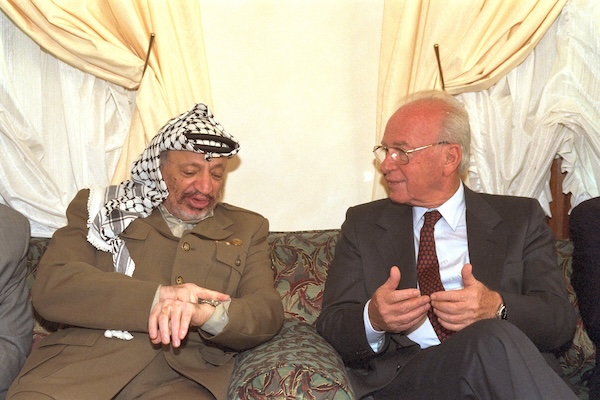
Prime Minister Yitzhak Rabin meets in Casablanca with PLO Chairman Yasser Arafat, 1994. (photo from flickr.com/photos/government_press_office/6324960139)

With all the darkness surrounding us since Oct 7, since the shattering of that tranquil Shabbat, have the people of Israel witnessed a miracle?

When Israel’s guard was fully down, when the south was under a vicious blitzkrieg by the monstrous Hamas, why did Hezbollah – with their 150,000 missiles pointed towards Israel – not exploit this excellent opportunity to open a second front? When Israel was existentially exposed, Hezbollah chose not to respond, at least not in any real-time, meaningful way. Complex geopolitical and military and conspiracy theories abound, attempting to explain why and why not. Pundits speculate and postulate and surmise. But maybe, just maybe, at some very esoteric level, the simplest and most logical answer, according to my close friend, a rabbi: it was a modern-day miracle. Pftt, pftt, pftt, as my great-grandmother would add.

***

The lights! Growing up, I was conditioned to shut the lights when leaving a room. I attempted to teach the same to my kids – and to my wife, although sometimes it seems she opens the lights when leaving a room. And then the missile sirens go off. Whoa! Slow it down. We have 90 seconds. Certainly time enough to shut the lights when racing to our shelter. My shouts muted by the screeching of the red alert, “Lights! Lights! Shut the lights!” I yell. To no avail, of course.

***

The day after … too soon to start thinking about it? That is where discussions about the war ultimately end up, each of us with our own theory, our own concerns, our own hopes. Once Israel achieves victory, in whatever form that takes, Gaza must then be rebuilt. But first it must be deradicalized – no more Hamas. Demilitarized – no more bombs hidden in schools, mosques and hospitals. And democratized – according to Winston Churchill, it’s the worst form of government … except for all others.

For this to succeed, Gaza should be divided into three cantons, similar to Germany, post-Second World War, each managed by a strong, Western or westward-looking country with enlightened self-interest for a stable and less radical Middle East. Maybe the United States. Maybe Britain. Maybe Germany. Maybe Egypt or Jordan. Escorted by a massive 21st-century Marshall-like plan. Maybe the Blinken Plan. Channeling the equivalent of $15 billion in 1948 purchasing power, that’s $191,569,917,012.48. OK, not that much, as the Gaza Strip is tiny compared to Germany, but enough funds to restore its economic infrastructure, to rebuild the Strip and rehabilitate its citizens, and make Gaza the Singapore of the Middle East – shipping, tourism, industry, maybe even offshore natural gas – like it could have become in 2005, when Israel fully withdrew. But then, what do I know.

***

Well before the day after, we need to take care of the Israeli hostages, including babies, children and octogenarians, both those still held in unknown condition by Hamas and other terrorists in Gaza, and those who have been returned. Interesting, but not necessarily surprising, is that neither the United Nations General Assembly nor UNICEF nor even the Red Cross demanded their unconditional release. Let alone a humanitarian visit.

As related by Liat Collins of the Jerusalem Post, Guelah Cohen – a 1980s right-wing parliamentarian, 2003 Israel Prize winner and mother of current senior Lukid lawmaker Tzachi Hanegbi – summarized this tragic situation best. Back during the First Lebanon War, when Tzachi was a combat solder, Cohen was asked what she would do if he were taken prisoner. She thoughtfully responded that, as a mother, she would be outside leading the protests to bring her son home, shouting with a megaphone outside the Prime Minister’s Office for the government to do anything and everything in its power to achieve his release. But, as a member of the government, she would be sitting quietly in the Prime Minister’s Office, advising him not to listen to the public. 

Prime Minister Yitzhak Rabin, during the controversial days of the 1993 Oslo Peace Accords process and accompanying Palestinian terror, said, “We must fight terrorism as if there’s no peace process and work for peace as if there’s no terror.” How utterly profound.

So, with the tragic circumstances of the hostages, the government must listen to the cries of the hostages’ families. But they also must lead and not be swayed by public opinion. The government must fight the war on Hamas as if there were no hostages and must, at the same time, bring all the hostages home. Alive.

***

As for economic recovery, I share a very micro, personal anecdote. About 18 months ago, we redid our condo, buying much of our furniture from BaKatzer, a wonderful and unique boutique furniture store located in a moshav (agricultural community) just outside the Gaza periphery, not too far from Ashkelon, which receives the brunt of the rockets from Gaza. While not the easiest of customers – I can be very demanding on price and service – I recently sent the owner a WhatsApp message. “Hey!” I wrote. “Hope all is well during these difficult times and hope to be back soon for more shopping.” Given my unforgiving consumerism, maybe she saw that as another threat. Alas, I can also be a very loyal consumer.

***

And there we were, my wife and I sitting around our Shabbat table with my daughter and her best friends, one with a brother who is a paratrooper and fighting in Gaza, the other an intelligence officer whose service was just extended, and still another, who was on a weekend leave from his Golani unit stationed up north. The conversation quickly moving from the trivial and benign to questioning and 

responding to issues and concerns that should be far away from them, that should not trouble the young minds of these 20-somethings, who should not deal with the complexities of miracles and hostages and day-after theories. Alas, there we were, talking of war and survival, looking hopefully to tomorrow. Am Israel chai. 

Bruce Brown is a Canadian and an Israeli. He made aliyah … a long time ago. He works in Israel’s high-tech sector by day and, in spurts, is a somewhat inspired writer by night. Brown is the winner of the 2019 AJPA Rockower Award for excellence in writing, and wrote the 1998 satire An Israeli is…. Brown reflects on life in Israel – political, social, economic and personal.
From poems to songs

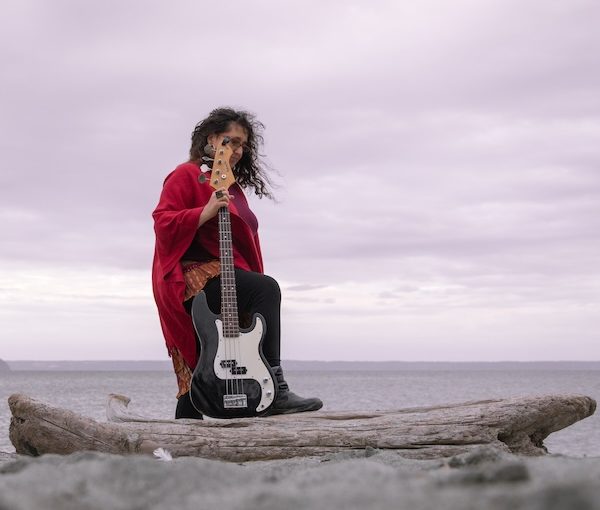
Loolwa Khazzoom (photo by Moriel O’Connor)

“Dear Hostages, as the world rallies to celebrate your desecration I will not forsake you,” begins the poem written by Seattle-based multimedia artist and educator Loolwa Khazzoom. Posted on her Facebook page, with a #BringThemHomeNow poster featuring photos of Israelis kidnapped on Oct. 7, it continues, “My instinct is to deprive myself of oxygen / Because you are underground / And I will not forget you // But I know that you would dance / In the sun / If given the chance / So I now rise up / And dance for you.”

Many of Khazzoom’s songs begin as poems. In this case, she told the Independent, “I felt as if I could not breathe and as if I did not even want to breathe, out of solidarity with the hostages and with all of Israel, in particular, all the victims of the Oct. 7 massacre. It’s like I wanted to physically feel their pain and suffering, as a way of physically demonstrating that I would not forsake them or forget them.”

In a traumatized mental state, Khazzoom returned to the “healing tools of poetry and music,” which was another way she could show her solidarity and do her part in keeping the issue of the hostages in front of people.

Similarly, Khazzoom and her band, Iraqis in Pajamas, recently released another poem-turned-song, “#MahsaAmini.” They did so this past Sept. 16, the first anniversary of the death of 22-year-old Mahsa Amini at the hands of Iranian “morality police.”

Finding out about Amini’s murder soon after it took place, from TikTok videos posted by Iranian women, Khazzoom “jumped into action.” She wrote to her political representatives, raised funds for United 4 Iran and reposted Iranian women’s videos on her feed constantly, to help boost the content’s views. “In addition,” she said, “a day after I found out about what happened, a poem with my feelings poured out of me, and I posted it on social media. Months later, I put that poem to a melody, and the band developed it into a full band song, which we released on the [anniversary of the] day of Amini’s murder.”

The death affected Khazzoom deeply for many reasons.

“First, the women in my family wore the abaya, the Iraqi equivalent of the hijab – Jewish women throughout the region were subject to Muslim dress codes, so it’s a Jewish issue, too,” she said. “Second, so many people assume that Islam is indigenous throughout the Middle East and North Africa, but it’s not. Arab Muslims rose up from the Arabian Peninsula and conquered the entire region, forcibly converting masses under the threat of death. So many indigenous ethnicities and religions predated the Muslim conquest, including Jews, Persians, Berbers and Kurds. The Iranian women protesting and burning their hijabs felt to me like challenging that Muslim conquest and awakening the ancient Persian warriors. Third, Persia is central to Jewish history and the origins of the Mizrahi community, dating back nearly three millennia ago…. And, lastly, the fire of these women, and the men who joined them, and their willingness to risk their lives for their dignity and freedom was just breathtaking and profoundly inspirational.”

Another of Iraqis in Pajamas’ releases this year was also intensely personal for Khazzoom.

“I wrote ‘The Convert’s Quest’ in response to some friends on social media sharing how hurt they were, coming under attack during the process of their conversion to Judaism. I had ample experience witnessing variations on this theme throughout my life – both first-person, seeing it happen to friends, and through my research as a Jewish multicultural educator. For decades, I felt very disturbed by this seemingly growing trend.

“I am the daughter of a Jew by choice, as my mother called herself, so the matter of conversion to Judaism is very personal for me,” she said. “I remember understanding very clearly as an Orthodox Jewish child that, according to halachah (Jewish law), once you convert, you are no longer to be called ‘a convert,’ but rather, a Jew, period. So, even from a religious Jewish perspective itself, I was very distraught by the ways that Jewish leaders and communities were rejecting or harassing converts, or even all-out forbidding people from converting. It all flies in the face of Jewish history, theology and practice.”

The band released “The Convert’s Quest” on May 24, on the harvest holiday of Shavuot, which celebrates the giving of the Torah to the Jewish people and on which the Book of Ruth is read. It tells the story of Ruth, a Moabite woman who converted to Judaism, whom Jewish tradition teaches will be the ancestor of the Messiah.

“To me, Jewish converts are the lifeblood of the Jewish people,” said Khazzoom. “I have a provocative line in my song, saying that converts are ‘the most Jewish Jews of all,’ because they are intentionally and consciously practising the foundational precepts of Judaism, which so many either take for granted or do rote, as is often the case in the Orthodox Jewish world where I was raised. In addition, amidst life-threatening levels of racism and violence against Jews, converts choose Judaism…. Why would we reject, in any way, from subtle to blatant, someone with such a heroic Jewish soul?”

Even when delivered in a playful manner, Khazzoom’s song are serious to the core. The campy “Kitchen Pirate,” for example, “emerged from my choice to reject the conventional option of surgery, in the wake of a cancer diagnosis in 2010,” she said. “Instead, I chose to radically alter my diet and lifestyle. Simply by overhauling my diet, I cold-stopped the growth of the nodules, which remained stable for the next five years – neither growing nor shrinking – until I returned to my lost-love of music, following which they began shrinking.”

Khazzoom said her songs “are always questioning, always challenging, always defiant. Sometimes, it’s more explicit, other times it’s embedded in silliness, which, parenthetically, I also see as defiant. I am and forever will be a curious, playful and awe-inspired child. I think that, if and when we ‘outgrow’ that, we die inside. And I refuse to capitulate to that norm of expected behaviour once we enter adulthood. By way of example, to this day, at age 54, when I am flying in a plane, if there is nobody sitting next to me, I will stretch out my arms and pretend I’m a bird, during takeoff.”

Not everyone has appreciated this aspect of her personality. “I have constantly gotten into trouble for it and have been at odds with my family, my community and society at large,” said Khazzoom. “I have endured terrible loneliness and often even self-doubt as a result. But I always come back to my core. And all of my songs emerge from that place – that raw, gut-wrenching place of being fiercely alive and allowing the clash with everything around me, and then writing about it.”

It is this enthusiasm that Victoria-based band member Mike Deeth enjoys about being in Iraqis in Pajamas, whose third member is Chris Belin.

“Loolwa and Chris are both easy-going, creative people. The energy is very positive, which makes collaborating with them fun and organic,” Deeth told the Independent. “Further, I appreciate the passion Loolwa has for the subject matter she writes about. One thing I always struggled with as a musician is ‘What do I have to say?’ At the end of the day, I’m a privileged guy who has never had to face oppression, hate, war or genocide. I have a lot of respect for artists who have experienced darker parts of humanity and have the courage to bring that perspective into their art.”

Born in Toronto, Deeth, who is not Jewish, spent most of his adolescence in Calgary, and moved to Vancouver Island when he was 18. He first picked up a guitar a few years earlier and has been playing ever since. “I was in my first band at 18 and played in bands throughout my 20s. For the past several years, I have been mainly focused on recording,” he said.

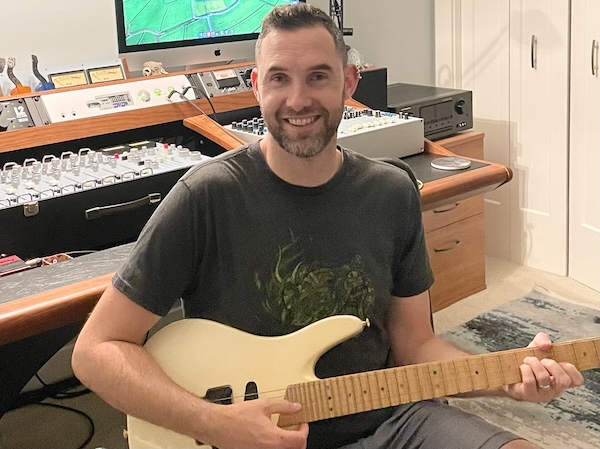
photo - Mike Deeth
Mike Deeth (photo from Mike Deeth)

Deeth got hooked on music production in his teens, getting his first digital recorder at age 16. “I still remember pulling all-nighters with friends trying to write songs and get ideas down on tape. Production was always fascinating to me, as I could layer parts together into something bigger than I could ever play on my own.”

Deeth and Khazzoom met a couple of years ago through a Craigslist posting. “She was looking for a guitarist to contribute to an early version of her track ‘The Convert’s Quest,’” he explained, complimenting Khazzoom on the fact that she “puts her full heart into her songs.”

“I recorded some initial guitar demos and, about a year later, we reconnected and worked up the current releases,” he said.

Deeth adds guitar to the songs and completes the mix and master of the songs when they are ready for those steps. Khazzoom sings, writes and plays bass, while Belin – who lives in Pennsylvania – composes the drum parts and performs them.

Among his other music ventures, Deeth has “played the guitar with Bryce Allan, a country musician here on the island, and recorded a few tracks with him. I also work closely with Jennie Tuttle, another musician from Victoria. We have been recording together for seven or eight years now.”

For Deeth, “recording is such an interesting combination of art and science. I get to be musically creative, but I also get to play with cool machines, solve problems and think about gain staging, compression ratios and other technical aspects. I thoroughly enjoy both the artistic and scientific parts of the process – they work my mind in different ways.

“I also love how each project starts as a blank canvas and ends with a new piece of music out in the world. There are an almost infinite number of possibilities when recording a track (all the possible settings on the equipment, the subtleties of different instruments) and it always fascinates me how each song takes shape during the process.”

“Mike has an exquisite sensitivity in his musical composition, performance and recording,” said Khazzoom. “He’s not only super-talented and -skilled, but he’s warm, upbeat, enthusiastic and professional. It’s a joy to create music with him. As is the case with our drummer Chris Belin, Mike has an uncanny ability to capture the essence of the songs I write, to the point that I feel he is playing back to me the sound of my soul. I have literally sat and cried after hearing the mixes.”

For more on Khazzoom, visit khazzoom.com. For more on Deeth’s production and sound services, visit glowingwires.com. 

Students to learn of Holocaust

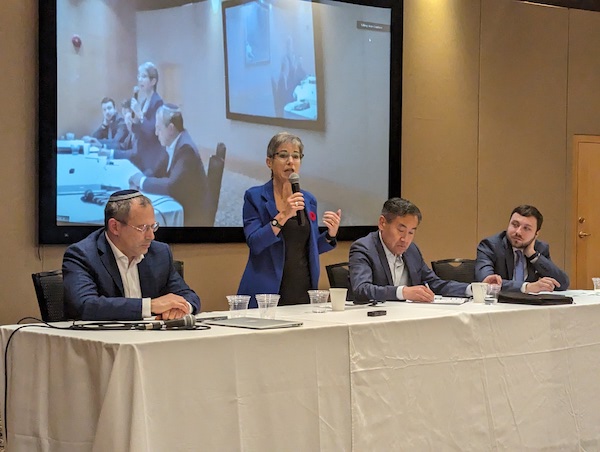
BC cabinet minister Selina Robinson speaks Nov. 5 at Schara Tzedeck Synagogue. Other panelists at the B’nai Brith Canada event that day were, left to right, Schara Tzedeck’s Rabbi Andrew Rosenblatt, BC United MLA Michael Lee and Aron Csaplaros, BC regional manager for B’nai Brith. (photo by Pat Johnson)

British Columbia is to become only the second province in Canada to mandate Holocaust education in the school curriculum. In a surprise announcement at the Jewish Community Centre of Greater Vancouver on Oct. 30, BC Premier David Eby was flanked by Jewish community leaders and survivors of the Holocaust when he said that Grade 10 students will be required to learn about the Holocaust, beginning in the 2025-26 school year.

Until now, it was possible for a student to graduate from the school system in British Columbia without ever having encountered the subject. Teachers have discretion to include the Holocaust in social studies classes and an elective on genocide is available in some schools, but there was no universally mandated requirement for learning about the Shoah. Ontario recently instituted mandatory Holocaust education at the Grade 6 level, becoming the first province in the country to make the subject compulsory.

Speaking at an event on Nov. 5, BC cabinet minister Selina Robinson recounted how the milestone decision unfolded. She credits former BC education minister (now minister of transportation and infrastructure) Rob Fleming with launching the idea in 2018. Fleming came to Robinson and asked if she knew that Holocaust education was not mandatory.

“Just like many, many others, I was surprised to learn that,” said Robinson. “He started the ball rolling.”

The COVID pandemic derailed the plans, as educators and administrators struggled to simply deliver learning to kids.

It was while reading Vancouver author Marsha Lederman’s book Kiss the Red Stairs that Robinson, who is the province’s minister of post-secondary education and future skills, wondered what had happened with Fleming’s idea.

“So, I picked up the phone and I called Rachna [Singh, the current minister of education] and then I called Rob Fleming and then I called a couple of my other colleagues who had an interest in seeing this move forward,” she recounted. “And then I called the premier and I said, David, this project that we started is moving at a snail’s pace and this needs to get done. We cannot wait any longer. I want to give kudos to our premier, to David Eby. He said, I’m on it.”

Robinson was speaking at Schara Tzedeck Synagogue on Sunday as part of a panel on antisemitism and Holocaust education organized by B’nai Brith Canada. Numerous members of the legislature, as well as mayors, councilors and school trustees from around the province joined the event virtually. Robinson’s fellow panelists were BC United MLA Michael Lee and Schara Tzedeck’s Rabbi Andrew Rosenblatt. Aron Csaplaros, BC regional manager for B’nai Brith Canada, moderated, with senior leaders from B’nai Brith beaming in from Eastern Canada.

From Robinson’s post-COVID jumpstarting of the Holocaust education planning, things leapt forward, she said.

“It really moved, I would say, from June until probably the beginning of September, at lightning speed – and anyone who’s ever had to work with government knows that nothing ever moves at lightning speed,” Robinson said. “So, I want to give kudos to our partners at the Vancouver Holocaust Education Centre and CIJA [the Centre for Israel and Jewish Affairs] and [the Jewish Federation of Greater Vancouver] for coming together and working in partnership. I know that B’nai Brith is new on the scene [in BC] and this is a very important piece, but I also think it’s really important to recognize those that have been working … for a number of years to make this happen.”

The timing of the announcement, in the weeks after the Oct. 7 terror attacks in Israel and in the midst of a massive spike in antisemitism worldwide, was coincidental. The issues, though, are related.

Robinson said the provincial government has been vigilant in monitoring antisemitism and potential for violence in British Columbia. She credited Minister of Public Safety and Solicitor General Mike Farnworth for spearheading the response.

“He called me every single day from Oct. 7 for about 10 days, to report in to me about what was happening on the ground,” she said. In addition to her official role with advanced education, Robinson said she is known among colleagues as “the Jew in the crew,” as the provincial elected official who is most publicly visible in her Jewishness.

On Nov. 1, Robinson convened a meeting of the heads of the 25 post-secondary institutions in the province.

“I got agreement from all 25 presidents that they would do everything within their power to make sure that everyone felt safe on their campuses,” she said. “I don’t think solving that is going to be an easy task, but it’s absolutely a requirement of all of them, because, in this province and in this country, we believe that everybody has the right to be who they are and to feel safe and, if it’s not happening, then we need to fix it.”

A bipartisan love-in that has been going on between Robinson and Lee, who represents Vancouver-Langara (the provincial constituency that includes many of Vancouver’s Jewish institutions and residents), continued Sunday in the obvious respect and affection between the two MLAs despite party lines. Lee made the news last week after rising in the house to give a personal tribute to Robinson’s strength as a leader who is Jewish in this challenging time and Robinson reciprocated kind words at the B’nai Brith event.

“Michael Lee has been a steadfast supporter, not just in this particular situation,” she said. “But also [to me] as a Jewish person who is having her own experience as a Jew around what is happening.”

Robinson spoke emotionally about the impacts of current events on her family, which includes her Israeli soon-to-be son-in-law, who became a permanent resident of Canada at the end of September.

Making Holocaust education a mandatory part of the province’s education curriculum has been a dream of the people at the Vancouver Holocaust Education Centre since the organization was founded, in 1994, according to Nina Krieger, the VHEC’s executive director.

“I think stars aligned and David Eby acknowledged Selina Robinson as being a key driving force in this initiative,” Krieger told the Independent.

A process of consultation will now begin and Krieger expects her agency will be central to that work, identifying and providing resources to help craft the new curriculum, which is likely to be a component of the Social Studies 10 learning outcomes.

“Certainly we bring a wealth of experience and a roster of programs and resources and best practices that will be relevant to the curriculum development process,” she said. “We are also poised to work with the minister of education to play whatever role is needed for that process. Also, we know the implementation and resource tools and training that teachers are going to need will be really important as well, so we’re looking forward to supporting the province and the teachers directly with that.”

The Jewish Federation and CIJA will continue to be engaged with the planning for mandatory Holocaust education. Both organizations issued statements after the announcement Oct. 30.

“When left unchecked, antisemitism culminates in some of the darkest chapters in human history. By learning from the Holocaust, we honour the memories of its victims and, we hope, contribute to preventing future tragedies,” said Ezra Shanken, Federation’s chief executive officer. “Today’s announcement shows the BC government’s commitment to creating a safer society for all.”

“Education is key to ensuring that our children learn to combat hate and that the Jewish community can live in a safer province,” said Nico Slobinsky, CIJA’s vice-president for the Pacific Region. “We look forward to working with the BC government on implementing mandatory Holocaust education in our province’s K-12 curriculum.”

At Sunday’s event, Marvin Rotrand, national director of B’nai Brith’s League of Human Rights, speaking virtually from Montreal, noted that 15 US states have some form of mandatory Holocaust education – and early indications from studies in those jurisdictions indicate a decrease in hate crimes not only toward Jews but other groups as well.

United against antisemitism

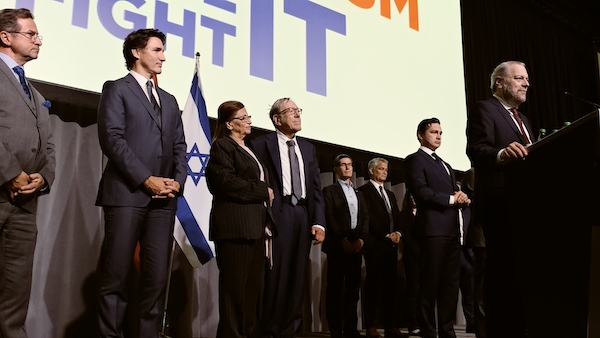
Among those on stage as Irwin Cotler received a lifetime achievement award from the Centre for Israel and Jewish Affairs last month were, left to right, Yves-François Blanchet (Bloc Quebecois leader), Prime Minister Justin Trudeau, Ariela and Irwin Cotler, David Posluns (one of the event co-chairs), Steven Kroft (one of the event co-chairs), Pierre Poilievre (Conservative Party leader) and Shimon Koffler Fogel (head of CIJA). (photo by Dave Gordon)

It was a conference months in the making, but Antisemitism: Face It, Fight It took on heightened poignancy in light of the Oct. 7 Hamas terror attacks on Israel and the subsequent spike in Jew-hatred globally.

Produced by Centre for Israel and Jewish Affairs (CIJA), the conference took place in Ottawa Oct. 16 and 17. Speakers included activists, politicians, experts and analysts on antisemitism. In attendance were 250 student leaders and some 600 others, Jews and non-Jews, according to organizers.

Shimon Koffler Fogel, chief executive officer of CIJA, noted there was an outpouring of support from the major political party leaders, as well as from minority, faith and other groups – “a uniform conclusion about Hamas and their actions, and we should embrace that.”

This message was echoed throughout the two days of the conference.

“It can’t just be Jews who talk about the rise of antisemitism. It can’t just be Muslims that talk about anti-Muslim hate,” said Farah Pandith, senior advisor to the Anti-Defamation League. “It can’t be. Whether we are talking about LGBTQ or issues of heritage or gender, we’ve had to stand up for each other. As a Muslim, it’s what my religion tells me I must do for the other.”

Former premier of Alberta Jason Kenney, who was elected as an MP in 1997, said he became a supporter of the Jewish people after the “unravelling of the Oslo process,” and learning of the antisemitism coming from Palestinian mosques and leaders.

“Do not take for granted the positions being expressed here in Ottawa today,” said Kenney. “You must redouble your efforts intelligently to build coalitions across the pluralism of this country, and to be a voice of clarity and courage with our political leadership.” Citing examples of possible coalitions, he told the JI that “the Jewish community has to continue to reach out to Muslim and other communities, find allies.”

“I know we can best tackle what we are seeing when we work together, when we are not siloed,” said Minister of Justice and Attorney General of Canada Arif Virani, an Ismaili Muslim, in his speech. “Hatred and intolerance against any minority community is a risk to every minority community. That’s why groups promoting equity have to have each other’s backs.”

Emily Schrader, digital strategist and senior correspondent of Ynet News, observed, “We see now that all over the world there are Iranians organizing and participating in rallies to support Israel … despite knowing that the Iranian regime is the biggest supporter of Hamas. The Iranian people have a complete rejection of the regime.”

Canadian human rights advocate Irwin Cotler received a lifetime achievement award from CIJA “in recognition of his enduring commitment to the pursuit of justice” and “the advancement of human rights for the world’s most vulnerable and oppressed.”

In his acceptance speech, Cotler applauded the multi-partisan groups standing up against antisemitism, “who heed this call to action, where we act in concert on behalf of our common humanity.”

Cotler was a parliamentarian from 1999 to 2015 and is a former minister of justice. Over the course of his legal career, he represented clients such as Natan Sharansky and Nelson Mandela. Until recently, he was the government’s special envoy on antisemitism. He said “2023 is not 1943” and “there is a Jewish state as an antidote to Jewish powerlessness.”

“In 1943,” he said, “the Jews could not get a meeting with the president of the United States, and, in 2023, the president has been a leader in calling out this [Hamas’s] moral evil.”

Cotler told the JI that young Jews should bravely step forward to “call out antisemitism when they see it, unmask it, expose it.”

Prime Minister Justin Trudeau called out Hamas as a “terrorist organization that launched an attack of unspeakable brutality” and said “Canada supports Israel’s right to defend itself in accordance with international law.” He said the only thing Hamas stands for is “more suffering for Israeli and Palestinian civilians.”

In addressing “scary rising antisemitism,” Trudeau said “families are worried about what they face if they go to synagogue, and I’m sure you are all seeing hateful rhetoric online.” He ended by saying, in Hebrew, “gam zu l’avor” – “this too shall pass.”

Opposition leader Pierre Poilievre, head of the Conservative Party, vowed that his party would stand with Israel, and acknowledged the fears of many Jewish Canadians. About Oct. 7, he said, “the terrorists that carried out this attack did so as part of a deliberate agenda: to maximize bloodshed not only of the Jewish people, but actually to maximize the bloodshed of Palestinians and Muslims as well. These are the actions of sadistic, criminal terrorists who can only be defeated and not negotiated with.”

Poilievre added that, especially in light of Iran’s fingerprints being on the attacks, governments must “respond with crippling sanctions – the strongest legal action – and by criminalizing the Islamic Revolutionary Guard Corps.”

Jagmeet Singh, leader of the New Democratic Party, said, “These are horrific attacks and we strongly condemn them. There is no place in our world for terrorism. The international community must work together to ensure that there is an end to terrorist organizations like Hamas and Hezbollah.”

Singh acknowledged that Jews in Canada are “deeply afraid” and “worried about their safety.”

“It’s wrong and I’m deeply sorry it’s happening,” he said.

In noting pro-Hamas rallies around the world, Singh said, “We’ve seen horrible celebrations for the attacks on Israelis civilians. This is abhorrent. This is antisemitism. Violence against civilians is never justified.”

He concluded: “I know that not everyone will agree with our position on a ceasefire, but I believe the only way to peace is to talk to each other.”

Historian and author Gil Troy encouraged the audience to not forget the courage of “our citizen’s army, our plainclothes commandos, our kibbutzim Rambos and our army,” who saved innocents from much worse.

“When I heard these stories, I shift[ed] from the victim mentality to the Zionist mentality. The Zionist is one that says ‘yes, we sometimes suffer,’ but we are not passive and we are not victims. The Zionist story says we are not alone. We can’t let them win.”

Calgary-based communications consultant Emile Scheffel, who is not-Jewish, told the JI: “History shows that those who threaten the Jewish people are enemies of freedom and dignity for the rest of us as well. I stand with Israel because the Jewish state embodies the values of freedom, democracy and pluralism that are important to me.”

He added, “the conference was an important call to action for non-Jews to stand with our Jewish friends and neighbours in opposing hatred and discrimination. A united front is essential to making sure that antisemitism doesn’t gain any more ground in Canada, and that Jewish Canadians can live in peace and security.”

Attendee Nika Jabiyeva, member of the Network of Azerbaijani Canadians, said she was proud to “stand against hate, shoulder to shoulder with our friends in the Jewish community and many multifaith allies.”

“Our voices carry more weight when we speak up for one another,” she said, “especially during trying times.”

Dave Gordon is a Toronto-based freelance writer whose work has appeared in more than 100 publications around the world. His website is davegordonwrites.com.

CJPAC bridges engagement

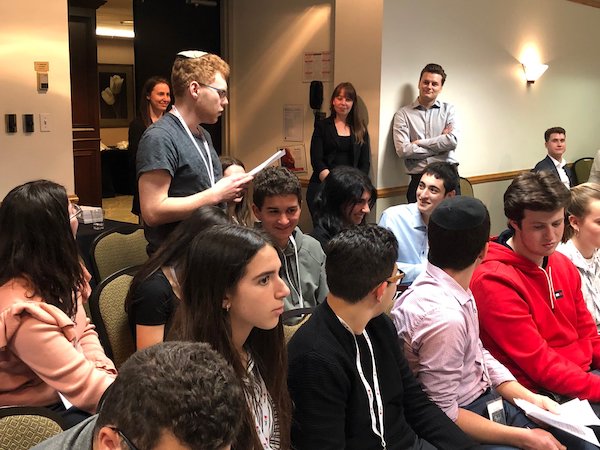
Avishai Infeld speaking during a mock question period at CJPAC’s Generation: Student Leaders Program. (photo from CJPAC)

When it comes to making a mark in Canadian politics, waiting for elections is a thing of the past. The Canadian Jewish Political Affairs Committee (CJPAC) is a bridge to meaningful political engagement, and the year 5784 is a perfect opportunity to jump in.

For Vancouverite Avishai Infeld, CJPAC kindled his political curiosity. “CJPAC ignited the spark of political interest that I long had,” he said.

Drawing from his participation in several CJPAC programs, Infeld added, “It showed me just how accessible yet valuable political engagement can be.”

CJPAC is a national, independent, multi-partisan organization with offices in British Columbia, Ontario and Quebec. It is committed to involving Jewish and pro-Israel Canadians in the democratic process.

“When you think ‘CJPAC,’ think volunteering and campaigning,” said Kara Mintzberg, CJPAC’s director for the B.C. region. “During elections, we’re like a political concierge. We help connect community members to candidates and campaigns of their choice.”

Yet, CJPAC’s role extends beyond elections, building relationships between politicians and the community year-round. The nonprofit also molds Canada’s future political leaders through innovative, hands-on programs.

Sarah Warsh, a product of CJPAC’s national Generation: Student Leaders Program, speaks highly of its transformative impact. “Growing up in Nanaimo, B.C., connecting with CJPAC was an invaluable experience,” she said.

Tailored for Jewish students in grades 10 through 12, the program features regular virtual and in-person sessions, cultivating political knowledge and skills. “Generation was the turnkey that immersed me into politics, multi-partisanship and the Jewish community,” said Warsh, who went on to participate in CJPAC’s flagship Fellowship Program for post-secondary students, where, each year, CJPAC equips 50 of Canada’s top, pro-Israel, politically engaged students with the tools to win campaigns.

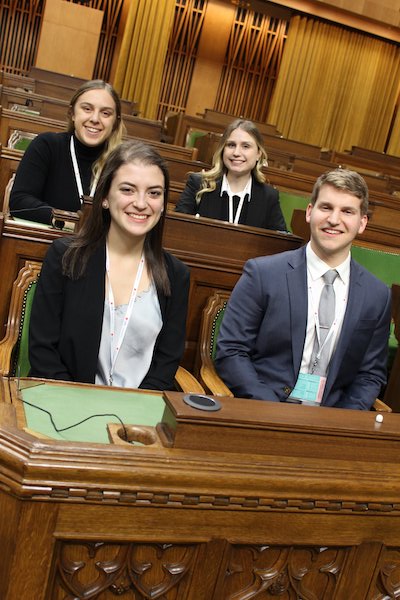
photo - Sarah Warsh (top left) in the House of Commons while participating in CJPAC’s Fellowship Program
Sarah Warsh (top left) in the House of Commons while participating in CJPAC’s Fellowship Program. (photo from CJPAC)

Since 2006, more than 500 of Canada’s brightest have graduated from the Fellowship Program, with more than one-third assuming roles in political offices across the country, including Warsh. She credited CJPAC for jumpstarting her career in a national political party, a federal political leader’s office and a premier’s office. “The decision to get involved with CJPAC was one of the best I’ve made,” she said.

Both programs send participants to Ottawa for multiple days to meet with politicians, strategists and staffers.

“Thanks to everything I gained from CJPAC,” said Infeld, “I have volunteered on campaigns in Canada, served on an MP’s youth council, and now work as the Hillel Montreal advocacy coordinator.”

For those acquainted with politically inclined students in high school or post-secondary education, applications for CJPAC’s Fellowship Program close Sept. 12, while the Generation program applications are due by Oct. 6.

But, even if you’re not a student or don’t know one, there’s still a chance to engage – attend CJPAC’s inaugural B.C. ACTION Party. Save the date for May 16, 2024, and get ready to celebrate political engagement with Jewish and political communities.

To learn more, visit cjpac.ca. For specific inquires, reach out to Mintzberg by email (kmintzberg@cjpac.ca) or phone (604-343-4126).

– Courtesy CJPAC

To give up is un-Israeli

Israelis might be among the world’s most resilient people. Across 75 years of constant war or threats of war, terrorism, geopolitical isolation and global political assault, the Israeli people have built one of the world’s strongest democracies and most powerful economies.

Faced with an endless succession of external existential threats, not to mention internal divisions, Israelis have fought hard to survive and build the sort of state that accommodates, however imperfectly, the diversity of Jewish (and non-Jewish) identities encompassed by the population.

This is now under threat. The current government’s efforts to chip away at democratic structures is a grievous concern. And the political disruption is having demonstrative economic impacts as well. The “startup nation” has seen investment nosedive this year. In the first half of 2023, private financing fell 29% from the previous six-month period and 67% from the same period a year earlier.

While the economic numbers are the most tangible measure of the dangers of political instability and skirmishes, an opinion poll number stands out as at least as grave. A survey last month indicated that 28% of Israelis are considering leaving the country.

A recent feature story about a colony of expat Israelis who have made Hebrew a common sound on the streets of Thailand cited affordability and a laid-back lifestyle as among the draws that have brought more than 100 families to the town of Ko Pha Ngan in the last year alone. These families joined hundreds of Israelis who had already set up homes there. The Times of Israel reports most migrants cite Israel’s “pressure cooker” atmosphere as a leading reason for their move. We get that. People deserve to live the lives they want.

What is more challenging to understand is Israelis who are motivated to quit the country because they don’t like its political direction. The same opinion poll that said more than a quarter of Israelis are considering emigration showed that the current government would be headed for (by Israeli standards) a decisive defeat if an election were held now. Shouldn’t that count for something?

A plurality of Israelis seems poised to oust the government (if given the chance) and yet, rather than seeing this poll as a harbinger of hope, the children and grandchildren of those who persevered against enormous and impossible odds to rebuild the Jewish homeland are ready to give up the fight. (And, of course, we mean “fight” figuratively. Despite the fact that 56% of Israelis worry about civil war, the institutions the current government is attacking, though battered, are still strong and should not yet be dismissed as ineffectual.) If 28% of Israelis left, you can bet that the government that most of them oppose and which led them to abandon their homeland would be reelected in a landslide and be given a free hand to remake the country in the image they want.

We are worried by the apparent depth and breadth of the hopelessness. But hundreds of thousands of Israelis not only wish to change the government, they are taking to the streets every single week for many months to register their disapproval. Many of these are people who have never before engaged in politics. If the current government is traveling down untrodden paths of autocracy and iniquity, it is not meaningless that an enormous movement is amassing in response, potentially laying the foundation for a future sea change.

A lesson from close to home might be instructive. In the 1980s, British Columbia’s Social Credit government instituted a “restraint program” inspired by Reaganomics and Thatcherism that led to mass marches in the streets. Hopelessness gave way to one of the biggest mass mobilizations in the province’s history, in the form of Operation Solidarity. Long story short, that opposition movement, in a sense, emerged into the movement that is now dominant and that has transformed the province, the New Democratic Party having won one of the biggest majority governments in history, in 2020. John Horgan, the former premier who led the New Democrats to that huge victory, was inspired to get involved in politics during that tumultuous earlier time.

Presumably, an entire new generation of Israeli leaders are likewise being forged in reaction to the current developments. Whether they have the impact that British Columbia’s opposition movement-cum-government has had depends on whether they turn this moment into a lasting movement.

If we can point to any reason to lose hope, it is less the direction of the current government than, on the other side, the loss of hope and determination itself. If the policies of the current government seem un-Israeli to many of us, it seems no less un-Israeli to look at an existential challenge and give up.

JI wins four Rockowers

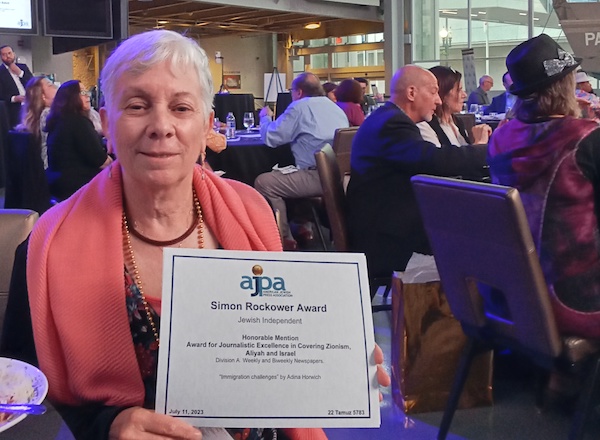
Adina Horwich at the 42nd annual Rockowers Awards. She received an honourable mention for journalistic excellence in covering Zionism, aliyah and Israel. (photo from Adina Horwich)

The Jewish Independent won four Simon Rockower Awards for Excellence in Jewish Journalism this year. The awards, which are given out by the American Jewish Press Association, were for work done in 2022. The JI has had a few Rockower hat tricks in its history, but this is the first time the paper has garnered four honours in one year.

The awards were presented on July 11 at the Higgins Hotel and Conference Centre in New Orleans, La., where the AJPA’s annual conference was held. The JI mainly competed in the division of weekly and biweekly newspapers, but there were some categories for which the competition was between all types of media (print and online); awards were given for first and second place, and sometimes honourable mention.

Writer Adina Horwich traveled from her home in Israel to New Orleans to receive her award in person. She won the JI an honourable mention for journalistic excellence in covering Zionism, aliyah and Israel for her article “Immigration challenges” (jewishindependent.ca/immigration-challenges-2). The piece both reviews Adi Barokas’s Hebrew-language graphic novel, The Journey to the Best Place on Earth (and Back), about Barokas’s experience trying to immigrate to Vancouver from Israel, and shares Horwich’s experience making aliyah from Canada. The jury commented: “Extremely readable story, that skilfully explores from a personal perspective the nitty gritty of making aliyah.”

The JI’s Pat Johnson also received an honourable mention – his article “Oasis in the Caucasus” (jewishindependent.ca/oasis-in-the-caucasus) garnered recognition for excellence in writing about Jewish heritage and Jewish peoplehood in Europe. The jury said about his piece:

“A terrific look into the Jewish community of Azerbaijan that most of us, unfortunately, don’t have on our ‘Must-Go Places to Visit.’ Pat Johnson’s very nice story strongly suggests otherwise. Johnson paints a wonderful picture of this tucked-away ‘shtetl’ where the residents say they have never faced antisemitism. If only we could feel so lucky here in the United States! And while most of us do well playing ‘Jewish geography,’ actual world geography is often more of a challenge. Having Johnson admit having to Google Azerbaijan before traveling there to report this story added a nice touch that connects with readers who may also be unfamiliar with the country – but now more knowledgeable thanks to this feature.”

Johnson was recognized for another of his articles, “Maus not too graphic” (jewishindependent.ca/maus-not-too-graphic), which placed second for excellence in education reporting. Johnson sat in on Anna-Mae Wiesenthal’s Holocaust and Genocide Studies class at King David High School, and listened as students discussed the graphic memoir Maus by Art Spiegelman.

“Lots of people laughed when a Tennessee school board pulled Maus from the curriculum because of the drawing of a naked cat. That was too much for board members and they banished the Pulitzer Prize-winning graphic novel,” wrote the Rockower jury. “Viewing the book through the eyes of five students at a Jewish high school subtly portrays the board decision’s absurdity.”

Rounding out the JI wins was a first place for excellence in editorial writing – where all entries competed in the same division. The JI editorial board of Johnson, Basya Laye and me were honoured for the set of editorials that included “Every person has a voice” (about Elon Musk, hatred and misinformation online, and how people can counter such forces), “Extremism not helpful” (about New Democratic Party leader Jagmeet Singh’s views on the Israeli-Palestinian conflict) and “New era in U.S. politics” (about the U.S. Supreme Court’s rejection of a woman’s right to reproductive self-determination, as well as the Jewish perspective on abortion).

About these editorials the Rockower jury wrote: “These pieces are good examples of what editorials should be – thoughtful examination of pressing issues, using clear reasoning in looking at both sides, then coming to a well-reasoned conclusion. Local tie-ins strengthen opinions.”

All of us at the JI appreciate the AJPA’s recognition of the hard work that goes into producing an independent Jewish newspaper, magazine or website, and we congratulate all of our colleagues on their achievements. For the full list of Rockower winners, visit ajpa.org.

The JI couldn’t do what we do without our subscribers, donors and advertisers – thank you for all your support. For readers who are thinking about subscribing, donating or advertising, please consider doing so to help us continue producing a high-quality, independent Jewish newspaper that connects community members from across the religious and political spectrums; covers lifecycle events and local, national and international news; and documents our community history as it happens. Visit jewishindependent.ca/support-the-ji, email cramsay@jewishindependent.ca or call 604-689-1520.

An unwelcome precedent

An Israeli cabinet minister visited Canada recently and, with due respect, some of our journalistic colleagues buried the lede.

In journo parlance, the “lede” is the most important and, therefore, first item mentioned in a conventional news story. To “bury the lede” is to (intentionally or unintentionally) downplay the most important thing that happened by talking about other things first.

This was the case when Amichai Chikli, Israel’s new minister for Diaspora affairs and combating antisemitism, visited Canada recently. Some of our colleagues reported on Chikli’s condemnations of Canada’s government for not following some other countries in moving our embassy to Jerusalem from Tel Aviv and commended the Conservative party for “unwavering support for Israel and Jerusalem.” The minister’s abandonment of international diplomatic protocols appeared lower in the coverage.

It seems to us that there is a bigger story than an Israeli pol backslapping overseas allies and criticizing the government in power – although that is not unrelated from the bigger problem here. The main thing – the lede, as it were – is that an Israeli government minister came to Canada, sidestepped conventional protocols around meeting with commensurate-level officials, hung out instead with an ad hoc group of mostly opposition members of Parliament, spoke to an evangelical Christian audience and then scooted back to the Middle East.

Canada and Israel have deep, historic bilateral bonds. The Jewish community in Canada is tied to Israel emotionally, spiritually and familially. There have been diplomatic disagreements between our governments – and, indeed, there are some very basic divergences right now between Canadian Jews and what is happening in the Jewish state – but there are ways that things are done. And there are ways that things are just not done.

For four years, what many people view as the highest political office in the world was held by a man who betrayed every diplomatic nicety and convention imaginable. It may be that, among the countless ways the former U.S. president’s smashing of standards has lowered the collective bar, an Israeli politician sees it as acceptable to barge into Canada and behave as though he is a free agent rather than an official representative of the Israeli people. Canadians should not see it as acceptable. Canadian Jews should be particularly concerned.

An elected official who is not a member of a cabinet is free to travel to foreign lands and meet with ideological cohorts. A member of the government is expected to represent his (or her) country, not their own narrow interests.

The Canadian group that hosted Chikli – a new entity called the Israel Allies Caucus – is also to blame. Apparently operating outside the more formalized parameters of the longstanding official Canada Israel Interparliamentary Group, the new body appears to be made up of evangelical Christians and political conservatives, and it is abandoning protocols in favour of its own agenda. This should be particularly concerning to Canadian Jews who care about our country’s relations with Israel, as well as being overshadowed by groups that may not represent our interests.

Presumably, the new group views Canada’s official approach to Israel as not the right kind of support – but the specifics of government policy are not the biggest issue here.

Let us not forget that there are activists in Canada who recently tried to prevent former Israeli prime minister Naftali Bennett from entering Canada, accusing him of being a “war criminal.” Other voices, critical of policies of the current government, want to ban representatives of that government based on political disagreements.

Diplomatic protocols exist to create a space where representatives of countries can keep lines of communication open even when we have grievous disagreements, as we do, for example, with the worst human rights violators in the world. Indeed, Canada has carved out a role in the world as a “soft power” that uses words, rather than weapons, to bring sparring parties closer together.

If we diverge from diplomatic protocols and allow activists on any side to subvert these carefully constructed channels of communication, we risk further politicizing issues that should be above politics. More to the point, making Canada’s relations with Israel a political football is to risk long-term gain for someone’s perception of short-term gain. It may have made partisan ideological activists feel good to shmooze with an Israeli cabinet minister. It will feel less good for all concerned when policies that strengthen the Canadian-Israeli bond become viewed through a prism of which Canadian political parties benefit from their adoption.

Further, if we accept, from apparently “pro-Israel” activist MPs, a flouting of protocol, we will be hard pressed to complain when MPs host other overseas visitors we might view as troubling. If an opposition MP invites an Israeli, Palestinian or other speaker that many or most Canadian Jews view as deeply problematic and rolls out the red carpet on Parliament Hill as the Israel Allies Caucus did for Chikli, we will have no moral pedestal from which to complain.

Chikli should have known better. Higher-ups in his government should dress him down for his breach of protocol. But it was the leader of his government – the prime minister of Israel – who first and most egregiously breached such protocols, accepting an invitation several years ago from the U.S. Congress, rather than the U.S. president. (Of course, it was the Congress that broke the protocol first by extending the invitation, so we are addressing a larger pattern of inappropriate behaviour.) But Canadian Jews, even – perhaps especially – those who most enthusiastically welcomed Chikli, his undiplomatic behaviour and his impolitic remarks (whether we agreed with them or not!), should be aware of the unwelcome precedent they may have set.

A family metaphor

As British Columbia’s Jewish community and friends come together Sunday to celebrate Israel’s 75th anniversary – a concert at the Queen Elizabeth Theatre, capping a multitude of celebratory events over the span of weeks – no one doubts that this moment is unlike any in the short history of the state, or in the relations between the Jewish state and the Diaspora.

The General Assembly of the Jewish Federations of North America took place recently in Tel Aviv and the news service JNS headline noted modestly: “Jewish Federations’ annual conference becomes embroiled in political battles.”

It is true that the umbrella of the Federation system has generally tried to steer clear of internal Israeli politics. This is part of a larger family dynamic in which the instruments of the Diaspora are expected to not rattle the cage of Israel and Israeli officials are expected to retain a level of polite distance in commenting on Diaspora affairs. This separation has always been porous, especially when it comes to issues that directly affect Diaspora Jews, such as recognition of non-Orthodox conversions, egalitarian prayer at the Kotel and similar matters. But fears that proposed judicial reforms, and other plans of the new governing coalition, will alter the fundamental democratic DNA of the state have lowered the bar for engagement by overseas mishpachah. Indeed, weekly demonstrations in cities across North America and Europe, including in Vancouver, by the group UnXeptable represent a new wrinkle in the stay-in-your-lane status quo.

It is interesting how little criticism we have heard of this phenomenon. Time was, such behaviour would have been seen as “airing dirty laundry in public.” Israel (and Jews) have enough people criticizing them that we don’t need to add to the pile-on ourselves, the thinking has tended to go. It may be a sign of the widespread revulsion to the proposed judicial reforms themselves that have eclipsed this long-held reluctance to publicly criticize. Or it may be something more fundamental. Perhaps Diaspora Jews and Israelis are now engaging on a more equal footing.

Of course, we should not overstate our influence. Like buttinsky in-laws, we may significantly overestimate the weight of our interventions. Israeli officials have long chided overseas critics for their uninvited advice. And indications are that average Israelis don’t think a great deal about us at all.

Michael Steinhardt, the American philanthropist who cofounded the Birthright Israel program, wrote in the online journal Sapir recently that we may be seeing a complete inversion of the Israel-Diaspora relationship. The paradigm since 1948 has been that the Diaspora’s role is to “build” and “save” Israel.

“Israel is doing just fine,” Steinhardt writes. “We non-Orthodox Diaspora Jews, on the other hand, are not. ‘Supporting Israel’ has become a kind of narcotic, giving us a sense of self-worth and achievement that allows us to ignore the tempest that has put our own future in doubt.”

While Israel still faces challenges, Steinhardt seems to argue that it has evolved to a point where it can handle them on their own. At the risk of taking the family symbolism to its extreme, Diaspora Jews may be behaving like empty-nesters, their role now diminished, struggling to find a new identity.

He specifically cites assimilation, disengagement from Jewish life, declining Jewish education and synagogue attendance, which was already in decline before being pummeled by the pandemic.

“And then there’s the increasing pressure of antisemitism on campuses, city streets, and in public institutions,” writes Steinhardt. “Taken together, these constitute a well-documented existential threat to Diaspora Jewry that is far more immediate and profound than anything Israel faces today.”

It may be hyperbole to suggest that these crises facing the Diaspora, however serious, are “far more immediate and profound” than Iran’s nuclear ambitions, continuing terrorism or, perhaps, even the self-inflicted divisions caused by overreach by the new government. But it deserves discussion.

When our family members grow up (there really is no end to the metaphor), we do not give up supporting them. We continue to offer advice and wisdom – whether they want it or not.

And perhaps this is the correct lesson from the metaphor: when the once-dependent member of the family reaches a level of maturity that they can engage in an equal footing with the rest of the kinfolk, the dynamic rightly changes to a discussion between equals, in which either side is freer to offer criticism and advice, and both sides are free to take or reject it.

Surely we can all agree on this: when you reach 75, you ain’t no kid.

Risk … game vs. reality

Playing the game of Risk. (photo © Jorge Royan)

I’ve always thought of the Nordic region as peaceful. Admittedly, my knowledge of the area is largely limited to Risk, the board game, where Greenland, Iceland and the Scandinavian countries are considered a haven, free of imminent attack from the throw of a dice.

Well, Finland just purchased Israel’s David’s Sling defensive system. For $345 million US. It was one of Finland’s first moves after recently being accepted into the North Atlantic Treaty Organization. And it was the first sale abroad for David’s Sling, an integrated part of Israel’s multi-tier missile defence system. Israel now carries the title of major supplier to NATO.

I guess the world’s a bit more complicated than Risk.

*** 

So long, Noa Tishby, the Israeli performer appointed by our previous prime minister, Yari Lapid, to advocate for Israel through her strong social media presence. With the formal and former title of special envoy for combating antisemitism and delegitimization of Israel – fit that onto a business card! – she was known for sparring with BDS advocate Bella Hadid and others. Tishby was also a vocal supporter of Israel’s anti-judicial reform movement. Giving voice to the many thousands protesting the current government and its extreme shift rightward and into sometimes theocratic territory, Tishby says this was the reason for her dismissal. Well, ya. As the hawkish Jerusalem Post editorialist Ruthi Blum noted, “Tisbhy is free to share [her opinion]. But she shouldn’t have expected the government she’s been bashing to keep her as a representative.” Well, no. But keep on truckin’ Noa Tishby.

BTW, Tishby will be a guest at the JNF Negev event in Vancouver on June 29.

***

Israel’s Tel Aviv Museum of Art is again among the world’s 100 most visited museums. This according to international art magazine The Art Newspaper. TAMA was ranked 49th in 2022, a jump from its 56th place the year prior. I am fortunate to be one of those visitors, on multiple occasions, over the past many years, often dragging my two children there when they were younger – how fun was that!

Paris’s Louvre and the Vatican Museum took first and second place, respectively. Canada was represented with a 60th place win by Toronto’s Royal Ontario Museum.

***

Congratulations Milk & Honey, Israel’s preeminent whisky distiller, awarded the 2023 world’s best single malt whisky by the World Drink’s Awards for its Elements, Sherry Cask drink. Described as “[f]ruity aromas of citrus zest and white peach with a dash of wood varnish. Sweet to the taste … with flavours of golden syrup, vanilla, tropical fruit and iced tea.…” Sounds like a palate pleaser to me. But, if I had to choose, my favourite would be Seagram’s Five Star rye whisky. Not so much for its taste but for fond memories of fighting with my siblings for the silver sheriff’s star glued to the bottles.

***

Jerusalem was selected by Time magazine as one of the world’s 2023 top 50 destinations, holding the 48th spot. It’s one of my favourite places to visit on a bustling Friday, starting with a walk through the overcrowded neighbourhood of Mea She’arim and enjoying a freshly baked challah. Then, bargaining my way through the Old City’s Arab Market, its tastes, smells and sights, and eventually making my way to the Western Wall, with the golden Dome of the Rock overhead. Ending with lunch at Machane Yehuda, the popular central Jerusalem food market, which has the freshest of meats and vegetables, and many colourful stalls.

Not to be outdone, Canada held two spots. Churchill was third – can’t beat those Northern Light spectaculars. Vancouver was 38th, for its eclectic cuisine and the beautiful Stanley Park.

***

For sure, difficult days in Israel. Sociopolitical cultures are clashing internally. External enemies are looking on with glee, and testing us. But we’re not sinking into despair. Israel has experienced difficult times before and emerged stronger and wiser. So it will be this time.

Arguably, we are being governed by the worst government in our short history – for many reasons, including recent security challenges. I mean, come on, with someone as inexperienced and reactionary as Itamar Ben-Gvir as national internal security minister. Or Finance Minister Bezalel Smotrich spouting off on things about which he should know better and doesn’t. But let’s not blame the victims for the terror and rockets. Hezbollah, Hamas, Iran, an inept Palestinian leadership with a hateful street – they are to blame, not the government.

Usually, it’s the right-wing governments that muster support for the very difficult realpolitik choices, from Menachem Begin’s 1982 Sinai exit to Ariel Sharon’s 2005 Gaza disengagement. Even Binyamin Netanyahu’s 2021 peace deals with several Arab countries under the Abraham Accords. Unfortunately, Netanyahu’s current government may be too inexperienced and messianic to enable reasonable, democratic, liberal change – read judicial reform – at such a scale. But who knows.

We cannot despair. At a very esoteric level, Israelis have hope. In fact, hope is the theme of our national anthem, Hatikvah, The Hope.

***

According to the World Happiness Report, published by the Sustainable Development Solutions Network, Israel remains one of the happiest countries in the world. (See jewishindependent.ca/measuring-happiness.) Rising to fourth place in 2023, just behind Finland, Denmark and Iceland, Israel’s showing likely reflected its reputation as a “villa in the jungle,” as dubbed by former prime minister Ehud Barak – despite being in the Middle East, one of the most contentious spots … on the Risk board.

Bruce Brown is a Canadian and an Israeli. He made aliyah … a long time ago. He works in Israel’s high-tech sector by day and, in spurts, is a somewhat inspired writer by night. Brown is the winner of the 2019 AJPA Rockower Award for excellence in writing, and wrote the 1998 satire An Israeli is…. Brown reflects on life in Israel – political, social, economic and personal.