Skip to content
  • Home
  • Subscribe / donate
  • Events calendar
  • Business Directory
  • FAQ
  • News
    • Local
    • National
    • Israel
    • World
    • עניין בחדשות
      A roundup of news in Canada and further afield, in Hebrew.
  • Opinion
    • From the JI
    • Op-Ed
  • Arts & Culture
    • Performing Arts
    • Music
    • Books
    • Visual Arts
    • TV & Film
  • Life
    • Celebrating the Holidays
    • Travel
    • The Daily Snooze
      Cartoons by Jacob Samuel
    • Mystery Photo
      Help the JI and JMABC fill in the gaps in our archives.
  • Community Links
    • Organizations, Etc.
    • Other News Sources & Blogs
  • JI Chai Celebration
  • JI@88! video

Recent Posts

  • SFU honours Gloria Gutman
  • Lifting people’s spirits
  • Wedding a ray of light
  • Indigeneity and Zionism
  • Rule of law broken: councilor
  • Football and its roles
  • The burden of defence
  • Fish Café returns after fire
  • All right in what goes wrong
  • Nuns & mermaids at TUTS
  • Camp offers holiday retreat
  • Students and mentors inspire
  • Once-in-a-lifetime trip
  • 100 dancers, one heart
  • Money for the sciences
  • What “Jewish food” means
  • Have a cookie, schnitzel too
  • Federation now across BC
  • Israel fighting for its existence
  • Deal strengthens Iran
  • Patriotic belonging diminishes
  • A campaign to engage
  • Upstanders’ first live event
  • Responding to Carney
  • Having your own home
  • Music a family tradition
  • Musical to warm heart
  • Community milestones … June 2026
  • Sharing her passion for Israel
  • Or Shalom reopens its doors
  • JFS from past to future
  • Need holistic approach
  • Sharing stories, advice
  • Journalist shares fears
  • Skills to live together
  • Road to independence

Archives

Follow @JewishIndie
image - CJN box ad Rockowers 2026

Tag: mental health

Dramatic Fringe work

Dramatic Fringe work

Jewish community membersGina Leon and Michael Germant co-star in Island Productions’ presentation of Gruesome Playground Injuries at the Vancouver Fringe Festival Sept. 8-17. (photo by Jayme Cowley)

Playwright Rajiv Joseph describes Gruesome Playground Injuries as being “about missed love, it’s about pain and regret. These are things that almost everyone in humanity has some experience with.”

Jewish community member Michael Germant, who co-stars in Island Productions’ presentation of Gruesome at the Vancouver Fringe Festival with fellow community member Gina Leon, also highlights the universal elements of Joseph’s play.

“Everyone has either wanted to be in, or has been in, or has come out of a relationship, therefore, there is something for everyone to relate to,” Germant told the Independent. “The show is rich in humour, empathy and tenderness. Internal and external pain are a measure of everything vulnerable when it comes to intimacy, timing and love.”

Gruesome Playground Injuries is part of the Fringe’s Dramatic Works Series celebrating playwrights of Asian descent. Germant said that he and Leon – who together produced and performed the play A Weekend Near Madison in the 2015 Fringe’s Dramatic Works Series – “had read Gruesome Playground Injuries a few years ago and I think it’s always been in the back of our minds to do it one day, and so this turned out to be the perfect opportunity.”

The press material calls the play “a harrowing and humorous story about love.” The description reads, “Over the course of 30 years, the lives of Kayleen and Doug intersect at the most bizarre intervals, leading the two childhood friends to compare scars and the physical calamities that keep drawing them together.”

It seems like pretty heavy fare for the Fringe, or is it?

“The foundation of the Fringe usually is to do experimental and challenging work,” said Germant. “Gruesome Playground Injuries’ non-linear structure, raw subject matter, and bloody and bruised characters – both figuratively and literally – we feel are representative of the aims of the festival. We chose the play because of the way we felt about this unique perspective of a love relationship. The play is realized through humour and drama.”

The humour, which is dark, “is expressed through the naivety of the characters and the comedy of misconnection,” he said.

In his remarks on Island Productions’ website, director Mel Tuck notes that the play “demanded much from the actors.”

“The demands of the play are numerous, reconnecting with a prism of memories,” Leon told the Independent. “What’s it like to be a child, a teenager, a young adult; how does one authentically play it? This part is close to the bone for me, and giving myself permission to be vulnerable – really vulnerable, and go to all the places I need to, to bring Kayleen to life – that’s scary and exciting.”

For Germant, “I’ve never experienced the physical injuries of Doug, but I do have emotional and psychological parallels. My challenge has been to open myself up to express these psychological and emotional injuries.”

Working on his character, said Germant, “has caused me to confront my own behaviour and address some of my foibles. I’ve learned to laugh at myself.”

Both Leon, who was born in Johannesburg, and Germant, who was born in Moscow, know what it is like to be an immigrant, to straddle more than one culture. They can relate to Gruesome’s theme of alienation.

“Growing up in Montreal as a Russian-Jewish immigrant, I realized very early how different and apart I was,” said Germant. “As such, I viscerally know alienation and separateness. Doug is experiencing being separate and alienated throughout the play – we play these characters from ages 8 to 38 – and he suffers from self-esteem issues because of it. He feels obligated to perform for approval, which, in his case, causes gruesome injuries.”

Gruesome Playground Injuries runs at the Cultch’s Vancity Culture Lab Theatre Sept. 8-17. For tickets ($14) and the whole Fringe lineup, visit vancouverfringe.com.

Format ImagePosted on September 1, 2017August 30, 2017Author Cynthia RamsayCategories Performing ArtsTags Fringe Festival, Gina Leon, mental health, Michael Germant, relationships
אפקט טראמפ

אפקט טראמפ

אמריקנים מחפשים אופציות הגירה ועבודה בקנדה. (צילום: Makaristos via Wikimedia Commons)

זכייתו של דונלד טראמפ בבחירות לנשיאות בארצות הברית ממשיכה להכות גלים במדינה. אמריקנים רבים המתוסכלים מבחירת טראמפ הנחשב במחינתם למאוד מסוכן, בודקים את האפשרות לעבור לקנדה ולמצוא כאן בית חם.

כפי שכבר פורסם אתר מחלקת ההגירה הקנדית קרס עם פרסום תוצאות בחירות של טראמפ בשמונה בנובמבר. זאת, לאור גידול משמעותי במספר הגולשים האמריקניים שהחלו לחשוב ברצינות על מציאת מקלט בקנדה מהחשש מטראמפ.

אפקט טראמפ משפיע גם בתחום העבודה. לאחרונה נרשם גידול משמעותי ביותר בחיפוש עבודה בקנדה מצד אמריקנים שרוצים לגור כאן לאור זכייתו בבחירות. במקביל נרשם גידול גם כן מצד אמריקנים שמחפשים שידוך עם קנדים, כך שתיפתח בפניהם הדלת להשיג ניירת לעבור ולגור כאן. אפילו בתחום התעופה והתיירות מתברר שיש גידול משמעותי מצד אמריקנים שמחפשים טיסות לקנדה.

יצויין כי קנדיים רבים לא “מאושרים” מבחירתו של טראמפ ומדי כשבוע מתקיימות הפגנות נגדו בסמוך למלונות דירות טראמפ טאור, בערים טורונטו וונקובר. גם הממשלה הקנדית חוששת מטראמפ שחוזר ומצהיר כי הוא רוצה לשנות את הסכם הסחר נפט”א המשותף לארה”ב, קנדה ומקסיקו.

“גדרות מצילות חיים” יותקנו על גשר בורארד למנוע מאזרחים להתאבד

עיריית ונקובר בונה בימים אלה גדרות בצידי גשר בורארד למנוע מאזרחים לקפוץ אל מותם, תוך כדי קפיצה חופשית אל המים העמוקים. עלות הפרוייקט שיימשך מספר חודשים נאמדת בכשלושה וחצי מיליון דולר. זאת, במסגרת עבודות שיקום, שיפוץ הגשר ובניית מסלולי אופניים חדשים. מהנדסי העירייה חשבו תחילה להתקין רשתות בתחתית הגשר שיעצרו את המנסים לקפוץ, או להציב קירות זכוכית בצידי הגשר. אך לבסוף הוחלט שהגדרות ממתכת (משגיעות לגובה 3.6 מטר) הן הפתרון הטוב והיעיל ביותר.

במערכת בריאות הנפש של מחוז בריטיש קולומביה ברכו על החלטה והוסיפו: “הגדרות יצילו חיים. זה ידוע שיש לא מעט נסיונות להתאבד מגשר בורארד”. ואילו המתנגדים לפרוייקט שטוענים כי במקום לבזבז כספים על הקמת הגדרות, עדיף היה להגדיל את תקציב מערכת בריאות הנפש ולעניק שירות טוב יותר לנזקקים, כך שהם לא ינסו להתאבד.

כוכב נוסף לסטארבקס: הרשת תממן טיפול נפשי לעובדיה בקנדה

רשת בתי הקפה סטארבקס בקנדה הולכת משמעותית לקראת העובדים. הנהלת הרשת המקומית תממן לעובדים טיפולים נפשיים בהיקף של עד חמשת אלפים דולר בשנה. מדובר בצעד חסר תקדים בענף רשתות הקפה והמזון ובכלל בקנדה, בארה”ב ובקומות אחרים.

בסטארבקס קנדה מועסקים כתשעה עשר אלף איש וכשבעים וחמישה אחוז מהם שעובדים עשרים שעות לפחות מדי שבוע, זכאים עם בני משפחותיהם לקבל את טיפול הנפשי (ללא צורך שום באישור רופא משפחה), שכולל ביקורים אצל פסיכולוג מורשה. ההחלטה לממן את הטיפולים התקבלה לאור התייעצות עם העובדים. בהנהלת הרשת מודעים לעובדה כי תחום בריאות הנפש משפיע מאוד על רבים בקנדה, כאשר ברובם הם הצעירים. יצויין כי מרבית עובדי סטארבקס צעירים (הגיל הממוצע ברשת עומד על עשרים וארבע) וביקורים אצל פסיכולוג נחשבים ליקרים מאוד במדינה.

מומחה בתחום אומר שלטיפולים נפשיים יש ערך רב. הם מקטינים תביעות רפואיות מצד העובדים, מגדילים משמעותית את שביעות רצונם וכן גם את נאמנותם למקום העבודה. לדבריו מדובר בתרומה חשובה מאוד לעובדים בעיקר בענפי המזון והמסחר הכל כך תחרותיים, ויש לקוות שחברות נוספות ילכו בדרכה של סטארבקס.

גם הנהלת סטארבקס בארה”ב החליטה אחרונה ללכת לקראת העובדים שם. הרשת העלתה את שכר עובדיה (כמאה וחמישים אלף במספר) בלפחות חמישה אחוזים.

Format ImagePosted on November 30, 2016November 30, 2016Author Roni RachmaniCategories עניין בחדשותTags Burrard Bridge, elections, immigration, life-saving fences, mental health, Starbucks, suicide, Trump, בחירות, בריאות הנפש, גדרות מצילות חיים, גשר בורארד, הגירה, התאבד, טראמפ, סטארבקס
We are all connected

We are all connected

Kerry Sandomirsky as Alice, centre. In Long Division, the way in which Alice’s son reacts to bullying “connects all the characters in the play, and it makes my character deeply question herself,” explains Sandomirsky. (photo by David Cooper)

Math, movement, images, text, music and more combine in Peter Dickinson’s Long Division, which will see its première at Gateway Theatre Nov. 17-26.

Dickinson is a professor at Simon Fraser University and the director of SFU’s Institute for Performance Studies. Long Division is his third play, and it features seven characters. Jewish community member Kerry Sandomirsky plays Alice.

“Alice is the single mother of a brilliant math student who is bullied,” Sandomirsky told the Independent. “He responds by making a shocking choice. This event connects all the characters in the play, and it makes my character deeply question herself. What could she have possibly done differently?”

Directed by Richard Wolfe and produced by Pi Theatre, Long Division is “about the mathematics of human connection.” The characters, explains the synopsis, “are linked by a sequence of ultimately tragic events, but there is more to the pattern than first appears. The three male and four female characters use number theory, geometry and logic to trace their connection to each other and to the moment that changed their lives.”

When asked about what challenges the script posed for her, Sandomirsky, said, “Well, have you ever tried to explain Pascal’s Wager using contemporary dance? Or Fibonacci numbers? Or Schrödinger’s cat? We’re dealing with mathematical concepts as metaphors for human stories. So, the first task is to learn the math!”

And to how much of the math could she relate?

“Zero,” she said. “Thank God my son has a math tutor.”

Not only is there the math to master, but the movement. For that, the cast also had help.

“Earlier today,” wrote Dickinson in his Oct. 20 blog, “the choreographer of Long Division, Lesley Telford, invited me to drop by the studio at Arts Umbrella on Granville Island, where she was working … with seven amazingly talented dancers … and they have each taken on a character in the play, drawing from the text … to improvise and develop individual gesture phrases that may or may not eventually get set in some related form on our corresponding actors when we begin rehearsals next week…. I was amazed at how bang-on their instincts were in terms of energy and tempo and line, as well as things like muscularity vs. flow, repetition, different levels and directional facings, and so on. I was also pleased to note that I could also read each character in the movement without reading the movement itself as telegraphing too obviously this or that character’s psychology or profession.”

Projection art also helps “reveal aspects of the characters’ inner lives,” according to the play description. On Oct. 29, Dickinson blogged that it was “useful to have Jamie [Nesbitt] at the table yesterday for our final beat-by-beat read-through of the text, as he asked a lot of tough dramaturgical questions about what exactly was going on in different sections, and how video might support them in some instances, or conceivably work against them in others. Combined with the cast’s similarly probing questions from the rest of the week, the rigorous text analysis has really forced me to justify my choices, and to explain their relevance to the overall structure of the play and the respective inner worlds of each of the characters.”

Playing Alice motivated Sandomirsky to read Sue Klebold’s book A Mother’s Reckoning: Living in the Aftermath of Tragedy. “Her son was one of the Columbine shooters,” explained Sandomirsky. “She experienced a firestorm of hatred. For example, when her family was sent food by her neighbors, her lawyer insisted she throw it out in case it was poisoned.

“This is the third play in a row where I play the mother of a tormented teenage boy. And this is definitely the first one that prescribes algebra as the way to get through life.”

But, Sandomirsky was quick to note, “Long Division is a workout for the mind – without sacrificing heart.”

Tickets for Long Division ($29) can be purchased from 604-270-1812 or gatewaytheatre.com/longdivision.

Format ImagePosted on November 11, 2016November 11, 2016Author Cynthia RamsayCategories Performing ArtsTags bullying, mental health
More than a pageant

More than a pageant

Vancouver Jewish community member Alicia Ohana is Miss Canada Petite 2016/17. (photo from misscanada.tv)

This August, self-described proud Jewish community member Alicia Ohana won the title of Miss Canada Petite 2016/17.

The mission of the national competition, which took place in Toronto, is to “help raise funds and bring public awareness to [competitors’] charitable causes; promote multiculturalism, special events and nonprofit fundraisers throughout Canada. Be a symbol of today’s modern woman!”

Born and raised in Vancouver, Ohana, 23, works at All Hair & Skin Care, a beauty salon owned and operated by her family. She had never competed in a pageant before, but was inspired to get involved because of the various opportunities this particular event provides.

“The Miss Canada Globe Pageant is a beauty pageant that offers girls all over Canada a chance to get involved in their community and represent a charity of their choice to help fundraise for improvements,” she told the Independent in an interview before the competition. “I was modeling jewelry for a company and met another girl that previously participated in the same pageant. She said it was a life-changing experience that opened many doors for her community-wise and has, overall, made her a well-rounded person with more unique experiences.”

Excited by the prospects of meeting new people, making a difference and traveling, Ohana began the lengthy application process.

“I went through multiple interviews by application, phone and essay submission,” she said. “They accept people who want to make a change, are looking for something new and exciting, and can handle pressure.”

And the pressure was intense, as Ohana realized once she was accepted into the contest, for which she was sponsored by Pharmasave (Oak and 41st), After Five and the Jewish Community Centre of Greater Vancouver.

“To prepare, I have been working out everyday (thank you, JCC!), researching charities, fundraising to help cover costs of the pageant, and trying to find appropriate gowns, clothes and attire,” she said. “I have been educating myself on foreign events, I have been writing many essays on how I plan on helping my charity and community, and I’ve also been designing and making my national costume.”

Ohana admitted that she was surprised by the time, work and commitment required.

“It’s taken me months to prepare and it’s honestly unbelievable,” she said. “I thought this was going to be about great hair, dresses and a trip to Toronto! But, it turns out, it’s a whole lot of research about my community and becoming involved to make it a better place.”

Ohana’s road to the pageant had its obstacles. In April, mere months before the competition, she made the difficult decision to withdraw due to her father’s battle with mental illness.

“My father unfortunately slipped into a huge depression, causing me to put more important things first,” she explained.

It was the time spent at her father’s side while he was in hospital that opened her eyes to the needs of that facet of her Vancouver community.

“I met other patients and saw how lovely and warm they were, and saw how grim the hospital was, and I realized I could help raise awareness about the conditions and actually make a change with the help of the pageant,” said Ohana. “The patients inspired me to make changes for their sake.”

Ohana jumped back into the competition in June with the hope of making those changes.

“It has actually set me back quite a bit,” she admitted. “I’ve returned donations, let go of sponsors, and didn’t have time to properly fundraise, which has caused me to work way harder, but I believe everything will work out fine!”

In light of her experiences, Ohana used the pageant platform to get involved with the VGH & UBC Hospital Foundation, specifically the fundraising unit for mental health care. But her commitment extends beyond the event.

“Because of what my father went through, the conditions at the hospital really struck a chord with me and this is more of a personal goal, to make things better, rather than just for the sake of the pageant,” she said.

Nonetheless, her participation in the pageant was essential for her to make the impact she wanted.

“This pageant is helping me get involved with charities that have helped my family personally and is giving me more of a voice,” she said. “Before I joined, I felt I could only help so much, but now it’s given me the power to join the foundation and raise awareness.”

Ultimately, Ohana wishes to help instil a sense of hope and community in the hospital’s mental health patients and their families.

“I hope to organize a group of people affected by mental illness directly or indirectly to help patients, once discharged, become more involved in the community so they do not feel so lost,” explained Ohana before the pageant. “I want to provide support for the patients in terms of visitation and outings, as many of them do not have supportive families or visitors and are faced with loneliness, boredom and a tough environment both inside and outside the hospital.”

During her father’s illness, Ohana saw firsthand the valuable difference being part of a strong, supportive community makes.

“As my family has experienced, a sense of community is everything,” she said. “Without this wonderful Jewish community, things would have been a lot harder and we would not have been able to handle it.”

Ohana – who won Miss Petite British Columbia and then took the national title – is following through on her pageant goals. Inspired by the 80 contestants of the event, she said, “I created OHANA support circles right after the pageant to help people who have gone through rape, abuse, mental illness, homophobia, molestation, eating disorders and many other forms of trauma; for victims to share their stories with other victims who do not have a support system. I’m hoping I can strengthen communities and destroy the fear that has been put in people. It has been lovingly received and I have had many men and women approach me to join. My pageant sisters across Canada are also taking on my challenge and starting circles in their communities.”

The group is accessible via facebook.com/ohanasupportcircles.

Ohana is also collecting donations in the form of toys, art supplies and books in support of fundraising for mental health care, which can be dropped off at All Hair & Skin Care on Oak Street.

“This year,” said Ohana, “I promised myself to try everything new that comes my way – and my life has definitely changed since I have.”

Brittni Jacobson is a freelance writer living in Toronto.

Format ImagePosted on September 9, 2016September 7, 2016Author Brittni JacobsonCategories LocalTags mental health, Miss Canada Petite, Ohana, pageant, tikkun olam, VGH
Working to heal, entertain

Working to heal, entertain

Steven Page describes his latest recording as “all about finding humility. I’m exploring my own foibles.” (photo from Steven Page)

Has it already been 25 years since we first heard radio hits “If I Had a Million Dollars” and “Be My Yoko Ono”?

In early 1992, Toronto-based Barenaked Ladies’ first label recording, Gordon, was released. It also produced classics “Enid,” “Grade 9” and “Brian Wilson.”

It didn’t take much time for stardom to follow, particularly after the next series of hits, “One Week” and “Pinch Me,” and a string of infectious melodies emanating from a dozen albums to come over the next 17 years.

It’s been said that frontman (and lantzman) Steven Page, who began the group with childhood chum Ed Robertson, wrote or contributed to 97 out of the 113 original Barenaked Ladies tunes. Since 2008, however, Page has pursued a divergent path.

Beginning with a split from the band – hastened by his much-publicized 2008 cocaine bust – Page has carved out a solo musical career, while also, in the past few years, candidly speaking to a variety of audiences about his battle with mental health issues.

In 2010, his inaugural solo album of original material, Page One, was released. And, earlier this year, its followup, Heal Thyself Pt. 1: Instinct.

Jewish Independent: How does it feel to have wrapped up Heal Thyself?

Steven Page: It feels like a total relief. In the weeks coming up to its release I was in full panic mode, because it’s hard to let go of something that you’ve been working on, especially this one. I’ve been working on it for a long time.

You spend all your time kind of obsessing over it and massaging it and fixing it and redoing parts. I learned a long time ago not to over-produce something so it just gets slick. But, for me, it was actually just a matter of trying to get what I heard in my head coming out of the speakers. And that takes some tweaking, but it can lead to some pretty obsessive behavior as well. I had thought, is this going to get ignored? Is everybody going to hate it, or not going to understand it the way it was meant? Did I do my job properly? And then it’s out there. And you can’t control it anymore.

JI: But you’ve never made anything that anybody’s hated? Have you?

SP: No, I don’t think so. But I think most artists have those conversations in their heads. They write their own worst reviews before it’s actually released. But the wonderful thing is, people have been so positive about this record, in a kind of shockingly, exorbitant way.

It’s out of my studio and actually in front of people. Sharing it, it’s really a nice feeling.

JI: What are you trying to say with the album?

SP: One of the things that I’ve struggled with a lot over the last 20 years has been: what is the value of what I do for a living? Am I creating a product people may or may not buy? Am I expressing myself and, if I am, who cares? Why would anyone want to listen to me? So, all those kinds of struggles I think a lot of artist ask themselves, especially when art is becoming more devalued. It’s like, where do we fit?

At the end of the day, the record becomes all about finding humility. I’m exploring my own foibles.

I think anybody else of my age comes to a point where your kids get older, your parents get older and, obviously, you do, too. And you can’t fix everything, and you can’t be responsible for everything, but you can at least find some peace in what your contribution is.

CD cover - Heal Thyself Pt. 1: InstinctJI: Thus Heal Thyself?

SP: Exactly. With that title also, it’s both sincere and ironic at the same time. It obviously comes from “physician, heal thyself,” which is a biblical quote from Jesus; it means don’t judge anybody else until you fix your own self. But, when you take it out of context, it sounds ridiculously snarky. In Jesus Christ Superstar, “heal yourselves, heal yourselves,” he says to the lepers. I thought that was kind of a funny dual meaning, but also is that sincere personal side.

JI: You have been known, over the course of your career, as this kind of funny guy, beginning with the Barenaked Ladies. What is underlying that funny or witty within the songs?

SP: Humor is still a big part of how I approach the world, whether that’s with a sense of sardonic, even some snark; sometimes, it’s also self-effacing. But I think I’ve finally moved past the full-on self-deprecation of some of my older material. And now it’s about finding the humor of the situation when you’re in the worst times. That’s how I look at the world, even when I’m in a pretty dark place. And I think I work really hard on my lyrics. I try not to have any throwaway lines or throwaway words or phrases. Everything is there for a reason. Sometimes a line just makes you laugh your head off when it’s in there.

JI: You spoke about dark places and I want to veer into it. You’ve spoken a lot about your bout with mental illness to audiences over the years. How has your perspective changed in your struggles?

SP: I think the biggest change for me is just that I’ve learned to lose the romance. I think it’s pretty easy when you’re in the arts to romanticize, especially depression and anxiety, neurosis. I mean, a lot of my favorite filmmakers and musicians and artists have multiple lives, and most of those are marked by anguish and mental health struggles.

I’ve realized over the years that, when I’ve struggled the most, I’ve been the least productive and the least creative. The hard times have given me perspective. Sometimes, it has given me an angle to write about, because I’m able to step back when I’m in a better place and assess it, and write about it and think about it.

I’ve learned to take it more seriously and learned to try to take care of myself, where before, I think, I would just let it go, because it seemed almost acceptable to me. We always see these images of the symphony conductor throwing a tantrum on the back of the stage, and that would be completely unacceptable if your band did it. It’s not that different. How you treat other people, the fallout from your behavior, how your illness influences you, is serious.

JI: Sometimes, people are frightened to seek help. They’re not sure if the help they get is going to help.

SP: I think what people are afraid of is medication, and I don’t blame them. Nobody wants to be on anti-depressants for the rest of their lives and, if it’s the wrong medication, then it can totally mess you up. I mean, it’ll make you sleepy, it’ll make you sad, you can never have another orgasm again, like all these horrible things.

There are all kinds of side effects to this stuff and the biggest problem, frankly, is that most people get their prescriptions from their family doctors and they get one prescription, because the family doctor says, “this one seems to work the most” or “haven’t heard any complaints.” You have to be able to go back and keep working until you find the right dosage, the right medication, the right cocktail of medications. The person who can prescribe should be a specialist and a psychiatrist.

So, what you end up doing is you get this one prescription and it makes you feel bad, or it makes you temporarily feel better after a couple of months, and you go, “OK, I’m better now,” and you stop taking it. I hear this all the time from people and I did it myself for years. You don’t follow up, you don’t follow through.

Depending on what their mental health struggles are, there are therapeutic talk therapies that don’t involve any medications at all. I work with a therapist who practises CBT, cognitive behavioral therapy, and it basically challenges your ingrained assumptions about yourself and gives you skills to learn how to defeat what I call the “sick brain,” by reminding yourself that sometimes your brain lies to you when you’re sick.

It’s not so much about mental health but mental fitness. It’s about having a relationship with somebody you trust.

People go to one therapist and feel judged, or feel they don’t have a connection, or they feel like they are in a relationship like they are with a parent or a teacher, [it] makes them feel uncomfortable and they don’t go back. People have to know that they should be able to audition people until you find the right match. One of the problems for most people is they can’t afford that.

JI: The health-care system needs to heal itself, too?

SP: Exactly. It needs to take mental health far more seriously.

I think people just need to keep reminding politicians that it’s a priority. Mental health, if it was treated with the same weight as physical health issues by the public – we have a prime minister now who’s dealt with this firsthand, with really horrific mental health issues with his mother, and she’s been such a great and open advocate – hopefully that would start to help. I really hope that he starts to help push the public perception in the right way.

JI: Songwriting, performing. What for you requires the most emotional strength or drive to do?

SP: There are several things. When it comes to writing, I’m both a workaholic and a procrastinator at the same time, if that makes any sense.

I’ll find a lot of ways to not commit to finishing a song. That’s why I love collaboration with another writer, because you push each other to go, whereas when you are by yourself, you have so much more space and so many more places to explore.

So, what I’ll do is, I’ll start to write something and then I’ll just start another song at the same time. I’ll work for 16 hours, but I didn’t finish a song.

The finality of a song is a bit scary to me, so that can be a challenge. But there are very few things that are as rewarding as finishing a song that you are proud of. And someone comes along and tells me they love a certain line, and it connects with them.

What is also hard is that there are times I’ve gone on stage and been a bit nervous.

JI: Nervous? Why?

SP: I’m not 100% sure. I might need more therapy for that.

I don’t do bad shows. But I want my show to be the best of mine they’ve seen, so there’s that added pressure on me.

Sometimes, I just have to trust myself and go into it, and try to get to that place where it’s transcendental for both me and the audience.

Dave Gordon is a Toronto-based freelance writer whose work has appeared in more than a hundred publications around the world.


Format ImagePosted on September 9, 2016September 7, 2016Author Dave GordonCategories MusicTags Barenaked Ladies, Heal Thyself, mental health, Steven Page
Revealing psychiatry

Revealing psychiatry

Dr. David Goldbloom (photo by Ksenija Ho)

It was not that long ago that seeing a psychiatrist meant that people saw you as unstable or abnormal in some way. While societal views on many things have broadened, the stigma of mental illness remains. So, how do we go about changing these perceptions? According to Dr. David Goldbloom, a psychiatrist at the Centre for Addiction and Mental Health in Toronto, this is something achievable in baby steps. And a step he has taken is to publish a book that not only looks at his patients’ experiences, but his own.

Goldbloom originally hails from Montreal.

“I come from a long line of pediatricians. If heredity was going to play any kind of role or environmental influence, you might think I would have ended up in that field.”

But Goldbloom’s father-in-law was Nate Epstein – a well-known figure in Canadian psychiatry. Epstein was formerly the chief of psychiatry at the Jewish General Hospital and, later, the founding chair of the department of psychiatry at McMaster University. “My exposure to him at close range was a formidable influence in terms of my ultimate career decision,” said Goldbloom.

The complexity of psychiatric illness in terms of its biological, psychological, social and cultural aspects, which requires one to think broadly about solutions to sufferers’ problems, drew Goldbloom to the field. And, during his career, he has written many books targeted to medical professionals, but only recently did he choose to write a book explicitly geared to non-professionals.

“It’s a very different kind of writing,” he said. “I would say it’s much tougher than writing a textbook. I wrote it with Dr. Pier Bryden. She and I cooked up the idea together.

“It was driven by a wish that we shared to make psychiatry better understood by the general public – not reducing it to some cartoonish stereotype. People who have mental illness themselves or those who treat them, we always thought there was a measure of curiosity in the general public about what the reality is versus the Hollywood or TV depiction.”

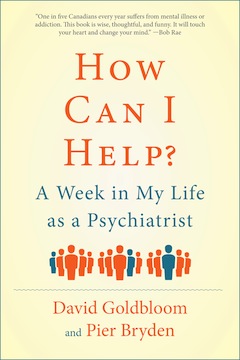
book cover - How Can I Help? A Week in My Life as a Psychiatrist How Can I Help? A Week in My Life as a Psychiatrist uses, as its title says, one week in Goldbloom’s professional life as its narrative framework. While Bryden is also a psychiatrist, she does not feature in the book.



In How Can I Help?, Goldbloom and Bryden explore the world of psychiatry, and talk about how it intersects with Goldbloom’s personal life, as they know that people are curious about how health professionals deal with the inevitable sorrows and joys of working in the field.

The book “contains some very real stories of real patients with their real names used with their real permission,” he said. Other patients described in the book are fictional composites, “masterfully disguised.”

Goldbloom himself is more revealed. “We felt, if these individuals were going to be candid and courageous enough to talk about their own experience, then I had better match them in terms of talking about my own reactions, including my reaction to the very real suicide of one of my patients.”

While Goldbloom said this was not the only time in his 30 years of practice that he has experienced a patient’s death, both he and Bryden felt that this one instance was particularly poignant. They also took the opportunity to write in more general terms about the impact of suicide on physicians.

“One of the other things the book does is use the events of the week to springboard into some of the larger issues within psychiatry,” said Goldbloom. “It’s not just a narrative, but it looks at some of the historical [elements], controversies, stuff like that.

“Whereas most people think of a psychiatric practice as being set in a secluded, private office, with somebody coming in Tuesdays at four to talk about themselves in a manner interminable, the reality of acute psychiatric care in a modern hospital is very different.”

According to Goldbloom, possibly the first thing a reader might be struck by is the variety of different settings in which they find him. He consults in his office, of course, but also through videoconferencing to reach distant areas, in emergency rooms and acute care units, as well as out in the community.

Readers will be able to learn of the varied roles psychiatrists in Canada play, and Goldbloom hopes the book will highlight the breadth of experiences – the professionals’ as well as the patients’.

When asked if another book project is on his radar, Goldbloom said, “I have to wait and see how the first book does. It’s encouraging that it was on the bestseller list, within a week of its publication, in the Globe and Mail and the Toronto Star … but, you know, it’s early days yet.”

How Can I Help? is available in most major bookstores, as well online via Amazon and Indigo.

Rebeca Kuropatwa is a Winnipeg freelance writer.

Format ImagePosted on May 20, 2016May 18, 2016Author Rebeca KuropatwaCategories BooksTags Bryden, Goldbloom, mental health, psychiatry
Expert on sundowning

Expert on sundowning

Dr. Brian Goldman (photo from Brian Goldman)

While most people have heard of dementia, many of us won’t have heard the term sundowning before.

According to Dr. Brian Goldman, emergency physician at Mount Sinai Hospital in Toronto, sundowning is generally part and parcel with dementia of various kinds.

“Sundowning refers to a person who is sleepy during the day and very active at night,” he explained. “Almost as soon as the sun goes down, that’s when they become active. The activity can be not just when awake and walking about in an agitated or restless state.… For sundowning to have its maximum impact on the patient and others – the caregivers and care providers – you have to have dementia [as well].

“A person who is cognitively intact, who is simply sleeping during the day and being up all night, would have the cognitive reserve to be able to handle that. They might feel they have a problem, need to see a doctor, or they might rearrange their lives because, when everyone’s sleeping, they’re up, [but] they’d be able to cognitively make sense of it.”

Goldman explained dementia as “a chronic disorder caused by a brain disease or injury. It is characterized or marked by impaired cognition or thinking, memory and personality changes.”

Goldman – who grew up in Toronto’s North York, the heart of the Jewish community – said he is seeing more elderly people with dementia. Often he is one of the first people to notice the symptoms.

“As an emergency physician,” he said, “I would say that an increasing percentage of the patients I see in the emergency department are frail seniors. When I started out in the 1980s, we would see an occasional patient over the age 90, but now it’s commonplace.

“I have professional experience, but I also have personal experience. Both my parents have passed away in the last two years and they both reached frail senior years. My mother had dementia. My father did not.”

Why some dementia patients also suffer from sundowning while others do not, Goldman said, remains a mystery. As well, the number of people who suffer from this newly defined condition of sundowning is also unknown, with estimates ranging from as low as two to three percent of people with dementia up to more than 60%.

“It has been said that sundowning tends to occur when the person is in unfamiliar surroundings, though it can also occur in the home,” said Goldman. “It’s well known that some people with dementia have damage to the pathways to their brain that recognize light coming in through their eyes and stimulating a part of the brain called the pineal gland. The pineal gland secretes the hormone melatonin.”

Melatonin is secreted somewhere around 2 or 3 a.m. every morning. It resets your body’s circadian rhythm. If that pathway is disrupted, it makes sense that your sleep-wake cycles would be seriously disrupted.

Another theory is that people who sundown are dreaming vividly. They are flipping between the awake and dreaming states quickly and frequently. And, again, because they don’t have the cognitive reserve, they do not know if they are dreaming or awake.

There is not yet a lot known about sundowning and another phenomenon known as delirium.

According to Goldman, delirium is confusion associated with the activation of the fight or flight response along with symptoms that include tremors, shaking, a fast heart rate, sweating and dilated pupils. These symptoms are sometimes also referred to as “toxic delirium.” People with toxic delirium have a rapid, traumatic change in their demeanor. Triggers of toxic delirium are often fever, urinary infection, pneumonia, flu, or even a heart attack.

“You recognize it if you see a sudden change from what the person was doing a week ago,” explained Goldman. “They look sick, sweaty … something seriously wrong … and there is an underlying cause. Treat the cause and the toxic delirium goes away.

“Sundowning is a more chronic pattern that can go on for months. There is no vast dramatic change. The only change in pattern you might notice, wherein dad or mom wander off at night once a month, then it becomes once a week, then every night. It’s a gradual pattern.”

Ways to help this condition, according Goldman, include regularizing a sundowner’s routine: having meals at set times, a set time for exercise (but not at night), set times for bathing and toileting (like washing in the morning or before bed), and the like.

“The experts say that caffeine should be avoided,” he added. “You want people to walk. Walking is good for them. Visitors are good, but probably not close to the time they’re going to bed. Also, reduce noise from TVs and radios and address the lighting in the room, ensuring you don’t have harsh lighting that could cast disturbing shadows on the wall.”

Besides these steps and before turning to sleep medication, Goldman advised exploring some other preventive approaches. Light therapy has shown some promise, he said, affecting patients in a similar way as those with seasonal affective disorder. This involves getting special light-generating therapy units, which are available without a prescription and come with instructions on use.

When it comes to lost brain pathways, Goldman sees the technique as especially helpful when approached in a “use it or lose it” fashion. “If you want to build up a reserve, this might be a way of doing that, with year-round light therapy,” he said.

“Certainly, making them busier during the day with exercise and other stimulation is the way to go. Somebody with dementia wants adventures in the same way that everyone wants adventures, something new. Keeping to the same routine everyday is helpful for structure, but the novelty factor can be helpful as well.”

Goldman said these practices can offer some relief of the effects of dementia, including Alzheimer’s, the most common cause and form of dementia.

Rebeca Kuropatwa is a Winnipeg freelance writer.

Format ImagePosted on May 20, 2016May 18, 2016Author Rebeca KuropatwaCategories NationalTags aging, Alzheimer's, dementia, mental health, sundowning
Couples need to talk about sex

Couples need to talk about sex

Doreen Seidler-Feller, PhD, is a clinical psychologist who has decided to focus her practice, in part, on the underserved population of Orthodox Jews. (photo from Doreen Seidler-Feller)

While sex is vital to our existence, it remains a topic many people are not comfortable discussing. Yet it is critical that we at least feel comfortable talking about it in private with our partners. It is even more fulfilling if we are able to enjoy the act of it with them, too.

Unfortunately, some newlywed Jewish Orthodox couples find themselves unable to consummate their marriages in an enjoyable way, due to a lack of sexual education and some misguided sexual advice from their peers. Enter sex therapist Doreen Seidler-Feller, PhD, a Los Angeles-based clinical psychologist who has decided to focus her practice, in part, on the underserved population of Orthodox Jews.

“I’m the last resort for everyone in this area,” Seidler-Feller told the Independent. “Nobody likes to come and face the situation in which they need to talk about something as intimate as their sexuality and their relations with their partners.”

Since people often only go to Seidler-Feller after they have exhausted all the options they can think of to solve the difficulties by themselves, she sees more complicated cases.

“It’s rare that I see a man alone,” she said. “It’s more likely that I’d see a man together with his wife, presenting as a couple, or that I’d see women alone. The reason for this is that, frequently, the problem is identified as theirs [the woman’s]. If it is an issue of painful intercourse or the involuntary contracture of the vaginal musculature that denies entry to the man … any sort of pain condition inside the vaginal vault or inability to tolerate intercourse … it makes sense that she would present alone.”

As treatment progresses, Seidler-Feller brings her patient’s partner into the process, as there is always some bridging required to bring the couple back into harmony and aid in their sexual choreography. Sometimes, the partner, too, may have a problem undiscovered until that point. In that case, his individual problem becomes addressable.

“The issue that causes the greatest anxiety is the inability to consummate marriage – a pain condition and an inability to tolerate insertion are conditions most likely to bring them into treatment,” she said. “These conditions not only deny the couple the opportunity for the mitzvah pru u’rvu [being fruitful and multiplying]. They deny them the opportunity for pleasure, the sensations of adulthood, and related normalcy.”

According to Seidler-Feller, the next most likely causes for seeking treatment are if the man has erection or ejaculation control difficulties, while the least likely cause is a woman being unable to achieve orgasm.

The majority of Orthodox couples and individuals Seidler-Feller sees are between the ages of 21 and 35.

“People, usually women, also sometimes want to come to me to talk about something in their past that they haven’t been able to talk to anyone about, that may be relevant to their sexual dysfunction,” said Seidler-Feller. “In that case, my being a stranger to her – not necessarily part of her community – is a plus, not a minus. That is because usually it enables the patient to maintain a certain kind of anonymity. At the same time, it enables her to raise the question of to what extent an experience of either subtle or outright sexual abuse might be relevant to her sexual difficulty.”

Since the work is so intimate, Seidler-Feller works strictly in person – not over the phone or electronically – partially to challenge the taboo around frank sexual discussion in the Orthodox world. Also, because of the inhibition that exists around both the language and activity involved in human sexuality, one-on-one discussions are most useful.

In a world where oblique language supplies the vocabulary, Seidler-Feller is not a fan of maintaining the status quo. One of her objectives is to train couples to be completely open with each other, to say what they mean and mean what they say.

“They can deal with the rest of the world in euphemism and indirection, that’s fine,” she said, “but I don’t want them, with one another, to talk in euphemistic and inhibited language, as it may lead to difficulties and misunderstandings.”

On the other hand, Seidler-Feller does not advocate the use of clinical or vulgar language. Her intention is simply to help a couple speak clearly to each other, so they can effectively express their desires.

“Once the dysfunction is behind them, they are left with a world of possibilities about how to enact their sexual relationship,” said Seidler-Feller. “Some find, at that stage, that they want to have a more ample, open and variable sexual relationship. For that to be realized, they need to be strong internally and know what they feel and want. This way, they can refer to their experience clearly and can effectively achieve their wishes.”

Seidler-Feller’s treatment is short-term behavior-oriented psychotherapy and involves focused discussion, not actual activity of any sort in a session. Her patients are given a series of exercises designed for them, specifically based on what their diagnostic assessment reveals and what are their halachic (Jewish law), cultural and value considerations. The exercises, which the couple completes in the privacy of their home, are the subject of each session. Usually, the person who has the dysfunction begins by doing self-directed exercises. Later, the couple performs partner exercises together.

“Over the course of the week, I expect my patients to do the exercises three or four times, and journal,” said Seidler-Feller. “Then, they bring back their journals or good memories, as the case may be, and we talk about what they did over the course of the week. And, I put in my two cents about how to enlarge it or differently shape it.”

In this broad way, Seidler-Feller approaches numerous issues wherein primary medical causes have been ruled out or are limited in their effects.

Seidler-Feller would like to see a standardized curriculum in Orthodox day schools.

“I’d like to see Orthodox day schools become more courageous, to face the fact that we live in a modern world where people of all kinds get their sexual information and values from all sorts of places,” she said. “It’s still true that most get information from their peers, which is variable, and, even when the information is good, is never enough.

“A sexual ethic involving a modern Jewish approach to sexual values must be developed to have a chance of captivating the imagination of both young Orthodox men and women, as well as the non-Orthodox. Otherwise, we condemn our young to the values either of the street or the Kitzur Shulchan Aruch [Code of Jewish Law].”

Seidler-Feller sees talking about problems surrounding sex, and giving young people especially a way to think about sex as something that is spiritually and emotionally enriching, is critical. She also thinks it will reduce a lot of personal anguish and marital tension.

“I’d like to see public forums in the Orthodox world, where people like me are invited into synagogues, panels or programs, offering the opportunity to talk about responsible human sexuality in the Jewish context, Orthodox context, in a straightforward, unapologetic way,” said Seidler-Feller. “This could help rabbis in the institutions that have failed us, to the extent that they consider all public discussion on sexuality as somehow immodest and prohibited. My dream is that when they come to the chuppah [marriage canopy] and to the world of marriage beyond, couples are truly prepared.”

Rebeca Kuropatwa is a Winnipeg freelance writer.

Format ImagePosted on May 20, 2016May 18, 2016Author Rebeca KuropatwaCategories WorldTags counseling, mental health, Orthodox, sex
Courage’s two records

Courage’s two records

Lorne Segal, chair, Courage to Come Back Awards. (photo by Cynthia Ramsay)

In its chai year, the Courage to Come Back Awards had a record night on May 5 at the Vancouver Convention Centre, with more than 1,500 guests and more than $1.43 million raised for Coast Mental Health.

In his address, Courage to Come Back chair Lorne Segal pondered the question of why the event is so popular. “Because,” he said, “at these awards, like nowhere else, we feel the extraordinary power of the ordinary spirit and the deep humanity so often lacking in our daily lives.”

He said, “We all shed a tear tonight and, whether it was a tear of joy, of hope, of love, it was not because we wanted to, but because we needed to. You see, we need to know that, even against the worst hand we could be dealt in life, we too can triumph. Because our six heroes tonight could do it, so can we.

photo - Cynthia Ramsay, publisher of the Jewish Independent, and Shay Keil of Keil Investment Group of ScotiaMcLeod
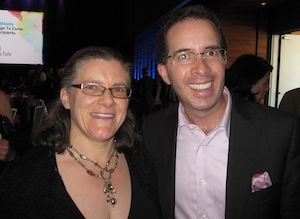
Cynthia Ramsay, publisher of the Jewish Independent, and Shay Keil of Keil Investment Group of ScotiaMcLeod. (photo from Cynthia Ramsay)

“Each of us came into this room for a different reason, but we will all leave with our nourished souls tied together by one common thread: the unshakeable belief that, by seeing the very best in others – courage, faith, hope, endurance – we will somehow find the strength to face our own fears and achieve our greatest dreams. And for that, we need to thank our six superstars who are symbols of the possibilities which lie within us all.”

This year’s six honorees were Christy Campbell (in the physical rehabilitation category), Jemal Damtawe (addiction), Meredith Graham (social adversity), Dr. Barbara Harris, (mental health), Coltyn Liu (youth) and Tom Teranishi (medical). Since 1999, Courage to Come Back has now honored 103 individuals who have had the “courage to overcome serious adversity, change their lives for the better and move forward to help others do the same.”

Co-hosting the gala evening were Randene Neill and Kevin Evans, while Howard Blank emceed the fundraising portion of the proceedings. In his comments, Blank noted that Coast Mental Health helps an average of 12 clients a day and that its programs address three main pillars: housing, employment and support services.

The largest donation of the evening came from B.C. taxpayers, as Minister of Health Terry Lake donated $100,000 from the province on behalf of Premier Christy Clark and Minister of Finance Mike de Jong. The largest private donation came from Joseph and Rosalie Segal, who contributed $50,000. Many other individuals and companies made donations, several citing the Segal family as their example of what it means to give back to community.

There was no shortage of role models for giving that night, with the six honorees leading the way. There were many meaningful takeaways, including Liu’s statement: “Mom’s lesson: don’t feed the negative monster inside; rather, fight with a belief in yourself and for a reality you want.” And Graham’s reminder that, “sometimes, you can give what you didn’t get.”

“What part will you play,” she asked the crowd, “to change lives today?”

Format ImagePosted on May 13, 2016May 11, 2016Author Cynthia RamsayCategories LocalTags Courage to Come Back, mental health, Segal, tikkun olam

Call for nominations

Nominations for this year’s Courage to Come Back Awards are open until Feb. 12, 2016, 5 p.m. The annual awards recognize abilities, celebrate differences and give centre stage to six British Columbians who have overcome tremendous challenges, yet reach out to help others in the province.

Courage recipients show us that people can walk again despite the predictions of some of the best medical minds. They teach us that disabled does not mean unable. They prove that hearing voices in one’s head does not mean a lifetime in hospital. These are valuable members of our community despite injury or illness: they are role models.

Nominations are open only to residents of British Columbia and the nominee must agree to be nominated for a Courage to Come Back Award. All nominees will receive a special certificate of nomination, which pays tribute to their outstanding courage.

A team of volunteer health professionals and community leaders will select one recipient in each category to be honored with an award. If your nominee is unsuccessful, he or she can be nominated again next year.

Any material submitted to Coast Mental Health will not be returned. Coast makes every effort to verify nominee stories but takes no responsibility for errors or omissions, and Coast reserves the right to place nominations in their award categories. Video or CD nominations are not accepted.

To nominate someone, tell the nominee’s story of a courageous comeback accurately and in detail. Submit only one nomination form for the nominee, and submit a minimum of three letters of support and testimonials, and optional supplemental documents, to [email protected]. Nominations will not be considered complete or eligible until a completed nomination form and all mandatory letters of support have been received.

Once you have clicked “submit,” an immediate message should appear confirming your nomination has been successfully submitted. You will also receive a confirmation email.

To read about past honorees and to access the nomination form, visit couragetocomeback.ca/courage-to-come-back-awards.

Posted on January 29, 2016January 26, 2016Author Coast Mental HealthCategories LocalTags Courage to Come Back, mental health

Posts pagination

Previous page Page 1 … Page 8 Page 9 Page 10 Next page
Proudly powered by WordPress