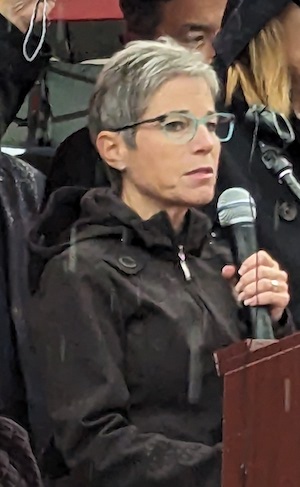
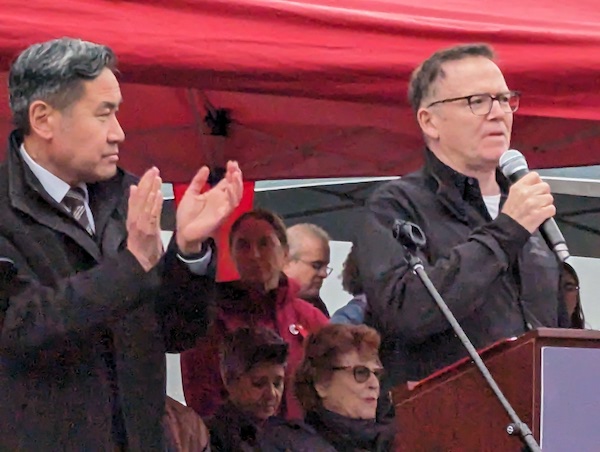
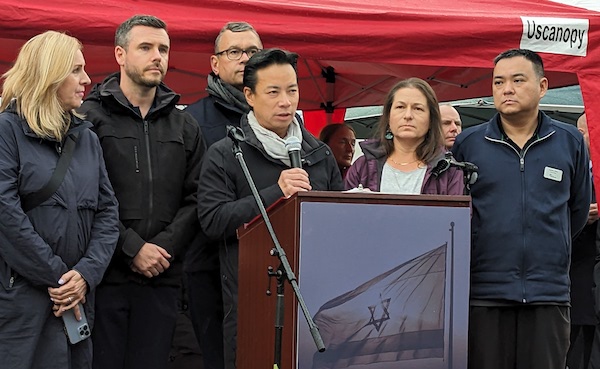
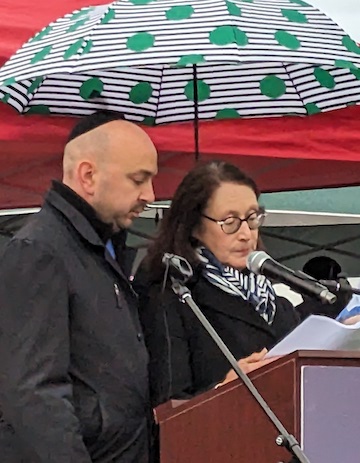
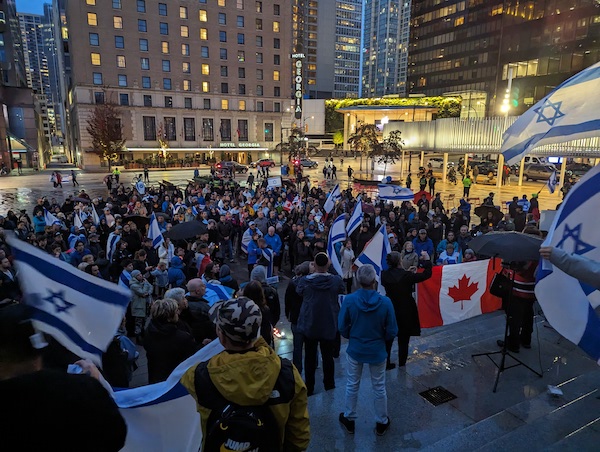
Jewish Federation of Greater Vancouver executive director Ezra Shanken, left, and Centre for Israel and Jewish Affairs Pacific region vice-president Nico Slobinsky were in Buenos Aires last month. (photo from Jewish Federation)
Nico Slobinsky was a 15-year-old high school student in Buenos Aires when, on July 18, 1994, the principal announced that their Jewish community centre and administrative hub had been blown up in an apparent terror attack.
The Asociación Mutual Israelita Argentina (Argentine Israelite Mutual Association, or AMIA) building was attacked by a car laden with 275 kilograms of explosive ammonium nitrate fertilizer and fuel oil. The building collapsed, killing 85 and injuring more than 300.
The AMIA attack remains the most significant terrorist attack in Argentina’s history. Two years earlier, though, the Israeli embassy in Buenos Aires was the target of a suicide bombing, on March 17, 1992, in which 29 were killed and 242 wounded.
“I remember vividly the morning that the building was targeted and blown to pieces,” said Slobinsky, now the Pacific region vice-president of the Centre for Israel and Jewish Affairs (CIJA). “I remember the pervasive feeling [that] we are no longer safe and what’s going to become of us. I remember the dinner that night at my family’s home, where the bombing, the targeting of the AMIA, was all that my parents were talking about and what was going to happen next. There was a lot of uncertainty at the time and, 30 years later, I can tell you that the same feeling of lack of justice and lack of safety persists.”
The perpetrators of the AMIA bombing have never been brought to justice, nor have the perpetrators of the earlier embassy attack. Hezbollah claimed responsibility for the 1992 embassy bombing but it was only this year that an Argentine court ruled that Iran was behind the 1994 bombing, through their international terror subsidiary Hezbollah.
Two of Slobinsky’s friends were murdered in the attack and many in his circles of acquaintances were killed or injured. He attended and helped organize memorial events on the anniversaries of the AMIA bombing when he lived in Argentina, until 2000, and then joined with the Argentine community in Israel when he lived there.
Last month, Slobinsky traveled to Buenos Aires for ceremonies marking the 30th anniversary of the atrocities. He was joined by a small delegation of other Vancouver Jewish community leaders, including Ezra Shanken, chief executive officer of the Jewish Federation of Greater Vancouver, and his wife, Rachel Shanken, director of operations at Jewish Family Services Vancouver; Karen James, who is on the national board of CIJA and also on the board of the Jewish Agency for Israel (JAFI); and Candace Kwinter, who is on the board ofJAFI, as well as the board of Jewish Federations of Canada-UIA, and her husband, Alan Kwinter, who is on the board of Congregation Beth Israel.
The anniversary of the terror attack coincided with a meeting of the World Jewish Congress in Buenos Aires, which the Vancouverites attended.
It is widely believed that there was government complicity in the AMIA attack. Police who were routinely stationed in front of the building departed before the bombing. Rubble from the building, which should have been preserved for investigation, was dumped in a river. In 2015, Alberto Nisman, a prosecutor leading the AMIA investigation released a 300-page report accusing then-president Cristina Fernández de Kirchner and other political leaders of covering up Iranian involvement. Hours before Nisman was to present his findings to parliament, he was found dead in his apartment. The government declared it a suicide.
James was impressed with the panoply of world leaders who attended the AMIA commemoration and the WZO conference, particularly Javier Milei, the new president of Argentina, who has made justice for the AMIA terrorists a belated priority. The presidents of Uruguay and Paraguay were also in attendance, as were Jewish parliamentarians from around the world, including Liberal Member of Parliament Anthony Housefather, and special envoys for antisemitism from scores of countries, including Canada’s Deborah Lyons, Deborah Lipstadt of the United States and Michal Cotler-Wunsh of Israel.
Family members of the bombing victims spoke and time has not lessened the agony of the attack, said James.
“They were sobbing and some couldn’t finish speaking,” she said. “There’s never been closure for them. It was so emotional. I was in tears.”
Candace Kwinter said that standing shoulder to shoulder with the families affected 30 years ago was an act of bearing witness.
“We’ve all been to Israel since 10/7 and it just feels like another deep, dark, awful part of our history,” she said.
Supporting Slobinsky in the return to the time and place of the bombing was a motivator for those who joined the trip, according to Alan Kwinter.
“It was important certainly to support Nico and also, in this time when there is rising antisemitism and there are so many people that are turning their backs on the Jewish people, I feel that it’s important for us to come together as a community, a global community as well as the local community, and for us to be there with those families that lost their loved ones and have never had justice,” he said. “It was important for me that we show solidarity with them, that they feel that they’re not alone.”
Slobinsky acknowledged the emotional impacts of the commemoration and drew contemporary connections from lessons of the past.
“It was difficult to be there with thousands of Argentinians on the streets still asking for justice 30 years later,” he said, noting that this early life experience reinforced his commitment to taking a leadership role in Jewish life.
“For those who argue that Canada should embrace the Iranian regime by reestablishing diplomatic ties, the 30th anniversary of the AMIA bombing that we just attended is just another painful reminder that Iran and its proxies like Hezbollah must be held accountable not only for the horrific attack on the AMIA [but] for their export of terrorism around the world,” said Slobinsky. “In memory of my friends Viviana and Christian and to the victims, the survivors and their families – I will never forget.”
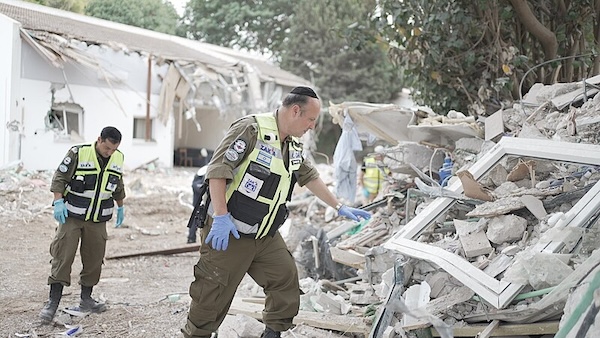
Members of ZAKA identification, extraction and rescue team search through the destruction in a Gaza Envelope community following the Oct. 7 attacks. (photo from ZAKA)
The annual Yom Hazikaron ceremony, marking Israel’s day of remembrance for fallen soldiers and victims of terrorism, took place May 12 at Temple Sholom. It was an unprecedentedly poignant ceremony, with hundreds of in-person attendees and hundreds more attending virtually, many of whom lost loved ones on Oct. 7 and in the war that began that day.
Dikla and Etsik Mizrachi, parents of Ben Mizrachi, the young Vancouver man murdered while heroically providing medical aid to others at the Nova music festival, both spoke.
“This Yom Hazikaron is different,” said Dikla Mizrachi. “This Yom Hazikaron, I can’t think of the many lives that we’ve lost. My heart can’t take the burden. The weight of my grief is too heavy to bear. This Yom Hazikaron, I can only think of one special boy, a boy who had big dreams, life ambitions.”
Ben grew up in Vancouver, she said, attended Vancouver Hebrew Academy and then King David High School.
“Ben was so proud of who he was,” his mother told the packed synagogue. “He was proud to be a Jew, he was proud to be Israeli. He had his mind set that, after high school, he would go to Israel and learn in a pre-army Mechina program to prepare him for the IDF. He couldn’t imagine himself doing anything else. And he didn’t. He did it all.”
Ben Mizrachi served three years in the parachute unit and completed a paramedic course.
“On Oct. 7, at the young age of 22, Ben was brutally taken from this world at the Nova festival in Re’im,” his mother said. “But he was not taken without a fight. His personality and moral core would not allow it. He did not run away to save himself when he had the chance. He showed tremendous courage and bravery as he tried to save others.
“We do not know everything about the last hours of Ben’s life. But we have been able to piece together some of them. What we know is that, from 6:30 a.m. to 8:10 a.m., Ben was under attack. We know that he and Itai Bausi, a friend from his kibbutz who went with him to Nova, made a choice to leave the safety of their car and their chance to flee. We know they made this choice in order to render aid to the injured,” she said.
Two brothers who survived the music festival attack have shared the story of how Ben used his medical skills to attend to the injuries of a young woman and then, with three other young men, transported her on a stretcher to the medical tent, holding her at hip level to avoid snipers.
“We know after they deposited the woman the boys then separated to run in different directions to escape their attackers,” said Dikla Mizrachi. “We know from the last voicemail message Itai’s girlfriend received from him that he was shot in his back and his leg. We know from both the phones that Itai called Ben multiple times but there was no response and we know that Ben died a hero, as did Itai.
“This past Oct. 7, our life as a family and our life as a Jewish nation changed forever,” she said. “Our collective hearts are completely shattered. Today, we are all in mourning. We all have soldiers in Gaza. We all have 132 hostages in Gaza. We all have evacuees from the north scattered all over the country. We are all suffering together.”
She told the audience that, at her son’s shiva, an army friend of Ben’s told her that he had lost a cousin in 2021, in Operation Guardian of the Walls.
“That year, on Yom Hazikaron, Ben had called him and said, ‘I know it’s your first Yom Hazikaron, so if you need or want to talk to someone, I’m here for you,’” she recounted. “This was Ben, thinking about others at every moment and being so sensitive.”
Addressing her late son, she said: “Ben, this is my first Yom Hazikaron and I need you.
“I need you to help our family choose life each day and give us strength. I know that you are still with us, but can you please send us a sign very soon, a sign that you are OK and in a good and peaceful place? Ben, we will do our best to live our lives according to your values, to be there for others, as you always were, and to cherish the things you loved. We love you. We think about you and we miss you every day a bit more.”
Later in the evening, Ben’s father, Etsik, said Kaddish for his son.
Geoffrey Druker, who has led the annual event for years, noted that this year was different.
“We have within our community families who lost loved ones in the past seven months, lost a son, a father, a brother, a sister, cousins, extended family, and friends,” he said. “Tonight, with our bereaved families here and worldwide, we remember our fallen in the establishment and the defence of the state of Israel, and all who have been murdered in terrorist attacks. We remember them all.”
Members of the BC Jewish community lit candles and spoke about those they have lost. A montage of photographs remembered friends and family of locals, from 1948 to recent months. Druker shared individual stories, a microcosm of the many stories of tragedy and heroism from Oct. 7 and the months since.
He told of the five members of the Kutz family of Kfar Aza – father Aviv, 54, mother Livnat, 49, and sons Rotem, 19, Yonatan, 17, and Yiftach, 15 – who were found hugging each other on a bed, father Aviv trying to provide a protective embrace.
In all, 64 members of Kfar Aza were murdered, and 13 soldiers killed in the battles on Kfar Aza. Among these residents was Mordechai Modi Amir.
“Modi was a creative person, always thinking outside the box,” Druker said. “So, when they built his secure room, he decided to add a small shower room, a room within a room, with its own door. At 6:30 a.m. on Oct. 7 – when the red alert siren went off, Modi, his two daughters and granddaughter entered the safe room.
“When they heard shots close by, and voices speaking Arabic, he told his daughters and granddaughter to enter the tiny shower room and to remain quiet as he closed the door behind them. He then stood waiting in front of the shower room door,” Druker said. “He most likely thought, when the terrorists enter the safe room, they will see a man standing by the wall, they will shoot him, and move on. A member of Kfar Aza later said: ‘Modi was shot several times and fell to the floor. He most likely, in his last seconds alive, saw the terrorist leave, knowing he saved his family.’ And,indeed, 13 hours later, his three family members left the tiny shower room alive, and survived.”
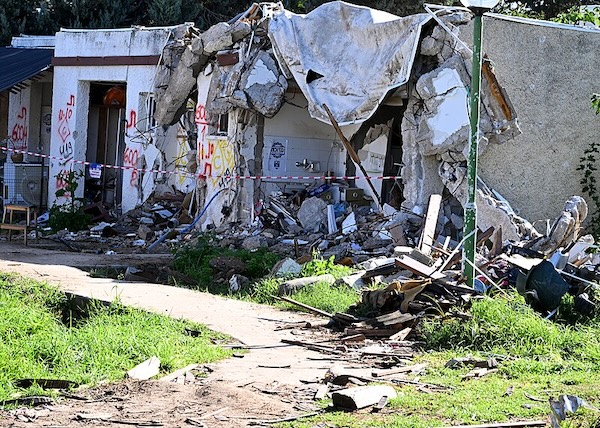
Destruction at Kibbutz Kfar Aza. (photo from US Embassy Jerusalem)
Vancouverite Amnon Kones and his family lived on Kfar Aza for 20 years and knew many of those killed. He lit a candle of remembrance, as did Sam Heller, who lived there during his military service as a lone soldier.
Adi Vital-Kaploun, an Israeli-Canadian who lived on Kibbutz Holit, was a relative of Vancouver residents Jason Rivers and Helen Heacock Rivers.
“Her husband was away that weekend,” Druker explained. “When Adi realized terrorists had infiltrated her kibbutz, she phoned her husband and asked how to operate his weapon, to defend her children.
“By some miracle, Adi persuaded the terrorists to allow her two young boys, Negev, 3-and-a-half, and Eshel, 6 months old, to be kept by her neighbour, Avital. Adi was shot and murdered in her home, and her body booby-trapped by the terrorists,” said Druker. “The Hamas terrorists then marched Adi’s neighbour, Avital, who was carrying Negev and Eshel, towards Gaza. At the Gaza border, for some unknown reason, they were released, and they survived, though 3-and-a-half-year-old Negev had been shot in the foot.”
Noam Caplan and Kessem Keidar, members of Habonim Dror Camp Miriam, lost family members and a friend on Oct. 7. Caplan spoke of his cousin, Maya Puder, 25, who was murdered at the Nova festival. Keidar remembered her cousin’s uncle, Amit Vax (Wachs), who was murdered in Netiv HaAsara.
“When he was killed, he was not aware that his brother Igal Vax was murdered earlier, while he too was fighting the terrorists on the other side of the moshav,” said Keidar.
The pair lit candles in memory of these victims, as well as Vivian Silver, another Canadian-Israeli, who lived on Kibbutz Be’eri.
It is estimated that about 120 people were murdered on Kibbutz Be’eri, among them Sylvia Ohayon. Dalia Ohayon lit a candle in memory of her sister.
Five members of the Bira family were murdered on the kibbutz: Oron Bira, 52, and his wife, Yasmin Laura Bira, 51, and their daughters Tahir, 22, and Tahel, 15, along with Oron’s elder brother, Tal, 62. Yahav, Oron and Yasmin’s son, was in another house, and is the sole survivor.
Navah Jacobs, a member of the extended Bira family, lit a candle in their memory.
Vancouverite Hofit Sabi recalled her cousin, Yinon Tamir, a 20-year-old paratrooper killed in action in the Gaza Strip in November, having earlier served among the first responders at Kibbutz Be’eri.
“Before going into Gaza, a few weeks after the battle of Be’eri, another comrade told of how Yinon comforted and guided him through his fears and anxieties to go into Gaza,” said Sabi. “Yinon promised that he would stay by his side and protect him, and he did, until his death. Yinon’s courage and leadership qualities shone through.”
Tamir had told his mother that he saw things at Be’eri that he could never unsee and that he felt a profound sense of privilege to serve and protect the right “to live as free people in our homeland.”
Itzhak Ben Bassat, a colonel nicknamed Benba, had just returned from vacation abroad at the end of a storied military career when he received a message to head for Be’eri on Oct. 7. He fought there for two days, securing the kibbutz, and survived. He died in battle two months later, age 44. His sister, Hamutal Ben Bassat, lit a candle in memory of her brother.
Nicky Wasserman Fried, whose uncle Aaron Fried died in the 1948 War of Independence, lit a candle in his memory and told the audience of casualties in Vancouver’s partnership region in northern Israel.
“Three IDF soldiers from our region were killed fighting Hamas as they infiltrated our communities surrounding Gaza on Oct. 7,” Fried said. “Since Oct. 7, an additional seven soldiers and three civilians have been killed.”
Cantor Yaacov Orzech chanted El Moleh Rachamim. The Clore & Roll Ensemble, who were the featured entertainers at the next evening’s Yom Ha’atzmaut event, performed, as did singers Mayan Molland, Shir Barzel and the Meitar Choir. Shir Barzel played piano.
The ceremony was presented by the Jewish Federation of Greater Vancouver, the Centre for Israel and Jewish Affairs, the Rabbinical Association of Vancouver and the Jewish Community Centre of Greater Vancouver.
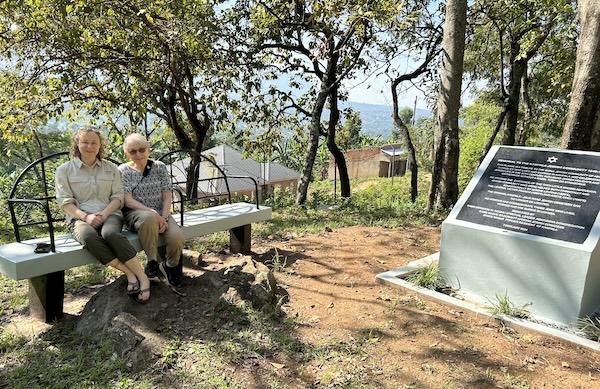
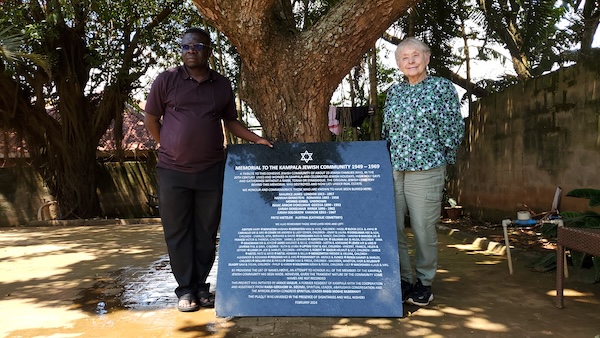
Janice Masur and her daughter, Liora Freedman, on March 3, after unveiling the memorial plaque in Nagoya village near Mbale, Uganda. (photo from Janice Masur)
I have just come back from Uganda, where my family used to live, in the Jewish community that existed from 1949 to 1961. My daughter, Liora, had returned 10 days earlier, as planned. I had to stay longer because my passport had been stolen two weeks previously, off my lap while sitting in a slow-moving car. Thankfully, after Liora involved my local member of Parliament, my temporary Canadian passport, processed in Nairobi, Kenya, finally arrived in Kampala, and I was able to leave.
Although still essentially an agricultural economy, Uganda is touted to visitors as the most entrepreneurial country in Africa. Most people in the countryside have a small plot to grow their own food and sell the surplus. Large-scale plantations of sugar cane, tea, coffee and bananas are grown for export. The Pearl of Africa is rich in mineral deposits and China is beginning to drill for oil on the edge of Murchison Falls National Park.
I could not find my way around Kampala anymore. It used to be a self-contained town situated over seven hills. Now it sprawls and spreads in all directions with Ugandan street names I can barely pronounce. My old house has a high fence and a guard at the gate, with a gun slung across his shoulder, who wouldn’t let us enter. I was charmed to find the same small five-petaled purple flowers floating down like tiny propellers, strewn on the driveway just as they had done in my childhood. Across the rutted road, there was a new modern hotel instead of modest houses.
We drove up Kibuli Hill to see Kibuli Mosque. In my day, the mosque was a friendly looking place of worship. I was shocked to see how fortress-like it had become, painted grey instead of white, with the words “None shall be worshipped but Allah. Muhammad is his prophet.”
I tried to find my bearings on Tank Hill – named for the three extremely large round water tanks in the neighbourhood – where we had once lived but couldn’t. Instead of being given help, I was told not to take photos, or I might be thought to be spying on an army unit. Important ministers travel in cars with armed guards seated outside of the cars facing sideways, guns at the ready.
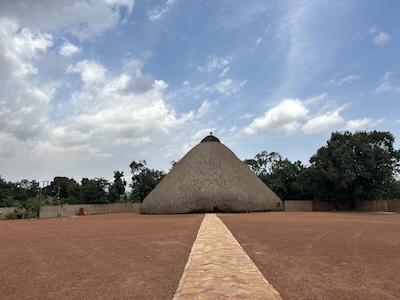
Kasubi Tombs on the Hoima Road, Kampala, Uganda. (photo from Janice Masur)
I visited the Kasubi Tombs, where the kabakas, or kings, have been buried since pre-Christian times. I had never known about this sacred UNESCO site when I lived in Uganda. A steep thatched roof, reaching almost to the ground covered intricate woven designs in the inner ceiling of one of the tombs. It was my absolute luck to have Prince Joseph as my tour guide. When I showed him a photograph, he told me proudly that he was the grandson of Edward, the brother of the kabaka, Mutesa II or Freddy, who was one of the two Ugandan men in the picture.
My purpose for traveling to Uganda was to unveil two memorial plaques for my Jewish community, which had been there from 1949 to 1961. None of the community infrastructure exists today, not even the cemetery, now submerged under real estate.
We placed a plaque in the Nagoya village near Mbale, where the Abayudaya, who converted to Judaism in 1921, live. Conservative Rabbi Gershom Sizomu and his wife, Tziporah, and others in the community were so welcoming and warm, helpful and supportive. We had a wonderful Shabbat evening, with lots of music and drumming, and Shabbat lunch under two large mango trees, with stunning views of Mount Elgon.
On Sunday, the whole community was invited to the unveiling of the plaque. We ambled down to a lower flat piece of land after morning minyan in the synagogue. There were speeches by Rabbi Sizomu and by Rabbi Netanel Kaszovitz, a young Orthodox rabbi visiting from Nairobi, who is responsible for administering to all the Orthodox Jewish communities in East and West Africa. The plaque glowed in the dappled sunlight. Two newly planted mango trees and two benches were nearby, offering enough room for a minyan, at Rabbi Sizomu’s request. The white lettering on the black granite looked impressive; beautifully supervised by Ariel Okiror Eyal.
Rabbi Gershom Sizumo and Janice Masur with the Kampala plaque that will be held in storage. (photo from Janice Masur)
I experienced all sorts of conflicting emotions, as you might imagine. At long last a plaque to commemorate the help that my Uganda Jewish community had given the Abayudaya last century was installed. Nothing had marked the presence of the once-vibrant, secular, 23-family Jewish community, which functioned without a rabbi, a Torah or a synagogue. Who would have guessed that, in 2024, a Conservative and three Orthodox Black Jewish communities would exist, interspersed with Muslim villages?
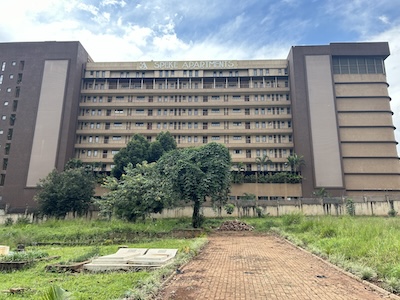
As for the other plaque I hoped to place, it was for the Jews who were buried more than 60 years ago in the Jewish cemetery just off the Kampala-Jinja Expressway, abutting the Christian cemetery. It is not common knowledge that the Jewish cemetery here had been destroyed and Speke Apartments, built by Dr. Sudhir Ruparelia, lies on top of where it had been. After many months of trying to contact Ruparelia I finally succeeded while in Kampala. In reply to my request to place a plaque somewhere in the vicinity of the apartments, in a discreet corner or on a less important wall, he said “No! None.”
Speke Apartments in Kampala, which is built alongside an unkempt Christian cemetery and on top of the Jewish cemetery. (photo from Janice Masur)
Perhaps I could mount the plaque at the edge of the unkempt Christian cemetery? It requires a Ugandan minister’s permission to approve a location near the 1972 Entebbe Raid plaque at the difficult-to-access old Entebbe Airport. Maybe at the Uganda Museum? The garden of the Chabad compound was also considered. Unfortunately, none of these placements have materialized.
I traveled to Uganda to place two memorial plaques, but my mission was not fully accomplished, and the second plaque lies in storage with Rabbi Sizomu. The Chabad Rabbi in Kampala, Moshe Raskin, said he would try to place it somewhere, perhaps in the future grounds of the new plot of land they will buy for Chabad, because Rabbi Moshe says Chabad is in Kampala to stay.
That I couldn’t find a place to mount the second plaque greatly saddened me. In many parts of the world, history is important and physical spaces or buildings are repurposed and feature plaques to show that a mikvah is buried here or a synagogue was once there. Today, few Ugandans know their local history, including that former governor (1952-1957) Sir Andrew Cohen was a British Jew. He was the first governor not to plunder Uganda’s wealth and he encouraged education and self-rule.
Now it is my task to contact my East African friends and perhaps schools and associations because Albert Kasozi, executive director of Buganda Heritage and Tourism – to whom Prince Joseph introduced me while we drank African tea at my hotel – would like as much 19th-century Bugandan history collected as possible for a new museum that has just been built in Kampala and will be formally opened soon. The banner exhibit I created, Shalom Uganda, will find a home in this new museum and I am very happy about the prospect. And the Kampala memorial plaque? To be determined….
Janice Masuris a Vancouver author and speaker. Her book, Shalom Uganda: A Jewish Community on the Equator, tells her story of growing up in the bygone Ashkenazi Jewish community of Kampala from 1949 to 1961.
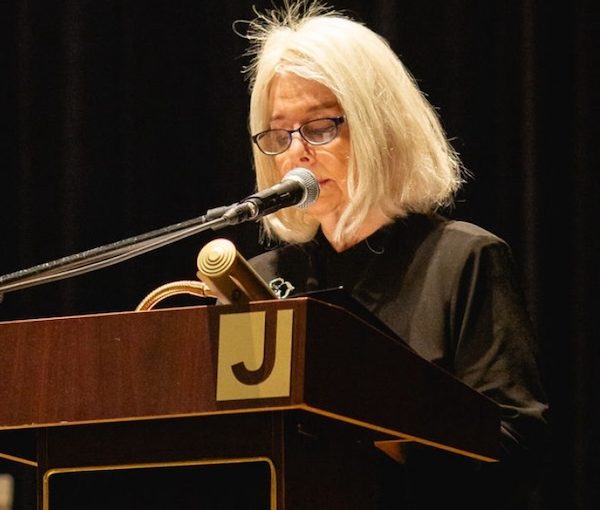
Child survivor Lillian Boraks-Nemetz speaks at the community’s Yom Hashoah CommemorationMay 5. (Rhonda Dent Photography)
The pogrom of Oct. 7 and the hurricane of antisemitism that has swirled since then added resonance to commemorations of Yom Hashoah this week.
Around the world, Jewish communities united in different ways to mark the annual Holocaust remembrance day. Sunday night, May 5, the local commemoration at the Jewish Community Centre of Greater Vancouver featured child survivor Lillian Boraks-Nemetz, who reflected on the unmistakable parallels across time, of “Broken families, broken bodies and minds and the poor frightened children and much more.”
Recently, said Boraks-Nemetz, she heard the words of Israel’s ambassador to the United Nations, Gilan Erdan, who reflected on how a sunny Shabbat morning in Israel turned, in a matter of seconds, into hell.
“On just such a sunny morning, in Warsaw, I lost my childhood,” said Boraks-Nemetz, who was introduced Sunday night in a touching tribute by her son, Stephen. “The day Nazis invaded Poland, I remember German bombers flying low over my head against an innocent blue sky and as World War Two began on Sept. 1, 1939, I had to become an adult at the age of 6.”
In the war that began that day, she said, 1.5 million Jewish children were murdered. She suffers guilt and questions around her survival when so many, including her little sister, did not live.
“Some of us were younger than others. Some older,” she said. “Nevertheless, we were all traumatized – as our brothers and sisters are today, in Israel, and in a world that won’t learn history and its lessons. We don’t feel safe anymore around our world. Thousands protest against us as they have always done, just looking for a reason to express their hate for Jews.”
Boraks-Nemetz shared parts of her Holocaust history, from the earliest time, when her mother took her to a favourite café only to find a sign declaring Jews were forbidden from entering – signs that then proliferated in parks, recreation areas, theatres, streetcars and elsewhere.
“We were beginning to lose our humanity,” she recalled. “Thousands protested against us with words such as ‘Death to Jews,’ ‘Final Solution’ and more.”
Today, she said, similar words are directed at Jews.
“This is being allowed to flourish unpunished, using our freedom of speech for their purposes,” she said. “But surely there are red lines where free speech ends and hate speech begins that must be punishable by law.”
She recalled seeing the wall around the Warsaw Ghetto being constructed, higher and higher, as she watched.
“I asked my father what this wall means,” said Boraks-Nemetz. “I asked many questions. I was almost 7 years old. This wall, he replied, will eventually enclose a part of Warsaw where we will be forced to live.”
That day came when, through a window, she saw a long car with officers and a bullhorn ordering Jews to enter the ghetto or suffer severe consequences.
“From the day I and my family entered our one room within these close, shabby quarters, I felt as if I had stepped out of sunlight into darkness,” she said. “I felt as if I was being stifled and the feeling of being stifled stayed with me as a memory and a trigger all of my life. The wall meant confinement, exclusion, isolation, fear, hunger and quarantine of a disease called typhus.”
Boraks-Nemetz shared the story of how she was to be smuggled out of the ghetto by her father, who had bribed a non-Jew but, when the day came, she was ill and instead her sister was sent out, never to be seen again.
“The streets were treacherous, with children dying of hunger and disease, poor and starved people peddling what little they had for a few potatoes and stealing what they couldn’t buy,” she said.
While smuggling a child out of the ghetto was a life-threatening act for all involved, so was remaining in the ghetto, she said. Eventually, thanks to an enormous bribe, young Lillian was passed through the gate of the ghetto, where she survived on the outside in the care of her grandmother, who had secured a false identity.
“That day, I felt as if I had lost my family, my home and any degree of safety I had felt,” she recounted. “I became numb and frozen. As a child, I didn’t understand why was I being sent away, alone, into a hostile world. I felt I wasn’t wanted by family or society. That day, I lost my identity as a Jew and a human being, a daughter.”
A forged piece of paper gave her a new, false name, false parents, a false age.
With a small blue suitcase in hand, she walked the short distance from her father, past the bribed guards, who looked the other way, into the care of a waiting stranger who would whisk her to a new, still very hazardous, life outside the ghetto.
“Although it was a very short distance, today I think of it as the longest walk, from impending death to the possibility of life,” she said.
Eventually, she started a new life in Canada, married at 19 and took on the role of a typical Canadian housewife, she said. At 40, she had a crisis, during which she was forced to confront the realities of what she had experienced, a struggle she has addressed ever since, through poetry, sharing her story with students and other means. For her, and for so many others, she said, Oct. 7 brought back from the mists of time the collective consciousness and memory of the past.
“We are still persecuted, blamed, hated,” she said.
Rabbi Carey Brown, associate rabbi at Temple Sholom, spoke earlier in the evening, expressing the need to be careful in drawing parallels between historical events, but acknowledging that the traumas of the past inform reactions to the present.
“It is difficult to distinguish between remembering the past and living in the present,” she said. “It feels inseparable.”
The current generation, said Brown, owes it to the memory of those who perished in the Shoah, as well as to the generations yet to come, “to take seriously and be steadfast in our commitment to ‘Never again.’”
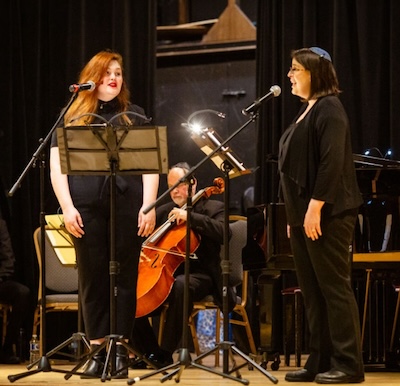
Singers Erin Aberle-Palm, left, and Cantor Shani Cohen and cellist Eric Wilson were part of the music program produced by Wendy Bross Stuart. (Rhonda Dent Photography)
The solemn ceremony began with Holocaust survivors in a procession escorted by King David High School students who are descendants of survivors.
Shoshana Krell-Lewis, a member of the board of directors of the Vancouver Holocaust Education Centre and a daughter of the centre’s founding president, Dr. Robert Krell,welcomed the audience and acknowledged elected officials and survivors. In recognition of survivors from the former Soviet Union, Irena Gurevich translated into Russian.
Sarah Kirby-Yung, deputy mayor of Vancouver, represented the city.
Cantor Yaacov Orzech recited El Moleh Rachamim.
A moving musical program by artistic producer Wendy Bross Stuart featured Eric Wilson on cello and singers Erin Aberle-Palm, Cantor Shani Cohen, Lisa Osipov Milton, Matthew Mintsis, Kat Palmer and Lorenzo Tesler-Mabe.
The program was presented by the Vancouver Holocaust Education Centre, funded through the Jewish Federation annual campaign and by the Province of British Columbia, and supported by the Gail Feldman-Heller & Sarah Rozenberg-Warm Memorial Endowment Fund, Temple Sholom Synagogue and the Jewish Community Centre of Greater Vancouver.
Several hundred people gathered for a second night of vigils, as elected officials, diplomats and allies convened in support of Israel and Jewish community. (photo by Pat Johnson)
For the second night in a row, Jewish Vancouverites and allies came together Tuesday for a vigil to mourn those murdered in the worst terror attacks in Israeli history, and to demonstrate solidarity with survivors, families of the victims, and all the people of Israel. The grief that was inevitable at the powerfully emotional event was made additionally anguished by the news several hours earlier that Ben Mizrachi, a young Vancouver man, was confirmed dead, one of about 260 victims murdered at a concert for peace in southern Israel Saturday morning.
In moderate rain at Jack Poole Plaza on Vancouver’s Coal Harbour waterfront, several hundred people gathered to hear from friends of Mizrachi, as well as from elected officials of all government levels, rabbis, a Holocaust survivors, and others.
Ben Mizrachi remembered in friends’ emotional testimony
Maytar and Rachel, who graduated alongside Mizrachi in 2018 from King David High School, shared memories of the young man they called “the life of the party” and “a true hero,” who died helping an injured friend at the scene of the attack.
Mizrachi had served as a medic in the Israel Defence Forces, having volunteered as a lone soldier.
“We understand that, during the attack, Ben stayed back with a wounded friend, keeping himself in danger to care for another,” said Maytar. “He used the training that he learned from his time as a medic with the IDF to tend to wounded people at the festival before he died. That was who Ben was. He was a true hero.”
She spoke of Mizrachi’s contributions to the King David community, to his friends and family.
“He was adored by everyone and known to students much younger and older than he was,” she said. “Everyone knew and loved Ben Mizrachi. Ben was a role model to his three younger siblings and valued his close and loving relationship with his family.”
She shared the memories of a fellow student, Eduardo, for whom young Ben became his first friend after moving here from Mexico City.
“Ben welcomed him, befriended him and taught him how to speak English,” Maytar said. “He told us that ‘Ben was much more than a friend, he was my brother and the type of personality that will cheer you up and make you smile.’ He had such a huge heart and you knew you could always count on Ben.”
She continued: “In school, Ben was always the first one dancing at any assembly and the last one cleaning up at the end, even when he cooked — and he loved to cook.”
He could be found in the kitchen at Beth Hamidrash on Shabbat helping to prepare the kiddush, Maytar said. “His kindness extended to every part of his life from such a young age. We all remember that, if we ever had a gathering on Saturday, the party wouldn’t really start until after Shabbat, when Ben would arrive. He was always the life of the party. This past weekend, that’s what he was doing. He was at a party with his friends. He was doing nothing wrong.”
Friends of terror victim Ben Mizrachi remember “true hero.” (photo by Pat Johnson)
Their friend Rachel spoke of Mizrachi’s commitment to his identity.
“Ben was always extremely proud of his Jewish identity and of being an Israeli citizen,” she said. “He loved to share his love of Judaism and he often invited friends to join him and his family for Shabbat services and meals. As a teammate of Ben, we played on multiple sports teams together and he proudly wore his kippah at every game. In Grade 12, Ben was the president of our NCSY [the youth wing of the Orthodox Union] chapter. He was involved in student council, he led weekly prayer services at our school. After high school, he was proud to join the IDF as a lone soldier. He was so proud to be a soldier in the army and to continue living in Israel after his service.”
Rachel then read a message from one of Mizrachi’s teachers at King David, Irit Uzan.
“Ben always stood out from the crowd,” Uzan wrote. “His happy disposition was infectious. He lit up a room with his positive energy and amazing sense of humour. When things got hard for the students, he always found a way to lighten the mood. He encouraged his peers by sharing his own struggles, but it was what he did beyond his studies that always impressed me. He reached out and offered a helping hand wherever it was needed, be it with a peer, a teacher, a staff member or his own family. He wasn’t asked, he just always knew what to do. Ben’s visits to school to catch me up on his life events were visits I always looked forward to. On his last visit, he seemed more eager than usual and I learned this was because he wanted me to know that he had decided to study engineering in Israel. He was so proud of this.”
In tears, Rachel concluded: “Ben, we are so proud of you and we will always miss you. Please pray for Ben’s family, for all the families who have lost their loved ones, as well as those wounded. Keep believing in the state of Israel and continue to be proud of our Judaism, like Ben always was. May Ben’s memory be a blessing.”
Rabbi Shlomo Gabay, spiritual leader of Mizrachi’s shul, Beth Hamidrash, led the vigil in El Maleh Rachamim, the prayer for the soul of the departed.
Reflections from a survivor
Marie Doduck, a child survivor of the Holocaust who was born in Brussels and came to Canada as a war orphan in 1947, reflected on the terrible echoes of the past the current news brings. She and 30 other Vancouverites who survived as Jewish children during the Second World War gather and, Doduck said, speak about their pasts and the present.
Holocaust survivor Marie Doduck spoke of historical trauma. (photo by Pat Johnson)
“For all the years we have been sharing our stories, for all the years we’ve been teaching tolerance, we know the worst that can happen,” she said. “But it always seems to happen to us. I spend my life as an educator, I share my story and the stories of the Holocaust so that people know and so that the world will remember, so that never again will children lose their childhood to hatred and to violence. And now, this week, I see children being taken from their parents in Israel. I’m reliving what I experienced as a child and it is horrible. I’m watching the news and hearing the sounds that were so terrifying when I was young, the sirens, the bombs falling. I’m seeing warplanes and bomb shelters and I cannot sleep at night.
“I’m seeing it all happen again,” Doduck said. “I see people who do not want peace treating us as if we are not human. I see the children captured. I cannot understand how they use children, how they use women and men like we are nothing. It is unthinkable. It is impossible to believe that humans can do this to other humans. The one place where we are safe they want to destroy. They want to do what the Gestapo did to us in the Second World War.”
With emotion, Doduck posed the question, “Does the world stand for us?”
“I don’t see them standing for us,” she said. “I see it happening again. I am reliving what I went through as a child and all we want, and all we have ever wanted, was peace.”
Support from Ottawa
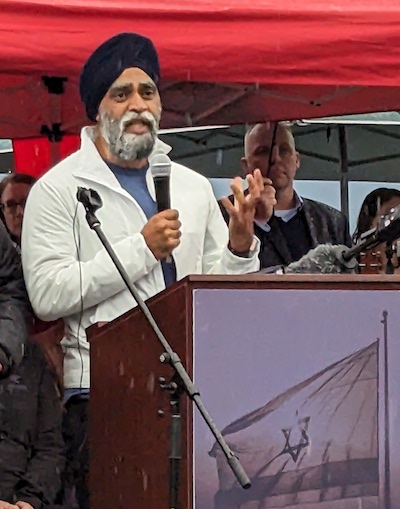
Harjit Sajjan, president of the privy council and minister of emergency preparedness, spoke on behalf of the federal government.
“I know that everyone’s heart is broken because of this brutal terrorist attack, a targeted attack on the Israeli people,” said Sajjan, who is member of Parliament for Vancouver South. “All of you have witnessed and have seen the news and the atrocity that has taken place. Myself and my colleagues here … stand here with you. But I don’t speak here just as a minister but [I am] also speaking to you as a Canadian, as a human being. It hurts so much when we see images from what has just taken place. Your community has gone through this far too often. When we say enough is enough, sometimes those words seem like they have no meaning. But when we come together like this, it gives me hope that we can get through this.”
Harjit Sajjan promised Canada’s government “is with you.” (photo by Pat Johnson)
Across Canada and elsewhere, rallies, public statements and social media comments have celebrated the terror attacks, some, like the president of the Ontario wing of the Canadian Union of Public Employees, lauding them as “the power of resistance around the globe.” Hours before a Jewish community vigil Monday, a rally celebrating the violence was held in the same Vancouver Art Gallery location. Along with many speakers at the Tuesday event, Sajjan condemned the expressions of support for the terror attacks.
“Anybody who glorifies what has just taken place, the atrocities that Hamas has committed, I’m here to say that we denounce you and I denounce you,” he said.
Sajjan referenced his military career, from which he retired with the rank of lieutenant-colonel.
“Over the last two decades, whether in politics or even before, [in] my other job in the military, I’ve seen atrocities committed all over the world,” he said. “And your heart breaks every single time. And you think, what can we do? One thing that always gives me hope is that I look back and remember where I live, in Canada, that we come together, we support one another. That’s how we get through this.
“I remember visiting Entebbe [Uganda] where, you know all too well, when Israeli citizens were taken captive and they were rescued at that time, I went to go pay my respects and remember what took place then. To see the atrocities committed over and over again is something that we all feel today. One thing I’m here to tell you: that we stand by you, we call for the captives to be released, we want humanitarian aid to be flown into all those people who are caught in the middle. But one thing is for sure: our government is with you.”
Other federal officials present were Joyce Murray, member of Parliament for Vancouver Quadra, and Parm Bains, member of Parliament for Steveston-Richmond East.
Message from the province
Selena Robinson, British Columbia’s minister of post-secondary education and future skills, brought greetings from Premier David Eby and the provincial government. She also emphasized the presence of officials from both sides of the legislature.
Selina Robinson, one of BC’s few Jewish elected officials, spoke emotionally of living in a frightening time. (photo by Pat Johnson)
“All of government and all members of the Legislative Assembly stand with me, they stand with all of you, against the horrific violence that was perpetrated by Hamas, a terrorist organization, an organization committed to indiscriminately killing and indiscriminately wiping out the Jewish people,” she said. “As a Jew, I have never in my life experienced a more frightening time. To see and bear witness to the carnage, to the babies, to the children, to young people at a concert.
“The stories that Jewish families have been telling for generations all come swarming back,” Robinson continued, her voice breaking. “The stories of pogroms in Russia and Poland at the turn of the 20th century, the Einsatzgruppen, the Nazi mobile death squads, going house to house killing everyone in their sights during the Holocaust. That is what happened this weekend. This is not a path to peace and it’s not the path to freedom. The Palestinians and the Israelis deserve to raise their families without fear, to grow old with dignity, but this vicious depravity is not the answer. It is not a path for peace for anyone. These last days have been so difficult and there are more hard days to come. So, we ask all of you to please be kind, be thoughtful, be supportive and to take care of each other.”
Opposition leader stands with community
Kevin Falcon, BC United party leader and the province’s leader of the opposition, was scheduled to hold a townhall in Kamloops Tuesday night but he cancelled the event and drove to Vancouver to be present for the solidarity gathering, he said, “Because I think it is important that all public officials stand united in saying … without equivocation, without moral equivocation, to be very, very clear, that we stand with you.”
Provincial opposition leader Kevin Falcon, with MLA Michael Lee. (photo by Pat Johnson)
Condemning terrorist brutality is “something that ought to be really easy,” he told the crowd. “But, unfortunately, in this day and age, it doesn’t seem to be easy for some people to come together and denounce unequivocally the violence and slaughter of innocent civilians in Israel, and to remember the right of that country and those individuals to defend themselves as a fundamental right because we cannot forget.
“We stand with the community and we want you to know that,” he said.
In addition to the government cabinet minister and opposition leader, other provincial officials present were cabinet ministers Brenda Bailey, Murray Rankin, Sheila Malcolmson and George Chow, parliamentary secretaries Mable Elmore and Susie Chant and members of the Legislative Assembly Henry Yao and Michael Lee.
Mayor condemns antisemitism
Vancouver Mayor Ken Sim was flanked by city councilors Sarah Kirby-Yung, Peter Meisner, Lisa Dominato, Mike Klassen and Rebecca Bligh as he expressed solidarity with the Jewish community and promised zero-tolerance for antisemitism.
Vancouver mayor Ken Sim, flanked by councillors, committed to fight antisemitism. (photo by Pat Johnson)
“What happened this weekend in Israel was absolutely horrific,” said Sim. “Our hearts are broken, just like yours…. Vancouver is a city of love, Vancouver is a city of peace, Vancouver is a city of inclusion. This is a place where we celebrate our differences in culture and religion. So, it’s absolutely disturbing and incredibly disgusting, in the city that we live in, the city that we are so proud of, that people were actually celebrating what happened. They are celebrating Hamas. That’s not right. Israel has a right to exist. Israel has a right to protect itself. At the City of Vancouver, we stand for all communities, including the Jewish community — especially the Jewish community, during this incredibly brutal time. You are our brothers and sisters, you are our neighbours, you are our friends, you are our family. Let me be very clear — let us be very, very clear — we will not stand for any antisemitic acts or acts of hatred in the city of Vancouver. We mourn with you, we stand with you, we love you and we will always be here for you.”
Dylan Kruger, a Delta city councilor was also present.
Gathered together as one
Tuesday’s vigil was organized by the Rabbinical Assembly of Vancouver, the Jewish Federation of Greater Vancouver and the Centre for Israel and Jewish Affairs.
Rabbi Jonathan Infeld of Congregation Beth Israel, and the head of the rabbinical assembly, spoke of the relentlessness of antisemitism.
“I am standing here as a neighbour of Ben Mizrachi and his family, in sadness and in grief,” said Infeld. “I am standing here today as the father of a young man who is currently in Jerusalem. I am standing here today as the child of Holocaust survivors who never met his grandparents or aunts or uncles because they were murdered as children because of antisemitism. Never would I have imagined again in my life that we would see 40 children, 40 babies in one day, discovered, who were murdered in cold blood because of antisemitism. Never would I have imagined in my life that we would see almost a thousand Jews in one day murdered because of antisemitism. Throughout the day, I’ve been asked, what is this moment about? This moment today, together, as one people, one community, Jews and non-Jews gathered together for solidarity, gathered together to mourn and gathered together to give strength to one another. We are so grateful to our politicians and to our leaders who really, truly, are leaders. All of you sitting here today, you are the leaders. You are sending the message that there is no similarity in morality, there is no equivalence in morality, between those who celebrate murder and those who are gathered together for peace.”
Iranian community members showed solidarity. (photo by Pat Johnson)
Federation leader sends message from Egypt
Jason Murray, vice-chair of the board of the Jewish Federation of Greater Vancouver, read a message from the board’s chair, Lana Marks Pulver, who, with her husband Doug, is in Egypt, leading a group of almost 100 Canadian business leaders in a mission that was slated to travel to Israel in the coming days.
“I share this with you so you know how close I am to the situation both physically and emotionally,” wrote Marks Pulver. “There were two Israeli tourists murdered by a police officer in Alexandria [Egypt]. We continued on with our tour of Egypt much to the chagrin of family and friends. We continued because we will not allow them to win. Never again.
“As for emotion, our 21-year-old niece and 19-year-old nephew are serving in the IDF and are stationed near Gaza. We are feeling sick about what’s happening in Israel and we are feeling sick about the celebratory rallies happening in Canada, rubbing salt in our fresh wounds. How can Canadian citizens possibly justify the celebration of rape, killing and kidnapping of innocent Jews, online and in public rallies? It’s both horrifying and heartbreaking that this is happening in our own backyard. Jews throughout history have consistently proven that we are resilient. This time is no different. Israel will prevail. We as a people will not allow evil to win. Despite thousands of years of antisemitism and countless attempts to annihilate our people, we always come back stronger and more unified as a community.
“I am confident that this time is no different,” she continued. “Let us pray this all ends soon, that Israelis move forward with their lives in safety and that we as a Jewish people proudly stand in our fight against hatred and our desire to live in peace. Am Yisrael chai.”
Gratitude for allies
Ezra Shanken, chief executive officer of the Jewish Federation of Greater Vancouver, praised the elected officials who attended and the police who provided security at the event.
“Often, we see public officials at our events and it’s special then,” he said. “But it’s even more special now. To have this incredible representation of folks behind us and around us in this moment is not something that I take for granted, not these days.”
Ezra Shanken and Karen James (photo by Pat Johnson)
In addition to elected officials, Shanken noted the presence of consuls general from France, Germany and Italy, as well as representation from the consulate of the United States.
Karen James, chair of the local partnership council for the Centre for Israel and Jewish affairs, Pacific region, lauded the unity of the Jewish community.
“I have always known that we are family, but I’ve never felt it so strongly as I do now,” she said. “Tonight, we are hurting. Our hearts are broken but our resolve has never been stronger.”
Severe audio problems plagued the event, which came a night after an earlier vigil, at the Vancouver Art Gallery, planned by Daphna Kedem, who is the lead organizer of UnXeptable Vancouver, though the event was not affiliated with any group. ( To read more about the Monday night vigil, click here.) At that event, a small group of provocateurs were kept apart from the main vigil by a phalanx of police. Police were also omnipresent at the Tuesday event, while protesters were nowhere to be seen.
Speakers at the event urged people to contribute to the emergency fund for victims and to access available mental health supports as needed. Federation’s website, jewishvancouver.com, is the access point for all relevant local resources.
Jewish Vancouverites and allies came together in grief and determination in a community vigil Monday night, Oct. 9, outside the Vancouver Art Gallery. (photo by Pat Johnson)
Several hundred Jewish Vancouverites and allies came together in grief and determination in a community vigil Monday night outside the Vancouver Art Gallery. The unprecedented terror attacks in Israel that began Saturday brought a large crowd to the public venue in light rain for an emotionally charged hour of prayers, songs and shared stories of tragedy and resolve. The uncertain fate of a young Vancouver man who had not been heard from since Saturday brought the immediacy of the tragedy home. Hours after the vigil, it was announced that the body of Ben Mizrachi had been identified.
“A piece of this community is missing,” said an audience member who addressed the crowd and identified himself as Adam. “His name is Ben Mizrachi.”
Mizrachi, who graduated from King David High School in 2018, was attending a music festival in Re’im, in southern Israel near the Gaza border. An estimated 260 people were murdered as terrorists invaded the event around 7 a.m. Saturday. Mizrachi had not been in contact with family or friends since, according to news reports and messages from Vancouver friends. Late Monday Vancouver time, it was announced that he had been murdered.
The Monday night vigil was organized by UnXeptable Vancouver. (photo by Pat Johnson)
“Every one of us here is feeling grief, is feeling loss,” said Adam. “We are all individuals here, but we are one nation and our nation has one heart. We will look at these candles, we will look at the light, we will look at all the universes they stole from us and we will say, this light will drown out that darkness.”
Leslie Benisz, who spent his first 10 years in Israel, spoke of his own family’s tragedy.
“I have a cousin and her husband who, unfortunately, were killed,” he said, “and, still, at this moment, we do not know the whereabouts of her four children. They were living on a kibbutz near the Gaza area.”
Benisz said his mother, who passed away in March, had advice for times like these.
“My mother used to say, ‘We have to be better than those people who hurt us. Just because they hurt us, don’t do the same thing to them. Maybe even show a level of tolerance and compassion they failed to show us, because there is a fine line sometimes between becoming a human being and becoming an animal and we have to show that we are better than that.’”
A small group of provocateurs carrying Palestinian flags, kept away from the vigil by police, screamed and taunted attendees throughout the event, including during two moments of silence, and vehicles repeatedly circled the venue, their occupants waving Palestinian flags and honking horns. A rally – ostensibly in support of Palestinians – was held several hours earlier at the same location as the vigil.
Monday’s event was organized by Daphna Kedem, who is the lead organizer of UnXeptable Vancouver, though the event was not affiliated with any group. The ad hoc vigil was organized before the Jewish Federation of Greater Vancouver scheduled a community solidarity event for the following evening, Oct. 10. Coverage of Tuesday’s event, which took place after the Independent went to press, is now online at jewishindependent.ca.
Daphna Kedem, one of the organizers, told the Independent that bringing the community together as soon as possible for mutual support was their priority. While awaiting notification of an event by community leaders, Kedem said, her group decided to schedule a gathering with haste.
“We are not waiting around for the community,” she said. “This is urgent and time-sensitive.”
“We are in the west, but our hearts very much are in the east,” said Rabbi Dan Moskovitz, senior rabbi at Temple Sholom. “We hold our loved ones and our families in those hearts and we come together as a community to pray and to mourn but also with resolve and resilience.”
Speaking above taunts and screaming from protesters on the sidelines, Moskovitz continued: “That’s what we want: to live in peace, to live in our native land in peace, to be together as human beings. Too often, the world ignores us. Too often, the silence is deafening. We who stand here today, we make our presence to call the world to conscience and to see us, to see how once again our people are in danger, our people are being killed and murdered and the world must not be silent again. We will not be silent. We are strong, we are a people with a nation now for the first time in 2,000 years and it will not slip from our grasp, it will not slip from our hearts or our minds or our prayers.”
Ofra Sixto, chef-owner of the Denman Street Israeli restaurant Ofra’s Kitchen, recounted her story of being harassed and of having her life threatened three years ago during a different time of conflict between Israel and Hamas. Then she made a prayer for those missing and for the survivors of those murdered.
“Please God, make them all come back home soon,” she said. “Please God, put solace in the hearts of the people who lost their loved ones.”
Another speaker recalled a year living near the Gaza Strip and hearing the endless sounds of explosions.
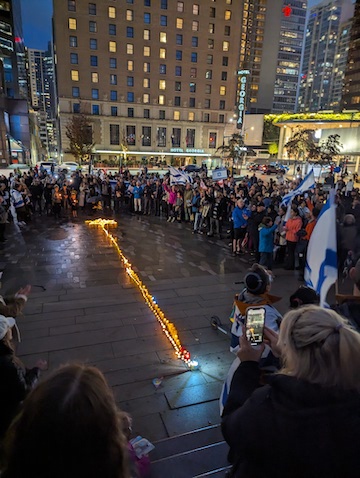
Memorial candles were placed in the shape of a Magen David. (photo by Pat Johnson)
“We are here tonight to remind ourselves and our people back in Israel that we are all one country, we are all one family, we are all together in this, united,” said another speaker. “Despite the tough year it’s been, with different opinions, we are all sticking together, especially when it gets tough. That’s our biggest strength.”
She then led the vigil in the song “Am Yisrael Chai.”
“My sister was sitting 13 hours in a shelter room and the terrorists roaming her kibbutz didn’t touch their home,” another speaker from the audience recounted. “It was a miracle.”
He added: “The one thing that our enemies cannot do is put a divider between the Jewish people and eretz Israel. Please remember that. There is no Jewish people without Israel and there is no Israel without the Jewish people.”
“This horrific attack was an attack on Israel,” said another member of the audience who spoke. “Moreover, it was an attack on all of those who value human life. I know that some people are of the belief that you are left to fight this battle alone. I’m neither Jewish nor Israeli and I’d like to tell you that there are millions of people around the world standing together with you. This includes me and many, many, many others.”
“We have a very simple message to the world today,” said Rabbi Shmulik Yeshayahu of the Ohel Ya’akov Community Kollel. “When we see those guys on the other side, and we see our crowd tonight, state proudly … we are human beings. We treat people fairly. We love Israel, we love humanity, we love the civil world.… We will never let terrorism take over. This is the message of Canada and all the Western world today.”
Yeshayahu lamented the hostages taken.
“We are talking about over 100 people, many of them little kids who were kidnapped, old people who survived the Holocaust and came to the holy land of Israel to live in a free country,” he said. “We are here for them.… No human being can stand by and see those bastards take little kids and kidnap 3-year-old kids and put them in a cage. This is not acceptable in 2023 and we are not going to be quiet about it. The eternal nation is not afraid of a long journey. We will defeat them.”
Rabbi Carey Brown, associate rabbi at Temple Sholom, said the prayer for Israeli soldiers in Hebrew, while a lone soldier who had served in the Israel Defence Forces a decade ago, shared the prayer in English. Rabbi Jonathan Infeld of Congregation Beth Israel led El Maleh Rachamim, the prayer for the souls of the departed.
After the main vigil, the Independent spoke with a number of attendees.
“With the horrors that happened in Israel, and all the innocents killed, bodies desecrated, kids getting kidnapped, I just had to come and show support,” said Adar Bronstein, who moved to Canada from Israel a decade ago. “I think local Jews and Israelis don’t really protest much. We’re actually quite a quiet society overall, so, when something as big as this happens, we have to make some sort of a stand. All my friends over there have been drafted and my Facebook page is full of my friends posting about their killed loved ones. My family is there and they are terrified. It’s been very, very difficult.”
“What brought me out tonight was seeing things that I didn’t think I would ever see in my life,” said Alex Greenberg. “This is my family, this is my people. I came just to show that people in Israel have support.”
Jillian Marks was huddled in a group of young women, some hugging and wiping away tears. The alumna of Vancouver Talmud Torah and King David is now a University of British Columbia student and president of the Israel on Campus club.
“We need to show that we are together, that we support each other in these times,” said Marks. “Just being here is a mitzvah and a blessing. I think it’s quite surreal. I have people fighting on the front lines. I have people missing. I have friends missing and friends hiding in bomb shelters. I’m just sad. But I’m grateful for the community here in Canada. I’m grateful we are all together tonight.”
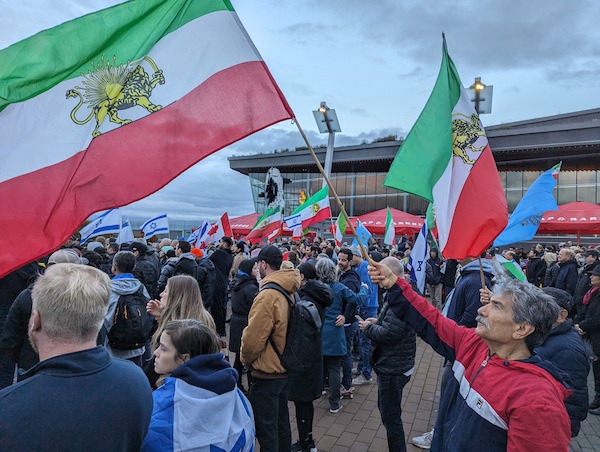
A small group of Iranian Canadians waved the national flag of Iran – not the flag of the Islamic revolutionary government.
Dr. Masood Masjoody, a mathematician and activist against the Iranian regime, said he came “to show support for Israel and the Israeli people.”
He said he was surprised that anyone would be surprised to see him there.
“We’ve been dealing with the regime that has been behind these heinous attacks for more than 40 years – 44 years – so we know this regime more than any other nation in the world,” he said, referring to the Iranian regime’s support for anti-Israel terrorism.
There are many organizations through which people can donate to help Israel, including the Jewish Federation of Greater Vancouver’s Israel Emergency Campaign, at jewishvancouver.com/israel-fund.
A scene from Site: Yizkor as it was performed in Sichów Duży, Poland, this past June. (photo from Chutzpah!)
Site: Yizkor is both an intensely personal work and a powerful, universally meaningful work. It is ever-changing and spans the past, present and future.
“For me, this project is a gesture of healing,” co-creator Maya Ciarrocchi told the Independent. “My goal for audiences and participants is that, through the process of shared commemoration, we may put aside our differences and look towards a reimagined future.”
Part of this year’s Chutzpah! Festival, Site: Yizkor is a collaboration between Canadian multimedia artist Ciarrocchi and American composer Andrew Conklin. It is an evolving “interdisciplinary project [that] explores the physical and emotional manifestation of loss through text, video and music.” It is an installation (of video, prints and drawings) and a performance, and includes workshops “where participants are invited to create their own Yizkor pages as a way to mourn and commemorate lost people and places.”
“Yizkor books are documents written by Holocaust survivors to commemorate the villages they lived in before the Second World War,” explained Ciarrocchi. “They capture the spirit of these places by describing the day-to-day life of their Jewish citizens. They include lists of the Jewish residents, the structure of political systems and where the best shopping could be found. They also include photographs and maps of the villages drawn from memory. They document a time and place that no longer exist but the traces of which are visible in the contemporary landscape.”
In introducing the project to workshop participants, Ciarrocchi said, “I tell them that, while Site: Yizkorexamines displacement through the lens of Yizkor, which is an inherently Jewish framework, the project is not limited to the Jewish experience. Site: Yizkor is centred on creating a space for shared commemoration and the universal experience of loss.”
For the local presentation, Conklin works with a local string quartet for the performance, while Ciarrocchi creates “video projections for the performance that include references to the known and erased histories of Vancouver,” and installs the exhibit in the gallery. She leads the workshops, which include both Jewish and non-Jewish community groups, and participants “are invited to read their text as part of the performances or share them as written documents or drawings as part of the exhibition.”
Site: Yizkor has been presented in New York City and in San Francisco. In June of this year, it was presented in Poland, from where Ciarrocchi’s maternal grandfather immigrated to Canada; Ciarrocchi was born in Winnipeg.
The project began in 2018, when Ciarrocchi was a fellow in the Laboratory for Jewish Culture program in New York City. “At the time,” she said, “I was working on a series of drawings depicting former Polish and Lithuanian wooden synagogues layered with memory maps sourced from Yizkor books. As part of the project, I gave a performance lecture where I read passages from Yizkor books, accompanied by projections of my drawings, maps and photographs from Yizkor books. I concluded the performance by prompting the audience to ‘describe a vanished place of personal importance.’ I collected these texts, and they were incorporated into future performances.”
Andrew Conklin (photo from Chutzpah!)
She met Conklin around when she was in residency at Millay Arts in upstate New York. “He expressed interest in using my drawings of maps as a musical score,” she said. “We then started working on a sound/video project comprising his compositions and my animated maps and drawings.”
In 2019, Ciarrocchi was invited to attend an international meeting of interdisciplinary artists in Poland.
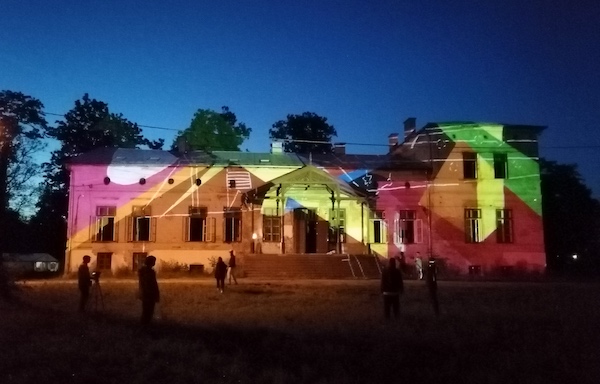
“The group gathered in Sichów Duży, a rural area not far from Staszów, a small town that was once an important centre of Jewish life,” said Ciarrocchi. “The site once belonged to an aristocratic family who lost their lands and titles during the Second World War. The buildings had been restored except for one and, one evening, I projected the video on its surface and played Andrew’s music from speakers inside. It was then I knew that I needed to return to this place and present the work live with musicians inside the structure. In June 2022, after three years, a pandemic and a war, I returned to Sichów with a team of musicians from the U.S., Germany and Poland. We presented Site: Yizkor inside the ruin to an audience comprised of Ukrainian refugees who were being housed on the site. The following week, we presented Site: Yizkor in another ruined manor home outside of Kraków. That iteration included dancers as well as musicians.”
It was an emotional experience.
“Gratitude and relief,” said Ciarrocchi about what she felt afterward. “Gratitude to Andrew and the incredible team of performers we assembled and to the funders who supported the work. Relief after all the planning and delays that we were finally able to bring the work to Poland. It was also exciting to see the project come together so beautifully. In many ways, my first research trip in 2019 was where I felt all the sadness and grief. This year, I was too busy to let myself go into the dark crevasses of my emotions. In 2019, though, I spent most of the three weeks I was there crying. I visited my grandmother’s shtetl, which was incredibly powerful. While sitting on the ground in the old Jewish cemetery there, I released all my grief. Poland is filled with ghosts. One does not help but feel their presence.”
It is in this context that the question asking workshop participants to “describe their dreams of the future” was added to the project.
“I added this part of the prompt in Poland,” said Ciarrocchi. “I realized that, understandably, so much of the Jewish experience there is about memory and the past. I’m two generations removed from the Holocaust and, while its effects are written into the code of my body, I am also interested in how we create something new from the residue of this loss. This also comes from these past years of the pandemic, when there has been such a huge loss of life. We’ve had to reimagine how we live now and in the future.”
The performance and exhibition of Site: Yizkor in Vancouver is the Canadian première of the work.
For a recent grant proposal, Ciarrocchi wrote about the première, “This event will also be a coming home. Site: Yizkor is rooted in research into the land and architecture of a place in relation to the known and mythological histories of my ancestors who fled Poland and Lithuania before the Second World War. My ancestors emigrated to Canada to form a new life for themselves and their descendants. On the surface, their story is one of success. My great-grandfather was a seminal figure in Winnipeg’s garment industry, and my family still benefits from his accomplishments. This story belies how the effects of trauma and displacement have persisted from their origins in Eastern Europe so many decades ago. Forming cross-cultural connections through Site: Yizkor’s performance and workshop model, first in Poland and now in Canada, irrigates ancient inherited wounds.”
Site: Yizkor is co-presented with the Zack Gallery and in partnership with the Vancouver Holocaust Education Centre, with the support of the Jewish Community Foundation. The performance takes place Nov. 19, 8 p.m., at the Rothstein Theatre, and it will livestreamed and available on demand; it will include a facilitated talkback and a reception with the artists. The exhibition and workshops take place Nov. 12-19 in the gallery. For tickets and more information, visit chutzpahfestival.com.
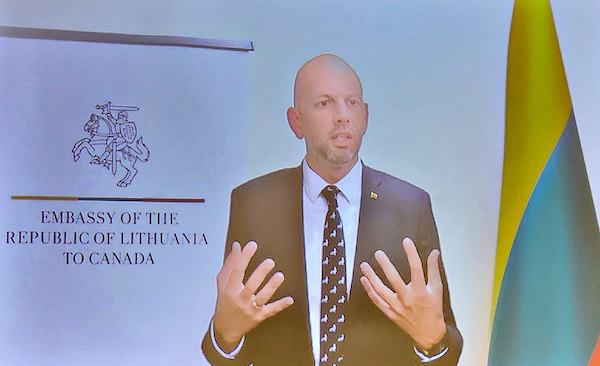
Lithuania’s ambassador to Canada, Darius Skusevičius, greets participants in pre-recorded video. (photo from Lithuanian Community of BC)
As a young teen growing up in Vancouver in the 1960s, I used to be puzzled by Remembrance Day. We were given red poppies at school to honour the soldiers who served Canada during the First and Second World Wars. But I knew my parents had also experienced war, and their families – my grandmothers, aunts, uncles, cousins, even my half-brother and stepsister – had been horribly murdered. Why were there no red poppies for them and the six million others who had died in the Holocaust? Where were their memorial parades, their wreaths?
In Vancouver’s Peretz School, which I attended a couple of afternoons a week to learn about Jewish culture, we commemorated Yom Hashoah, which was established by the Israeli government in 1959. Our commemoration was a small event, important to staff, students and families, but ignored by Canadian society in general. It was not until 2005, when the United Nations General Assembly established Jan. 27 as International Holocaust Remembrance Day, that non-Jews as well as Jews began to join in collective memorialization – or so I thought until quite recently.
In 1994, the Lithuanian Parliament established Sept. 23 as National Memorial Day for the Genocide of Lithuanian Jews. Every Sept. 23, the anniversary of the liquidation of the Vilna (Vilnius) Ghetto, commemorative activities are held at Lithuanian memorial sites, in schools and in other educational institutions. Government institutions, with the support and involvement of local Jewish communities and survivors’ groups, shape the content of these activities, and Jewish and non-Jewish Lithuanians regularly participate in them.
A few years ago, I joined the Lithuanian Community of British Columbia (LCBC), where I currently serve on the board of directors. This year, on Sept. 22, with the support of the Vancouver Holocaust Education Centre (VHEC) and generous volunteers from Lithuanian and Jewish communities, LCBC and its partners, National Memorial Day for the Genocide of Lithuanian Jews was commemorated. The event, which took place at the Peretz Centre for Secular Jewish Culture in Vancouver, was held for the first time in Canada.
Participants were welcomed by Algis Jaugelis, president of the LCBC, followed by opening remarks by Nina Krieger, the executive director of the VHEC. The ambassador of Lithuania to Canada, Darius Skusevičius, kindly provided a recorded welcome to the event, followed by a written statement from Christopher Juras, the honorary consul of Lithuania in Vancouver.
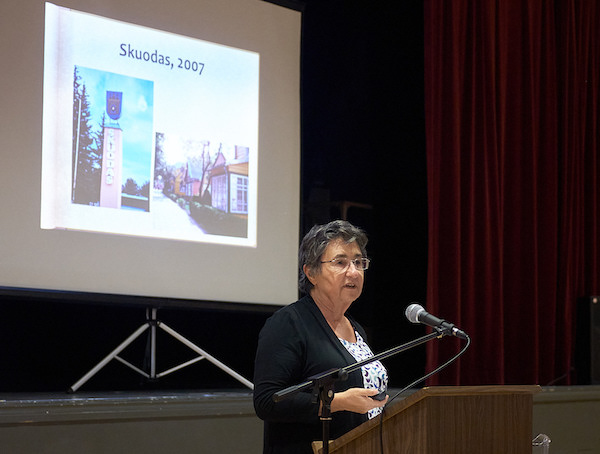
LCBC member and historian Dr. Gene Homel presented an overview of Jewish life in Lithuania from the 1300s to the present day. I gave an illustrated presentation on the Jewish community in my father’s ancestral town in Lithuania, using photos and information found in my research.
Rachel Mines characterizes the lives of the Jewish residents of Skuodas, Lithuania. (photo from Lithuanian Community of BC)
Helen Mintz, a Yiddish translator, read a selection from one of her translations of Abraham Karpinowitz’s short stories. Karpinowitz, the son of a theatrical family in Vilna, survived the Holocaust and later wrote several volumes of stories memorializing prewar Jewish life in Vilna.
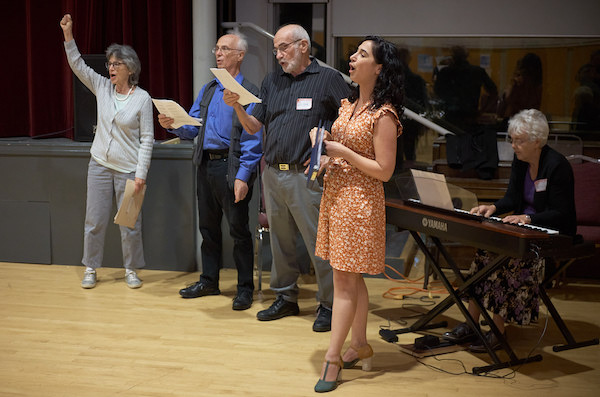
The ceremony ended with the singing of the “Partisans’ Song” / “Zog Nit Keynmol,” written by Hirsh Glick in the Vilna Ghetto, which was followed by a recording of Glick’s words translated into Lithuanian and read by high school student Giedrius Galvanauskas under the auspices of Eli Rabinowitz’s We Are Here! international educational project.
The ceremony ended with the singing of “Zog Nit Keynmol.” Left to right are Celia Brauer, Alan LeFevre, Victor Neuman and Kathryn Palmer. At the piano is Cathrine Conings. (photo from Lithuanian Community of BC)
Lithuanian and non-Lithuanian participants found the remembrance ceremony both educational and emotional, and emphasized the importance of dialogue and reconciliation. According to Jaugelis, it was “an important and moving event, an opening of doors and minds, with great potential for future intercultural and bridge-building events.” Andrea Berneckas, another LCBC director, wrote, “It was such a privilege to be part of this solemn, yet beautiful and hopeful event. I look forward to being part of the Lithuanian community’s strengthening of ties by the sharing of stories and experiences.”
“I look forward to more opportunities to bring the communities together,” said Krieger. And Celia Brauer, a local Yiddishist whose parents survived the Holocaust in Latvia and Poland, summed up the general feeling: “We are far away from the original homeland, yet this event brought people closer together – which is incredibly important.”
National Memorial Day for the Genocide of Lithuanian Jews is now on LCBC’s yearly calendar of events and the next memorial will take place in September 2023.
More information about the Lithuanian Community of British Columbia can be found at lithuaniansofbc.com.
Rachel Mines, the daughter of Holocaust survivors, was born and raised in Vancouver. As a child, she attended classes at the Peretz School (now the Peretz Centre for Secular Jewish Culture) and served on Peretz’s board of directors 2015-2016. Mines, whose Lithuanian citizenship was reinstated in 2022, now serves on the board of directors of the Lithuanian Community of British Columbia.
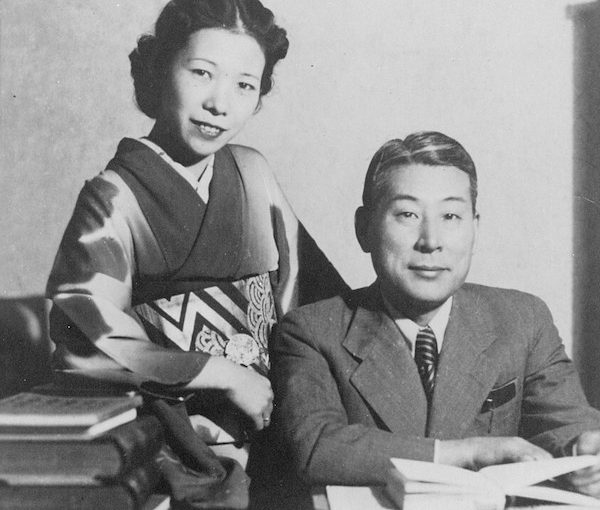
Yukiko and Chiune Sugihara (photo from Firehall Arts Centre)
It is written in the Mishnah that, “If you save the life of one person, it is as if you save the entire world.” Chiune Sugihara saved 6,000 Jewish lives – 6,000 worlds – in the summer of 1940, despite the dangers of doing so to himself and his family.
A new play about Sugihara sees its world première at the Firehall Arts Centre this month. Written by Japanese-Canadian actor and playwright Manami Hara, Courage Now opens Nov. 19.
Contrary to his government’s strict instructions to not issue visas to Jewish refugees, Sugihara, the Japanese consul in Kaunas (Kovno), Lithuania, handwrote in a 30-day period more than 2,300 visas for Jews trying to escape from Europe via the Soviet Union to Japan. Sugihara was a husband, a father, a career diplomat, a linguist, but, above all, with his strict Samurai upbringing, he believed in respect for, and sanctity of, human life. As he said, “They were human beings and they needed help.”
Sugihara’s actions are responsible for more than 40,000 Jews being alive today. Yet, after the war, the Japanese government dismissed him from diplomatic service and treated him as a persona non grata. However, Israel has honoured his courage and his memory on three occasions – in 1985, by recognizing him as one of the Righteous Among the Nations at Yad Vashem; in 2016, by naming a street in Netanya after him; and, in October 2021, by dedicating Sugihara Square in Jerusalem.
In an interview with the Independent, playwright and actor Hara talked about the journey that led her to write Courage Now.
“About 12 years ago, my mentor from Studio 58, Jane Heyman, approached me and asked if I knew about Sugihara and I said that I did not. She told me his story, that her parents and uncle had been saved by him and that she would not be here if not for his actions. We talked about collaborating on a play. Her story and my being Japanese made it very personal for me, as I was very embarrassed by how the Japanese government treated him after 1945.”
Getting a play from conception to the stage is a long process.
“I heard that a Japanese playwright, Hiraishi Koichi, had written about Sugihara. I got a hold of his play, translated it into English and worked with Jane on it but it just did not seem dramatic enough,” said Hara. “I talked to Koichi and asked if I could adapt the play and he gave me permission. So, I researched the Jewish families who were Sugihara survivors and created more scenes. But it still did not seem to have the theatrical weight it needed to be a success so I put it away for a couple years, as I felt I had lost my vision.
“About five years ago, I traveled to Japan and had a chance to speak to Sugihara’s daughter-in-law and two of his grandchildren, which gave me a firsthand intimate look into his life and that of Yukiko, his wife. Then it dawned on me that the way to tell the story was from two female points of view, that of Yukiko and of a child survivor, Margaret. So, I went back to the story and after many years of writing drafts and workshopping, here we are.”
There are five characters in the play: Sugihara, Yukiko, a young Margaret, an adult Margaret (Jewish community member Advah Soudak) and young Margaret’s father (community member Amitai Marmorstein). Margaret is a fictional character, created from the stories of many survivors. Scenes are set up to move between the Lithuanian summer of 1940 and mid-1980s Vancouver, where an adult Margaret now lives.
Hara does double duty in this production, as the playwright and performing as Yukiko. “It is difficult to switch, wearing both hats, you feel like you have a split personality,” she acknowledged. “However, I take off my playwright hat and then I concentrate on my character in terms of what are her needs, where should I be focused and what is happening with the other characters. So, when I am on stage, I am the actor and I let the director take over from there. If he or the other actors see anything that needs tweaking or fixing, they will let me know. It is a very collaborative process. We are three weeks from opening and still finalizing many of the details.”
Hara sees her character as a spirited, stubborn, strong woman, not as stereotypically subservient, but rather as someone who also was idealistic and who was supportive of her husband in all that he did. “She knew the risk to her family and the sacrifice that would have to be made in carrying out her husband’s plan to save the Jewish refugees,” said Hara. “It is an amazing role and I am so honoured to be able to bring this story to Vancouver audiences. I hope the audience takes away that there is always hope, that there is always a way to find courage to walk towards that hope and one should never give up.”
Director Amiel Gladstone got involved in the project, having worked with Hara before.
“She was looking for the right kind of collaborative director for the show and she reached out to me because I work so much with new plays,” said Gladstone in a telephone interview with the Independent. “She told me that she had been hoping for a Jewish director…. I told her that my father was Jewish.”
As to the play, he said, “It is a memory play dealing with two women trying to piece together what happened to them years ago during those dark times. We had to create a space that includes both 1940 and present-day locations: a Japanese home and garden, a Jewish refugee apartment, the Kaunas consul office, a park, the train station, with all the locations in view at the same time. It becomes a dream world, where the actors move from set to set as they go back and forth in time. Itai Erdal’s lighting design will inform the audience as to the change in time and place.” (Erdal is also a member of the Jewish community.)
Soudack’s character, in her 50s, is going through a difficult separation and divorce. In an interview with the Independent, Soudack explained, “She realizes that she has a big hole in life, as she does not know what happened to her parents. She travels to Japan to seek out Sugihara and to ask about her father but learns that Sugihara is dead (he died in 1986) so she looks to Yukiko for answers. At the same time, Yukiko is also going back and remembering that time through her interaction with Margaret.”
Soudack had to grapple with capturing the essence of Margaret’s psychological issues, including post-traumatic stress disorder.
“She has broken pieces of memory that she wants to fit together. She has had a difficult life,” said Soudack. “It must have been terrifying to be leaving your family, everything you know and being put on a train and sent off on your own. She has a lot of anger, sadness and abandonment and betrayal issues. She does not form close loving relationships very easily, as she learned that people closest to her disappear. She has to work through all this as she seeks the truth.”
Working with Hara has been a treat, said Soudack. “It is fabulous with the playwright right there so, when a question comes up, she can give us the explanation. It is a beautiful sense of collaboration, respect, joy and appreciation of what she wrote and it is a gift to be right there with her working through this project.”
As to being a Jewish actor in this role, she said, “As a Jewish person, you grow up with the Holocaust and the plight of the Jews – it is so part of our DNA that, when you come across a story and people that you never heard of, it makes you have such gratitude and respect for these non-Jewish heroes who, in the face of so much antisemitism, still found the courage to do the right thing. If I could meet Mr. Sugihara, I would hug him, look him in his eyes and thank him for his bravery and courage.”
Courage Now runs to Dec. 4. For tickets, visit firehallartscentre.ca or call the box office, 604-689-0926.
Tova Kornfeldis a Vancouver freelance writer and lawyer.
Ephraim Mirvis, chief rabbi of the United Hebrew Congregations of the Commonwealth, issued a special prayer in English and Hebrew to mark the passing of Queen Elizabeth II. It was shared by Beth Israel’s Rabbi Jonathan Infeld at the opening of the Jewish Federation of Greater Vancouver annual campaign Sept. 8, hours after the Queen passed away.
“In an age of profound change, she signified order and justice; and in times of tension, she offered generosity of spirit,” the prayer read. “A defender of faith with an unfailing sense of duty, she was a steadfast guardian of liberty, a symbol of unity and a champion of justice in all the lands of her dominion.… In life, she was a most gracious monarch, who occupied a throne of distinction and honour. In death, may her legacy inspire the nations of the world to live together in righteousness and in peace.”
History’s longest serving British monarch, Elizabeth II passed away 70 years and 214 days after ascending the throne upon the death of her father, King George VI.
Canada’s Governor General Mary Simon paid homage to the Queen and, on Monday, the government announced that Simon and Prime Minister Justin Trudeau, perhaps accompanied by others, would represent the country at the monarch’s funeral Sept. 19.
President Isaac Herzog will represent Israel at the Queen’s funeral. Jewish leaders around the world joined others in lauding the Queen’s service.
In 2005, the monarch attended a ceremony commemorating the 60th anniversary of the liberation of Auschwitz. According to reports, she refused to be ushered away by staff, instead remaining to speak individually to the attendees and listening to each of their experiences of survival.
“She gave each survivor – it was a large group – her focused, unhurried attention. She stood with each until they had finished telling their personal story. It was an act of kindness that almost had me in tears,” the late British chief rabbi Lord Jonathan Sacks wrote afterward. “One after another, the survivors came to me in a kind of trance, saying: ‘Sixty years ago I did not know if I would be alive tomorrow, and here I am today talking to the Queen.’ It brought a kind of blessed closure into deeply lacerated lives.”
Queen Elizabeth II was patron of the Holocaust Memorial Day Trust, a British government-funded charity that promotes International Holocaust Remembrance Day.
Buckingham Palace seems to have maintained an unspoken boycott of Israel, one of the countries the Queen never visited, although she met many Israeli leaders and knighted the former prime minister and president Shimon Peres.