Skip to content
  • Home
  • Subscribe / donate
  • Events calendar
  • Business Directory
  • FAQ
  • News
    • Local
    • National
    • Israel
    • World
    • עניין בחדשות
      A roundup of news in Canada and further afield, in Hebrew.
  • Opinion
    • From the JI
    • Op-Ed
  • Arts & Culture
    • Performing Arts
    • Music
    • Books
    • Visual Arts
    • TV & Film
  • Life
    • Celebrating the Holidays
    • Travel
    • The Daily Snooze
      Cartoons by Jacob Samuel
    • Mystery Photo
      Help the JI and JMABC fill in the gaps in our archives.
  • Community Links
    • Organizations, Etc.
    • Other News Sources & Blogs
  • JI Chai Celebration
  • JI@88! video

Recent Posts

  • SFU honours Gloria Gutman
  • Lifting people’s spirits
  • Wedding a ray of light
  • Indigeneity and Zionism
  • Rule of law broken: councilor
  • Football and its roles
  • The burden of defence
  • Fish Café returns after fire
  • All right in what goes wrong
  • Nuns & mermaids at TUTS
  • Camp offers holiday retreat
  • Students and mentors inspire
  • Once-in-a-lifetime trip
  • 100 dancers, one heart
  • Money for the sciences
  • What “Jewish food” means
  • Have a cookie, schnitzel too
  • Federation now across BC
  • Israel fighting for its existence
  • Deal strengthens Iran
  • Patriotic belonging diminishes
  • A campaign to engage
  • Upstanders’ first live event
  • Responding to Carney
  • Having your own home
  • Music a family tradition
  • Musical to warm heart
  • Community milestones … June 2026
  • Sharing her passion for Israel
  • Or Shalom reopens its doors
  • JFS from past to future
  • Need holistic approach
  • Sharing stories, advice
  • Journalist shares fears
  • Skills to live together
  • Road to independence

Archives

Follow @JewishIndie
image - CJN box ad Rockowers 2026

Tag: lifestyle

Story about friendship

Story about friendship

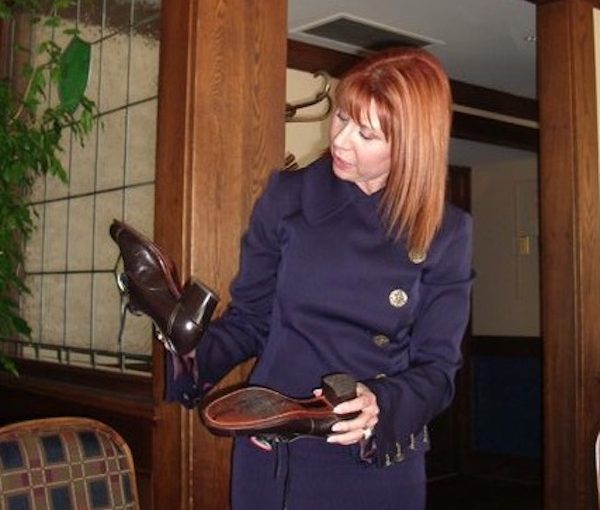
Penny Sprackman receives the special shoes on her 60th birthday, in 2006. (photos from Shirley Barnett)

Some things just happen and, before long, they become a tradition. In 1987, Harvey Shafron, while working at Freedman Shoes on South Granville, came across a rather clunky pair of women’s shoes on a top shelf and gave them to his sister, Rhoda (Shafron) Brickell.

Brickell, in turn, presented them to her friend Lola Pawer for her 50th birthday. Since then, the shoes have been passed from friend to friend among a group of Vancouver Jewish women on birthdays that end in a zero or five.

“It just happened,” said Shirley Barnett, a two-time recipient – on her 60th and 70th birthdays. “It became kind of fun to say, ‘Oh my God, it’s the shoes again.’”

The pair is not casually delivered; the recipient is formally presented the shoes at a celebration, usually at a restaurant, in front of the assembled pals.

“I really believe, as they were passed around, that it’s a story about friendship,” Barnett said. “When you reach a special age of some sort, everybody seems to say girlfriends are really important. It doesn’t matter if you’re divorced or widowed or you’re still married. At a certain age – and that could be 60, 70, 80 or 90 – a light seems to go on in women’s heads that says girlfriends are important. They are the ones you call in the middle of the night – maybe not, maybe you call your kids, I don’t know – but there seems to be an unwritten code that the older you get, you just need a few good girlfriends.”

photo - The “traveling shoes”
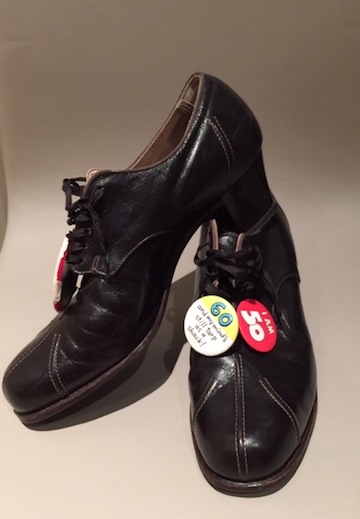
The “traveling shoes.” (photo from Shirley Barnett)

The size 8C shoes have fit every recipient, Barnett said. A ceremonial walkabout by the birthday celebrant is a part of the ritual.

Leslie Diamond and Pawer have received the shoes five times. Sylvia Cristall and Darlene Spevakow have received them four times. Karla Marks is a three-time recipient and Carole Chark and Penny Sprackman have gotten them twice. Others who have been honoured with the pair are Maja Mindell, Shelley Lederman, Anita Silber, Sandy Magid, Esther Glotman and Cynthia Levy.

At the start, the names of the recipients were written on the soles of the shoes but, as Dorothy Parker said, time wounds all heels, and the inscriptions have become mostly illegible.

What has remained indelible are some of the remarks made by recipients over the years. Barnett, who is sort of the informal archivist of the group, has collected words of wisdom shared over the years.

“It is the friends we meet along life’s way who make the trip more fun,” said one birthday celebrant.

“Friends make good things better and bad things not so bad,” said another.

“Being older sets you free,” reflected one. “You care less about what other people think, you no longer need to question yourself. You have earned the right to be wrong and not think about what could have been or what will be.”

On one birthday, a friend declared: “Remember, growing old is a privilege and old friendships are rare. So, when your ‘old’ friends reach for your hand, grab it.”

Another gem Barnett has collected: “The better the friend, the less cleaning you have to do before they come over!”

Format ImagePosted on February 22, 2019February 21, 2019Author Pat JohnsonCategories LocalTags friendship, lifestyle, Shirley Barnett, shoes, women
Retirement offers new path – the Accidental Balabusta

Retirement offers new path – the Accidental Balabusta

It was an uber-yummy pot roast that spawned the Accidental Balabusta. (photo by Shelley Civkin)

The definition of balabusta goes like this: 1) an impressively competent homemaker; 2) female head of household.

I recently saw balabusta used in a sentence: “She’s such a balabusta, she can make Shabbos for 20 in one afternoon.” Seriously? In which galaxy could anybody (never mind a balabusta) make any meal for 20 in one afternoon? I’m pretty sure that’s called hyperbole, or straight up bovine caca. Maybe I’m just not aware of the superpowers of real-life balabustas; the ones who sport red aprons and rule the domestic world. Personally, I couldn’t even make mac and cheese for 20 in one afternoon.

According to the Jewish Chronicle, “Balaboosters [sic] are rather out of fashion these days, victims of feminism and women’s magazines. Still, at least according to family myth, all of our grandmothers were balaboosters – heroic homemakers who raised large numbers of children in straitened circumstances and made real gefilte fish from a carp that swam about in the bathtub.” Not my Jewish grandmothers! Mine were neither spectacular cooks, nor did they have a bathtub filled with fish.

I don’t buy the idea that balabustas are out of fashion these days. I believe they’re just contemporary versions of the old-time balabustas. We hold down jobs, raise kids – well, not me, personally, but millions of other modern balabustas – and we’re active in our communities. And we just happen to bake, cook, do the laundry, clean the house and more. I, for one, am flattered to be called a balabusta. Even an accidental one. I feel like it puts me squarely in the category with other competent Jewish women, who juggle multiple tasks and are the glue that holds their families together.

So, how did I come to be crowned “the Accidental Balabusta”? It was the day I made a textbook perfect, uber-yummy pot roast. My husband Harvey took one bite and proclaimed me the Accidental Balabusta. Just like that! To substantiate his declaration, a week later I baked a batch of kalamata olive and rosemary challah buns (recipe from Rising: The Book of Challah by Rochie Pinson). They were exquisite. Or so I’m told. For the record, there was no bread machine or KitchenAid dough hook within 100 metres of my tiny galley kitchen. Just me, a 13-litre stainless steel bowl and enough flour to coat a bison.

For an encore, I made a handmade, painted challah cover. Next thing you know, I’ll be herding sheep. Anyway, that’s how the new moniker stuck.

Regarding the definition of balabusta, I might qualify as the “female head of household,” depending on whom you ask. As for being a remarkably skilled homemaker … well, the jury’s still out on that one. Way out. Truth to tell, most people I know would unequivocally classify me as the anti-balabusta. “That Shelley Civkin is a real balabusta!” Said nobody. Ever.

It’s not for lack of trying. OK, for about 50 years, it was. I simply wasn’t interested in cooking and cleaning. I was single and worked full-time. Since I only got married at age 53, the childbearing train had left the station. Empty. I was zero for three.

Then heaven happened: I retired three years ago. I took the advice of a wise rabbi, who told me that retirement doesn’t mean just sleeping in and doing nothing. It means helping others, doing mitzvot and finding your purpose in life. Did I mention I regularly volunteer to bake challah for seniors? I took the rabbi’s words to heart, and here I am today, the Accidental Balabusta. I’m sure my family and friends are laughing their tucheses off right now. “Shelley, a balabusta? You gotta be kidding?” For most of my life I was a water-burner.

If you ask Harvey, he’ll tell you I’m a great cook. To wit, he’ll eat anything. Exhibit A: the fish fiasco. A year or two into our relationship, I decided to make breaded snapper. So, I used my father’s recipe and coated the fish in flour, eggs and breadcrumbs. While it was frying, a tiny piece of breading came off, so I popped it my mouth. Something didn’t taste right. I checked the expiry date on the egg container – it was fine. Then I put my finger in the bread crumbs to taste them – they were good. Finally, I put my finger in the jar of flour. Only to realize that I’d just coated all my fish in icing sugar. Harvey, G-d bless him, ate the icing-sugar-coated fish. I went out for sushi.

Then there was the infamous lamb debacle. It was New Year’s Eve and I decided to go for broke, so I made a rack of lamb. I covered the lamb in my usual Dijon mustard, lemon and garlic mixture and put it in the oven. Our first bite in, both of us noted the unusually strong lemon flavour. But it was tasty.

An hour later, it wasn’t. Harvey ended up in the bathroom driving the big, white porcelain bus. Several hours later, I landed in the hospital emergency department having three bags of IV fluids pumped into me. Let’s just say I got very dehydrated, and leave it at that.

As for being a great homemaker, that’s not my strong suit. What I mean to say is this: I am not on a first-name basis with my vacuum cleaner. In fact, I couldn’t tell you the brand if my life depended on it. I am to housecleaning what porcupines are to Winnebagos. If tchotchkes aren’t screaming out to be dusted, leave well enough alone. Let me clarify: I’m not dirty. I’m just a little messy. I figure there are more important things to do than clean house. Like read. Or eat chips. When guests come over, though, I pull out all the stops. OK, I pull out the fancy hand towels. Actually, Harvey pulls them out. I watch.

The last time I did anything domestic was in Grade 3 Hebrew school, when our teacher had all the girls embroider kippot for the boys. The boys’ assignment – wait for it – was to wear the kippot. No sexism there. Of course, it was the early 1960s. So, you’re welcome, boys.

But back to the balabusta thing. It turns out that I actually enjoy cooking and baking. Who knew? With nothing but free time on my hands now (except for my volunteer activities), I can kick back, put my hair up and tie one on. An apron, that is.

Stay tuned for more Accidental Balabusta.

Shelley Civkin, aka the Accidental Balabusta, is a happily retired librarian and communications officer. For 17 years, she wrote a weekly book review column for the Richmond Review, and currently writes a bi-weekly column about retirement for the Richmond News.

Format ImagePosted on February 22, 2019April 2, 2020Author Shelley CivkinCategories LifeTags Accidental Balabusta, Judaism, lifestyle, memoir, retirement
Making home a sanctuary

Making home a sanctuary

My kids love a song called “Make me a sanctuary.” The Hebrew comes directly from Exodus 25:8. It’s based on a Shaker hymn (much of the Jewish musical liturgy comes from outside sources) and it’s in Hebrew and English. The English lyrics say: “Lord, prepare me, to be a sanctuary, pure and holy, tried and true, with thanksgiving, I’ll be a living sanctuary for you.” In Hebrew transliteration: “V’asu li mikdash, v’shochanti b’tocham,va’anachnu n’varech yah, me-ata v’ad olam.” Translation: “Make me a sanctuary, that I may dwell among them, and we will bless Hashem, now and forever.”

This comes from the Torah portion Terumah, and describes how the people will make an exquisite ark so that they can worship together. I’m a “maker” and love creating things. I spin, knit, weave and sew. I write knitting patterns. I love to build and create. Today, I just finished making some cloth napkins. However, a home (or a congregation) can’t be an inspirational sanctuary without the basics. In Canada, that includes heat.

Recently, I noticed our house seemed cool. I perched on the stairs to check the thermostat. Someone installed it decades ago in a way that makes it hard for shorter adults, like me, to see. (My partner, whose ancestors spent time in Eastern Europe, didn’t seem cold.)

The next morning, the boiler wasn’t working. After checking the thermostat battery and shrugging, my partner went to work. As the work-from-home adult, I called repair places. Although it was warm outside for winter, the forecast predicted plummeting temperatures. I worried.

The busy repair places offered an appointment for the next day. We have two gas fireplaces, which pumped out heat valiantly while I called Manitoba Hydro. Hydro scheduled someone to come out to check our boiler’s pilot light. As the temperatures dropped, the boiler kept cycling, but no heat came up, so I shut it off.

At lunchtime, a chirping alarm went off in the basement. Something else was wrong, but I couldn’t even tell what was beeping. We have an old house. Its antiquated systems can be confusing. (Smart house upgrades circa 1918, 1952, etc.) I was also tired when this started from a busy weekend. I was so befuddled by what was going on with the boiler that I wondered if I was confused due to some kind of gas leak.

Once I shut it off the boiler, I was no longer confused but so tired from the cold that I wanted to take a nap. I was wearing a toque, a heavy Icelandic wool sweater and a shawl, but part of me was like, “Don’t take a nap! People die this way! How will the Hydro guys get in if you fall asleep?!”

Here’s the stupid coincidence. The beeping was an older fire alarm with a failing battery, which had nothing to do with the boiler. Installed in 2004, it was guaranteed to last 10 years. It gave up the ghost 15 years later, on the same day as the boiler troubles. We’ve had new, hardwired fire, carbon and radon alarms installed, but missed removing this one. I was freaking out over nothing. I’d call it irrational stupidity, possibly caused by a tired “freeze” brain.

The Hydro guys came, cheerfully disconnected the old fire alarm, relit the pilot light and told me to get the boiler fully serviced. When the tradesperson serviced the boiler, it was black, dirty and not burning cleanly. It needed attention. I also got the boiler chimney cleaned. It took awhile for the house to heat up, but there was good news. We were warm again! Bad news? I lost the better part of a work week to this drama, and I was cold.

Once I was warm, I thought beyond the basics – but many people can’t. If you’re stuck with challenges like staying warm, you can’t think clearly. In the midst of a Canadian winter, we’re so lucky to have heat. Taking a moment to remember this, and recognize that there are many who are cold this winter, and how it affects us, is very important.

I was incredibly grateful to hear the boiler cycling as everything became toasty. It made me very aware of how hard it is for those among us who cannot afford to keep their houses warm or who are homeless. I was so anxious that I woke up the next morning at 5:30 a.m., panicked that the boiler might stop working again as temperatures plummeted to -30 outside.

For those of us who find something’s wrong, there are ways to fix it. This is a kind of “adulting.” Grown-ups should keep up with home maintenance, whether it’s the fire alarms or getting their boilers serviced and chimneys cleaned regularly. I couldn’t remember the last time this was done at our house.

When I had twins, life got busy. We did the best we could, but forgot a lot of important details. We all need heat during the winter. Aside from being grateful, do something that I didn’t do – be proactive. Getting your heat in order before the cold temperatures and cold freeze brain hit is wise. I wish I’d known better, but you can still get it serviced in the wintertime.

Here’s wishing you a well-maintained warm, cozy home, with up-to-date fire alarms, during all the cold snaps. It’s much better to be safe and warm than sorry.

Joanne Seiff has written regularly for CBC Manitoba and various Jewish publications. She is the author of three books, including From the Outside In: Jewish Post Columns 2015-2016, a collection of essays available for digital download or as a paperback from Amazon. See more about her at joanneseiff.blogspot.com.

Format ImagePosted on February 15, 2019February 13, 2019Author Joanne SeiffCategories Op-EdTags gratitude, heating, homelessness, Judaism, lifestyle, winter
Girls funny, open and smart

Girls funny, open and smart

Girls Gotta Eat co-hosts Rayna Greenberg, left, and Ashley Hesseltine have created careers they love. (photo from JFL NorthWest)

To say it’s a podcast about dating and relationships doesn’t begin to describe Girls Gotta Eat. Co-creators and co-hosts Rayna Greenberg and Ashley Hesseltine invite their guests to talk about pretty much anything, and pretty much as explicitly as they’d like. Recent topics include creating successful online businesses, avoiding toxic partners, managing depression, the health benefits of masturbation, and having sex with famous people – and that was on just one show.

Girls Gotta Eat celebrates its first anniversary this month, and Greenberg and Hesseltine will be in Vancouver for that milestone. The pair has two soldout performances at JFL NorthWest, which runs Feb. 14-23 (jflnorthwest.com). They were scheduled to do just one show initially, and the demand would have sold out a third, no doubt, and probably even a fourth. On Instagram, Girls Gotta Eat has garnered more than 69,900 followers in less than a year. (By the time you’re reading this article, that number will likely be more than 71,000, as the account gained 300-plus new followers in the space of two days last week.)

In addition to Girls Gotta Eat, Greenberg and Hesseltine each have other ventures on various platforms, including websites, Twitter and Facebook, but Instagram is where their celebrity status is most remarkable. At press time, Greenberg’s One Hungry Jew had more than 350,000 followers on Instagram; Hesseltine’s Bros Being Basic, more than 915,000, and her Fashion Dads, another 186,000. It is no wonder that a good chunk of time on the Girls Gotta Eat podcast is spent promoting advertisers’ products, mainly cosmetics and fashion. These women have worked hard to secure an enviable target market – their 30-something peers who have money to spend.

While Girls Gotta Eat generally focuses on one topic or guest, Greenberg and Hesseltine try to cover a range of topics and have different guests for the live version, as well as make the show an interactive experience for the audience.

“We typically try to have a guest that has already been on the podcast,” Greenberg told the Independent in a recent phone interview from Los Angeles, where she and Hesseltine were performing.

“It’s rare,” she said, “that we go to a new city and invite somebody we’ve never had on the show. Just because our audience is so invested in the show and they love it, it’s so exciting for them to be able to also see another person that was on the show.”

The weekly podcast now averages well over an hour. In its first several months, it was about 45 minutes, the approximate length of a commute to work, said Greenberg.

“As we had more and more guests, the show just became really fun. We want guests to feel like they can cover a range of topics and we don’t want to truncate the show, something that’s great,” she explained. “We don’t want to hold ourselves to 45 minutes if it’s great content, so it’s just gotten a little longer. There was no day where we woke up and said, let’s do an hour-and-a-half. So, it just depends on the guests; some episodes are going to be 45, some are going to be an hour-and-a-half, we’ll see when the guests come in.”

For Greenberg, the podcast was a huge departure from what she had been doing before.

“I’ve worked in restaurants, I went to culinary school and then I really worked in tech startups for a long time,” she said.

The Girls Gotta Eat podcast was Hesseltine’s idea initially.

“She is a comedian herself and she really wanted to do a show about dating and relationships, and wanted to find somebody that would be open and honest about their own lives and also could be funny,” said Greenberg. “She and I met on a press trip because we both have very large Instagram influencer accounts, and we just really hit it off. We had a great time with each other, we became friends over the course of a few months, and then she asked me if I’d be interested in doing this.”

As soon as the idea came up, said Greenberg, “I decided, and she decided with me, that it wasn’t going to be a hobby or a side project, this could be what we do. So, we focused on it as a business: we built a website, we had professional photos taken, we devised a way to market this. From Day 1, there was definitely a strategy of let’s make this a business, let’s expand it.”

Greenberg had already monetized her food blog, One Hungry Jew, by doing ads for brands. “For example, a company like American Express will come to me if they’re looking to attract a younger audience that has money and they’ll say, OK, we want to create a campaign that is designed to encourage people to use our AmEx Travel and they’ll give me an idea of what they’re looking for and, obviously, a budget, a price, and it can be something like, hey, we want to encourage people to sign locally, so go to a restaurant, take a photo of yourself at the restaurant, write a caption, and they pay me for something like that. It’s clearly an ad, it says ad. That’s how, personally, I make money through social media.”

One Hungry Jew started “as a silly hobby,” said Greenberg. “I would never purposely have named a business One Hungry Jew…. I’ve always enjoyed food, I’d always worked in food, and I was in the tech startup world and I didn’t have much of a creative outlet, so I started taking photos of food with my cellphone. It’s something I always spent money on anyways, it’s what I enjoyed, and I just put them on Instagram because I wanted somewhere to put the photos. It’s just as simple as that.

“There weren’t a lot of food blogs back then…. I was one of the earlier people that started posting continuously. I had really good content, and it was really ‘right place, right time.’ It was certainly a time in the world where marketing and PR were shifting heavily to social media…. And I started getting invited to all these places for free, for a free meal in exchange for a photo.”

Working at Amazon at the time, Greenberg said she was splitting her focus between her job and the social media account. “I was obviously doing a bad job of both of them and I had to make a decision, so I chose. I left my job two-and-a-half years ago to pursue this full time and I worked really hard. I reached out to every single PR and advertising agency in the United States. I introduced myself, I said this is what I do, this is what makes me unique, I’d love to find time to meet. So, just like the podcast, I tried to make it into a business as opposed to a silly hobby.”

While not religious, Greenberg said, “I am exactly who I am because I was brought up in a Jewish family, I was brought up in a big Jewish community. A lot of my social activities as a child revolved around that, so I had a really nice upbringing because I was brought up in this Jewish community.”

Though her parents divorced when she was 4 years old, she said, “I have an incredibly supportive family from both sides.”

She could always talk about sex with her parents, and said her mom is a psychologist, so “we’ve always explored my feelings.”

“My mom bought me a book about puberty when I was like 11,” said Greenberg. “She wanted me to understand my body and what was happening.”

Nonetheless, she admitted to being a little nervous when she and Hesseltine started the podcast, as the pair does talk openly about their sex lives.

“It was a real struggle and a real choice that I wrestled with, how much do I talk about myself and how open am I going to be? And we both, Ashley and I, made the decision that, if we’re going to put ourselves in a public light, then we have to be honest and open about things in our life, and we both really are. And I think that’s what makes our show really good, is that people really feel like they know us, they really feel like they understand our pitfalls and our successes.”

Over the course of the year, Greenberg and Hesseltine have interviewed a wide variety of people. “We’ve had the founder of Hinge, which is a dating app, on the show; we’ve had a sex therapist; we’ve had a psychotherapist; we’ve had matchmakers; we’ve had comedians, actors and artists and all these different people. And everybody brings such a different, unique view of their own life and other people’s lives, and I feel so lucky to have amassed this huge knowledge of dating and what other people go through,” said Greenberg.

The podcast, she said, has “helped me be more calm and not so emotional, not take everything personally all the time. It’s helped me to realize that people are people and they make mistakes…. And I think that lots of people are looking for love and, just because you’re not the person they fall in love with, it’s not insulting, it’s not personal.

“It’s helped me to relax a little bit and be happy with my own life and realize that I should do other things besides focus on dating, which is funny because I do a show about dating. But, the advice I always give girls is focus on your job, focus on hobbies and friends and family and all these other things that bring so much joy your life, and that can be really fulfilling. And love will come and dating will come. And, if you’re a more whole person, it allows you to let in love in a really beautiful way.”

Format ImagePosted on February 8, 2019February 7, 2019Author Cynthia RamsayCategories Performing ArtsTags comedy, dating, JFL NorthWest, lifestyle, podcasts, relationships
Children are also stressed out

Children are also stressed out

The most important thing as a parent is to be able to identify when your child is stressed. (photo from Psychology Foundation of Manitoba)

Despite the numerous technological advances we have achieved to make our lives easier, we are more stressed than ever. Even children are affected.

American psychologist Dr. Robin Alter moved to Toronto in 1980 to work at the city’s mental health centres. Her focus is on children’s health and, over her 36-year career, she has helped treat more than 10,000 families.

“If you’re just in private practice, you don’t get to do that…. You can’t see that many people,” Alter told the Independent. “So, I started thinking that I really need to start writing down what I’ve learned from this incredible experience and try to give it back.

“A lot of the things I was learning on the ground, in those face-to-face meetings, were things I couldn’t read about. It was not written in the studies I was reading. My experience, and what works for people or doesn’t, is different than what was written in books or journals.”

In addition to numerous articles, many of which can be found on her website (docrobin.com), Alter is the author of the book Anxiety and the Gift of Imagination and The Anxiety Workbook for Kids.

When she was in university, Alter’s teacher, Judy Levy, helped steer her toward working with children.

“I loved talking with them and finding ways they could express themselves so we could understand what they were feeling and why they were behaving the way they were,” said Alter. “Then, I came to Canada. I walked into these children’s mental health centres and looked around and I found all these people who shared the same mission as me…. I was ecstatic, realizing that I’m not doing this by myself. I’m doing this with an army of people who are passionate, who are inspired to dedicate their lives and energy to helping children and families.”

When the system switched to providing such care in a hospital setting, Alter opted to work from the outside, to educate people about how changes in society are affecting kids.

According to Alter, the effects of stress start at infancy for many kids, as they are thrust into a daycare environment for eight to 10 hours a day.

“That’s very hard for kids if you think about it,” she said. “When you’re with your family, you can let your hair down, right? You can be yourself, be relaxed. You’re protected, cared for, special. When you’re in a large group of other kids – even if it’s a good place – they have a number of kids to look after … there is always stress involved, some kids who want the toy you want to play with.

“You don’t have the skills yet to figure out a compromise, so you’re just fighting over the toy or feeling left out. Everybody seems to be playing with somebody and you don’t have anybody to play with. And, you know, there’s not always going to be an adult who notices that you’re under stress.

“The children leave their home early in the morning, spend all day in a competitive environment, and [are] picked up at the end of the day just to have dinner, a bath and go to bed…. Going to bed, too, is stress-inducing for all of us, but especially for kids. And we wonder why they are having trouble keeping up.

“I think there’s an epidemic of sleep deprivation,” she added. “Kids really don’t know how to unwind at night, how to take their worries and put them aside. I know most parents have a fairly good bedtime routine, where they read to their kids and turn out the lights, but I think it can be improved. Kids need to learn how to turn off their minds and put the day to rest.”

Alter has conducted nearly 6,000 psychological assessments and continues to do more. For this, there is a form that parents fill out – in 90% of these assessments, parents identify problems with sleep.

According to Alter, Vancouver’s Dr. Gabor Maté, an expert on child development, believes that many kids who are identified as ADHD (attention deficit hyperactivity disorder) are really just sleep deprived and misdiagnosed. And, if they get diagnosed as having ADHD, they will likely get medication – medication that causes sleep deprivation, further intensifying the problem.

The most important thing as a parent, said Alter, is to be able to identify when your child is stressed. The key to doing this is paying attention mainly to what is not being said. “Look for the cues,” she said. “Kids have a different response, but, usually, it’s a change in behaviour. They stop and, sometimes, their eyes get wider. We can do things to alleviate that stress, explain things to them. For example, the other night, at dinner, I drank a little bit of water, and then I was talking to Lewis [her 2-year-old grandson] and he turned to me and said, ‘Baba, you just spit at me!’

“He looked horrified at that. Why would his grandmother spit at him? Something he’s learned in daycare is that you don’t spit. He looked like I had just done this horrible thing. We explained to him that I didn’t spit at him, that it was water that came off my lips and that I’d never spit at him. Then he became unstressed.

“So, sometimes, just explaining what’s going on; giving the kid a good explanation can alleviate the stress. Those are minimal stresses. But, sometimes, there are big stressors going on.”

While stress can be overwhelming, it is important to remember that we don’t want to completely eliminate it. “Stress is our passport, or what we need to have an interesting life,” said Alter.

We have to learn that stress is a part of life and that we need to learn ways to de-stress. This is a main focus of the Psychology Foundation of Canada program Kids Have Stress Too, for kids 3 to 5 years old.

One of the strengths of the program is that it relays that stress is normal, everybody gets stressed. “And, you know, you can identify it in other kids,” said Alter. “When other kids are stressed, you can identify it in yourself and you can help yourself to feel better…. You can learn how to come back, bounce back from stress.

“I was at a session, my own personal professional session with a mother. She was very stressed by her daughter, who was 5 years old and had been diagnosed with epilepsy. The mother was very stressed by the diagnosis and the symptoms. The kids were in the room.

“The 5-year-old heard her mother talking about how stressed she was – and the kid had actually been through the Psychology Foundation program Kids Have Stress Too. Her ears perked up at the word ‘stress’ and she said, ‘Mom, I know what to do when you get stressed.’ The mother said, ‘You do?’ And the kid said, ‘You sing a song.’ She had a song she learned in the program and she sang it to her mother, and it was very cute and helpful, and the mother laughed. Laughter is a good way to alleviate stress.

“Another good way of helping kids alleviate stress is to encourage them to be helpful to others. When we are kind to others, when we reach out and give people food, and share – all those things alleviate our stress.”

The Kids Have Stress Too program teaches children to be aware of when they are stressed. Some kids feel nausea or a rush, as if an alarm system is going off in their body. Some kids feel it in their tummies. Others feel it in their heads. Once they learn what these feelings mean, it normalizes it and then it is not so scary. So, they are able to take care of themselves and sometimes take care of others.

“If you see other kids going through the program, someone stressed, they sometimes put their arm around them and say, ‘It’s OK. Everything’s alright, so let’s go play, let’s go do something fun,’” said Alter. “And that’s what it’s all about.

“There are wonderful little techniques,” she said. “The one I like most is the cloud push. You stand up and put your hands up and push the clouds away, like you’re pushing all the stress away. You’re getting rid of all the things you don’t want. Push them into the sky. Let them fly away.”

Alter shared a story about visiting a junior kindergarten class, where she read the kids a book about animals having a bad day and getting stressed. She was taken aback by the responses she got from the 4-year-olds when she asked them if they had ever had a bad day.

“I turned to them and said, ‘Well, the orangutan is having a bad day. Have you ever felt that way?’ And, I look up to see this whole sea of faces, all shaking their heads as hard as they can, saying, ‘No. No. Never!’ And, I was shocked. I realized that, even at this age, the peer pressure of how we’re not supposed to feel that way, not supposed to admit to others that we feel bad, was already instilled so early.

“Then, they went to little tables independently. We gave them crayons and paper, and each one of them drew these amazing pictures of things in their life that stress them out. One kid drew a picture of his mom having cancer and going to the hospital. Another kid drew a picture of his father leaving the family. And, I realized that they got the message, what I was reading about. They were not going to admit it in the group, but they were very eager to talk about it individually.

“We need to help kids realize that they are not alone with these problems or feelings,” said Alter. “That’s one of the biggest strengths of the program – an adult can help kids, too, by talking about their stresses.”

Parents need to be sharing their feelings with their kids, and then showing them how we move past them, she said.

“Kids don’t so much listen to what we say as much as what we do,” said Alter. “Kids are more doers. And so, for example, getting them out to the yard and doing exercise – throwing a ball around or something – is a good way to alleviate stress.

“Many kids stop talking because we use words they don’t understand, and they just don’t understand what we’re talking about. But, they understand action and behaviour. So, doing things with them and encouraging them to do things is a lot more helpful. Also, laughing is a way to alleviate stress. So, telling a joke, being silly, or just letting … stress out that way is great.

“Kids need to know that when they are out there in the ‘jungle’ of school that their parents are behind them and that they are not alone in whatever is going on,” she said. “Our daughter had a lot of trouble in grades 4 to 6 – bullying, mistreating stuff. Every night, we’d strategize what she could do, have long conversations. None of them worked. She’d say, ‘I tried that. It didn’t work.’ She knew that we were behind her, that she wasn’t alone. She had a team who understood how difficult the situation was. I think all those things help.”

For more information on the Kids Have Stress Too program and more, visit psychologyfoundation.org.

Rebeca Kuropatwa is a Winnipeg freelance writer.

Format ImagePosted on January 25, 2019January 24, 2019Author Rebeca KuropatwaCategories NationalTags healthcare, lifestyle, parenting, Robin Alter, science

Complexity and perspective

I recently heard some difficult news. A good friend of mine from university has been diagnosed with a serious form of cancer. Over time, we’d moved, had children and fallen out of touch, but I was able to reach her quickly. She is well enough for emailing, and we’ve fallen right back into the dear friendship we had 20-some years ago. Some of her more recent pathology reports are slightly more hopeful. Even so, it’s a very serious diagnosis and she’s in her mid-forties with kids in elementary school.

During university, this friend and I were part of a trio of busy young women. Often the only time we could spend together was breakfast. We’d have bagels and coffee at a sunny warm spot, the Ithaca Bakery. The snow was piled high outside and the windows were steamed with humidity as we laughed and complained together. It was the third friend who told me about the brain cancer. She and I each, within moments, had come up with medical resources for our dear friend. We felt lucky to be able to say, “I know something about this,” or “I know someone if you need medical information or another opinion.” We wanted to support her from far away.

I was reminded of this when looking at the Torah portion Yitro (Exodus 18:1-20:23), which starts out with a story about Jethro, Zipporah’s father, and Moses. Jethro is Moses’ father-in-law. When Moses tells him how the Israelites have escaped Egypt and what has happened, Jethro responds in Exodus 18:9: “And Jethro rejoiced over all the kindness that the Lord had shown Israel when He delivered them from the Egyptians.”

Rashi responds to this by saying that Jethro rejoicing is the literal meaning, but that Sanhedrin 94A (a talmudic midrash) suggests that Jethro’s skin prickled, or crept with horror. He felt upset about Egypt’s destruction. Rashi explains further that “people say” that one should not speak negatively about non-Jews in front of someone who has converted to Judaism, even if the family converted 10 generations ago.

Jethro is called a Midianite priest, and is considered a “non-Hebrew.” The Druze consider Jethro an important prophet and ancestor. No matter – Moses was close with him, and married his daughter. This text and the commentary is laden with meaning. Just on its surface: Jethro celebrates and is grateful that his daughter and son-in-law and the Israelites have come through a terrible experience. Yet further still, the midrash explains that Jethro knew the ramifications of the experience. Egyptians suffered and were destroyed to bring about this event. Finally, there are valued connections between people. It doesn’t matter where you come from – we shouldn’t cause distress to those we love, if at all possible, even if they aren’t part of our “in-group.” Things in life are complex. We should celebrate and be grateful, but not cause further harm, either. Jethro intertwines these concepts.

Jethro goes on to help Moses learn to delegate and do “leadership development.” He encourages Moses to rely on the Israelites to lead and take care of one another, as well.

What does this have to do with hearing of my friend’s terrible illness?

It was a wake-up call and a reminder to be thankful, as Jethro was, and celebrate what we have – we can’t take our health for granted.

The good news is I am back in touch with someone I care about. It’s also an opportunity to look at how a third friend told me this news, and that my friend with cancer has a rich community to lean on. She can delegate, too, regarding communication, help with her family, and maybe even finding medical advice and explanations.

It’s also a reminder that we’re all connected, regardless of religion. As Rashi shows us, treating people with care extends beyond the team with which you daven (pray).

Finally, smart people realize that real-life situations are complicated. It’s simplistic to have a one-size-fits-all approach to nationalism, for example. Moses supported and shepherded the Israelites, but he also cared deeply about people who were not, strictly speaking, part of his crowd. Yes, we’re Jewish, but we often love people who aren’t, and that is part of our tradition, too.

We’re lucky to have a tradition that values complication. As Jews, we face a lot of complex concepts in the world, whether it’s our own personal observances or how we apply those values to the world at large. We could choose a simplistic response, such as a tirade or blanket objection to a view different than our own. Many people do this – face it, it’s easier. Or, we could acknowledge the complexity of our choices instead.

Jethro wasn’t Jewish, and he wasn’t a one-issue guy. He could celebrate and express gratitude while wrestling with other feelings: concern, loss, sadness and worry. I hope to be like Jethro and do the same.

Joanne Seiff has written regularly for CBC Manitoba and various Jewish publications. She is the author of three books, including From the Outside In: Jewish Post Columns 2015-2016, a collection of essays available for digital download or as a paperback from Amazon. See more about her at joanneseiff.blogspot.com.

Posted on January 25, 2019January 24, 2019Author Joanne SeiffCategories Op-EdTags interfaith, Judaism, lifestyle

Make the effort to celebrate

Some people hate birthdays. They don’t want to hear about them. They refuse to tell you their age, or even discuss such matters. What’s that about? Other people are different about such things. I am one of those.

When we were kids, birthdays were all about celebrations. There was the cake, the gaudier the better. And the presents! Didn’t we look forward to all that? There was all the fuss about getting friends to attend. And even hard feelings if someone you thought was a friend didn’t attend. Parents got into it and it could get all political. The “keeping up with the Joneses” adage raised its ugly head and your party had to be as spectacular as those of your friends. I remember once we had a small pony to ride at a birthday. Some kids had a clown come to entertain the kids at their party. When we were teens, they were just an excuse for a dance, with all the to-ing and fro-ing between girls and boys. And getting money from the relatives so we could add to the bank account for college was a very serious business.

In our parenting years, it was more about the kids. Birthdays, if they were marked at all, were something quiet between parental partners. At least, that’s the way it was for me. There had to be a special something between the partners for fuss to be made on birthday occasions. Many years of our lives went by with no conscious notice taken to the passage of time. All of a sudden we were at 20-year anniversaries. Pity! There is a lot to be said for marking occasions with some ceremony. There were a lot of occasions we missed that should have been celebrated. Too bad about that as I look back. Maybe things were better for you.

I find things are so much different for me these days. I try to linger consciously on the special events, the birthdays and other milestones as well. Like when we do yoga, we really concentrate on feeling the now, our presence in the instant. Birthdays are great moments for that. I track the dates and give advance notice to those who may have the faintest of interest, sending out blindcopied email messages to all and sundry alerting them to the occasion, so they can jump on the computer, the telephone, or any other communication vehicle. They can pretend that they have known about the matter all along, so the object of the interest will feel really appreciated. It helps draw all of us closer together, reinvigorating our ties.

If we can be present for a birthday, that takes the cake. Thinking of my own experience as the one being fêted, don’t we all feel good when somebody makes a fuss over us, doing something that we wouldn’t think of doing for ourselves? After all, we usually think of others. We would feel too self-absorbed, even conceited, to make a fuss about ourselves. It’s so much nicer when somebody else goes to the trouble of doing it. Doesn’t that make us feel great! It does me.

And, know a secret? I’m no longer shy about that stuff. I am totally obnoxious. I had a birthday when I was 75 and invited everybody I could think of, especially those I really wanted to see. And I made them travel, hundreds, even thousands, of miles to attend. Of course, I insisted I wanted no other present than their presence. (And I graciously accepted gifts from those who ignored my request.) All the cards and letters I received were great. And one of my daughters assembled a book of my poems, with pictures and comments, that is among my treasures today.

I held my 75th in my old hometown, thousands of miles from where I lived. I went to a place where they had a chocolate fountain for the kids. It was wonderful to see all those chocolatey faces. And my son-in-law stepped in and picked up the tab. Wow! What a gift! Yes, I remember, and am grateful. I would have been very happy to pick up the bill just the same, but it makes one feel so appreciated. It was an orgy of self-satisfaction. Aren’t I a brat! I know that. My Bride reminds me I am all the time.

I did the same thing for my 80th in Dublin, where my Bride and I were living at the time. I knew then that we would be leaving to come back to Canada, so it was a great occasion to invite a few thousand of my favourite people to say goodbye. A couple of my kids even came across the big water to be there. It was another indulgence to my ego and I enjoyed it thoroughly. We only live once, right? We have to celebrate survival. We may not be around too much longer to do it.

So, I believe in indulging in all the things now that I never gave a thought to during the years I was slugging it out, making my way through life. Many of us are too busy during those years putting one foot in front of the other. When younger, we did things the quickest way, the most economical way. We shrugged off the sentimentality we might have felt, that might weaken our resolve to forge ahead. In doing so, we surrendered a lot of what might have been very good times, but we remember the few times we weakened, now some of the best of our memories.

These days, I make a great fuss about every birthday – even when it’s not mine!

Max Roytenberg is a Vancouver-based poet, writer and blogger. His book Hero in My Own Eyes: Tripping a Life Fantastic is available from Amazon and other online booksellers.

Posted on January 25, 2019January 24, 2019Author Max RoytenbergCategories Op-EdTags birthdays, lifestyle, milestones

Seek peace and truth in 2019

My family recently traveled to northern Virginia for a bar mitzvah. We did it in a long weekend. We left Thursday afternoon and returned on Tuesday. It was the farthest we’ve ever gone in a weekend with kids. Afterward, I felt bleary and fuzzy around the edges. However, wandering through three airports in each direction and attending five or six big family events and meals exposes you to things you might not have noticed before.

My nephew became a bar mitzvah at my childhood congregation. Each weekend, they print a bulletin or program with information about services and upcoming activities. When services ended, my husband tucked his program into his tallis bag as a memento. I also took one for safekeeping, but I saw it as primary source material. Proof that, indeed, all these activities could happen at a healthy congregation.

Awhile back, I wrote a column describing a slate of weekend Jewish events, for every age group, at North American congregations. As one template, I used Temple Rodef Shalom, in Falls Church, Va. I’ll never forget some of the feedback I got. The loudest responses were from older men. One told me I must be making this up. Why would any congregation cater to special interests (children, teenagers, those with disabilities, women, Jews of colour, the needy, Jews by choice, and others) the way these ones did? This man stopped just shy of telling me I was writing fake news.

I don’t consider myself a journalist. I wasn’t trained as one. I usually write clearly marked opinion pieces, how-to articles and features. I don’t go to war zones, report on famine or natural disasters, but, apparently, that didn’t matter either. In a reply, I linked to two congregations’ calendars, including ones that had served as my template. The somewhat virulent response from this man targeted Reform Judaism, liberals and … no need to go on, you get the picture. No amount of valid information would likely sway him.

While going through the Winnipeg, Minneapolis and Washington National airports, I glimpsed newsstand magazine covers. Time magazine’s Person of the Year was not Trump. No, the 2018 people of the year were journalists killed or imprisoned for doing their job.

Journalists and, more generally, writers, have a job that requires them to observe, hear and listen to what’s going on around them. In a fast-moving world, a well-written piece can help readers absorb information or perceive a different point of view – ideally to help us understand a bigger worldview than we can find on our own.

I thought about this “fake news” response while I read the synagogue bulletin from the bar mitzvah. The congregation’s name, chosen in the 1960s – Rodef Shalom, Pursuer of Peace, referencing Psalm 34:15 – was carefully selected: “Depart from evil and do good. Seek peace and pursue it.” And, indeed, the congregation was doing many good activities in December. They examined issues concerning gun violence, Torah, politics and the life of the synagogue. On Dec. 25, they had a Mitzvah Day scheduled, working on creating “care kits” for the homeless, cooking and delivering hot meals and sandwiches to homeless shelters, and collecting, sorting and distributing winter clothing for those who needed it.

There are many Jewish angles to being a good journalist, writer or observer. Jews are People of the Book. We’re also primed, in the Sh’ma, to “hear these words, to speak them, to write them and to teach and listen to them.” In our efforts to understand who we are as Jews, we also must learn to hear, listen and communicate with others. We should know what it means to be a witness to events, whether we are journalists or not.

If one wants to, you can really shelter yourself these days into consuming (watching, hearing and reading) just the “feed” that caters to your sensibilities. That is, you can believe there is a border wall already being built between the United States and Mexico to keep out dangerous criminals instead of refugees. You can provide yourself a fake news narrative that somehow allows you to think that the white person who shot at synagogue-goers in Pittsburgh, or the one who killed so many in Las Vegas, is not as threatening as Al Sharpton or American Muslims.

I choose a different approach. In the airport, we smiled at others – no matter their skin colour or religious beliefs. We chatted with a young woman who attends Howard University (an historic and respected African-American institution) and I told her how great the campus was when I once took a teacher licensing exam there. One of my kids pulled a book out of a backpack for me to read them while we waited: a Scholastic book on Viola Desmond (who’s on Canada’s new $10 bill, by the way).

Time said they chose these journalists “for taking great risks in pursuit of greater truths, for the imperfect but essential quest for facts, for speaking up and for speaking out.”

Part of being Jewish is taking the time to hear and listen to what is around us, and to take risks to pursue truth and peace. We’re known as people who speak out for those who need compassion (Joseph helped the Jews in Egypt in time of famine) and justice (Moses spoke out against slavery). In that tradition, we have had modern leaders like Abraham Joshua Heschel, who spoke out on civil rights.

I take this one step further when I write it down and it gets sent to you in the newspaper. We’re lucky – as we start 2019, we have the power to choose to read, listen, learn and treat each other with love and an open heart and discern what is real. I have an actual printed bulletin to prove that synagogues can and do provide programming for many constituencies.  I do fear hatred, lies, violence and fake news, but I don’t spread a blanket of fear where it doesn’t belong – not on top of people of colour (Jews or non-Jews) or others with predominantly moderate religious traditions like Islam.

Christians may talk about witnessing but, every day, Jews recite in the Sh’ma an obligation to hear and to listen, to read and communicate our values. When we truly pursue peace, we don’t accuse each other of making up the news. Instead, we make news for doing good things and being upright and honest with one another.

Let’s lift a glass to tolerance and good communication, too. Here’s to a loving, peaceful, civil and truthful 2019. L’chaim.

Joanne Seiff has written regularly for CBC Manitoba and various Jewish publications. She is the author of three books, including From the Outside In: Jewish Post Columns 2015-2016, a collection of essays available for digital download or as a paperback from Amazon. See more about her at joanneseiff.blogspot.com.

Posted on January 18, 2019January 16, 2019Author Joanne SeiffCategories Op-EdTags journalism, Judaism, lifestyle, synagogue

Some thoughts on happiness

Some thoughts on happiness

How are you feeling today? Any aches and pains you wish would go away? Maybe a good night’s sleep will do the job because your health is basically in good shape. Or not. Are you and your partner getting along? Maybe you wish you had a partner or are sad about the one you lost? Is there love and affection in your life?

Are your efforts allowing you to make ends meet and to set a generous table in a place you are happy to be in? Do you have interesting things to do in your life that are making you feel fulfilled? And the kids, if you have any, are they well, and turning out how you had hoped? Are there things happening in the world that are so distressing they are making you unhappy? Is there anything you can do about it?

I am not looking for raging joy and ecstasy. We might look for moments like that sometimes in our lives. But that is unsustainable and we would burn out. It’s not the drug high we are looking for, it’s the quiet sense of satisfaction and accomplishment. It’s a feeling of well-being and comfort in your own skin and “all’s well with my world.”

There are so many things in life that can go wrong; it’s a miracle we ever have a happy moment. Something like the bodies we inhabit, we inhabit such a complex environment. There is the great potential for one of many of the things we face to go wrong. Or, for things to come out very differently from the way we might like things to work out. Fortunately, so many of the important things about our bodies are on automatic and are mostly made to last a lifetime. The lives we get to live are not like that. A lot of it depends on chance but a lot of it also depends on what we make of it.

I am well into my 80s, alive and in relatively good health. Retired, I have time to think about these things while many of you are out there sweating the 9-to-5. Without getting into too much detail, in my life I have worked hard and accomplished satisfying things that have benefited others as well as myself. I can conclude that life has treated me kindly. I have washed up on a friendly beach, and now the living is easy. Because I know I have earned my way, I don’t have to feel guilty about my good fortune, and I am grateful for what help I received along the way. I hope those of you out there at my age and stage feel the same way.

I can contrast that with the life my father lived. His father left the family when he was a child, coming to Canada to make his fortune. (My grandfather made his living in Canada with a horse and cart, collecting junk that he could sell to dealers.) My father’s mother died of typhoid, in Russia, and my father and his brother were shuttled around to relatives. His father, already in Canada, finally sent money for him and his younger brother to join him. My father never received any formal education.

When he arrived from Danzig to England, they found that my father had pink eye and the authorities took him off the boat. They were going to send him back to where he came from. Somehow, though, he evaded them (still a teenager) and he spent two years hiding out in London before he was able to come to Canada. I don’t know what he did when he arrived in this country, but, in the years I was growing up (I was born in 1934), he never seemed to have a steady job.

His big break came when the Second World War started and all the young men were called up as soldiers. My dad was hired to shovel coal into a furnace, the heat being used for drying eggs to be shipped to England. Because the engineers were drafted too, soon he was asked to study for papers that would allow him to replace the engineers. How did they know he could do it?

All my school years, my father was studying his books at the kitchen table. When I tried reading his stuff, it made my head spin. He became a full-fledged stationary engineer by the time the war was over. All three of us kids in my family got secondary educations. My father died at 67, still on that job. He was a happy man, I think. Compared to him, I had it easy.

So, what does it take to be happy? Isn’t it about having the right answers to some of the questions I asked when we got started? It sure helps if your health is good. It sure helps if the kids you had turn out healthy and self-sufficient. It sure helps if you have had someone in your life to love, and if someone has loved you. It sure helps if you have, or have had, fulfilling work. It sure helps if you know that you have done things that have benefited others as well as yourself. It sure helps if you have earned the means to meet your needs.

You don’t have to have them all. Just having some of these things, and the proper attitude, and you get to catch the brass ring. Having a sense of gratitude for the things you do have helps a lot, too. Be happy.

Max Roytenberg is a Vancouver-based poet, writer and blogger. His book Hero in My Own Eyes: Tripping a Life Fantastic is available from Amazon and other online booksellers.

Posted on January 11, 2019January 9, 2019Author Max RoytenbergCategories Op-EdTags happiness, lifestyle, philosophy
Canada’s silver tsunami

Canada’s silver tsunami

Isobel Mackenzie, seniors advocate for the Province of British Columbia, was the keynote speaker at the Changing Landscape: Pathways Ahead forum Nov. 27. (photo from Jewish Federation)

“Plan for tomorrow!” That’s the message from Isobel Mackenzie, seniors advocate for the Province of British Columbia. With seniors living much longer, there are some urgent issues facing aging Canadians.

Mackenzie was speaking to a packed house at the Changing Landscape: Pathways Ahead forum on the growing population of older adults in the Jewish community. Hosted by Jewish Federation of Greater Vancouver with the Jewish Community Centre of Greater Vancouver, Jewish Family Services, Jewish Seniors Alliance, Kehila Society of Richmond, L’Chaim Adult Day Care, and Louis Brier Home and Hospital, the forum was held at Beth Israel Synagogue Nov. 27. Three key themes were the focus of the evening: caregiver support; aging in place; and social connections.

Sharing insights into best practices and new opportunities for the Jewish community were: on caregiver support, Dr. Beverley Pitman, regional planner, healthy aging, United Way of the Lower Mainland; on aging in place, Terry Robertson of Parkdale Manor; and, on social connections, Gyda Chud (Peretz Centre for Secular Jewish Culture), Ken Levitt (Jewish Seniors Alliance), Toby Rubin (Kehila Society of Richmond) and Lisa Cohen Quay (Jewish Community Centre of Greater Vancouver).

Referencing the United Way’s Better at Home program, which helps seniors live independently in their own homes while remaining connected to the community, Mackenzie emphasized, “We are under-subsidizing people who are aging at home.” She added that many seniors pay for their own care as they age, despite insufficient income. She highlighted the urgency for government and community agencies to increase their funding for seniors who choose to age in place.

Mackenzie told the capacity crowd that, right now, there are 920,000 seniors over the age of 65 living in British Columbia, which represents 19% of the total population. By 2031, there will be 1.38 million seniors in the province, which will represent 25% of the total population. Referring to “the silver tsunami,” she said we need to start planning for that change now.

Addressing financial issues, Mackenzie said many seniors have less disposable income than their younger counterparts. For example, she noted that, for seniors age 65 and older, the bottom 20% of that group have an annual average single income of $17,000, while the top 20% have an annual average single income of $80,000. For seniors 85 and older, she said, the bottom 20% have an income of $17,500 while the top 20% have an income of $73,000. These numbers have a significant impact on how and where those seniors live. “Disproportionately poorer people live in care facilities,” said Mackenzie.

She also commented that there is a disconnect in terms of public policy and the entitlements available to those 65 and older, when the government is giving the same amount of money to both the rich and the poor.

According to Mackenzie, 94% of all seniors who are 65 or older live independently, while 74% of all seniors who are 85 or older live independently. A full 80% of these seniors are homeowners, she said. However, the remaining 20% are renters who are disproportionately poorer than homeowners. Consequently, they often don’t have enough leftover income to buy necessities like glasses, hearing aids and mobility devices, she said.

On the topic of aging in place, Mackenzie pointed to family members’ overall reluctance to allow elderly relatives to “accept risk”; that is, to live independently. Given the dangers inherent in living at home (stairs, rugs, lack of bathtub rails, etc.), she said relatives sometimes try to “control the risks” by encouraging loved ones to move to a care facility, often against the older person’s wishes. “We have to accept the rights of the [cognitively able] elderly to live at risk,” she said. “They have the right to make their own decisions, even if it’s a risky decision.” The message was, while we want our elderly to be safe, it’s not our choice to make.

In terms of the social isolation of those aging in place, Mackenzie said this depends primarily on the senior’s level of engagement. If their interactions with others are limited, they may feel marginalized. However, feeling useful to themselves and others keeps seniors feeling engaged, which is why we see so many senior volunteers. “Everybody needs to feel useful and is useful, in their own way,” said Mackenzie. She encouraged people not to do things for seniors that they can do for themselves, because “everyone needs a sense of purpose and usefulness.” She stressed that not all seniors are frail and not all seniors need help. Rather than viewing seniors as a problem, she said, we should view them as “an active and valuable citizenry.”

On the issue of caregivers, Mackenzie said, “Not everyone comes to this role equally equipped. We need to give more support to caregivers for the frail elderly and those with dementia. It’s more stressful dealing with someone with dementia than with someone who has a physical disability or disease.”

With the possible exception of the workshop on social connections, whose speakers were from Jewish agencies, but whose workshop the Jewish Independent could not attend, none of the presenters addressed how the community could support Jewish seniors in connecting to their Judaism, culture and traditions as they age. Neither Mackenzie or Pitman, the presenter on caregiver support, differentiated between the needs of Jewish seniors and non-Jewish seniors; the workshop on aging in place also did not specifically address Jewish seniors.

Pitman, however, shared some eye-opening statistics in her workshop. According to the Office of the Seniors Advocate for British Columbia’s 2017 report Caregivers in Distress: A Growing Problem:

• Statistics Canada estimates that there are approximately one million caregivers in the province.

• The work of caregivers is a critical pillar in the healthcare system, allowing seniors to remain at home and delay, or even prevent, costly care options.

• Unpaid caregivers provide roughly three-quarters of care for people who receive care at home in Canada.

• Caregiver tasks range from taking over household duties to providing time-sensitive personal and medical care.

• Caregivers’ most common tasks fall into three broad categories: emotional support, assistance with health and daily living, and care management.

• Caregivers are often information and referral specialists and systems navigators dealing with the health system, the housing system and the legal system.

The 2017 report notes that, on average, unpaid caregivers provide 20 hours per week of informal care and that replacing the care they provide with care from paid caregivers would cost an estimated $3.5 billion in British Columbia. And the report warned that “31% of unpaid caregivers are experiencing symptoms of distress such as anger, depression, anxiety and sleep difficulties.” This number seemed low to audience members who are or were caregivers.

Pitman also shared a sample of the resources available for caregivers, including BC211, 8-1-1 HealthLinkBC, local Jewish and other community support agencies, information and referral services, and libraries. She encouraged caregivers to call the Family Caregivers of British Columbia Caregiver Support Line (1-877-520-3267) if in need and highlighted the United Way’s Better at Home, which can provide light housekeeping, minor house repair, yard work and friendly visits. She offered audience members the 2016 publication United Way of the Lower Mainland’s Family & Friend Caregivers Information and Resource Handbook. While acknowledging that it’s somewhat out-of-date, she said it still contains much valuable information.

Shelley Civkin is a happily retired librarian and communications officer. For 17 years, she wrote a weekly book review column for the Richmond Review, and currently writes a bi-weekly column about retirement for the Richmond News.

Posted on December 14, 2018December 12, 2018Author Shelley CivkinCategories LocalTags Aging in Place, Isobel Mackenzie, lifestyle, seniors

Posts pagination

Previous page Page 1 … Page 21 Page 22 Page 23 Page 24 Next page
Proudly powered by WordPress