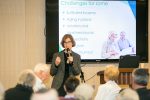
Isobel Mackenzie, seniors advocate for the Province of British Columbia, was the keynote speaker at the Changing Landscape: Pathways Ahead forum Nov. 27. (photo from Jewish Federation)
“Plan for tomorrow!” That’s the message from Isobel Mackenzie, seniors advocate for the Province of British Columbia. With seniors living much longer, there are some urgent issues facing aging Canadians.
Mackenzie was speaking to a packed house at the Changing Landscape: Pathways Ahead forum on the growing population of older adults in the Jewish community. Hosted by Jewish Federation of Greater Vancouver with the Jewish Community Centre of Greater Vancouver, Jewish Family Services, Jewish Seniors Alliance, Kehila Society of Richmond, L’Chaim Adult Day Care, and Louis Brier Home and Hospital, the forum was held at Beth Israel Synagogue Nov. 27. Three key themes were the focus of the evening: caregiver support; aging in place; and social connections.
Sharing insights into best practices and new opportunities for the Jewish community were: on caregiver support, Dr. Beverley Pitman, regional planner, healthy aging, United Way of the Lower Mainland; on aging in place, Terry Robertson of Parkdale Manor; and, on social connections, Gyda Chud (Peretz Centre for Secular Jewish Culture), Ken Levitt (Jewish Seniors Alliance), Toby Rubin (Kehila Society of Richmond) and Lisa Cohen Quay (Jewish Community Centre of Greater Vancouver).
Referencing the United Way’s Better at Home program, which helps seniors live independently in their own homes while remaining connected to the community, Mackenzie emphasized, “We are under-subsidizing people who are aging at home.” She added that many seniors pay for their own care as they age, despite insufficient income. She highlighted the urgency for government and community agencies to increase their funding for seniors who choose to age in place.
Mackenzie told the capacity crowd that, right now, there are 920,000 seniors over the age of 65 living in British Columbia, which represents 19% of the total population. By 2031, there will be 1.38 million seniors in the province, which will represent 25% of the total population. Referring to “the silver tsunami,” she said we need to start planning for that change now.
Addressing financial issues, Mackenzie said many seniors have less disposable income than their younger counterparts. For example, she noted that, for seniors age 65 and older, the bottom 20% of that group have an annual average single income of $17,000, while the top 20% have an annual average single income of $80,000. For seniors 85 and older, she said, the bottom 20% have an income of $17,500 while the top 20% have an income of $73,000. These numbers have a significant impact on how and where those seniors live. “Disproportionately poorer people live in care facilities,” said Mackenzie.
She also commented that there is a disconnect in terms of public policy and the entitlements available to those 65 and older, when the government is giving the same amount of money to both the rich and the poor.
According to Mackenzie, 94% of all seniors who are 65 or older live independently, while 74% of all seniors who are 85 or older live independently. A full 80% of these seniors are homeowners, she said. However, the remaining 20% are renters who are disproportionately poorer than homeowners. Consequently, they often don’t have enough leftover income to buy necessities like glasses, hearing aids and mobility devices, she said.
On the topic of aging in place, Mackenzie pointed to family members’ overall reluctance to allow elderly relatives to “accept risk”; that is, to live independently. Given the dangers inherent in living at home (stairs, rugs, lack of bathtub rails, etc.), she said relatives sometimes try to “control the risks” by encouraging loved ones to move to a care facility, often against the older person’s wishes. “We have to accept the rights of the [cognitively able] elderly to live at risk,” she said. “They have the right to make their own decisions, even if it’s a risky decision.” The message was, while we want our elderly to be safe, it’s not our choice to make.
In terms of the social isolation of those aging in place, Mackenzie said this depends primarily on the senior’s level of engagement. If their interactions with others are limited, they may feel marginalized. However, feeling useful to themselves and others keeps seniors feeling engaged, which is why we see so many senior volunteers. “Everybody needs to feel useful and is useful, in their own way,” said Mackenzie. She encouraged people not to do things for seniors that they can do for themselves, because “everyone needs a sense of purpose and usefulness.” She stressed that not all seniors are frail and not all seniors need help. Rather than viewing seniors as a problem, she said, we should view them as “an active and valuable citizenry.”
On the issue of caregivers, Mackenzie said, “Not everyone comes to this role equally equipped. We need to give more support to caregivers for the frail elderly and those with dementia. It’s more stressful dealing with someone with dementia than with someone who has a physical disability or disease.”
With the possible exception of the workshop on social connections, whose speakers were from Jewish agencies, but whose workshop the Jewish Independent could not attend, none of the presenters addressed how the community could support Jewish seniors in connecting to their Judaism, culture and traditions as they age. Neither Mackenzie or Pitman, the presenter on caregiver support, differentiated between the needs of Jewish seniors and non-Jewish seniors; the workshop on aging in place also did not specifically address Jewish seniors.
Pitman, however, shared some eye-opening statistics in her workshop. According to the Office of the Seniors Advocate for British Columbia’s 2017 report Caregivers in Distress: A Growing Problem:
• Statistics Canada estimates that there are approximately one million caregivers in the province.
• The work of caregivers is a critical pillar in the healthcare system, allowing seniors to remain at home and delay, or even prevent, costly care options.
• Unpaid caregivers provide roughly three-quarters of care for people who receive care at home in Canada.
• Caregiver tasks range from taking over household duties to providing time-sensitive personal and medical care.
• Caregivers’ most common tasks fall into three broad categories: emotional support, assistance with health and daily living, and care management.
• Caregivers are often information and referral specialists and systems navigators dealing with the health system, the housing system and the legal system.
The 2017 report notes that, on average, unpaid caregivers provide 20 hours per week of informal care and that replacing the care they provide with care from paid caregivers would cost an estimated $3.5 billion in British Columbia. And the report warned that “31% of unpaid caregivers are experiencing symptoms of distress such as anger, depression, anxiety and sleep difficulties.” This number seemed low to audience members who are or were caregivers.
Pitman also shared a sample of the resources available for caregivers, including BC211, 8-1-1 HealthLinkBC, local Jewish and other community support agencies, information and referral services, and libraries. She encouraged caregivers to call the Family Caregivers of British Columbia Caregiver Support Line (1-877-520-3267) if in need and highlighted the United Way’s Better at Home, which can provide light housekeeping, minor house repair, yard work and friendly visits. She offered audience members the 2016 publication United Way of the Lower Mainland’s Family & Friend Caregivers Information and Resource Handbook. While acknowledging that it’s somewhat out-of-date, she said it still contains much valuable information.
Shelley Civkin is a happily retired librarian and communications officer. For 17 years, she wrote a weekly book review column for the Richmond Review, and currently writes a bi-weekly column about retirement for the Richmond News.