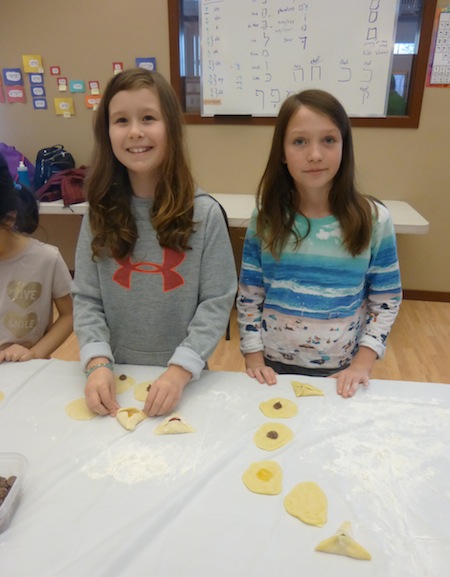
 In preparation for Purim, students of White Rock South Surrey JCC Religious School baked hamantashen to take home and share with their families. (photos from WRSS JCC)

In preparation for Purim, students of White Rock South Surrey JCC Religious School baked hamantashen to take home and share with their families. (photos from WRSS JCC)
Anna Levy (photo from Yarilo Contemporary Music Society)
My mother’s maiden name was Levy, my dad’s surname was also Levy. My story is about life. None of my family was killed during the Holocaust. I am alive because I grew up in a small European country, Bulgaria, that – despite being Nazi-aligned – managed to save all its Jews during the Second World War. And I – and many others – will be saying thank you through music this spring in a major concert marking the 75th anniversary of this historic series of events, for which we are so grateful.
During the Holocaust, Bulgaria had a complex record. While it is responsible for deporting 11,000 Jews from Bulgarian-occupied territories, most of whom were murdered at Treblinka, it defied Hitler and saved all 50,000 of its Jews, among which was my family.
In 1943, the complicated diplomatic manoeuvres of the Bulgarian parliament, led by Dimitar Peshev, along with civil disobedience and the strong official opposition of the Bulgarian Orthodox Church, resulted in the cancellation of the deportation that was planned for March of that year.
In June 1943, then German ambassador to Bulgaria, Adolf Heinz Beckerle reported to Berlin, “The Bulgarian society doesn’t quite understand the real meaning of the Jewish question … so the racial question is totally foreign to them,” and he complained that the Bulgarian people lacked “the ideological enlightenment that we [Germans] have.”
In 1996, Jewish National Fund named a forest in honour of Bulgaria, with memorial plaques dedicated to Peshev, the Bulgarian Orthodox Church and to King Boris.
This year marks the 75 years since the salvation of Bulgarian Jews during the war and preparations are underway in Bulgaria, Israel and in other countries to mark this anniversary.
In Vancouver, on May 27, Project Tehillim will take place at the Orpheum Annex. Twenty-three professional musicians will participate in the program featuring Tehillim, which was written by one of the most famous living Jewish American composers, Steve Reich. This event should occupy a central place in Metro Vancouver’s cultural life, as the work is unique, rarely performed and difficult to put together.
“Tehillim,” explains Reich, “is the original Hebrew word for Psalms. Literally translated, it means praises, and it derives from the three-letter Hebrew root ‘hey, lamed, lamed’ … which is also the root of halleluyah.”
In his notes on the website of classical music publishing company Boosey & Hawkes, Reich also writes, “One of the reasons I chose to set Psalms as opposed to parts of the Torah or Prophets is that the oral tradition among Jews in the West for singing Psalms has been lost. (It has been maintained by Yemenite Jews.) This meant that I was free to compose the melodies for Tehillim without a living oral tradition to either imitate or ignore.”
That said, he notes, “The rhythm, of the music here comes directly from the rhythm of the Hebrew text and is, consequently, in flexible changing meters.”
Tehillim is deeply rooted in ancient Hebrew traditions from biblical times. This is not music of contemporary daily life, but instead conjures the timeless and eternal. This work is a deep reflection of Jewish tradition presented in a modern way.
The budget for this large-scale project is more than $20,000: for musicians’ fees, theatre rental, scores, instrument rentals and other expenses. To help raise these funds, the Yarilo Contemporary Music Society – of which I am co-artistic director with Jane Hayes – is holding the concert Lest We Forget, on Sunday, April 8, 3 p.m., at Pyatt Hall, with the support of the Peretz Centre for Secular Jewish Culture.
The fundraising concert features classical masterpieces. The centrepiece of the program – which will be performed by Angela Cavadas (violin), Rebecca Wenham (cello), Johanna Hauser (clarinet) and me on piano – is Tchaikovsky’s Piano Trio in A Minor, written in memory of his Jewish friend Nikolai Rubinstein. In addition, there will be music by Jewish composers Srul Irving Glick (Suite hébraïque) and Ernest Bloch (Prayer).
Both concerts – Tehillim and Lest We Forget – highlight the spiritual qualities of the Jewish people. In the words of the non-Jewish author Milan Kundera about the importance of Jews in Europe: “Indeed, no other part of the world has been so deeply marked by the influence of Jewish genius. Aliens everywhere and everywhere at home, lifted above national quarrels, the Jews in the 20th century were the principal cosmopolitan, integrating element in Central Europe: they were its intellectual cement, a condensed version of its spirit, creators of its spiritual unity. That’s why I love the Jewish heritage and cling to it with as much passion and nostalgia as though it were my own.”
I love the Jewish heritage with a passion, as well, and it is “our own.” I hope that other members of the Jewish community will become Yarilo’s partners, and help us make Project Tehillim a worthy thank you. To contribute to the project, visit gofundme.com/2018-my-jewish-story-is-for-life; the campaign includes a third concert, which is planned for October. For tickets to the April 8 fundraising performance at Pyatt Hall, visit yarilomusic.com.
Rabbi Deborah Waxman, PhD, president of Reconstructionist Judaism, recently released a statement about rebranding. Instead of calling the rabbinical college and umbrella congregational movement the Reconstructionist Rabbinical College and Jewish Reconstructionist Communities, the header now is “Reconstructing Judaism.” The tag line below it reads, “Deeply rooted. Boldly relevant.”
Why do this? Well, in Rabbi Waxman’s statement, this sentence jumped out: “A critical path forward is shifting from a focus on ‘being’ Jewish – important but insufficient for providing substance and structure – to a focus on ‘doing’ Jewish.”
This is of central importance as we reshape 21st-century Jewish life. If you’re modifying Jewish by saying Reconstructionist, or Reform, Orthodox, Conservative, etc., you define your Jewish identity as a state of being. That is, “this is who I am.” It is akin to saying “I have brown eyes” or “I have freckles.”
However, in an era when people aren’t participating in group or congregational activities as often, it’s useful to go back to our tradition itself. We practise Judaism. Judaism doesn’t rely on a theological belief system as do some evangelical Christians. Or, as my husband jokes, when somebody needs a 10th body for a minyan, no one asks what you believe. There’s no extended questioning or exam. In that moment, we’re defined by what we do – the person showed up when needed, ready to “do Jewish” in a Jewish space.
If you’re wondering why anyone should care about this, it’s because Rabbi Mordecai Kaplan, the founding thinker of Reconstructionism, significantly affected North American Judaism as a whole. His concept of Jewish peoplehood affected every form of 20th- and 21st-century Judaism. Kaplan, while raised Orthodox, was a professor at the Jewish Theological Seminary (Conservative movement) until he retired. His son-in-law founded the Reconstructionist Rabbinical College. So, even if you don’t consider yourself a Reconstructionist, many aspects of how North American Jews understand their belonging to the Jewish people stem from Kaplan’s mid-20th century work, which was conceived of as “radical” at the time.
Around the same time that I read about rebranding Judaism, I had a strange “blast” from the past. I was contacted by someone who had once been a dear close friend. How close? I’d lived with her for a year on a kibbutz in Israel. I ate dinner with her the night I got engaged. She stood up for me under the chuppah at my wedding – we were friends for 15 years. We often saw each other on a weekly basis, if not more often. This person was an essential part of my life.
As an aside, I’ll stop to say it’s just not in my nature to ditch a longtime friend or, as some say, ghosting. I wouldn’t disappear or ignore someone on purpose. I take to heart the part of Pirkei Avot (Sayings of Our Fathers) 1:6 – “Find yourself a mentor, acquire for yourself a friend.” While learning opportunities are a lifelong interest, I also understood the rabbis’ interpretation of “acquiring” a friend. You have to invest and work on friendship. It takes time and effort. You have to show interest and concern about friends, and try to “pay them” that attention so that they will like you back.
What happened with my dear friend? In 2003, she was going through some life changes, as was I. We had a disagreement. Instead of discussing it and resolving things, or even fighting, she just dumped me. She wouldn’t respond to me at all. For many years, it tore me apart. I missed her terribly, but, what’s more, I felt as though if I’d just done something differently or been a better friend, this wouldn’t have happened.
I sought her forgiveness several times. I tried to contact her on holidays and wish her well. I even emailed her brother to make sure she was healthy and OK, because the absolute silence and rejection seemed so unlike the previous 15 years of our friendship. In short, I tried hard to be her friend, to invest in repairing any wrongs, long after she’d left the partnership.
This was a painful life lesson. I eventually learned that no matter how hard I tried to fix things, friendships take two people. I couldn’t do it on my own.
At first, I was thrilled to hear from this person again. I showed my husband the note I’d received, and I responded eagerly. My husband was more dispassionate and worried about me. He showed me something I’d overlooked. While clearly she’d laboured over the note’s wording, it didn’t look like it was personally sent to me. It might have been sent to multiple people she’d wronged over the years. While a group teshuvah (apology) is sometimes necessary, it’s not the personal reconnection and friendship I’d craved.
My old friend is professionally affiliated with Jewish Reconstructionism. The rebranding of Reconstructing Judaism pushed me to reflect. One of her online statements says she embraces rachamim (compassion), gemilut hasadim (acts of lovingkindness) and ethical living – but there’s sometimes a distance between what we “believe in” and what we do. I’m impressed that Reconstructing Judaism has taken a strong, active step. They’re doing Jewish in an era when North America Judaism needs this leadership.
Corporations rebrand all the time. It boosts sales and changes their public images. It might be time that Judaism does the same. As for me, I’ve had an internal emotional rollercoaster – the loss of a long friendship perhaps made me a more cautious, distant person when it came to building new connections. I don’t throw myself into friendships with the joie de vivre that I did as a teenager. In my rush to respond, my note to this old friend was still wary, with clichés. “Life is long. It’s good to have friends.”
Relearning this Jewish notion of acquiring friendship helped me put this episode in perspective. I wish I’d included it in my note. Could we learn together, invest in each other, do right by people, and create a rooted and relevant future? If that’s what she’s up for, I hope she writes back.
Joanne Seiff writes regularly for CBC Manitoba and various Jewish publications. She is the author of three books, including From the Outside In: Jewish Post Columns 2015-2016, a collection of essays available for digital download or as a paperback from Amazon. See more about her at joanneseiff.blogspot.com.
הרב אדם שאייר מנהיג קהילת ‘שער השמים’ במונטריאול יוצא נגד הרבנות הראשית. (צילום: מקהילת שער השמים)
הרב הראשי של קהילת ‘שער שמיים’ במונטריאול, אדם שאייר, יוצא בחריפות נגד פעילותה של הרבנות הראשית בישראל, שלדבריו פסלה אותו. הרב שאייר ביקר בישראל לאחרונה ואף השתתף בישיבת ועדת העלייה, הקליטה והתפוצות של הכנסת, כדי לשטוח את טענותיו הקשות נגד התנהלות הרבנות. הרב שאייר הוא הרב הבכיר הנמנה על “הרשימה השחורה” של הרבנות הראשית, הכוללת 160 רבנים מעשרים וארבע מדינות כולל ארה”ב, קנדה, אנגליה ודרום אפריקה. בהם רבנים אורתודוכסים בכירים ביהדות החרדית, ומחסידות חב”ד. הרבנים שנמנים על “הרשימה השחורה” לא הוכרו על ידי הרבנות לנושאי בירור יהדות ומעמד אישי.
דבר “הרשימה השחורה” שפורסמה בחודש יולי אשתקד עורר תגובות נזעמות בארץ ובחו”ל. יו”ר ‘עתים’ (עמותה המסייעת למי שנתקל בקשיים מול הממסד הדתי), הרב שאול פרבר, אמר כי “הרשימה השחורה” היא תעודת עניות להתנהלותה של הרבנות הראשית, מול יהדות התפוצות. הוא הוסיף: “אני תוהה מי הסמיך את הרבנות להחליט שרב של קהילה מסויימת בחו”ל אינו מקובל, ולפיכך חברי קהילתו אינם יהודים. הרבנות מנסה להפוך את עצמה לסמכות הבלעדית, והתנהגות זאת מביאה את העולם היהודי כולו לחשוש מן הבאות, ולגנות בתוקף את המגמה הפסולה הזו”.
הרב שאייר אמר בישיבת הוועדה: “אין לי אישור מהרבנות לחתן כיוון שהיא פסלה אותי. הרבנות גורמת לחלול השם. הם לא אמרו לי כי נדחתי, ורק שלחו לי מכתב שאולי אני לא יהיה מאושר. אני רב אמיתי והסמכתי לגיטימית. נפגעתי אישית מזה שהרבנות דחתה אותי ואת ההסמכה שלי. היא פוגעת ביכולת שלי לשרת את העם היהודי. המצב הקיים גורם לחוסר אמון ביני כמנהיג קהילה גדולה, לבין חבריה, החוששים לעלות לישראל ולהתחתן בה, מחשש שלא יוכרו בה כיהודים. זה פוגע במעמדי ובמוניטין שלי. הדבר הגיע לידי כך, שרבנים אחרים ממלצים לזוגות שלא לפנות אלי לעריכת חופה”. בדיון נכח גם מנכ”ל הרבנות הראשית לישראל, משה דגן. הרב שאייר הטיח בו: “בפעם הבאה לפני שאתם שוללים אותי, אני מזמין אתכם לבקר בבית הכנסת שלי. זו בהחלט תהיה חווית למידה”.
דגן אמר בתגובה כי הרבנות לא יצרה כביכול “רשימה שחורה” של רבנים בחו”ל. הוא הוסיף: “הדמגוגיה הזו שכביכול יצרנו רשימה של רבנים לא מוכרים, זה דבר שקר. הרבנות ובתי הדין אישרו את הרב שאייר, אך הם מחוייבים לבדוק את אמיתות המסמכים שהוצגו להם מטעמו. לא הספקנו לפנות לרב שאייר כיוון שיש לנו עומס עבודה רב. למחלקת האישות והגירות מגיעים כשלושת אלפים אישורים מדי שנה, ורק עובד אחד ושני סטודנטים מטפלים בכל הבקשות”. מנכ”ל הרבנות ביקש להוסיף עוד: “ההחלטות של הרבנות הוצאו מהקשרן. אני מיצר על פגיעה ברבנים כתוצאה ממה שהוצג על ידי אחרים “כרשימה שחורה”, ומתנצל על פירסומה. הטיוטה והקריטריונים להכרה ברבני חו”ל כבר גובשה, והיא נשלחה לארגוני הרבנים בעולם. לאחר קבלת התייחסותם, כמתחייב, הם ידונו ויאושרו במועצת הרבנות הראשית”.
הרב שאייר המשמש גם סגן נשיא ועד רבני קנדה, נחשב למקורב לראש ממשלת קנדה, ג’סטין טרודו. הוא אף ביקר עם טרודו באתר מחנה ההשמדה אושוויץ לפני כקרוב לשנתיים. הרב שאייר שימש גם כרבו של הזמר ליאונרד כהן, אף הוא חבר בקהילתו שנפטר אשתקד.
קהילת ‘שער שמים’ האותודורכסית נוסדה בשנת 1846 בווסטמאונט מונטריאול והיא מונה כיום כאלף וארבע מאות משפחות. הקהילה מחזיקה בבית הכנסת האותודוכסי הגדול ביותר בקנדה.
Our son, Nissim Shalom, recently became a bar mitzvah, and it is a living reminder for us of our family’s remarkable and ancient history. According to Jewish law, a Jewish boy reaching the age of 13 becomes a bar mitzvah and is responsible for assuming the mitzvot of Jewish adulthood. (A girl becomes a bat mitzvah at the age of 12.) Once a bar mitzvah, a person may be counted in a minyan (prayer quorum) and may lead religious services in the family and the community.
The bar mitzvah age was selected because it roughly coincides with physical puberty (Talmud Niddah, 45b). Prior to a child becoming a bar mitzvah, the child’s parents are responsible for the child’s actions, but b’nai mitzvah bear responsibility for their own actions with respect to Jewish ritual law, ethics and tradition and are able to participate in all areas of Jewish community life.
Upon a boy’s becoming a bar mitzvah, a celebration is made in his honour. The current scale of celebrations is much greater than it used to be in the mellah, or shtetl, of the old countries. In the past, this rite of passage was a joyous matter of course for every Jewish child without exception. In more recent times, however, this milestone is unfortunately not as absolute as it once was. Hence, we celebrate the occasion with more ostentation to highlight the cherished continuity of our heritage.
In the Moroccan community, we have many unique customs.
On the eve of the celebration, the bar mitzvah gets a haircut in the presence of his family and, as in every Moroccan celebration, traditional henna is put on his hand. On the celebratory day, it is customary for the family to help the bar mitzvah boy don tallit and tefillin, thereby showing him how dear this mitzvah is.
Many in the Moroccan community had the custom of taking the boy to a mikvah, stressing the idea of purity and holiness. Some had the custom of snatching the tefillin from the boy, so that the father would be obliged to redeem them with money, thereby demonstrating their importance.
When the bar mitzvah is called to the Torah, it is customary for the women to ululate “lulululu.” This custom originates from a kabbalistic source stating that, in every holy and happy occasion, the evil inclination (yetzer harah) is challenged to act. Thus, the women scream out in order to confuse and to chase away the yetzer harah.
It is hardly an exaggeration to say that the future of the Jewish people depends in large measure upon the bar (and bat) mitzvah event. Education, and particularly education of our young, has been and remains the means by which we continue to thrive, to exist, to ensure the future of Klal Israel. Is it any wonder that we celebrate with such gusto, as families and communities, this uniquely Jewish simchah by which we renew ourselves and our time in Jewish history?
Rabbi Ilan Acoca is a veteran rabbi and educator. He is the rabbi emeritus of Vancouver’s Congregation Beth Hamidrash and currently serves as the rabbi of the Sephardic Congregation of Fort Lee-Bet Yosef, in Fort Lee, N.J., and rav beit hasefer of Yeshivat Ben Porat Yosef, in Paramus, N.J. He is the writer of the book The Sephardic Book of Why and has written hundreds of articles on various topics for different publications.
Steven Finkleman, vice-president of the Okanagan Jewish Community, takes a moment to enjoy some Israeli dancing. (photo by Misty Challmie)
When the founders of Kelowna’s fledgling Jewish community decided to open a building, they couldn’t call it a synagogue.
The B.C. government of the day would contribute a third of the construction costs toward a community centre but nothing if it were a church or synagogue. So, a small group of dedicated volunteers named it the Okanagan Jewish Community Centre and got the funding.
The building – also known as Beth Shalom Synagogue – features a sanctuary alongside a large kitchen, library and daycare. Twenty-five years after its dedication in the heart of British Columbia’s Okanagan Valley, a dozen original members and 50 supporters celebrated the milestone with Israeli dancing, humour and heartwarming stories.
Steven Finkleman, who led the event, reminisced about how a few retired couples kept the Jewish religion “alive in these boonies” by getting together at various houses. Members gathered regularly for services at a church after they formalized their community at an inaugural meeting in 1983.
“We met at St. Michael’s Anglican Church. For us, it was St. Moishe’s,” said Finkleman, who grew up in Winnipeg. “The question wasn’t, ‘Do we need a building?’ It was, ‘If someone dies, where do we put them?’ So a cemetery was most important.”
As more Jews moved into the Okanagan, momentum grew. Then-newcomer Mel Kotler, a businessman from Montreal who ran the Western division of Fabric-land, helped launch the community’s first cemetery drive. The committee bought pews, bimah artifacts and an ark from a synagogue that closed in Moose Jaw, Sask. Members contracted Emil Klein, a retired rabbi living in nearby Winfield, to lead services in houses and at St. Moishe’s.
Soon, they picked out a burial site overlooking a lake north of Kelowna, making it the only Jewish cemetery between Metro Vancouver and Calgary. After shifting the focus to establishing a centre, lawyer Robert Levin met with developers of a new subdivision in Kelowna’s North Glenmore area to negotiate a location. They agreed the Jewish community would put in a daycare to serve the neighbourhood as part of the deal.
Plans were drawn up for a $400,000 building, and a successful fundraising dinner followed. Once built, two former members of the Moose Jaw synagogue helped carry in two Torahs for the dedication in October 1992. More than 300 people attended the ceremony, which included a six-foot challah. Among the dignitaries were British Columbia’s former premier, Dave Barrett, member of the Legislative Assembly Cliff Serwa and B.C. Liberal leader Gordon Wilson.
Today, about 60 families – with Orthodox, Conservative and Reform backgrounds – support the centre. Visiting rabbis and cantors lead services, and children learn about Judaism at Hebrew school. Rabbi Shaul Osadchey and Cantor Russ Jayne of Calgary’s Beth Tzedec Congregation currently travel to Kelowna four times a year for Jewish holidays.
“They have the skill set we don’t have,” said Okanagan Jewish Community president Mondy Challmie. “When people have questions of a religious nature that we’re unable to answer, we encourage them to email or call Rabbi Osadchey.”
To celebrate the 25th anniversary, Cantor Russ sang a Hebrew-English version of Leonard Cohen’s “Hallelujah.” Israeli dancers – who have practised every week for 14 years at the centre – performed. Member of Parliament Stephen Fuhr and Kelowna Councilor Mohini Singh gave speeches. And everyone shared a nosh, a slideshow and plenty of laughs.
As the party wound down and people folded up the chairs, Finkleman reflected on the biggest challenge for this tight-knit but tiny congregation.
“Generating interest, support and commitment in a small community – distant from a major Jewish centre – was difficult. It still is a challenge, but, when the building opened, it served as a focal point for recent arrivals in the Okanagan. We were very honoured to have some of the original members present. We miss those who are no longer with us.”
For more information, visit ojcc.ca.
Don Plant is a retired journalist and member of the Okanagan Jewish Community in Kelowna. He’s now studying archeology and helped excavate an Early Bronze Age site in Israel last summer.
The other night, I sat on the couch with my husband in an attempt at togetherness. We watched an episode of Madam Secretary. It was our second attempt. On the first try, worn out, I was about to fall asleep when my spouse suggested that we save it for another time so I could go to bed. It was, he pointed out, supposed to be fun. Sticking to the initial “date time” wasn’t working. Thank goodness for the PVR.
The show we watched was full of allusions to knitting and design, which are parts of my freelance work. I cringed inwardly, preparing for derogatory comments about “women’s work.” To my surprise, the textile theme was respectful. A man with PTSD takes up knitting as part of his therapy – it helps him focus his mind. A first-year university student struggles with a design assignment – she comes away with a couture dress, but not before we hear the sounds of her sewing machine at work in the background. Best yet, when her sister begins to panic at modeling the dress, the student gives her a pep talk, saying, “Pull yourself together, be strong. Do this, I need you.” What started as a frivolous thing – “help me out at this fashion show” – became more. It became a chance to succeed academically, and to use inner strength to prevail over a trying situation. The episode showed strong women and struggling men seeking to be their best selves.
All this came to mind later, in the context of a Talmud class. I signed up for a Jewish Theological Seminary online course. With the wonders of technology, I can hear lectures by Rabbi Dr. Judith Hauptman, who is a gifted teacher and intellect. Her course has an interesting premise – looking at situations when “law meets life.”
She began with basic information, and got started studying talmudic text. Whenever I study Talmud (or any older text), I have to remember the inherent inequalities. Women were seen as subservient, with less agency than we think is appropriate today. Through careful reading, we saw lists of tasks wives are obligated to perform for their husbands (Bavli Ketubot 61a) and a discussion about how one might “wash” – sprinkle water on – a floor on Shabbat (Bavli Shabbat 95a). (This last reference was not cleaning so much as providing a form of air conditioning and reducing dust on an extremely hot Shabbat in Babylonia.)
Hauptman showed us how women’s interpretations allowed them both to obey the spirit of Jewish law, and to accomplish what needed to be done. In more than one place in these readings, the rabbis (all male) allude to the fact that women were smart and had power or agency. Even if the language of the Talmud relegates women to being “property of a man’s house,” the women in these stories shine through as being shrewd and savvy.
We think sometimes that our lives are infinitely more complicated, sophisticated and detailed than those in the nostalgic past. Yet, these talmudic texts reminded me that, more than 1,500 years ago, smart people focused on the details that make our households and lives function. We may have a way to record entertainment now (and a TV!) or access to machine-produced clothing, but our fundamental concerns are similar. How are we to balance the spirit of our commitments with the laws’ requirements? What is the intention of our roles? How do men and women balance and subvert traditional roles in order to cope? How do our household tasks make life comfortable and/or meaningful?
The first text we studied refers to tasks that wives perform for their husbands: grinding grain, baking bread, doing the laundry, cooking, nursing his babies, making his bed, and working with wool. When she has wealth and servants, she can avoid some of these household obligations. As we studied this text together, I was knitting a wool sweater I’d promised to finish for one of my kids. I thought the webcam was trained up, only on my face. No, as it turned out – a friend, also taking the class, in New York, said she could see my knitting.
That’s OK. In the end, the more things change, the more they stay the same. Regardless of your level of observance, we still wrestle with these issues. Women often interpret Jewish law and tradition when it comes to household details. If one doesn’t have enough servants or financial resources, or even enjoys knitting and finds it focuses the mind, one might still be working with wool.
A recent study indicated that, in Reform Jewish congregations, rabbis who are women are paid less than their male counterparts. Women have fewer positions “at the top” as senior or sole congregational rabbis. We continue, even in the most progressive Jewish movements, to struggle with pay equity and gender roles.
The Talmud is an essential part of Jewish oral law, but it’s also literature, with narratives that shed light on daily life. A current TV show portrays a woman as U.S. Secretary of State, and shows that interaction with fibre arts is still an important, useful and viable thing to devote time to creating, no matter your gender.
In both the show’s legal negotiations and this talmudic text, we’re taught that, sometimes, the spirit of the law, the intention, is more important than the letter of the law. Through all the big decisions, it’s sometimes the small household details that make people’s lives rich. I’ll keep knitting handmade sweaters for my kids – and studying Talmud. Even in these times, there’s a place for both.
Joanne Seiff writes regularly for CBC Manitoba and various Jewish publications. She is the author of three books, including From the Outside In: Jewish Post Columns 2015-2016, a collection of essays available for digital download or as a paperback from Amazon. See more about her at joanneseiff.blogspot.com.
Ayala and Ariel Wilchfort are recent arrivals to Vancouver. (photo from Ariel Wilchfort)
Two years ago, Rabbi Gideon Osher Shmueli donated a kidney to a stranger, saving that individual’s life. These days, he works at Magen David Yeshivah in Brooklyn, N.Y., teaching Hebrew and bringing with that teaching the culture and values of Judaism and eretz Yisrael, the land of Israel.
To him, teaching about Judaism is akin to donating a vital organ. “Connecting Jews to Torah and mitzvot is no different from helping someone to live,” said Shmueli, 32, who, with his wife, Leore Sachs Shmueli, was matched with the school by Ohr Torah Stone’s Beren-Amiel Practical Training Program for Educational Emissaries, which trains educators who are sent to teach Judaic studies in both Orthodox and non-Orthodox schools throughout the Diaspora. A similar initiative, the Straus-Amiel Program for Rabbinical Emissaries, trains rabbis for synagogue postings in the Diaspora.
Like Shmueli, Rabbi Ariel Wilchfort is a recent arrival to his new post. He is city director for the National Conference of Synagogue Youth in Vancouver, following his participation in the emissary training at OTS’s Israel campuses.
“They guided me and helped me choose positions,” said Wilchfort, 33, who relocated to Vancouver with his wife Ayala and their two young children.
Wilchfort, who attended the emissary training from 2015 to 2017, said he found his current job when a representative for NCSY, the youth arm of Orthodox congregations in North America, visited with him and other emissaries.
Based in Israel, OTS is a modern Orthodox network of 24 institutions on 12 campuses, founded by Rabbi Shlomo Riskin with a mission in part to demonstrate that Judaism’s “laws and traditions remain profoundly relevant to the contemporary world,” Riskin has said.
As part of that mission, OTS has some 200 emissary families serving in more than 50 countries, according to Rabbi Eliahu Birnbaum, who directs the emissary programs. Shlichim (emissaries) serve on average five to six years, with some who have been at their posts as long as 18 years.
They serve not only in large Diaspora communities but also in places that are far afield and have few Jews, such as Quito, Ecuador; Guangzhou, China; Cochin, India; and Harare, Zimbabwe. “We believe that people need to work with people, and the only way to influence other people and strengthen their Jewish identity, as well as the community itself, is by having emissaries and creating personal connections,” Birnbaum said.
OTS annually receives at least 150 applications for the program, and chooses 25. “We accept only applicants who have advanced Torah knowledge and yeshivah background, high academic level and, most important, very good people and leadership skills,” said Birnbaum.
The training program consists of weekly classes with educators, rabbis, experts in halachah (Jewish law) and advisers. Shlichim assignments range from teaching positions, to youth directors to pulpit positions.
In a smaller Jewish community like Vancouver, Wilchfort occupies several roles on the community scene, mentoring young people at Congregation Schara Tzedeck and running a religious education program called Torah High, in which Jewish students can attend afternoon classes and gain a few credits toward earning their high school degree.
Originally from Englewood, N.J., Wilchfort’s family immigrated to Israel when he was a child, and he received his rabbinic ordination from Israel’s Chief Rabbinate at the same time that he was enrolled in the Beren-Amiel program. He said he was drawn to the initiative by a desire to serve Jews in the Diaspora and help them enrich their Jewish lives.
“I entered the program out of a care for other Jews, a love for our nation, and especially a love for our fellow Jews who have not had an adequate religious education,” he said.
Wilchfort has enjoyed settling into Vancouver, which he credits for having a vibrant Jewish scene. “Our community has a great infrastructure; it’s a very pro-Israel community here,” he said. “As for the area itself, it’s beautiful. In Vancouver, we live between forests and the ocean, and everyone is so health-aware, nature-aware.”
For Wilchfort, whose wife’s first language is Hebrew, not English, it’s a true cross-cultural experience. “It’s a new city, new country, new culture. It’s really an adventure, and we feel so excited to be here.”
What strange quirk brought it about that what may be one of the greatest and most Jewish of Jewish novels should be written not by a Diaspora Jew, nor an Israeli Jew, nor a Diaspora Jew who had made aliyah, but rather an Israeli who relocated to New York?
Further stymying expectations, Ruby Namdar did not write this novel in English, but in Hebrew (it was recently translated by Hillel Halkin). “For who?” asked an audience member at the Cherie Smith JCC Jewish Book Festival event on Nov. 26, when I had the pleasure of interviewing Namdar in front of a small gathering. If Namdar wanted his novel, which he acknowledged to be soundly in the lineage of Bernard Malamud, Saul Bellow and Philip Roth, to be read by New Yorkers, why write it in Hebrew? If he wanted the novel to make sense to Israelis, why write it about a rootless Diaspora Jew with no connection to Israel?
“I don’t know what I was thinking,” said Namdar, “I don’t know who I was writing for, I just wrote.”
The Ruined House is not just a great Jewish novel or a great novel in modern Hebrew. It possesses a structure that is at once talmudic and kabbalistic, a structure that is deep and intricate yet carried off with such a sense of understatement and naturalness, effortlessly unfolding within Namdar’s lucid, lyrical and vivid prose, that most English-language reviewers thus far have not fully noticed it. This structure is what gives the novel its profoundly Jewish resonance, which is at once modern and ancient, rootless and anchored in the archetypal depths of Jewish experience and textuality.
Talmudic structure
The Ruined House is divided into seven books, with its seventh book being the culmination of an obviously Jewish numerical pattern. Each book follows the anti-hero, Andrew P. Cohen, over the course of one year of his life, as he enters what seems to be a midlife crisis from hell (or perhaps from heaven).
Cohen is a successful and wealthy professor of comparative culture, who lives in an idyllic Manhattan high-rise with a view of the river, a pristine Apollonian realm in the skies. He has a beautiful young lover, Ann Lee, and an adoring group of followers and acolytes. He cherishes his controlled, harmonious and detached existence, which he has gained through leaving his wife and two daughters years before.
At the end of the first six sections of the novel are a few pages of text designed to look like a blat Gemara, a page of Talmud. The central text in these inserts tells the story of a high priest preparing and executing the Yom Kippur sacrifices. While he does so, he is watched by Obadiah, a humble Levite who wonders whether the priest is truly pious or just a functionary in league with the elite. Encircling the narrative are passages from the Talmud, Mishnah and Tanakh, which describe the laws, folklore and spiritual significance of the high priest’s duty. They also feature key excerpts from Shaarei Gilgulim (The Gate of Reincarnation), a kabbalist text written by Chaim Vital (1542-1620) to expound the cosmology of his master, the Ari HaKodesh, Isaac Luria (1534-1572).
The insertion of these texts is deliberate and precise. Just as the narrative in the inserts is flanked by canonical Jewish sources, the narrative of the novel is surrounded by ancient Jewish forces. As the hidden, broken nature of Cohen’s life begins to surface, he begins to have intense, waking visions of the ancient Temple in Jerusalem. His dreams turn nightmarish, alternating between repressed guilt at his betrayal of his family and dreadful tableaus of the rape of Jerusalem by the Romans and the murder of Jews by the Nazis.
The structure of the story and the inserts are not the only mirrors in the book: Cohen’s life is cast as priest-like. His elite status; the pure harmonious realm in which he lives; his having separated from his wife like Moses to live in the skies; even the elaborate meat dinners he cooks up for his dinner guests alone in his perfect kitchen all point to it. His name, of course, highlights both the substance and the irony of his life as priestly metaphor. At one point, his daughter, Rachel, disgustedly mocks people who think that Jews named Cohen are descended from the priestly lineage: “Everyone knows they just gave out those names randomly at Ellis Island.”
As Cohen descends into apparent madness, a grotesque version of the priestly sensibility gets stronger in him. He becomes morbidly obsessed with the impure and averse to the physical, the decaying and the dead. He finds himself horrified by menstrual blood and semen. The explanation of this growing claustrophobic sensibility lies in the paragraphs of Shaarei Gilgulim, which are included in Namdar’s inserts.
Kabbalist elements
Shaarei Gilgulim describes the way that some souls, during the process of reincarnation, unite with other souls in order to complete their own tikkun (repair). In the first pages of The Ruined House, “one shining soul, the figure of a high priest” is suddenly visible above New York among the celestial machinations momentarily revealed as the veil is briefly sundered. The key to the priest’s identity lies in the kabbalist doctrine of ibbur, or impregnation, where a soul from beyond enters into an earthly person in order to help them, to complete their own mission, or some combination of the two. In Cohen’s case, as suggested in a last talmudic insert, he has been “impregnated” by the soul of the high priest in need of tikkun for feeling himself superior to Obadiah, the humble Levite. The high priest and Cohen share a sin in common: arrogance. Their collective confrontation and reckoning with it will be psychically violent and cathartic and come close to doing Cohen in.
Critique of Diaspora?
Some reviewers have read The Ruined House as a critique of the Diaspora Jew, viewing the narrative as a kind of punishment of Cohen, enacted on him by the rising tide of archaic Jewish intrusions into his life. Namdar said this is a moralistic distortion of his ambivalent, questioning text. Instead, Namdar pointed to the shatterings of the illusion of wholeness and perfection that happen in the book. “Where things are broken, there, seeds can take root and grow,” he said.
For example, Cohen’s harmonious life is an illusion that is shattered in the course of the book, leaving a “ruined house.” Yet the figure of the ruined house (bayit asher necharev in the original Hebrew, a phrase that comes from a poem by Yehuda Amichai) is also an allusion to another ruined house, that of the Beit Hamikdash, the Jerusalem Temple, whose pristine world of order and control, Namdar suggests, also was illusory.
The third ruined house is suggested by the timing of the events in the novel. The story begins in the Hebrew month of Elul (signifying its theme of repentance), on Sept. 6, 2000. After the narrative comes to a head on Tisha b’Av, the date of the destruction of the Temple, it jumps from Aug. 1, 2001, to Sept. 18, 2001, leaving a lacuna where Sept. 11, 2001, and the destruction of the Twin Towers, resides.
“I did not want Sept. 11 to appear in the narrative, thus making the novel reducible to being about that event,” said Namdar when I asked him about this. “Rather, I wanted the trajectory to point to its occurrence outside the frame.”
There is much more to talk about in this remarkable novel, which manages at once to be so Jewish, so Israeli, so American and so human. I did not touch here on the attention Namdar lavishes on the details of Cohen’s daily life or Namdar’s subversion of the lineage of Malamud, Bellow and Roth in his intense empathy with the female characters of the novel, and his unsparing deconstruction of Cohen’s narcissistic masculinity. I did not examine his vivid and hilarious slow-motion evocation of a grossly excessive bar mitzvah, or his brilliant parody of the Zionist clichés of a Birthright-like propaganda tour of Israel, and many other delights. I hope this introduction is enough to invite you to step into Namdar’s mesmerizing fusion of a talmudic-esoteric structure with an incandescent evocation of life in Manhattan, and discover what else he has hidden there, of which, I promise you on good authority, there is much.
Matthew Gindin is a freelance journalist, writer and lecturer. He writes regularly for the Forward and All That Is Interesting, and has been published in Religion Dispatches, Situate Magazine, Tikkun and elsewhere. He can be found on Medium and Twitter.
Land-based activities at Camp Hatikvah form a large part of the summer experience. (photo from camphatikvah.com)
Like most everything, camp enrolment goes in cycles. And, for the past few years, Camp Hatikvah has had a waiting list for its first session, a full second session and has closed off the summers with the highly popular Family Camp experience that sells out within hours of registration opening in October the year prior. With the largest-ever single age group of campers rising through the ranks, Hatikvah is looking to expand its facilities to accommodate these campers as they move toward the counselor-in-training program.
Camp Hatikvah has a formula that seems to be working well. In order to fill every bunk, current board president Joanna Wasel worked closely with camp director Liza Rozen-Delman to make some changes in programming. In addition, they have brought the concept of camper care front and centre, and the programming is more flexible than the camp experience of yesteryear. As but one example, Hatikvah has been bringing in specialist instructors for activities such as tennis or mountain biking to run weekly sessions, and such initiatives are drawing campers. Once their interest is piqued, the kids tend to come back year after year.
“Liza does an excellent job ensuring that the campers are well cared for, safe and happy,” said Wasel. “I believe her reputation of providing exceptional camper care is the primary reason we are seeing the success we are today.”
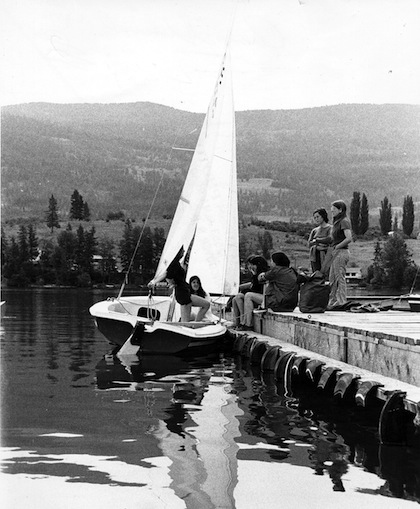
While Camp Hatikvah has been known for years as a watersport camp, the land-based activities have been overhauled during Wasel’s tenure as president. “We are now able to offer expert instruction from professionals in a plethora of land activities including tennis, football, basketball, fitness, yoga, dance and more,” she told the Independent. “The change has been dramatic and campers are now equally engaged on land and water.”
Those who remember their own experiences of the “good old days” of camp continue the tradition, and send their children, according to Rozen-Delman. “Many of our campers are second- or third-generation participants,” she said. “Our camp is rich in traditions and many of the programs we offer our campers today are based on programs their grandparents participated in during the ’50s and ’60s and their parents did in the ’70s and ’80s. We are very proud of this dedication to our roots and traditions and believe this makes our camp experience even more meaningful.”
The list of former campers reads a bit like a who’s who of the local Jewish community, something that shows the link between camp attendance and Jewish community involvement. Many of the children from Camp Hatikvah are already well ensconced within the community; many are students at Vancouver Talmud Torah. Rozen-Delman noted that campers also come from Alberta, Ontario, Washington and California. Hatikvah has combined a number of initiatives to draw a diverse group of campers, some of whom have no other connection with the Jewish community.
The effort to diversify and attract unaffiliated Jews this year has been aided by the Laskin Outreach Fund. This initiative, created and entirely funded by Elliot and Megan Laskin, provides $1,800 (almost the full fee) to first-time campers from British Columbia with little or no Jewish communal engagement to try Camp Hatikvah in its second summer session.
Both Wasel and Rozen-Delman stress that the programming at Camp Hatikvah is oriented toward helping children develop as members of the community. As a pluralistic camp, children from all sorts of Jewish backgrounds are introduced to and experience the camp’s motto: “Leadership by example.”
Although the programming for younger campers is focused on fun and socializing, with some Zionist and Jewish learning, it is the staff-in-training (SIT) program that begins the leadership training in earnest.
“This program is designed specifically to enhance the leadership abilities and traits of our campers. Participants engage in almost daily hadracha (leadership) sessions or discussions where they learn the importance of leadership, citizenship and community,” said Rozen-Delman of SIT.
Both Wasel and Rozen-Delman are alumna of Camp Hatikvah, with Wasel starting as a camper in 1988 and Rozen-Delman in 1979. Both have worked and volunteered within the Jewish community, in addition to their work at Camp Hatikvah.
While local Jewish life is part of the formula, Hatikvah’s Zionist roots are as strong as ever. Last summer, there were 14 Israeli schlichim (emissaries) on staff.
This year’s camp sessions are both looking like they will be full, said Rozen-Delman. For more information on the camp, subsidies to attend or the Laskin Outreach initiative, call the camp office at 604-263-1200.
Michelle Dodek is a freelance writer who spent one summer at Camp Hatikvah a long time ago and loved the sailing program.