In October, our community lost one of its most devoted supporters, Leon Glassman, z”l. Leon will be remembered for generations to come for his commitment to Jewish education and its central role in Jewish identity and continuity. Through the Jewish Community Foundation, Leon created a legacy that reflects his lifelong passion in these areas. Together with his wife Rose Marie, they made an indelible impact on our community – an impact that will ensure his memory lives on.
Leon and Rose Marie’s commitment to Jewish education goes back decades to their life as young parents in Regina. Their move to Vancouver was motivated in part because here they would be able to provide their children with a Jewish education, which they saw as an integral aspect of helping them develop strong Jewish identities.
Leon and Rose Marie recognized that the high cost of living in the Lower Mainland today has reduced the ability of many families to enrol their children in Jewish day schools and Jewish educational programs. They wanted to find a way not just to help families and children, but to strengthen Jewish continuity for the community as a whole.
In April 2016, Leon and Rose Marie made a million-dollar gift to create the Leon Glassman Fund for Jewish Continuity through Education endowment fund. The response from community members who share their passion, as well as from the day school community that understands so clearly the impact this endowment will make, was tremendous, and it inspired Leon and Rose Marie to make a second million-dollar gift to the fund.
The fund will provide a steady source of support for tuition assistance, so more children can reap the benefits of a Jewish day school education. This endowment will support an area of need that was close to Leon’s heart, enriching our community in perpetuity.
According to executive director Marcie Flom, the Jewish Community Foundation was “privileged to work with the Glassmans to create Leon’s legacy for the Jewish community.” She said, “Leon’s philanthropy reflected his life’s passion and his commitment to Jewish education in a way that perpetuates his memory for his children and grandchildren.”
Like Leon and Rose Marie, there are many community members who support causes that reflect their interests and their values. If you are among them, then you, too, can create a legacy at the Jewish Community Foundation that reflects your passions. To make a contribution to the Glassman Fund or for more information on how to create a legacy, visit jewishcommunityfoundation.com.
Hospitality is culture itself and not simply one ethic amongst others. (Jacques Derrida, On Cosmopolitanism)
One of the late French-Jewish philosopher Jacques Derrida’s most famous short works is his On Cosmopolitanism, in which he discusses the problem of refugees. Cosmopolitanism is a word first coined in ancient Greece by wandering, homeless philosophers and popularized by the Stoics. It refers to the idea that the whole world (cosmos) is my city, or community (polis). It is the idea of an international or, better, transnational humanity and citizenship. Cosmopolitanism became popular again during the European enlightenment and slowly had a growing influence on international law and modern ethical sensibilities, including the sense that countries have a duty of hospitality, of offering refuge even to peoples of other nationalities.
This same ethical idea occurs in Derrida’s own Jewish tradition, where “love the stranger” is a commandment uttered many more times than “love your neighbour” and where Isaiah the prophet urged Israeli kings to give shelter to refugees of war.
In On Cosmopolitanism, which was based on a speech Derrida gave to the International Parliament of Writers on the subject of refugees, Derrida discusses the nature of hospitality and the contradiction at its heart. Hospitality involves welcoming guests into your home, in sharing resources and shelter, yet, to do so, it must remain “a home.” Should all boundaries of the home dissolve in unconditional welcome then the possibility of hospitality itself will also be obliterated. Derrida’s insight mitigates against a naive or utopian call for the obliteration of borders or the indiscriminate welcome of refugees.
In this thought of Derrida we see a tragic conflict at the heart of modern Zionism. Do we want a hospitable Zionism? Is the house the Jews built in Israel for Jews alone? Yet if the doors are flung wide, what will happen to “our Jewish home”?
There is much anxiety to protect our “home,” of that we can be sure. An extensive security wall, checkpoints, and airport border guards who are masters of interrogation. When we press Israel to become more hospitable – to African asylum seekers, to displaced Palestinians – we hear a chorus of voices arise: if we let them in, if we include them, the demographics will dissolve our home!
And we so badly want a home. Wandering for 2,000 years, we were homeless, exiled, a tolerated or cursed minority. Finally, we returned to our ancient home and, amid controversy with others who had come to live there and also claim it as home, built walls to protect it. We now again had a home, and we have chanted this word to ourselves over and over again, “home, home,” for the last 70 years.
Yet what good is a home that does not extend hospitality? Sure, we airlifted Ethiopians, we opened our arms to Russians, and so on and so forth. Yet they were us, our family. True hospitality, though, as it says in our own foundational text, is given to the stranger. The other.
Unconditional welcome is not the only way to destroy a home. What good is a home that offers no hospitality? Is a home that offers no hospitality even a home at all?
Israel is in the process of deporting the 60,000 African refugees who arrived before the building of a barrier wall with the Sinai to prevent more entering. As Russel Neiss wrote in the Forward, “For years, in actions held to be illegal multiple times by Israel’s Supreme Court, the Israeli government has arrested and placed these refugees in a detention centre in the Negev and forcefully deported them to other African nations in exchange for money or favourable terms for weapons contracts and military training.”
Twenty thousand refugees, most from Sudan and Eritrea, have already been deported or left of their own accord, and the government has ordered the rest to leave, with a small financial gift and plane tickets paid, or be jailed.
According to Derrida, hospitality is both a duty and a defining feature of a real home. The feeling that an inhospitable Israel is not really a home, I fear, is growing and will continue to grow among Israelis and Jews. Maintaining the feeling that Israel is a Jewish home only will require an unremitting focus on perceived and real threats to Jews in Israel and abroad. It will reinforce the unhealthy sense of home as a shelter from others, rather than fostering the healthy sense of home, one that is open to sheltering others.
The result may be that we have a very well guarded home. But, for those of us who perceive the lack of hospitality on offer, it begins to feel like no home at all. The opposite of Derrida’s formula – “in order for there to be hospitality, there must be a home” (a formula that is surely true and needs due respect) – is “in order for their to be a home, there must be hospitality.”
Jews, being a transnational people for so many years, became, in two senses, a “cosmopolitan people.” One was that fact of transnationality; the other stemmed from the involvement of Jews in socialist political movements, which problematized nationalism, as well as our involvement in activism aimed at the liberalization of immigration laws. It was all of this, seemingly, which coalesced to give birth to the use of “cosmopolitan” as an antisemitic code word for “Jew.”
I don’t think “cosmopolitan” is an insult, but rather a very high compliment. When an antisemite calls Jews “cosmopolitan,” I hear it as a calling, not a calling out. Israel will not truly be our Jewish home until it embodies the highest cosmopolitanism of the Jewish spirit, which can be read in the Torah’s call – millennia ago – to love the stranger and refugee.
Matthew Gindinis a freelance journalist, writer and lecturer. He writes regularly for the Forward and All That Is Interesting, and has been published in Religion Dispatches, Situate Magazine, Tikkun and elsewhere. He can be found on Medium and Twitter.
(photo from teenlife.com/summer-program/urj-camp-kalsman)
Going to camp was a rite of passage when I was growing up. Everybody went to camp. In my day, it was the B’nai B’rith camp that all Jewish kids went to, in Sandy Hook, past Winnipeg Beach.
I don’t recall much detail of my really young days as a camper, but we never missed a summer. As small kids, we went with our mothers. It all had to do with getting away from the oppressive summer heat and time at the beach, wading and swimming, sunning on a blanket, playing the games on the boardwalk. I would have an ice cream cone every day, even though, back then, all you could get were vanilla and strawberry flavours. There may have been chocolate, too.
I enrolled in Young Judaea in my early teens. In the heady days leading up to and after Israel declared its independence, movements of every political stripe in Israel had a youth group and camps in Canada and in the United States.
At camp, we built our Jewish consciousness and reinforced our Jewish identity. We were part of larger society, of course, but the one that was becoming central to our lives was the Jewish one, and the camp experience strengthened all that. Everything around our activities focused on our life as Jews, intellectually and emotionally, in our developing teen years. It was easy to pick out the future leaders – assertive, confident, basing their arguments on material accepted as fact. That was the stuff we brought forward into our adult years, colouring what we would become and the messages we would transmit to our children.
Aliyah to Israel was an enormous focus of the Zionist camps I associated with. This possibility, went the argument, was why we had to study our history, our customs, our holidays. We were building a new kind of Jew, unapologetic for his striving nature, determined to never again be a victim. History’s lessons were clear and we had to take heed and take our future into our own hands. The camps I attended were the educational vehicle.
In those days, we pretended we were chalutzim (pioneers), so we went out into the bush and made like we were going to live off the land. We built lean-tos to sleep under, chopped down trees, built things, learned how to make a campfire even without matches, and engaged in marches, canoeing, the whole megillah.
The years I spent as a camper – learning to be a scout, learning to create things with my hands, to develop myself physically, to compete for excellence – we were modeling the new Jew. We were not content with just being students, we knew we could do that – we were going to be doers. We were building pride in ourselves and in our accomplishments.
In turn, I became one of the leaders trying to transmit the messages I had absorbed to others. The young people I grew up with at camp worked in their own communities in the same way. All across the country and across the United States, we were a network fighting assimilation, building loyalty to Israel and a consciousness of being Jewish and the values it represented.
One of the best experiences I had was when I was invited to be a Camp Shalom program director in Gravenhurst, Ont. I spent six months preparing programs and then threw them all out on my second day on the job. I spent the next two months preparing different programs on the fly, built around Jewish holidays or events in Jewish history. We organized camper teams, choosing names, uniforms and cheers, and had athletic competitions, colour wars, talent competition skits, swimming competitions or just fun at the beach. I don’t know about the campers, but I had a great time exploring my creative capacities. We set up a pattern that was followed for years at that camp.
Some of us became community leaders. A few of us even got to Israel, at least for a time. Many of the associations we made have withstood the test of time. Some of the best friendships I have today are ones I made in those years. A good number of marriages came out of those experiences, including one of my own.
What a wonderful institution camps are, whatever their nature! Bringing kids into a healthful environment with responsible supervision, living lives completely different from what they are accustomed to, meeting people they would not normally meet, exposing them to alternative behavioural norms, has to be good. And getting away from the city into a natural environment, who has to be convinced that that is a good thing? Let’s hear it for camp days. Rah, rah, rah!
Max Roytenberg is a Vancouver-based poet, writer and blogger. His book Hero in My Own Eyes: Tripping a Life Fantastic is available from Amazon and other online booksellers.
On Dec. 4, Chabad of Downtown Vancouver, led by Rabbi Binyomin Bitton, held a siyyum, a celebration to mark the conclusion of studying the entire book of Tanya, sometimes called “the Bible of Chassidic thought.”
The siyyum also celebrated Yud-Tes Kislev, the 19th day of the Jewish month of Kislev, which began this year on the evening of Dec. 6, and is known as “the New Year of Chassidism,” due to the release of the founder of Chabad and author of the Tanya, Rabbi Schneur Zalman of Liadi, known as the Alter Rebbe, from prison in czarist Russia on that date in 1798.
The Tanya is a guide to the pursuit of righteousness and the meaning of Jewish religious life from a Chabad Chassidic perspective. It is known for its counsel on how the intellect can transform the emotional life, and its teachings on how contemplating the nature of God and the soul can inspire and focus spiritual life. The Tanya also asserts that the height of the spiritual life lies paradoxically in the simple actions of human beings, and that the highest expression of God’s intention in creation is in the human doing of a mitzvah (religious commandment, good deed).
Bitton opened the siyyum by noting his pleasure that it happened to fall so close to Yud-Tes Kislev, when Jews all around the world start a new cycle of Tanya learning. He then welcomed Adina Ragetli, a descendant of the Alter Rebbe, to play the niggun (sacred wordless melody) of the Alter Rebbe, “Arba Bavos,” on the harp.
“We are all very happy tonight,” said Bitton afterwards, “except one person, whose name I won’t say, but I’ll tell you the letters of his name, Samech-Mem-Alef-Lamed [Samael, an evil angel, whose name is not spoken by Chassidim]. You know what the letters of his name stand for? Siyyum masechet lo aseh [the completion of a book you will not do].”
Rivka Arieli read the final section of Tanya with which they completed the book, and then the rabbi invited a series of students to speak of the meaning of the text to them. First to talk were Eduardo and Gabrielle Sonnino, who spoke of their discovery of the meaning of Judaism through the Tanya after coming to Canada from Brazil three years ago. They spoke humorously of their adoption of Jewish observance as a result, teasing Bitton that, in getting them to “leave their cheeseburgers,” he had ruined their lives.
Shirley Hirsch and her husband, Gabriel, had learned previously with Rabbi Lipa Dubrawsky, z”l, the educational director of Chabad-Lubavitch BC for 15 years until his passing in 2013. His wife, Dena Dubrawsky, urged the Hirsches to contact Bitton, and soon they were taking on Tanya every Monday. Hirsch spoke of the uniqueness of the Tanya in conveying the highest mystical truths of Judaism in a form that anyone can understand.
Robert Elias shared how the study of Tanya and its differentiation between the egoic and divine elements in the person had helped him improve his marriage, mend broken friendships, improve his relations with his co-workers, and remove the sense of ennui he was experiencing in his otherwise successful professional life.
Ragetli closed the celebration with another piece of music. Rabbi Yechiel Baitelman of Richmond Chabad also attended the siyyum.
Matthew Gindin is a freelance journalist, writer and lecturer. He writes regularly for the Forward and All That Is Interesting, and has been published in Religion Dispatches, Situate Magazine, Tikkun and elsewhere. He can be found on Medium and Twitter.
On Dec. 7, Temple Sholom Sisterhood hosted a discussion on the relationship, history and relevance of today’s kosher practices. The panel aimed to “explore, broaden and in some cases challenge the term kashrut” and “explore integrating values such as ethics, community and spirituality as it relates to food.”
The panelists were Rabbi Lindsey bat Joseph, executive director of the Centre for Jewish Excellence; Michael Schwartz, director of community engagement at the Jewish Museum and Archives of British Columbia; and Noam Dolgin, a Jewish environmental educator and “sustainable realtor.”
As participants ate baked organic apples – sourced locally and made with gluten-free oats – Dolgin began at the beginning, discussing the Garden of Eden and asking the audience to name the first mitzvah (commandment) given to human beings alone. Although many people think it was “be fruitful and multiply,” that commandment was given to animals as well. The first human commandment, Dolgin said, was to “work and protect” the garden. After leaving the hunter-gatherer society of the garden, we became farmers able to produce surplus food and wealth, he explained, and so came the laws around our relationship to the land and to other people, which aimed to promote justice towards the earth and to each other.
Dolgin gave an overview of the development of Jewish law in relation to land, animals and people, touching on such core rabbinic laws as ba’al tashchit (do not waste) and ba’al tzarei chayyim (do not be cruel to animals). Dolgin said, although there are biblical laws protecting the land, there has been a shift in recent years from an emphasis on immediate human concerns – “don’t pollute upwind,” for example – to deeper ecological concerns, such as “don’t pollute at all.”
Schwartz spoke about how Jewish culinary traditions go beyond the legalities of kashrut. He focused on the home as the locus of cultural preservation, and noted the museum’s recent initiative to collect and share Jewish cultural stories around food. As part of this project, he said, one Jewish woman talked of her memories of food from Second World War-era Bangalore, India; another spoke of her Mizrahi Jewish family who had lived in China for years and were more comfortable in Vancouver’s Chinatown than in other parts of the city, including Jewish institutions.
Schwartz also discussed efforts to bring Jewish ethics to bear on food, describing the community’s creation of a food bank, and of other food-justice-related organizations.
“The alert among you will notice that I have made it this far into my talk without mentioning the word kosher,” he said. “That is not an accident. The reason for this is that I wanted to demonstrate that there are many ways that food can preserve our identity and inform our morals.”
Rounding out the discussion, bat Joseph explored the architecture of kosher law and the way it was built out of biblical law. She explained how kosher laws are traditionally considered to be transrational, or beyond human understanding. She said, despite our not understanding the details, the Torah suggests two primary purposes of kashrut: to make us distinct from the nations around us and to promote a holy lifestyle, to encourage mindfulness and “a sense of priestliness in the most mundane things.” She debunked the commonly held idea that kosher laws may have had a connection to health.
A wide-ranging question-and-answer period included humourous stories of trying to live kosher, different family traditions, and the struggle to balance inclusivity both among Jews and between Jews and non-Jews while observing kashrut.
Matthew Gindin is a freelance journalist, writer and lecturer. He writes regularly for the Forward and All That Is Interesting, and has been published in Religion Dispatches, Situate Magazine, Tikkun and elsewhere. He can be found on Medium and Twitter.
When you have twins, many people ask questions, particularly about “when” you will separate them. When did they sleep in separate cribs, rooms, go to different activities, or have separate school classes? The answers for every family are different, of course.
My kids arrived at the same time, but they’re fraternal twins. That means, they’re brothers and they’re the same age. From the beginning, we tried to make Jewish connections to this: part of their Hebrew names are Ephraim and Menashe, and their dad is named, in part, Yosef. (And his father’s name is Ya’akov.) In the Bible, Ephraim and Menashe were brothers, not twins.
Twins have a special bond. My kids slept in the same crib for about nine months, and then in cribs across the room from each other. I met another parent of twin girls once. He described how the two toddlers would be placed in their separate, but adjoining, cribs to sleep. Inevitably, someone climbed into the other crib. When their parents went to get them, they both were sleeping in the same place.
Even now, one of my twins begs the other for a “sleep over” and what he means is, “Can I go climb into your bed with you?” (We say no, as it ends up keeping everyone in the house up.) My kids also shared something else – they didn’t sleep through the night until they were 4½ years old. It wouldn’t be an overstatement to say: we value sleep and bedtime, perhaps much more than togetherness.
The Torah portion of Vayeshev (Genesis 27:1-40:23) is a difficult story about brothers. It’s essentially about favouritism and sibling rivalry – when Joseph’s older brothers decide to gang up on him and get rid of him, because he is their father’s favourite.
I asked my kids what they thought about it, and they mentioned how great it was to have a brother, and a twin. They didn’t have toys that were “too old” or “too little kid” for them and they always had someone with whom to play. They love each other. They are best friends. They chose to take baths together in our claw foot bathtub until they were too big to fit comfortably.
At the same time, they also fight, get very jealous of anything seen as “unfair” – all the normal sibling things. However, instead of reading only rabbinic commentaries this time, I thought about my kids’ responses. This is valuable, too. They’re learning to take turns and take care of each other, and are establishing these bonds for life.
My husband shared a room with his brother throughout their childhood. In adulthood, despite managing young families and living in different countries, they still communicate often, about everything and nothing.
A teacher recently suggested I might separate my kids so they could develop their “individuality.” Instead, I reflected on the teenagers I met when I lived on a kibbutz in Israel. They were raised in children’s houses, all together. Though not twins, they were raised as a group. While this model isn’t common anymore, kibbutzniks produced great leaders for the state of Israel: many brave volunteers, military leaders and strong politicians. The kids I met answered questions as a class: their favourite game was soccer, their favourite foods were chips (French fries), ice cream and salad. The strength these kids had together and their camaraderie were powerful. We chose to keep our kids together, to nurture a deep feeling that someone has their back.
Part of sharing everything is learning together what’s safe and acceptable, and what isn’t. I want to raise my kids in Jewish ways – and that includes working on raising boys who know how to respect others. My kids love the newspaper cartoons, but require an adult to read and interpret them and, lately, political cartoons about celebrities and sexual assault are more frequent. This is a “touchy” subject for 6 year olds.
The rabbis teach us that everything is worth examining, and open to interpretation and extrapolation. Whether it’s the Torah portion’s lessons about how to treat siblings or a cartoon at the breakfast table, we need to think critically and learn from what is presented to us. This morning, we covered another lesson – “This man touched other people without permission. No one wanted to be touched that way. He lost his job. Now people are saying how wrong this behaviour is – in the cartoons and news.”
North American society puts a strong emphasis on being rugged individualists; people who know their minds and act independently. However, being a good Jewish person, a mensch, involves knowing how to behave among others – people you love, and strangers, too. Often, life isn’t fair – your youngest brother gets a fancy handmade coat, like Joseph. Yet, what matters is where the rubber hits the road; how we use derech eretz (the right way to behave) to cope with what life gives us. How we behave and treat others, no matter who they are, is what counts. In Jewish tradition, it’s how we act that matters.
Sometimes, the Torah portion of the week reminds of how we shouldn’t behave. When we read about Joseph’s “Technicolour Dreamcoat,” we’re reminded to examine how we behave: as parents, as siblings, and as people. We don’t live completely independently of our families and communities, even if we see ourselves as individuals. When I used to teach full time, I often had to stop students from doing something inappropriate, and I’d ask, “What would your mother or grandmother think of this?”
My twins know the Jewish thing to do – your mother wants you to keep your hands to yourself, to take care of each other and … don’t act like Joseph’s brothers did!
Joanne Seiffwrites regularly for CBC Manitoba and is a regular columnist for Winnipeg’s Jewish Post and News. She is the author of the book From the Outside In: Jewish Post Columns 2015-2016, a collection of essays available for digital download or as a paperback from Amazon. See more about her at joanneseiff.blogspot.com.
Matthew Gindin takes a pause in his talk, The History of Jewish Humour. (photo from Jewish Seniors Alliance)
On Nov. 24, the first session of the 2017-18 Empowerment Series started with a bang. Almost 80 people came out to launch the series’ season, which has the theme of Laughter and Music: Feeding the Soul. This first meeting was co-sponsored by Jewish Seniors Alliance and Sholem Aleichem Seniors of the Peretz Centre for Secular Jewish Culture, and it took place at the centre.
Featured speaker Matthew Gindin spoke on the topic The History of Jewish Humour. Gindin is a journalist, lecturer and teacher, and a regular writer for the Jewish Independent.
Gyda Chud, coordinator of Sholem Aleichem Seniors and vice-president of JSA, began the session by introducing JSA president Ken Levitt, who spoke briefly about JSA, and urged those who hadn’t yet joined, to become supporters and members.
Gindin began his talk by posing the questions, Why speak of Jewish humour; why do these words go so well together? He then proceeded to answer the question.
Jews have been over-represented in the comedy scene. At one time, they comprised 75% of the comics in America, while they were less than three percent of the population, he said.
Humour has a long tradition in Judaism dating back to biblical times. The name Yitzchak, Isaac, means “he will laugh,” explained Gindin. The prophet Elijah said that two jesters in the marketplace already had a place in the World to Come because they made people laugh. Reb Nachman of Bratzlav, the founder of the Chassidic movement, preached about the importance of happiness. Sigmund Freud also spoke of happiness and humour in his book Jokes and Their Relation to the Unconscious.
Jews are known for making fun of themselves, said Gindin. They have used humour as a means of preparing for things that could go wrong. It was a method of coping with the many negative experiences in their lives. He pointed out that this type of humour was mainly a product of Ashkenazi culture.
Gindin described several different types of humour. For example, jokes about assimilated Jews trying to fit into non-Jewish society, Chassidim telling jokes about themselves, Jewish folk humour, jokes told under Nazism and communism in order to relieve tension, and jokes about Israeli life. An example of folk humour can be found in Sholem Aleichem’s glossary of his stepmother’s curses. For example: “May you grow so rich that your wife’s second husband never has to work for a living.”
In the United States, Jewish humour became popular in theatres and comedy routines starting in the Borsht Belt, said Gindin. Much of this humour was self-deprecating. The comedians focused on such themes as Jewish-gentile differences, Jewish family dynamics, the stereotype of the Jewish mother, Jewish professions, the diminished role of the rabbi. An example is a joke about waiting for Moshiach (Messiah) – “at least it’s steady work.”
Gindin told many stories and had the audience in stitches. He then asked if there were questions or comments and if anyone had any good stories. The audience responded with many amusing jokes of their own.
Chud thanked Gindin and commented on how well he wove the theme of humour into its time and places and how well he explained how the words Jewish and humour went together. She then invited everyone for coffee and dessert.
The second session in this season’s Empowerment Series will take place on Jan. 24, in cooperation with Jewish Community Centre Seniors and will feature the film Broadway Musicals, A Jewish Legacy. This documentary, by Michael Kantor, narrated by Joel Grey, explores the unique role of Jewish composers and lyricists in the creation of the modern American musical.
There will be three more sessions on the Laughter and Music theme: March 21, with Temple Sholom seniors; April 17 with Beth Israel seniors, in conjunction with Jewish Family Services’ lunch program; and June 25, with Kehila Society in Richmond. For more information, visit jsalliance.org.
Shanie Levin, MSW, worked for many years in the field of child welfare. During that time, she was active in the union. As well, she participated in amateur dramatics. She has served on the board of the Jewish Federation of Greater Vancouver and is presently on the executive of Jewish Seniors Alliance and a member of the editorial committee.
Rabbi Simon Jacobson gives a lecture during a recent Kollel Shabbaton. (photo from Kollel)
In an effort to direct Vancouver’s Jewish consciousness from an “I” culture to a “we” culture, Ohel Ya’akov Community Kollel has launched WeLearn, expanding the Kollel’s centre of learning and celebration.
“We want to spark lifelong learning within the community,” said Rabbi Shmulik Yeshayahu, director of Kollel. “We’ve become a society that over-values individuality and separateness, to the detriment of our personal growth.
“We encourage people to move away from isolation, and experience the richness of community learning,” he added.
Rabbi Simon Jacobson, right, with Rabbi Shmulik Yeshayahu. (photo from Kollel)
WeLearn recently kicked off with a Shabbaton Nov. 30-Dec. 2, attended by more than 400 Jews from across the Lower Mainland. The Shabbaton featured Rabbi Simon Jacobson, author of Toward a Meaningful Life and founder of the Meaningful Life Centre; Shimona Tzukernik, “the Kabbalah Coach”; and Audi Gozlan, the founder of Kabalah Yoga.
The Shabbaton started off with Tzukernik, one of the foremost female authorities on kabbalah as it applies to daily life. Her talk – Joy is an Inside Job – highlighted the importance of developing internal joy, which results in achieving personal understanding and humility. Her claim that “pain is inevitable, but suffering is a choice,” appeared to resonate with the audience. She also shared inspiring personal stories, and emphasized that beauty and joy exist from the inside out.
Jacobson engaged the audience next, with a lecture called Is your Self-Worth Defined by Your Net-Worth? He focused on the intrinsic value of tzedakah, and the family legacy of giving that was started by Abraham, the father of the Jewish people. Jacobson remarked how Abraham educated his own children in the path of justice and charity, and left this legacy for all Jews to follow.
The rabbi followed this with a story about Moses Montefiore, a wealthy, philanthropic 19th-century Jew. When questioned by Queen Victoria about the exact amount of his personal wealth, Montefiore is said to have replied that his real worth was what he gave away to others, because its benefit would live on. In short, Jacobson’s message was that our self-worth is defined by what we give, not what we have.
Gozlan, who founded Kabalah Yoga (also called Aleph Bet Yoga), spoke about the daily struggles between the body and soul, and the need to tap into our internal joy. Gozlan explained how yoga and conscious breathing can connect us to ancient Chabad Chassidic philosophy. He went on to describe how we can elevate our body and soul to become a holy spark and a source of light.
“At Kollel, we celebrate education, community and Jewish continuity, and this Shabbaton was a perfect example of this,” said Yeshayahu. “Hundreds of Jews joined us over the course of four days, in friendship and openness to learn and be inspired. It was a truly unforgettable weekend.”
The Kollel distributed brochures outlining their upcoming classes for the winter and spring. Among the classes being offered are sessions on medical ethics, business ethics, prayer, the weekly parashah, kabbalah, Tanya, Genesis and creation, and more. In addition to Yeshayahu, Rabbi Avraham Feigelstock, Shifra Feigelstock, Dan Friedmann, Karen Levitt, Rivki Yeshayahu, Asaf Cohen and other guest lecturers will provide a variety of perspectives and teaching styles to enhance the Kollel’s education centre.
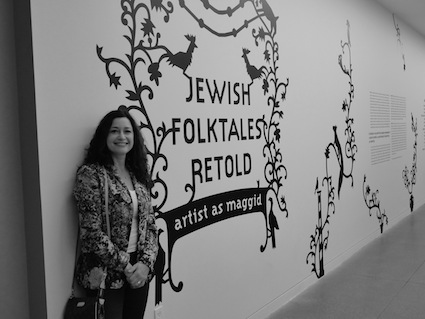
Artist Dina Goldstein is a proven storyteller, so it’s not surprising that she was asked to take part in the exhibit Jewish Folktales Retold: Artist as Maggid, which opened at the Contemporary Jewish Museum in San Francisco on Sept. 28. Metro Vancouverites will also have the chance to see her photographic interpretations of 11 “classic Jewish tales” – Snapshots from the Garden of Eden – at the Zack Gallery this month.
Jewish Folktales Retold was inspired by the book Leaves from the Garden of Eden: One Hundred Classic Jewish Tales by Howard Schwartz (Oxford University Press, 2008). As CJM executive director Lori Starr explains on the exhibit’s website: “Schwartz elucidates four varieties of these tales: fairy tales, folktales, supernatural tales and mystic tales. Fairy tales, he writes, are ‘fantasies of enchantment.’… Folktales ‘portray the lives of the folk as they imagined them, with … magical and divine intervention.’… Supernatural tales portray fears about the powers of evil entities and, finally, mystical tales are teaching stories of the great rabbis.”
“I was asked to participate over a year and a half ago,” Goldstein told the Independent. “At first, I discussed this with the curator, Pierre-François Galpin. At that time, I was planning on starting another series and I told Pierre-François that I just couldn’t take this on, as I saw it as quite an ambitious project.”
But, Goldstein was curious enough that she asked Galpin – who worked with CJM chief curator Renny Pritikin on the exhibit – to send her Leaves from the Garden of Eden so she could take a look.
“After receiving it,” she said, “I found that I really enjoyed reading these ancient stories. I told him that I could possibly photograph a few pieces as a contributing artist.
“I became intrigued by a few specific characters in the book and proceeded to take on more than I had anticipated at the beginning. I continued to photograph 11 pieces for the exhibit. I also decided to photograph the series in black-and-white large-scale tableau.”
Goldstein had free creative rein. “The museum did not give me any direction at all,” she said. “In fact, I came back to them with the chosen characters and ideas that I had for the retelling of these folktales. They did not see the work until it was completed.”
Dina Goldstein was one of the artists whose work was commissioned by the Contemporary Jewish Museum in San Francisco for the exhibit Jewish Folktales Retold: Artist as Maggid. (photo from Dina Goldstein)
The characters Goldstein has reinvented for contemporary audiences include Lilith (from the story “The Queen of Sheba”), Elijah (“The Cottage of Candles”), Golem (“The Golem”), King Solomon (“The King’s Dream”), the Princess in the Tower (in the story of the same name), the positive spirit Ibbur (“The Soul of the Ari”), the malicious spirit Dybbuk (“The Dybbuk in the Well”), the Tree of Life (“An Apple from the Tree of Life”) and Ashmodai (“The Bride of Demons”). She has also created an image inspired by the story “The Hair in the Milk.”
“I selected characters that were relevant and reappear throughout many of the tales in the collection,” Goldstein told the Independent. “I chose characters from each of the four types of tales: folktales, fairy tales, supernatural and mythical tales.”
She created two images for Ashmodai.
“I very much enjoyed this narrative, ‘The Bride of Demons,’ with relevant themes of desire and retribution,” said Goldstein. “The story is quite long, so I wanted to create a diptych to illustrate and interpret it in my own way.”
The Snapshots catalogue explains, “A devil king, Ashmodai is mentioned in talmudic legends and Renaissance Christianity. He is regarded as the demon of lust and is responsible for twisting people’s sexual desires.”
In one of the Ashmodai images, a woman in a bridal dress looks happily at herself in a half-length mirror; there are other mirrors in the room, which show her from different angles. In the second image, we see what looks like a garden, with the woman, buried, screaming, only her head and bridal veil above ground. The quote accompanying this disturbing scene is, “… And he longed to look at her … but he remembered the words of the rabbi and did not turn his gaze away from the king of demons. If he had, he would have seen his bride buried in the earth up to her neck, for she was almost lost to the Devil.”
All of Goldstein’s tableaux are striking, fascinating to explore and contemplate.
“I very much enjoyed uncovering these richly textured ancient tales and short stories, which include magnificent characters: kings and queens, princes and princesses, witches, mystics and malevolent wandering spirits,” she said. “Each of the characters face extraordinary challenges – placed in front of them by fate – that they must overcome. Every society is replete with myths and legends that transform and bend into parables that attempt to make order of life. It is this impact on culture, old and new, that led me to create a body of work that plays with satire, metaphor and irony.”
Goldstein’s photographic creations challenge viewers’ perceptions, asking them to reconsider the stories they’ve been told. Her collections include Fallen Princesses, which imagines how 10 of Disney’s princesses would face the challenges of real women; In the Dollhouse, which focuses on Ken and Barbie’s not so happily ever after; Gods of Suburbia, which brings various deities down to earth; and Modern Girl, which looks at consumerism in Western culture using the imagery of Chinese pinup girls from the 1930s.
The creative process for Snapshots from the Garden of Eden was similar to that of these previous works.
“I do my usual research online and then I hit the library for historical references,” said Goldstein. “I like to get a sense of how these characters have been depicted in art throughout history, what has been written about them from various sources. Many of these characters are actual historical figures. Others are supernatural and exist in various forms throughout the stories.”
It took her eight months to produce and photograph the series, she said. “Much of my work is in preproduction, organizing the cast and crew, the locations, and collecting all of the props and costumes and details that are germane to the final result of the piece.”
She concluded, “I am very fortunate to live in the city which has so much talent to utilize. All of the cast and crew are from Vancouver. I reached out on Facebook and social media to find all sorts of strange items – people pulled together to help out. I am thankful to Gordon Diamond, who has been a great supporter of my work throughout the years. Gordon will donate the series for viewing at the Jewish Community Centre in December.”
And, because of that, local community members will have the chance to see Goldstein’s work at the Zack. Snapshots from the Garden of Eden opens Dec. 14, 7 p.m., and runs until Jan. 20.
One of the stories that my father, z”l, used to tell me about his father, my grandfather, Rabbi Eyad Acoca, z”l, was that back in Morocco, at a young age, my grandfather traveled to the city of Sale to learn under the revered hacham, Ribbi Rafael Enkaua, z”l. In order to get there, he had to cross the Bou Regreg river. Once, while my grandfather was on a raft with other travelers, the raft tipped and all the people drowned except my grandfather, who held tightly onto his Talmud volume and got to the other side of the river safe and sound!
My father often recounted that my grandfather’s last wish was that at least one of his descendants continue his legacy and become a rabbi. His wish was fulfilled when I became a rabbi; in doing so, I merited to inherit a few volumes of my grandfather’s set of Talmud.
Through the years, I have come to understand that I have a big responsibility to continue in my grandfather’s footsteps and teach about Sephardi Judaism, which is unique and special. In recent years, numerous articles and lectures have been given regarding the future of Sephardi Judaism. As a Sephardi rabbi, I am delighted. However, to my dismay, I have found that most of the lectures have been framed in the extreme right or left. In my opinion, Sephardi Judaism has to come back to its origin, which was always the middle path.
Our great sage Maimonides, teaches us in his book Mishneh Torah (De’ot, the laws of personal development):
“Each and every man possesses many character traits. Each trait is very different and distant from the others.
“One type of man is wrathful; he is constantly angry. [In contrast,] there is the calm individual who is never moved to anger, or, if at all, he will be slightly angry, [perhaps once] during a period of several years.
“There is the prideful man and the one who is exceptionally humble. There is the man ruled by his appetites – he will never be satisfied from pursuing his desires, and [conversely,] the very pure of heart, who does not desire even the little that the body needs.
“There is the greedy man, who cannot be satisfied with all the money in the world, as [Ecclesiastes 5:9] states: ‘A lover of money never has his fill of money.’ [In contrast,] there is the man who puts a check on himself; he is satisfied with even a little, which is not enough for his needs, and he does not bother to pursue and attain what he lacks.
“There is [the miser,] who torments himself with hunger, gathering [his possessions] close to himself. Whenever he spends a penny of his own, he does so with great pain. [Conversely,] there is [the spendthrift,] who consciously wastes his entire fortune.
“All other traits follow the same pattern [of contrast]. For example: the overly elated and the depressed; the stingy and the freehanded; the cruel and the softhearted; the coward and the rash, and the like.” (chabad.org)
Maimonides writes, “The two extremes of each quality are not the proper and worthy path for one to follow or train himself in. And, if a person finds his nature inclining towards one of them or if he has already accustomed himself in one of them, he must bring himself back to the good and upright path.”
He continues, “The upright path is the middle path of all the qualities known to man. This is the path which is equally distant from the two extremes, not being too close to either side. Therefore, the sages instructed that a person measure … his character traits, directing them in the middle path so he will be whole.” (torah.org)
How I wish that the great minds of Sephardi Jewry would sit, united, and craft the future of Sephardi Jewry through Maimonides’ model. I hope that this will happen soon but, for now, let us all implement the lesson of Maimonides and implement the middle path in all our endeavours.
Rabbi Ilan Acocais a veteran rabbi and educator. He is the rabbi emeritus of Vancouver’s Congregation Beth Hamidrash and currently serves as the rabbi of the Sephardic Congregation of Fort Lee-Bet Yosef, in Fort Lee, N.J., and rav beit hasefer of Yeshivat Ben Porat Yosef, in Paramus, N.J. He is the writer of the book The Sephardic Book of Why and has written hundreds of articles on various topics for different publications.