We’ve seen a huge rise in neighbourhood property crime. We’re still driving a car without a back window (yup, two windows vandalized). We also lost a flower planter in June.
We realized the flowers were gone on Shabbat. We were on our way to services when we saw that we only had one and not two matching flowerpots. This matters for two reasons. First, we use the pots to keep people from parking illegally and blocking our gate. Sometimes, the planters get moved because a truck is parked to do work at our house or at a neighbour’s. Sometimes, big trucks or strangers just run over our planters so they can turn around or park illegally at our house. Despite multiple “private parking” signs, we struggle with these issues frequently. After each run-over or blocked gate, we’re scooping up the soil and repotting the flowers, trying to keep the planters going.
Two weeks after the pot went missing, when I was helping my twins walk their bikes to the schoolyard so we could safely practise cycling without training wheels, we stopped to look at our neighbours’ yards. My kids planted the flower pots themselves as part of their birthday celebrations at the beginning of June (reason #2 for their importance). They knew exactly which colours they’d put in each planter. And – surprise – our planter was firmly ensconced in a neighbour’s front yard, a block away from home.
We tried knocking but no one was there. When we returned home, we couldn’t put it out of our minds. My husband filed a supplement to our police report, asking if the cops could help invite these folks to return our flowers. So far, nothing has happened.
One of my kids has taken to doing the early morning walk with me and our two dogs now that it’s summertime. He reflects on the stolen/lost flowers every morning we pass them. On one of these walks, he brought up another story: he’d encountered a lost dog at day camp. Others shooed it away from the grass, into the parking lot, where he feared it would be run over. No one, in his view, helped it get home.
When I mentioned it to adults at camp, I was reassured that someone had found the dog’s owner. It was also pointed out to me that many kids were afraid of dogs; perhaps that’s why it was shooed away. I responded that, even if no one taught kids how to behave around animals, that dog was a “lost item.” Jewish tradition teaches us that it is a mitzvah, a commandment, to return lost items to their owners.
Jewish tradition is full of stories and rabbinic instructions for how we are to manage theft and loss. How we should address theft, punish thieves and figure out the motivations of those who do harm are part of what we should learn and teach as Jews. It’s our responsibility to return things and to help others find that order and closure in the world.
The rabbis recognize this commandment is complex. In some cases, hungry or suffering people may steal, borrow or “find” a lost item that they need to survive. However, we shouldn’t assume that the person who lost something can always make do or be fine without it. If we budget in our household to fill two planters with flowers – so the twins can each plant one – and someone steals one? Our kids feel that one planter is clearly not the same as two. There’s no food involved in this but, aside from contacting the police or directly confronting the neighbours, we run the risk of being seen as the crooks if we “steal” it back.
We have public services – police, courts, animal services – to solve some conflicts. Yet, if public services are delayed or unresponsive, we’re left with the same moral issues. How do we solve these problems without timely intervention or help? What can we do to practise tikkun olam, repair of the world?
We rely on voting in a democratic society, as well as a responsive civil service, to make sure our public services work. (This is a hint – please vote in the next election.) On a personal level, though, my kid suffers when he worries about a missing person, a dog or a flowerpot. He is the same kid who knows what the Red Dress installations mean: I have an 8-year-old who knows these commemorate the loss of missing and murdered indigenous women and girls. It’s hard to see a kid learn about this. It’s harder yet to live with loss. Imagine the huge pain of losing a person. For a kid, losing a beloved animal or giving up on something that was stolen seems hard enough.
The rabbis give ways to respond to challenges of theft or loss and it’s up to us not just to study the sources, but to live in a way that carries out their teachings. We must call others to account when they fail to do what’s right. If someone steals, promises to pay for something and doesn’t, or “loses” someone or something, it’s our obligation to ask them to honour their commitments.
It’s not OK to take a loved one, an animal, a kid’s flowerpot or to skip paying the bill. We have limited funds in our household, school and government budgets. Yet, our tradition also teaches a compassionate compromise – if a person truly cannot survive, we must help. The question we’re left with is how to find closure when the world fails us. If no one returns a missing child or animal, if we do not honour our commitments to others, what kind of a place is this?
We have a stake in making this world a better place. It starts with practical steps like helping get a lost person, dog or belongings home safely. Let’s at least honour our obligations.
Joanne Seiffhas written regularly for CBC Manitoba and various Jewish publications. She is the author of three books, including From the Outside In: Jewish Post Columns 2015-2016, a collection of essays available for digital download or as a paperback from Amazon. See more about her at joanneseiff.blogspot.com.
This colour image was obtained by NASA’s Galileo spacecraft early Dec. 12, 1990, when the spacecraft was about 1.6 million miles from the earth. (photo from NASA/JPL)
It’s been 50 years since Neil Armstrong became the first human to walk on the moon, on July 20, 1969. But there was another “first” six months earlier – in January 1969, the first Jew journeyed into space, Soviet cosmonaut Boris Volynov.
Since then, there have been 14 Jewish space-bound astronauts, including arguably the most famous, Israeli Ilan Ramon, who died in the explosion of the Columbia Space Shuttle, with six colleagues, in February 2003.
Like many before him, and many since, Ramon’s mission was infused with his Jewish heritage. For the voyage, he packed a pocket-sized Torah smuggled in (and out) of Bergen-Belsen, the Nazi death camp, and brought “Moon Landscape,” drawn by Petr Ginz, a 14-year-old inmate of Auschwitz. He also requested kosher food on the shuttle and NASA contacted Illinois-based My Own Meals, which makes kosher “thermo-stabilized” sealed pouches for campers. Reports say that Ramon also asked Rabbi Zvi Konikov of Satellite Beach, Fla., about keeping Shabbat in space – depending on the shuttle’s position, sunrise can happen 16 times a day.
To mark the 50-year milestone of the moon landing, the Jewish Independent interviewed three Jewish astronauts: Jeffrey Hoffman (the first Jewish male astronaut in space), David Wolf and Mark Polansky.
* * *
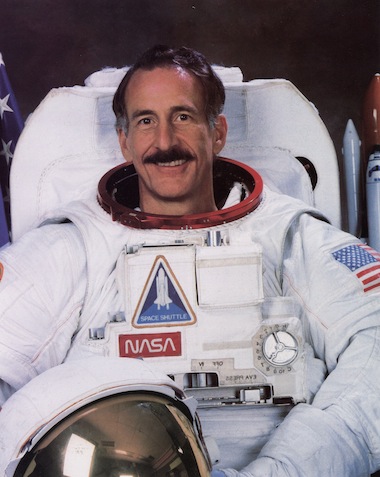
Hoffman was sent on five missions, the first in 1985; the last in 1996. In 1993, he repaired the Hubble Space Telescope. He logged more than 1,000 hours (the first to do so) and 21.5 million miles in space.
JI: Did you always want to be an astronaut?
Jeffrey Hoffman (photo from NASA)
JH: Well, if you asked in 1962 … any red-blooded young American boy, or probably Russian boys, for that matter, what they wanted to be when they grew up, 90% would say astronauts. I recognized that all of the early astronauts were military test pilots, and it was not a career I was interested in. I never considered it a realistic career prospect, but it was something I was always fascinated by.
In the late ’70s, NASA was developing what was then the brand new Space Shuttle, which had a crew of up to seven and they only needed two pilots. So, when they put out the first call for shuttle astronauts, all of sudden there were two types of astronauts now they were looking for. They were looking for the pilots, who were the traditional test pilot astronauts just like it had always been in the program, but they were also looking for scientists, engineers, medical doctors…. I all put in an application, and I was lucky enough to get selected.
JI: What was a highlight in space?
JH: The first highlight was riding a rocket into space, which fulfilled a childhood dream. But, the most memorable was, for every shuttle flight, two crew members were trained to use the space suits, just in case something happened. We weren’t planning on doing one on our flight, but one of our satellites malfunctioned and they sent me and my partner out to do what was, for NASA, the very first ever unplanned spacewalk. That was just an extraordinary experience.
JI: How did you get the idea to spin a dreidel in space?
JH: Before my first flight, my rabbi (Shaul Osadchey) asked me if I was interested in taking Jewish artifacts up. There were several dreidels I took up, one from the synagogue. I also took a mezuzah (donated to the Jewish Museum in New York), a Torah, both tallits from my two sons from their bar mitzvah, and a menorah, which is still at the front door of the science museum in Jerusalem. While I was in Jerusalem, I met a couple of Jewish artists who had read about me, a Jewish astronaut who took Jewish things into space. I had planned on being in space during Chanukah and one thing led to another and they presented me with a dreidel and a traveling menorah. It is a beautiful dreidel. It simply would not stop spinning!
JI: What did you do with the other Jewish stuff?
JH: There are only bunks for half the crew, with little places where you would sleep at night, and so we would share those with someone on the other crew. Well, I had a mezuzah with me. Of course, you can’t nail a mezuzah to the door when you are in a spacecraft; you have to use Velcro. So, I put it on the inside of my little sleep compartment and I would remove it every morning, because I figured this was for me and I didn’t want to impose on someone else who might not know what it is about. Fourth day of the mission, the guy who had been using my bunk at night said, “Hey, Jeff, that’s a nice idea putting the mezuzah in there!” I slapped my forehead…. It was Scott Horowitz, another Jewish astronaut. So, after that, we just left the mezuzah Velcroed to the wall for the both of us.
JI: Did you know Ilan Ramon?
JH: I knew Ilan, and had numerous contacts with his wife, Rona, since Ilan’s death. Although he was a payload specialist astronaut – a non-professional astronaut, on a crew for a special reason, for only one flight – he was totally accepted into the astronaut office culture. A large part of this is because his heroism as an Israeli Air Force pilot impressed the pilot astronauts, and another large part was because he was a genuinely likable person.
* * *
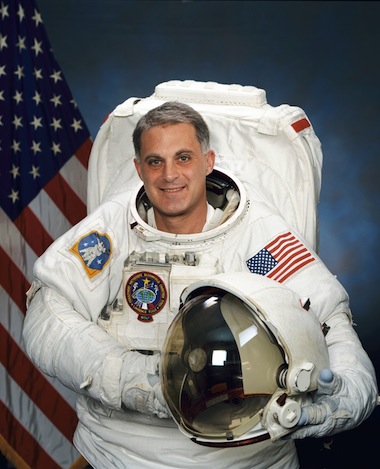
Wolf had four missions from 1993 to 2009, with more than 4,000 hours in space, 168 days in orbit on the space station Mir and seven spacewalks. He was the chief engineer for the orbital medical facility and chief scientist for the International Space Station (ISS) National Laboratory bioreactor (tissue-engineering) program. He conducted a number of experiments and studies, including advanced microgravity tissue-engineering techniques.
JI: How did you become an astronaut?
David Wolf (photo from NASA)
DW: I’d been flying in the F4 Phantom in the international guard for many years and had that air force background; I had this mix of medicine, engineering and flying. I wound up in a very unique situation as an astronaut because I had been at NASA for nine years already, building instruments for the shuttle and the space station. Interestingly enough, I went to NASA as a bioengineer and a flight surgeon initially. I was the chief engineer for what became the health medical facility on the space station.
JI: What was terrifying about being in space?
DW: I was trapped outside the airlock on a spacewalk in a Russian space suit in a Russian spacecraft. The airlock was never recovered. It wouldn’t repressurize, so we had to ditch into another module. [It] took like 14 hours; we were [brought in] at the last second. I have had three total power failures of a spacecraft.
JI: Now tell me about the Jewish aspects.
DW: We Jewish astronauts do consider ourselves as representing the Jewish community. We take it seriously. I carried a mezuzah and it’s on my door now. I also carried a yad, a Torah pointer, and gave it to my synagogue in Indianapolis. I had a small menorah up there. I have the world-record dreidel spin.
JI: You might want to ask Hoffman about that.
DW: Hoffman and I are having a running battle, a running argument, on who has the longest dreidel spin. But I know mine went for like an hour and a half until it got sucked into an air intake. It was just floating there spinning.
JI: Did you know Ilan Ramon?
DW: We were good friends, and his office was right down the hall, a few doors down. He was one of the very finest that we ever saw come through. And Israel should be totally proud of providing that kind of quality to the astronaut office.
* * *
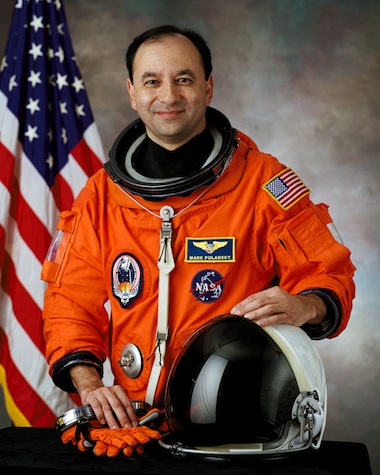
Polansky was sent on three missions – in 2001, 2006 and 2009 – all of which contributed to assembly of the ISS. He has logged nearly a thousand hours in space, and served as director of operations at the Gagarin Cosmonaut Training Centre in Star City, Russia. His initial flight was notable for several firsts: the first shuttle to dock with the ISS, the first time that a total of 13 crew members lived and worked onboard the ISS at the same time, and the first time that an astronaut/cosmonaut from every ISS partner agency was in orbit together.
JI: When did you decide to become an astronaut?
Mark Polansky (photo from NASA)
MP: I was 13 when we landed on the moon and I got inspired and thought about becoming an astronaut. I’m old enough to remember that everything came to a screeching halt. The teacher would roll in a rickety old black-and-white TV on a stand and plug it in, and pull out rabbit ears….
I was a freshman in college in ’74 and I was living in a dormitory at Purdue University with, of all people, David Wolf, and Gene Cernan came to campus to give a talk. Imagine yourself as a freshman in college being about five feet away from a man who walked on the moon – I still have goosebumps about that. And that led me down a road which went to the air force and beyond to eventually get where I got.
JI: What was a highlight of being in space?
MP: You go over places, especially when you orbit around the Middle East, and you know what goes on, on the ground, and the horrible things humans can do to each other, and the suffering. You see none of that from there. You get this feeling of, it’s almost both hope and sadness. It gives you hope that we as a species can get past this.
JI: Given past disasters, were you afraid?
MP: Flying high-performance aircraft, being a fighter pilot, a test pilot, unfortunately, there are times when there are going to be aviation mishaps, and it’s usually very unforgiving. You realize that, as much as you would like to make things so safe, there is no such thing as absolute safety, where you never get hurt. You don’t want to get hurt in an aviation accident? Well, don’t fly airplanes. I always knew there was a lot of risk to it.
I got to meet a lot of the people who were working on the hardware. This was a calling for them. They could have made a lot more money working in another industry, but they were there because they just lived and breathed working on Space Shuttles, doing everything they could to make sure those Space Shuttles were as safe as they possibly could be.
JI: Did you know Ilan Ramon?
MP: I knew Ilan Ramon and, when he came over, he was flying with a couple of classmates of mine. After that tragedy, I spoke on behalf of the agency at a reception they had in Los Angeles, about Ilan. He was just a normal, great guy, and a man of peace.
** *
Other Jewish astronauts:
Jerome Apt: Four missions, 1991 to 1996. Author of Orbit: NASA Astronauts Photograph the Earth (National Geographic Society). Received the NASA Distinguished Service Medal in 1997. In 2012, the International Astronomical Union approved the name “Jeromeapt” for the main-belt asteroid 116903.
Martin Fettman: 1993 mission. Has published more than 100 articles in refereed scientific journals.
Scott J. Horowitz: three missions, 1996-2001. Four Space Shuttle flights. A retired U.S. air force colonel.
Garrett Reisman: 2008 and 2010 missions. Joined SpaceX in 2011 as a senior engineer working on astronaut safety.
Gregory Chamitoff: 2008 and 2011 missions. The Lawrence Hargrave Professor of Aeronautical Engineering at the University of Sydney, Australia; professor of engineering practice in aerospace engineering at Texas A&M University.
Ellen Louise Shulman Baker: three missions, 1989-1995, the last of which was the first Space Shuttle mission to dock with the Russian space station Mir, and involved an exchange of crews. Logged almost 700 hours in space.
Marsha Ivins: five missions, 1990-2001. Spent 55 days in orbit, on missions devoted to such diverse tasks as deploying satellites, conducting scientific research, and docking with Mir and the ISS.
John M. Grunsfeld: five missions, 1995-2002. In January 2012, returned to NASA and served as associate administrator of NASA’s Science Mission Directorate.
Judith Resnik: first Jewish American and the first Jewish woman in space. Died on Challenger, January 1986.
Dave Gordonis a Toronto-based freelance writer whose work has appeared in more than 100 publications around the world.
Halifax-based lawyer Hanna Garson. (photo from Hanna Garson)
In 2015, the B.C. Civil Liberties Association and the John Howard Society launched a legal challenge to the federal government’s laws that allow administrative segregation – a form of solitary confinement – in prisons, calling it a cruel and inhumane punishment that can lead isolated prisoners to harm and even kill themselves. They won their case in the B.C. Supreme Court in January 2018, a decision that was appealed by the government the next month. Last week, the B.C. Court of Appeal affirmed the unconstitutionality of provisions that allow indefinite and prolonged solitary confinement of prisoners.
In the January 2018 decision, the B.C. Supreme Court gave the federal government 12 months to pass new laws. In January 2019, the court gave the government an extension to April, but said certain stipulations had to come into effect immediately. Correctional Service Canada was ordered to take several steps, including giving prisoners in segregation more time outside, requiring daily visits from healthcare professionals, allowing inmates legal counsel in hearings related to solitary confinement, and changing the authorization system regarding the placement of an inmate in segregation for more than 15 days.
The federal government was given another extension after the April deadline, to the end of June. Then, on June 24, the B.C. Court of Appeal came out with its decision on the matter – rejecting the government’s appeal.
“This particular case is very interesting, as there are no actual individual complainants,” said Jewish community member Hanna Garson, a lawyer based in Halifax whose focus is ensuring that everyone is treated fairly by the justice system. “So, the court [was] being asked to decide whether or not the written laws themselves breach provisions of the Charter of Rights and Freedoms in Canada.”
According to Garson, sections of the Charter are indeed being breached when it comes to administrative segregation, especially as it comes with no time limit. “People are being put into segregation not knowing when, if ever, they’re going to get out,” she told the Independent. “That really plays on the mind.”
Noting that many people have mental illness or struggle with mental health before they are incarcerated, which “may have led to their negative interaction with the law,” she said, “That population, in particular, is very damaged by periods of segregation.”
The appeal court’s reasons for judgment, written by Justice Gregory Fitch, stated that the Corrections and Conditional Release Act violated Section 7 of the Charter, which protects an individual’s right to life, liberty and security of the person. The court “found that the harm caused by prolonged confinement in administrative segregation undermines the maintenance of institutional security, as well as the ultimate goal of achieving public protection by fostering the rehabilitation of offenders and their successful reintegration into the community.” It also “found that prolonged confinement in administrative segregation is not necessary to achieve the safety or security objectives that trigger its use.”
The judgment noted “that administrative segregation has a small, but significant, disproportionate effect on indigenous men and an even more significant effect on indigenous women” and that the “impugned laws” violated Section 15 of the Charter “to the extent that they authorize and effect a procedure that results in discrimination against aboriginal inmates.”
Section 15 states that, “Every individual is equal before and under the law and has the right to the equal protection and equal benefit of the law without discrimination and, in particular, without discrimination based on race, national or ethnic origin, colour, religion, sex, age or mental or physical disability.”
Another issue, said Garson – who, in addition to being part of the firm Planetta Hughes LLP, is chair of the East Coast Prison Justice Society and is on the board of the Elizabeth Fry Society Mainland Nova Scotia – is that, while prisoners being placed in segregation have access to review boards, administrative segregation review boards consist of the same prison administration that placed them there. “So, it’s not an independent review and so, basically, the people who initially made the decision then question their own decision, which doesn’t necessarily secure a fair assessment of whether or not a person really needs to be segregated,” she said.
While legal counsel is permitted at these reviews, it is not provided in many provinces and few prisoners can afford representation or are not in a mental state of being able to request it, she said. “If you’re running a facility with hundreds of people who may be violent, I can understand a time-out for a moment to see what else needs to be done,” said Garson. “But, there needs to be a time limit and other solutions.
“Long-term, serious mental health treatments take far more expensive staff and thorough training. Are these better solutions though? Without a doubt, yes. Unfortunately, a lot of the constraints are budgetary and this is something that, oftentimes, courts are hesitant to rule on. But, for example, the court did say that, as it says in Section 15 [of the Charter], everyone has a right to be equal before the law and receive equal treatment of the law. So, the court does an assessment of whether or not people are being discriminated against by these laws.”
After hearing testimony and expert opinions, Garson said, “the court decided that both aboriginal people and people suffering from mental illness are segregated far more often … and that the impact on them is far more negative. But, it went further, ordering incarceration facilities to put in place better solutions – better programming that does not involve segregation.
“Usually, the court is hesitant to make decisions that would force the government to put more funding into something. But, it did in this decision, which is, in my opinion, really wonderful and a great precedent. This case is really groundbreaking and, to a certain extent, it was a wonderful thing that it was appealed.”
The B.C. Supreme Court said, “basically, we had to come up with new laws. But then, they suspended it for a year, as the government needs time to pass new bills and stuff like that. In the meantime, the attorney general appealed, because they don’t think it’s fair,” she said.
The Constitution of Canada, which includes the Canadian Charter of Rights and Freedoms, is the supreme law in Canada, she explained. Section 52 (1) of the Constitution Act 1982 mandates that any law inconsistent with the provisions of the Constitution is, to the extent of the inconsistency, of no force or effect. The decision by the appeals court will become a binding precedent in all provinces, not only in British Columbia.
Garson emphasized that she is especially happy with the decision because it is one that has really considered the damage segregation does on the mental health of those being isolated and notes that, “if we really care about rehabilitation, then [segregation] makes no sense as a strategy, especially for those with mental illness.”
Because the court looked at the experiences of those who have been segregated and the decision will affect them, the system and society as a whole in the long-term, Garson said, “It’s more like a living document in that way, and it’s a very exciting case for this reason.”
As for where Jewish law falls on this matter, the organization T’ruah has been leading a campaign to abolish solitary confinement in the United States. In a 2014 report on the compliance of the United States with the United Nations Convention Against Torture, T’ruah notes, “The very first two chapters of our Torah teach us that every human being is created in the image of God, and that no human being should be alone. The practice of solitary confinement violates these principles and diminishes the divine image. It also violates one of the Torah’s central moral teachings, expressed in Leviticus 19:18, that one should ‘Love your neighbour as yourself.’ The rabbis explain that this is taught, so that no one can justify degrading treatment of a member of their community…. If you do thus, know that the person you have dishonoured was created in the image of God.”
The report argues that “Jewish tradition understands instinctively that humans are social creatures. In a story about a character who outlives his family, friends and study partners, the Talmud teaches, ‘Either companionship or death.’ Life alone is unbearable. Jewish law warns against excessive punishment, ‘lest your brother be degraded before your eyes.’ (Deuteronomy 25:3) Even a person who has committed a horrific crime must be regarded as a member of one’s own family and, therefore, deserving of dignity.”
T’ruah contends that Jewish criminal law seeks to inspire teshuvah (repentance) and that there are several principles that should hold in prisons:
“1. No matter his or her crime, the prisoner should be seen as our ‘brother or sister’ and treated with dignity.
“2. No human being should be alone for extended periods of time. Isolation diminishes the human being and can even be deadly.
“3. Prisons should seek to rehabilitate the prisoner and not simply to degrade him or her.
“4. A prisoner should have a fair trial before being placed in solitary confinement. Therefore, solitary confinement cannot be used for those in pre-trial detention.”
There’s a funny story from when my husband and I were first married. We were in graduate school, but I had returned to grad school after teaching in Washington, D.C., inner-city high schools. I discovered that my husband and his friend Lou, one of his school lab mates, were regularly going out to eat fast food. Worried for his health and our budget, I let my new husband and our friend know that he was absolutely “not allowed” to be doing this. It was bad for them! My high school teacher tone was threatening and both guys heard me loud and clear.
Lo and behold, later, they walked past the student centre’s Burger King. And guess what? As Lou describes it (to this day), “WHOA!… She shut down Burger King!” Both believed that perhaps I had this huge power. I had jokingly let them think that I could shut down Burger King, all on my own. Sometimes, for our own best interest, we need to be told what to do.
The Torah portion Chukat, Numbers 19:1-22:1, is full of practical advice about how to deal with challenges in life, including food, death and sacrifices. There’s information about how adults should clean themselves, change clothing and do other ritual routines, such as those around deaths, which could prevent the spread of disease. Yet, there are complainers who forget to be grateful even about food, as when, in Numbers 20:5, the Israelites say, “Why did you make us leave Egypt to bring us to this wretched place, a place with no grain or figs or vines or pomegranates? There is not even water to drink!”
Then, there are divine-inspired miracles, like when Moses struck the rock (twice) and the water appeared.
There is a medical term called “dysregulation.” It means something may not be “normal,” but it could be part of a metabolic physiological or psychological process. So, a person can be physically dysregulated (klutzy or clumsy) or emotionally dysregulated (unable to respond with socially appropriate emotions). Dysregulation doesn’t come from one thing. It’s a general term. It means, this is abnormal and maybe the person is impaired by it. It’s something to be aware of and to work on.
Those who struggle with dysregulation may mature or become stronger than average and successful because of how hard they work to function “normally.” An example might be adopting an older animal-shelter dog. When I’ve adopted these dogs, sometimes they are already adolescents but lack basic training or manners. Through consistent, daily practice, they become good at the few obedience commands and behaviours I expect. When both my dogs sit on command at a street corner, a bystander, perhaps with an unruly dog, might say, “Wow! That’s amazing! How did you do that?”
I smile. The answer is something like, “Well, I’ve been asking these dogs to sit at every street corner every morning for the last six to 12 years.” With a lot of practice, my older shelter dogs grow and learn. They are every bit as amazing as a pedigreed puppy someone bought. It’s a maturation process, and it comes with years of practice and the assumption of responsibility.
In this Torah portion, there is the strong narrative voice and actions of G-d, telling the people what is expected of them, and pointing out where they may have faltered or failed. In effect, the impairments faced by people who used to be slaves have to be overcome. The people have been in a state of imbalance because of their traumatic experiences. Overcoming that dysregulation means healing, finding maturity and a reliable path forward.
All of this doesn’t happen overnight. We can’t do it alone. I know about dysregulation through reading about it in medical reports. Yet, through consistent learning, maturation and hard work, humans (and animals like shelter dogs) can overcome many things. This is a process. It’s a “two steps forward, one step back” narrative.
I was reminded of this issue when I recently visited a newly renovated grocery store. While the layout looked complete, the cashier said there was a mountain of work still to be done in the warehouse. Even the employees, on close inspection, were out of sync. I watched a manager willing to give a locked cart to a shopper for free rather than make change. Meanwhile, another manager shooed away a person down on his luck who was asking for change or food. There was a huge amount of new and fancy food on display but the food bank bin was nearly empty.
The store boasts of being community-minded, but it was dysregulated. They’d lost their way. Just as in the Torah, nobody, not even Moses, is perfect – he shouldn’t have hit the rock twice. Nobody should complain about the lack of figs or pomegranates – but we’ve got shortcomings. We’re all in the process of becoming something more.
Growth comes through many paths. Sometimes, in order to cut back on the fast food, you need a scary commandment from your new spouse! On more important matters? There’s an important divine voice. It’s a series of small, ritual, self-regulated steps that shape us into being our best selves.
Joanne Seiffhas written regularly for CBC Manitoba and various Jewish publications. She is the author of three books, including From the Outside In: Jewish Post Columns 2015-2016, a collection of essays available for digital download or as a paperback from Amazon. See more about her at joanneseiff.blogspot.com.
My Southern friends and family often joke, “The Lord works in mysterious ways.” This morning, I wondered what I would write for this column. I was walking dogs in the sunshine and things were mostly going well.
Except, right after 8 a.m., as I set up the slow cooker for dinner, my husband returned to the back door. He’d just left for work, but announced, “Change of plans.” Why? He’d just discovered that my car had another window smashed. It was the second time in eight days.
This column could be a real downer. There’s plenty to write about the rise in vandalism and crime, the current meth and opioid addiction crisis, the lack of mental health supports and addiction counseling; there’s a lot to say. Since we’re commanded to care for the sick and the homeless, well, it’s all a Jewish topic. (Yes, Jews struggle with mental health issues, commit crimes and take drugs.)
However, I’m going to look at something else that happened instead. When the first window broke, we thought it might be from vandalism, but it was just as likely that the vibrations from nearby construction broke the glass. I tried to come up with a positive narrative.
Sad to say, the second broken window was clearly smashed by a person, who then scattered our (totally worthless) belongings around in the car. We came to the inevitable conclusion – this wasn’t just an accident. Someone was trying to steal but couldn’t find much in there of value.
It’s easy to get stuck in a negative feedback loop here. If you spend a lot of time complaining, focusing on the negative, and repeating what happened, it’s bound to get you down. Yet, it takes work to be positive sometimes.
My kids are the lucky recipients of PJ Library books each month. Every generation of Jewish kids is offered the folk story where someone comes to the rabbi to complain about his house. The rabbi usually tells the man to get a dog, then a chicken, a duck, then a goat, cow and horse … put them all in the house.
Of course, it’s a chaotic, messy, loud experience. The poor complainer comes back to the rabbi saying, “Rabbi, why did you suggest this?” And the rabbi tells the man to give away or sell all the animals. Suddenly, when his little house is empty and quiet again? It’s a palace.
I won’t lie, we all have many things to kvetch over. Things don’t go well, or things that we want that cost too much money, or seem beyond reach. The truth is that we’ve been struggling with this, as a people, for as long as we’ve been around. In the Torah portion Sh’lach L’cha (Numbers 13:1-15:41) which happens around this time of year, we read about how scouts were sent out to check out the Promised Land. How they describe it – good (who doesn’t like milk and honey?) but with significant downsides. It’s settled by giants! They will eat us!
As a result, aside from Caleb and Joshua, G-d doesn’t let anyone in who was enslaved in Egypt, essentially sending a new generation into the land of Israel. Some read this as punishment for all the negativity and things that went wrong. Others see it as something of a narrative “refresh” button. Want to get rid of the negative feedback loop? Start with people who see things in a positive light, and don’t let them focus on what is going badly.
Is it possible to cut out all negativity? In my opinion, I think that’s naïve. The world is a challenging place. There are going to be difficult experiences and bad days. However, we also need to consciously work to be grateful for what we have. Like the man with the livestock in his house, we may not realize how good we have it until things get much, much worse.
Recently someone commented that she was amazed to see me smiling and present when I was actually quite tired. (Plus, I was struggling with some bad stuff, but I kept it to myself. She didn’t even know about that.) Sometimes, we have to “fake it until we make it.” As a mom with grade school kids, I don’t get many breaks. There are times when a kid or dog is sick and wakes me up at night, when street construction is terribly loud or, heck, my car keeps getting vandalized. However, if I give in to the negative feelings and list all the complaints, I get stuck on that same problematic negative narrative, like the aforementioned Torah portion, when those folks in the desert got frightened and suggested they should go back to Egypt.
This portion also mentions a list of physical things we can do to remind ourselves of our positive connection to G-d and Judaism, such as wearing tzitzit and taking a portion of our baking as a gift to G-d. It was a good reminder. Today, I’m making a big batch of challah – and I said the blessing as I sectioned off a portion of the dough.
It takes a brave leap some days to be positive and seek out the things for which we are grateful. Yes, my windows were smashed. I’m hoping all will be repaired by the time you read this column. In the meanwhile, I focus on how good that challah will taste and – maybe? – how quiet it will be when the construction is over.
Seeing life’s challenges as the glass half-full rather than half-empty can be hard work. However, that work is a conscious (and a Jewish) choice.
Joanne Seiff has written regularly for CBC Manitoba and various Jewish publications. She is the author of three books, including From the Outside In: Jewish Post Columns 2015-2016, a collection of essays available for digital download or as a paperback from Amazon. See more about her at joanneseiff.blogspot.com.
Lately, I’ve been thinking about Elijah the Prophet, or Eliyahu Hanavi. He’s that guy who somehow travels worldwide, to drink all the wine at every Passover seder every year. (What a hangover he must have!) Elijah is also supposed to attend every Jewish boy’s circumcision (brit milah or bris). We sing about him during Havdalah, the short service that separates the Sabbath from the rest of the week. This guy’s all over the place!
Well, he’s both all over the place in Jewish tradition and shrouded in mystery. This is the quirky prophet that never actually died, but instead ascended to heaven. He’s got three separate roles in Jewish tradition.
1) He’s a zealous prophet, reminding people how to behave properly and to remember G-d.
2) He’s known to appear and help those in distress.
3) He’s supposed to announce the coming of the Messiah or the Messianic Age.
(There’s more to Elijah’s roles, depending on what text you study.)
I hadn’t thought much about Elijah as an adult. I’m not big into worrying over the coming of a man on a white donkey (from Babylonian Talmud, Sanhedrin 98a) or the Messianic Age. However, he makes an appearance in ways that capture my kids’ interest. There’s that mysterious cup on the seder plate, and the song that we sing hoping that this week will be the one where Eliyahu Hanavi shows up to bring about the Messiah’s coming. Even if a kid doesn’t attend a bris too often, he might ask questions about Elijah.
There are a lot of stories that retell rabbinic traditions about Elijah. The most powerful are ones I never forgot from childhood, and which may still be helpful today. The stories seem to align directly with those points above, that adults are already supposed to know.
From the Prophets, we know that Elijah reprimanded others, threatened them with scary stories and told them to shape up. It’s essentially “putting the fear of G-d” into them. Apparently, he was good at this role, as he was sent to do it multiple times. In Jewish folklore, Elijah is the stranger who appears and helps the poor and reminds the wealthy of their failings. It’s this combination of the stranger who appears when you least expect it and the coming of the Messianic Age that I think about most often. Why?
I was taught to try to treat everybody with respect and empathy – because that person might be Elijah. That Elijah could appear at any time, looking like an old lady or a child, a homeless person or an older person with dementia. How we treat people indicates how we’re doing on bringing about a better age, or a Messianic one. When this idea was introduced to me, I remember thinking it sounded weird.
As an adult, it makes more sense because, well, life is weird. Life offers us many opportunities to practise conscious kindness, to do mitzvot (commandments) that help make the world a better place. If we keep doing this “fixing the world” (tikkun olam), well, we might just hear from Elijah.
There was that time when we had a stranger knock at our door. My husband answered it and then told me what happened. It was an indigenous man who didn’t look well. He looked like he had been doing some traveling through back lanes, but he came to the door with our dog’s collar in his hand.
I was immediately anxious. Our dogs are never without their collars and ID tags. However, this man came along, saw the collar in the back lane, clearly beyond the fenced yard. He was worried for the dog. The good news? We called her, and our dog was happy and safe inside. She’d somehow managed to shed her collar and leave it in the back lane without anyone noticing. This kind act made me wonder: Was this Elijah, known for his affinity with dogs? In the Sefer HaAggadah, it’s said that, when dogs are happy for no reason, it’s because Elijah is in the neighbourhood.
Sometimes, one of my kids carefully saves the seat beside him at services for what appears to be an imaginary friend. We joke that he knows Elijah is coming. Instead, it ends up being the friend on her own who needs just one spot or maybe even a stranger, who we then get to welcome to synagogue.
It’s the extra granola bar in my “mom bag,” when I thought someone might need a snack – and, indeed, a hungry person turns up. He needs it to continue onwards. Who knows what that person’s potential will be? That stranger gets a granola bar because, well, he might be Elijah.
This is all mystery and whimsy, if you take a purely Western and scientific view of the world. Yet, most of us acknowledge that we can’t explain why we’re lucky or when misfortune befalls us. Is it because of our behaviour or our efforts to do good in the world? Is it because some people “deserve” misfortune? I think not.
There are amazing people, all around us, who have struggled. Some were homeless, were put in foster care as children, or had addictions. Perhaps they suffered through wars or trauma. This childhood lesson about Elijah has stood me in very good stead because, if you remember that every person has value, every soul is important, it doesn’t matter how the person’s body presents itself. Whatever their clothes or hair look like, that person could be Elijah. Better yet, every person is someone important. It’s up to us to see that light inside, the potential waiting there, and to acknowledge the “other,” as Martin Buber would say. Be ready to offer something, with love and hope, when needed. It could be welcoming someone and offering a seat, a kind word, a thank you for returning a lost item, or a granola bar. Anybody can do this. Remember, that person across from you may be Elijah. The rest? It’s up to you.
Joanne Seiffhas written regularly for CBC Manitoba and various Jewish publications. She is the author of three books, including From the Outside In: Jewish Post Columns 2015-2016, a collection of essays available for digital download or as a paperback from Amazon. See more about her at joanneseiff.blogspot.com.
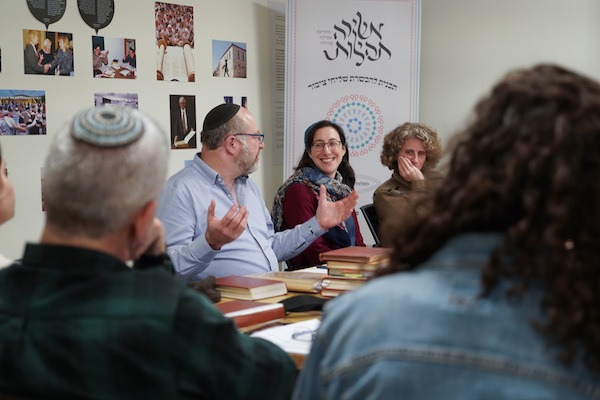
Rabbi Uri Kroizer from the Ashkenazi track with his students. (photo by Itai Nadav)
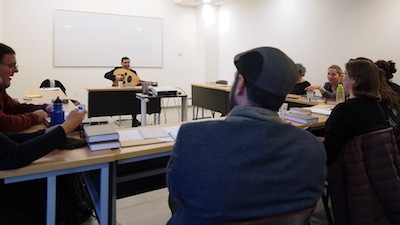
Some 50 prayer leaders recently completed the first session of the inaugural Ashira program. The program’s goal is to train prayer leaders (schlichei tzibur) from across Israel to direct creative prayers in one of the following three tracks: Ashkenazi, Sephardi and contemporary liturgy.
This unique program, which is held at the Schechter Rabbinical Seminary in Jerusalem, is a joint initiative of Rabbi Avi Novis Deutsch, dean of the Schechter Rabbinical Seminary, and Yair Kochav, one of the founders of the Tahrir cultural platform. Both are graduates of the New York Federation’s social leadership Cohesion Lab.
At one of the meetings at the Schechter campus in Jerusalem, Novis Deutsch explained, “Musical prayer is at the crux of the soul – it is clear that enabling people to study prayer touches their souls. We can discern true happiness in the classes. As the director of many programs at the Schechter Rabbinical Seminary, I can sincerely say that when you teach Torah you sometimes see happiness, but when you teach prayer you constantly see happiness on the students’ faces.”
The Ashira program is comprised of 15 weekly five-hour meetings, where students study both theoretical and practical aspects of prayers and it is sponsored by donors from Vancouver and various parts of Israel.
From December 2018 to just after Passover 2019, when you walked down the hallways of the building, you would hear different styles of music from the classrooms.
“The students represent a broad variety of Israeli communities – some are studying in rabbinical programs, some are prayer leaders, and all have a love for Jewish liturgical music,” said Novis Deutsch. “The Ashira program furthers social cohesion; it is a collaborative project with the leaders of prayer renewal in Israel. Many of those who participate in the program never thought that they could be prayer leaders. Ashira allows them to imagine this possibility – it reduces their anxiety about leading prayers and gives them a voice.
The program’s premise is that, to find your voice as a prayer leader, you must acquire an in-depth knowledge of the tools, styles and procedures in this field.
“Before we embarked on the program, we assembled 12 leaders in the field of Israeli music and started a process, which gave birth to Ashira,” explained Yair Kochav. Of the three tracks, he said the Ashkenazi and Sephardi work with the existing liturgy, teaching it to the new prayer leaders, while the “contemporary liturgy track fuses the first two tracks with modern Israeli reality.”
Sephardi track director Hacham David Menachem (holding the oud). (photo by Itai Nadav)
According to Kochav, each track is divided into three sections: theoretical, musical and practical.
“This gives students a multifaceted experience of the essence of prayer and what motivates people to pray,” said Kochav. “Each identity and motivation must receive its own space. There is a certain apprehension that the traditional liturgy will disappear due to the growth of a popular modern Israeli liturgy. Therefore, students in all three tracks meet to discuss the similarities and differences of each liturgy.”
Rabbi Rani Yager, from the Shalom Hartman Institute, who heads the contemporary liturgy track together with Yair Harel, said, “The most important lesson that I learned in this program is that prayer is a need felt by people in all communities: it is not connected to one’s religious or ethnic background, nor to one’s gender. People are willing to discuss this need, to learn and to share their feelings. Singing together requires courage, and the enormous need for prayer engendered this courage.”
Rabbi Uri Kroizer and Dr. Naomi Cohn Zentner direct the Ashkenazi track and Hacham David Menachem and Drori Yehoshua direct the Sephardi track.
Students study the musical scales of each liturgical style; each student plays an instrument and/or sings during the classes. During the breaks, students meet in the hallway and eat dinner together (organized by different students each week) and discuss current events.
“Those of us in the Ashkenazic track, who come from different backgrounds, meet weekly and make space for the voices that we bring from our homes,” said Shira Levine, who received her master’s from the Schechter Institute of Jewish Studies and is now a rabbinical student of the Hartman/Oranim program. “I have learned much from Rabbi Kroizer, who is an expert in Ashkenazic liturgy and a real mensch. I hope to study Sephardic liturgy in the next session.”
Osnat Ben Shoshan Pruz, a participant in the Sephardi track, said, “The program opened a door to a significant and immense world in which I have participated for many years. Ashira provided me with an opportunity to study, in depth, areas that I had not previously had a chance to examine. I have acquired numerous tools and knowledge in liturgy, Talmud and Jewish philosophy.”
“The program changed the manner in which I sing prayers, which goes beyond the pages of the siddur,” said David Arias, a Schechter Rabbinical Seminary student who participates in the contemporary liturgy track.
I chatted with a friend recently about what it was like in “the old days” when someone had to take a cellphone call during synagogue. This is when there were only big, clunky cellphones. I remember seeing a doctor on call pacing in the lobby. He – and it was usually a man – looked apologetic as he listened carefully. It was an emergency. It was a doctor who needed to attend to a patient, even though it was Shabbat and he was at services.
Given the circumstances, we recognized it was OK, because it was pikuach nefesh. He was helping save a life and that level of emergency is allowed, no matter how observant you are, on Shabbat. You put a person’s life above everything else.
The media has done many features where they reflect on research that shows how social media and being attached to a cellphone or other device has affected our health. It can keep us from interacting in the real world with other people, from sleeping or focusing properly. Social media increases our anxiety levels and, sometimes, it’s an addiction. Waiting to get that next update, from a friend or a news source, can sometimes seem more important than any actual person or event taking place in the same room.
My kids know the lesson from Sesame Street and the classic song, “Put down the ducky!” Ernie wants to play the saxophone, but Hoots the Owl tells him, “Put down the ducky if you want to play the saxophone!” It’s a lesson that we must break habits – like carrying a cellphone or the rubber ducky – to learn something new, make music and interact with others.
In the Jewish context, I see it everywhere. It’s at services, lectures, at the Passover seder or Shabbat table, at the kids’ events and play dates. It’s so pervasive that those doing it don’t even realize they are blocking out the world to engage with their electronics. It’s like a body part for those folks, while its noise means others can’t concentrate.
I was at a family service on Shabbat when we were interrupted with what sounded like a radio playing. It seemed to drift on and off and it was terribly distracting. Are we hyper-aware of such things? Absolutely. I am always tired and it makes me extra sensitive to noise and stimulation. There are some folks in my family who are also noise-sensitive. Too much noise and chaos often means we just have to leave. It’s too much.
Meanwhile, while the radio-like sound continued to compete with the prayers, adults in the back kept talking over it all. My husband, usually immune, looked bothered. I encouraged him to get up and ask someone to shut it off, since I sat with a kid on my lap. I thought it might be somewhere outside, but I was wrong. It was one of the talking adults, who failed to even notice that her phone was making the noise. Even when it was finally shut off, the adults continued to talk.
The interference was so pervasive and distracting that I couldn’t wait to leave. At Kiddush, at the end of the service, I heard someone say to a kid, “You can go ask the rabbi, he’s not praying now.”
That was it in a nutshell. I found myself wondering what the heck we were doing there. Are you coming to synagogue to play live-streaming radio and talk loudly? If you aren’t praying, or even sitting quietly, as a role model for kids, why bother coming to disrupt everyone else?
Some might say this is just an isolated incident, but it’s pervasive. On Yom Kippur, there was a grandfather who thought it was OK to hop up and snap photos with his phone during the service.
As I looked at the Torah portion, Behukotai, Leviticus 26:3-27:34, for the first week of June this year, I remembered this experience. It’s a portion that emphasizes all the amazing things offered by the Divine Presence “if you follow my laws and observe my commandments.” It’s a carrot-and-stick story, it clearly states the bad things that will happen to those who don’t follow the rules.
Our understanding of the laws and commandments may have changed, but social norms still exist. We live in a society with clear tension between individuality and the common good. If you judge someone else’s behaviour, you can be told that judgment is inappropriate – even when the individual isn’t behaving in a considerate or safe way for the community. If you feel uncomfortable with someone’s behaviour, we’re taught “we can only control ourselves and our response to it.”
You may not want to stop social media use on Shabbat or want to pray at services, and that’s your choice. However, it’s probably not your place to keep others distracted with your phone so they cannot concentrate on prayer. If you’re set on having it your way, and don’t want to think about others, why join a community Jewish event to do it? Stay home to use your cellphone instead.
Winnipeg prides itself on being a friendly place, and inspired other places to adopt a United Way campaign day of “conscious kindness.” It might be time to live the slogan and think of others – if you can’t put down the phone for your own sake, please do it for ours.
Joanne Seiffhas written regularly for CBC Manitoba and various Jewish publications. She is the author of three books, including From the Outside In: Jewish Post Columns 2015-2016, a collection of essays available for digital download or as a paperback from Amazon. See more about her at joanneseiff.blogspot.com.
On the second day of Passover, we begin to count the omer (sheaves of a harvested crop). The counting concludes seven weeks later, with Shavuot (the Feast of Weeks), which has different names, but is associated with one type of food: dairy products. Hence, my sharing a few cheesecake recipes.
Song of Songs Chapter 4 reads, “honey and milk are under thy tongue,” a reference to the Torah being as nourishing as milk and as sweet as honey. Thus, on the holiday celebrating the giving of the Torah, it became traditional to eat foods with milk and honey.
Interpreters of the Tanach liked to use gematria (Jewish system of assigning numerical values to words and phrases, based on their letters). For example, Psalm 68 is read on Shavuot and, in verse 16, it reads: “A mount of G-d is the mountain of Bashan.” The Hebrew for peaks is gavnuneem, which sounds like gveeneh (cheese). One could interpret this to mean that, on Shavuot, we should eat mountains of cheese.
Another example: the values of the Hebrew letters in chalav (milk) sum to 40. Moses spent 40 days on Mount Sinai, so we eat foods with milk.
As well, there is a legend that says, until Moses descended with the Torah, kashrut was unknown so, rather than prepare the meat as per the new rules, the people ate dairy. Pragmatically, since Shavuot is a summer festival and Israel is hot, it was logical to eat light, dairy foods. Also, sheep give birth around this time, so milk and cheese are plentiful.
In the Shulchan Aruch (code of Jewish law), Rabbi Moses Isserles wrote: “It is a universal custom to eat dairy food on the first day of Shavuot.”
CRUSTLESS CHEESECAKE
1 cup cream cheese 1 1/2 cups creamed cottage cheese 1/2 cup sugar 2 eggs 1 tsp vanilla 1 cup sour cream
Preheat oven to 350°F. Spray vegetable shortening in a nine-inch round cake pan.
Mix together cream cheese, creamed cottage cheese, sugar, eggs and vanilla. Pour into pan.
Bake 35-40 minutes or until centre firm.
Remove from oven and spread with sour cream while cake is hot. Cool then refrigerate.
BLENDER CHEESECAKE
crust: 15 graham crackers 1 tbsp sugar 1/2 tsp cinnamon 1/4 cup melted margarine or 3 tbsp vegetable oil
filling: 1 envelope unflavoured gelatin 1 tbsp lemon juice grated peel of 1 lemon 1/2 cup hot water or milk 1/3 cup sugar 2 egg yolks 1 package cream cheese 1 heaping cup crushed ice 1 cup sour cream
Break five crackers into quarters, blend to crumbs. Empty into bowl. Repeat twice more.
Stir in sugar and cinnamon. Add melted margarine or oil and mix until crumbs are moist. Grease a spring form pan. Press crust against sides and chill.
Mix in blender gelatin, lemon juice, lemon peel, hot water or milk 40 seconds.
Add sugar, egg yolks and cream cheese and blend 10 seconds. Add ice and sour cream and blend 15 seconds.
Pour onto crumb crust and chill.
MY MOM’S (Z”L) SCRUMPTIOUS CHEESE CAKE
crust: 2 cups graham cracker crumbs 1/2 cup butter or margarine or 1/4 cup plus 2 tbsp oil 1/4 cup sugar dash cinnamon
Combine crushed crackers, butter, margarine or oil, sugar and cinnamon and press into spring form pan.
Bake 10 minutes.
Combine the filling’s cream cheese, eggs, sugar and vanilla with a mixer until fluffy. Pour into crust and bake 30 minutes.
Beat topping’s sour cream, sugar and vanilla. When cake is done, remove from oven and spread topping on it. Return to oven and bake 10 minutes.
Serve with cherries, crushed pineapple or strawberries on top.
Sybil Kaplanis a journalist, lecturer, book reviewer and food writer in Jerusalem. She created and leads the weekly English-language Shuk Walks in Machane Yehuda, she has compiled and edited nine kosher cookbooks, and is the author of Witness to History: Ten Years as a Woman Journalist in Israel.
Worn out by recent events? Me, too. For most of my work, I write things in advance to meet a deadline, but I can’t predict the future. Like Jewish balabustas (Yiddish for a woman who manages her household) throughout time, one way I cope is through working harder – by multitasking and planning ahead. I bake challah and meals in batches and freeze the extra. Why? So I can also work, take kids to medical appointments or even stop everything so I can sit down to help with math homework in those crucial moments before dinner.
Yet, we have a hard time calmly planning ahead when things feel out of control. Rising antisemitism, murders and crimes in the world affect us, as do natural disasters both locally and farther afield. These experiences can cause us to feel a sense of “trauma fatigue.” This can also be called “compassion fatigue,” and some say it particularly affects those in helping professions, like first responders, mental health and medical professionals, and social workers. However, it’s not limited to those people. Even bystanders to an event, who perhaps see footage on social media, on TV or in the newspaper, can be affected. Kids can be affected, too. We’re not immune to what this experience does.
Many react with a sort of post-traumatic stress syndrome. There may be an increased sense of panic or “fight or flight” feelings of adrenalin. Some people cannot sleep, or sleep too much. They have flashbacks to bad incidents that occurred, as well as physical symptoms. They may feel disassociated from themselves or others, and may feel less compassion for others in general. There are lots of symptoms associated with this. I’m not an expert.
However, I realized one morning as I walked my dogs that I felt weary and emotionally drained. It’s awful to hear about shootings of people at prayer, hate crimes and massive natural disasters like flooding. There are only so many times you can feel heartsick about these types of events before it takes a toll.
A recent New York Times editorial was an apology for an antisemitic cartoon that they printed. The editors acknowledged the creep of numbness and a lack of judgment when it printed this cartoon and when it came to recent anti-Jewish incidents. This numbness mirrored the New York Times’ and other newspapers’ historic failure to address the widespread rise in antisemitism in the 1930s and 1940s. The current editors pointed out the danger in this, apologized for one editor’s poor choices and the paper’s lack of oversight.
We’re all coping with a sort of numbness when it comes to the news cycles and increasingly frequent events. It’s hard to respond with equal amounts of compassion after every shooting or traumatic world disaster. What can we do to relieve this?
The following list is partial and includes both Jewish and general responses to stress.
Shut off social media. Whether you’re Sabbath observant or not, find ways to silence your phone, newsfeed or other notifications for a few hours or days. Shut off the noise on occasion and step away from the news and alerts. It will calm your fight or flight instinct.
Get outside. Take the ear buds out. Take a walk or run. Bring the dog, family, a friend or just your thoughts. Listen to the birds, squirrels, wind or the traffic. Give yourself a chance to exercise, be out in nature and smile at neighbours. See the world at a slower pace.
Read a book. Escape fiction is not just for the beach. Find something engrossing to read and lose yourself in it for awhile. If fiction isn’t your thing, learn something new with non-fiction. Study Jewish texts, geography, geology or whatever interests you. Give yourself time for your mind to do something other than freak out.
Practise deeds of loving kindness. Try every day to do something for others. It can be a thank you note, helping a friend or holding a door open for a stranger. Donate money or food to the food bank, volunteer or simply help clean up at home, work or synagogue. This is a Jewish way of keeping the world afloat.
Prayer and meditation can help us remain calm and boost our health. Everyone differs on this topic. Some religious people feel prayer “protects” the faithful. Others are skeptical but hedge their bets. Even atheists can be aided with repetitive words or activities that help tune into this part of the brain. However you see this, it’s hard to refute the scientific evidence that being part of a religious community or meditating on your own can make a substantial difference to our health and well-being.
Speak out. We can’t control much – not natural disasters or the actions of others. We can, however, work for what’s right. Judaism has a long history of social activism. While we may disagree in our opinions, we can still choose to advocate for what we believe. We feel less helpless when we talk with others who share our views and try to make positive change.
Seek out support. It’s natural to feel anxious. This is a good time to seek out others at your congregation, community centre, workplace or school and talk about how you’ve been feeling. Talk to a therapist or a rabbi. Find time for friends, family and community members who care about you.
These are only some things that might help. It’s just a start, but, as the rabbis say, “The world stands on three things: Torah, prayer/service and deeds of loving kindness.” It’s true that life isn’t boring these days, but I’m wishing for a bit of boring. Here’s to enjoying some safe, quiet and calm, and peaceful, warm days ahead. Be well.
Joanne Seiffhas written regularly for CBC Manitoba and various Jewish publications. She is the author of three books, including From the Outside In: Jewish Post Columns 2015-2016, a collection of essays available for digital download or as a paperback from Amazon. See more about her at joanneseiff.blogspot.com.