Skip to content
  • Home
  • Subscribe / donate
  • Events calendar
  • News
    • Local
    • National
    • Israel
    • World
    • עניין בחדשות
      A roundup of news in Canada and further afield, in Hebrew.
  • Opinion
    • From the JI
    • Op-Ed
  • Arts & Culture
    • Performing Arts
    • Music
    • Books
    • Visual Arts
    • TV & Film
  • Life
    • Celebrating the Holidays
    • Travel
    • The Daily Snooze
      Cartoons by Jacob Samuel
    • Mystery Photo
      Help the JI and JMABC fill in the gaps in our archives.
  • Community Links
    • Organizations, Etc.
    • Other News Sources & Blogs
    • Business Directory
  • FAQ
  • JI Chai Celebration
  • JI@88! video

Recent Posts

  • Sharing her testimony
  • Fall fight takes leap forward
  • The balancing of rights
  • Multiple Tony n’ Tina roles
  • Stories of trauma, resilience
  • Celebrate our culture
  • A responsibility to help
  • What wellness means at JCC
  • Together in mourning
  • Downhill after Trump?
  • Birth control even easier now
  • Eco-Sisters mentorship
  • Unexpected discoveries
  • Study’s results hopeful
  • Bad behaviour affects us all
  • Thankful for the police
  • UBC needs a wake-up call
  • Recalling a shining star
  • Sleep well …
  • BGU fosters startup culture
  • Photography and glass
  • Is it the end of an era?
  • Taking life a step at a time
  • Nakba exhibit biased
  • Film festival starts next week
  • Musical with heart and soul
  • Rabbi marks 13 years
  • Keeper of VTT’s history
  • Gala fêtes Infeld’s 20th
  • Building JWest together
  • Challah Mom comes to Vancouver
  • What to do about media bias
  • Education offers hope
  • Remembrance – a moral act
  • What makes us human
  • המלחמות של נתניהו וטראמפ

Archives

Follow @JewishIndie
image - The CJN - Visit Us Banner - 300x600 - 101625

Tag: JMABC

Come celebrate our history

Come celebrate our history

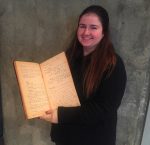
Jewish Museum and Archives of British Columbia archivist Alysa Routtenberg holds a minute book from Victoria’s Congregation Emanu-El, circa 1920. (photo from Alysa Routtenberg)

The documents and artifacts collected, processed and housed by the Jewish Museum and Archives of British Columbia are part of “everyone’s story,” JMABC archivist Alysa Routtenberg told the Independent in a recent interview. She encouraged people to donate material, join museum walking tours and visit the archives.

Routtenberg, who was born and raised in Vancouver, did her undergraduate studies in history and art history at the University of British Columbia before heading to Montreal for two years to earn her master’s of library information and archival studies at McGill University. In the summer of 2014, she had the opportunity to work in her field at the JMABC and, when she completed her studies, the museum’s then-archivist, Jennifer Yuhasz, was getting ready to move on and Routtenberg won the job.

“I ended up moving back to Vancouver, and was lucky enough to get this position not that long after I moved back to start my career as an archivist here,” she said.

Routtenberg’s family has been very involved in historical societies and groups for generations, and she always has loved her family’s library and the study of history.

“We did a lot of trips – like Fort Langley and all sorts of museums and things – so I always knew I wanted a career in history,” she said. “It was just a matter of figuring out the practicality of what that looked like.”

The JMABC originally started out as the Jewish Historical Society of British Columbia in 1971. Its founding president was Routtenberg’s grandfather, Cyril Leonoff, who passed away last year. Since its beginnings, the museum’s mandate has evolved, but the core objective has stayed the same – to preserve, collect and share the history of Jewish people in British Columbia.

The museum and archives makes information “accessible so people can come in and research,” said Routtenberg. “Then, we try to use that material in our public programming, whether that be with walking tours, lectures or physical exhibits. It’s all about celebrating and sharing the history. It’s a fairly short history compared to Jewish people in other provinces, but that doesn’t mean it’s any less important.”

The oldest material in the archives is from 1862 – from Congregation Emanu-El in Victoria. While not Canada’s oldest synagogue, it is the oldest synagogue in continuous use in the country. It’s been open and operational ever since it was started a couple years after Jews first arrived in the province.

“They were mostly coming up from California during the gold rush,” said Routtenberg of these pioneers. “And then, they developed businesses and, within a couple years, wanted to start a synagogue. So, that’s our oldest material. They are pretty special … very beautiful … handwritten notebooks and things.”

The first Jewish arrivals, she said, “set up businesses where they sold supplies to the guys who were going off panning [for gold]. So, that’s what allowed them to build a community. They built a business, a home, then a synagogue…. A couple guys called themselves wholesalers, selling every kind of supply. And then, as soon as there were actually people staying in Victoria and wanting to live there … I know there were a couple clothing stores and then a women’s clothing store, specifically, and a fur store … that sort of thing.”

As others did, Jews kept trickling into British Columbia, moving west with the hope of a better life, with more space. In the 1920s and 1940s, the Jewish community got big population boosts and communal groups began to be organized. Some community groups and businesses have now been around for three or four generations.

“There were furniture and scrap metal dealers … and we’ve collected a lot of those stories, fortunately, while those people were still with us,” said Routtenberg. “We’ve been able to write a couple of books about them,” she said, referring to the JMABC’s annual journal, The Scribe. The museum also publishes a newsletter, The Chronicle, twice a year.

Routtenberg’s job is to collect and preserve all the historical artifacts from the Jewish community, and the artifacts are divided into two major groups.

One group is family collections, which includes letters, photos, certificates and any other correspondence or paper material a family produced over the years. In that area, the JMABC has many great collections from a range of people.

“They were involved with any number of organizations,” said Routtenberg. “We’ll have their handwritten notes from meetings from the 1950s. We’ll have their letters back and forth with relatives across the country. Those are the sorts of things we have in the family collection.”

The second group focuses on community organizations, with collections from the Jewish Community Fund and Council, the Canadian Jewish Congress and the Hebrew Free Loan Association, as but three examples. The material in these collections includes correspondence, meeting minutes, agendas, publications they produced, information relating to events, etc.

“We’re very lucky in that most of the synagogues in the city have agreed to donate their materials to us,” added Routtenberg. “We collect the material related to the synagogue’s administration, meeting minutes, member lists, committee minutes, photos, events and publications.”

One important aspect of Routtenberg’s job is to reach out to and speak with people and organizations, to explain what it is that the JMABC does, what types of things it collects and, at times, making house calls to help sort materials.

“Once materials have been fully processed, everything is in a file and we know exactly what it is, what the dates are, and where to find it,” said Routtenberg. “So, that’s the main job we do.

“We deal with a lot of research requests as well,” she added. “A lot of people call or email and they are researching their family, asking what information we might have about them. Also, a lot of students, from high school to doctoral students, contact us when they are doing projects and want to know about a theme.

“I’ll make notes about those. I’ll try to answer right away, but often it requires some searching. Usually, looking through material in the archives needs to wait for a volunteer to be available or I encourage people to come in themselves.”

Routtenberg especially enjoys getting to dig into a box, and she has made some exciting discoveries.

“Something I love finding are handwritten letters,” she said. “We have a number of collections in the archives that are very thorough. There’s one that’s [between] a couple who was in Vancouver and Montreal in 1920, and they wrote letters back and forth.

“They met in Montreal, I believe, and then were secretly engaged for I think six months or so. And they wrote letters everyday, sometimes twice a day, back and forth. It’s those kinds of things that people don’t necessarily think is important, but they tell us so much about what life was like back then – things they struggled with and thought about. They are just beautiful.”

The archives are meant to preserve everyone’s history, not just the visible part of the community, stressed Routtenberg.

“If we don’t preserve our history, no one else will,” she said. “That’s what it comes down to at the end of the day. It’s really easy for people to think they’re not important, that their stuff isn’t important, thinking there is no reason why we would want it. People, all the time, bring stuff from the 1970s and 1980s, and they think it’s not important … but, if we don’t do it now, it never gets to be 150 years old.

“And we get so many research requests – we average 650 to 700 per year. These are all people with a wide range of questions wanting to know about the Jewish community. I don’t want to have to sit there and explain something, because I happen to know it – I want the evidence to back it up, providing the original documents for people to be able to come and look through.

“We’ve really been trying to promote community ownership of these archives,” she said. “They’re not this thing to be locked away from the public. They’re really everyone’s story.”

For more information, visit jewishmuseum.ca.

Rebeca Kuropatwa is a Winnipeg freelance writer.
Format ImagePosted on March 17, 2017March 14, 2017Author Rebeca KuropatwaCategories LocalTags Alysa Routtenberg, archives, British Columbia, history, Jewish museum, JMABC
Uncle’s letters reveal much

Uncle’s letters reveal much

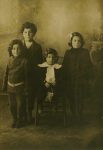
Left to right, Harry, Joseph, Benjamin and Rachel Seidelman, in approximately 1906. (photo from JMABC L.25670)

The following is an edited version of remarks presented at the Jewish Museum and Archives of British Columbia (JMABC) Intersections speakers series on Dec. 15 about the museum’s online exhibit Letters Home.

Recently, my wife Shelley and I were on a tour of Italy that stopped at the Cassino War Cemetery for soldiers killed during the Battle of Monte Cassino, a battle which resulted in 55,000 Allied casualties. In the 15 minutes we were there, we found two headstones with a Magen David, for soldiers from British Columbia who were killed in this Second World War battle. These headstones commemorate just two of many soldiers who have died in the fight for democracy but whose bodies are interred far away from family. My Uncle Joe was even less fortunate. Since his body was never found, there is no grave and, therefore, no headstone.

The First World War claimed the lives of 38 million civilians and soldiers alike. Approximately 2,700 Canadian Jews served in the Canadian Expeditionary Force, with about 1,200 seeing combat. Of those, an estimated 123 died in battle.

In late 1917, Gen. Douglas Haig, commander of the British Expeditionary Force, insisted that the key to victory on the Western Front was capturing the area around the village of Passchendaele, near Ypres in Belgium. Even though bad weather had turned the battlefield into a quagmire, Haig was determined to proceed.

At Passchendaele, on Oct. 26, 1917, 15,654 Canadian soldiers were killed. Among those who paid the terrible price for this hopeless decision was Pte. (Edward) Joseph Seidelman, 20, of Vancouver. His father, William, was a Hungarian Jewish immigrant who, after living in Kansas and Seattle, had settled in Vancouver in the 1890s. There, he met Esther Pearlman from Winnipeg. The two were married in 1896. Joseph was born a year later, followed by four more children during the next decade. Their father unfortunately died in 1907, leaving Joseph, Rachel, Harry and Ben; William was born after his father died and was named after him.

In 1916, Joseph was a student at the University of British Columbia. He would have graduated in 1918, the final year of the university’s transition from being an annex of McGill University to being a fully independent UBC.

Yearbooks are meant to celebrate successes at the institution but the 1918 edition also records the experiences of students who went to fight in the war and returned home, and it laments those students who went to war and did not return. One section is entitled “Military” and includes a copy of the Roll of Honour in Memoriam plaque that hangs in the foyer of the UBC War Memorial Gymnasium. It also contains brief biographies of those who were killed in action, including Joseph. Seventy-eight UBC students lost their lives during the war, and are commemorated on plaques in the War Memorial Gymnasium.

Compelled to do his patriotic duty, Joseph enlisted in the Western Universities 196th Battalion, which was made up of more than 150 students from universities in Manitoba, Saskatchewan, Alberta and British Columbia. Joseph was in England by November 1916. Early in 1917, he was sent to northern France and found himself in the muddy trenches of the Western Front.

So, how much do we know about someone who lived and died so long ago? Well, because of the letters featured in the JMABC online exhibit Letters Home, we have come to know Edward Joseph Seidelman better. In addition, in the 1918 yearbook, there is also a short mention of Joseph in a message from Prof. Lemuel Robertson, the first chair of the classics department at UBC. “Do you remember those little talks on socialism with Coughlan, or when Norman Hughes came into class the day after a dance, in the hope that he wouldn’t be asked anything? And Seidelman, too?” There are only three words but they give us a clue into his personality, that perhaps he liked to party.

In the letters Joseph wrote to his sister Rachel over nine months, he discussed family business and Vancouver affairs – in one letter, he expressed surprise at being a candidate for a Rhodes scholarship – and stated his hope that the war might end soon, though his optimism about the war varied. Even though he was in the centre of the action, he seems, in retrospect, to have been somewhat ignorant of how the war was actually proceeding.

The following letters are only examples drawn from the 87 he wrote. The letters from May 7, 1917, and are part of the JMABC online exhibit.

Camp Hughes, Man., Oct. 2, 1916: “I am going to Brandon again on Thursday afternoon and will stay over Friday, the 6th of October and also Saturday. I stayed with a Jewish family named Kisner and they were glad indeed to have me. Five or six decent-looking Jewish families wanted me to stay with them but Kisners had me first. Mrs. Kisner is only about 30 years old and she comes from the same city in Russia where mamma comes from, Novgorod. Mrs. Kisner introduced me to her 18-year-old sister….”

Dec. 24, 1916: “I knew Mr. Gibson’s son who was reported killed. Mamma has no reason to worry about me. It looks as though Germany will surrender to the Entente Allies…. I read in a London newspaper to-day called Lloyd’s Weekly News that a very high official of the German government … has confessed that Germany is starving and will give to England all that England demands even surrendering the Kaiser himself if necessary. It is quite possible, therefore, that the war may stop within a month or two by Germany’s sudden and complete surrender.”

Joseph stated that he applied for a transfer to the Royal Flying Corps but they were not taking any more applicants at that time. Instead, he was taking a lieutenant’s course and would perhaps go to a military training school later.

Feb. 17, 1917: “Two large Trans Atlantic liners carrying about 12,000 sacks of mail were reported torpedoed and sunk by German submarines and so let me tell you once again not to send anything valuable, for a German submarine might put an end to it.”

photo - Joseph Seidelman in uniform
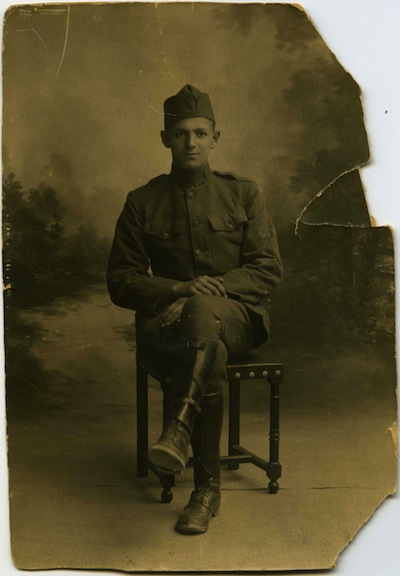
Joseph Seidelman in uniform. (photo from JMABC L.25664)

Feb. 27, 1917: “No doubt there are still many fellows hanging around in Vancouver who should be in the Army. I cannot understand their state of mind unless they have no self-respect or sense of honour. Let them go their ways while there is no conscription but I certainly am glad I am not in those times in civilian clothes. The B.C. University will have to wait until the end of the war for me at least.”

March 4, 1917: “France is certainly a muddy place. You ought to hear our artillery guns hurl death and destruction into the rank of the Huns [Germans]. The artillery makes most of the noise at night and then, when you wake up, you hear the terrific reports of each shot as quickly as the pat-pat-pat of a typewriter.”

March 11, 1917: “Things are somewhat interesting around this part of the world. British aeroplanes fly over us about as thickly as birds. To-day the Huns were firing at our aeroplanes and the puffs of smoke from the enemy’s shells bursting around the aeroplanes could easily be seen. It is very regrettable though that one of the enemy’s shells must have pierced the petrol tank of one of our aeroplanes, for it came down a mass of flames with a thick black column of smoke shooting out behind it. I never saw a single German aeroplane since I came to France. No doubt they have their wits scared out of them.”

April 7, 1917: “The chances of peace do not … look as rosy as I thought but the Huns will be defeated ultimately.”

April 17, 1917: “To-day after returning with a party from a certain part of France where the Germans were once expelled from and the ground all cut and plowed up with trenches, I found waiting for me a parcel containing a broken biscuit tin with some of mamma’s home-made confectionary (including many crumbs) and a tin of strawberries and coffee.”

May 7, 1917, datelined “some other place in France this time”: “I suppose it must have been reported to you that I was very slightly wounded by two very small pieces of shrapnel and, as I feel that you folks at home are very anxious to hear particulars, I want to assure you that there is absolutely nothing whatever for you to worry about. The two wounds I got are on the outer side of my right leg, one above the knee about the centre and the other below the knee about the centre. Although each wound has the appearance of nothing more than a [scratch?] on the skin, nevertheless I had to come to the hospital, where it is a pleasure to be for a change. One of the attendants told me that the leg will be alright again in about 5 days. So tell mamma to be happy and cheerful at home.

“I received three letters from you while I was in the firing line. I was much surprised to hear of the murder of Chief of Police McLennan. I guess Vancouver was shocked at the time almost as badly as a war event.”

On May 22, 1917, from “somewhere in France,” Joseph writes that he still has not rejoined his battalion after his leg injury, as another shrapnel piece was found in his leg, and required more medical attention at the hospital. Joseph tells Rachel that the shrapnel was found with the aid of an X-ray, and the doctor let him keep the shrapnel as a souvenir.

On July 3, 1917, again from “somewhere in France,” Joseph has returned to his battalion. In this letter, he tells Rachel that, on the night of May 5, 1917, when he received his leg wound, he still made the effort to help out a wounded officer. A telegram indicating Joseph’s return to the battalion from the hospital was sent to Joseph’s mother, Esther, on July 5, 1917.

On Oct. 14, 1917, still “somewhere in France,” Joseph reports “nothing to write about.” It is the last letter he writes home.

Joseph fought and survived the Battle for Vimy Ridge, was wounded in the leg in another battle and spent several weeks in an army hospital before being sent back to the front. On Oct. 26, the first day Canadian soldiers fought at Passchendaele, he was killed. Joseph was the first Canadian Jewish soldier from Vancouver to die fighting in the war.

UBC Remembrance Day Ceremonies have been held since 1951, when the War Memorial Gymnasium was opened. Since that time, I have attended nearly every ceremony. At first, I went with my brother and our father, Harry, who was too young to be part of the First World War and too old to be part of the Second World War. In the early years, my father would speak with veterans who knew Joseph. Over time, they all have passed away, but I have continued to attend the memorial ceremony with various members of my family as a way to remember my Uncle Joe, who is lying somewhere in France with no grave or headstone; our own kever avot (tradition of visiting the graves of our fathers).

Perry Seidelman is, among other things, president of the board of the Jewish Museum and Archives of British Columbia.

Format ImagePosted on January 20, 2017January 17, 2017Author Perry SeidelmanCategories LocalTags Jewish museum, JMABC, UBC, war
Mystery photo … Jan. 20/17

Mystery photo … Jan. 20/17

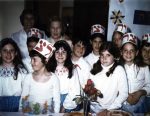
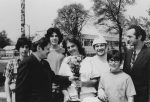
Beth Israel celebrations, 1971. (photo from JWB fonds, JMABC L.09840)

If you know someone in this photo, please help the JI fill the gaps of its predecessor’s (the Jewish Western Bulletin’s) collection at the Jewish Museum and Archives of B.C. by contacting [email protected] or 604-257-5199. To find out who has been identified in the photos, visit jewishmuseum.ca/blog.

Format ImagePosted on January 20, 2017January 17, 2017Author JI and JMABCCategories Mystery PhotoTags Beth Israel, JMABC
Thoughts on Oakridge exhibit

Thoughts on Oakridge exhibit

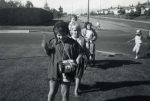
Staging a parade on Laurel Street, circa 1960. An image from the Jewish Museum and Archives of British Columbia’s online exhibit, Oakridge. (photo from Gail Dodek Wenner via jewishmuseum.ca)

The oral history exhibit recently launched by the Jewish Museum and Archives of British Columbia on the postwar Jewish community of Vancouver’s Oakridge neighbourhood struck a chord and gave me pause. This is the area where my mom grew up – she was 13 when the shopping centre opened, the mall where my high school friends and I would later hold part-time jobs – and where my grandparents’ family home remained until a few years ago. And, it gave me pause because it reminded me that a little history can shake one’s sense of complacency.

Spending my teen years in Vancouver in the late 1980s, I sometimes wondered why the Jewish community didn’t live more north or more west – in short, closer to the beach, and in reach of sea and mountain views. Surely, part of the Jewish community’s move southward had to do with the wider lots and newer homes available as the city sprawled outward. But another important – and, to me, overlooked – part of the story is the legacy of racism and antisemitism that had infected the buying and selling of property in Vancouver.

One of the interviewees in the exhibit recalls a real estate agent telling her father, in reference to a house on King Edward Avenue between Oak and Granville streets, “This is a good neighbourhood because no Jews or Chinese are allowed.” By the fifties and sixties, however, Jews felt welcome and comfortable in the south Vancouver area, bounded by Oak and Cambie.

Times were different for my generation, growing up as multiculturalism was taking hold in a serious way and antisemitism and racism were increasingly seen as unmannered, even if they never fully went away.

In the mid-1980s, I recall accompanying my grandmother to an annual general meeting at the Richmond Country Club, where she regularly played tennis. I recall a discussion that evening about whether Jewish membership should be privileged. (An interview with the club’s current general manager, Mark Strong, confirms that, while the club’s written charter states that no member will be denied admission based on race, colour or creed, in practice, during that era, the club promoted Jewish membership.) After the meeting, I was outspoken in my criticism. To my 12-year-old sensibilities, trying to stack the membership of a recreational club with any particular religion or ethnicity seemed parochial and antiquated at best, and prejudiced and discriminatory at worst.

What I didn’t sufficiently appreciate then was the legacy of Jews being barred from many country clubs and, indeed, the Richmond Country Club had been founded by a group of Jewish businessmen and professionals in 1951 for that reason. If the club’s policies seemed antiquated to my 12-year-old ears, there was more resonance to it than I then realized. While I was trying to afflict the comfortable, these club members likely still felt the sting of affliction requiring comfort.

Today, the Richmond Country Club has a Magen David in its logo, and states on its website that “the spirit of inclusion remains one of our core values.” (I will leave aside the separate though partially related question of whether any country club can be economically inclusive.)

What does it mean to have grown up in what felt like a post-antisemitism era? I admit that, until recently, I have been suspicious of those who seek to find antisemitism at every turn. Not long ago, an older relative clipped a real estate ad for a cottage near Lake Winnipeg that stated it was in a “restricted” area. My relative took this to mean no Jews allowed. I did a little research and soon learned that, in this particular cottage zone, “restricted” meant something very different – no cars allowed. When I showed my relative what I’d found, he turned angry. It’s easy to get locked into patterns of victimhood.

But now my comfortable post-antisemitism bubble seems to be bursting. The Trump era has unleashed a torrent of hateful, xenophobic and bigoted discourse. Swastikas and racist graffiti have popped up on various houses of worship – including four Jewish institutions where I live, in Ottawa. Trump has appointed as chief counsel Steve Bannon, a man accused of trafficking in antisemitism via his website, Breitbart News.

Modern liberal polities require a constant sense of balance between comfort and vigilance. Too much comfort, and one risks complacency – for oneself and others. Too much vigilance, and one veers into paranoia. At the very least, we mustn’t forget history. Narratives of the past help explain collective fears, while suggesting what is necessary to make possible the kinds of societies that are worth fighting for.

Mira Sucharov is an associate professor of political science at Carleton University. She is a columnist for Canadian Jewish News and contributes to Haaretz and the Jewish Daily Forward, among other publications.

Format ImagePosted on January 13, 2017January 11, 2017Author Mira SucharovCategories Op-EdTags antisemitism, Jewish Museum and Archives of BC, JMABC, Oakridge, real estate, Vancouver
Mystery photo … Dec. 23/16

Mystery photo … Dec. 23/16

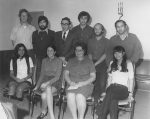
A group of people at Hillel, 1970. Back row, left to right: unidentified, Richard Bass, Rabbi Marvin Hier, Bob Golden, unidentified, unidentified. Front row, left to right: unidentified, unidentified, unidentified, Hildy Groberman. (photo from JWB fonds, JMABC L.11673)

If you know someone in this photo, please help the JI fill the gaps of its predecessor’s (the Jewish Western Bulletin’s) collection at the Jewish Museum and Archives of B.C. by contacting [email protected] or 604-257-5199. To find out who has been identified in the photos, visit jewishmuseum.ca/blog.

Format ImagePosted on December 23, 2016January 17, 2017Author JI and JMABCCategories Mystery PhotoTags Hillel, JMABC
Food in story and song

Food in story and song

Ken Levitt, JSA president, with Debby Fenson, who was one of the singers at the event. (photo by Binny Goldman)

On Nov. 25, Jewish Seniors Alliance’s first Empowerment Series in partnership with the Jewish Museum and Archives of British Columbia was held at the Peretz Centre for Secular Jewish Culture.

Gyda Chud, JSA vice-president and Peretz president, and Ken Levitt, president of JSA, welcomed the 65 people gathered, with Levitt thanking Chud and citing her as an example of koach, strength, in all she did.

The theme of this year’s series is Food: The Doorway to Our Culture, so the partnership with the JMABC was a natural fit, as its theme for the year is “Feeding the Community,” said Michael Schwartz, coordinator of programs and development of the JMABC, who briefly described how the museum functions and the extent of its collection.

As for its theme, Schwartz said the JMABC has created a new podcast, called Kitchen Stories. Episodes include stories about Sephardi Jews adapting to the culture of a different land, and that of a blended family from Ukraine and Rhodes. Schwartz highlighted the story of a family in Haida Gwaii, where, he explained, contact is usually made through an event; a shared feast celebrating the catching of fish, for example, the preparing of the meal and then the partaking of it, all instrumental to the success of the project itself.

Often a dilemma is faced when adapting to a new food culture and discarding the former, said Schwartz. Questions often arise, Which self am I? Does this diminish my former self? Food represents identity, acceptability and relationships, he explained, adding that a new JMABC venture planned for the coming year is a supper club at the Peretz Centre, where each get-together will focus on a different cultural theme: Persian, Israeli and Mexican.

Shanie Levin, a vice-president of JSA, then shared stories of food with those gathered. Formerly involved in amateur theatre and more recently in Yiddish reading groups at the Isaac Waldman Jewish Public Library, Levin said she collected stories from several different perspectives. The first she read was an excerpt from Rhapsody in Schmaltz by Michael Wex, in which he lists the various blessings to be said before and after consuming foods. In the passage, Wex also notes the problem of dealing with a spoonful of milk that falls into the chicken soup. Does it render the whole soup non-kosher? Or just the pot? What if the family is poor and there is nothing else to eat? Referring to Wex’s book, Levin discussed how Ashkenazi Jews have remained close to their customs of origin while Sephardi Jews more often have adapted their food preparation according to the country in which they found themselves.

A crowd favorite was The Chicken Tale by Rabbi Daniel T. Grossman, which had everyone laughing, hearing about the rabbi who, traveling with a group of Jewish choir singers, finds himself in a town that knows nothing about the customs of Jews. Hoping to impress him, his hostess does some research at the local library. When she meets the rabbi, she informs him that she knows rabbis kill chickens, therefore, there is a chicken in the yard and the townspeople are waiting to witness the kill. However, the horrified rabbi says that he is not that kind of rabbi, but a praying and teaching rabbi. So, that night, they all eat fish.

Another story, A Town Called Roosevelt by Moishe Nadir, illustrated that a preconceived notion can be changed gradually with each course of a delicious meal.

A personal favorite was Challahs in the Ark by Rabbi Zalman Schachter-Shalomi, written about the time the Jews were expelled from Spain, eventually to relocate to Tzfat. The shul caretaker was desperate to know if he had found favor in God’s eyes. Knowing his wife was an expert challah baker, he asked her to bake 12 loaves, which he then placed in the Torah ark, thinking that, if they were gone in the morning, then he would know God had accepted his offering. In the meantime, the shamash, who had not been paid for many weeks and had a hungry family, was pleading with God to show him a sign that his prayers were being heard. Imagine his joy upon discovering the loaves of bread at the ark, which he thought to be a definite sign. This joy was echoed by the caretaker the next morning. Seeing the challahs were gone, he felt God had accepted them.

photo - Serge Haber, Jewish Seniors Alliance emeritus president and JSA founder, left, and Larry Shapiro, second vice-president and executive board member of JSA, sit in the front row of JSA’s first Empowerment session of the year’s series
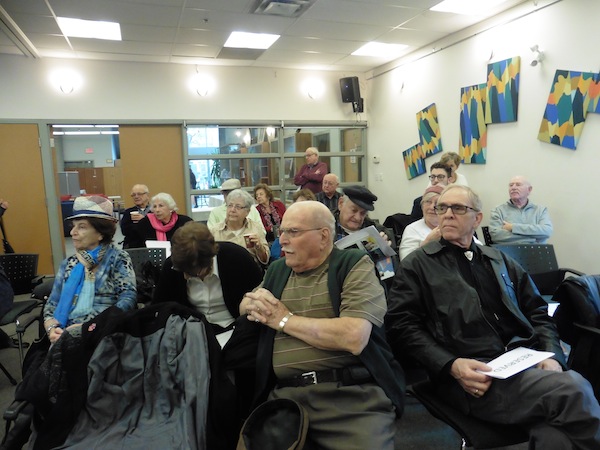
Serge Haber, Jewish Seniors Alliance emeritus president and JSA founder, left, and Larry Shapiro, second vice-president and executive board member of JSA, sit in the front row of JSA’s first Empowerment session of the year’s series. (photo by Binny Goldman)

The audience was reluctant to let Levin stop, so she read one more story, a short version of Sholem Aleichem’s Chanukah Gelt. Her delivery held listeners’ rapt; they could envision the action, as each story enfolded.

A musical program followed, featuring Debby Fenson, Deborah Stern Silver and accompanist Elliot Dainow. Fenson is ba’alat tefilah (Torah reader) at Congregation Beth Israel, where she teaches b’nai mitzvah students; Stern Silver is a trained soprano who sings with Fenson at Beth Israel; and Dainow is musical director of the Unitarian Church, as well as being an accompanist for soloists and various ensembles, including the Vancouver Jewish Folk Choir, which calls the Peretz Centre home.

Introducing their program, Stern Silver said the songs being presented were of Ashkenazi sources. They included “Tayere Malkeh,” a Yiddish drinking song, performed with a drinking cup and an empty bottle of wine, and a song about having to eat potatoes every day, which had the audience eagerly joining in with the chorus of bulbes (potatoes). The third song transported everyone to the Israeli marketplace, “Shuk HaCarmel,” and “Rozhinkes mit Mandlen” (“Raisins and Almonds”), a lullaby sung to children, brought tears of recognition and nostalgia.

Several instruments were handed out and those in the audience became participants in the performance of “The Latke Song” by Debbie Friedman. For the final song, “Finjan,” the audience enthusiastically clapped along.

It is impossible to capture the warm feeling of shared chavershaft (camaraderie) prevailing in the room; a fargenign, a pleasure.

In addition to Chud, who was the convenor, the event was made possible with the help of JSA staff, and Karon and Stan Shear filmed it for JSA’s website. Here’s to continuing the singing of our songs and sharing our stories m’dor l’dor, from generation to generation, af eybik, forever.

Binny Goldman is a member of the Jewish Seniors Alliance of Greater Vancouver board.

Format ImagePosted on December 16, 2016December 14, 2016Author Binny GoldmanCategories LocalTags food, JMABC, JSA, museum, seniors
Museum launches Oakridge

Museum launches Oakridge

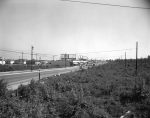
Cambie Street, looking south from 41st Avenue, 1952. (photo from City of Vancouver Archives via jewishmuseum.ca/oakridge)

On Nov. 23, the Jewish Museum and Archives of British Columbia had both its annual general meeting and launched its newest online exhibit, Oakridge.

JMABC board president Perry Seidelman called the AGM to order and noted a major absence.

“Forty-five years ago,” he said, “Cyril Leonoff became our founding president and was at our side throughout all of those years. However, sadly, this ongoing support ended this year with Cyril’s passing. There is so much that can be said about Cyril but tonight I will only say that he has been and will continue to be missed. It goes without saying that we would probably not be here tonight if it was not for Cyril Leonoff.”

Seidelman then went on to list some of the year’s accomplishments, including ongoing speaking engagements and historical tours, as well as the recording of 35 new oral history interviews and the digitization of “various family fonds, the Mountain View Cemetery Restoration Committee fonds and the Temple Sholom fonds.”

He noted that the digitization of “the oldest books from Congregation Emanu-El (1861 through 1901 approximately)” was complete and they will be online soon, that several online exhibits had been mounted during the year, and that the museum’s “largest collection by far, the Canadian Jewish Congress, Pacific Region, fonds, has begun to be processed, with immense research potential.”

The museum handled hundreds of research requests, he said, and “received donations ranging from fiction manuscripts to synagogue records to WWII records.”

Seidelman noted that longstanding JMABC member (and a past president) Bill Gruenthal was recognized by “Jewish Seniors Alliance for years of extraordinary volunteer work” and that archivist Alysa Routtenberg had “recently completed her first year as archivist as Jennifer Yuhasz’s successor. It has proven to be a nearly seamless transition with a continuing and increasing inflow of documents and interviews and regular transmission of the vast history of which we are guardians.”

He thanked JMABC administrator Marcy Babins, JMABC coordinator of programs and development Michael Schwartz, Shirley Barnett for her leadership in the restoration of the Jewish section of Mountain View Cemetery, Cynthia Ramsay for editing the JMABC’s annual journal, The Scribe, and donors and funders, including the Jewish Federation of Greater Vancouver. He bid farewell to three members of the board – Barnett, Chris Friedrichs and Barbara Pelman – and welcomed four new members: David Bogoch, Alan Farber, Alex Farber and Carol Herbert.

After the AGM was the Oakridge launch.

“With this exhibit,” said Schwartz, “we set out to document an important period in our community history; a moment when a population boom coincided with financial stability and postwar optimism to cause our community to grow both in size and stability in a way rarely seen before or since. This era set a new foundation for our community that we have built upon and relied upon ever since.

“This exhibit places this period in context with events happening both before and since. It asks why and how many Jewish families and institutions chose to establish themselves in Oakridge.”

Compiled over two years, the Oakridge research team was Erika Balcombe, Junie Chow, Elana Freedman and Josh Friedman, with Schwartz. A large portion of the exhibit comprises oral history interview excerpts from community members Harry Caine, Vivian Claman, Irene and Mort Dodek, Gail Dodek Wenner, Wendy Fouks, Debby Freiman, Sarah Jarvis, Ed Lewin, Sandy Rogen, Ken Sanders, and Seidelman.

“Irene deserves double thanks,” said Schwartz, “as we have included an excerpt of an interview that she carried out with Bea Goldberg and Marjorie Groberman in 1996. Naturally, I thank Bea and would certainly thank Marjorie were she still with us.”

Schwartz also gave thanks to JMABC colleagues Babins and Routtenberg, as well as Yuhasz, “each of whom devoted much time and energy to this project,” and the board of directors.

At the turn of the last century, explained Schwartz, “there were essentially two interconnected Jewish communities: the affluent Reform Jews in the West End and the Orthodox, working-class Jews in the East End, what today we call Strathcona…. Over time, the Jews of the East End grew more financially stable and began to relocate to the new neighborhood of Fairview in the 1920s and ’30s.”

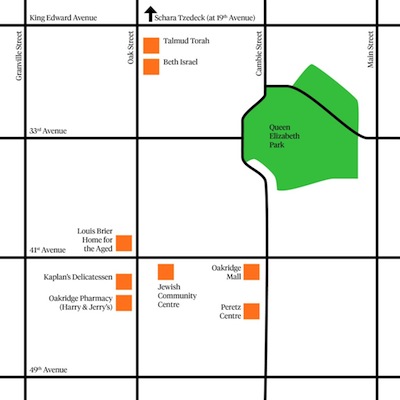
He noted, “If the Great Depression hadn’t hit, it seems likely that Oak and 12th Avenue would have been the heart of the Vancouver Jewish community. Instead, campaigns to build Beth Israel, Talmud Torah and a new Schara Tzedeck were put on hold until after the war. All three projects were completed in 1948. By that time, the city had continued to expand southward, so these three facilities were built closer to King Edward Avenue.

photo - Oakridge Mall at 41st and Cambie opened in 1960 and provided a commercial hub for the neighborhood, which attracted many young families – Jewish and not – to the area
Oakridge Mall at 41st and Cambie opened in 1960 and provided a commercial hub for the neighborhood, which attracted many young families – Jewish and not – to the area. (image from jewishmuseum.ca/oakridge)

“This southward shift was further encouraged by another important event,” he continued. “In 1950, the CPR, the Canadian Pacific Railway, released a parcel of land stretching from 41st Avenue and Granville Street to 57th Avenue and Main Street. The city identified the middle third of this land for residential development and worked with Woodward’s and other developers to construct Oakridge Mall as an anchor for the new neighborhood.

“This neighborhood didn’t attract exclusively Jews, but it arrived at a perfect moment for our community.”

There was a lot of material from which the researchers had to choose. “The work was to pare it down to a manageable size, a representative cross-section of the community,” said Schwartz. “As you can imagine, everyone we spoke to had a very different experience. For instance, Vivian Claman and Ed Lewin shared with us the experience of survivor families.”

In the exhibit, said Schwartz, Lewin comments, “The survivors and their children were almost like a sub-community of the Jewish community. We kind of did everything together, we were like an extended family.”

“In general, the Baby Boomers we spoke to had happy memories of their childhoods,” said Schwartz, giving the example of Claman.

“We played in the street – we would be gone all day,” she says in the exhibit. “We played kick the can! I mean, those were the days that you would go outside and you would just play till it was dark or till your parents yelled and said come in for dinner. There was a lot of hanging out.”

That’s not to say everything was perfect. Schwartz noted Mort Dodek’s comments in the exhibit.

“One other thing that you have to understand is that there was a lot of antisemitism at that time,” says Dodek. “There were people who were uncomfortable living in Shaughnessy, a lot of Jewish people were not comfortable there. The Shaughnessy Golf Course was there, and it was restricted, no Jews were allowed to join that club.”

And Irene Dodek notes, “When we first moved to Vancouver in 1947, my parents went out with a real estate man to look at a house at 25th between Oak and Granville, and the real estate agent told my father, ‘This is a good neighborhood because no Jews or Chinese are allowed.’”

Schwartz also pointed out that there were divisions within the Jewish community, citing Seidelman and Mort Dodek’s comments from the exhibit.

“The rabbi of Schara Tzedeck would not go to Beth Israel, would not be seen to enter, whereas today they have the Rabbinical Association, all the rabbis get on really well together and they seem to respect each other’s different levels of observance, whereas in those days they didn’t,” says Seidelman.

“If you want to talk about splits in the community,” says Dodek, “there was a terrific split between the people who were involved with the Peretz shul and people who were involved with, say, Talmud Torah…. It was not religious and believed that the main language to speak for a Jewish person was Yiddish. And, of course, the people at the Talmud Torah, the language to speak, of course, with the establishment of the state of Israel, was Hebrew.”

“Another theme that emerged through our interviews,” said Schwartz, “was the way gender roles were changing and have changed since the 1960s. Men always worked outside the home, but women rarely did. This was beginning to change, but very slowly. Without full-time jobs, women had the time to dedicate to volunteer organizations like Hadassah and National Council of Jewish Women. Both organizations accomplished a great deal in the 1950s, ’60s and ’70s, but have struggled in the years since, as fewer young women have the time to devote to this type of work.”

For anyone wanting to know more about the role of women in the community, Schwartz recommended the museum’s 2013 exhibit More Than Just Mrs., which can be found online.

“Oakridge, like each of our exhibits, serves three functions,” said Schwartz, listing those functions: a chance to grow the museum’s archives, to increase awareness of the JMABC and of Jewish life in the province, and to reflect on how the community has changed over time.

For the Oakridge exhibit, he noted, the majority of the oral history interviews “were undertaken by volunteer and student interns, giving them valuable experience in the art and science of oral history interviews. Thanks to projects like this, including other exhibits and our annual journal, The Scribe, our oral history collection has grown substantially in recent years, bringing our current total to 762 interviews.

“Just this month,” he added, “we held two interviewer training sessions as the first phase of our Southern African Diaspora Oral History Project…. Through this project, we intend to interview hundreds of community members who arrived here from South Africa and the neighboring countries in the 1970s, ’80s and ’90s.”

With respect to increasing awareness, Schwartz said, “Many of you will remember the launch of our modern architecture exhibit New Ways of Living back in January of this year. This event had an attendance of over 150 people, many of whom were not Jewish and found out about the event through our partners, Inform Interiors and the UBC School of Architecture and Landscape Architecture. Similarly, our 2015 exhibit, Fred Schiffer: Lives in Photos, attracted more than 800 people over its two-week run, again with much thanks to our partners, Make Gallery and Capture Photography Festival…. Each new exhibit has a specific thematic focus which draws in a new audience.”

As for reflection on the Oakridge years, Schwartz pointed to the expansion of the Jewish community. “Families,” he said, “have settled into neighborhoods throughout the city and the region in general.”

Referring to the Oakridge area, he concluded, “[I]f fewer and fewer Jews live in this neighborhood, does it make sense for the Oak Street corridor to remain the hub of much Jewish activity? This remains to be seen.”

See the exhibit at jewishmuseum.ca/oakridge.

Posted on December 9, 2016December 7, 2016Author Cynthia RamsayCategories LocalTags history, JMABC, museums, Oakridge
Mystery photo … Nov. 25/16

Mystery photo … Nov. 25/16

United Synagogue Youth Cycle-athon, 1971. (photo from JWB Fonds, JMABC L.09838)

If you know someone in this photo, please help the JI fill the gaps of its predecessor’s (the Jewish Western Bulletin’s) collection at the Jewish Museum and Archives of B.C. by contacting [email protected] or 604-257-5199. To find out who has been identified in the photos, visit jewishmuseum.ca/blog.

Format ImagePosted on November 25, 2016January 17, 2017Author JI and JMABCCategories Mystery PhotoTags Jewish life, JMABC, USY, youth
Mystery photo … Nov. 11/16

Mystery photo … Nov. 11/16

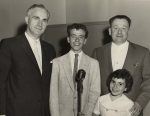
B’nai B’rith, 1960. (photo from JWB fonds, JMABC L.12160)

If you know someone in this photo, please help the JI fill the gaps of its predecessor’s (the Jewish Western Bulletin’s) collection at the Jewish Museum and Archives of B.C. by contacting [email protected] or 604-257-5199. To find out who has been identified in the photos, visit jewishmuseum.ca/blog.

Format ImagePosted on November 11, 2016January 17, 2017Author JI and JMABCCategories Mystery PhotoTags B'nai B'rith, JMABC
Mystery photo … Oct. 28/16

Mystery photo … Oct. 28/16

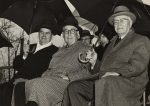
Louis Brier Home, 1965. (photo from JWB fonds, JMABC L.12338)

photo - B’nai B’rith, woman receiving an award, 1971
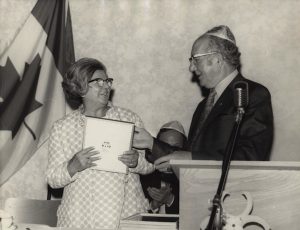
B’nai B’rith, woman receiving an award, 1971. (photo from JWB fonds, JMABC L.12175)

If you know someone in these photos, please help the JI fill the gaps of its predecessor’s (the Jewish Western Bulletin’s) collection at the Jewish Museum and Archives of B.C. by contacting [email protected] or 604-257-5199. To find out who has been identified in the photos, visit jewishmuseum.ca/blog.

Format ImagePosted on October 28, 2016October 27, 2016Author JI and JMABCCategories Mystery PhotoTags B'nai B'rith, JMABC, Louis Brier, seniors

Posts pagination

Previous page Page 1 … Page 4 Page 5 Page 6 … Page 10 Next page
Proudly powered by WordPress