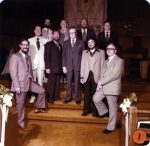
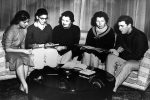
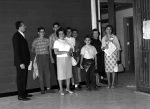
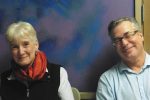
Beth Israel National Confab (clergy), 1975. (photo from JWB fonds, JMABC L.09862)
If you know someone in this photo, please help the JI fill the gaps of its predecessor’s (the Jewish Western Bulletin’s) collection at the Jewish Museum and Archives of B.C. by contacting archives@jewishmuseum.ca or 604-257-5199. To find out who has been identified in the photos, visit jewishmuseum.ca/blog.
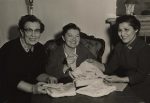
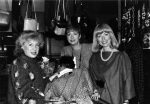
Na’amat Pioneer Women, 1960. (photo from JWB fonds, JMABC L.12599)
If you know someone in this photo, please help the JI fill the gaps of its predecessor’s (the Jewish Western Bulletin’s) collection at the Jewish Museum and Archives of B.C. by contacting archives@jewishmuseum.ca or 604-257-5199. To find out who has been identified in the photos, visit jewishmuseum.ca/blog.
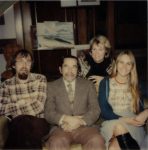
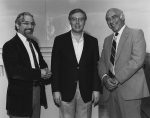
Beth Israel Sisterhood panel, 1977. (photo from JWB fonds; JMABC L.09864)
If you know someone in this photo, please help the JI fill the gaps of its predecessor’s (the Jewish Western Bulletin’s) collection at the Jewish Museum and Archives of B.C. by contacting archives@jewishmuseum.ca or 604-257-5199. To find out who has been identified in the photos, visit jewishmuseum.ca/blog.
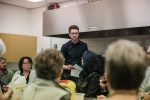
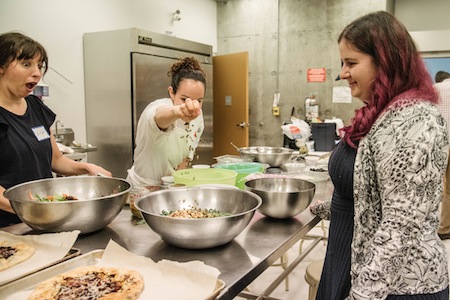
Michael Schwartz, director of community engagement at the Jewish Museum and Archives of British Columbia, speaks to guests at a Chosen Food Supper Club gathering. (photo from JMABC)
This spring, the Jewish Museum and Archives of British Columbia began airing the podcast The Kitchen Stories. The series, which is focused on Jewish food, is the brainchild of Michael Schwartz, the museum’s director of community engagement.
“A podcast is not so different from a museum exhibit,” said Schwartz in an interview with the Independent. “It is a way to present a story…. It doesn’t have a visual component but, unlike a museum exhibit, people can take a podcast with them, listen to it whenever they have the time.”
While podcasts have evolved on and from the internet, Schwartz considers the format a renaissance of a much older type of media – the radio talk show. “Like radio, a podcast is an audio presentation, but on a different technological level. In the past couple of years, there have been some creative and innovative podcasts, and we’re trying to add to their number.”
The idea of a food-related podcast came to him after he experimented with a couple of other topics. “My role at the museum is to make people, both Jews and non-Jews, more aware of our museum. I tried several different themes – architecture, photography – but food seems to be universal. Everyone is interested in food, especially in Vancouver. We are a foodie city, so it seemed appropriate to ride that momentum, to let people tell their stories about food. That’s what a museum does: it lets people tell their stories. Ideally, the museum staff should be invisible.”
The Kitchen Stories concept, as well as the museum’s Chosen Food Supper Club – a dinner series where people meet each other, learn about and enjoy the food being served – crystallized for Schwartz simultaneously. “We started the podcasts a bit earlier, in March, and the supper club in April…. Lots of storytelling happens during the club meetings,” he explained. “Like the podcasts, each club meeting has a theme. Sometimes, it is geographical: food from different parts of the globe. Sometimes, thematic, like holiday food.”
Chef Lior Ben-Yehuda puts the finishing touches on a salad as Erika Balcombe, left, and JMABC archivist Alysa Routtenberg look on. (photo from JMABC)
A similar variety of themes characterizes the podcasts. To date, shows have examined food links to family dynamics and worldwide migrations, climate and gender roles, cultural customs and regional culinary quirks.
“We brainstormed the possible themes as we listened to other podcasts, read books on culinary history. We tried to pinpoint what is missing and use those points as our guidelines. One of the underlying themes in our podcasts is the tension between traditional and modern. How people adapt to the local food sources when they move, how the familiar recipes change with times and places. How those recipes diverge when members of one family move to different countries, or continents, and the usual ingredients become unavailable.”
Schwartz believes that the museum has to be open to the stories of all Jews, regardless of their religiosity, affiliation or geographic roots. “The museum’s role is not to provide answers but to discuss a question, to open a forum for conversation. In The Kitchen Stories, food is a medium of telling stories. We explore healthy food choices and how they change with generations: what our grandmothers thought healthy and what we think healthy could be different. We talk about kosher food and organic food. And, of course, when people talk about food, everyone has an opinion.”
The topics are approached often from an historical perspective. “Food is a way to keep history alive,” Schwartz said. “When a kid asks his parents or grandparents why do you cook this way, stories emerge. We wanted to showcase those stories. Food is also a way towards peace and harmony. When we share food with friends, we talk and try to understand each other. Food is a means of communication.”
Schwartz doesn’t create the podcasts alone. Co-producer April Thompson has been working for the museum for the past year.
“I do research on the theme we select, I conduct the interviews,” Thompson said. “Sometimes we interview people in their homes or their businesses. Other times, they come here to the museum; we use a quiet room for the interviews. The museum has had an oral history program for decades, so we use the existing museum equipment for recording. Then I do the editing, choose the music. After I’m done, Michael listens to my material. He records the narration, inserts special terminology sometimes, or we move the pieces around to structure the story better.”
“April is very important to the series,” said Schwartz. “She is not Jewish, and that fact has given her an interesting angle on the project. She brings necessary curiosity to some things those of us within the Jewish community take for granted.”
“Yes,” Thompson agreed. “I’m like a child. I ask: why do you do this, because I don’t know. I want to know. I’m now working on a podcast about [dealing with] grief through food, about the Jewish shivah custom. It’s different from many other cultures.”
Beth Israel group reading, 1965. (photo from JWB fonds, JMABC L.09870)
If you know someone in this photo, please help the JI fill the gaps of its predecessor’s (the Jewish Western Bulletin’s) collection at the Jewish Museum and Archives of B.C. by contacting archives@jewishmuseum.ca or 604-257-5199. To find out who has been identified in the photos, visit jewishmuseum.ca/blog.
Beth Israel Sisterhood luncheon, 1983. (photo from JWB fonds, JMABC L.09853)
If you know someone in this photo, please help the JI fill the gaps of its predecessor’s (the Jewish Western Bulletin’s) collection at the Jewish Museum and Archives of B.C. by contacting archives@jewishmuseum.ca or 604-257-5199. To find out who has been identified in the photos, visit jewishmuseum.ca/blog.
Jewish National Fund, 1980. (photo from JWB fonds; JMABC L.11965)
If you know someone in this photo, please help the JI fill the gaps of its predecessor’s (the Jewish Western Bulletin’s) collection at the Jewish Museum and Archives of B.C. by contacting archives@jewishmuseum.ca or 604-257-5199. To find out who has been identified in the photos, visit jewishmuseum.ca/blog.
Jewish Community Centre of Greater Vancouver, 1950. (photo from JWB fonds, JMABC L.11154)
If you know someone in this photo, please help the JI fill the gaps of its predecessor’s (the Jewish Western Bulletin’s) collection at the Jewish Museum and Archives of B.C. by contacting archives@jewishmuseum.ca or 604-257-5199. To find out who has been identified in the photos, visit jewishmuseum.ca/blog.
Grace Haan, JSA Peer Support trainer and supervisor, and Charles Liebovitch, JSA Peer Support coordinator, at the March 8 Food and Film Empowerment session. (photo by Binny Goldman)
The screening of Dough at the March 8 Food and Film session of the JSA Snider Foundation Empowerment Series continued the 2016-17 series’ theme of “Eating our way through Jewish history: Food, the doorway to our culture.”
Presented in partnership by the Jewish Seniors Alliance and the Jewish Museum and Archives of British Columbia, this latest session took place at the Unitarian Centre.
JSA president Ken Levitt greeted those gathered, taking the opportunity to introduce the alliance’s new motto – “Seniors, stronger together.” He emphasized the comma in the phrase, as it had been the topic of much discussion. He also credited me for the motto’s origin.
Gyda Chud, convener of this third session of the food-related Empowerment Series, said she was happy to see so many women in the audience as the event took place on International Women’s Day. Chud was wearing a scarf commemorating the World March of Women that took place in Montreal in 2000.
Michael Schwartz, JMABC coordinator of programs and development, noted how women were responsible for the existence of many organizations in the province. He stressed the importance of families contributing their own pieces of history to the museum to help future generations know the community’s origins and its past. And he asked audience members to become members of the museum, the benefits of which include receiving The Chronicle, which will keep them up-to-date on the museum’s events and research. One upcoming event, he said, is the Supper Club, which will take place at the Peretz Centre for Secular Jewish Culture, where the museum is housed. He concluded, “Without further a dough we hope you enjoy the movie Dough.”
Dough depicts the desperation that sometimes drives people together. Widowed and finding it hard to manage, Nat Dayan is desperate to save his London bake shop from closing – his grandfather had opened Dayan and Son 60 years ago. Customers are getting scarce, moving away or dying, and Nat’s son, a lawyer, is not interested in continuing the family business or helping it survive. In addition, competition is becoming a concern, with a shop next door that is selling baked goods, as well as groceries, and Nat’s apprentice has left to work for them.
Struggling to keep his kosher bakery open, Nat hires Ayyash, the teenage son of his cleaning lady. Ayyash has been selling drugs to help support his mother and himself and, when Ayyash accidentally drops cannabis into the challah dough mix, sales at Dayan and Son soar. Long lines appear and the closing of the shop seems far off.
A warm and special friendship develops between the Muslim boy and the Jewish baker, as Ayyash and his mother go to live at Nat’s when their home floods. A line in the film – Fiddler on the Roof meets West Side Story – helps describe what we see developing.
Tragedy is averted when a fire set by a competitor, instead of destroying the shop as well as Nat’s dream forever, serves to bring them closer together with mutual aspirations of continuing to exist. Dayan and Son survives with the “son” being Ayyash. The theme is an especially moving one – overcoming racial prejudice and bringing about closeness through the will for openness, acceptance and understanding, which can be found in unexpected places.
Chud thanked the delighted audience and invited all to enjoy baked goods – though not the cannabis-filled ones in the movie. The JSA staff worked hard to bring this event to the public, and Stan Shear was invaluable for all his technical work.
May we “break bread” together in the future. B’tayavon, b’shalom.
Binny Goldmanis a member of the Jewish Seniors Alliance of Greater Vancouver board.
Don’t Break the Chain is the first publication of what the Jewish Museum and Archives of British Columbia hopes will become a Family History series.
The Jewish Museum and Archives of British Columbia has released the first book in what it hopes will become a Family History series. Don’t Break the Chain: The Nemetz Family Journey from Svatatroiske to Vancouver was published in collaboration with the Ben and Esther Dayson Charitable Foundation, and was researched by Shirley Barnett and Philip Dayson.
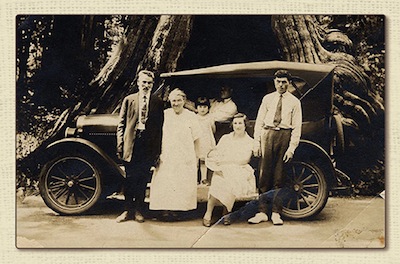
Abraham Nemetz, Toba Nemetz, Esther Wosk, Bill Nemetz (driving), Chava Wosk holding baby Sonny, and Abrasha Wosk; taken at the hollow tree in Stanley Park, 1927. (photo from nemetzfamily.ca/gallery)
Barnett described her family as founders and workers behind the scenes of the Vancouver Jewish community.
“One of my mother’s sisters helped build Congregation Schara Tzedeck, the Louis Brier Home and funeral chapels, while another sister founded Jewish Family Services and visited the poor, people in prisons and mental hospitals. My mother ran charity events for Jewish Vancouver from the age of 18 and her brother started Camp Hatikvah,” she said. “They brought a lot of strength to the community. The next generation, which was mine and included 23 of us, has made significant contributions to Jewish Vancouver, too.”
There was plenty of raw material to draw from for the book, given the fact that Barnett’s six brothers had created memoirs and Dayson had begun creating family trees 25 years ago. The project became challenging when she opted to include charts and photographs of children, grandchildren and great-grandchildren.
“I established contact with members of the family I never knew, siblings who’d had arguments and people estranged from the family, and it took a very soft approach, getting them to respond with photographs,” she explained. “I wasn’t looking to mend fences or interfere in anyone’s life, I just wanted to write a book!”
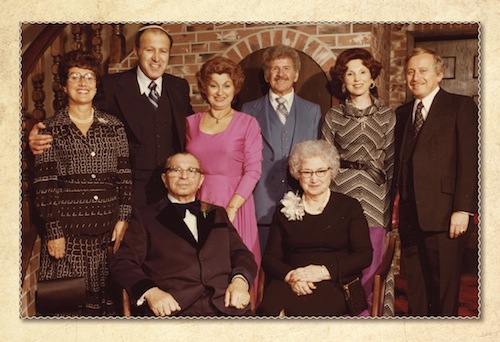
A Congregation Schara Tzedeck testimonial evening in honour of Abrasha Wosk, 1977. Left to right are, in the back row, Joyce and Sonny Wosk, Esther and Hymie Aheroni, Rosalie and Joe Segal, and, in the front row: Abrasha and Chava Wosk. (photo from nemetzfamily.ca/gallery)
Ultimately, with the assistance of graphic designer Barbi Braude and Facebook, she was able to source all the photographs required to complete the book.
Michael Schwartz, director of community engagement at the JMABC, said the Nemetz family journey would resonate among many other Jewish families in Vancouver.
“The story of leaving Europe, getting here and eventually bringing their family to Canada has parallels for many in our community and is a fascinating tale,” he said. “The Nemetz family has a very interesting history and many siblings of the early generation have accomplished great things and had an important impact on the community as a whole.”
The museum is hoping to partner with other families who are interested in creating similar books. Barnett described the creation of the book as a joint venture. “My brother and I contributed the money to the museum and archives, which then allowed us to use their name, resources, and to co-publish this,” she said. “I’d like to see the Wosk, Groberman and Waterman families – all large, extended families with deep roots in Vancouver – do a book like this.”
The launch of Don’t Break the Chain is being celebrated at a hosted brunch at the Jewish Community Centre of Greater Vancouver on April 2, 11 a.m. If you are interested in attending, call the museum 604-257-5199.
Lauren Kramer, an award-winning writer and editor, lives in Richmond. To read her work online, visit laurenkramer.net.