

Tag: Israel
Innovative approach to care
On Sept. 30, Canadian Friends of Sheba Medical Centre will host Medicine Reimagined, an evening with Prof. Amitai Ziv, deputy director of Sheba Medical Centre and head of its Rehabilitation Hospital, which is the national rehabilitation facility of Israel. Ziv is also the founder and director of the Israel Centre for Medical Simulation (MSR), an innovation hub for improving patient safety and clinical training.
Originally from Montreal, Ziv is spending his sabbatical in Vancouver at the University of British Columbia.
“This will be the first Canadian Friends of Sheba event in Vancouver, as we launch our chapter here, and we are truly thrilled to welcome Prof. Amitai Ziv,” Galit Blumenthal, manager of donor relations and events at Canadian Friends of Sheba Medical Centre, told the Independent. “Our goal is to raise awareness of Sheba Medical Centre and highlight its profound impact both in Israel and on the global stage.”

Sheba Medical Centre was established in 1948. Located in Tel HaShomer, near Tel Aviv, its website notes the facility has 159 medical departments and clinics, almost 2,000 beds and 75 laboratories, and receives about 1.9 million clinical visits and 200,000 emergency room visits a year. Its seven major facilities comprise a cancer centre, an academic campus, a research complex and four hospitals: children’s, women’s, acute care and rehabilitation. It also has several centres of excellence and institutes, notably for cancer, and heart and circulation. It counts 10,000 healthcare professionals, 1,700 physicians and 200 PhD research professionals.
“I support them, along with many other Israeli institutions, as I feel that this is at least some contribution that I can make during these difficult times,” said Tova Kornfeld, who connected Canadian Friends of Sheba Medical Centre (CFSMC), which is based in Toronto, with the Independent.
“I sometimes feel powerless living here in Canada when I see what is happening in Israel,” said Kornfeld. “If I can help in any way, whether by bringing awareness to the work being done by the various organizations or by making financial contributions, then I feel I must. As far as Sheba is concerned, it stepped up to the plate when Soroka Hospital was hit by an Iranian missile and took in all the ICU patients.
“It is also the biggest rehab hospital in Israel and is providing rehabilitation for thousands of soldiers who have been injured since Oct. 7,” she added. “I have family members in the IDF and it is comforting to know that, if something were to happen to any of them, there would be hospitals like Sheba to care for them.”
Ziv’s areas of expertise are medical education, simulation and rehabilitative medicine, and he has served as a consultant and speaker at academic and health institutions around the world. The event in Vancouver will offer a look at Sheba Medical Centre and its innovations in, among other things, the rehabilitation field.
On Sept. 30, Vancouverites will also get to meet Einat Enbar, chief executive officer of CFSMC, which was established in 2017 to raise awareness and funds for Sheba Medical Centre, the care it offers, the research it conducts and the educational training it provides.
For Kornfeld, there is another aspect to supporting Israeli organizations and institutions. She hopes that financial and other assistance from the diaspora “gives the Israelis caught in the fray the message that we have their backs and that we are all in this together regardless of where we live. I would hope that this would be comforting to them when it appears that most of the world is against not only Israel but the Jewish people themselves.”
For more information on CFSMC and SMC, visit shebacanada.org. To attend the Sept. 30, 7 p.m., event in Vancouver (location upon registration), go to weblink.donorperfect.com/ProfAmitaiZivInVancouver. While free to attend, donations are welcome. Readers can email Blumenthal at galit@shebacanada.org with any questions.

Problematic work in exhibit
“Delible (poppy, watermelon, wheat, walnut, blackberry)” is on display at the Art Gallery of Greater Victoria until Oct. 26, as part of the Architectures of Protection exhibition. (photo by Toni Hafkenscheid, courtesy Susan Hobbs Gallery)
Beth Stuart’s “Delible (poppy, watermelon, wheat, walnut, blackberry)” is part of the Architectures of Protection exhibition, which opened at the Art Gallery of Greater Victoria (AGGV) on May 24 and ends Oct. 26.
In each of the five “Delible” pieces, a black ledge has replicas of food items on top of it and a length of black mesh suspended below. Stuart used plaster, iron oxide pigment, dyed silk, steel and Sumi ink to create the works. The replicas are casts of halved walnuts, pizza crusts, poppy hulls, blackberries and watermelon seeds. According to the artist, each original mold was made from the source itself, except for the watermelon seeds, which were cast from clay originals.
On a wall leading to the five pieces, there is a several-square-foot textual display featuring more than 1,600 words, written entirely in capital letters, with the thoughts seeming to randomly jump from one topic to another; there are no paragraphs, but the words cover five columns. The text, an integral element of the overall artwork, was hand-stenciled by Stuart and relates to the physical pieces.
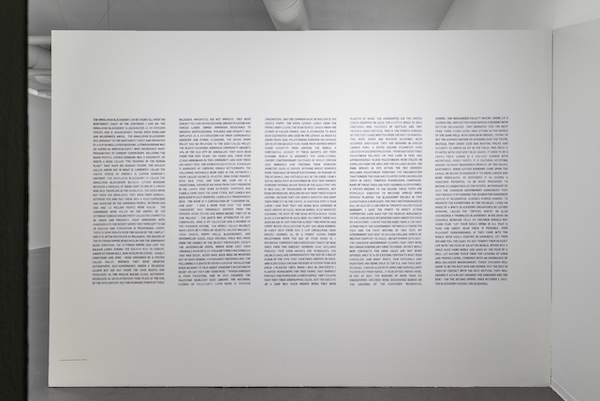
The text begins with mention of the Himalayan blackberry, an invasive species in British Columbia, and then moves to Luther Burbank, an American botanist, horticulturist and eugenicist, before discussing the Armenian Genocide (1915-16) and Canada’s residential schools.
In the middle portion of the textual display, Stuart describes what she sees as the plight of Gazans and the attitudes of certain Israelis.
“AS I WRITE, THERE HAS BEEN NO AID OF ANY KIND FOR ALMOST TWO MONTHS AND EVERY WATER DESALINATION PLANT HAS BEEN BOMBED,” Stuart writes. “IN EARLY 2024 THERE WAS A CLIP CIRCULATING FROM ISRAELI CHANNEL 14, OF A PUNDIT SAYING EVERY PALESTINIAN OVER THE AGE OF FOUR YEARS IS A POTENTIAL TERRORIST AND A NECESSARY TARGET OF WAR. SINCE THEN TWO KNESSET MEMBERS HAVE DECLARED PUBLICLY THAT EVEN INFANTS ARE TERRORISTS. THE DELIBLES BAGS ARE APPROXIMATELY THE SIZE OF A BAG OF FLOUR OF THE TYPE THAT SOMETIMES ARRIVES IN GAZA, AND ALSO COULD CONTAIN THE BODY OF A FOUR-YEAR-OLD CHILD.”
Stuart then talks about tree-planting, which she apparently did in university, then writes: “THIS IS THE FOURTH VERSION OF THIS TEXT I HAVE WRITTEN OVER THE PAST 20 MONTHS. THIS WEEK THERE ARE MASSIVE WILDFIRES NEAR OCCUPIED JERUSALEM. THEY ARE BURNING IN AYALON CANADA PARK, A SEVEN SQUARE KILOMETER PARK LOCATED IN OCCUPIED PALESTINE. THERE HAD BEEN THREE PALESTINIAN VILLAGES ON THIS LAND IN 1948. AND APPROXIMATELY 10,000 PALESTINIANS WERE KILLED OR EXPELLED FROM THE AREA AND THE VILLAGES RAZED.”
She talks more about “THE ORGANIZATION THAT FUNDED THE PARK” without naming it and then raises the issue of the Canadian government’s involvement with Israel and, specifically, its military.
“BETWEEN OCTOBER 7TH 2023 AND THE FIRST WRITING OF THIS TEXT, MY GOVERNMENT HAD SENT 30 MILLION DOLLARS WORTH OF MILITARY SUPPORT TO ISRAEL,” she writes. “ON SEPTEMBER 10TH 2024 THE CANADIAN GOVERNMENT CLAIMED THAT THEY WERE NO LONGER SENDING ANY ARMS TO ISRAEL. IN FACT, WHILE CONTRACTS FOR ARMS SALES ARE NOT BEING OFFERED, ONLY 12% OF EXISTING CONTRACTS HAVE BEEN CANCELLED, AND MANY PARTS, RAW MATERIALS AND MUNITIONS ARE BEING SOLD TO THE U.S. AND THEN SENT TO ISRAEL. CANADA ALSO BUYS ARMS AND SURVEILLANCE TECHNOLOGY FROM ISRAEL.”
The text moves into Stuart’s comments on residential schools before she concludes with the sentence: “FOR THE SECOND SPRING SINCE OCTOBER 7, 2023 THE BLACKBERRY HEDGES ARE BLOOMING.”
To at least one member of the Victoria Jewish community, Stuart’s work is an example of “artfully coded antisemitism – all the more reprehensible for its coyness.”
“In itself, ‘Delibles’ are very beautiful, evocative works,” Maurice Yacowar, a professor emeritus (English and film studies) of the University of Calgary, wrote in a letter to the art gallery that was also sent to the Independent.
“What renders the work problematic is the full-wall text – in spectral grey – that accompanies the sculptures,” Yacowar said.
He said,“As a whole, the work contrasts the self-renewal of nature’s produce with humans’ murderousness. Unfortunately, the art is undermined by the artist’s ignorance and prejudice in its Palestinian references.”
He said Stuart misrepresents Israel and its media by choosing to reference a news outlet “that even in Israel is considered extremist.” And, he argues,“She omits the Oct. 7 context. A Hamas spokesman flatly stated, ‘There are no civilians in Israel’ – ie., only targets in war.”
Stuart’s exhibit does not include the word “Hamas.”
In a statement to the Independent, the AGGV said:
“The gallery is aware that some members of the community disagree with the subject matter of a current work of art on display. We are always interested to hear how the public, and our members, respond to our exhibitions. We also embrace learning, new ideas and critical perspectives.
“At the AGGV, we respect the artists and curators who work with us to create exceptional exhibitions. As an arts institution, our role is to amplify artists’ voices and create space for conversation and learning. We encourage an exchange of ideas that results in meaningful dialogue and understanding through art.”
The Architectures of Protection exhibition, in the synopsis posted by the AGGV, is supposed to reflect “on ideas and modes of protection and refuge – with regards to oneself, to community, knowledge, culture, identity and land. What are these spaces and practices? What is protection for some and not for others?
Together, in the wake of the COVID-19 pandemic and in the current global social and political climate, the artworks in Architectures of Protection direct critical attention towards systems and structures that shape and impact everyday and sacred environments and encounters, alongside individual and collective relationships with the land.”
The exhibit also features the artwork of Dana Claxton, Jessica Karuhanga, Emilio Rojas and France Trépanier.
Sam Margolis has written for the Globe and Mail, the National Post, UPI and MSNBC.
VIFF’s mixed offerings
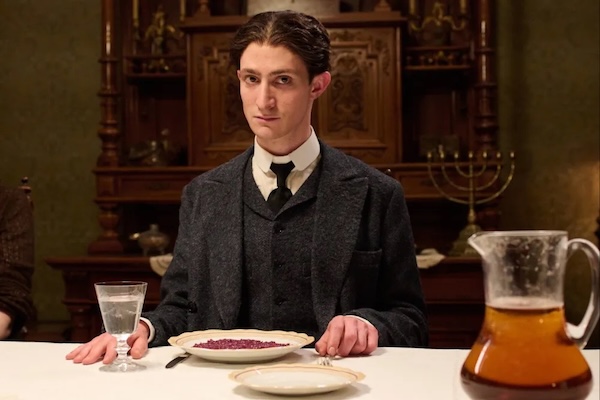
Franz stars newcomer Idan Weiss. (photo from lene Film Production)
As it does every year, the 2025 Vancouver International Film Festival, which runs Oct. 2-12, has offerings of particular interest to the Jewish community. Below are the synopses (less some of the hyperbole) from the festival’s website of the three films featuring Jewish content, as well as the three films about Israel, all of which are from Palestine and other countries – there are no films from Israel in this year’s festival. The Jewish Independent, which has been a media partner of the festival for more than 20 years, has chosen to sponsor Franz.
Franz
You don’t need to have read Kafka to know what “Kafkaesque” means – the idea that the world is a nightmare, a sick joke at your expense, continues to resonate a century after the writer died. Franz Kafka’s “uneasy dreams” have inspired filmmakers like Orson Welles, David Lynch, Michael Haneke, Terry Gilliam and Roman Polanski, to name a few, and now director Agnieszka Holland has delivered a biopic that’s Kafkaesque and then some.
Holland blends scenes from Kafka’s life as a German Jew in Austro-Hungarian Prague with dramatizations of his short stories and – at the film’s most surreal – documentary footage of Kafka’s present-day tourist economy (“Who will join me for a Kafka burger?”). Franz (2025) is densely layered but lively, starring newcomer Idan Weiss, whose tragicomic presence suggests a persecuted clown somewhere between Charlie Chaplin and Adrien Brodie.
Franz is in German and Czech with English subtitles, and runs 127 minutes. It screens Oct. 7, 8:45 p.m., at Vancouver Playhouse, and Oct. 11, 3:30 p.m., at Granville Island Stage. (18+)
Orphan
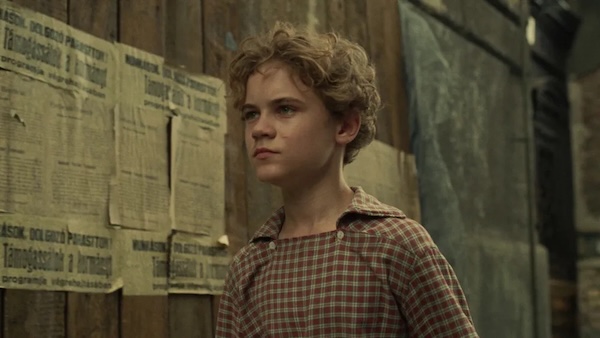
Orphan (2025) is set in communist Hungary in the late 1950s. Conceived during the war and brought up by his mother, Andor (Bojtorján Barabás) is convinced his father will return one day. Instead, another man emerges to stake his claim to both mother and child. Berend (Grégory Gadebois) is a butcher and a gentile and, even worse, a divorcee. Appalled, Andor is determined to save his mother from this brute.
The latest film from Son of Saul director László Nemes builds Andor’s world from the inside out, through the child’s troubled eyes. This personal vision grants us access to the wider history unfolding on the edge of the frame, which Andor barely comprehends: the fallout from the Holocaust, the crushing grip of the communist state.
Orphan is in Hungarian with English subtitles, and runs 132 minutes. It screens Oct. 2, 8:45 p.m., at Fifth Avenue Cinema (19+) and Oct. 4, 6:30 p.m., at International Village 9. (18+)
Cover-Up
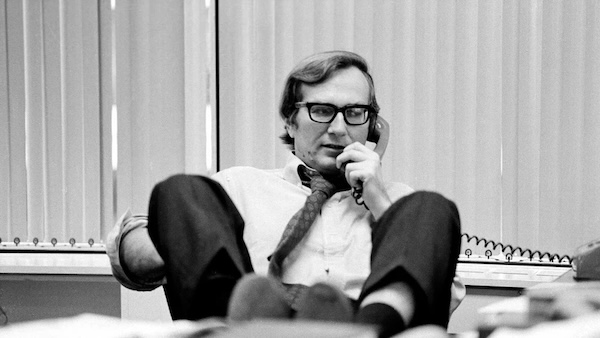
Cover-Up (2025) pulls viewers into the uncompromising ethos of journalist Seymour Hersh. From exposing the My Lai massacre to unraveling CIA abuses and Abu Ghraib atrocities, Hersh has spent decades dragging concealed histories into the light – often at great personal and political cost. In this portrait, Oscar-winning filmmaker Laura Poitras (Citizenfour) and Emmy-winning Frontline producer Mark Obenhaus trace Hersh’s process. “I barely trust you guys,” Hersh quips, establishing a candid and often thorny dynamic between subject and directors.
Cover-Up is a meditation on source protection, moral clarity and the imperative to report when it’s needed most. Its story bridges past and present: Hersh is still reporting, now turning his gaze toward Gaza.
Cover-Up has a content warning for graphic violence. It screens at Fifth Avenue Oct. 11, 5:45 p.m. (19+), and at International Village 10 on Oct. 12, 3:45 p.m. (18+)
Divine Intervention
Palestinian Elia Suleiman is at the height of his powers with this series of deadpan, interconnected, absurdist vignettes about Palestinian life on either side of an Israeli military checkpoint. Mutely following the travails of two lovers – one who lives in Nazareth, the other in Ramallah – as they navigate the wall between them, Divine Intervention (2002) is surreal, satirical and biting in its political criticism. It’s both sad in its vision of the world but also warm in its humour.
All but forgotten from the mainstream filmgoing consciousness, Jacques Tati’s innovations with form and tone have been repurposed by filmmakers as varied as Roy Andersson, Aki Kaurismäki, Ulrich Seidl and, perhaps most of all, Wes Anderson. But Suleiman’s method of feeding the Tati-esque through the prism of Palestinian experience creates something completely new that walks a line between melancholy and absurdity. And what an amazing soundtrack!
Divine Intervention is in English, Arabic and Hebrew with English subtitles, and runs 92 minutes. It screens Oct. 6, 8:45 p.m., at VIFF Cinema, and Oct. 12, 3:45 p.m., at the Cinematheque. (18+)
Palestine 36
Set during the 1936 Palestinian uprising against British colonial rule, this historical drama follows an ensemble of characters. Yusuf (Karim Daoud Anaya), a peasant, straddles two worlds – the city of Jerusalem and his farming village. Denied fair wages, a Jaffa port dockworker (Saled Bakri) joins the rebel movement. Elsewhere, a widowed mother (Yafa Bakri) stashes away an heirloom gun in hopes of defending her family from the British military’s raids.
Shot on location and interspersed with archival footage, the film boasts an international cast, including Hiam Abbas, Jeremy Irons and Liam Cunningham. Palestine 36 (2025) is the third feature from writer-director Annemarie Jacir to be selected as the Palestinian entry for best international feature at the Academy Awards.
Palestine 36 is in Arabic and English with English subtitles, and has a running time of 118 minutes. The film is at Fifth Avenue Oct. 9, 9 p.m., and Oct. 10, 11:45 a.m. (19+)
With Hasan in Gaza
Three unearthed MiniDV tapes from 2001 offer a time capsule of life in Gaza before devastation. What begins as a search for a former prison mate leads to a road trip from the north to the south of Gaza, accompanied by Hasan, a local guide whose fate remains unknown. As the camera moves through Gaza’s streets and landscapes, it captures fleeting moments of everyday life: vendors, schoolchildren, shopkeepers, relatives and strangers, all going about their days in a place that, today, has been forever altered.
In With Hasan in Gaza (2025), Palestinian filmmaker Kamal Aljafari transforms forgotten footage into a time capsule. What was once ordinary is now precious, even endangered. “It is a film about the catastrophe and the poetry that resists,” Aljafari writes.
With Hasan in Gaza is in Arabic with English subtitles, and runs 106 minutes. It screens Oct. 10, 3:30 p.m., at VIFF Cinema and Oct. 12, 6:30 p.m., at International Village 8. (18+)
– from viff.org
Writers fest starts soon
 he 38th annual Vancouver Writers Festival takes place on Granville Island Oct. 20-26. Among the 130-plus local and international authors at 87 events are several members of the Jewish community. A glance through the lineup finds, in order of appearance, Rachel Hartman, Marsha Lederman, Guy Gavriel Kay, Katherine Ashenburg, Jill Yonit Goldberg, Eve Lazarus, Sam Wiebe and Jerry Wasserman. There are, no doubt, others.
Hartman, author of the bestseller Seraphina, comes to the festival with Among Ghosts, which has a found-family theme set in a vibrant fantasy world. She participates with other writers in Paranormal Activity: Ghost Stories for YA (grades 8-12) on Oct. 21, 1 p.m., at Granville Island Stage ($12).
 Lederman talks with Linden MacIntyre about his latest work of nonfiction, An Accidental Villain, on Oct. 21, 6 p.m., at the NEST ($27), and she is in conversation with Elamin Abdelmahmoud on Oct. 22, 5:30 p.m., at the Revue Stage ($27), about her own new book, October 7th: Searching for the Humanitarian Middle. October 7th is a collection of Lederman’s columns for the Globe and Mail, which have been a real-time archive capturing a period of deep division and trauma.
 Kay, the internationally bestselling author of Tigana, All the Seas of the World and A Brightness Long Ago, talks about his latest fantasy novel, Written on the Dark, which is set in a magical version of medieval France, replete with ambitious royals, assassins and invading armies. He also talks about his overall body of work with moderator Robert J. Wiersema on Oct. 24, 8 p.m., at the Revue Stage ($27).
 Ashenburg, author of Margaret’s New Look, published her first fiction book at the age of 72. She will join two other writers in the session called Wisdom, Age & Beauty, which takes place Oct. 25, 5 p.m., at Waterfront Theatre ($27). She also participates with several other writers in the Afternoon Tea on Oct. 26, 3:30 p.m., at Performance Works ($50), which includes high tea delicacies, including a signature glass of sherry.
 The Soundtrack of Life panel, on Oct. 25, 8 p.m., at the Revue Stage ($27), includes Jill Yonit Goldberg with her book After We Drowned, a haunting coming-of-age story with a fierce feminist subplot set in 1984 to the music of Tina Turner, Madonna and Stevie Nicks.
 On Oct. 26, 10:30 a.m., at Performance Works ($40), Lazarus joins six other authors of nonfiction in an event described as TED Talk meets café social, with a morning snack included. Lazarus explores a forgotten tragedy in Beneath Dark Waters, an account of the 1914 sinking of the Empress of Ireland.
The Crime Scene on Oct. 26, 7 p.m., at Waterfront Theatre ($27) is moderated by Jerry Wasserman and the authors featured include Sam Wiebe, whose The Last Exile finds PI Dave Wakeland at the centre of gang warfare on the streets of Vancouver.
In addition to Lederman’s October 7th, there are a couple of other Israel-related books included in the program, the first directly, the second only tangentially.
Palestinian-Canadian author Saeed Teebi is one of the writers joining Blood in the Pen: Stories, Crises, Repair and the Writer on Oct. 21, 8:30 p.m., at Granville Island Stage ($27), and he will be in conversation with Adel Iskandar on Oct. 22, 8:30 p.m., at Waterfront Theatre ($27). Teebi is also one of the writers featured in A Doctor, a Lawyer and a Journalist Walk into a Literary Festival, on Oct. 23, 8:30 p.m., at Waterfront Theatre ($27). He describes his memoir You Will Not Kill Our Imagination as exploring “what it means to be a Palestinian in this moment, the effects of the genocide on Palestinian art and imagination, and that to even claim a belonging to the land from a country thousands of miles away is an act of subversion.”
Queer Stories on the Map on Oct. 23, 8 p.m., at Revue Stage ($27) includes Ziyad Saadi, whose reimagining of Mrs. Dalloway, Three Parties, follows a Palestinian refugee who plans to come out to his entire family at his birthday dinner party.
For more information about festival events and to purchase tickets, visit writersfest.bc.ca.
– from Vancouver Writers Festival program

Support for a hostage deal
(image from Israel Democracy Institute)
The August 2025 Israeli Voice Index, conducted by the Viterbi Centre for Public Opinion and Policy Research at the Israel Democracy Institute (IDI), asked whether Israel should agree to a deal that would include the release of all Israeli hostages, the cessation of hostilities and the complete withdrawal of the Israel Defence Forces from Gaza. Sixty-two percent of Jewish Israelis and 81% of Arab Israelis support such a deal.
Looking at political orientation among Jews, a large majority on the left (92%) and centre (77%) support such a deal, while the right is more divided, with slightly more in favour (47%) than opposed (44%). A breakdown by vote in the 2022 elections reveals a majority of supporters for this deal among voters for all opposition parties and all coalition parties, except for Religious Zionism voters.
 Military operations in Gaza
A plurality of Jewish Israelis (49%) support the decision to expand military operations in Gaza while the overwhelming majority of Arab Israelis (81.5%) oppose the decision.
“There is a substantial share of Israelis who support a hostage deal that involves a full withdrawal from Gaza while also saying they support the expansion of fighting in Gaza,” said IDI’s Prof. Tamar Hermann. “This is due to the context-specific nature of each question – many Israelis prioritize bringing the hostages home even at a great cost, but if a deal cannot be struck, they support the expansion of operations in Gaza.”
Jewish settlement in Gaza
Similar to IDI’s polling from November 2024, last month, 53% of Jewish Israelis and 86.5% of Arab Israelis oppose Jewish settlement in the Gaza Strip. Most on the left (93%) and centre (77%) oppose settlement while most on the right (61%) support it. Rates of support increase in tandem with levels of religiosity, with the highest rate of support among Haredim (75%) and lowest among secular Israelis (21%).
The release of hostages
More than half of the Israeli public (53%) think that their leadership is not making every effort to secure the release of the hostages (Jews, 51.5%; Arabs, 63%). A breakdown by political orientation (Jews) shows that, on the right, as in the past, 63% think that the leadership is indeed doing everything it can. By contrast, this view is held by 28.5% in the centre and 6% on the left.
 Control of Gaza after war
Similar to past measurements, a plurality of Jewish Israelis (44%) believe a multinational force should control Gaza after the war, as does 22% of Arab Israelis. Twenty-three percent of Arab Israelis believe the Palestinian Authority should control Gaza.
 The burden of fighting
A plurality of Jewish (34%) and Arab (37%) Israelis assess that Israeli society can only bear the burden of fighting for another few months. A decreasing share of Jews think Israelis can bear the burden for as long as it takes, down from 39.5% in March 2024 to 28% today.
 National mood
In this latest survey, IDI found no major changes in the levels of optimism about the future, excepting a slight improvement (2% in the total sample) in the share of optimists about the future of the economy. There was a small decline in optimism about the future of security (3%), though this is within the margin of error and thus should not be taken as evidence of a new trend. As in previous surveys, in three of the four indicators (security, democracy and economy), the share of optimists is larger among Jews than among Arabs. Overall, in all four indicators and among both Jews and Arabs, less than half the public are optimistic.
The Abraham Accords
Five years after signing the Abraham Accords, 46% of Jewish Israelis say the accords met their expectations, down from 64% in 2021, one year after signing them. Among Arab Israelis, 41% say the accords met their expectations, similar to 43% in 2021, and a substantial share of Arabs (28%) say they don’t know.
Survey methodology
The survey was conducted via the internet and by telephone (to include groups that are under-represented on the internet) Aug. 24-28, 2025, with 600 men and women interviewed in Hebrew and 150 in Arabic, constituting a nationally representative sample of the adult population in Israel aged 18 and over. The maximum sampling error was ±3.58% at a confidence level of 95%. Field work was carried out by Shiluv I2R. More of the report and the full data file can be found at en.idi.org.il/articles/61601.
– Courtesy Israel Democracy Institute

Rare archeological finds
Mosaics attesting to the wealth and prosperity of the ancient Samaritan community were found in Kafr Qasim, located in central Israel. (photo by Emil Aladjem, IAA)
The Israel Antiquities Authority (IAA) has sent out several press releases in the last couple of months. Here is a roundup of what has been discovered recently in a few excavations.
An agricultural estate, about 1,600 years old, was uncovered in Kafr Qasim, located in central Israel. The excavation, undertaken on behalf of the IAA and financed by the Israel Ministry of Construction and Housing prior to establishing a new northern neighbourhood, is within the boundaries of the archeological site Kh. Kafr Hatta.
The Samaritan settlement existed for about 400 years, from the end of the Roman period to the end of the Byzantine period (4th to 7th centuries CE). The site of Kh. Kafr Hatta is described in historical sources as the birthplace of Menander, the Samaritan magician, successor of Simon Magus, who was considered the father of the Gnostic sects and one of Christianity’s first converts.
According to IAA excavation directors Alla Nagorsky and Dr. Daniel Leahy Griswold: “The size and splendour of the buildings discovered, the quality of their mosaic floors and the impressive agricultural installations, all point to the great wealth and prosperity of the local Samaritan community over the years.”
In one of the buildings, a mosaic floor was preserved, decorated with a geometric pattern and vegetal images. Alongside its central medallion are acanthus leaves combined with rare decorations of fruits and vegetables, such as grapes, dates, watermelons, artichokes and asparagus. In the entrance to this room was a partially preserved Greek inscription wishing the building’s owner Good Luck!; the owner’s first name was common in Samaritan communities.
In the northern part of the estate were found an olive press, a warehouse building and a public purification bath, a mikvah. The proximity of the oil press to the mikvah was probably used to produce olive oil in purity. The olive press was carefully planned, consisting of two wings; the northern wing contained the main production areas, while auxiliary rooms were erected in the southern wing. In the production areas, two screw presses were found, as well as a large basin in which the olives were crushed.

Over the years, the estate saw dramatic changes.
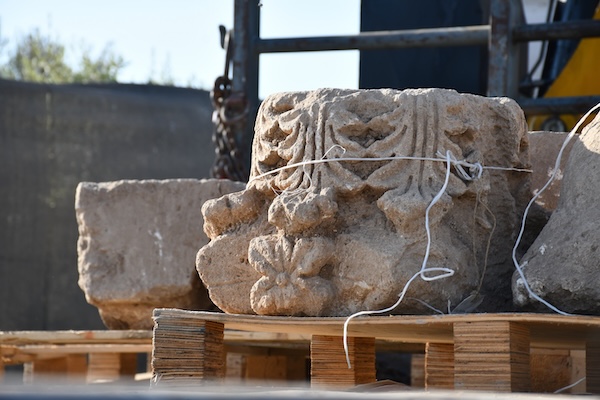
“The wealth and luxury of the buildings were replaced by oil production and agricultural installations. New walls damaged the mosaic floors, and the magnificent capitals and columns were integrated within the new walls,” said Nagorsky. She suggested that these changes are related to the Samaritan Revolts under the Byzantine rule – a series of 5th to 6th century CE uprisings against the Byzantine emperors, who enforced restrictive laws on members of other religions.
“What makes this site particularly interesting is that, unlike some of the other Samaritan sites that were destroyed in these revolts, the agricultural estate in Kafr Qasim actually continued in use, and even preserved its Samaritan identity – as evidenced by the Samaritan ceramic oil lamps uncovered in our excavation,” Nagorsky said.
According to Israeli Minister of Heritage, Rabbi Amichai Eliyahu, “The discovery of the Samaritan agricultural estate illuminates another chapter in the common shared story of the ancient peoples of this land; foremost, in this period, the Jews and the Samaritans. These two ancient communities led their lives based on the Torah and shared common roots, and also experienced similar hardships during periods of antagonistic rule…. These physical remains are another reminder that our heritage in this land is deep and multifaceted.”
* * *

A monumental dam excavated in the Siloam Pool in the City of David National Park has now been dated in a joint study by the IAA and the Weizmann Institute of Science, to the reign of the kings of Judah, Joash or Amaziah. Its construction may have been a creative solution to a climate crisis about 2,800 years ago, according to the researchers. The research was published in the scientific journal PNAS.
The wall uncovered in excavations of the Siloam Pool in the City of David National Park was built around 805-795 BCE. Its discovery was made by excavation directors Dr. Nahshon Szanton, Itamar Berko and Dr. Filip Vukosavovic on behalf of the IAA.
“This is the largest dam ever discovered in Israel and the earliest one ever found in Jerusalem,” the directors stated in a press release. “Its dimensions are remarkable: about 12 metres high, over 8 metres wide, and the uncovered length reaches 21 metres – continuing beyond the limits of the current excavation. The dam was designed to collect waters from the Gihon Spring, as well as floodwaters flowing down the main valley of ancient Jerusalem (the historical Tyropoeon Valley) to the Kidron Stream, providing a dual solution for both water shortages and flash floods.”
Dr. Johanna Regev and Prof. Elisabetta Boaretto of the Weizmann Institute explained: “Short-lived twigs and branches embedded in the dam’s construction mortar provided a clear date at the end of the 9th century BCE, with extraordinary resolution of only about 10 years – a rare achievement when dating ancient finds. To complete the climatic reconstruction, we integrated this dating with existing climate data from Dead Sea cores, from Soreq Cave and from solar activity records influencing the formation of certain chemical elements. All the data pointed to a period of low rainfall in the Land of Israel, interspersed with short and intense storms that could cause flooding. It follows that the establishment of such large-scale water systems was a direct response to climate change and arid conditions that included flash floods.”
The newly uncovered structure joins two other water systems from the same period discovered in the City of David: a tower that dammed the Gihon Spring and a water system that gathered water from the Gihon, directed through a channel into the Siloam Pool, where it was joined by floodwaters blocked by the dam.
These systems reflect comprehensive urban planning for managing Jerusalem’s water supply as early as the late 9th century BCE – clear evidence of the city’s power and sophistication.
* * *
Lamp wicks made of textiles, approximately 4,000 years old – among the oldest known in the entire world – were discovered during an archeological dig at the Newe Efraim antiquities site near Yehud, Israel. The wicks, uncovered in an IAA excavation, funded as part of development works by the Israel Lands Authority to establish a new neighbourhood in the city of Yehud, were preserved inside clay lamps, used for illumination in the Intermediate Bronze Age (circa 2500-2000 BCE).
The study was published in the scientific journal ’Atiqot, Vol. 118, published by the IAA.
According to IAA researchers Dr. Naama Sukenik and Dr. Yonah Maor: “This is a unique discovery that we did not expect could ever be found in the moist Mediterranean climate…. Although wicks were a common product for lighting in the ancient world, the fact that they are made of organic fibres makes it difficult to discover them in an archeological dig. Even in cases where the organic matter is preserved, such as in desert climate conditions, it is difficult to identify a wick, unless found inside a lamp, since it has no special characteristics to distinguish it from any group of fibres, threads or ropes…. The fact that three wicks were found – and that one of them survived in its entirety, is especially surprising in the humid climate of the coastal plain.”

According to Dr. Gilad Itach, Yossi Elisha and Yaniv Agmon, the excavation directors on behalf of the IAA, “The wicks were discovered inside oil lamps uncovered in the graves alongside other burial offerings, including various types of pottery, animal bones, metal weapons and jewelry. While these lamps must have been used to illuminate the underground dark burial space during the burial ceremony itself, it seems that this was not their only function. The fire burning in a lamp has been associated with magical power since the dawn of humankind…. Admittedly, the Intermediate Bronze Age population in the Land of Israel did not leave any writings behind, but various sources from around the ancient Near East demonstrate the central role of fire in burial ceremonies. Just like today, thousands of years ago, the fire burning in a lamp symbolized the human soul. The common term we use today, ‘ner neshama,’ ‘the flame of the soul,’ probably originated thousands of years ago.”
Traces of soot were found in the wicks tested in the study, indicating these lamps were used; seemingly lit while the grave was prepared and/or during the burial ceremony. The analysis also revealed that the wicks were apparently made from reused linen fabric. “It is unlikely that an expensive textile such as linen would have been woven especially for an object intended for combustion,” said Sukenik. “We speculate that the wicks were recycled from other textiles, after their original purpose was completed…. The secondary use of textiles indicates smart economic conduct, in which precious raw materials were maximally utilized.”
– Courtesy Israel Antiquities Authority
ישראל ממשיכה לדעוך ונתניהו ממשיך לחגוג
כאשר גרתי בישראל צפיתי שהמדינה תלך למקומות לא נכונים והיא תעמוד מול סכנות הולכות וגוברות מכל הכיוונים. אחד מחברי הטובים טען אז שאני רואה שחורות, מגזים בפסימיות שלי ונבואותי הרעות לא יתגשמו. לאורך השנים האחרונות החבר שינה את דעתו לגבי נבואותי מקצה לקצה. ועכשיו הוא טוען שהמציאות הקשה בה ישראל נמצאת, היא הרבה יותר קשה ממה שחזיתי ולכן נבואותי היו אופטימיות מידי
אני יכול להבין את אלה שרוצים להיות אופטימיים, לראות את האור, לשמוח ולעסוק בדברים חיוביים. אך אסור לשכוח שמי שמתעלם מהמציאות הקשה ביותר בה ישראל נמצאת כיום, מאפשר לראש הממשלה המושחת, בנימין נתניהו, להמשיך בדרכו הגרועה תוך חיסול הדמוקרטיה. ההיסטוריה מלמדת אותנו שמנהיגים רעים הולכים ותופסים תאוצה כאשר אין כח גדול שעומד מולם ועוצר אותם. אזרחים שמעדיפים לעסוק בחיי היום יום ולהתעלם ממה שקורה בישראל, יתעוררו יום אחד ויראו שהדמוקרטיה נמוגה לחלוטין, שזכויותיהם נעלמו ואין להם יותר זכות בחירה. ישראל בשליטת נתניהו צועדת לכיוון המסוכן הזה במלוא העוצמה. כי כידוע נתניהו חושב רק על נתניהו ולא אכפת לו מאחרים, בהם המשפחות השכולות, משפחות החטופים, תושבי ישובי הספר ואחרים
כל עוד לא יתאגדו כל כוחות האופוזיציה בניסיון רציני להפיל את ממשלת נתניהו המסוכנת, כל עוד לא יצאו לרחובות מיליוני אזרחים להפגין נגדה ונגד המדיניות שלה, הרכבת שצועדת אל התהום האסוני הזה לא תיעצר. על תושבי ישראל לנקוט בכל הצעדים האפשריים לעצור את נתניהו וממשלתו הרעה ולמנות תחתם ממשלה שפוייה שתדאג לישראל ולא לעצמה. המלחמה בעזה מיותרת, עולה במחיר רב של חיילים שנופלים, החטופים לא משוחררים וגם פלסטינים רבים נהרגים ללא סיבה מוצדקת. לאור זאת, ישראל הפכה כיום להיות אחת המדינות המנודות והשנואות בעולם. ולא פלא שהאנטישימיות מרימה ראש, וישראלים ויהודים נפגעים כל הזמן פיזית מאלה ששונאים אותם. האנטישמיות צפויה להחמיר כל עוד צה”ל ממשיך לפעול בעזה ולפגוע ולהרוג אזרחים מקומיים שם
את הישראלים המתנגדים לנתניהו אפשר לחלק לשלוש קבוצות: הקבוצה הראשונה כוללת את אלה שיעשו כל מאמץ להילחם בו, להביא לפיטוריו ובעצם פיטורי כל הממשלה הנוראית הזו. הקבוצה השנייה כוללת את אלה שמבינים שישראל תמשיך להידרדר לתהומות עמוקים עוד יותר. ועל כן מבחינתם הפתרון היחידי האפשרי הוא לעזוב את המדינה. הקבוצה השלישית כוללת את החלשים והתבוסתנים המציינים כי אין מה לעשות אלה לקבל את גזרות נתניהו כמו שהן, ולקוות לטוב
בתור אחד שנולד וגדל בישראל עצוב לי לראות את תהליך הנסיגה הגדולה של המדינה וההידרדרות הבלתי נתפסת הזו. יש שטוענים שכל הרע החל מהשבעה באוקטובר, אך אני חושב שזה התחיל הרבה שנים קודם לכן. בחודשים האחרונים, חברו הטוב של נתניהו במשך שנים, הסופר איל מגד, התנתק ממנו והחל לבקר אותו בחריפות. מגד הוא דוגמא טובה לחברים ומעריצים מושבעים של נתניהו ומשפחתו, שיום אחד התעוררו והבינו שהוא אסון למדינה. אני כבר אמרתי זאת בסוף שנות השמונים. נתניהו תמיד היה נתניהו: נוכל, שקרן פתולוגי, אינטרסנט ומגלומן. טועה מגד ה מציין כי הוא הבחין בתכונותיו השליליות של נתניהו רק אחרי השבעה באוקטובר. מגד היה עד אז פשוט עיוור שהעריץ את נתניהו
אם לא יקומו הישראלים ברובם ויהפכו לאקטיביים כדי להעיף את שלטונו של נתניהו, ישראל תלך לאבדון. אם לא תקום ממשלה חדשה ושפויה בקרוב זה יהיה אסון. הנזק שנתניהו גורם כל יום הוא כבד מנשוא.
Almost 700 days of waiting
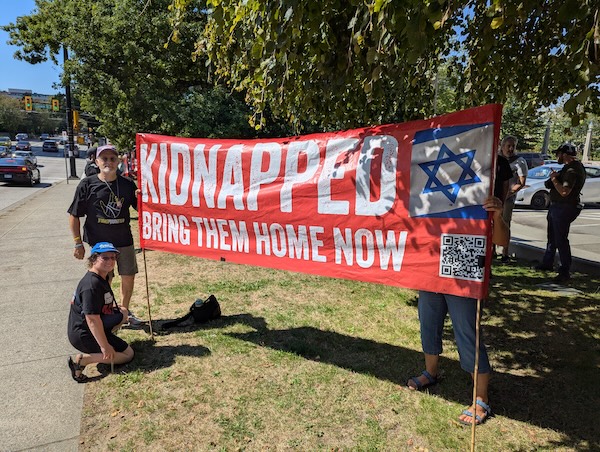
Almost every Sunday since the first days after Oct. 7, Daphna Kedem has led a vigil for the hostages. People have gathered in solidarity and to hear from a diverse array of speakers, first outside the Vancouver Art Gallery and now at Vancouver City Hall. (photo by Pat Johnson)
Almost 700 days have passed since the horrors of Oct. 7, 2023, and the holding of Israeli hostages in the tunnels of Gaza.
In Vancouver, as in cities worldwide, Jews and their allies gather frequently to mourn the lost, stand in solidarity with Israelis and remind the families whose loved ones are still in captivity that there are people across the planet who hold them in their thoughts.
Almost every Sunday since the first days after Oct. 7, Daphna Kedem has led a vigil for the hostages – first outside the Vancouver Art Gallery and now at Vancouver City Hall. Missing only a few weeks due to Jewish or statutory holidays or, like this month, because police security was stretched thin with the Pride Parade, a stalwart group gathers at 12th and Cambie in solidarity and to hear from a diverse array of speakers.
Another regular gathering also takes place, with the group Vancouver Stands With Israel organizing marches across the Burrard Street Bridge and back, waving Canadian and Israeli flags. This past Sunday, scores of participants were greeted with a few hostile catcalls, an exponentially larger number of supportive messages, and a great deal of nonchalance and curiosity. Joining the parade were members of the Persian- and Indian-Canadian communities, carrying their respective flags.

Over the summer, the group Vancouver Friends of Standing Together began holding weekly vigils, also at Vancouver City Hall. (See jewishindependent.ca/encouraging-another-way.)
The competing events reflect divisions in the community. At a rally earlier this month, Kedem acknowledged that she has received “a lot of backlash” from people who believe she and some of her speakers are “too political.” Kedem calls for an immediate end to the war, which she views as the most likely path to get the remaining live hostages home safely.
“If this is too political, then I’m probably very political,” she said.
Over the course of almost two years, the Sunday rallies organized by Kedem have featured diverse voices, both hawkish and dovish, with many speakers expressing personal reflections that cannot be pegged on a political spectrum. Christian pastors have spoken and sung. First Nations representatives have taken part. Rabbis are usually in attendance, including Rabbi Philip Bregman, who, most weeks, leads the group in national anthems.
Kedem begins the events by reading excerpts from the previous evening’s rallies in Tel Aviv, usually voices of family members of those held hostage.
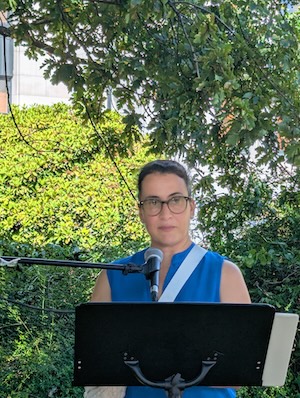
Rabbi Carey Brown, associate rabbi of Temple Sholom and a fellow of the Rabbinic Leadership Institute of Shalom Hartman Institute, spoke this past Sunday of the significance of the month of Elul, which began the night before.
“It’s the time that we as a people and as individuals begin our journey of self-reflection and soul-searching as we prepare for the new year,” she said. “It is a month that whispers to us: return, reflect, renew.”
When she is asked how to live more Jewishly, Brown suggests people let the Jewish calendar guide them.
“It’s a map,” she said. “It’s a heartbeat. It’s the soul’s clock. We measure time in many sacred ways. In Judaism, we count days, months, years … a reminder of the holiness in time, and even our grief and our longing are measured in time. Today is Day 688 … of the captivity of still 50 hostages, living and dead. We count because we care. We count because they matter. We count because time is sacred and their time has been stolen. Think of all the time that has passed: 688 days of missed holidays, 688 days without their families, 688 days of fear, torment and waiting. And now, here we are again, standing on the threshold of Elul, preparing once more for Rosh Hashanah, for Yom Kippur. This time, time feels different. It feels heavy.”
Toby Rubin, local chapter president of Canadian Hadassah-WIZO, urged attendees to stand firm until all the hostages are returned.
“We ask that all of you continue to support, to advocate, to push and to ask your allies and your political leaders to continue to do what they need to do to get every one of those 50 home,” she said. “And, again, whether they’re dead or alive, we want them back.”
Earlier in August, on Tu b’Av, community activist and leader David Berson blew the shofar and reflected on the date, which is a commemoration of love and unity.
“The shofar isn’t only a High Holiday symbol, it’s also a biblical emblem of revelation and covenant,” he said. “As I blow the shofar today, let this be a clarion call to rebuilding the wholeness of our people, of listening and understanding, of hearing what is troubling the other and taking that into consideration, of opening our hearts and being curious about what is hurting. We have all been through so much since Oct. 7 and, while we cannot put the genie back in the bottle, we must stand together and embrace that which does bind us in an eternal bond of community, of belonging and embracing our humanity and the humanity of others.”
That same day featured Karen James, a past board chair of the Jewish Federation of Greater Vancouver and current chair of the local partnership council for the Centre for Israel and Jewish Affairs. She is also on the board of governors of the Jewish Agency for Israel.
James reflected on her experiences as a competitive swimmer, including participating in the Maccabiah Games in Jerusalem in 1965, which connected her more deeply not only to her Jewishness and to Israel, but to the branch of her family that had made its way to Palestine in the era when her grandfather settled in Canada.
She shared another personal story that affected her connection to her identity and to Israel.
In 1972, James was on Canada’s Olympic swim team. She and teammates were out celebrating after their competitions were over, watching the Canada-Russia hockey series. As they walked back to the Olympic Village in the wee hours of the morning, they saw four men with a big duffle bag. The four men clambered over the fence to get into the Olympic Village and the Canadians did likewise.
“I went to my dorm, slept for a little bit, but then was woken up to all the commotion in the village,” James recalled. She became a firsthand witness to the terrorist attack on Israeli athletes at the Munich Games.
“I watched the negotiations happen between [the terrorists] and the Germans and, in the evening, I saw when the Israeli team members were led out onto a bus with their hands bound and they were blindfolded,” she said. “Later that night, we’d heard that they were safe and alive, that they’d been freed. But that was wrong. They made a mistake. I don’t know how that got out there because, in fact, the Germans tried to storm the planes and the Palestinians threw grenades and shot the remaining Israeli hostages.”
James went on to describe a more intimate experience with antisemitism. In a consultation with a medical specialist, the doctor repeated the words “It could be worse” twice. On the second occasion, James asked the doctor what she meant by noting that “it could be worse.”
“And she said, ‘Look at what’s happening in Gaza,’” James recalled the doctor telling her. “It was so inappropriate to say that to me.”
Antisemitism is growing, said James. “The main thing that keeps me going is community,” she said. “All of you. All of my community.”

BGU rebuilds after much loss
Jeff Kaye, vice-president for public affairs and resource development at Ben-Gurion University of the Negev, was in Vancouver earlier this month. (photo from BGU)
A couple of years ago, many Israelis were beginning to think the country’s legendary solidarity was fraying, that people were less caring, that a split between Israelis and diaspora Jews was growing and that young Israelis had lost some of the fervour of earlier generations. Oct. 7 changed everything. The chasm between Israelis and diaspora Jews evaporated, according to one Israeli who visited Vancouver recently.
“We really are in this together and we are a much stronger Jewish people, both in Israel and outside of Israel,” said Jeff Kaye, a vice-president of Ben-Gurion University of the Negev, who spoke with the Independent Aug. 7.
Older Israelis who thought younger people took the country for granted have had their assumptions upended, he said.
“They were the TikTok generation,” Kaye characterized the stereotypes about young Israelis. “All they wanted to do was earn some money, take care of themselves. And what Oct. 7 taught us is, underneath this, we had raised a generation of young people who have purpose, who care deeply about the country, who care deeply about values and, without being told, they took responsibility.”
Kaye saw this attitude in action at the university. Administrators were struggling to come to terms with the changed reality and students themselves instantly set up a babysitting initiative, food collections and volunteer teams.
Kaye, BGU’s vice-president for public affairs and resource development, made aliyah from Scotland in 1981, then spent a decade in special needs education before joining the philanthropic sector. He spent four years as emissary to the Jewish Federation of Detroit and then more than a decade in a senior leadership position at the Jewish Agency for Israel, during which time he helped create the Fund for Victims of Terror. Before joining BGU, he served for five years as executive vice-president and director-general of the International Fellowship of Christians and Jews.
Kaye was in Vancouver at the invitation of BGU Canada, one of about a dozen national and regional affiliates of BGU, that include chapters in Argentina, Belgium, France, South Africa, Switzerland and a global chapter for Russian speakers.
“My role is to find people throughout the world and say, this is what we do. This is who we are. This is why we do what we do,” he explained.
With a team of about 35, Kaye helps connect people with projects that meet their objectives and those of the university, whether recruiting people to serve on the board, run activities, sponsor projects, build a building or provide a scholarship.
Oct. 7 and the months since have affected the university profoundly, as they have every aspect of Israeli life. About 118 BGU students, faculty and staff were killed that day or in the war. Of BGU’s approximately 20,000 students, about one-third of them were called up for military service just as the academic year would have been starting in 2023.
“Obviously, universities couldn’t open and we were still under attack,” Kaye said. The first semester after Oct. 7 was delayed to Dec. 31.
Kaye credits the university’s president, Daniel Chamovitz, with ensuring a flexibility that allowed students to access as much education as possible around their military and other responsibilities.
In addition to the semester that began Dec. 31, another semester began a month later for soldiers who had returned in the interim. The university had multiple semesters running concurrently and, like many organizations that adopted new technologies, also offered recorded classes so students did not need to be on campus.
Because Israelis routinely start university after military service, many BGU students are not living at their parents’ homes, and may even have kids of their own. That created economic challenges for many who had lost not only class time but part-time or full-time income and saw spouses away on military duty. The university had to provide laptop computers for people whose homes were destroyed and psychological assistance for students who had witnessed or experienced horrific things.
On June 19 this year, during the war with Iran, a ballistic missile hit the university-affiliated Soroka Medical Centre, destroying a major part of the facility.
“Our labs – teaching labs, research labs, pathology labs – were all entirely destroyed,” Kaye said.
Miraculously, there were no fatalities. In an act of prescience, administrators had moved surgeries into a basement, fearing just such an attack. Kaye said the move – a day before the bombing – may have saved scores or hundreds of lives.
Another blast damaged a university gym. After the formal ceasefire, but when Iran continued sending missiles, an off-campus residence was struck, leaving 50 or more students and faculty homeless.
In Israel, a portion of property taxes are allocated to a fund to restore private property damaged or destroyed by terrorism or war. If your seven-year-old car is hit by a rocket, the fund will reimburse you the value of a seven-year-old car, Kaye said. “But if it’s a microscope that costs $800,000 and it’s 12 years old, you get money for a 12-year-old microscope,” he said. “But there’s no secondhand microscopes out there. So, you have to find the money to buy a new microscope.”
This is one of an incalculable number of examples of expenses incurred as a result of the war in this one university alone.
Kaye is grateful for donors worldwide who have stepped up to assist BGU in its time of challenge, but he noted that almost every organization in Israel faces variations on the same challenge – and diaspora communities have been called upon over the past two years to support umbrella emergency campaigns.
Amid all this, Kaye finds both optimism and hope.
What’s the difference?
“Hope is, you sit by and pray, wonder, hope that something’s good is going to happen,” he said. “Optimism is when you make it happen. I’m an optimist who is actively involved in bringing hope – and that’s incredibly easy to do in our university because we get up every day and we say, how can we make it happen?”