ישראלים רבים לאור אירועי השבעה באוקטובר הפכו להיות פסימים ובצדק. הם לא רואים שום תמונה אופטימית באופק ופתרונות לסיום המשבר הבלתי נגמר
האחראי הישיר למשבר בישראל הוא ראש הממשלה בנימין נתניהו, שעושה הכל כדי להמשיך בתפקידו ולא מעניין אותו המחיר הכבד לכך. נתניהו כיום הוא אחד המנהיגים השנואים בעולם, כולל במרבית מדינות המערב וכן בישראל. היום רבים מבינים מיהו האיש, כיצד הוא פועל ומה האינטרסים שלו. מצער שהשבעה באוקטובר האירו בצורה רבה עד כמה ישראל לא היתה מוכנה, ועד כמה נתניהו מסוכן ולא יקח אחריות על מעשיו ומחדליו הרבים
בישראל העדיפו להגן על ההתנחלויות בשטחים הכבושים ואף לעבות אותן במקום להגן על גבולות המדינה. העדיפות ניתנה למתנחלים על חשבון תושבי ישראל. זו הקונספציה שנתניהו הוביל וזה מחדל אדיר שהוא לא יוכל להימלט ממנו
יש לא מעט שנוטים להעריץ מנהיגים שזה מנהג לא בריא שיכול להפוך למסוכן, כאשר מדובר באישים כמו נתניהו ודונלד טראמפ. הערצה לנתניהו לאורך השנים הרבות שבה הוא מעורב בפוליטיקה הישראלית, הפכה את תומכיו לעיוורים ואת נתניהו לנוכל. אהוד אולמרט נכנס לכלא על עבירות פחותות בהרבה מאלה של נתניהו, שמתכחש להן כמובן. נתניהו המכהן בתפקידוכשבעה עשרה שנים צבר עבירות רבות בתחומים שונים. הוא הפך לאיש עשיר, הוא מחזיק במספר נכסים וחשבונות בנק מנופחים. נתניהו ומשפחתו חיים ברמת חיים גבוהה והחשבונות מוטלים על משלם המיסים הישראלי
לאור שנותיו בפוליטיקה הבויל נתניהו מהלכים מסוכנים ביותר. הוא הוביל את ההסתה הרבתי שהביאה לרצח של יצחק רבין, הוא הוביל תוכניות רבות להרחבת והוספת ההתנחלויות בשטחים שפוגעות קשות בעתיד של ישראל והפלסטינים. הוא לחץ על טראמפ לבטל את הסכם הגרעין עם איראן – כאשר המומחים לנושאי ביטחון בישראל טוענים שמדובר במהלך שגוי ומסוכן לישראל. נתניהו גם איפשר העברת כסף רב מקטאר לחמאס, ששימש לחימושו בממדים אדירים. עדיין לא ברור האם לנתניהו היה גם רווח אישי מהעברות כספים אלה
נתניהו בימי שלטונו – דאג במדיניות ההפרד ומשול שלו כמו דיקטטורים – ליצור וללבות שנאת אחים בתוך ישראל. המצב היום בחברה הישראלית הוא כה חמור שכבר אי אפשר לגשר על הפערים בין תומכי נתניהו למתנגדיו. התעמולה השיקרית המופצת על ידיי נתניהו, בנו יאיר ומקורבים אחרים ומכונה “מכונת הרעל” רק מוסיפה שמן רותח לסכסוך הפנימי בישראל. הגיעו הדברים לידי אבסורד כאשר תומכי נתניהו מאשימים את משפחות החטופים כאילו הן שייכים לשמאל. לא מעט משפחות החטופים הוכו ואויימו על ידי תומכי נתניהו. ומה תומכיו אומרים לישראלים יוצאי אירופה: תחזרו לאירופה כדי שהיטלר יחסל אתכם. דוגמאות אלה מוכיחות שמאז שנתניהו השתלט על ישראל, המדינה החלה להתפרק והתהליך המדאיג הזה רק מתעצם
תומכי נתניהו מעריצים דמות בעייתית לא פחות והיא טראמפ. הם מאמינים כי רק טראמפ ידאג לישראל. לעומתו המועמדת השנייה לנשיאות בארה”ב, קמלה האריס, לא תדאג לישראל. הישראלים התומכים בטראמפ עיוורים למעשיו המסוכנים ורצונו להפוך לדיקטטור. כידוע הישראלים ונתניהו בראשם לא מסתכלים על התמונה הכוללת, אלה רק על היום ומחר. מבחינתם טראמפ יפתור את הבעיות של ישראל היום ומחר. הם לא קולטים עד כמה טראמפ מסוכן לארה”ב ולמערב, ולכן גם לישראל. אם טראמפ יחזור לשלטון יחליש הדבר את ארה”ב וזה בדיוק מה שרוצים ברוסיה ובסין. בישראל כיוון שלא חושבים על העתיד לא מבינים עד כמה ארה”ב חלשה תחליש גם את ישראל
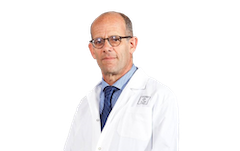
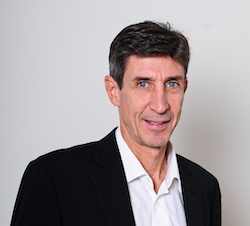
In Vancouver, on the evening of Nov. 10, the Canadian Shaare Zedek Hospital Foundation will present Voices of Resilience, featuring Prof. Ofer Merin, director general of Shaare Zedek Medical Centre, and Glenn Cohen, former Mossad psychologist and hostage negotiator. Part of a national tour, the event aims to shed light on the experiences and insights following the tragic events of Oct. 7, 2023.
Prof. Ofer Merin, director general of Shaare Zedek Medical Centre. (photo from CSZHF)
Merin completed his fellowship in adult cardiac surgery at Sunnybrook Hospital in Toronto. Upon returning to Israel, he became a pivotal member of the Shaare Zedek team, where he now serves as director general. A colonel in the Israel Defence Forces, Merin has led numerous humanitarian efforts and, as of Oct. 7, 2023, has headed a medical intelligence committee that plays a role in assessing the hostage situation in Gaza.
Glenn Cohen, former Mossad psychologist and hostage negotiator. (photo from CSZHF)
Cohen has served as an air force pilot, Mossad officer, hostage negotiator and special forces psychologist for more than 30 years. Retiring with the rank of colonel and chief of psychology in Mossad, he now trains organizations worldwide using a methodology he developed. During the war that followed Oct. 7, Cohen has served more than 100 days to date in reserve duty, providing critical debriefing for the released hostages.
All proceeds from Voices of Resilience will go to the Healing Minds Campaign, which focuses on extending the mental health support available at Shaare Zedek Medical Centre. This initiative provides specialized training in therapy, post-traumatic stress disorder counseling, psychotherapy and other services for those affected by the Oct. 7 attacks. The centre hopes to increase their mental health team from 14 to 42 professionals to meet the overwhelming demand, an increase that would require $1.6 million Cdn for medical and para-medical training, as well as ongoing staffing costs.
To date, Shaare Zedek has treated more than 700 individuals, primarily IDF soldiers, with injuries ranging from minor to life-threatening. Nearly every patient presents signs of mental trauma, whether immediately or in the weeks following hospitalization. Many young patients have been exposed to traumatic battlefield conditions and the loss of life. Even those who initially report limited emotional impact often show symptoms later. To address this, Shaare Zedek has created a comprehensive emotional trauma care service. Every patient admitted for war-related injuries is evaluated by the psychiatry team, they are monitored throughout their stay and receive counseling prior to discharge, with follow-up care recommendations.
To attend Voices of Resilience in Vancouver on Nov. 10, 7 p.m., visit linktr.ee/voicesofresilience2024. Tickets are $18 ($72 for the VIP meet-and-greet). The location will be provided to registrants closer to the event date.
– Courtesy Canadian Shaare Zedek Hospital Foundation
There is something somewhat intimate about being woken up in the middle of the night by rocket sirens. Feet and arms lightly intertwined with my wife’s, feeling a slight tug of the cover to her side in the never-ending battle-of-the-blankets, I am startled by the sound. I am slow to make sense of the sirens, which are coming both from outside and my cellphone, the latter also providing a strobe-light effect. I look to my wife, nudge her and say in a most loving but rushed tone, “Let’s go! Missiles!”
Remember those Love is… comic strips of the 1970s by New Zealand cartoonist and love culturalist Kim Casall? Well, how about Love Is… waking up snuggled together to a missile alert? Not the free love and innocence of the hippie generation, but for sure love!
And what about Love is… ensuring your wife enters the safe room first. How’s that for being a gentleman? As the sirens go off and we rush to our safe room, my wife goes in first, then I rush in after her, slamming shut the heavy iron door behind us. Actually, if our kids are home or we have guests, I will make sure everyone is inside – including our dog – before entering. Just seems like the right thing to do, danger be damned. How’s that for bravado?
***
Speaking of love. Returned from Tel Aviv with my wife the other day. Incoming missiles and a known routine. Pull over. Exit car. Move away from the vehicle. Crouch down on roadside. Cover your head with your hands (though I don’t know how that helps if a missile strikes you). So, there was my wife, huddled next to me, while the Iron Dome chased and intercepted its overhead target. In a chivalrous act of protection, I hovered over my wife, giving her a second layer of armour. I hugged her. Amazing how adrenalin works. Love is… shielding your wife from incoming missiles.
In a similar spirit. Love is… being alone with your wife in the safe room during missile alerts. It’s not for no reason that births spike during wartime.
***
Then there’s our morning routine. Prewar, it was pillow talk about the chores ahead. Now, the first thing we cross-check is Code Red missile alerts received on our cellphones overnight. Where were the sirens? Where did the missiles land? Or almost land? Other carnage or near-carnage? Other military developments? Not the most romantic of topics but that’s where our minds are these days – from the moment we wake up until we fall asleep. Love is… lying in bed together comparing missile alerts and military actions.
***
The other week, during Iran’s second cruise missile attack on Israel, where more than 180 missiles were fired at our little shtetl with the intent to exact maximum, indiscriminate death and destruction, there was significant news chatter about the attack. Under the fog of war, not fully clear what to expect.
My wife, who works in Tel Aviv, just completed her shift and was taking a bus home. She called to advise me that her bus was late and that her cellphone battery was running low, so I shouldn’t worry if she’s delayed and doesn’t answer. Shortly after our conversation came the news flash about a mega-casualty terrorist attack in nearby Jaffa and another attempted attack in Tel Aviv. I tried calling my wife back. No answer. Wishfully and optimistically, I attributed it to no battery.
Then the news flash that Iran had fired several hundred cruise missiles at Israel. Expected to arrive in our airspace within the next … 12 minutes. Not 10 minutes, not 15, but 12. This was for real! Where was my wife?! There was no way to call her, to learn of her whereabouts.
If she were on the bus during a missile barrage, what would happen? Would the driver follow Homefront commands? Would the bus pull over? Would the passengers get off the bus? Would they crouch down away from the bus with their hands covering their heads? Would someone hover over my wife … protect her?
Time is ticking – three minutes from the expected cruise missile impact. Anxiously pacing the living room, I keep looking to the news for some insight about something. Then, I hear the elevator. I run into the hallway, watching the red digits slowing climbing to my floor. One. Two. Three. Four. Five. The door opens. There she is. In all her beauty. Somewhat frazzled-looking. I give her a giant, protective bear hug. Immediately, sirens go off throughout the city and our cellphones buzz and flash with missile alerts. My wife arrived literally in the nick of time.
We quickly make our way to the safe room. My wife enters first. I slam the door shut behind us. With her tension unravelling, my wife begins to cry – from exhaustion, from stress, from survival. Again, we embrace.
Love is… holding your wife near in the safety of your safe room during a missile attack.
***
Please continue donating to the Israeli war and revival efforts, or buy Israel Bonds. Twelve months after the Oct. 7, 2023, Hamas terror attacks, the war is still raging, and on several active fronts. Sderot and Metula – and even Tel Aviv and Haifa – are Israel’s front lines. And Israel is the diaspora’s front line.
Bring them home now.
Bruce Brown, a Canadian-Israeli, made aliyah more than 25 years ago. He works in high-tech and is happily married, with two kids. He is the winner of a 2019 American Jewish Press Association Simon Rockower Award for excellence in Jewish writing.
ישראל נמצאת בסכנה קיומית מהיום שהתחלתי לנשום לפני למעלה משישים וחמש שנים ואני לא אומר זאת כדי להפחית מחומרת העניין. מצער מאוד שחבורת פושעים בלתי אנושית של החמאס וחבריהם “הזכירו” שוב לישראלים בשבעה באוקטובר, כי הם גרים באזור מסוכן ביותר. ישראל ישנה והישראלים כהרגלם התעלמו מכל התרעה אפשרית לחדירה כה קשה כפי שאירעה באוקטובר
פרופ’ ישעיהו ליבוביץ אמר לאחר כיבוש השטחים כתוצאה ממלחמת ששת הימים שנכפתה על ישראל, כי זהו דבר חמור שיגרום נזק גדול לישראל, ישחית את המדינה ואולי אף יביא לקיצה. כל יום מאז התבגרותי הרגשתי עד כמה דבריו החמורים של פרופ’ ליבוביץ נכונים, ועד כמה הישראלים ברובם לא ראו שום בעייה בנושא החזקת השטחים הכבושים. להיפך: שטחים אלו יצרו גל הולך וגדל של תנועה משיחית של יהודים פנאטיים, שמאמינים בכל ליבם שאת השטחים הכבושים הם קיבלו מאלוהים ומצווה עליהם להתיישב בהם. תנועה משיחית מסוכנת זו שמספר תומכיה גדל משמעותית כל שנה, ממשיכה במלאכת בניית התנחלויות והרחבתן בשטחים, תוך שמתקבלות תמיכה ועידוד רב ממשלות נתניהו השונות. בנימין נתניהו ראש הממשלה הנצחי של ישראל שיושב על כיסא המלך כבר כשבעה עשרה שנים, מיישם את תפיסתו ותפיסת אביו – שיש ליישב יהודים בכל ארץ ישראל, כולל ובעיקר בשטחים הכבושים. תפיסה זו שמקובלת על ידי חלק נרחב מתושבי ישראל כיום, מונעת כל אפשרות של הקמת מדינה פלסטינית בשטחים שנכבשו. וכך גם נמנע מישראל לחיות בביטחון מלא תוך אפשרות של שלום עם מרבית מדינות ערב. מי שמתעלם מהבעייה הפלסטינית בעצם מתעלם מהאופציה היחידה לפתרון הסכסוך הארוך והנוראי הזה בין ישראל לשכנותיה. בין היהודים למרבית המוסלמים בעולם
הישראלים רוצים בדומה לאזרחי מרבית המדינות בעולם לבלות, לטוס לחו”ל וליהנות מהזריחות ומהשקיעות כאחד. אך הישראלים מעדיפים לשכוח כי מי שרוצה להחזיק בשטחים של עם אחר לא יכול לחיות חיים אזרחיים רגילים, אלא חיים מלאים בצבא, ביטחון, כוננות והתרעות. כאמור מחבלי החאמאס הוכיחו לישראלים מה קורה שישנים באזור מסוכן זה
טעה מי חשב שהחזרת רצועת עשה לתושביה יפתרו כל בעיותיה של ישראל. אי אפשר להפריד בין תושבי הרצועה לבין התושבים הפלסטינים בשטחים הכבושים. לא היה שקט באזור אחד אם לא יהיה שקט גם באזור השני. ועובדה היא שהמלחה בעזה מעוררת את הפלסטינים להתעמת עם צה”ל והישראלים ופיגועי הטרור הולכים גדלים מאז באוקטובר
כשאומרים לישראלים כי לא בטוח לגור בישראל הם עונים כמעט אוטומטית כי לא בטוח לישראלים ויהודים לגור בשום מקום אחר בעולם. האם פעם אחת שאלו תושבי ישראל מדוע אחיהם בגולה לא בטוחים? השנאה והאנטישמיות הולכות וגדלות משמעותית מאז השבעה באוקטובר? האם יש שמבינים כי מה שצה”ל עושה ברצועת עזה הוא נוראי – גם לאחר המאורעות הקשים ביותר שאירעו בשבעה באוקטובר? האם זה מובן שהנקמה צריכה לבוא בכל הכוח, ללא הפסקה ולהביא למותם של אלפי פלסטינים חפים מפשע בעזה? האם בישראל מבינים שהתוצאות הקשות של המלחמה בעזה יגרמו נזק קשה מאוד למדינה ולישראלים והיהודים בחו”ל
בישראל לא אוהבים לראות את התמונה הכוללת ולחשוב על העתיד. קל יותר להתנהל מהרגע להרגע, ללא תכנון וללא ארגון. נתניהו מנהל את המלחמה הקשה הזו בעזה שלא מביאה לעתיד טוב יותר בישראל, בדיוק כמו שהוא נכשל בהגנה על גבולותיה של המדינה. נתניהו רק חושב על נתניהו ועל רצונו להמשיך ולשלוט על המדינה שהוא הורס
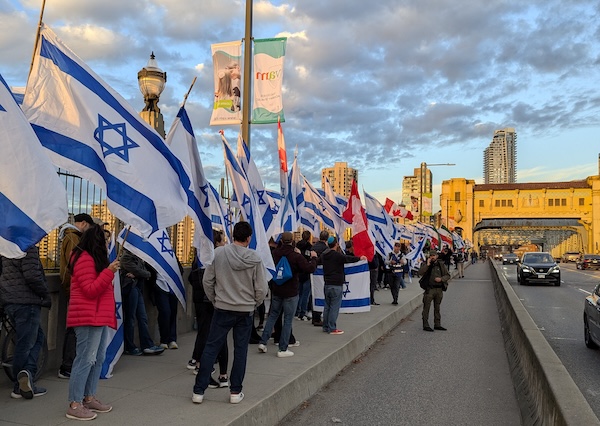
Several hundred held vigil on the Burrard Street Bridge at sundown Oct. 6. Another vigil took place at the Vancouver Art Gallery at the same time. (photo by Pat Johnson)
The youngest victim of the Oct. 7 pogrom was born and died that day.
At a moving ceremony at Schara Tzedeck Synagogue Monday night, more than 1,400 Jewish community members and allies came together to mark the anniversary of the worst terror attacks in Israel’s history. Another 700 watched a livestream online.
Rabbi Philip Gibbs of West Vancouver’s Congregation Har El shared the story of the youngest victim.
At 5:30 a.m., Sujood Abu Karinat, a Bedouin Israeli, went into labour. Her husband Triffy began driving them to the hospital, but sirens also began.
“Two vans appeared and tried to box them in,” said Gibbs. Triffy was able to swerve and avoid the ambush but a bullet pierced Sujood’s belly.
“Though they were able to get away, soon the car stalled before an intersection and they were able to ask for some help from some of the other local Bedouins,” he said. “But, again, the white van appeared and terrorists fired, ignoring their pleas in Arabic to leave them alone and, again, Sujood received another bullet in the stomach.”
When they finally arrived at the hospital, doctors detected a fetal heartbeat. The bullets had pierced the baby’s leg and, in the process, protected Sujood’s vital organs. The baby was successfully delivered and bandaged.
“After hearing this news, Sujood fell back asleep to recover. But, that evening, the baby passed away,” said Gibbs.
“Sujood never saw her daughter, unable to bear the sight of her dead firstborn.”
Schara Tzedeck’s Rabbi Andrew Rosenblatt, who introduced the program and speakers, contextualized the commemoration as an opportunity to “preserve names and to preserve stories.”
In addition, he said, the community gathers to ensure that people do not ignore a world “where children are ripped from their parents’ arms, where children and the aged are taken hostage, where young women are slaughtered and dragged through the streets to be spit upon by a jeering public.”
Rabbi Dan Moskovitz of Temple Sholom spoke of Vivian Silver, the Winnipeg-born-and-raised peace activist whose burned bones were found in her safe room. World media eulogized Silver, a cofounder of the 50,000-member Women Wage Peace, as an irrepressible force and one of Israel’s best-known advocates for peace.
Jason Rivers remembered his cousin, Adi Vital-Kaploun, another Canadian-Israeli who was killed on Oct. 7. Vital-Kaploun received the highest marks ever attained at Ben-Gurion University, he said, and, on Oct. 7, a lab was named in her honour.
“If you believe in miracles, they sometimes do happen,” said Rivers. While Adi was murdered, her 3-year-old, Negev, and 6-month-old, Eshel, were inexplicably released. Adi was later found by the Israel Defence Forces – she had been killed by multiple bullets and her body booby-trapped with grenades.
“She was identified by her wedding ring,” said Rivers.
Daphna Kedem, who has organized weekly rallies at the Vancouver Art Gallery since the hours after the attack, said, “The past year has been unbearable.”
She said, “It is inconceivable that 101 hostages, our loved ones, our family, our members, our children, our parents, our grandparents, remain captive in the hands of the terror organization Hamas, held in appalling conditions.”
The local community’s rabbis and cantors chanted the prayer for hostages.
Lana Marks Pulver, chair of the board of the Jewish Federation of Greater Vancouver, and Ezra Shanken, Federation’s chief executive officer, spoke of the connections between Israel and diaspora Jews.
Pulver remembered Ben Mizrachi, the young Vancouver medic who died heroically at the Nova music festival when he returned to help a friend who had been shot. He had earned the nickname “savta” from friends, Hebrew for “grandma,” because he was always helping and caring for others. Shanken noted that a plaque in Mizrachi’s honour was unveiled earlier that day at his alma mater, King David High School, and that Federation has nominated Mizrachi for Canada’s highest civilian decoration for heroism. At Schara Tzedeck, a Torah scroll is being refurbished in his memory.
Eli Cohen, a friend of Ben Mizrachi and who accompanied the chevra kadisha to identify Mizrachi’s body, recited the Kaddish in his memory.
Several hundred held vigil on the Burrard Street Bridge at sundown Oct. 6. (photo by Pat Johnson)
Flavia Markman, one of the organizers of the vigils that take place on Vancouver bridges, shared the story of Aner Shapira.
Shapira, a member of the IDF’s elite Nahal Brigade, was attending the Nova music festival and he took shelter with a group of others. He was the last to enter the shelter and told the others he was in Nahal; he assured them the military would be there soon to rescue them. Across several heroic minutes that were caught by a car’s dashcam and are available online, Hamas shot bullets and threw grenades into the shelter.
“You can see,” Markman said of the video, “after the terrorists threw the grenades into the shelter, Aner threw them back out. One, two, three, four times, five, six, seven.…”
The eighth grenade exploded in his hand, killing him.
“At least seven people who were hiding in the shelter with Shapira survived the attack,” Markman said. One of them called Shapira an angel who saved their lives. Israeli poet Zur Erlich has written a tribute to Shapira, likening the eight grenades to the eight candles on the Hanukkah menorah.
Rabbi Carey Brown of Temple Sholom shared the story of Capt. Shir Eilat, a 20-year-old Combat Intelligence Corps commander who died alongside 14 of her female comrades at Nahal Oz surveillance outpost. Five women from her unit were taken hostage to Gaza.
“Shir was a hero in her final moments, in an unbelievable manner,” according to survivors who were there, said Brown. “Shir stayed calm, worried about everyone, protected them, and calmed them down. She put herself aside to be a presence of safety for them.”
Rabbi Philip Bregman, rabbi emeritus of Temple Sholom, spoke of the 1,000 people he and his wife Cathy, escorted to Israel over their 33 years of service to the temple. In Israel, he said, they would pay for meals of IDF soldiers and the grateful but baffled uniformed young people would ask, Why? Bregman said it was impossible for relatively safe Canadian Jews to adequately thank Israeli soldiers for defending their people.
Rabbi Susan Tendler of Beth Tikvah noted that there were at least 1,200 people in the sanctuary – the approximate number of people murdered on Oct. 7. Each attendee had been handed a card with a victim’s name and, often, a photograph. People stood at different times, quietly reciting the prayer and invoking the name of “their” martyr while musician Eric Wilson played cello.
Rabbi Hannah Dresner of Or Shalom reflected on the El Moleh Rachamim prayer and presented an interpretation of the prayer in English before Cantor Yaacov Orzech chanted the traditional version. Her Or Shalom colleague, Rabbi Arik Labowitz, led the congregation in Oseh Shalom, the prayer for peace.
“Perhaps, like many of you, it’s been difficult to say the Oseh Shalom this past year knowing that peace and security can sometimes be at odds with each other,” said Labowitz. “Yet the hope for peace is not shaped by our feelings about the present situation and about the history behind it. The hope for peace is our moral imperative. It is the most essential prayer of our people.… May we never give up hope and may we work toward that peace in the name of those we have lost and for the sake of those who are yet to be born.”
Rabbi Jonathan Infield of Beth Israel, and head of the Rabbincal Association of Vancouver, reflected on the Zionist and Israeli anthem “Hatikvah” (“The Hope”), which was adopted at the 18th Zionist conference in Prague, in 1933 – the “chai” conference, in the year the Nazis came to power in Germany. He spoke of his hope that the grandchildren of the current generation would never have to attend a ceremony for victims of terrorism.
The Monday event was attended by many elected officials from all levels of government.
On Sept. 28, Temple Sholom unveiled a new group exhibition in its gallery. “This is not a regular art show,” curator Rina Vizer told the Independent. “It is a commemoration of Oct. 7, of its hope and memories.”
Vizer has wanted to organize a show that would act as a fundraiser since the horrific terror attack on Israel last year.
“It has been the theme of my art from the moment I heard about the attack. I couldn’t process it in any other way than through my painting,” she said. “Last year, in September, we couldn’t even imagine that such an atrocity was possible. I wanted the other artists to do the same, to express what was beyond words through their paintings and share it with viewers.”
“HaTikvah” by Rina Lederer-Vizer is part of the Memory and Hope exhibit at Temple Sholom that Vizer curated to commemorate the terror attacks of Oct. 7, 2023. (image from Rina Vizer)
At first, she contemplated the Zack Gallery as a venue but it had a schedule to maintain, and its shows were booked well in advance. “Then I discussed with our rabbi some other art installation, and I asked him: ‘What about a show commemorating Oct. 7?’ And he agreed that it was a great idea to reflect on this calamity through art.”
The timeline to find other contributors was very tight. “I started the process at the end of August,” she said. “My only condition [to the artists] was: it had to be new art, created as a reaction to Oct. 7. Nothing old would work.”
Vizer contacted several people she knew personally, including Vivienne Davicioni, Sidi Schaffer and Glenda Leznoff. “I’ve also seen the art of Olga Campbell, and I had heard about Zohar Hagbi and her intuitive art studio. I was sure both of them would be a good fit for this show. The Zack Gallery director, Hope [Forstenzer], recommended Brian Gleckman, who agreed to participate. In all, we have seven Vancouver artists in this show.”
“Tikun Olam” by Brian Gleckman is part of the Memory and Hope exhibit, which is at Temple Sholom until Oct. 28. (image from Rina Vizer)
Vizer and Hagbi were born in Israel, Gleckman hails from the United States, Schaffer was born in Romania, Campbell in Iran, Davicioni in South Africa and Leznoff in Canada. Regardless of their countries of origin, all of them dedicated their artwork for this show to Israel, and all of the pieces reflect the traumatic impacts of Oct. 7.
Vizer’s paintings are not large, but they pack a punch. She signs her art as Rina Lederer-Vizer. “Lederer is my family name,” she explained. “But I only have one sister. When we go, the name will disappear. This way, I hope to keep it a bit longer.” Her painting “HaTikvah” is full of hope and despair in equal measure. A woman gazes up, her palms together in prayer, but her eyes are sad, her expression stark. Is she praying for the hostages’ return? Is she a hostage herself?
Another of her paintings, similar at first glance, is called “101 Days of Awe.” The woman in the foreground is from the diaspora, but her solidarity with the suffering in Israel is unmistakable. Like the figure in her painting, Vizer stalwartly expresses her solidarity with Israel.
“I have been attending the ‘Bring Them Home’ rallies every Sunday since last October,” she said. “We meet at the Vancouver Art Gallery at 2 o’clock. At first, there were thousands of people there each week. Now, it is a hundred or so, but I go.”
At one of the rallies, Vizer carried a banner with the name and image of one of the hostages, Carmel Gat, a therapist from Tel Aviv. Vizer was so moved by Gat’s plight she used the portrait at her family seder. “I was shocked and angry when I learned on Sept. 1 that Gat was executed in a tunnel,” she said. That was when she painted “Light in Tunnel.” There are darkness and death in those tunnels, but, contends Vizer, light always comes after darkness.
“I See You” by Olga Campbell. (image from Rina Vizer)
Like Vizer, Campbell’s paintings are mostly figurative. “I See You” depicts a face, fearful and anxious. There is a catastrophe unfolding in front of this person, and they are helpless to prevent it. Another of Campbell’s paintings, a number of shadowed figures on a foggy background, bears a fateful title: “I Didn’t Get a Chance to Say Goodbye.” Campbell’s third painting, a black and white collage reminiscent of an old-fashioned newspaper, has an even more explicit title: “October 7.”
The same title applies to one of Schaffer’s paintings. In a short email exchange with the Independent, she said about that horrible day: “The event had and still is impacting me very much. Early every morning, the first thing I do is turn on the TV to hear what’s happening in Israel. I am a child survivor of the Holocaust, and I hoped nothing like that would happen again, but the reality of today is different.”
Schaffer has two paintings in the show, and she explained her symbolism. “The small one is titled ‘October 7.’ It’s a collage. I have done it this year, not long ago. You can see prayer hands and a memory candle for those we lost. There is a child’s wooden rocking horse left without a child. In one of the videos after the horror, I saw a house totally destroyed. Only this horse alone remained on the front lawn.
“The second work is bigger and is titled ‘The Phoenix Reborn from Ashes.’ I worked on it for a few years, but, this year, inspired by the October tragedy, I finished it. I feel it gives hope of renewal, of better days to come, of freedom and joy.”
Leznoff, who is also a writer, talked about her experience joining this show. “I was invited to participate by Rina Vizer, who I met about a decade ago at Israeli dancing. This year, I have been very active writing letters to governments and organizations about antisemitism in Canada since Oct. 7. I had an op-ed in the National Post last January, when two British Columbia theatres canceled the play The Runner. Rina knew me as both an artist and a writer. She knew I have been very moved by the events, both in Israel and in Canada, so she asked me to contribute works I’ve done in response to the war.”
Leznoff’s two pieces in the exhibit are titled “Shattered” and “Morning Light.”
“The first painting is a mixed media piece that uses black ink and paint, yellow paint, a photo, dried flowers from my garden, and charcoal. The painting is abstract, however, there is a sense of something explosive and raw with the black paint,” she said. “For me, the yellow is a sign of hope, and the falling flowers are in memory of the tragedy of the flower children at the music festival.
“The other piece,” she continued, “is connected to a poem I wrote called ‘Winter Light’ that accompanies the painting. The poem is framed with the painting, and it’s about how the hostages and soldiers are always on our minds, and we are not giving up. Ironically, although I am a published writer, I hardly ever write poetry. I think both abstract painting and poetry handle emotional issues that are sometimes difficult to convey in a straight narrative.”
The Memory and Hope exhibit will be displayed at Temple Sholom until Oct. 28. The art is for sale and all proceeds from the sales will go to Hostages and Missing Families Forum: Bring Them Home Now, and Magen David Adom in Israel.
Olga Livshin is a Vancouver freelance writer. She can be reached at olgagodim@gmail.com.
The following remarks were delivered at the Israel hostages rally at Vancouver Art Gallery on Sept. 15, which is also the International Day of Democracy.
In recognition of the International Day of Democracy, I will talk about how antisemitism is harming and potentially destroying democracy. This talk will be based mainly on a report by Amy Spitalnick, just published in the United States. Fair warning, this talk will be heavy, but, in my view, important to understand.
Antisemitism is a form of religious, racial and ethnic prejudice against Jews. But, unlike other such prejudices, antisemitism also operates as a conspiracy theory that lies about Jewish power and influence. And, because it functions as a conspiracy theory, antisemitism poses a threat far beyond the Jewish community. It fuels other forms of hate and extremism, including against other communities and against democratic institutions that are depicted as pawns of Jewish control.
Antisemitism – like other conspiracy theories – increases at times of social or political anxiety, as people look for a source to blame for what’s wrong with society and with their lives.
Enemies of democracy, such as Iran and Russia, use antisemitism to undermine trust in democracies and make them seem like failed states. The “conspiracy myth” that Jews control certain sectors of society, such as banks, media or elections, is the cornerstone of antisemitism, and anyone who accepts this myth loses faith indemocracy. If Jews control elections, judges and finance, people say to themselves, how can I, as a non-Jew, live up to my potential? My failings are caused by evil forces beyond my control.
Casting Jews as all-powerful naturally fuels hatred of Jews. But it also explains what extremists believe – that other communities, like People of Colour, non-Christians, LGBTQ+, are incapable of success except through unfair or illegal ways. And so, belief in this powerful Jewish control group causes distrust in democratic institutions and values.
When neo-Nazis came to Charlottesville, Va., in 2017, they chanted “Jews will not replace us,” showing that they believed in the “Great Replacement” conspiracy theory.Once hidden in the dark corners of the internet, this conspiracy theory says that there is a deliberate Jewish effort to replace the white population with immigrants and People of Colour. This conspiracy theory has directly inspired many mass killings targeting not only Jewish people (Pittsburgh and Poway), but also Hispanic people (El Paso), Black people (Buffalo), Muslims (New Zealand and London, Ont.) and other communities.
Versions of this conspiracy theory have become increasingly mainstreamed, courtesy of influencers, elected officials, candidates and foreign powers in our social media. They use it to advance their own political goals – and, at the same time, they embolden violent extremists. In the Jan. 6, 2021, attack on the US Congress, when many insurrectionists carried white supremacist symbols in their efforts to overturn the 2020 US election results, they included false claims of undocumented immigrants stealing the election. Only recently, we heard in the presidential debate about immigrants eating their neighbours’ pets from a man who wants to be president.
Recent polling shows that belief in conspiracy theories is among the best predictors of antisemitism. And a recent US survey found that highly antisemitic Americans are significantly more likely to support political violence and other forms of anti-democratic extremism. So, what to do?
First of all, we need to fight like hell! We need to call out conspiracy theories against Jews and any other identifiable group every time we encounter them. We need to educate ourselves about what antisemitism means by knowing the International Holocaust Remembrance Alliance definition and its examples, and we must call out antisemitism and other forms or racism when we see it.
We should fight against antisemitism but also against all other forms of racism, including Islamophobia, misogyny, sexual-preference bigotry and other forms of hate and violence; and we should work to advance inclusive, multi-ethnic democracy. The safety and fates of all minority communities and, eventually, all supporters of democracy, are bound together. Jews historically thrive in free, democratic states, and don’t do so well in autocracies, even if autocratic rule might at first seem attractive.
I know this won’t be easy. Many Jews, including me, have felt abandoned and isolated by those who have remained conspicuously silent, or worse, fallen for anti-Israel and antisemitic lies. This crisis since Oct. 7 exposed the lack of understanding of antisemitism in so many parts of society, including how antisemitism is present in conversations related to Israel. Fundamentally, there is a lack of recognition that Jewish safety, including in Israel, is deeply linked to the safety of all communities in all democracies. We need to change that.
But, while we need to work tirelessly to save ourselves and combat antisemitism, we alone, without allies, cannot stop antisemitism. We need to recognize that antisemitism is one part, granted a big part, of the assault on democracy that affects everyone.
If we accept what we need to do as I’ve outlined today, it means having open and difficult conversations with others who think they can save democracy without fighting antisemitism. We need to show them that they are wrong. Let’s start today.
Bernard Pinsky, KC, is chair of the Ronald S. Roadburg Foundation.
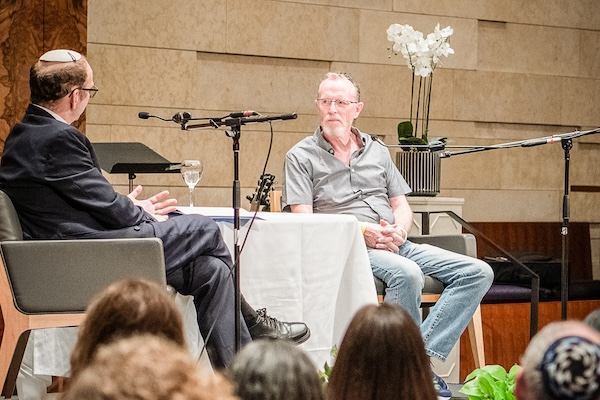
Rabbi Jonathan Infeld, left, in conversation with Thomas Hand at Congregation Beth Israel. (Adele Lewin Photography)
Emily Hand was a healthy 8-year-old girl with chubby cheeks on Oct. 7, 2023, when she was abducted by Hamas terrorists from a sleepover at a friend’s home on Kibbutz Be’eri. When she was released, 50 days later, she was a pale, gaunt 9-year-old who would not speak above the faintest whisper.
Emily and her dad, Thomas Hand, were in Vancouver this month, where the father was part of Congregation Beth Israel’s Selichot program Sept. 28. He spoke with the Independent in advance of the conversation he had with Rabbi Jonathan Infeld at the synagogue.
On Oct. 7 last year, Emily was at the home of her friend Hila Rotem-Shoshani. After the terrorists invaded the kibbutz and the murderous rampage subsided, Thomas Hand had no idea where his daughter was. It was almost midnight that evening when the Israel Defence Forces made it to Be’eri and rescued the survivors. In the chaos of the moment, Hand was told that his daughter was dead.
His immediate response was relief.
“It’s a terrible thing to say,” said Hand, “but I was more relieved and at peace that she was at peace and not being terrorized or beaten or threatened or in the hands of the Hamas.”
Eventually, it would become known that, of Be’eri’s approximately 1,100 residents, about 100 were murdered and about 50 taken hostage to Gaza. Be’eri’s surviving residents were removed to a location near the Dead Sea.
After a few days, Hand was informed that there was no evidence that Emily had been murdered. Her remains were not found and neither was any of her DNA. Hand has no explanation for how the misunderstanding occurred. His former wife, however, was found dead. (Emily’s mother died of cancer when Emily was 2.)
Now, Emily was officially missing.
A kibbutz member mentioned to Hand that they had seen Raaya Rotem “and her two children” led away at gunpoint. Hand knew that Rotem has only one daughter – Emily’s friend Hila – and that was his confirmation that Emily had been abducted alive.
“When they told me that she was actually alive, I was in the nightmare of not knowing what the hell was going to happen to her,” he said.
It is now known that Emily, Hila and Raaya were taken to Gaza, moved from location to location for the first couple of days and then held in a house along with several other hostages.
They lived in constant terror and were given very little food – a quarter of a pita a day sometimes, though they could smell the plentiful food their captors were cooking. Their accommodations were squalid, they were watched while using the toilet and warned to remain totally silent.
Doing what he could to raise global awareness of his daughter’s situation, as well as those of the other hostages, Hand launched a campaign, beginning with a trip to Ireland. Hand had made aliyah from Ireland and Emily, as a result, is a dual citizen. Hand then traveled to the United States and appeared on American TV, further humanizing the plight of the hostages and their families.
In November last year, during the temporary ceasefire, Emily was one of 105 hostages freed. She was released along with Hila. Hila’s mother Raaya was released a couple of days later.
Hand has no clear memories of their reunion, except that he would not allow himself to believe it would happen until they locked eyes.
“Anything could go wrong,” he said of the temporary ceasefire negotiations and promised release of the hostages. “Not until the very last second did I really believe that she was coming back, only when I saw her eyes.”
The joy of reunion was mixed with the harsh reality of what she had endured.
“She came back a different child,” Hand said, reflecting on her transformation from an innocent 8-year-old to a much-matured child shaped by trauma. The changes were most immediately noticeable physically. “Her cheekbones were sharp, her body much thinner.”
The effects of being threatened for more than two months to remain silent did not dissipate immediately either.
“When she came back, she was whispering, just moving her lips,” he said. “Her confidence was shattered.”
Since Emily’s release, the Hands – she has an older brother, 29, and a sister, 27 – have been working to help her recover. Therapies, including horse riding, dog training, theatre and singing, have played a crucial role in rebuilding her confidence. Regular psychological support in Tel Aviv, despite being a two-hour drive, has also been essential.
“She’s very strong, very resilient,” said her father.
The Hand family has relocated to a semi-permanent residence near Be’er Sheva while they await the reconstruction of Be’eri, to which he is determined to return.
“It’s been my home for over 30 years. I raised my eldest kids and Emily there,” he said. “It’s paradise. I want to go back home.”
Not all kibbutz members feel the pull to return, he acknowledged, though he estimates that 75% of the surviving members hope to rebuild there. Security, of course, is the foremost concern.
“The government needs to be different, and Hamas needs to be as weak as we can possibly make them because I need to feel safe in my own home before I would ever bring Emily back there again,” he said.
Reflecting on the international response to the crisis, Hand expressed frustration.
“Why is the UN or all the governments in the world not putting the pressure on Hamas to stop?” he asked.
To critics of Israel’s actions in Gaza, he is defiant. “We have to defend ourselves, and we will defend ourselves,” he said, “no matter what the world says or thinks.”
As Emily continues her recovery, Hand remains focused on a mission.
“Our primary concern now is getting the hostages back,” he said.
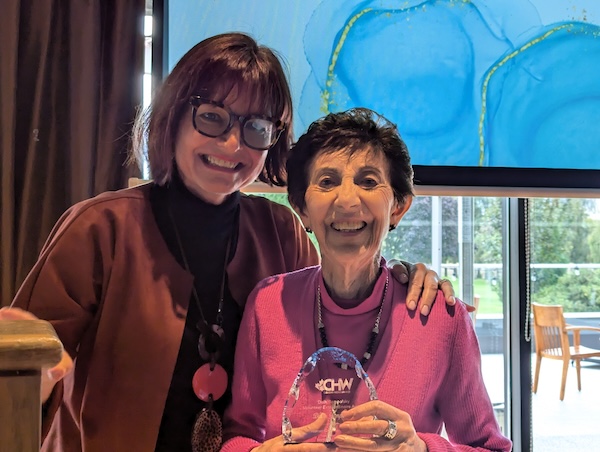
Claudia Goldman, left, presents Bev Corber with the Claudia Goldman Award for Excellence in Leadership. (photo by Pat Johnson)
Diplomatic relations between Israel and Canada have never been worse, according to Israel’s envoy to Toronto and Western Canada.
“The relationship between Israel and Canada is at an all-time low,” said Idit Shamir, consul general of Israel for Toronto and Western Canada. “Canada, according to many, has abandoned Israel, the only democratic ally they have in the region.”
Speaking via remote video link to the opening event of the Vancouver branch of CHW (Canadian Hadassah-WIZO) Sept. 22, Shamir cited, among other things, the Canadian government’s legitimizing of Hamas information, rather than Israeli government sources, when commenting on the conflict.
“Many times, they have been proven as mistaken,” said Shamir. “Not as many times, they have taken the time to correct themselves.”
Canadian Jews are asking themselves if there is a future for their families in Canada, the envoy said.
“This is a question that I don’t think was asked here before Oct. 7, and that’s very, very sad,” said Shamir.
Israelis and Canadians alike were shocked by the alarming spike in antisemitism in Canada and worldwide in recent years, but especially in the past 12 months, she said.
Shamir addressed concerns about the climate on university campuses and even in public elementary and secondary schools. She spoke just after the controversy erupted over an officially sanctioned Toronto public school field trip to what evolved into an anti-Israel rally.
Making Jews unwelcome on campuses will have negative repercussions for the entire society, she said.
“Jews have been instrumental in the university system here, and pushing them out is going to have a serious impact on the future of Canada,” she warned.
Regrettably, Shamir said, Canada has been the launchpad over the years for several negative developments, including Israel Apartheid Week, which began at the University of Toronto before spreading internationally, and, more recently, the concept of “anti-Palestinian racism,” which was adopted as policy by the Toronto and District School Board. The idea, she said, paints any expression that is critical of the prevailing Palestinian narrative as racist.
“When you see that happening already at the elementary school level, we can imagine the depth of indoctrination that is going on in the universities,” said Shamir.
On the positive side, the consul general said, opinion polls indicate that most Canadians support Israel.
“Most Canadians can understand that … we didn’t choose this war,” she said. “We are fighting a war for our survival, for the survival of the only Jewish democracy and country in the world. And now we understand more than ever the need for a safe haven for Jews.”
Among the 101 hostages remaining in captivity, Shamir said, the Israeli government believes more than half remain alive. The body of Judy Weinstein Haggai, a dual Canadian-Israeli citizen who is known to have been killed, remains in Gaza.
“The hostages are the utmost priority,” Shamir said, “releasing the ones who are alive and returning the bodies of those who are not.”
She linked the Gaza conflict to wider geopolitical issues, pointing to Iranian-backed forces launching missiles from Lebanon, Iraq and even Yemen. She was speaking before Iran launched more direct attacks on Israel Oct. 1.
“We cannot forget that Iran is behind this, and we can see that rockets are coming from Iranian-sponsored sources in places we would not have imagined,” she said.
In response to these challenges, the consul general called for unity among the Jewish community and its allies, stressing the need for resilience and solidarity.
Noting that “Jews are coming together and becoming a united force to be reckoned with in Canada,” Shamir said members of the Jewish community must remain vigilant and continue to fight antisemitism and support Israel.
The envoy lauded CHW’s long-standing efforts to empower women and children, provide health care and assist displaced Israelis.
“It’s a labour of love that touches hearts and changes lives every single day,” she said.
The CHW Vancouver event, held at the Richmond Country Club, benefited the Michal Sela Forum, an Israeli organization dedicated to preventing domestic violence through innovative technology and collaboration.
Toby Rubin, president of CHW Vancouver, presents the inaugural Dolly Jampolsky Volunteer Extraordinaire Award to Jampolsky. (photo by Pat Johnson)
Longtime CHW leaders Beverley Corber and Dolly Jampolsky were the honourees. Corber received the Claudia Goldman Award for Excellence in Leadership, and Jampolsky received the inaugural Dolly Jampolsky Volunteer Extraordinaire Award. Sylvia Cristall and Claudia Goldman were inducted into the CHW Lillian Freeman Society by Lisa Colt-Kotler, national chief executive officer of CHW, who spoke at the opening and interviewed the consul general. Toby Rubin, president of CHW Vancouver, emceed the event.
[Editor’s Note: Due to unforeseen circumstances related to flight restrictions, the Chutzpah! Festival must postpone Yamma Ensemble’s performances to March. However, the festival has found a vibrant alternative for Nov. 5: Itamar Erez Trio and special guests. Click here for more.]
Original music that honours the culture and traditions of its creators. Unique songs that you’d have to travel thousands of kilometres to see and hear live. Or, you could buy tickets to Chutzpah! The Lisa Nemetz Festival of International Jewish Performing Arts, which runs Nov. 1-10.
Kommuna Lux from Ukraine brings its unique “Odesa Gangsta Folk” – which they describe as “thrilling klezmer music and common gangster folk songs from their hometown, all with a dose of rocket fuel” – to Vancouver to open the festival Nov. 2, 7 p.m., at the Pearl. The event is presented in partnership with Caravan World Rhythms. The group will also travel to Victoria, for a Nov. 1 show at the Edelweiss Club.
Kommuna Lux’s music is specific to their part of the world, Volodymyr Gitin (clarinet) told the Independent.
“What I like most about this style is the special energy that charges both us and our listeners,” he said. “But I also really like how diverse our music is, because it includes almost everything related to the cultural heritage of Odesa.”
Similarly, Yamma Ensemble from Israel brings its unique heritage-rich music to Chutzpah! – on Nov. 5, 7 p.m., at Rothstein Theatre. They also give an intergenerational matinee performance Nov. 4, geared to school and seniors groups, in which they will “include as many explanations as possible about the ancient musical instruments, about the Jewish communities around the world, about the songs,” lead vocalist Talya G.A Solan told the Independent.
“We wish to celebrate and enjoy the richness and the immense beauty of the Jewish culture and our origins,” she said. “We mainly bring out the mix of Jewish cultures, the mix of our different backgrounds and the fact that we came together into an organic and whole music ensemble…. So, in our music, you can hear the music of Spanish Jews from Thessaloniki and Spanish Jews from Turkey, the singing of psalms by the Jews in Iraq and the singing of religious poems from Yemen.”
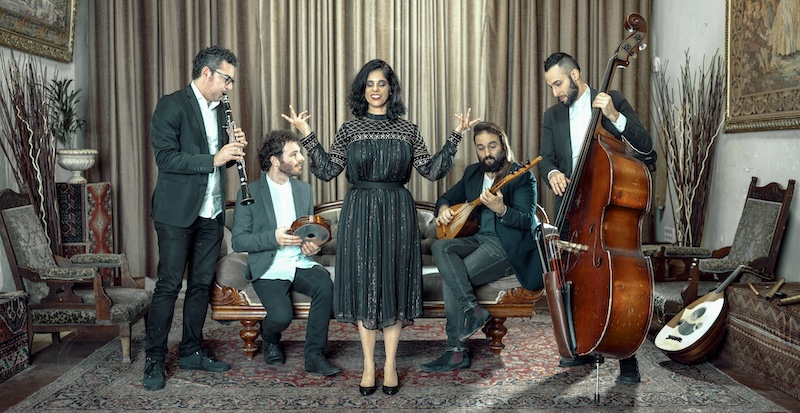
Yamma Ensemble (photo by Zohar Ron)
On the group’s website, they note that Yamma means “toward the sea” in Hebrew and “mother” in Arabic.
“The connection between Hebrew and Arabic is not only a connection between two very similar Semitic languages, but also a connection between the countries of origin of the Jews who lived in Arab countries and their descendants, who were born here and grew up in Israel,” explained Solan. “Our musical heritage, like our origins, is connected to the Jewish communities in the Middle East who immigrated to Israel with the language they spoke, the Arabic language in its many dialects (Yemeni, Iraqi, Moroccan, etc.). They came to Israel and had to speak the local language – Hebrew.”
Hebrew is a central element of the ensemble’s repertoire, directly tied to the members’ identity as Israeli musicians.
“Hebrew is our mother tongue, the language we were born into and the language in which we dream and communicate,” said Solan. “It is an ancient, gorgeous and special language that became extinct and was revived in the 20th century. We try to perform mostly in Hebrew. We mix between our own original creations (always Hebrew) and traditional music (Sephardic, Yemenite).
“There is no Israeli music group that performs out of Israel and has been active for a long time [mainly] performing Hebrew music,” she continued. “This fact is odd and crazy, since Hebrew is the spoken language in Israel, but none of the Israeli musicians active abroad focus on this magnetizing and beautiful ancient language.
“One of the reasons that Yamma Ensemble’s YouTube channel is the most viewed channel of Hebrew music for foreign audiences,” she said, is “the accessibility of Hebrew for foreign audiences who do not speak it. We translate all the songs, so people can watch them with English translation. We receive daily messages from all over the world from people who write us that they learn Hebrew with the songs, that they get closer to their Judaism through the songs. It feels like a serious task that we didn’t ask to take on, and it happened naturally.”
Yamma Ensemble has four albums – Yamma (2011), Basket Full of Stars (2017), Rose of the Winds (2020) and To Awaken Love (2023) – the last of which comprises entirely original music, inspired by traditional sounds, said Solan.
The group is working on an album of psalms. Their performance of Psalm 104 is “the most viewed Jewish chant on YouTube, [in the] category of live and traditional music,” she said. “It has already passed 10 million views! So, we need to record this psalms album.”
However, to produce a recording is an expensive undertaking, and that’s one thing when the music will have a relatively large market. For music “that is not commercial and does not carry profits or compensation, there must be a budgetary basis or significant support,” said Solan. People who are interested may support the psalms project via the ensemble’s website, yammaensemble.com.
Coincidentally, Kommuna Lux’s original name also has to do with the financial side of the music business.
“Dengi Vpered means ‘Money Forward’ or ‘Cash in Advance,’” explained Gitin. “This name appeared before I was in the group. One day, the guys didn’t get paid for a performance and, since then, they started taking money in advance. At the same time, they named the group that way, with a bit of Odesa humour, and also so that it would be immediately clear how they do business.
“After six incredible years of being together, it so happened that our vocalist decided to go his own way and we needed to figure out how and with whom to continue our journey. Also, for various reasons, we felt that it was necessary to change the name…. So, first we found [singer] Bagrat [Tsurkan], who quickly became a valuable member of our team, and then the name itself came along, which resonated with us very much.
“Kommuna Lux has several meanings,” he said. “One of them is ‘the Commune,’ which is united by the common idea of bringing light and joy to people. But ‘Kommuna’ can also mean a communal apartment in which several families live. In such apartments, there is a shared kitchen and sometimes a bathroom, and people need to agree with each other to live in peace and harmony. And ‘Lux’ in this case has another meaning, as a sign of the quality of how we look and sound on stage, the quality of the luxury level.”
Gitin joined the band, which has one album to date (OdesaFM), in 2014.
“I was attracted by the idea of reviving Odesa songs and Jewish folklore in a new, modern way,” he said. “Everything was created and performed with great enthusiasm and a desire to share positive emotions with people. We felt that we were doing something special.”
And they do something extra special in some of their performances – they raise money for Ukrainians affected by the ongoing war with Russia.
“Mostly, we collect money for 110 Brigade, they always need different vehicles for different goals,” said Gitin. “Also, during our last tour, we [participated in a] joint initiative of Rotary E-Club of Ukraine to buy beds for burn victims, for a hospital in the city of Kramatorsk in Donetsk region.
“Our whole life is connected with our home and we feel that every Ukrainian joined to help our people,” he said. “So, our reasons are the same, we can’t just watch, we feel that we should do what we can.”
He added, “Music is very important, especially in such periods, because, through it, it is possible to express the whole spectrum of feelings. Music can raise the spirit, unite everyone around a common idea, and also help people experience deep feelings, especially when they lose loved ones.”
Rounding out the musical offerings at Chutzpah! this year is New Orleans multi-instrumentalist Mark Rubin, “offering Southern Americana from a Jewish, socially conscious point-of-view.” Jacob Samuel headlines a comedy night hosted by Kyle Berger, and Jeremy Goldstein’s Truth to Power Café includes stories from Vancouverites in response to the question, “Who has power over you and what do you want to say to them?” A dance double bill features Fortress (Rebecca Margolick and Livona Ellis) and About Time (Ne.Sans Opera & Dance, Idan Cohen). Canadian Yiddishist Michael Wex brings The Last Night at the Cabaret Yitesh (di letste nakht baym yitesh) to the festival, and the Vancouver Jewish Film Festival and Chutzpah! co-present the screening of Gimpel the Fool Returns to Poland by Nephesh Theatre artistic director Howard Rypp, which “follows the show’s journey throughout different towns of Poland, while tracing [Gimpel writer Isaac Bashevis] Singer’s escape from the Holocaust, finally finding refuge in the USA.”
For tickets to any of the festival events, visit chutzpahfestival.com or call 604-257-5145.
New this year for the Chutzpah! Festival: Jewish Community Centre of Greater Vancouver members receive discounted ticket prices and concession purchases at the theatre. Select Student/Senior/JCC Member tickets and ChutzPacks and bring your membership card to the theatre.