Vigil marks nine months

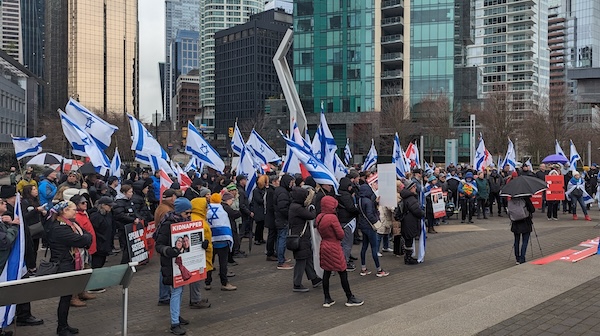
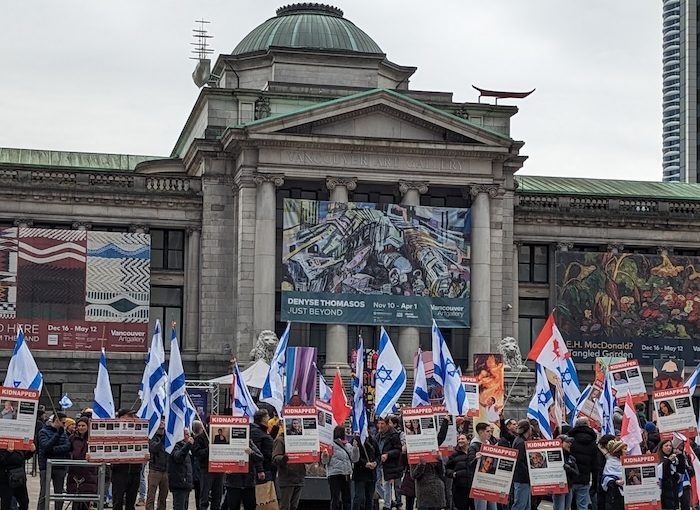
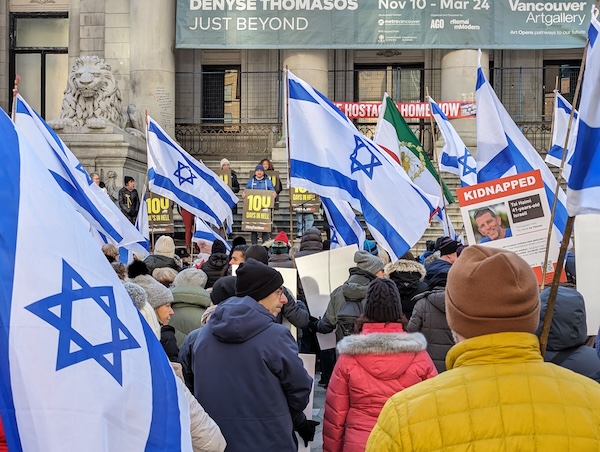
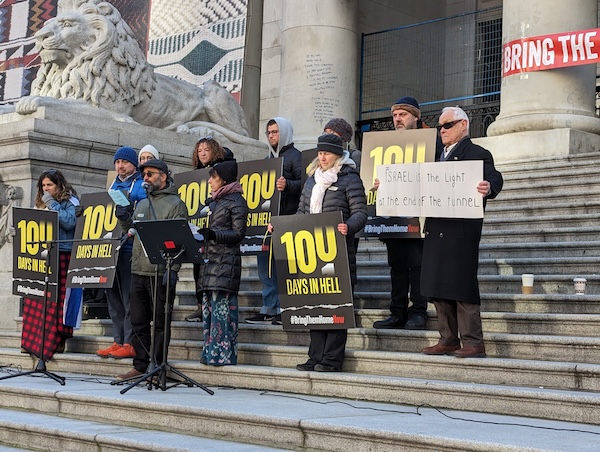
The weekly rally at Vancouver Art Gallery marked nine months since the pogrom of Oct. 7. (photo by Anna-Mae Wiesenthal)

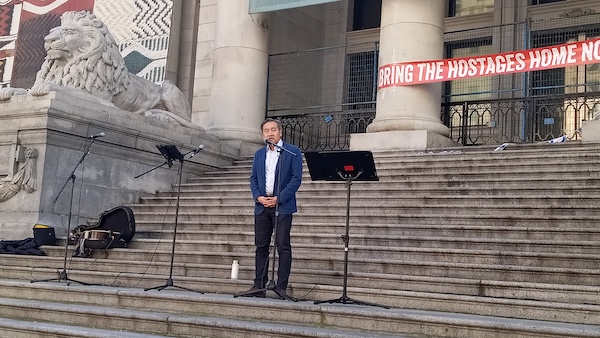
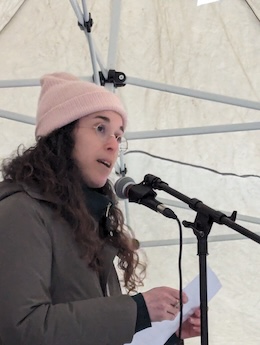
Selina Robinson, the former BC cabinet minister whose planned speech at Vancouver’s weekly rally for the hostages was canceled over security concerns earlier this year, was the surprise speaker Sunday at the vigil marking nine months since the pogrom of Oct. 7.

“I was out here nine months ago, representing government and the Jewish community … as we mourned together the slaughter of young people, the rape of women, the death of so many innocent people perpetrated by Hamas,” Robinson said. “I took it upon myself to make sure that we did right by the Jewish community and I took that honour with great reverence and commitment. I did so at the request of [then-premier] John Horgan and then I did it at the request of [current premier] David Eby and I did it diligently, as best I could. And we watched as a government what happens when hate goes unchecked. I never thought in my life, really, that I would see this level of hatred directed toward Jews.”
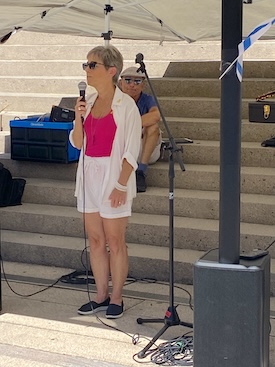
photo - Selina Robinson speaks at the July 7 vigil
Selina Robinson speaks at the July 7 vigil. (photo by Anna-Mae Wiesenthal)

She lauded fellow elected officials who stand with the Jewish community and said there should be unanimity.

“On this issue, we should not be divided,” said Robinson, a former minister of finance who was minister of postsecondary education when Eby, the premier, demanded her resignation after comments she made on a webinar calling pre-state Israel a “crappy piece of land.”

She credited Jewish organizations and allies for the work they are doing, but warned of a steep road ahead.

“We have a lot of work to do, my friends,” she said. “The antisemitism that has been unleashed is going to be hard to put back in the bottle.”

Congregation Beth Israel’s Rabbi Jonathan Infeld had harsh words for Robinson’s treatment at the hands of colleagues.

“Let’s tell the truth of why Selina was kicked out of cabinet,” Infeld said. “The reason is because Selina was the one representative of the Jewish people in cabinet. Selina was the one person in cabinet, in our government, willing to stand up not for some people’s human rights but for all of our human rights. Selina was kicked out of cabinet because she was a strong woman who stood for all that our province is supposed to stand for and she was kicked out of cabinet because she is a Jewish hero.”

BC Conservative Party leader John Rustad spoke, and was joined at the rally by fellow Conservative MLA Elenore Sturko and a number of Conservative candidates standing in October’s provincial election.

“I am proud to say that I stand here with you,” said Rustad. “I stand against terrorism. I stand against Hamas and what they have done.”

The government in British Columbia needs to do more to counter antisemitism, he said. 

“People who come to this province, to live here, come here with the expectation that they will live in peace,” Rustad said. “They come with the expectation to be able to raise a family, to be able to build the future, and what we are seeing today, with the antisemitism that is happening throughout our communities, I just find completely wrong.”

Ezra Shanken, chief executive officer of the Jewish Federation of Greater Vancouver, expressed pride in the community he serves. He urged elected officials to stand with the community. 

“We remember who was there on day one and we see who’s there now and that’s something that we have to stand up for here in our province and in our country,” he said. “We need them side-by-side by us and you need to be the ones to continue to tell them at all levels of government that we need them now more than ever.”
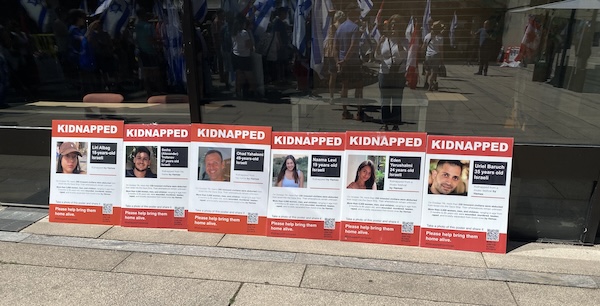
photo - Approximately 120 hostages are still being held in Gaza, more than nine months after the Hamas attacks on Oct. 7
Approximately 120 hostages are still being held in Gaza, more than nine months after the Hamas attacks on Oct. 7. (photo by Anna-Mae Wiesenthal)

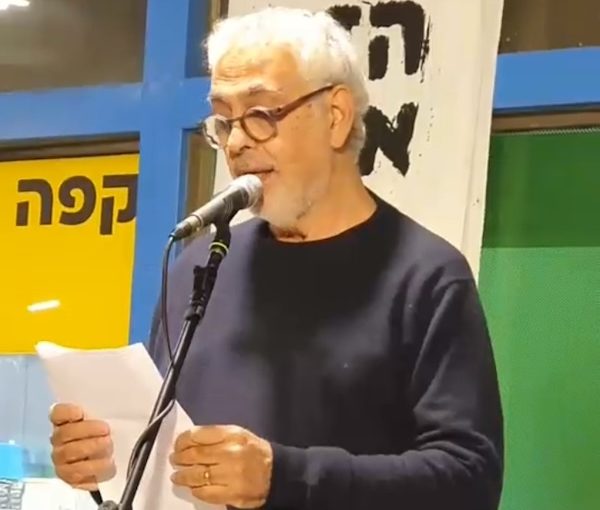
Lior Noyman, an Israeli-Canadian educator and filmmaker, expressed sorrow for victims of violence in Israel and Gaza. He warned the audience to be vigilant against expanding antisemitism.

“Leaders, teachers, parents, Canadians, I am calling to you all,” he said. “Don’t let them walk us back in time.”

Dov (David) Rosengarten, a Vancouverite who is chief of staff for donor communications at United Hatzalah, Israel’s network of 7,000 volunteer first responders, brought greetings and gratitude from Israel. 

“Your display of unwavering solidarity every weekend here continues to give us strength through this difficult period,” he said. 

Noting the nine-month period since Oct. 7, Rosengarten drew parallels with the human pregnancy term, except that these past 40 weeks have been a time of unprecedented trauma. He sees hope in news of a ceasefire plan and hopes that “these painful birth pangs will end and the citizens of Israel and the Jewish people at large, including here in Vancouver, will be reborn again. After these many painful months, these cries of sorrow will be transformed to jubilation and we will finally hold our beloved hostages and loved ones again and celebrate the victory of unity and, like with a newborn child, we will shape for ourselves a bright future full of new dreams and possibilities.” 
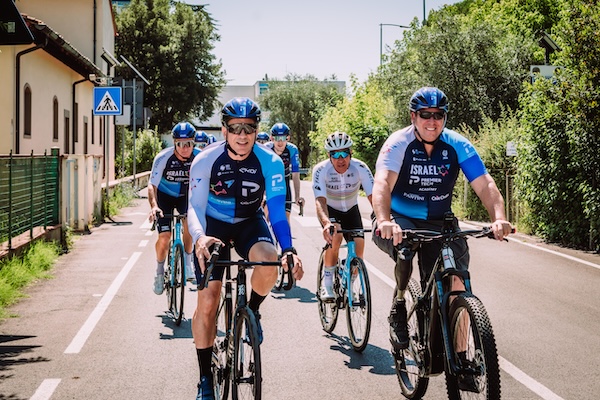
Oct. 7 heroes support Team Israel-Premier Tech

Oct. 7 survivors Sharon Shabo, left, and Avida Bachar lead Team Israel-Premier Tech riders in the team’s final training session before the Tour de France started on June 29 in Florence, Italy. (photo by Noa Arnon)

Three injured heroes from the Oct. 7 Hamas terror attacks came to support Team Israel-Premier Tech at the Tour de France. As well, they held signs bearing the names of hostages, some of whom are their close friends, and called for their release. Alongside them stood Israel-Premier Tech owners Sylvan Adams and Ron Baron.

“My friends from the kibbutz are suffering there. We can’t wait another moment,” said Avida Bachar. He lost his son and wife, who were murdered in their shelter in Be’eri on the morning of Oct. 7, while he himself was severely injured and lost his leg. Despite adapting to his prosthetic, Bachar insisted on riding his bike for the first time since his injury to lead the Israeli team in their final training session. “It was an immense moment, one of the most emotional of my life,” he said.

Joining Bachar was his good friend Sharon Shabo, who was seriously injured in a Hamas ambush on the morning of Oct. 7 while riding his bike, and 20-year-old Oded Gelbstein, a young combat engineer soldier who was critically wounded in Gaza and is currently undergoing rehabilitation in Florence.

“Avida and Sharon will be our great inspiration at the Tour de France,” said Adams to the team riders before the race started.

The Tour de France lasts three weeks, during which the riders cycle more than 3,400 kilometres. Twenty-two teams are taking part in the 21-stage race, which culminates in Nice, France, on July 21. 

– Courtesy Team Israel-Premier Tech

Small wins amid gloom

The rescue of four Israeli hostages from Gaza last week and their reunions with their loved ones is a bright spot amid much dismal news – though there remain 120 hostages whose reunions with their families we dream of and hope will happen soon.

This rescue has been a source of tempered joy for Israelis and others. In a time of tragedy and despair, these moments are worth appreciating. Amid the relief, we mourn the life of the Israel Defence Forces officer who died from wounds received during the operation and we mourn the lives of the many innocent Gazans lost. Holding this tension is weighing mightily on many of us, knowing that placing hostages among civilians is a deliberate and overwhelmingly cruel strategy of Hamas.

Closer to home, we are not without bleak news, but neither are we bereft of hopefulness.

The arson attack on Schara Tzedeck Synagogue two weeks ago is deeply troubling and scary. The outpouring of support and empathy from so many is a silver lining. Clergy, elected officials, multicultural community leaders and ordinary folks have expressed solidarity with Schara Tzedeck and the broader Jewish community.

A few less monumental but hopeful items crossed our desks recently.

The Vancouver Comic Arts Festival, which had earlier canceled the participation of artist Miriam Libicki, issued an apology for their actions – and announced that “the vast majority” of individuals who had perpetrated Libicki’s banning had resigned from the organization’s board.

Suffice to say, this is not the foremost news story this year. But it is surprisingly uplifting when a glimmer of common sense emerges where intolerance had once prevailed.

Libicki had been canceled ostensibly because she had served, once upon a time, in the Israeli army. IDF service was also the excuse used when inspirational speaker Leah Goldstein, a BC resident, was canned from an International Women’s Day event in Ontario in March. 

Assertions that an artist (or performer or whoever) is being excluded because they served in a military that we see every day in the news engaged in a tragic conflict may seem legitimate, or at least not quite as blatant as, say, posting a sign that reads “No Jews allowed.” Notably, though, no such litmus test, to our knowledge, has ever been applied to any artist (or whoever) in Canada based on their service in any other national armed forces – and, given the diversity of our country, we can be pretty much assured that we have citizens who have served in many of the world’s most tyrannical and nasty, even genocidal, militaries.

Other excuses to ban Jews or pull Jewish- or Israel-related work from events, exhibits, performances, etc., have also included enough plausible deniability to steer just clear of indisputable antisemitism.

Goldstein’s cousin, local photographer Dina Goldstein (it’s sadly becoming a family affair), was recently removed from a group exhibition. In this instance, the gallery claimed financial considerations were the deciding factor.

Then there are cases where venues pull an event or performer based on security concerns, as the Belfry Theatre in Victoria did with their scheduled performance of the play The Runner. They had reason to fear violence – the theatre was vandalized amid the controversy. But cancelations based on security concerns, as valid as they may seem, give an effective veto to those who are potentially violent.

In the shadow of the Belfry decision, The Runner was pulled from the PuSh Festival in Vancouver, the stated reason being that another artist threatened to pull their work from the event if the play was mounted. 

In addition to cancelations, there is plenty to raise alarm bells about anti-Israel bias in the public education system, as well, as we are forced to outline in discouraging detail elsewhere in this issue, with the BC Teachers’ Federation making some controversial decisions. But, again, here some reason prevails, though not from the BCTF.

The Burnaby school district took what it called “immediate action” when it became known that elementary students had been given an exam question asking them to make a case for and against the existence of the state of Israel. We could fill volumes with outrage about the unmitigated nerve of a teacher thinking this was a legitimate subject for grade sixers (if it was on the exam, one can only imagine what the same educator said in the classroom) but let’s take some solace that there were reasonable people in a position of authority to respond when this became public.

In further good news in the education realm, on June 1, the University of British Columbia’s Vancouver Senate soundly rejected (by a vote of 49 to 16) a motion urging the university to cut ties with institutions in Israel.

In challenging times, it is even more necessary to acknowledge and celebrate small victories and acts of decency. It is an act of individual and communal resistance to remain hopeful and steadfast in pursuit of peace and justice. 

Rally highlights resilience

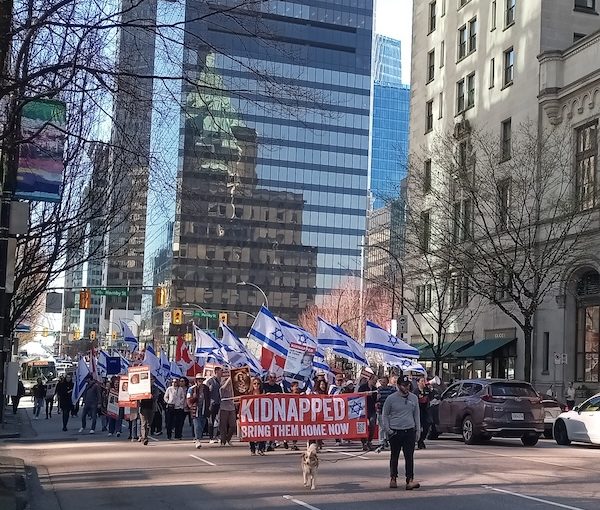
Those who gathered for the weekly rally to call for the release of the Israeli hostages take their message down Georgia Street on Sunday, March 17. (photo by Cynthia Ramsay)

After five months of attending almost every one of the weekly rallies for the Israeli hostages, I found myself Sunday on the other side of the crowd. Daphna Kedem, the organizer of these events, invited me to address the audience on March 17, alongside Rabbi Philip Bregman and Michael Lee, member of the Legislative Assembly for Vancouver-Langara.

I was speaking on nobody’s behalf but my own, although my nearly 30 years of writing for this Jewish newspaper, my being the director of Upstanders Canada, which fights antisemitism, and just generally my being a non-Jew who is a keen Zionist, were presumably the reasons I was asked to speak.

Someone whose primary role is reporter does not like to become part of the story. This is different. I am a journalist (among other things) but there are identities and values that, in my view, supersede journalistic constraints – support for democracy, for example, and free expression. Zionism covers a wide swath of opinion and experience and I fall on that spectrum. There is no point in pretending I don’t. 

Several people have requested that the Independent print the full text of my remarks. We have not done this for other speakers over the past five months, and this issue is jam-packed with news around related topics of allegations of antisemitism in the province so there is not space to run the entire speech. However, we have posted it on the paper’s website, with apologies to the dozens of speakers whose words have not been shared in their entirety over the past five months. Insider privilege, undoubtedly.

Even though the audience at these vigils is overwhelmingly Jewish, I felt my message should be aimed at non-Jewish people.

I’m also angry, and I decided to let that show. In addressing those gathered at the Vancouver Art Gallery, where the weekly rallies for the Israeli hostages are held, I observed that I was standing on the same steps where, days after the pogrom of Oct. 7, people stood and celebrated murder, rape, beheadings and kidnappings. 

“We mourn,” I said, “We grieve every single innocent life lost. We do not celebrate dead innocents. Neither do we tally up bodies in a grotesque competition where the side with the most dead wins moral victory.”

I warned that it is not only Jews and Israelis who are threatened by the behaviours of anti-Israel activists.

“The violence, coercion, intimidation and racism these people embody is a threat to Canada … to our civility, our peace, our multiculturalism and political discourse,” I said.

Maybe, I suggested, there are Canadians who don’t care if the Jewish people lose their country.

“But when they wake up and see that Canadians have lost ours … Jewish Canadians and their allies will be asking: Where were you? Where were you when we were standing up for the values that Israelis and Canadians share? Where were you when we demanded ‘bring them home’? Because, if you are not standing with Israelis against extremism … you are emboldening extremism in Canada.

“This is not about choosing between Israelis and Palestinians,” I said. “Unlike the extremists, we want peace for everyone. This is about choosing between civilization and barbarism. And we need to ask every Canadian:  Which side are you on?”

Before I spoke, Kedem shared comments made the night before at the weekly rally in Tel Aviv, with relatives of living and dead hostages urging Prime Minister Binyamin Netanyahu to do everything in his power to negotiate their release.

Kedem told the crowd that former cabinet minister Selina Robinson was to address the rally but security concerns prevented her from attending.

“I think it’s very, very sad moment for us that we can’t have a Jewish representative walk the streets of Vancouver in 2024,” said Kedem. 

Robinson sent remarks, which were read by Kamiel Kruse. Those remarks can also be read in their entirety on the Independent’s website. Robinson stressed the rally’s theme of resilience, sharing many examples of where she finds resilience.

“Resilience comes from seeing the Oct. 7 survivors of rape and torture pick up the pieces of their lives. It comes from seeing Israelis gather once again to protest their government. It comes from so many of you who have reached out with words of support, encouragement and love,” wrote Robinson.

“Resilience comes from us gathering our collective strength as we lift each other up and remind ourselves that we are not alone – that together we will find the strength – the strength to bring peace,” she concluded.

Bregman – who was the senior rabbi of Temple Sholom from 1980 until 2013 and then was executive director of Hillel BC and created the Other People, an interfaith and multicultural group that has spoken to some 7,500 students and faculty about racism and bigotry – also spoke of resilience.

He contextualized current events as part of a very long Jewish history, with almost 4,000 years of steadfastness in the face of challenges, Temple destructions, expulsions, Crusades, pogroms and worse. He spoke of his own experiences growing up with antisemitism in rural Ontario, and the firebombing of Temple Sholom synagogue, then on West 10th Avenue, on Jan. 25, 1985.

Through all this ancient and modern history, Bregman said, one thing has remained constant.

“The message is clear. We are not going anywhere,” he said. “We are here.”

Lee had just returned from Germany and a meeting of state and provincial legislators from the United States, Germany and Canada. He reflected on the extremism that is rising in places around the world.

photo - Michael Lee, member of the Legislative Assembly for Vancouver-Langara, addresses the March 17 rally for Israeli hostages
Michael Lee, member of the Legislative Assembly for Vancouver-Langara, addresses the March 17 rally for Israeli hostages. (photo by Cynthia Ramsay)

Part of the BC United party, Lee said he strives to avoid partisanship when speaking at these rallies to help ensure “that the Jewish community is not made a political football” and he assured Jewish community members that they have allies on both sides of the Legislature.

Lee called for the province to fully adopt the International Holocaust Remembrance Alliance Working Definition of Antisemitism because it would clarify discussions. Some of the commentary being heard today falls directly into at least one of the examples accompanying that definition, he said.

“Denying Jewish people the right of self-determination by calling the state of Israel a racist endeavour is an example of antisemitism,” he said.

Lee was recently shuffled into the role of opposition critic for the attorney general, a position he had held before, and he said he has called on the AG to take a stronger line in the justice system against potential hate crimes. 

“We need the attorney general to direct Crown counsel to prosecute the Criminal Code violations which are antisemitic and hate crimes incitement to public violence that are antisemitic in nature on our streets,” he said.

Lee lauded Robinson’s work in the Legislature, especially her commitment to the Jewish community.

“I am very disappointed, like so many of you, that she is not able to be here with you,” said Lee, who has spoken admiringly in the Legislature and elsewhere about Robinson. “But she is with you, you know that. Selina has always been with you. She will always be with you.”

Throughout the afternoon, Mia Mor sang and Richard Lowy joined on guitar and vocals. 

Pat Johnson’s full speech – rally for Israeli hostages March 17/24

I want to thank Daphna not just for inviting me today. But for inviting each of us here every Sunday. It’s so important.

Daphna – todah rabah.

**

I was not born into this community. Nor did I convert. I just showed up here, about 30 years ago, like a stray dog. And you took me in.

As someone coming into this community from the outside — but especially, coming from a background of progressive, left-wing activism, from the gay community, from antiracist activism, I have had the opportunity to see, to hear and to understand events from different angles.

When I showed up in Vancouver’s Jewish community, I had no idea about the depths of the familial, spiritual, emotional and personal connections between almost every Jewish person and the state and the land of Israel.

And I think this is one of the things that you probably discovered in the last five months. Most people just do not comprehend what Israel means to Jewish people.

We need to share that story. But we can only share that story if other people will listen. And that is the problem.

Because the people who need to hear it are too busy chanting to listen … or to understand.

**

Many British Columbians fail to understand why a former cabinet minister is claiming anti-Jewish bias while so many of her colleagues, who have apparently invested no effort into exploring the many forms antisemitism can take, steadfastly insist there must be some other explanation.

Israel is the national embodiment of the Jewish people. To attack Israel is to attack Jews.

Here is the bigger issue …

The people who are marching against Israel … they are not helping the people of Gaza … and they sure as hell are not making the world a better place.

The only thing they are doing is making Canada a more dangerous, toxic, intolerant country.

Hateful words against Israel are inciting violence against Jews in Canada.

And when we express concern about this undeniable correlation, we are accused of conflating anti-Zionism with antisemitism … as if that distinction makes a damn bit of difference to the victim of a hate crime.

Words of hate … lead to acts of hate. We understand this when it comes to any other group.

But when it comes to Jews … people are willing to employ the most dangerous, inflammatory and incendiary rhetoric. And let the chips fall where they may.

**

But it is not only Jews and Israelis who are under attack by these radical extremists.

It is the very essence of what it means to be Canadian. It is our core national values that these activists betray.

Day after day, we see shrieking, crazed mobs shutting down events, screaming obscenities and threatening people who are trying to live their lives, commute to work, go to the theatre, attend synagogue or get an education.

The person you should be hearing from is not me.

Selina Robinson was invited here today. But it was not safe for her to come.

What does that tell you about the state of civil discourse in Canada?

You’ve seen their rallies. You have heard their chants. Do those look to you like people of peace?

They call for Israel to stop defending itself … but they refuse to demand the one thing that would immediately end the war and all this dying – the surrender of Hamas.

On the steps of this art gallery, days after the pogrom of October 7, people stood here and celebrated murder, rape, beheadings and kidnappings.

**

We mourn … we grieve every single innocent life lost.

We do not celebrate dead innocents.

Neither do we tally up bodies in a grotesque competition where the side with the most dead wins moral victory.

And even if some of the people who march for Palestine do not celebrate beheadings, do not applaud rape or rejoice at mass murder – they are absolutely content to march alongside people who do.

Those who on these steps called those horrific, inhuman atrocities “brilliant and amazing” are not only part of a movement that is holding human beings hostage.

They are holding hostage humanity itself.

They have abducted words like peace and ceasefire, freedom and human rights — but they desecrate these values.

Canadians have allowed people who align with the most misogynistic, homophobic, xenophobic, violent and totalitarian forces on earth to masquerade as voices for justice and equality … while accusing us of humanity’s greatest crimes.

If these people were genuinely advancing human rights and social justice, they wouldn’t need to cover their faces in keffiyahs and balaclavas.

We need to figuratively tear off their masks and show Canadians who these people are …

**

Maybe many Canadians don’t care about a conflict half a world away.

But the violence, coercion, intimidation and racism these people embody is a threat to Canada… to our civility … our peace, our multiculturalism and political discourse.

But the threat does not come only from the goons marching in the streets.

It also comes from some of our elected officials – including some who, until very recently, we thought were our friends — from the trusted teacher, the activist clergyperson, the crusading union leader, the self-righteous politically engaged artist.

Meanwhile, far too many Canadians have stood on the sidelines while extremists have taken over our streets, our campuses, our community theatres, our high schools, our public service.

Maybe they don’t care about Israelis.

Maybe they don’t care if the Jewish people lose their country.

But when they wake up and see that Canadians have lost ours … Jewish Canadians and their allies will be asking. Where were you?

Where were you when we were standing up for the values that Israelis and Canadians share?

Where were you when we demanded bring them home?

Because if you are not standing with Israelis against extremism … you are emboldening extremism in Canada.

This is not about choosing between Israelis and Palestinians. Unlike the extremists, we want peace for everyone.

This is about choosing between civilization and barbarism.

And we need to ask every Canadian: Which side are you on?

Selina Robinson’s full speech – rally for Israeli hostages March 17/24

My friends,

I am sorry that I could not join you in person for safety reasons, but I thank the organizers for sharing a few words on my behalf.

My heart has been with all of you these past five months. I join you in seeking release of the hostages now. I join you in seeking peace – peace for the Palestinians – peace for Israelis – peace for us all.

I am told the theme for this week is resilience and so I have spent the last few days reflecting on my own resilience – as the lone voice in government speaking up for the Jewish community and how difficult it had become while others remained silent. I also focused on how much more difficult it became after I was forced to resign, feeling punished for speaking up about Jew-hatred.

I reflected on where the strength, the koach came from to persist, when it would have been so much easier to be silent, to fade into the background, to go along with the others and to pretend that everything was okay.

So, from where do I draw the strength?

It comes from different places:

  • A husband outraged that his wife is poorly treated by her colleagues, forced from a role she loves and who now keeps a baseball bat in the bedroom because others are threatening her life.
  • A son who stopped going to his gym shortly after the massacre on Oct. 7 because the Port Moody gym owner and city councillor decided that putting up a large Palestinian flag in her gym demonstrating to the world that she suddenly cares so deeply about a complex geopolitical conflict thousands of miles away is more important than the hurt this causes friends, colleagues, and customers.
  • A daughter who now must find significant financial resources to make sure the Jewish children in her care are safe this summer.

My strength has also come from:

  • The two Jewish professional women who, as a requirement of their jobs, came to hear the Throne Speech at the Legislature in February. They were forced to find a safe route into the building as there were dozens of protesters aggressively calling for a unilateral ceasefire and the destruction of Jews.
  • The physicians who refuse to train Jew-hating UBC medical students.
  • The teachers who organize to push back on the Jew-hatred we are seeing in the [BC Teachers’ Federation].
  • The people working in the public service who are telling their stories of intimidation like being told that their Jewish star necklace is a symbol of genocide.

Resilience for me comes from the countless stories from people who talk about being fearful at work, from Holocaust survivors who say, “It’s happening again.”

Resilience comes from Jewish community leaders and volunteers who are doing everything they can to keep programs running, to push government to do the right thing, to care for their congregants who are scared and worried, and who lead by example.

Resilience comes from the emails and letters from hundreds of people, Jewish and non-Jewish alike, who remind me that even though I felt alone in my caucus and in government, I was not alone. I am not alone. We are not alone. Many were seeing what I was seeing, what we are seeing and are prepared to stand up to Jew-hatred.

Resilience comes from reaching out to others who are hurting too and finding out that they want to help heal our wounds together.

Resilience comes from seeing the Oct. 7 survivors of rape and torture pick up the pieces of their lives. It comes from seeing Israelis gather once again to protest their government. It comes from so many of you who have reached out with words of support, encouragement, and love.

Resilience comes from us gathering our collective strength as we lift each other up and remind ourselves that we are not alone – that together we will find the strength – the strength to bring peace.

Rally highlights women

On March 3, many stories of heroism were shared at the weekly rally for Israeli hostages, of whom 13 are women, still being held by Hamas. The gathering marked International Women’s Day, which takes place on March 8. (photo by Pat Johnson)

On Oct. 7, Amit Mann, a 22-year-old paramedic, spent six hours treating the wounded and dying in a dental clinic on Kibbutz Be’eri. 

“Six hours during which she did not stop treating the wounded, six hours during which she did not lose hope,” recounted Ruth Jankelowitz at the weekly rally for Israeli hostages March 3. “Amit Mann, a Magen David Adom paramedic, treated the wounded at Kibbutz Be’eri with her dedication and heroism with the sounds of gunfire all around her and the threatening voices of the murderers getting closer. Together with a nurse and a dentist … she tried to do everything to save everybody as she had done since she was 13, until the bullets of the vile terrorists hit her, too.”

Mann’s tragic story of heroism was one of numerous shared at the gathering Sunday, marking International Women’s Day, March 8, where speakers called for the release of all the hostages, including 13 women still being held. 

Ofra Sixto, owner of Ofra’s Kitchen restaurant, whose pro-Israel activism in recent months has attracted threats and intimidation, led a moment of silence for female victims of Oct. 7.

“The world is angry when women are being raped, abused, disrespected and brutally murdered by men – unless they are Jewish women,” she said. “Then the world is silent, complacent and, at the time, had the audacity to question the acts.

“What gets me the most is the young and old women that support Hamas, knowing what they know of how they treat women in general and our women in particular,” Sixto said. “It’s beyond me.”

Masha Kleiner, an Israeli-Canadian who co-founded NOAH, Nonviolent Opposition Against Hate, said that, for every Jew, “Oct. 7 is absolutely personal.”

“Each and every single one of us knows it could have been me who was tortured and kidnapped and killed,” she said. “I am selfishly lucky that nobody I personally know was killed or kidnapped on Oct. 7, but many of our tribe have been, so this is a personal loss for every one of us.”

Jews worldwide are grieving the loss of life, she said, but Jews lost something else that day and in the months since, she said.

“One other thing that we are all grieving in the post-Oct. 7 world is our illusions, the illusion that the world around us is safe and sane and friendly,” she said. “We grieve, and this grief can be lonely because some people that we considered friends chose to keep their distance and some of them turned their backs on us. But, while this happens, we become so much closer to the people who do have the moral clarity and the courage to stand with us.”

Mirit Murad – an Israeli who came to Vancouver two decades ago and has two nieces, Gal Klein and Ofek Elias, serving as reservists since the onset of the war – urged people to take time on International Women’s Day to honour and celebrate Israeli women, both civilians and soldiers.

“These women are demonstrating unparalleled strength, resilience, resourcefulness, bravery, intellect and protective instincts,” she said. “They embody the very essence of courage, never hesitating to leap into action or shield others from harm.”

The week’s rally took place at Jack Poole Plaza, rather than the usual location at the Vancouver Art Gallery because that space was provided to organizers of Vancouver’s International Women’s Day event.

That event’s theme was Palestinian women and featured images of “activists” including Fatima Bernawi, Ahed Tamimi and others. 

Bernawi served a decade in Israeli prisons after planting a bomb in a Jerusalem movie theatre in 1967, which was discovered before detonation. Tamimi is something of a social media star, a young woman who came to prominence as a 16-year-old when a video of her assaulting an Israeli soldier in 2017 went viral. After the Oct. 7 attacks, Tamimi wrote on social media: “We will slaughter you and you will say that what Hitler did to you was a joke, we will drink your blood and eat your skulls.”

“These women are arbiters of Palestinian resistance who advocated for the rights and freedoms of Palestinian people and are continuing to do so every day,” organizers of the Vancouver IWD event said in a statement.

“International Women’s Day belongs to everyone, everywhere,” said Daphna Kedem, organizer of the weekly vigils. “Where are you, women’s organizations? Believe Israeli women. Release our women.” 

Israeli women among the hostages still being held by Hamas

Liri Albag, soldier, 18
Noa Argamani, student, 26
Karina Ariev, soldier, 19
Agam Berger, soldier, 19
Shiri Bibas, 32, kidnapped with husband and two children
Amit Esther Buskila, fashion stylist, 28
Carmel Gat, occupational therapist, 39
Daniella Gilboa, soldier, 19
Romi Gonen, dancer, choreographer, medic, 23
Naama Levy, soldier, 19
Doron Steinbrecher, veterinary nurse, 30
Arbel Yehoud, astronomy guide, 28
Eden Yerushalmi, bartender, 24

Mishpacha comes together

The weekly rally for Israeli hostages at the Vancouver Art Gallery Sunday, Feb. 18. (photo by Pat Johnson)

Family was the theme at the weekly rally for Israeli hostages at the Vancouver Art Gallery Sunday, Feb. 18, the day before British Columbians marked the Family Day holiday. Speakers took to a stage at the edge of the gallery’s north face out of respect for a makeshift memorial to Alexei Navalny, the Russian opposition leader who died in custody two days earlier.

“Family Day will be celebrated here tomorrow,” said Daphna Kedem, organizer of the weekly vigils for the hostages. “But this year casts a heavy shadow over the day for some families of our community here and in Israel…. It is difficult to be happy when families are waiting to be reunited with their loved ones, or for many families who have lost their loved ones.”

Dr. Michael Elterman, a psychologist, spoke of the psychological effects of what is happening in Israel and worldwide.

“We see the indescribable anguish in the families and we easily feel ourselves in their shoes and intuitively imagine what we might feel if that happened to us,” he said. “There has developed a related construct of post-traumatic stress disorder over the past decade … this is the sadness, anger and sometimes spiritual distress that arises from moral outrage. It is a broader set of reactions that arise even when the individual themselves were not present at the trauma but rather are morally outraged and left furious and depressed by events. This is even more likely where we identify so strongly with those who are personally impacted by Oct. 7.”

This anxiety is heightened by increases in antisemitic rhetoric and attacks, including in Vancouver. 

“Some of you may be experiencing the symptoms of post-traumatic stress, such as disturbed sleep, intrusive thoughts, trouble concentrating and being easily startled,” Elterman said, adding that help is available through Jewish Family Services and other resources. Getting involved in the community response can help ease feelings of helplessness and he directed people to the Community Toolkit on the website of the Jewish Federation of Greater Vancouver. 

“Remember to practise self-care in small ways, like proper nutrition and sleep,” he said. “Continue to do the things you previously enjoyed, even if you don’t feel like doing them. Finally, hug each other a little longer and a little tighter.”

Aviya Kones, who works at Jewish Family Services, spoke not about the services offered by that organization, but about the people of Kfar Aza, where she grew up.

photo - Aviya Kones speaks about the people of Kfar Aza, where she grew up
Aviya Kones speaks about the people of Kfar Aza, where she grew up. (photo by Pat Johnson)

“Kfar Aza was a desert oasis,” said Kones. “It was home, it was love and life, it was filled with unique and quirky and hilarious traditions and it was generations of family. It was also savagely and brutally destroyed after countless and seemingly endless hours of horrors.”

Her own childhood home was destroyed on Oct. 7.

She shared memories of three people who died that day.

“Smadar, a year above me, was tall, slender, so elegant,” she said. “Even as a child, I recall looking up to her. She had big, beautiful brown eyes and thick brown hair. I remember being awed by her grace, kindness and gentle nature.

“Nadav was two years older than me,” she said. “He knew how to make everyone laugh in every situation – not at anyone’s expense but maybe his own.

“Yoav was my age group,” she continued. “He had blue eyes, blond hair and a genuine smile. All the girls thought he was cute and all the guys wanted to be his best friend. He was shy, kind, creative and athletic. He loved his family. He was so close with his parents, his siblings and the many, many cousins he had living on the kibbutz.

“All three, amongst many others, tragically, brutally and with unimaginable cruelty, lost their lives on Oct. 7,” said Kones. “They were living in our beautiful oasis, our safe place, our home. They are survived by a broken and mourning community, generations of family that absolutely adored them and … all three were also survived by their young children. Nadav had two daughters, Smadar had three children and Yoav was a first-time dad to a little girl who was only 10 days old on Oct. 7.”

Rabbi Jonathan Infeld, senior rabbi at Congregation Beth Israel and head of the Rabbinical Association of Vancouver, said that Oct. 7 was not just an attack on Israelis or those living in Israel.

“It was indeed the beginning of an attack on the entire Jewish people,” he said. “It was a catalyst for antisemitism across the world that we have felt even here in Vancouver…. Too many of us have felt the antisemitism that began to boil over on that day.”

Gordon Shank, a First Nations member, a business innovator and a survivor of the Sixties Scoop, which saw Indigenous children abducted from their families and placed with white families, spoke of the centrality of family and the trauma of separation. 

“I’ve known the pain of separation from family, being torn from the embrace of loved ones, albeit under different circumstances,” he said. “The Sixties Scoop and the current crisis in Gaza might stem from vastly different contexts yet, at their core, they resonate with the universal cry for the right to family, to unity and to belonging. This parallel is not to equate the experiences but to underline the shared understanding that every individual deserves to grow, to dream and to thrive within the warmth of their family’s love.” 

Of the hostages and their families, Shank said: “Their pain is our pain. Their hope is our hope. Let our gathering today send a powerful message that we stand together across cultures and histories, united in our resolve to bring the hostages home.”

The march through downtown streets that has been a feature of the weekly events since October will be a monthly activity only for the coming weeks, Kedem told those gathered. The crowd then moved to the sidewalk adjacent Georgia Street for a demonstration, with a brief disruption by an individual waving a Palestinian flag.

Kedem has organized the weekly events since October and, early on, affiliated with the ad hoc international group Bring Them Home which, in turn, is affiliated with the Hostage and Missing Families Forum, in Israel. 

Recently, Kedem also associated her activities with another international group, Run for their Lives, which encourages groups as small as a single individual to demonstrate solidarity with Israel and its hostages by walking, biking or running. 

A plea for the hostages

A screenshot of former Israel Air Force pilot Uri Arad speaking at the Jan. 20 Bring Them Home rally in Jerusalem.

***

Weekly rallies have been held in “Hostages Square,” the plaza in front of the Tel Aviv Museum of Art, since the Oct. 7 terror attacks by Hamas, who killed 1,200 people and kidnapped 240 that day. Every week, thousands gather in the square and in other locations, calling for the release of the 136 hostages still being held in Gaza, at least 32 of whom are now believed to be dead. At the Jan. 20 Bring Them Home rally in Jerusalem, one of the speakers was Uri Arad, a former pilot who was held in captivity in Egypt for six weeks during the 1973 Yom Kippur War. Arad is not related to Ron Arad, an Israeli Air Force officer missing in action since 1986, who Arad mentions in his speech. The remarks below were translated into English by Rahel Halabe, a Vancouver translator and educator, who is a family friend.

***

I was asked to speak here today because I have been a prisoner of war. Until recently, I had avoided talking publicly about my captivity or even identifying as a past captive. The reason I stand here today and talk to you stems from my deep empathy with the hostages and their families, my fear for the hostages’ fate and the need to join the call for their immediate release.

Indeed, I can testify from my experience that captivity is a very difficult experience, physically and mentally. Still, it is important for me to emphasize that, as difficult as my experience was, it is not the same as what our hostages in Gaza are going through. As a pilot of the air force, I was totally aware of the possibility of falling into captivity and I was prepared physically and mentally to cope with the experience. This is not the same for innocent civilians who are kidnapped out of the blue, without any previous preparation. As time goes on, it shows that the hostages are indeed going through hell.

Moreover, being held captive by a state is not the same as being held captive by a murderous terrorist organization. Being held by a state, I did not feel the constant existential threat on my life – I knew that, eventually, I would return home. This is unlike the hostages in Gaza, who are in constant existential fear of being murdered by their captors, or even killed by our own forces. It is, therefore, a much more difficult experience than what I went through.

I shut my eyes and imagine Noa Argamani, the Bibas family, Amit Buskila, Elyakim Libman, Yusef and Hamza Alziadneh, Liri Elbag, and all the other hostages, and my heart is shattered. Here in Israel, there are so many tormented families who are suffering from uncertainty and worry for their loved ones, some of them after experiencing losses without the ability to properly mourn. It’s just horror. We have to say clearly and loudly: we have reached a stage in which every day that passes is like Russian roulette in the life of the hostages. Therefore, it is necessary to do everything, everything, to bring them home now!

When people ask what reassured me most and helped me get through my time in captivity, I answer without any hesitation: I knew that the state would do all that it could to bring me back home. The ability to cope with torture, difficult interrogations and the uncertainty of my fate mostly came from my belief in the contract between me and the state, from knowing that I would not be abandoned. This confidence is what accompanies all soldiers who are ready to give their life for the state. This is the Israeli ethos of solidarity, the most sublime expression of which is that those injured on the battlefield are never abandoned, even if their rescue may involve losses, and that the state goes above and beyond to bring its captives and hostages home.

This is why I came here today, to say in a clear voice: the return of the hostages is the most important mission, maybe the only one, that should guide decision-makers at this moment. This is the necessary condition for our ability as a nation to recuperate from the horrendous disaster that hit us on Black Saturday. All of us are tormented knowing that Ron Arad never came back. It is, therefore, important to say it is unthinkable that there will be tens more of “Ron Arads.” If we don’t regain our composure and immediately bring the hostages home, this will happen. Some of the hostages will return in coffins, others will be forever lost.

But, I am asked, how do we bring them back? Don’t they keep telling us that the objective of destroying Hamas is not less important, that there have been great attempts to bring them back, that both objectives are interconnected and that we must keep putting military pressure on Hamas to bring the hostages back? It must be said, at this point in time, as Gadi Eisenkot expressed so well two days ago, this is senseless. The truth is that, today, these two objectives contradict each other. And the evidence is that – except for one hostage – all the hostages who have come back were returned in the framework of a deal. The military operation not only did not help in the return of the hostages, but it even cost the life of a few of them, and every day that passes just increases the danger to their lives. The conclusion is clear and sharp: the only way to bring the hostages back alive is through a deal. Now!

There are those who object to stopping the war, claiming that it would be a repetition of the same mistake that brought Oct. 7 upon us, and that it will eventually bring upon us many more Black Shabbats and an existential danger to the state in the long run. They mistakenly think that the destruction of Hamas is just around the corner. This is a delusion! Today, it is clear to all who are reasonable that the destruction of Hamas is an extremely difficult goal, which will require years to achieve. It is important to understand that what really hides behind this claim is the willingness to give up on the hostages. In the clash between short-term and long-term interests, those who claim the above prefer the long-term. I say, first, we must bring back the hostages! In the long-run, we will be able to continue weakening the terrorists through both military pressure and political initiatives, while striving for comprehensive agreements that will bring an end to the conflict.

I know that the thought of being forced to stop the fighting and, on top of that, pay the heavy price of a mass release of terrorists, is difficult for many people. I, too, have found it hard to swallow and say this grudgingly, but there is no escape. It is necessary to internalize that the hostages are the major asset Hamas has in its hands, and that [Hamas leader Yahya] Sinwar will not give up this asset except in exchange for the end of fighting. The strategic failure of Black Shabbat puts us, after more than 100 days of fighting, in a position in which we are forced to clearly make a decision and pay the price. The Israeli government, therefore, should initiate a deal of “all for all,” including a stop to the fighting. Now!

Binyamin Netanyahu refused to take responsibility for what happened on Oct. 7, but has been “gracious” enough to declare that he is responsible for all that will happen. If so, it must be clearly said: Netanyahu is responsible for the fate of the hostages. From here, I would like to address the prime minister and say: Netanyahu, you have brought upon us the worst catastrophe in the history of the state. This will be your legacy; you will be inscribed in history with shameful disgrace. Still, you have a chance to somehow soften history’s judgment, if you bring the hostages back alive. This is the time to rise above the political considerations that have led you and initiate a deal for the return of the hostages. Now!

Finally, I would like to say: continuing the current policy will cause a rupture, impossible to repair, in Israeli society. Israel will lose its soul, one of its most significant elements. We will never again be able to say that we hold human life sacred. This is an unbearable price. Therefore, bring the hostages back in exchange for stopping the fighting. Now!

Thank you all. 

Rallies help keep hope alive

Jewish Federation of Greater Vancouver chief executive officer Ezra Shanken addresses those who gathered at the Vancouver Art Gallery Jan. 14. (photo by Pat Johnson)

Vancouverites gathered Jan. 14 to mark the 100th day since the Oct. 7 terror attacks and to demand the release of hostages. The weekly vigils – which have taken place since the day after the attacks with the exception only of two weeks during the December holidays – continue to gather hundreds, with police escorts accompanying marchers through downtown streets after speeches outside the Vancouver Art Gallery.

“This is the moment for leaders of the world to take a stand against terrorism, to call on Hamas to release the hostages,” said event organizer Daphna Kedem. “Where are you, world leaders? You stay silent while girls are held in tunnels and Hamas are abusing women of all ages. Where are you? [There are] 136 hostages: 17 women, two children, 15 men and women over the age of 65, 94 men and youngsters, eight foreigners. We will not rest until they are all back.”

Kathryn Zemliya spoke of the commitment she made to Israel when she became a Jew by choice 17 years ago.

“Israel is the Jewish homeland,” she said. “Israel is also the birthplace and source of our Jewish faith. Our religious holidays reflect all the seasonal changes in the state of Israel and we celebrate those throughout the year.”

Her commitment to Israel, she said, is also a very personal one. 

“Israel is one of a very few handful of Middle Eastern countries where people are not punished as criminals simply because of their sexual orientation or gender identity,” said Zemliya. “For me, this is tremendously important. There are lots of places in the world where I could not travel with my family, where I could not travel with my wife, but I know that I would always be welcomed in Israel.”

She called for justice and defined what that justice would look like.

“Justice requires that we listen to and believe those who have given testimony of rape, brutality and torture that they have experienced or witnessed at the hands of terrorists,” she said. “Justice requires that we recognize and care for those who have been displaced from their homes due to conflict on all fronts in Israel because the war is not happening just in Gaza. Justice requires that we recognize and care for those who have lost family members, who have been traumatized and who, because of their life circumstances, are retraumatized daily by this terror. My hope is that we will see this justice soon and in our time, that is what we pray for.”

Rabbi Hannah Dresner, senior rabbi at Or Shalom Synagogue, and Rabbi Arik Labowitz, assistant rabbi, addressed the crowd.

“We are here to console one another through the power of gathering in such a difficult time,” said Dresner. She noted that the week’s Torah portion featured the demand by the Israelites to the tyrant of their time to let their people go. “We, likewise, are commanded by everything we know to be decent, to demand of the tyrant of our time, let our people go.”

Labowitz spoke of “waves of grief, fear and deep concern for the existential realities of our precious home in the land of Israel.”

“We are all heartbroken by the loss of life, the ever-deepening chasm and the generations of repair that will be required to heal from this moment in our shared history,” he said. “We know that the Jewish people have a heart that is bigger than any malicious attempts against us. The love and support that has come together to repair the fabric of Israeli society, of our local communities and of each of our hearts, is made up of the strength whose origin is in the plight of our ancestors to be free people in a land of our own, a land where our people were sovereign for centuries and a land that we returned to after 2,000 years of exile.”

photo - Rabbi Arik Labowitz, assistant rabbi of Or Shalom, standing next to his colleague, Rabbi Hannah Dresner, the congregation’s senior rabbi. The two spoke at the Jan. 14 rally marking 100 days since Oct. 7
Rabbi Arik Labowitz, assistant rabbi of Or Shalom, standing next to his colleague, Rabbi Hannah Dresner, the congregation’s senior rabbi. The two spoke at the Jan. 14 rally marking 100 days since Oct. 7. (photo by Pat Johnson)

Adi Keidar, who moved to Vancouver from Israel in 2000, shared the lesson she has learned since Oct. 7.

“Life, I used to think, matters to all,” she said. “But these past 100 days, I am sad to say, I’m wrong.”

Evil exists, she said, but must not be allowed to be the dominant voice. 

Ezra Shanken, chief executive officer of the Jewish Federation of Greater Vancouver, acknowledging the day’s below-freezing temperatures, said of the hostages: “The least we can do is stand here in the cold if they live in the cold depths of the tunnels.

“Let them know that, even in the coldest days of the year, we will stand out here and we will stand with them because we know that they need it,” he said, urging attendees to “keep showing up.”

Kedem, who has organized the events week after week, read aloud the names of the 136 hostages.

107 days

A week later, the King David High School community was front and centre at the Jan. 21 rally. Students of the Jewish school sang and spoke at the gathering, which ended in a downpour of rain as the group marched through city streets.

“You’re a link in a chain that has been growing stronger for thousands of years,” event organizer Daphna Kedem told the students.

Erica Forman, a 2022 alumna of King David, and brother Max Forman, a Grade 12 student, spoke of the strength they gathered during this time of unprecedented antisemitism from their respective communities at the University of British Columbia Hillel and at King David.

Rutie Mizrahi, parent of a Grade 12 student, spoke of her uncle and aunt, Oded and Yocheved Lifshitz, who were abducted from their home in Kibbutz Nir Oz Oct. 7. Yocheved, 85, was among the first hostages released, after 17 days in captivity, because her captors believed she was near death.

The captors underestimated her aunt, Mizrahi said, and she has survived, despite arriving back in Israel appearing to be about half the weight she was when kidnapped. Yocheved had been rolled in a carpet and driven away on a motorcycle, but not before she saw her 83-year-old husband being savagely beaten outside their home. She did not believe he could have survived, but another hostage, freed later, confirmed that Oded was alive in Gaza but, without his blood pressure medication, had repeatedly fainted and was then taken to a hospital. 

“The odds that we will see him back alive are close to zero,” Mizrahi said.

King David’s head of school Russ Klein said he is grateful his father, Emerich Klein, a Holocaust survivor who passed away earlier in 2023, is not witnessing the hatred in the world since Oct. 7.

“He instilled in us the need for Israel,” the principal said. “Only Jews, he said, would take care of Jews. I spent much of my time growing up not believing him. As I found with so many things as I got older, I learned my father was right.”

Klein called the school assembly on Oct. 10, when students and faculty gathered to mourn the Hamas murder of alumnus Ben Mizrachi, 22, and the other victims of the pogrom, the hardest moment of his career.

He urged people of all ages to inform themselves of facts to better engage in the discussion around events in Israel and Gaza, specifically directing attendees to resources released recently by the Jewish Federation of Greater Vancouver, an online toolkit called “The Power of One” and a messaging guide called “Real Peace Now.” Both are available at jewishvancouver.com.