Vigils spotlight women, children

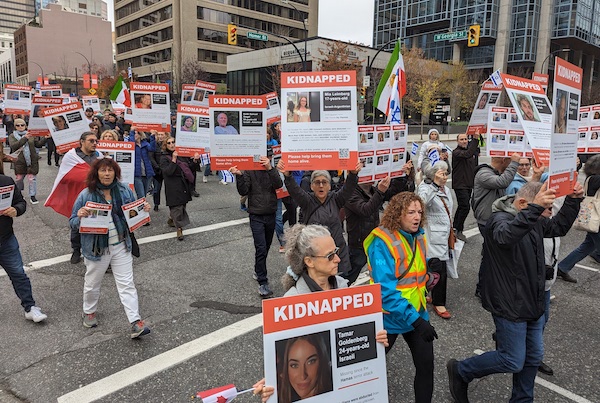
Weekly vigils calling for the release of hostages held in Gaza continue weekly at the Vancouver Art Gallery.

On Nov. 26, the vigil spotlighted female victims of the atrocities and emphasized the hypocrisy of many groups, including UN Women, an entity ostensibly dedicated to gender equality and the empowerment of women, which took 50 days to express any concern about Israeli women.

The vigil took place a day after the United Nations International Day for the Elimination of Violence Against Women.

Rebeka Breder, a lawyer in Vancouver who specializes in animal law, addressed the assembled crowd. She reflected on how, as a child, she looked up to the United Nations as a humanitarian organization.

“Laughable, I know,” she said. “As I have come to learn, and as many of the people standing here have come to learn … the UN is a humanitarian organization – but not for Jewish people.”

The world seemingly cares about women’s rights, she said, except for Jewish women.

“Since Oct. 7, UN Women issued 26 statements about Palestinian women and children versus only three statements about Palestinian and Israelis together,” said Breder. “There is not one statement by UN Women that specifically condemns the brutal rape and mutilation of women’s bodies that was committed by Hamas. Not one. When we look at the photos that are posted by UN Women, most if not all of the pictures are about Palestinian women and children. I’m not saying we shouldn’t care. We should care about all life. But when you see UN Women that is an agency, that is supposed to be standing up and essentially representing women around the world, not post even one — not even one — picture of Oct. 7’s brutal attacks on women and [what] other Jewish people have gone through, it speaks volumes.”

Women’s rights groups and officials in Israel have been working to compile information and evidence about the brutality, rapes, mutilation and other atrocities committed by Hamas, Breder said.

“My understanding is that they have tried a number of times to send this information to UN Women so they can review it and, up until yesterday, there was silence, there was absolutely nothing coming from them,” she said.

Temple Sholom member Shirley Hyman, a board member of ARZA Canada, the voice of Reform Zionism in Canada, paid tribute to Vivian Silver, the Canadian-Israeli woman who was murdered Oct. 7 but who was not confirmed dead until Nov. 14.

“Vivian Silver was a proud Zionist,” said Hyman. “Vivian Silver spent the last four decades working to end the Israeli-Palestinian conflict while advocating for coexistence and harmony between both peoples. She was born in Winnipeg and, after a stint at Hebrew University in Jerusalem, in 1974, she moved to Israel and so began her life as an activist.”

Silver was a founder of Kibbutz Be’eri and oversaw construction projects, while shuttling back and forth to Gaza advancing coexistence.

“When Hamas took over the control of Gaza in 2007, everything changed,” Hyman said. “The closest she got to Gaza was the border, where she picked up sick Palestinians in order to take them to hospitals in Jerusalem.”

Disenchanted with the political left’s inability to end the conflict, Hyman said, Silver “turned to woman power.” She helped found the organization Women Wage Peace (Nashim Osot Shalom, in Hebrew).

“It has today grown to be the largest grassroots organization in Israel composed of both Israelis and Palestinians, numbering over 45,000 and located in 95 different areas,” Hyman said. “Every Monday, they protest at the Knesset, wearing white and turquoise so government officials can identify them. They host peace-building webinars, protests and marches around the country and conduct peace-building activities.”

On Oct. 4, days before she was murdered, Silver was with a group in Bethlehem, protesting at the security barrier in Bethlehem, many wearing T-shirts declaring “Peace is possible.”

Toby Rubin, president of CHW Vancouver, the local branch of the national organization founded as Canadian Hadassah-WIZO, stated, “Violence against women is never resistance.”

“It’s our duty to continue to speak for those who cannot,” she said. “But the silence has been deafening from the international women’s groups. Jewish women, Israeli women, our sisters, deserve the same respect, the same rights, and the same voice as women everywhere. Shame on the global community for deliberately ignoring them. Even if the UN came out yesterday, that was 50 days too late.”

The Canadian branch of the worldwide women’s Zionist organization has raised $2.5 million in emergency relief since Oct. 7, she said.

Rubin paid tribute to Daphna Kedem and others who have organized the weekly vigils since the terror attacks. Kedem read the names of all the child hostages. “Your dedication and your Zionism in helping this community never forget the faces,” she said. “We must never forget and we must continue to fight [until] every single one of the hostages is back.”

The previous week’s vigil, on Nov. 19, occurred a day before UN World Children’s Day. Volunteers stood on the steps of the Vancouver Art Gallery holding posters featuring the children murdered or being held hostage by Hamas.

Noemi Gal-Or, professor emerita of politics and international relations, said international law declares that a child should not be separated from their parents against their will. She called on Canada to redouble efforts to press Hamas to release all hostages.

Rabbi Shmulik Yeshayahu of the Ohel Ya’akov Community Kollel said the world should not accept that 40 children – including an infant born in captivity – are being held hostage.

“And the world is silent,” he said. “This is not acceptable. This is not the world that we envisioned. This is not a world that should be. We’ll do anything within their power to bring them home.”
From poems to songs

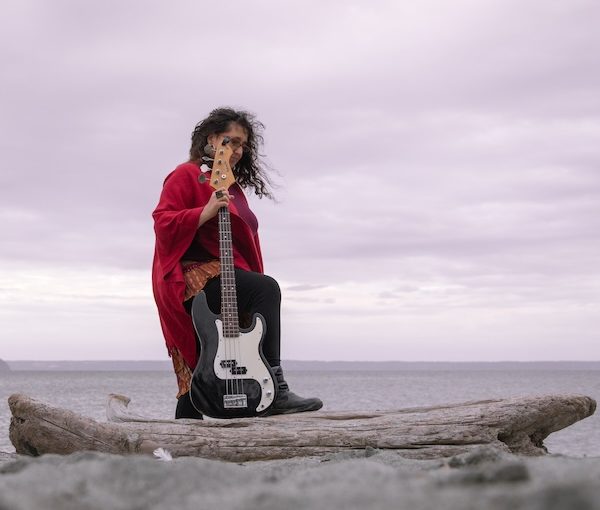
Loolwa Khazzoom (photo by Moriel O’Connor)

“Dear Hostages, as the world rallies to celebrate your desecration I will not forsake you,” begins the poem written by Seattle-based multimedia artist and educator Loolwa Khazzoom. Posted on her Facebook page, with a #BringThemHomeNow poster featuring photos of Israelis kidnapped on Oct. 7, it continues, “My instinct is to deprive myself of oxygen / Because you are underground / And I will not forget you // But I know that you would dance / In the sun / If given the chance / So I now rise up / And dance for you.”

Many of Khazzoom’s songs begin as poems. In this case, she told the Independent, “I felt as if I could not breathe and as if I did not even want to breathe, out of solidarity with the hostages and with all of Israel, in particular, all the victims of the Oct. 7 massacre. It’s like I wanted to physically feel their pain and suffering, as a way of physically demonstrating that I would not forsake them or forget them.”

In a traumatized mental state, Khazzoom returned to the “healing tools of poetry and music,” which was another way she could show her solidarity and do her part in keeping the issue of the hostages in front of people.

Similarly, Khazzoom and her band, Iraqis in Pajamas, recently released another poem-turned-song, “#MahsaAmini.” They did so this past Sept. 16, the first anniversary of the death of 22-year-old Mahsa Amini at the hands of Iranian “morality police.”

Finding out about Amini’s murder soon after it took place, from TikTok videos posted by Iranian women, Khazzoom “jumped into action.” She wrote to her political representatives, raised funds for United 4 Iran and reposted Iranian women’s videos on her feed constantly, to help boost the content’s views. “In addition,” she said, “a day after I found out about what happened, a poem with my feelings poured out of me, and I posted it on social media. Months later, I put that poem to a melody, and the band developed it into a full band song, which we released on the [anniversary of the] day of Amini’s murder.”

The death affected Khazzoom deeply for many reasons.

“First, the women in my family wore the abaya, the Iraqi equivalent of the hijab – Jewish women throughout the region were subject to Muslim dress codes, so it’s a Jewish issue, too,” she said. “Second, so many people assume that Islam is indigenous throughout the Middle East and North Africa, but it’s not. Arab Muslims rose up from the Arabian Peninsula and conquered the entire region, forcibly converting masses under the threat of death. So many indigenous ethnicities and religions predated the Muslim conquest, including Jews, Persians, Berbers and Kurds. The Iranian women protesting and burning their hijabs felt to me like challenging that Muslim conquest and awakening the ancient Persian warriors. Third, Persia is central to Jewish history and the origins of the Mizrahi community, dating back nearly three millennia ago…. And, lastly, the fire of these women, and the men who joined them, and their willingness to risk their lives for their dignity and freedom was just breathtaking and profoundly inspirational.”

Another of Iraqis in Pajamas’ releases this year was also intensely personal for Khazzoom.

“I wrote ‘The Convert’s Quest’ in response to some friends on social media sharing how hurt they were, coming under attack during the process of their conversion to Judaism. I had ample experience witnessing variations on this theme throughout my life – both first-person, seeing it happen to friends, and through my research as a Jewish multicultural educator. For decades, I felt very disturbed by this seemingly growing trend.

“I am the daughter of a Jew by choice, as my mother called herself, so the matter of conversion to Judaism is very personal for me,” she said. “I remember understanding very clearly as an Orthodox Jewish child that, according to halachah (Jewish law), once you convert, you are no longer to be called ‘a convert,’ but rather, a Jew, period. So, even from a religious Jewish perspective itself, I was very distraught by the ways that Jewish leaders and communities were rejecting or harassing converts, or even all-out forbidding people from converting. It all flies in the face of Jewish history, theology and practice.”

The band released “The Convert’s Quest” on May 24, on the harvest holiday of Shavuot, which celebrates the giving of the Torah to the Jewish people and on which the Book of Ruth is read. It tells the story of Ruth, a Moabite woman who converted to Judaism, whom Jewish tradition teaches will be the ancestor of the Messiah.

“To me, Jewish converts are the lifeblood of the Jewish people,” said Khazzoom. “I have a provocative line in my song, saying that converts are ‘the most Jewish Jews of all,’ because they are intentionally and consciously practising the foundational precepts of Judaism, which so many either take for granted or do rote, as is often the case in the Orthodox Jewish world where I was raised. In addition, amidst life-threatening levels of racism and violence against Jews, converts choose Judaism…. Why would we reject, in any way, from subtle to blatant, someone with such a heroic Jewish soul?”

Even when delivered in a playful manner, Khazzoom’s song are serious to the core. The campy “Kitchen Pirate,” for example, “emerged from my choice to reject the conventional option of surgery, in the wake of a cancer diagnosis in 2010,” she said. “Instead, I chose to radically alter my diet and lifestyle. Simply by overhauling my diet, I cold-stopped the growth of the nodules, which remained stable for the next five years – neither growing nor shrinking – until I returned to my lost-love of music, following which they began shrinking.”

Khazzoom said her songs “are always questioning, always challenging, always defiant. Sometimes, it’s more explicit, other times it’s embedded in silliness, which, parenthetically, I also see as defiant. I am and forever will be a curious, playful and awe-inspired child. I think that, if and when we ‘outgrow’ that, we die inside. And I refuse to capitulate to that norm of expected behaviour once we enter adulthood. By way of example, to this day, at age 54, when I am flying in a plane, if there is nobody sitting next to me, I will stretch out my arms and pretend I’m a bird, during takeoff.”

Not everyone has appreciated this aspect of her personality. “I have constantly gotten into trouble for it and have been at odds with my family, my community and society at large,” said Khazzoom. “I have endured terrible loneliness and often even self-doubt as a result. But I always come back to my core. And all of my songs emerge from that place – that raw, gut-wrenching place of being fiercely alive and allowing the clash with everything around me, and then writing about it.”

It is this enthusiasm that Victoria-based band member Mike Deeth enjoys about being in Iraqis in Pajamas, whose third member is Chris Belin.

“Loolwa and Chris are both easy-going, creative people. The energy is very positive, which makes collaborating with them fun and organic,” Deeth told the Independent. “Further, I appreciate the passion Loolwa has for the subject matter she writes about. One thing I always struggled with as a musician is ‘What do I have to say?’ At the end of the day, I’m a privileged guy who has never had to face oppression, hate, war or genocide. I have a lot of respect for artists who have experienced darker parts of humanity and have the courage to bring that perspective into their art.”

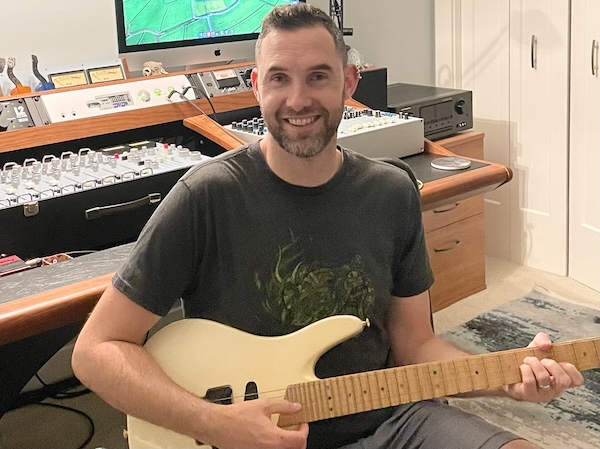
Born in Toronto, Deeth, who is not Jewish, spent most of his adolescence in Calgary, and moved to Vancouver Island when he was 18. He first picked up a guitar a few years earlier and has been playing ever since. “I was in my first band at 18 and played in bands throughout my 20s. For the past several years, I have been mainly focused on recording,” he said.

photo - Mike Deeth
Mike Deeth (photo from Mike Deeth)

Deeth got hooked on music production in his teens, getting his first digital recorder at age 16. “I still remember pulling all-nighters with friends trying to write songs and get ideas down on tape. Production was always fascinating to me, as I could layer parts together into something bigger than I could ever play on my own.”

Deeth and Khazzoom met a couple of years ago through a Craigslist posting. “She was looking for a guitarist to contribute to an early version of her track ‘The Convert’s Quest,’” he explained, complimenting Khazzoom on the fact that she “puts her full heart into her songs.”

“I recorded some initial guitar demos and, about a year later, we reconnected and worked up the current releases,” he said.

Deeth adds guitar to the songs and completes the mix and master of the songs when they are ready for those steps. Khazzoom sings, writes and plays bass, while Belin – who lives in Pennsylvania – composes the drum parts and performs them.

Among his other music ventures, Deeth has “played the guitar with Bryce Allan, a country musician here on the island, and recorded a few tracks with him. I also work closely with Jennie Tuttle, another musician from Victoria. We have been recording together for seven or eight years now.”

For Deeth, “recording is such an interesting combination of art and science. I get to be musically creative, but I also get to play with cool machines, solve problems and think about gain staging, compression ratios and other technical aspects. I thoroughly enjoy both the artistic and scientific parts of the process – they work my mind in different ways.

“I also love how each project starts as a blank canvas and ends with a new piece of music out in the world. There are an almost infinite number of possibilities when recording a track (all the possible settings on the equipment, the subtleties of different instruments) and it always fascinates me how each song takes shape during the process.”

“Mike has an exquisite sensitivity in his musical composition, performance and recording,” said Khazzoom. “He’s not only super-talented and -skilled, but he’s warm, upbeat, enthusiastic and professional. It’s a joy to create music with him. As is the case with our drummer Chris Belin, Mike has an uncanny ability to capture the essence of the songs I write, to the point that I feel he is playing back to me the sound of my soul. I have literally sat and cried after hearing the mixes.”

For more on Khazzoom, visit khazzoom.com. For more on Deeth’s production and sound services, visit glowingwires.com. 

Gathering marked 30 days

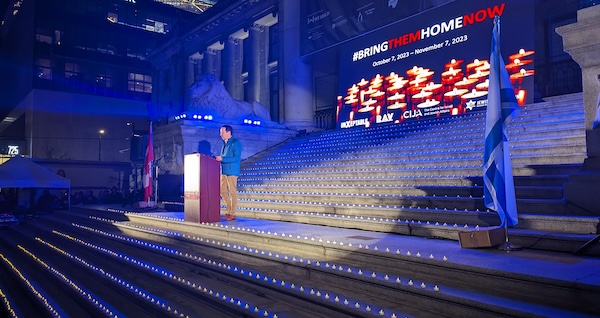
The steps of the Vancouver Art Gallery were illuminated by lights representing those murdered by Hamas on Oct. 7, as the community gathered Nov. 7 to mark shloshim, 30 days of mourning. Here, Ohad Arazi addresses the crowd. (photo by Pat Johnson)

The steps of the Vancouver Art Gallery were illuminated by hundreds of lights representing lost lives, as the community gathered Nov. 7 to mark shloshim, 30 days of mourning, after the unprecedented terror attacks in Israel.

Among the lives lost on that single day was Ben Mizrahi, a 22-year-old Vancouverite, for whom Rabbi Shlomo Gabay of Congregation Beth Hamidrash recited El Moleh Rachamim.

“The past 30 days have been some of the most difficult of our lives,” said Ohad Arazi, who spoke at the gathering. “They have been difficult for some of us as Jews, for others as Israelis. They have been difficult for all of us as humans.

“There are not two sides here. It is not about politics, history, land, religion or anything in between,” Arazi continued. “This is about one thing and one thing only. This is about humanity. Nothing, absolutely nothing, justifies the horrific crimes that were committed 30 days ago. I do not know what comes next from the region as Israel and its allies must now fight to end Hamas’s regime…. But one thing I do know is that we here in Vancouver, here in Canada and elsewhere, we have a voice. We have a voice to stand up for humanity and to cry out against the senseless massacres that were carried out a month ago.

“For now, we need you, all of you, to stand up for Israel. Speak up. Your voice matters. Call them terrorists, not militants, for crying out loud. Do not give up hope that we will bring home all 242 hostages. These are dark days for Israel, but it’s an even darker time for the world, as many choose to side with evil or to not take a stand unequivocally in support of humanity.”

Another speaker, Moti Kotik, is an Israeli who has lived in Vancouver for 20 years. His friend’s daughter, Agam Berger, was kidnapped to Gaza on Oct. 7.

“Tonight, I don’t want to talk about the barbaric atrocities committed by Hamas,” Kotik said. “Nor do I want to speak about those crimes against humanity that so many failed to condemn. Instead, I’d like to share some personal thoughts and realizations that I’ve had in the last 30 days about what it means to be an Israeli Jew in the diaspora.”

For Israelis abroad, he said, it’s challenging to witness events from afar. He cited the Yom Kippur War, which began 50 years to the day before the October pogrom, calling it “a war that changed the lives of our parents.”

“This is our Yom Kippur and it’s already changing us,” he said. “For the first time, I was able to look from the outside and imagine what life for Jews would have been if there was not the state of Israel.”

Kotik said there has traditionally been a division between Israelis and other Jews in the community.

“Many times, we don’t mix with the local community,” he said. “For me, that is done. There is no more duality. I realize that I cannot escape from what I am, from what we are, which is one people, Jewish people, one community that supports each other, that makes us stronger.”

Kotik said the soldiers defending Israel on the frontlines today carry a burden of history.

“They are not there for their families and friends or neighbours, they are not even there just for the people of Israel or even for all of us,” he said. “They are there right now, risking their lives, in the name of every Jew that ever lived. Every Jew throughout history who did not have someone to protect him, who did not have someone to defend him, for every Jew throughout history, they are risking their life and putting it on the line. But they feel us and they feel our warmth and our support and our unconditional trust and they know, while they are on the front, we have their back and it helps them carrying that weight.”

photo - The community gathered Nov. 7 to mark 30 days of mourning
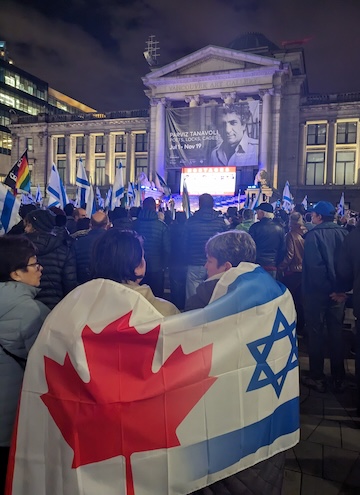
The community gathered Nov. 7 to mark 30 days of mourning since Hamas’s terror attacks. (photo by Pat Johnson)

Ezra Shanken, chief executive officer of the Jewish Federation of Greater Vancouver, welcomed elected representatives and said he does not take for granted the presence and support of government officials and police.

Michael Lee, member of the Legislature for Vancouver-Langara, said he has been hearing from parents whose children in public schools and at universities are experiencing antisemitic taunts and bullying. He commended the City of Vancouver and the Government of Canada for adopting the International Holocaust Remembrance Alliance Working Definition of Antisemitism and said he has been advocating for years that the province of British Columbia likewise adopt it, so that Crown counsel and law enforcement have that tool to aid in prosecuting hate crimes.

John Rustad, leader of the B.C. Conservative party, said he was disgusted that Canada has allowed pro-Hamas rallies to take place.

“It should never, never happen in this country,” he said. “I will do everything I can to stand with you, to stand for peace and to make sure that people understand history.”

Lenny Zhou, a Vancouver councilor, brought greetings from city hall.

“This is not about Israel and Palestine,” Zhou said. “It is not about Jewish or Muslim. It is about Israel and Hamas. It is about civilization and terrorists.”

Rabbi Susan Tendler of Beth Tikvah Congregation read a prayer written for the shloshim and spoke of the anxieties felt by Jews worldwide.

Rev. Doug Longstaffe, a United Church minister and a founding member of the Multi-Faith Summit Council of BC, but speaking on his own behalf, said he believes it is a mistake that more non-Jews are not stepping up in solidarity.

“No group has had power used against them for so long, systemically and lethally, in such a variety of ways and places and it is staggering,” he said. “While I am not arguing that it is harder to be a Jew than to be Black or Brown or Asian – how would I know? I’m white – but it is different. I see that. And it is different mostly because of the history of antisemitism, which I have been privileged to learn about and horrified by.

“There are more hate crimes today against Jews in Canada each year than [against] any other group,” Longstaffe said. “I think our first responsibility as gentiles to Jews is to understand that, considering their unique history, the right of every group to protection under the law needs to be applied most rigorously to Jews.

“Second, considering this unique history of the Jewish people, we need to lose our naivety, so that we do not unconsciously jeopardize Jewish safety by thinking they should simply assume goodwill,” he said. “Third, we need to be especially understanding, as gentiles, of Israel’s need and right to self-defence when surrounded by terrorist groups who wish to destroy all Jewish citizens.”

Regular weekly rallies to free the hostages continued Sunday. That vigil, which emphasized the approximately 40 children held hostage – including an infant born in captivity last week – recognized United Nations World Children’s Day Nov. 20. Four Vancouverites whose cousin, 17-year-old Ofir Engel, is a hostage in Gaza, attended, with one giving a moving sketch of the youth, who was visiting his girlfriend at Kibbutz Be’eri when the attacks occurred. Attendees then marched down Robson Street to Denman, where they amassed outside the restaurant Ofra’s Kitchen, whose proprietor, Ofra Sixto, has been subjected to hateful anti-Israel harassment.

Tensions at university

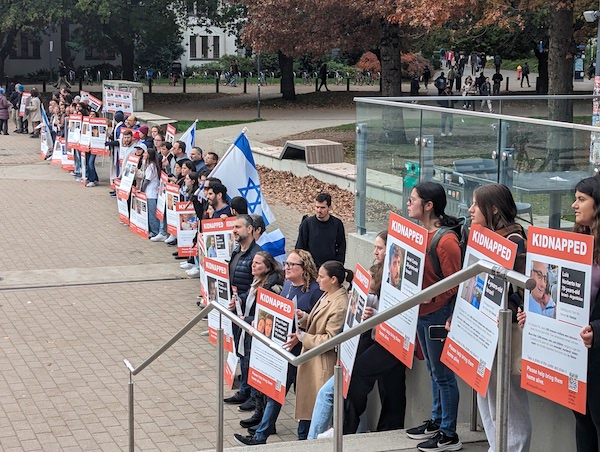
On Nov. 1, about 200 Jewish students and their supporters engaged in a low-key demonstration, with many holding posters of kidnapped Israelis. (photo by Pat Johnson)

When the new president of the University of British Columbia arrived for his first day on the job Nov. 1, he already had a full plate, including a 9 a.m. meeting with Jewish representatives and an urgent letter from community organizations expressing concerns about the safety of Jewish students on campus.

Dr. Benoit-Antoine Bacon starts his tenure at a contentious time, as Jewish, pro-Israel, anti-Israel and other students engage, sometimes constructively but often much less so, with events taking place in the Middle East.

Rob Philipp, executive director of Hillel BC, was joined by his assistant executive director, Ohad Gavrieli, and Nico Slobinsky, Pacific region vice-president for the Centre for Israel and Jewish Affairs, at the meeting with Bacon. Afterward, Philipp told the Independent the university has been on the right track but needs guidance.

“Generally speaking, I would say UBC has been very supportive of us, to the best of their ability,” he said, noting that Bacon’s welcoming of Jewish representatives is a good sign. “I had one of the very first meetings with him, so that speaks to how important this is on their radar.”

The university administration has been “somewhat consistent,” said Philipp.

“We are seeing support,” he said. “We don’t always see the right action, so that’s where we have to help and guide them.”

The larger issues, he said, are the serious affronts to civility on campus during the weeks since the start of the war between Israel and Hamas.

“There are so many red lines being crossed right now, it’s incredible,” said Philipp. “It seems OK now to kill civilians, to murder people for the ‘just’ cause and it keeps spilling over. People aren’t always understanding the details behind it all, so it’s as difficult a time as I have ever seen in this community – and it’s not just UBC, it’s all the university campuses all over North America.”

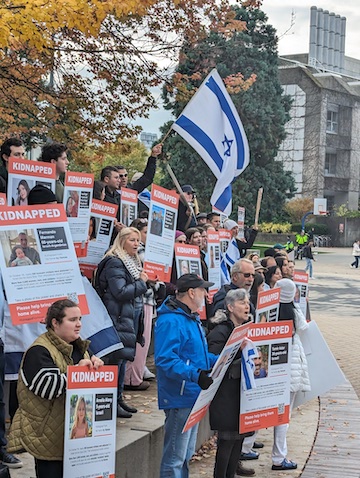
Hours after the meeting with the university president, about 200 Jewish students and their supporters engaged in a low-key demonstration, walking from Hillel House to the student union building, with many marchers holding posters of kidnapped Israelis. A student entered the building to deliver a letter to the president of the student government, the Alma Mater Society, expressing the group’s collective concerns. An emailed response to the letter from the AMS president was characterized by Hillel officials as positive.

photo - Jewish students and their supporters at the University of British Columbia on Nov. 1
Jewish students and their supporters at the University of British Columbia on Nov. 1. (photo by Pat Johnson)

A Jewish student leader from Simon Fraser University who asked that her name not be published said she came to the rally to protest the antisemitism in the world and, specifically, the lack of regard among student bodies to recognize what happened in Israel.

“It’s an extremely complex conflict that isn’t just black-and-white and I wish people would pay more attention or just seek a more nuanced view on the subject,” she said, adding that the climate at Simon Fraser does not seem as negative as at UBC, but that could change. In the last couple of years, the student government at SFU has demonstrated unbalanced, anti-Israel approaches, including adopting a motion on Israel and Palestine for which they consulted what the student called “tokenized [Jewish] fringe groups” while excluding Hillel and other mainstream Jewish voices.

Other participants at the rally said they felt the need to attend to be seen, and to register empathy with Israelis overseas and with Jewish students in Canada.

“We are here today so UBC acknowledges what’s going on in Israel – the kidnapped kids, elderly, children, women, Israelis – and what happened on Oct. 7,” said a 21-year-old Israeli-born woman who is not a student but came to support her brother, who is.

“I’m feeling very alone and feeling a lack of empathy and sympathy with what’s going on in Israel, feeling like people are too quick to comment sometimes,” she added.

Several non-Jewish students participated in the rally.

“I’m here because even though I’m not Jewish, I have a lot of Jewish friends and I believe the Hamas attacks against Israel are terrorism,” said fourth-year political science student Joe Latam. “The university’s attitude towards these literal terrorist organizations has been completely inadequate and they need to take better action.… The Jewish people have been systematically discriminated against for thousands of years and Israel is the one place where they can feel safe.”

Zara Nybo, who is also not Jewish, was motivated in part because her partner is Jewish and she sees the impact of events on him and his family.

“It’s important for me to stand up against terrorism and help spread the word that there are still innocent hostages who have been taken out of their home country,” she said. “We see a lot on the news that is politicized and very emotionally heartbreaking. I’m not here to say that Palestinian citizens have not died in this war, but I am here to say that death is death and we need to be able to recognize that heartbreak is heartbreak, so we are all here together.”

A first-year student who is Sikh called statements he has seen from peers and student leaders “frankly shameful.”

“I think there are many international students here that have been espousing hate, that have been espousing terrorist beliefs,” he said. “They have been saying they are pro-Hamas, they are saying [the Oct. 7 attacks were] a ‘beautiful act of resistance.’ I think we should double-check whether they deserve to be students at our wonderful university institutions.”

Bar Wolpert, an Israeli doing a one-semester landscape architecture exchange at UBC, said he was accosted by someone who tried to “shame” him as an Israeli.

“He just approached me out of the blue,” said Wolpert. “He was [aiming] his camera in front of my face.”

The person asked Wolpert if he supports “genocide.”

“I’m holding a [poster of a] kidnapped woman,” he said. “I am Israeli. I have a loss. So, please, first, respect my loss, respect my grief. And we are all standing here with many signs of kidnapped people and dead people, that is what is mattering for us right now, so before you are attacking me, respect my loss.”

Also at the rally were two brothers, Israeli high school students, whose parents sent them to stay with Canadian friends and family during the conflict.

A mother, walking with her young adult daughter, teared up when she realized that the poster she was carrying of a 21-year-old French-Israeli hostage could have been her own daughter.

“I can understand the pain,” said Evelyn Fichmann. “I think anybody can understand the pain.”

As he walked alongside scores of Jewish students and allies, a UBC student said the event gave him much-needed optimism.

“It really gave me some hope about unity,” he said.

Rally and march for hostages

Hundreds marched on Oct. 22, calling for the release of the more than 200 Israeli hostages being held by Hamas and other terror groups in Gaza. (photo by Pat Johnson)

Erez, aged 12, and his sister Sahar, 16, had spent the night at their father’s house in Kibbutz Nir Oz when Hamas terrorists stormed the home. The kids jumped out the window and hid in the bushes while gunmen rampaged their community, shooting entire families in their beds and safe rooms. “Mom, be quiet, don’t move,” he texted his mom, Hadas. She texted back: “I love you forever. I hope you survive.”

Erez did not reply. For hours, Hadas called Erez’s cellphone repeatedly, even as she fought for her life, physically blocking terrorists from breaking down her safe room door. Then Erez’s older sister found an 18-second video circulating on social media. It showed Erez in a black T-shirt, being gripped by both arms and led into captivity.

In all, five members of the Kalderon family were taken: Erez, Sahar, their 50-year-old father, Ofer, their 80-year-old grandmother, Carmela, and 12-year-old cousin, Noya, were grabbed from another house in the community.

This was one of many individual stories shared at a vigil and march in Vancouver Sunday, Oct. 22, where hundreds of Vancouverites chanted “Bring them home!” and “Let our people go!” as they marched from the Vancouver Art Gallery, protected by a large police presence, along Georgia Street, over to Robson and back to the original site. The steps of the art gallery’s north side were packed with people holding posters of the hostages – and these posters represented only half of the total number of Israeli hostages held by Hamas and other terror groups in Gaza.

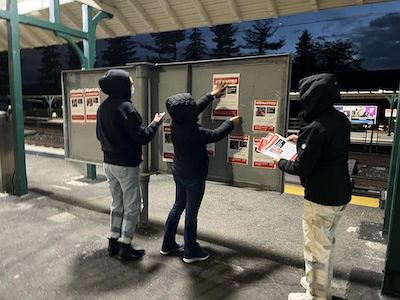
The faces are also seen on thousands of posters around Metro Vancouver and elsewhere. Activists in communities worldwide have downloaded and printed the sheets, plastering them around city streets. The Vancouver efforts – which have seen probably 20,000 posters distributed so far – are led by Daphna Kedem, who also initiated the Sunday afternoon event and an earlier vigil two days after the Oct. 7 terror attacks.

photo - About 20,000 posters – the cost of which was covered by two anonymous non-Jewish donors – have been put up by volunteers all around Metro Vancouver
About 20,000 posters – the cost of which was covered by two anonymous non-Jewish donors – have been put up by volunteers all around Metro Vancouver. (photo from Daphna Kedem)

Kedem is also a lead organizer of the local branch of UnXeptable, which, until the current crisis, was agitating against proposed Israeli government efforts to undermine responsible government there. Her current activism, she stressed, is done in her capacity as an individual, but she expressed gratitude to Rabbi Dan Moscovitz of Temple Sholom for helping organize, and to other synagogues, the Jewish Federation of Greater Vancouver and others for unhesitatingly jumping in to help.

Putting a human face to the hostages is the right thing to do, Kedem said.

“We have to bring it out to the public because it’s a humanitarian crisis,” she told the Independent. “Once you personalize it and you see that it’s an innocent baby or a child, you care more.”

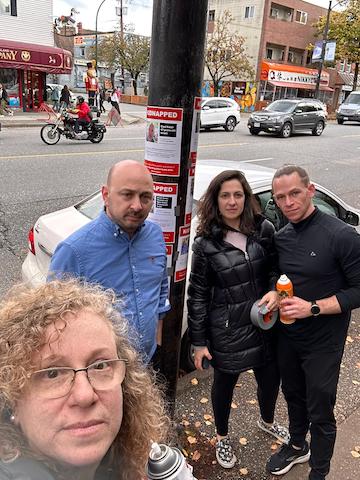
photo - Left to right: Flavia Markman, Ezra Shanken, Anet Bernadette and William Wolff. The four are among the many volunteers who have put up around the city approximately 20,000 posters with the faces, names and ages of Israelis taken hostage by the terrorist group Hamas. For more on the Bring Them Home Now effort
Left to right: Flavia Markman, Ezra Shanken, Anet Bernadette and William Wolff. The four are among the many volunteers who have put up around the city approximately 20,000 posters with the faces, names and ages of Israelis taken hostage by the terrorist group Hamas. For more on the Bring Them Home effort. (photo by Flavia Markman)

Kedem said the cost of printing the thousands of posters was covered by two anonymous non-Jewish donors and, at the rally this past Sunday, Christian clergy spoke, including a Catholic representative and two evangelical ministers.

Nevertheless, frustration over the silence of so many others was evident in the words of Moskovitz to the rally.

“Once again, Jews are being slaughtered and violently attacked and the world is silent,” he told hundreds of attendees, many carrying Israeli or Canadian flags. “Or they say, ‘Yes, but.’ There is no ‘but’ to murder. There can be no ‘but’ to hate. There can be no ‘but’ to the kidnapping of civilians, of children, of grandparents, of pregnant mothers, of disabled people. There can be no ‘but’ to that. There can be no justification for that. This is 2023, not 1943. And yet ‘Never again’ is happening again right now. The Jewish people will not be silent. You must not be silent.”

Moskovitz slammed the moral equivocation heard in commentary and seen in street rallies worldwide.

“This was not an act of resistance,” he said. “This was not a military campaign. This was not a popular uprising. This was cold, calculated and barbaric murder and rape and kidnapping of innocent civilians, the vast majority of them Jews.”

Motioning to the posters of the hostages, he added: “We call on those in our own city who cheer and celebrate what Hamas has done to these people and thousands of others on that horrible day to stop. Stop cheering the terrorists. Stop denying our grief, our human value. Stop your whataboutism. Stop tearing down pictures of children who have been kidnapped. Stop helping the terrorists. Stop justifying their brutality. Simply, stop.… Find your moral compass. Find the compassion you have for everyone and everything except Jews. Join us in this most basic of human cries: return our children to their parents, return our families to their homes.”

A WhatsApp group, “BTH – Vancouver,” is coordinating the postering activities: to join, visit bit.ly/BTH-Vancouver. Posters are downloadable by anyone at kidnappedfromisrael.com.