Skip to content
  • Home
  • Subscribe / donate
  • Events calendar
  • Business Directory
  • FAQ
  • News
    • Local
    • National
    • Israel
    • World
    • עניין בחדשות
      A roundup of news in Canada and further afield, in Hebrew.
  • Opinion
    • From the JI
    • Op-Ed
  • Arts & Culture
    • Performing Arts
    • Music
    • Books
    • Visual Arts
    • TV & Film
  • Life
    • Celebrating the Holidays
    • Travel
    • The Daily Snooze
      Cartoons by Jacob Samuel
    • Mystery Photo
      Help the JI and JMABC fill in the gaps in our archives.
  • Community Links
    • Organizations, Etc.
    • Other News Sources & Blogs
  • JI Chai Celebration
  • JI@88! video

Recent Posts

  • SFU honours Gloria Gutman
  • Lifting people’s spirits
  • Wedding a ray of light
  • Indigeneity and Zionism
  • Rule of law broken: councilor
  • Football and its roles
  • The burden of defence
  • Fish Café returns after fire
  • All right in what goes wrong
  • Nuns & mermaids at TUTS
  • Camp offers holiday retreat
  • Students and mentors inspire
  • Once-in-a-lifetime trip
  • 100 dancers, one heart
  • Money for the sciences
  • What “Jewish food” means
  • Have a cookie, schnitzel too
  • Federation now across BC
  • Israel fighting for its existence
  • Deal strengthens Iran
  • Patriotic belonging diminishes
  • A campaign to engage
  • Upstanders’ first live event
  • Responding to Carney
  • Having your own home
  • Music a family tradition
  • Musical to warm heart
  • Community milestones … June 2026
  • Sharing her passion for Israel
  • Or Shalom reopens its doors
  • JFS from past to future
  • Need holistic approach
  • Sharing stories, advice
  • Journalist shares fears
  • Skills to live together
  • Road to independence

Archives

Follow @JewishIndie
image - CJN box ad Rockowers 2026

Tag: family

Around the world in 382 days

Around the world in 382 days

Naomi Steinberg has toured the world with Goosefeather and is now working on a book of her travels. (photo from Naomi Steinberg)

Naomi Steinberg’s Goosefeather started in 2011. “It began with interviewing my French maternal grandfather in Paris before he died,” she said. “I wanted to know how he had helped my Jewish grandmother survive the Second World War and why he was a collector of maps, weights and scales. Given his work with the metric system, I also thought it would be interesting for us to talk about measurements in general.”

Fascinated by her grandfather’s story, the kernel of Goosefeather was born. “I made him a promise that he would see the final result,” she said.

She immersed herself in research. “Measurements are extremely important to humans,” she said. “We measure everything, but we have to realize that no measurement is 100% accurate; we have to accept that…. As I went deeper into it, I wanted to know how we measure the truth. What is the truth? What is reality? Same as when measuring length and weight, measuring reality can’t be 100% accurate. We have to accept this area of the unknown. We have to let ourselves ‘not know.’ We have to let everyone just be.”

The show that emerged out of her research is a multifaceted tale involving maps of places and relationships, measurements of physical elements and of abstract concepts. “How should we measure the space between me and another person? Between me and the planet?” she asked herself. “It soon became clear not only that I had a complicated story to tell, I also had an entertaining show that wanted to be on the road…. Goosefeather was going adventuring and I would be going around the planet, by land and sea, carrying a performance with me. As I journeyed, I would be carrying my own prime meridian in the form of presence. I had hypothesized that if, with this, I charted the space-time between myself and others, I might be guided in a good way.”

As the show was still coming into form, Steinberg’s grandfather was dying in a hospice in France. In 2013, she visited him in the hospice one last time and showed him the first draft of Goosefeather. “I shared with him all my ideas, and he said I got it ‘correctly.’ For a man obsessed with measurements, that was a high praise.”

The first performance of Goosefeather occurred in 2014 in Vancouver. (For a short review, see jewishindependent.ca/storytellers-excel-at-fringe.) But Steinberg needed to take it on the road. “I knew the show should travel like a Canada goose, all around the world,” she said. “I love traveling. I have a nomad soul, and I value my experience as a traveler, but I care very much about the environment. I didn’t want to just take a plane. You don’t experience your travels fully when you fly. It should be closer to the ground, slower, so I could stop and perform.”

In November 2014, she left Vancouver for California, where she boarded a cargo ship heading to Australia, which started her journey around the world. “It was easy,” she said. “The cargo companies sell tickets. They often have a couple cabins vacant – an owner’s cabin and a pilot’s cabin. That’s where I stayed on the cargo ships.”

She also performed Goosefeather on the first ship, as a Christmas gift for the sailors. When the captain asked her for a repeat performance, she bartered: a show for a phone call to her father, who celebrated his birthday while she was on the water.

It took her 21 days to reach Australia. From there, she took another cargo ship to China. Her further travels – by boat, bus and train – included Japan, Russia, Belgium, France, Switzerland, the United States and, finally, back to Canada. The entire trip took 382 days.

In every country, she performed Goosefeather, facilitated workshops and participated in creative collaborations. In every country, she stayed with friends. “I came back with $100. I lived in a cash economy for over a year and I fully supported my journey with my shows and workshops,” she said. “In the entire time I was away from home, I only paid for a hotel for seven nights.”

Despite the crazy itinerary, she didn’t prepare all her stops beforehand. “Sometimes, I didn’t even know where I would spend the night when I arrived in a city or a country, but I always found friends,” she said. “I researched storytelling organizations on the internet. I put my scheduled countries on my Facebook page and asked my friends for help. They asked their friends, and the word spread around the world like a goose feather. Everywhere, people wanted to see my show. I got contacts in every city and country. Everywhere, people wanted to help.”

Even the language barrier in countries like Japan and Russia didn’t deter Steinberg. She can perform Goosefeather in either English or French, and she always found a translator when she needed one.

“In Japan, they asked me to perform for children, and I created a special show for them: a Kamishibai show.”

For Steinberg, a professional storyteller, a storytelling tradition like Kamishibai is extremely compelling. According to Wikipedia, “Kamishibai is a form of Japanese street theatre and storytelling popular during the Depression years and the postwar period … until the advent of television.” Storytellers would travel from town to town, performing on “street corners with sets of illustrated boards … narrat[ing] the story by changing each image.” Some consider Kamishibai to have influenced manga and anime.

“For my first Kamishibai show, the adventures of a little goose feather, a talented 8-year-old drew the illustrations,” said Steinberg. “It was a big success. Now, I perform it with the pictures created by a wonderful Japanese artist, Shiho Oshita Beday.”

Currently, Steinberg is busy writing a book, a travelogue of her journey around the world with Goosefeather. She aims to publish it next year. To learn more, visit goosefeather.ca.

Olga Livshin is a Vancouver freelance writer. She can be reached at [email protected].

****

Note: This article has been edited to reflect that Steinberg’s total journey took 382 and not 386 days.

Format ImagePosted on June 29, 2018May 28, 2020Author Olga LivshinCategories Performing ArtsTags family, Goosefeather, Naomi Steinberg, storytelling, travel

Send more than love by mail

Have you ever seen a grandfather advertising for work? “Experienced grandfather seeks skilled or semi-skilled position, any shift that doesn’t interfere with afternoon nap.” Nope, haven’t seen any ads. And I know why: we are already busy as a bee in the clover patch serving as the family anchor.

Most of us are convinced that our grown children are still too young and far too immature to be real parents and thus must need our help. My advice is to concentrate on the smaller dependents; they’re still malleable. And the younger the better: the little ones are far more impressed by a grandparent’s ministrations than, say, a 13-year-old.

My grandkids live out of town, so I take advantage of every form of communications I can get my hands on. Even in this age of email, that quaint invention, the telephone, still works – except with the littlest ones, who haven’t mastered the art of holding onto the receiver without dropping it.

I’ve written about this before, but it’s worth saying again – the United States Post Office gets my vote because, for 49 cents, you can send a large number of words and, for not much more, you can include other accessories and get them all delivered by a uniformed employee of the U.S. government (kids love uniforms). You can’t send a stick of gum attached to an email. A wise grandfather, besides sage counsel and family gossip, will include a baseball card, a newspaper clipping, bubblegum, or even a candy bar. I don’t think of it as a bribe, rather as a way to lure the young mind into the civilized joy of correspondence.

Legend tells us that Socrates kept a big jar of black olives on his desk to reward precocious students. So, I too use wiles of all kinds to encourage younger kin to rip open envelopes from me with frantic enthusiasm. The result I’m looking for is, “Wonder what he sent this time? Maybe if I write back today, he’ll send another Hershey bar.”

On second thought, while chocolate bars are nice and flat for mailing, they have their disadvantages in summer, so unless you’re mailing from Nome to Anchorage, you might want to skip that idea. But I do try to always include something that is amusing, edible or ethically fortifying. My grandkids usually award the family Pulitzer Prize to the clippings I call “Pet Heroes” – the collie who pulled little Jimmy out of the river, the cocker spaniel whose barking woke up a family in time to escape their burning home, the rescue dog who finds the missing child. If it’s true that the gabbling geese saved Rome, then I bet there was a grandfather’s letter reporting it to the kids in Venice.

Today’s kids are fascinated by this old-world form of communication. It doesn’t interrupt their TV dependency, and often yields candy or money. And it doesn’t take a great writer to be a fabulous correspondent; in fact, the letter can be pretty drab, like, “Dear Malcolm, How are you? I am fine. Grandma says hello too. The End.” (Kids seem to like formal endings.)

How to outwit the smart kid who just goes straight for the cartoon or the baseball card? I include coupons. Here’s a sample post-epistle phone conversation: “Malcolm, did you like the candy?” “Yes, I like candy.” “Great. You know, I had another one here, but you didn’t send me back the coupon and a letter, so I had to feed it to the cat.” (Whispered aside: “Mom, where’s the coupon?”)

I once had a 4-year-old granddaughter – well, I still have her, but she’s 8 now. She loved insects. You wouldn’t believe how well crickets, grasshoppers and locusts travel in the mail. My best letter, she told me later, was accompanied by a thin, flat frog mashed into two dimensions by a truck. He shipped well.

Ted Roberts is a freelance writer and humorist living in Huntsville, Ala. His website is wonderwordworks.com.

Posted on June 15, 2018June 14, 2018Author Ted RobertsCategories Op-EdTags family, Father’s Day
Traveling with family

Traveling with family

Levinsky Market (photo by Daniel Dodek)

The decision to travel with your family to Israel is a big one. It’s so expensive and the long distance requires going for at least two weeks to make it worthwhile. My husband and I debated for years on the merits of taking our children on such a trip. Finally, our daughter’s bat mitzvah convinced us it was time. At nearly 13, she would get a lot out of it, and our 11-and-a-half-year-old son seemed ready as well. To mitigate jet lag, I traveled a week early with the kids to London, England, where we laid low, staying with friends and taking in a few sights. We then met my husband in Jerusalem.

photo - Michelle Dodek with Max and Naomi
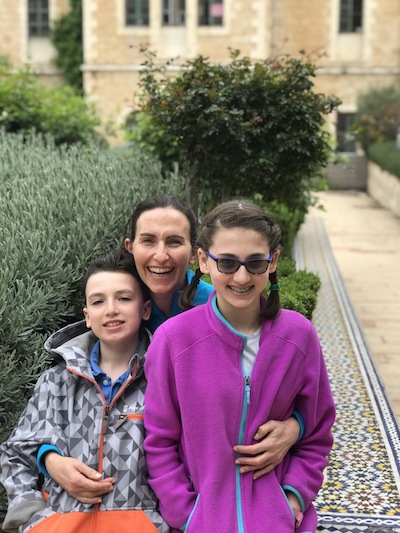
Michelle Dodek with Max and Naomi. (photo by Daniel Dodek)

The morning after we arrived, we went on a walking tour. Our guide, Dvir, specializes in tours of the Old City, which must be done on foot. Not only did he take us to all of the highlights, find us the best food in the Old City and explain the geopolitics of Jerusalem but, also, he knew where to find all of the clean toilets. And our children surprised us with the knowledge they had gleaned from their years of Jewish education, enriching our experience, as well. That day, we walked more than 13 kilometres, helping us sleep well and rid us of any jet lag that might have been lingering.

The next day, we returned to the Old City to buy special gifts of Judaica, and managed to pick up plenty of beautiful treasures for ourselves. We finally found use for our son’s bargaining skills, which had previously only been used to negotiate things like screen-time and treat consumption.

One of the best decisions we made was to stay in apartments. With two preteens, the need for food sometimes comes fast and furious. Knowing breakfast was in the fridge and we could make nutritious snacks to take along with us every day contributed enormously to the success of our trip. The other element that made it the best vacation we’ve ever had with our children was the planning my husband did, combining some days with a tour guide and other days with age-appropriate activities. Since neither of us is interested in driving in Israel, he also worked our plans around all the different kinds of transit. Our centrally located lodging enabled us to walk many of the places we wanted to go.

photo - Daniel and Max Dodek enjoy the beach
Daniel and Max Dodek enjoy the beach. (photo by Daniel Dodek)

We were invited by a friend, who was also visiting Israel with her family, to join their tour one morning of an agriculture reserve called Neot Kedumim. Near Modi’in, the site is of archeological significance and takes visitors back to biblical times through the landscape, agriculture and activities. Our experience included tree-planting, za’atar-grinding, pita-making, cooking and pulling water up from a cistern. My husband’s dream now is to spend his birthday working as a shepherd there. Another morning, with the same friends, was spent in fierce competition at the Tower of David doing something called the Amazing Race. It was good fun and educational, too.

We ventured one windy day to Ein Gedi and did a hike. Luckily, before driving to Masada, we discovered that, when it’s too windy for the cable car to run, Masada is closed. However, the Dead Sea was open for business as usual and, while we took in the experience of the mud and the floating, we also loved the variety of people from around the world visiting the waters.

In Jerusalem, we loved the green spaces like Station One. Formerly a train station and tracks, it is beautifully landscaped and is perfect for cycling, so we rented bikes. The public art in Israel makes the parks and streets even more interesting. Markets are favourites when we travel and Machane Yehuda did not disappoint. We returned there a number of times to buy Israeli essentials like halva, rugelach and dates, as well as more mundane food like fruit, vegetables and bread. The dinner scene is like the best food court in the world.

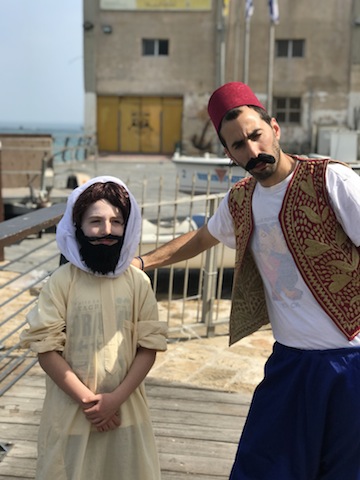
photo - Max Dodek dressed as Aaron Chelouche, founder of Neve Tzedeck, and Noam Rumsack, the guide
Max Dodek dressed as Aaron Chelouche, founder of Neve Tzedeck, and Noam Rumsack, the guide. (photo by Daniel Dodek)

We all enjoyed the food in Israel. Gone are the days when every corner had falafel, fly-covered shawarma and pizza with corn and tuna. You can still find those delights in a few places but, these days, no matter what you like to eat, you can find it in Israel (except on Shabbat or holidays in Jerusalem). Keeping kosher for Passover, once the holiday began, was certainly easier than we find it in Vancouver.

Two days before Passover started, we took the bus from Jerusalem to Tel Aviv. Comfortable, cost-effective and an experience in Israeli culture, the bus took only 45 minutes. Our lovely apartment in Tel Aviv was in an area in transition. Just over a block from the beach and a short walk from Shuk HaCarmel (where we went almost daily), the location was excellent. We were able to walk to many places, including Sarona (the market is like an upscale Granville Island), Shenkin (shopping), the Tachana (eclectic Israeli items) and Neve Tzedeck (artists and fancy touristy stores). We ended every day relaxing at the beach on the powdery sand.

The seder was delightful at my cousin’s house in Ramat Hasharon. Seeing my secular Israeli cousins argue over the tunes and forget the words occasionally showed us that they observe Passover similarly to how we celebrate it. The only difference was that they served twice as much food as I do, including seven types of meat. The food was almost as unreal as the traffic jam at 12:30 a.m., as people left their respective seders.

Other excellent parts of our trip included a fun and informative walking tour of Jaffa. Our guide, Noam, dressed in Turkish garb of 1905 – and, for awhile, our son dressed up as well, beard and all. We spent a day in Ramat Aviv, between the Museum of the Diaspora (Beit Hatfutsot) at Tel Aviv University and the Palmach Museum, just down the road. All of us took full advantage of the many types of exercise equipment in the public parks all around Tel Aviv and rode bikes along the Yarkon River, in addition to enjoying the lively promenade (Tayelet) along the ocean. One day, we took a fabulous full-day private tour up north to Akko, Haifa and Caesarea. The guide enabled us to get the most out of the day.

When we saw the family dynamic start to go sideways, we split up. Our ability to keep good snacks handy and to make sure everyone got enough outdoors time each day made everything we were able to see and do a wonderful experience for all of us. I would recommend a trip to Israel to anyone.

Michelle Dodek is a freelance writer living in Vancouver who spent enough time in Israel in her youth to speak sufficient Hebrew to communicate with taxi drivers and vendors in the shuk.

Format ImagePosted on June 15, 2018June 14, 2018Author Michelle DodekCategories TravelTags family, Israel, travel
Traveling with young kids

Traveling with young kids

(photo by Masada Siegel)

Taking a red-eye flight was no way to end a glorious Hawaii vacation with my nine-month-old, but it was the only nonstop and I figured everyone would go to sleep. Ah, how wrong I was! My little guy, who just had started walking, was so excited that we were not only awake the entire flight, but we spent it walking up and down the aisle.

Having little ones is a game-changer. After having traveled solo for months at a time, where I could follow any whim and not plan if I didn’t want to, my travel style has been turned completely upside down, but for all the right reasons.

So, while I always pack lots of extra food and supplies for my little guy, who’s now a toddler, I’ve learned to pack light for myself. Everything needs to be multipurpose. For example, my go-to travel uniform consists of a wrap-sweater because I use it as a baby blanket, and many friends use it as a nursing cover-up. Also, because it’s attractive, it can dress up a simple outfit.

Part of the travel experience is keeping your kids entertained. The best compliment I got recently was when a woman two rows behind me exclaimed, “What, you have a toddler with you? I had no idea. Thank you for making this a pleasant flight for all of us.”

Truth is it helps to be extremely prepared with planned activities, as well as making sure your little one is excited about the journey. A happy kid makes for a pleasant flight for all. Prior to our trip, I gave my son his own luggage, a super-cute airplane-themed rolling suitcase that also turns into a backpack. He loves it and constantly drags it around with him. I find it helpful for him to feel as if he is one of us, and part of the adventure.

I always pack a number of toys – they all must be useful both on the long flights and at the destination. I never leave home without our Bubzi, a stuffed owl that plays lullabies and projects stars on the ceiling, as it helps with sleep. Another lightweight item to bring is the Cinemood, an ultra-light three-inch portable projector that can be used just about anywhere with a flat surface, as its preloaded with lullabies, books and kid-friendly content. Be sure to pick up kid-safe headsets that protect little ears; Buddyphones are especially good on planes to help drown out the noise, too.

Traveling with a toddler has its ups and downs. On a recent trip, my son, who has always disliked cribs, was sleeping in a bed. Even though he was right next to me, he still flew off of it in the middle of the night, leading to a bruised up nose and an upset mom. There seem to be a million tiny situations that need to be thought through, some as simple as piling pillows all over the floor around a bed.

I’ve also learned that the details matter, such as keeping my little one out of the sun. While I tan easily, my son is blond and fair, leading me to explore a million different sunscreens, many sticky, which led to complaints. While we do use sunscreen, I’ve heard conflicting reports of how useful they are and how bad some of the chemicals are, so I finally changed my travel stroller to one that has on oversized canopy, as extra protection.

A sturdy stroller is also important because you can place your bags in it and my son can walk alongside me or even push the stroller. I’ve realized, the more active he is in the airport, the more tired he will be on the airplane. I always research the airport we are flying into, to see if there is anything to see, such as an aquarium, museum or viewing deck, so as to keep everyone entertained.

However, being organized takes a lot of effort and, while I try my best to keep everything in its place in my diaper bag, sometimes I don’t. I’ve had to dig around for my wallet, plane tickets and all sorts of odds and ends. Usually, a box of milk or other liquid slips my mind and then security zeroes in on me.

Even with a baby in tow, I have been patted down on every single flight I have taken with my son. Security is in no rush and generally don’t care if you miss your plane. On my last flight, I had to run through the airport holding my son to make it in time.

Traveling with a toddler certainly keeps you on your toes, but isn’t that why we travel in the first place, because we want to have new experiences? So, while the getting to the destination is part of the journey, my best advice is to try to enjoy the ride.

Masada Siegel is an award-winning journalist and photographer. Follow her at @masadasiegel and visit her website, masadasiegel.com.

Format ImagePosted on June 15, 2018June 14, 2018Author Masada SiegelCategories TravelTags children, family, travel
Digital impact on our lives

Digital impact on our lives

(photo from publicdomainpictures.net)

Dr. Simon Trepel, child analyst and psychiatrist at the Manitoba Adolescent Treatment Centre, is seeing an increasing number of children and teenagers using phones – even during sessions.

“I was hearing more and more from parents about some difficulties they were having around technology and screen time,” said Trepel. “I was noticing, even in my own family, how pervasive screens are becoming … as a preferred source of entertainment, as well.

“When this stuff marinates in you for awhile, it makes you curious about deeper questions about what’s going on. It ultimately behooves anybody who is working in mental health to start wondering about all the ingredients that might be contributing to someone’s mental health…. I became more curious about how these devices and screen time might be affecting, not just kids and teens, but, really, all of us.”

According to Trepel, using technology in daily life is no longer a choice. It is a fundamental part of how we all get by. Most of us check our phones several times a day, and conduct business and communication on our phones or tablets almost exclusively.

He said there are about four billion people using the internet right now worldwide, and a third of those people are children and teens. There are about five billion people using mobile phones and a little over three billion people on social media at any given time, he said. And, these are all increases of anywhere from five to 15% in comparison to the previous year.

“These trends are changing how we communicate,” said Trepel. “They are changing how much face-to-face communication we have and the nature of the communication itself. The previous generation would use words and texts. Now, videos, pictures and memos are the preferred way to communicate. It’s changing the very ingredients we use to communicate with one another.”

There are implications to this change, especially in children, whose not yet fully developed brains are particularly susceptible to getting into trouble online. But, Trepel said, there is something that can be done – and it starts with adults getting off their phones and other screens, especially when around young people. We also need to start talking about these issues, as kids who come from homes that discuss such topics tend to be less at risk.

“When there’s a more negotiated amount of technology use and supervision and things like that, that is a good thing,” said Trepel. “But, there are many, many kids who have a combination of not a lot of supervision combined with having an immature brain, and these kids are the ones we are most worried about getting into trouble online.

“We worry that screens are displacing a lot of other activities that might be healthier than being on technology – things like getting adequate sleep or being outside. The amount of hours spent outside is now at about half of what it used to be. It’s gone from about 18 hours a week to about seven hours a week in one single generation.”

Getting a handle on this will not be easy, but it starts with parents making the time to fully understand the tech diet of their kids. Just like we monitor their food intake, we need to monitor their tech intake.

“Sit down with them and let them take you through a typical day,” advised Trepel. “What types of sites are they using and for how long? What types of interactions are they are having on this site? The timing of this is important. Is it the first thing they do in the day, getting on their device? Is it the last thing they do before bed? Do they themselves detect any problems with their screen use? Are they running into any cyber-bullying or being taken advantage of? Do they feel better or worse after using their phones? Do they notice phones cutting into their sleep, or do they notice themselves having a difficult time stopping themselves from checking? This is the beginning of getting data about how your kids and teens are using their phones. But, it’s also starting to ask the question of whether or not this is becoming a problem for your kid or teen.”

Trepel suggested that, when you monitor your kids, you want to make sure it is active monitoring – that you are co-viewing and discussing the sites that they are on. It is also important to avoid spy-type programs, he said, as kids will find ways to work around them.

Aim to be playing together, following each other on social media. Use any opportunity for educational guidance – not so much making it a single conversation, but, instead, an ongoing dialogue about the device. You can ask for their help learning about social media, for example. “I think that’s a very elegant way to cover a lot of bases,” said Trepel. “It allows the parent to learn a lot about what the kid is using, in terms of technology use. But, it also updates the parents as to what these social media sites are all about – how they are navigated, how they are used.

“It may also be a great way for kids and parents to spend more time together, interacting with each other, teaching each other. While they might teach you about Twitter, you might be able to point out various ways they are using the technology that might be helpful or harmful. You might, if the child teaches you Twitter, find out if the child has a public account and is being followed by hundreds of people the child has never met before.

“It’s not only a way to have a child feel good about helping a parent, but, once the parent knows more about the technology, the parent can start to look for red flags.”

Studies have shown that parental behaviour is one of the most powerful influences on a child’s behaviour. So, Trepel suggests taking an honest look at yourself as a parent, about how embedded these devices are in your own life. And then, start to change that for yourself, while also becoming a good role model for your kids.

“You want to be proactive with your kids,” said Trepel. “You don’t want to wait until there’s a problem. You want to educate them to the possibility of problems.

“You also want to be proactive about texting and driving. This really might be the drinking and driving of our generation. I remember, when I was in high school, there was MADD, Mother’s Against Drunk Driving. I think we need some sort of revival of that, looking at parents being concerned about texting and driving. The stats from Manitoba are striking that, just five or 10 years ago, we were seeing maybe 3,000 collisions per year. And, in the span of just a few years, it’s now up to 11,000 collisions involving distracted driving per year – a four- or fivefold increase, about 30 distracted driving collisions a day.”

Trepel said it is best to avoid taking technology away without offering an alternative. Make it easy for kids to see their friends in real life, he said. Let them go over to their friends’ houses, take them places they want to go, and do things they want to do – provide them with in-person opportunities. Play a board game, do arts-and-crafts, encourage them to learn to play an instrument or participate in a sport. Off-screen activities, he said, have a greater likelihood of making your kids feel happy as compared to on-screen activities.

Trepel suggested having your kids turn off their phone notifications at important times of the day, like sleep time, family time, meal time, school time, and so on. And make sure that you do the same.

“Every time we get a signal from our phone, it could be someone liking our photo or giving us a compliment, or something we anticipate might be good,” said Trepel. “And that reward system in our brain kicks into gear and compels us to want to check what the notifications are. Once our screen is on and in our hands, we might end up surfing or doing something else we weren’t even intending to do – at the expense of whatever original activity we were doing before the notification occurred. So, we have to make sure that we turn off all those attention stealers.”

Trepel recommended that parents turn off the wifi after 9 p.m., or even earlier, if they think there will be a significant battle to have their kids turn off their screens in the evening or if it is affecting their ability to do homework.

Or, he added, you can get your kids a phone with no internet capabilities. Some executives, he said, have even switched back to such phones, as they were wasting too much of their time when they had a phone with more tech capabilities.

For starters, Trepel said, begin the conversation. Ask your kids for ways to keep things under control. Dialogue, go back and forth, and find ways that work for your family.

Rebeca Kuropatwa is a Winnipeg freelance writer.

Format ImagePosted on June 8, 2018June 6, 2018Author Rebeca KuropatwaCategories NationalTags cellphones, children, family, health, Simon Trepel, technology, teenagers
Unique, unconditional love

Unique, unconditional love

(photo from discogs.com)

“Oh, I know that I owe what I am today to that dear little lady so old and grey, to that wonderful Yiddishe momme of mine.”

The beautiful song “My Yiddishe Momme” was written by Lew Pollack and Jack Yellen in the 1920s. Sophie Tucker sang it (among many others), making it a hit in 1925. It has become a classic in acknowledging the culture of that era, when the stereotypical mother was the very essence of love, warmth and selfless devotion and sacrifice. (See the 2006 article “Jewish Mothers” by Philologos in the Forward.)

This Sunday, May 13, many people will pay homage to their mothers. No matter the distance, flowers will be sent and phones will be ringing as sons and daughters take a few moments to honour the woman who nurtured and cared for them, who was the source and sustenance of life, and to acknowledge her sacrifices. On this day, once a year, we recognize the value of a mother. But, there is, perhaps, a contradiction that belies our actions. While we rightly honour our mothers on Mother’s Day, we devalue their role on other days. For example, the recognition and awareness of the crucial role of mothering in a child’s healthy development and, consequently, to future generations, is often seen as a secondary role in the scheme of our busy lives.

Psychologist and author Penelope Leach says in her book Child Care Today: Getting It Right for Everyone (Alfred A. Knopf, 2009), “unlike all other mammals, most of the growth of the human brain is postnatal, and continues for several years.” Social and economic pressures continue to present conflicts for all mothers in terms of child care, as attachment theory emphasizes the importance of mothering in the early years.

But mothers don’t have to be perfect. Like her children, she has her own needs and cares. Yet, she performs a multitude of tasks in ensuring her child’s needs are met, and that is a greater challenge and more important than any other undertaking. We can attempt to delineate her role in three areas: providing the basic physical, emotional and psychological needs; protecting her children from harm, along with safety, security and stability; as well as being a role model who offers guidance as her children make their way in the world. In what way can we define her worth? Do we put a monetary value on it? That is impossible because it is priceless.

To this point, I have only described the practical responsibilities that mothers do. What cannot be seen, but only felt, is the unconditional love that permeates her actions, which envelops her child like a warm blanket. We’re much like Linus, a character in the Charles Schulz’s Peanuts comic strip, who clings to that security blanket like a lifeline.

Perhaps the importance of my Yiddishe momme can best be expressed in the words of the child in each of us:

She gives me a hug when I am sad
And holds me close when I am mad
She cools my brow when I am sick
And puts my art work on the fridge
She makes me wear mittens, and a toque, and a scarf, and boots when it’s cold outside, even if I don’t want to
She holds me when I have bad dreams, when I am afraid of the dark, or when lightning and thunder scare me
She kisses me for no reason
She loves me just because I’m me.

These needs are not just for children. They remain with us all our lives. We learn how to satisfy them better as we “mature,” but, when life overwhelms us, or we feel sad or lonely or frightened, we all hunger for a mother’s touch, for a mother’s hug, for a mother’s love. As Barbra Streisand sings in the song, “People,” “we are … letting our grown-up pride hide all the need inside.”

This is why the most fundamental loss of a mother – due to an untimely death, or her being present physically but absent emotionally or psychologically through mental illness or other debilitating disorder – is the loss of love. A child may recognize who they have lost but not what they have lost. Only in her absence does the impact of the loss become clearer. Only in her absence does her value become perceptible. Only when it disappears is the value of a mother deeply felt. And it is irreplaceable.

Doris Lessing, who was a Nobel Prize-winning author and lecturer at the CBC Massey Lectures, shared a deep insight in the 1986 essay “Prisons We Choose to Live Inside,” when she said, “… what we have we take for granted. What we are used to, we cease to value.”

To those who are fortunate to still have your Yiddishe momme in your lives, be thankful, and let her know how much she is cherished. For those who don’t, treasure the memories, which are precious. And, for those who are themselves mothers, you have undertaken one of the most difficult but important tasks of life with all its pleasures and perils. To all mothers and to those who “mother,” we honour you, today and every day.

Libby Simon, MSW, worked in child welfare services prior to joining the Child Guidance Clinic in Winnipeg as a school social worker and parent educator for 20 years. Also a freelance writer, her writing has appeared in Canada, the United States and internationally, in such outlets as Canadian Living, CBC, Winnipeg Free Press, PsychCentral and Cardus, a Canadian research and educational public policy think tank.

Format ImagePosted on May 11, 2018May 9, 2018Author Libby SimonCategories Op-EdTags children, family, Mother’s Day, Yiddishe Momme
Treat your mom special

Treat your mom special

H Tasting Lounge at the Westin Bayshore has a new tea service. (photo from westinbayshore.com/htasting-lounge)

Mother’s Day might be celebrated only once a year, but being a mother is an everyday, every minute occupation. Rashi, the brilliant 11th-century sage, offered a moving interpretation: “A mother is a woman who gives life,” he wrote (see Rashi, Genesis 3:20).

Rabbi Pinchas Allouche, spiritual leader of Congregration Beth Tefillah in Scottsdale, Ariz., explained, “A mother does not just live; she makes life. She does not just occupy space for herself; she makes space for others. She does not desire to take; she desires to provide. She does not seek power; she seeks influence. She does not just live by existing; she lives by giving. And she breathes life, continuously, into her own children, and into her own surroundings.”

Since most moms are so busy taking care of everyone else, this special day is an opportunity to give back to this wonderful person, if you’re lucky enough to have her still in your life. Here are a few ideas on how to celebrate.

Something sweet

If you live in the Metro Vancouver area, check out the new tea service at the H Tasting Lounge at the Westin Bayshore in Coal Harbour (westinbayshore.com/htasting-lounge). It has two choices, Eastern-style and Western. Their Western Tea includes smoked salmon and cucumber tea sandwiches, as well as a variety of sweet samplings such as scones with jam and cream. Meanwhile, the Eastern Tea, while also a classic tea service, includes a mix of traditional Asian foods, such as a duck wrap.

If you would rather create something unique at home, try using Yonanas (yonanas.com). My mom and I made a healthy dairy-free dessert, as the machine transforms frozen fruit into what tastes like ice cream – without all the calories. They include a recipe book with the machine, but we found it fun to experiment. We added, for example, a little chocolate and cinnamon to the frozen bananas.

DNA kit

Mother’s Day is a great opportunity to get to know your mom better in myriad ways and a DNA test is a great way to learn about your family. We used the Living DNA test (livingdna.com), but there are others.

My mom swabbed the inside of her mouth and, within a few weeks, we discovered that some of our ancestors were Dutch, Finnish and Swedish! Living DNA does a comprehensive analysis. It provided data on our ancestry throughout human history, as well as percentages of our ethnic backgrounds from 80 global regions. The company also offers a full-colour coffee table book of your results, which preserves your family history for future generations.

Something stylish

I recently discovered a few new stylish brands of purses for moms. MZ Wallace and Be Brilliant have purses that are useful for a variety of purposes, from practical to simply being fashionable, which is always a treat for the mom shlepping around a million items usually not for herself. Both brands are easily cleaned, offer lots of pockets and, best of all, will make your mom feel special. (And both companies sell and ship to Canada.)

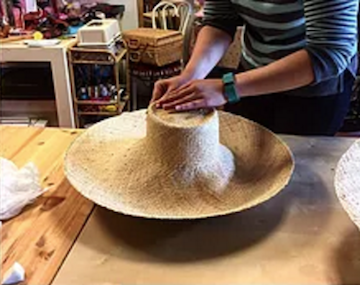
photo - To design and make your own hat, check out Vancouver-based West Coast Hatters
To design and make your own hat, check out Vancouver-based West Coast Hatters. (photo from westcoasthatters.com)

The purse can be paired with a fancy hat. I love creating new fashions, and spending quality time with my mom doing something creative is always a joy. To design and make your own hat, check out Vancouver-based West Coast Hatters (westcoasthatters.com), which specializes in creating hats for film and hosts one-on-one workshops or small classes for people who want to create their own special style.

In the fascinator-making class, students use a straw base and build up from there. However, if you want to get serious about hat-making, try the two-day class, where you will create a masterpiece by hand, blocking, steaming and draping the fabric into your own special creation.

Spa day

A personal favourite is to treat my mom to a spa day. The truth is I have yet to meet a mom would couldn’t use some time for herself, and what better way to celebrate each other than by spending quality time together in a quiet setting.

There is also the option of a do-it-yourself spa day. You can set the mood by lighting candles and putting out comfortable chairs while you and your mom give yourselves facials.

Personally, I like American spa owner David J. Witchell’s eponymous collection (davidjwitchell.com), which features an all-natural line of products. I like DJW’s Matcha Wash with grit for cleansing, using a towel or natural sea sponge, then following it with the company’s Shaman oil blend, which firms and illuminates the tone and texture of the skin, and its Time Traveler, which brightens, hydrates and protects your skin.

To complete the spa experience, you can gift your mom some luxury body soaps. One brand I use it Costa d’Oro (siegebrands.com/naturalsoaps). Its soaps are natural, made in Arizona and leave my body feeling a decade younger. I especially like Himalayan Salt Scrub with Activated Charcoal; Lemongrass and Rosemary; and Gardenia.

The best part of a do-it-yourself spa day is that your mom can use the products again and again.

Happy Mother’s Day!

Masada Siegel is an award-winning journalist and photographer. Follow her @masadasiegel and visit her website, masadasiegel.com.

Format ImagePosted on May 11, 2018May 23, 2018Author Masada SiegelCategories Celebrating the HolidaysTags children, family, hat-making, Mother’s Day
Experiencing a renewal

Experiencing a renewal

More than 100 people came out to Burquest Community Association’s Purim carnival this year. (photo from Burquest)

At the end of a short, upward-sloping driveway in Port Coquitlam, what was originally a Jehovah’s Witness centre was converted into a Jewish community centre a couple of decades ago. The community the centre houses, Burquest, has been active since 1973. As the Jewish presence in the Tri-Cities grows, it is playing an increasingly essential role in providing services and connecting Jews to one another and to our culture and traditions.

The Burquest Jewish Community Association is dedicated to the “religious, social, cultural and educational needs of the Jewish population of the Fraser Valley,” with a membership of around 70 families, according to their website. The membership is diverse, with roots in five continents and a wide variety of Jewish backgrounds and interests, ranging in age from infants to grandparents. Yet, two years ago, the community’s future was uncertain – the board was considering continuing under the auspices of the Jewish Federation of Greater Vancouver, until Shoshana Szlachter stepped up to offer new leadership. She became board president just over a year ago.

“We were suffering from an onerous debt, it didn’t look like there was enough membership to keep it going,” Rudy Rozanski, Burquest vice-president, told the Jewish Independent. “A few of us got together, and Shoshana was at the head of that, and we decided that we do believe in the future of Burquest and we decided we did want to re-invigorate it. We had many ideas and they were instituted by Shoshana in a clear and positive way. We transformed it into a centre for Jewish learning, as well as being a community centre.”

Part of Burquest’s new success seems to lie in going back to their origins. “When I first joined Burquest, we were non-denominational, and then went Reform. But that didn’t work out as an experiment,” said Rozanski. “In a sense, we’ve returned to our roots.”

A year into Burquest’s renewal, things are looking up.

“Financially, we’ve come along really well,” said Szlachter. “When I came in, I thought, there’s still some life in this old donkey, let’s give it a kick and see what happens.”

The community reduced the cost of seats for the High Holidays and gave free memberships to those who bought tickets – this tripled membership. The centre has also gotten key grants, including from Federation, the Waldman Foundation and the City of Coquitlam. They have partnered with PJ Library to offer activities for children, as well as expanding their programming overall. For example, Burquest now has a Seniors on the Go program, covering yoga for seniors, mah jongg, art and piano gatherings, and a lunch-and-learn program on Jewish genealogy. There is a women’s class led by Devorah Brody, a teen club, Maccabee Kids (with optional Hebrew lessons) and a parent-and-tot drop-in program called Coffee and Knishes. Cantor Steve Levin leads religious services, and holiday events have been well-attended, with some 100 people joining the Chanukah and Purim celebrations.

“For a small community, our calendar is pretty full,” said Szlachter.

“I really enjoy the wide range of programming that Burquest is now offering,” said Sandra Hochstein, who has been involved with Burquest for 20 years. “When my daughters were young, I participated in all the child-oriented activities and am glad to see they are still there and going strong. Now that I am an empty-nester and newly retired, I love being able to participate in the adult activities, such as lunch-and-learn sessions and Monday morning yoga. I still appreciate the sense of community that I feel when attending Shabbat or High Holiday services.”

Asked about Szlachter’s role in Burquest’s “renewal,” Rozanski said, “Shoshana is an outstanding leader who is genuinely effective and concerned about our community, and her decisions regarding Burquest’s future have been unanimously applauded. Renewal is the right word for what our community is going through.”

More information about Burquest can be found at burquest.org.

Matthew Gindin is a freelance journalist, writer and lecturer. He is Pacific correspondent for the CJN, writes regularly for the Forward, Tricycle and the Wisdom Daily, and has been published in Sojourners, Religion Dispatches and elsewhere. He can be found on Medium and Twitter.

Format ImagePosted on April 27, 2018April 25, 2018Author Matthew GindinCategories LocalTags Burquest, family, Judaism, Rudy Rozanski, Sandra Hochstein, Shoshana Szlachter, Tri-Cities
About the Passover cover art

About the Passover cover art

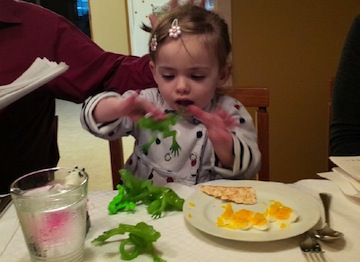
photo - Fae at Passover
Fae at Passover (photo from Ramsay family)

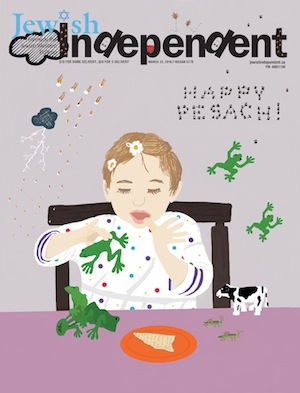
While based on the above photo of my niece Fae at a seder several years ago, the cover art is inspired by all my nieces and nephews: Hannah, 24, Zac, almost 22, Caleb, 17, Fae, 6, and Charlotte, 4. I may not get to as many family seders as I would like, with all of my immediate family living in Ontario, but this photo is just one of many that has adorned my fridge over the years I’ve lived “out here,” and there have been many visits, as well as Skype and phone calls, so I’ve been able to get to know the wonderful people they are, despite the physical distance, and am so proud to be one of their aunts. I am confident that they will contribute, each in their own way, to helping make this a world in which, eventually, everyone has the love and opportunities our family has had.

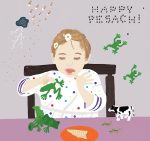
image - JI Passover cover 2018 smallTo create the cover illustration, I scanned a pencil sketch I made from looking at the photo. I emailed the scan to myself so that I could use the app Paper 53 on my iPad to do most of the “painting,” including nine of the 10 plagues. Jewish Independent production manager Josie Tonio McCarthy helped me symbolize the death of the firstborn sons in QuarkXPress – trust me, no letter d’s were harmed in the making of this cover! Josie also refreshed my memory of how to use some aspects of Photoshop, which is where I brought everything together, with the odd embellishment or two, or three.

With wishes from all of us here at the JI for a Pesach sameach.

Format ImagePosted on March 23, 2018March 22, 2018Author Cynthia RamsayCategories From the JITags art, family, Passover, plague
Finding the future in the past

Finding the future in the past

Left to right: Michael Rubenfeld, Mary Berchard and Katka Reszke in We Keep Coming Back, which plays March 13 and 14 as part of the Chutzpah! Festival. (photo by Jeremy Mimnaugh)

At first, we expected the piece to focus mainly on the past and how sad the absence of Jewish life in Poland is. After going and also spending more time in Poland, we now propose that it is through focusing on the present and future, with an aim at building positive perspectives, that will ultimately lead to transformation and genuine healing,” said Michael Rubenfeld about We Keep Coming Back, which plays at the Chutzpah! Festival March 13 and 14.

Rubenfeld created the multimedia work with Sarah Garton Stanley, as well as his mother, Mary Berchard, and filmmaker and translator Katka Reszke. Rubenfeld and Garton Stanley are co-directors of Selfconscious Theatre. We Keep Coming Back is based on a trip that Rubenfeld and his mother took to Poland in 2013.

“It was always our intention to make a piece of theatre and the trip was connected to a desire to explore intergeneration trauma and, also, more specifically, the problems in my relationship with my mother that stem from unresolved trauma and disconnect from our family’s roots in Poland,” said Rubenfeld. “So, the trip was an experiment of sorts; to see if going to Poland with my mother, visiting her mother and father’s hometowns and going to Auschwitz, would give us the opportunity to mourn together, which might also bring us closer together.”

According to a blog on Selfconscious Theatre’s website, after surviving the Holocaust, “Berchard’s family moved from Poland to Sweden, where she was born. They then immigrated to Canada in 1951, where she grew up and eventually had a son, Michael.”

Rubenfeld and Berchard were in Poland for about two weeks. “My mother has since been back three or four more times, and I now have a home in Poland with my wife,” said Rubenfeld – the couple lives in both Krakow and Toronto. “We’ve toured We Keep Coming Back to Poland three times,” he added.

The project has worked to bring mother and son closer.

“It’s been really nice for us to have a piece that we do together,” said Rubenfeld. “It gives us an excuse to spend time together to do something we know we’re going to enjoy. It’s also given us commonality, which has been really essential for our relationship.

“My mother has always been very supportive, though we don’t always have a lot in common. This project has changed that. We also now have Poland in common, and our mutual interest. My mother really loves it in Poland. She’s also become quite interested in uncovering more about our history and has started researching and archiving our family tree. It’s brought her a lot of happiness and has been a really healing thing – which, in general, has been good for our relationship as well.”

We Keep Coming Back “speaks so openly and honestly about what it means to love a parent, or to be loved by a child, and how so many of the resources for a good and enduring love were torn apart by the Holocaust and all of the horrors, throughout the generations that linger,” said Garton Stanley, who is also associate artistic director of English theatre and interim facilitator for indigenous theatre at the National Arts Centre in Ottawa.

“Honestly, as someone on the ground since the get-go, I was most curious about Michael’s developing love for Poland and how, over the course of the play’s creation, he not only fell in love with a Jewish woman from Poland but that he now lives there,” she said. “Michael and I are very interested in the line between fiction and reality and the space for realizing possible worlds through dramatic form. Michael now speaks some Polish. He’s making deep-rooted reconnections and helping contribute to a vibrant Jewish life in Poland.”

Garton Stanley and Rubenfeld met just over 10 years ago, after she saw him in a show. “He was performing in it with my partner at the time,” she said. “He was amazing. We became fast friends shortly thereafter.”

At Selfconscious Theatre – which they started together – the two have also co-created The Book of Judith; Mother, Mother, Mother; and The Failure Show.

For We Keep Coming Back, Garton Stanley is not only co-creator but the director. “My co-creation,” she explained, “was part facilitator, part conceiver, part devisor, part writer, part mediator, part friend and always enthusiast.”

How Reszke became involved in the production is a little more circuitous and fortuitous.

“Once we decided to take the trip to Poland, we connected with a producer named Evelyn Tauben, who was doing research around contemporary Jewish Poland,” explained Rubenfeld. “Through Evelyn initially, we started learning about the renaissance of Jewish culture in Poland, which, at the time, I knew nothing about. Once learning about it, we determined that it was important to us that we engage with it on our trip, and that’s when Katka came into the picture.

“We knew we needed a translator to join us, and we also knew we wanted to document the process. We joked that it would be incredible if we could find someone who could both translate, film and be a Polish Jew who might want to collaborate with us artistically. On a lark, we Googled ‘Polish, Jewish, filmmaker,’ and that’s how we discovered Katka. We sent her an email, and one thing led to another.”

“Mary Berchard and Katka Reszke,” added Garton Stanley, “are fascinating performers and neither of them has any training in this area. Their stories and their curiosity combine with Michael’s to create a new family. And this feels like one of the piece’s hidden successes.”

As for what has most surprised her about the project, she said, “That we are still doing it and learning from it. And learning from the audiences whose histories intersect with Michael’s, Mary’s and Katka’s own generational challenges and traumas. And that the piece resonates as deeply as it does. It has a beautiful heart and this is always surprising, in the best way.”

“I believe that, in our desire to never forget what happened during the Holocaust, we have also forgotten that Poland was one of the most important contemporary homelands for the Ashkenazi Jewish people for over 500 years,” said Rubenfeld. “So much of our contemporary culture was bred in this land, and we forget that the Jewish people were happy living in Poland before the war. We are raised to think of Poland as only the place of tragedy. While I understand why, I think that it’s essential to remember and celebrate a time when there was such vibrant Jewish culture. Most was destroyed because of the war, and it’s impossible to not feel sad. But, as we move into the future and the pain continues to recede, it is just as important to remember the incredible prewar Polish Jewish world of Poland. It was very profound.”

For tickets to We Keep Coming Back at the Rothstein Theatre, and for the full Chutzpah! schedule, visit chutzpahfestival.com.

Format ImagePosted on March 2, 2018March 1, 2018Author Cynthia RamsayCategories Performing ArtsTags Chutzpah! Festival, family, Holocaust, intergenerational trauma, Michael Rubenfeld, Poland, Sarah Garton Stanley, Selfconscious Theatre

Posts pagination

Previous page Page 1 … Page 7 Page 8 Page 9 Page 10 Next page
Proudly powered by WordPress