Skip to content
  • Home
  • Subscribe / donate
  • Events calendar
  • News
    • Local
    • National
    • Israel
    • World
    • עניין בחדשות
      A roundup of news in Canada and further afield, in Hebrew.
  • Opinion
    • From the JI
    • Op-Ed
  • Arts & Culture
    • Performing Arts
    • Music
    • Books
    • Visual Arts
    • TV & Film
  • Life
    • Celebrating the Holidays
    • Travel
    • The Daily Snooze
      Cartoons by Jacob Samuel
    • Mystery Photo
      Help the JI and JMABC fill in the gaps in our archives.
  • Community Links
    • Organizations, Etc.
    • Other News Sources & Blogs
    • Business Directory
  • FAQ
  • JI Chai Celebration
  • JI@88! video

Recent Posts

  • Sharing her testimony
  • Fall fight takes leap forward
  • The balancing of rights
  • Multiple Tony n’ Tina roles
  • Stories of trauma, resilience
  • Celebrate our culture
  • A responsibility to help
  • What wellness means at JCC
  • Together in mourning
  • Downhill after Trump?
  • Birth control even easier now
  • Eco-Sisters mentorship
  • Unexpected discoveries
  • Study’s results hopeful
  • Bad behaviour affects us all
  • Thankful for the police
  • UBC needs a wake-up call
  • Recalling a shining star
  • Sleep well …
  • BGU fosters startup culture
  • Photography and glass
  • Is it the end of an era?
  • Taking life a step at a time
  • Nakba exhibit biased
  • Film festival starts next week
  • Musical with heart and soul
  • Rabbi marks 13 years
  • Keeper of VTT’s history
  • Gala fêtes Infeld’s 20th
  • Building JWest together
  • Challah Mom comes to Vancouver
  • What to do about media bias
  • Education offers hope
  • Remembrance – a moral act
  • What makes us human
  • המלחמות של נתניהו וטראמפ

Archives

Follow @JewishIndie
image - The CJN - Visit Us Banner - 300x600 - 101625

Tag: art

Political art of living

Political art of living

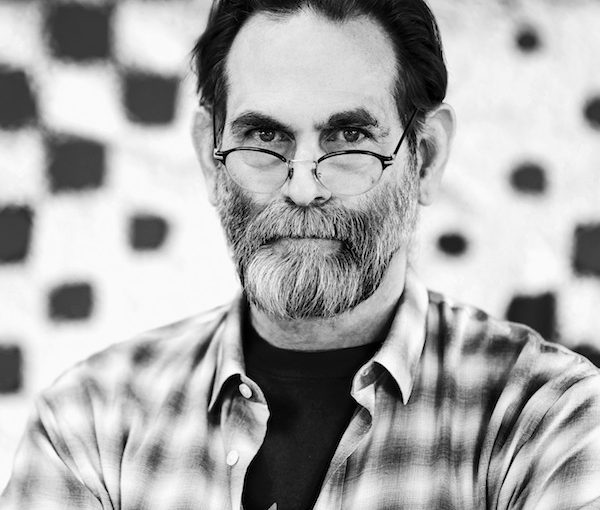
Avram Finkelstein will be participating in the Queer Arts Festival, which takes place July 16-26. (photo by Alina Oswald)

A lot of it feels familiar, said New York-based artist and activist Avram Finkelstein about the current situation in the United States. The same American institutions that failed during the HIV-AIDS crisis are failing to effectively deal with the pandemic. And, when he was a teenager in the 1960s, cities were also being burned in America.

“It’s sad to think that we will be having the same struggles,” he told the Jewish Independent in a phone interview last week. “But, also, as you get older, you realize that progress is not a pendulum swing from left to right, it’s actually a spiral going forward and things do move to the right and they move to the left, but [there is] incremental change. So, part of me feels like we’re seeing the dying gasp of a world that I hope we’re leaving behind, and I see a world in the future that I want to live in. So that’s kind of helping me through this.”

Finkelstein was scheduled to come to Vancouver next month to participate in the Queer Arts Festival.

A founding member of the Silence=Death and Gran Fury collectives, as well as the political group ACT UP, he is the author of After Silence: A History of AIDS Through its Images (University of California Press, 2017). His artwork is part of the permanent collections of MoMA, the Smithsonian, and the Victoria and Albert Museum, to name but a few places, and his work has been shown around the world. He was set to unveil one of his new works in Vancouver. As it is, with the restrictions required to minimize the spread of COVID-19, he will be helping open the festival remotely, as part of a panel discussion chaired by curator Jonny Sopotiuk, which will also provide viewers with a tour of the festival’s art exhibition.

“I have a large mural that was going to be in the exhibition and now it’s going to be in a virtual space,” said Finkelstein. “I’m very excited about this piece and the fact that Jonny chose it – it’s the first time I’ve shown it…. I had a commission to do a work for the Shed, which is a new art space in New York, and, while I was waiting for the weaving tests of the final pieces – it’s a very large jacquard weaving – I decided to start drawing from the same source material as the cartoon for the weaving. I hadn’t drawn since recovering from a stroke; I had a stroke about two years ago…. I then realized that my hand isn’t my own, my body is no longer my own.”

The source material, he explained, “is a portrait of a gender-non-conforming friend who later transitioned. The work was all about corporeality as an abstraction and the ways in which we’re allowed to look at certain things, and what is public and what is private about gender and sexuality. And then, all of sudden, I realized, I’m actually talking about my own body in these drawings because my own body is not my own body anymore. I realized that I had made this sharp pivot from an abstract, theoretical idea of corporeality to this kind of war or dance, or I don’t know how to describe the physical process of having to use your entire body to hold a pencil.”

Despite the health, political and other challenges Finkelstein has faced, he remains hopeful.

“We’re trained to think that, if we don’t have hope, then the only thing that’s left is despair, but the truth is, hope isn’t so much the point – it’s the horizon that hope is sitting on and, so long as you can see a horizon, I think that, to me, is the same thing,” he said.

“I’m Jewish, as you know, and I think that Jews have a very different relationship to memory and to witnessing. If your people have been chased all over the globe for centuries, you take a long view. You sleep with one eye open, but you take a long view, and I think, therein, I’m eternally hopeful.”

In an interview in 2018, Finkelstein predicted that the situation in the United States would worsen before it improved.

“Which is another thing about being Jewish – you learn that there is no such thing as paranoia because it’s all real,” he said. “So, one could have seen, as plain as the nose on one’s face, where America was heading. And, in actual fact, what happened with Trump’s election was, we’ve joined the international march of global totalitarianism…. And, it’s not about to get really bad, it’s really, really bad. It’s really bad and I think that, here again, you can’t be Jewish and not think – not think your entire life, actually – in some way being prepared for, OK, what are the risks I’m willing to take if this happens? How far would I be willing to fight for other people if that happens. The shadow of Nazi Germany never escaped your consciousness.”

So how does Finkelstein conquer the fear?

“I guess I’ve replaced it with anxiety,” he said, laughing. But, he added, “I don’t know why I’m not fearful. I think that I was just raised – a day doesn’t go by that I’m not reminded of another lesson or another incident or another part of Jewish-American social history in the 20th century that my family was directly there for. I almost feel like I’m the Zelig of the left. All the stories you would tell my mother or my father, they’d be like, ‘Oh, yeah, we were there. We were there at the Robeson riots. Oh, yeah, we were there when they closed The Cradle Will Rock and everyone walked down the street’ – exactly the way it was in the last scene in Tim Robbins’ movie. When I saw it, it seemed too preposterous, I called my mother, said, ‘Could that have happened?’ And she started singing the song that Emily Watson sings in the film.

“So, I think I have such a sense of self that one could interpret it as fearlessness, but I think that it would be more accurate to say I was not given an alternative role model. I was raised to feel the suffering of others and, if other people are suffering, there’s no night’s sleep for me. So, there’s really no option – you’re either closing your eyes to something terrible or you’re doing everything you can to try and make it less terrible. And I think that that’s the Jewish condition.”

He described Jews as being like queer people. “We are everywhere,” he said. “We’re in every culture, we’re in every race, we’re in every gender, we’re in every country. We have every type of ethnic community that we surround ourselves with. An Ethiopian Jew is different from an Ashkenazi Jew, but we’re still all Jews.”

Though raised by atheists, he said, “I don’t think you’ll find anyone more Jewish than I am or than my family, but Jews are prismatic. We are many things. Consequently, I feel like I can’t speak on behalf of other Jews, I can only speak on behalf of myself.

“Likewise, I’ve always had people of colour in my family; I just always have. And, I learned very early on back in the ’60s, when the civil rights movement was fragmented between King and Stokely Carmichael and the Panthers, and everyone was choosing sides, I think that’s another example of what I’m talking about – there are many ways in which to be black. And so, I don’t feel like what I have to say about this current moment is anywhere near as important, essential, vital, critical … [as] a person of colour – what a person of colour has to say about this moment is much more important.”
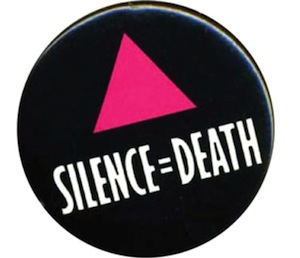
image - The original Silence=Death poster has been adapted over the years by many people, including for use as a pin
The original Silence=Death poster has been adapted over the years by many people, including for use as a pin.

Finkelstein was one of the minds behind the now-iconic Silence=Death poster, which has been adapted over the years by many people. A variation of it could be seen in at least one of the recent protests. The original iteration encourages viewers to use their power and, for example, vote. In general, working towards solutions is an important part of Finkelstein’s activism.

“I think critiques are easier,” he said. “I think also we mistake public spaces, we mistake the commons, as a declarative space. I tend to think of it as an interrogative space. I think that, even in late-stage capitalism, when someone is trying to get you to put your money in a bank or go buy a soft drink, there’s something Socratic about the gesture of trying to get you to do something … you’re responding to it, you’re engaged in it, and that’s the interrogative part that I think is easy to overlook. And I think that’s where the answers are.

“I think that the way that the Silence=Death poster is structured is it’s really like a bear trap. We worked on it for nine months – the colour has certain codes and signifiers, and the triangle has another set of codes and we changed the colour of the triangle from the [concentration] camps and inverted it to obfuscate some of the questions about victimhood. And the subtext has two lines of text, one that’s declarative and one that’s interrogative, and the point size forces you into a performative interaction.”

This poster and other work with which Finkelstein has been involved include aspects that “people are very afraid to experience,” he said, “which is fallibility, mess-making and tension. And I find all of those things as generative, as kindness, support, community. They’re differently generative and … hearing so many people who are trying to figure out how to find their way in, as white people, into the conversations that are happening in America right now, is the same struggle as a young queer person trying to find their way into the AIDS crisis. I mentor a lot of young queer artists and activists and the first thing they say, their immediate impulse is, I have no right to this story, I wasn’t here, I didn’t live through it. To which my response is, immediately, you have every right to the story – it’s your story, it’s the story of the world…. Race is a white person’s problem. People of colour are paying the price for it, but the problem, the genesis of the problem, is whiteness. And we have to figure out how to talk about it…. But I think now is the time for listening.”

He said, “We have to know what our responsibilities are and this goes back to Judaism – our responsibilities as witnesses. You can’t let your discomfort change the importance of this moment or overshadow the importance of this moment.”

One of the things Finkelstein does is teach social engagement via flash collectives. “I think we’re never put into a position where people mentor our personhood,” he said. “We have people mentor us as computer programmers or healthcare providers or tax accountants or artists or writers, but … there’s something primeval which is missing in the way we’re acculturated, and the flash collective is almost shamanistic in that regard; it taps into this primal thing that is quite astonishing when you let it out.”

Understanding that he will not live forever, he said “the Silence=Death poster casts a very mighty shadow and it makes it very difficult for people to figure out how to make new work, if that’s what they think it has to be…. It became obvious to me that I could be talking about Silence=Death until the day I drop, but, one day, I am going to drop and I want other people to start making those new works and I thought this would be a way to get people to make new work.”

He described the collectives, which teach political agency, as being “like a stew of the top 10 hits of grassroots organizing in a condensed workshop that’s tailored to the individuals in the room.”

He said, “I believe that I don’t necessarily have to change the world because I know that there could be a teenager in 2050 who sees something that someone I worked with did that made them think of something else that I never would have thought of. That is the point of the work, not the how do I fix it before I’m gone, which is the dilemma of Larry Kramer [who passed away last month]. He really thought, and I think it’s really male, but it’s very men of a certain generation also – he really thought that he could fix the AIDS crisis, and it didn’t happen.”

Unfortunately, space doesn’t allow for most of what Finkelstein shared with the Independent about Kramer, who he described as “a complicated person.”

Kramer was a rhetorician, said Finkelstein. “And I’m a propagandist. We’re both rhetoricians in a way, but what was the dividing line that made Larry incapable of understanding the work that I did?… I felt like I understood his process better than he understood mine. And I started to think, well, here’s the difference between a person who articulates their rage with words and a person who articulates their rage with every tool in the toolbox…. Not to make myself sound superior, but I realized that I think of rage as sculptural; he thought of rage as rhetorical. I think of rhetoric as sculptural, I think of it as casting a shadow and activating social spaces. And I think that he was a Jewish gay man of a different generation and a lot of his rage was tied into his personal struggles. And I did not have those. I had other personal struggles, but I did not have them.”

As part of the Queer Arts Festival, Finkelstein will lead a flash collective on the question, “What does queer public space mean in a 21st-century pandemic?” He hopes the resulting work will be shown in a public space.

For more information about the festival, visit queerartsfestival.com. The next issue of the JI will feature an interview with QAF artistic director and Jewish community member SD Holman.
Format ImagePosted on June 12, 2020June 11, 2020Author Cynthia RamsayCategories Visual ArtsTags activism, AIDS, art, Avram Finkelstein, history, politics, QAF, Queer Arts Festival, United States
Illustrating Holocaust stories

Illustrating Holocaust stories

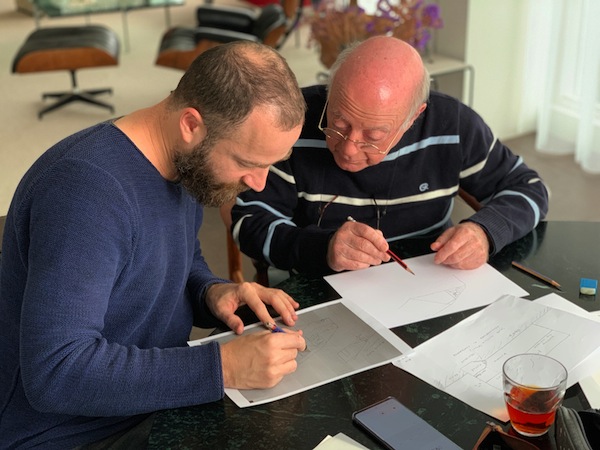
Gilad Seliktar, left, and Rolf Kamp in Amsterdam. They are drawing the last hiding place of Nico and Rolf Kamp in Achterveld, which was liberated in April 1945 by Canadian troops. (photo from UVic)

A University of Victoria professor is orchestrating an international project that links Holocaust survivors with professional illustrators to create a series of graphic novels, thereby bringing the stories of the Shoah to new generations.

Charlotte Schallié, a Holocaust historian and the current chair of UVic’s department of Germanic and Slavic studies, is leading the initiative, which connects four survivors living in the Netherlands, Israel and Canada with accomplished graphic novelists from three continents.

The project, called Narrative Art and Visual Storytelling in Holocaust and Human Rights Education, is supported by the Social Sciences and Humanities Research Council of Canada. Its aim is to teach about racism, antisemitism, human rights and social justice while shedding more light on one of the darkest times in human history.

UVic is partnering with several organizations in the project, including the Canadian Museum for Human Rights in Winnipeg, the Anne Frank House in Amsterdam and the Vancouver Holocaust Education Centre.

Many historians of the genre have argued that the rise of graphic novels as a serious medium of expression is largely due to the commercial success of Art Spiegelman’s Maus in 1986. Maus, the first graphic novel to win a Pulitzer Prize, depicts recollections of Spiegelman’s father, a Shoah survivor, with Jews portrayed as mice, Germans as cats and Poles as pigs.

Schallié told the Independent that the idea for the project came from observing the interest her 13-year-old son has in graphic novels and the appeal Maus has had among her students, who have continually selected it as one of the most poignant and memorable materials in her classes.

“Though a graphic novel, Maus could hardly be accused of treating the events of the Holocaust frivolously,” she said from her office on the campus of the University of Victoria.

As most survivors are now octogenarians and nonagenarians, the passage of time creates an ever more compelling need to tell their stories as soon as possible.

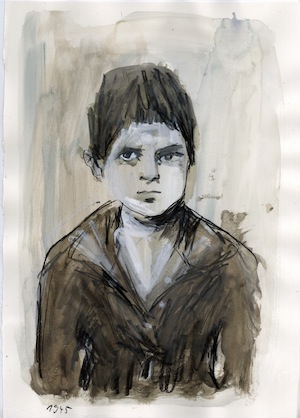
image - Barbara Yelin’s illustration of Emmie Arbel, now
Barbara Yelin’s illustration of Emmie Arbel, now. (image from UVic)
image - Barbara Yelin’s illustration of Emmie Arbel, then
Barbara Yelin’s illustration of Emmie Arbel, then. (image from UVic)

“Given the advanced age of survivors, the project takes on an immediate urgency,” said Schallié. “And what makes their participation especially meaningful is that each of them continues to be a social justice activist well into their 80s and 90s. They are role models for the integration of learning about the Shoah and broader questions of human rights protection.”

The visual nature of a graphic novel allows it to bring in elements or depict scenes that are not possible with an exclusively written work, according to Schallié. A person may describe an event in writing but leave out aspects of a scene that might add more to the sense of what it was like to be there at the time.

One of the survivors participating in the project, David Schaffer, 89, lives in Vancouver. He is paired with American-Israeli comic artist Miriam Libicki, who is also based in the city. The two met in person in early January so that Libicki could learn the story of how he survived the Holocaust as a child in Romania.

In 1941, Schaffer was forcibly sent with his family to Transnistria, on the border of present-day Moldova and Ukraine, by cattle car. There, they suffered starvation and were subjected to intolerable and inhumane living conditions.

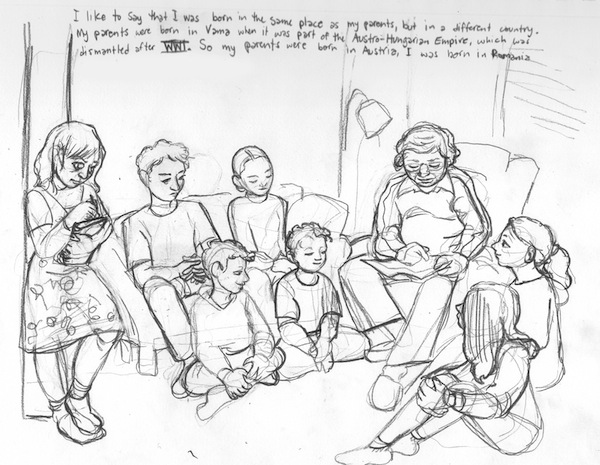
image - One of the illustrations by Miriam Libicki, who is working with survivor David Schaffer
One of the illustrations by Miriam Libicki, who is working with survivor David Schaffer. (image from UVic)

“The most important thing is to share the story with the general population so they realize what happened and to avoid it happening again. It’s very simple. History has a habit of repeating itself,” said Schaffer.

Libicki, who was the Vancouver Public Library’s Writer in Residence in 2017, is the creator of jobnik!, a series of graphic comics about a summer she spent in the Israeli military. An Emily Carr University of Art + Design graduate, she also published a collection of essays on what is means to be Jewish, Toward a Hot Jew. (See jewishindependent.ca/drawing-on-identity-judaism.)

“The more stories, the better. The wiser we can be as people, the more informed we can be as citizens and the more empathy we can have for each other,” Libicki said. “Graphic novels are not just a document in the archives; they’re something people will be drawn to reading.”

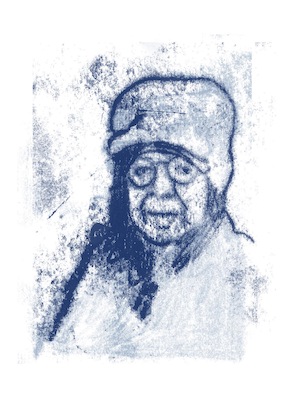
image - Gilad Seliktar drew this sketch of Rolf Kamp
Gilad Seliktar drew this sketch of Rolf Kamp. (image from UVic)

The other illustrators are Barbara Yelin, a graphic artist living in Germany, and Gilad Seliktar, who is based in Israel. Yelin is the recipient of a number of prizes for her work, including the Max & Moritz Prize for best German-language comic artist in 2016. Seliktar has illustrated dozens of books – from publications for children to adult graphic novels – and his drawings frequently appear in leading Israeli newspapers and magazines.

Brothers Nico and Rolf Kamp in Amsterdam and Emmie Arbel in Kiryat Tiv’on, Israel, are the other three survivors who are providing their accounts of the Holocaust.

The books will be available digitally in 2022. A hard copy version of each book is planned, as well. When finished, the graphic novels will be accompanied by teachers guides and instructional material designed for schools in Canada, Germany, Israel, the Netherlands, the United Kingdom and the United States.

UVic hopes to match a larger number of survivors with professional illustrators in the future. To learn more, contact Schallié at [email protected]. You can also visit the project’s website at holocaustgraphicnovels.org.

Sam Margolis has written for the Globe and Mail, the National Post, UPI and MSNBC.

Format ImagePosted on April 3, 2020April 1, 2020Author Sam MargolisCategories BooksTags art, Charlotte Schallié, David Schaffer, graphic novel, history, Holocaust, Miriam Libicki, survivors, University of Victoria, UVic
A busy year for local artist

A busy year for local artist

“Midnight Sun” by Monica Gewurz, who was to show her work at Art Vancouver, which has been postponed. (image from Monica Gewurz)

The Jewish Independent last spoke with Vancouver artist and Jewish community member Monica Gewurz when she participated in Art Vancouver in 2018. She was to be a participant in this year’s international art fair, which has been indefinitely postponed because of the coronavirus pandemic.

“As a professional artist,” said Gewurz, “it is important to exhibit at high-calibre international art exhibition shows. Art Vancouver provides me with a platform to display my works as well as sell them – this will be my fifth time exhibiting there.”

Gewurz was to share a booth with fellow contemporary artist Pam Carr. Previous Art Vancouver fairs have drawn more than 10,000 art appreciators and collectors to the Vancouver Convention Centre. The annual event is billed as “Western Canada’s largest contemporary art fair.”

“In the past year,” Gewurz told the Independent, “I have successfully increased the number of juried exhibitions in B.C. and the U.S., including one in Singapore. My sales and my collector base has increased, as well.”

Gewurz’s artwork can be found in corporate and private collections throughout Canada, the United States, Europe, Mexico, Peru, Australia, New Zealand, China and Japan.

photo - Vancouver artist Monica Gewurz
Vancouver artist Monica Gewurz.

Artistically, she said, for this past year, “the focus of my work has become more introspective and philosophical, with less emphasis being put on the literal depiction of the landscape and more on the feelings evoked by the experience.

“The expansiveness and the quiet energy of coastal British Columbia are strongly evident in the imagery and the palette of my recent paintings, which are meant to be a transformative interpretation rather than a literal rendering of the coastal landscape,” she explained. “Using mixed media and metallic paints and foils has allowed me to develop a personalized style that translates and interprets nature and iconography through layers of transparent glazes.”

Another new development since the Independent spoke with Gewurz is that her art is featured on both a wine bottle and on a line of skincare products. While she has always created wearable art, such as jewelry, this foray into commercial art is different.

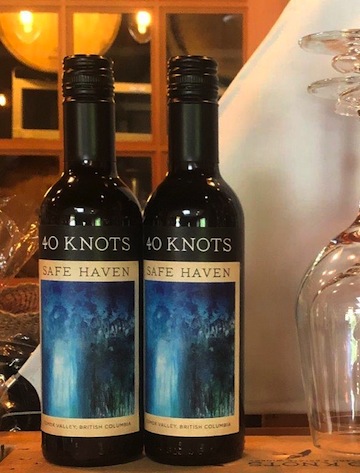
“‘Ebbing’ was chosen through a juried competition to become the label of Safe Haven fortified wine of the 40 Knots winery,” she said. “A portion of the wine sales goes to support the Kus-kus-sum salmon habitat restoration by Project Watershed, an NGO. Because I am a supporter of environmental causes, I donated the artwork.”

photo - Monica Gewurz’s painting “Ebbing” adorns the label of 40 Knots Vineyard and Estate Winery’s Safe Haven fortified wine
Monica Gewurz’s painting “Ebbing” adorns the label of 40 Knots Vineyard and Estate Winery’s Safe Haven fortified wine. (image from Monica Gewurz)

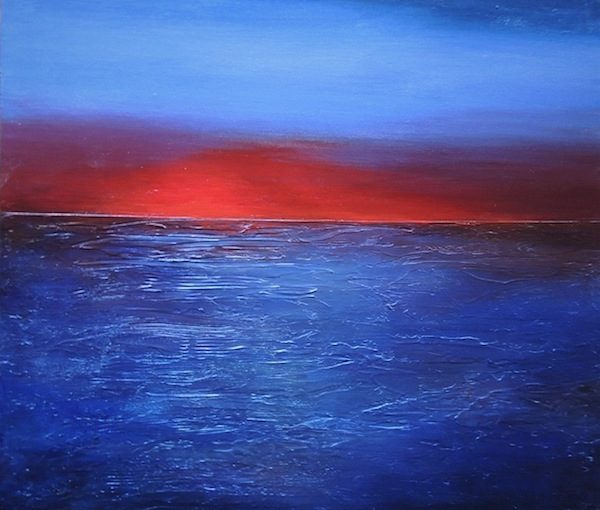
The vineyard also produces its own line of skincare products and, said Gewurz, “The owner of the 40 Knots winery commissioned the artwork ‘Waves of Tranquility’ to be featured in all VinoSpa product labels, using some of the lees of their red wines. The painting was created to capture the feeling of and tranquility and restfulness provided in all VinoSpa skincare lines and their associated spa.”

The winery website explains that Gewurz mixed the lees from the fortified wine with acrylic gels and paints to create the colours of “Waves of Tranquility.” It notes, “Influenced by Turner, ‘the painter of light,’ and Asian traditional painting, Monica’s abstract landscapes aim to reflect truthfully the moods of nature. Captured on canvas or in silver, her work draws on the exceptional landscape of the Pacific West Coast.”

Gewurz was to bring a new collection of work to this year’s Art Vancouver. Her bio noted, “She is excited to share her highly textured, iridescent, colourful acrylic and oil abstract paintings, often worked with a palette knife, unconventional tools and metallic patinas.

“Texture and thin layers of colour are two key elements in her work, as she aims to blur the line between painting and sculpture. She invites you to touch the work, by integrating natural and man-made repurposed materials, including textiles, paper and plastic, each layer of colour and medium allowing you to experience the paintings – perhaps sparking memories, perhaps freeing your mind to wander, imagine and dream. Through materials and her own travels and life experiences, she strives to make work that can be understood across cultures.”

For more on Gewurz, see jewishindependent.ca/inspired-by-cultures-nature, and her website is mgdesigns.org. For updates on Art Vancouver, visit artvancouver.net.

Format ImagePosted on April 3, 2020April 1, 2020Author Cynthia RamsayCategories Visual ArtsTags 40 Knots, art, Art! Vancouver, Monica Gewurz, winery
Israel’s quirky design house

Israel’s quirky design house

Peleg Design’s Magnetic Vase is a bestseller. (photo from Peleg Designs)

From optical illusion flower vases to playful elephant-shaped cutlery drainers, Shahar Peleg wants his products to bring his customers joy, but first and foremost to fulfil a need in their home.

How does he figure out what those needs are? “Some of the ideas came to us while daydreaming, some in the shower, some we woke up with and some just came to us by email,” reads the website’s Suggest an Idea section.

People from all over the world reach out, the designer and founder of the brand told Israel21c. “Once in awhile, we get a great idea and we pay royalties to the designers or inventors,” he said. “It’s really amazing because a lot of people have a lot of ideas.” For example, the Bag Bunny, a magnetic rabbit-shaped tool for easily opening plastic packaging, was inspired by a customer suggestion.

photo - Shahar Peleg wants his products to bring his customers joy, but first and foremost to fulfil a need in their home
Shahar Peleg wants his products to bring his customers joy, but first and foremost to fulfil a need in their home. (photo from Facebook)

Founded in 2005 and based in Tel Aviv, Peleg Design’s online store offers around 100 unique products that stem from everyday needs, each with quirks, twists or optical illusions that Peleg describes as “magical.” Nothing, he said, is what it seems.

The product that kicked off the company’s success was a vase Peleg designed for his own wedding in 2005. These “floating” vases are anchored by magnetic bases hidden underneath the tablecloth. To this day, the vase set is one of Peleg Design’s bestsellers. “It was a huge hit,” he said. “That’s what really began to generate business.”

Another universal problem Peleg wanted to solve was grime building up at the bottom of a cutlery drainer. His answer was Jumbo, an elephant-shaped cutlery holder that drains water out of its trunk, directly into the sink.

Peleg said function is key, and design secondary, to usefulness. But, still, he hopes his customers will fall in love with his “cute” designs.

His newest item, the Egguins, is an example of that cuteness. The penguin-shaped eggholder is not only visually amusing, but makes it easy to remove eggs from boiling water and store them in the fridge. One comment on Peleg Design’s Instagram page calls the item “the best thing since sliced bread.”

Many of Peleg’s products are made from plastic but they are meant to last. Sensitive to environmental issues, he explained that he wants his customers to develop an emotional connection to the items and use them for as long as possible before discarding them.

Passion and profession

Growing up, Peleg dreamed of being an astronaut, but he would eventually find his passion in a different form of exploration: design.

Peleg studied interior design at the Holon Institute of Design. A class project made him realize he had an eye for creating quirky but useful knick-knacks. He had made a wine-bottle holder that seemed to defy gravity. He was able to sell a few even before graduating.

“It started from selling one product in two or three stores in Tel Aviv,” he said. “It’s now become both my passion and my profession.”

photo - The Jumbo cutlery holder drains into the sink straight away
The Jumbo cutlery holder drains into the sink straight away. (photo from Peleg Designs)

What began as a one-man show has expanded to more than 30 countries, including the United States, Japan, Peru, France and South Korea. Some designs can even be found at the gift shop of the Louvre Museum in Paris and the Museum of Modern Art’s gift shop in New York City, where the Magnetic Vase is one of its bestselling items.

Peleg explained that his products are available in most major economies, excluding those that have no political relations with Israel. He hopes one day that will change, and he says so to the businesspeople he meets from countries like Iran and Kuwait.

Every now and then, Peleg receives an email from an Israeli customer, with a photo of his Magnetic Vase on a shelf in the MOMA gift shop. They are so happy to see an Israeli designer’s product among some of the world’s best, he said, noting, “That makes me proud.”

For more information, visit peleg-design.com.

Israel21c is a nonprofit educational foundation with a mission to focus media and public attention on the 21st-century Israel that exists beyond the conflict. For more, or to donate, visit israel21c.org.

Format ImagePosted on March 13, 2020March 12, 2020Author Lauren Izso ISRAEL21CCategories WorldTags art, design, functional art, Israel, Shahar Peleg
Artistic visions on belonging

Artistic visions on belonging

“We are Family” by Cat L’Hirondelle is now on exhibit at the Zack Gallery, as part of he group show Community Longing and Belonging, which runs to March 29.

The new group show at the Zack Gallery, Community Longing and Belonging, is the second annual exhibit in celebration of Jewish Disability Awareness, Acceptance and Inclusion Month. Organized by Jewish Community Centre of Greater Vancouver’s inclusion services and its coordinator, Leamore Cohen, the show is a silent auction. Half of the proceeds will go to the artists, and the other half will be divided between inclusion services and the gallery.

The show consists of 50 paintings by different artists. The size and shape of all the paintings are the same – small rectangles – but the contents and media used are vastly different, indicative of the artists’ various styles and training levels. Some are highly professional. Some are figurative; others abstract. But all reflect their creators’ need to belong, to be part of a community. Each painting tells a story.

One of the prevalent themes of the show is flight. Wings appear on several paintings, emphasizing the yearning for the freedom flight entails, but also for the brotherhood of other fliers. The white ornamental wings on Mikaela Zitron’s multimedia piece are bigger than the background board. They take the artist into the sky, into a joyful aerial dance, while Jamie Drie’s feathers, drifting in a sad emptiness, invoke the feeling of disconnection.

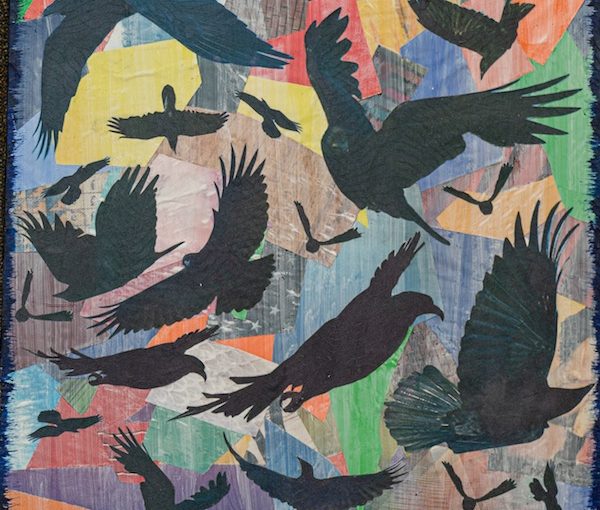
The murder of crows in Cat L’Hirondelle’s painting relates yet a different story. “I am a feminist,” said L’Hirondelle. “I was thinking about the importance of being part of a community of like-minded women. My group of longtime women friends is my family, my tribe and, like the crows, I know that they will always be there for me. Since I became disabled, I have felt more and more disassociated with the able-bodied-centric society in general. Just look at the history of people with disabilities in different societies – genocide, forced sterilizations, segregation, isolation, etc. I would love to feel that people with disabilities belong in the world. My piece is trying to impart that sense of longing to be included in general community and how crow communities seem to include everyone: the old, the disabled, the young. I have lived in the crow flight path for many years and have been watching crows’ behaviour; sometimes, I wished people were more like crows.”

image - “Leaving for Awhile” by Daniel Malenica
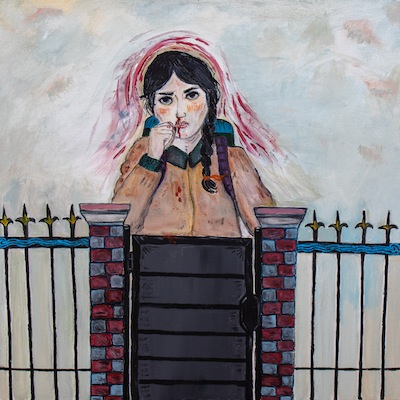
“Leaving for Awhile” by Daniel Malenica

The second recurring motif in the show is loneliness, the sense of separation. Daniel Malenica’s image is distinctive among such pictures. The woman in the painting stands behind closed garden gates. She gazes at us from the painting, and the naked longing in her eyes is painful to behold. She desperately wants to open that gate and step through, to join us, but she lacks the courage. What if the people inside reject her? So, she just lingers outside, desolate and alone, waiting for an invitation.

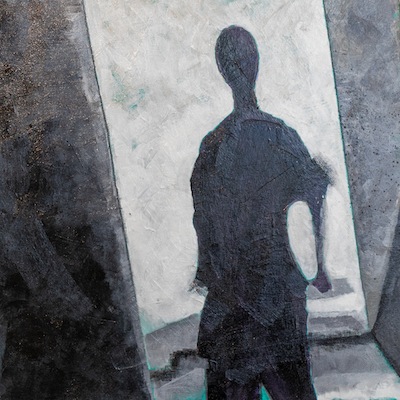
Another outstanding piece on the same theme is Estelle Liebenberg’s black and white painting “Solitude Standing.” She told the Independent, “I work primarily as a potter and a metalsmith, but I accepted the challenge to paint something for the exhibition because I’ve had wonderful times working as a substitute art instructor at the JCC. I chose the monochromatic colour palette because, at the moment, I am quite fascinated by shadows, specifically how they change the shape of objects but still remain recognizable.”

image - Estelle Liebenberg’s “Solitude Standing”
Estelle Liebenberg’s “Solitude Standing.”

Her focus for the piece was the idea of a community in general. “I’ve spent my life dealing with different communities and, I guess, for me, the lines have softened over time,” she said. “We spend so much time in our lives working on belonging, or longing to belong somewhere, to someone or something. It’s an integral part of the beauty, the joy, the frustration and the heartbreak of life. For me, this was longing and belonging as an immigrant, as an introvert, as a mother of grown children, as a single person living in a city.”

She explained the title of her painting: “It is a hat tip to a song by Suzanne Vega. For me, her words truly encapsulate the feeling of longing to belong somewhere: ‘Solitude stands in the doorway / And I’m struck once again by her black silhouette / By her long cool stare and her silence / I suddenly remember each time we’ve met.’”

Different artists explore different aspects of community and belonging, and not all the communities are small or local. For Marcie Levitt-Cooper, the community in her painting is the universe, the earth and stars encompassed by love. Esther Tennenhouse, on the other hand, contemplates the darker side of belonging.

“My piece is a photocopy from a pre-World War Two Jewish encyclopedia, Allgemeine Ensiklopedya,” Tennenhouse explained. “It was labeled in Yiddish and issued in New York in 1940, the year Germany occupied France. On first seeing this old map, I found it very poignant. The map had to fit the 16-by-16 canvas given to all participants. The format left space, and I filled it with the music of two nigguns and lyrics of six Yiddish songs.”

That colourful map with Hebrew lettering, published just before the Nazis unleashed the full horrors of the Holocaust on European Jews, made for a tragic, frightening image, despite its bright and cheery appearance.

While the exhibit includes other figurative paintings, the majority of the pictures are abstract, either simple swirls of paint or complex geometric patterns, like Daniel Wajsman’s piece – two irregular overlapping rectangles.

“I wanted to emphasize that we should bring everyone in, not leave anyone out,” he said.

Community Longing and Belonging runs to March 29.

Olga Livshin is a Vancouver freelance writer. She can be reached at [email protected].

Format ImagePosted on March 6, 2020March 4, 2020Author Olga LivshinCategories Visual ArtsTags art, Cat L’Hirondelle, Daniel Wajsman, disability awareness, Estelle Liebenberg, Esther Tennenhouse, inclusion, JCC, Jewish Community Centre, Leamore Cohen, painting
Goldstein’s Snapshots in Montreal

Goldstein’s Snapshots in Montreal

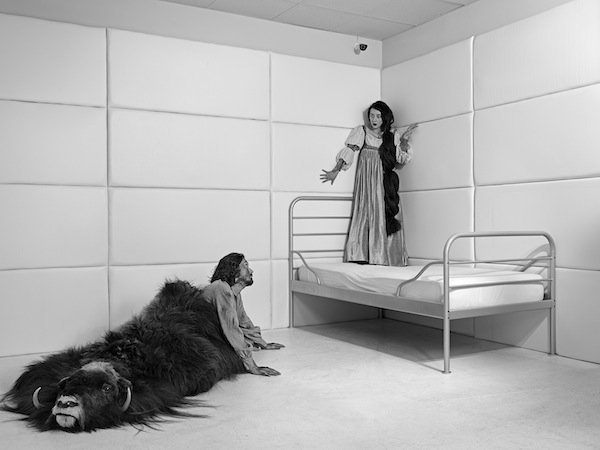
Part of Dina Goldstein’s 11-photograph series Snapshots from the Garden of Eden is “Princess in the Tower” (2017). (image © Dina Goldstein)

On Feb. 20, Vancouver-based artist Dina Goldstein’s Snapshots from the Garden of Eden opened at the Museum of Jewish Montreal (imjm.ca). The exhibit will be on display until May 17.

A collection of 11 large-scale black-and-white photographs, Snapshots re-imagines modernized versions of characters and passages from Jewish fairytales, folk stories and legends collected in the book Leaves from the Garden of Eden by award-winning folklorist Howard Schwartz. Drawn from Jewish oral and written traditions across the centuries, the stories span the Jewish world – from Italy to Afghanistan – bringing to life the diversity and vibrancy of this overlooked area of Jewish storytelling and heritage.

Renowned for her reinterpretations of cultural symbols, Goldstein’s Snapshots reframes Jewish lore both famed and forgotten through the eyes of the 21st century. “The resonance of Goldstein’s work stems from her ability to weave intricate visual narratives,” said curator Alyssa Stokvis-Hauer, “where the history of Jewish folklore is catapulted into the modern era with a cast of characters and film noir-esque scenes that are provocative, imaginative and layered with meaning.”

Playing with visual and narrative archetypes, Goldstein creates new connections and relevance by merging the traditional and whimsical with contemporary themes of technology, desire, justice and identity, exploring and reinvigorating the history and role of Jewish folk narratives in broader cultural memory.

Commissioned in 2017 by the Contemporary Jewish Museum in San Francisco for an exhibition on Schwartz’s Leaves from the Garden of Eden, Goldstein’s photographic series has already been exhibited across Europe and North America. (For more on Goldstein, see jewishindependent.ca/modern-ancient-jewish-tales and jewishindependent.ca/challenging-viewers-beliefs. Her website is dinagoldstein.com.)

Format ImagePosted on February 28, 2020February 26, 2020Author Museum of Jewish MontrealCategories Visual ArtsTags art, Dina Goldstein, folk tales, Howard Schwartz, Museum of Jewish Montreal, photography, Snapshots
Couple cartoons about love

Couple cartoons about love

Yehuda and Maya Devir and their self-drawn webcomic characters in One of Those Days. (image from Devirs)

Fans always do a double take when they see Yehuda and Maya Devir at a comics convention or in a New York City subway, or wherever. The young Israeli couple looks like they jumped right out of their virally popular webcomic One of Those Days.

“I suppose it’s like meeting a real Bart Simpson in the street,” mused Yehuda. “We act exactly the same as our characters.”

Indeed, about seven million social media followers know that Maya loves super-hot showers and hates folding laundry. They know Yehuda’s a big baby when he’s sick and is willing to say “I’m sorry” after an argument. They sympathized with the couple’s struggle to get pregnant.

Most of all, fans smile at the humorous spin the webcomic puts on everyday scenes in a marriage, from dishes in the sink to kisses on the couch.

“We get lots of emails and messages from around the world about how we changed the way couples look at their relationship and how they talk to each other,” Yehuda told Israel21c. “It’s amazing that we can make such a difference for people, that our work can connect Muslim, Jewish, black, white, rich, poor … it doesn’t matter.”

One of Those Days won the Most Creative Content Maker Award at the Inflow Global Summit 2019 Awards for social media influencers.

“We dedicated our award to our followers and supporters around the world. We have fans in Brazil, Japan, Trinidad, Iran, Iraq – basically, every country,” Yehuda said. “People thank us for making them happy once a week and making them feel they are not alone. It’s an amazing journey we’ve been on.”

The Devirs’ journey began in September 2016, when they packed up their diplomas in visual communication from Jerusalem’s Bezalel Academy of Art and Design and moved to Tel Aviv.

The newlyweds hoped to find an affordable apartment in a nice neighbourhood. And they hoped to make a living in illustration and design. Neither aspiration was terribly realistic.

“A friend suggested we post a selfie on Facebook asking friends to help us find an apartment,” said Maya. “We didn’t know how to take a good selfie, but we can draw really well, so we did a cartoon of ourselves and posted that.”

Not only did that illustration help them find an affordable flat in a very expensive city, but it also formed the kernel of One of Those Days.

While working as a freelance illustrator in the fashion, music and startup industries, Yehuda posted funny snippets on social media about being a new husband.

“Very quickly I joined him because I wanted him to make me look good,” Maya said with a laugh, “and because the story belonged to both of us. The concept was to illustrate moments we both experienced.”

In May 2017, Bored Panda posted a piece about the Devirs that went viral. “After a week, we gained half a million followers on Instagram,” Maya said. “Since then, we never stopped gaining followers. We got tons of emails and Yehuda couldn’t manage by himself. So, I left my job as art director in an ad firm and joined him full-time in October 2017. This was our dream – to create something of our own.”

They take complementary roles in each cartoon. “We start the idea together and the actual illustration is Yehuda’s talented hand,” said Maya. “Then I add my suggestions about colour composition and typography. I also manage the business.”

She said, “I opened an ecommerce shop. At first, we sold only autographed A5-sized prints of One of Those Days comics and Yehuda’s other comic illustrations. People who were into art and comics appreciated that.”

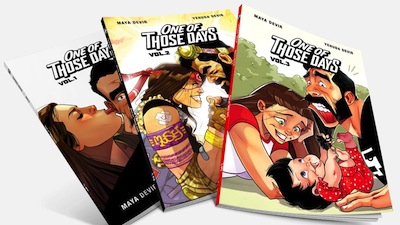
The online shop now sells three One of Those Days books plus merchandise, including apparel, shower curtains, calendars, phone skins and other items imprinted with favourite cartoons.

The Devirs’ YouTube channel has 46,000 subscribers. They have a Patreon subscription content service. They’ve appeared at comic-cons in Europe, India and will soon visit the United States. They are in great demand to give talks and lectures.

“Everything we do is because our fans suggested it,” said Yehuda. “Now, they want a TV show and we are going to try to do it. We are working with a scriptwriter at a studio in the U.S.”

photo - The online shop sells three One of Those Days books, plus other merchandise
The online shop sells three One of Those Days books, plus other merchandise. (image from Devirs)

Relationships proved to be a universal kind of language for the Devirs. “When we decided to move into the stage of being parents and saw it wouldn’t be that easy for us, this was a turning point,” Yehuda confided. “Would we really talk about the unpleasant experience of trying to get pregnant? It’s a super-personal subject.”

Maya felt that Yehuda’s humorous and colourful style would put the right spin on the topic and could be supportive for other couples in a similar situation. And so they introduced comics about ovulation, periods and lovemaking on demand. Messages offering support and advice came pouring in. It was like a worldwide group therapy session, Yehuda said.

The cartoon announcing Maya’s pregnancy got 16 million likes and shares. The first illustration of baby Ariel got 13 million. As of Dec. 1, she had 219,000 Instagram followers at just six months old.

“It was unbelievable to see the amount of love we got from people we didn’t know,” said Yehuda. “As Israeli and Jewish people, it was especially unbelievable to get supportive reactions from our huge fan base in the Arab world. The Israeli part is not important. We’re just the cartoon couple about love.”

Now living on Maya’s childhood kibbutz, the couple puts Ariel in the care of her two grandmothers when they travel to shows and lectures. The difficulty of parting with their baby became another comic that went viral because it was so relatable.

“It’s hard for Maya and me to leave her,” said Yehuda, “but, when she’s older, she’ll join us.”

Israel21c is a nonprofit educational foundation with a mission to focus media and public attention on the 21st-century Israel that exists beyond the conflict. For more, or to donate, visit israel21c.org.

Format ImagePosted on February 28, 2020February 26, 2020Author Abigail Klein Leichman ISRAEL21CCategories Visual ArtsTags art, Devir, illustration, Israel, marriage, webcomics
Zack Gallery’s new director

Zack Gallery’s new director

Former Zack Gallery director Linda Lando, left, with new director Hope Forstenzer. (photo by Daniel Wajsman)

The Sidney and Gertrude Zack Gallery at the Jewish Community Centre of Greater Vancouver has a new director, Hope Forstenzer – one of the few directors in the gallery’s history to be a professional artist.

Forstenzer is a graphic designer and a glass artist; she is a member of the Terminal City Glass Co-op. She takes over the reins of the Zack Gallery from Linda Lando, who retired at the end of last year.

“I have a background in visual art and performing art,” Forstenzer told the Independent. “For years, I was the artistic director of a multimedia company in New York. We worked on short plays: judged them and then produced them around New York. It was an amazing job, very interesting, but it didn’t pay my bills. For that, I worked as a graphic designer.”

She also taught graphic design, first in the United States – New York, Seattle and Baltimore – and, later, in Vancouver, after her wife accepted a job at B.C. Children’s Hospital in 2012 and the family moved here. Forstenzer has been teaching graphic design at Emily Carr University of Art + Design and at Simon Fraser University.

The artist began working with glass in 2001, while still in New York. She liked it so much that she made it her principal medium. A number of glass shows in Seattle and Vancouver have included her pieces.

“I had two solo shows for my glass, both here in B.C.,” she added. “I also participated in a group show at the Zack in 2015.”

The life of a freelance artist is a hectic one. Forstenzer has had to juggle her teaching schedule and studio time, plus a family with young children. She longed for more professional stability.

“I started looking for a steady part-time job,” she said, “then I heard Linda Lando was retiring from the Zack. I always loved this gallery and its artists, loved the JCC. I decided to apply for the job. I’ve worked in leadership positions in the art field all my life, so this job seemed perfect, both in its essence and its timing.”

Her plans for the gallery are extensive. “I want to do at least as well as Linda did. She was a marvelous director, so I have big shoes to fill.”

Forstenzer is already working on future shows, both solo and group exhibitions, in various artistic formats. “I love diversity,” she said. “But a group show might be harder in some ways to jury and organize. Art is always subjective and, in a group show, some people will always like certain artists more than others. The trick is to make it work for the majority…. When a curator assembles a group show, it is a collaboration, like putting together a puzzle, making as little dissonance as possible from the disparate pieces. On the other hand, in a solo show, you create a flow of energy.”

With regard to the gallery and its place in the community, Forstenzer said, “I want to make sure the gallery is connected to the JCC. We are part of it, and that should be emphasized. It doesn’t mean only Jewish artists – the JCC has a diverse membership, it draws in people of all ages, skills and cultural influences. I want to reflect that in our future shows and programs. Linda started that with her amazing poetry series. I want to do more. Children’s programs. Sessions for older citizens. Workshops for families. I want interactions with the gallery. I want our visitors to be part of the shows.”

As for the artists, she said, “I want to create a nurturing environment for them in the gallery, want to encourage younger artists, not just in age but in experience. Some people only start in the arts after they retire, and their mastery in other areas makes them unique in artistic venues. I want to establish a relationship with our artists, so they will trust me.”

Forstenzer is sure that her being an artist herself is an asset for her work as gallery director. “I’m not only an artist, I’m a fan of the arts, of beautiful things of any kind. It’s not really that common. Many artists are not fans, they prefer their own art to anyone else’s, but I love art. When I visit a museum or a gallery, I want to absorb as much as I can of the other artists’ imaginations.”

Her years as an artist and as an art administrator give her a unique perspective – to see the gallery from both sides. “I can advocate for the artists,” she said, “but I also can and will represent the gallery and its patrons.”

While acting as the gallery director, Forstenzer said she will not exhibit her own work at the Zack. “It would be a conflict of interest,” she said. “I’ll never exhibit here. I will participate in the Terminal City Glass Co-op’s group shows as a glass artist, but, at the Zack, I’m the director, not an artist. I will keep a hard line between my glass-blowing and my gallery.”

To learn more about Forstenzer’s glassworks, visit her website, hopeforstenzer.com.

Olga Livshin is a Vancouver freelance writer. She can be reached at [email protected].

***

Editor’s Note: This article has been corrected to reflect the fact that Hope Forstenzer was not the first Zack Gallery director to be a professional artist, but rather is one of the few directors in the gallery’s history to be a professional artist.

Format ImagePosted on February 21, 2020February 24, 2020Author Olga LivshinCategories Visual ArtsTags art, glass-making, Hope Forstenzer, Linda Lando, Terminal City Glass Co-op, Zack Gallery
Inspiring optimism with art

Inspiring optimism with art

Linda Frimer’s exhibit, Beckoned by the Light, runs until Feb. 23 at the Zack Gallery. (photo from Linda Frimer)

“Since I was a child, I’ve always looked for the light – in the forest near my home and in the stories of my family. All the paintings in my show were inspired by light, the light of creation,” said Linda Frimer.

The exhibit, Beckoned by the Light, opened at the Zack Gallery on Jan 30. Originally, Frimer thought that her show would open simultaneously with the launch of her upcoming book, Connecting the Dots, and this is why the gallery exhibit opened in conjunction with the Cherie Smith JCC Jewish Book Festival. But life interfered, and the book is still a work-in-progress. Nevertheless, Frimer told the Independent, “I decided to go ahead with the show.”

Frimer’s paintings are beautiful, suffused with light. They are closer to impressionism than to realism, but every piece is unmistakably and uniquely hers. Light bathes the trees and the streams. It filters among the branches. It soars on dove’s wings over brilliant abstractions and illuminates mysterious paths winding through the woods. Light bursts into explosions of gladness and swirls like dancing fairies, inviting gallery visitors to share the luminous joy, to rejoice in the rainbow of colours.

“When I paint, I want to be positive,” the artist said. “Life is hard. That’s why I want joy in my paintings.”

To express her joy, Frimer uses bright colours, including gold and silver. “Gold and silver are great for all the recurring symbols in my paintings,” she explained. “One of my favourite symbols is wings – wings of the birds, like a dove, which is a metaphor for light.”

Another symbol that appears frequently is a tree. “Trees have wings, too. Sure, they are rooted in earth, but they reach for the sky, for the light,” Frimer said.

One more symbol populates many of her paintings – a flower, specifically a sunflower, which always strives to stretch higher, to touch the sun.

And then there are paths, roads to the light. Or to a better place. Or to someone you love. “I love people,” she said. “Love being a member of a group. I’m a member of several different groups.”

One of her groups – with five artist friends – attended her opening night and brought a gift: a wooden staff adorned with symbols of her art. Each object that was attached to the staff was created by a member of the group.

“We met through a project of the Hebrew University about 15 years ago,” Frimer said. “Now, we meet regularly, support each other in life and art. Whenever one of us has a show, the rest of us always make something symbolic for her.”

The group comprises Frimer, Nomi Kaplan, Lilian Broca, Barbara Heller, Sid Akselrod and Melenie Fleischer. “We call our group Five Hens and a Rooster,” Fleischer said with a laugh, as she presented the group’s gift to Frimer.

Music also plays a big part in Frimer’s artistic life. One could almost hear notes thrumming in her imagery. “I often listen to music when I paint,” she said. “I even dance sometimes. I love classical music, pop, all kinds, really.”

Frimer always starts a painting with an idea, but then her imagination takes over. “I follow my intuition,” she said. “Painting is a spiritual act for me. It’s like meditation. I love the process, the magic of creating. It’s wonderful to be able to express all that positive energy.”

In her opinion, everyone is an artist. Not necessarily a visual artist, but we all create in our own way. “It’s about how you feel, how you express yourself,” she said. “The process is much more important than the end result. I taught art a lot and I facilitated several healing artistic projects. It is great when I can help people tell their stories through creativity.”

Her new book is about that, too. “It’s my life story through art,” she said. “There are also creative exercises there, and some essays about different aspects of creativity. It’s about the healing power of the arts.”

Many of Frimer’s canvasses are large, expensive, fit for corporate headquarters or ballrooms, but the artist wants more than to sell her paintings for profit. “I believe in art reaching the public, being accessible. That’s why I make reproductions of my own work,” she said. “I make posters and giclée prints in different sizes. While my original paintings might not be affordable to many, anyone can afford a small print or appreciate a poster.”

In the same spirit, she often makes donations of her art to hospitals and synagogues. “When a painting hangs in a hospital,” she said, “I hope it might make someone feel better, help with their healing. In a synagogue, I hope my paintings might inspire and support. I studied colours and how they could aid in healing a body or a spirit. I even wrote about it in my book.”

Frimer’s bright paintings are permeated with hope and energy. They are celebrations of possibilities, as if the artist sees everything through the lens of optimism. And she shares that optimism freely with all of us.

Beckoned by the Light runs until Feb 23. For more information on Frimer and her work, visit lindafrimer.ca.

Olga Livshin is a Vancouver freelance writer. She can be reached at [email protected].

Format ImagePosted on February 7, 2020February 6, 2020Author Olga LivshinCategories Visual ArtsTags art, Beckoned by the Light, Linda Frimer, painting, tikkun olam, Zack Gallery
Artistic visions of hope

Artistic visions of hope

Left to right, Three Echoes artists Sorour Abdollahi, Devora and Sidi Schaffer. Their exhibit, Hope and Transformation, is at Amelia Douglas Gallery until Feb. 29. (photo from Three Echoes)

Connected by similar values and inspirations in their creative work and in their lives more generally, Sidi Schaffer, Sorour Abdollahi and Devora are longtime friends. Their fifth exhibit together – as the informal collective Three Echoes – is called Hope and Transformation. It is at the Amelia Douglas Gallery at Douglas College in New Westminster until Feb. 29.

“Art transcends the limitations of time, space, language and cultural background,” said Devora in her written remarks, prepared for the exhibit’s opening Jan. 16, which was postponed because of the snow, and given Jan. 21. “The echoes from within spill over onto the canvases,” she said. “Together, our works create a dialogue of hope and transformation.”

Devora told the Independent that the name for the exhibit came “through talk and discussion between the three of us in reflecting on our individual and collective journeys and where we found ourselves, and the world, at that moment.”

“Today, there is a lot of anxiety about globalization and migration,” Abdollahi said. “As an immigrant artist, my art deals with connections between cultures and hybridity. Therefore, my works might help serve as a bridge and tell the immigrant story.”

Abdollahi was born and raised in Iran, where she graduated with a diploma in Persian literature from Yazd University and a bachelor’s in fine arts from the University of Art in Tehran. In Vancouver, where she settled 20 years ago, she studied at Emily Carr University of Art and Design. She writes in the exhibit catalogue that her Iranian heritage and Canadian experience “have had a tremendous influence on my works’ subject matter, dealing with the mediation between the modern and the ancient, the old and the new, the West and the East.”

The artist uses collage, a multi-layering technique and mixed media. “My works show the relationship between culture and environment and migration,” Abdollahi explained to the Independent. “Our environments are changing both internally in our mind and externally, and my works illustrate this change. My works create negotiation between different cultures and societies.”

Schaffer also started her fine arts education in her birth country, Romania. In Israel, she received a degree in art education and taught in the school system for more than a decade. When she came to Canada in 1975, she studied at the University of Alberta, where she majored in printmaking and painting. Initially focused on abstraction, her work has become “more integrated, combining abstract and figurative forms,” she writes in the catalogue. “Now I am continually exploring new possibilities with mixed media, a combination of print, drawing, painting and collage. Important for me is the visual poetry, the relationship of form, space, colour and light. Some of my works in this show are a combination of collages of different things from nature and painting; others are collages of my own imagination.”

“I am an optimist and also I am amazed about the continuous transformation in nature around me,” Schaffer told the Independent. “I combined my love and respect for the beauty of flowers and leaves, surrounding them with hope, and new imaginary landscapes. In a way, I give the dry flowers a new life, bringing them out from the pages of old books.”

As for Devora, she told the JI, “What gives me hope is my relationship with the Divine – that there is no separation, that we are all connected and made of stardust, that we are all on an unfolding journey of being together. I attempt to express that emotion onto the canvas.”

For Devora, art has the power to transform the viewer when the viewer can hear her work speak to them from their own experience. “At the opening,” she said, “the Douglas College students from two classes – one poetry class and one art history class – gathered around and engaged with all three of our works, asking questions, wanting to understand the process, the intention and how they could relate from their own lives to what they were seeing.”

Normally, only the art history students attend each artist talk. However, after Devora shared that the Zack Gallery at the Jewish Community Centre of Greater Vancouver hosts Pandora’s Collective poetry nights, where members of the collective create works inspired by the art, the Amelia Douglas Gallery invited the poetry class, as well.

Growing up in Berkeley, Calif., where she earned a master’s at California School of Professional Psychology, Deborah Ross does all of her creative work under her maternal grandmother’s name, Devora, in honour of her grandmother, who was murdered in the Holocaust. “Her spirit gives me the strength and confidence to create,” said the artist in her remarks for the exhibit.

Devora, who now lives both in Vancouver and on Salt Spring Island, came to Canada in 1993. She has studied art at Emily Carr, Langara College and elsewhere. “My artwork reflects the love I have for the creative process and exploration,” she writes in the exhibit catalogue. “I am fascinated by the inner world of emotion, dream, metaphor and story and strive to illuminate both the universal and personal by bringing them onto the canvas.

“My latest works explore the interplay and continuum between abstract and representational images of landscapes and figure, and a fascination with the surreal, in mixed media combining acrylic and collage.”

In her remarks for the exhibit opening, Devora explained, “My art reflects a search for understanding and clarity about my personal and ancestral history and the world. My experiences inform my work as I go inside and bring them onto the canvas. I endeavour to transform darkness into the light of hope. I am interested in what is hidden and how it informs what is revealed.”

She noted that she, Abdollahi and Schaffer “turned to esthetics as a way to focus and navigate our journey.” And she expanded on this concept. “Through the lens of esthetics combined with the common immigrant experience and effects of war and displacement,” she said, “the three of us have managed to bridge all other divides: language, ethnicity, culture, religion and country of origin. Our childhood environments and experiences could not have been more different on the surface and yet the foundations of connection and similarity were already being laid down, established through the development of the lens of sensitivity to beauty in the world and compassion for the human experience.

“Our ideal, of different cultures living in harmony, is reflected in our own personal experiences, in which intimate exposure to the world of ‘the other,’ unearths commonalities and gives rise to a greater depth of understanding about our own lives.”

She concluded, “In closing, I would like to quote Sorour, as Sidi and I feel that her words speak for all three of us: ‘In my friendship and collaboration with Sidi and Deborah, I see an opportunity to explore and express my own culture, but also to relate these themes to other cultural experiences – recognizing the echoes of each other in our works and our lives. My works side by side those of my friends’ works create a dialogue and negotiation which hopefully provides the viewer with a different vision of the world – one which is borderless, free and peaceful.’”

Format ImagePosted on January 31, 2020January 28, 2020Author Cynthia RamsayCategories Visual ArtsTags art, Devora, immigration, Sidi Schaffer, social commentary, Sorour Abdollahi, Three Echoes

Posts pagination

Previous page Page 1 … Page 10 Page 11 Page 12 … Page 18 Next page
Proudly powered by WordPress