Skip to content
  • Home
  • Subscribe / donate
  • Events calendar
  • News
    • Local
    • National
    • Israel
    • World
    • עניין בחדשות
      A roundup of news in Canada and further afield, in Hebrew.
  • Opinion
    • From the JI
    • Op-Ed
  • Arts & Culture
    • Performing Arts
    • Music
    • Books
    • Visual Arts
    • TV & Film
  • Life
    • Celebrating the Holidays
    • Travel
    • The Daily Snooze
      Cartoons by Jacob Samuel
    • Mystery Photo
      Help the JI and JMABC fill in the gaps in our archives.
  • Community Links
    • Organizations, Etc.
    • Other News Sources & Blogs
    • Business Directory
  • FAQ
  • JI Chai Celebration
  • JI@88! video

Recent Posts

  • Legal help for students
  • Revisiting myth of Lilith
  • Wrong person rebuked
  • Canada’s mixed messages
  • Questions for museum
  • Symposium on antizionism
  • Making soccer political
  • CJPAC lauds Pulver’s impact
  • City recognizes Vrba’s legacy  
  • Organ donation saves lives
  • Theodore’s March premiere
  • A healing Shabbaton
  • Supplying healthy food
  • A chime of metal tags
  • Yellowknife seder a first
  • Ishai energizes, unifies
  • A Lag b’Omer to remember
  • Expanding the healing
  • Hannah Senesh – a unique hero
  • Community milestones … May 2026
  • Sharing her testimony
  • Fall fight takes leap forward
  • The balancing of rights
  • Multiple Tony n’ Tina roles
  • Stories of trauma, resilience
  • Celebrate our culture
  • A responsibility to help
  • What wellness means at JCC
  • Together in mourning
  • Downhill after Trump?
  • Birth control even easier now
  • Eco-Sisters mentorship
  • Unexpected discoveries
  • Study’s results hopeful
  • Bad behaviour affects us all
  • Thankful for the police

Archives

Follow @JewishIndie
image - The CJN - Visit Us Banner - 300x600 - 101625

Trying to be gracious of spirit

My family recently came back from a trip to Alberta. My husband (a professor) helped run a conference at the University of Calgary. We took our twins and went on vacation, too. I won’t lie. I felt intimidated about managing a strange city on my own with two active 6-year-olds, but I planned like crazy. Due to some lucky breaks, it went well.

More than once, I was reassured by a comforting sense of community. The first day, we took the fancy mini-van (an unexpected rental car upgrade) and it began to ding. A tire was low. I worried. I warned my kids that we might have to stop – if I could find a gas station – and check the air on the tire. Before I’d managed that, we’d arrived at Heritage Park.

We were surprised to find the Montefiore Institute (original 1916 prairie synagogue) had been moved there. The living-history interpreter sang Yiddish folk songs to us. She’d been raised in Winnipeg, where I now live. However, the most comforting thing? The man next to me as we watched our children on the kiddy rides. He said the new car sensors were overly sensitive and that if I checked the tires, I might find nothing wrong. (We did. He was right.)

On the way out, I mistakenly turned down an (empty) one-way street. A woman yelled, “Wrong way! Wrong way!” and frightened us terribly. I apologized to her. I figured out the problem and turned around. She, too, was looking out for me.

Next day, we were at the zoo – enjoying the eclipse and how it made crescent-shaped shadows on the pavement – with my friend and her baby. We commiserated about how scary it is to be raising kids. We want to help them be strong in what is suddenly a more threatening environment for minorities. She also waited, smiling, while my kids and I recited a brachah (blessing) I’d found online over the wonder of seeing the eclipse. My friend is Muslim. Her parents were born in Jerusalem.

In Drumheller, at the Royal Tyrrell Museum, my kids had a blast until exhaustion hit. It was very hot. We dragged them out in mid-tantrum. In the parking lot, my husband handed the expensive tickets to another family to use. We ended up at a restaurant. Everything was better after eating in air conditioning. On the way out, I apologized to the senior citizens near us if we had disrupted their meal. They smiled graciously. One mentioned that everyone had been a kid once.

On our day trip to Banff, we wandered into a theatre. We were the only people attending a magnificent children’s show, filled with dancing animals and an amazing set done by artist Jason Carter. The performers said, “Be our guest!” It turned out we saw an $80 show for free.

Why am I telling you this? In recent issues of the Jewish Post & News, some have commented on a child who happened to go up on the bimah (pulpit) of a congregation during services. Some bemoaned how children are poorly behaved in “adult” restaurants and theatres, as well.

While I would be the first to ask children to try to behave and to suggest that synagogues develop good Jewish programming options for them, the thing is, a synagogue isn’t a theatre or a restaurant. A shul is a house of learning, community and prayer. Who should learn to pray in a loving community? Kids.

During my trip, I encountered embarrassing learning moments (“Wrong way!”) and moments of gracious compassion. (“We were all kids.”) I also consistently had my kids in public, in theatres and restaurants, where I worked awfully hard to make sure they behaved – and those around me were big enough to understand the challenges of the task.

I wasn’t sure what to write for this column. Late last night, I lay awake, near an open window. Noise kept me up. Adults were laughing and shouting on a nearby patio of an upscale restaurant as they drank. In warm weather, this happens several times a week. I was tempted to march out in my pajamas to tell them to be quiet so I could sleep but, instead, I tried to be more understanding. I didn’t call the cops.

To those who would say that this child disrupted them during services, I suggest to perhaps be a little more generous of spirit. Synagogue is about community. That means it’s not just about “me” and what I should get out of the experience. It’s about what we can offer each other – as we learn, pray and support each other. Sometimes, it’s challenging, embarrassing, hard or sad and, you know, that’s life. It’s not a fancy dinner with cocktails, or an expensive concert.

Rosh Hashanah is upon us. It’s time to evaluate how we can aim higher and do better next year. There are plenty of things for which I can atone, things I haven’t done well and want to do better. Meanwhile, I just heard from old friends (who went to Cornell University as undergrads with me) who live in Houston. They are OK. Their house is OK. But, in their brief email, they relayed such horrible stories about flooding and drowning all around them. They mentioned that they were trying to help those nearby who were less fortunate.

We’re so very lucky, I thought. That random community of helpers is so important, whether in Houston or Calgary or Winnipeg. It helped me through a big first vacation on my own in an unfamiliar city with kids. Those people lifted me up and helped me do it, despite the challenges. My friends survived a major hurricane, and they were going to help gut a friend’s flooded house. Upon reflection, I’d say, we can all be that “better person” and help out.

Next time a kid acts out?  Smile. Meet the family. Ask if you can chase her down the aisle to give the parents a five-minute break. Heaven knows they need it.

Wishing you a sweet, happy, productive, meaningful 5778.

Joanne Seiff, a regular columnist for Winnipeg’s Jewish Post and News, is the author of a new book, From the Outside In: Jewish Post Columns 2015-2016. This collection of essays is available for digital download, or as a paperback from Amazon. See more about her on joanneseiff.blogspot.com.

Posted on September 8, 2017September 5, 2017Author Joanne SeiffCategories Op-EdTags Jewish life, Judaism, kindness
What does future hold?

What does future hold?

Jewish community member mia amir is the dramaturg of Wypsa, which is at the Fringe Festival until Sept. 16.

While the plot of Wyspa may bring to mind William Golding’s Lord of the Flies, the book was not a direct inspiration for this work, co-writer and director Julia Siedlanowska told the Independent.

The creation of the play, which opened at the Vancouver Fringe Festival Sept. 7, began with the reading and discussion of an original story written by Siedlanowska and Kanon Hewitt.

“Our team includes five collaborators between the ages of 11 and 16,” said Siedlanowska. “They have all been involved directly in the creation of this piece through world-building, research, writing text, improvisation, creating soundscapes, costumes and props. They are all also performing in the piece.”

Siedlanowska and Kanon’s story “tells the tale of a walled-in community that has sustained itself through oil extraction for centuries,” Siedlanowska explained. “When fires start raging within the walls, the mothers of the community make the decision to send their children away through the only opening to the outside world – an opening to the ocean.

“After days of drifting, they finally arrive on an island. Here, they must decide whether they will live by the rigid rules of their old society or create their own.

“We separated the experience into three worlds,” she continued. “The home world, the world of the boat and the world of the island. From there, we collectively decided the specific circumstances of each of these, including what rules apply in the home world and the island world. The youth created their own characters and decided on each of their relationships to each other. Text and movement were all generated by the collaborators, with myself and Kanon making decisions about the show structure with the help of our dramaturg mia amir. There are some improvisational aspects – much of the show takes place within an improvised structure with scenes changing depending on the audience.”

The end result came from research of instances in which children were removed from their homes during the Second World War, said Siedlanowska, “including Japan after the Tokyo bombings and the Kindertransport of Jewish children in Europe, as well as the Sixties Scoop in Canada.

“One piece of literature that I did directly mention in the initial phases of brainstorming was the story of King Matt the First, written by Polish-Jewish playwright Janusz Korczak. Korczak ran an orphanage in Second World War Poland. He was a pedagogue, writer and children’s rights activist. The orphanage was called Our House, and the children living there published their own newspaper and held their own court when conflicts arose among them. King Matt the First was about a child who becomes king, and what might happen if children were rulers.”

However, the idea of the story first arose, she said, “from questions around the rise in domestic violence in Alberta as a result of the economic downturn and job loss in the oil and gas industry. This violence is predominantly towards women.

“This then led to questions around how raising youth within rigid gender identities might enforce these patterns of violence. Instead of writing what we think youth might have to say about these themes, we decided to ask directly. In relation to climate change, we also wanted to ask the question, how do we – as an adult audience – react to dialogue around the climate crisis when those who will inherit the planet stand directly in front of us?”

Wyspa is being presented as part of Generation Hot, a mentorship initiative of the Only Animal and the Fringe Festival, which presents the work of seven writer-directors between the ages of 17 and 24. This year’s program is called Waterborne. “Each participant has found a personal response to a chosen site on Granville Island and the theme of water,” explains the press release. “Two programs of these short works will run in rep during the 2017 Vancouver Fringe Festival…. Wyspa is paired with Citlali: A Fantastic Tale About Water by a Mexican Poet by Brenda Muñoz.”

Wyspa runs Sept. 8, 10, 13-14 and 16, 8 p.m., at Ron Basford Park on Granville Island. For tickets ($12) and the full Fringe schedule, visit vancouverfringe.com.

Format ImagePosted on September 8, 2017September 5, 2017Author Cynthia RamsayCategories Performing ArtsTags domestic violence, Fringe Festival, Julia Siedlanowska, theatre, Wyspa
Volunteer to tutor students

Volunteer to tutor students

Chabad Richmond is looking for seniors to teach English to Israelis. (photo from chabadrichmond.com)

Want to make a difference in the lives of Israeli teens? Consider Israel Connect, a volunteer program where Vancouver retirees engage via Zoom (it’s like Skype) with Israeli high school students who want to sharpen their English conversation and reading skills. The program, which starts after the High Holidays, is sponsored by Chabad Richmond.

“We are looking for retirees, seniors or adults with time available for volunteering. Volunteers do not have to be teachers, and the curriculum will be provided,” said Vancouver coordinator Shelley Civkin. “We’re looking for Jewish adults who are fluent English speakers, have basic computer skills and own a computer with a camera.” Volunteers can tutor from home – it will entail a half hour per week – and technical support will be available if needed. Volunteers will be trained in how to download and use Zoom.

“This is a meaningful way for community members to support Israel in a practical way,” said Rabbi Yechiel Baitelman of Chabad Richmond. “You’ll be doing a mitzvah, while investing in Israel and its young people.”

Time preferences of volunteers will be coordinated beforehand, but sessions will likely take place in the morning between 8 and 10 a.m. The Chabad Richmond Israel Connect program is asking for a one-year commitment from volunteers.

“English proficiency is crucial to Israeli students, since it accounts for a third of their entrance exam marks for university,” said Baitelman. “Partnering with the Israeli Ministry of Education, the Israel Connect program targets teens from the most disadvantaged neighbourhoods in Israel. The tutoring sessions are vital to students’ upward mobility in terms of education and jobs, which is why this program is so important.”

“Past volunteers really enjoyed helping their Israeli students, and made great connections with them. The students’ marks on their English exams prove that this kind of one-on-one tutoring makes a significant difference in their lives,” said Civkin.

For more information, contact Civkin at 604-732-6330 or [email protected].

Format ImagePosted on September 8, 2017September 5, 2017Author Chabad RichmondCategories LocalTags Chabad Richmond, education, Israel, seniors, youth
Fighting for peace, or to win?

Fighting for peace, or to win?

We need to redefine our “opponents.” In the news, it’s whites against blacks, Palestinians against Israelis. But we don’t have to accept these categories. In Pittsburgh, you can find black and white, Jewish and Arab Steelers fans united against the New England Patriots. (photo by Bernard Gagnon)

The past several weeks have been difficult, but also very easy. Difficult, because it feels like civilization could be spiraling into an irreversible Armageddon of hate, violence and destruction. Easy, because I feel like I know where I stand. I have moral clarity. The neo-Nazis marching down the streets yelling anti-black, antisemitic chants reminiscent of 1930s Nazi Germany are wrong. The people who counter-protest for equality, shouting that hate will not prevail – they’re right. They’re the good guys. The “bad guys” think they’re superior; they think it’s OK to disparage others because of their race or the colour of their skin. “We” believe in the dignity of every human being. Simple.

Until recently, when I had one of those moments of disconcerting humility. I saw a Facebook post of Trump Tower surrounded by big, white garbage bins. The caption read something like, “As usual, Trump surrounded by white trash.”

I am mortified to say that my initial reaction was to chuckle. The joke tickled the funny bone of my youth, growing up in small town New Jersey, where the “white trash” used to make fun of us and “we” would look down on them. But I felt horrible for my reaction, and was forced to ask myself, am I really so much different than those I am quick to blame?

I was similarly disturbed when I saw a video of counter-protesters in Charlottesville screaming at the white supremacists marching. They chanted, “You lost, we won. Go home!” Their argument being – our military defeat ended your right to be in public? Is that what we think? If so, when we “lost” and Donald Trump “won,” should we have conceded, packed it up and stayed home?

Of course not. Defeat makes us dig in our heels and fight back harder. When “we” do it, it’s right, but when “they” do it, they’re a bunch of cry-babies.

This summer, I had the tremendous privilege of participating in a four-day retreat with Pathways, a program sponsored by the American embassy that brings together Arab and Jewish English teachers in Israel to teach them “negotiating skills.” The program was powerful, intense, optimistic, and hopelessly depressing.

I was somewhat familiar with Pathways prior to the retreat because they’d done a workshop at my school with our 10th graders. Our students met with Arab kids from Nazareth, engaging in exercises that stretched their ability to think outside the box, and beyond themselves. They learned how to listen, cooperate and confront challenges with a variety of new and different tools.

One tiny example is when the students were paired to arm-wrestle. The challenge was for each kid to “bring the other’s hand to the table as many times as you can.” Intuitively, the kids begin to wrestle, but one clever boy said to his partner, wait, if we work together, letting each other win, we can both do much better than if we actually fight. The point being – you don’t have to lose in order for me to win. In fact, when we help each other, we both win more.

So, when, at our teachers’ retreat, we were divided in pairs and given the task to play a two-dimensional Connect Four game, I was prepared. Each of us was given a different set of instructions that we were not permitted to share with our opponent. This meant, of course, that we were playing by different rules. The challenge to both of us was to get “as many points as you can.”

My secret paper instructed me to get as many XOXO combinations as possible. I quickly figured out from his strategy that he was going for XXXX. Great. If we could have spoken and I could have explained to him the idea, we would have designed the board to maximize our mutual success. There was nothing that required us to get more points than the other person, only to maximize our own. However, we were not allowed to discuss, and my opponent was out to win. He didn’t understand that I had different rules. He thought he was clobbering me.

In our first round, I was happy to let him take his wins and I took mine. It looked to me like we were neck and neck. But, somewhere in the middle of the second round, his smug attitude was getting to me and I wanted not just to win, but to take him down. I started to block him, and I was scoring big, and he had no idea. It was fun.

When we got to the end and they revealed all the instructions and asked us to tally our points, we were both in for a surprise. It turned out that not only did we have a different set of rules, but I received more points per row than he did. The game was totally and illogically stacked in my favour. It would have been nearly impossible for him to win, even if he had all the information from the start.

It was an interesting exercise, but my partner didn’t really get it, not even after it was over. He protested that it was unfair – that I had all the advantages. And, while it was a game, I felt uncomfortable with this Arab person not understanding why I, the Israeli, had all the advantages and he never stood a chance. A little too close to home. And it was a bit depressing that my partner couldn’t understand that the whole point of the exercise was that it didn’t matter who had more points. It was never about winning and losing.

Sadly, it reminded me of another moment at the retreat, when I was seated by a different Arab man. He told me he lives in Abu Tor, a mixed Arab and Jewish neighbourhood on the border of East Jerusalem. Without thinking, I blurted out, “Hey! My best friend just moved to Abu Tor!” As the words came out of my mouth, I realized that many Arabs are not so happy that Jews are moving to Abu Tor. Indeed, he replied, “Yes, well, I’m sure her area is much nicer than mine because many more resources are invested in the Jewish section than where I live.”

I could have countered with the fact that most Jerusalem Arabs reject citizenship, or that they teach their children to hate us, but the truth is that I just wanted to cry. Because, basically, he was right. Why should he live in the same municipality as my friend and get inferior services? At the same time, why do I have to fear getting stabbed or blown up when I walk down the street? These two questions do not justify each other, they exacerbate each other.

With the “game” stacked unfairly on both sides, how are we supposed to learn to cooperate? We both wanted to; that’s why we were there. But we had to work extra hard to change the rules. And, if we couldn’t figure it out at a retreat where we were all there because we wanted to learn to live together, then what hope did we have out there, where everything is about who is right and who should go away.

From where do we get this need to win? When my kids were 6, 4 and 2, they had an amusing game. When we’d go from the house to the car or from the car to the house, the two older kids would race. They’d run howling and laughing, until they reached their destination, whereupon one would scream, “I win!” and the other would burst out crying. Then the little guy would come hauling up the back announcing proudly, “I lose! I’m the rotten egg!”

When do we go from the stage of enjoying the game and laughing simply because others are laughing, to needing to win and watch our opponents cry?

I’ve always hated competitive games. I happen to be pretty good at many of them and I come from a very competitive family, so I can easily get swept up in the challenge of winning. But I hate when I beat another person and it makes them sad. With my kids, it was often hard to balance the honesty and integrity of playing my best with the desire to see their pride when they win. Fortunately, today my kids can beat me at almost anything, but watching them try to clobber each other is painful.

Still, thanks to Pathways, I discovered an unexpected positive side to this not-always-pleasant phenomenon. When the Arab students came to our school, the kids from both schools were very nervous. What would they talk about? What would they do together? How would they get along with people who they had grown up to believe were their “enemy”?

In one of the first activities of the morning, they divided the kids into groups by table. Every table was mixed, with both Jews and Arabs. To start, they had to make a paper chain of things that everyone at the table had in common. They would write one thing on each piece of paper and attach them together, while everyone had one hand tied behind their back. The kids were laughing, joking, learning about each other and cooperating. By the end, each table felt a strong sense of solidarity. “Table 6 rules!” And “Table 3, we’re taking you down!” could be heard across the room. In less than an hour, having a longer chain than Table 3 had become much more important than who controlled the Temple Mount. It was beautiful. And scary – are we fighting about obstacles to peace, or are we locked in a cycle of violence because we can’t bear to lose?

So, how do we “win”? In Israel, we’ve tried with military might – if they see how much stronger we are, they might just admit defeat and back off. They’ve tried with terror – if we don’t feel safe walking our own streets, maybe we’ll give in, pack up and leave. But these strategies don’t seem to be working. Humans are not wired to accept defeat.

The problem is, as we learned in Charlottesville and as we see here in Israel every day, we can’t win by causing our opponents to lose. To win, we need to rethink the rules and reconsider our objectives.

We also need to redefine our “opponents.” In the news, it’s whites against blacks, Palestinians against Israelis. But we don’t have to accept these categories. In Pittsburgh, you can find black and white, Jewish and Arab Steelers fans united against the New England Patriots. And, at the supermarket, it’s everyone against the jerk in the express line with more than 10 items, who we all want to clobber, regardless of race or religion. And, sometimes, admit it, we’re the jerk in that line.

God knows that none of His children are perfect, but He loves us all just the same. If God is anything like me (and I was created in His image), what could possibly please Him more than if His children could create a new game – a game in which everybody wins?

So, as we enter the last part of Elul, a month of self-reflection, let’s try to shake up the rules – to question what we know and what we think we want. Let’s convert some of our anger into curiosity. Let’s turn a few of our screaming chants into invitations. Not because we’re wrong to be angry or to protest, but because, if we can find each other’s humanity, perhaps we can change the game entirely.

Emily Singer is a teacher, social worker and freelance writer. Singer and her husband, Ross, were rebbetzin and rabbi of Vancouver’s Shaarey Tefilah congregation until 2004. The Singers spent two years in Jerusalem and then moved to Baltimore, Md., where Ross was rabbi at Congregation Beth Tfiloh and Emily taught Judaic studies at Beth Tfiloh High School, until they moved to Israel in 2010. They have four children.

Format ImagePosted on September 8, 2017September 5, 2017Author Emily SingerCategories Op-EdTags Israel, Israeli-Palestinian conflict, peace, spirituality
Atheism has a long history

Atheism has a long history

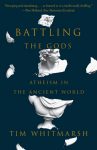
The title of a book review in Biblical Archaeology Review caught my eye, “Ancient atheism.” I read, “A common assumption is that atheism – a lack of belief in gods and the supernatural – is a recent phenomenon, brought on by the advent of science during the Enlightenment.” I ordered the book immediately: Battling the Gods: Atheism in the Ancient World by Tim Whitmarsh (Alfred A. Knopf, 2015).

Bumbling, staggering, veering and lurching: these are the words that come to mind when I think of my path towards a Jewish identity. As the product of a secular household, my only contact with Judaism was my brother’s bar mitzvah and a yearly Passover seder at a family friend’s home. I was born in 1939, the beginning of the Second World War, yet the word “Holocaust” was never mentioned during my childhood or adolescence. The topic of God was not broached. The exception to the rule was that my brother and I were sent for seven summers to a Jewish camp in the Adirondacks, in New York state. There, we became familiar with Friday night services, which included singing Jewish songs and a few prayers in Hebrew.

Fast forward to 1970, after 12 years of marriage, the birth of four sons and a sincere attempt at keeping a kosher home (it lasted three years), creating Passover seders and Chanukah parties and the decision to prepare our sons for bar mitzvahs, my husband and I divorced.

I enrolled immediately in courses at Concordia University. English and French literature introduced me to the Hebrew Bible and the New Testament. This led to a bachelor’s in French literature, which was followed by many courses in a master’s program called The History and Philosophy of Religion.

My search was on. I was determined to find out what religiosity and devotion to God entailed. I studied Judaism (modern and medieval), Jewish mysticism, Christianity, Buddhism and Hinduism. I wrote scholarly papers on these subjects. Later, I would take up the study of Modern Hebrew at McGill University. Upon moving to Vancouver, I studied Biblical Hebrew for three years and enrolled in the Judaic studies program at the University of British Columbia. Jewish law, Jewish ethics, Proto-Hebrew, I loved it all; but I was no closer to feeling comfortable during the High Holiday services at any synagogue.

I tried Conservative, Reform, Reconstructionist and Jewish Renewal congregations. I could not make that leap of faith required to pray to God. The secular humanist group had replaced Hebrew with Yiddish. I wanted my Hebrew! The result is that, every year, during Rosh Hashanah and Yom Kippur, I felt uneasy, out-of-step and different.

I continued studying Modern Hebrew. I became editor of Jewish Seniors Alliance’s magazine, Senior Line. Studying, writing, volunteering and participating in the Jewish community were rewarding and gratifying activities, yet I felt like a second-class Jew. Was there something wrong with me?

Then along came Battling the Gods: Atheism in the Ancient World. As the May/June 2017 Biblical Archaeology Review notes, “In clear prose, Whitmarsh explores the history of atheism from its beginnings in ancient Greece in the eighth century BCE through the fourth century CE, when Christianity was adopted as the state religion of the Roman Empire. Whitmarsh says up-front that he is not interested in proselytizing atheism – but rather in studying its first thousand years. He argues that the history of atheism is an issue of human rights because denying the history of a tradition helps to delegitimize it and paint it as ‘faddish.’”

In reading this book, I came to understand, as Stephen Greenblatt is quoted on the back cover as saying, that “atheism is as old as belief. Skepticism did not slowly emerge from a fog of piety and credulity. It was there, fully formed and spoiling for a fight, in the bracing, combative air of ancient Athens.” And I agree with Susan Jacoby’s comments – also cited on the back cover – that it “is a pure delight to be introduced to people who questioned the supernatural long before modern science provided physical evidence to support the greatest insights of human reason.”

I devoured Battling the Gods, relishing the research and the historical insights. Homer’s epic poems of human striving, journeying and passion were ancient Greece’s only “sacred texts,” but no ancient Greek thought twice about questioning or mocking his stories of the gods. Whitmarsh states that “this book thus represents a kind of archaeology of religious skepticism.…This loss of consciousness of that classical heritage [the long history of atheism] is what has allowed the ‘modernist mythology’ to take root. It is only through profound ignorance of classical tradition that anyone ever believed that 18th-century Europeans were the first to battle the gods.”

Whitmarsh writes, “The Christianization of the Roman Empire put an end to serious philosophical atheism for over a millennium. The word itself, indeed, acquired an additional meaning, which was wholly negative: rather than the rational critique of theism as a whole, it came to mean simply the absence of belief in the Christian god.”

With Whitmarsh’s sentence, “The conclusion seems inevitable that the violent ‘othering’ as atheists of those who hold different religious views was overwhelmingly a Judeo-Christian creation,” my self-respect was restored. I now understand that I come from a longstanding tradition of atheists. My beliefs have history and credulity behind them. I will continue to study Hebrew, write, volunteer and participate in the Jewish community. In accepting my skepticism, I join the minds and hearts of the ancient Greek and Roman skeptics and atheists who came before me.

Dolores Luber, a retired psychotherapist and psychology teacher, is editor of Jewish Seniors Alliance’s Senior Line magazine and website (jsalliance.org). She blogs for yossilinks.com and writes movie reviews for the Isaac Waldman Jewish Public Library website.

Format ImagePosted on September 8, 2017September 5, 2017Author Dolores LuberCategories BooksTags atheism, Battling the Gods, history, Judaism, religion, spirituality, Tim Whitmarsh
שישה סרטים ישראלים בפסטיבל של טורונטו

שישה סרטים ישראלים בפסטיבל של טורונטו

“מונטנה” סרט הביכורים של הבימאית והתסריטאית לימור שמילה (שהייתה עד כה מלהקת מוכרת של סרטים). (צילום: tiff.net/tiff/montana)

ישראל נמצאת במקום מכובד בעולם מבחינת היצירה הקולנועית. זאת לאור העובדה שלא פחות משישה סרטים ישראלים ישתתפו השנה בפסטיבל הסרטים הבינלאומי של טורונטו, שחשב לשני בחשיבותו בעולם הקולנוע אחרי פסטיבל קאן. כידוע מדי שנה כוכבים ויוצרים רבים בתחום הקולנוע מגיעים לאירועי פסטיבל הסרטים של טורונטו.

להלן מידע בדבר שלושה מבין הסרטים הישראלים שיוקרנו בפסטיבל היוקרתי. במסגרת דיסקברי המשבצת המוקדשת ליוצרי העתיד של הקולנוע העולמי, שמומלץ לעקוב אחרי עבודתם, יוקרנו שני סרטים ישראלים. הראשון “מונטנה” סרט הביכורים של הבימאית והתסריטאית לימור שמילה (שהייתה עד כה מלהקת מוכרת של סרטים), שעוקבת אחרי צעירה החוזרת לבית ילדותה בעכו ממנו ברחה לאחר היעדרות ארוכה, לאור מות סבה. הצעירה מתאהבת במורה שהיא גם אמא, אותה היא פוגשת בזמן תקופת האבל ומתנהל קשר רומנטי אינטימי בין השתיים. כך גם מתגלה הסוד הקשה שגרם לצעירה לעזוב את עכו. “מונטנה” הוקרן כבר בפסטיבל הסרטים של חיפה. בסרט משתתפים בין היתר: נעה בירון, נטע שפיגלמן, חוה אורטמן ואבי מלכה. השני הוא “פיגומים” (קופרודוקציה ישראלית-פולנית) סרט הביכורים של הבימאי והתסריטאי מתן יאיר, שעוסק בקשר בין אב קשה ודומיננטי לבנו, תוך שהוא מצפה שהבן יחליף אותו בעבודתו על הפיגומים. הנער רואה חיים אחרים וטובים יותר לאחר שמגיע לבית הספר בו הוא לומד (בכיתה של תלמידים בעייתיים), מורה לספרות רגיש במיוחד לתלמידיו. “פיגומים” הוקרן כבר בהצלחה במסגרת הלא רשמית של פסטיבל קאן, וכן זכה בפרס התחרות הישראלית של פסטיבל הסרטים של ירושלים. בסרט משתתפים בין היתר: עמי סמולרצ’יק ואשר לקס.

במסגרת תצוגה מיוחדת יוקרן הסרט המדובר “פוקסטרוט” (קופרודוקציה ישראלית-גרמנית) של הבימאי והתסריטאי שמואל מעוז. הסרט עוסק בסיפורה של משפחה שנמצאת בקשר רחוק עם בנם החייל. האב בטעות גרם למותו של בנו למרות שלא התכוון לכך. הסרט יתחרה בפרס אריה הזהב של פסטיבל הקולנוע של ונציה. משתתפים בו בין היתר: ליאור אשכנזי, שרה אדלר ויונתן שיראי. מטבעה שרת החינוך, התרבות והספורט של ישראל, מירי רגב, ניצלה את ההזדמנות לבקר את הסרט במקום לתמוך ביוצריו, דבר המתבקש מתפקידה. רגב אמרה בין היתר את הדברים הבאים: “זוהי בושה וחרפה שהסרט “פוקסטרוט” של שמוליק מעוז ישתתף בפסטיבלי קולנוע נחשבים כפסטיבל טורונטו ופסטיבל ונציה. הדעת אינה סובלת, שסרטים המבאישים את שמו הטוב של צה”ל, הם אלו שנתמכים על ידי קרן הקולנוע הישראלי, הנתמכת על ידי המדינה, והם אלה שנבחרים להיות חלון הראווה של הקולנוע הישראלי בחו”ל”. בהקשר זה טענה רגב כי הסרט פוגע בשמו הטוב של צה”ל, בין היתר בשל סצנה הכלולה בו, כאשר קבוצת חיילים הנמצאת במחסום מפגינה אלימות קשה כלפי פלסטינים.

פסטיבל הסרטים של טורונטו נערך מדי שנה מאז 1976, במהלך חודש ספטמבר והוא נחשב לגדול בעולם. האירוע נמשך עשרה ימים ובמהלכו מוקרנים קרוב לארבע מאות סרטים. השנה יפתח הפסטיבל הארבעים ושתיים במספר ביום חמישי השבוע (השבעה בחודש) ויימשך עד ה-17 בחודש. על נותני החסות של האירוע נמנים: ויזה, רויאל בנק אוף קנדה, אייר פראנס, סינפלקס, סאן לייף פננשיאל, חברת התעופה דלתא, נשיונל בנק, פיצ’ה נובה, היץ’.אס.בי.סי, בריקס, אקורה רכב, מק קפה ובל. אירועי הפסטיבל בטורונטו מביאים להכנסה של כמאה ותשעים מיליון דולר לעסקים שונים בעיר ובקנדה בכלל. בין אורחי האירוע השנה: הלן מירן, אנג’לינה ג’ולי, גאל גרסיה ברנאל וחאווייר ברדם.

Format ImagePosted on September 6, 2017September 3, 2017Author Roni RachmaniCategories עניין בחדשותTags cinema, films, Israel, Toronto International Film Festival, הקולנוע, ישראל, סרטים, פסטיבל הסרטים הבינלאומי של טורונטו
Making discourse civil

Making discourse civil

Rabbi Jay Henry Moses will speak at FEDtalks on Sept. 13. (photo from Rabbi Jay Henry Moses)

While hate groups and their opponents across North America rally, and sometimes brawl, proponents of civil discourse are teaching people to communicate effectively across divides.

However, Rabbi Jay Henry Moses, who will speak in Vancouver this month, admits that those at the extremes may not be fertile soil for seeding civil discussion. It’s the vast majority in the middle of the bell curve he is interested in, the great number of people of goodwill who wish to debate agreeably but sometimes lack the skills to do so.

Moses is vice-president of the Wexner Foundation, which was founded by Ohio philanthropist Les Wexner in the 1980s to focus on the development of Jewish professional and volunteer leaders in North America, and public leaders in Israel. Moses will visit here as one of five speakers at FEDtalks, the opening event of the Jewish Federation of Greater Vancouver’s annual campaign, on Sept. 13.

The Wexner Foundation has an upcoming summit on civil discourse and the topic permeates everything the organization does.

“The topic is of particular interest to us because, built into the fabric of all the programs that we run for leaders is the element of diversity,” he told the Independent in a telephone interview. “We have, since the very beginning of our work, always been very clear that we serve the entire Jewish people and the entire state of Israel and that the leaders who go through the programs that we run will be stronger and better leaders for having encountered those with different viewpoints, and learn from them. It’s actually long been part of the secret sauce of what makes our program successful … that we’ve managed to be able to bring together people who disagree with each other about important things but who share a common mission of one type or another. We’ve been able to bring them together and have the resulting cohorts be greater than the sum of their parts precisely because of that diversity.”

Nurturing an openness to diversity of opinion, particularly in the frequently contentious realm of Jewish and Israeli leadership, allows alumni of Wexner’s varied programs to bring some of that wisdom to the other circles of influence they occupy, he explained.

Inside and outside of the Jewish world, there are challenges and opportunities around civil discourse, Moses said.

“I am optimistic in the long run but realizing in the short run the hill that we have to climb is pretty steep,” he said. In the aftermath of Charlottesville and other conflicts, the chasm between the ideal and the real is evident.

“The ideal may be that everybody will be able to participate in conversations with people they disagree with and do so in the spirit of openness and learning and growth and not necessarily agree, but at least be able to occupy the same space and have the spirit of open-mindedness in their conversations and maybe get to better solutions because of talking with people who are speaking differently and so on,” he said. “That’s the ideal that we are working towards. The reality is that we have extremes on both ends. We have people whose adherence to their worldview and ideology is so extreme and so rigid that they have no interest in, nor ability to, engage in conversation – civil conversation – with people they disagree with.”

Focusing on these extremes is not a recipe for success, said Moses.

“We have to start by not focusing on them, [and] actually focus on those in the middle of the bell curve who may be on one side or another of any given ideological divide, but who are not closed off entirely to engaging with people they disagree [with],” he said. “I think the vast majority of North American Jews, if you want to talk about the universe that we are mostly influencing, are mostly in the middle of that bell curve somewhere. They are not extremists and [are] candidates for the kind of experiences that can enrich them, and enrich our community, by bringing people together who disagree in the right way.”

Providing people with the tools to express themselves and to listen to those with whom they disagree is an art, not a science, and Moses acknowledges he doesn’t have the silver bullet. But working toward civil discourse may be more urgent now, in the age of social media.

“When conversation is left to its own devices, especially in an era of social media, we often lead with less than our best selves,” said Moses, dryly. “So, having a structure within which to safely and carefully and slowly approach sensitive topics is really important. Letting it unfold organically, as it often does in social media is, in many cases, a recipe for miscommunication and breakdown of civil discourse.”

Bad experiences on social media, Moses fears, have actually made people more wary of having potentially difficult conversations in person.

“They are more hesitant to have conversations in person because they’ve seen online how quickly it can devolve into personal attacks or other really uncomfortable and difficult situations,” he said. “I think we are encountering people we disagree with all the time but I feel like we’re actually talking to them less because we feel we have nothing to talk about. We don’t know how to start those conversations, or we have had them end badly. We’ve had personal relationships damaged and much of that damage has happened online because things happen more quickly and at a greater distance. So, face-to-face conversation is suffering as a result.”

The essence of his message to the Vancouver audience will be that struggling to communicate civilly is not a new phenomenon, but it is made more urgent by contemporary developments.

“This problem is not new – it’s been part of our community’s challenge for centuries,” he said. “At the same time, we are in a moment where, because of a combination of a lot of these factors, it’s a crisis, you have a level of urgency that it may not have had before. I want to make the point that, although unhealthy disagreement has a long history in Jewish life, we also have baked into the fabric of our tradition amazing resources and a time-tested recipe for creating a culture of dissent that allows us to engage in a healthy way as a community. I’d like to address some of the ways we can use those principles from our tradition and from our history, sort of repurpose them for the 21st century, and create a new model for how we can rebuild that culture of healthy dissent using our own DNA and adapting it to our day.”

Before becoming vice-president of the Wexner Foundation, Moses was head of the Wexner Heritage Program. Originally created as a stand-alone foundation, and now based within the larger foundation, the Wexner Heritage Program’s mission is “to expand the vision of Jewish volunteer leaders, deepen their Jewish knowledge and confidence, and inspire them to exercise transformative leadership in the Jewish community.”

“As the director of that program for many years,” he said, “I worked with Jewish communities across North America to identify and then train volunteer leaders – high potential, promising, up-and-coming volunteer Jewish leaders who engage in a two-year program of study of Jewish history and Jewish thought and also of Jewish leadership. We basically are investing in these leaders to give them knowledge and inspiration to go back to their Jewish communal volunteer work with broader vision, more confidence, a deeper network and a sort of bolder vision of what the Jewish future can be and their own sense of responsibility for bringing us toward that future.”

There are several connections between the Wexner Foundation and other speakers at FEDtalks, Moses noted. Also at the Chan Centre podium will be Eric Fingerhut, president of Hillel: The Foundation for Jewish Campus Life, of which the Wexner family has been very supportive. He also noted that Ruth Wasserman Lande, another speaker (profiled in the Independent Aug. 18), is a Wexner alumna.

Moses has a request for the Vancouver audience: “Judge me kindly if I’m sharing the stage with Ruth, who is an extraordinarily impressive and charming person.”

For the full speaker list and to purchase tickets, visit jewishvancouver.com.

Format ImagePosted on September 1, 2017August 30, 2017Author Pat Johnson and Rebecca ShapiroCategories LocalTags annual campaign, education, FEDtalks, Jay Henry Moses, Jewish Federation, Wexner Foundation
Talmud Torah celebrates 100

Talmud Torah celebrates 100

Vancouver Talmud Torah’s expanded new campus includes many collaborative spaces. (photo from VTT)

On Sept. 17, Vancouver Talmud Torah will mark its centenary, celebrating “its humble beginnings as an afterschool cheder to the VTT of today – a modern, state-of-the-art facility with the capacity to educate generations of Jewish children in the decades to come, just as we have been doing for the past 100 years,” head of school Cathy Lowenstein told the Independent.

The focal point of the celebratory evening is the documentary Vancouver Talmud Torah Onward: The 100-Year History, written and directed by Adam Bogoch. The event sold out in three hours, said David Bogoch, Adam Bogoch’s father and chair of the VTT Alumni Fund, which supported the project.

David Bogoch was on the VTT board for seven years. He served as alumni chair when he was a board member and it’s a position he retains.

“It is my hope that anyone who attended the school could reconnect with the school and their classmates through the alumni organization,” he said in an interview with the Independent. “It is not an association, nothing formal, just a large family of friends, past students and parents of students.”

The alumni fund, he said, “receives donations and, in turn, makes gifts to the school. Over the last few years, the alumni fund installed an alumni garden at the corner of Oak and 26th, purchased band instruments for the students of the school, and purchased display cases for use in the hallway of the school.

“In an effort to get more people excited about reconnecting with the school, I felt it was necessary to document the 100-year history of the school, and to celebrate the 100th anniversary of the school appropriately. It is important for future parents, board members, staff and administration, and the community at large, to know how much of a struggle it is to keep the school open, paid for, able to properly care for and educate the children who walk in the door. It takes great effort from many individuals, and the full support from the entire community to keep Talmud Torah doing its best.

“We must also recognize all of the leaders of the past and the people who helped the school become what it has become,” he added, “so the documentary was a natural fit. The film is a permanent reminder and a wonderful gift to the school.”

The film was produced independently from the school, said Lowenstein. While they knew an historical piece was being made, she said, “the fact that it was completed to coincide with VTT’s 100th anniversary year was sheer good fortune. Many of us were interviewed, but we actually had no idea how and when it would all come together.”

photo - Vancouver Talmud Torah head of school Cathy Lowenstein
Vancouver Talmud Torah head of school Cathy Lowenstein. (photo from VTT)

Lowenstein said the production of the film “is close to the heart of David and Adam, who are the son and grandson of the late Dr. Al Bogoch, z’l, a former VTT board chair who, through passion and conviction, single-handedly engaged our community to burn our last mortgage. Adam is a wonderful storyteller and he does his family proud through the recounting of Talmud Torah’s fascinating story. VTT Onward is a vitally important historical record of our school.”

Some members of the VTT leadership team were shown a rough cut of the film and, said Lowenstein, “while we might not endorse everything that’s said in the film, it would be an honour to kick off VTT’s 100th year by showing it to our community.”

The title of the film, she said, captures “the very essence of what our school is about. We are always looking to fulfil our mission of academic excellence and nurturing lifelong learners. We have a responsibility to look ahead, to plan and vision forward to ensure that we are offering the best possible in core academics and Judaic studies to our students and families.”

But looking back is also necessary. “The film relies on archival photographs and live interviews with some of the very community leaders who ensured that the school remained strong and viable through some exceedingly difficult periods,” she said. “I appreciated learning about different perspectives from many community stakeholders. It is not often that one has the opportunity to hear so many different points of view from those who have been intimately connected to the school.

“The challenges our predecessors faced are the very same challenges we also face today – and that Jewish day schools across North America confront as well. I found it encouraging to see the ebb and flow and highs and lows of this institution, yet with the reassurance that VTT is a treasured community asset that is vital to the growth, strength and future of our community.”

Stressing her pride in the school’s faculty, Lowenstein said, “Although our expanded new campus allows us to do things we never imagined possible, what happens inside the four walls of the classroom (and now in our many collaborative spaces) is still our top priority. I have a team of key professionals dedicated to ensuring that the academic and Jewish experience at VTT remains relevant and vibrant. We are continuously looking to improve our offerings, and each new school year brings new ideas and new innovations. This, to me, is the hallmark of a responsive and reflective school.”

As for some of the current challenges, Lowenstein said, “As the community knows, we have just completed the building of a magnificent new campus and now we must finish paying for it. Paying down the interest on our loan is one of our key priorities to remain financially sustainable. One of our greatest challenges – and it applies to almost every independent school on Vancouver’s West Side – is the decreasing number of school-age children in the catchment due to Vancouver’s high housing costs. This is an issue that VTT, [Jewish] Federation and so many other Jewish community agencies are exploring and trying to address. Our board of directors is also committed to ensuring VTT remains an affordable option to middle-income families.

“Ultimately, our goal is to ensure we meet the diverse needs of our VTT families. We want students to receive their Jewish education at VTT from the early years until they become proud graduates in Grade 7.”

“For 100 years,” said David Bogoch, “the school has been a focal point of the Jewish community. Students make lifelong friends from their years there. They learn so much about being Jewish and what that means. The students become successful leaders throughout the entire community as they grow up, and the entire community benefits from the school.”

Format ImagePosted on September 1, 2017August 30, 2017Author Cynthia RamsayCategories LocalTags Cathy Lowenstein, David Bogoch, education, Vancouver Talmud Torah, VTT
The making of VTT Onward

The making of VTT Onward

Adam Bogoch and Cynthia Ramsay at Main Street Brewery, where they discussed, among other things, Adam’s documentary film about Vancouver Talmud Torah. (photo by Adam Bogoch)

As I watched filmmaker and writer Adam Bogoch briefly consider jaywalking across Main Street to meet me at Brassneck Brewery, I held my breath. Thankfully, he decided to cross at the lights and, together, all body parts intact, we headed into the crowded tasting room and found two places at the bar.

We had lots to talk about that sunny, humid day in July – he was excited to share with me, and Jewish Independent readers, news of a commercial project he was just completing. The final product, Vancouver Talmud Torah Onward: The 100-Year History, will première on Sept. 17 at Rothstein Theatre. While the event has sold out, there will be other opportunities for community members to see it.

“… there have always been community-minded individuals who have been ready to step forward and guide the Talmud Torah onward, and keep the light of Jewish learning alive.”

Adam chose to frame the work with an article from the Jewish Western Bulletin, the predecessor of the JI. Written by Harry Wolfe, the short item appeared in the Sept. 2, 1948, issue of the JWB, which was dedicated to the imminent opening of the then-new building at 26th Avenue and Oak Street, and featured a lengthy history of the school’s first 30 years. What is interesting about Wolfe’s quote – and Adam’s decision to use it – is that it recognized both the numerous (recurring) problems that faced the school, as well as the fact that “there have always been community-minded individuals who have been ready to step forward and guide the Talmud Torah onward, and keep the light of Jewish learning alive.” Hence, the name of the film.

“It’s extremely challenging to create a documentary on an institution that doesn’t feel like a puff piece. Honestly, that was the first obstacle to overcome,” said Adam in an email interview. “I have my own personal perspectives on religion and community politics that I didn’t want clashing with the mission of the movie. So, the only way I could get around this was to locate the heart, that something that we can all relate to.

“Luckily, this was almost instantaneous. While going through the archives, I found a superb article in the Jewish Western Bulletin … written by Harry Wolfe in 1948…. It perfectly encapsulated the trials and tribulations of the school and how the success or failure of the institution was, and still is, solely on the backs of the community. It also stated that, despite major setbacks, there have always been those willing to put their tucheses on the line for VTT.

“The reasons they did this were numerous and we explore some of them in the movie,” he said. “But, even when I went to VTT, there was a love that pervaded the halls of the school. No matter where you fell on the religious, financial or political spectrum, there was a place for you. That’s an institution worth talking about and one worth fighting for.

“That’s not to say that it’s perfect. Nothing is, and the movie doesn’t shy away from that, which, aside from being a vital part of storytelling, is part of the fun of it. But, hopefully, the film helps to keep the school (and the community) on the right track.”

It certainly kept Adam on track, making “sifting through hundreds of hours of footage far easier. If it didn’t fall under the umbrella idea, it got cut.”

The film project was funded, said Adam, “by the generosity of Syd Belzberg and by multiple donations made to the VTT Alumni Fund.” It took more than three years to complete – and that was after years of discussing the idea of a documentary. It was a concept for which his father, David Bogoch, in his capacity as alumni chair, advocated “with many different boards.”

“Frankly, it took awhile for excitement to build,” said Adam. “At first, only my dad, who’s a wealth of information on the topic, truly saw a story worth telling. By the time we knew the school would be celebrating its 100th anniversary, things really began to take shape. Past board members and individuals in the administration embraced my dad’s ideas and he convinced me to helm the project.”

In addition to funding the documentary, the VTT Alumni Fund has been financing the digitization of the archives, said Adam.

“I spent the first two years of this project doing research. This included the expansive VTT archives, the Jewish Western Bulletin, the Jewish Museum and Archives of B.C. and Rozanne Feldman Kent’s book The Vancouver Talmud Torah: 1913-1959 and Beyond.”

While he did most of the legwork himself, he received “some significant assists” from his dad. “As well,” he said, “I was lucky enough to work with a small crew on certain days. So much visual content came from [VTT’s] Jennifer Shecter-Balin, and she simply must be praised.” He gave a lion’s share of the credit to film editor Thomas Affolter. “The broad strokes of the project may have been due to my experience as a writer,” said Adam, “but he has a director’s mind that added a real sense of professionalism and cleanliness that is immediately evident on screen.”

The decision of who to interview was a collaboration between Adam and his dad. “We had suggestions given to us by [VTT head of school] Cathy Lowenstein, as well as by staff members, but most of the 46 faces featured were our decision,” said Adam.

“… we have an all-star lineup of community members of all different ages, occupations, experiences and perspectives. It’s like the Ocean’s Eleven of the Jewish community.”

In his 1948 article, Wolfe wrote, “We have attempted to give credit where it is due, but many will have to remain unmentioned because of modesty or because research could not uncover names.” Adam said he faced the same challenge and is expecting to receive “a few remarks on missing faces. But, it’s important to note that some people were unavailable or had no interest in being on camera. The movie also couldn’t be unbearably long, so we had to cap at a certain number of individuals. But, we have an all-star lineup of community members of all different ages, occupations, experiences and perspectives. It’s like the Ocean’s Eleven of the Jewish community.”

This is Adam’s favourite aspect of the documentary, “that it provides voices from all corners of the community. Sure, we could have always featured more. There will always be factions that we didn’t include. However, we have 46 featured faces. Each with their own perspective. Some of which are in conflict with one another. But all of them are shooting for the same goal – a prosperous Jewish day school that welcomes everyone.”

Adam gave the school credit for its hands-off approach to the content. “Some of these opinions [in the film] are not what the school endorses. But they understand that they are just opinions. Informed discussion is vital for growth, and we can’t shy away from it. At the end of the day, we had very little interference from the school; and what little we did have made the project stronger, kinder and still just as honest.”

He added, “The board and admin have been so supportive of this journey, and they must be acknowledged for their bravery in embracing something that wasn’t completely shiny and beautiful. That tells me that they’re confident in the quality of their school.

“Another thing that interested me about VTT Onward,” he said, “was that I was honouring my family roots. My grandfather, Dr. Abraham (Al) Bogoch was a giant in the community, especially when it came to VTT. My dad has followed in his footsteps in a way that I think exceeds my grandfather’s influence. My connection is different, but this is one way that I can contribute to something that’s been integral to the Bogoch family.”

Adam himself is a VTT alumnus – class of 2005. By the time I first met him, he had moved to the next level of his Jewish education and was at King David High School. The reason for that meeting, in 2009, was the screening of his first feature film, Avoid Confrontation – he was 17!

From April 2010 through March 2011, we ran a series in the JI that that followed the production process of his second feature film, Complexity, from concept to completion. And I interviewed Adam in July 2011 about the short film Eye of the Beholder, co-written by David Kaye and Vanessa Parent, which he directed.

When we were organizing our beer-tasting and informal interview this summer, I was shocked how long it had been since I’d written about his work. It wasn’t like we hadn’t kept in touch. We get together every so often to catch up on each other’s lives, though generally over coffee and pastry.

The idea for the beer-tasting interview originated in the spring, while we were at Thomas Haas café on West Broadway. There, Adam made an offhand comment about having to come back another time to take a proper photo of the cappuccino (it might have been a latte). Lo and behold, he writes about coffee for the food blog Hidden Gems Vancouver.

While he initiated that blogging gig, and does enjoy content writing immensely – blogs, websites, ghost-writing – he said, “ultimately, I do it to supplement my other works.”

His resumé includes “writing and rewriting film outlines and treatments, as well as penning works for the visions of others,” but his passion remains screenwriting.

“Writing and directing two feature films as a teenager, before I could truly comprehend what story really is, was the best training for what I do now. But it’s a constant learning experience,” he said. “I’ve also been lucky to have been trained by some of Hollywood’s most influential writers and professors. Experiences I’ll never forget.”

At Brassneck, we discussed how to construct a plot, as well as successful and not-so-successful adaptations of books to the screen. Our beer choices oddly echoed our personalities, with me tending toward the darker beers, only accidentally ordering the aptly named Klutz Kolsch, a blonde ale, and Adam ordering the likes of Hibiscus Wit (which he has in abundance), Wingman (I’m sure he makes a great one) and Sunny Disposition (which he also has, both in temperament and in looks, with his broad smile and ginger locks).
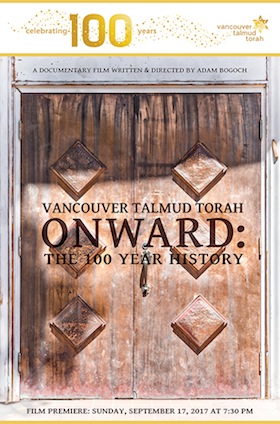
image - Vancouver Talmud Torah Onward: The 100-Year History film screening posterAs we took our interview and beer-tasting to Main Street Brewing on East 7th Avenue – and had some much-needed food – we talked about VTT Onward, the Jewish Independent’s upcoming Chai Celebration (don’t make any other plans for the night of Dec. 6!), more about film adaptations and a bit about the challenges we each face being self-employed in the arts.

“At the end of the day,” said Adam, “I’ve picked a profession that is highly competitive and doesn’t operate in any way like ‘mainstream’ careers. It’s a constant barrage of rejection and uncertainty. But I’ve been extremely fortunate to have signed with a tornado of a manager, Liz Hodgson. She’s been responsible for the careers of some notable A-list talent, both in front of and behind the camera. She’s been mentoring me consistently – one of the most common ways for writers to break into the industry on a significant level – and is currently representing my next two projects, one of which I’ve been rewriting for over six years.”

This latter script has almost been made four times, and has received multiple offers, said Adam. “I’ve taken none. This is because there’s always been something that has kept me from releasing it. That, or the deals haven’t been right.

“Recently, I’ve been working with my manager on a rewrite that will hopefully allow me to let it go…. Without over-talking it, Between Me (current title) is about a teenager battling his three personality projections who seek to push and pull him towards utterly catastrophic directions.”

We decided that Brassneck’s Bivouac Bitter could possibly represent the teenager’s negative id, its Raspberry Changeling (which was sour, not sweet) his super ego. To describe his whole character, Adam thought Main Street’s Old Knights Pale might be appropriate. We found the teen’s positive id at 33 Acres Brewing on East 8th Avenue, in Nirvana, appropriately enough.

Despite having a little more to eat at 33 Acres, the beer-tasting was having an effect on me. After more discussion about life, the VTT film screening, which was then only in the planning stages, and the JI, which Adam described at one point as the “printed record of history,” we parted ways. He was decidedly more peppy, but I slowly made my way safely home. When I looked at my watch, I couldn’t believe that six hours had gone by.

A real tête-à-tête had obviously been overdue and the beer-tasting a good idea – at least for deep conversation. As for an interview, not so much. While I took the odd note, all of the material for this article comes from an email interview after the fact.

I will next see Adam at the Sept. 17 première of VTT Onward. Even though I’ve seen it, I’m looking forward to it. I’m not the only one who was impressed by the rough cut. A few others have seen it.

“I’m blown away by the response,” said Adam. “I had no clue it would be received as well as it has been so far. I’m now confident that the community at large will find something in it that moves them and, therefore, I’m thrilled to be able to share it.


Format ImagePosted on September 1, 2017August 30, 2017Author Cynthia RamsayCategories TV & FilmTags Adam Bogoch, education, Vancouver Talmud Torah, VTT

How we memorialize the past

The most recent racist conflagration in the United States was ignited, ostensibly, by the removal (or threatened removal) of Confederate commemorative statues and plaques. We say ostensibly because it seemed some people were just itching for a fight and this issue popped up.

Each community, or each society, must determine who and what it commemorates. It is understandable that African-Americans, among others, would be offended by statues and other historical monuments that adulate those who defended slavery in the U.S. Civil War. Those who decry their removal as an “erasing of history” seem to be unfamiliar with the concept of libraries and museums, which are among the foremost repositories of history. Remembering history is different from venerating it. For example, a statue of Confederate General Robert E. Lee in front of a courthouse is an affront to equality before the law. The same statue in a museum could provide an opportunity for reflection and discussion.

Outside Budapest is a curious outdoor museum featuring dozens of statues and monuments from the communist era. It is a kitschy museum but it invites guests to ponder the propaganda of earlier eras, even admire some of it from a perspective of artwork, but it is decidedly not a place of veneration. It is a clear statement that such works, if they are to be publicly displayed, should be positioned in a way that does not esteem the ideas that inspired them, but instead invites observers to reflect on their meanings and the often catastrophic outcomes of their ideologies.

Similarly, the preservation of Auschwitz and other places of Nazi terror was not done in honour of that terrible time and the evil that defined it, but for the opposite reason: to ensure that future generations face the reality of that history and to inspire people to seek a better future. Context is crucial.

While Americans battle their demons, some Canadians have taken issue with our history and how it is commemorated. The government of Sir John A. MacDonald, Canada’s first prime minister, was responsible for implementing the residential schools system, a past with which most Canadians are only now beginning to grapple. Last month, the Ontario elementary teachers’ union said MacDonald’s name should be stripped from the nine schools in that province that are named for him. By that logic, we would eliminate his visage from our $10 bills and remove his statues and other likenesses from our public spaces.

Should we? Well, if Canadians had a thoroughgoing national discussion on the subject and a consensus clearly emerged that what was bad about MacDonald outweighs that which was good, then yes. But we should not jump in willy-nilly, thoughtlessly applying the values of today upon people of the past. To be clear: the residential schools system was an atrocity and a national disgrace; we know this now. How we attempt to rehabilitate our country and make amends for this awful history is a discussion in which we are immersed. The veneration of figures who were party to that history invites a legitimate and thoughtful reconsideration – neither those whose knee-jerk reaction is to tear down statues, nor those who reflexively balk at the very idea, are exhibiting the sort of approach we need. Ontario’s elementary school teachers, for example, may have missed the mark. If ever there were a teaching opportunity, it would be to engage young Canadians in critical thinking about why their school is named for the first prime minister, why some people think that’s problematic, and how empathy toward minorities is key to a better future.

But we should be careful in determining the measuring stick we apply. In considering the legacies of any public figure who lived more than a couple of decades ago, we would be hard-pressed to find one who would measure up to today’s standards on the rights and roles of Canadian indigenous peoples, Jews, women, gay people, or really any minorities. One might even argue: Who are we to judge? Are we assuming this generation has reached the moral summit of civilization? The state of the world today suggests we have much left to do to advance tikkun olam. Future generations will not likely give us any great kudos for perfecting humanity.

In the end, we cannot fathom how our descendants will view us and our behaviours. If, as now seems tragically inevitable, human-created climate change wreaks havoc on our world, future generations may look at our car driving, energy consumption and jet vacations as the direct cause and remove the names and likenesses of even the best of our generation from their schools and public squares.

By all means, we should consciously consider representations of our past and whether they are appropriate or inappropriate for our times. It is a discussion worth having, but we should have that discussion before we go racing around tearing down monuments and renaming schools.


Posted on September 1, 2017August 30, 2017Author The Editorial BoardCategories From the JITags Charlottesville, history, memorial, racism

Posts pagination

Previous page Page 1 … Page 428 Page 429 Page 430 … Page 669 Next page
Proudly powered by WordPress