A scene from Annemarie Jacir’s Palestine 36, which screens at the Vancouver International Film Festival Oct. 9-10. (still from film)
Bethlehem-born filmmaker Annemarie Jacir’s historical epic Palestine 36 had its world premiere Sept. 5 at the Toronto International Film Festival. It screens at the Vancouver International Film Festival Oct. 9-10.
While Jacir is an accomplished filmmaker and spokesperson for her people, her flawed drama is unlikely to bring clarity to events then – or now.
Shot in Israel, the West Bank and Jordan, and incorporating colourized archival footage from the 1930s, Palestine 36 tells the story of the Arab Revolt against the British Mandate from 1936 to 1939 through the eyes of Yusuf, played by Karim Daoud Ananya. Other stars include Jeremy Irons, Hiam Abbass and Liam Cunningham.
Depicted in Palestine 36 are characters like British High Commissioner Sir Arthur Wauchope and anti-insurgency experts Maj.-Gen. Orde Wingate and Sir Charles Tegart. Alas, they are all depicted as cartoon characters protecting Britain’s imperial interests even as they violently suppress the revolt and implement the emergency measures acts still used in Israel today. While Wingate was a Bible-quoting, onion-chomping eccentric, Jacir’s depiction of his behaviour andabsurd haircut are egregious.
What struck this reviewer most was the lack of nuance about Arab society in 1930s Palestine. (At the time, Jews called themselves Palestinians while Arabs avoided that name.)The country’s foremost leader in the years before the bloody revolt, Hajj Amin al-Husseini, does not appear in the film. Nor does rebel leader Fawzi al-Qawukji. Both escaped the British dragnet and made their way to Iraq, where they staged a pro-Nazi coup in 1941, then fled to Berlin during the war. Their bitter rivalry is well documented.
Since neither man graced Jacir’s film, there was no need to explain the clan divisions, mutual contempt and assassinations that characterized Palestine and prevented the country’s Arabs from uniting. A militant Muslim triumphalist and genocidaire, al-Husseini aimed to destroy Palestine’s Sunday People once he had dealt with the Saturday People. Perhaps surprisingly, given that Jacir is Christian, this detail was omitted. Instead, the film falsely gives the impression that, rather than being marginalized, her co-religionists fought alongside their Muslim neighbours as equals.
The natural hero of Izz ad-din al-Qassam is also missing from Palestine 36. A teacher from Syria who bravely faced the British soldiers and their bloodhounds until hunted down in the Galilee, al-Qassam’s name graces the missiles today’s Gaza terrorists lob at Israel.
Typical of Jacir’s striving for accurate details while omitting the big picture, she depicts British customs officers in Jaffa Port uncovering a barrel of smuggled Mauser rifles, but fails to mention the guns’ German source. Indeed, there’s the rub of this movie – while correctly pursuing the policy that the enemy of my enemy is my friend, the Palestinians’ alliance with Nazi Germany and Fascist Italy is not part of the story.
Judging from the 10-minute standing ovation at Roy Thompson Hall, such a huge omission is unlikely to spoil the impact of Palestine 36 in Vancouver and elsewhere. In Pallywood – and the rest of the film industry, for that matter – facts can’t stand in the way ofa good story. Indeed, Zionist mega-hits like Exodus and Cast A Giant Shadow are both kitsch films with a huge impact. Palestine 36 is likely to join them.
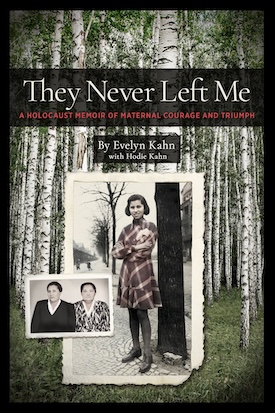
The harrowing new memoir by Vancouver’s Evelyn Kahn, They Never Left Me: A Holocaust Memoir of Maternal Courage and Triumph, written with her daughter Hodie Kahn, tells of a family’s survival while hiding in the forests of Eastern Europe.
They Never Left Me includes some of the most debasing inhumanity imaginable. Perhaps most shocking, though, is that human beings can withstand what the author and her family experienced and somehow endure and begin again in a post-Holocaust world, to raise a successful family and find meaning and happiness.
Evelyn Kahn wrote They Never Left Me: A Holocaust Memoir of Maternal Courage and Triumph with her daughter, Hodie Kahn. On Oct. 19, at Schara Tzedeck Synagogue, Evelyn Kahn will talk about the book with Dr. Robert Krell.
Stories of Chava’s (Evelyn’s) early years, typical of traditional Eastern European Jewish shtetl life – her father’s preparations for morning prayers, her mother baking round challah for Rosh Hashanah, a live fish floating around in preparation for gefilte – read as ominously ordinary, knowing as we do a little of what is to come.
From their hometown of Eishyshok, a shtetl in Poland that historically had shifted between Lithuania, Poland and then, tragically, between the Nazis and the Soviets, the family moved a few dozen kilometres to Lida, in what is now Belarus. This relocation, an economic move driven by her father’s proficiency in the Russian language, was the least dramatic move of Chava Landsman’s young life. Nonetheless, that move might have been the first of many near-miracles that saved the lives of Chava and the women in her family.
“On the eve of Rosh Hashanah 1941, Eishyshok’s Jews were rounded up and locked in the synagogue and two schools. After three days, they were herded to the horse market.… Over the next two days, the Jews were taken in groups of 250 – first the men and then the women and children – to the old Jewish cemetery. They were ordered to undress and stand at the edge of large open ditches, where they were shot to death by Lithuanian police. Babies were bashed to death against headstones or tossed into the air for sharpshooting practice led by the chief of police, Ostrauskas, before their tiny lifeless or quivering bodies were thrown into the killing pits to join their parents. Everyone was murdered.”
The final victim of the massacre was the town rabbi, “shot after being forced to witness the murder of his entire flock.”
As the Nazis invaded Lida, the family witnessed the aerial bombardment and made the decision to flee. They headed south, and sought refuge in another shtetl, Zhetel. But this was a brief refuge – not an escape. Death was chasing them.
Chava’s father was rounded up during a cull of intelligentsia on July 23, 1941, barely a month after they arrived.
“We watched in misery as Papa climbed into the back of a truck and was driven away,” she writes. “I never saw my father again.”
Chava’s Uncle Chaim and Rivke’s husband Shael were conscripted into the Red Army, leaving the women as the only family together in the Zhetel ghetto, which was created in February 1942. Chaim was captured by the Nazis, but incredibly escaped a POW camp and returned to Zhetel, where he became a Partisan in the forest and was killed. On April 30, 1942, the first liquidation began in the Zhetel ghetto.
“My own memory of the procession along the street is of being corralled into a narrow funnel and of feeling smothered by the crush of human bodies around me,” she writes. “I remember telling my mother I could not breathe. I was worried I might pass out and be trampled. People were on top of one another – on top of me – crying and tearing their hair out. I wanted Mama to pick me up, but it was impossible. We were compressed like livestock in a cattle chute. I just held onto Mama’s hand and prayed that mine would not slip out of hers.”
In terror, Chava told her mother she was being suffocated.
“She bent down close to me and I will never forget her tearful words,” Kahn writes. “My child, it is better that you should suffocate here than my eyes should witness you being murdered.
“I took in what she said and then simply asked, ‘Does it hurt to die, Mama?’ She assured me it was a peaceful experience. ‘Neyn mayn kind, es iz vey a feygele, git a brum’ (‘No my child, it is like a chirp of a bird’).
“Her answer quieted my fears and calmed me. I was never afraid of death from that moment on. I never remember feeling despair. On the contrary, I was exceptionally calm and clear throughout the nightmare to come.”
Somehow, the women survived the first liquidation. When the second and what would be the final liquidation of the ghetto began on Aug. 6, 1942, 3,000 Jews were herded to the Jewish cemetery and murdered. Knowing what was to come, Chava’s mother Basia decided to risk going into hiding – a choice between instant death and likely later death for disobedience. Again, it was a lifesaving decision.
Basia, Chava and her grandmother (Bobe) Hoda fled to the forest. Miraculously, with the help of a non-Jewish friend of the family, they were reunited with Chava’s Aunt Rivke, and the three adult women and Chava would endure the horrors of life in the woods for two years. (Shael fought with the Red Army through the war and survived, but he and Rivke did not reunite.)
The women largely fended for themselves with some assistance from Partisans and the occasional righteous non-Jew. Like other Jews in the forests at the time, they formed fluctuating ad hoc survival “family groups” of a dozen or as many as 20 people.
“We had learned the rules of the ghetto and we had survived. Now we would have to learn the rules of the forest. And we would have to learn them very, very well and very, very quickly. We could either adapt and hopefully live or not adapt and definitely die.
“We lived with the constant nervous anticipation of being discovered and killed at any moment. We were careful to speak quietly. We were always alert. We became as hypersensitized and wary as the creatures of the forest.”
In winter, they sheltered in holes in the ground.
“Needless to say, hygiene and maintaining our health in the forest was hugely challenging,” Kahn writes. “We were malnourished and vitamin deficient. We were unwashed and unkempt. We wore the same clothes day after day with no relief. We were filthy skeletons, bulked up only by the layers of our lice-infested clothing, which we wore 24 hours a day. I often wonder how we managed to survive those two years without bathing.”
Basia’s doggedness saved her family. Even at 40 degrees below zero and with snow to her thighs, she would trudge out of the woods to beg or steal provisions from local farmers.
“It is true that many (most) farmers were unfeeling or, worse, informers. But it is important to acknowledge that there were those who hung onto their humanity during the war, righteous gentiles who were sympathetic and compassionate and gave us food and other necessities,” Kahn writes.
It is estimated that only one-half to one-third of the Jews who hid in forests survived to liberation. And, when “liberation” did come, and the Nazis were defeated, antisemitism remained. Many ordinary Russians, Poles, Lithuanians and Belarusians thought they had seen the last of the Jews and were not welcoming to the few straggling remnants who found their way back home.
The three generations of women – Bobe Hoda, mother Basia, Aunt Rivke and Chava, as well as Rivke’s baby, Joseph, who was born in and knew life only in the forest – remarkably survived and proceeded through a series of displaced persons camps, with schooling and vocational training for the young survivors. They had no family in the new state of Israel and so America seemed the more logical destination. At age 16-and-a-half, Chaya/Evelyn, her mother, aunt, cousin and grandmother were greeted at New York by the Statue of Liberty and a coterie of cousins. Eventually, Evelyn reconnected with a young man from Eishyshok, Leon (Leibke) Kaganowicz, who would become Leon Kahn and, because of American migration quotas, a Canadian who lived in Vancouver. Together, they became stalwarts of the Vancouver community.
Leon Kahn passed in 2003. His memoir, No Time To Mourn: The True Story of a Jewish Partisan Fighter, was published in 1978 and reissued in 2004. It will be released again this fall.
Evelyn has two sons, Mark and Saul, and daughter Hodie, as well as seven grandchildren and three great-grandchildren.
The idyllic start of Chava’s life, surrounded by a tight and loving family and community, juxtaposes horrifically with the abrupt cataclysm of history that would follow. The survival of three generations of women in the forests of Eastern Europe is a monument to human resolve and resilience. They Never Left Me is a momentous contribution to the literature of the Holocaust.
An event featuring Evelyn Kahn in conversation about the memoir with Dr. Robert Krell will take place on Oct. 19, 2 p.m., at Schara Tzedeck Synagogue, presented by the Vancouver Holocaust Education Centre, Ronsdale Press and Schara Tzedeck.
The Vancouver Recital Society welcomes the multiple-award-winning Jerusalem Quartet back to the city for a concert at the Vancouver Playhouse Oct. 19. The program features works from Hadyn, Janácek and Beethoven.
This year marks the 30th anniversary of the establishment of the Jerusalem Quartet. Since their first appearance for the VRS in 2001, the ensemble has become a regular and beloved presence on the world’s concert stages. They have appeared many times in Vancouver, and a highlight in the annals of the VRS was their five-concert performance of all the Shostakovich string quartets in the Telus Theatre at the Chan Centre in 2006. They are returning to Vancouver to perform the same program they played in their Wigmore Hall debut 25 years ago, an appearance that launched them to international fame. It features Hadyn’s Quartet in B-flat major, Op. 76, No. 4 (“Sunrise”); Janácek’s Quartet No. 1 (“Kreutzer Sonata”); and Beethoven’s Quartet in B-flat major, Op. 130, with the Grosse Fugue finale, Op. 133.
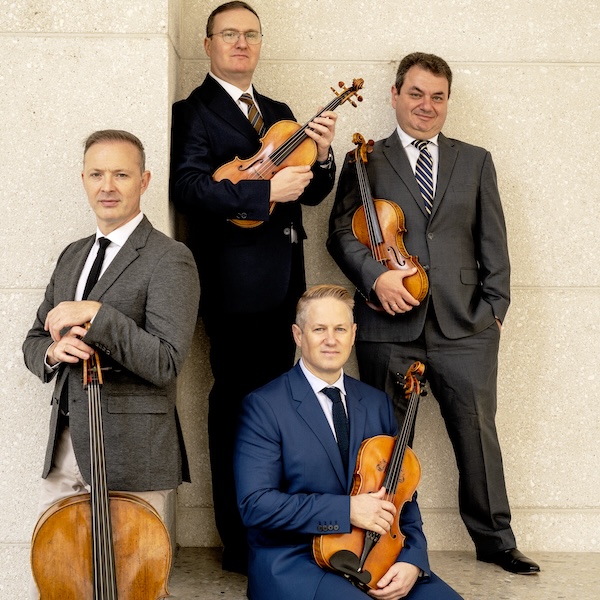
The Jerusalem Quartet is Alexander Pavlovsky (first violin), Sergei Bresler (second violin), Kyril Zlotnikov (cello) and Ori Kam (viola). Both individually and as the quartet, the musicians have performed around the world, garnering numerous accolades.
Born in Ukraine, Pavlovsky immigrated with his family to Israel in 1991, and is a graduate of the Jerusalem Academy of Music and Dance.
Bresler was also born in Ukraine. He started to play violin in age of 5 and, at the age of 12, gave his first recital. He immigrated to Israel in 1991, where he studied at the Rubin Academy of Music and Dance in Jerusalem.
Zlotnikov also studied at the Rubin Academy, having begun his studies at the Belarusian State Music Academy, and Kam, who was born to Israeli parents in La Jolla, Calif., grew up in Israel and studied there, as well as in the United States and Germany. Kam started his musical education at the age of 6, began playing the viola at 15 and had his debut at age 16.
The Jerusalem Quartet has found its core in a warm, full, human sound and an egalitarian balance between high and low voices. This approach allows them to maintain a healthy relationship between individual expression and a transparent and respectful presentation of the composer’s work. It is also the drive and motivation for the continuing refinement of their interpretations of the classical repertoire, as well as exploration of new epochs.
In 2019, the quartet released an album exploring Jewish music in Central Europe between the wars and its far-reaching influence, featuring a collection of Yiddish cabaret songs from 1920s Warsaw, as well as works by Schulhoff and Korngold. The second instalment of their Bartok quartet recording was released in 2020. Starting this year, the quartet began recording exclusively for BIS records, with their first release featuring three quartets by Shostakovich: Nos. 2, 7 and 10.
Although the Quartet No. 2 was composed in 1944, it makes no direct reference to the war; yet, this is a substantive work, dark, powerful and, at times, dissonant. Quartet No. 7, consisting of three short movements played without interruption, is an enigmatic and deeply personal work dedicated to the memory of the composer’s wife. For all its questioning and complex inner references, Quartet No. 10 is among the most immediately appealing of Shostakovich’s later works. By this stage in his life, his music tended to speak in a quieter voice and to a more intimate audience.
The Jerusalem Quartet’s performance at the Playhouse on Oct. 19 starts at 3 p.m., but there is also a pre-concert talk, at 2:15 p.m. For tickets, visit vanrecital.com.
Rudolf Vrba, in the 1960s. (photo from University of British Columbia. Archives)
Rudolf Vrba’s escape from Auschwitz and testimony helped alert the world to the horrors of the Holocaust, and Vrba is credited with saving the lives of more than 100,000 Hungarian Jews. On Oct. 26, 2 p.m., at Schara Tzedeck Cemetery Chapel in New Westminster, a commemoration ceremony will be held for Vrba. The program will feature reflections on his life, legacy and enduring impact from Dr. Robert Krell and Dr. Joseph Ragaz, and will conclude with the dedication of a memorial monument inVrba’s honour.
Lorin Sklamberg, left, Sasha Lurje and Craig Judelman close the 10-day festival of comedy, music, theatre, dance and storytelling on Nov. 23 with Yiddish Songs of Social Change. (photo from Chutzpah! Festival)
The Chutzpah! Festival returns for its 25th anniversary with a mix of festival favourites and new discoveries in a lineup of performances Nov. 12-23, showcasing music, theatre, comedy, dance and storytelling through a multicultural Jewish lens.
“This Chutzpah! Festival is one of collaboration and celebration, combining past artistic managing director Jessica Gutteridge’s vision and my own,” said the festival’s new artistic managing director, Shayna Goldberg. “Chutzpah!’s legacy over the last 25 years has been to share diverse work from a multitude of Jewish perspectives, and the offerings this year are just as thrilling and exciting as any other. For 10 days this November, come and experience the best of what Canadian and international artists have to offer.”
Israeli-American comedian Modi Rosenfeld brings his Pause for Laughter Tour to Vancouver on Nov. 12 to open the festival. (photo from Chutzpah! Festival)
The festival opens Nov. 12, 8 p.m., at the Vogue Theatre with Modi Rosenfeld, presented in partnership with MRG Live. The Israeli-American comedian brings his Pause for Laughter Tour here for the festival.
Erik Angel, also an Israeli-American comedian, brings his project Comedy for Peace to Chutzpah! on Nov. 22, 7:30 p.m., at the Rothstein Theatre. Aimed at uniting communities through humour and mutual understanding, Comedy for Peace brings together stand-up comedians – Jewish, Christian, Muslim – for a show of “no politics. just laughs.” Joining Angel will be Ashley Austin Morris, Natan Badalov and Zara Khan. (See jewishindependent.ca/comedy-can-unite-and-heal.)
Chutzpah presents the West Coast debut of 8 Gays of Channukah: The Musical (Canada) at the Rothstein Theatre Nov. 13, 7:30 p.m. Blending Broadway-style musical numbers with comedy, drag artistry and Jewish joy, eight stories are brought to life by show creators Gila Münster, Sarah Freia and Yan Simon. The show includes an opening act by a local artist and there will be an 8 Gays of Channukah Shuk, featuring the work of local artisans, where you can pick up some gifts for the holidays.
Lea Kalisch’s Shtetl Cabaret (Switzerland/United States/Canada) is a night of collaborations featuring Tobias Moss and local Vancouver artists including Mike Braverman and Jason Overy. This show, which takes place Nov. 19, 7:30 p.m., at the Beaumont Studios (19+ venue), presents Jewish music, from forgotten melodies to original songs, and mashups from rap to rumba and folk to feminism.
Yiddish Songs of Social Change (United States/Germany/Latvia), presented by the Golden Thread Septet, explores Yiddish music as a tool for and reflection of social change, and features Lorin Sklamberg and Sasha Lurje, with arrangements by Craig Judelman. Judelman has arranged the Yiddish and English songs in a style that reflects the context of the songs themselves and honours the centuries-old tradition of using all these influences to inform the creation of new Yiddish music. In addition to the performance on Nov. 23, 7:30 p.m., at the Rothstein, Sklamberg, Lurje and Judelman will lead a free workshop about Yiddish music and dance that same day, at 2 p.m. Come explore both traditional and contemporary versions of Yiddish music and learn how you can dance along.
Back by popular demand, Chutzpah! and Vancouver Opera present Ne. Sans Opera & Dance’s Take This Waltz: Celebrating the Music of Leonard Cohen (Canada/Israel). This operatic and contemporary dance performance inspired by Canadian singer-songwriter Leonard Cohen was originally presented in 2022 as a Chutzpah! Plus event. Created by local choreographer Idan Cohen and bass-baritone Daniel Okulitch, it features Okulitch alongside dancer/musician Ted Littlemore and a virtuoso live ensemble of strings and accordion. Take This Waltz is at the Rothstein Theatre Nov. 15 and 16, 7:30 p.m. (See jewishindependent.ca/celebrating-leonard-cohen.)
On Nov. 20, 7:30 p.m., at the Rothstein Theatre, Chutzpah! presents the North American premiere of Common Place (Australia/Israel) by power-duo dancer/choreographer Omer Backley-Astrachan and multiple-award-winning dancer Jana Castillo. Common Place is a physical exploration of belonging and togetherness, delving into shared action, collaboration and synchronization.
Deb Williams returns to Chutzpah! with the Flame, an evening of storytelling, on Nov. 17, 7:30 p.m., at the Rothstein Theatre. The Flame is a grassroots series where real people share their personal, true stories in front of an audience under Williams’s direction. This edition will feature a multicultural group including Karen Segal, Dhana Musil and others. Williams will also host an in-depth weekend workshop prior to the event (Nov. 15 and 16, at the Post at 750) to help storytellers hone their craft.
On Nov. 18, 7:30 p.m., at the Rothstein, Chutzpah! presents I’m Not a Comedian … I’m Lenny Bruce (United States), a one-man show exploring the life and battles of one of the most groundbreaking comedians of all time, Lenny Bruce. Created and performed by Ronnie Marmo and directed by Tony Award-winner Joe Mantegna, this show threads Bruce’s original comedic bits with insights from his writings.
Other workshops and talkbacks with festival artists, facilitated by members of the Vancouver arts community, will run throughout the festival. Visit the festival website for updates and registration information.
Most single tickets for Chutzpah!’s live performances are offered at a pay-what-you-will price, with the levels at $18, $36, $52 and $70 (+ gst/sc). I’m Not a Comedian … I’m Lenny Bruce is $40 (students/seniors), $54 (general) and $72 (VIP) (+gst/sc). ChutzPacks are also available, for $136: see four different regular-price shows of your choice. Tickets for Modi can be purchased through admitone.com/events. For tickets to any of the performances and more information about any of the events, visit chutzpahfestival.com or call 604-257-5145.
Leaders are simply people, of course. And all people have strengths and weaknesses. Just like the traditional approach to weaving Persian rugs with an intentional mistake, we must remember that only the Almighty is perfect.
But some leaders become lionized and celebrated, their human failings swept under the rug (sorry). However, we’re in a political moment where some leaders’ mistakes are all too obvious. No need to name anybody. Many fit this description. It’s upsetting and confusing to realize that even those chosen as “the best” or “brightest” fail sometimes. It’s a useful learning experience, too.
Awhile back, I was discussing politics online with other Canadians. I came upon something that stopped me cold. A poster criticized a political leader. I asked what she saw as solutions. The questions I asked were how, if she were in charge, she’d do things differently.
Her response surprised me. She said the only thing she could do was vote and complain. That, essentially, it was her right to find fault, but not her obligation to offer solutions. Her opinion was that she wasn’t passive because, well, she voted consistently and complained vociferously.
From a Jewish perspective, we have plenty of examples of whiners. Remember the Israelites, wandering in the desert, who wanted to go back to Egypt because they didn’t have meat, fish, onions, garlic, leeks or cantaloupes? (Numbers 11:4-5) It’s a normal response to crave foods when you’re unable to get them. As a high schooler studying abroad, I craved M&Ms so much that my mother brought them when she visited. They were superfluous, but I wanted them.
The opportunity to complain is always available, but it’s unattractive, especially if there’s something you can do to fix the problem yourself. Since that high school moment, I’ve lived many places where I’ve craved food but couldn’t buy it locally. As a result, I’ve become a more creative cook. When traveling, it’s good to “load up” on cravings if they’re available. Not to hoard, but just as an extra pleasure.
Worldwide political upheaval made me study the Babylonian Talmudic tractate of Horayot with more interest. It’s a small part of the Talmud but it’s about how people in charge (kings, high priests, judges, teachers, etc.) can make amends or do the right sacrifices or actions to atone for their mistakes. This text assumes that there will always be errors in judgment. People in certain important positions have societal roles to play, and that means their atonements to seek forgiveness for errors must be bigger sometimes than if they were private citizens.
This may sound irrelevant but consider the role of a teacher. Teachers make mistakes. The best resolution to this would be a public acknowledgement of the error and a demonstration of how to fix it. We might shrug and get on with things after a private math mistake. Yet, if a math teacher makes this error in front of the class, the best lesson is having a student find and correct the error. Then, the teacher can perform the act of learning from their error, thank the student, and acknowledge that no one is perfect.
In our lives, even if we are not teachers, parents, supervisors, or in any authority roles, it’s a great idea to try to practise this approach: to remember that no one is perfect and that it’s all our jobs to find solutions. As Rabbi Tarfon teaches, “that it’s not upon us to complete the work, but neither are we free to stop doing it.” (Pirkei Avot 2:16)
This sounds simple. But, in the tractate of Horayot, there’s a very powerful ending about how our pride and ego can get in the way. It’s about three rabbis and their leadership roles: Rabban Shimon ben Gamliel (Rashbag) was the leader of the Jewish community in the Galilee during the late second century, after the Bar Kochba Revolt; the head of the court was Rabbi Natan; and a great scholar at the time was Rabbi Meir.
Rashbag is upset with a lack of protocol in the Torah academy. He wants everyone to stand when he comes in until they’re told to be seated. Rashbag suggests that, for Rabbi Natan and Rabbi Meir, who he perceives as less important, those studying should rise when they enter, but students can sit down again right afterwards. Rabbis Meir and Natan try to put Rashbag to an intellectual test to prove that he isn’t above them, but Rashbag finds out in advance and bests them.
Rabbis Meir and Natan are expelled from the Torah academy and forced to study outside. However, the academy couldn’t continue without their expertise, so there was the ancient equivalent of paper airplane communication happening. The expelled rabbis would throw questions into the academy, students would try to answer. If the students couldn’t, they’d ask for more help.
Obviously, this was a bad way to learn. Rashbag was forced to readmit the scholars, but only with the proviso that their rulings couldn’t be under their own names. Essentially, the glory of Torah was more important than the glory of Torah scholars. This remained true for all except for Rashbag and his descendants, who insisted on maintaining their grudge and hereditary leadership and denying these two learned men their due.
Where does that lead us? Leaders are fallible. Each of us has the potential to uplift, lead and find solutions. When necessary, we need to stop being passive and lead more. Sometimes, that means trying to avoidbig egos or coming up with creative responses to difficult problems. It can feel uncomfortable to raise our voices and act, if we’re used to letting others do the hard work. Also, we need allies to help make change. This means building connections with others, particularly outside the Jewish community.
The pressing example for the Canadian Jewish community is our political leaders’ refrain after antisemitic incidents: “This isn’t who we are as Canadians.” Well, in fact, it is who we are, as evidenced by the dramatic rise in hate crimes. We have leaders who aren’t acting to solve this problem. It’s getting worse. In response, we must step up and ask our allies to do so, too. Nobody’s perfect. People make mistakes. That said, we must hold leaders – and all those passive followers – to account if we expect to remain safe in Canada. It’s time to find solutions. Complaints alone don’t cut it.
Joanne Seiffhas written regularly for the Winnipeg Free Press and various Jewish publications. She is the author of three books, including From the Outside In: Jewish Post Columns 2015-2016, a collection of essays available for digital download or as a paperback from Amazon. Check her out on Instagram @yrnspinner or at joanneseiff.blogspot.com.
Jewish Addictions Community Services (JACS) welcomes two members to its team.
Jordana Jackson, JACS’s new addictions specialist, is a certified addiction counsellor. In addition to having a wealth of experience working in addiction and recovery spaces throughout Vancouver Coastal and Fraser Health authorities, she is the founder and director of AWARE (Addicts With Aspirations Recovery Entertainment), a therapeutic performance-arts program. Jackson is already making a difference at JACS, creating navigation support structures and providing counseling for clients.
Elana Epstein, JACS’s new group facilitator, is a certified recovery coach. More importantly, she has years of experience being a mother of a child who struggled with addiction and is now in recovery. At JACS Family Circle, Epstein is using both her spiritual and professional skill sets to hold space for individuals whose friends and family have been affected by addiction. These group counseling sessions are an important aspect of JACS.
* * *
Elvira Molochkovetsk takes on the role of a community connector in Victoria. This position is a joint Jewish Federation of Victoria and Vancouver Island (JFVVI) and Jewish Federation of Greater Vancouver project. Her goal is to connect and engage all community members but, in particular, those who do not attend any existing synagogue or Jewish association.
Over the past two years, Molochkovetsk has been part of the JFVVI as a PJ Library parent, volunteer, connector and, for the past year, as PJ Library coordinator for Vancouver Island and the Gulf Islands. PJ Library has focused on connecting people with children up to the age of 13 and, in her expanded role as a connector, Molochkovetsk will be expanding it to reach out to teenagers, seniors and young entrepreneurs.
The parents of four kids, Molochkovetsk and her husband, Dimitri, have run family businesses for the last decade. Almost three years ago, they moved to Victoria from Winnipeg, where they lived for seven years. They both grew up in Israel and have family there.
חברת הלואו קוסט הקנדית אייר טרנזיט החלה לטוס ישירות בקו טורונטו ברלין. קו זה מאפשר לישראלים שמגיעים לברלין להמשיך בטיסה ישירה לטורונטו. הקו החדש יופעל בשלב זה רק בחודשי הקיץ: מטורונטו לברלין בימים חמישי וראשון ומברלין לטורונטו בימים שני ושישי
הקו החדש הוא בשורה טובה לישראלים שרוצים לטוס לקנדה. זאת, לאור העובדה שאל על הפסיקה את הטיסות הישירות שלה בין ישראל לקנדה לפני כשלוש שנים. ואילו חברת התעופה לאומית של קנדה אייר קנדה לא טסה כרגע לישראל לאור המצב הבטחוני המסובך
למי שבוחר לטוס באייר טרנזיט לטורונטו יש אפשרות גם לקחת טיסות המשך בשיתוף החברה הקנדית הנוספת ללואו קוסט אייר פורטר, ליעדים נוספים בקנדה בהם: מונטריאול, ונקובר, קלגרי, אדמונטון והליפקס. או להגיע בטיסות המשך מטורונטו ליעדים בארה”ב ובהם: לאס וגאס
הטיסות של אייר טרנזיט מטורונטו וברלין ובחזרה מתקיימות באמצעות מטוסי איירבוס החדישים שכוללים מאה שמונים ושבעה מקומות במחלקת תיירים, שמונים ושבע מקומות במחלקת הפריום ועוד שנים עשר מושבים במחלקת העסקים. אגב משך זמן הטיסה בין ברלין לטורונטו נאמד בכתשע שעות
הטיסות של אייר טרנזיט מברלין לטורונטו מאפשרות גם גישה נוחה לקנדה לנוסעים ממדינות נוספות באירופה בהן צרפת, בלגיה, הולנד ושוויץ
אייר טרנזיט שמתמחה בעיקר בחבילות נופש ליעדים באירופה, ארה”ב והאיים הקריביים נבחרה לאחת החברות הטובות בתחום זה בשנים האחרונות
ואילו חברת התעופה הלאומית של איחוד האמירויות איתיחאד שחידשה לאחרונה את טיסותיה לישראל, כחלק מההתעצבות הגלובלית שלה, חנכה לאחרונה קו טיסות ישיר בין אבו דאבי לטורונטו. קו זה מאפשר לישראלים לטוס ישירות לאבו דאבי ומשם להמשיך ישירות לטורונטו. הקו החדש בין אבו דאבי לטורונטו באמצעות מטוסי איירבוס החדישים מגדיל את הקיבולת של החברה של איחוד האמירויות בכשלושים אחוזים. ובכך החברה מגיעה ללמעלה ממאה יעדים בעולם תוך שימוש בצי מטוסים מתקדמים. מדי חודש החברה מטיסה קרוב לשני מיליון נוסעים בקווים השונים שלה
צי המטוסים של חברת איתיחאד מונה כיום מאה במספר כולל חמישה מטוסי מטען
איתיחאד כידוע טסה ישירות לישראל ומאפשרת לישראלים להגיע למגוון רחב של יעדים ברחבי העולם, באמצעות טיסות המשך משדה התעופה של אבו דאבי
הקו החדש בין אבו דאבי לטורונטו של איתיחאד כאמור מאפשר לנוסעים מישראל אפשרות להגיע לטורונטו, בדומה לאפשרות להגיע לברלין ומשם להמשיך באייר טרנזט הקנדית לטורונטו
כידוע לחברת התעופה של אחיד האמירויות איתיחאד יש מחלקת עסקים מפוארת ביותר שכוללת תאים פרטיים סגורים עם חדר שינה, מיטה פרטית וכורסה אישית ומקלחת
קנדה תכיר במדינה הפלסטינית
ראש ממשלת קנדה, מארק קרני, הודיעה לאחרונה כי קנדה מתכוונת להכיר במדינה הפלסטינית במושב השמונים של האו”ם שיערך בספטמבר. הוא הוסיף כי הכוונה להכיר במדינה הפלסטינית כרוכה במחויבות של הרשות הפלסטינית לבצע רפורמות נחוצות ומשמעותיות ביותר, לקיים בחירות כלליות בשנה הבאה ללא החאמאס, ולפרק את המדינה הפלסטינית מצבא. קרני ציין עוד כי קנדה עובדת יחד עם מדינות נוספות לקיים את פתרון שתי המדינות, ישראל ולצידה מדינת פלסטין, שהוא הולך ונשחק מול עיננו
זאת לאחר שבמהלך ועידת שתי המדינות שהתקיימה לאחרונה במטה האו”ם בניו־יורק ביוזמת צרפת וסעודיה, הכריזו מדינות נוספות על כוונתן להכיר במדינה פלסטינית, במסגרת העצרת הכללית של האו”ם הצפויה להיערך בספטמבר הקרוב. קנדה מצטרפת אפוא למדינות נוספות שהחליטו להכיר במדינה הפלסטינית ובהן צרפת, בריטניה,מלטה, ספרד, אירלנד ונורווגיה
On Sept. 30, Canadian Friends of Sheba Medical Centre will host Medicine Reimagined, an evening with Prof. Amitai Ziv, deputy director of Sheba Medical Centre and head of its Rehabilitation Hospital, which is the national rehabilitation facility of Israel. Ziv is also the founder and director of the Israel Centre for Medical Simulation (MSR), an innovation hub for improving patient safety and clinical training.
Originally from Montreal, Ziv is spending his sabbatical in Vancouver at the University of British Columbia.
“This will be the first Canadian Friends of Sheba event in Vancouver, as we launch our chapter here, and we are truly thrilled to welcome Prof. Amitai Ziv,” Galit Blumenthal, manager of donor relations and events at Canadian Friends of Sheba Medical Centre, told the Independent. “Our goal is to raise awareness of Sheba Medical Centre and highlight its profound impact both in Israel and on the global stage.”
Prof. Amitai Ziv, deputy director of Sheba Medical Centre and its Rehabilitation Hospital, speaks in Vancouver on the topic Medicine Reimagined. (internet photo)
Sheba Medical Centre was established in 1948. Located in Tel HaShomer, near Tel Aviv, its website notes the facility has 159 medical departments and clinics, almost 2,000 beds and 75 laboratories, and receives about 1.9 million clinical visits and 200,000 emergency room visits a year. Its seven major facilities comprise a cancer centre, an academic campus, a research complex and four hospitals: children’s, women’s, acute care and rehabilitation. It also has several centres of excellence and institutes, notably for cancer, and heart and circulation. It counts 10,000 healthcare professionals, 1,700 physicians and 200 PhD research professionals.
“I support them, along with many other Israeli institutions, as I feel that this is at least some contribution that I can make during these difficult times,” said Tova Kornfeld, who connected Canadian Friends of Sheba Medical Centre (CFSMC), which is based in Toronto, with the Independent.
“I sometimes feel powerless living here in Canada when I see what is happening in Israel,” said Kornfeld. “If I can help in any way, whether by bringing awareness to the work being done by the various organizations or by making financial contributions, then I feel I must. As far as Sheba is concerned, it stepped up to the plate when Soroka Hospital was hit by an Iranian missile and took in all the ICU patients.
“It is also the biggest rehab hospital in Israel and is providing rehabilitation for thousands of soldiers who have been injured since Oct. 7,” she added. “I have family members in the IDF and it is comforting to know that, if something were to happen to any of them, there would be hospitals like Sheba to care for them.”
Ziv’s areas of expertise are medical education, simulation and rehabilitative medicine, and he has served as a consultant and speaker at academic and health institutions around the world. The event in Vancouver will offer a look at Sheba Medical Centre and its innovations in, among other things, the rehabilitation field.
On Sept. 30, Vancouverites will also get to meet Einat Enbar, chief executive officer of CFSMC, which was established in 2017 to raise awareness and funds for Sheba Medical Centre, the care it offers, the research it conducts and the educational training it provides.
For Kornfeld, there is another aspect to supporting Israeli organizations and institutions. She hopes that financial and other assistance from the diaspora “gives the Israelis caught in the fray the message that we have their backs and that we are all in this together regardless of where we live. I would hope that this would be comforting to them when it appears that most of the world is against not only Israel but the Jewish people themselves.”
For more information on CFSMC and SMC, visit shebacanada.org. To attend the Sept. 30, 7 p.m., event in Vancouver (location upon registration), go to weblink.donorperfect.com/ProfAmitaiZivInVancouver. While free to attend, donations are welcome. Readers can email Blumenthal at [email protected] with any questions.