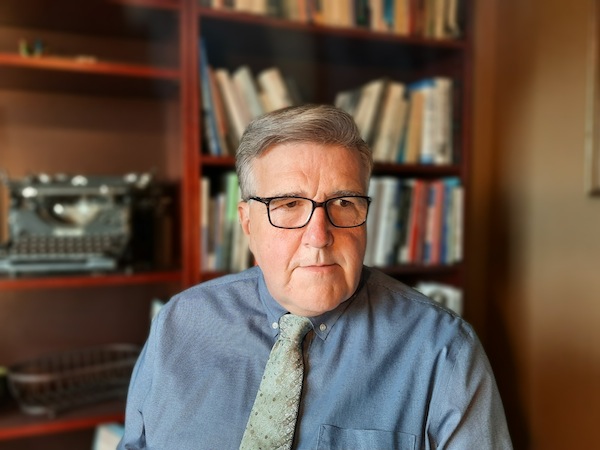
Pat Johnson, founder of Upstanders Canada. (photo by Paul Tillotson)
There has been a widening split between many progressive movements and the Jewish community in recent decades, according to Pat Johnson, the founder of Upstanders Canada. His Vancouver-based organization aims to encourage Canadians – especially non-Jewish Canadians – to stand against hatred of all kinds, but particularly against antisemitic words and deeds.
“You can make whatever justifications you want about what is wrong with Israel or criticize the government, but if a progressive movement finds itself at odds with 80% of Jewish people, then that is a sign that something is wrong with your worldview,” said Johnson, a member of the Jewish Independent’s editorial board.
“I have been watching as many people within the Jewish community became skeptical of the left – which their parents had built in this country. It is a betrayal.”
Long involved with progressive causes, such as gay rights, gender equality and interfaith dialogue, Johnson observed a rift forming amid the left and the Jewish community at the time of the Second Intifada that began in the Middle East in 2000.
“When Yasser Arafat turned to violence and the world, led by progressives, sided with the violence instead of demanding he return to the negotiating table, that is when the global left went off the rails,” he posited.
Johnson maintains that the North American left, with few exceptions, has let down the Jewish people. “If you do not believe in the Jewish people’s right to self-determination and that is the only people you do not support, then there is a problem in your movement.”
An ardent supporter of Israel, this was the genesis of his cognitive dissonance with the left. “I am a progressive Canadian and a fervent Zionist and there is nothing contradictory about that,” said Johnson, who is not Jewish. “What is contradictory is calling yourself a progressive and not supporting the Jewish people’s right to self-determination. I might not fit on the left any more but that is not because of me. It is because of them.”
The tipping point for Johnson happened in October 2018 on a return flight from Israel. On the airplane, he learned of the mass shooting at the Tree of Life synagogue in Pittsburgh. He realized then the need to launch Upstanders Canada.
“I thought somebody has to do something, I guess that someone could be me. We can’t pretend any more that this is not a serious problem in North America,” he said. “The Jewish community has always had to fight their battles themselves while progressives are standing up as allies to every socio-cultural group except Jews.”
An example Johnson uses to demonstrate this point is how many progressives have taken it upon themselves to disagree with the definition of antisemitism developed by the International Holocaust Remembrance Alliance. This, he asserts, they would not do with any other group. “When you treat the Jewish people differently than any other group in society – that is problematic,” he contended.
Antisemitism can be a “perfect prejudice,” he added, as Jews are deemed powerful by many, including those on the left. Thus, though most progressives may think antisemitism is not right and not view themselves as antisemitic, there is an element of “sticking it to the man and that the Jewish people will be just fine.”
“There is a theory that whatever happens to the Jewish people happened because they brought it on themselves and it is not something we say with any other group. Progressives will never say that any other victim of a hate crime brought that act upon themselves,” said Johnson.
A solution, Johnson believes, is for supporters of Israel to stop arguing with the people who will never agree with them. Instead, what should be done is to identify and mobilize the people who agree with Israel’s right to self-determination and don’t need convincing.
To Upstanders Canada, antisemitism is not a Jewish problem – it is a non-Jewish problem with serious implications for Jewish people. It is a problem created by non-Jewish people that needs to be confronted by non-Jewish people, said Johnson.
Upstanders Canada takes no position on issues that deserve to be resolved by Jewish people or the state of Israel, he said. Rather, it is based on the belief that Jewish people have a right to live safely and free from fear everywhere in the world.
The organization is currently building its database of allies. They welcome everyone, including those in the evangelical community and those communities in which antisemitism has surfaced, such as political parties on the left and trade unions.
In the past few months, Johnson’s letters have appeared in several newspapers across the country, reminding Canadians to be vigilant in the fight against bigotry and hatred.
Johnson has a long-standing connection to the Jewish community. In addition to being a regular contributor to the Independent, he has worked with numerous organizations: Hillel BC, Canadian Jewish Congress, the Vancouver Holocaust Education Centre and the Louis Brier Home and Hospital.
“I don’t have the short answer for how I wound up in the Jewish community, so I just say bashert [destiny],” Johnson said.
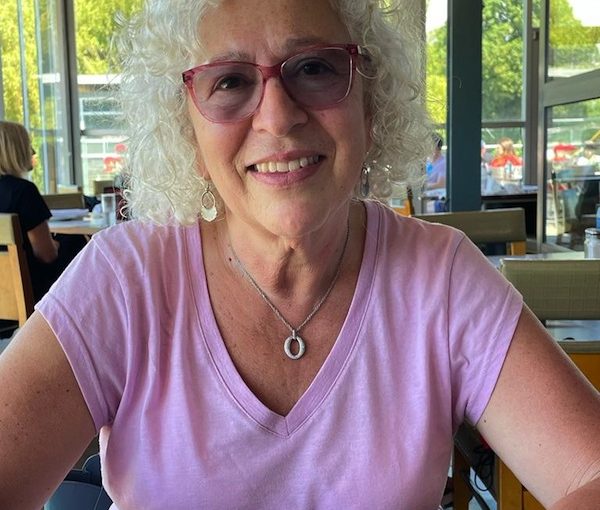
Helen Pinsky still chairs Waldman Library’s Jewish Book Club, which she started in 2015 when she was librarian there. (photo from Helen Pinsky)
Helen Pinsky founded the Waldman Library’s Jewish Book Club in 2015, when she was the librarian there. She has since retired from the position but stays on as the book club chair.
“We started it as a drop-in,” Pinsky told the Independent. “Always once a month, on a last Thursday. People drifted in gradually. Some were library volunteers who wanted to discuss their recent reads. Others were readers who wanted to talk about books. Waldman had book clubs before, on and off for years, but this one has lasted the longest.”
She defined the club’s goal: to foster the love and understanding of books written by Jewish authors or featuring Jewish content. “We try to select books that are entertaining, interesting to many readers. Mostly we read fiction,” she said. “Rarely, we try non-fiction books, but unless they are memoirs, not many people are eager to read or discuss them. We even attempted a separate non-fiction club, but it didn’t work.”
The books selected come from different sources. “I’m a librarian. I listen to what people want to read,” said Pinsky. “Sometimes, I select the books myself. Other times, the library staff might make a suggestion, or the group would vote on the title or author.”
The books that club members have read so far are divided between English-language writers and translated novels. “There are so many outstanding Israeli writers,” said Pinsky. “Our chosen books are not always new. Some of them were published a number of years ago. Often, they are not easy reads.”
But new or old, easy or sophisticated, they are always books with brilliant writing and complex ideas – “great literature exploring universal themes,” she said.
Generally, the club reads mainstream fiction. “We often read historical literature,” Pinsky said. “Not so much about the Holocaust and wars, but stories about Jewish life in other centuries and other countries. Some of our most captivating recent novels talked about the post-Holocaust decades, about the survivors rebuilding their lives.”
To find books for the club, Pinsky regularly scours the Jewish Book Council website. She reads reviews on Goodreads and Amazon. She seeks recommendations from the National Council of Jewish Women.
“We always choose books with multiple copies at the Waldman, as well as at the VPL [Vancouver Public Library] and the Richmond library, so people are not forced to buy them. Occasionally, the book was donated. Then it makes a round on a goodwill system, so every member of the club can read it. We usually announce the titles three or four months in advance, to give people time to read the books.”
The club’s facilitator from the beginning, Pinsky tries to make every meeting interesting in a different way. “I do my research about every book. Usually, in the beginning of a meeting, I would do a bio sketch of the author. Then, before we open a discussion, I would list the main points of the story, maybe a quote or two from the reviews to demonstrate something that caught other readers’ interest,” she explained. “Then we go around the table. Everyone who wants to speak raises their hands. I would ask questions to nudge the conversation. Who is your favourite character? Why? What lesson did you learn from the story? Some people enjoy talking at the meetings. Others keep quiet; they come to listen. I keep a list of speakers, but if someone new, who rarely participates, raises their hands, I bump them to the top of the list.”
In her experience as the club moderator, people are interested in different aspects. “Some read for the plot,” she said. “Others are fascinated by character development or emotional issues. Still others pay the most attention to the quality of writing.”
She said that, occasionally, even if you don’t like a book, it could provide a valuable insight. “We once read a book about Alzheimer’s. I didn’t want to read it,” she admitted. “It seemed too close to my private life. I had a personal experience with this dreadful disease. My mother had Alzheimer’s for years. It was very hard. But the book was written in a remote way that allowed me to maintain emotional distance. Otherwise, I probably couldn’t have read it.”
She shared her opinions about that book with the club, and the discussion was lively. It also veered from that particular book into more personal territory, as everyone had a story to tell.
Besides discussing books, sometimes the club has the privilege of meeting the authors. “If the author is local, I would invite them to speak to us,” Pinsky said. “Often, we tie our book selection to the Jewish Book Festival and organize the club nights to coincide with the author’s public appearances.”
According to Pinsky, the number of participants in the club fluctuates from month to month. Some people come for several months and then stop for various reasons. Some realize they are not interested, while others are devastated to leave the club but have no choice. Sometimes, more than 20 people attend the meetings, but the optimal number is around 10 or 12, said Pinsky.
“As we meet in the daytime, most of our members are retired,” she said. “Although we have younger participants if they are students or have flexible working hours, or if they are library staff. Some of the members are writers themselves. Newcomers to Canada also occasionally join the club to read and discuss Canadian Jewish authors.”
Pinsky stressed that COVID changed the book club atmosphere a lot, as it changed everything else. “During the pandemic,” she said, “we couldn’t meet in person, of course. We had our meetings on Zoom for almost two years. Only the last few months, we resumed out meetings in-person, and some longtime members are still not comfortable meeting face-to-face. New people come in. We might institute some changes to reinvigorate the club.”
The July selection of the club is The Last Rose of Shanghai by Weina Dai Randel, published last year. Everyone is welcome. Send a message to [email protected] if you’d like to join the discussion.
Olga Livshin is a Vancouver freelance writer. She can be reached at [email protected].
A Caplansky’s Deli fan takes a selfie with the restaurant’s founder, Zane Caplansky. (photo from Zane Caplansky)
As Zane Caplansky describes it, his journey in the world of deli, which ultimately led him from Toronto to Tofino, began on a hot summer night in 2007.
Sitting in a bar on Toronto’s Dupont Street, Caplansky was “hangry” (hungry and angry). He thought to himself, “Why can’t you get a decent smoked meat sandwich in this city? I am going to have to do it myself.” Toronto offered nothing that, to his tastes, compared to Schwartz’s Deli in Montreal.
As a child, whenever grownups would ask what he wanted to do when he was older, he said he wanted to own a restaurant. As an adult, he had worked in restaurants in every capacity, from dishwasher to manager, but not as an owner.
“That night, in a fit of hanger, I had a deli epiphany. Deli is so me. Deli has shtick, deli has chutzpah, deli has flavour. I am not a fine dining or fast food person. I am a deli guy,” he told the Independent. “That night, I resolved that this is what I was going to do.”
He opened Caplansky’s in 2008 in a dive bar in the Little Italy neighbourhood – it began as what many regard as Toronto’s first “pop-up restaurant.”
Shortly thereafter, David Sax, author of the book Save the Deli, wrote a piece for the Globe and Mail about the return of Jewish food to downtown Toronto.
“Every Jew in the city saw that headline and we got slaughtered. Everyone showed up and wanted a sandwich,” said Caplansky.
Following that success, he started what was to be his flagship location, not far from Kensington Market. There is also a Caplansky’s Deli at Toronto’s Pearson Airport in Terminal 3.
After a few years, the stresses of running the downtown business and continued complications with his landlord led him to consider a change.
In December 2017, he had a conversation with his wife, who hails from Tofino. “We were in the guest room of my in-laws when we decided to close the downtown Toronto restaurant and move here,” he said. “Now we are living our dream. The restaurant at the airport has afforded us the financial freedom to do what we have done.”
From 2011 to 2016, Caplansky had a line of mustards. From its earliest days, the restaurant used the mustard on all the food items it sold, and people would send him emails, asking how they could get some for home.
When considering what to do after settling in Tofino in early 2019, Caplansky returned to the idea of mustard. Later in 2019, when he was asked by the Toronto Blue Jays to open a kiosk at Rogers Centre, he saw it as an opportunity to relaunch the product.
“The aura of Major League Baseball is a very special thing. And the mustards were a hit,” he said. “As a Blue Jays fan, it was such a big deal to see fans eating my food in the stands.”
When the pandemic struck in March 2020, Caplansky was prepared. People started ordering products online and, as Caplansky recounts, business boomed. Retailers and distributors, too, were receptive to working with him and his products are now sold in nearly 500 retailers across Canada and the United States. His biggest problem, he said, is keeping up with demand.
“It’s going at a pace I never would have imagined,” he said.
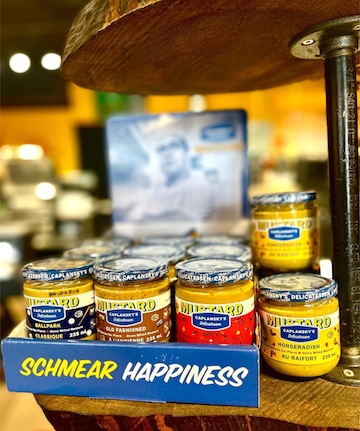
Presently, Caplansky is focusing on four key mustards: ballpark, old fashioned, horseradish and spicy.
“To me, deli is the food you celebrate with. Our mustard connects with people to a degree that I never truly appreciated or anticipated. The secret ingredient of our product is resilience. I think people really identify and connect with it,” he explained.
Caplansky takes pride in creating what he calls a “unique quirk” around his deli. Oftentimes, people would come into the restaurant and tell him that, despite its mere 15-year history, they remember coming into Caplansky’s with their parents and grandparents. Despite this chronological impossibility, he would never correct them.
“It was amazing to us that people thought that it had been around forever. The idea of a deli holds a place in people’s minds,” he mused. “It’s truly a blessing.”
The entrepreneur has appeared on CBC’s Dragons’ Den several times and been a regular on Food Network Canada.
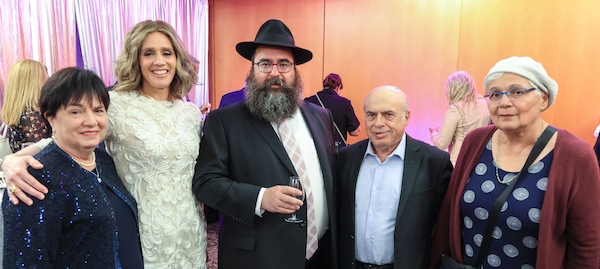
At the Freilach 25 gala on June 19, left to right, are Yocheved Baitelman, Chanie Baitelman, Rabbi Yechiel Baitelman, Natan Sharansky and Avital Sharansky. (photo by Kasselman Creatives)
Natan Sharansky, the most famous “Prisoner of Zion” and a former Israeli senior cabinet minister, shared reflections on his extraordinary life with a Vancouver audience last month.
Sharansky spoke June 19 at the Freilach 25 gala honouring Rabbi Yechiel and Chanie Baitelman on the 25th anniversary of their leadership of Chabad of Richmond. The event took place at Schara Tzedeck Synagogue.
Born in 1948 – the same year as the state of Israel – Sharansky was, like most Jews in the officially atheist Soviet Union, utterly disconnected from his Judaism. There was no brit milah, no bar mitzvah, no Jewish culture, language or tradition, he said – “What there was, was antisemitism.”
There were about 150 nationalities in the sprawling Soviet Union, each one of them identified on the fifth line of the official state identification issued to every citizen. Everyone, regardless of ethnic origin, was treated relatively equally, if not fairly, under the communist regime, with one exception. If someone said, “He has a fifth-line problem” or “the fifth-line disease,” it meant they were a Jew and, therefore, had more limited opportunities for advancement than members of the other national groups, said Sharansky.
While they had only the vaguest idea of what being a Jew meant – “There was nothing positive in this word ‘Jew,’” he said – his parents instilled in him the need to overcome the officially proscribed handicap through excellence.
“You must be the best at chess or music or whatever you’re doing,” they told him, “the best in your class, your school, your city.”
Sharansky – then called Anatoly – was 5 years old when Stalin died (on Purim). At the time, the so-called “doctor’s plot,” a Stalinist campaign to whip up antisemitism based on allegations that Jews were trying to assassinate Soviet leaders, was approaching a climax. Boris Sharansky told his two sons that the dictator’s demise was a good thing, but that they must not let on to others that they believed this.
Back at school, young Anatoly mimicked his fellow kindergarteners.
“We are crying together with all the other kids,” he said. “We are singing songs about the great leader.… You have no idea how many children are really crying and how many children are crying because their fathers told them to do it.”
This was Sharansky’s first conscious awareness of “doublethink,” the phenomenon in which Soviet citizens learned to compartmentalize what they knew from what they were supposed to know.
“You are reading what you’re supposed to read, you’re saying what you’re supposed to say, you are voting as everybody votes and you know that this is all a lie,” he recalled.
For Jews of his generation, the deracination from their heritage changed in 1967.
“The Six Day War was a big humiliation for the Soviet Union,” he said. “They had thrown in their lot with the Arabs.”
While the seemingly miraculous Israeli victory over the combined neighbouring Arab armies was notable, it didn’t change the perceptions of Soviet Jews overnight. It didn’t, for example, distract the young from their studies for university exams.
“But, over time, some things changed,” Sharansky said. “Those that loved you and those that hate you” changed their attitudes, he said. “They all look at you and say, ‘How did you Jews do it?’” Jews were upgraded, Sharansky has written. “We went from greedy, cowardly parasites to greedy, bullying hooligans.”
Soviet Jews did not consider themselves part of Israel, but at least some of their non-Jewish neighbours did. This sparked a new curiosity among Soviet Jews about their connection to Jews outside their realm and kindled pride in their identity for the first time.
Soon, smuggled copies of Leon Uris’s 1958 historical novel Exodus, about the founding of the state of Israel, found its way into circulation. The forbidden book was passed from hand to hand, not only because it was a page-turner, but because it was not the kind of book a Jew in the Soviet Union wanted sitting around the house.
Sharansky realized that the soldiers in Israel who had defeated the Arabs in 1967 were the same age as him.
“Suddenly, the university exams didn’t look so significant,” he recalled. So began a quest for identity and dissidence that would lead Sharansky to nine years in a Soviet prison, then, later, to nine years as a senior figure in Israel’s government and, later still, nine years as head of the Jewish Agency for Israel.
As Jews in the Soviet Union gained consciousness about their identity – and began their “treasonous” demands to abandon the communist state for Israel – they ignited a parallel and larger fight against Soviet tyranny. In his presentation, and more deeply in his book Never Alone: Prison, Politics and My People, co-authored with Gil Troy, Sharansky explained how he struggled with whether his fight was for his right to fully express his particular Jewish identity or whether it was a larger battle to free the millions of oppressed Soviets of all 150 or so nationalities.
At the same time, international solidarity that had begun as a tiny rally of Columbia University students in 1964 exploded into a massive global movement calling for the Soviets to free both “Prisoners of Zion” – those Jews imprisoned in gulags for openly confronting the Soviet powers – and the millions more Jews in the Soviet Union who were not free to leave the country.
As the Soviets grew more concerned about this international attention, they responded in two ways. They permitted some Jews to make aliyah – particularly middling troublemakers they preferred not to deal with – while imprisoning leaders like Sharansky, who soon became the leading face in the fight to free Soviet Jewry.
If Anatoly Sharanasky – who would rename himself Natan as his Jewishness evolved – was the face of the movement, his imprisonment required a voice to take up the mantle. This role was adopted by his wife, Natasha, who herself would become Avital as she, too, reconnected with her identity. As Avital Sharansky sat in the audience at Schara Tzedeck last month, her husband recounted her meetings with world leaders, Jewish community officials and anyone who would listen to her demands to free her husband.
Before being thrust into the roles of world-leading activists, Natasha and Anatoly – Avital and Natan – had a one-day honeymoon. They were hastily married and the next day she flew to Israel, not sure whether the Soviets would soon rescind her exit visa. She began her lobbying while he continued the activism that led him, three years later, to be sentenced to death by shooting for “high treason.”
Jews all over the world demonstrated, including a 250,000-person march on Washington in 1987. Soviet ambassadors in Western capitals were called in to explain their treatment of Jewish citizens. The U.S. Congress passed an amendment to a trade law, tying Jewish emigration and broader human rights issues to economic ties with the Soviets.
A Toronto man, Noah Landis (né Lantsevitsky), saw Sharansky on the news and did a little genealogy. Discovering a family connection, he contacted Irwin Cotler, Sharansky’s Canadian lawyer and later Canada’s minister of justice, who was able to go to then-prime minister Pierre Trudeau and demand that the government stand up for this relative of Canadian citizens being held hostage for his identity.
The ascent of Mikhail Gorbachev, with his liberalization programs of “glasnost” and “perestroika,” put the treatment of Soviet Jews further into the spotlight. In 1985, then-U.S. president Ronald Reagan met with Gorbachev in Geneva. At one point, Avital Sharansky, dressed in a prisoner’s uniform, accosted Raisa Gorbachev, wife of the Soviet leader, asking for her intervention. In private, Reagan demanded Gorbachev act on Sharansky’s case and, three months later, Sharansky was released, the first of the Prisoners of Zion to gain freedom. The day he was released from prison, Sharansky was stripped of his Soviet citizenship and flown to East Berlin, transported across to West Berlin and on to Israel, where he ended the very long day dancing at the Western Wall.
Sharansky’s attendance in Vancouver was to mark the quarter-century of commitment Rabbi Yechiel and Chanie Baitelman and their family have made to the B.C. community as Chabad shlichim in Richmond.
The rabbi said he felt “embarrassed and inadequate” at the recognition, saying, “Serving this community is not some great burden. It is in fact the greatest privilege imaginable.”
Baitelman spoke of the exponential growth Chabad of Richmond has seen in 25 years, including a huge increase in the number of educational programs delivered, meals prepared and shared, and youth activities, Hebrew classes and outreach programs initiated. The model of the late Lubavitcher Rebbe is one they try to emulate, said Baitelman.
“This is what we try to do – to ignite the soul of every Jew with the love of Torah, the love of Judaism and a passion for our Jewish traditions so that each person can realize their unique potential and fulfil the purpose for which he or she was created,” said the rabbi.
Chabad of Richmond is bursting at the seams, he said, and has begun a campaign to relocate to larger premises. On a personal level, Baitelman said he and his wife are not slowing down.
“We have no intentions of resting on our laurels, not for a minute,” he said. “Our work is only just beginning. Chanie and I pledge to work even harder, to grow this organization, to bolster our acts of chesed on behalf of this community, to increase the number of programs we have to offer.”
Shelley Civkin and Gayle Morris co-chaired the event. Steve Whiteside, president of Chabad of Richmond, welcomed guests, while his vice-president, Ed Lewin, offered closing remarks. Mark and Yolanda Babins introduced the keynote speaker.
Canadian Associates of Ben-Gurion University honouree Martin Thibodeau, B.C. president of RBC Royal Bank, speaks at the June 9 gala. (photo from CABGU)
Less than six decades ago, the city of Beersheva, in Israel, had more camels than people. Now, it is home to one of the world’s most innovative post-secondary institutions – Ben-Gurion University – and 400 British Columbians packed a Vancouver ballroom June 9 to help launch the university’s new School of Sustainability and Climate Change.
The Canadian Associates of Ben-Gurion University (CABGU) event at the Fairmont Pacific Rim Hotel honoured Martin Thibodeau, B.C. president of RBC Royal Bank, and featured Prof. Daniel A. Chamovitz, president of Ben-Gurion University (BGU), in conversation with event emcee Robin Gill.
Since taking the helm of RBC in the province, in 2018, Thibodeau has continued an involvement in Jewish community affairs that began earlier in his career, in Winnipeg and later in Montreal. He credits his mother with instilling in him a respect for multiculturalism and a connection with the Jewish experience.
In 2018, RBC Royal Bank created a cybersecurity partnership with BGU, investing in artificial intelligence and machine learning technologies to develop advanced cyber-security techniques. Two years later, RBC British Columbia sponsored the first two research fellowships at the new School for Sustainability and Climate Change and, later this year, Thibodeau will lead a summit to Israel, bringing a group of Canadian business leaders to BGU. He is engaged with a host of community organizations, including the Jewish Community Centre of Greater Vancouver, the Jewish Federation of Greater Vancouver, United Way of the Lower Mainland, B.C. Children’s Hospital, Science World and others. He is also co-chair of RBC’s Diversity Leadership Council.
“I’m always amazed at the dynamic and progressive work that continues to be produced by the scholars and the teams at Ben-Gurion University,” Thibodeau said at the June event. “The world owes a great deal of debt to the outstanding advancements that have already contributed to how we live and work as a society. I am excited to see what the future holds in the hands of these amazing and brilliant individuals.”
Thibodeau, who oversees 7,000 employees in the province, was introduced by Lorne Segal who, with his wife Melita, co-chaired the event. Segal gave an emotional testimonial to his late father, Joseph Segal, who passed away 10 days earlier, at age 97. Segal said his father had not attended many events in the past several years but had been looking forward to being present to honour Thibodeau.
In his presentation, Thibodeau thanked the Segals for their support, and for their presence in a time of mourning. Thibodeau paid credit to Joe Segal, who called him soon after he arrived on the West Coast, invited him for lunch and offered advice and an open ear.
In recorded greetings, Israel’s ambassador to Canada, Ronen Hoffman, called Thibodeau “far more than just a businessman. He is a leader, innovator and community-oriented friend of the Jewish people, of Israel.”
Chamovitz, the university’s president, noted that David Ben-Gurion’s dream of a university “at the gates of the Negev Desert” was intended to uncover secrets: “How to make energy from the sun, water from the air and agriculture from the infertile sands, taking advantage of resources that, until now, were going to waste.”
The changing climate has made innovations such as solar energy, desalinization and agriculture in inhospitable places answers to urgent questions that affect lands far beyond the Negev.
“We all of a sudden realized that what we thought was a local problem is now a global imperative and people from all over the world started coming to Beersheva to learn from our expertise,” said Chamovitz, who grew up in Pennsylvania and has been president of the university since 2019. The Abraham Accords have opened new doors to cooperation between BGU and Gulf States that need these technologies, he added.
The School of Sustainability and Climate Change was announced last year and, so far, 25 departments are collaborating on planetary life-and-death topics. (See previous articles at jewishindependent.ca.)
“My simple challenge was to get them to collaborate in order to really leverage our expertise into something that’s much greater than the sum of each of those departments,” said Chamovitz. Even the department of Hebrew literature is involved.
“Hebrew literature did a big seminar on climate fiction, understanding how climate change is influencing what people write about and how this literature is influencing public opinion about climate change,” he said.
While BGU was created with the development of the Negev Desert in mind, the work they are doing is global, with impacts reaching British Columbia, said Chamovitz.
“You cannot look at British Columbia divorced from the world,” he said. Flooding and heat domes are processes that are happening worldwide. Mitigation and prevention must take place both locally and globally, he said.
Chamovitz credited the leadership of Thibodeau and RBC for making it easier for BGU to go to other major donors to fund the new school.
Another new development at the university, he said, is a high-tech park dedicated to advanced research in cybertech, agricultural technologies and green energy.
CABGU B.C.-Alberta board member Eli Joseph chaired the event and board member Rachelle Delaney was the convener. Si Brown, president of CABGU B.C.-Alberta, opened the event. The corporate sponsorship committee was chaired by board member Adam Korbin, and David Berson is CABGU regional executive director.
Terry Beech, member of Parliament for Burnaby North-Seymour, brought greetings from the federal government. Representing the government of British Columbia, Minister of Finance Selena Robinson spoke of her family’s connections to Israel.
Winnipeg has had a bagel renaissance. It’s not exactly a bagel mecca, and these are definitely not the New York City bagels my husband was raised eating. However, the recent bagel trends here are a step forward.
In the earlier days of the pandemic, summer 2020, my kids and I were out at the park when we met another family who seemed to recognize us, I’m not sure from where. I was surprised when they struck up a conversation but we had such a nice moment. Now that we’ve all spent so much time on our own, I have come to realize how important these outdoor encounters can be to our health and well-being.
Towards the end of the chat, these kind strangers handed us a bagel, straight from a brown paper bag that contained a couple dozen, as my twins were missing snack and getting hangry (hungry angry). We divided it up and ate. Ohhh. It was good. Not exactly a Montreal bagel, more like a combination between a New York City and a Montreal bagel, but definitely better than anything I’d ever had in Winnipeg.
I rushed home to tell my husband how to acquire more of these. Bagelsmith was, at that time, almost an underground bakery with a simple website. It didn’t have an open storefront, due to the pandemic, but if you got online right at 8 p.m. Sunday night, you could get bagels delivered on, say, a Tuesday or Thursday afternoon. There were also schmears, but these all had strange things mixed in with the cream cheese, which my purist spouse could not abide even considering. Soon, we were up to ordering three or four dozen of these at a time.
It should be noted that these bagels have a hole in the centre and are properly boiled but, although we enjoy sesame, poppy or everything bagels, they have way too many seeds for our taste. In fact, we’ve collected the seeds from the bottom of a paper bag, filled a spice jar with them and used them for challah toppings. (That is way too many seeds for a house with kids in it. They get everywhere and our dog doesn’t like them!)
I clarify all this because we have been treated to all kinds of bagels over the years that, quite frankly, are not bagels. Round things with a hole perhaps, but they haven’t been boiled, or boiled things that have no hole, or varieties that are absolutely abhorrent to a purist. The Big Nope – blueberry bagels. We’ve lived in a variety of places, including North Carolina, Kentucky and Buffalo, N.Y., and had to do without, because some bagels aren’t worth the calories.
My husband spent part of his childhood getting pletzels and biales from Kossar’s on the Lower East Side in New York and bagels from Russ and Daughters. (Of course, in New York City, there are a lot of good bagel places!) His grandparents and the extended Eastern European family have strong memories of what things should taste like. He has very high standards. Years ago, on a work trip to Montreal, his colleague and good friend (who happens to be Muslim), took my husband on a tour of all the famous Montreal bagel places. Then, the friend loaded him up with so many bagels and so much Montreal smoked meat that it was hard to carry it all home on the plane. This is the kind of love they have for each other, a perfect experience – two longtime colleagues who affectionately value each other through food!
Back to Winnipeg … as the bakery grew and the pandemic situation changed, there were times when we could not get these bagels delivered. The bakery was downtown in a spot that wasn’t far away but was hard to negotiate by car. I even figured out that the bagel baker had children who went to our kids’ school. However, when everybody’s in remote school, that morsel of information is useless. When we couldn’t get them delivered, we went without. This wasn’t a life or death situation. I baked our bread regularly and, when the local bakery was open, we got sourdough bread, baked in a wood-fired oven.
You may think that I could try harder, and maybe that’s true. I bake lots of bread, but draw the line at any recipe that takes more than 24 hours or is fidgety. I leave croissant production, bagel boiling and sourdough to the experts. After one multi-day sourdough experiment in hot weather in Kentucky, we agreed that, while the pink thing I grew was definitely alive, it wasn’t likely to be edible or safe. Lucky for me that my husband is a scientific researcher, because that weird starter attempt was not worth the risk to health and safety.
OK, back to our bagels. A huge thing has happened. Our favourite, artisanal, expensive bagel bakery has opened a second shop, and it’s easy to get to and just about in the neighbourhood. Today was the grand opening. It was also our 24th wedding anniversary.
My husband went out in between work meetings and came home with two dozen – yes, 24 – bagels. No, it’s not flowers or wine or a fancy meal, but to my partner, this is as good and romantic as it gets.
Bagels are an ethnic delight for Polish Jews. To be honest, I wasn’t raised with steady access to good bagels, growing up in Virginia. Bagels weren’t my (more North American assimilated, with some Western European roots) family’s biggest food focus. However, the Talmud speaks to this, too. We have a papercut, framed in our kitchen, of this phrase. Check out Pirkei Avot 3:17 – “No bread, no Torah. No Torah? No bread.” If you don’t have food, you can’t learn properly and without learning? You can’t earn your bread, either.
So, here’s to a good bagel, and a person, a partner, with whom I can continue to learn and grow. Here’s to another 24 years. L’chaim! B’tayavon. Enjoy your meal. Eat in good health!
Joanne Seiffhas written regularly for CBC Manitoba and various Jewish publications. She is the author of three books, including From the Outside In: Jewish Post Columns 2015-2016, a collection of essays available for digital download or as a paperback from Amazon. Check her out on Instagram @yrnspinner or at joanneseiff.blogspot.com.
Who among us enjoys using a 400°F oven during the summer? That would be: Nobody. Ever. For me, summer is synonymous with barbecuing, which is first cousin to steak, hamburgers, chicken and grilled veggies.
Recently introduced to tuna steaks, I’ve now gone over to the light side. On a recent trip to Victoria, good friends had us over for dinner and served one of the best meals we’ve eaten in years. While most of the component parts were healthy, some were deliciously questionable, in terms of caloric heft (see lemon mousse below). The star of the meal, by a long shot, however, was the marinated tuna steak, grilled on the barbecue. Even though it was more well done than I prefer, it was still juicy, incredibly flavourful and tender. I like my tuna steak with grill marks on the outside and pink rareness on the inside. Most good fish restaurants serve it like that. Despite the variance in preferences, our friend cooked it to perfection. As with all good things, I like to share my enjoyment with others. So, you’re welcome.
You can buy frozen tuna steaks at lots of stores. Fresh is even better, but not always available. For your culinary edification, did you know that Pacific bluefin tuna are approximately five feet long and weigh about 130 pounds? (Think: that’s bigger than me!) Apparently, the world record for the largest bluefin tuna caught was set in Nova Scotia in 1979. It weighed in at a whopping 1,496 pounds. How do you even land something like that? It’s like the Tuna That Ate New York. The tuna we had was cut into petite steaks of about five inches by three inches, and was one-inch-thick perfection.
MARINATED TUNA STEAKS (serves 4)
4 4-ounce tuna steaks 1/4 cup orange juice 1/4 cup soy sauce 2 tbsp olive oil 1 tbsp lemon juice 2 tbsp chopped fresh parsley 1 clove garlic, minced 1/2 tsp chopped fresh oregano 1/2 tsp ground black pepper salt to taste
In a large non-reactive dish (does this mean it’s even-tempered?), mix together the orange juice, soy sauce, olive oil, lemon juice, parsley, garlic, oregano and pepper. Place the tuna steaks in the marinade and turn it over to coat. Cover and refrigerate for at least 30 minutes. Bring to room temperature before grilling/frying. Preheat grill at high heat, or pan sear on high in a frying pan.
Lightly oil grill grate or frying pan. Cook the tuna steaks for approximately five minutes, then turn and baste with the marinade. Cook for an additional five minutes, or to desired doneness. I’ve read recipes that call for as little as a 45-second-per-side cooking time, so, use your own discretion. Discard any remaining marinade.
Serve it up with a side of guacamango salad (see below), and you’re sure to get a thank you note. Add some tri-coloured baby new potatoes and, voila, just like that, your guests/partner/pets will think you’re Julia Child!
Despite all evidence to the contrary, I can cook and not give people E. coli. I have been known to give my husband and I food poisoning from bad lamb. In my defence, it was a full moon and I was unsupervised. I’ve also been known to accidentally coat snapper in icing sugar instead of flour. Because Harvey and I were in our “courting” phase, he ate it nonetheless. I went out for takeout sushi. This is one of Harvey’s favourite stories. Mostly, I just cook stuff that it’s humanly impossible to screw up. Or, I let Harvey cook and, since he thinks that cooking is like doing a chemistry experiment, I say, knock yourself out Science Guy.
Never heard of my newly created gaucamango salad? Feast your tastebuds.
Mix all the ingredients together and tell me this isn’t the freshest-tasting summer salad you’ve ever eaten. Just try me.
As I’ve told you before, this accidental balabusta puts a premium on fast, easy meals, especially during the summer months. And, preferably, recipes that call for fewer than six ingredients, including spices. However, I made an exception for the lemon mousse, which breaches my boundaries for both patience and level of patchkerey. But, man, is it worth it! I usually never try recipes that involve separating eggs, because, well … it’s just dicey. Add in the double boiler element and we’re moving precariously into Ina Garten territory. But my friend’s rendition of this was just so darn good, I couldn’t not try it. If you’re a lemon lover, you won’t be disappointed. If you’re a sourpuss, you also won’t be disappointed.
Wash the lemons. Zest the peel of one lemon and set it aside. Squeeze the juice of both lemons and set it aside.
Separate the eggs. Whisk sugar into the egg yolks.
In a double boiler, heat the egg yolk/sugar mixture and whisk continuously until very hot (but not boiling). If you’re like me and don’t own a double boiler, just set a bowl on top of a pot of hot water instead.
Slowly whisk in the gelatin powder, then add the lemon juice and zest. Put mixture into the fridge to cool, whisking occasionally.
Beat the egg whites with a pinch of salt until firm. Beat the whipping cream.
Once egg yolk/lemon mixture is cooled, gently mix in the egg whites and whipping cream until just combined. Pour into a glass serving bowl for a pretty presentation. Chill in the fridge for a few hours and then garnish with raspberries on top.
This dessert is both fluffy and light, despite all the whipping cream. And the lemon zest gives the richness a welcome bit of texture and zhuzh. This lemon mousse is a spectacular, tart addition to any meal, plus it looks über impressive. Go ahead, boldly go where no accidental balabusta has gone before. Until now. B’tayavon!
Shelley Civkin, aka the Accidental Balabusta, is a happily retired librarian and communications officer. For 17 years, she wrote a weekly book review column for the Richmond Review. She’s currently a freelance writer and volunteer.
Tabbouleh is such a popular Lebanese salad that the first Saturday of July is known as Lebanese National Tabbouleh Day. Although there are variations, classical tabbouleh is bulgur, parsley, tomatoes, mint and onion with olive oil, lemon juice and salt. The word tabbouleh means seasoning or dip, and bulgur, the primary ingredient, is a cereal food made from whole grains of different wheat species, said to be as healthy or healthier than quinoa and rice.
Another summer treat is cobbler, as fresh strawberries, cherries, apricots, peaches, nectarines and all kinds of apples start to appear. Cobbler is said to have originated among the American colonists, but the origin of the name – dating back at least to 1859 – is uncertain. According to Wikipedia, it may be related to cobeler, meaning “wooden bowl,” or to its top looking like a cobbled stone pathway, rather than a smoothly “paved,” i.e. rolled out, pastry top.
MY FAVOURITE TABBOULEH (4 servings)
1 cup steamed and drained broccoli 7 tbsp water 1/2 tsp chicken soup powder 2 tbsp wine vinegar 1 tsp Dijon mustard salt and pepper to taste 2 crushed garlic cloves 2/3 cup bulgur 5 tsp oil 4 tsp cider vinegar chopped radishes chopped celery chopped green onions chopped tomatoes chopped red pepper
In a saucepan, combine water, soup powder, wine vinegar, mustard, salt, pepper and garlic, and bring to a boil. Add bulgur, cover, and let set 15 minutes.
Place broccoli in a salad bowl. Add bulgur mixture, oil, cider vinegar, radishes, celery, onions, tomatoes and red peppers and toss lightly.
TABBOULEH WITH MARINATED ARTICHOKES AND BABY SPINACH
(This recipe by Deborah Knight came from Food & Wine online. It makes 4 servings.)
4 large artichokes 1/2 tsp cumin seeds (optional) 2 tbsp sherry vinegar 2 tsp finely chopped fresh oregano salt and pepper to taste * * * 1 cup boiling water 1 cup coarse bulgur 3 tbsp extra virgin olive oil 3 tbsp lemon juice 2 finely chopped scallions 1/2 cup coarsely chopped curly leaf parsley 1 finely diced plum tomato 1 tbsp fresh chopped mint salt and pepper to taste 10 halved cherry tomatoes 2 cups packed baby spinach leaves 1/4 cup crumbled feta cheese 2 tbsp toasted pine nuts
Cut stems off artichokes, then steam the stems and artichokes. When cool, pull off leaves and trim fibrous outer skin. Scrape out the chokes and quarter the artichoke bottoms. Peel the stems and cut into 1/2-inch rounds.
Toast cumin seeds in a skillet until fragrant, about 40 seconds. Let cool, and ground to a powder.
Place artichoke bottoms and stems in a bowl. Add olive oil, sherry vinegar, oregano, salt and pepper. Let stand at room temperature one hour or refrigerate overnight.
In a large bowl, pour boiling water over bulgur. Cover and let stand 40 minutes, until bulgur is tender. Fluff with a fork. Stir in olive oil, lemon juice, scallions, parsley, plum tomato and mint. Season with salt and pepper. Cover and refrigerate for one hour or until chilled.
In a bowl, toss cherry tomatoes with spinach, feta and pine nuts. Spoon two tablespoons of artichoke marinade over salad and toss well. Season with salt and pepper.
Spoon tabbouleh onto plates and surround with artichokes. Top with spinach salad and serve.
PEACH COBBLER (6 servings)
1 cup flour 3/4 cup sugar 1 1/2 tsp baking powder 4 tbsp unsalted pareve margarine 1 large egg 1/4 cup non-dairy milk 5 cups pitted and sliced peaches 4 tsp cornstarch 1/4 tsp cinnamon non-dairy vanilla ice cream
Preheat oven to 400°F. Grease a shallow baking dish.
In bowl, mix flour, two tablespoons sugar and baking powder. Cut in margarine until mixture resembles coarse crumbs.
Beat together egg and non-dairy milk. Add to flour mixture until dry ingredients are moistened and a dough forms.
Put peaches, remaining sugar, cornstarch and cinnamon in a saucepan. Cook until peaches are tender and syrup is clear, thick and boiling (five to seven minutes).
Pour peach mixture into baking dish. Drop dough by heaping tablespoons in six portions over peach mixture. Bake for 20 minutes. Serve with pareve vanilla ice cream.
PAREVE REVERSE FRUIT COBBLER
1/4 cup plus 2 tbsp canola oil 1 cup non-dairy creamer 1 cup flour 1 1/2 tsp baking powder 1 cup sugar 1/4 tsp cinnamon 4 cups of fruit (strawberries, cherries, apples, peach, plums, nectarines and/or blueberries) pareve whipping cream
Preheat oven to 350°F. Grease a round glass pie plate.
Pour oil into the glass dish. Add non-dairy creamer, flour, baking powder, sugar and cinnamon. Stir until blended.
Add fruit.
Bake for 25 minutes. Serve warm with pareve whipped cream on top.
Sybil Kaplanis a journalist, author, editor/compiler of nine kosher cookbooks. She is a food writer for North American Jewish publications, and leads English-language Shuk Walks in Machane Yehuda.
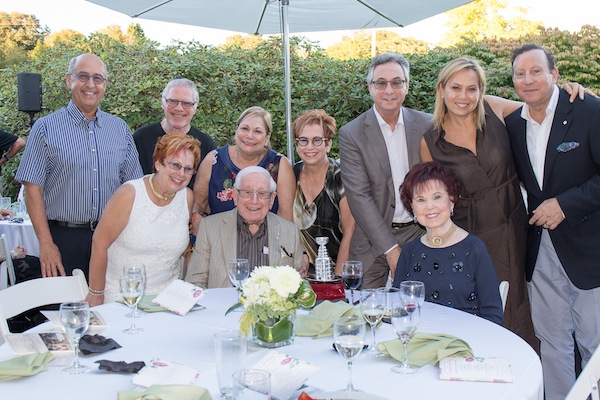
Joseph and Rosalie Segal (seated) and family at the 2016 Summer Garden Party fundraiser for Vancouver Hebrew Academy. (photo by Jocelyne Hallé)
Joseph Segal, an entrepreneur and philanthropist who was recognized by the governments of British Columbia and Canada with the highest civilian honours, a Second World War veteran who helped liberate the Netherlands, a businessman who founded and led iconic companies and a community-builder whose imprint on the Jewish and general communities in Vancouver is indelible, passed away May 31. He was 97 years old and was actively engaged in philanthropy to his final hours.
Segal was born in 1925, in Vegreville, Alta. After the death of his father, when Joe was 14, the family experienced financial hardship and young Joe Segal experienced hard labour while building the Alaska Highway. He fought in the infantry in the Second World War where, with his compatriots in the Calgary Highlanders, he participated in the liberation of the Netherlands.
After the war, he arrived in Vancouver and, with $1,500 in savings, started selling war surplus goods, then founded Fields department stores. Eventually, his business took over the Zellers store chain – which Segal described as “a case of the mouse swallowing the elephant” – and, later, obtained a large share of the venerable Hudson’s Bay Company before he launched Kingswood Capital Corp., which has interests in real estate, manufacturing and finance.
In recent years, while lauded for his business acumen, Segal was most prominent as one of Canada’s leading philanthropists. For his work in both fields, he was a recipient of both an Order of Canada and an Order of British Columbia.
In addition to leaving his mark on a vast number of institutions and causes in the Jewish community, he was a strong supporter of charities such as Variety Club, the United Way, Vancouver General Hospital and B.C. Children’s Hospital.
Among his community roles was serving on the board, and as chancellor, of Simon Fraser University. Perhaps his most visible contribution in Vancouver was his donation to SFU of the historic Bank of Montreal building at 750 Hastings St., creating a home for the Segal Graduate School of Business.
In 2010, Joseph and his wife Rosalie donated $12 million to the VGH and UBC Hospital Foundations to create the Joseph and Rosalie Segal and Family Centre, a 100-private-room acute care centre serving the mental health needs of people in crisis.
Joseph and Rosalie Segal modeled philanthropy for the successive generation of their family, including children Sandra, Tracey, Gary and Lorne, their spouses and, now, grandchildren and great-grandchildren.
At Joe Segal’s funeral on June 1, Gary Segal reflected on his parents’ 74 years of marriage, calling it “a love story for the ages.”
“My father worshipped my mother, he relied on her support and wisdom and insights,” he said. “They were true partners in everything they did and accomplished in life.”
Gary Segal called his father “a natural-born philosopher, a generous man, caring. He would never forget anything or anybody. He was passionate about life. He had many dreams – his own and those that inspired others. He had the ability to talk to people and make everybody, no matter what stage in life, feel important, like they mattered, that somebody cared about them.”
Although he knew the impact that his father had had on the world and the people in it, “to see these genuine expressions of sorrow and appreciation for the person my father was has been truly extraordinary for me and for my family.”
He shared three core tenets of his father’s philosophy:
• Don’t worry about what you can’t control, worry about what you can.
• You need to commit to life and you need to commit to happiness.
• Money is only worth something if you do something good with it.
Gary Segal quoted actor John Barrymore, who said, “You’re never old until regrets take the place of dreams.” In that respect, said Segal, although his dad lived to 97, “My father was not old. He never aged. Right up to the last minute, he was young. He was always young at heart, in spirit, and right up to the end, he had his dreams.”
Longtime friend and book collaborator Peter Legge reflected on a half-century of friendship after the pair met when Legge was an adman at radio station CJOR.
“Joe was a man who shared all he could with those who needed help,” said Legge. “Never to lift himself up, but to lift up those who needed help.”
Rabbi Yitzchok Wineberg noted that some people are saying the passing of Joe Segal is the end of an era.
“I beg to differ,” said the city’s longest-serving rabbi and Chabad emissary. “Joe didn’t live his life for himself or for himself and Rose. He lived his life for his children, for his grandchildren, for his great-grandchildren. They were there to observe everything he did and be inspired by it…. This family will continue his legacy. It’s not the end of an era, it’s a milestone. It’s a date that we all know we are going to have to face one day and, especially at such a funeral, we think about our own mortality. But it’s not just what you’ve accomplished in your lifetime. It’s what’s going to be accomplished after you leave this world. For that reason, I feel it’s not the end of an era. It’s just a continuation, and God should help that we should celebrate many happy occasions together in the future and we should be there for one another just as Joe was there for everybody else.”
Rob Schonfeld, a grandson, said that it may sound strange to be shocked that a 97-year-old man has passed away.
“But Grandpa Joe was so larger-than-life and still 100% on his game,” he said. “None of us really internalized that this day was going to come.”
Of Segal’s 11 grandchildren and 18 great-grandchildren, Schonfeld said: “We all had really unique and different relationships with him. None of them was the same and it’s because he always treated us as individuals. He respected us as grown-ups – even when we were little kids. I think that allowed each of us to bond with him in really different ways.”
Schonfeld shared one of his favourite “Joe-isms” – “You can’t ride two horses with one ass” – and said Segal’s secret weapon was “reading everything in sight.”
Rabbi Andrew Rosenblatt of Congregation Schara Tzedeck compared Segal with the biblical Joseph. The moment before the Exodus, the rabbi observed, Moses was looking for the bones of Joseph to carry with the Israelites to the Promised Land.
“He’s fulfilling a promise, granted, but it’s more than that,” said Rosenblatt. “Moses needs a symbol of what it means to succeed materially in this world and to succeed with others. Joseph is that symbol. He is a symbol of somebody who can have material success and can have spiritual success as well. There are two chests that walk with the Jews through the desert. One holds the tablets that Moses brings down from Sinai and the other one carries Joseph. Our Joseph is a little like that, too. He is a lesson, a paragon, a role model, an icon. Just like the biblical Joseph, his personality, his legend, survives even him. Joe Segal will continue to be that for so many in our community.”
The rabbi remarked that he was professionally forbidden from sharing the many stories of individuals who Joseph Segal helped when called on to assist an individual or family in crisis.
Rosenblatt added that Segal specifically asked for donations in his memory to be given to Yaffa House and to the Jewish Food Bank.
The Independent spoke with some of the people who worked with and knew Segal in different capacities.
David Levi served with Segal on the board of the Phyliss and Irving Snider Foundation and is on the board of governors for Camp Miriam, one of the causes Segal championed.
“Over the years, he’s given [Camp] Miriam quite a large amount of money and he was always very supportive of giving money to the camp and the kids. It was a central focus of his,” Levi said, noting that Camp Hatikvah was another cause Segal admired.
“Joe’s view, I think, on camp in general is that it built a connection to Judaism for kids at a young age and he saw camps making that connection to the Jewish community and to Israel. Those were important things for him,” Levi said.
“The thing about Joe was his complete commitment to the community – to the Jewish community and to the larger community.” But Levi stressed that large gifts to major organizations were not the only way the legendary philanthropist operated. Echoing Rabbi Rosenblatt, Levi referred to “Joe’s secret life.”
“He would get calls not only from individuals but from rabbis and other leaders in the community on a very personal level for people who needed a hand up or needed some financial means for a brief period of time,” Levi said. “It was smaller amounts of money, but, in his mind, as important as the organizations that he worked with. People would call and say we have this family and they are really having a tough time and they need an injection of $1,000 or $500 and Joe would quietly do that. He never really talked about it. He certainly never talked about the individuals he supported. But he was always available for those kinds of emergency calls.
“He believed in hard work but he also believed that people who had difficulty in achieving the kinds of things that he would hope everybody would be able to achieve, people who are challenged by mental or physical disabilities, he would help in any way he could,” Levi said.
Bernie Simpson, who is also on the board of Camp Miriam, echoed Levi’s reflections of Segal’s support for Jewish camping.
“For over 50 years, Joe was a strong supporter of Camp Miriam,” said Simpson. “He joined the late [B.C. Supreme Court] Justice Angelo Branca, who was the chair of the finance committee of Miriam in rebuilding the camp in 1970. Fifteen years ago, Joe was responsible for the building of the camp infirmary through the Snider Foundation, honouring Joe and Rosalie Segal’s close friends Mike and Rita Wolochow.… Joe’s support of the camp policy that every child should have a Jewish camping experience, regardless of their financial means, goes back to when he was a youth himself from very humble beginnings. Several years ago, he praised the camp and its leadership for their devotion to the youth whose attendance at camp was possible through the campership fund. He will be sorely missed.”
Simpson said Segal was in frequent contact with his wife, Lee Simpson, when she was president of the board of the Louis Brier Jewish Aged Foundation, to catch up on developments at the Jewish home and hospital.
“I understand, from other organizations, he would constantly keep in touch with what was going on in the community,” said Simpson. “He looked at the big picture.”
In a message to the Independent, Vancouver Hebrew Academy (VHA) said, “Mr. Segal took his responsibility to the Jewish community very seriously and he showed it in many ways. Of course, he was a strong financial supporter of Vancouver Hebrew Academy, as he was for many of our institutions, but his advocacy went further than that. He believed strongly in Torah education and what it means to the future of the Jewish people. In the summer of 2016, Joe and Rosalie were the honourees at VHA’s Summer Garden Party. There, Joe spoke passionately and emotionally of the importance of our mission.”
Rabbi Don Pacht, VHA’s former head of school, remembers fondly the conversations with Joe Segal about the school, the community and his admiration for those who chose to dedicate themselves to building community.
“I often came away from our visits encouraged in the work we were doing,” said Pacht. “Mr. Segal always had words of wisdom to offer … and sometimes a bottle of scotch too!”
Michael Sachs, executive director of Jewish National Fund of Canada, Vancouver branch, reflected on a long relationship.
“He was a titan in the business world and a leading philanthropist to all communities, but most of all he was a family man through and through,” said Sachs. “I have many fond personal memories with Joe from my childhood up until a few weeks ago. He touched everyone in our community and I count myself amongst one of those touched.”
Segal’s legacy was celebrated and remembered outside of the Jewish community, including by many organizations that Segal, wife Rosalie and the family had collectively supported.
“Joe was an enthusiastic champion of the university,” Simon Fraser University said in marking Segal’s passing. “His advice, energy and wisdom supported eight presidents and his business savvy and connections helped SFU to thrive. His commitment to community-building and philanthropy was recognized in 1988 with a doctor of law, honoris causa, from SFU and in 1992 with the President’s Distinguished Community Leadership Award, honouring his innovation, optimism and strong sense of public service to SFU’s community.”
The VGH & UBC Hospital Foundation issued a statement honouring Segal.
“A pledge of $12 million in 2011 to initiate planning of a new purpose-built mental health facility was the largest individual donation to this cause in B.C. at the time. This commitment initiated a $28 million fundraising campaign and the construction of an $85 million purpose-built mental health facility which stands as his legacy: the Joseph & Rosalie Segal & Family Health Centre.”
It continued: “Joe never retired, and his mind and memory were sharper at 97 than many people years his junior. Until very recently, he remained active in business, working from home as was required throughout the pandemic. Similarly, he continued to support the causes he cared about, offering sage advice, wisdom and guidance. He continued to support VGH and UBC Hospital’s most innovative clinician-researchers and surgeons, kicking off a campaign in support of the Vancouver Stroke Program and seed-funding research for innovative medical talents, as well serving as the honourary chair of the Brain Breakthroughs Campaign.”
After performing “My Way” in its original format, Paul Anka sings a custom rendition of the song to Joseph and Rosalie Segal at a 2013 gala spearheaded by Lorne Segal, which celebrated Joe Segal’s life and achievements, and raised $2.3 million for Coast Mental Health. (photo from Lorne Segal)
Coast Mental Health declared Segal “B.C.’s most significant supporter of mental health services.” His devotion to the cause began in 1999, when he first attended the Courage to Come Back Awards, where he heard people share personal stories of living with mental health and emotional challenges. His devotion to the cause was born out of a belief that no one is immune from the detrimental effects that mental illness can have if not properly treated.
Lorne Segal has chaired the Courage to Come Back Awards for the past 17 years, and the family as a whole has championed the cause.
Shirley Broadfoot, the founding chair of Courage to Come Back, recalled meeting Joe Segal for the first time.
“He was inspired by the power of the evening but said, ‘You really don’t know how to fundraise.’ It was true. We didn’t. So his son, Lorne, took on the role of chair for Courage and all that changed. Through Lorne’s leadership, Courage has risen to be the largest event in Vancouver. We could never have imagined that the awards would flourish and go on to give hope to people for 24 years, including through a global pandemic, while raising over $22 million and honouring 139 heroic British Columbians,” she said.
Coast Mental Health chief executive officer Darrell Burnham added: “Joe Segal was an incredible leader who gave so much to the community of Vancouver. I met Joe in the ’90s, and I was so pleased when he chose mental health as one of his philanthropic causes. Joe knew everyone in the city. He also had the charisma to engage other philanthropists in social causes that needed visibility and support. When Coast Mental Health Foundation and the Courage to Come Back Awards took shape, it was Joe Segal and his family who stepped up to provide financial assistance to support Coast Mental Health.”
Ezra Shanken, chief executive officer of Jewish Federation of Greater Vancouver, said Segal “was not only a titan in the business and philanthropic worlds, but a genuinely caring and compassionate person – a true mensch. He is among a generation of leaders who helped shape our Jewish community.… Joe was a steadfast supporter of countless worthy causes both within and beyond our Jewish community, including the work of our Federation and our partners. We are deeply grateful to him for his incredible generosity over the decades.”
The Jewish Food Bank operates out of Jewish Family Services’ the Kitchen, on East 3rd Avenue. (photo from JFS)
Like so many other individuals and organizations since Joseph Segal’s death on May 31, Jewish Family Services Vancouver has been reflecting on the impact he has had.
“Joseph Segal was a very generous supporter of the program,” said Carol Hopkins, coordinator of the Jewish Food Bank, which was one of the two organizations people were asked, at Segal’s funeral, to donate to in his memory; the other being Yaffa House.
“He touched the lives of many people through our Seniors Home Support program and annual Passover holiday campaign. However, food security and food access was his passion and a clear priority,” said JFS in a statement. “His dedication to help underwrite our food voucher program was notable. This was a special program for many, especially in the early days, before we had satellite food hubs across the Lower Mainland.”
Those vouchers allowed people to purchase groceries near where they lived. Further, the program presented recipients the opportunity to maintain anonymity and a sense of dignity – by not having to line up at a local food bank or use discount coupons at a till. Segal placed great value on a dignified means of accessing support.
More recently, JFS has directed its efforts towards mitigating food insecurity in the community to the food bank, of which Segal was an ardent and magnanimous backer. Currently, the food bank, which operates from JFS’s the Kitchen, at 54 East 3rd Ave., serves more than 800 clients regularly and delivers more than 10,000 kilograms of healthy food every month.
On its website, JFS notes, “While not a kosher food bank, the Jewish Food Bank does not offer any meats, poultry or shellfish. In addition, for those clients who do keep kosher, it ensures that kosher items are available to them.”
Since its inception, the food bank has been operated in partnership with Jewish Women International-BC. It started with a few volunteers and has operated from various locations since the mid-2000s. It first served clients from the Jewish Community Centre of Greater Vancouver. Later, it switched to the Peretz Centre for Secular Jewish Culture, where it was based until COVID-19 hit.
At the beginning, the food bank was mostly a walk-in model. Clients would come in and people would select the items they needed. This changed to an all-delivery model during the pandemic: bags were packed and then dropped off to clients who needed support.
The number of clients has grown since March 2020, with deliveries going across the region, including the North Shore, Surrey, Coquitlam and Burnaby. In April 2021, the food bank made its move to the Kitchen, where it maintains a warehouse facility with refrigerators and freezers, allowing JFS to keep perishable donations until they are ready to be used.
In addition to providing people the chance to pick up food at the Kitchen, JFS can distribute directly to clients and to its hubs across the Lower Mainland. Food is brought into the Kitchen on Mondays and sent out to different locations from Tuesday to Thursday. In an average week, more than 40 volunteers help the program.
“We are seeing more and more the challenge of food prices going up in conjunction with expensive housing, not to mention seniors on a fixed income,” said Hopkins. “People are having trouble supplying food. Our grocery service allows people to get support and the nutritious food that they need. We really pride ourselves on that.
“JFS is fortunate,” she said. “Distributors supply us with the best pricing that they can. This allows JFS to stretch the financial contributions it receives and buy in bulk.”
JFS depends largely on donations, both monetary – to buy supplies – and of items such as food, soap, shampoo, toilet paper and diapers.
JFS estimates there will be 150 new families accessing the food bank in the coming year, given economic trends; costs are increasing and needs are growing. Rising food prices are changing the perception and the reality of who needs the help of the food bank.