Skip to content
  • Home
  • Subscribe / donate
  • Events calendar
  • News
    • Local
    • National
    • Israel
    • World
    • עניין בחדשות
      A roundup of news in Canada and further afield, in Hebrew.
  • Opinion
    • From the JI
    • Op-Ed
  • Arts & Culture
    • Performing Arts
    • Music
    • Books
    • Visual Arts
    • TV & Film
  • Life
    • Celebrating the Holidays
    • Travel
    • The Daily Snooze
      Cartoons by Jacob Samuel
    • Mystery Photo
      Help the JI and JMABC fill in the gaps in our archives.
  • Community Links
    • Organizations, Etc.
    • Other News Sources & Blogs
    • Business Directory
  • FAQ
  • JI Chai Celebration
  • JI@88! video

Recent Posts

  • Eby touts government record
  • Keep lighting candles
  • Facing a complex situation
  • Unique interview show a hit
  • See Annie at Gateway
  • Explorations of light
  • Help with the legal aspects
  • Stories create impact
  • Different faiths gather
  • Advocating for girls’ rights
  • An oral song tradition
  • Genealogy tools and tips
  • Jew-hatred is centuries old
  • Aiding medical research
  • Connecting Jews to Judaism
  • Beacon of light in heart of city
  • Drag & Dreidel: A Queer Jewish Hanukkah Celebration
  • An emotional reunion
  • Post-tumble, lights still shine
  • Visit to cradle of Ashkenaz
  • Unique, memorable travels
  • Family memoir a work of art
  • A little holiday romance
  • The Maccabees, old and new
  • My Hanukkah miracle
  • After the rededication … a Hanukkah cartoon
  • Improving the holiday table
  • Vive la différence!
  • Fresh, healthy comfort foods
  • From the archives … Hanukkah
  • תגובתי לכתבה על ישראלים שרצו להגר לקנדה ולא קיבלו אותם עם שטיח אדום
  • Lessons in Mamdani’s win
  • West Van Story at the York
  • Words hold much power
  • Plenty of hopefulness
  • Lessons from past for today

Archives

Follow @JewishIndie
image - The CJN - Visit Us Banner - 300x600 - 101625

Keeping sacred songs alive

Keeping sacred songs alive

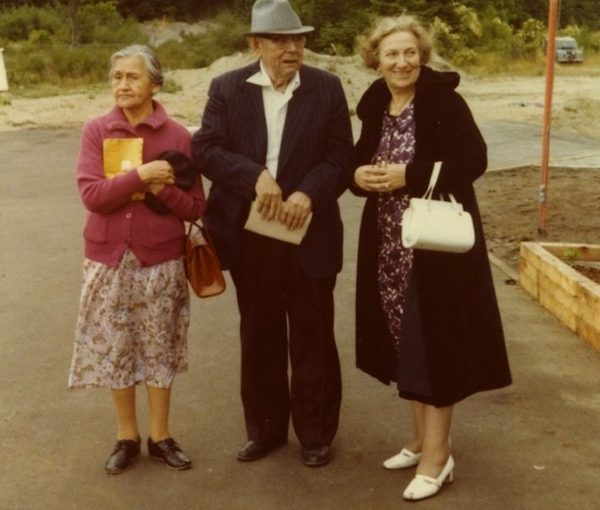
Ida Halpern, right, with Chief Harry and Ida Assu in Cape Mudge, 1979. Chief Assu was the son of Chief Billy Assu. (Image J-00562 courtesy Royal B.C. Museum and Archives)

In 1947, ethnomusicologist Dr. Ida Halpern and hereditary Kwakwaka’wakw chiefs Billy Assu and Mungo Martin, among others, began a decades-long collaboration. They recorded more than 300 sacred and traditional songs that otherwise would have been lost because of the Potlatch Ban and the suppression of Indigenous culture in general. The exhibit Keeping the Song Alive explores these preservation efforts and highlights how these songs are inspiring Indigenous artists today.

Co-developed by the Bill Reid Gallery of Northwest Coast Art and the Jewish Museum and Archives of British Columbia, Keeping the Song Alive is at the Bill Reid Gallery until March 19. The exhibit is co-curated by Michael Schwartz, former director of community engagement with the Jewish Museum, and Bill Reid Gallery’s Cheryl Kaka’solas Wadhams, a practising artist who also is an active member of the local Kwakwaka’wakw Cultural Sharing Group and a participant in the Kwak’wala language program through the First Nations Endangered Language Program at the University of British Columbia.
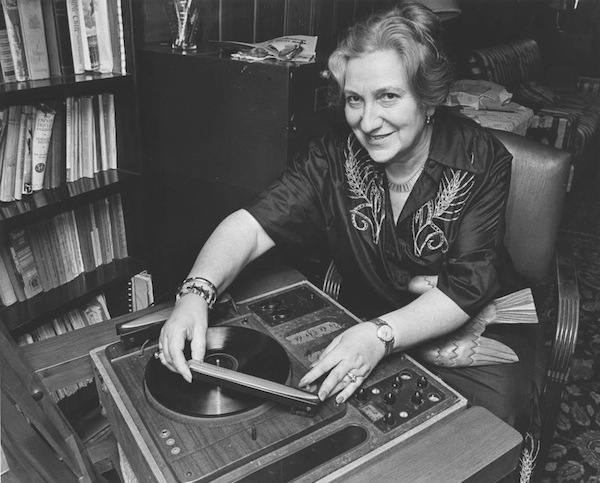
photo - Ida Halpern with her audio recorder, circa 1960
Ida Halpern with her audio recorder, circa 1960. (Courtesy Royal B.C. Museum and Archives)

“I first learned about Ida Halpern at a B.C. Museums conference in Victoria in 2017,” Schwartz told theIndependent. “My colleagues at the B.C. Archives shared the news that they had recently submitted the Ida Halpern Collection to be considered for inclusion in the Canadian UNESCO Memory of the World register. The collection was inscribed in the register in March of the following year but, at that conference, I was inspired by the story of Ida Halpern and thought it would be an excellent topic for an exhibit or project by the JMABC.

“A few months later, I ran into [curator] Beth Carter from the Bill Reid Gallery and we agreed to collaborate on the exhibit. Doing so would expand the possibilities and improve the final project, which definitely turned out to be true. Shortly thereafter, we brought in Cheryl Wadhams, who brought lived experience and essential connections as a member of the Kwakwaka’wakw community.”

A 2020 grant from the B.C. Arts Council made it possible for Schwartz and his colleagues to visit the Kwakwaka’wakw communities in Alert Bay, in Campbell River and on Mudge Island. They did so in early summer of this year.

“The impact is still revealing itself,” said Wadhams of guest curating the exhibit. “In general, it is causing me to think more deeply about my relationship with my community. Our research helped me to reconnect with community leaders back home in Alert Bay. Living in the city, this is so important to me.”

In addition to the historical elements, Keeping the Song Alive includes contemporary art, artist talks, Kwakwaka’wakw dance and drum group performances, and more.

“We were honoured to receive permission from the families to share certain songs,” said Wadhams. “All of the artists in the show are directly speaking to the recordings, the Potlatch Ban, or the contemporary flourishing of Kwakwaka’wakw potlatches. Barb Cranmer is an influential filmmaker whose important films are all based on our culture.

“We first approached Sonny Assu as the great-great-grandson of Chief Billy Assu,” she said. “He has explored the ideas behind these recordings for several years and created a new work for the exhibition. Andy Everson is also sharing a personal family story in his work. Maxine Matilpi supports the community with her beautiful regalia and her deep cultural knowledge.”

Several Kwakwaka’wakw community members and cultural leaders are featured in the exhibition, said Wadhams. “They speak directly to the value of the recordings and their meaning for the community. They are the leaders of today who are teaching our youth for the future.”
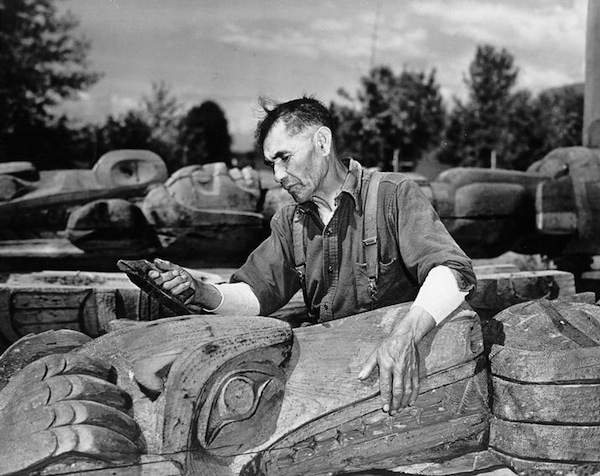
photo - Chief Mungo Martin restoring totem poles, 1949
Chief Mungo Martin restoring totem poles, 1949. (UBC Archives Photograph Collection)

“At a time when historic injustices are in the spotlight and racial tensions and hate crimes are high, stories of cross-cultural collaboration can soothe and provide inspiration,” said Schwartz, who described the exhibit as a “capstone” to his time at the Jewish Museum. (He recently became a director of development at Ballet BC.) “The JMABC’s last physical exhibit was in 2015, Fred Schiffer: Lives in Photos. Eight years later, it’s nice to produce another one,” he said.

In an interview with the CBC in 1967, which can be found on the Royal B.C. Museum website, Halpern describes the preservation of these local Indigenous songs as a project close to her heart.

“Some have suggested that Ida’s experience fleeing the Holocaust informed her work, and that this experience may have given the chiefs confidence in trusting her. But it’s difficult to know for certain,” said Schwartz. “It is apparent in her writing that she felt other academics had misrepresented and oversimplified this musical tradition and she sought to remedy this perceived wrong.”

Ida and Georg Halpern fled Vienna shortly after Kristallnacht and, by way of Shanghai, made their way to Vancouver, said Schwartz. “Ida had been a promising pianist as a teenager and intended to pursue a career as a performer, but a spell of rheumatic fever landed her in the hospital for a year, making her practise and training impossible. Her health restored, she studied musicology at the University of Vienna during a time when the field was flourishing and some of the best minds in the discipline were teaching there. It was a transformative time for her.

“Arriving in Vancouver, Ida set out to record and analyze the song traditions of local Indigenous nations,” he said. “She spent close to a decade building trust and often spoke of all the time she spent in kitchens, helping the women prepare food for community events. These efforts paid off when she was invited by Chief Billy Assu to record him singing 100 songs at his home in Cape Mudge.

“Over the course of a week, the two recorded 88 songs, complete with explanations of the history, meaning and significance of each song, when it was to be sung and by whom. This encounter was the initial spark for Ida’s research. Assu was a widely respected leader and his endorsement opened the doors for her to meet with other Indigenous leaders, including Mungo Martin and Tom Willie.

“Selections from these recordings were later published through Smithsonian Folkways Records, through the 1960s, ’70s and ’80s, giving them an audience far beyond the academic community. Many of the people we worked with in developing this exhibit spoke to the importance of these records and the fact that they were many people’s first encounter with their own tradition.”

Hereditary Chief K’odi Nelson was one of the people the research group met in Alert Bay, said Schwartz. “He’s an extremely kind and welcoming person, who told us about the classes his mother and aunties started to teach the children the old songs. In the early days, they couldn’t persuade any of the elders to come sing in person, so his mom swiped a copy of one of the Folkways records from the band office. K’odi had a visceral memory of being about 5 years old and hearing the needle drop as he waited behind the curtain to start dancing.”
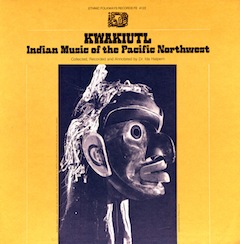
image - Kwakiutl: Indian Music of the Pacific Northwest record cover
Kwakiutl: Indian Music of the Pacific Northwest was published in 1981 by Folkways Records.

It is important to note that Halpern and the chiefs’ recordings were made during the Potlatch Ban, Schwartz said. The ban came into effect in 1885 and was in place until 1951.

“By working with Halpern, the chiefs were breaking the law and putting themselves at risk,” he said, “but they saw the necessity to do so. Their children were distancing themselves from their cultural tradition and showing a lack of interest in learning the old ways. Members of the community felt it was safer to assimilate and blend into the dominant society. The chiefs feared that their tradition would die with them; by recording with Halpern, they were essentially crafting a time capsule, making it possible for a future generation to reconnect with the tradition, which we’re seeing happen now and over the past decade.”

Schwartz was quick to point out that the recordings weren’t the only way that the traditions were kept alive during the Potlatch Ban.

“Kwakwaka’wakw leaders violated the ban or navigated tightly around the edges of it in various ways, including by holding gatherings under the guise of Christmas or Thanksgiving dinners,” he explained. “While technically not a potlatch, they were opportunities to undertake the ‘business’ of the potlatch: namings, agreements, honours and so forth.

“These creative solutions in the face of attempted erasure brought to mind for me the story of Hanukkah,” said Schwartz, “How the dreidel was used as a mask for study groups, and the old adage that an idea can’t be killed.”

About the importance of keeping these songs alive, Wadhams said, “Speaking to the singers in the Urban Dance Group, and also back home, I have learned that they find them so valuable. They have them on their phones and listen on YouTube, Spotify, all the time. Living in the city, I started my journey 25 years ago to learn the songs and dances. Having access to these songs really made it possible for me to connect in a new way with my ancestry.”

To watch the Nov. 2 opening celebration of the exhibit and for more information, visit billreidgallery.ca.
Format ImagePosted on November 25, 2022November 23, 2022Author Cynthia RamsayCategories MusicTags Bill Reid Gallery, Billy Assu, Cheryl Wadhams, Ida Halpern, Indigenous culture, Kwakwaka’wakw, Michael Schwartz, Mungo Martin, songs
Remembering is not enough

Remembering is not enough

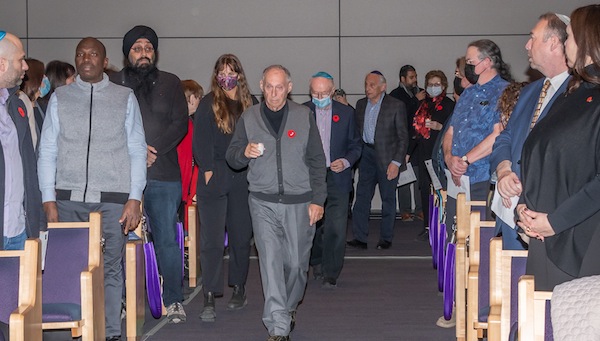
Holocaust survivors participate in the candlelighting ceremony at the community’s Kristallnacht commemoration Nov. 9. (photo by Al Szajman)

Commemorating the Holocaust and the sad succession of genocides that have been perpetrated since is a sacred responsibility – but it is not enough, says Liliane Pari Umuhoza. That memory must be the motivation that drives people to make a better world, she said.

Umuhoza was 2 years old when her father and a million others were murdered during the Genocide Against the Tutsis of Rwanda, in 1994. After experiencing trauma in her adolescence due to that familial and communal history, Umuhoza has devoted her life to commemorating and educating about the genocide and encouraging people to dedicate themselves to healing their societies.

“When we remember, we help ensure that the memories and legacies of the victims and survivors continue to resonate for future generations,” she said at Vancouver’s community Kristallnacht commemoration Nov. 9. “When we remember, we learn about the history and create awareness. But that’s not enough. What matters the most is how we use that history to create a better world.”

The annual event took place at Beth Israel synagogue on the 84th anniversary of Kristallnacht, the “Night of Broken Glass,” on Nov. 9-10, 1938, which is the moment when anti-Jewish regulations and systemic discrimination turned into overt violence and murder. It is seen by many historians as the effective beginning of the Holocaust.

The event was presented by the Vancouver Holocaust Education Centre (VHEC), in partnership with Congregation Beth Israel and with support from the Robert and Marilyn Krell Endowment Fund of the VHEC and from the Jewish Federation of Greater Vancouver annual campaign.

Umuhoza arrived in Vancouver several months ago to attend the University of British Columbia, where she is pursuing a master’s degree in public policy and global affairs. She is founder of the Women Genocide Survivors Retreat and is project officer for Foundation Rwanda, which provides funding for education to those who were born from rape during the genocide.

She began by outlining her own family’s history.

“I was 2 years old in the genocide of the Tutsis in Rwanda,” she said. “During this tragedy, my father was killed. Some of my uncles, aunties, cousins and many other members of my extended family are among the million Tutsi who were killed by the Hutu extremists in 100 days.

“One million people were killed in 100 days,” she stressed. “I was lucky to survive with my mother, who managed to escape to a neighbouring country, Congo, holding me, a 2-year-old baby, where we lived as refugees until it was safe enough for us to go back to Rwanda.”

She considers herself fortunate in comparison with many of her peers.

“I now have a stepfather and stepsiblings and I cannot tell you how blessed I feel because most of my friends from home grew up without a father or a mother figure in their lives,” she said.

Umuhoza was too young to understand what was happening at the time, she said. “But I grew up facing the consequences of that tragedy in every corner of my life. As many of you may know, psychologically, young children between the age of 0 and 5 are the most vulnerable to the effects of trauma since their brains are in the early development stage. For most people who have been exposed to genocide or war as children, the trauma can become severe at the adolescent stage and adulthood, if it is not properly treated.”

At the age of 12, Umuhoza began to exhibit symptoms of trauma, including depression, post-traumatic stress, nightmares, frustration, anger and confusion. She used the strength of others as an example to recover, including a friend who had to take on the parent role from childhood after she and her younger siblings were orphaned. Umuhoza is now deeply immersed in often deeply difficult aspects of education, such as translating the narratives of other survivors through Foundation Rwanda.

“My role with this organization was to listen to the stories of these women in their Rwandan mother language and translate the stories in English so we could use those stories to create awareness and educate the world about the genocide and its ongoing consequences,” she said. “I found myself in a series of stories I’d never heard before … stories of mass murder, stories of pain, stories of rape.”

One of the lessons she learned from the genocide is to never tolerate injustice, no matter how big or small, Umuhoza said.

“Speak up and raise your voice when you see or hear people denying that the Holocaust happened,” she said. “Speak up when you hear people saying that the genocide did not happen. Speak up when you see minorities being unfairly treated. Speak up when you see women in Tehran being oppressed. Let’s dare to step out of our common comfort zone and cultivate empathy to people around us.”

She concluded: “Individually, we can change our communities. But together we can change the world.”

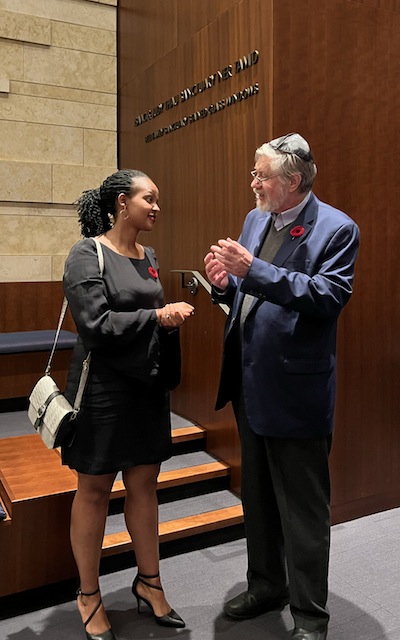
photo - Liliane Pari Umuhoza speaks with Prof. Chris Friedrichs at the Kristallnacht commemoration, which took place at Beth Israel
Liliane Pari Umuhoza speaks with Prof. Chris Friedrichs at the Kristallnacht commemoration, which took place at Beth Israel. (photo by Al Szajman)

Earlier in the evening, Prof. Chris Friedrichs contextualized the history of the Holocaust, emphasizing the importance of synagogues as a place of refuge for Jewish communities. The Kristallnacht commemoration has been taking place in the sanctuary of Beth Israel for more than 40 years, he said.

There were more than 1,000 synagogues in Germany at the time of Kristallnacht, he noted, some many centuries old, while others were newer, having been dedicated in the presence of senior German officials, clergy and others, a testament to the apparent solidity of the Jewish community’s place in the country.

“But then, beginning in 1933, everything started to change,” said Friedrichs, professor emeritus of history at UBC. “Once the Nazis came to power, Germans were taught to shun their Jewish neighbours. Jews were banned from public places. They could no longer go to the theatre or walk in the park or send their children to public schools. But one place was still open to them – their own synagogues, where they could gather to worship or study or simply spend time with their fellow Jews. And so it was until Nov. 9, 1938, when, in one carefully orchestrated nationwide night of terror, hundreds of synagogues all over Germany were set aflame, thousands of Jews were arrested, over 100 were killed. The next morning, Jews found their synagogues turned into empty shells and the windows of their shops shattered into broken shards of glass and the contents plundered. No Jew in Germany ever forgot that night of broken glass, Kristallnacht.”

Irwin Cotler, Canada’s special envoy on preserving Holocaust remembrance and combatting antisemitism, spoke via video link to the audience.

Of the Holocaust, he said, “It was a continuation and manifestation of history’s oldest, longest, most enduring and most toxic of hatreds, antisemitism, a hatred that mutates and metastasizes over time, which is grounded in one generic, historical, foundational, conspiratorial trope of the Jews – the Jewish people, the Jewish state – as the enemy of all that is good and the embodiment of all that is evil, which led, therefore, to the demonization and dehumanization of the Jew as prologue and justification for Kristallnacht and the Holocaust.”

A parallel between the Holocaust and the genocide against the Tutsis, he said, is that they were preventable.

“Nobody could say we did not know,” said Cotler. “We knew, but we did not act.”

Corinne Zimmerman, president of the VHEC, opened the event. Nina Kreiger, executive director, introduced the speakers and acknowledged dignitaries in attendance.

Beth Israel’s Rabbi Jonathan Infeld, a child of Holocaust survivors, thanked Umuhoza and reflected on her words and those of other speakers. He understands the idea of trauma being passed down through generations, he said. Reflecting on Friedrichs’ discussion of the centrality of the synagogue in Jewish life, Infeld said his spiritual leadership of the congregation during the construction of the new synagogue building was a form of response to the history of his family and the Jewish people.

Elected officials also spoke at the ceremony. Taleeb Noormohamad, member of Parliament for Vancouver Granville, spoke of his first trip to Berlin, where he walked around the streets of the old Jewish district.

“As somebody who had never really seen firsthand until that trip the horrors of what had happened to the Jewish community and to so many others,” said Noormohamad, “in that moment you come to realize the absolute inexplicable horror that was cast upon people and what it does to people, to communities, to families and to the histories of people.”

He committed to standing with the Jewish community against discrimination and noted the diversity of the audience, which included himself, a Muslim Canadian; Michael Lee, a Chinese-Canadian member of the legislature; and Ken Sim, a Chinese-Canadian mayor.

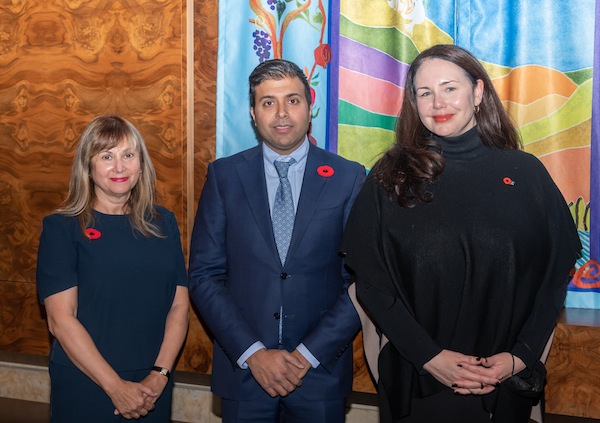
Parm Bains, member of Parliament for Steveston-Richmond East, was also present, as was Marc Eichhorn, consul general of Germany in Vancouver.

“Antisemitism is not a problem, a fight, that is for the Jewish community alone,” Noormohamad said. “When you look in this room today, we are all in this together. This is our community. You are our family and the remembrance of what happened is our responsibility as much as it is yours.”

photo - Vancouver Holocaust Education Centre president Corinne Zimmerman, left, and VHEC executive director Nina Kreiger with MP Taleeb Noormohamad
Vancouver Holocaust Education Centre president Corinne Zimmerman, left, and VHEC executive director Nina Kreiger with MP Taleeb Noormohamad. (photo by Al Szajman)

The Kristallnacht commemoration was the first official community event for Sim, who was sworn in as mayor of Vancouver three days before. He, too, spoke of visiting Germany, along with his wife and their four sons, where they witnessed the Memorial to the Murdered Jews of Europe and pondered the Stolpersteine, the “stumbling stones” that have been installed to mark the places where victims of Nazi extermination or persecution lived. The family, he said, has also visited Auschwitz, in Poland, and the United States Holocaust Memorial Museum, in Washington, D.C.

During the recent election campaign, Sim promised that, as mayor, he would promote the adoption of the International Holocaust Remembrance Alliance Working Definition of Antisemitism, which the previous council failed to do. He repeated his commitment at the ceremony, and council passed the motion on Nov. 16. (Click here and here for stories.)

Sim was joined at the event by Vancouver Councilor Sarah Kirby-Yung, who Sim credited as a stalwart ally of the Jewish community. Together, they read the official proclamation from the City of Vancouver.

“Out of the shards of destruction, in this case the glass on the night of Kristallnacht, often are born the glimmers of hope,” said Kirby-Yung, “and I think that is what keeps all of us going. It is the resilience and faith and the hope of the Jewish community that I think embodies the spirit of what we aspire to deliver here in the city of Vancouver.”

Format ImagePosted on November 25, 2022November 28, 2022Author Pat JohnsonCategories LocalTags Beth Israel, Chris Friedrichs, genocide, Kristallnacht, Liliane Pari Umuhoza, Rwanda, VHEC
Acts of remembrance, respect

Acts of remembrance, respect

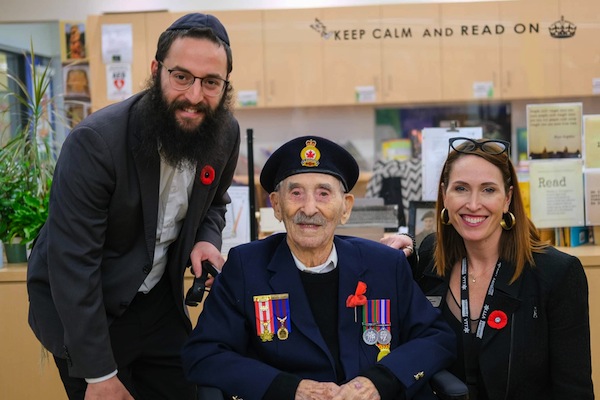
Reuben (Rube) Sinclair, centre, with Rabbi Levi Varnai and head of school Emily Greenberg. (photo by Tybie Lipetz)

In front of hundreds of students, staff and guests at Vancouver Talmud Torah elementary Nov. 11, Canada’s oldest veteran of the Second World took an honoured place and laid a wreath at the school’s annual Remembrance Day ceremony Nov. 10.

At the age of 111, Reuben (Rube) Sinclair is not only the oldest war veteran but certainly one of the oldest people in Canada. Soft-spoken and hard of hearing, Sinclair nevertheless quipped with family and reporters before the ceremony and beamed with pride at times throughout the midday event.

Sinclair was born in 1911, on the family farm near Lipton, Sask., a Jewish farm colony underwritten by Baron Maurice de Hirsch’s Jewish Colonization Association. Sinclair’s parents, Yitzok and Fraida, received property from the association but the farmland was poor so they saved up money Yitzok earned working for the Canadian National Railway to purchase better land nearby.

It was a vast undertaking – more than 2,500 acres, with milking cows and 42 horses. Among young Rube’s tasks was collecting the eggs from the chickens. He was driving vehicles at the age of 12.

Yitzok Sinclair (né Sandler) had migrated from Ukraine and was a leader in the small Saskatchewan Jewish community. He donated land and helped construct a school, which doubled as a synagogue.

Rube Sinclair was no longer a kid when he signed up for the war effort. At the age of 31, in 1941, he joined the Royal Canadian Air Force, where he became a corporal pilot and taught other pilots to take off and land in the dark using a “standard beam approach” that, in the days when radar was rare, involved a navigation receiver that lined the aircraft up with the runway.

The forces redeployed him to the West Coast and, after the war, with his youngest brother Joe, the siblings opened Sinclair Bros. Garage and Auto Wrecking in Richmond, just across the two long-disappeared Fraser Street bridges from Vancouver. Rube trolled in a tow truck, collecting old cars to salvage and the brothers refurbished and sold surplus military vehicles.

For three decades, from 1964, Sinclair and his wife, Ida, lived in southern California, where Rube worked in a family furniture business. Their philanthropy included raising more than a million dollars for a cancer hospital and research facility.

They returned to Vancouver, and Ida passed away in 1996. Rube is a great-great-grandfather and, among other recognitions, is a lifetime member of Congregation Schara Tzedeck.

At the VTT commemoration, Sinclair waved and grinned at students as his daughter, Nadine Lipetz, pushed him in a wheelchair, escorted by a bagpiper, to the place of honour at the ceremony in the school gymnasium.

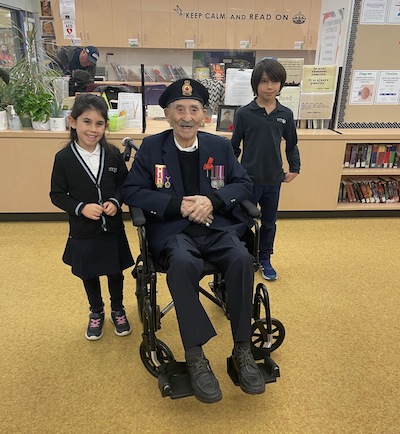
photo - Reuben (Rube) Sinclair with students at Vancouver Talmud Torah on Nov. 10.
Reuben (Rube) Sinclair with students at Vancouver Talmud Torah on Nov. 10. (photo by Tybie Lipetz)

Also present were representatives of the lieutenant governor of British Columbia, the Canadian Armed Forces, the Vancouver Police, the United States Secret Service and the Royal Canadian Legion Shalom Branch #178. All these guests laid wreaths, as did representatives of the Jewish Federation of Greater Vancouver, the Centre for Israel and Jewish Affairs, the VTT board of directors and VTT staff.

“Today, our community gathers to remember, pay our respects and appreciate the freedoms we have been granted by the sacrifices of others,” said Emily Greenberg, VTT head of school. She urged students to recommit themselves to being students of history and humanity “so that you can steward and inspire peace and compassion.”

In a d’var Torah, Rabbi Levi Varnai, the VTT school rabbi, held up the veterans as a model.

“What we can learn from their courage and their bravery is that we too should and could be brave and courageous, to always stand up for what’s right,” said Varnai. “Whenever we see something happening in the world, remember you have a voice and you can stand up and you can say always what’s right. That would be a legacy to their memories.”

Students sang and a video was screened of VTT students holding photographs of ancestors who had served in the military.

Format ImagePosted on November 25, 2022November 23, 2022Author Pat JohnsonCategories LocalTags milestones, Remembrance Day, Reuben Sinclair, Vancouver Talmud Torah, VTT

IHRA definition adopted

On Nov. 16, Vancouver city council became the latest Canadian jurisdiction to adopt or commit to using the International Holocaust Remembrance Alliance (IHRA) working definition of antisemitism.

The decision received support from organized Jewish community representatives, including both the Jewish Federation of Greater Vancouver and the Centre for Israel and Jewish Affairs (CIJA).

“Defining antisemitism is an essential step towards recognizing its manifestations and being able to counteract it,” said Shimon Koffler Fogel, president and chief executive officer, Centre for Israel and Jewish Affairs. “Today’s adoption of the IHRA definition of antisemitism by Mayor Ken Sim and Vancouver city council is a clear stand against the rise in acts of hatred against members of the Jewish community.”

Developed by IHRA’s Committee on Antisemitism and Holocaust Denial, the IHRA working definition of antisemitism is grounded in the research of the international experts on antisemitism and the Holocaust. It is supported by the United Nations, the European Union and 30 countries, including the United States and Canada.

“History has repeatedly shown, what begins as hatred of Jews never ends as hatred of Jews. Canadians must stand united with the Jewish community in the fight against antisemitism,” said Fogel. “The decision made by Vancouver city council today is a victory for all who stand against hate – no matter which group is the immediate target.”

“Today, Mayor Sim and the vast majority of Vancouver city council sent a strong message that antisemitism has no place in society,” said Ezra Shanken, chief executive officer, Jewish Federation of Greater Vancouver. “To combat antisemitism effectively, it must first be defined. The IHRA definition will help the people of Vancouver identify and combat antisemitism in all its forms. The rise of antisemitic hate crimes across the country has meant that fighting antisemitism must be a priority for all Vancouverites and Canadians, not just members of the Jewish community.”

Councilor Sarah Kirby-Yung introduced the motion to adopt the IHRA definition.

“Nobody should have to live in fear because of who they are. It was an honour to bring this motion forward to adopt the IHRA working definition of antisemitism,” she said. “We stand united with Vancouver’s Jewish community in the ongoing fight against antisemitism and the troubling rise of hate incidents in our city.

“The best means to combat hate is through education, and the IHRA definition can help foster a deeper level of understanding,” she said. “Education is more powerful than any punitive actions could ever be.”

“We are proud to stand with the Jewish community both in Vancouver and around the world,” said Sim. “Antisemitism has no place in our city, and today we take an important step towards building a more inclusive and safe society for all.”

In his weekly email message Nov. 18, Shanken wrote, “In 2019, when the IHRA working definition of antisemitism was first brought before council [by Kirby-Yung], thousands of you wrote letters and signed up to speak in favour of the motion. From community members and leaders to elected officials, clergy, partners agencies, and more, your words were powerful and you were heard by this council – even if your letter was from 2019.”

Shanken highlighted the work of several community leaders: Nico Slobinsky, senior director of CIJA-Pacific Region; Geoffrey Druker, chair of CIJA’s local partnership council; Candace Kwinter, board chair of the Jewish Federation of Greater Vancouver; Lana Marks Pulver, chair of the Federation annual campaign; Nina Krieger, executive director of the Vancouver Holocaust Education Centre (who has been a member of the Canadian delegation to the IHRA since 2012); and Corrine Zimmerman, president of VHEC.

Learn more about the IHRA definition at holocaustremembrance.com.

– Courtesy CIJA and Jewish Federation of Greater Vancouver

Posted on November 25, 2022November 23, 2022Author CIJA & Jewish FederationCategories LocalTags antisemitism, Centre for Israel and Jewish Affairs, IHRA, International Holocaust Remembrance Alliance, Jewish Federation of Greater Vancouver, Ken Sim, Sarah Kirby-Yung, Vancouver city council

Opposition to IHRA definition

Independent Jewish Voices Canada posted an open letter to Vancouver Mayor Ken Sim on their website before the Nov. 16 city council vote, expressing concern over the intention to endorse the International Holocaust Remembrance Alliance definition of antisemitism.

While applauding council’s intention to fight antisemitism, Neil Naiman, chair, IJV Canada, Vancouver chapter, wrote, “We are of the view, however, that the IHRA definition serves to deflect attention from real antisemitism by focusing on criticisms of Israel. It does so by adding to the basic definition of antisemitism what it deems to be 11 ‘examples’ of antisemitism – seven of which relate to Israel.

“The existence of these examples and the focus on defending Israel have led IJV and a host of other organizations to oppose the IHRA definition. These include the B.C. Civil Liberties Association, the Union of B.C. Indian Chiefs, the Canadian Association of University Teachers, 40 faculty associations, the Jewish Faculty Network, and many others. More than 650 Jewish academics across the country having signed a petition urging the rejection of the IHRA.”

The letter states, “The IHRA definition raises issues which have been debated in the Jewish community for more than 100 years, issues about which there is no community consensus. For example, many of IJV’s members join with Palestinians and others in condemning Israel as a ‘racist endeavour’ (to use one of the IHRA examples). The basis for this charge is that 750,000 Palestinians were expelled when Israel was founded, that it subjugates the inhabitants of the Occupied Palestinian Territories under military rule and subjects Palestinian citizens of Israel to second class status. The IHRA definition would deem these IJV members to be ‘antisemitic.’ By adopting the IHRA definition Vancouver council will be condemning some of its citizens as racists and antisemites based on their legitimate political views of the situation in Israel-Palestine. This would be unconscionable.”

For the full letter, visit ijvcanada.org/no-ihra-vancouver.

Posted on November 25, 2022November 23, 2022Author Independent Jewish Voices CanadaCategories LocalTags antisemitism, IHRA, IJV, Independent Jewish Voices, International Holocaust Remembrance Alliance, Ken Sim, Neil Naiman, Vancouver city council

Dealing with addiction

Rabbi Allan Finkel of Winnipeg’s Temple Shalom spoke about addiction in the Jewish community and Jewish-based recovery during a Nov. 6 Zoom presentation organized by Kolot Mayim Reform Temple in Victoria.

The talk was the first of Kolot Mayim’s 2022/23 lecture series entitled Hineini: Answering the Call to Heal the World. It widened the definition of addictions to go beyond those that are substance-based to include dozens that are behavioural. Finkel also explored new research on the causes of addiction, particularly childhood trauma.

“My name is Allan and I am an addict,” he began. “This was a huge hineini, when I first said ‘here I am.’ This was my declaration 13 years ago. At that time, hineini meant here I am at the bottom of a drug addiction, I am broken and I am open to an unknown path that might lead to recovery.”

That path, starting at Narcotics Anonymous, would take him on a spiritual journey, reconnecting him with his Judaism and leading him to become a rabbi.

For his rabbinical program, Finkel wrote his thesis on addictions in the Jewish community. “I was curious to know what we might learn as rabbis, and how we can carry our journey forward in terms of serving our congregations,” he said. “It is a mental health issue, and there wasn’t very much known about it…. And there are certain issues, particularly within the Jewish community, that made it a topic that I wanted to explore.”

Finkel discussed a 1962 study of the Jewish community in the United States that tried to find out what percentage of the Jewish community was addicted to drugs and/or alcohol. The answer was zero, compared to a 10% addiction rate in the overall population. Clearly, the study indicated a denial within the Jewish community that Jews can also be addicts. A 1995 study in the United Kingdom produced similar results.

Beginning in the early 2000s, research began to demonstrate that, to understand addictions, one needed to look beyond substances and towards behavioural addictions, which can encompass many areas: shopping, food, internet and gambling, among them. More recently: cellphone use, online gaming and video gaming.

From this standpoint, the number of people demonstrating addictive behaviour reaches 47%, according to studies Finkel cited, though he suggested the number is likely far higher. A commonality among people with addictive behaviours is the inability to stop, no matter what harm it does to those around them and to themselves.

Returning to the denial of addiction in the Jewish community, Finkel proposed that one cause is the long-standing fear of shame, which could be triggered by an admission of a problem at a synagogue, Jewish school or other institution. Looking at areas of the Torah, such as the story of Noah, he explained, one sees that “the Jewish denial of addiction is social and cultural, it is not religious in orientation.”

Within the past decade, there has been a broader consensus within Jewish institutions that addiction is not a moral failing, but instead can be caused by the same factors that result in other mood and psychological disorders.

Using the work of Vancouver physician Dr. Gabor Maté, Finkel noted that all addictive behaviour can be traced to something that happened when a person was very young. “Not everyone who was traumatized becomes an addict, but every addict was traumatized.”

One conclusion Finkel draws is the need to destigmatize the word “addiction.” He stressed that an addiction, as stated in the American Psychiatric Association’s 2013 manual on mental disorders, is a means of coping no different from any other mental health disease.

A second takeaway is that adults and not children bear much of the responsibility for addictions; in other words, no child ever dreams of becoming an addict. Children do not have the rational skills to take on and cope in a non-destructive way with trauma that happens to them.

Further, Finkel argued that real recovery is not simply about stopping addictive behaviour, but about going back to one’s past and taking care of the fears and resentments of childhood, as well as the habits that build up over a lifetime.

Finkel told the audience that it has been more than 10 years after his last relapse. He said the rewards of recovery have been immense and have brought incredible relationships with his children, himself and life.

Finkel is an outspoken advocate for interfaith engagement and for the building of strong bridges and partnerships across all denominations within the Jewish community. He currently chairs the Winnipeg Council of Rabbis.

A video of Finkel’s lecture is posted at kolotmayimreformtemple.com.

Sam Margolis has written for the Globe and Mail, the National Post, UPI and MSNBC.

*******

Some resources

Rabbi Allan Finkel provided this list of resources for those experiencing addiction and those close to them:

  • Crisis and suicide line: 1-800-784-2433
  • Jewish Addiction Community Service (JACS) Vancouver 778-882-2994
  • Mental health support: 310-6789 (no area code required)
  • Umbrella Society: support, outreach, recovery, counseling, groups, harm reduction and education, umbrellasociety.ca
  • Our Jewish Recovery: Facebook group, with 16 active Jewish recovery meetings and classes, virtual retreats, individual and group coaching, led by Rabbi Ilan Glazer
  • Rabbi Mark Borovitz, Finding Recovery and Yourself in Torah: A Daily Spiritual Path to Wholeness
  • Rabbi Kerry Olitzky and Dr. Stuart Copans, Twelve Jewish Steps to Recovery, and other of Olitzky’s books, including with co-authors
  • Rabbi Paul Steinberg, Recovery and Jewish Spirituality: Reclaiming Hope, Courage and Wholeness
  • Rabbi Shais Taub, God of our Understanding: Jewish Spirituality and Recovery

– SM

Posted on November 25, 2022November 23, 2022Author Sam MargolisCategories LocalTags addictions, Allan Finkel, health, Kolot Mayim, mental health
Go see Courage Now

Go see Courage Now

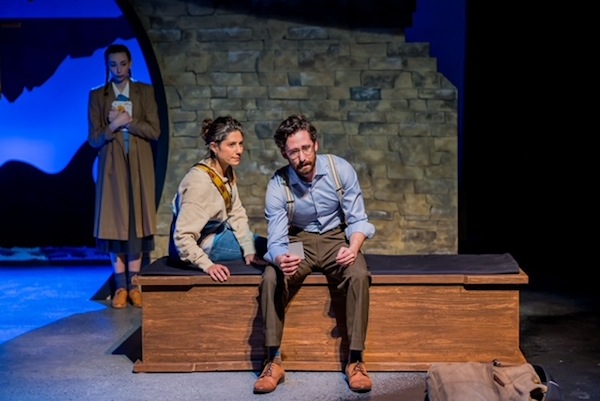
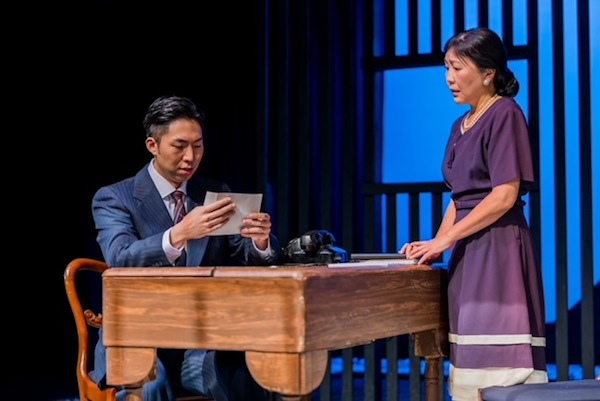
Left to right, Katherine Matlashewski (as Shayna Schneider), Advah Soudack (as Margaret Grant) and Amitai Marmorstein (as Jankl Schneider) in Courage Now, playing at the Firehall Arts Centre until Dec. 4. (photo by Youn Park)

One does not often get a chance to see a world première of a play in Vancouver. After writing my preview article on Courage Now in the last edition of the Independent, I was looking forward with great anticipation to seeing the final product. I was not disappointed.

It is a difficult story to tell but it is done with such sensitivity and style that I highly recommend seeing it. As a child of a Holocaust survivor, any story of courage and heroism arising out of that era resonates with me – this one in particular had me in tears.

From the moment you walk into the intimate Firehall Arts Centre theatre, you know you are about to see something special. The set is austere – a desk, a bench, a lattice-like trellis, an empty wall-mounted picture frame – with a pagoda-style roof and an archway backlit with vibrant colours. (Kudos to set designer Kimira Reddy and lighting designer Itai Erdal.)

To summarize the backstory, Chiune Sugihara, the Japanese consul in Kaunas, Lithuania, in 1940, against the instructions of his government, issued more than 2,300 handwritten visas in a 30-day period to save Jews trying to leave Poland and Lithuania. He was supported in his decision by his wife, Yukiko, who knew the price the family would pay for going against the government edicts. And a price was paid: career loss, humiliation and Sugihara’s self-imposed postwar exile to Russia for 16 years.

The play follows what appear to be two separate narratives that intersect in an unexpected way in the final scene. In 1986, Yukiko (playwright Manami Hara) is forced to revisit wartime when a visitor from Vancouver, Margaret Grant, born Shayna Schneider (Advah Soudack), comes for answers from Sugihara as to what happened to her father after he put her on a train out of Kaunas when she was 13 years old. She has resented her father through the years, feeling abandoned and betrayed by his sending her off alone; she is also coping with a difficult divorce and her own daughter’s hatred. Sugihara has recently died, however, and Margaret must turn to Yukiko for answers instead.

The play opens with Yukiko waking from a dream where she is visited by the ghost of her husband. Then Margaret enters her garden. She tells Yukiko, “I am a Sugihara Jew, Sempo saved my life.” The play then moves through a series of memory flashbacks, as the audience is transported back and forth between 1940 Kaunas and 1986 Japan.

Katherine Matlashewski plays the teenage Shayna and Amitai Marmorstein plays her father, Jankl. Jankl visits Sugihara (Ryota Kaneko) to plead for visas on behalf of the thousands of Jews who have been lining up every day outside the consul’s office. In a touching and poignant scene, something as simple as a shared cup of coffee gives you a sense of the integrity and honour of these two men as they strive to do the right thing. Kaneko plays Sugihara with a quiet intensity and Marmorstein portrays Jankl with dignity. The scene where he sees Shayna off at the train station is heartbreaking – he watches his only child (his “little mouse,” as he calls her) walk away from him, tattered suitcase in hand, in a fog of smoke and the eerie sound of a train whistle in the distance.

photo - Ryota Kaneko plays Chiune Sugihara and Courage Now playwright Manami Hara takes on the role of Yukiko Sugihara
Ryota Kaneko plays Chiune Sugihara and Courage Now playwright Manami Hara takes on the role of Yukiko Sugihara. (photo by Youn Park)

In many ways, the journeys of the two women are love stories. Yukiko grapples with the grief of losing her husband, moving through the stages towards acceptance, and Margaret comes to the realization that it was her father’s love that put her on that train in 1940. Both characters become conduits for the other’s catharsis. When Yukiko shares her husband’s journal from that time, Margaret says, “My father lives in that journal.”

All five of the actors do credit to their roles in this ensemble piece but Hara and Soudack’s performances are sublime. The play is particularly effective when all five actors are on stage at the same time in the memory flashback vignettes.

My one criticism is that there is quite a bit of Japanese dialogue between Kaneko and Hara and it would have been helpful to have either a reader board translating or a program insert with translations.

Hara has penned a lovely tribute to Sugihara and I, for one, am grateful to her for her work.

Courage Now is at the Firehall until Dec. 4. For tickets, visit firehallartscentre.ca.

Tova Kornfeld is a Vancouver freelance writer and lawyer.

Format ImagePosted on November 25, 2022November 23, 2022Author Tova KornfeldCategories Performing ArtsTags Chiune Sugihara, Courage Now, Firehall Arts Centre, history, Holocaust, Japan, Manami Hara, theatre, women, Yukiko Sugihara
Enjoy the gift of words

Enjoy the gift of words

When someone loves what they do or is passionate about a certain topic, it’s obvious. In the case of a book, if this someone is also proficient with words and excels at writing, their enthusiasm figuratively jumps off the page and inhabits the reader, getting them as excited as the author. This is how I felt reading Jonathan Berkowitz’s latest book, Tales From the Word Guy: What Your English Teacher Never Taught You(FriesenPress). Excited about the wonder that is language – in this case, the English language.

With the help of his wife, Heather, Berkowitz has compiled a collection of essays adapted from his segments on CBC Radio 1’s North by Northwest over several years as the Word Guy. Noting that people “perceive the spoken word differently from the written word,” he writes: “Adapting the radio columns into written essays requires a sensitivity to the difference between listening and reading. Heather has that sensitivity, not to mention a keen sense of style and grammar.”

North by Northwest host and producer Sheryl MacKay has written the book’s foreword.

“I first met Jonathan when he came in to talk about the National Puzzlers’ League convention, which was taking place that year in Vancouver,” she writes. “I was struck right away by his enthusiasm, his depth of knowledge (in the field of puzzles and beyond), his sense of humour, and by the fact that he could identify patterns in words and numbers everywhere. It’s like a superpower he has!

“I immediately asked him to do a regular column on the show. Jonathan, who is always up for a new adventure, agreed and, for the next year, he was our Puzzling Professor. Every month, he’d appear on the show and introduce listeners to a different kind of puzzle, talk about its history and then challenge them to solve a few. It was such fun and so mind-bending!

“The next year, Jonathan changed focus a little and became the Word Guy for the show. Each month, he takes us on a radio journey through some of the vagaries of the English language. As Jonathan owns more dictionaries and language reference books than anyone I know, he’s well equipped to lead this particular expedition!”

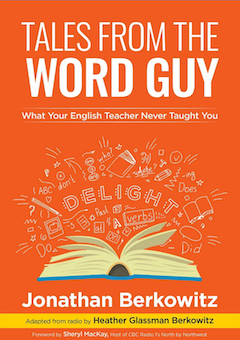
image - Tales From the Word Guy book coverIn Tales From the Word Guy, Berkowitz admits that his favourite books are dictionaries, followed perhaps by thesauri (I admit that I Googled the plural of thesaurus).  “In fact,” he writes, “thesaurus comes from Latin, meaning ‘treasure,’ and the first dictionary definition of thesaurus is treasury or storehouse. Indeed, what a treasure house it is.”

Words have always been a passion for Berkowitz, but he is also a fan of numbers and mathematics, having chosen a career as a statistician. With his facility for words, numbers and problem-solving, it is no wonder that MacKay, in 2015, invited him to present puzzles on her show. I never heard him in that role, but I did very much enjoy the book those puzzles led to: The Whirl of Words, also published by FriesenPress. (See jewishindependent.ca/playing-with-words-and-more.)

Berkowitz’s breadth and depth of knowledge can be overwhelming at times. To build off his metaphor of this latest book as a box of chocolates, you might get the equivalent of a sugar rush if you read too much of it in one sitting. While the chapters are short, amusing and easy to read, there is just so much information “filling,” from the erudite to the silly to Berkowitz’s trademark puns. (Among those he shares is one of his favourites: “The only thing flat-earthers have to fear is sphere itself.”)

I learned so much in Tales From the Word Guy. For example, I knew that A, E, I, O, U and sometimes Y are vowel letters – but also sometimes W?! Berkowitz gives the example of the “uncommon word, cwm, a synonym for cirque, [which] means ‘a deep steep-walled basin on a mountain usually forming the blunt end of a valley.’ Linguists sometimes refer to Y and W as semivowels,” he writes. “Conversely, U and I sometimes represent consonants, as in quiz and onion, respectively.”

I can understand the U being considered a consonant in quiz, but remain confused about the I in onion. But in a good way. I enjoy having my mind challenged, my assumptions upended.

I also enjoy being wowed and there are many “really?!” moments in this book, such as W being a vowel sometimes, albeit rarely. To name just a few of the other things that made me ooh and ah – the origins of the terms uppercase and lowercase; the number of words Shakespeare created (and some examples); and the name for and function of “um,” “uh,” “like,” “you know,” all those annoying sounds or words most of us unconsciously insert into our sentences when we talk.

But it’s not just the many fun facts that make Tales From the Word Guy such fun to read. Berkowitz shares a bit of himself, from more serious topics, like how his mother and father influenced his life, to his favourite, or most beautiful, words, his language pet peeves and his efforts at making up new words. It is easy to see why CBC’s the Word Guy is so popular.

To order a copy of Tales From the Word Guy, go to talesfromthewordguy.com.

****

Tales From the Word Guy: What Your English Teacher Never Taught You book launch with author Jonathan Berkowitz in conversation with Sheryl MacKay; adapted from radio by Heather Glassman Berkowitz. Nov. 29, 7pm, at the Jewish Community Centre of Greater Vancouver. No registration required.

Tales From the Word Guy: Jonathan Berkowitz talks about his new book with Daniella Givon. Dec. 12, 7:30pm, at Beth Israel. bethisrael.ca.

Format ImagePosted on November 25, 2022November 23, 2022Author Cynthia RamsayCategories BooksTags CBC, Heather Glassman Berkowitz, Jonathan Berkowitz, language, North by Northwest, Sheryl MacKay, the Word guy, words
Old Stock returns by popular demand

Old Stock returns by popular demand

Ben Caplan stars in Old Stock: A Refugee Love Story, which opens at SFU Goldcorp Centre for the Arts Dec. 1. (Stoo Metz Photography)

Ben Caplan is narrator and co-creator (with Christian Barry and Hannah Moscovitch) of Old Stock: A Refugee Love Story, which opens at SFU Goldcorp Centre for the Arts Dec. 1. It is a fantastic show, well worth seeing, which was last in Vancouver for the 2020 PuSh Festival.

“The show hasn’t changed all that much,” said Barry, artistic director of Halifax’s 2b theatre company. “We have a brilliant new drummer and keyboardist working on the show and, on top of that, the team has more skill and experience just by virtue of having had more opportunities to refine our show through repetition. But, ultimately, the reason we are bringing [it] back to Vancouver is all about access. In January 2020, we were only able to perform six times at UBC as part of the PuSh Festival. It was a lovely run with full houses and boisterous responses, but we think there were many people who just didn’t have the chance to see the show. We were thrilled to receive an invitation from SFU to bring the show back, and to perform in downtown Vancouver.”

To read more about the music-theatre performance, visit jewishindependent.ca/searching-for-a-safe-harbour. For tickets, go to eventbrite.com.

Format ImagePosted on November 25, 2022November 23, 2022Author Cynthia RamsayCategories Music, Performing ArtsTags 2b theatre company, Ben Caplan, history, immigration, Old Stock, theatre
Art for wide variety of tastes

Art for wide variety of tastes

Margaux Wosk makes pins, magnets, necklaces and other items. (photo from the artist)

Last year’s Affordable Art Show at the Zack was such a success that the gallery is repeating it in 2022, just in time for the winter holidays. Gallery director Hope Forstenzer hopes it will become an annual tradition.

Everything in the show is less than $250, and the selection is wide enough to appeal to a variety of tastes. The participating artists are a mix of repeat appearances and newcomers. Some of the newcomers have exhibited in Zack group shows before. For the others, this is their first event at the gallery.

Margaux Wosk is one of the new artists. Their company, Retrophiliac, produces pins, magnets, necklaces and other items, many of which are priced below $20.

“I’m an autistic, self-taught artist, designer, writer, entrepreneur and disability advocate,” Wosk said. “I have been a ‘retrophiliac’ for a long time. I am inspired by retro and vintage styles, but I also want to celebrate neurodiversity.”

In addition to their company’s distinct merchandise, Wosk creates vibrant, retro-inspired paintings and mixed media work. “I hope to break down barriers and eliminate the stigma of neurodiversity,” they said. “With my art, I want to open a dialogue about what autistic and disabled people are capable of.”

Aimee Promislow, another new artist, works with glass. Her company, Glass Sipper, produces reusable drinking straws. “I met Hope [Forstenzer] a number of years ago,” she told the Independent. “We were both members of the same glass co-op. When she joined the Zack Gallery, she began reaching out to me for various events and shows. Last year, I participated in the Hanukkah show here. I’m excited to be part of the Affordable Art Show this year.”

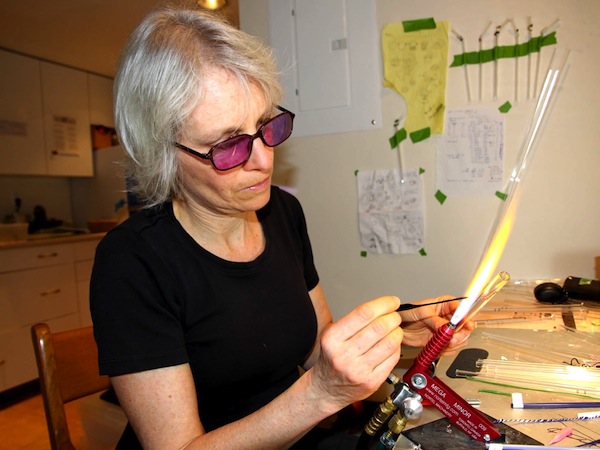
photo - Aimee Promislow works with glass, making reusable drinking straws
Aimee Promislow works with glass, making reusable drinking straws. (photo from the artist)

Promislow summed up her creative path and why she chose it. “I have always, since a young age, dabbled in art,” she said. “My mother is an artist, Nomi Kaplan. She had introduced me to various art forms. After high school, I tried pottery, then glass enamel, then I played with resin. Eventually, about 15 years ago, I started melting coloured glass. I love colour and I love watching things form in fire. Glass is hard when cold, but, once heated, it is malleable, and I love moving it around.”

At first, Promislow made glass beads and sculpted little animals out of glass: dogs, cats, turtles. “At the same time, our family enjoyed smoothies,” she said. “The kids wanted straws for their smoothies, but the only smoothie straws I could find were plastic ones.”

Concerned about the environment, she combined her passion for glass with her care for nature. “I had a ‘eureka’ moment,” she recalled. “I realized that, instead of making glass beads, I could make reusable glass drinking straws and decorate them with my tiny creatures. That night, Glass Sipper was born.”

She also makes glass mezuzot and yads (the pointers used to read Torah). “They are perfect gifts for bar and bat mitzvah,” she said. “And everything I make is under $100, ideally suitable for the Affordable Art Show.”

Another glass artist in the show is Sonya Labrie. Her company, SML Glassworks, produces vases and other elements of home décor, as well as jewelry. “I’ve always created pieces that could be in anyone’s home,” she said. “The idea that art is to be loved and available to everyone in our community is very important to me.”

With such a mindset, when Forstenzer invited her to participate in this show, Labrie’s answer was an unequivocal yes.

“I started working with glass in 2005,” she said. “The first glass class I attended was at Red Deer College in Red Deer, Alta. Then I went on to complete a three-year advanced diploma in craft and design at Sheridan College, majoring in glass. I’ve also had the opportunity to study glass at the renowned Pilchuck Glass School in northern Washington.”

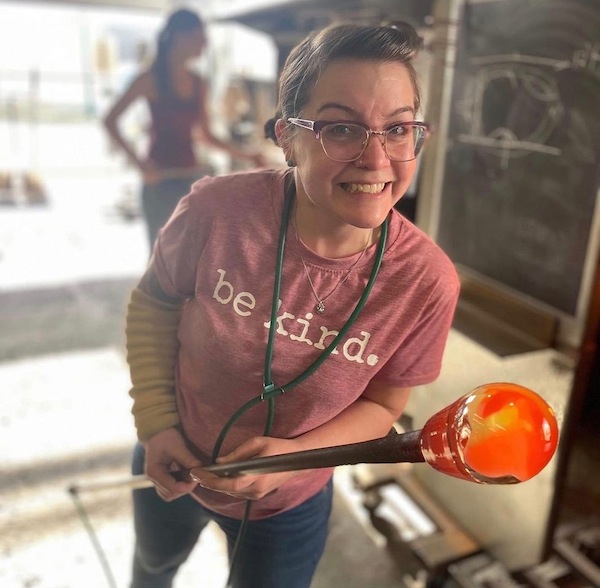
photo - Glass artist Sonya Labrie creates vases and other elements of home décor
Glass artist Sonya Labrie creates vases and other elements of home décor. (photo from the artist)

Labrie said she can’t imagine her life without creating beautiful things out of glass. “My body of work includes blown glass, flamework and kilns-cast items,” she elaborated. “Glass has endless possibilities, it is a challenging medium, and I keep discovering new ways of working with it.”

She also teaches glasswork for the Vancouver School Board. “I teach students grades 8 to 12 and I teach continuing education workshops for adults at the Terminal City Glass co-op.”

Unlike these company-owning creators, fibre artist Deborah Zibrik doesn’t consider herself a full-time artist. Not yet.

“I am a registered dietitian,” she said. “I’m still working part time, finishing a career that started in 1975. I will retire soon, after a research project at the B.C. Children’s Hospital Research Institute is completed. Until then, I simply don’t have enough time each day to work as a full-time artist. However, I consistently carve out ‘me time’ every day to complete some stitching. Ideas are constantly percolating in my head. Typically, many pieces are framed up or in the sketchbook phase at any one time. Perhaps the best descriptor for me is a part-time artist.”

Zibrik makes elaborate embroidered pieces. Some of them are like miniature tapestries, landscapes emerging out of fabric and threads. Others are tiny blossoms, beetles and butterflies that could be used separately or together, each one a delightful surprise. She also does golden embroidery.

“Smaller pieces are often whimsical and stitched quickly, with a minimum of stitches. On the other hand, my gold work requires hours to complete, and the materials are much more costly.”

Zibrik started learning needlecraft when still very young. “Like many girls growing up in rural Canada, I was taught by my mother and grandmother. They wanted to make sure I had all the critical homemaker skills, from crocheting blankets to mending socks…. Later, after 10 years of part-time study at Gail Harker Creative Studio, I completed Level 2 Design (based on a City and Guilds of London Institute in the U.K. curriculum) and Level 4 Diploma for stitch. Luckily for me, the studio is located in La Connor, Wash. That made it possible for me to attend sessions in-person to complete the evidence-based curriculum.”

photo - Fibre artist Deborah Zibrik makes elaborate embroidered pieces
Fibre artist Deborah Zibrik makes elaborate embroidered pieces. (photo from the artist)

After receiving her diploma in 2015, Zibrik decided to share her skills with others. “Time permitting, I have been teaching workshops for specific needlework techniques,” she said. “Guild members are my usual students. There is currently a discussion among the guilds about the lost generations of children who haven’t learned any of the needle arts, including embroidery; they haven’t had the exposure. Because of that, membership in the guilds is declining, as members age. I am considering ways to fix that. Perhaps I could offer embroidery classes to youngsters, maybe at the community centre level, to teach basic skills and prime creativity to future artisans.”

When asked where they see themselves on the scale of art versus craft, artists’ replies varied.

“I’m an artist and a designer,” said Wosk.

Promislow said, “I am a craftsperson. I use my medium to make things that are functional and beautiful.”

“My work rides a fine line between both,” said Labrie. “There is a fluid movement in my practice.”

“My personal journey suggests that, especially for women, craft and art are inextricably linked,” offered Zibrik. “More, they have been connected for thousands of years. They are but different places on the same continuum. In that sense, I am privileged to say: I am an artist.”

The Affordable Art Show continues until Dec. 30. And, if you’re visiting the exhibit Dec. 5-7 or 12-14, check out the Jewish Community Centre of Greater Vancouver’s Chanukah Marketplace, which takes place in the centre’s atrium.

Olga Livshin is a Vancouver freelance writer. She can be reached at [email protected].

Format ImagePosted on November 25, 2022November 23, 2022Author Olga LivshinCategories Visual ArtsTags Affordable Art Show, Aimee Promislow, Deborah Zibrik, gift ideas, glass, Margaux Wosk, painting, Sonya Labrie, textiles, Zack Gallery

Posts pagination

Previous page Page 1 … Page 137 Page 138 Page 139 … Page 650 Next page
Proudly powered by WordPress