Skip to content
  • Home
  • Subscribe / donate
  • Events calendar
  • Business Directory
  • FAQ
  • News
    • Local
    • National
    • Israel
    • World
    • עניין בחדשות
      A roundup of news in Canada and further afield, in Hebrew.
  • Opinion
    • From the JI
    • Op-Ed
  • Arts & Culture
    • Performing Arts
    • Music
    • Books
    • Visual Arts
    • TV & Film
  • Life
    • Celebrating the Holidays
    • Travel
    • The Daily Snooze
      Cartoons by Jacob Samuel
    • Mystery Photo
      Help the JI and JMABC fill in the gaps in our archives.
  • Community Links
    • Organizations, Etc.
    • Other News Sources & Blogs
  • JI Chai Celebration
  • JI@88! video

Recent Posts

  • Federation now across BC
  • Israel fighting for its existence
  • Deal strengthens Iran
  • Patriotic belonging diminishes
  • A campaign to engage
  • Upstanders’ first live event
  • Responding to Carney
  • Having your own home
  • Music a family tradition
  • Musical to warm heart
  • Community milestones … June 2026
  • Sharing her passion for Israel
  • Or Shalom reopens its doors
  • JFS from past to future
  • Need holistic approach
  • Sharing stories, advice
  • Journalist shares fears
  • Skills to live together
  • Road to independence
  • Cutting grass with scissors
  • Zionism as a solution
  • Deceit, desire & the divine
  • Reclaiming sacredness
  • Creative project ideas
  • Summer squares and cobbler
  • Thou shalt … summer commandments
  • Legal help for students
  • Revisiting myth of Lilith
  • Wrong person rebuked
  • Canada’s mixed messages
  • Questions for museum
  • Symposium on antizionism
  • Making soccer political
  • CJPAC lauds Pulver’s impact
  • City recognizes Vrba’s legacy  
  • Organ donation saves lives

Archives

Follow @JewishIndie
image - CJN box ad Rockowers 2026

Category: Op-Ed

CANCELED Statements on The Runner

The Jewish Independent received the following statements regarding the play The Runner after the Belfry Theatre in Victoria canceled the scheduled March performances of the play, which is set to run as part of the PuSh Festival in Vancouver Jan. 24-26.

Since this article was published, PuSh has canceled the production. For the statement, click here.

Christopher Morris, artistic director of Human Cargo and playwright of The Runner:

As a playwright who values the role of theatre as a platform to explore ideas about the complexities of life, I was disappointed to learn that the Belfry removed The Runner from its programming. I also empathize with the challenging situation they were facing. I am saddened that people in Victoria – especially those with very divergent views and those traumatized by the atrocities in Israel and Gaza – will be denied the opportunity to come together in a theatre to explore their common humanity, share their grief and perhaps discover a flicker of solace and hope. 

Since it premièred in 2018, my play The Runner has been seen by audiences in six cities, received numerous awards and unanimous critical acclaim. I am humbled that theatre companies have produced this play, which is a nuanced and thoughtful conversation about the preciousness of human life. Their endorsement tells me that they also see its effectiveness in creating a dialogue with their audience.  

I am deeply traumatized and saddened by humankind’s capacity to wage war. As a Canadian, I want our politicians to do all they can to make the violence in Gaza and Israel stop. I hope theatre companies and playwrights do all they can to give audiences the opportunity for dialogue and to build bridges between our silos. I believe The Runner is an excellent opportunity for those things to happen. And Vancouver audiences will get the chance to experience this production in a few weeks, at the upcoming PuSh Festival.

***

Gabrielle Martin, director of programming, and Keltie Forsyth, director of operations, PuSh Festival:

The PuSh Festival recognizes the pain of those watching or connected to the conflict in Gaza and Israel and the feelings of hurt and helplessness, knowing our experiences here in Vancouver are nothing like those who are suffering direct violence or who have lost homes, friends and family members.

We understand the objections to our programming of The Runner as a part of that shared hurt. When we see death, particularly civilian death, on this scale, we feel the injustice and the inhumanity at work, and we want to do something about it. Here in Canada, far from the conflict, it’s easy to feel helpless, to feel like contacting politicians, rallying or protesting isn’t enough. At PuSh, what we do is present live art, and sometimes we share the feeling that what we do isn’t sufficient. 

Art reflects the world and the times in which we live. At its best, it’s an essential cultural force that builds empathy and understanding. Our aim is that PuSh brings us together and inspires us to have complex conversations; to challenge ourselves and each other not only to think differently, but to feel differently. The festival experience is greater than the sum of its parts and defined in how each piece sits in conversation with the other. These pieces share a sense of cultural urgency and, together, welcome generative friction through plurality as a cultural strategy. 

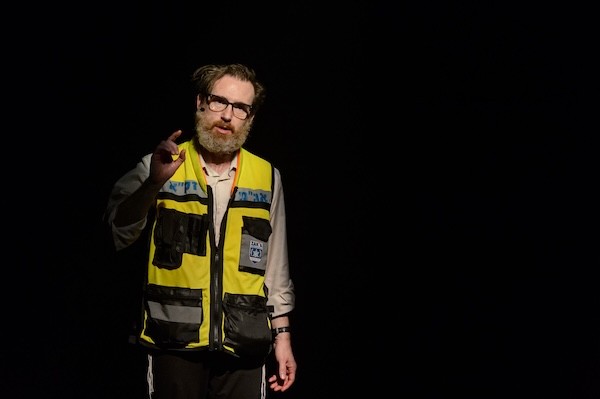
The Runner is situated within a program that explores our shared humanity in ways that transform the political into the personal, intimate and domestic. This play, by Canadian playwright Christopher Morris, is a story about triage that’s set in Israel. It is not funded by the Israeli government, and Christopher has no direct ties to any country in the region. The play unpacks one character’s dilemma between humanist impulse and socially imposed morals, as he advocates for seeing all human life as equal. In its commitment to examining the polarizing tensions and conflicting ideologies at work within its Israeli protagonist, it exposes painful racism behind the dehumanizing sentiments encountered by the character. Christopher shares: “I lack the experience, or expertise, to speak on or write a play about the extremely complicated conflict that’s happening right now in that part of the world. And what I’ve been offering since 2018 is a play, from my Canadian perspective, that explores the complexities, and limitations, of empathy and kindness.” Ultimately, he frames The Runner as “an offer for discussion.”

We believe this work offers one voice in a diversity of perspectives that diverge in specifics of identity and experience, but that all advocate for empathy and compassion. Dear Laila, playing parallel to The Runner, offers an autobiographical perspective on the forced displacement of Palestinians through one family’s experience of war and exile. Basel Zaraa, the artist behind the project, is a Palestinian refugee who grew up in Yarmouk refugee camp in Damascus, Syria. Dear Laila features a miniature model of his destroyed family home in Yarmouk camp, and three stories that represent the three generations who lived in the house. Intimate and interactive, the experience invites each audience member to connect with this story of “[a] family, like many families of our communities, who are stuck in a loop of losses.” Basel further frames it as “a way for me to face and express and understand the trauma that we live with.”

These two works form part of the wider 2024 festival ecology, and each plays an integral role to a balance that has been curated with care. In the face of violence and atrocity, presenting live art can feel small. We hope that, collectively, the performances and multimedia experiences of this year’s festival offer opportunities for self-reflection, better understanding others’ experiences, and dialogue – actions that, in our view, can sometimes offer building blocks for meaningful political change.

***

The Jewish Federation of Victoria and Vancouver Island is disappointed by the decision of the Belfry Theatre to cancel its production of the acclaimed play The Runner. 

It is regrettable that the Belfry Theatre felt the need to cancel an artistic production, for the first time in its 46 years of existence, because it featured an Israeli Jewish man. 

It is regrettable and disheartening that, when the Belfry Theatre attempted to have an open dialogue, it was vandalized and threatened by a “pro-Palestinian” mob, which ultimately led to a very quick decision without any meaningful consultation. The Belfry’s stated reasons for this decision were: “we believe that presenting The Runner at this particular time does not ensure the well-being of all segments of our community … this is not the time for a play which may further tensions among our community.” This decision does not reflect the wishes of the community as expressed in competing petitions: 1,400 against showing the play vs. 2,400 wanting the play to proceed.  

We fear this decision will lead to other cultural events being canceled, as other venues may also give in to mob mentality and bullying. This is not what we expect from our cultural institutions, nor our community. It is not too late for the Belfry Theatre to reconsider their actions, as we hope they will. 

The decision does not bode well for artistic and cultural expression in Victoria and Vancouver Island. It matters to stand up for what is right. 

To read the Jewish Independent’s interview with playwright Christopher Morris, click here. To read the Independent’s op-ed on the Belfry Theatre’s choice to cancel its March run of The Runner, click here.

Posted on January 12, 2024January 12, 2024Author Community members/organizationsCategories Op-Ed, Performing ArtsTags Christopher Morris, Gabrielle Martin, Jewish Federation of Victoria and Vancouver Island, Keltie Forsyth, PuSh Festival, The Runner

Focus during distracted times

As a freelancer, I often find interesting work opportunities that don’t pan out. I spent time in December applying for an editor gig that involved editing summaries of literature to provide students with educational support. I used to think these supports were “cheating,” using these kinds of guides, but now I know differently. Students with special needs deserve access to these stories. I recognize that every student has the right to learn, read great pieces of literature and access education, even if they struggle along the way. So, I dutifully filled out the form, sent off my CV and submitted an application. One application question irked me. “What’s your favourite piece of literature and why?”

Two things bothered me. One is that this response had a word limit on the form, so nobody could wax eloquent about whatever they chose. The second thing is that, as someone in mid-life who reads voraciously, I thought it was ridiculous to ask what someone’s all-time favourite was. I couldn’t possibly name only one, but I thought about it. I’ve been reading Talmud daily for about four years. I must like it. Further, it has helped me gain a lot of insight into the ancient world, and reflects further on ancient cultures, law systems and storytelling.

I tried to fit this into the form, but I had reservations. The organization had a big “We do not discriminate” statement on its page but, after Oct. 7, I wondered if I was risking something to say that the Babylonian Talmud was my current favourite. My concerns might have been warranted. On Dec. 25, in the morning, I received a vague form email telling me my application hadn’t been successful. My household laughed about the timing of the form letter. What were they indicating? That Jews should work as usual on Christmas, a North American statutory holiday? Or that my choice of literature was so egregious they couldn’t wait for a business day to reply? Perhaps something else about my qualifications didn’t meet their needs. It’s best not to work for a place that isn’t a good fit. Although this part-time gig had great potential, I wasn’t a contender. That’s OK.

This experience made me reflect on my lifelong relationship with reading. I’ve always loved to read. One of my undergraduate majors was in comparative literature. A  favourite moment during my graduate work in English education came when the professor put different things on a table and asked us to list which things were “literature.” The professor included newspaper articles, fiction and nonfiction, plays and song lyrics, advertisements, and more. Her point was that we often couldn’t predict what piece of writing would stand the test of time. Further, all of us would have different answers to this question about how to define literature and its meaning. She was right.

Since Oct. 7, I’ve had a hard time focusing. For a long time, I couldn’t read a book. Don’t get me wrong – I’ve been glued to the news and social media, reading many articles and much political analysis. I listened to completely “fluffy” fiction audio books as I cooked but, eventually, I had to stop renewing a book I’d checked out from the public library. It was nonfiction, a book about the US Great Migration called The Warmth of Other Suns, by Isabel Wilkerson. It was well-written and engaging. I felt like apologizing to the author. I couldn’t focus enough to remember the various narrative threads or finish it.

Later, on Dec. 25, I managed to complete reading On the Way Home, the short diary of Laura Ingalls Wilder, which recounted her trip from South Dakota to her new home in Mansfield, Mo., in 1894. This brief chronicle transported me, giving me a window into travel during a period of US history that I could only imagine. Was it literature? Perhaps, because it worked the way literature should. I spent time in my imagination in a different place and time. It offered a brief respite. Perhaps it’s the start of being able to focus on reading again? I can only hope.

I wondered why I’d made it through this (admittedly short) volume I’d found at a neighbourhood Little Free Library. It made me reflect on what aspects of literature are valuable and what allows us to focus on it. Perhaps it’s about escape or the imagination. Maybe it helps us learn about relationships, history and culture.    

Four years ago, I resolved to start Daf Yomi, reading a page of Talmud a day, on Jan. 5. It was my birthday and close enough to the start of the secular new year to be a “resolution” that truly stuck. After four years of reading a page a day, I am still immersed in this experience. Even though I read mostly in English, and barely skim the surface of each page, I’d argue this is a good read. I’ve learned a lot, but it has taken work and research to make meaning. Sometimes, I have to struggle with finding connections with the rabbis who lived 2,000 years ago. Even as the rabbis struggled with practical issues, I sometimes have to read commentaries and make a leap to figure out how the issues applied then as compared to today. 

Great literature is about history and context, as well as mystery, and it’s all there, wrapped up for us like a big gift in Jewish literature. Religious texts like Torah and Talmud, as well as all the other Jewish stories that came afterwards, add meaning and depth to our lives. Surprisingly, I haven’t had trouble focusing on these narratives.

Here, too, is another lesson that literature is teaching me – we Jews are a small people but have incredibly rich literary and spiritual resources. As Israel struggles physically with war, these texts remind me what we’re fighting to maintain. Doing the work to understand these texts offers us so much history, context and tradition, I’m grateful to have the opportunity. It’s the least I can do when so much is at stake. 

Joanne Seiff has written regularly for CBC Manitoba and various Jewish publications. She is the author of three books, including From the Outside In: Jewish Post Columns 2015-2016, a collection of essays available for digital download or as a paperback from Amazon. Check her out on Instagram @yrnspinner or at joanneseiff.blogspot.com.

Posted on January 12, 2024January 11, 2024Author Joanne SeiffCategories Op-EdTags books, education, literature, Oct. 7, reading

Pride in being “just a Jew”

There is an age-old question that frequently nags at us along our journey of life: “Who am I?” I’ve struggled with it, and perhaps you have as well. When you ask yourself “Who am I?” you probably start by listing superficial things about yourself. In my case, I’m from Argentina, I play music, and people say I have a great sense of humour. Even though I always knew who I was on the surface, a deeper layer eluded me. There is still more to learn about myself.

When I was young, well, younger than now, I constantly pressed my father with the similar question that was scrambling in my head: “Who are we?” I was trying to find a simple way to get my answer, to avoid spending my own time navigating the question so I could do something (seemingly) more productive, like playing video games. I figured that, by asking my dad, I may very well be who he is, given I’m his son, an extension of him, in many ways. But, every time, my father would reply in the same cryptic way and always with a smile on his face: “Son, we are Jews.”

I was never quite able to comprehend why he couldn’t just give me a plain answer, rather than that infuriating, puzzling and annoying explanation. I was not going to give up and, with my insistent character, I continued asking. I posed the question from different angles, wanting him to elaborate, but he would just say, “Uriel, it’s simple. We are Jews. You and I are solely Jews.”

When my dad couldn’t satisfy my curiosity, I turned to my school’s rabbi, Rabbi Stephen Berger. When I asked Rabbi Berger, his answer was just as confusing and mysterious. He kindly stated that he could not provide me with the answers I sought; I had to embark on this road of self-discovery myself, with the help of my loved ones. Then, about halfway through the year, he introduced me to StandWithUs Canada, an organization that would help me better understand who I was by putting me in touch with other Jewish teenagers from around the world.

I now realize why I couldn’t access a fast-food solution to a philosophical question. I finally found the answer I’d been seeking.

Last August, as I joined 190 of my peers from high schools throughout the United States and Canada at the StandWithUs conference in Los Angeles, I found myself on a path leading to enlightenment that has reshaped my understanding of Jewish identity. The sessions were informative and interesting, but it was when we reached the segment focusing on what Jews were before the dark chapters of persecution during the Holocaust – they were highly contributing members of society, and more – that everything started to click.

A single statement truly hit home: Jews have been forcibly expelled from about 109 countries throughout history. It was a stark reminder that, regardless of our accomplishments and contributions, we would always be seen as “Just a Jew.” It became clear that the essence of being Jewish transcended any specific occupation or societal role. We are a resilient and diverse community with a history of triumphs and tragedies. 

This knowledge instilled a sense of pride in my identity, not as a limitation but as a source of strength and unity. Thanks to StandWithUs Canada, I learned that, at the end of the day, embracing who we are, with all our complexities and contributions, is a powerful testament to the enduring spirit of the Jewish people. I felt a sense of pride but a pride that could be taken away from me at any moment. This is when I decided to become a more invested member of the community by being on the board of NCSY, the Orthodox Union’s youth group.

Talking to politicians and people who can truly make a difference became an essential component of my advocacy. I understood how dialogue and education could change people’s perspectives. 

My aim in sharing the history of the Jewish expulsions and the resilient spirit of our community is to raise awareness and foster understanding. My tool against bigotry and ignorance is teaching. I am committed, every day, to teaching people about the rich history of the Jewish people.

Uriel Presman Chikiar is in Grade 12 at King David High School and is a board member of NCSY.

Posted on January 12, 2024January 11, 2024Author Uriel Presman ChikiarCategories Op-EdTags education, history, identity, Judaism, StandWithUs

Torts and the Jewish holidays

I’m that grown-up who jumps to catch a kid who is about to fall off a playground slide, even if the kid isn’t mine. I’m saying, “Hey, be careful!  You don’t want to hurt your bum,” or whatever concern is applicable. Some feel I’m overprotective. Rather than using unkind words like “hovering,” I prefer “proactive worrier.”

I felt isolated with this habit. Then I got to know the contractors for our home renovation better. The brothers who worked for us were also parents. They did everything possible to keep kids, dog and parents safe as they worked on the house with us living in it. The older brother, the electrician, would spell out exactly which hazards he was trying to avoid. He would close a door, put up a sign saying “Please stay out” or another proactive way to avoid problems. The day they installed a big new bathtub was a good example. After caulking it, the tub was filled with water to weigh it down and create a good seal. We knew the kids and dog would be very tempted to check it out – we imagined kids falling in in their clothing, playing with rubber duckies, a dog jumping in and flooding the room. We strategized how to keep everyone away from the tub until the caulk hardened.

I was surprised when I started studying Bava Kamma, a Babylonian talmudic tractate dedicated to civil law, particularly the law of damages and compensation owed. In “fancy” legal vocabulary, this is tort law, which “provides damages to victims in compensation for their losses.” The rabbis of the Talmud thought through these issues. They used examples from their day. They talked about oxen that gored, camels that fell (and caused a stumbling block) and other unpredictable situations. I’d heard sermons where people laughed about this level of detail, but my brain returned to those playground moments. Perhaps others don’t take these examples seriously because they’ve never interacted with large, stubborn livestock or a fussy, heavy toddler or two.

Here’s an example of a question posed in a baraita in Bava Kamma 29: “If one’s jug broke and he did not remove its shards, or if his camel fell and he did not stand it up, Rabbi Meir deems him liable to pay for any damage they cause. The rabbis say that he is exempt according to human laws, but liable according to the laws of Heaven.” So, the understanding is, if you create a dangerous situation, you’re obligated to clean it up. If you don’t clean it up, you’re still responsible for it. You’re guilty even if you don’t owe money as compensation.

Examples like these keep popping up. This tractate is a Jewish rabbinic lesson in taking responsibility for our actions. How might something we do harm someone? What if it’s an accident, like dropped pottery? What if you purposely left broken glass or pottery that could harm others?

This ancient rabbinic text can seem dry, as law texts might be, but also relevant. In the last few days, many communities have started to use law as an excuse to exclude public acknowledgement or celebration of Hanukkah. Moncton, N.B., made a name for itself in this way. A Hanukkah candlelighting has been customary there for 20 years. Suddenly, this year, the mayor and council felt it interfered with the separation of church and state. They canceled the event, although Moncton City Hall decorates with angels, a Christmas tree and wreaths. A last-minute petition with many opposing voices succeeded in forcing a new vote that overturned this decision, so the menorah and candlelighting were reinstated.

Other communities wrestling with this include Williamsburg, in my home state of Virginia. Organizers there suggested that a menorah lighting couldn’t be allowed unless it was under a “ceasefire now” banner. In Britain, a London town council reversed their decision to cancel a public menorah lighting after an outcry. Back in Canada, in Calgary, Alta., the mayor canceled her attendance at the city’s public menorah lighting. 

Suddenly, the rabbis’ detailed discussions in Bava Kamma make more sense. Their debates explore when someone is wronged by accident, and if they owed compensation. However, they also include the question of responsibility when someone is wronged “on purpose.” For example, when a government uses the law to suppress a minority religious observance, like Hanukkah. When this kind of action takes place, it does harm. It does harm beyond whether Jews are legally allowed to light a hanukkiyah in a public place. The message it sends causes bigger damage and fear. 

After all, if Jews in Canada or the United States aren’t allowed to publicly celebrate their religious rituals, it feels unsafe to be Jewish in these places. Where is it safe? Most Jews would then think about Israel as being the place where it’s truly safe to be Jewish. The people who want to withdraw public observance of Jewish traditions due to the Israel/Hamas war send a message to Jews living in North America – it’s not OK with them to have a Jewish homeland in Israel. It’s also not OK with them for Jews to observe their religion openly here. They probably missed the irony, as their message is that it’s especially not OK when the Jewish holiday is about religious freedom.

Laws about compensation for damages can sound uninteresting. It becomes more intriguing when imagining an unsafe play structure, a broken piece of pottery or a camel that won’t budge. It gets even more pertinent – and uncomfortable – when the law is used to keep us from celebrating our religious traditions freely, in public, without fear, in a democracy.

While Hanukkah is ending, it’s still the time of year when many indulge in more sweets and tortes than we’d planned. Sadly, it’s a different kind of tort this year, one where we consider how to compensate for the potential loss of religious freedom. 

Joanne Seiff has written regularly for CBC Manitoba and various Jewish publications. She is the author of three books, including From the Outside In: Jewish Post Columns 2015-2016, a collection of essays available for digital download or as a paperback from Amazon. Check her out on Instagram @yrnspinner or at joanneseiff.blogspot.com.

Posted on December 15, 2023December 14, 2023Author Joanne SeiffCategories Op-EdTags Chanukah, Hanukkah, Judaism, law, lifestyle, politics, religious freedom, Talmud
Writing in praise of neoteny

Writing in praise of neoteny

Campers being silly at Rockbrook Camp for Girls. (photo from rockbrookcamp.com)

Today, the word of the day is neoteny. It’s really a term from evolutionary biology, but it describes the retention of childlike attributes in adults. You might think of a grown-up who has a “baby face,” or is generally “cute.” When you are talking about these kinds of physical features, we tend to think it’s a good thing to have “young looking skin” or the “energy of youth,” for example. Neotenic people are usually attractive. Being neotenous is mostly considered a good thing.

But what about personality traits, attitudes or approaches to the world? What about these ways of being childlike? Think about what life is like as a child. The world is magical, full of curiosities, almost always kind and wondrous. As kids, we spend so much time being creative and playing. We feel so many more things – joy, excitement, anticipation, and the broad sensuous world around us. All of this probably makes it so easy to make friends (“Come on! Let’s play!”).

You’ve also noticed what usually happens when we grow up. We get serious, we latch on to patterns of behaviour, we get scared, we feel the need to protect what we believe, we accept responsibilities and feel pressure to perform and “be” someone in particular. As adults, we spend almost all of our time, mostly alone, working to stay organized and fighting opposing forces. We’re all too consumed by those adult things we’ve grown to accept as important, and it ain’t easy.

photo - Kids at Rockbrook Camp for Girls with soapy hair
(photo from rockbrookcamp.com)

It’s no surprise to see that being an adult overpowers those childlike traits. Sadly, to grow up often means losing touch with what we used to be, those aspects of being human we loved as kids. As adults, we have a harder time feeling what makes the world wonderful, a harder time making friends, and a much harder time playing and having fun. Of course, there are exceptions to this, but that’s the point. They are exceptions. And that’s too bad.

Let’s remember the value of being childlike even as adults.

Let’s be joyful as we’re responsible.

Let’s be curious when encountering opposing beliefs.

Let’s be friendly and playful, cooperative and excited about learning new things.

Let’s strive to foster our innate neotenous instincts.

Bringing this back to camp.… Summer camp is a place where kids can really be kids. It’s a special time when they are encouraged to play, make friends, be creative and explore the world around them. Separate from the forces of home and school (which are fundamentally about forming “adults”), camp provides a wonderful opportunity to strengthen our “kid selves.” It celebrates and fosters the neotenous traits. Camp is a joyful break from all that training, and that’s a big part of why it’s so fun.

Maybe we could say…. Camp helps you learn how to be a really great kid so that, later in life, you’ll be a really great (happy, satisfied, remarkable) adult.

Camp’s power to strengthen these “kid traits,” I suspect, will be a big part of that success. 

Jeff Carter is director of Rockbrook Camp for Girls, which is in the western part of North Carolina. For more information, visit rockbrookcamp.com.

Format ImagePosted on December 15, 2023December 14, 2023Author Jeff CarterCategories Op-EdTags education, lifestyle, neoteny, Rockbrook Camp for Girls, summer camp, youth
Growing and sharing our inner light

Growing and sharing our inner light

If we fear “advertising” our identities, we should do everything we can to maintain our inner light and self-worth in trying times. (photo from PxHere)

Years ago, my husband lost both his grandmother and his great aunt. Several years apart, he traveled to the Lower East Side in New York to attend their funerals at the same funeral home. There was a rabbi there who officiated at both funerals. This rabbi told the same story twice. Perhaps he had only the one funeral teaching, but my husband remembered it. This rabbi suggested that a famous rabbi taught that the worst of the plagues against the Egyptians was darkness. Why was darkness the worst? It was all encompassing, overwhelming, and seemingly permanent. No one knew if the sun would ever return. This rabbi used this to talk about death, but the metaphor stayed with us.

Despite our efforts to find the source for this story, we couldn’t track down its origin. While looking for it, I thought about darkness and what we can learn from it as we celebrate Hanukkah this year.

There are parallels between the Hanukkah story and our current struggles. Before Oct. 7, Israelis were distracted by potential changes to their court system and very divided politically. While that political turmoil didn’t disappear in the face of the massacre and the war, Israelis have immediately united in the aftermath to work together. Israelis I know have said that it isn’t the government that is taking care of those who are displaced, but rather nongovernmental organizations and volunteers from every corner of Israeli society. Israelis are cooking meals for soldiers, for moms managing as single parents for long periods of time, and for those who have been evacuated or made homeless by the conflict. Israelis and the Jewish people worldwide have also worked together as a people to take care of one another.

The military conflict of Hanukkah is a story of division and unity. There were Jews at this time, around 200 BCE, who had become increasingly assimilated and Hellenized. They cooperated with the Seleucid Empire. There was societal upheaval. Others were more traditional in practice and offended by the changes made by more “liberal”-minded Jews and King Antiochus. The Maccabees represented the traditional or more orthodox Jewish tradition. They rose up against King Antiochus’s pagan practices and the more assimilated Jews who had adapted to Hellenistic practice.

We know now that the Maccabees won these battles. They rededicated the Temple in Jerusalem. This is a military victory and a story around religious or national liberation. The rabbis tried to focus the religious observance on the miracle of the light (the “ner tamid,” the holy flame in the Temple that should not go out) rather than on the military situation. However, we wouldn’t have Hanukkah without these historical cultural conflicts or the Maccabees’ wars.

The historical details of this struggle are in the books of the First and Second Maccabees, which describe the Hanukkah story. While there are many references to the holiday in the Mishnah, the detailed story has been maintained through the Catholic and Orthodox churches, which kept First and Second Maccabees as part of their Old Testament. Protestants don’t include these books in their bibles. We study these texts to understand Hanukkah, but they don’t hold any official status in Jewish tradition.

This, too, has a parallel to our modern experience. While we know our traditions around Hanukkah, some of the context comes from many historical texts preserved by others. During this war against Hamas, we are being forced to defend ourselves against antisemitism, and also to defend the existence of the state of Israel. The worldwide Jewish community doesn’t have to use our personal experiences to educate others about this. The historical contexts for understanding both antisemitism and the need for the existence of the state of Israel are embedded in world history. Learning about the historical roots of Christian antisemitism in Europe or in the dhimmi law of Islamic empires is part of the greater history. Information about when the Romans conquered Israel and destroyed the second Temple can be found in multiple sources, including on the Arch of Titus in Rome. The creation of the modern state of Israel in 1948 is also part of a much broader historical context.

The rabbis chose, in creating the rules around the holiday of Hanukkah, to focus on light and miracles rather than military victories. Rabbi Lord Jonathan Sacks (z”l) wrote in “8 Short Thoughts for 8 Hanukkah Nights” about the ways in which the light is emphasized. His fifth short thought focuses on Maimonides’ teaching about how to fulfil the mitzvah of Hanukkah. Maimonides teaches that lighting candles on Hanukkah is precious and that one must sell something or borrow to fulfil this commandment. Yet, if one finds Shabbat is coming and you have only one candle? Light it for Shabbat. In this case, Maimonides teaches: “The Shabbat light takes priority because it symbolizes shalom bayit, domestic peace. And great is peace because the entire Torah was given to make peace in the world.” Sacks suggests that, “in Judaism, the greatest military victory takes second place to peace in the home.” He points out the great victory is a spiritual and not military one.

For Israel today, too, the great victory must be the notion of continuing to pray and negotiate for peace while also navigating difficult military situations.

Sacks makes several points that could be articles on their own, but the ones I felt most drawn to remain relevant. The Hanukkah candles should be lit so that people can see them outside, but if one is afraid of inviting hate, it has long been taught that it is OK to light the candles indoors, out of public view. Still, we are meant to be public about our “light” more generally and fight for it, if necessary. If we fear “advertising” our identities, we should do everything we can to maintain our inner light and self-worth in trying times.

Finally, Sacks discusses a story in the Talmud in which Rav and Shmuel, third-century rabbis, disagree over whether you can use one Hanukkah candle to light another (if you lack an extra candle, a shamash, the helper candle, that is used to light the other eight candles). Rav suggests that you may not, as this might diminish the light of the first candle. Shmuel disagrees, and halachah (Jewish law) follows Shmuel, who teaches that you can use one Hanukkah candle to light another because it helps the light grow and brings us more light. Using your light to enlighten others is the best practice.

I bumped into a rabbi I admire who lives in Winnipeg, where I live. We were each dropping off kids at a Jewish youth group activity. He wore a ball cap, as he was “off duty.” I thanked him for his contribution to a news article about the war and local protests, and he responded, “These are dark times.”

Like the plague of darkness in Egypt, we don’t know exactly how or when things will lighten. We need Hanukkah’s message and rituals to offer that light. Maybe we won’t put our Hanukkah candles on public display this year, but we can draw wisdom and comfort from our long history and rabbinic teachings. These teach us to reach deep to find the messages of hope, faith and peace from a story about a war. This time around, we need to act individually like Hanukkah candles. We can lend our inner lights to volunteer, to speak out, to support others and to kindle others’ lights during a hard time. Even during times of war and hate, we can be the light. 

Joanne Seiff has written regularly for CBC Manitoba and various Jewish publications. She is the author of three books, including From the Outside In: Jewish Post Columns 2015-2016, a collection of essays available for digital download or as a paperback from Amazon. Check her out on Instagram @yrnspinner or at joanneseiff.blogspot.com.

Format ImagePosted on December 1, 2023November 30, 2023Author Joanne SeiffCategories Celebrating the Holidays, Op-EdTags Hanukkah, history, Jonathan Sacks, lifestyle, politics, Talmud

The omission of antisemitism

Many Jewish students are worried to go to campus in view of threatening and hateful messages and even open hostilities at some Canadian campuses. These are taking place within a wider context of antisemitic incidents in the wake of the eruption of the Hamas-Israel war.

The silence of some Canadian universities in addressing antisemitism, in particular when considered alongside otherwise active approaches toward equity, diversity, inclusion, decolonization (EDID) and racial justice needs to be explicitly addressed.

Legal action has recently been filed against some Canadian universities for failing to address antisemitism.

Anti-Palestinian racism, antisemitism

I’m an education scholar whose work centres on equity, diversity, inclusion, decolonization and anti-racism.

My engagement in this work has been shaped by my own background migrating to Canada from Israel 12 years ago. My graduate studies in Jewish history, with focus on Holocaust memory, made me attuned to injustice.

My migration was informed by concern my children wouldn’t be able to grow up without absorbing the racism against Palestinians that is pervasive in Israeli society. I now fear that my children, and students, will be absorbing antisemitism.

Antisemitism in society at large, on campus

Antisemitism — the prejudice, hatred, and oppression of Jews and one of the oldest forms of racism — is an ongoing concern in Canada.

There has been work at some post-secondary institutions to consider how EDID frameworks need to address antisemitism and also Islamophobia and anti-Palestinian racism both in the context of Israel and Palestinian issues and in the everyday.

But many EDID frameworks — both of specific institutions, and larger guiding frameworks — do not explicitly address these problems. For example, the Federation for the Humanities and Social Sciences’ 2021 “Charter on EDID,” which states the need for “a more resolute effort to achieve [EDID] in our disciplines [and] fields of inquiry,” mentions categories of race, ethnicity and does not name antisemitism.

Addressing covert and explicit discrimination

Because racism and discrimination are often covert in higher education institutions, EDID initiatives focus on creating systemic and institutional changes in all levels and aspects of institutions, including through policies, leadership, hiring, curriculum and student experiences. But this frame is also applied to specific discrimination cases and complaints in higher education.

Universities’ equity, diversity, inclusion and decolonization initiatives are emerging and should rightfully comprehensively respond to specific forms of racism and discrimination. For example, in 2020, work on the Scarborough Charter on Anti-Black Racism and Black Inclusion in Canadian Higher Education was launched and multiple universities have since signed it, pledging “shared recognition of the realities of anti-Black racism.”

Focus on decolonization

Inspired by the Truth and Reconciliation Commission and its 94 Calls to Action, decolonization and Indigenization of Canadian higher education plans have become central for conceiving EDID work.

For example, the second part of the Social Sciences and Humanities Research Council’s Igniting Change 2021 report, from the Advisory Committee on Equity, Diversity, Inclusion and Decolonization, focuses on “Principles, Guidelines, and Promising Practices of Decolonization.”

In Canadian universities, an EDID focus on issues of decolonization and racism is important, given histories and legacies of colonial oppression, racism, exclusion and marginalization affecting Black, Indigenous and people of colour in Canada.

Yet this focus, in specific institutional approaches to EDID, fails to address and at times downplays the history of antisemitism and its ongoing reality in Canada.

Whiteness and Jews’ ambivalent racialized status

Several factors have contributed to this. The majority of North American Jews self-identify as white. “Whitening” allowed white-passing Jews to become part of a white Christian mainstream in ambivalent ways.

This process has reduced Jewish heritage to simply a religious/faith affiliation, even while Jews remain vulnerable to pernicious white supremacist and antisemitic beliefs about Jewishness being “in the blood.”

No doubt, it is complex to identify Jews as a category under “race,” since such a categorization is reminiscent of Nazi ideology. On the other hand, if we understand race as a social construct, the absence of naming antisemitism in EDID frameworks is deeply problematic.

Tools to acknowledge antisemitism

This prevents scholars and educators from acknowledging the historical, institutional, ideological and cultural underpinnings of antisemitism.

Academics working on anti-racism issues trying to bring up antisemitism are often told this is not part of the EDID agenda.

A report by a senior adviser on antisemitism at the University of Toronto’s medical school described how instances of antisemitism were dismissed as political activism against Israel, protected under academic freedom even while this activism was rife with antisemitic dog whistles (such as seeing Jews as “controlling the media” or “owning the university.”)

This conflation points to EDID settler-colonial discourses that position Jews as white colonial forces.

This framing fails to acknowledge the historical, cultural, and spiritual ties of Jews to the land of Israel and also erases the reality that Jews both in Israel and in diasporic communities globally are not a uniform ethnic group. For example, about half of the Jewish population of Israel are “Mizrachi”, descendants of Jews from the Middle East and North Africa.

Not about shielding Israel from critique

Addressing the complexity of Jewish identities doesn’t mean justifying Israeli state politics or shielding Israel from critique.

Critiquing Israel is not antisemitism. Many Jewish and Israeli scholars have strong criticisms toward Israeli politics, just as many Jews object to the killing of civilians in Gaza, and support “free Palestine.”

CBC news video announcing the death of Canadian Israeli peace activist Vivian Silver who was killed in the Hamas attacks.

Unpacking history and current events is important for EDID work.

But portraying Jewish peoples as the embodiment of colonial oppression is an antisemitic trope that legitimizes hate and violence.

Antisemitic tones, slogans in political calls

Antisemitism was seen after Oct. 7 when some academics publicly celebrated the Hamas massacre as a form of decolonizing and liberation, while victim-blaming those murdered and kidnapped.

Colleagues shared video with me of people at University of British Columbia marching and chanting “there is only one solution: Intifada revolution.” For many Jews, this chillingly evokes the “final solution.”

In other protests, demonstrators have carried signs saying: “Keep the world clean,” portraying a trash can with a Star of David in it.

Including all experiences

The failure of EDID to address antisemitism makes Jewish students targets of microaggression and hate on campuses.

Universities must aim to create educational institutions in which all lived experiences are included.

A good way to address antisemitism would be for specific universities and the higher education sector to launch a task force. In so doing universities would also need to address hard political conversations surrounding Israel and settler colonialism. Universities have tended not to address this because of complexity, but this can no longer be avoided.

Jewish students should not be made to feel less than or illegitimate as they attend university. We have a responsibility to condemn and actively address antisemitism as part of our commitment to EDID.The Conversation

Lilach Marom, Assistant Professor, Faculty of Education, Simon Fraser University

This article is republished from The Conversation under a Creative Commons license. Read the original article.

Posted on December 1, 2023November 30, 2023Author Lilach Marom SIMON FRASER UNIVERSITYCategories Op-EdTags antisemitism, campus, diversity, education, Israel, Palestine, racism, university

As we light the hanukkiyah 

When we look at our calendars – especially that darkest of recent days, Saturday, Oct. 7, 2023 – it’s hard to imagine that that now-infamous date is part of a millennia-long continuum. 

About 2,200 years ago, the Maccabean revolt against the Greeks controlling Judea succeeded in the rededication of the Second Temple in Jerusalem. From this ancient victory, we celebrate Hanukkah, lighting candles over eight nights to honour our brave ancestors then and those who have followed. 

Now, more than two millennia later, we call on the Israeli Defence Forces to protect Israel from Hamas who, on Oct. 7, murdered more than 1,200 (mostly) civilians, injured more than 5,400 and abducted more than 240 elderly women, men, children and other civilians. Since that day, 200,000 Israelis have had to flee their homes and all in the entire country are living under constant threat of thousands of indiscriminately fired rockets launched by Hamas from Gaza. 

Operation Iron Swords is the Israeli response fighting for the safety of its people and, in fact, for its very existence. Is it Israel’s right to defend itself? Yes. But it’s much more than that. It is Israel’s obligation to its citizens, as it would be any country’s that wants to call itself a state. 

This operation, so necessary and yet so treacherous both on the ground and in the world of public opinion, has been used as an excuse for a disgusting surge in anti-Israel and – let’s be truthful – anti-Jewish rhetoric, threats, anarchy and vandalism. We’ve seen this before, in the May 2021 Gaza War and its aftermath, and we are seeing it again, only now the campaigns are emboldened and expanded by years of online Jew-hate that has made its way from the fringes to the centre.

photo - Judy Zelikovitz
Judy Zelikovitz (photo from CIJA)

What can we do? As descendants of the Maccabees – and generations more of intrepid survivors – we can rally, finding strength and comfort in our collective calls for civility, tolerance and bedrock Canadian values. 

We can stay informed and stay connected. 

We can, as thousands young and old across Canada have done already, donate to our local federation’s emergency campaigns supporting Israelis. How proud we can be that Canada’s diaspora has already raised more than $100 million in response to the emergency. Federations have already sent millions to support victims of terror, evacuees and those in need.

We can say something if we see something. The Centre for Israel and Jewish Affairs tracks hate-based incidents at cija.ca, under the Get Involved link. If you witness an antisemitic incident, report as many details as you can remember and, if it’s safe to do so, take pictures. If there is a threat or a crime, contact your local police. Many have officers specializing in this kind of report. 

Just as we honour our forebears who protected our lives, our culture and our values, we will honour those who were injured or died on Oct. 7. We will keep the Canadians who lost their lives in our hearts and remember their bravery in saving the lives of others.

At CIJA’s Antisemitism: Face It, Fight It conference in mid-October, most among the 1,000+ attendees were Jewish. But hundreds were not. We are not alone in fighting antisemitism.

As we light our hanukkiyah candles this year, let us celebrate the courage of those who went before us, of those who served us in sacrifice over thousands of years, and let’s ensure that those protecting Israel now feel our support and our gratitude. Let us be the light!

Wishing you and yours a joyful, meaningful Hanukkah. 

Judy Zelikovitz is vice-president, university and local partner services, at the Centre for Israel and Jewish Affairs.

Posted on December 1, 2023November 30, 2023Author Judy ZelikovitzCategories Op-EdTags antisemitism, Centre for Israel and Jewish Affairs, CIJA, Hanukkah, Israel-Hamas war

Universities have obligations

My mom left Brooklyn, NY, to attend Cornell University in the early 1960s at age 16. Among other things, women students had nighttime curfews. This type of legal responsibility or intervention, called in loco parentis (in place of a parent), was common, but, by the time my mother graduated, in the mid-1960s, times had changed. Curfews became a thing of the past.

When I got to Cornell in the 1990s, some things were the same. Cornell impressed upon its new students that “actions have consequences” and that “with rights and privileges come responsibilities.” That is, you were privileged to be there. If you did something stupid, you were held responsible. All this hit me while watching North American college campuses’ turmoil since the Oct. 7 Hamas massacre of Israelis.

I have a front row seat to the drama. My husband is a professor in Manitoba. Between the two of us, we have six degrees from five different universities. We’ve got insider knowledge. I watched some of the behaviour on campuses with horror during the first days after the attack, including seeing Dr. Russell Rickford, a Cornell professor, speak of his “exhilaration” in response to Hamas’s actions. I’m not listing all of the concerning antisemitic events that continue to occur at North American universities. We’re all seeing it on social media and the news.

The first good news I read was from an article written by Rob Eshman in the Forward, which covered Dartmouth University’s response. Dartmouth is a small school. Its academic experts on the Middle East collaborated quickly. On Oct. 9, they announced two public teach-ins, with expectations of a small crowd. Hundreds attended, and there were thousands of YouTube views. What’s the primary responsibility of a university? To educate and encourage students to be critical thinkers. Dartmouth rose to the challenge.

There are other universities following this educational approach, with mixed results. Some universities don’t have the academic firepower or the will to provide an appropriately diverse panel of experts. Some attempts have been derailed by harassment or protest. Other institutions have made poor educational efforts by platforming only one side (usually the pro-Hamas/genocide/apartheid side) of the conversation.

Most professors are evaluated for their performance and tenure on several measures: teaching, research and service. To do these aspects of their job, many feel that free speech is essential and that, while the university employs them, the administration may not hamper their speech as it pertains to teaching or research. Since early October, many professors have felt stifled when expressing their political views, particularly when it comes to anti-Israel political rhetoric about the war.

I recently read a Canadian university faculty union’s stance. The document stated all members had a right to academic freedom and free expression and the union would defend that. However, that right comes with “the responsibility to respect the rights and freedoms of others” and “does not confer legal immunity from hate speech and other violations of the law.” It also doesn’t protect a professor from criticism or condemnation from others.

This document reminds academic professionals what I was taught as an undergraduate: actions have consequences, and they must take responsibility for any consequences that may occur.

Many Jewish students are being physically harassed, verbally assaulted and intimidated on college campuses. Some universities are trying to take action. Cornell had a situation where a student made death threats towards Jewish students at the kosher dining hall. The FBI was quickly involved, the student was arrested. Soon after, the president of the university and the New York State governor sat down to eat in that dining hall with students. Rickford, the professor who spoke out about the Hamas attack as an exhilarating sign of liberation, is now on leave.

Other US universities have responded with less force. Some, like George Washington University, suspended student groups who used pro-Hamas rhetoric. Others, for example, MIT, have suspended students who participate in violent or disruptive protest from all non-academic activities. There are efforts to offer antisemitism education and awareness at some universities. Hillel, the Jewish student organization on many American and Canadian campuses, offers support and advocacy for struggling Jewish students.

Universities now also face legal action when they fail to protect Jewish students. The US Department of Education is opening investigations of antisemitism (and Islamophobia) at US schools such as Cornell, Columbia, Cooper Union, University of Pennsylvania and Wellesley College. There’s a lawsuit being brought against McGill in Montreal, with support from B’nai Brith Canada, and the University of British Columbia, York University, Toronto Metropolitan University and Queen’s University have had class action lawsuits filed against them for alleged antisemitic incidents.

Where does this lead? Consider again the notion that actions have consequences. In some widely circulated video clips, university students or professors scream obscenities and tear down posters of kidnapped victims of the Hamas attack. Some cover their faces; others sneer at the camera. Sometimes, a student is seized by regret later and begs others not to post the images. These choices, caught on video and distributed online, may affect students’ careers forever – and I think that’s OK.

Yes, university students are often (but not always) still adolescents. Perhaps, according to the research, their brains are still developing and they have poor impulse control. But they are also adults in our society. These are people who legally drink, drive, vote and fight in wars. These students are old enough to work, marry and have kids. With all these rights and also the privilege of attending university, they have the responsibility to behave appropriately. Think you might be embarrassed to be caught vandalizing posters of missing persons? Don’t do it.

University leadership and professors have an important role to play “in loco parentis.” It appears many have forgotten this. Students attend universities to get an education, to become critical thinkers and to contribute to leading and shaping our future society. They deserve more than “free speech” from their teachers. They need to learn multiple perspectives, history and policy, and that includes understanding nuance.

While most universities no longer impose curfews or other restrictions, professors owe it to their students to be mentors and role models. Professors should be upstanding community members beyond academic research and teaching. They should behave with integrity. The obligation to do service means different things in various academic disciplines, but, in every case, professors shape the next generation’s professionals beyond giving exams and classroom lectures. Teaching students how they should behave, with compassion and respect for others, matters.

Don’t get me wrong, it’s OK to speak out. Academic freedom is important, but universities have an obligation, too. They should expect students to behave with dignity and respect for the law, even when speaking out. Alumni can pressure universities to do better, as can lawsuits.

There’s no “one size fits all” answer. However, we should expect that every student should have access to education without discrimination. All students – Jewish and non-Jewish – deserve nothing less.

Joanne Seiff has written regularly for CBC Manitoba and various Jewish publications. She is the author of three books, including From the Outside In: Jewish Post Columns 2015-2016, a collection of essays available for digital download or as a paperback from Amazon. Check her out on Instagram @yrnspinner or at joanneseiff.blogspot.com.

Posted on November 24, 2023November 23, 2023Author Joanne SeiffCategories Op-EdTags antisemitism, free speech, law, racism, university campuses

Under the bed, in the closet

If you’ve ever seen the movie Monsters, Inc. or its sequels, you may have an immediate visual image of what the craziest monsters look like when kids imagine what’s under the bed or in the closet. A few weeks ago, I started approaching this when we essentially moved. To clarify, we moved into our “new” house, built in 1913, more than a year ago. However, we’d all camped out in temporary spaces on the third floor while there were renovations done to the first and second floors.

We weren’t making cosmetic updates, these were basic needs like bathrooms that worked, a kitchen with heat, and other essentials. Turns out that, after more than 100 years and some poorly done, decades-old renovation choices along the way, it’s a good idea to have things fixed and updated – insulation and asbestos removal, new plumbing and safe wiring, too. We had scheduled our big “move” to the renovated second floor bedrooms for the Simchat Torah/Thanksgiving weekend. We would have had three days to manage the chaos. Little did we know that Hamas scheduled its horrific Israeli invasion and massacre for the same weekend.

Fueled by anxiety and a looming school and work deadline, we moved all four of us and dog beds downstairs. We set up kids’ clothes areas and adults’ nightstands, while we parents furtively looked at increasingly upsetting news online. I’ll probably always remember this moment in our Canadian character home renovation as when this massacre and the war against Hamas started.

We cleaned up the nearly vacated third floor, then set it up sufficiently to host another family who was visiting town the very next weekend. During the visit, we walked them over to see the Manitoba Legislature grounds while monitoring when each pro-Palestinian/anti-Israel rally might occur. There have been several now in Winnipeg, complete with pro-Israel counter-protests, with conflicts that required police intervention. We kept plowing forward amid the nightmare of the news.

Like many other places, Winnipeg has experienced acts of antisemitism. Some of it hit us personally. There was graffiti that my kids reported at middle school, and some of the bigger incidents have happened nearby or to people we know.

Like many other people have experienced, there are times when I have felt paralyzed and isolated by the overwhelming nature of the conflict. I am miserable about the loss of life, the impossibility of Israel’s situation, the fear for the hostages amid the knowledge that Hamas broke a ceasefire when it attacked Oct. 7, and that a ceasefire alone will not resolve this situation. I cannot bear the news. I also cannot look away.

The hardest task of this latest move has been the one where we open any closet door. I am still cleaning up boxes of belongings we have stored for more than a year. Things fall on me and surprise me. The worst part is the fear, the moment when the unknown jumps out at us and causes panic. Even if the box is labeled or the animated monster is in a movie, our startle instincts still cause fear when the unexpected and awful occurs.

When my kids told me about the hateful words on the test-taking dividers in math class, I didn’t feel afraid, but purposeful and angry. I wrote the teachers to report the situation and acted promptly. Within a few hours, the physical issue was addressed. The graffiti may be gone, but out there, some kid is still capable of writing more hate or worse.

Making lists, doing constructive activities – whether they are our daily obligations, additional volunteer efforts, or taking on new mitzvot (commandments) or prayers – may make us feel stronger. Also, in Mr. Rogers’ words, we can “look for the helpers.” We can ask for support from friends, neighbours, teachers, and others. We stay alert to the dangers and also strengthen ourselves with steps to make change during an incredibly difficult time.

There are lists on social media of how to protect our mental health and warnings for how to be proactive about protecting ourselves further. While this feels like new territory for us, it is, in fact, an ancient path. The prayer we use is the most compassionate call to free captives, and it begins with “Acheinu,”  “our brothers.” Old-fashioned translations call it our “brethren.” We pray for Israel, for those in captivity, and for the soldiers, too. For those who feel this leaves something out, remember that our tradition is one of shalom, peace. We pray for peace at every turn in our religious services. We’re not praying for any innocent person’s death.

I can’t say we’re all tidied up at our house and that everything has found its proper place. Daily, I discover items that we put away and then lost during this renovation and life transition. The metaphor extends to this difficult period as Jews in Israel and the diaspora. We’re not in a good place. We need to manage a truly dangerous situation. We’re losing things. Scary things surprise us. The unknown at the back of the closet is terrifying and is a living nightmare for many.

Let’s pray, if you’re the praying sort – or hope, if you’re not – for peace, for safety, for the return of captives and for the strength of those who fight on our behalf, in Israel and elsewhere in the world. Also, make yourself a list. Figure out how you’re going to get through this time. Try and focus on the light. I’m going to keep emptying moving boxes, too.

Joanne Seiff has written regularly for CBC Manitoba and various Jewish publications. She is the author of three books, including From the Outside In: Jewish Post Columns 2015-2016, a collection of essays available for digital download or as a paperback from Amazon. Check her out on Instagram @yrnspinner or at joanneseiff.blogspot.com.

Posted on November 10, 2023November 9, 2023Author Joanne SeiffCategories Op-EdTags antisemitism, Israel-Hamas war, Oct. 7, terrorism

Posts pagination

Previous page Page 1 … Page 10 Page 11 Page 12 … Page 56 Next page
Proudly powered by WordPress