Skip to content
  • Home
  • Subscribe / donate
  • Events calendar
  • Business Directory
  • FAQ
  • News
    • Local
    • National
    • Israel
    • World
    • עניין בחדשות
      A roundup of news in Canada and further afield, in Hebrew.
  • Opinion
    • From the JI
    • Op-Ed
  • Arts & Culture
    • Performing Arts
    • Music
    • Books
    • Visual Arts
    • TV & Film
  • Life
    • Celebrating the Holidays
    • Travel
    • The Daily Snooze
      Cartoons by Jacob Samuel
    • Mystery Photo
      Help the JI and JMABC fill in the gaps in our archives.
  • Community Links
    • Organizations, Etc.
    • Other News Sources & Blogs
  • JI Chai Celebration
  • JI@88! video

Recent Posts

  • Federation now across BC
  • Israel fighting for its existence
  • Deal strengthens Iran
  • Patriotic belonging diminishes
  • A campaign to engage
  • Upstanders’ first live event
  • Responding to Carney
  • Having your own home
  • Music a family tradition
  • Musical to warm heart
  • Community milestones … June 2026
  • Sharing her passion for Israel
  • Or Shalom reopens its doors
  • JFS from past to future
  • Need holistic approach
  • Sharing stories, advice
  • Journalist shares fears
  • Skills to live together
  • Road to independence
  • Cutting grass with scissors
  • Zionism as a solution
  • Deceit, desire & the divine
  • Reclaiming sacredness
  • Creative project ideas
  • Summer squares and cobbler
  • Thou shalt … summer commandments
  • Legal help for students
  • Revisiting myth of Lilith
  • Wrong person rebuked
  • Canada’s mixed messages
  • Questions for museum
  • Symposium on antizionism
  • Making soccer political
  • CJPAC lauds Pulver’s impact
  • City recognizes Vrba’s legacy  
  • Organ donation saves lives

Archives

Follow @JewishIndie
image - CJN box ad Rockowers 2026

Category: Op-Ed

We are not here, there

These past weeks have been nothing we diaspora Jews have known for generations. We feel pain, anguish and horror. If our hearts are not just broken, but shattered, how can we begin to imagine theirs, in Israel, when we are here and not there?

As citizens of the world, we fail to comprehend how human beings can be filled with a type of venom so potent to allow themselves to commit acts of such savagery. We want to turn our eyes away from the pictures that serve as testament to the Hamas terrorists’ brutality, but we are forced to look, we must look.

We try to capture in our minds snapshots of the land we love; the rich and wonderful places we have visited on times spent there and the vitality of the strong, diverse and beautiful people that crowd Israel’s usually bustling streets.

We WhatsApp, email and call family and friends to check on their safety. We are without words. We don’t have the vocabulary. It is hard to put together sentences or know what to ask. We type and erase, erase and then type again. Of course, they are not OK, we know they are not, but grasping the depth of their despair we cannot know for we are here: we are not there.

We turn to the media to tell us what they know, or what they think they know. We scroll at an accelerated pace through social media and, if brave enough, we post our thoughts and then we wait; we wait for response.

We try not to judge, but we do judge those people we thought could understand our anguish. Why haven’t they reached out? Why haven’t they written? Do they find it harder to find the words than we do?

We go to gatherings and rallies thinking how can we even begin to feel afraid? We are not in harm’s way, for we are here and not there, and, yet, we catch glimpses of the helicopter hovering above and the uniformed police and security guards stationed outside our community institutions. Some debate going to classes on university campuses, sending precious children to school and attending synagogue services. We measure the size of the protests that take place on the streets of our home.

As the days go by, we try to go back to some sort of normal, feeling guilty that we actually can, because we are here and not there. This time, however, something feels eerily different. Things are not the same. Until now, perhaps we lived under the illusion that we are safe, protected and fully accepted because we are here and not there. We have tricked ourselves into believing that double standards do not exist, that under-the-surface bias toward us cannot lurk. But we know better now that it can, and it does, and it is painful and lonely and real.

We must not be complacent, as we cannot fade into the masses. We must put on our own armour of pride, strength and morality and endure all that lies ahead. And, while we go on, we do so having to sit with the uncomfortable truth that, while we are not there, we are not really here either.

Danita Dubinsky Aziza is a member of the Winnipeg Jewish community and wrote a book about her experiences as a third-generation Canadian living in Israel from 2008 to 2012, Finding Home: A Journey of Life Lessons in the Land of Israel. This article was originally published in the Winnipeg Jewish Review.

Posted on November 10, 2023November 9, 2023Author Danita Dubinsky AzizaCategories Op-EdTags Diaspora, Hamas, Israel, security, terrorist attacks
Open letter – Jewish media outlets worldwide call for combating the surge in antisemitism

Open letter – Jewish media outlets worldwide call for combating the surge in antisemitism

The following piece, an initiative of the Jewish News in London and the Jerusalem Post, is being published simultaneously in Jewish media outlets around the world.

Two decades ago, the former British Chief Rabbi, Lord Jonathan Sacks, astutely likened antisemitism to a constantly evolving virus. One that, in the modern era, specifically targets the Jewish nation-state.

He aptly described this prejudice as a deeply ingrained malignancy, perpetually lingering beneath the surface of society. For many of us in the global Jewish community, the great man’s words were not merely a statement of truth but also a stark reminder. Until recent days, the extent and intensity of this virulent strain of hatred were tragically underestimated.

While the need for stringent security measures at schools and synagogues has long been a familiar reality, the realization that such profound levels of hatred and indifference to the threat exist on a global scale has been a devastating shock.

We dared to hope such malevolence had been relegated to the annals of history.

Today, in an unprecedented moment in Jewish history, we unite as Jewish news outlets spanning borders, continents, and religious affiliations to issue this open letter – something we never envisioned as necessary or even conceivable.

The events of recent weeks have surpassed even the somber portrayal offered by Rabbi Sacks all those years ago. Some of those who propagate hatred, concealing their prejudice under the veneer of being ‘anti-Israel,’ no longer find it necessary to obscure their malice.

We’ve witnessed raw hatred against Jews in cities across the globe.

In Dagestan, a mob ran towards planes on a runway to check passengers’ passports, hunting for disembarking Jews.

In Sydney, when authorities lit the famous Opera House in Israel’s colors, a crowd sang ‘Gas the Jews’.

In Lyon France, a woman was stabbed at her home, and a Swastika was spraypainted on her front door.

In London, red paint was daubed on Jewish school doors and the Wiener Holocaust Library.

In Berlin, Magen Davids have been spray painted on homes, a haunting echo of scenes in that German city 90 years ago.

On campuses across the United States, ‘martyrs’ who butchered Jewish children in their beds on October 7 are being celebrated, while a student at Cornell University was arrested for posting death threats against Jews.

This is not a call for two states living side by side in peace. This is not legitimate opposition to Benjamin Netanyahu and his government.

How could we have been so blind to this malignancy in our midst?

And yet, all that we have seen so far isn’t even our worst fear. Our gravest concerns lie in what the future may hold.

Meanwhile, some world leaders act as cheerleaders, sometimes inadvertently but at other times, not. Colombia’s president Gustavo Petro said: “If I had lived in Germany of 1933, I would have fought on the side of the Jewish people, and if I had lived in Palestine in 1948, I would have fought on the Palestinian side”.

Turkish President Recep Tayyip Erdogan said: “Hamas is not a terrorist organization”.

The head of the UN Antonio Guterres said 7/10 “didn’t happen in a vacuum”.

No, it didn’t, Mr Guterres. It required decades of indoctrination, years of holding up terrorists as heroes to be lionized, a sure way to fame and, often, fortune, and the presence of a terrorist organization whose central aim is to wipe Israel – and every one of our a Jewish family and friends – off the face of the earth.

Have no doubt, that Hamas is cheering those ‘from the river to the sea’ chants because a Palestine between the river to the sea leaves not a single inch for Israel.

Why do so many still seek to deny what’s in Hamas’ own charter?

And why are so many good people still silent when cheerleaders for terrorists decide the worst massacre of our co-religionists since the Holocaust is a good moment to open up a second, global front targeting Jews on campus, at work, on the streets, and at home?

Clearly not everyone marching under the Palestinian flag fantasizes about our deaths or the destruction of the world’s only Jewish state.

But please, try to understand that whether it’s one person, 100 people, or 10,000, the chilling impact of seeing so many people echo and excuse hateful chants is profound.

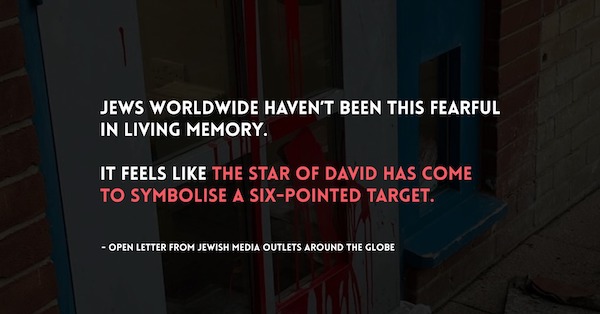
It’s not easy to speak on behalf of Jews in one country, never mind the world, nor do we purport to. As journalists, we report, opine, and comment. But the level of fear among our readers is like nothing in memory. It feels like those two equilateral triangles that combine to form our beloved Star of David represent a six-pointed target.

This is heightened by the fact there will be those who dismiss every word in this piece as having been written in bad faith, part no doubt of our supposed control of power and the media that has manipulated their warped minds. There will also be Jews who tell you this article doesn’t speak for them. Before those in the media feel the urge to put them on the airwaves in an attempt at ‘balance’, please first ask for an ounce of proof that they represent more than a tiny band of misfits. Some are more likely to stand alongside the Iranian regime that is so despised by much of the Muslim world than they would with most Jews.

Please don’t, however, mistake this growing fear for a lack of determination to fight our corner as citizens deserving of support and protection in our home nations, or doubt our solidarity as a people numbering just 16 million. In fact, we’ve never been so determined, so energized, so united and so proud, as highlighted by the huge uptick in sales of Stars of David. The incredible response in holding rallies, supporting charities, and fighting running battles on social media is something that will remain a source of pride for as long as those horrific images from Kibbutz Beeri and the peace rave.

This unity has been a light in the darkness. Another has been the support, publicly and sometimes not, of our real friends in all communities. Again, we will never ever forget this.

Our collective Jewish heart bleeds for the families of those who lost relatives in the Hamas atrocities and those facing agonizing waits for news of the kidnapped men, women, and children. Whether directly or not directly, many of our readers will be connected to these innocents. But our hearts bleed too for the innocents killed in Gaza as a result of this entirely unnecessary war launched by Hamas.

Over the unbearably painful days ahead, we – as providers of news for secular or religious Jews, those who frequently critique Israeli policy and those who don’t, those who see Israel are central to their identity, and those who are drawn nearer by crises such as this – call on the world to listen and treat us as you would want to be treated.

It shouldn’t be too much to ask.

Format ImagePosted on November 8, 2023November 8, 2023Author Jewish News & Jerusalem PostCategories Op-EdTags AJPA, American Jewish Press Association, antisemitism, Hamas, terrorism
Watch them blame Israel

Watch them blame Israel

A restaurant in Vancouver closed for a day, calling for people “to hold the Zionist occupation accountable” for the war in Gaza. Writer Loolwa Khazzoom notes, “When terrorists blow up Israelis, there is often an undertone of accusation: it’s Israel’s fault, the narrative goes, that these tragedies happen…. But who truly was responsible for creating Palestinian desperation, and who is accountable for remedying it?” (photo by Larry Barzelai)

On 9/11, I was 20 blocks away from Ground Zero, sleeping in the living room of a friend when she woke me up, screaming hysterically – something about terrorists and an airplane crashing into one of the Twin Towers. As I tried to comprehend what was happening, my friend turned on the television and, right then, the second plane crashed into the second tower, as we watched in horror.

My thoughts came in this order: Now they’ll understand what it feels like to live in Israel. Watch them blame this on Israel. OMG we’re going to die.

Two decades later, on the morning of Oct. 7 – in the wake of what some are calling Israel’s equivalent of 9/11 – I felt the pain of collective Jewish agony, and promptly reached out to my friends and family in Israel, including those living close to the Gaza border.

Unbeknownst to many, those in the border towns, such as Sderot, are predominantly working-class Mizrahim and Sephardim – children and grandchildren of the 900,000 Jewish refugees from throughout the Middle East and North Africa. They are the ones predominantly getting pummeled by Hamas rocket fire, as the world yells about “white European colonist settler Israelis.”

So, it’s no surprise that, after the initial feelings of shock and outrage, grief and concern, I once again thought, “Watch them blame this on Israel.” And they did, within hours – with a BBC News interview going so far as to compare the Hamas attack to the Warsaw Ghetto Uprising.

It’s nothing new, of course. When terrorists blow up Israelis, there is often an undertone of accusation: it’s Israel’s fault, the narrative goes, that these tragedies happen. By creating Palestinian desperation, Israel has created Palestinian terrorism. But who truly was responsible for creating Palestinian desperation, and who is accountable for remedying it?

The Arab world is called just that for a reason. Beginning in the Arabian Peninsula about 1,300 years ago, Arab Muslims launched a brutal campaign of invasion and conquest, taking over lands across the Middle East and North Africa. Throughout the region, Kurds, Persians, Berbers, Copts and Jews were forced to convert to Islam under the threat of death and in the name of Allah.

Jews were one of the few indigenous Middle Eastern peoples to resist conversion to Islam, the result being they were given the status of dhimmi – legally second-class, inferior people. Jews were spared death, but forced to endure an onslaught of humiliating legal restrictions – forced into ghettos, prohibited from owning land, prevented from entering numerous professions and forbidden from doing anything to physically or symbolically demonstrate equality with Arab Muslims.

When dhimmi laws were lax and Jews were allowed to participate to a greater degree in their society, the Jewish community would flourish, both socially and economically. On numerous occasions, however, the response to that success was a wave of harassment or massacre of Jews instigated by the government or the masses. This dynamic meant that the Jews lived in a basic state of subservience: they could participate in the society around them; they could enjoy a certain degree of wealth and status; and they could befriend their Arab Muslim neighbors. But they always had to know their place.

The Arab-Israel relationship and the current crisis occur in the greater context of a history in which Arab Muslims have oppressed Jews for 1,300 years. Most recently, anti-Jewish riots erupted throughout the Arab world in the 1930s and 1940s. Jews were assaulted, tortured, murdered and forced to flee from their homes of thousands of years. Throughout the region, Jewish property was confiscated and nationalized, collectively worth hundreds of millions of dollars at the time.

Yet the world has never witnessed Middle Eastern and North African Jews blowing themselves up and taking scores of Arab innocents with them out of anger or desperation for what Arab states did to the Jewish people. Despite the fact that there were 900,000 Jewish refugees from throughout the Middle East and North Africa, we do not even hear about a Middle Eastern/North African Jewish refugee problem today, because Israel absorbed most of the refugees. For decades, they and their children have been the majority of Israel’s Jewish population, with numbers as high as 70%.

To the contrary, Arab states did not absorb refugees from the war against Israel in 1948. Instead, they built squalid camps in the West Bank and Gaza – at the time controlled by Jordan and Egypt – and dumped the refugees in them, Arabs doomed to become pawns in a political war against Israel. Countries such as Syria, Iraq, Saudi Arabia, Libya and Lebanon funded assaults against Israeli citizens instead of funding basic medical, educational and housing needs of Palestinian refugee families.

In 1967, Israel inherited the Palestinian refugee problem through a defensive war. When Israel tried to build housing for the refugees in Gaza, Arab states led votes against it in United Nations resolutions, because absorption would change the status of the refugees. But wasn’t that the moral objective?

Israel went on to give more money to the Palestinian refugees than all but three of the Arab states combined, prior to transferring responsibility of the territories to the Palestinian Authority in the mid-1990s. Israel built hospitals and educational institutions for Palestinians in the territories. Israel trained the Palestinian police force. And yet, the 22 Arab states dominate both the land and the wealth of the region. So, who is responsible for creating Palestinian desperation?

Tragically, the Arab propaganda war against Israel has been a brilliant success, laying on Israel all the blame for the Palestinian refugee problem. By refusing to hold Arab states accountable for their own actions, by feeling sympathy for Palestinian terrorists instead of outrage at the Arab propaganda creating this phenomenon, the so-called “progressive” movement continues to feed the never-ending cycle of violence in the Middle East.

Loolwa Khazzoom (khazzoom.com) is the frontwoman for the band Iraqis in Pajamas (iraqisinpajamas.com) and editor of The Flying Camel: Essays on Identity by Women of North African and Middle Eastern Jewish Heritage (theflyingcamelbook.com). She has been a pioneering Jewish multicultural educator since 1990, and her writing has been featured in the Washington Post, Marie Claire, Rolling Stone and other top media worldwide. This article was originally published in the Times of Israel.

Format ImagePosted on October 27, 2023October 26, 2023Author Loolwa KhazzoomCategories Op-EdTags 10/7, 9/11, antisemitism, Arab propaganda, Hamas, history, Israel, terrorism
Did Judeans cede their lands?

Did Judeans cede their lands?

The Kotel (Western Wall) in Jerusalem (photo by James Blake Wiener)

Two weeks ago, 34 student organizations published a letter blaming Israel for the violent attacks that occurred on Oct. 7, on the holiday of Simchat Torah, that killed hundreds of Israelis in a brutal fashion. The letter claimed that Israel is entirely responsible for all unfolding violence and further claimed, “today’s events did not occur in a vacuum, for the last two decades, millions of Palestinians in Gaza have been forced to live in an open-air prison,” according to ABC News.

On the Stanford campus, an instructor in a civil, liberal and global education course asked Jewish students to take their belongings and stand in a corner, saying, “This is what Israel does to the Palestinians.” According to the Forward, the teacher then asked, “How many people died in the Holocaust?” The students answered, “six million”; the response from the instructor was, “Colonizers killed more than six million. Israel is a colonizer.”

Those of us who grew up in the West in the ’60s, ’70s and ’80s always thought Hitler was the embodiment of all evil and the Nazis were the greatest evil known to mankind. The merging of pure hatred and technology created an evil unmatched because of its scale and virulence. However, in today’s world there appears to be a sin worse than that of being a Nazi, that is to be a “colonizer.”

The theory of (Western racial colonizing) was made famous by a professor in whose class I studied, Edward Said. The New Yorker several years ago reflected that Said’s most famous book, Orientalism, “proved to be perhaps the most influential scholarly book of the late 20th century; its arguments helped expand the fields of anti-colonial and post-colonial studies.” The crimes of colonialism cannot be ignored … including many tragedies such as the Trail of Tears, residential schools, the partitioning of India and more.

The reflexive hatred of Israel, even as its citizens are being slaughtered and taken hostage, stems from those who believe the Jewish presence in Israel is among the last vestiges of colonialism. Such rationalization theorizes that civilians are really a military asset because they advance the aims of the conquering nation and, as such, civilians are a legitimate target.

Hamas uses a similar thought model for its theory of mind for the Israeli population. Haviv Rettig Gur, a columnist for the Times of Israel, wrote the following: “Arab opponents of Israel speak of it often as an artificial, rootless construct doomed to collapse in the face of Palestinian faith and resilience. It is at heart, they say, a colonialist project that for all its outward power lacks the inner authenticity and conviction to survive.”

That interpretation of Israel isn’t just a put-down; it’s a call for action, including especially the kind of sustained terrorism and cruelty that pushed other colonialist projects out, from the French in Algeria to the British in Kenya. This interpretation of Israel is the basic logic behind Palestinian suicide bombings, rocket fire and the whole slew of terrorist tactics employed by Hamas on Oct. 7.

One thousand years ago, as the Crusaders were first launching the military campaign to recapture the Holy Land from the infidels, Rashi was musing about land rights as well. Rashi wanted to explain why a lawbook, the Torah, does not begin with laws, but rather with the story of Creation. Rashi says that the nations of the world will ultimately call the Jews thieves, or colonizers in a more (contemporary) flexible translation. The Torah, therefore, begins with the story of creation to establish that all the land belongs to G-d and G-d gave title to the Children of Israel. Nachmanides, another great medieval scholar, argues that Rashi’s explanation ignores the important stories of Abraham, Isaac and Jacob. The land of Israel is the land of their stories, of Moriah, Beit El, Chevron, Be’er Sheva. This is where our ancestors are buried.

Did the tribe of Reuven ever cede its land to Aram? Did Ephraim ever cede its land to Ashur?

If you were to walk the archeological sites in the land of Israel and look at the graves, the etchings on the walls, the seals from sites dated between 3,000 and 2,500 years ago – this is the Iron II period, from 1000 to 586 BCE, between the time of Solomon and the fall of Jerusalem to Babylon – what names would you find? The vast majority of those names carved into stones and pottery are names that end with YHU or YH’L  these are Hebrew names for G-d: names like Yishayahu/Isaiah, Uriah and Or Samuel, respectively. (Journal of the American Oriental Society, Vol. 134, No. 4, October-December 2014; pp. 621-642) The stones speak the names of tribes that never willingly gave up their land to their conquerors.

The Judeans also did not cede land to the Romans. When Omar ibn Khattab conquered Jerusalem from the Romans in 638, he did not establish a treaty with the Jews, he did not trade high-value consumer durables for the land. He conquered it and, in 717, less than 100 years later, his successor Omar II forbade the Jews from praying in Jerusalem’s Temple Mount, a policy that was to last through Muslim rule of Jerusalem.

When Omar conquered, he brought Arabic into Israel for the first time. Hebrew inscriptions in Israel were already 1,500 years old when Arabic first arrived in Israel with the conqueror’s sword. Compared to the thousands of Hebrew inscriptions from the time of Solomon, there is only one find of an ancient dialect of Arabic, likely from a traveler.

We Jews are not colonizers, we are the people from the unceded lands of Judah and Benjamin, Naftali and Ephraim, Dan and Zevulun. Our language has always been Hebrew.

Prof. Yeshayahu Gafni of Hebrew University notes that, if you want to read a letter written by a Jew 2,000 years ago, you need to know Hebrew. Jews have always spoken, read and written Hebrew. If you want to write a letter to those who will be your descendants 2,000 years from now, you should write it in Hebrew.

We Jews have to make sure there is no daylight between our identity now, and the identities of our ancestors whose graves and etchings can be found from Tel Dan to Be’er Sheva. We need to embrace our language. There is no reason not to know it; it is ours.

Furthermore, we need to know the story of who we are, of the land and the people in it. We need to know who is Yeshayahu, who is Yehoshaphat, and Yoav, and Chizkiyahu, and Uziyah, and Abigail, and Jezebel and Atalyah. And we need to know how an Ephrati pronounces Shibbolet. These names figure prominently in the story of our people and our land. We need to embody the identity that holds their story true.

When we carry that identity together, we do not allow them to call us imperialists and colonizers. We are the people of the unceded lands of Judah and Benjamin. We must embrace that identity.

Rabbi Andrew Rosenblatt is senior rabbi at Congregation Schara Tzedeck. This article was originally published on the synagogue’s special Israel page at scharatzedeck.com.

Format ImagePosted on October 27, 2023October 26, 2023Author Rabbi Andrew RosenblattCategories Op-EdTags colonialism, Gaza, history, indigenous, Israel, Palestinians

Navigating the rough times

There are no words. I’m doom-scrolling, praying and worrying, reaching out to family and friends, but nothing prepares us for seeing more than a thousand Israelis murdered and hundreds kidnapped. The images are so graphic, so many bodies desecrated. On my social media feed, the images haven’t stopped coming.

Yet, in the first days of the war, there was a silence. I realized that others weren’t seeing what I was seeing in my Instagram feed. The North American media felt sanitized, distant from the reality that was depicted on Israeli TV and media. The first day or two back at school after the Simchat Torah/Thanksgiving weekend, my kids were stunned when others asked them why they were sombre. Until this year, they attended a Hebrew/English bilingual public elementary school. With their transition to junior high, they didn’t have nearly the same number of classmates who understood the situation.

At their International Baccalaureate middle school, there are curriculum additions, such as a special lunchtime club that meets to make a difference in the world. The resource teacher advises the club. She was sensitive to the needs of the kids affected by the war in Israel and Gaza, and mine came home with fundraising brainstorms. I wrote to thank the teacher for showing support during this hard time.

Then, she asked – do you have ideas for what else we can do? It took me awhile to make a list. I thought about what mattered most for me, far from the war but also very affected by it. The hardest parts of the list are long-term things that teachers should do: teach about misinformation, and definitions of things like terrorism, “rules of engagement” and more. The easiest parts, perhaps the most meaningful ones? Conducting a kindness campaign. Asking how others are doing and listening to their responses. Active listening would help everyone, Israelis, Canadians who are Jewish or Palestinian, and concerned bystanders. So many innocent lives have been lost. We need to talk about it.

I suggested to the teacher that another way of reaching out positively would be to do cards of support. The next day, my son joined other kids from the middle school who walked to the bilingual elementary school to deliver the cards. It was on Friday, Oct. 13, the day that Hamas suggested be a global day of harm for Jews. On a positive note, my son got to share his elementary school and his Hebrew skills by translating for a non-Jewish friend. He was proud. On the other hand, most of the kids in the bilingual program were absent due to the threat. Those who did come to school, from grades 1 through 6, filled just one classroom, according to my kid. He visited with beloved grade school teachers and ate challah at the Shabbat party – but the threat was real.

Outside the school, my kid saw both an unmarked police car and a marked cruiser. My heart flooded with gratitude when I heard this, but the school is in a huge field, accessible from multiple directions. One police car? Two? I felt the fear all over again. How many police would be “safe enough”?

Meanwhile, I heard that Jewish homes in one Winnipeg neighbourhood were egged, and the police were called. A potentially violent rally in support of Palestine, using words like “genocide,” was scheduled within easy walking distance of my home.

Even though we’re far from the fighting, it’s hard to gain traction on work while feeling so emotionally undone. Massive numbers of Palestinians were asked to move and large swaths of Israelis evacuated from both the north and south regions of the country, while so many have been called up to reserve army service. For those Canadians who have lost a family member, the pain is constant. For those who have kidnapped loved ones, like Vivian Silver’s family in Winnipeg and Israel, the families work to publicize their losses and wait in dread to hear what has happened.

Twice, I felt able to rise above this emotional turmoil and felt joy. Both times, it was because of a bar mitzvah.

The first instance that stunned me took place last week, when the cantor who tutors my twins asked them to chant together for their lesson. Their lesson was short, as there was an Israel solidarity rally that she was leaving to attend. I lurked in the next room. Usually, my kids jostle for position but, during that lesson, their voices rang out together, making the rote practice of Torah and Haftorah blessings become so powerful. “Wow,” I heard the cantor say, continuing with something like, “I’m glad I didn’t cancel your lesson. Thank you for gifting me with those brachot.” An almost holy silence hung in the air afterwards.

A few days later, we attended a Chabad bar mitzvah for a kid my twins knew in preschool. Even behind a mechitzah (the barrier between the mens’ and women’s sections), the bar mitzvah boy’s voice rang out sure and strong as he absolutely shone. It was something to see: his big personality, confidence and knowledge. I was achingly proud of our Judaism, in all its diversity and strength.

Writing to deadline, I imagine what might be relevant in a few days, but the things that have helped me will still help later. I am following my own advice. Each day, I am taking time to write emails or texts to friends and reach out. How are they? Are their families safe? Do they need anything? I try to take time to pause, hear what everyone says, and listen for the moments of Jewish joy that we can create – in synagogue or at our homes, when we’re alone or together.

Many ask, “How are you doing?” I pause and say, “Well, it’s been a rough time.” I’m also trying to maintain hope for the future. One hears it – through the generational continuity of every child becoming b’nai mitzvah, through Hatikvah and one other phrase – Am Yisrael chai, the Jewish people lives. It will be my prayer as we get through the days ahead. Amen.

Joanne Seiff has written regularly for CBC Manitoba and various Jewish publications. She is the author of three books, including From the Outside In: Jewish Post Columns 2015-2016, a collection of essays available for digital download or as a paperback from Amazon. Check her out on Instagram @yrnspinner or at joanneseiff.blogspot.com.

Posted on October 27, 2023October 26, 2023Author Joanne SeiffCategories Op-EdTags b'nai mitzvah, Diaspora, Israel, Judaism, parenting, terrorism

Finding awe & wonder again

As a kid, I remember sitting through High Holidays with my family at our Reform congregation. We’d hit a section in the services where the English responsive reading, inspired by the Hebrew, used words like “awe,” “awesome” and “supreme.” There were smirks and stifled giggles as we passed this yearly reading. Why? Our family had discussed it at a holiday meal, and we agreed this sounded like a really big pizza special. It was hard to concentrate after that, thinking about pizza.

This moment hit me again when I heard Rabbi Jeffrey Saxe, one of the rabbis at Temple Rodef Shalom in Virginia, give a Kol Nidre sermon about awe, gratitude and wonder. It was powerful. Before I get into the details, we chose to stream services again this year from home in Winnipeg. In part, it’s so we can be a part of two worlds – my parents’ congregation in Virginia, where I grew up, and our Winnipeg synagogue, too. After the holiday, I can discuss sermons with my mom as if I had been sitting beside her during services and this is meaningful. For many people who are apart from their families during holidays, using shared moments to bond is important.

Even though I knew our choice to stay home made sense, I felt pressured to “get back to normal” and “be together again,” especially when a synagogue publication suggested that those who chose to stream did so for “mobility reasons.” (Not all those who choose to stay home have the same challenges. There are multiple reasons to stay home.)

Back to Rabbi Saxe’s sermon, which touched on the ways that the rabbis created liturgy that helps us remain grateful, and even encourages experiences of awe and wonder. If you see a rainbow, there’s a prayer for that. There are specific prayer formulas for eating fruits, snacks, and there’s even, Rabbi Saxe mentioned, a prayer for after you’ve gone to the bathroom. At this, some in the congregation laughed.

I felt shame. Not only is the bathroom prayer something I’ve written about and, yes, recited, but it’s also something I might have laughed at as a kid. Without going into details, thanking G-d for the intricacies of how our bodies work, opening and closing appropriately at the right times, can be absolutely meaningful. If you doubt this, maybe you have been very lucky and never had food poisoning or a stomach virus. Yes, we smirk and laugh when we feel uncomfortable, sure. Also, it’s when we take things like being healthy for granted.

I also felt weird guilt about not being in a congregational community over the holidays, even though we had a holiday meal with another family, dressed up, streamed services and took time off together. I felt strange checking messages over Yom Kippur. Then something happened.

Within a short period of time, two of our close family friends ended up in the hospital. One is in his 80s, in ICU, with COVID. The other friend is 5 years old, and she has a sister who is a newborn.

During Yom Kippur, the 5-year-old was admitted to Children’s Hospital after being up all night in the emergency room.

In the middle of Yom Kippur services, I got up, went to the kitchen and gathered together food for the parents for this unexpected stay. This is why we make the second round challah, I thought, as I threw it in the bag. I left my family, hopped in the car while fasting, and navigated the hospital until I found the room with one dear-to-us child with her oxygen mask, her exhausted-looking parents and their infant. I handed them the food, it wasn’t time for a visit, and rushed out again.

Somewhere on the drive home, I processed what had happened. I felt a profound sense of awe. I had been in exactly the right place. If I’d gone to services in person, I wouldn’t have been online or known that our friends’ child had been admitted to the hospital. I wouldn’t have been able to rush out and offer food, a quick bikkur holim (visiting the sick), and support her family. Leaving the twilight of their windowless hospital room, I was blinded by sunlight as I left the garage. I parked in front of our house and took a moment to cry.

Our liturgy traditionally links daily gratitude with prayer. This is an automatic check-in with nature, our bodies and the world to see and wonder at what’s around us. However, we’re all too likely to get sarcastic, cynical and, frankly, depressed. Mental health experts recommend expressing gratitude and getting into nature to improve our health, but the rabbis, like other faith traditions, prescribed it a long time ago.

It’s easy to ignore the natural world or our bodily functions. I’ve become increasingly aware of the sensory overload in our society. Some people easily manage very stimulating environments, like a dance club or even a household with the TV and radio on, a dog barking and a phone ringing, all at once. Others cannot manage this much. Sometimes, it’s diagnosed as a sensory processing disorder, but this can mean different things. There’s a person who cannot manage too much input, and the person who needs fidget toys and constant stimulation to maintain equilibrium. Nature or the trendier “forest bathing” can sometimes help us find balance.

As I head into autumn, I’m seeking fewer big events or gatherings. Here’s to quiet moments of awe. One of my kids is a new band student. His enthusiasm about his instrument is contagious. I cannot wait to play sax duets and “honk” together. The other kid has been spotting woodpeckers on our dog walks and pointing out migrating birds as the weather turns.

Rabbi Saxe closed his sermon with Genesis 28:16, when Jacob wakes up and says, “Surely, G-d is in this place and I did not know it!” Perhaps, like Jacob, we can all wake up and discover the joys of small wonders, too. We just have to slow down, open up and look for them.

Joanne Seiff has written regularly for CBC Manitoba and various Jewish publications. She is the author of three books, including From the Outside In: Jewish Post Columns 2015-2016, a collection of essays available for digital download or as a paperback from Amazon. Check her out on Instagram @yrnspinner or at joanneseiff.blogspot.com.

Posted on October 12, 2023October 12, 2023Author Joanne SeiffCategories Op-EdTags bikkur holim, High Holidays, Judaism, lifestyle, mitzvah, Talmud

Obligated to warn of danger

I often chat with a retired doctor neighbour as I walk by his house with my dog. When he mentioned hiking solo on the famously difficult Mantario Trail in southeastern Manitoba, it sounded risky to me. I asked him what safety precautions he was taking. Afterwards, he chided me for being overly motherly and a worrywart. While his response made me feel uncomfortable, maybe it was because he was defensive about a potentially unsafe hike. The defensiveness might be a sign that part of his brain thought I might be right.

I just studied Kiddushin 29, a page of the Babylonian Talmud, while doing Daf Yomi (a page a day of Talmud). It turns out, this scene has played out before. At the time, rabbis had their own yeshivas/schools where others came to learn and a seven-headed demon was in Rav Abaye’s “study hall.” The best advice to avoid a demon, according to the rabbis, was to travel during the day and in pairs. Demons were known to come out at night, but this situation was so dangerous that students were unsafe even during the day.

Now, it happened that Rav Aha bar Yaakov wanted to come study with Abaye, but had nowhere to stay. Instead of helping Rav Aha find a place to sleep, Abaye tells others not to accommodate him. This forces Rav Aha to stay overnight at the study hall. It’s a set up. There, Rav Aha must battle the demon and vanquish it. Abaye hopes for a miracle to take place.

When Rav Aha is faced with the demon, the text indicates that he prayed. As he prayed, he bowed to shuckle (the movement many Jews make when davening/praying), and each vigorous bow resulted in knocking off one of the demon’s heads. Rav Aha battles the demon with prayer and survives.

This storyline, according to Dr. Sara Ronis’s introduction to the page on My Jewish Learning, fits into a greater literary and historic context. There are many tales of a divine hero combating a demon in Ugarit and ancient Mesopotamia. There are Zoroastrian, Christian and Jewish holy heroes who triumph over demons through prayer.

Rav Aha was a pious and great man who came eagerly to study with Abaye. However, he wasn’t without fault. Just before this story takes place, Kiddushin 29b says that Rav Aha sent his son to study. Alas, his son’s studies weren’t sufficiently “sharp,” so Aha left his son at home to manage the household while Rav Aha went to study instead.

After his confrontation with the demon, Rav Aha says to the others, “If a miracle hadn’t occurred, you would have placed me in danger.” Rav Aha was given no warning about the demon. He had no opportunity to stay elsewhere. Abaye relied on Rav Aha pulling off a miracle to save his study hall and his students.

This is one of the talmudic stories you can “sink your teeth into.” The rabbis appear as flawed people and a product of their time. There were stories about demons floating around the wider community, and people in general worried about demons and how to fight them. In the Jewish community, you see a “pious and learned” person, Rav Aha, who chooses his own study over further opportunity for his son’s education. And Abaye is a famous scholar, but asks others to deny hospitality to a student, and chooses to endanger others.

After my concern over the Mantario Trail hike, I got to wondering. If your friend is about to be in a potentially unsafe situation, do you have an obligation to warn them, to show concern? I believe we do. I still think I have this obligation, even if I’m belittled for it. I think we have the obligation even if some see it as hovering, annoying or overly solicitous.

I think about this a lot. We live in a peaceful urban residential enclave, but it’s not unusual to hear news reports of violent crime just a few blocks away. We have a neighbourhood watch, too. It pays to be cautious to avoid “demons” that might endanger us. It isn’t just a motherly inclination to be street smart. It’s not wrong to let others know if we foresee danger ahead.

Returning to this talmudic story, I’m angry that Abaye doesn’t warn or protect his student, Rav Aha. Abaye had an opportunity to do the right thing and failed in his responsibilities as a teacher. I’m also amazed at Rav Aha’s tact and self-control. After being endangered in this way, I might have made a much bigger fuss.

This time of year, we’ve got a lot to think about in the Jewish world. On Yom Kippur, the Day of Atonement, we spend time thinking about our behaviours and failings as individuals and in community, the concept of forgiveness and our fate for the coming year. Yet we also look forward to Sukkot, grateful for the harvest, and to celebrating the Torah with joy on Simchat Torah.

Our calendar is complicated. Like the story of Abaye and Aha, we can’t find just a single obvious answer. Maybe this keeps us from getting bored as we repeat the rituals of each Jewish year. Perhaps it helps us sharpen our skills so we can perform miracles, protect and look out for one another, and slay unexpected (proverbial) demons, too.

Joanne Seiff has written regularly for CBC Manitoba and various Jewish publications. She is the author of three books, including From the Outside In: Jewish Post Columns 2015-2016, a collection of essays available for digital download or as a paperback from Amazon. Check her out on Instagram @yrnspinner or at joanneseiff.blogspot.com.

Posted on September 22, 2023September 21, 2023Author Joanne SeiffCategories Op-EdTags High Holidays, Judaism, lifestyle, Talmud
Response to death sentence

Response to death sentence

L’chaim! Jews Against the Death Penalty co-founder Cantor Michael Zoosman on Democracy Now! with Amy Goodman on Aug. 2, 2023, reiterating L’chaim’s opposition to the death penalty for the Pittsburgh Tree of Life synagogue shooter – and in all cases. (screenshot)

Recently, the American TV show Democracy Now! with Amy Goodman approached me in my role as co-founder of L’chaim! Jews Against the Death Penalty – which has roughly 2,700 members worldwide – to explain our opposition to the death sentence that the U.S. federal government issued for Robert Bowers, the perpetrator of the Pittsburgh Tree of Life shooting on Oct. 27, 2018. This was the deadliest antisemitic attack in American history and a crime of unspeakable horror that took the lives of the 11 Tree of Life martyrs, z”l.

My journey to becoming L’chaim’s co-founder was a direct result of my service as the cantor of Vancouver’s Congregation Beth Israel from 2008 to 2012. During my time at BI, that wonderful kehillah granted me the opportunity to serve as an agent of the Canadian government as Jewish prison chaplain for the 11 federal prisons within the Pacific region of Correctional Service Canada, which I did from 2009 to 2012. That experience was integral in the formation of my stance as a firm opponent of capital punishment in every case. During my years in that position, I got to know many individuals whose crimes might have qualified them for the death penalty in various states or federally in the United States. I saw firsthand how many of these individuals changed, while they remained incarcerated.

Since 2020, L’chaim’s members and I have been in touch with all individuals with active execution warrants in the States, as well as all Jewish men and women on American death rows. This includes my longtime penpal Jedidiah Murphy, a Jewish man with dissociative identity disorder who is the next human set for execution by Texas. The Lone Star State – the most prolific state killer in the United States – plans to kill Jedidiah on Oct. 10, which is World Day Against the Death Penalty. To do so, Texas will use the most common American form of execution, which is lethal injection.

Lethal injection was first implemented in this world by the Nazis as part of the Aktion T4 protocol used to kill people deemed “unworthy of life.” That protocol was first devised by Dr. Karl Brandt, the personal physician of Adolf Hitler. Every use of lethal injection carries on this direct Nazi legacy. This is the method by which the federal government likely will put to death Robert Bowers. Various states employ gas chambers to put their inmates to death, with Arizona even offering Zyklon B, as used in Auschwitz.

The members of L’chaim who, like me, are direct descendants of Holocaust survivors, know very well that the death penalty is not the same as the Shoah. And yet, members also know the dangers of giving a government the power to kill prisoners. Holocaust survivor and human rights activist Elie Wiesel articulated this most prophetically when he famously said in a 1988 interview: “With every cell of my being and with every fibre of my memory, I oppose the death penalty in all forms…. I don’t think it’s human to become an agent of the angel of death.”  He later added of capital punishment: “death should never be the answer in a civilized society.”

There are no exceptions. For Wiesel, Martin Buber, Gershom Scholem, Nelly Sachs and other Jewish human rights activists in the wake of the Shoah, this included staunch opposition to Israel’s execution of Nazi perpetrator Adolf Eichmann, which Buber called a “great mistake.” For the thousands of members of L’chaim! Jews Against the Death Penalty who carry this torch, the mistake applies as well to Robert Bowers.

In his “Reflections on the Guillotine,” Albert Camus concluded: “But what then is capital punishment but the most premeditated of murders, to which no criminal’s deed, however calculated it may be, can be compared?” From my personal experience in communicating daily over email, letters and phone with condemned men and women counting down their final months, weeks, days and hours, I can attest to this psychological torture. I can confirm that there is no humane way to put prisoners to death against their will.

The death penalty condemns the society that enacts it infinitely more than the human beings it condemns to death. Canada realized this decades ago, when it abolished the death penalty. The west African nation of Ghana was the latest country to join Canada as an abolitionist nation, just weeks ago, during the Tree of Life capital trial. I pray that, one day, the United States will join Ghana, Canada and the more than 70% of world nations who stand against the consummate human rights violation that is capital punishment.

For those who remain unconvinced, as I was before I became a prison chaplain, consider the words of the late Jewish U.S. Supreme Court justice Louis Brandeis, the namesake of my alma mater. In his dissent for a renowned 1928 case, Brandeis wrote: “Our government is the potent, the omnipresent teacher. For good or for ill, it teaches the whole people by its example. Crime is contagious.”

When the government imposes and then carries out a death sentence, it teaches everyone that unnecessary lethal violence is an appropriate problem-solving tool. Pittsburgh resident and death penalty abolitionist Fred Rogers (children’s educator and entertainer Mister Rogers) recognized this when he said of the death penalty “it just sends a horribly wrong message to children.” In every single case, state-sponsored murder under the disproven pretence of deterrence is not an appropriate tool to punish an offender who is no longer a threat behind bars. As Brandeis and Wiesel knew: the government should set a moral and ethical example.

The ruling in favour of state killing perpetuates the cycle of violence. It leaves the door open to the man-made Angel of Death – a door that allowed the United States to execute a severely mentally ill prisoner in Missouri on Aug. 1 and a prisoner “volunteer” for state-assisted suicide in Florida on Aug. 3. The United States was joined that week by Iran, which executed 12 human beings. The previous week, Singapore hanged a man and a woman for drug charges, and Bangladesh hanged two other human beings.

America – and human civilization – must do better. If not, the Pandora’s box of death can lead to what the world has seen with the execution of political protesters in Iran, the recent “kill the gays” law passed in Uganda, which allows execution for homosexual sex crimes, and the calls for the death penalty for abortion, which at least four American states have proposed since the overturning of Roe vs. Wade.

Let there be no doubt that those immediately impacted by the Pittsburgh shooting – including surviving family members – have been divided in their attitudes about the death penalty for the shooter. On a congregational level, two of the three targeted synagogues within the Tree of Life building have asked the federal government not to pursue the death penalty. This includes Dor Hadash, which hosted leaders in L’chaim for a program to help their community mobilize to abolish the death penalty. Still, quite understandably, most immediate family members indeed advocated death for the shooter. Far be it from me or anyone to judge them for how they feel. As a hospital chaplain, I regularly counsel mourners that, when grieving, they should be allowed to feel the full gamut of human emotion, including rage, and even the desire for vengeance where applicable. Any civilized society has a responsibility to protect and honour all such mourners, while simultaneously upholding the fundamental human rights upon which the world stands. Most basic to these, of course, is the right to life.

May Americans and Jews everywhere honour the victims of Pittsburgh’s Tree of Life – Eitz Chaim in Hebrew – by reaffirming the sanctity of life. Instead of more killing, may they follow the example of the inspiring Jewish community of Pittsburgh. Earlier in the week before the verdict of death, in what was but the latest example of that community’s unflagging proverbial steel resolve, it hosted a life-affirming parade to celebrate the dedication of a new Torah – known also as an Eitz Chaim – in loving memory of Joyce Fienberg, z”l, one of the 11 Tree of Life martyrs, and her late husband, Dr. Steven Fienberg, z”l. That sacred community once again has brought new life to the exhortation that has motivated Jewish people for millennia: “Am Yisrael chai,” “The people of Israel live.”

To this profound demonstration of the very best of Jewish values and resilience, I fervently add the resounding response to the Tree of Life verdict from the thousands of members of L’chaim! Jews Against the Death Penalty, chanting “l’chaim!” – “to life!”

The Democracy Now! TV interview ended with a video clip of the El Maleh Rachamim for the 11 Tree of Life martyrs that I chanted in front of the U.S. Supreme Court while the trial was taking place, as part of the Annual Fast and Vigil to Abolish the Death Penalty. No matter where TV viewers and readers stand on the death penalty, it is most appropriate for that memorial prayer for the victims to be the final words here.

Zichronam livracha, may the beloved memories of the 11 Tree of Life martyrs be for an everlasting blessing.

May their neshamot / spirits be loving guides for us all.

May their loved ones be comforted among all the mourners of Zion and Israel from a grief the likes of which most human beings like me never could begin to fathom.

May the killings end.

Cantor Michael J. Zoosman, MSM, BCC, served as cantor of Congregation Beth Israel 2008-2012 and as Jewish prison chaplain for Correctional Service of Canada, Pacific Region, 2009-2012. He is the co-founder of L’chaim: Jews Against the Death Penalty and an advisory committee member of Death Penalty Action.

Format ImagePosted on September 1, 2023August 29, 2023Author Cantor Michael J. ZoosmanCategories Op-EdTags crime, death penalty, human rights, Pittsburgh, Robert Bowers, Tree of Life

CIJA takes campaign public

I love the High Holidays and the opportunity they present to get together with extended family, to visit with friends and to reach out to colleagues. In addition to the special foods of the season, it’s a time to remember what is important, and what we need to acknowledge and reject from the past year. It’s also a chance to pause to consider how to find the path we really want to follow, to figure out what we need to make our lives safer, calmer, more balanced. To make our lives – and our families’ lives – better.

photo - Judy Zelikovitz says CIJA’s Oct. 16-17 conference will be its “biggest effort ever to respond to antisemitism”
Judy Zelikovitz says CIJA’s Oct. 16-17 conference will be its “biggest effort ever to respond to antisemitism.” (photo from CIJA)

Whether we are part of large Jewish communities in Israel, the United States, Canada  or Europe, or part of small pockets of Jews anywhere around the world, our connections one to another have never been more important. Our support for our community’s values, for their protection, is strengthened by our connections to one another, and it is together that we will be effective in the vital fight against Jew-hatred, a scourge that’s grown significantly in Canada and around the world over the past few years.

In Israel, we’ve seen a shocking spike in 5783 in lone-wolf assaults against Israeli Jews, along with vile rhetoric and attacks by terrorist groups against the Jewish people. In Canada, still among the safest places anywhere, we are nevertheless living through a growth in online hate, threats to Jews and their neighbourhoods, and an alarming statistical rise in hate crime of all kinds against Jewish Canadians.

This growth in Jew-hatred has been the focus of much of the advocacy CIJA has undertaken in recent years and, this year, we are taking our national campaign public. On Oct. 16-17 in Ottawa, CIJA and the federations across Canada will host Antisemitism: Face It, Fight It, a two-day conference where we will confront the issue head-on.

We will “Face It.” We will learn from international and local experts about how they have addressed Jew-hatred and how we can advocate for legislation and other changes that will make our community safer. The second day, we will “Fight It,” speaking directly to our elected officials, ensuring they know the impact of antisemitism on our community, the effects of hate on all minorities, and its toxic effect on all Canadians. We will unite – with one another and with our partners – to fight antisemitism, and we will leave the conference better educated and better prepared to get this done.

Speakers will include Jews and non-Jews whose careers have been dedicated to combating antisemitism. We will hear what has worked, what has not, how to advocate for effective legislation, and how to equip our students and young leaders to take on this fight on campuses across Canada.

We will leave the conference secure in the knowledge that we are embarking on our biggest effort ever to respond to antisemitism. We will ensure Ottawa and other governments hear our call. We will amplify our voices, speaking as a united community and as one supported by allies across Canada.

Now is the time for us to show up, to speak up and to step up. Register now at fightit.ca.

I hope to see you in Ottawa and, in the meantime, over these High Holidays, I wish you a sweet, healthy and happy 5784. L’shana tova!

Judy Zelikovitz is vice-president, university and local partner services, at the Centre for Israel and Jewish Affairs.

Posted on September 1, 2023August 29, 2023Author Judy ZelikovitzCategories Op-EdTags antisemitism, conference, Face It Fight It, High Holidays

Value of community

When we hear about addiction and recovery, most of us might think of the incredibly difficult journey to achieve and then sustain sobriety. For certain, this is one reality.

That said, it’s one thing to refrain from using, and quite another to rebuild one’s life. One of Jewish Addiction Community Services’ clients told us that, although they have been in recovery for three years, they felt that their life had little meaning. Working together, we uncovered the “missing link”: their prior lifestyle had damaged, and in some cases severed, many of their connections to family and community. More importantly, that insight led to building some practical plans for reconnecting. They now report that they feel like they have turned the corner – rediscovering motivation for work, life, and being an active member of our community.

Another client, who had been using drugs for over 25 years, is now seven months sober. They recognize that Judaism’s role in their early life was important, and reconnecting to some aspect of that former life is comforting and familiar. This client attended a seder for the first time in many years and looks forward to the High Holidays.

It is no secret that community plays a crucial role in sustained recovery. The harder part is to operationalize the insight. Our role at JACS is to meet people where they are, help them find treatment, if needed, work with them to rebuild their lives, and be a link to the greater Jewish community.  At the very practical level, we have helped clients connect with Tikva Housing, access the Jewish Food Bank and get financial help from Hebrew Free Loan Association. As well, working with rabbis and other agencies, we are helping individuals find ways to reconnect with a Jewish social network, support systems and the community at large.

JACS is proud that we are here to help our community. It is gratifying to know that, through education, counseling and connection, we are making a difference for those who need to know they have value and do indeed belong.

For more information about what we do, visit jacsvancouver.com.

Shelley Karrel is manager of counseling and community education at JACS Vancouver. She can be reached at [email protected].

Posted on September 1, 2023August 29, 2023Author Shelley KarrelCategories Op-EdTags addiction, High Holidays, JACS, Jewish Addiction Community Services, Judaism, recovery

Posts pagination

Previous page Page 1 … Page 11 Page 12 Page 13 … Page 56 Next page
Proudly powered by WordPress