Skip to content
  • Home
  • Subscribe / donate
  • Events calendar
  • News
    • Local
    • National
    • Israel
    • World
    • עניין בחדשות
      A roundup of news in Canada and further afield, in Hebrew.
  • Opinion
    • From the JI
    • Op-Ed
  • Arts & Culture
    • Performing Arts
    • Music
    • Books
    • Visual Arts
    • TV & Film
  • Life
    • Celebrating the Holidays
    • Travel
    • The Daily Snooze
      Cartoons by Jacob Samuel
    • Mystery Photo
      Help the JI and JMABC fill in the gaps in our archives.
  • Community Links
    • Organizations, Etc.
    • Other News Sources & Blogs
    • Business Directory
  • FAQ
  • JI Chai Celebration
  • JI@88! video

Recent Posts

  • Story of Israel’s north
  • Sheltering in train stations
  • Teach critical thinking
  • Learning to bridge divides
  • Supporting Iranian community
  • Art dismantles systems
  • Beth Tikvah celebrates 50th
  • What is Jewish music?
  • Celebrate joy of music
  • Women share experiences 
  • Raising funds for Survivors
  • Call for digital literacy
  • The hidden hand of hate
  • Tarot as spiritual ritual
  • Students create fancy meal
  • Encouraging young voices
  • Rose’s Angels delivers
  • Living life to its fullest
  • Drawing on his roots
  • Panama City welcoming
  • Pesach cleaning
  • On the wings of griffon vultures
  • Vast recipe & story collection
  • A word, please …
  • מארק קרני לא ממתין לטראמפ
  • On war and antisemitism
  • Jews shine in Canucks colours
  • Moment of opportunity
  • Shooting response
  • BC budget fails seniors
  • Ritual is what makes life holy
  • Dogs help war veterans live again
  • Remain vital and outspoken
  • An urgent play to see
  • Pop-up exhibit popular
  • An invite to join JWest

Archives

Follow @JewishIndie
image - The CJN - Visit Us Banner - 300x600 - 101625

Category: News

B.C. marks Yom Hashoah

B.C. marks Yom Hashoah

(photo from Vancouver Holocaust Education Centre)

Many child survivors of the Holocaust did not identify as survivors – and were not deemed so by other survivors, including their parents – until decades after the end of the Second World War. The emergence and evolution of the unique experiences of child survivors was the subject of the Yom Hashoah keynote address in Vancouver by Dr. Robert Krell, professor emeritus of psychiatry at the University of British Columbia.

Local survivors of the Shoah and their families, as well as the premier, cabinet ministers and other elected officials, joined hundreds more in Vancouver and Victoria to commemorate Yom Hashoah, Holocaust Remembrance Day, earlier this month. An event presented by the Vancouver Holocaust Education Centre took place at the Jewish Community Centre of Greater Vancouver on April 11 and another took place at the B.C. legislature in Victoria the following day.

In his presentation, Krell spoke about how he was liberated at the age of 5, having been a hidden child in the Netherlands. From the only family he knew, he was returned to the parents of his birth.

“My father and mother’s parents – my grandparents – and their brothers and sisters – my uncles and aunts – had all been murdered,” he said. “I learned about being Jewish at home, hearing stories from survivors who returned. They spoke of Auschwitz and other mysterious places in Yiddish, ably translated by my second cousin, 8-year-old Millie, who had returned from Switzerland with her parents. We heard things no child should hear and, therefore, listened all the more attentively.

“That was my introduction to Judaism, an unforgettable litany of horrors visited upon Jews that imprinted on my mind,” said Krell. “So far as I knew … being a Jew meant death, for everyone was dead, save one first cousin and Millie.”

Finding one’s way through the present with such a burden was an added challenge. “The task of being normal when you know you are not is all-encompassing,” he said. “What I did not realize then was how deeply affected we children were by the events of the Shoah and how intimately the traumatic consequences were entwined with our daily existence.”

While at UBC, in his small private practice, Krell began to see the children of Holocaust survivors. “And, from them, I learned of the impact of the Shoah on survivor families.”

During this period, he was spearheading Holocaust education initiatives in the province, including the Holocaust Symposium for high school students, which will have its 42nd iteration on May 2, and video recording survivor testimonies. “But there was one overriding issue that became the driving force of my preoccupations,” Krell said. “I discovered child Holocaust survivors. That may sound strange…. They did not need to be discovered. But they had disappeared from view. For almost 40 years, child survivors did not identify themselves as survivors. Immediately after the war, children were discouraged from talking about their experiences. In any case, said adults, you were too young to have memories, lucky you. Therefore, you did not suffer like we did.

“Other well-meaning adults urged children to forget in order to get on with their lives. That is not how it works,” said the psychiatrist. “Traumatic memories experienced in early childhood are not forgotten. They remain and they return.”

Throughout the 1980s, child Holocaust survivors began to speak with each other and to the public. In 1991, 1,600 people, primarily child survivors and their families, gathered in New York. “The workshops provided a safe environment in which participants gained self-awareness and much-needed relief,” said Krell.

Yom Hashoah corresponds to the 27th day of Nissan in the Hebrew calendar, the anniversary of the Warsaw Ghetto Uprising. This year marks the 75th anniversary of the uprising, which began on April 19, 1943. “The ghetto fighters were able to hold out for nearly a month,” said Vivian Claman, a member of the second generation at the Vancouver event. “On May 16, 1943, the revolt ended and a total of 13,000 Jews died. It was the largest single revolt of Jews during the Second World War.”

Jody Wilson-Raybould, federal minister of justice, also addressed the audience. “I want to say that we hear you, we honour your lived experiences and your stories, and we renew our commitment, and we reaffirm our vigilance to speak out against antisemitism, to speak out against xenophobia, to speak out against any form of racism or intolerance as unacceptable in this country and throughout the world,” she said.

Councilor Raymond Louie, acting mayor of Vancouver, read the proclamation from city hall. Kaddish was led by Chaim Kornfeld, a survivor. Eric Wilson played cello, and singers included Advah Soudack, Kathryn Palmer and Mia Givon. Wendy Bross Stuart played piano and, with Ron Stuart, were artistic producers. The ceremony ended, as is tradition, with “Zog Nit Keynmol,” the Partisan Song.

* * *

B.C. Premier John Horgan quoted Elie Wiesel: “To forget the dead would be akin to killing them a second time.”

“That’s why it’s so important,” said Horgan in the legislature’s Hall of Honour, “that, on Yom Hashoah, we acknowledge, as a society … that this may never happen again provided – provided – we don’t let time and the sands of history go through our fingers and we remember the words of the survivors that I was fortunate enough to hear today and we remember the millions and millions of lives that were lost because of hate, intolerance and because people didn’t stand up fast enough.”

Selena Robinson, minister of municipal affairs and housing, who is Jewish, emceed the commemoration. MLAs of all parties were present. British Columbia is the only province with a Yom Hashoah commemoration in the legislature.

“We are here today to think deeply on one of the darkest moments in human history so we can remember and, in our remembering, stop it from happening again,” she said.

Opposition MLA Sam Sullivan said, “It is only through knowledge and recognition of humanity’s worst capabilities, including the profound banality of evil, that we can strive for ensuring justice and good in the world and ensure that such heinous acts will not happen again.”

Judy Darcy, minister of mental health and addictions, shared the story of how her father hid his Jewishness with the intention of protecting his family after he survived the Second World War in Europe. Darcy shared the story with the Independent last year. (See the Feb. 24, 2017, issue.)

Temple Sholom’s Rabbi Carey Brown chanted El Maleh Rachamim and an adaptation of the Kaddish, also by Wiesel, which includes the names of camps and other places Jews were interned. Members of the audience spoke out names of places that they or family members came from or experienced.

MLA Nicholas Simons played Kol Nidre on the viola while Holocaust survivors Daniel Wollner, Alex Buckman, Rita Akselrod, Suzi Deston and Edith Matous lit candles. Another candle was lit by Nathan Kelerstein, a member of the second generation. A seventh candle was lit by representatives of other groups targeted by the Nazis, including people with disabilities, who were represented by Meyer Estrin and his mother Tzvia Estrin; Peter Csicsai of the Romani Canadian Alliance; and Jonathan Lerner, in memory of gender- and sexuality-divergent peoples. A group of young people, led by Hannah Faber, sang.

Micha Menczer, a Victoria lawyer who deals with First Nations and aboriginal rights, spoke as a child of a survivor of the Shoah. His mother, he said, spoke frequently of the non-Jews who risked their lives to save or help Jews.

“I learned also that, while Jews were a central target, others were attacked, deported and killed because of their race, political or religious belief, disability or sexual orientation,” he said. “Very importantly, my mother taught me that this does not diminish the memory of the Shoah or those who perished to give full recognition to the pain of other people and to the heroism of non-Jews who helped at great risk to themselves. It takes nothing away from our collective memory as Jews to honour those people and remember others who suffered.”

Format ImagePosted on April 27, 2018April 25, 2018Author Pat JohnsonCategories LocalTags British Columbia, child survivor, Holocaust, Robert Krell, Shoah, VHEC
Retracing family history

Retracing family history

(photo from Victoria Shoah Project)

The following remarks have been edited from a talk given at the April 15 Yom Hashoah commemoration at Victoria’s Jewish Cemetery, which was organized by the Victoria Shoah Project.

I recently saw a beautifully poignant play called We Keep Coming Back. It’s about a Jewish mother and her son who – in real life – travel to Poland, retracing the steps of her parents, who survived the Shoah. They documented their journey and now share their experience with audiences in theatres around the world. Their play triggered me on many levels.

I have yet to do my roots trip. I’ve been thinking about it, but haven’t done it yet. At the age of 30, I have done extensive traveling around the globe, yet somehow have always managed to avoid four places: Poland, Belarus, Japan and New Denver (the Slocan Valley camp where my Japanese-Canadian family was interned). After being exposed to this mother and son’s story and seeing proof that traveling to an historically hostile land can be done and that it can be a profound and life-changing experience for the better, I am finally at a point in my own life journey where I feel ready to start tracing the steps of my grandparents on both sides of my Second World War-torn family.

* * *

It was a sweltering hot summer day in Israel and I was 12 years old. I was helping my mom clean my grandparents’ gravesites in a Haifa cemetery, overlooking the Mediterranean Sea, located on Mount Carmel (after which I’m named). In this cemetery, in addition to the person’s name who is laid to rest, there are also the names of grave-less victims etched into the headstone of their one surviving family member. My maternal grandparents’ headstones are no different.

Shifra Atlasovich (my savta) was born in Bialystok, Poland, in 1917. She was the daughter of a wealthy businessman who owned a cooking oil factory. Before the war, she attended the Hebrew Gymnasium High School, enjoyed traveling and skiing, and was admired for her beauty, especially her blond hair and blue eyes. She married her high school sweetheart and seemed to have a picture-perfect life.

A year before the war broke out, her mother died of cancer, which, some say, was a blessing, considering what was to follow. When the war began, her father was deported by the Russians, who occupied eastern Poland and deported all capitalists and influential people to Siberia. He suffered an unknown fate.

Shifra, her husband and her brother were also deported by the Russians, but sent to Kazakhstan, where they spent the rest of the war. When the war ended, non-Russians were given an opportunity to return to their home countries. Taking advantage of this, Shifra left with her infant son and brother, leaving behind her husband (her sweetheart), who, after being tortured and brainwashed by the KGB, chose to stay behind and become a communist – she never saw him again.

Once back in Poland, Shifra handed her son to Catholic nuns while she and her brother searched for survivors. She went to their family home, which had been taken over by their gentile nanny, who said that, if Shifra did not leave the premises immediately and cease to claim the house, she would call the neighbours, who may kill her.

When Shifra went to pick up her son, he was warm, well-fed, settled and no longer on the run – but the nuns refused to return him. Only with the help of American officers was she able to get him back.

From Bialystok, they migrated to West Berlin, where they stayed in a refugee camp and she taught Hebrew to orphaned children. While there, her brother fell ill and, tragically, died at the age of 33 in a hospital in East Berlin from an infection of the lining of his heart, which today could have been cured by penicillin, a rare commodity back then.

Berel “Dov” Gottlieb (my saba) was born in 1914 in Drahichyn near Pinsk, Poland (today, Belarus), into a working-class family. He was a skilled carpenter by trade and married when the war broke out – he had to leave his pregnant wife when he was drafted into the Polish army, which quickly lost within several weeks to the Nazis. He later escaped to Russia, joining to fight with the Jewish Partisans.

Dov’s second-oldest brother, Mordechai, fled to Israel in 1938. After the war, Dov found out that most of his family, including his parents, five other siblings, as well as his wife and newborn daughter, were all sent to Auschwitz concentration camp and gassed to death.

Dov secured a visa to the United States – he had relatives in Chicago, who had emigrated in 1905 after pogroms in Eastern Europe – and made his way to a refugee camp in West Berlin to wait for his pending departure. It was there he met my grandmother, Shifra, and, instead of going to America, they headed to Israel on the first boat to enter the newly independent country in 1948. There, he was reunited with his brother, Mordechai.

Both Dov and Shifra became active members of the Irgun, an underground resistance movement headed by Menachem Begin.

* * *

In 1950, my mother, Dalia Gottlieb, was born in Haifa, Israel. During her days at Bezalel Academy of Arts and Design in Jerusalem, she fell in love with a Japanese-Canadian foreign exchange student, my father, Mineo Tanaka, and would follow him to Canada, eventually marrying him in 1976. My sister Talia was born in 1979 and I came along in 1987.

I remember spending many a summer in Israel visiting my grandparents. I didn’t know Hebrew well at the time or Yiddish or Polish, so, in the absence of a common language, I would play gin rummy – Shifra’s favourite card game – repeatedly with her. Boy, was she good at that game, and taught me to be just as ruthless. I’d give endless bear hugs to Dov and lick my plate clean at every meal to show them just how much I loved them and their matzo ball chicken soup.

Dov passed away in 1995, followed by Shifra in 2004, taking with them the chance for me to ask the questions to which I so crave answers: What was your life like before the war? What did you enjoy doing? Do I remind you of any of my relatives? What were my great-grandparents like? How did you survive? How did you find the will to live life? To start again? It’s questions like these that the child I was would not have thought to ask, but nor would I have understood the answers.

On that hot summer day visiting my grandparents’ final resting place, I noticed that the names of my grandfather’s first wife and first daughter (my half-aunt) were not written on his headstone. At this point, my grandmother was still alive and had been active in getting both his and her headstones engraved. In retrospect, I feel bad assuming my grandmother had something to do with the missing names on his headstone. When I spoke with my mother, she told me that she once asked her father about them and the sad truth was that he couldn’t remember his first wife’s name or what she looked like, and he never had the opportunity to meet his firstborn and learn her name. It was in this moment when I first learned about the impact of trauma and that there could be such a thing as repression in people who have gone through horrific loss.

* * *

Between the Holocaust survivors on my mother’s side and my interned Japanese-Canadian grandparents on my father’s side (a story for another time), I joke that there is enough post-traumatic stress disorder to go around in my family. But, pushing dark humour aside, I would like to draw attention to what has and continues to be a rather taboo topic at many Holocaust commemorations and symposiums – the topic of trauma, specifically intergenerational trauma.

When people tell me, “The Holocaust happened long ago … get over it … it’s time to move on,” I find it very hard to do so. Among other things, I have been raised and prepared my entire life for when the Nazis, or their equivalent, will return.

There are no longer survivors in my family to tell the world about what happened to them, and I am their voice now. I consider myself one of the lucky ones, as I know from my mom the survival stories of my Jewish grandparents – not everyone does. My personal post-Holocaust syndrome has thankfully, to my knowledge, not presented itself in the form of serious or debilitating mental illness or addiction; however, some of my family members have not been so fortunate. I speak candidly to break down these chains and to spread awareness within our own community and beyond – on the need for proper support for victims of trauma to ensure a brighter future.

I plan to drive to New Denver this summer and fly to Poland next year. My story is just beginning.

Carmel Tanaka is partnerships manager at the Centre for Israel and Jewish Affairs, Pacific Region, and former director of the University of Victoria branch of Hillel BC.

Format ImagePosted on April 27, 2018April 25, 2018Author Carmel TanakaCategories LocalTags history, Holocaust, Shoah, Victoria
Israel’s 70th

Israel’s 70th

(photo from Ashernet)

Israeli Prime Minister Binyamin Netanyahu addressed a special meeting of the Israeli cabinet in Independence Hall in Tel Aviv on April 20 in honour of the 70th anniversary of the proclamation of the modern state by Israel’s first prime minister, David Ben-Gurion. Plans are to restore Independence Hall and turn it into a museum, where the Declaration of Independence will be displayed publicly for the first time. The document is currently stored at the State Archive in Jerusalem.

Format ImagePosted on April 27, 2018April 25, 2018Author Edgar AsherCategories IsraelTags independence, Israel, Netanyahu
שיתוף הפעולה הטכנולוגי

שיתוף הפעולה הטכנולוגי

שיתוף הפעולה הטכנולוגי בין קנדה לישראל מתרחב משמעותית. (צילום: tec_estromberg)

מועצת המנהלים של קרן קנדה-ישראל תממן שמונה פרוייקטים חדשים בסכום כולל של כחמישה עשר מליון שקל (שהם כמישה מיליון ושלוש מאות אלף דולר קנדי). הפרוייקטים יבוצעו בשיתוף פעולה עם חברות בתחומים הבאים: חקלאות, רובטיקה, תקשורת לווינים, טכנולוגיות, מזון וטכנולוגיה נקייה (קלינטק). רשימת שמונה החברות שזכו בתקציבים של קרן קנדה-ישראל כוללת את: פלורה-פוטוניקה – בתחומי החקלאות, אינובופרו – בתחומי החקלאות, סי-נייצ’ר – בתחומי החקלאות, אף.אף.אר רובוטקס – בתחומי הרובוטים לחקלאות, גילת רשתות לווינים – בתחומי תקשורת לווינים, קנופי מדיה – בתחומי הטכנולגיות לאינפורמציה ותקשורת, אטלנטיום טכנולוגיות – בתחומי המזון והטכנולוגיה הנקייה (קלינטק) ואפקון בקרה ואוטומציה – בתחומי הטכנולוגיה הנקייה (קלינטק).

יצויין שקנדה כיום היא אחת השותפות המשמעותיות של ישראל, בתחום החדשנות. בנוסף לשיתוף הפעולה עם קרן קנדה-ישראל, מתבצעים שיתופי פעולה נוספים עם ממשלת מחוז קוויבק, ממשלת מחוז אונטריו וגורמים נוספים, בתחומי בריאות, תחבורה חכמה ועוד. התקציב הכולל של מחקר ופיתוח הכולל של פרוייקטים בין קנדה וישראל שאושרו בשנה האחרונה, עומד על לא פחות מכארבעים ושניים מיליון שקל (שהם כחמישה עשר מיליון דולר קנדי).

אומר שר הכלכלה של ממשלת ישראל, אלי כהן: “קשרי החדשנות בין ישראל לקנדה קיימים כבר יותר מארבעים שנה. מדובר במנוף כלכלי בילטרלי חשוב מאין כמוהו, המחבר בין חברות, חוקרים, ויזמים ישראלים וקנדים. שיתוף הפעולה הטכנולוגי שלנו עם קנדה, על מגוון ערוציו הוא נכס אסטרטגי חשוב למדינת ישראל ולאקוסיסטם הטכנולוגי שלנו”.

מנכ”ל רשות החדשנות ,אהרון אהרון, מוסיף: “קנדה מפעילה מערכות חדשנות מתקדמות ומפותחות מאד, הן ברמה הפדרלית והן ברמה המקומית. רשות החדשנות מפעילה מגוון תכניות ברמות שונות שמאפשרות לחברות טכנולוגיה ישראליות בתחומים שונים ליהנות ממערכות חדשנות אלה, ולשתף פעולה עם חברות וגופים קנדיים”.

הקרן הדו-לאומית קנדה-ישראל שמופעלת על ידי רשות החדשנות הוקמה לפני כעשרים וארבע שנים (ב-1994). מאז היא עוסקת בחיבור שבין חברות טכנולוגיה בין שתי המדינות. וזאת במימון של פרוייקטים של מחקר ופיתוח משותפים. בנוסף לקרן הדו-לאומית, רשות החדשנות מפעילה מספר הסכמי שיתוף פעולה עם גורמים נוספים בקנדה. כאמור בהם בין היתר ממשלת מחוז אונטריו. במסגרת זו אושרו בחודש פברואר שנה זו ארבעה פרוייקטים חדשים בתחומי: החקלאות, טכנולוגיה נקייה (קלינטק), תעופה, חלל וטכנולוגיות לאינפורמציה ותקשורת. ההיקף הכספי של פרוייקטים אלה עומד על כארבעה מיליון שקל (שהם כמיליון וחצי דולר קנדי). גם עם ממשלת קוויבק נחתמו (בשנה שעברה) הסכמים ליישום ארבעה פרוייקטים חדשים, בסכום של כעשרה מיליון שקל (שהם כשלושה וחצי מיליון דולר קנדי). הרשות לחדשנות מפעילה בנוסף תוכנית ייעודית של אימות פתרונות בריאות לקשישים בבתי חולים בכל רחבי קנדה. ובמקביל הרשות לחדשנות מפעילה תוכנית חדשה בתחומי התחבורה החכמה בקנדה.

המפלגה השמרנית תכיר בירושלים כבירת ישראל

מפלגת השמרנים הקנדית בראשות אנדרו שייר, תכיר בירושלים כבירת ישראל כפי שארה”ב עשתה. ארה”ב הבטיחה להעביר את שגרירותה מתל אביב לירושלים בקרוב. כך הכריז שייר אם מפלגתו תנצח בבחירות 2019 את מפלגת השלטון הליבראלית בראשות ג’סטין טרודו. בהודעה רשמית של השמרנים נאמר בין היתר כי: “המפלגה מכירה בעובדה כי ישראל, כמו לכל מדינה ריבונית אחרת, שמורה הזכות לקבוע היכן תמצא בירתה”.

יש לזכור שהמפלגה השמרנית בראשות סטיבן הרפר, החזיקה בשלטון במשך קרוב לעשר שנים. דווקא הרפר שהיה מקורב מאוד לישראל, לא חשב להכיר בירושלים כבירת ישראל. שייר חושב אחרת.

Format ImagePosted on April 25, 2018April 25, 2018Author Roni RachmaniCategories עניין בחדשותTags Andrew Scheer, Canada, Conservative Party, Israel, Jerusalem, technology, אנדרו שייר, טכנולוגיה, ירושלים, ישראל, מפלגה השמרנית, קנדה
#MeToo waves reverberate

#MeToo waves reverberate

Rabbi Mark Dratch (photo from Mark Dratch)

In the first of a series of articles on sexual harassment and violence in the Jewish community, the Jewish Independent speaks with Rabbi Mark Dratch, executive vice-president of the Rabbinical Council of America and founder of JSafe, the Jewish Institute Supporting an Abuse Free Environment, about child abuse.

The “Me Too” movement was started more than 10 years ago to help survivors of sexual violence. Propelled by the hashtag #MeToo, the long-overdue public discussion about sexual harassment and violence against women has revealed that most women have at one point or other in their lives – and usually on more than one occasion – been belittled or threatened, harassed and/or assaulted.

It also has become clear that much abuse occurs – or first occurs – in childhood, and that such abuse is often perpetrated by individuals considered trustworthy, such as a family member, a family friend or someone in an authoritative role, like a teacher, coach or spiritual leader.

Rabbi Mark Dratch, executive vice-president of the Rabbinical Council of America (RCA) and founder of JSafe, the Jewish Institute Supporting an Abuse Free Environment, first became acquainted with the issue when he was working as a pulpit rabbi.

“It was probably about 30 years ago,” he told the Independent. “When I was a young rabbi, I became aware of instances of child abuse in the Jewish community and I was very displeased – by the way the situations were being handled, by the way victims were being treated, by the way communities were in a state of denial … and that many of our institutions were not responding appropriately to the allegations. Victims were becoming re-victimized and we weren’t protecting the safety of victims in our community.”

In a paper on child abuse within the Orthodox community, Dratch argued that the then-status quo way of handling these cases was, in fact, based on misinterpretations of the spirit and letter of Jewish law. He addressed, for example, the notion that one must not speak ill of others and their actions, using the Torah to explain that, in instances of child abuse, this sanction does not apply. Taking it a step further, he showed that, in situations such as child abuse, people have an obligation to speak up. His paper was distributed to members of the RCA, and also to many Jewish child and family services agencies in the United States.

“People objected to calling the child protective agencies or civil authorities because of what was perceived to be a religious ban against reporting a fellow Jew to the civil authorities,” said Dratch. “So, I advocated very strongly and proved that it’s not the case – that there’s an obligation to call and work hard to share that information, and to establish community policies that advocate the importance of reporting. There is a whole host of other Jewish values that are good and appropriate but, when they’re misapplied, they can be very harmful.

“I started to get more and more involved in the issue and became aware of more issues. I became involved in organizations in the Jewish community, the general community and the interfaith community that dealt with issues of child abuse.

“This was a period of education for me in terms of the nature of the incidents, but also various responses, and I have been involved ever since,” he said. “Also, for a number of years, I’ve been involved in trying to educate the community and address the objections people have … trying to advocate for policy and to change attitudes. Over the 30 years or so, we see that the community is in a very different place than it was then.”

Thanks to movements like #MeToo, many survivors have become less fearful of speaking out. “Many of them had felt that, somehow, the stereotype that this doesn’t happen in the Jewish community further alienated them and made it difficult for them to acknowledge the abuse,” said Dratch.

Although he admitted we still have a long way to go, Dratch said he feels that the topic is now more common in community discussions. He also said there are now more supports in place for survivors to come forward and get the help they need from the community. As well, more institutions are developing policies of prevention and response in regards to child abuse.

“I think we are now way beyond the situation where there was denial that this was happening,” said Dratch. “We’re way beyond a situation where the community denies that it has any responsibility in prevention and such.”

According to Dratch, the RCA has been a leader in this field, giving rabbis the tools to respond appropriately if complaints of child abuse come up.

“We serve as a resource to our rabbis looking for guidance on how to handle specific situations that may arise in their communities,” said Dratch. “And, we’ve also evolved our mechanisms for holding our rabbis accountable if there are complaints against them for boundary violations or abuse.”

With respect to the Orthodox community, Dratch has found that the number of females victimized is generally lower than that of males, while numbers in the general community indicate that females are more likely targets of child abuse than males. He attributes the difference as likely being due to the increased segregation of the sexes in Orthodox communities.

“The larger culture, in the Jewish and Orthodox community, has enabled and empowered people to come forward and share their complaints and seek justice,” said Dratch. “We will continue to look for ways to educate our rabbis and our communities, and to make our communities and institutions safer.”

While Dratch deals mostly with the Orthodox community, in previous years, he has been involved with the entire spectrum of the Jewish community. In his view, the phenomenon of abuse does not discriminate between observant and non-observant.

“It doesn’t discriminate at all,” he said. “And we have an obligation, as individuals and as a community, to be there for every member of our larger community. Many people who are involved in these things think that we are no different than the general community. It’s really hard to know what our numbers are. My position is that even one is too many. And we certainly have many more than one victim.”

According to Dratch, in the general community – Jewish and non-Jewish together – one out of seven boys and one out of three or four girls become victims of child abuse.

Rebeca Kuropatwa is a Winnipeg freelance writer.

Format ImagePosted on April 20, 2018April 18, 2018Author Rebeca KuropatwaCategories WorldTags #MeToo, child abuse, harassment, Judaism, Mark Dratch

Class leads to understanding

This academic year marks the second session of Writing Lives, a two-semester project at Langara College, coordinated by instructor Dr. Rachel Mines. Writing Lives is a partnership between Langara, the Vancouver Holocaust Education Centre and the Azrieli Foundation. Last fall, students learned about the Holocaust by studying literary and historical texts. In January, students began interviewing local Holocaust survivors and are now in the process of writing the survivors’ memoirs, based on the interviews. Students are keeping journals of their personal reflections on their experiences as Writing Lives participants. They used their most recent journal entry to reflect on the topic of Multicultural Perspectives. Here are a few excerpts.

It’s been more than half a year since I decided to join the Writing Lives program. The historical context should have been enough motivation for me to join when I first heard of the program about a year ago, but I hesitated. I’d never done a writing project as large or as important as this. I felt that my skills and experience were inadequate in preserving the stories of Holocaust survivors. I still feel that way.

As a child and then later, as a student of history, I regarded my sources as just that: sources. The stories I listened to were filtered, edited for a younger audience. The books and films I read and watched were similarly altered. As I delved into the history and historiography of it all, I had an inkling in the back of my mind that people actually lived through these events, experienced them. But the moment our survivor partner started telling his story, it really struck me that yes, this is real, these are real people.

This project isn’t just a curiosity, an interest – it has become more of a duty. It has been mentioned many times since the program started that it is crucial for these stories to be told, written down and passed on, for time is running out. I never felt the gravity of that responsibility until we heard the history from someone who saw it with his own eyes.

– J.V. Malabrigo

***

Courses like Writing Lives are a reminder of the damage complacency can cause. Without knowledge, without tolerance, we are doomed to walk in circles until our hatred ends our capacity to recognize each other as human beings. We will fail to recognize that we all bleed, cry, laugh and need each other to survive.

I have learned the beauty of a human story. I have learned what it truly means to be triumphant and what it means to be a survivor. I am learning what it means to achieve true greatness and compassion, despite the lack of it that is shown to so many. I have explored the reality of how complacency may be our true enemy. I have learned that ignorance and acceptance of extremism means turning off our humanity and letting hatred rule minds and hearts alike.

We see history as ancient stories…. Through this class, I understand how to immortalize living, breathing history and to show a history of peace and love coming out of trauma and violence.

– Heather Parks

***

The Writing Lives program has had a significant impact on me. I hope to become an elementary school teacher, specifically teaching a primary grade (kindergarten to Grade 3). Holocaust education may be out of my hands in terms of the curriculum, but there is a major, never-ending lesson that I take away from this experience. I hope to teach my students the importance of embracing and celebrating our differences.

When someone looks different from us, celebrates different holidays, eats different food – whatever the case may be – these are opportunities to learn and to love. If there are things we notice about each other that we don’t understand, there are ways to respectfully ask questions. We will always have differences of views and opinions, but the most important thing to remember is that no single person’s opinion is “proper” or more important than anyone else’s. Our differences make us unique. Our differences are what make the world such an amazing place. If we remember the importance of respect and understanding, we can ensure that we will never see another Holocaust.

– Chelsea Riva

***

My father is Chinese South African. Born in 1965 in Johannesburg, South Africa, he grew up in the final stages of apartheid. This racist system denied people of colour, namely black people, basic human rights and dignity. Laws were based on the race or colour of a person and, while laws were well-defined for most ethnic groups, Chinese people in South Africa were such a small minority that most of their daily lives fell into a legal grey area. In this system, Chinese people were above black people, below white people. Chinese people in some cases would be allowed into white institutions but could be refused service at the discretion of the owner. While Chinese people were given certain privileges, at the end of the day, my family was denied the full rights of humanity. They had to carry identification cards, they were victims of racism and their lives were constructed in fear of punishment from a racist system whose punishment was seemingly random.

My mother is Japanese. Born in 1965 in Hiroshima, Japan, she grew up in a conservative society that often refuses to talk about its violent history of invasion, colonialism and war. This is not to say that my mother herself denies this history, but, in general, Japanese people become uncomfortable when discussing the role of Japan as an invading force in Asia. Numerous Japanese war crimes remain unacknowledged to this day, and even those that have been acknowledged have never reached the same global recognition as the crimes of the Holocaust.

It is unfair to compare separate instances of invasion, imprisonment or murder. The discrimination my father experienced was distinctive and had similarities to the Holocaust, but by no means was it the same. The invading history of my mother’s homeland was horrific, but to compare the actions of the Japanese army and government to those of the Nazis dilutes the complicated issues of Japanese society while disrespecting the unique experience of those terrorized by the Japanese. However, it was with knowledge of these two sides of my family, both Chinese and Japanese, that I took this class.

Taking this class did not change my perspective of the Holocaust. Instead, the Holocaust became more real, more detailed. I came to this class with the utmost respect for what we were studying and with an intense desire to do something that “mattered,” which is a common goal for many people my age. What I didn’t expect was to form such a personal connection with our survivor. I didn’t expect for it to become so real that I would break down crying.

My experience in this class has been enriching in ways that I didn’t expect. I don’t think that I can say this class changed me, but it deepened the ideas of legacy that I held because of my background, and it helped personalize the Holocaust. My family’s history helped me form a deep respect for my elders. Because of them, I learned that there is power in the retelling of stories told with fear, shame and beauty. I have family that comes from the side of both the oppressed and the oppressors, and this informed my perspective and my need to take this class.

– Yukiko Takahashi-Laisut

Posted on April 20, 2018April 18, 2018Author Writing Lives studentsCategories LocalTags Azrieli Foundation, education, Holocaust, Langara College, VHEC, Writing Lives
B.C. premier tours JCC

B.C. premier tours JCC

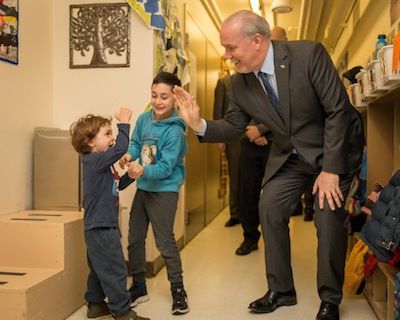
B.C. Premier John Horgan toured the Jewish Community Centre of Greater Vancouver on March 29, speaking with community members of all ages. (photo from Office of the Premier)

B.C. Premier John Horgan visited the Jewish Community Centre of Greater Vancouver just before erev Pesach, March 29.

The premier had visited the JCCGV before, but only to attend meetings in the boardroom, and this was his first visit as the province’s head of government.

photo - Horgan toured the building, visited the Vancouver Holocaust Education Centre, the sports facilities and spent time with children and parents at the daycare
Horgan toured the building, visited the Vancouver Holocaust Education Centre, the sports facilities and spent time with children and parents at the daycare. (photo from Office of the Premier)

Horgan toured the building, visited the Vancouver Holocaust Education Centre, the sports facilities and spent time with children and parents at the daycare.

In a statement to the Independent after the meeting, the premier said: “People drive community. Touring the centre really hit that message home.… I was glad to meet with and hear from community leaders, see the range of services being provided and visit with kids, parents and educators at the childcare centre in advance of Passover.”

On April 12, the premier also participated in a Yom Hashoah ceremony at the B.C. Legislature, which included numerous survivors of the Holocaust. In next week’s Independent, there will be more about the Yom Hashoah commemorations that took place in Victoria and Vancouver.

“Our goal was for him to get to know us and get to see our centre, get to understand the level and breadth of activities we offer,” said Eldad Goldfarb, executive director of the JCCGV. “His focus was primarily on childcare and I think he had a few more visits during that day to other [childcare] facilities.… We wanted him to see what we are doing and we wanted him to hear about our plans for the future.”

While there was no formal agenda for the meeting, after the tour, Horgan met with representatives of agencies that are located in the building. He was introduced and thanked by Alvin Wasserman, vice-president of the JCCGV.

While affordable housing was not on the agenda officially, Goldfarb said he discussed with the premier the opportunity for including such accommodations within the planned redevelopment of the JCCGV site. The new provincial government made a substantial commitment to affordable housing in its first budget, Feb. 27.

Nico Slobinsky, director of the Pacific Region for the Centre for Israel and Jewish Affairs, said Horgan was at the centre more to listen than to talk.

“He was there to learn a little bit about what the centre does and the opportunity to connect with the community since becoming premier,” said Slobinsky, who helped arrange the visit. “He hasn’t had a chance yet to do that. He did that before but not since becoming premier.

“As a community,” he said, “we have long enjoyed a great relationship with the provincial government and we are very happy to see that continue.”

Format ImagePosted on April 20, 2018April 18, 2018Author Pat JohnsonCategories LocalTags British Columbia, CIJA, Eldad Goldfarb, JCCGV, John Horgan, Nico Slobinsky, politics
High-tech medicine

High-tech medicine

A 1-year-old boy being treated with a novel gene therapy drug. “Usually, this type of injury with a hemophiliac patient would involve hours in the emergency room, with repeated doses of intravenous coagulation factors,” said Prof. Gili Kenet, director of the National Hemophilia Centre at Sheba Medical Centre. (photo from IMP)

From wearables that allow cardiac specialists at a hospital in Ramat Gan to monitor a patient’s cardiac performance thousands of miles away from home, to giving gravely ill patients a new lease on life with groundbreaking new therapies, Israeli medical innovators are almost literally thumbing their noses at the Angel of Death and changing the way we live.

According to start-up “ecosystem” sources, there are at least 6,000 active start-up companies operating in Israel. Within the realm of digital health, the number of active start-up companies engaged in this field has grown from 65 companies in 2005 to more than 400 in 2018. A significant number of these start-ups are being financially supported by global corporations such as Philips, GE Healthcare, Merck and IBM. Some of these companies have opened up offices close to start-up hubs in Haifa (near the Technion) and Metro Tel Aviv, the recognized “capital” of Israeli business and high-tech.

photo - This digital watch developed by the Sheba medical team and Datos Health is equipped with an app that contains a care path specially designed for each patient
This digital watch developed by the Sheba medical team and Datos Health is equipped with an app that contains a care path specially designed for each patient. (photo from IMP)

“Israel serves as a global incubator of innovative ideas for a variety of reasons,” said Dr. Eyal Zimlichman, deputy director general, chief medical officer and chief innovation officer at Sheba Medical Centre, which is located in Ramat Gan and is the largest facility of its kind in the Middle East. “First of all, it’s in our genes. Secondly, there is the military aspect, where we are taught to improvise when necessary in the field. These things allow us to be naturally innovative. This has trickled down into the medical field, where we are offering the highest level of medical care. I also believe unique innovations in medicine, that will impact the world for the next 100 years, will be developed in Israel.”

Prime examples of Sheba Medical Centre’s innovative efforts revolve around combating potentially fatal diseases such as cancer with immunotherapy, oncology’s new medical “magic bullet”; targeting hemophilia with a novel gene therapy drug; and creating an app for a wearable device used by people with serious heart and diabetes issues.

Immunotherapy is a treatment that uses our body’s own immune system to invade and destroy cancer. CAR-T (chimeric antigen receptor) and TIL (tumour-infiltrating lymphocytes) are not universal cancer cures at this stage. However, there are ongoing clinical trials being conducted for major pharmaceutical companies and America’s National Institutes of Health at Sheba Medical Centre’s oncology unit, where end-stage cancer patients are being treated with CAR-T, which specifically targets leukemia and lymphoma, and TIL, which zeroes in on melanoma and ovarian cancer patients.

Seventeen people with cancer were treated at Sheba during an initial CAR-T trial, after all of these patients had displayed zero improvement in the wake of traditional chemotherapy treatments and bone marrow transplants. Of the 17, 75% had a complete response to the CAR-T. One of those patients, an 8-year-old girl from Bnei Brak, was the first child to achieve complete remission from childhood leukemia. A Sheba centre oncologist said, “When we came to give her the CAR-T cells, she was very, very sick. She couldn’t even get out of bed. When we came back to visit her three weeks later, she was going back and forth on her rollerblades.”

A few weeks ago, a 1-year-old boy became the youngest patient in the world suffering from both severe hemophilia A and an unusual allergy to be treated with a gene therapy drug that only recently was approved for use in the United States. The new drug, developed by an American biopharmaceutical company, contained a “bispecific antibody” that was injected into the child at Sheba Medical Centre. According to clinical trial results published in The New England Journal of Medicine, the drug has shown a 90% reduction in bleeding in children and a 70% reduction in adults.

photo - Prof. Gili Kenet
Prof. Gili Kenet (photo from IMP)

“This is a new, exciting era with many novel options for improved care and even complete cure of patients with hemophilia,” said Prof. Gili Kenet, director of the National Hemophilia Centre at Sheba. “The child’s mother is so happy with the new treatment. The child had experienced a head trauma, but required no further therapy at all. Usually, this type of injury with a hemophiliac patient would involve hours in the emergency room, with repeated doses of intravenous coagulation factors. However, there were no complications, as his hemostasis (blood factors) was completely normal.”

Within the realm of what is known as IoT (internet of things), Prof. Robert Klempfner is blazing a trail of what he has dubbed IoMT (internet of medical things), where heart patients are able to engage in cardiac care and rehabilitation using wearables (for example, a high-tech watch), without having to return to the hospital for treatment.

“Today, the challenge for both heart doctors and cardiac care patients is what happens after a coronary event (heart attack), intervention or heart surgery,” said Klempfner. “What kind of regimen can be created for someone who might have had surgery at Sheba but lives and works in faraway places such as the United States or other countries? Within the new world of telemedicine and digital health, we have the technology to create rehab programs that are a win-win experience for both the hospital and the patient.

“We give cardiac care patients a watch,” he explained, “that is equipped with an app developed by the Sheba medical team and Datos Health [an Israeli start-up company]. The app contains a care path specially designed for each patient, containing rehab regimens, education material and secure communication with our patients. The medical centre receives data from wherever he/she is located when they are walking, exercising, doing other physical activities. Our technicians then analyze the info and provide ongoing feedback, assisted by smart algorithms provided by the innovative system.

“The program is also primed,” he said, “for patients who suffer from hypertension and diabetes that are now able to transmit all their measurements automatically to our system. This not only saves the patient time, by not having him/her return to the hospital, it saves the hospital time and bed space, so we are able to treat more patients. This ushers in a new era in digital healthcare.”

For more information on Sheba Medical Centre’s oncology unit, visit shebaonline.org.

Format ImagePosted on April 20, 2018September 30, 2019Author Steve K. Walz IMP MEDIA LTD.Categories IsraelTags cancer, children, health, IoMT, IoT, science, Sheba Medical Centre, technology
Tel Aviv’s Independence Trail

Tel Aviv’s Independence Trail

Children follow the new Independence Trail in Tel Aviv. (photo by Ricky Rachman)

In honour of Israel’s 70th Independence Day, the city of Tel Aviv has introduced a new interactive walking route that takes visitors past 10 of the city’s heritage sites. All of the sites are connected in some way with the Declaration of Independence and the beginnings of Tel Aviv itself.

The trail is just under a kilometre long and features a golden track that illuminates at night. The route begins at the first kiosk of Tel Aviv, at the intersection of Rothschild Boulevard and Herzl Street. The walking route brings two stories to life that are central to the story of modern Israel: the birth of Tel Aviv, the first Jewish, self-governed, Hebrew-speaking city, in 1909; and how, in 1948, Tel Aviv would make way for the birth of the state of Israel, fulfilling a millennia-old dream.

Visitors can follow the route with a mobile app, or can guide themselves using a map that features information in eight different languages.

The building of the trail demanded extensive infrastructure work, including the implementation of a unique lighting system that allows visitors to walk along the trail at night. The Independence Trail was inspired by the Freedom Trail in Boston, one of the most popular heritage sites in the United States.

The Independence Trail’s 10 sites are:

The first kiosk was established in 1910, and quickly became a central meeting place. During the 1920s, about 100 kiosks operated in the city under the Association of the Kiosk and Soft Drink Store Owners.

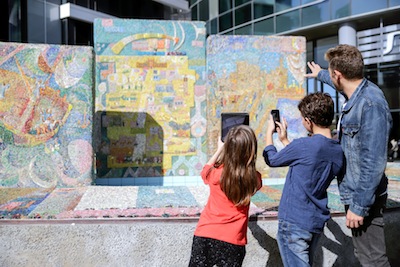
photo - The mosaics at Nahum Gutman Fountain
The mosaics at Nahum Gutman Fountain. (photo by Ricky Rachman)

Nahum Gutman Fountain: Nahum Gutman was an Israeli artist who grew up in Tel Aviv along with the new city, and whose work reflected the simplicity of the early days of “the First Hebrew City.” An illustrator, photographer and writer, Gutman was awarded the Israel Prize in 1978. His mosaics around the fountain tell us the history of Jaffa, the ancient port city from which Tel Aviv was born.

Akiva Aryeh Weiss’s house: Weiss was the founder of the Ahuzat Bayit neighbourhood, which evolved into Tel Aviv. As president of the then newly established building society, Weiss presided over the 1909 lottery in which 66 Jewish families drew numbers written on seashells to determine the allocation of lots in the about-to-be established city.

Shalom Meir Tower: former site of the Herzliya Hebrew Gymnasium, the first Hebrew-language high school. The building on Herzl Street was a major Tel Aviv landmark until 1962, when it was razed for the construction of the tower. Its destruction sparked widespread recognition of the importance of conserving historical landmarks. Today, Shalom Meir Tower is home to a visitors centre about the history of Tel Aviv, which is open, free to the public, on weekdays.

The Great Synagogue was the spiritual centre of Tel Aviv, located in the heart of the city’s business centre. The building features a huge dome, elaborate lighting fixtures and magnificent stained glass windows.

The Haganah Museum is located in what was the home of Eliyahu Golomb, the founder and de facto commander of the Haganah. From 1930 to 1945, the Haganah’s secret headquarters were located in this house. Golomb’s residential room, his office on the ground floor, as well as the exterior of the house, were fully preserved. The museum will be open to the public free of charge during 2018, to mark Israel’s 70th anniversary.

Bank of Israel’s Visitors Centre, at the historical headquarters of Israel’s national bank, presents the history of the financial system in Israel. It features an extensive exhibit of banknotes and coins issued from pre-state days to the present. The centre also will be open to the public free of charge until the end of the year.

Tel Aviv Founders Monument is dedicated to the men and women who established Tel Aviv in the first half of the 19th century. It is a quiet spot, dotted with benches and centred around a small pool and fountain.

Statue of Meir Dizengoff, honouring the first mayor of Tel Aviv, who was known for riding his horse from his home – which is now Independence Hall – to City Hall, which was then located on Bialik Street. The statue of Dizengoff on his horse was created by artist David Zondolovitz.

Independence Hall: Dizengoff dedicated his home for the establishment of the Tel Aviv Museum of Art. In the home, on May 14, 1948, the ceremony of the Declaration of Independence took place.

In addition to the Independence Trail, visitors will be able to enjoy, until the end of December, the Israeli Democracy Pavilion, which features a presentation about the story of the Declaration of Independence. The project, which is a collaboration between the Israel Democracy Institute and the Tel Aviv-Yafo Municipality, takes place in a majestic pavilion on Rothschild Boulevard, in which visitors are shown a film in 360 degrees, highlighting important moments of Israeli democracy. The pavilion is surrounded by arcades reflecting the diversity of Israeli society. Selected quotes from the Declaration of Independence are showcased on the pavilion’s arches and visitors are invited to sign a pledge to uphold the core values of the declaration. Entry to the film is free of charge, and the pavilion is expected to travel to other cities in Israel next year.

Format ImagePosted on April 20, 2018April 18, 2018Author Edgar AsherCategories IsraelTags history, Independence Trail, Israel, Tel Aviv, tourism
Follow the Sanhedrin

Follow the Sanhedrin

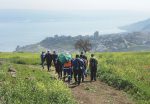
The trail crosses the Galilee from Beit She’arim to Tiberias. (photo by Israel Antiquities Authority from Ashernet)

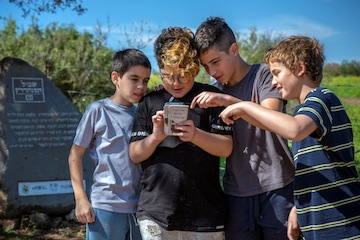
photo - Dozens of stone relay stations along the path transmit information and activities to hikers’ mobile telephones
Dozens of stone relay stations along the path transmit information and activities to hikers’ mobile telephones. (photo by IAA from Ashernet)

This year in the Galilee, thousands of students have been excavating and organizing the first “smart trail,” in which dozens of stone relay stations along the path transmit information and activities to hikers’ mobile telephones. The trail comprises part of the celebration of Israel’s 70th year of independence, and just opened. It extends 70 kilometres and is divided into sections, tracing the movements of the country’s greatest figures, the Sanhedrin sages, who rehabilitated the Jewish people following the Bar Kokhba Revolt. As did the Sanhedrin, the trail crosses the Galilee from Beit She’arim to Tiberias, passing through magnificent landscape, such as Nahal Zippori, Yodfat, Mount Arbel and Mount Atzmon.

Format ImagePosted on April 20, 2018April 18, 2018Author Edgar AsherCategories IsraelTags Galilee, Israel, Sanhedrin, tourism

Posts pagination

Previous page Page 1 … Page 186 Page 187 Page 188 … Page 322 Next page
Proudly powered by WordPress